
A English
Connective tissue Questions in English
Class 11 Biology · Structural Organisation In Animals · Connective tissue
301+
Questions
English
Language
100%
With Solutions
Showing 50 of 301 questions in English
51
MediumMCQ
External ear $(pinna)$ contains a hard, flexible structure composed of
A
Bone
B
Cartilage
C
Tendon
D
Ligament
Solution
(B) The external ear $(pinna)$ is supported by elastic cartilage.
Elastic cartilage contains a network of yellow elastic fibers in its matrix, which provides both hardness and flexibility to the structure.
This type of cartilage is also found in the epiglottis, the walls of the eustachian tube, and the tip of the nose.
Elastic cartilage contains a network of yellow elastic fibers in its matrix, which provides both hardness and flexibility to the structure.
This type of cartilage is also found in the epiglottis, the walls of the eustachian tube, and the tip of the nose.
0 likes
View Solution52
MediumMCQ
$A$ tissue similar to a ligament but stretchable is called:
A
Tendon
B
Raphe
C
Both $(a)$ and $(b)$
D
None of these
Solution
(D) ligament is a dense regular connective tissue primarily composed of collagen fibers,which provides stability to joints but has limited elasticity.
Elastic connective tissue,often referred to as yellow elastic tissue,contains a high proportion of elastin fibers,making it highly stretchable.
Since neither tendons (which connect muscle to bone) nor raphe (a ridge or seam of tissue) are defined as stretchable tissues similar to ligaments,the correct answer is $(d)$.
Elastic connective tissue,often referred to as yellow elastic tissue,contains a high proportion of elastin fibers,making it highly stretchable.
Since neither tendons (which connect muscle to bone) nor raphe (a ridge or seam of tissue) are defined as stretchable tissues similar to ligaments,the correct answer is $(d)$.
0 likes
View Solution53
MediumMCQ
Choose the correct statement regarding the canals in bone tissue.
A
Haversian canals are transverse canals.
B
Volkmann's canals are longitudinal canals.
C
Haversian canals are longitudinal whereas Volkmann's canals are transverse canals.
D
None of the above.
Solution
(C) In compact bone,the $Haversian$ canals run longitudinally through the bone matrix,containing blood vessels and nerves.
$Volkmann's$ canals (also known as perforating canals) run transversely or obliquely,connecting the $Haversian$ canals to each other and to the periosteum.
Therefore,the correct statement is that $Haversian$ canals are longitudinal whereas $Volkmann's$ canals are transverse canals.
$Volkmann's$ canals (also known as perforating canals) run transversely or obliquely,connecting the $Haversian$ canals to each other and to the periosteum.
Therefore,the correct statement is that $Haversian$ canals are longitudinal whereas $Volkmann's$ canals are transverse canals.
0 likes
View Solution54
EasyMCQ
Formation of cartilage is known as
A
Diapedesis
B
Chondrogenesis
C
Haemopoiesis
D
Ossification
Solution
(B) The process of formation of cartilage is called $Chondrogenesis$.
$Diapedesis$ refers to the migration of white blood cells out of blood vessels into tissues.
$Haemopoiesis$ is the process of formation of blood cells.
$Ossification$ is the process of bone formation.
$Diapedesis$ refers to the migration of white blood cells out of blood vessels into tissues.
$Haemopoiesis$ is the process of formation of blood cells.
$Ossification$ is the process of bone formation.
0 likes
View Solution55
EasyMCQ
The percentage of inorganic and organic salts in the matrix of a bone is
A
$40\%$ inorganic,$60\%$ organic
B
$62\%$ inorganic,$38\%$ organic
C
$80\%$ inorganic,$20\%$ organic
D
$85\%$ inorganic,$15\%$ organic
Solution
(B) The matrix of a bone is composed of both inorganic and organic components.
Inorganic salts,primarily calcium phosphate and calcium carbonate,constitute approximately $62\%$ of the dry weight of the bone,providing hardness and rigidity.
The organic phase,which mainly consists of collagenous fibers,makes up the remaining $38\%$ of the bone matrix,providing flexibility and tensile strength.
Therefore,the correct percentage is $62\%$ inorganic and $38\%$ organic.
Inorganic salts,primarily calcium phosphate and calcium carbonate,constitute approximately $62\%$ of the dry weight of the bone,providing hardness and rigidity.
The organic phase,which mainly consists of collagenous fibers,makes up the remaining $38\%$ of the bone matrix,providing flexibility and tensile strength.
Therefore,the correct percentage is $62\%$ inorganic and $38\%$ organic.
0 likes
View Solution56
EasyMCQ
Hyaline cartilage forms
A
Tracheal rings
B
Pubic symphysis
C
Epiglottis
D
External ear
Solution
(A) Hyaline cartilage is the most abundant type of cartilage in the body.
It is found in the nose, larynx, trachea $(tracheal rings)$, bronchi, and the ends of long bones.
Pubic symphysis is composed of fibrocartilage, while the epiglottis and external ear are composed of elastic cartilage.
Therefore, the correct option is $(A)$.
It is found in the nose, larynx, trachea $(tracheal rings)$, bronchi, and the ends of long bones.
Pubic symphysis is composed of fibrocartilage, while the epiglottis and external ear are composed of elastic cartilage.
Therefore, the correct option is $(A)$.
0 likes
View Solution57
MediumMCQ
Osteon is found in the
A
Femur of frog
B
Femur of bird
C
Femur of rabbit
D
Femur of man and rabbit
Solution
(D) The $Osteon$ or $Haversian$ system is a characteristic feature of the compact bone of mammals.
Long bones in mammals,such as the $Femur$ and $Humerus$,contain these $Haversian$ systems,which consist of a central $Haversian$ canal surrounded by concentric lamellae.
Therefore,both man and rabbit,being mammals,possess $Osteons$ in their $Femur$.
Long bones in mammals,such as the $Femur$ and $Humerus$,contain these $Haversian$ systems,which consist of a central $Haversian$ canal surrounded by concentric lamellae.
Therefore,both man and rabbit,being mammals,possess $Osteons$ in their $Femur$.
0 likes
View Solution58
EasyMCQ
Bone-forming cells are known as
A
Chondroclasts
B
Osteoblasts
C
Chondroblasts
D
Osteoclasts
Solution
(B) $Osteoblasts$ are specialized cells responsible for the formation and mineralization of bone tissue. They synthesize and secrete the organic matrix of the bone,known as osteoid,which subsequently undergoes mineralization to form mature bone. In contrast,$Osteoclasts$ are responsible for bone resorption,$Chondroblasts$ are involved in cartilage formation,and $Chondroclasts$ are involved in cartilage resorption.
0 likes
View Solution59
EasyMCQ
The matrix of hyaline cartilage contains
A
Collagen
B
Chondrin
C
Ossein
D
All of these
Solution
(B) The matrix of hyaline cartilage is composed of a protein-polysaccharide complex known as chondrin.
Chondrocytes,which are the cells of the cartilage,secrete this flexible,semi-solid matrix.
Collagen fibers may be present in the matrix,but the characteristic ground substance is chondrin.
Ossein is the protein found in the matrix of bone,not cartilage.
Therefore,the correct answer is $(b)$.
Chondrocytes,which are the cells of the cartilage,secrete this flexible,semi-solid matrix.
Collagen fibers may be present in the matrix,but the characteristic ground substance is chondrin.
Ossein is the protein found in the matrix of bone,not cartilage.
Therefore,the correct answer is $(b)$.
0 likes
View Solution60
EasyMCQ
The protein present in cartilage is:
A
Chondrin
B
Osein
C
Cartilagin
D
Ossein
Solution
(A) Cartilage is a specialized connective tissue. The matrix of cartilage is composed of a protein called $Chondrin$.
$Ossein$ is the protein found in the matrix of bones.
Therefore,the correct option is $A$.
$Ossein$ is the protein found in the matrix of bones.
Therefore,the correct option is $A$.
0 likes
View Solution61
EasyMCQ
Which among the following is the strongest cartilage?
A
Hyaline cartilage
B
Elastic cartilage
C
White fibrocartilage
D
Violet fibrocartilage
Solution
(C) The correct answer is $C$.
White fibrocartilage is the strongest type of cartilage.
It contains a large number of thick collagen fibers arranged in bundles,which provide high tensile strength,rigidity,and firmness to the tissue.
It is found in areas subjected to heavy pressure,such as the intervertebral discs and the pubic symphysis.
White fibrocartilage is the strongest type of cartilage.
It contains a large number of thick collagen fibers arranged in bundles,which provide high tensile strength,rigidity,and firmness to the tissue.
It is found in areas subjected to heavy pressure,such as the intervertebral discs and the pubic symphysis.
0 likes
View Solution62
MediumMCQ
Cartilage is made up of
A
Collagen
B
Dermin
C
Matrigen
D
None of these
Solution
(A) Cartilage is a specialized connective tissue.
Its matrix is composed of proteins,sugars,and a specific protein called collagen.
Collagen fibers provide structural support and flexibility to the cartilage tissue.
Therefore,the correct option is $A$.
Its matrix is composed of proteins,sugars,and a specific protein called collagen.
Collagen fibers provide structural support and flexibility to the cartilage tissue.
Therefore,the correct option is $A$.
0 likes
View Solution63
EasyMCQ
Haversian canals are found in
A
Bone marrow
B
Hyaline cartilage
C
Bone matrix
D
Calcified cartilage
Solution
(C) The Haversian canals are characteristic features of the compact bone tissue.
They run longitudinally through the bone matrix and contain blood vessels,nerves,and lymphatic vessels.
These canals are interconnected by transverse channels known as Volkmann's canals,which facilitate the transport of nutrients and waste products throughout the bone structure.
They run longitudinally through the bone matrix and contain blood vessels,nerves,and lymphatic vessels.
These canals are interconnected by transverse channels known as Volkmann's canals,which facilitate the transport of nutrients and waste products throughout the bone structure.
0 likes
View Solution64
MediumMCQ
During an injury,the nasal septum gets damaged. Which type of cartilage is present in the nasal septum for its structure and recovery?
A
Hyaline cartilage
B
Elastic cartilage
C
Calcified cartilage
D
Fibrocartilage
Solution
(A) The nasal septum is primarily composed of hyaline cartilage.
Hyaline cartilage is the most abundant type of cartilage in the body.
It provides structural support and flexibility to the nasal septum,larynx,trachea,and the ends of long bones.
Therefore,in the event of an injury to the nasal septum,hyaline cartilage is the tissue involved in its structure and recovery.
Hyaline cartilage is the most abundant type of cartilage in the body.
It provides structural support and flexibility to the nasal septum,larynx,trachea,and the ends of long bones.
Therefore,in the event of an injury to the nasal septum,hyaline cartilage is the tissue involved in its structure and recovery.
0 likes
View Solution65
EasyMCQ
Which of the following cartilage is present on the ends of long bones?
A
Elastic cartilage
B
Fibrous cartilage
C
Calcified cartilage
D
Hyaline cartilage
Solution
(D) . Hyaline cartilage is the most abundant type of cartilage in the body. It forms the articular surfaces at the joints of long bones,where it is specifically referred to as articular cartilage. This smooth surface reduces friction and absorbs shock during movement.
0 likes
View Solution66
EasyMCQ
Tendons are formed of:
A
White fibrous connective tissue
B
Yellow fibrous connective tissue
C
Areolar tissue
D
Adipose tissue
Solution
(A) Tendons are dense regular connective tissues primarily composed of collagen fibers,which are white fibrous connective tissues. Their main function is to attach skeletal muscles to bones.
0 likes
View Solution67
EasyMCQ
Which of the following tissues is most widely distributed in the body and forms a major part of it?
A
Connective tissue
B
Epithelial tissue
C
Muscular tissue
D
Nervous tissue
Solution
(A) Connective tissue is the most abundant and widely distributed tissue in the body of complex animals.
It links and supports other tissues or organs of the body.
It includes a diverse range of tissues such as blood,bone,cartilage,adipose tissue,and loose connective tissue,which collectively make up a significant portion of the body's mass.
It links and supports other tissues or organs of the body.
It includes a diverse range of tissues such as blood,bone,cartilage,adipose tissue,and loose connective tissue,which collectively make up a significant portion of the body's mass.
0 likes
View Solution68
EasyMCQ
Cells secreting dentine are called
A
Osteoblasts
B
Calcoblasts
C
Chondriocytes
D
Odontoblasts
Solution
(D) Dentine is the hard,calcified tissue that makes up the bulk of the tooth.
It is secreted by specialized cells known as $Odontoblasts$.
These cells are located at the periphery of the dental pulp.
Therefore,the correct option is $D$.
It is secreted by specialized cells known as $Odontoblasts$.
These cells are located at the periphery of the dental pulp.
Therefore,the correct option is $D$.
0 likes
View Solution69
EasyMCQ
Kupffer cells of the liver are:
A
Loose connective tissue
B
Phagocytic cells
C
Mast cells
D
Fat cells
Solution
(B) Kupffer cells,also known as stellate macrophages,are specialized macrophages located in the liver sinusoids.
Their primary function is to perform phagocytosis,which involves engulfing and destroying foreign particles,bacteria,and aged red blood cells.
Therefore,they are classified as phagocytic cells.
Their primary function is to perform phagocytosis,which involves engulfing and destroying foreign particles,bacteria,and aged red blood cells.
Therefore,they are classified as phagocytic cells.
0 likes
View Solution70
EasyMCQ
Heparin is secreted by
A
Blood cells
B
Liver cells
C
Kidney
D
Nerve cell
Solution
(B) $Heparin$ is a natural anticoagulant.
It is primarily synthesized and secreted by the mast cells,which are found in various connective tissues,including the liver.
Therefore,the correct option is $B$.
It is primarily synthesized and secreted by the mast cells,which are found in various connective tissues,including the liver.
Therefore,the correct option is $B$.
0 likes
View Solution71
EasyMCQ
Bone marrow is largely composed of
A
Periosteum and osteoblast
B
Adipose tissue and blood vessels
C
Yellow and elastic tissue
D
Cartilage and elastic tissue
Solution
(B) Bone marrow is the soft,spongy tissue found in the hollow cavities of bones.
It is primarily composed of adipose tissue (fat cells),blood vessels,and hematopoietic stem cells.
In adults,red bone marrow is found in flat bones and the ends of long bones,while yellow bone marrow,which is largely composed of adipose tissue,is found in the shafts of long bones.
It is primarily composed of adipose tissue (fat cells),blood vessels,and hematopoietic stem cells.
In adults,red bone marrow is found in flat bones and the ends of long bones,while yellow bone marrow,which is largely composed of adipose tissue,is found in the shafts of long bones.
0 likes
View Solution72
EasyMCQ
Elastic cartilage is found in
A
The trachea
B
The auditory tube
C
The intervertebral disc
D
None of the above
Solution
(B) Elastic cartilage is a type of connective tissue that provides both strength and elasticity to various structures in the body.
It is characterized by the presence of a network of elastic fibers within the matrix.
Elastic cartilage is found in the pinna of the ear,the epiglottis,and the auditory tube (also known as the Eustachian tube).
In contrast,the trachea contains hyaline cartilage,and the intervertebral discs contain fibrocartilage.
Therefore,the correct option is $B$.
It is characterized by the presence of a network of elastic fibers within the matrix.
Elastic cartilage is found in the pinna of the ear,the epiglottis,and the auditory tube (also known as the Eustachian tube).
In contrast,the trachea contains hyaline cartilage,and the intervertebral discs contain fibrocartilage.
Therefore,the correct option is $B$.
0 likes
View Solution73
MediumMCQ
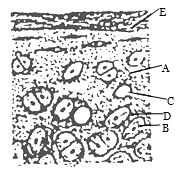
In the diagram of a section of Hyaline cartilage, the different parts have been indicated by alphabets; choose the answer in which these alphabets correctly match with the parts they indicate.
A
$A = \text{Chondrin}, B = \text{Chondrocyte}, C = \text{Lacuna}, D = \text{Capsular matrix}, E = \text{Perichondrium}$
B
$A = \text{Capsular matrix}, B = \text{Chondrocyte}, C = \text{Lacuna}, D = \text{Perichondrium}, E = \text{Chondrin}$
C
$A = \text{Chondrin}, B = \text{Chondrocyte}, C = \text{Lacuna}, D = \text{Capsular matrix}, E = \text{Perichondrium}$
D
$A = \text{Chondrin}, B = \text{Lacuna}, C = \text{Chondrocyte}, D = \text{Capsular matrix}, E = \text{Perichondrium}$
Solution
(A) Based on the histological structure of Hyaline cartilage:
$E$ points to the outer fibrous layer, the Perichondrium.
$A$ points to the matrix of the cartilage, known as Chondrin.
$C$ points to the space containing the cells, known as the Lacuna.
$B$ points to the cartilage cell itself, the Chondrocyte.
$D$ points to the area immediately surrounding the cell within the lacuna, known as the Capsular matrix.
Therefore, the correct matching is $A = \text{Chondrin}, B = \text{Chondrocyte}, C = \text{Lacuna}, D = \text{Capsular matrix}, E = \text{Perichondrium}$.
$E$ points to the outer fibrous layer, the Perichondrium.
$A$ points to the matrix of the cartilage, known as Chondrin.
$C$ points to the space containing the cells, known as the Lacuna.
$B$ points to the cartilage cell itself, the Chondrocyte.
$D$ points to the area immediately surrounding the cell within the lacuna, known as the Capsular matrix.
Therefore, the correct matching is $A = \text{Chondrin}, B = \text{Chondrocyte}, C = \text{Lacuna}, D = \text{Capsular matrix}, E = \text{Perichondrium}$.
0 likes
View Solution74
EasyMCQ
The protein present in the bones is known as
A
Chondrin
B
Ossein
C
Sclero protein
D
Globulin
Solution
(B) The protein present in the bone matrix is known as $Ossein$.
$Ossein$ is a collagenous protein that provides structural support and flexibility to the bone tissue.
It plays a crucial role in the process of bone formation and mineralization.
$Ossein$ is a collagenous protein that provides structural support and flexibility to the bone tissue.
It plays a crucial role in the process of bone formation and mineralization.
0 likes
View Solution75
EasyMCQ
The outer covering of cartilage is known as:
A
Perichondrium
B
Periosteum
C
Endosteum
D
Peritoneum
Solution
(A) The outer covering of cartilage is called the perichondrium.
It is a layer of dense irregular connective tissue that surrounds the cartilage of developing bone.
Periosteum is the covering of bone,endosteum lines the medullary cavity of bone,and peritoneum is the serous membrane lining the abdominal cavity.
It is a layer of dense irregular connective tissue that surrounds the cartilage of developing bone.
Periosteum is the covering of bone,endosteum lines the medullary cavity of bone,and peritoneum is the serous membrane lining the abdominal cavity.
0 likes
View Solution76
MediumMCQ
The function of the Haversian canal is:
A
Nutrition
B
Respiration
C
Excretion
D
Both nutrition and respiration
Solution
(D) The Haversian canal is a central canal found in the osteons of compact bone.
It contains blood vessels,nerves,and lymphatic vessels.
Its primary function is to provide osteocytes with the necessary nutrients and oxygen (respiration) through chemical exchange,as the matrix of compact mammalian bone is dense and requires an orderly system for transport.
It contains blood vessels,nerves,and lymphatic vessels.
Its primary function is to provide osteocytes with the necessary nutrients and oxygen (respiration) through chemical exchange,as the matrix of compact mammalian bone is dense and requires an orderly system for transport.
0 likes
View Solution77
MediumMCQ
Cartilage is formed by
A
Osteoblasts
B
Chondriocytes
C
Fibroblasts
D
Epithelium
Solution
(B) Cartilage is a specialized connective tissue.
It consists of cells known as $Chondriocytes$.
These cells are enclosed in small cavities within the matrix secreted by them.
$Osteoblasts$ are involved in bone formation,while $Fibroblasts$ produce fibers in connective tissue.
It consists of cells known as $Chondriocytes$.
These cells are enclosed in small cavities within the matrix secreted by them.
$Osteoblasts$ are involved in bone formation,while $Fibroblasts$ produce fibers in connective tissue.
0 likes
View Solution78
EasyMCQ
Haversian canals are found in
A
Spinal cord
B
Brain
C
Long bones
D
Sponge
Solution
(C) The Haversian canals are microscopic channels found in the compact bone tissue of mammals.
They are a characteristic feature of the osteons (Haversian systems) present in long bones such as the $humerus$,$femur$,and $tibia$.
These canals contain blood vessels,nerves,and lymphatic vessels that provide nourishment to the bone cells $(osteocytes)$.
They are a characteristic feature of the osteons (Haversian systems) present in long bones such as the $humerus$,$femur$,and $tibia$.
These canals contain blood vessels,nerves,and lymphatic vessels that provide nourishment to the bone cells $(osteocytes)$.
0 likes
View Solution79
MediumMCQ
Tendon is a structure which connects
A
$A$ bone with another bone
B
$A$ nerve with a muscle
C
$A$ muscle with a bone
D
$A$ muscle with a muscle
Solution
(C) The correct answer is $C$.
Tendon is a specialized type of dense regular connective tissue.
It is composed primarily of collagen fibers arranged in parallel bundles,which provide great tensile strength.
Its primary function is to attach skeletal muscles to bones,allowing for the transmission of force generated by muscle contraction to the bone,thereby facilitating movement.
Tendon is a specialized type of dense regular connective tissue.
It is composed primarily of collagen fibers arranged in parallel bundles,which provide great tensile strength.
Its primary function is to attach skeletal muscles to bones,allowing for the transmission of force generated by muscle contraction to the bone,thereby facilitating movement.
0 likes
View Solution80
EasyMCQ
Bone is distinguished from cartilage by the presence of
A
Collagen
B
Blood vessels
C
Lymph vessels
D
Haversian canals
Solution
(D) The correct answer is $D$.
$Haversian$ canals are a series of microscopic tubes in the outermost region of bone called cortical bone.
These canals allow blood vessels and nerve fibers to travel through the bone.
Cartilage is avascular and lacks these specialized structures,which is why $Haversian$ canals serve as a distinguishing feature between bone and cartilage.
$Haversian$ canals are a series of microscopic tubes in the outermost region of bone called cortical bone.
These canals allow blood vessels and nerve fibers to travel through the bone.
Cartilage is avascular and lacks these specialized structures,which is why $Haversian$ canals serve as a distinguishing feature between bone and cartilage.
0 likes
View Solution81
EasyMCQ
Which of the following is an embryonic connective tissue?
A
Endometrium
B
Mediastinum
C
Mesenchyme
D
Endothelium
Solution
(C) Mesenchyme is a type of embryonic connective tissue that is derived from the mesoderm. It consists of loosely packed,unspecialized cells set in a gelatinous ground substance. It is the precursor from which most other connective tissues,blood,and lymphatic vessels develop during embryonic development.
0 likes
View Solution82
MediumMCQ
Thousands of years old mummies are still in their condition as they were before due to the non-destruction of:
A
Yellow elastin fibres
B
White elastin fibres
C
Collagen fibres
D
Veins
Solution
(C) Collagen fibres are the most abundant proteins in the animal kingdom and are known for their high tensile strength and resistance to degradation.
In the process of mummification,the preservation of the structural integrity of tissues is largely attributed to the stability of collagen fibres,which do not easily decompose or break down over long periods,thus maintaining the shape and structure of the mummified remains.
In the process of mummification,the preservation of the structural integrity of tissues is largely attributed to the stability of collagen fibres,which do not easily decompose or break down over long periods,thus maintaining the shape and structure of the mummified remains.
0 likes
View Solution83
EasyMCQ
Obesity is caused by an excess of which of the following?
A
Connective tissue
B
Blood
C
Muscular tissue
D
Adipose tissue
Solution
(D) Obesity is a condition characterized by the excessive accumulation of body fat.
Adipose tissue is a specialized type of connective tissue that functions as the primary site for fat storage in the body.
When the intake of energy exceeds the expenditure,the excess energy is stored in the form of triglycerides within the adipocytes of the adipose tissue,leading to an increase in its mass and resulting in obesity.
Adipose tissue is a specialized type of connective tissue that functions as the primary site for fat storage in the body.
When the intake of energy exceeds the expenditure,the excess energy is stored in the form of triglycerides within the adipocytes of the adipose tissue,leading to an increase in its mass and resulting in obesity.
0 likes
View Solution84
EasyMCQ
The proteoglycan found in cartilage is known as:
A
Chondroitin
B
Ossein
C
Casein
D
Cartilage
Solution
(A) Cartilage is a specialized connective tissue. The matrix of cartilage contains a complex polysaccharide called chondroitin sulfate,which is a type of proteoglycan.
Ossein is the protein found in the bone matrix.
Casein is the primary protein found in milk.
Therefore,the correct answer is Chondroitin.
Ossein is the protein found in the bone matrix.
Casein is the primary protein found in milk.
Therefore,the correct answer is Chondroitin.
0 likes
View Solution85
EasyMCQ
What do mast cells secrete during an injury?
A
Histamine
B
Heparin
C
Prothrombin
D
Antibody
Solution
(A) Mast cells are specialized cells of the connective tissue that play a crucial role in the inflammatory response.
During an injury or an allergic reaction,mast cells release chemical mediators such as histamine,serotonin,and heparin.
Histamine is a vasodilator that increases blood flow to the site of injury,causing redness and swelling,which helps in the recruitment of immune cells to the affected area.
Therefore,histamine is the primary substance secreted by mast cells during an injury to initiate the inflammatory process.
During an injury or an allergic reaction,mast cells release chemical mediators such as histamine,serotonin,and heparin.
Histamine is a vasodilator that increases blood flow to the site of injury,causing redness and swelling,which helps in the recruitment of immune cells to the affected area.
Therefore,histamine is the primary substance secreted by mast cells during an injury to initiate the inflammatory process.
0 likes
View Solution86
EasyMCQ
What do mast cells secrete during an injury?
A
Histamine
B
Hirudin
C
Heparin
D
Serotonin
Solution
(A) Mast cells are specialized cells of the connective tissue that play a crucial role in the inflammatory response. During an injury or allergic reaction,mast cells release chemical mediators such as $Histamine$,$Serotonin$,and $Heparin$. Among these,$Histamine$ is primarily responsible for the inflammatory response,causing vasodilation and increased permeability of blood vessels to allow immune cells to reach the site of injury.
0 likes
View Solution87
EasyMCQ
The Haversian canal contains $ \dots $.
A
Blood vessels and nerves
B
Only blood vessels
C
Only lymph
D
Only connective tissue
Solution
(A) The Haversian canal is a central canal found in the compact bone tissue.
It is a microscopic channel that runs longitudinally through the center of each osteon (Haversian system).
These canals contain blood vessels, lymphatic vessels, and nerve fibers that supply the osteocytes within the bone matrix.
Therefore, the correct option is $A$.
It is a microscopic channel that runs longitudinally through the center of each osteon (Haversian system).
These canals contain blood vessels, lymphatic vessels, and nerve fibers that supply the osteocytes within the bone matrix.
Therefore, the correct option is $A$.
0 likes
View Solution88
MediumMCQ
Which are the most abundant cells found in areolar connective tissue?
A
Mast cells
B
Plasma cells
C
Fibroblasts
D
Macrophages
Solution
(C) Areolar connective tissue is a type of loose connective tissue that acts as a support framework for epithelium.
It contains various types of cells and fibers embedded in a semi-fluid ground substance.
The most abundant cells in this tissue are fibroblasts,which are responsible for producing and secreting structural fibers (collagen and elastin) and the matrix components.
While mast cells,plasma cells,and macrophages are also present,they are less numerous than fibroblasts.
It contains various types of cells and fibers embedded in a semi-fluid ground substance.
The most abundant cells in this tissue are fibroblasts,which are responsible for producing and secreting structural fibers (collagen and elastin) and the matrix components.
While mast cells,plasma cells,and macrophages are also present,they are less numerous than fibroblasts.
0 likes
View Solution89
MediumMCQ
Vitreous humor is a type of .....
A
Reticular connective tissue
B
Fibrous connective tissue
C
Adipose connective tissue
D
Mucoid connective tissue
Solution
(D) Vitreous humor,found in the posterior chamber of the eye,is a transparent,jelly-like substance. It is classified as a type of mucoid (or mucous) connective tissue because it contains a jelly-like matrix rich in hyaluronic acid and a very small amount of collagen fibers. Therefore,the correct option is $D$.
0 likes
View Solution90
MediumMCQ
How does blood differ from typical connective tissue?
A
The plasma of blood is not secreted by blood cells.
B
Blood cells are not produced in the blood.
C
Fibers are absent in blood.
D
All of the above.
Solution
(D) Blood is a specialized connective tissue that differs from typical connective tissues due to the following reasons:
$1$. The blood cells ($RBCs$,$WBCs$,and platelets) do not secrete the proteins or fibers found in the plasma,whereas in other connective tissues,cells actively secrete fibers.
$2$. Fibers (such as collagen or elastin) are absent in blood,while they are characteristic of typical connective tissues.
$3$. Blood cells are not produced within the blood itself; instead,they are produced in organs like the bone marrow.
Therefore,all the given options are correct.
$1$. The blood cells ($RBCs$,$WBCs$,and platelets) do not secrete the proteins or fibers found in the plasma,whereas in other connective tissues,cells actively secrete fibers.
$2$. Fibers (such as collagen or elastin) are absent in blood,while they are characteristic of typical connective tissues.
$3$. Blood cells are not produced within the blood itself; instead,they are produced in organs like the bone marrow.
Therefore,all the given options are correct.
0 likes
View Solution91
EasyMCQ
Areolar connective tissue is present in . . . . . . .
A
Iris
B
Mesentery
C
Frog skin
D
All of the above
Solution
(D) Areolar connective tissue is a type of loose connective tissue that serves as a support framework for epithelium. It is widely distributed in the body.
$1$. It is found in the iris of the eye.
$2$. It is present in the mesentery,which supports the abdominal organs.
$3$. It is also found beneath the skin (subcutaneous layer),including the skin of a frog.
Therefore,all the given options are correct.
$1$. It is found in the iris of the eye.
$2$. It is present in the mesentery,which supports the abdominal organs.
$3$. It is also found beneath the skin (subcutaneous layer),including the skin of a frog.
Therefore,all the given options are correct.
0 likes
View Solution92
MediumMCQ
What is chondrin composed of?
A
Chondroitin$-6-$sulfate and ossein
B
$MAG$ and $GA$
C
Chondroitin$-6-$sulfate and hyaluronic acid
D
Chondroitin$-6-$sulfate and chondrocytes
Solution
(C) Chondrin is the matrix of cartilage. It is a protein-polysaccharide complex. The matrix of cartilage is composed of a ground substance containing chondroitin$-6-$sulfate and hyaluronic acid,which are glycosaminoglycans (GAGs). These components provide the cartilage with its characteristic firmness and elasticity.
0 likes
View Solution93
MediumMCQ
Brown adipose cells contain ....
A
Only one lipid droplet
B
More than one lipid droplet
C
No lipid droplets
D
Peripheral lipid droplets with central nucleus
Solution
(B) Brown adipose tissue $(BAT)$ is a specialized type of adipose tissue. Unlike white adipose tissue,which contains a single large lipid droplet (unilocular),brown adipose cells are multilocular. This means they contain numerous small lipid droplets and a large number of mitochondria,which give the tissue its characteristic brown color and are responsible for thermogenesis.
0 likes
View Solution94
MediumMCQ
Which of the following are not components of areolar connective tissue?
A
Macrophages
B
Plasma cells
C
Mast cells
D
Adipocytes
Solution
(D) Areolar connective tissue is a type of loose connective tissue that serves as a support framework for epithelium.
Its primary components include fibroblasts,macrophages,mast cells,and plasma cells.
$1$. Fibroblasts: Produce fibers.
$2$. Macrophages: Phagocytic cells.
$3$. Mast cells: Involved in inflammatory responses.
$4$. Plasma cells: Produce antibodies.
Adipocytes (fat cells) are the primary components of adipose tissue,not areolar tissue. Therefore,the correct answer is $D$.
Its primary components include fibroblasts,macrophages,mast cells,and plasma cells.
$1$. Fibroblasts: Produce fibers.
$2$. Macrophages: Phagocytic cells.
$3$. Mast cells: Involved in inflammatory responses.
$4$. Plasma cells: Produce antibodies.
Adipocytes (fat cells) are the primary components of adipose tissue,not areolar tissue. Therefore,the correct answer is $D$.
0 likes
View Solution95
EasyMCQ
Perichondrium is a/an .....
A
Adipose tissue
B
White fibrous connective tissue
C
Yellow elastic tissue
D
Fibrous connective tissue
Solution
(D) The perichondrium is a layer of dense irregular connective tissue that surrounds the cartilage of developing bone. It consists of two layers: an outer fibrous layer and an inner chondrogenic layer. Therefore,it is classified as a fibrous connective tissue.
0 likes
View Solution96
MediumMCQ
What is the primary function of a ligament?
A
Joining two bones
B
Joining muscles
C
Joining muscle to bone
D
Joining muscle to nerves
Solution
(A) ligament is a specialized type of dense regular connective tissue that connects bone to bone.
It provides stability to joints and prevents excessive movement.
In contrast,a tendon connects muscle to bone.
It provides stability to joints and prevents excessive movement.
In contrast,a tendon connects muscle to bone.
0 likes
View Solution97
EasyMCQ
Mast cells secrete which of the following?
A
Anticoagulant: Heparin
B
Vasodilator: Histamine
C
Vasoconstrictor: Serotonin
D
All of the above
Solution
(D) Mast cells are specialized cells found in connective tissue. They secrete three main types of substances:
$1$. Heparin: It is an anticoagulant that prevents blood from clotting.
$2$. Histamine: It is a vasodilator that dilates blood vessels.
$3$. Serotonin: It is a vasoconstrictor that constricts blood vessels.
Therefore,all the given options are correct.
$1$. Heparin: It is an anticoagulant that prevents blood from clotting.
$2$. Histamine: It is a vasodilator that dilates blood vessels.
$3$. Serotonin: It is a vasoconstrictor that constricts blood vessels.
Therefore,all the given options are correct.
0 likes
View Solution98
EasyMCQ
Which type of cells are known as cartwheel cells?
A
Mast cells
B
Plasma cells
C
Reticular cells
D
Adipose cells
Solution
(B) Plasma cells are known as cartwheel cells. This is because their nucleus contains peripheral clumps of heterochromatin,which gives the nucleus a characteristic appearance resembling the spokes of a cartwheel.
0 likes
View Solution99
MediumMCQ
Which of the following has a hard and non-pliable ground substance?
A
Cartilage
B
Bones
C
Both
D
Areolar tissue
Solution
(B) The ground substance of connective tissue determines its physical properties.
$1$. Bones have a hard and non-pliable ground substance rich in calcium salts and collagen fibers.
$2$. Cartilage has a solid but pliable (slightly bendable) ground substance.
$3$. Areolar tissue has a loose,jelly-like ground substance.
Therefore,bones are characterized by a hard and non-pliable matrix.
$1$. Bones have a hard and non-pliable ground substance rich in calcium salts and collagen fibers.
$2$. Cartilage has a solid but pliable (slightly bendable) ground substance.
$3$. Areolar tissue has a loose,jelly-like ground substance.
Therefore,bones are characterized by a hard and non-pliable matrix.
0 likes
View Solution100
EasyMCQ
The spleen and lymph nodes are composed of which type of tissue?
A
Areolar connective tissue
B
White fibrous connective tissue
C
Reticular connective tissue
D
Mucoid connective tissue
Solution
(C) The spleen and lymph nodes are lymphoid organs that contain a framework of reticular fibers.
These fibers are produced by reticular cells,which are a type of fibroblast.
This specialized tissue is known as $Reticular \ connective \ tissue$.
It provides structural support to the soft organs of the lymphatic system.
These fibers are produced by reticular cells,which are a type of fibroblast.
This specialized tissue is known as $Reticular \ connective \ tissue$.
It provides structural support to the soft organs of the lymphatic system.
0 likes
View SolutionStructural Organisation In Animals — Connective tissue · Frequently Asked Questions
1Are these Structural Organisation In Animals questions useful for JEE and NEET?
Yes. All questions in this section are mapped to JEE Main and NEET exam patterns. Previous year questions from JEE Main, NEET, GUJCET and state-level exams are included with full solutions.
2Can I switch to Hindi or Gujarati for these questions?
Yes. Use the language tabs in the hero section or the sidebar to view the same questions and solutions in English, Hindi or Gujarati.
3How do I generate a question paper from this subtopic?
Use the Vedclass Exam Paper Generator — select the chapter and subtopic, set difficulty, and generate Sets A, B, C, D automatically. First 3 chapters of every subject are free.
Vedclass Products
For Students
Vedclass Test Series
Mock tests in real JEE/NEET style with performance analysis. 5-day free trial.
Start Free TrialFor Teachers
Exam Paper Generator
Generate Set A/B/C/D papers from this chapter in 2 minutes. 3 chapters free.
Try FreeFor Institutes
Online Exam Module
Live online exams with unlimited students, 360° analytics & white-label branding.
See DemoFor Teachers & Institutes
Generate a Structural Organisation In Animals Exam Paper in 2 Minutes
Select subtopic & difficulty — Sets A, B, C, D auto-generated with No Repeat logic.
First 3 chapters of every subject are free — no payment required.