
A English
Connective tissue Questions in English
Class 11 Biology · Structural Organisation In Animals · Connective tissue
301+
Questions
English
Language
100%
With Solutions
Showing 50 of 301 questions in English
251
MediumMCQ
The connective tissue in which the matrix is not secreted by its component cells is
A
Skeletal
B
Vascular/fluid
C
Dense regular
D
Dense irregular
Solution
(B) Fluid connective tissue (blood) consists of a fibre-free fluid matrix (plasma) and specialized living cells (RBCs,WBCs,and platelets).
Unlike other connective tissues where cells like fibroblasts or chondrocytes secrete the matrix,the cells in blood do not secrete the plasma matrix.
The fluid component of vascular tissue is derived from extracellular fluid and is not a product of the blood cells themselves.
Unlike other connective tissues where cells like fibroblasts or chondrocytes secrete the matrix,the cells in blood do not secrete the plasma matrix.
The fluid component of vascular tissue is derived from extracellular fluid and is not a product of the blood cells themselves.
0 likes
View Solution252
EasyMCQ
During an injury,the nasal septum gets damaged. Which cartilage is involved?
A
Elastic cartilage
B
Hyaline cartilage
C
Calcified cartilage
D
Fibrous cartilage
Solution
(B) Hyaline cartilage is found in the larynx,nasal septum,tracheal rings,and costal cartilage.
In hyaline cartilage,the matrix is fiber-less and glass-like (hyaline),yet translucent.
It provides these structures with a definite but pliable form.
In hyaline cartilage,the matrix is fiber-less and glass-like (hyaline),yet translucent.
It provides these structures with a definite but pliable form.
0 likes
View Solution253
EasyMCQ
Which cartilage is present at the end of long bones?
A
Calcified cartilage
B
Hyaline cartilage
C
Elastic cartilage
D
Fibrous cartilage
Solution
(B) Hyaline cartilage is the most abundant type of cartilage in the body.
It is found in the trachea,the larynx,the nose,and at the articular ends of long bones where they form joints.
It provides flexibility and support while reducing friction at the joints.
It is found in the trachea,the larynx,the nose,and at the articular ends of long bones where they form joints.
It provides flexibility and support while reducing friction at the joints.
0 likes
View Solution254
MediumMCQ
Which of the following cells can release heparin and histamine in the blood?
A
Mast cells
B
Eosinophils
C
Mast cells and basophils
D
Eosinophils and mast cells
Solution
(C) Both mast cells and basophils contain cytoplasmic granules.
These granules store and release heparin (an anticoagulant),histamine (a vasodilator),and other inflammatory substances involved in immune responses.
These granules store and release heparin (an anticoagulant),histamine (a vasodilator),and other inflammatory substances involved in immune responses.
0 likes
View Solution255
MediumMCQ
$A$ : Human bone has Haversian canals.
$R$ : Haversian canals are interconnected by Volkmann's canals.
$R$ : Haversian canals are interconnected by Volkmann's canals.
A
Assertion and Reason both are correct and Reason is the correct explanation of Assertion.
B
Assertion and Reason both are correct but Reason is not the correct explanation of Assertion.
C
Assertion is correct,but Reason is incorrect.
D
Both Assertion and Reason are incorrect.
Solution
(B) Assertion is true because compact bone tissue contains structural units called osteons or Haversian systems,which feature central Haversian canals.
Reason is also true because Volkmann's canals (perforating canals) run transversely and connect Haversian canals to each other and to the periosteum.
While both statements are factually correct,the presence of Volkmann's canals is a structural feature of bone,but it does not explain why human bone possesses Haversian canals in the first place. Therefore,the Reason is not the correct explanation of the Assertion.
Reason is also true because Volkmann's canals (perforating canals) run transversely and connect Haversian canals to each other and to the periosteum.
While both statements are factually correct,the presence of Volkmann's canals is a structural feature of bone,but it does not explain why human bone possesses Haversian canals in the first place. Therefore,the Reason is not the correct explanation of the Assertion.
0 likes
View Solution256
MediumMCQ
$A$: The cells that produce and secrete fibres are called fibroblasts.
$R$: Fibroblasts are the characteristic cells of all types of connective tissue.
$R$: Fibroblasts are the characteristic cells of all types of connective tissue.
A
Assertion and Reason both are correct and Reason is the correct explanation of Assertion.
B
Assertion and Reason both are correct but Reason is not the correct explanation of Assertion.
C
Assertion is correct,but Reason is incorrect.
D
Both Assertion and Reason are incorrect.
Solution
(C) Assertion is true because fibroblasts are the most abundant cells in areolar connective tissue. They are responsible for the secretion of the extracellular matrix and various types of protein fibers like collagen and elastin.
Reason is false because fibroblasts are not the characteristic cells of all types of connective tissue. For instance,in specialized connective tissues like bone,the characteristic cells are osteocytes; in cartilage,they are chondrocytes; and in blood,they are blood cells (erythrocytes,leukocytes,and platelets).
Reason is false because fibroblasts are not the characteristic cells of all types of connective tissue. For instance,in specialized connective tissues like bone,the characteristic cells are osteocytes; in cartilage,they are chondrocytes; and in blood,they are blood cells (erythrocytes,leukocytes,and platelets).
0 likes
View Solution257
EasyMCQ
Which tissue is mainly composed of fat-storing cells?
A
Dense regular
B
Adipose tissue
C
Areolar
D
Dense irregular
Solution
(B) Adipose tissue is a type of loose connective tissue located mainly beneath the skin. The cells of this tissue are specialized to store fats. The excess nutrients which are not used immediately are converted into fats and are stored in this tissue.
0 likes
View Solution258
EasyMCQ
The ends of long bones are covered with:
A
Muscle
B
Cartilage
C
Adipose tissue
D
Bone marrow
Solution
(B) Bone is a highly mineralized connective tissue composed of osteocytes. In the matrix of the bone,there are spaces called lacunae,which contain osteocytes. The external lining of the bone is known as the periosteum,and the internal lining is known as the endosteum. The ends of long bones are covered by hyaline cartilage,also known as articular cartilage,which provides a smooth surface for joint movement.
0 likes
View Solution259
MediumMCQ
Ligament connects
A
Bone to bone
B
Bone to muscle
C
Muscle to muscle
D
Both $(b)$ and $(c)$
Solution
(A) ligament is a specialized type of dense connective tissue.
It is characterized by a high proportion of elastic fibers and white collagen fibers.
Its primary function is to connect bone to bone,providing stability to joints.
It is characterized by a high proportion of elastic fibers and white collagen fibers.
Its primary function is to connect bone to bone,providing stability to joints.
0 likes
View Solution260
EasyMCQ
In the body,the covering of the bone is known as
A
Periosteum
B
Endosteum
C
Perichondrium
D
Chondrocytes
Solution
(A) The bone in the body is surrounded by a membrane called the $Periosteum$.
It consists of two distinct layers: a thin outer layer of fibrous connective tissue and an inner layer containing osteoblasts,which are responsible for bone growth and repair.
It consists of two distinct layers: a thin outer layer of fibrous connective tissue and an inner layer containing osteoblasts,which are responsible for bone growth and repair.
0 likes
View Solution261
EasyMCQ
Haversian canals are found in
A
Internal ear of mammal
B
External ear of mammal
C
Long bone of mammal
D
Spinal cord
Solution
(C) Haversian canals are a characteristic feature of the compact bone (long bones) of mammals.
These canals are interconnected by Volkmann's canals to form the Haversian system or osteon.
The primary function of these canals is the transportation of nutrients and $O_{2}$ through blood vessels to the bone cells (osteocytes).
These canals are interconnected by Volkmann's canals to form the Haversian system or osteon.
The primary function of these canals is the transportation of nutrients and $O_{2}$ through blood vessels to the bone cells (osteocytes).
0 likes
View Solution262
EasyMCQ
The matrix of bone is composed of
A
Chondrin
B
Ossein
C
Casein
D
Auxin
Solution
(B) The intercellular substance of bone is hard and dense.
About $35\%$ to $38\%$ of the bone matrix is organic,primarily consisting of the bone protein known as ossein.
About $60\%$ to $65\%$ of the matrix is inorganic,referred to as hydroxyapatite,which mainly contains calcium and phosphorus.
About $35\%$ to $38\%$ of the bone matrix is organic,primarily consisting of the bone protein known as ossein.
About $60\%$ to $65\%$ of the matrix is inorganic,referred to as hydroxyapatite,which mainly contains calcium and phosphorus.
0 likes
View Solution263
EasyMCQ
Intervertebral disc consists of a shock absorber connective tissue known as
A
Hyaline cartilage
B
Elastic cartilage
C
Fibro cartilage
D
Reticulo cartilage
Solution
(C) Fibrocartilage possesses thick dense bundles of collagen fibres in its matrix. White fibrocartilage is the strongest type of cartilage. It is found in the joints between vertebrae,where it functions as a shock absorber,and also in the pubic symphysis.
0 likes
View Solution264
EasyMCQ
Volkmann's canals occur in
A
Internal ear
B
Liver
C
Cartilage
D
Bone
Solution
(D) Volkmann's canals are small channels in the bone that transmit blood vessels from the periosteum into the bone and communicate with the Haversian canals. They are characteristic features of the compact bone tissue in mammals.
0 likes
View Solution265
MediumMCQ
Which of the following features differentiate bone from cartilage?
A
Haversian canal
B
Blood vessel
C
Lymph vessel
D
All of these
Solution
(D) Haversian canals are longitudinal canals present in the compact bone of mammals.
Bones are highly vascularized tissues containing both blood vessels and lymph vessels,which provide nutrients and facilitate waste removal.
In contrast,cartilage is avascular and lacks Haversian systems,blood vessels,and lymph vessels.
Therefore,all these features are present in bone but absent in cartilage.
Bones are highly vascularized tissues containing both blood vessels and lymph vessels,which provide nutrients and facilitate waste removal.
In contrast,cartilage is avascular and lacks Haversian systems,blood vessels,and lymph vessels.
Therefore,all these features are present in bone but absent in cartilage.
0 likes
View Solution266
MediumMCQ
Hardness of the bones is due to
A
Hard matrix made up of calcium salts
B
Soft matrix made up of sodium salts
C
Hard matrix made up of sodium salts
D
Soft matrix made up of calcium salts
Solution
(A) Bone and cartilage are specialized connective tissues. The bone has a very hard and non-pliable matrix due to the presence of calcium salts (mainly calcium phosphate and calcium carbonate). In contrast,cartilage has a slightly pliable matrix due to the presence of chondroitin salts.
0 likes
View Solution267
MediumMCQ
Tendons connect:
A
Muscle to bone
B
Bone to vertebral column
C
Bone to bone
D
Bone to cartilage
Solution
(A) Tendons are dense regular connective tissues that attach skeletal muscles to bones. They are composed of collagen fibers arranged in parallel rows,providing high tensile strength to transmit the force generated by muscle contraction to the bone,thereby facilitating movement.
In contrast,ligaments are connective tissues that connect bone to bone.
In contrast,ligaments are connective tissues that connect bone to bone.
0 likes
View Solution268
MediumMCQ
Mast cell is a cell of $A$ of vertebrate animals. Mast cells mediate inflammatory responses such as $B$. Mast cells store a number of different chemical mediators including $C$ and $D$. Here $A$ to $D$ refers to:
A
$A-$immune system,$B-$allergic reactions,$C-$histamine,$D-$serotonin
B
$A-$bone marrow,$B-$allergic reactions,$C-$mucous,$D-$cerumen
C
$A-$thymus,$B-$allergic reactions,$C-$histamine,$D-$cerumen
D
$A-$immune system,$B-$allergic reactions,$C-$cerumen,$D-$serotonin
Solution
(A) Mast cells are specialized cells of the immune system found in connective tissues.
They play a crucial role in mediating inflammatory responses,particularly allergic reactions.
These cells contain granules that store various chemical mediators,most notably histamine and serotonin,which are released upon activation to trigger immune responses.
They play a crucial role in mediating inflammatory responses,particularly allergic reactions.
These cells contain granules that store various chemical mediators,most notably histamine and serotonin,which are released upon activation to trigger immune responses.
0 likes
View Solution269
EasyMCQ
Which of the following is not a connective tissue?
A
Adipose tissue
B
Cartilage
C
Neuroglia
D
Blood
Solution
(C) Connective tissues are the most abundant and widely distributed tissues in the body of complex animals. They are named connective tissues because of their special function of linking and supporting other tissues/organs of the body.
$1$. Adipose tissue is a type of loose connective tissue that stores fat.
$2$. Cartilage is a type of specialized connective tissue.
$3$. Blood is a fluid connective tissue.
$4$. Neuroglia are the supporting cells of the nervous system,which make up more than one-half the volume of neural tissue in our body. They are not connective tissues.
Therefore,the correct answer is $C$.
$1$. Adipose tissue is a type of loose connective tissue that stores fat.
$2$. Cartilage is a type of specialized connective tissue.
$3$. Blood is a fluid connective tissue.
$4$. Neuroglia are the supporting cells of the nervous system,which make up more than one-half the volume of neural tissue in our body. They are not connective tissues.
Therefore,the correct answer is $C$.
0 likes
View Solution270
MediumMCQ
Which tissue provides support to the body?
A
Epithelial tissue
B
Connective tissue
C
Muscular tissue
D
Neural tissue
Solution
(B) Connective tissue is the most abundant and widely distributed tissue in the body of complex animals.
It is named 'connective' because of its special function of linking and supporting other tissues or organs of the body.
It includes a diverse range of tissues such as cartilage,bone,adipose,and blood,which provide structural framework,support,and protection to the body.
It is named 'connective' because of its special function of linking and supporting other tissues or organs of the body.
It includes a diverse range of tissues such as cartilage,bone,adipose,and blood,which provide structural framework,support,and protection to the body.
0 likes
View Solution271
MediumMCQ
Which of the following tissues is $NOT$ classified as a specialized connective tissue?
A
Blood
B
Cartilage
C
Adipose tissue
D
Bone
Solution
(C) Connective tissues are classified into three types: loose connective tissue,dense connective tissue,and specialized connective tissue.
$1$. Loose connective tissue includes areolar and adipose tissue.
$2$. Dense connective tissue includes dense regular and dense irregular connective tissue.
$3$. Specialized connective tissue includes cartilage,bone,and blood.
Therefore,adipose tissue is classified as a loose connective tissue,not a specialized connective tissue.
$1$. Loose connective tissue includes areolar and adipose tissue.
$2$. Dense connective tissue includes dense regular and dense irregular connective tissue.
$3$. Specialized connective tissue includes cartilage,bone,and blood.
Therefore,adipose tissue is classified as a loose connective tissue,not a specialized connective tissue.
0 likes
View Solution272
MediumMCQ
How many major types of connective tissues are there?
A
$3$
B
$4$
C
$5$
D
$6$
Solution
(A) Connective tissues are classified into $3$ major types based on the nature of their matrix and fibers:
$1$. Loose connective tissue (e.g.,areolar,adipose).
$2$. Dense connective tissue (e.g.,tendons,ligaments).
$3$. Specialized connective tissue (e.g.,cartilage,bone,blood).
Therefore,the correct answer is $3$.
$1$. Loose connective tissue (e.g.,areolar,adipose).
$2$. Dense connective tissue (e.g.,tendons,ligaments).
$3$. Specialized connective tissue (e.g.,cartilage,bone,blood).
Therefore,the correct answer is $3$.
0 likes
View Solution273
MediumMCQ
Connective tissue $= ...............$
A
Cells + Fibers
B
Cells + Fibrils
C
Cells + Fibrils + Matrix
D
Cells + Fibers + Matrix
Solution
(D) Connective tissues are the most abundant and widely distributed in the body of complex animals. They are named connective tissues because of their special function of linking and supporting other tissues/organs of the body. They consist of three main components: $1.$ Cells,$2.$ Fibers,and $3.$ Ground substance or Matrix. Therefore,the correct composition is Cells + Fibers + Matrix.
0 likes
View Solution274
MediumMCQ
$A$ tendon is a structure that connects $..................$.
A
Muscle to muscle
B
Bone to bone
C
Bone to muscle
D
None of these
Solution
(C) tendon is a type of dense regular connective tissue that connects a muscle to a bone. It is composed primarily of collagen fibers,which provide high tensile strength,allowing the force generated by the muscle to be transmitted to the bone to produce movement. In contrast,a ligament connects bone to bone.
0 likes
View Solution275
EasyMCQ
$A$ ligament is a $..............$
A
Connection between muscle and muscle
B
Connection between bone and bone
C
Connection between bone and muscle
D
None of these
Solution
(B) ligament is a specialized connective tissue that connects bone to bone. It is composed of elastic fibers and collagen fibers,providing stability to joints. In contrast,a tendon connects muscle to bone.
0 likes
View Solution276
EasyMCQ
What is a tendon?
A
Epithelial tissue and connective tissue
B
Connective tissue and muscle tissue
C
Connective tissue and connective tissue
D
Muscle tissue and muscle tissue
Solution
(C) tendon is a dense regular connective tissue that connects a skeletal muscle to a bone. Since both the tendon itself is a type of dense regular connective tissue and the structures it connects (bone and muscle) involve connective tissue components,it is fundamentally a structure composed of connective tissue connecting to other connective tissue structures. In the context of biological classification,tendons are dense regular connective tissues that attach skeletal muscles to bones.
0 likes
View Solution277
MediumMCQ
Identify the locations of cartilage tissue in the human body.
A
Tip of the nose
B
External ear (pinna)
C
Between adjacent bones of the vertebral column
D
All of the above
Solution
(D) Cartilage is a specialized connective tissue that provides structural support and flexibility to various parts of the body.
$1$. The tip of the nose contains hyaline cartilage.
$2$. The external ear (pinna) is supported by elastic cartilage.
$3$. The intervertebral discs located between adjacent bones of the vertebral column are composed of fibrocartilage.
Since all the mentioned locations contain different types of cartilage,the correct answer is $D$.
$1$. The tip of the nose contains hyaline cartilage.
$2$. The external ear (pinna) is supported by elastic cartilage.
$3$. The intervertebral discs located between adjacent bones of the vertebral column are composed of fibrocartilage.
Since all the mentioned locations contain different types of cartilage,the correct answer is $D$.
0 likes
View Solution278
MediumMCQ
Which tissue provides support and protection to soft tissues and organs?
A
Blood
B
Bone
C
Cartilage
D
Epithelial tissue
Solution
(B) The correct answer is $B$ (Bone).
Bone is a specialized connective tissue that has a hard and non-pliable ground substance rich in calcium salts and collagen fibers.
It provides structural frame to the body,supports and protects softer tissues and organs,and helps in locomotion.
Bone is a specialized connective tissue that has a hard and non-pliable ground substance rich in calcium salts and collagen fibers.
It provides structural frame to the body,supports and protects softer tissues and organs,and helps in locomotion.
0 likes
View Solution279
MediumMCQ
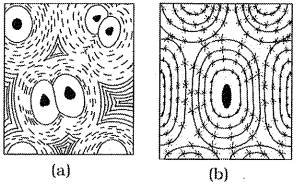
Identify the tissues given below.
A
Cartilage,Bone
B
Bone,Cartilage
C
Areolar tissue,Adipose tissue
D
Adipose tissue,Areolar tissue
Solution
(A) In the given figure,$(a)$ represents Cartilage and $(b)$ represents Bone.
Cartilage is a specialized connective tissue where the cells (chondrocytes) are enclosed in small cavities within the matrix secreted by them.
Bone is a specialized connective tissue that has a hard and non-pliable ground substance rich in calcium salts and collagen fibers which give bone its strength. The bone cells (osteocytes) are present in spaces called lacunae.
Cartilage is a specialized connective tissue where the cells (chondrocytes) are enclosed in small cavities within the matrix secreted by them.
Bone is a specialized connective tissue that has a hard and non-pliable ground substance rich in calcium salts and collagen fibers which give bone its strength. The bone cells (osteocytes) are present in spaces called lacunae.
0 likes
View Solution280
MediumMCQ
Which cells secrete fibers in connective tissue?
A
Mast cells
B
Macrophages
C
Fibroblasts
D
All of the above
Solution
(C) In connective tissue,$Fibroblasts$ are the cells that are responsible for the synthesis and secretion of fibers (such as collagen and elastin fibers) and the ground substance of the matrix.
$Mast$ $cells$ are involved in inflammatory responses and release substances like histamine and heparin.
$Macrophages$ are phagocytic cells that engulf debris and pathogens.
Therefore,the correct answer is $Fibroblasts$.
$Mast$ $cells$ are involved in inflammatory responses and release substances like histamine and heparin.
$Macrophages$ are phagocytic cells that engulf debris and pathogens.
Therefore,the correct answer is $Fibroblasts$.
0 likes
View Solution281
MediumMCQ
Which tissue provides a structural framework for the epithelium?
A
Areolar tissue
B
Adipose tissue
C
Blood
D
Bone
Solution
(A) The areolar tissue is a type of loose connective tissue that serves as a support framework for the epithelium. It is present beneath the skin and acts as a packing material for organs,providing structural support and connecting various tissues.
0 likes
View Solution282
MediumMCQ
Excess nutrients that are not used immediately are converted and stored in which tissue?
A
Areolar tissue
B
Adipose tissue
C
Blood
D
Bone
Solution
(B) The $Adipose$ tissue is a type of loose connective tissue located mainly beneath the skin. The cells of this tissue are specialized to store fats. Excess nutrients which are not used immediately by the body are converted into fats and stored in this tissue.
0 likes
View Solution283
MediumMCQ
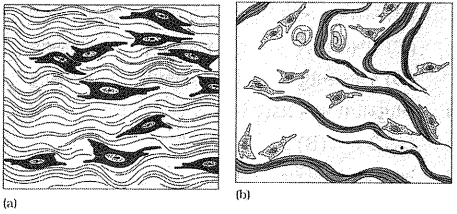
Identify the given connective tissues in the figure.
A
Areolar tissue,Adipose tissue
B
Dense irregular,Dense regular
C
Dense regular,Dense irregular
D
Adipose tissue,Areolar tissue
Solution
(C) Figure $(a)$ shows Dense regular connective tissue,where collagen fibers are present in rows between many parallel bundles of fibers.
Figure $(b)$ shows Dense irregular connective tissue,where fibroblasts and many fibers (mostly collagen) are oriented differently.
Figure $(b)$ shows Dense irregular connective tissue,where fibroblasts and many fibers (mostly collagen) are oriented differently.
0 likes
View Solution284
MediumMCQ
Which type of tissue is present in tendons and ligaments?
A
Dense irregular connective tissue
B
Dense regular connective tissue
C
Cartilage
D
Bone
Solution
(B) Tendons and ligaments are examples of dense regular connective tissue.
In dense regular connective tissue,the collagen fibers are present in rows between many parallel bundles of fibers.
Tendons attach skeletal muscles to bones,while ligaments attach one bone to another.
In dense regular connective tissue,the collagen fibers are present in rows between many parallel bundles of fibers.
Tendons attach skeletal muscles to bones,while ligaments attach one bone to another.
0 likes
View Solution285
EasyMCQ
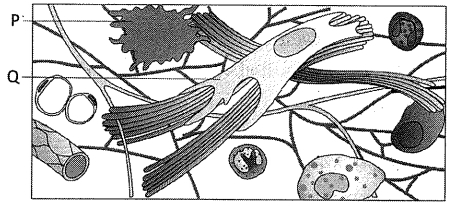
Identify cells $P$ and $Q$ in the given areolar connective tissue diagram.
A
Macrophage,Fibroblast
B
Fibroblast,Macrophage
C
Macrophage,Mast cell
D
Mast cell,Macrophage
Solution
(A) In the provided diagram of areolar connective tissue:
- $P$ points to a Macrophage,which is an amoeboid-shaped cell involved in phagocytosis.
- $Q$ points to a Fibroblast,which is a large,flattened cell with processes that secretes fibers of structural proteins like collagen and elastin.
Therefore,the correct identification is $P$ = Macrophage and $Q$ = Fibroblast.
- $P$ points to a Macrophage,which is an amoeboid-shaped cell involved in phagocytosis.
- $Q$ points to a Fibroblast,which is a large,flattened cell with processes that secretes fibers of structural proteins like collagen and elastin.
Therefore,the correct identification is $P$ = Macrophage and $Q$ = Fibroblast.
0 likes
View Solution286
MediumMCQ
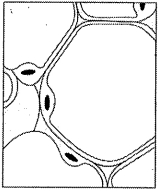
What is the function of the tissue shown in the image?
A
To conserve body heat
B
To store excess nutrients
C
Found in the mesentery
D
All of the above
Solution
(D) The image shows adipose tissue,which is a type of loose connective tissue.
$1$. Adipose tissue cells are specialized to store fats (lipids),which serves as a reserve of nutrients.
$2$. This tissue is located mainly beneath the skin and acts as an insulator,helping to conserve body heat.
$3$. It is also found in various parts of the body,including the mesentery (the fold of the peritoneum that attaches the stomach,small intestine,pancreas,spleen,and other organs to the posterior wall of the abdomen).
Therefore,all the given statements are correct.
$1$. Adipose tissue cells are specialized to store fats (lipids),which serves as a reserve of nutrients.
$2$. This tissue is located mainly beneath the skin and acts as an insulator,helping to conserve body heat.
$3$. It is also found in various parts of the body,including the mesentery (the fold of the peritoneum that attaches the stomach,small intestine,pancreas,spleen,and other organs to the posterior wall of the abdomen).
Therefore,all the given statements are correct.
0 likes
View Solution287
MediumMCQ
Which type of animal tissue is present in the epiglottis?
A
Epithelial tissue
B
Connective tissue
C
Muscular tissue
D
Nervous tissue
Solution
(B) The epiglottis is a thin,leaf-shaped flap of cartilage that prevents food from entering the windpipe (trachea) during swallowing.
Cartilage is a specialized type of connective tissue.
Therefore,the epiglottis is composed of connective tissue.
Cartilage is a specialized type of connective tissue.
Therefore,the epiglottis is composed of connective tissue.
0 likes
View Solution288
EasyMCQ
Glisson's capsule is made up of .......
A
Epithelial tissue
B
Connective tissue
C
Nervous tissue
D
Muscular tissue
Solution
(B) The liver is covered by a thin connective tissue sheath known as Glisson's capsule.
This capsule surrounds each hepatic lobule,which is the structural and functional unit of the liver.
Therefore,Glisson's capsule is composed of connective tissue.
This capsule surrounds each hepatic lobule,which is the structural and functional unit of the liver.
Therefore,Glisson's capsule is composed of connective tissue.
0 likes
View Solution289
MediumMCQ
Given below are two statements:
Statement $I$: Ligaments are dense irregular tissue.
Statement $II$: Cartilage is dense regular tissue.
In the light of the above statements,choose the correct answer from the options given below:
Statement $I$: Ligaments are dense irregular tissue.
Statement $II$: Cartilage is dense regular tissue.
In the light of the above statements,choose the correct answer from the options given below:
A
Statement $I$ is false but Statement $II$ is true
B
Both Statement $I$ and Statement $II$ are true
C
Both Statement $I$ and Statement $II$ are false
D
Statement $I$ is true but Statement $II$ is false
Solution
(C) Statement $I$ is incorrect because ligaments are composed of dense regular connective tissue,not dense irregular tissue.
Statement $II$ is incorrect because cartilage is a type of specialised connective tissue,not dense regular tissue.
Therefore,both Statement $I$ and Statement $II$ are false.
Statement $II$ is incorrect because cartilage is a type of specialised connective tissue,not dense regular tissue.
Therefore,both Statement $I$ and Statement $II$ are false.
0 likes
View Solution290
EasyMCQ
The matrix or ground substance in connective tissues is made up of $......$
A
Thick proteins
B
Elastin fibres
C
Modified polysaccharides
D
Modified triglycerides
Solution
(C) In connective tissues,the cells secrete fibres of structural proteins called collagen or elastin.
These cells also secrete modified polysaccharides,which accumulate between cells and fibres and act as the matrix or ground substance.
Therefore,the correct answer is $C$.
These cells also secrete modified polysaccharides,which accumulate between cells and fibres and act as the matrix or ground substance.
Therefore,the correct answer is $C$.
0 likes
View Solution291
MediumMCQ
Match the Column-$A$ and Column-$B$.
| Column-$A$ | Column-$B$ |
| $(A)$ Loose connective tissue | $(I)$ Non-pliable ground substance |
| $(B)$ Dense connective tissue | $(II)$ Resists compression |
| $(C)$ Cartilage | $(III)$ Semi-fluid ground substance |
| $(D)$ Bones | $(IV)$ Compactly packed fibres and fibroblast cells |
A
$(A-III, B-IV, C-II, D-I)$
B
$(A-I, B-II, C-III, D-IV)$
C
$(A-IV, B-III, C-II, D-I)$
D
$(A-II, B-I, C-IV, D-III)$
Solution
(A) The correct matching is as follows:
$(A)$ Loose connective tissue: It contains cells and fibres loosely arranged in a semi-fluid ground substance. Thus,$(A-III)$.
$(B)$ Dense connective tissue: In this tissue,fibres and fibroblasts are compactly packed. Thus,$(B-IV)$.
$(C)$ Cartilage: The intercellular material of cartilage is solid and pliable and resists compression. Thus,$(C-II)$.
$(D)$ Bones: Bones have a hard and non-pliable ground substance rich in calcium salts which gives them strength. Thus,$(D-I)$.
Therefore,the correct sequence is $(A-III, B-IV, C-II, D-I)$.
$(A)$ Loose connective tissue: It contains cells and fibres loosely arranged in a semi-fluid ground substance. Thus,$(A-III)$.
$(B)$ Dense connective tissue: In this tissue,fibres and fibroblasts are compactly packed. Thus,$(B-IV)$.
$(C)$ Cartilage: The intercellular material of cartilage is solid and pliable and resists compression. Thus,$(C-II)$.
$(D)$ Bones: Bones have a hard and non-pliable ground substance rich in calcium salts which gives them strength. Thus,$(D-I)$.
Therefore,the correct sequence is $(A-III, B-IV, C-II, D-I)$.
0 likes
View Solution292
MediumMCQ
The most abundant and widely distributed tissue in the bodies of complex animals is:
A
Epithelium
B
Connective
C
Muscular
D
Neural
Solution
(B) Connective tissue is the most abundant and widely distributed tissue in the bodies of complex animals. It provides structural support,connects different tissues and organs,and plays a crucial role in transport and defense. Unlike epithelial,muscular,or neural tissues,connective tissue is found throughout the body,linking and supporting other structures.
0 likes
View Solution293
MediumMCQ
Which of the following connective tissues connects skeletal muscles to bones in the form of a tendon?
A
Areolar connective tissue
B
Adipose tissue
C
Dense regular connective tissue
D
Dense irregular connective tissue
Solution
(C) Tendons are specialized structures that attach skeletal muscles to bones.
These structures are composed of dense regular connective tissue.
In dense regular connective tissue,collagen fibers are present in rows between many parallel bundles of fibers.
Therefore,the correct answer is $C$.
These structures are composed of dense regular connective tissue.
In dense regular connective tissue,collagen fibers are present in rows between many parallel bundles of fibers.
Therefore,the correct answer is $C$.
0 likes
View Solution294
MediumMCQ
Tendon is :-
A
$A$ structure which connects bone to bone.
B
$A$ structure which connects muscle to bone.
C
$A$ structure which stores fat.
D
$A$ structure for weight bearing.
Solution
(B) $Tendon$ is a dense regular connective tissue that primarily consists of collagen fibers.
Its main function is to attach skeletal muscles to bones.
This connection allows the force generated by muscle contraction to be transmitted to the bone,enabling movement.
In contrast,a $Ligament$ is a structure that connects bone to bone.
Its main function is to attach skeletal muscles to bones.
This connection allows the force generated by muscle contraction to be transmitted to the bone,enabling movement.
In contrast,a $Ligament$ is a structure that connects bone to bone.
0 likes
View Solution295
EasyMCQ
Match List-$I$ with List-$II$.
| List-$I$ | List-$II$ |
| $A$. Dense irregular connective tissue | $I$. Serves as a support framework for epithelium |
| $B$. Dense regular connective tissue | $II$. Blood |
| $C$. Areolar tissue | $III$. Present in skin |
| $D$. Specialised connective tissue | $IV$. Ligaments |
A
$A-I, B-IV, C-III, D-II$
B
$A-III, B-IV, C-I, D-II$
C
$A-IV, B-III, C-II, D-III$
D
$A-I, B-IV, C-II, D-III$
Solution
(B) The correct matches are as follows:
$A$. Dense irregular connective tissue is present in the skin $(A-III)$.
$B$. Dense regular connective tissue is found in tendons and ligaments $(B-IV)$.
$C$. Areolar tissue serves as a support framework for the epithelium $(C-I)$.
$D$. Blood is a type of specialised connective tissue $(D-II)$.
Therefore,the correct sequence is $A-III, B-IV, C-I, D-II$.
$A$. Dense irregular connective tissue is present in the skin $(A-III)$.
$B$. Dense regular connective tissue is found in tendons and ligaments $(B-IV)$.
$C$. Areolar tissue serves as a support framework for the epithelium $(C-I)$.
$D$. Blood is a type of specialised connective tissue $(D-II)$.
Therefore,the correct sequence is $A-III, B-IV, C-I, D-II$.
0 likes
View Solution296
MediumMCQ
Consider the following statements.
Statement-$I$: In tendons,collagen fibers are present in rows between many parallel bundles of fibers.
Statement-$II$: Skin is a dense regular connective tissue that has fibroblasts and collagen oriented differently.
Choose the correct option from the following.
Statement-$I$: In tendons,collagen fibers are present in rows between many parallel bundles of fibers.
Statement-$II$: Skin is a dense regular connective tissue that has fibroblasts and collagen oriented differently.
Choose the correct option from the following.
A
Statement-$I$ is true,but statement-$II$ is false
B
Statement-$I$ is false,but statement-$II$ is true
C
Statement-$I$ and statement-$II$ both are true
D
Statement-$I$ and statement-$II$ both are false
Solution
(A) Statement-$I$ is true: Tendons are examples of dense regular connective tissue where collagen fibers are present in rows between many parallel bundles of fibers.
Statement-$II$ is false: Skin is composed of dense irregular connective tissue,not dense regular connective tissue. In dense irregular connective tissue,fibroblasts and many fibers (mostly collagen) are oriented differently (irregularly).
Statement-$II$ is false: Skin is composed of dense irregular connective tissue,not dense regular connective tissue. In dense irregular connective tissue,fibroblasts and many fibers (mostly collagen) are oriented differently (irregularly).
0 likes
View Solution297
MediumMCQ
What is the function of adipose connective tissue?
A
Support framework for epithelium tissue
B
Store the excess food in carbohydrate form
C
Secretion and connection
D
Excess nutrients are converted into fats and are stored in this tissue.
Solution
(D) Adipose tissue is a type of loose connective tissue located mainly beneath the skin.
Its primary function is to store fats.
When the body consumes excess nutrients that are not immediately used for energy,they are converted into fats and stored within the adipocytes (fat cells) of this tissue.
Therefore,option $D$ is the correct answer.
Its primary function is to store fats.
When the body consumes excess nutrients that are not immediately used for energy,they are converted into fats and stored within the adipocytes (fat cells) of this tissue.
Therefore,option $D$ is the correct answer.
0 likes
View Solution298
MediumMCQ
Matrix of cartilage is $:-$
A
Liquid and pliable
B
Liquid and non pliable
C
Solid and pliable
D
Solid and non pliable
Solution
(C) Cartilage is a specialized type of connective tissue.
Its intercellular material (matrix) is solid and pliable.
It is pliable because it contains chondroitin salts,which allow for some flexibility while maintaining structural support.
Therefore,the correct option is $C$.
Its intercellular material (matrix) is solid and pliable.
It is pliable because it contains chondroitin salts,which allow for some flexibility while maintaining structural support.
Therefore,the correct option is $C$.
0 likes
View Solution299
MediumMCQ
Which of the following structures attaches skeletal muscles to bones?
A
Ligament
B
Adipose tissue
C
Cartilage
D
Tendon
Solution
(D) $Tendon$ is a tough band of fibrous connective tissue that connects muscle to bone and is capable of withstanding tension.
$Ligaments$ connect bone to bone.
$Adipose tissue$ is a type of loose connective tissue that stores fat.
$Cartilage$ is a flexible connective tissue found in various parts of the body, such as joints and the nose.
Therefore, the correct option is $D$.
$Ligaments$ connect bone to bone.
$Adipose tissue$ is a type of loose connective tissue that stores fat.
$Cartilage$ is a flexible connective tissue found in various parts of the body, such as joints and the nose.
Therefore, the correct option is $D$.
0 likes
View Solution300
MediumMCQ
Statement-$I$: Bones have hard and pliable ground substance.
Statement-$II$: Outer ear joint is made up of cartilage.
Statement-$II$: Outer ear joint is made up of cartilage.
A
Statement-$I$ and $II$ both are correct.
B
Statement-$I$ is correct and $II$ is incorrect.
C
Statement-$I$ is incorrect and $II$ is correct.
D
Both statement-$I$ and $II$ are incorrect.
Solution
(C) Statement-$I$ is incorrect because bones have a hard and non-pliable ground substance rich in calcium salts and collagen fibers,which provide structural strength.
Statement-$II$ is correct because the outer ear (pinna) is composed of elastic cartilage,which provides both support and flexibility.
Statement-$II$ is correct because the outer ear (pinna) is composed of elastic cartilage,which provides both support and flexibility.
0 likes
View SolutionStructural Organisation In Animals — Connective tissue · Frequently Asked Questions
1Are these Structural Organisation In Animals questions useful for JEE and NEET?
Yes. All questions in this section are mapped to JEE Main and NEET exam patterns. Previous year questions from JEE Main, NEET, GUJCET and state-level exams are included with full solutions.
2Can I switch to Hindi or Gujarati for these questions?
Yes. Use the language tabs in the hero section or the sidebar to view the same questions and solutions in English, Hindi or Gujarati.
3How do I generate a question paper from this subtopic?
Use the Vedclass Exam Paper Generator — select the chapter and subtopic, set difficulty, and generate Sets A, B, C, D automatically. First 3 chapters of every subject are free.
Vedclass Products
For Students
Vedclass Test Series
Mock tests in real JEE/NEET style with performance analysis. 5-day free trial.
Start Free TrialFor Teachers
Exam Paper Generator
Generate Set A/B/C/D papers from this chapter in 2 minutes. 3 chapters free.
Try FreeFor Institutes
Online Exam Module
Live online exams with unlimited students, 360° analytics & white-label branding.
See DemoFor Teachers & Institutes
Generate a Structural Organisation In Animals Exam Paper in 2 Minutes
Select subtopic & difficulty — Sets A, B, C, D auto-generated with No Repeat logic.
First 3 chapters of every subject are free — no payment required.