
A English
ETS Questions in English
Class 11 Biology · Respiration in Plants · ETS
209+
Questions
English
Language
100%
With Solutions
Showing 50 of 209 questions in English
151
MediumMCQ
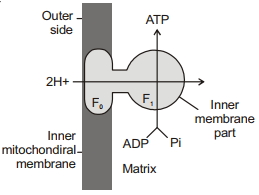
Protons for the formation of $ATP$ first pass from:
A
$F_o$ part
B
$F_1$ head piece
C
$Cyt$ $c$
D
Complex $II$
Solution
(A) The $ATP$ synthase enzyme consists of two major components,$F_o$ and $F_1$.
The $F_o$ component is an integral membrane protein complex that forms a channel through which protons $(H^+)$ cross the inner mitochondrial membrane from the intermembrane space into the matrix.
The movement of protons through this $F_o$ channel provides the energy required for the $F_1$ head piece to catalyze the synthesis of $ATP$ from $ADP$ and inorganic phosphate $(Pi)$.
Therefore,protons first pass through the $F_o$ part.
The $F_o$ component is an integral membrane protein complex that forms a channel through which protons $(H^+)$ cross the inner mitochondrial membrane from the intermembrane space into the matrix.
The movement of protons through this $F_o$ channel provides the energy required for the $F_1$ head piece to catalyze the synthesis of $ATP$ from $ADP$ and inorganic phosphate $(Pi)$.
Therefore,protons first pass through the $F_o$ part.
0 likes
View Solution152
MediumMCQ
The complex concerned with oxidative phosphorylation in the inner mitochondrial membrane is:
A
Complex $IV$
B
Complex $V$
C
Complex $III$
D
Complex $II$
Solution
(B) Oxidative phosphorylation is the process by which $ATP$ is synthesized using the energy released during the electron transport system $(ETS)$.
In the inner mitochondrial membrane, $Complex$ $V$ is known as $ATP$ synthase.
This complex consists of two major components: $F_0$ and $F_1$.
$F_0$ is an integral membrane protein complex that forms a channel through which protons cross the inner membrane.
$F_1$ is a peripheral membrane protein complex that contains the site for $ATP$ synthesis from $ADP$ and inorganic phosphate $(Pi)$.
In the inner mitochondrial membrane, $Complex$ $V$ is known as $ATP$ synthase.
This complex consists of two major components: $F_0$ and $F_1$.
$F_0$ is an integral membrane protein complex that forms a channel through which protons cross the inner membrane.
$F_1$ is a peripheral membrane protein complex that contains the site for $ATP$ synthesis from $ADP$ and inorganic phosphate $(Pi)$.
0 likes
View Solution153
MediumMCQ
Mobile electron carriers in $ETS$ in the mitochondrial membrane are
A
$PQ, PC$
B
$CoQ, Cyt$ $c$
C
$PQ, Cyt$ $c$
D
$PC, CoQ$
Solution
(B) In the mitochondrial electron transport system $(ETS)$,$CoQ$ (Coenzyme $Q$ or Ubiquinone) and $Cyt$ $c$ (Cytochrome $c$) act as mobile electron carriers.
$CoQ$ is a lipid-soluble carrier that moves within the inner mitochondrial membrane,while $Cyt$ $c$ is a small protein attached to the outer surface of the inner membrane that acts as a mobile carrier for electrons between Complex $III$ and Complex $IV$.
$CoQ$ is a lipid-soluble carrier that moves within the inner mitochondrial membrane,while $Cyt$ $c$ is a small protein attached to the outer surface of the inner membrane that acts as a mobile carrier for electrons between Complex $III$ and Complex $IV$.
0 likes
View Solution154
MediumMCQ
Which one of the following is an incorrect statement regarding mitochondrial $ETC$ and oxidative phosphorylation?
A
Enzyme complex $I$ accepts electrons and $H^+$ from $NADH$ and $FADH_2$.
B
Passage of protons through the channel is coupled to the catalytic site of the $F_1$ for $ATP$ production.
C
Cytochrome-$c$ is a mobile protein attached to the outer surface of the inner membrane.
D
$6 H^+$ passes through $F_0$ from the intermembrane space to the matrix down the electrochemical proton gradient to produce $3 ATP$.
Solution
(A) The incorrect statement is $A$. Complex $I$ ($NADH$ dehydrogenase) specifically accepts electrons and protons from $NADH$ only,not from $FADH_2$. $FADH_2$ donates its electrons to Complex $II$ (Succinate dehydrogenase). Therefore,the statement that Complex $I$ accepts from both $NADH$ and $FADH_2$ is scientifically incorrect.
0 likes
View Solution155
MediumMCQ
$A$ false statement regarding cytochrome $c$ oxidase complex in $ETS$ in mitochondria is
A
Receives electrons directly from ubiquinone
B
Capable of reducing $O_2$
C
Extend across the thickness of inner mitochondrial membrane
D
Contains $Fe$ & $Cu$ both
Solution
(A) The cytochrome $c$ oxidase complex (Complex $IV$) receives electrons from cytochrome $c$,not directly from ubiquinone. Ubiquinone transfers electrons to Complex $III$ (cytochrome $bc_1$ complex),which then transfers them to cytochrome $c$,and finally to Complex $IV$. Therefore,the statement that it receives electrons directly from ubiquinone is false.
0 likes
View Solution156
MediumMCQ
$A$ : $2,4-DNP$ $(2,4-Dinitrophenol)$ is an uncoupling agent of $ETS$.
$R$ : It is soluble in lipids.
$R$ : It is soluble in lipids.
A
Assertion and Reason both are correct and Reason is the correct explanation of Assertion.
B
Assertion and Reason both are correct but Reason is not the correct explanation of Assertion.
C
Assertion is correct,but Reason is incorrect.
D
Both Assertion and Reason are incorrect.
Solution
(A) $2,4-DNP$ $(2,4-Dinitrophenol)$ acts as an uncoupling agent because it is a lipid-soluble proton ionophore.
It facilitates the movement of protons $(H^+)$ across the inner mitochondrial membrane,bypassing the $ATP$ synthase enzyme.
As a result,the proton gradient is dissipated,which prevents the synthesis of $ATP$ while allowing electron transport to continue.
Thus,both the Assertion and Reason are correct,and the lipid solubility of $DNP$ is the reason it can act as an uncoupler.
It facilitates the movement of protons $(H^+)$ across the inner mitochondrial membrane,bypassing the $ATP$ synthase enzyme.
As a result,the proton gradient is dissipated,which prevents the synthesis of $ATP$ while allowing electron transport to continue.
Thus,both the Assertion and Reason are correct,and the lipid solubility of $DNP$ is the reason it can act as an uncoupler.
0 likes
View Solution157
MediumMCQ
$A$ : In cellular respiration,$ETS$ electron movement is a downhill journey.
$R$ : Electrons move from high redox potential to low redox potential.
$R$ : Electrons move from high redox potential to low redox potential.
A
Assertion and Reason both are correct and Reason is the correct explanation of Assertion.
B
Assertion and Reason both are correct but Reason is not the correct explanation of Assertion.
C
Assertion is correct,but Reason is incorrect.
D
Both Assertion and Reason are incorrect.
Solution
(C) In the Electron Transport System $(ETS)$,electrons move from a carrier with a lower redox potential to a carrier with a higher redox potential.
This movement releases energy,which is used to pump protons across the membrane,creating a proton gradient.
Because the electrons move towards a more positive (higher) redox potential,the process is described as a 'downhill' journey in terms of energy levels.
Therefore,the Assertion is correct because the movement is energetically favorable (downhill),but the Reason is incorrect because electrons actually move from low to high redox potential,not high to low.
This movement releases energy,which is used to pump protons across the membrane,creating a proton gradient.
Because the electrons move towards a more positive (higher) redox potential,the process is described as a 'downhill' journey in terms of energy levels.
Therefore,the Assertion is correct because the movement is energetically favorable (downhill),but the Reason is incorrect because electrons actually move from low to high redox potential,not high to low.
0 likes
View Solution158
MediumMCQ
$A$ : Cytochrome $c$ is a peripheral protein.
$R$ : It is found attached on the perimitochondrial space side of the inner mitochondrial membrane.
$R$ : It is found attached on the perimitochondrial space side of the inner mitochondrial membrane.
A
Assertion and Reason both are correct and Reason is the correct explanation of Assertion.
B
Assertion and Reason both are correct but Reason is not the correct explanation of Assertion.
C
Assertion is correct,but Reason is incorrect.
D
Both Assertion and Reason are incorrect.
Solution
(A) Cytochrome $c$ is a small protein attached to the outer surface of the inner mitochondrial membrane.
It acts as a mobile electron carrier for electron transfer between Complex $III$ (cytochrome $bc_1$ complex) and Complex $IV$ (cytochrome $c$ oxidase).
Since it is loosely associated with the membrane surface and not embedded within the lipid bilayer,it is classified as a peripheral membrane protein.
It is located on the side of the inner mitochondrial membrane that faces the intermembrane space (perimitochondrial space).
Therefore,both the Assertion and the Reason are correct,and the Reason provides the correct explanation for the Assertion.
It acts as a mobile electron carrier for electron transfer between Complex $III$ (cytochrome $bc_1$ complex) and Complex $IV$ (cytochrome $c$ oxidase).
Since it is loosely associated with the membrane surface and not embedded within the lipid bilayer,it is classified as a peripheral membrane protein.
It is located on the side of the inner mitochondrial membrane that faces the intermembrane space (perimitochondrial space).
Therefore,both the Assertion and the Reason are correct,and the Reason provides the correct explanation for the Assertion.
0 likes
View Solution159
MediumMCQ
Oxygen $(O_{2})$ is utilised by an organism to
A
Directly to breakdown the nutrient molecules
B
Indirectly as an electron acceptor to form water
C
Directly as an enzyme for oxidation of food
D
Indirectly to activate enzymes for breakdown of food
Solution
(B) Oxygen $(O_{2})$ is utilised by living organisms indirectly during the oxidation of nutrients like glucose. It acts as the final electron acceptor in the electron transport chain $(ETC)$ located in the inner mitochondrial membrane,where it combines with electrons and protons to form water $(H_{2}O)$.
0 likes
View Solution160
MediumMCQ
Which of the following statements is incorrect?
A
During aerobic respiration,the role of oxygen is limited to the terminal stage.
B
In $ETC$ (Electron Transport Chain),one molecule of $NADH+H^{+}$ gives rise to $2$ $ATP$ molecules,and one $FADH_{2}$ gives rise to $3$ $ATP$ molecules.
C
$ATP$ is synthesized through complex $V$.
D
Oxidation-reduction reactions produce a proton gradient in respiration.
Solution
(B) The correct answer is $B$.
In the Electron Transport Chain $(ETC)$,the oxidation of one molecule of $NADH+H^{+}$ results in the production of $3$ $ATP$ molecules,while the oxidation of one molecule of $FADH_{2}$ results in the production of $2$ $ATP$ molecules.
Option $B$ states the reverse,making it incorrect.
Oxygen acts as the final electron acceptor at the end of the $ETC$ (terminal stage).
Complex $V$ ($ATP$ synthase) is responsible for the synthesis of $ATP$ using the proton gradient.
The proton gradient is generated by the energy released during oxidation-reduction reactions in the $ETC$.
In the Electron Transport Chain $(ETC)$,the oxidation of one molecule of $NADH+H^{+}$ results in the production of $3$ $ATP$ molecules,while the oxidation of one molecule of $FADH_{2}$ results in the production of $2$ $ATP$ molecules.
Option $B$ states the reverse,making it incorrect.
Oxygen acts as the final electron acceptor at the end of the $ETC$ (terminal stage).
Complex $V$ ($ATP$ synthase) is responsible for the synthesis of $ATP$ using the proton gradient.
The proton gradient is generated by the energy released during oxidation-reduction reactions in the $ETC$.
0 likes
View Solution161
MediumMCQ
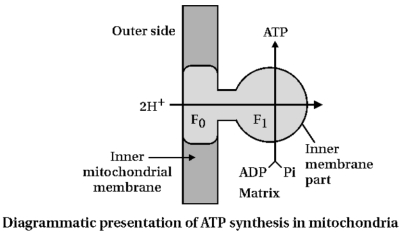
$F_{0}-F_{1}$ particles participate in the synthesis of $..........$
A
$ATP$
B
$ADP$
C
Glucose
D
$NADH$
Solution
(A) $F_{0}-F_{1}$ particles are located in the inner mitochondrial membrane. They take part in the synthesis of $ATP$,which is the energy currency of the cell.
The energy released during the electron transport system is utilized in synthesizing $ATP$ with the help of $ATP$ synthase (Complex $V$).
This complex consists of two major components,$F_{0}$ and $F_{1}$.
The $F_{1}$ headpiece is a peripheral membrane protein complex and contains the site for the synthesis of $ATP$ from $ADP$ and inorganic phosphate $(ADP + Pi \rightarrow ATP)$.
$F_{0}$ is an integral membrane protein complex that forms the channel through which protons cross the inner membrane.
The passage of protons through the channel is coupled to the catalytic site of the $F_{1}$ component for the production of $ATP$.
For each $ATP$ produced,$2 H^{+}$ ions pass through $F_{0}$ from the intermembrane space to the matrix down the electrochemical proton gradient.
The energy released during the electron transport system is utilized in synthesizing $ATP$ with the help of $ATP$ synthase (Complex $V$).
This complex consists of two major components,$F_{0}$ and $F_{1}$.
The $F_{1}$ headpiece is a peripheral membrane protein complex and contains the site for the synthesis of $ATP$ from $ADP$ and inorganic phosphate $(ADP + Pi \rightarrow ATP)$.
$F_{0}$ is an integral membrane protein complex that forms the channel through which protons cross the inner membrane.
The passage of protons through the channel is coupled to the catalytic site of the $F_{1}$ component for the production of $ATP$.
For each $ATP$ produced,$2 H^{+}$ ions pass through $F_{0}$ from the intermembrane space to the matrix down the electrochemical proton gradient.
0 likes
View Solution162
MediumMCQ
Where are cytochromes located?
A
Grana
B
Inner mitochondrial membrane
C
Mesosomes
D
All of the above
Solution
(D) Cytochromes are iron-containing hemoproteins that act as electron carriers in electron transport chains.
They are found in the thylakoid membranes of the grana in chloroplasts (during photosynthesis),the inner mitochondrial membrane (during cellular respiration),and the plasma membrane of prokaryotes (mesosomes).
Therefore,all the given options are correct locations for cytochromes.
They are found in the thylakoid membranes of the grana in chloroplasts (during photosynthesis),the inner mitochondrial membrane (during cellular respiration),and the plasma membrane of prokaryotes (mesosomes).
Therefore,all the given options are correct locations for cytochromes.
0 likes
View Solution163
MediumMCQ
In mitochondria,the proton gradient is established in which direction?
A
From matrix to intermembrane space
B
From intermembrane space to matrix
C
From matrix to cytoplasm
D
None of these
Solution
(A) During the process of oxidative phosphorylation in mitochondria,the electron transport chain $(ETC)$ complexes pump protons $(H^+)$ from the mitochondrial matrix into the intermembrane space. This creates a high concentration of protons in the intermembrane space compared to the matrix,establishing a proton gradient (electrochemical gradient) across the inner mitochondrial membrane. Therefore,the gradient is established from the matrix to the intermembrane space.
0 likes
View Solution164
MediumMCQ
$F_1$ and $F_0$ are parts of . . . . . . .
A
$PS-I$ and $PS-II$
B
$NADP$ reductase
C
$ATP$
D
$ATP$ synthase
Solution
(D) $F_0$ and $F_1$ are the two main components of the $ATP$ synthase enzyme complex.
$F_0$ is an integral membrane protein complex that forms a transmembrane channel through which protons cross the membrane.
$F_1$ is a peripheral membrane protein complex that projects into the matrix or stroma and contains the site for $ATP$ synthesis from $ADP$ and inorganic phosphate $(Pi)$.
$F_0$ is an integral membrane protein complex that forms a transmembrane channel through which protons cross the membrane.
$F_1$ is a peripheral membrane protein complex that projects into the matrix or stroma and contains the site for $ATP$ synthesis from $ADP$ and inorganic phosphate $(Pi)$.
0 likes
View Solution165
MediumMCQ
Identify the site of oxidative phosphorylation.
A
Cytosol
B
Inner mitochondrial membrane
C
Outer mitochondrial membrane
D
Mitochondrial matrix
Solution
(B) Oxidative phosphorylation is the process in which $ATP$ is synthesized during the electron transport system $(ETS)$.
This process occurs in the inner mitochondrial membrane,where the electron transport chain complexes and $ATP$ synthase are located.
During this process,electrons are transferred from $NADH$ and $FADH_2$ to oxygen,and the energy released is used to pump protons across the membrane,creating a proton gradient that drives $ATP$ synthesis.
This process occurs in the inner mitochondrial membrane,where the electron transport chain complexes and $ATP$ synthase are located.
During this process,electrons are transferred from $NADH$ and $FADH_2$ to oxygen,and the energy released is used to pump protons across the membrane,creating a proton gradient that drives $ATP$ synthesis.
0 likes
View Solution166
MediumMCQ
Who is the final electron acceptor in oxidative phosphorylation?
A
Oxygen
B
$H_2$
C
$Cyt\,a-a_3$
D
$Cyt\,c$
Solution
(A) In the electron transport system $(ETS)$ of oxidative phosphorylation,electrons are passed through a series of complexes.
At the end of the chain,the final electron acceptor is oxygen $(O_2)$.
Oxygen accepts the electrons and combines with protons $(H^+)$ to form water $(H_2O)$.
This process is essential for maintaining the flow of electrons through the transport chain.
At the end of the chain,the final electron acceptor is oxygen $(O_2)$.
Oxygen accepts the electrons and combines with protons $(H^+)$ to form water $(H_2O)$.
This process is essential for maintaining the flow of electrons through the transport chain.
0 likes
View Solution167
MediumMCQ
How many $ATP$ molecules are produced during oxidative phosphorylation from one molecule of $NADH + H^+$ and $FADH_2$ respectively?
A
$3, 3$
B
$2, 3$
C
$3, 2$
D
$2, 2$
Solution
(C) During oxidative phosphorylation,the electron transport system $(ETS)$ facilitates the synthesis of $ATP$ through chemiosmosis.
One molecule of $NADH + H^+$ donates electrons to Complex $I$,which leads to the pumping of protons across the inner mitochondrial membrane,resulting in the production of $3$ $ATP$ molecules.
One molecule of $FADH_2$ donates electrons to Complex $II$,bypassing Complex $I$,which results in the pumping of fewer protons and the production of $2$ $ATP$ molecules.
Therefore,the correct sequence is $3$ $ATP$ from $NADH + H^+$ and $2$ $ATP$ from $FADH_2$.
One molecule of $NADH + H^+$ donates electrons to Complex $I$,which leads to the pumping of protons across the inner mitochondrial membrane,resulting in the production of $3$ $ATP$ molecules.
One molecule of $FADH_2$ donates electrons to Complex $II$,bypassing Complex $I$,which results in the pumping of fewer protons and the production of $2$ $ATP$ molecules.
Therefore,the correct sequence is $3$ $ATP$ from $NADH + H^+$ and $2$ $ATP$ from $FADH_2$.
0 likes
View Solution168
MediumMCQ
Which of the following act as electron carriers in the Electron Transport System $(ETS)$?
A
Lipids
B
Carbohydrates
C
Vitamins
D
Proteins
Solution
(D) In the Electron Transport System $(ETS)$,the complexes are primarily composed of proteins.
Specifically,cytochromes (which are heme-containing proteins) and iron-sulfur proteins act as essential electron carriers.
These proteins facilitate the transfer of electrons from $NADH$ and $FADH_2$ to oxygen,which is the final electron acceptor.
Therefore,proteins are the primary molecules that function as electron carriers in the $ETS$.
Specifically,cytochromes (which are heme-containing proteins) and iron-sulfur proteins act as essential electron carriers.
These proteins facilitate the transfer of electrons from $NADH$ and $FADH_2$ to oxygen,which is the final electron acceptor.
Therefore,proteins are the primary molecules that function as electron carriers in the $ETS$.
0 likes
View Solution169
MediumMCQ
Match the following columns regarding the Electron Transport System $(ETS)$:
| Column-$I$ ($ETS$ Complex) | Column-$II$ (Name of Complex) |
| $P$. Complex-$I$ | $I$. Cytochrome $c$ oxidase complex |
| $Q$. Complex-$II$ | $II$. Cytochrome $bc_1$ complex |
| $R$. Complex-$III$ | $III$. $ATP$ synthase complex |
| $S$. Complex-$IV$ | $IV$. $FADH_2$ dehydrogenase complex |
| $T$. Complex-$V$ | $V$. $NADH$ dehydrogenase complex |
A
$(P-V), (Q-IV), (R-I), (S-II), (T-III)$
B
$(P-IV), (Q-V), (R-I), (S-II), (T-III)$
C
$(P-V), (Q-IV), (R-II), (S-I), (T-III)$
D
$(P-IV), (Q-V), (R-II), (S-I), (T-III)$
Solution
(C) The Electron Transport System $(ETS)$ in mitochondria consists of five major complexes:
$1$. Complex-$I$ is $NADH$ dehydrogenase.
$2$. Complex-$II$ is Succinate dehydrogenase ($FADH_2$ dehydrogenase).
$3$. Complex-$III$ is Cytochrome $bc_1$ complex.
$4$. Complex-$IV$ is Cytochrome $c$ oxidase complex.
$5$. Complex-$V$ is $ATP$ synthase.
Matching these with the given columns:
$P$ (Complex-$I$) matches with $V$ ($NADH$ dehydrogenase).
$Q$ (Complex-$II$) matches with $IV$ ($FADH_2$ dehydrogenase).
$R$ (Complex-$III$) matches with $II$ (Cytochrome $bc_1$ complex).
$S$ (Complex-$IV$) matches with $I$ (Cytochrome $c$ oxidase complex).
$T$ (Complex-$V$) matches with $III$ ($ATP$ synthase).
Therefore, the correct sequence is $(P-V), (Q-IV), (R-II), (S-I), (T-III)$.
$1$. Complex-$I$ is $NADH$ dehydrogenase.
$2$. Complex-$II$ is Succinate dehydrogenase ($FADH_2$ dehydrogenase).
$3$. Complex-$III$ is Cytochrome $bc_1$ complex.
$4$. Complex-$IV$ is Cytochrome $c$ oxidase complex.
$5$. Complex-$V$ is $ATP$ synthase.
Matching these with the given columns:
$P$ (Complex-$I$) matches with $V$ ($NADH$ dehydrogenase).
$Q$ (Complex-$II$) matches with $IV$ ($FADH_2$ dehydrogenase).
$R$ (Complex-$III$) matches with $II$ (Cytochrome $bc_1$ complex).
$S$ (Complex-$IV$) matches with $I$ (Cytochrome $c$ oxidase complex).
$T$ (Complex-$V$) matches with $III$ ($ATP$ synthase).
Therefore, the correct sequence is $(P-V), (Q-IV), (R-II), (S-I), (T-III)$.
0 likes
View Solution170
MediumMCQ
When energy is released from $FADH_2$,through which complex do electrons $NOT$ pass?
A
Complex-$I$
B
Complex-$II$
C
Complex-$III$
D
Complex-$IV$
Solution
(A) In the Electron Transport System $(ETS)$,$FADH_2$ is oxidized by Complex-$II$ (Succinate dehydrogenase).
Electrons from $FADH_2$ are transferred to ubiquinone $(Q)$ via Complex-$II$.
Since $FADH_2$ enters the $ETS$ at Complex-$II$,it bypasses Complex-$I$ ($NADH$ dehydrogenase).
Therefore,electrons from $FADH_2$ do not pass through Complex-$I$.
Electrons from $FADH_2$ are transferred to ubiquinone $(Q)$ via Complex-$II$.
Since $FADH_2$ enters the $ETS$ at Complex-$II$,it bypasses Complex-$I$ ($NADH$ dehydrogenase).
Therefore,electrons from $FADH_2$ do not pass through Complex-$I$.
0 likes
View Solution171
MediumMCQ
During the oxidation of $NADH + H^+$,through which complex do electrons $NOT$ pass?
A
Complex-$I$
B
Complex-$II$
C
Complex-$III$
D
Complex-$IV$
Solution
(B) In the Electron Transport System $(ETS)$,$NADH + H^+$ is oxidized by $NADH$ dehydrogenase,which is $Complex-I$.
Electrons from $NADH$ are transferred to $Ubiquinone$ $(UQ)$ via $Complex-I$.
$Complex-II$ ($Succinate$ dehydrogenase) is specifically involved in the oxidation of $FADH_2$,not $NADH$.
Therefore,electrons derived from $NADH$ do not pass through $Complex-II$.
Electrons from $NADH$ are transferred to $Ubiquinone$ $(UQ)$ via $Complex-I$.
$Complex-II$ ($Succinate$ dehydrogenase) is specifically involved in the oxidation of $FADH_2$,not $NADH$.
Therefore,electrons derived from $NADH$ do not pass through $Complex-II$.
0 likes
View Solution172
MediumMCQ
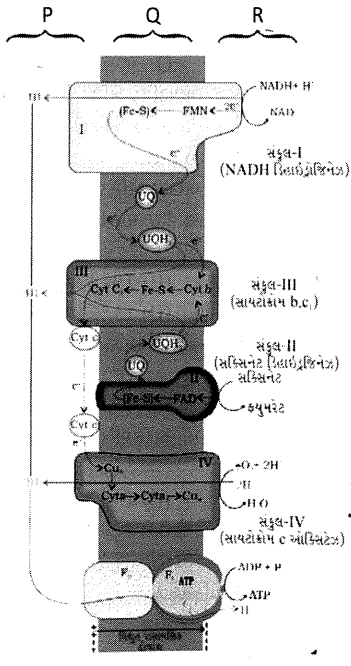
In the given diagram of oxidative phosphorylation,what are the regions $P, Q,$ and $R$?
A
$P -$ Matrix,$Q -$ Inner mitochondrial membrane,$R -$ Intermembrane space
B
$P -$ Intermembrane space,$Q -$ Inner mitochondrial membrane,$R -$ Matrix
C
$P -$ Matrix,$Q -$ Chloroplast inner membrane,$R -$ Intermembrane space
D
$P -$ Intermembrane space,$Q -$ Chloroplast inner membrane,$R -$ Matrix
Solution
(A) The diagram represents the Electron Transport System $(ETS)$ located in the inner mitochondrial membrane.
$P$ represents the matrix,where the $NADH$ and $FADH_2$ are oxidized and protons are released.
$Q$ represents the inner mitochondrial membrane,which contains the protein complexes $(I, II, III, IV)$ and $ATP$ synthase.
$R$ represents the intermembrane space,where protons are pumped to create a proton gradient.
$P$ represents the matrix,where the $NADH$ and $FADH_2$ are oxidized and protons are released.
$Q$ represents the inner mitochondrial membrane,which contains the protein complexes $(I, II, III, IV)$ and $ATP$ synthase.
$R$ represents the intermembrane space,where protons are pumped to create a proton gradient.
0 likes
View Solution173
MediumMCQ
In mitochondria,the proton gradient is established in which direction?
A
From intermembrane space to stroma
B
From matrix to intermembrane space
C
From intermembrane space to matrix
D
From stroma to intermembrane space
Solution
(B) During the process of oxidative phosphorylation in mitochondria,the electron transport system $(ETS)$ is located in the inner mitochondrial membrane. As electrons pass through the complexes,energy is released,which is used to pump protons $(H^+)$ from the mitochondrial matrix into the intermembrane space. This creates a high concentration of protons in the intermembrane space compared to the matrix,establishing a proton gradient. Therefore,the proton gradient is established from the matrix to the intermembrane space.
0 likes
View Solution174
MediumMCQ
How many $ATP$ molecules are produced when $2 H^+$ ions pass through the $ATP$ synthase complex?
A
$1$
B
$2$
C
$3$
D
$4$
Solution
(A) The $ATP$ synthase complex consists of two major components: $F_0$ and $F_1$.
$F_0$ is an integral membrane protein complex that acts as a channel for protons $(H^+)$ to cross the inner mitochondrial membrane.
$F_1$ is a peripheral membrane protein complex that contains the site for $ATP$ synthesis.
According to the chemiosmotic hypothesis,the movement of $2 H^+$ ions from the intermembrane space to the mitochondrial matrix through the $F_0-F_1$ complex provides enough energy to catalyze the phosphorylation of one $ADP$ molecule into one $ATP$ molecule.
Therefore,the passage of $2 H^+$ ions results in the production of $1$ $ATP$ molecule.
$F_0$ is an integral membrane protein complex that acts as a channel for protons $(H^+)$ to cross the inner mitochondrial membrane.
$F_1$ is a peripheral membrane protein complex that contains the site for $ATP$ synthesis.
According to the chemiosmotic hypothesis,the movement of $2 H^+$ ions from the intermembrane space to the mitochondrial matrix through the $F_0-F_1$ complex provides enough energy to catalyze the phosphorylation of one $ADP$ molecule into one $ATP$ molecule.
Therefore,the passage of $2 H^+$ ions results in the production of $1$ $ATP$ molecule.
0 likes
View Solution175
MediumMCQ
Which of the following electron carriers is mobile?
A
Ubiquinone
B
Plastoquinone
C
$Cyt\,c$
D
All of the above
Solution
(D) In the Electron Transport System $(ETS)$,mobile electron carriers are essential for transferring electrons between fixed protein complexes.
$1$. Ubiquinone $(UQ)$ is a lipid-soluble mobile carrier that transfers electrons from Complex $I$ and Complex $II$ to Complex $III$ in the mitochondrial inner membrane.
$2$. Plastoquinone $(PQ)$ is a mobile carrier in the thylakoid membrane of chloroplasts that transfers electrons from Photosystem $II$ to the Cytochrome $b_6f$ complex.
$3$. Cytochrome $c$ $(Cyt\,c)$ is a small,water-soluble protein that acts as a mobile carrier,transferring electrons from Complex $III$ to Complex $IV$ in the mitochondria.
Since all three are mobile electron carriers,the correct answer is $D$.
$1$. Ubiquinone $(UQ)$ is a lipid-soluble mobile carrier that transfers electrons from Complex $I$ and Complex $II$ to Complex $III$ in the mitochondrial inner membrane.
$2$. Plastoquinone $(PQ)$ is a mobile carrier in the thylakoid membrane of chloroplasts that transfers electrons from Photosystem $II$ to the Cytochrome $b_6f$ complex.
$3$. Cytochrome $c$ $(Cyt\,c)$ is a small,water-soluble protein that acts as a mobile carrier,transferring electrons from Complex $III$ to Complex $IV$ in the mitochondria.
Since all three are mobile electron carriers,the correct answer is $D$.
0 likes
View Solution176
MediumMCQ
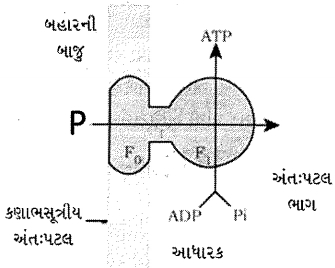
The following figure is a diagrammatic representation of $ATP$ synthesis in mitochondria. What is $P$ in it?
A
$H_2$
B
$H^+$
C
$H_2O$
D
$O_2$
Solution
(B) The figure shows the $F_0-F_1$ particle ($ATP$ synthase) located in the mitochondrial inner membrane.
$ATP$ synthesis occurs through chemiosmosis,which is driven by a proton gradient.
Protons $(H^+)$ flow from the intermembrane space (outside) into the mitochondrial matrix (inside) through the $F_0$ channel of the $ATP$ synthase complex.
This flow of protons provides the energy required for the phosphorylation of $ADP$ to $ATP$ in the $F_1$ headpiece.
Therefore,$P$ represents the flow of protons $(H^+)$.
$ATP$ synthesis occurs through chemiosmosis,which is driven by a proton gradient.
Protons $(H^+)$ flow from the intermembrane space (outside) into the mitochondrial matrix (inside) through the $F_0$ channel of the $ATP$ synthase complex.
This flow of protons provides the energy required for the phosphorylation of $ADP$ to $ATP$ in the $F_1$ headpiece.
Therefore,$P$ represents the flow of protons $(H^+)$.
0 likes
View Solution177
MediumMCQ
Where does the synthesis of $ATP$ from $ADP + Pi$ occur by $ATP$ synthase?
A
$F_0$
B
Matrix
C
Intermembrane space
D
$F_1$
Solution
(D) The $ATP$ synthase enzyme complex consists of two major components,$F_0$ and $F_1$.
$F_0$ is an integral membrane protein complex that forms a channel through which protons cross the inner mitochondrial membrane.
The $F_1$ headpiece is a peripheral membrane protein complex that protrudes into the mitochondrial matrix.
When protons flow through the $F_0$ channel into the matrix,the energy released is used by the $F_1$ subunit to catalyze the phosphorylation of $ADP$ to $ATP$ $(ADP + Pi \rightarrow ATP)$.
Therefore,the synthesis of $ATP$ occurs at the $F_1$ subunit.
$F_0$ is an integral membrane protein complex that forms a channel through which protons cross the inner mitochondrial membrane.
The $F_1$ headpiece is a peripheral membrane protein complex that protrudes into the mitochondrial matrix.
When protons flow through the $F_0$ channel into the matrix,the energy released is used by the $F_1$ subunit to catalyze the phosphorylation of $ADP$ to $ATP$ $(ADP + Pi \rightarrow ATP)$.
Therefore,the synthesis of $ATP$ occurs at the $F_1$ subunit.
0 likes
View Solution178
MediumMCQ
State the path of $H^+$ for the synthesis of $ATP$ by $ATP$ synthase.
A
Matrix $\rightarrow F_1 \rightarrow$ Intermembrane space
B
Intermembrane space $\rightarrow F_1 \rightarrow$ Matrix
C
Intermembrane space $\rightarrow F_0 \rightarrow$ Matrix
D
Matrix $\rightarrow F_0 \rightarrow$ Intermembrane space
Solution
(C) In the process of oxidative phosphorylation,$ATP$ synthase consists of two major components: $F_0$ and $F_1$.
$F_0$ is an integral membrane protein complex that forms a channel through which protons $(H^+)$ cross the inner mitochondrial membrane.
$F_1$ is a peripheral membrane protein complex that projects into the matrix and contains the site for $ATP$ synthesis.
Protons accumulate in the intermembrane space due to the electron transport chain,creating a proton gradient.
These protons flow back into the matrix through the $F_0$ channel,which provides the energy for $F_1$ to catalyze the synthesis of $ATP$ from $ADP$ and inorganic phosphate $(Pi)$.
Therefore,the path of $H^+$ is: Intermembrane space $\rightarrow F_0 \rightarrow$ Matrix.
$F_0$ is an integral membrane protein complex that forms a channel through which protons $(H^+)$ cross the inner mitochondrial membrane.
$F_1$ is a peripheral membrane protein complex that projects into the matrix and contains the site for $ATP$ synthesis.
Protons accumulate in the intermembrane space due to the electron transport chain,creating a proton gradient.
These protons flow back into the matrix through the $F_0$ channel,which provides the energy for $F_1$ to catalyze the synthesis of $ATP$ from $ADP$ and inorganic phosphate $(Pi)$.
Therefore,the path of $H^+$ is: Intermembrane space $\rightarrow F_0 \rightarrow$ Matrix.
0 likes
View Solution179
MediumMCQ
Which of the following is a peripheral membrane protein complex?
A
$F_1$
B
$F_0$
C
Complex-$I$
D
Complex-$II$
Solution
(A) In the mitochondrial electron transport system,the $F_1$ subunit of $ATP$ synthase is a peripheral membrane protein complex.
It is located on the matrix side of the inner mitochondrial membrane.
In contrast,$F_0$ is an integral membrane protein complex that acts as a proton channel.
Complex-$I$ and Complex-$II$ are also integral membrane protein complexes embedded within the inner mitochondrial membrane.
It is located on the matrix side of the inner mitochondrial membrane.
In contrast,$F_0$ is an integral membrane protein complex that acts as a proton channel.
Complex-$I$ and Complex-$II$ are also integral membrane protein complexes embedded within the inner mitochondrial membrane.
0 likes
View Solution180
MediumMCQ
The complex $II$ of mitochondrial electron transport chain is also known as
A
Cytochrome $bc_1$
B
Succinate dehydrogenase
C
Cytochrome $c$ oxidase
D
$NADH$ dehydrogenase
Solution
(B) Complex $II$ of the mitochondrial electron transport chain is $\text{Succinate dehydrogenase}$.
It is a membrane-bound enzyme that catalyzes the oxidation of succinate to fumarate in the citric acid cycle, while simultaneously reducing $FAD$ to $FADH_2$, which then transfers electrons to the electron transport chain.
It is a membrane-bound enzyme that catalyzes the oxidation of succinate to fumarate in the citric acid cycle, while simultaneously reducing $FAD$ to $FADH_2$, which then transfers electrons to the electron transport chain.
0 likes
View Solution181
EasyMCQ
Which complex of oxidative phosphorylation has two copper centers?
A
Complex $II$
B
Complex $IV$
C
Complex $V$
D
Complex $III$
Solution
(B) Complex $IV$,also known as cytochrome $c$ oxidase,is the final protein complex in the electron transport chain.
It contains two heme groups ($a$ and $a_3$) and two copper centers ($Cu_A$ and $Cu_B$).
The $Cu_A$ center receives electrons from cytochrome $c$,while the $Cu_B$ center,along with heme $a_3$,forms the active site where oxygen is reduced to water.
It contains two heme groups ($a$ and $a_3$) and two copper centers ($Cu_A$ and $Cu_B$).
The $Cu_A$ center receives electrons from cytochrome $c$,while the $Cu_B$ center,along with heme $a_3$,forms the active site where oxygen is reduced to water.
0 likes
View Solution182
DifficultMCQ
In the electron transport system in the inner mitochondrial membrane,complex-$I$ and $IV$ are respectively:
A
$NADH$ dehydrogenase and $FADH_2$
B
$FADH_2$ and $NADH$ dehydrogenase
C
$NADH$ dehydrogenase and cytochrome-$c$ oxidase complex
D
$NADH$ dehydrogenase and $ATP$ synthase
Solution
(C) In the electron transport system $(ETS)$ located in the inner mitochondrial membrane,the complexes are organized as follows:
$1$. Complex-$I$: $NADH$ dehydrogenase.
$2$. Complex-$II$: Succinate dehydrogenase.
$3$. Complex-$III$: Cytochrome $bc_1$ complex.
$4$. Complex-$IV$: Cytochrome-$c$ oxidase complex (containing cytochromes $a$ and $a_3$ and two copper centers).
$5$. Complex-$V$: $ATP$ synthase.
Therefore,Complex-$I$ is $NADH$ dehydrogenase and Complex-$IV$ is the cytochrome-$c$ oxidase complex.
$1$. Complex-$I$: $NADH$ dehydrogenase.
$2$. Complex-$II$: Succinate dehydrogenase.
$3$. Complex-$III$: Cytochrome $bc_1$ complex.
$4$. Complex-$IV$: Cytochrome-$c$ oxidase complex (containing cytochromes $a$ and $a_3$ and two copper centers).
$5$. Complex-$V$: $ATP$ synthase.
Therefore,Complex-$I$ is $NADH$ dehydrogenase and Complex-$IV$ is the cytochrome-$c$ oxidase complex.
0 likes
View Solution183
MediumMCQ
Cytochrome $C$ oxidase complex contains:
A
Cytochrome $a, a_3$ and one copper centre
B
Cytochrome $a$ and two copper centres
C
Cytochrome $a_3$ and one copper centre
D
Cytochrome $a, a_3$ and two copper centres
Solution
(D) The Cytochrome $C$ oxidase complex is known as Complex $IV$ in the electron transport system $(ETS)$.
It contains two cytochromes,$a$ and $a_3$,and two copper centers ($Cu_A$ and $Cu_B$).
These components work together to transfer electrons from cytochrome $c$ to molecular oxygen,reducing it to water.
It contains two cytochromes,$a$ and $a_3$,and two copper centers ($Cu_A$ and $Cu_B$).
These components work together to transfer electrons from cytochrome $c$ to molecular oxygen,reducing it to water.
0 likes
View Solution184
EasyMCQ
During $\text{ETS}$,ubiquinone receives reducing equivalents via
A
Complex $IV$
B
Complex $III$
C
Complex $V$
D
Complex $II$
Solution
(D) In the Electron Transport System $(\text{ETS})$,ubiquinone (also known as Coenzyme $Q$) acts as a mobile electron carrier within the inner mitochondrial membrane.
It receives reducing equivalents (electrons) from two main sources:
$1$. From $\text{Complex } I$ ($\text{NADH}$ dehydrogenase) via the oxidation of $\text{NADH}$.
$2$. From $\text{Complex } II$ (Succinate dehydrogenase) via the oxidation of succinate to fumarate.
Since $\text{Complex } II$ is one of the primary donors of electrons to ubiquinone,the correct option is $\text{Complex } II$.
It receives reducing equivalents (electrons) from two main sources:
$1$. From $\text{Complex } I$ ($\text{NADH}$ dehydrogenase) via the oxidation of $\text{NADH}$.
$2$. From $\text{Complex } II$ (Succinate dehydrogenase) via the oxidation of succinate to fumarate.
Since $\text{Complex } II$ is one of the primary donors of electrons to ubiquinone,the correct option is $\text{Complex } II$.
0 likes
View Solution185
MediumMCQ
Select the wrong match :
A
Cytochrome $c$ oxidase $-$ Cytochromes $a$ and $a_3$
B
Cytochrome $c -$ Mobile electron carrier
C
Ubiquinone $-$ Located within the inner membrane
D
Complex $\text{V}$ of $\text{ETS} -$ Transfers electrons between complex $\text{III & IV}$
Solution
(D) In the Electron Transport System $(ETS)$,Complex $\text{V}$ is $ATP$ synthase,which is responsible for the synthesis of $ATP$ from $ADP$ and inorganic phosphate using the proton gradient.
Complex $\text{III}$ (Cytochrome $bc_1$ complex) and Complex $\text{IV}$ (Cytochrome $c$ oxidase) are linked by Cytochrome $c$,which acts as a mobile electron carrier.
Therefore,the statement that Complex $\text{V}$ transfers electrons between Complex $\text{III}$ and $\text{IV}$ is incorrect.
Complex $\text{III}$ (Cytochrome $bc_1$ complex) and Complex $\text{IV}$ (Cytochrome $c$ oxidase) are linked by Cytochrome $c$,which acts as a mobile electron carrier.
Therefore,the statement that Complex $\text{V}$ transfers electrons between Complex $\text{III}$ and $\text{IV}$ is incorrect.
0 likes
View Solution186
MediumMCQ
Electron transport system occurs in $:-$
A
Outer membrane of mitochondria
B
Cristae of mitochondria
C
Matrix of mitochondria
D
Golgi body
Solution
(B) The Electron Transport System $(ETS)$ is a series of protein complexes and electron carrier molecules located in the inner mitochondrial membrane.
These complexes are embedded within the folds of the inner membrane,which are known as cristae.
The $ETS$ facilitates the transfer of electrons from $NADH$ and $FADH_2$ to oxygen,creating a proton gradient that drives the synthesis of $ATP$ via oxidative phosphorylation.
These complexes are embedded within the folds of the inner membrane,which are known as cristae.
The $ETS$ facilitates the transfer of electrons from $NADH$ and $FADH_2$ to oxygen,creating a proton gradient that drives the synthesis of $ATP$ via oxidative phosphorylation.
0 likes
View Solution187
MediumMCQ
Which of the following is not a component of complex-$IV$ (cytochrome-$c$ oxidase)?
A
cyt-$a$
B
cyt-$a_3$
C
cyt-$c$
D
Two copper centres
Solution
(C) Complex-$IV$ of the electron transport system $(ETS)$ is known as cytochrome-$c$ oxidase.
It contains cytochromes $a$ and $a_3$,and two copper centres.
Cytochrome-$c$ is a small protein that acts as a mobile electron carrier between complex-$III$ and complex-$IV$.
Therefore,cytochrome-$c$ is not a component of complex-$IV$ itself.
It contains cytochromes $a$ and $a_3$,and two copper centres.
Cytochrome-$c$ is a small protein that acts as a mobile electron carrier between complex-$III$ and complex-$IV$.
Therefore,cytochrome-$c$ is not a component of complex-$IV$ itself.
0 likes
View Solution188
EasyMCQ
The ultimate electron acceptor in $ETS$ of aerobic respiration is . . . . . . .
A
Cytochrome $a$
B
molecular oxygen
C
glucose
D
hydrogen
Solution
(B) In the electron transport system $(ETS)$ of aerobic respiration,the electrons are passed through a series of complexes.
At the end of this chain,molecular oxygen $(O_2)$ acts as the final or ultimate electron acceptor.
It combines with electrons and protons to form water $(H_2O)$,which is essential for the continuation of the process.
At the end of this chain,molecular oxygen $(O_2)$ acts as the final or ultimate electron acceptor.
It combines with electrons and protons to form water $(H_2O)$,which is essential for the continuation of the process.
0 likes
View Solution189
EasyMCQ
Match the electron carriers and reduced substances in Column $I$ with respiratory complexes in Column $II$. Choose the correct option given below.
| Column $I$ | Column $II$ |
| $i.$ $FADH_2$ | $a.$ Complex $III$ |
| $ii.$ Ubiquinol | $b.$ Complex $IV$ |
| $iii.$ $NADH + H^{+}$ | $c.$ Complex $II$ |
| $iv.$ Cytochrome $C$ | $d.$ Complex $I$ |
A
$i-b, ii-a, iii-c, iv-d$
B
$i-c, ii-a, iii-d, iv-b$
C
$i-b, ii-d, iii-a, iv-c$
D
$i-b, ii-c, iii-a, iv-d$
Solution
(B) The correct matching is as follows:
$i.$ $FADH_2$ is oxidized by Complex $II$ (Succinate dehydrogenase).
$ii.$ Ubiquinol $(QH_2)$ transfers electrons to Complex $III$ (Cytochrome $bc_1$ complex).
$iii.$ $NADH + H^{+}$ is oxidized by Complex $I$ ($NADH$ dehydrogenase).
$iv.$ Cytochrome $C$ transfers electrons to Complex $IV$ (Cytochrome $c$ oxidase).
Thus, the correct sequence is $i-c, ii-a, iii-d, iv-b$.
$i.$ $FADH_2$ is oxidized by Complex $II$ (Succinate dehydrogenase).
$ii.$ Ubiquinol $(QH_2)$ transfers electrons to Complex $III$ (Cytochrome $bc_1$ complex).
$iii.$ $NADH + H^{+}$ is oxidized by Complex $I$ ($NADH$ dehydrogenase).
$iv.$ Cytochrome $C$ transfers electrons to Complex $IV$ (Cytochrome $c$ oxidase).
Thus, the correct sequence is $i-c, ii-a, iii-d, iv-b$.
0 likes
View Solution190
EasyMCQ
Which mitochondrial complex donates electrons to molecular oxygen during $ETS$?
A
Complex $I$
B
Complex $II$
C
Complex $III$
D
Complex $IV$
Solution
(D) Complex $IV$,also known as cytochrome $c$ oxidase,is the mitochondrial complex that donates electrons to molecular oxygen during the Electron Transport Chain $(ETC)$.
It is the final complex in the $ETC$ and plays a crucial role in transferring electrons to oxygen to form water $(H_2O)$.
It is the final complex in the $ETC$ and plays a crucial role in transferring electrons to oxygen to form water $(H_2O)$.
0 likes
View Solution191
EasyMCQ
How many molecules of $ATP$ are generated through $ETS$ after complete oxidation of one glucose molecule?
A
One
B
Thirty four
C
Ten
D
Eight
Solution
(B) The net gain of $ATP$ by the complete oxidation of $1$ glucose molecule is $38$ $ATP$ molecules.
Out of these,$4$ $ATP$ molecules are produced via substrate-level phosphorylation (during glycolysis and the Krebs cycle).
The remaining $34$ $ATP$ molecules are generated through oxidative phosphorylation via the Electron Transport System $(ETS)$.
Out of these,$4$ $ATP$ molecules are produced via substrate-level phosphorylation (during glycolysis and the Krebs cycle).
The remaining $34$ $ATP$ molecules are generated through oxidative phosphorylation via the Electron Transport System $(ETS)$.
0 likes
View Solution192
EasyMCQ
The enzymes required for $ETS$ are arranged in/on . . . . . . .
A
inner membrane of mitochondria
B
mitochondrial matrix
C
outer chamber of mitochondria
D
outer membrane of mitochondria
Solution
(A) The Electron Transport System $(ETS)$ is a series of protein complexes and electron carriers embedded in the inner mitochondrial membrane.
These complexes ($Complex$ $I$ to $IV$) and $ATP$ synthase ($Complex$ $V$) facilitate the transfer of electrons from $NADH$ and $FADH_2$ to oxygen,creating a proton gradient that drives $ATP$ synthesis.
Therefore,the inner mitochondrial membrane is the site where these enzymes are organized.
These complexes ($Complex$ $I$ to $IV$) and $ATP$ synthase ($Complex$ $V$) facilitate the transfer of electrons from $NADH$ and $FADH_2$ to oxygen,creating a proton gradient that drives $ATP$ synthesis.
Therefore,the inner mitochondrial membrane is the site where these enzymes are organized.
0 likes
View Solution193
EasyMCQ
Given below are two statements.
Statement-$I$: Cytochrome $c$ is a small, copper-containing protein loosely attached to the inner membrane.
Statement-$II$: Cytochrome $c$ acts as a mobile electron carrier transferring electrons between complex $I$, $II$, and $IV$.
In the light of the above statements, choose the correct answer from the options given below.
Statement-$I$: Cytochrome $c$ is a small, copper-containing protein loosely attached to the inner membrane.
Statement-$II$: Cytochrome $c$ acts as a mobile electron carrier transferring electrons between complex $I$, $II$, and $IV$.
In the light of the above statements, choose the correct answer from the options given below.
A
Statement-$I$ is correct but Statement-$II$ is incorrect.
B
Both Statement-$I$ and Statement-$II$ are correct.
C
Both Statement-$I$ and Statement-$II$ are incorrect.
D
Statement-$I$ is incorrect but Statement-$II$ is correct.
Solution
(C) Statement-$I$ is incorrect because Cytochrome $c$ is an iron-containing protein, not copper-containing.
Statement-$II$ is incorrect because Cytochrome $c$ acts as a mobile electron carrier that transfers electrons specifically between Complex-$III$ and Complex-$IV$, not between Complex-$I$, $II$, and $IV$.
Statement-$II$ is incorrect because Cytochrome $c$ acts as a mobile electron carrier that transfers electrons specifically between Complex-$III$ and Complex-$IV$, not between Complex-$I$, $II$, and $IV$.
0 likes
View Solution194
EasyMCQ
The carriers and enzymes of $ETS$ found on the inner mitochondrial membrane for complex $I$ and $IV$ are . . . . . . and . . . . . . respectively.
A
$NADH$ dehydrogenase and Cytochrome c oxidase
B
$NADH$ dehydrogenase and $FADH_2$
C
Cytochrome $bc_1$,Succinate dehydrogenase
D
$NADH$ dehydrogenase,Succinate dehydrogenase
Solution
(A) $NADH + H^+$ is oxidized by $NADH$ dehydrogenase (complex $I$).
Complex $IV$ is known as cytochrome $c$ oxidase,which contains cytochromes $a$ and $a_3$ along with two copper centers.
Therefore,complex $I$ is $NADH$ dehydrogenase and complex $IV$ is cytochrome $c$ oxidase.
Complex $IV$ is known as cytochrome $c$ oxidase,which contains cytochromes $a$ and $a_3$ along with two copper centers.
Therefore,complex $I$ is $NADH$ dehydrogenase and complex $IV$ is cytochrome $c$ oxidase.
0 likes
View Solution195
EasyMCQ
What is ubiquinol?
A
Oxidized ubiquinone
B
Coenzyme $Q$
C
Ubiquinone
D
Reduced ubiquinone
Solution
(D) Ubiquinone (also known as Coenzyme $Q$) is a lipid-soluble electron carrier in the electron transport chain $(ETC)$ of mitochondria.
It exists in three redox states: fully oxidized (ubiquinone),semi-reduced (semiquinone),and fully reduced (ubiquinol).
Ubiquinol is the fully reduced form of ubiquinone,which carries two electrons and two protons $(H^+)$ during the process of cellular respiration.
It exists in three redox states: fully oxidized (ubiquinone),semi-reduced (semiquinone),and fully reduced (ubiquinol).
Ubiquinol is the fully reduced form of ubiquinone,which carries two electrons and two protons $(H^+)$ during the process of cellular respiration.
0 likes
View Solution196
EasyMCQ
Given below are two statements.
$Statement-I$: During aerobic respiration, $ETS$ releases energy in a stepwise manner to prevent damage to cells.
$Statement-II$: During aerobic respiration, $ETS$ provides water molecules.
In the light of the above statements, choose the correct answer from the options given below.
$Statement-I$: During aerobic respiration, $ETS$ releases energy in a stepwise manner to prevent damage to cells.
$Statement-II$: During aerobic respiration, $ETS$ provides water molecules.
In the light of the above statements, choose the correct answer from the options given below.
A
$Statement-I$ is incorrect but $Statement-II$ is correct.
B
Both $Statement-I$ and $Statement-II$ are correct.
C
Both $Statement-I$ and $Statement-II$ are incorrect.
D
$Statement-I$ is correct but $Statement-II$ is incorrect.
Solution
(B) $Statement-I$ is correct: The Electron Transport System $(ETS)$ releases energy in a stepwise manner to ensure that the energy is captured efficiently in the form of $ATP$ and to prevent the sudden release of energy which could damage the cell.
$Statement-II$ is correct: During the final step of $ETS$, oxygen acts as the final electron acceptor and combines with protons and electrons to form water molecules $(H_2O)$.
$Statement-II$ is correct: During the final step of $ETS$, oxygen acts as the final electron acceptor and combines with protons and electrons to form water molecules $(H_2O)$.
0 likes
View Solution197
EasyMCQ
Given below are two statements.
Statement-$I$: During aerobic respiration,$ETS$ regenerates co-enzymes such as $NAD^+$ and $FAD^+$ from their reduced forms $NADH + H^+$ and $FADH_2$.
Statement-$II$: During aerobic respiration,$ETS$ generates a major amount of energy in the form of $ATP$ molecules.
In the light of the above statements,choose the correct answer from the options given below.
Statement-$I$: During aerobic respiration,$ETS$ regenerates co-enzymes such as $NAD^+$ and $FAD^+$ from their reduced forms $NADH + H^+$ and $FADH_2$.
Statement-$II$: During aerobic respiration,$ETS$ generates a major amount of energy in the form of $ATP$ molecules.
In the light of the above statements,choose the correct answer from the options given below.
A
Both Statement-$I$ and Statement-$II$ are correct.
B
Both Statement-$I$ and Statement-$II$ are incorrect.
C
Statement-$I$ is correct but Statement-$II$ is incorrect.
D
Statement-$I$ is incorrect but Statement-$II$ is correct.
Solution
(A) Statement-$I$ is correct: During the Electron Transport System $(ETS)$,the reduced co-enzymes $NADH + H^+$ and $FADH_2$ are oxidized to regenerate $NAD^+$ and $FAD^+$,which are then reused in the earlier stages of respiration (Glycolysis and Krebs cycle).
Statement-$II$ is correct: The primary function of the $ETS$ is to facilitate oxidative phosphorylation,where the energy released from electron transfer is used to synthesize a large amount of $ATP$ molecules from $ADP$ and inorganic phosphate $(Pi)$.
Therefore,both statements are correct.
Statement-$II$ is correct: The primary function of the $ETS$ is to facilitate oxidative phosphorylation,where the energy released from electron transfer is used to synthesize a large amount of $ATP$ molecules from $ADP$ and inorganic phosphate $(Pi)$.
Therefore,both statements are correct.
0 likes
View Solution198
EasyMCQ
During aerobic respiration,the total number of $ATP$ formed through oxidative phosphorylation / $ETS$ from one glucose molecule is . . . . . . .
A
thirty
B
thirty eight
C
eight
D
thirty four
Solution
(D) In aerobic respiration,the complete oxidation of one glucose molecule yields $10$ $NADH$ and $2$ $FADH_2$ molecules.
Through the electron transport system $(ETS)$ and oxidative phosphorylation,each $NADH$ produces $3$ $ATP$ ($10 \times 3 = 30$ $ATP$) and each $FADH_2$ produces $2$ $ATP$ ($2 \times 2 = 4$ $ATP$).
Therefore,the total number of $ATP$ molecules produced specifically through oxidative phosphorylation is $30 + 4 = 34$ $ATP$.
Through the electron transport system $(ETS)$ and oxidative phosphorylation,each $NADH$ produces $3$ $ATP$ ($10 \times 3 = 30$ $ATP$) and each $FADH_2$ produces $2$ $ATP$ ($2 \times 2 = 4$ $ATP$).
Therefore,the total number of $ATP$ molecules produced specifically through oxidative phosphorylation is $30 + 4 = 34$ $ATP$.
0 likes
View Solution199
EasyMCQ
Which one of the following is the correct sequence of cytochromes in the order of their participation in the respiratory chain?
A
Cyt. $b-c_1 \rightarrow$ Cyt. $c \rightarrow$ Cyt. $a \rightarrow$ Cyt. $a_3$
B
Cyt. $a \rightarrow$ Cyt. $a_3 \rightarrow$ Cyt. $b-c_1 \rightarrow$ Cyt. $c$
C
Cyt. $b-c_1 \rightarrow$ Cyt. $a_3 \rightarrow$ Cyt. $a \rightarrow$ Cyt. $c$
D
Cyt. $a_3 \rightarrow$ Cyt. $a \rightarrow$ Cyt. $b-c_1 \rightarrow$ Cyt. $c$
Solution
(A) In the electron transport system $(ETS)$ of the mitochondrial inner membrane,electrons are transferred through a series of complexes.
Specifically,the sequence of electron carriers in the cytochrome chain is: Cyt. $b \rightarrow$ Cyt. $c_1 \rightarrow$ Cyt. $c \rightarrow$ Cyt. $a \rightarrow$ Cyt. $a_3$.
Complex $III$ contains Cyt. $b$ and Cyt. $c_1$,which transfers electrons to Cyt. $c$,and subsequently to Complex $IV$ (which contains Cyt. $a$ and Cyt. $a_3$).
Therefore,the correct sequence is Cyt. $b-c_1 \rightarrow$ Cyt. $c \rightarrow$ Cyt. $a \rightarrow$ Cyt. $a_3$.
Specifically,the sequence of electron carriers in the cytochrome chain is: Cyt. $b \rightarrow$ Cyt. $c_1 \rightarrow$ Cyt. $c \rightarrow$ Cyt. $a \rightarrow$ Cyt. $a_3$.
Complex $III$ contains Cyt. $b$ and Cyt. $c_1$,which transfers electrons to Cyt. $c$,and subsequently to Complex $IV$ (which contains Cyt. $a$ and Cyt. $a_3$).
Therefore,the correct sequence is Cyt. $b-c_1 \rightarrow$ Cyt. $c \rightarrow$ Cyt. $a \rightarrow$ Cyt. $a_3$.
0 likes
View Solution200
EasyMCQ
Co-enzymes of Electron Transport Chain in mitochondria are . . . . . . .
A
Cytochromes,dehydrogenases,flavoproteins
B
Cytochromes,catalases,peroxidases
C
Hyaluronidases,dehydrogenases,hydrolases
D
Flavoproteins,anhydrases,phosphatases
Solution
(A) The Electron Transport Chain $(ETC)$ located in the inner mitochondrial membrane consists of several protein complexes and mobile electron carriers.
Key components include $NADH$ dehydrogenase (Complex $I$),Succinate dehydrogenase (Complex $II$),Cytochrome $bc_1$ complex (Complex $III$),and Cytochrome $c$ oxidase (Complex $IV$).
These complexes contain prosthetic groups and co-enzymes such as flavoproteins ($FMN$,$FAD$),iron-sulfur proteins,and cytochromes.
Dehydrogenases are enzymes that catalyze the removal of hydrogen atoms from substrates,and they often utilize flavoproteins as co-enzymes to facilitate electron transfer.
Therefore,the correct group consisting of components/co-enzymes involved in the $ETC$ is Cytochromes,dehydrogenases,and flavoproteins.
Key components include $NADH$ dehydrogenase (Complex $I$),Succinate dehydrogenase (Complex $II$),Cytochrome $bc_1$ complex (Complex $III$),and Cytochrome $c$ oxidase (Complex $IV$).
These complexes contain prosthetic groups and co-enzymes such as flavoproteins ($FMN$,$FAD$),iron-sulfur proteins,and cytochromes.
Dehydrogenases are enzymes that catalyze the removal of hydrogen atoms from substrates,and they often utilize flavoproteins as co-enzymes to facilitate electron transfer.
Therefore,the correct group consisting of components/co-enzymes involved in the $ETC$ is Cytochromes,dehydrogenases,and flavoproteins.
0 likes
View SolutionRespiration in Plants — ETS · Frequently Asked Questions
1Are these Respiration in Plants questions useful for JEE and NEET?
Yes. All questions in this section are mapped to JEE Main and NEET exam patterns. Previous year questions from JEE Main, NEET, GUJCET and state-level exams are included with full solutions.
2Can I switch to Hindi or Gujarati for these questions?
Yes. Use the language tabs in the hero section or the sidebar to view the same questions and solutions in English, Hindi or Gujarati.
3How do I generate a question paper from this subtopic?
Use the Vedclass Exam Paper Generator — select the chapter and subtopic, set difficulty, and generate Sets A, B, C, D automatically. First 3 chapters of every subject are free.
Vedclass Products
For Students
Vedclass Test Series
Mock tests in real JEE/NEET style with performance analysis. 5-day free trial.
Start Free TrialFor Teachers
Exam Paper Generator
Generate Set A/B/C/D papers from this chapter in 2 minutes. 3 chapters free.
Try FreeFor Institutes
Online Exam Module
Live online exams with unlimited students, 360° analytics & white-label branding.
See DemoFor Teachers & Institutes
Generate a Respiration in Plants Exam Paper in 2 Minutes
Select subtopic & difficulty — Sets A, B, C, D auto-generated with No Repeat logic.
First 3 chapters of every subject are free — no payment required.