
A English
ETS Questions in English
Class 11 Biology · Respiration in Plants · ETS
209+
Questions
English
Language
100%
With Solutions
Showing 50 of 209 questions in English
101
EasyMCQ
Choose the correct sequence of cytochromes in the Electron Transport System $(ETS)$.
A
$Cyt$ $a, a_3, b, c$
B
$Cyt$ $b, c, a, a_3$
C
$Cyt$ $c, b, a, a_3$
D
$Cyt$ $b, c, a_3, a$
Solution
(B) In the mitochondrial Electron Transport System $(ETS)$,electrons are transferred through a series of complexes.
Specifically,the sequence of cytochromes involved in the electron transport chain is $Cyt$ $b \rightarrow Cyt$ $c_1 \rightarrow Cyt$ $c \rightarrow Cyt$ $a \rightarrow Cyt$ $a_3$.
Therefore,the correct order among the given options is $Cyt$ $b, c, a, a_3$.
Specifically,the sequence of cytochromes involved in the electron transport chain is $Cyt$ $b \rightarrow Cyt$ $c_1 \rightarrow Cyt$ $c \rightarrow Cyt$ $a \rightarrow Cyt$ $a_3$.
Therefore,the correct order among the given options is $Cyt$ $b, c, a, a_3$.
0 likes
View Solution102
MediumMCQ
Where does oxidative phosphorylation occur?
A
In the outer membrane of mitochondria
B
On the outer side of mitochondria
C
In the cristae of mitochondria
D
In the chloroplast
Solution
(C) Oxidative phosphorylation is the process in which $ATP$ is synthesized during the electron transport system $(ETS)$.
This process occurs in the inner mitochondrial membrane,specifically within the cristae (folds of the inner membrane).
The enzymes and electron carriers required for $ETS$ and oxidative phosphorylation are embedded in the inner mitochondrial membrane.
Therefore,the correct location is the cristae of the mitochondria.
This process occurs in the inner mitochondrial membrane,specifically within the cristae (folds of the inner membrane).
The enzymes and electron carriers required for $ETS$ and oxidative phosphorylation are embedded in the inner mitochondrial membrane.
Therefore,the correct location is the cristae of the mitochondria.
0 likes
View Solution103
MediumMCQ
Where are the enzymes for the $ETS$ (Electron Transport System) found in the mitochondria?
A
Stroma
B
Outer membrane
C
Inner membrane
D
Between the outer and inner membrane
Solution
(C) The Electron Transport System $(ETS)$ is located in the inner mitochondrial membrane.
These enzymes,organized into complexes ($I$ through $IV$) and $ATP$ synthase ($Complex$ $V$),are embedded within the inner membrane to facilitate the transfer of electrons and the synthesis of $ATP$ via oxidative phosphorylation.
These enzymes,organized into complexes ($I$ through $IV$) and $ATP$ synthase ($Complex$ $V$),are embedded within the inner membrane to facilitate the transfer of electrons and the synthesis of $ATP$ via oxidative phosphorylation.
0 likes
View Solution104
EasyMCQ
Cytochromes are .........
A
Metallo flavoproteins
B
$Fe$-containing porphyrin pigments
C
Glycoproteins
D
Lipids
Solution
(B) Cytochromes are iron-containing hemoproteins that act as electron carriers in the electron transport chain $(ETC)$.
They contain a heme group,which is a porphyrin ring with a central iron $(Fe)$ atom.
These proteins are essential for cellular respiration and photosynthesis.
Therefore,they are classified as $Fe$-containing porphyrin pigments.
They contain a heme group,which is a porphyrin ring with a central iron $(Fe)$ atom.
These proteins are essential for cellular respiration and photosynthesis.
Therefore,they are classified as $Fe$-containing porphyrin pigments.
0 likes
View Solution105
MediumMCQ
In photosynthesis and respiration,$ATP$ synthesis occurs through oxidation processes. From where is the energy obtained for this process?
A
Cytochromes
B
Ferredoxin
C
Electrons
D
Carbon dioxide
Solution
(C) In both photosynthesis (photophosphorylation) and respiration (oxidative phosphorylation),$ATP$ synthesis is driven by the movement of electrons through an electron transport chain $(ETC)$.
As electrons move from a higher energy state to a lower energy state through various carriers (like cytochromes or ferredoxin),they release energy.
This released energy is used to pump protons $(H^+)$ across a membrane,creating a proton gradient.
The dissipation of this proton gradient through $ATP$ synthase provides the energy required to phosphorylate $ADP$ into $ATP$.
Therefore,the energy for $ATP$ synthesis is derived from the movement of electrons.
As electrons move from a higher energy state to a lower energy state through various carriers (like cytochromes or ferredoxin),they release energy.
This released energy is used to pump protons $(H^+)$ across a membrane,creating a proton gradient.
The dissipation of this proton gradient through $ATP$ synthase provides the energy required to phosphorylate $ADP$ into $ATP$.
Therefore,the energy for $ATP$ synthesis is derived from the movement of electrons.
0 likes
View Solution106
MediumMCQ
Which final cytochrome in the respiratory chain donates electrons to oxygen?
A
$Cyt \, b$
B
$Cyt \, c$
C
$Cyt \, a$
D
$Cyt \, a_3$
Solution
(D) In the electron transport system $(ETS)$ of aerobic respiration,the final complex is Complex $IV$,also known as cytochrome $c$ oxidase.
This complex contains cytochromes $a$ and $a_3$,along with two copper centers.
The cytochrome $a_3$ is the terminal component that transfers electrons directly to the final electron acceptor,which is oxygen $(O_2)$,to form water $(H_2O)$.
This complex contains cytochromes $a$ and $a_3$,along with two copper centers.
The cytochrome $a_3$ is the terminal component that transfers electrons directly to the final electron acceptor,which is oxygen $(O_2)$,to form water $(H_2O)$.
0 likes
View Solution107
MediumMCQ
What is produced by oxidative phosphorylation?
A
$ATP$ in photosynthesis
B
$ATP$ in respiration
C
$NADPH$ in photosynthesis
D
$NADPH$ in respiration
Solution
(B) Oxidative phosphorylation is the process in which $ATP$ is formed as a result of the transfer of electrons from $NADH$ or $FADH_2$ to $O_2$ by a series of electron carriers.
This process occurs in the inner mitochondrial membrane during cellular respiration.
In contrast,photophosphorylation is the process of $ATP$ synthesis in the chloroplast during photosynthesis.
Therefore,oxidative phosphorylation is specifically associated with the production of $ATP$ during respiration.
This process occurs in the inner mitochondrial membrane during cellular respiration.
In contrast,photophosphorylation is the process of $ATP$ synthesis in the chloroplast during photosynthesis.
Therefore,oxidative phosphorylation is specifically associated with the production of $ATP$ during respiration.
0 likes
View Solution108
MediumMCQ
Out of $38$ $ATP$ molecules produced per glucose,$32$ $ATP$ molecules are generated from $NADH/FADH_2$ in which of the following processes?
A
Respiratory chain
B
Krebs cycle
C
Oxidative decarboxylation
D
$EMP$ pathway
Solution
(A) In aerobic respiration,the complete oxidation of one glucose molecule yields $38$ $ATP$ molecules.
Out of these,$4$ $ATP$ are produced via substrate-level phosphorylation (two from glycolysis and two from the Krebs cycle).
The remaining $32$ $ATP$ molecules are generated through the Electron Transport System $(ETS)$ or Respiratory chain,where $NADH$ and $FADH_2$ are oxidized to produce $ATP$ via oxidative phosphorylation.
Out of these,$4$ $ATP$ are produced via substrate-level phosphorylation (two from glycolysis and two from the Krebs cycle).
The remaining $32$ $ATP$ molecules are generated through the Electron Transport System $(ETS)$ or Respiratory chain,where $NADH$ and $FADH_2$ are oxidized to produce $ATP$ via oxidative phosphorylation.
0 likes
View Solution109
MediumMCQ
The introduction of cyanide into $ATP$ synthesis becomes toxic because it $..........$
A
is required for cellular functions.
B
is required for the $Na^+ - K^+$ pump.
C
the $Na^+ - K^+$ pump occurs on the cell membrane.
D
$ATP$ breaks down cyanide.
Solution
(B) Cyanide is a potent inhibitor of the electron transport chain $(ETC)$,specifically binding to cytochrome c oxidase (Complex $IV$).
This inhibition prevents the final step of aerobic respiration,where oxygen is reduced to water.
As a result,the proton gradient across the inner mitochondrial membrane cannot be maintained,and $ATP$ synthesis stops.
Since $ATP$ is essential for vital cellular processes,including the active transport of ions via the $Na^+ - K^+$ pump,the cessation of $ATP$ production leads to cell death and toxicity.
This inhibition prevents the final step of aerobic respiration,where oxygen is reduced to water.
As a result,the proton gradient across the inner mitochondrial membrane cannot be maintained,and $ATP$ synthesis stops.
Since $ATP$ is essential for vital cellular processes,including the active transport of ions via the $Na^+ - K^+$ pump,the cessation of $ATP$ production leads to cell death and toxicity.
0 likes
View Solution110
MediumMCQ
What is produced at the end of oxidative phosphorylation where oxidation and phosphorylation occur simultaneously?
A
Pyruvate
B
$NADP$
C
$DPN$
D
$ATP$
Solution
(D) Oxidative phosphorylation is the metabolic pathway in which cells use enzymes to oxidize nutrients,thereby releasing energy which is used to produce $ATP$.
In this process,the electron transport chain $(ETC)$ facilitates the transfer of electrons from $NADH$ and $FADH_2$ to oxygen.
The energy released during this electron transfer is used to pump protons across the inner mitochondrial membrane,creating an electrochemical gradient.
Finally,$ATP$ synthase utilizes this gradient to phosphorylate $ADP$ into $ATP$.
Therefore,the final product of this process is $ATP$.
In this process,the electron transport chain $(ETC)$ facilitates the transfer of electrons from $NADH$ and $FADH_2$ to oxygen.
The energy released during this electron transfer is used to pump protons across the inner mitochondrial membrane,creating an electrochemical gradient.
Finally,$ATP$ synthase utilizes this gradient to phosphorylate $ADP$ into $ATP$.
Therefore,the final product of this process is $ATP$.
0 likes
View Solution111
MediumMCQ
In which stage of cellular respiration is the maximum number of $ATP$ molecules produced from $ADP$ through the complete oxidation of glucose?
A
Glycolysis
B
Krebs cycle
C
Conversion of pyruvic acid to acetyl $Co-A$
D
Electron Transport Chain $(ETC)$
Solution
(D) The complete oxidation of glucose involves several stages: Glycolysis,the Link reaction,the Krebs cycle,and the Electron Transport Chain $(ETC)$.
$1$. Glycolysis produces a net gain of $2 \ ATP$ molecules.
$2$. The Krebs cycle produces $2 \ GTP$ (which is equivalent to $2 \ ATP$) per glucose molecule.
$3$. The Electron Transport Chain $(ETC)$ is the final stage where the majority of $ATP$ is synthesized via oxidative phosphorylation.
$4$. During $ETC$,the oxidation of $NADH$ and $FADH_2$ provides the energy to pump protons,creating a gradient that drives $ATP$ synthase to produce approximately $28$ to $30 \ ATP$ molecules per glucose molecule.
Therefore,the maximum number of $ATP$ molecules is produced during the $ETC$.
$1$. Glycolysis produces a net gain of $2 \ ATP$ molecules.
$2$. The Krebs cycle produces $2 \ GTP$ (which is equivalent to $2 \ ATP$) per glucose molecule.
$3$. The Electron Transport Chain $(ETC)$ is the final stage where the majority of $ATP$ is synthesized via oxidative phosphorylation.
$4$. During $ETC$,the oxidation of $NADH$ and $FADH_2$ provides the energy to pump protons,creating a gradient that drives $ATP$ synthase to produce approximately $28$ to $30 \ ATP$ molecules per glucose molecule.
Therefore,the maximum number of $ATP$ molecules is produced during the $ETC$.
0 likes
View Solution112
MediumMCQ
According to the chemiosmotic coupling hypothesis,$ATP$ is synthesized in oxidative phosphorylation because:
A
High-energy bonds are formed in mitochondrial proteins.
B
$ADP$ is pumped out of the matrix into the intermembrane space.
C
$A$ proton gradient is formed across the inner membrane.
D
There is a change in the permeability of the inner mitochondrial membrane to $ADP$.
Solution
(C) The chemiosmotic coupling hypothesis,proposed by Peter Mitchell,explains that $ATP$ synthesis in mitochondria occurs due to the electrochemical gradient of protons ($H^+$ ions).
$1$. During the electron transport chain,protons are pumped from the mitochondrial matrix into the intermembrane space.
$2$. This creates a high concentration of protons in the intermembrane space compared to the matrix,establishing a proton gradient (or proton-motive force) across the inner mitochondrial membrane.
$3$. Protons flow back into the matrix through the $F_0-F_1$ $ATP$ synthase complex.
$4$. This flow of protons provides the energy required for the phosphorylation of $ADP$ to form $ATP$.
$1$. During the electron transport chain,protons are pumped from the mitochondrial matrix into the intermembrane space.
$2$. This creates a high concentration of protons in the intermembrane space compared to the matrix,establishing a proton gradient (or proton-motive force) across the inner mitochondrial membrane.
$3$. Protons flow back into the matrix through the $F_0-F_1$ $ATP$ synthase complex.
$4$. This flow of protons provides the energy required for the phosphorylation of $ADP$ to form $ATP$.
0 likes
View Solution113
MediumMCQ
Oxidative phosphorylation is...........
A
Addition of a phosphate group to $ATP$.
B
Formation of $ATP$ by energy released from electrons removed during substrate oxidation.
C
Formation of $ATP$ by the transfer of a phosphate group from a substrate to $ADP$.
D
Oxidation of a phosphate group in $ATP$.
Solution
(B) Oxidative phosphorylation is the process in which $ATP$ is synthesized from $ADP$ and inorganic phosphate $(Pi)$ using the energy released during the electron transport chain $(ETC)$.
In this process,electrons are removed from substrates (like $NADH$ and $FADH_2$) and passed through a series of electron carriers to oxygen.
The energy released during this electron transfer is used to pump protons across the inner mitochondrial membrane,creating a proton gradient.
The flow of protons back into the mitochondrial matrix through $ATP$ synthase drives the synthesis of $ATP$.
In this process,electrons are removed from substrates (like $NADH$ and $FADH_2$) and passed through a series of electron carriers to oxygen.
The energy released during this electron transfer is used to pump protons across the inner mitochondrial membrane,creating a proton gradient.
The flow of protons back into the mitochondrial matrix through $ATP$ synthase drives the synthesis of $ATP$.
0 likes
View Solution114
DifficultMCQ
What is the role of $NAD^+$ in cellular respiration?
A
It is the final electron acceptor for anaerobic respiration.
B
It functions as an enzyme.
C
It is a nucleotide source for $ATP$ synthesis.
D
It functions as an electron carrier.
Solution
(D) $NAD^+$ (Nicotinamide Adenine Dinucleotide) acts as a coenzyme in cellular respiration.
Its primary role is to accept high-energy electrons and hydrogen ions during metabolic pathways such as glycolysis,the link reaction,and the Krebs cycle.
By accepting these electrons,it gets reduced to $NADH$.
This $NADH$ then transports these electrons to the electron transport system $(ETS)$ located in the inner mitochondrial membrane,where they are used to generate $ATP$.
Therefore,$NAD^+$ functions as an electron carrier.
Its primary role is to accept high-energy electrons and hydrogen ions during metabolic pathways such as glycolysis,the link reaction,and the Krebs cycle.
By accepting these electrons,it gets reduced to $NADH$.
This $NADH$ then transports these electrons to the electron transport system $(ETS)$ located in the inner mitochondrial membrane,where they are used to generate $ATP$.
Therefore,$NAD^+$ functions as an electron carrier.
0 likes
View Solution115
MediumMCQ
In the electron transport chain during terminal oxidation,the cytochrome,which donates electrons to $O_2$ is
A
Cytochrome $-b$
B
Cytochrome $-c$
C
Cytochrome $-a_3$
D
Cytochrome $-f$
Solution
(C) In the $ETS$ (Electron Transport System) or respiratory chain,there are several cytochromes including $b$,$c_1$,$c$,$a$,and $a_3$.
Cytochrome $a_3$ is the terminal cytochrome of the $ETS$.
It is responsible for donating electrons directly to $O_2$,which acts as the final electron acceptor.
This process leads to the reduction of $O_2$ and the formation of metabolic water.
Cytochrome $a_3$ is the terminal cytochrome of the $ETS$.
It is responsible for donating electrons directly to $O_2$,which acts as the final electron acceptor.
This process leads to the reduction of $O_2$ and the formation of metabolic water.
0 likes
View Solution116
EasyMCQ
Where is the respiratory electron transport system $(ETS)$ located in plants?
A
Mitochondrial matrix
B
Outer mitochondrial membrane
C
Inner mitochondrial membrane
D
Intermembrane space
Solution
(C) The respiratory electron transport system $(ETS)$ in plants is located in the inner mitochondrial membrane.
This system consists of a series of protein complexes $(Complexes I-IV)$ and electron carriers that facilitate the transfer of electrons from $NADH$ and $FADH_2$ to oxygen.
The energy released during this electron transport is used to pump protons from the matrix into the intermembrane space,creating a proton gradient that drives $ATP$ synthesis via $ATP$ synthase.
This system consists of a series of protein complexes $(Complexes I-IV)$ and electron carriers that facilitate the transfer of electrons from $NADH$ and $FADH_2$ to oxygen.
The energy released during this electron transport is used to pump protons from the matrix into the intermembrane space,creating a proton gradient that drives $ATP$ synthesis via $ATP$ synthase.
0 likes
View Solution117
Difficult
Explain $ETS$.
Solution
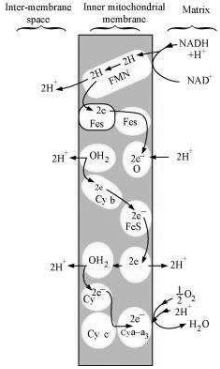
(N/A) $ETS$ or electron transport system is located in the inner mitochondrial membrane. It facilitates the release and utilization of energy stored in $NADH + H^+$ and $FADH_2$,which are formed during glycolysis and the citric acid cycle. $NADH + H^+$ is oxidized by $NADH$ dehydrogenase (complex $I$). The electrons generated are transferred to ubiquinone through $FMN$. Similarly,$FADH_2$ (complex $II$) generated during the citric acid cycle transfers its electrons to ubiquinone. The electrons from ubiquinone are received by cytochrome $bc_1$ (complex $III$) and further transferred to cytochrome $c$. Cytochrome $c$ acts as a mobile carrier between complex $III$ and the cytochrome $c$ oxidase complex,which contains cytochrome $a$ and $a_3$ along with copper centers (complex $IV$).
During the transfer of electrons through these complexes,the process is coupled with the synthesis of $ATP$ from $ADP$ and inorganic phosphate by the action of $ATP$ synthase (complex $V$). The amount of $ATP$ produced depends on the molecule being oxidized. Generally,the oxidation of one molecule of $NADH$ yields $3$ $ATP$ molecules,and the oxidation of one molecule of $FADH_2$ yields $2$ $ATP$ molecules.
During the transfer of electrons through these complexes,the process is coupled with the synthesis of $ATP$ from $ADP$ and inorganic phosphate by the action of $ATP$ synthase (complex $V$). The amount of $ATP$ produced depends on the molecule being oxidized. Generally,the oxidation of one molecule of $NADH$ yields $3$ $ATP$ molecules,and the oxidation of one molecule of $FADH_2$ yields $2$ $ATP$ molecules.
0 likes
View Solution118
Medium
What is oxidative phosphorylation?
Solution
(N/A) Oxidative phosphorylation is a process in which electrons are transferred from electron donors to oxygen,which acts as the final electron acceptor.
This process involves oxidation-reduction reactions that lead to the formation of a proton gradient across the inner mitochondrial membrane.
The main role in oxidative phosphorylation is played by the enzyme $ATP$ synthase (complex $V$).
This enzyme complex consists of $F_{0}$ and $F_{1}$ components.
The $F_{1}$ headpiece is a peripheral membrane protein complex and contains the site for $ATP$ synthesis from $ADP$ and inorganic phosphate.
The $F_{0}$ component is an integral membrane protein complex that acts as a channel for the movement of protons from the intermembrane space to the mitochondrial matrix.
For every two protons passing through the $F_{0}-F_{1}$ complex,the synthesis of one $ATP$ molecule takes place.
This process involves oxidation-reduction reactions that lead to the formation of a proton gradient across the inner mitochondrial membrane.
The main role in oxidative phosphorylation is played by the enzyme $ATP$ synthase (complex $V$).
This enzyme complex consists of $F_{0}$ and $F_{1}$ components.
The $F_{1}$ headpiece is a peripheral membrane protein complex and contains the site for $ATP$ synthesis from $ADP$ and inorganic phosphate.
The $F_{0}$ component is an integral membrane protein complex that acts as a channel for the movement of protons from the intermembrane space to the mitochondrial matrix.
For every two protons passing through the $F_{0}-F_{1}$ complex,the synthesis of one $ATP$ molecule takes place.
0 likes
View Solution119
Medium
Describe: Electron Transport System $(ETS)$ and oxidative phosphorylation.
Solution
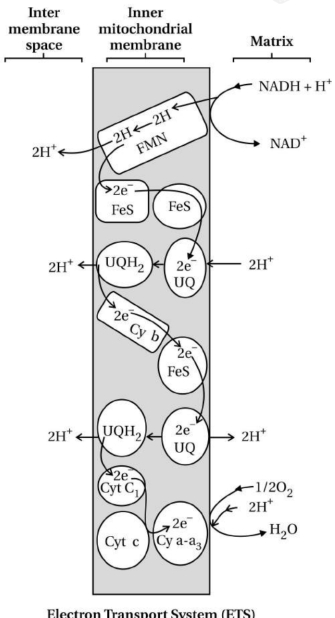
(N/A) The respiratory process releases and utilizes the energy stored in $NADH+H^{+}$ and $FADH_{2}$. This is accomplished when they are oxidized through the electron transport system,and the electrons are passed on to $O_{2}$,resulting in the formation of $H_{2}O$.
The metabolic pathway through which electrons pass from one carrier to another is called the electron transport system $(ETS)$.
It is located in the inner mitochondrial membrane.
Electrons from $NADH$ produced in the mitochondrial matrix during the citric acid cycle are oxidized by an $NADH$ dehydrogenase $(Complex-I)$.
Electrons are then transferred to ubiquinone located within the inner membrane.
Ubiquinone also receives reducing equivalents via $FADH_{2}$ $(Complex-II)$,which is generated during the oxidation of succinate in the citric acid cycle.
The reduced ubiquinone is then oxidized with the transfer of electrons to cytochrome $c$ via the cytochrome $bc_{1}$ complex $(Complex-III)$.
Cytochrome $c$ is a small protein attached to the outer surface of the inner membrane and acts as a mobile carrier for the transfer of electrons between $Complex-III$ and $IV$.
$Complex-IV$ refers to the cytochrome $c$ oxidase complex containing cytochromes $a$ and $a_{3}$,and two copper centers.
$ATP$ formation in $ETS$:
When electrons pass from one carrier to another via $Complex-I$ to $IV$ in the electron transport chain,they are coupled to $ATP$ synthase $(Complex-V)$ for the production of $ATP$ from $ADP$ and inorganic phosphate.
The number of $ATP$ molecules synthesized depends on the nature of the electron donor.
Oxidation of one molecule of $NADH$ gives rise to $3$ molecules of $ATP$,while that of one molecule of $FADH_{2}$ produces $2$ molecules of $ATP$.
Although the aerobic process of respiration takes place only in the presence of oxygen,the role of oxygen is limited to the terminal stage of the process. Yet,the presence of oxygen is vital,since it drives the whole process by removing hydrogen from the system.
Oxygen acts as the final hydrogen acceptor (for the production of $H_{2}O$).
In respiration,the energy of oxidation-reduction is utilized for the same process. It is for this reason that the process is called oxidative phosphorylation.
The metabolic pathway through which electrons pass from one carrier to another is called the electron transport system $(ETS)$.
It is located in the inner mitochondrial membrane.
Electrons from $NADH$ produced in the mitochondrial matrix during the citric acid cycle are oxidized by an $NADH$ dehydrogenase $(Complex-I)$.
Electrons are then transferred to ubiquinone located within the inner membrane.
Ubiquinone also receives reducing equivalents via $FADH_{2}$ $(Complex-II)$,which is generated during the oxidation of succinate in the citric acid cycle.
The reduced ubiquinone is then oxidized with the transfer of electrons to cytochrome $c$ via the cytochrome $bc_{1}$ complex $(Complex-III)$.
Cytochrome $c$ is a small protein attached to the outer surface of the inner membrane and acts as a mobile carrier for the transfer of electrons between $Complex-III$ and $IV$.
$Complex-IV$ refers to the cytochrome $c$ oxidase complex containing cytochromes $a$ and $a_{3}$,and two copper centers.
$ATP$ formation in $ETS$:
When electrons pass from one carrier to another via $Complex-I$ to $IV$ in the electron transport chain,they are coupled to $ATP$ synthase $(Complex-V)$ for the production of $ATP$ from $ADP$ and inorganic phosphate.
The number of $ATP$ molecules synthesized depends on the nature of the electron donor.
Oxidation of one molecule of $NADH$ gives rise to $3$ molecules of $ATP$,while that of one molecule of $FADH_{2}$ produces $2$ molecules of $ATP$.
Although the aerobic process of respiration takes place only in the presence of oxygen,the role of oxygen is limited to the terminal stage of the process. Yet,the presence of oxygen is vital,since it drives the whole process by removing hydrogen from the system.
Oxygen acts as the final hydrogen acceptor (for the production of $H_{2}O$).
In respiration,the energy of oxidation-reduction is utilized for the same process. It is for this reason that the process is called oxidative phosphorylation.
0 likes
View Solution120
Easy
Describe the reaction occurring in the membrane of cristae of mitochondria.
Solution
(N/A) The respiratory process releases and utilizes energy stored in $NADH+H^{+}$ and $FADH_{2}$.
This is accomplished when they are oxidized through the electron transport system $(ETS)$,and electrons are passed to $O_{2}$,resulting in the formation of $H_{2}O$.
The metabolic pathway through which electrons pass from one carrier to another is called the electron transport system $(ETS)$,which is present in the inner mitochondrial membrane.
Electrons from $NADH$ produced in the mitochondrial matrix during the citric acid cycle are oxidized by $NADH$ dehydrogenase (Complex-$I$).
Electrons are then transferred to ubiquinone located within the inner membrane.
Ubiquinone also receives reducing equivalents via $FADH_{2}$ (Complex-$II$),which is generated during the oxidation of succinate in the citric acid cycle.
The reduced ubiquinone is then oxidized with the transfer of electrons to cytochrome $c$ via the cytochrome $bc_{1}$ complex (Complex-$III$).
Cytochrome $c$ is a small protein attached to the outer surface of the inner membrane and acts as a mobile carrier for the transfer of electrons between Complex-$III$ and Complex-$IV$.
Complex-$IV$ refers to the cytochrome $c$ oxidase complex containing cytochromes $a$ and $a_{3}$,and two copper centers.
$ATP$ formation in $ETS$: When electrons pass from one carrier to another via Complex-$I$ to $IV$ in the electron transport chain,they are coupled to $ATP$ synthase (Complex-$V$) for the production of $ATP$ from $ADP$ and inorganic phosphate.
The number of $ATP$ molecules synthesized depends on the nature of the electron donor. Oxidation of one molecule of $NADH$ gives rise to $3$ molecules of $ATP$,while that of one molecule of $FADH_{2}$ produces $2$ molecules of $ATP$.
Although the aerobic process of respiration takes place only in the presence of oxygen,the role of oxygen is limited to the terminal stage of the process. Yet,the presence of oxygen is vital,since it drives the whole process by removing hydrogen from the system. Oxygen acts as the final hydrogen acceptor for the production of $H_{2}O$.
In respiration,the energy of oxidation-reduction is utilized for this process; hence,it is called oxidative phosphorylation.
This is accomplished when they are oxidized through the electron transport system $(ETS)$,and electrons are passed to $O_{2}$,resulting in the formation of $H_{2}O$.
The metabolic pathway through which electrons pass from one carrier to another is called the electron transport system $(ETS)$,which is present in the inner mitochondrial membrane.
Electrons from $NADH$ produced in the mitochondrial matrix during the citric acid cycle are oxidized by $NADH$ dehydrogenase (Complex-$I$).
Electrons are then transferred to ubiquinone located within the inner membrane.
Ubiquinone also receives reducing equivalents via $FADH_{2}$ (Complex-$II$),which is generated during the oxidation of succinate in the citric acid cycle.
The reduced ubiquinone is then oxidized with the transfer of electrons to cytochrome $c$ via the cytochrome $bc_{1}$ complex (Complex-$III$).
Cytochrome $c$ is a small protein attached to the outer surface of the inner membrane and acts as a mobile carrier for the transfer of electrons between Complex-$III$ and Complex-$IV$.
Complex-$IV$ refers to the cytochrome $c$ oxidase complex containing cytochromes $a$ and $a_{3}$,and two copper centers.
$ATP$ formation in $ETS$: When electrons pass from one carrier to another via Complex-$I$ to $IV$ in the electron transport chain,they are coupled to $ATP$ synthase (Complex-$V$) for the production of $ATP$ from $ADP$ and inorganic phosphate.
The number of $ATP$ molecules synthesized depends on the nature of the electron donor. Oxidation of one molecule of $NADH$ gives rise to $3$ molecules of $ATP$,while that of one molecule of $FADH_{2}$ produces $2$ molecules of $ATP$.
Although the aerobic process of respiration takes place only in the presence of oxygen,the role of oxygen is limited to the terminal stage of the process. Yet,the presence of oxygen is vital,since it drives the whole process by removing hydrogen from the system. Oxygen acts as the final hydrogen acceptor for the production of $H_{2}O$.
In respiration,the energy of oxidation-reduction is utilized for this process; hence,it is called oxidative phosphorylation.
0 likes
View Solution121
Medium
Explain the chemiosmotic hypothesis.
Solution
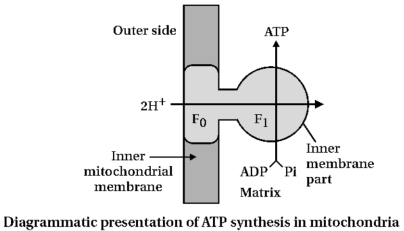
(N/A) The chemiosmotic hypothesis explains how the energy released during the electron transport system is utilized to synthesize $ATP$ with the help of $ATP$ synthase (complex $V$).
The $ATP$ synthase complex consists of two major components: $F_{0}$ and $F_{1}$.
The $F_{1}$ headpiece is a peripheral membrane protein complex that contains the catalytic site for the synthesis of $ATP$ from $ADP$ and inorganic phosphate $(ADP + Pi \rightarrow ATP)$.
$F_{0}$ is an integral membrane protein complex that forms a transmembrane channel through which protons $(H^{+})$ cross the inner mitochondrial membrane.
The passage of protons through this channel is coupled to the catalytic site of the $F_{1}$ component,which drives the production of $ATP$.
For each $ATP$ molecule produced,$2 H^{+}$ ions pass through the $F_{0}$ channel from the intermembrane space into the matrix,moving down the electrochemical proton gradient.
This flow of protons provides the necessary energy to drive the conformational changes in $ATP$ synthase,resulting in the synthesis of $ATP$.
The $ATP$ synthase complex consists of two major components: $F_{0}$ and $F_{1}$.
The $F_{1}$ headpiece is a peripheral membrane protein complex that contains the catalytic site for the synthesis of $ATP$ from $ADP$ and inorganic phosphate $(ADP + Pi \rightarrow ATP)$.
$F_{0}$ is an integral membrane protein complex that forms a transmembrane channel through which protons $(H^{+})$ cross the inner mitochondrial membrane.
The passage of protons through this channel is coupled to the catalytic site of the $F_{1}$ component,which drives the production of $ATP$.
For each $ATP$ molecule produced,$2 H^{+}$ ions pass through the $F_{0}$ channel from the intermembrane space into the matrix,moving down the electrochemical proton gradient.
This flow of protons provides the necessary energy to drive the conformational changes in $ATP$ synthase,resulting in the synthesis of $ATP$.
0 likes
View Solution122
Medium
Give an explanation of the synthesis of $ATP$ in mitochondria.
Solution
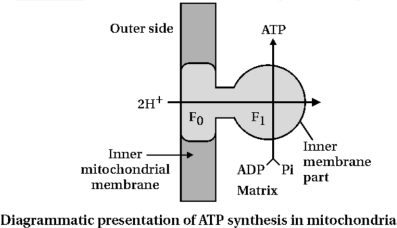
(N/A) The energy released during the electron transport system is utilized in synthesizing $ATP$ with the help of $ATP$ synthase (complex $V$).
This complex consists of two major components,$F_{0}$ and $F_{1}$.
The $F_{1}$ headpiece is a peripheral membrane protein complex and contains the site for the synthesis of $ATP$ from $ADP$ and inorganic phosphate $(ADP + Pi \rightarrow ATP)$.
$F_{0}$ is an integral membrane protein complex that forms the channel through which protons cross the inner membrane.
The passage of protons through the channel is coupled to the catalytic site of the $F_{1}$ component for the production of $ATP$.
For each $ATP$ produced,$2 H^{+}$ ions pass through $F_{0}$ from the intermembrane space to the matrix,moving down the electrochemical proton gradient.
Thus,$ATP$ is synthesized.
This complex consists of two major components,$F_{0}$ and $F_{1}$.
The $F_{1}$ headpiece is a peripheral membrane protein complex and contains the site for the synthesis of $ATP$ from $ADP$ and inorganic phosphate $(ADP + Pi \rightarrow ATP)$.
$F_{0}$ is an integral membrane protein complex that forms the channel through which protons cross the inner membrane.
The passage of protons through the channel is coupled to the catalytic site of the $F_{1}$ component for the production of $ATP$.
For each $ATP$ produced,$2 H^{+}$ ions pass through $F_{0}$ from the intermembrane space to the matrix,moving down the electrochemical proton gradient.
Thus,$ATP$ is synthesized.
0 likes
View Solution123
Easy
Oxygen is an essential requirement for aerobic respiration, but it enters the respiratory process at the end. Discuss.
Solution
(N/A) In aerobic respiration, $O_{2}$ acts as the final electron acceptor in the Electron Transport System $(ETS)$.
Although the entire process of respiration involves glycolysis, the Krebs cycle, and the $ETS$, $O_{2}$ is specifically required at the very end of the $ETS$.
It combines with electrons and protons $(H^{+})$ to form water $(H_{2}O)$.
By removing electrons from the last cytochrome $(Cyt a_{3})$, $O_{2}$ allows the continuous flow of electrons through the $ETS$, which is essential for the generation of the proton gradient required for $ATP$ synthesis via oxidative phosphorylation.
Without $O_{2}$, the $ETS$ would stop, leading to the accumulation of reduced coenzymes ($NADH$ and $FADH_{2}$) and the cessation of $ATP$ production.
Although the entire process of respiration involves glycolysis, the Krebs cycle, and the $ETS$, $O_{2}$ is specifically required at the very end of the $ETS$.
It combines with electrons and protons $(H^{+})$ to form water $(H_{2}O)$.
By removing electrons from the last cytochrome $(Cyt a_{3})$, $O_{2}$ allows the continuous flow of electrons through the $ETS$, which is essential for the generation of the proton gradient required for $ATP$ synthesis via oxidative phosphorylation.
Without $O_{2}$, the $ETS$ would stop, leading to the accumulation of reduced coenzymes ($NADH$ and $FADH_{2}$) and the cessation of $ATP$ production.
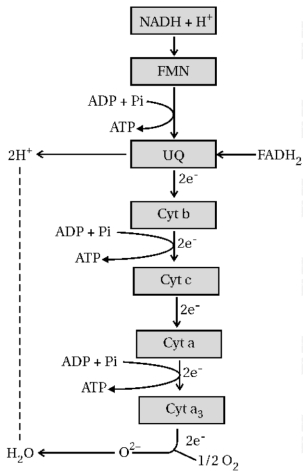
0 likes
View Solution124
Medium
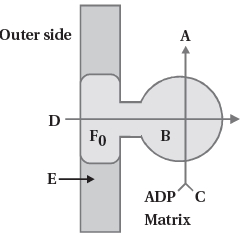
Given below is a diagram showing $ATP$ synthesis during aerobic respiration. Replace the symbols $A, B, C, D$ and $E$ with the appropriate terms from the following list: $F_1$ particle,formation of $Pi$,$2H^+$,inner mitochondrial membrane,$ATP$,$F_0$ particle,$ADP$.
Solution
(A-ATP, B-F1 PARTICLE, C-PI, D-2H+, E-INNER MITOCHONDRIAL MEMBRANE) Based on the mechanism of oxidative phosphorylation in the mitochondria:
$A$ represents $ATP$,which is the final product of the reaction.
$B$ represents the $F_1$ particle (the catalytic head of the $ATP$ synthase enzyme).
$C$ represents the inorganic phosphate $(Pi)$ required for the phosphorylation of $ADP$ to $ATP$.
$D$ represents the flow of $2H^+$ ions from the intermembrane space into the matrix through the $F_0$ particle.
$E$ represents the inner mitochondrial membrane,where the $ATP$ synthase complex is embedded.
$A$ represents $ATP$,which is the final product of the reaction.
$B$ represents the $F_1$ particle (the catalytic head of the $ATP$ synthase enzyme).
$C$ represents the inorganic phosphate $(Pi)$ required for the phosphorylation of $ADP$ to $ATP$.
$D$ represents the flow of $2H^+$ ions from the intermembrane space into the matrix through the $F_0$ particle.
$E$ represents the inner mitochondrial membrane,where the $ATP$ synthase complex is embedded.
0 likes
View Solution125
Medium
Oxygen is critical for aerobic respiration. Explain its role with respect to $ETS$.
Solution
(N/A) The importance of $O_{2}$ in aerobic respiration is as follows:
$1$. Aerobic respiration begins with the glycolysis of glucose in the cytoplasm.
$2$. This is followed by the Krebs cycle,and finally,the Electron Transport System $(ETS)$ occurs in the inner mitochondrial membrane.
$3$. $O_{2}$ acts as the final electron acceptor in the $ETS$.
$4$. It accepts electrons and protons to form water $(H_{2}O)$.
$5$. If $O_{2}$ is absent,electrons cannot pass through the electron transport chain,preventing the formation of a proton gradient across the inner mitochondrial membrane.
$6$. Consequently,the proton pump stops,and $ATP$ synthesis via oxidative phosphorylation cannot occur. Thus,$O_{2}$ is essential for the completion of aerobic respiration.
$1$. Aerobic respiration begins with the glycolysis of glucose in the cytoplasm.
$2$. This is followed by the Krebs cycle,and finally,the Electron Transport System $(ETS)$ occurs in the inner mitochondrial membrane.
$3$. $O_{2}$ acts as the final electron acceptor in the $ETS$.
$4$. It accepts electrons and protons to form water $(H_{2}O)$.
$5$. If $O_{2}$ is absent,electrons cannot pass through the electron transport chain,preventing the formation of a proton gradient across the inner mitochondrial membrane.
$6$. Consequently,the proton pump stops,and $ATP$ synthesis via oxidative phosphorylation cannot occur. Thus,$O_{2}$ is essential for the completion of aerobic respiration.
0 likes
View Solution126
MediumMCQ
Cyanide kills an animal by
A
Killing the brain cells
B
Competitive inhibitor of enzyme cytochrome oxidase
C
Inhibiting cytochrome oxidase,a mitochondrial enzyme essential for cellular respiration by non-competitive inhibition
D
Killing the cells of cardiac muscles
Solution
(C) Cyanide acts as a potent metabolic poison. It binds to the iron atom in the heme group of the cytochrome $c$ oxidase enzyme (complex $IV$) in the mitochondrial electron transport chain. This binding is a classic example of non-competitive inhibition,which prevents the enzyme from transferring electrons to oxygen. Consequently,cellular respiration is halted,$ATP$ production ceases,and the organism dies due to the inability of cells to produce energy.
0 likes
View Solution127
MediumMCQ
The substance which is essential for both respiration and photosynthesis is:
A
Cytochrome
B
RuBisCo
C
Plastocyanin
D
Ubiquinone
Solution
(A) Cytochromes are iron-containing hemoproteins that act as electron carriers in the electron transport chain. They play a crucial role in both cellular respiration (in the mitochondria) and photosynthesis (in the chloroplasts) by facilitating the transfer of electrons.
0 likes
View Solution128
EasyMCQ
Electron Transport System $(ETS)$ occurs in
A
Inner mitochondrial membrane
B
Outer mitochondrial membrane
C
Both $(a)$ and $(b)$
D
Not specific place
Solution
(A) The Electron Transport System $(ETS)$ is located in the inner mitochondrial membrane. During the citric acid cycle,$NADH$ is produced in the mitochondrial matrix. These electrons are oxidized by an $NADH$ dehydrogenase (Complex $I$) and are subsequently transferred to ubiquinone,which is located within the inner mitochondrial membrane.
0 likes
View Solution129
EasyMCQ
Which of the following processes takes place in the mitochondria?
A
Photolysis
B
Photophosphorylation
C
Carboxylation
D
Oxidative phosphorylation
Solution
(D) The respiratory chain,which is responsible for oxidative phosphorylation,is located in the inner mitochondrial membrane.
Photolysis and photophosphorylation occur in the chloroplasts during photosynthesis.
Carboxylation is a key step in the Calvin cycle,which also occurs in the chloroplasts.
Photolysis and photophosphorylation occur in the chloroplasts during photosynthesis.
Carboxylation is a key step in the Calvin cycle,which also occurs in the chloroplasts.
0 likes
View Solution130
EasyMCQ
Chemiosmotic mechanism of $ATP$ production in aerobic respiration was given by
A
Krebs
B
Calvin
C
Hatch and Slack
D
Peter Mitchell
Solution
(D) The chemiosmotic hypothesis for $ATP$ synthesis was proposed by Peter Mitchell in $1961$.
This mechanism explains how a proton gradient across the inner mitochondrial membrane drives the synthesis of $ATP$ via $ATP$ synthase.
This mechanism explains how a proton gradient across the inner mitochondrial membrane drives the synthesis of $ATP$ via $ATP$ synthase.
0 likes
View Solution131
EasyMCQ
The last electron acceptor in respiration is
A
Oxygen
B
Hydrogen
C
Carbon dioxide
D
$NADH$
Solution
(A) The electron transport chain $(ETC)$ occurs in the inner mitochondrial membrane and consists of various electron carriers such as flavins,ubiquinone,and cytochromes.
In aerobic respiration,electrons are passed through these carriers to the final electron acceptor.
The sequence of electron transport is:
$NADH + H^+ \rightarrow FMN \rightarrow Co-Q \rightarrow Cyt-b \rightarrow Cyt-c_1 \rightarrow Cyt-c \rightarrow Cyt-a \rightarrow Cyt-a_3 \rightarrow O_2$.
Oxygen $(O_2)$ acts as the final electron acceptor,where it combines with electrons and protons to form water $(H_2O)$.
In aerobic respiration,electrons are passed through these carriers to the final electron acceptor.
The sequence of electron transport is:
$NADH + H^+ \rightarrow FMN \rightarrow Co-Q \rightarrow Cyt-b \rightarrow Cyt-c_1 \rightarrow Cyt-c \rightarrow Cyt-a \rightarrow Cyt-a_3 \rightarrow O_2$.
Oxygen $(O_2)$ acts as the final electron acceptor,where it combines with electrons and protons to form water $(H_2O)$.
0 likes
View Solution132
MediumMCQ
Which of these are respiratory poisons or inhibitors of electron transport chain?
A
Cyanides
B
Antimycin-$A$
C
Carbon monoxide
D
All of these
Solution
(D) Respiratory poisons are substances that inhibit the process of cellular respiration by blocking the electron transport chain $(ETC)$.
$1$. Cyanides inhibit cytochrome $c$ oxidase (Complex $IV$) in the $ETC$.
$2$. Antimycin-$A$ inhibits the oxidation of ubiquinol by cytochrome $c$ reductase (Complex $III$).
$3$. Carbon monoxide binds to the iron in cytochrome $c$ oxidase,similar to cyanide,thereby blocking the electron flow.
Therefore,all the listed substances act as inhibitors of the electron transport chain.
$1$. Cyanides inhibit cytochrome $c$ oxidase (Complex $IV$) in the $ETC$.
$2$. Antimycin-$A$ inhibits the oxidation of ubiquinol by cytochrome $c$ reductase (Complex $III$).
$3$. Carbon monoxide binds to the iron in cytochrome $c$ oxidase,similar to cyanide,thereby blocking the electron flow.
Therefore,all the listed substances act as inhibitors of the electron transport chain.
0 likes
View Solution133
MediumMCQ
The haem protein complexes,which act as oxidizing agents are known as
A
Haemoglobin
B
Myoglobin
C
Chlorophyll
D
Cytochrome
Solution
(D) Cytochromes are small proteins (intrinsic membrane proteins) that contain a cofactor,haem,which holds an iron atom.
The iron carries electrons and cycles between $+2$ and $+3$ oxidation states.
These form a part of the electron transport chain in mitochondria and chloroplasts and act as electron transporters or electron acceptors in respiration and photosynthesis.
The iron carries electrons and cycles between $+2$ and $+3$ oxidation states.
These form a part of the electron transport chain in mitochondria and chloroplasts and act as electron transporters or electron acceptors in respiration and photosynthesis.
0 likes
View Solution134
MediumMCQ
The metabolic pathway through which the electron passes from one carrier to another is called:
A
Electron transport system
B
Electron procedure system
C
Electron moving procedure
D
None of the above
Solution
(A) The metabolic pathway through which electrons pass from one carrier to another is known as the Electron Transport System $(ETS)$.
This system is located in the inner mitochondrial membrane of eukaryotic cells.
It involves a series of protein complexes that facilitate the transfer of electrons,ultimately leading to the production of $ATP$ through oxidative phosphorylation.
This system is located in the inner mitochondrial membrane of eukaryotic cells.
It involves a series of protein complexes that facilitate the transfer of electrons,ultimately leading to the production of $ATP$ through oxidative phosphorylation.
0 likes
View Solution135
MediumMCQ
The process by which $ATP$ is produced in the inner membrane of a mitochondrion,where the electron transport system transfers protons from the inner compartment to the outer,and as the protons flow back to the inner compartment,the energy of their movement is used to add phosphate to $ADP$,forming $ATP$,is known as:
A
Chemiosmosis
B
Phosphorylation
C
Glycolysis
D
Fermentation
Solution
(A) Chemiosmosis is the movement of ions across a semi-permeable membrane,down their electrochemical gradient.
In the context of cellular respiration,it refers to the generation of $ATP$ by the movement of hydrogen ions $(H^+)$ across the inner mitochondrial membrane.
The electron transport system creates a proton gradient by pumping protons from the mitochondrial matrix to the intermembrane space.
As these protons flow back into the matrix through the $ATP$ synthase enzyme,the energy released is used to phosphorylate $ADP$ into $ATP$.
This mechanism occurs in mitochondria,chloroplasts,and many bacteria.
In the context of cellular respiration,it refers to the generation of $ATP$ by the movement of hydrogen ions $(H^+)$ across the inner mitochondrial membrane.
The electron transport system creates a proton gradient by pumping protons from the mitochondrial matrix to the intermembrane space.
As these protons flow back into the matrix through the $ATP$ synthase enzyme,the energy released is used to phosphorylate $ADP$ into $ATP$.
This mechanism occurs in mitochondria,chloroplasts,and many bacteria.
0 likes
View Solution136
MediumMCQ
Choose the correct combination of $A$ and $B$ in accordance with the $NCERT$ textbook.
The $NADH$ synthesised in ...$A$... is transferred into the mitochondria and undergoes oxidative ...$B$...
The $NADH$ synthesised in ...$A$... is transferred into the mitochondria and undergoes oxidative ...$B$...
A
$A-EMP; B-carboxylation$
B
$A-ETS; B-phosphorylation$
C
$A-glycolysis; B-phosphorylation$
D
$A-TCA cycle; B-decarboxylation$
Solution
(C) During the process of glycolysis,$NADH$ is produced in the cytoplasm.
This $NADH$ is then transported into the mitochondria to participate in the electron transport system.
Inside the mitochondria,it undergoes oxidative phosphorylation to produce $ATP$.
This $NADH$ is then transported into the mitochondria to participate in the electron transport system.
Inside the mitochondria,it undergoes oxidative phosphorylation to produce $ATP$.
0 likes
View Solution137
MediumMCQ
Which one of the following is the terminal electron acceptor?
A
Molecular $CO_{2}$
B
Molecular $O_{2}$
C
Molecular $H_{2}$
D
$NADPH_{2}$
Solution
(B) In the electron transport chain $(ETC)$,the final step involves the transfer of electrons to oxygen.
Cytochrome $a_{3}$ (part of cytochrome $c$ oxidase complex) transfers electrons to molecular oxygen $(O_{2})$.
Oxygen acts as the terminal electron acceptor and combines with protons $(H^{+})$ to form water $(H_{2}O)$.
Therefore,molecular $O_{2}$ is the terminal electron acceptor in aerobic respiration.
Cytochrome $a_{3}$ (part of cytochrome $c$ oxidase complex) transfers electrons to molecular oxygen $(O_{2})$.
Oxygen acts as the terminal electron acceptor and combines with protons $(H^{+})$ to form water $(H_{2}O)$.
Therefore,molecular $O_{2}$ is the terminal electron acceptor in aerobic respiration.
0 likes
View Solution138
MediumMCQ
Which one of the following is complex $V$ of the $ETS$ of the inner mitochondrial membrane?
A
$NADH$ Dehydrogenase
B
Cytochrome oxidase
C
Ubiquinone
D
$ATP$ synthase
Solution
(D) The complex $V$ of the $ETS$ of the mitochondrial membrane is $ATP$ synthase.
It consists of a head piece,a stalk,and a base piece.
The head piece is identified as the coupling factor $1$ $(F_{1})$,the stalk portion is necessary for binding to the inner mitochondrial membrane,and the base piece is isolated as $F_{0}$,which is embedded within the inner mitochondrial membrane.
It consists of a head piece,a stalk,and a base piece.
The head piece is identified as the coupling factor $1$ $(F_{1})$,the stalk portion is necessary for binding to the inner mitochondrial membrane,and the base piece is isolated as $F_{0}$,which is embedded within the inner mitochondrial membrane.
0 likes
View Solution139
MediumMCQ
Which of the following enzymes is/are found attached to the inner membrane of the mitochondria instead of the matrix?
A
Succinic Dehydrogenase
B
Cytochrome oxidase
C
Both $(a)$ and $(b)$
D
Malic Dehydrogenase
Solution
(C) Most enzymes of the Krebs' cycle,fatty acid synthesis,and amino acid synthesis are located in the mitochondrial matrix.
However,Succinic dehydrogenase (a component of Complex $II$) and Cytochrome oxidase (a component of Complex $IV$ of the Electron Transport Chain) are specifically embedded within the inner mitochondrial membrane.
However,Succinic dehydrogenase (a component of Complex $II$) and Cytochrome oxidase (a component of Complex $IV$ of the Electron Transport Chain) are specifically embedded within the inner mitochondrial membrane.
0 likes
View Solution140
MediumMCQ
During which stage in the complete oxidation of glucose are the greatest number of $ATP$ molecules formed?
A
Conversion of pyruvic acid to acetyl Co-$A$
B
Electron transport chain
C
Glycolysis
D
Krebs' cycle
Solution
(B) The complete oxidation of glucose involves several stages.
In glycolysis,a net gain of $2$ $ATP$ molecules is achieved.
In the Krebs' cycle,$2$ $ATP$ (or $GTP$) molecules are produced directly.
The Electron Transport Chain $(ETC)$ is the final stage where the majority of $ATP$ is synthesized through oxidative phosphorylation.
Specifically,the oxidation of $NADH$ and $FADH_2$ produced in earlier stages yields approximately $34$ $ATP$ molecules.
Therefore,the greatest number of $ATP$ molecules is formed during the Electron transport chain.
In glycolysis,a net gain of $2$ $ATP$ molecules is achieved.
In the Krebs' cycle,$2$ $ATP$ (or $GTP$) molecules are produced directly.
The Electron Transport Chain $(ETC)$ is the final stage where the majority of $ATP$ is synthesized through oxidative phosphorylation.
Specifically,the oxidation of $NADH$ and $FADH_2$ produced in earlier stages yields approximately $34$ $ATP$ molecules.
Therefore,the greatest number of $ATP$ molecules is formed during the Electron transport chain.
0 likes
View Solution141
MediumMCQ
Oxidative phosphorylation refers to
A
Anaerobic production of $ATP$
B
The citric acid cycle production of $ATP$
C
Production of $ATP$ by chemiosmosis
D
Alcoholic fermentation
Solution
(C) Oxidative phosphorylation refers to the synthesis of $ATP$ from $ADP$ and inorganic phosphate by chemiosmosis. It occurs with the help of energy obtained from the oxidation of reduced coenzymes ($NADH$ and $FADH_2$) produced during glycolysis and the citric acid cycle. This process takes place in the inner mitochondrial membrane.
0 likes
View Solution142
MediumMCQ
The correct sequence of electron acceptors in $ATP$ synthesis is:
A
$cyt-a, a_{3}, b, c$
B
$cyt-b, c, a, a_{3}$
C
$cyt-b, c, a_{3}, a$
D
$cyt-c, b, a, a_{3}$
Solution
(B) In the electron transport system $(ETS)$ of the inner mitochondrial membrane,electrons are transferred through a series of carriers. The correct sequence of cytochromes involved in the electron transport chain is $cyt-b \rightarrow cyt-c \rightarrow cyt-a \rightarrow cyt-a_{3}$. Therefore,the correct sequence is $cyt-b, c, a, a_{3}$.
0 likes
View Solution143
MediumMCQ
The main purpose of the electron transport chain is to
A
Cycle $NADH + H^+$ back to $NAD^+$
B
Use the intermediates from the $TCA$ cycle
C
Break down pyruvic acid
D
All of the above
Solution
(A) The primary purpose of the electron transport chain $(ETC)$ is to release and utilize the energy stored in $NADH + H^+$ and $FADH_2$. This is accomplished when these molecules are oxidized through the electron transport system,and the electrons are passed on to $O_2$,resulting in the formation of $H_2O$ and the regeneration of $NAD^+$ and $FAD$.
0 likes
View Solution144
MediumMCQ
$A$ scientist added a chemical (cyanide) to an animal cell to stop aerobic respiration. Which of the following is most likely to have been affected by this treatment?
A
Active transport of substances across the plasma membrane
B
Passive transport of substances across the plasma membrane
C
Diffusion of substances across the plasma membrane
D
The thickness of the plasma membrane
Solution
(A) Cyanide reacts with one of the proteins (cytochrome-$a_3$) in the electron transport system and prevents the transfer of electrons to oxygen.
This leads to the inhibition of $ATP$ formation through oxidative phosphorylation.
$ATP$ is required for the active transport of substances across the plasma membrane,in addition to other metabolic reactions.
Therefore,active transport is the process most likely to be affected by the lack of $ATP$.
This leads to the inhibition of $ATP$ formation through oxidative phosphorylation.
$ATP$ is required for the active transport of substances across the plasma membrane,in addition to other metabolic reactions.
Therefore,active transport is the process most likely to be affected by the lack of $ATP$.
0 likes
View Solution145
EasyMCQ
Where does $ETS$ occur in our body?
A
Cytoplasm
B
Mitochondrial matrix
C
Inner mitochondrial membrane
D
Outer mitochondrial membrane
Solution
(C) $ETS$ (Electron Transport System) occurs in the inner mitochondrial membrane of the mitochondria. This is where the complexes of the electron transport chain are located,facilitating the synthesis of $ATP$ through oxidative phosphorylation.
0 likes
View Solution146
MediumMCQ
How many complexes are involved in the electron transport system $(ETS)$ in mitochondria?
A
$1$
B
$2$
C
$4$
D
$5$
Solution
(C) The electron transport system $(ETS)$ in the inner mitochondrial membrane consists of four major protein complexes involved in the transfer of electrons:
$1$. Complex-$I$ ($NADH$ dehydrogenase)
$2$. Complex-$II$ (Succinate dehydrogenase)
$3$. Complex-$III$ (Cytochrome $bc_1$ complex)
$4$. Complex-$IV$ (Cytochrome $c$ oxidase)
Although $ATP$ synthase is often referred to as Complex-$V$,it is involved in oxidative phosphorylation ($ATP$ synthesis) rather than the electron transport chain itself. Therefore,$4$ complexes are primarily involved in the electron transport process.
$1$. Complex-$I$ ($NADH$ dehydrogenase)
$2$. Complex-$II$ (Succinate dehydrogenase)
$3$. Complex-$III$ (Cytochrome $bc_1$ complex)
$4$. Complex-$IV$ (Cytochrome $c$ oxidase)
Although $ATP$ synthase is often referred to as Complex-$V$,it is involved in oxidative phosphorylation ($ATP$ synthesis) rather than the electron transport chain itself. Therefore,$4$ complexes are primarily involved in the electron transport process.
0 likes
View Solution147
MediumMCQ
The complex which transfers electrons from $FADH_2$ to the $ETS$ is:
A
$I$
B
$II$
C
$III$
D
$IV$
Solution
(B) In the Electron Transport System $(ETS)$,electrons derived from $FADH_2$ are transferred to ubiquinone by Complex $II$ (succinate dehydrogenase). Complex $I$ receives electrons from $NADH$. Therefore,the correct complex is Complex $II$.
0 likes
View Solution148
MediumMCQ
The last acceptor of electrons in $ETS$ which transfers electrons to oxygen is . . . . . . .
A
$Cyt$ $c_1$
B
$Cyt$ $c$
C
$Cyt$ $a-a_3$
D
$Cyt$ $bc_1$
Solution
(C) In the Electron Transport System $(ETS)$,the final electron transfer to oxygen is mediated by Complex-$IV$.
Complex-$IV$ is also known as Cytochrome $c$ oxidase.
It contains two copper centers ($Cu_A$ and $Cu_B$) and two cytochromes,$Cyt$ $a$ and $Cyt$ $a_3$.
$Cyt$ $a_3$ is the specific component that directly reduces oxygen to water.
Complex-$IV$ is also known as Cytochrome $c$ oxidase.
It contains two copper centers ($Cu_A$ and $Cu_B$) and two cytochromes,$Cyt$ $a$ and $Cyt$ $a_3$.
$Cyt$ $a_3$ is the specific component that directly reduces oxygen to water.
0 likes
View Solution149
MediumMCQ
Ubiquinone receives reducing equivalents from
A
$NAD^+$
B
$FADH_2$
C
$NADH + H^+$
D
Both $(b) \& (c)$
Solution
(D) In the electron transport system $(ETS)$,ubiquinone (coenzyme $Q$) acts as a mobile electron carrier.
It receives electrons from complex-$I$ ($NADH$ dehydrogenase) via $NADH + H^+$ and from complex-$II$ (succinate dehydrogenase) via $FADH_2$.
Therefore,ubiquinone receives reducing equivalents from both $NADH + H^+$ and $FADH_2$.
It receives electrons from complex-$I$ ($NADH$ dehydrogenase) via $NADH + H^+$ and from complex-$II$ (succinate dehydrogenase) via $FADH_2$.
Therefore,ubiquinone receives reducing equivalents from both $NADH + H^+$ and $FADH_2$.
0 likes
View Solution150
EasyMCQ
The mobile electron carrier in the $ETS$ of the mitochondrial membrane is:
A
$Complex$ $I$
B
$Cyt$ $c$
C
$Cyt$ $a-a_3$
D
$Cyt$ $bc_1$
Solution
(B) $Cyt$ $c$ (Cytochrome $c$) is a small protein attached to the outer surface of the inner mitochondrial membrane and acts as a mobile electron carrier for the transfer of electrons between $Complex$ $III$ ($Cytochrome$ $bc_1$ complex) and $Complex$ $IV$ ($Cytochrome$ $c$ oxidase complex) in the electron transport system $(ETS)$.
0 likes
View SolutionRespiration in Plants — ETS · Frequently Asked Questions
1Are these Respiration in Plants questions useful for JEE and NEET?
Yes. All questions in this section are mapped to JEE Main and NEET exam patterns. Previous year questions from JEE Main, NEET, GUJCET and state-level exams are included with full solutions.
2Can I switch to Hindi or Gujarati for these questions?
Yes. Use the language tabs in the hero section or the sidebar to view the same questions and solutions in English, Hindi or Gujarati.
3How do I generate a question paper from this subtopic?
Use the Vedclass Exam Paper Generator — select the chapter and subtopic, set difficulty, and generate Sets A, B, C, D automatically. First 3 chapters of every subject are free.
Vedclass Products
For Students
Vedclass Test Series
Mock tests in real JEE/NEET style with performance analysis. 5-day free trial.
Start Free TrialFor Teachers
Exam Paper Generator
Generate Set A/B/C/D papers from this chapter in 2 minutes. 3 chapters free.
Try FreeFor Institutes
Online Exam Module
Live online exams with unlimited students, 360° analytics & white-label branding.
See DemoFor Teachers & Institutes
Generate a Respiration in Plants Exam Paper in 2 Minutes
Select subtopic & difficulty — Sets A, B, C, D auto-generated with No Repeat logic.
First 3 chapters of every subject are free — no payment required.