
A English
ETS Questions in English
Class 11 Biology · Respiration in Plants · ETS
209+
Questions
English
Language
100%
With Solutions
Showing 9 of 209 questions in English
201
EasyMCQ
Oxidative phosphorylation in eukaryotes occurs during
A
photosynthesis
B
protein synthesis
C
lipid synthesis
D
respiration
Solution
(D) Oxidative phosphorylation is the process in which $ATP$ is formed as a result of the transfer of electrons from $NADH$ or $FADH_2$ to $O_2$ by a series of electron carriers.
This process takes place in the inner mitochondrial membrane.
It is the final stage of cellular respiration,where the energy released during the electron transport chain is used to synthesize $ATP$ from $ADP$ and inorganic phosphate $(Pi)$.
Therefore,oxidative phosphorylation is a key component of aerobic respiration.
This process takes place in the inner mitochondrial membrane.
It is the final stage of cellular respiration,where the energy released during the electron transport chain is used to synthesize $ATP$ from $ADP$ and inorganic phosphate $(Pi)$.
Therefore,oxidative phosphorylation is a key component of aerobic respiration.
0 likes
View Solution202
EasyMCQ
Which one of the following electron acceptors is present in the respiratory chain?
A
Cytochrome $f$
B
Cytochrome $a_3$
C
Plastocyanin
D
Ferredoxin
Solution
(B) The respiratory chain,also known as the Electron Transport System $(ETS)$,is located in the inner mitochondrial membrane.
It consists of several complexes and electron carriers.
Cytochrome $a_3$ is a component of Complex $IV$ (Cytochrome $c$ oxidase) in the mitochondrial electron transport chain.
It acts as the final electron acceptor in the chain,transferring electrons to oxygen to form water.
Cytochrome $f$,Plastocyanin,and Ferredoxin are components typically associated with the photosynthetic electron transport chain in chloroplasts,not the respiratory chain.
It consists of several complexes and electron carriers.
Cytochrome $a_3$ is a component of Complex $IV$ (Cytochrome $c$ oxidase) in the mitochondrial electron transport chain.
It acts as the final electron acceptor in the chain,transferring electrons to oxygen to form water.
Cytochrome $f$,Plastocyanin,and Ferredoxin are components typically associated with the photosynthetic electron transport chain in chloroplasts,not the respiratory chain.
0 likes
View Solution203
EasyMCQ
The last electron acceptor in the Electron Transport System $(ETS)$ is
A
$NADP^+$
B
Oxygen
C
Cytochrome $a_3$
D
Cytochrome $a$
Solution
(B) In the Electron Transport System $(ETS)$ located in the inner mitochondrial membrane,electrons are passed through a series of complexes.
Oxygen acts as the final electron acceptor at the end of the chain.
It combines with electrons and protons $(H^+)$ to form water $(H_2O)$,a reaction catalyzed by the enzyme cytochrome $c$ oxidase (which contains cytochromes $a$ and $a_3$).
Oxygen acts as the final electron acceptor at the end of the chain.
It combines with electrons and protons $(H^+)$ to form water $(H_2O)$,a reaction catalyzed by the enzyme cytochrome $c$ oxidase (which contains cytochromes $a$ and $a_3$).
0 likes
View Solution204
EasyMCQ
In the Electron Transport System $(ETS)$, the water molecule is formed at which stage?
A
Between $Cyt-c$ and $Cyt-a_3$
B
Between $Cyt-b$ and $Cyt-c_1$
C
Between $Cyt-b$ and $Cyt-c$
D
At the end of the $ETS$
Solution
(D) In the Electron Transport System $(ETS)$, electrons are passed from one carrier to another via complexes $I$ to $IV$.
At the end of the chain, the enzyme $Cytochrome \, c \, oxidase$ (Complex $IV$) transfers electrons to oxygen.
Oxygen acts as the final electron acceptor and combines with protons $(H^+)$ from the matrix to form water $(H_2O)$.
Therefore, the formation of water occurs at the very end of the $ETS$ process.
At the end of the chain, the enzyme $Cytochrome \, c \, oxidase$ (Complex $IV$) transfers electrons to oxygen.
Oxygen acts as the final electron acceptor and combines with protons $(H^+)$ from the matrix to form water $(H_2O)$.
Therefore, the formation of water occurs at the very end of the $ETS$ process.
0 likes
View Solution205
EasyMCQ
The molecule common to photosynthesis and respiration is
A
Chlorophyll
B
Cytochrome
C
Ferredoxin
D
Phytochrome
Solution
(B) Cytochromes are iron-containing hemoproteins that act as electron carriers in both photosynthesis and cellular respiration.
In photosynthesis, they are part of the electron transport chain in the thylakoid membrane (e.g., $Cytochrome \, b_6f$ complex).
In cellular respiration, they are essential components of the electron transport system located in the inner mitochondrial membrane (e.g., $Cytochrome \, c$, $Cytochrome \, a$, $Cytochrome \, a_3$).
In photosynthesis, they are part of the electron transport chain in the thylakoid membrane (e.g., $Cytochrome \, b_6f$ complex).
In cellular respiration, they are essential components of the electron transport system located in the inner mitochondrial membrane (e.g., $Cytochrome \, c$, $Cytochrome \, a$, $Cytochrome \, a_3$).
0 likes
View Solution206
EasyMCQ
Cytochromes,the electron carriers in the Electron Transport System $(ETS)$,are:
A
Glycoproteins
B
Glycolipids
C
Sulphur containing proteins
D
Iron containing proteins
Solution
(D) Cytochromes are iron-containing hemoproteins that act as electron carriers in the Electron Transport System $(ETS)$ of mitochondria and chloroplasts.
They contain a heme group,which is a prosthetic group consisting of an iron atom coordinated within a porphyrin ring.
These proteins facilitate the transfer of electrons through redox reactions,where the iron atom oscillates between the ferrous $(Fe^{2+})$ and ferric $(Fe^{3+})$ states.
Therefore,they are classified as iron-containing proteins.
They contain a heme group,which is a prosthetic group consisting of an iron atom coordinated within a porphyrin ring.
These proteins facilitate the transfer of electrons through redox reactions,where the iron atom oscillates between the ferrous $(Fe^{2+})$ and ferric $(Fe^{3+})$ states.
Therefore,they are classified as iron-containing proteins.
0 likes
View Solution207
EasyMCQ
Chemiosmotic theory of $ATP$ synthesis in the mitochondrion is based on
A
$Ca^{++}$ gradient
B
$K^{+}$ gradient
C
$H^{+}$ gradient
D
$Na^{+}$ gradient
Solution
(C) The correct answer is $C$.
According to the chemiosmotic hypothesis,the synthesis of $ATP$ in both mitochondria and chloroplasts is driven by a proton $(H^{+})$ gradient across the membrane.
In mitochondria,this gradient is established across the inner mitochondrial membrane during the electron transport chain,creating a higher concentration of protons in the intermembrane space compared to the matrix.
This electrochemical gradient provides the energy required for $ATP$ synthase to phosphorylate $ADP$ into $ATP$.
According to the chemiosmotic hypothesis,the synthesis of $ATP$ in both mitochondria and chloroplasts is driven by a proton $(H^{+})$ gradient across the membrane.
In mitochondria,this gradient is established across the inner mitochondrial membrane during the electron transport chain,creating a higher concentration of protons in the intermembrane space compared to the matrix.
This electrochemical gradient provides the energy required for $ATP$ synthase to phosphorylate $ADP$ into $ATP$.
0 likes
View Solution208
EasyMCQ
Hibernating animals have tissues containing mitochondria with a membrane protein that accelerates electron transport while blocking the synthesis of $ATP$. What is the consequence of this?
A
Hibernating animals can synthesise fat instead of wasting energy of respiration.
B
Energy is saved because glycolysis and the citric acid cycle shuts down.
C
Pyruvate is converted to lactic acid by anaerobic fermentation.
D
The energy of respiration is converted into heat.
Solution
(D) The energy of respiration is converted into heat.
In mammals,there are two types of adipose tissue: white and brown. 'Brown fat' cells contain a great many mitochondria,and brown adipose tissue is well supplied by blood capillaries. Brown adipose tissue produces a considerable amount of heat because lipids are respired there with little or no $ATP$ formation; most energy is released as heat. This heat is transported in the blood to the body organs.
In mammals,there are two types of adipose tissue: white and brown. 'Brown fat' cells contain a great many mitochondria,and brown adipose tissue is well supplied by blood capillaries. Brown adipose tissue produces a considerable amount of heat because lipids are respired there with little or no $ATP$ formation; most energy is released as heat. This heat is transported in the blood to the body organs.
0 likes
View Solution209
EasyMCQ
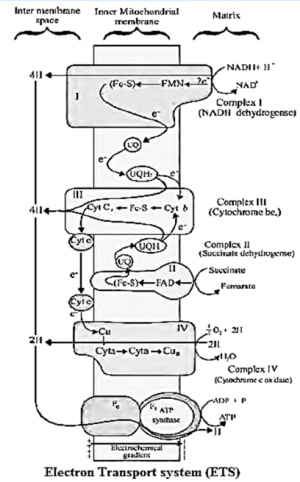
The following is a scheme showing the electron transport system. Identify the electron carrier molecules indicated as $A$ and $B$. Choose the correct option.
A
$A$ = coenzyme $Q$,$B$ = cytochrome c
B
$A$ = cytochrome c,$B$ = coenzyme $Q$
C
$A$ = Fe-$S$ protein,$B$ = $FMN$
D
$A$ = $FMN$,$B$ = Fe-$S$ protein
Solution
(A) The correct option is $A$.
In the electron transport system $(ETS)$ located in the inner mitochondrial membrane:
$1$. Coenzyme $Q$ (ubiquinone),labeled as $A$,acts as a mobile electron carrier that transfers electrons from Complex $I$ ($NADH$ dehydrogenase) and Complex $II$ (succinate dehydrogenase) to Complex $III$ (cytochrome $bc_1$ complex).
$2$. Cytochrome $c$,labeled as $B$,is a small protein attached to the outer surface of the inner membrane and acts as a mobile carrier for electrons between Complex $III$ and Complex $IV$ (cytochrome $c$ oxidase).
In the electron transport system $(ETS)$ located in the inner mitochondrial membrane:
$1$. Coenzyme $Q$ (ubiquinone),labeled as $A$,acts as a mobile electron carrier that transfers electrons from Complex $I$ ($NADH$ dehydrogenase) and Complex $II$ (succinate dehydrogenase) to Complex $III$ (cytochrome $bc_1$ complex).
$2$. Cytochrome $c$,labeled as $B$,is a small protein attached to the outer surface of the inner membrane and acts as a mobile carrier for electrons between Complex $III$ and Complex $IV$ (cytochrome $c$ oxidase).
0 likes
View SolutionRespiration in Plants — ETS · Frequently Asked Questions
1Are these Respiration in Plants questions useful for JEE and NEET?
Yes. All questions in this section are mapped to JEE Main and NEET exam patterns. Previous year questions from JEE Main, NEET, GUJCET and state-level exams are included with full solutions.
2Can I switch to Hindi or Gujarati for these questions?
Yes. Use the language tabs in the hero section or the sidebar to view the same questions and solutions in English, Hindi or Gujarati.
3How do I generate a question paper from this subtopic?
Use the Vedclass Exam Paper Generator — select the chapter and subtopic, set difficulty, and generate Sets A, B, C, D automatically. First 3 chapters of every subject are free.
Vedclass Products
For Students
Vedclass Test Series
Mock tests in real JEE/NEET style with performance analysis. 5-day free trial.
Start Free TrialFor Teachers
Exam Paper Generator
Generate Set A/B/C/D papers from this chapter in 2 minutes. 3 chapters free.
Try FreeFor Institutes
Online Exam Module
Live online exams with unlimited students, 360° analytics & white-label branding.
See DemoFor Teachers & Institutes
Generate a Respiration in Plants Exam Paper in 2 Minutes
Select subtopic & difficulty — Sets A, B, C, D auto-generated with No Repeat logic.
First 3 chapters of every subject are free — no payment required.