
A English
Pteridophytes (General) Questions in English
Class 11 Biology · Plant Kingdom · Pteridophytes (General)
417+
Questions
English
Language
100%
With Solutions
Showing 50 of 417 questions in English
301
MediumMCQ
Horsetail and fern are
A
Bryophytes
B
Pteridophytes
C
Angiosperms
D
Gymnosperms
Solution
(B) Horsetails (Equisetum) and ferns are classified under the group $Pteridophytes$.
$Pteridophytes$ are the first terrestrial plants to possess vascular tissues ($xylem$ and $phloem$).
They reproduce by spores and do not produce seeds or flowers.
Therefore,the correct option is $B$.
$Pteridophytes$ are the first terrestrial plants to possess vascular tissues ($xylem$ and $phloem$).
They reproduce by spores and do not produce seeds or flowers.
Therefore,the correct option is $B$.
0 likes
View Solution302
MediumMCQ
Choose the correct pair:
A
$Pteropsida - Selaginella$
B
$Lycopsida - Adiantum$
C
$Sphenopsida - Equisetum$
D
$Psilopsida - Pteris$
Solution
(C) The classification of Pteridophytes is as follows:
$1$. $Psilopsida$: Example includes $Psilotum$.
$2$. $Lycopsida$: Examples include $Selaginella$ and $Lycopodium$.
$3$. $Sphenopsida$: Example includes $Equisetum$.
$4$. $Pteropsida$: Examples include $Dryopteris$,$Pteris$,and $Adiantum$.
Comparing these with the options,$Sphenopsida - Equisetum$ is the only correct pair.
$1$. $Psilopsida$: Example includes $Psilotum$.
$2$. $Lycopsida$: Examples include $Selaginella$ and $Lycopodium$.
$3$. $Sphenopsida$: Example includes $Equisetum$.
$4$. $Pteropsida$: Examples include $Dryopteris$,$Pteris$,and $Adiantum$.
Comparing these with the options,$Sphenopsida - Equisetum$ is the only correct pair.
0 likes
View Solution303
EasyMCQ
Which of the following is a heterosporous plant?
A
Selaginella
B
Mango
C
Maize
D
Ground nut
Solution
(A) Heterospory is the production of two different types of spores, namely microspores and megaspores.
In the plant kingdom, heterospory is a significant evolutionary step observed in certain Pteridophytes like $Selaginella$ and $Salvinia$, as well as in all seed-bearing plants (Gymnosperms and Angiosperms).
However, among the options provided, $Selaginella$ is the classic example of a heterosporous Pteridophyte, whereas $Mango$, $Maize$, and $Ground nut$ are Angiosperms. While Angiosperms are also heterosporous, $Selaginella$ is the most distinct representative of this trait in the context of Pteridophytes, which is a common focus in this topic.
Therefore, $Selaginella$ is the correct answer.
In the plant kingdom, heterospory is a significant evolutionary step observed in certain Pteridophytes like $Selaginella$ and $Salvinia$, as well as in all seed-bearing plants (Gymnosperms and Angiosperms).
However, among the options provided, $Selaginella$ is the classic example of a heterosporous Pteridophyte, whereas $Mango$, $Maize$, and $Ground nut$ are Angiosperms. While Angiosperms are also heterosporous, $Selaginella$ is the most distinct representative of this trait in the context of Pteridophytes, which is a common focus in this topic.
Therefore, $Selaginella$ is the correct answer.
0 likes
View Solution304
MediumMCQ
Identify the pteridophyte from the given options.
A
Lycopodium
B
Red wood tree
C
Funaria
D
Sphagnum
Solution
(A) The plant kingdom is classified into various groups based on their characteristics.
$Lycopodium$ is a well-known genus of club mosses,which belongs to the group $Pteridophyta$.
$Red$ $wood$ $tree$ $(Sequoia)$ is a gymnosperm.
$Funaria$ and $Sphagnum$ are both bryophytes (mosses).
Therefore,the correct option is $Lycopodium$.
$Lycopodium$ is a well-known genus of club mosses,which belongs to the group $Pteridophyta$.
$Red$ $wood$ $tree$ $(Sequoia)$ is a gymnosperm.
$Funaria$ and $Sphagnum$ are both bryophytes (mosses).
Therefore,the correct option is $Lycopodium$.
0 likes
View Solution305
MediumMCQ
Match the following:
| Column-$I$ | Column-$II$ |
|---|---|
| $(1)$ Psilopsida | $A$. Selaginella |
| $(2)$ Lycopsida | $B$. Adiantum |
| $(3)$ Sphenopsida | $C$. Equisetum |
| $(4)$ Pteropsida | $D$. Psilotum |
A
$(1-D), (2-A), (3-B), (4-C)$
B
$(1-D), (2-C), (3-B), (4-A)$
C
$(1-D), (2-A), (3-C), (4-B)$
D
$(1-C), (2-A), (3-D), (4-B)$
Solution
(C) The classification of Pteridophytes is as follows:
$1$. Psilopsida: Examples include $Psilotum$.
$2$. Lycopsida: Examples include $Selaginella$ and $Lycopodium$.
$3$. Sphenopsida: Examples include $Equisetum$.
$4$. Pteropsida: Examples include $Dryopteris$,$Pteris$,and $Adiantum$.
Therefore,the correct matching is: $(1-D), (2-A), (3-C), (4-B)$.
$1$. Psilopsida: Examples include $Psilotum$.
$2$. Lycopsida: Examples include $Selaginella$ and $Lycopodium$.
$3$. Sphenopsida: Examples include $Equisetum$.
$4$. Pteropsida: Examples include $Dryopteris$,$Pteris$,and $Adiantum$.
Therefore,the correct matching is: $(1-D), (2-A), (3-C), (4-B)$.
0 likes
View Solution306
MediumMCQ
$A$ - Selaginella and Salvinia produce heterospores.
$R$ - Cones (strobili) are developed in Selaginella and Equisetum.
$R$ - Cones (strobili) are developed in Selaginella and Equisetum.
A
$A$ and $R$ are both correct.
B
$A$ and $R$ are both incorrect.
C
$A$ is correct,$R$ is incorrect.
D
$A$ is incorrect,$R$ is correct.
Solution
(A) Assertion $(A)$: Selaginella and Salvinia are heterosporous pteridophytes,meaning they produce two kinds of spores: microspores and megaspores. This statement is correct.
Reason $(R)$: In many pteridophytes,the sporophylls may form distinct compact structures called strobili or cones. Selaginella produces strobili,and Equisetum also produces strobili (cones). This statement is also correct.
Therefore,both $A$ and $R$ are correct.
Reason $(R)$: In many pteridophytes,the sporophylls may form distinct compact structures called strobili or cones. Selaginella produces strobili,and Equisetum also produces strobili (cones). This statement is also correct.
Therefore,both $A$ and $R$ are correct.
0 likes
View Solution307
MediumMCQ
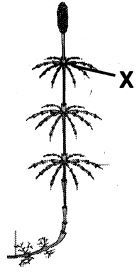
Identify $X$ from the figure.
A
Node
B
Branch
C
Internode
D
Leaf
Solution
(A) The figure represents $Equisetum$,a member of the class $Sphenopsida$ (Pteridophytes).
In $Equisetum$,the stem is jointed and possesses distinct nodes and internodes.
The structure marked as $X$ points to the region where branches or leaves arise,which is known as the node.
Therefore,the correct option is $A$.
In $Equisetum$,the stem is jointed and possesses distinct nodes and internodes.
The structure marked as $X$ points to the region where branches or leaves arise,which is known as the node.
Therefore,the correct option is $A$.
0 likes
View Solution308
MediumMCQ
Meiosis is seen in pteridophytes during which process?
A
Gametogenesis
B
Sporogenesis
C
Post-gametogenesis
D
Post-sporogenesis
Solution
(B) In $Pteridophytes$,the main plant body is a $Sporophyte$ $(2n)$,which is differentiated into true roots,stems,and leaves.
These plants produce specialized structures called $Sporangia$ that contain $Spore$ mother cells.
During the process of $Sporogenesis$,these $Spore$ mother cells undergo $Meiosis$ to produce haploid $(n)$ spores.
These spores germinate to form a multicellular,free-living,mostly photosynthetic,thalloid gametophyte called a $Prothallus$.
These plants produce specialized structures called $Sporangia$ that contain $Spore$ mother cells.
During the process of $Sporogenesis$,these $Spore$ mother cells undergo $Meiosis$ to produce haploid $(n)$ spores.
These spores germinate to form a multicellular,free-living,mostly photosynthetic,thalloid gametophyte called a $Prothallus$.
0 likes
View Solution309
MediumMCQ
Which of the following is included in the class $Sphenopsida$?
A
$Ginkgo$
B
$Marchantia$
C
$Cedrus$
D
$Equisetum$
Solution
(D) The plant kingdom is classified into various groups. $Equisetum$ belongs to the class $Sphenopsida$ under the division $Pteridophyta$.
$Ginkgo$ is a member of $Gymnosperms$.
$Marchantia$ is a liverwort belonging to the class $Hepaticopsida$ under the division $Bryophyta$.
$Cedrus$ is a member of $Gymnosperms$.
Therefore,the correct option is $D$.
$Ginkgo$ is a member of $Gymnosperms$.
$Marchantia$ is a liverwort belonging to the class $Hepaticopsida$ under the division $Bryophyta$.
$Cedrus$ is a member of $Gymnosperms$.
Therefore,the correct option is $D$.
0 likes
View Solution310
MediumMCQ
Selaginella and Salvinia are considered to represent a significant step toward the evolution of the seed habit because
A
Female gametophyte is free and gets dispersed like seeds
B
Female gametophyte lacks archegonia
C
Megaspores possess endosperm and embryo surrounded by seed coat
D
Embryo develops in female gametophyte which is retained on parent sporophyte
Solution
(D) The evolution of the seed habit is a critical evolutionary trend observed in certain pteridophytes like $Selaginella$ and $Salvinia$.
These plants are heterosporous,meaning they produce two types of spores: microspores and megaspores.
The key feature representing the seed habit is the retention and germination of the megaspore within the female gametophyte,which remains attached to the parent sporophyte for a variable period.
This development of the embryo within the female gametophyte,while it is still attached to the parent plant,provides protection and nutrition to the developing embryo,which is a precursor to the seed habit found in higher plants (gymnosperms and angiosperms).
These plants are heterosporous,meaning they produce two types of spores: microspores and megaspores.
The key feature representing the seed habit is the retention and germination of the megaspore within the female gametophyte,which remains attached to the parent sporophyte for a variable period.
This development of the embryo within the female gametophyte,while it is still attached to the parent plant,provides protection and nutrition to the developing embryo,which is a precursor to the seed habit found in higher plants (gymnosperms and angiosperms).
0 likes
View Solution311
MediumMCQ
$Pteris$ and $Adiantum$ resemble each other in having:
A
Seeds
B
Motile sperm
C
Cambium
D
Cambium ring
Solution
(B) $Pteris$ and $Adiantum$ are both members of the class $Pteridopsida$ (ferns).
$Pteridophytes$ are seedless vascular plants that reproduce via spores.
They require water for fertilization because they produce flagellated,motile sperm (antherozoids) that must swim to the egg.
They lack seeds,cambium,and secondary growth (cambium rings).
$Pteridophytes$ are seedless vascular plants that reproduce via spores.
They require water for fertilization because they produce flagellated,motile sperm (antherozoids) that must swim to the egg.
They lack seeds,cambium,and secondary growth (cambium rings).
0 likes
View Solution312
MediumMCQ
The formation of a sporophyte (fern) from a gametophyte (prothallus) without fertilization is known as .......... .
A
Apospory
B
Apogamy
C
Parthenocarpy
D
Parthenogenesis
Solution
(B) The development of a sporophyte directly from a gametophyte without the fusion of gametes (fertilization) is called $Apogamy$.
In ferns,the prothallus (gametophyte) normally produces gametes that fuse to form a zygote,which then develops into a sporophyte.
However,in $Apogamy$,the sporophyte arises vegetatively from the cells of the prothallus.
$Apospory$ is the opposite process,where a gametophyte develops from a sporophyte without meiosis.
$Parthenocarpy$ refers to the development of fruit without fertilization.
$Parthenogenesis$ is the development of an embryo from an unfertilized egg.
In ferns,the prothallus (gametophyte) normally produces gametes that fuse to form a zygote,which then develops into a sporophyte.
However,in $Apogamy$,the sporophyte arises vegetatively from the cells of the prothallus.
$Apospory$ is the opposite process,where a gametophyte develops from a sporophyte without meiosis.
$Parthenocarpy$ refers to the development of fruit without fertilization.
$Parthenogenesis$ is the development of an embryo from an unfertilized egg.
0 likes
View Solution313
MediumMCQ
Which of the following is an important evolutionary feature of $Selaginella$?
A
Heterospory
B
Rhizophore
C
Strobili
D
Ligule
Solution
(A) The most significant evolutionary feature of $Selaginella$ is $Heterospory$.
$Heterospory$ is the production of two types of spores: microspores and megaspores.
This phenomenon is considered a precursor to the seed habit in higher plants because it leads to the development of female gametophytes that are retained on the parent sporophyte for variable periods.
While $Rhizophore$,$Strobili$,and $Ligule$ are also characteristic features of $Selaginella$,$Heterospory$ is the most critical evolutionary advancement.
$Heterospory$ is the production of two types of spores: microspores and megaspores.
This phenomenon is considered a precursor to the seed habit in higher plants because it leads to the development of female gametophytes that are retained on the parent sporophyte for variable periods.
While $Rhizophore$,$Strobili$,and $Ligule$ are also characteristic features of $Selaginella$,$Heterospory$ is the most critical evolutionary advancement.
0 likes
View Solution314
MediumMCQ
Pteridophytes differ from algae/bryophytes in possessing .............
A
Independent gametophyte
B
Well-developed vascular system
C
Archegonia
D
Flagellated spermatozoa
Solution
(B) Pteridophytes are the first terrestrial plants to possess vascular tissues ($xylem$ and $phloem$).
While algae and bryophytes lack a true vascular system,pteridophytes have a well-developed vascular system for the conduction of water and nutrients.
Therefore,the presence of a well-developed vascular system is a key feature that distinguishes pteridophytes from algae and bryophytes.
While algae and bryophytes lack a true vascular system,pteridophytes have a well-developed vascular system for the conduction of water and nutrients.
Therefore,the presence of a well-developed vascular system is a key feature that distinguishes pteridophytes from algae and bryophytes.
0 likes
View Solution315
MediumMCQ
$A$ characteristic feature of Pteridophytes is that they $..........$
A
have the sporophyte attached to the gametophyte.
B
produce spores.
C
lack roots.
D
lack vascular tissues.
Solution
(B) Pteridophytes are the first terrestrial plants to possess vascular tissues ($xylem$ and $phloem$).
They reproduce by producing spores,which are formed in sporangia.
Unlike Bryophytes,where the sporophyte is dependent on the gametophyte,in Pteridophytes,the sporophyte is the dominant,independent phase.
Therefore,the production of spores is a characteristic feature of Pteridophytes.
They reproduce by producing spores,which are formed in sporangia.
Unlike Bryophytes,where the sporophyte is dependent on the gametophyte,in Pteridophytes,the sporophyte is the dominant,independent phase.
Therefore,the production of spores is a characteristic feature of Pteridophytes.
0 likes
View Solution316
MediumMCQ
Seed habit is first observed in some:
A
Pteridophytes
B
Pines
C
Monocots
D
Dicots
Solution
(A) The evolution of the seed habit is a significant event in plant evolution.
It was first observed in certain heterosporous pteridophytes,such as $Selaginella$ and $Salvinia$.
In these plants,the development of the zygote into young embryos takes place within the female gametophytes retained on the parent sporophytes.
This precursor to the seed habit is considered an important step in evolution.
It was first observed in certain heterosporous pteridophytes,such as $Selaginella$ and $Salvinia$.
In these plants,the development of the zygote into young embryos takes place within the female gametophytes retained on the parent sporophytes.
This precursor to the seed habit is considered an important step in evolution.
0 likes
View Solution317
MediumMCQ
The name "Walking Fern" is given because of:
A
its propagation by motile animal agencies.
B
it shows vegetative growth through the tips of its leaves.
C
it knows how to walk by itself.
D
its spores are motile (can walk).
Solution
(B) The "Walking Fern" (scientifically known as $Adiantum \, caudatum$) is named so because it reproduces vegetatively through the tips of its leaves. When the leaf tip touches the soil, it develops adventitious roots and a new plantlet, allowing the fern to "walk" or spread across the ground over time.
0 likes
View Solution318
MediumMCQ
Which of the following plants are vascular but seedless?
A
Algae
B
Bryophytes
C
Pteridophytes
D
Gymnosperms
Solution
(C) The plant kingdom is classified based on the presence or absence of vascular tissues and seeds.
$1$. Algae and Bryophytes are non-vascular plants (thallophytes and bryophytes).
$2$. Pteridophytes are the first terrestrial plants to possess vascular tissues ($xylem$ and $phloem$) but they do not produce seeds; they reproduce via spores.
$3$. Gymnosperms and Angiosperms are vascular plants that produce seeds.
Therefore,Pteridophytes are the correct group of plants that are vascular but seedless.
$1$. Algae and Bryophytes are non-vascular plants (thallophytes and bryophytes).
$2$. Pteridophytes are the first terrestrial plants to possess vascular tissues ($xylem$ and $phloem$) but they do not produce seeds; they reproduce via spores.
$3$. Gymnosperms and Angiosperms are vascular plants that produce seeds.
Therefore,Pteridophytes are the correct group of plants that are vascular but seedless.
0 likes
View Solution319
MediumMCQ
In $Dryopteris$ (fern),meiosis occurs during:
A
Spore germination
B
Gamete formation
C
Spore formation
D
Antheridia and archegonia formation
Solution
(C) In $Dryopteris$ (a pteridophyte),the main plant body is the sporophyte $(2n)$.
It produces sporangia,which contain spore mother cells.
These spore mother cells undergo meiosis to produce haploid $(n)$ spores.
Therefore,meiosis occurs during spore formation.
It produces sporangia,which contain spore mother cells.
These spore mother cells undergo meiosis to produce haploid $(n)$ spores.
Therefore,meiosis occurs during spore formation.
0 likes
View Solution320
MediumMCQ
In the prothallus of a vascular cryptogam,the antherozoids and the egg mature at different times. As a result,.......
A
The success rate of fertilization remains unchanged.
B
There is a high rate of sterility.
C
One can easily conclude that the plant is apomictic.
D
Self-fertilization is prevented.
Solution
(D) In many vascular cryptogams (like ferns),the prothallus is bisexual,meaning it bears both male (antheridia) and female (archegonia) sex organs. When the antherozoids and the egg mature at different times,a phenomenon known as $dichogamy$ occurs. This temporal separation of maturation prevents self-fertilization (selfing) and promotes cross-fertilization,which increases genetic diversity.
0 likes
View Solution321
EasyMCQ
Which of the following is heterosporous?
A
Dryopteris
B
Salvinia
C
Adiantum
D
Equisetum
Solution
(B) Heterospory is a condition in which two types of spores are produced,namely microspores and megaspores.
In the plant kingdom,specifically among Pteridophytes,the genera $Selaginella$ and $Salvinia$ are known to be heterosporous.
$Dryopteris$,$Adiantum$,and $Equisetum$ are generally homosporous,meaning they produce only one type of spore.
Therefore,$Salvinia$ is the correct answer.
In the plant kingdom,specifically among Pteridophytes,the genera $Selaginella$ and $Salvinia$ are known to be heterosporous.
$Dryopteris$,$Adiantum$,and $Equisetum$ are generally homosporous,meaning they produce only one type of spore.
Therefore,$Salvinia$ is the correct answer.
0 likes
View Solution322
MediumMCQ
Which of the following is considered an important step for the development of seed habit?
A
Dependent gametophyte
B
Heterospory
C
Haplontic life cycle
D
Free-living gametophyte
Solution
(B) The development of seed habit is a significant evolutionary trend in plants.
$Heterospory$ is the production of two different types of spores,microspores and megaspores,which is a prerequisite for the development of seed habit.
In heterosporous plants,the megaspore is retained within the parent sporophyte for a variable period,where it develops into the female gametophyte.
This retention and germination of the megaspore within the megasporangium is the key step that leads to the formation of seeds.
$Heterospory$ is the production of two different types of spores,microspores and megaspores,which is a prerequisite for the development of seed habit.
In heterosporous plants,the megaspore is retained within the parent sporophyte for a variable period,where it develops into the female gametophyte.
This retention and germination of the megaspore within the megasporangium is the key step that leads to the formation of seeds.
0 likes
View Solution323
MediumMCQ
Which of the following is a vascular,non-flowering plant?
A
Equisetum
B
Ginkgo
C
Marchantia
D
Cedrus
Solution
(A) The plant kingdom is classified based on the presence or absence of vascular tissues and seeds.
$1$. $Marchantia$ is a bryophyte,which lacks true vascular tissues (xylem and phloem).
$2$. $Equisetum$ is a pteridophyte. Pteridophytes are the first terrestrial plants to possess vascular tissues ($xylem$ and $phloem$) and they are non-flowering (cryptogams) as they do not produce seeds or flowers.
$3$. $Ginkgo$ and $Cedrus$ are gymnosperms,which are vascular plants that produce seeds but do not produce flowers.
Therefore,$Equisetum$ is the correct answer as it is a vascular,non-flowering plant.
$1$. $Marchantia$ is a bryophyte,which lacks true vascular tissues (xylem and phloem).
$2$. $Equisetum$ is a pteridophyte. Pteridophytes are the first terrestrial plants to possess vascular tissues ($xylem$ and $phloem$) and they are non-flowering (cryptogams) as they do not produce seeds or flowers.
$3$. $Ginkgo$ and $Cedrus$ are gymnosperms,which are vascular plants that produce seeds but do not produce flowers.
Therefore,$Equisetum$ is the correct answer as it is a vascular,non-flowering plant.
0 likes
View Solution324
MediumMCQ
Compared to the gametophyte of bryophytes,the gametophyte of vascular plants (pteridophytes) has ......
A
larger size but smaller sex organs.
B
larger size and larger sex organs.
C
smaller size and smaller sex organs.
D
smaller size but larger sex organs.
Solution
(D) In bryophytes,the gametophyte is the dominant,independent,and photosynthetic phase,which is relatively large. In contrast,in vascular plants like pteridophytes,the gametophyte (prothallus) is much smaller,inconspicuous,and often short-lived. However,the sex organs (antheridia and archegonia) in pteridophytes are generally larger and more complex compared to the simpler,smaller sex organs found in bryophytes. Therefore,the gametophyte of vascular plants is smaller in size but possesses larger sex organs.
0 likes
View Solution325
MediumMCQ
Which of the following statements is correct?
A
The gametophyte of Pteridophytes has a prothallus and a leafy stage.
B
The female gametophyte of Gymnosperms is free-living.
C
Antheridiophores and archegoniophores are present in Pteridophytes.
D
The precursor of seed habit is found in Pteridophytes.
Solution
(D) In Pteridophytes,the gametophyte (prothallus) is small but multicellular,free-living,and mostly photosynthetic. Some Pteridophytes like Selaginella exhibit heterospory,which is considered a precursor to the seed habit. Option $A$ is incorrect because the prothallus is the gametophyte itself,not a stage within it. Option $B$ is incorrect because the female gametophyte in Gymnosperms is retained within the megasporangium and is not free-living. Option $C$ is incorrect as these structures are typically associated with Bryophytes (like Marchantia). Therefore,option $D$ is the correct statement.
0 likes
View Solution326
EasyMCQ
From an evolutionary point of view,the retention of the female gametophyte with the developing young embryo on the parent sporophyte for some time is first observed in:
A
Liverworts
B
Mosses
C
Pteridophytes
D
Gymnosperms
Solution
(C) The phenomenon of retention of the female gametophyte with the developing young embryo on the parent sporophyte is a significant evolutionary precursor to the seed habit.
In $Pteridophytes$,specifically in heterosporous species like $Selaginella$ and $Salvinia$,the female gametophytes are not fully independent but are retained on the parent sporophyte for variable periods.
This development represents an important step in evolution towards the seed habit found in $Gymnosperms$ and $Angiosperms$.
In $Pteridophytes$,specifically in heterosporous species like $Selaginella$ and $Salvinia$,the female gametophytes are not fully independent but are retained on the parent sporophyte for variable periods.
This development represents an important step in evolution towards the seed habit found in $Gymnosperms$ and $Angiosperms$.
0 likes
View Solution327
EasyMCQ
The botanical name of Sanjeevani is:
A
Selaginella chrysocaulos
B
Selaginella bryopteris
C
Selaginella chrysorhizos
D
None of the above
Solution
(B) Selaginella bryopteris $(L.)$,popularly known as Sanjeevani,is a plant with medicinal properties.
Sanjeevani grows on the hills of tropical areas,particularly the Arawali mountain terrains from east to west in India.
Traditionally,this plant has been used to: $(i)$ provide relief from heat stroke and burning sensation during urination; $(ii)$ restore menstrual irregularities to normal and,when applied topically to pregnant women,aid in easy delivery; and $(iii)$ treat jaundice.
Sanjeevani grows on the hills of tropical areas,particularly the Arawali mountain terrains from east to west in India.
Traditionally,this plant has been used to: $(i)$ provide relief from heat stroke and burning sensation during urination; $(ii)$ restore menstrual irregularities to normal and,when applied topically to pregnant women,aid in easy delivery; and $(iii)$ treat jaundice.
0 likes
View Solution328
EasyMCQ
Sporocarp is a reproductive structure of
A
Some algae
B
Some aquatic ferns having sori
C
Angiosperms having spores
D
Bryophytes
Solution
(B) Sporocarp is a reproductive structure found in some aquatic ferns,such as $Marsilea$.
Sporocarps are functionally and developmentally modified leaves that bear several sori.
Each sorus consists of two types of sporangia: megasporangia,which produce large female megaspores,and microsporangia,which produce many small male microspores.
Sporocarps are functionally and developmentally modified leaves that bear several sori.
Each sorus consists of two types of sporangia: megasporangia,which produce large female megaspores,and microsporangia,which produce many small male microspores.
0 likes
View Solution329
MediumMCQ
Match the following:
| Column-$I$ (Classes) | Column-$II$ (Examples) |
|---|---|
| $A$. Psilotopsida | $I$. Dryopteris,Pteris,Adiantum |
| $B$. Lycopsida | $II$. Equisetum |
| $C$. Sphenopsida | $III$. Selaginella |
| $D$. Pteropsida | $IV$. Lycopodium |
| $V$. Psilotum |
A
$A-V; B-III, IV; C-II; D-I$
B
$A-I; B-II; C-III; D-IV$
C
$A-IV; B-III; C-II; D-I$
D
$A-III; B-V; C-I; D-II$
Solution
(A) The classification of Pteridophytes into four classes is as follows:
$1$. Psilotopsida: Example is $Psilotum$ $(V)$.
$2$. Lycopsida: Examples are $Selaginella$ $(III)$ and $Lycopodium$ $(IV)$.
$3$. Sphenopsida: Example is $Equisetum$ $(II)$.
$4$. Pteropsida: Examples are $Dryopteris$,$Pteris$,and $Adiantum$ $(I)$.
Therefore,the correct matching is $A-V; B-III, IV; C-II; D-I$. Since option $A$ is the closest representation of this classification,it is the correct choice.
$1$. Psilotopsida: Example is $Psilotum$ $(V)$.
$2$. Lycopsida: Examples are $Selaginella$ $(III)$ and $Lycopodium$ $(IV)$.
$3$. Sphenopsida: Example is $Equisetum$ $(II)$.
$4$. Pteropsida: Examples are $Dryopteris$,$Pteris$,and $Adiantum$ $(I)$.
Therefore,the correct matching is $A-V; B-III, IV; C-II; D-I$. Since option $A$ is the closest representation of this classification,it is the correct choice.
0 likes
View Solution330
Easy
What is heterospory? Briefly comment on its significance. Give two examples.
Solution
(N/A) Heterospory is a phenomenon in which two kinds of spores are produced by the same plant. These spores differ in size: the smaller one is known as the $microspore$ and the larger one is known as the $megaspore$.
The $microspore$ germinates to form the male gametophyte,while the $megaspore$ germinates to form the female gametophyte. The male gametophyte releases male gametes,which reach the female gametophyte to fuse with the egg.
The development of the zygote occurs inside the female gametophyte. This retention and germination of the $megaspore$ within the $megasporangium$ ensures the proper development of the zygote into the future sporophyte.
Heterospory is considered a crucial evolutionary step because it is a precursor to the seed habit. The evolution of the seed habit is directly related to the retention of the $megaspore$.
Examples of plants exhibiting heterospory include $Selaginella$ and $Salvinia$.
The $microspore$ germinates to form the male gametophyte,while the $megaspore$ germinates to form the female gametophyte. The male gametophyte releases male gametes,which reach the female gametophyte to fuse with the egg.
The development of the zygote occurs inside the female gametophyte. This retention and germination of the $megaspore$ within the $megasporangium$ ensures the proper development of the zygote into the future sporophyte.
Heterospory is considered a crucial evolutionary step because it is a precursor to the seed habit. The evolution of the seed habit is directly related to the retention of the $megaspore$.
Examples of plants exhibiting heterospory include $Selaginella$ and $Salvinia$.
0 likes
View Solution331
Medium
Give detailed information about pteridophytes.
Solution
(N/A) $\rightarrow$ They are the first terrestrial plants.
$\rightarrow$ Habitat: Pteridophytes are found in cool,damp,and shady places,although some may flourish well in sandy soil conditions.
$\rightarrow$ Body structure: They possess true roots,stems,and leaves.
$\rightarrow$ Vascular tissues: They possess well-developed vascular tissues (xylem and phloem).
$\rightarrow$ Leaves: The leaves in pteridophytes are small (microphylls) as in $Selaginella$ or large (macrophylls) as in ferns.
$\rightarrow$ Life cycle: The main plant body is a sporophyte,which is differentiated into true roots,stems,and leaves.
$\rightarrow$ Reproductive structures: The sporophytes bear sporangia that are subtended by leaf-like appendages called sporophylls. These may form distinct compact structures called strobili or cones (e.g.,$Selaginella$,$Equisetum$).
$\rightarrow$ Spore formation: The sporangia produce spores by meiosis in spore mother cells. The spores germinate to give rise to inconspicuous,small but multicellular,free-living,mostly photosynthetic thalloid gametophytes called prothallus.
$\rightarrow$ Reproduction: Due to the specific requirement of water for fertilization,the spread of living pteridophytes is limited and restricted to narrow geographical regions.
$\rightarrow$ Sex organs: The gametophytes bear male and female sex organs called antheridia and archegonia.
$\rightarrow$ Fertilization: Water is required for the transfer of antherozoids from the antheridia to the mouth of the archegonium. Fusion of the male gamete with the egg results in the formation of a zygote.
$\rightarrow$ Development: The zygote thereafter produces a multicellular,well-differentiated sporophyte,which is the dominant phase.
$\rightarrow$ Homospory vs Heterospory: In the majority of pteridophytes,all spores are of similar kinds (Homosporous,e.g.,$Nephrolepis$). Genera like $Selaginella$ and $Salvinia$ produce two kinds of spores,macro (large) and micro (small) spores,and are known as Heterosporous.
$\rightarrow$ Gametophyte retention: In heterosporous plants,the megaspores and microspores germinate to give rise to female and male gametophytes,respectively. The female gametophytes are retained on the parent sporophytes for variable periods.
$\rightarrow$ Habitat: Pteridophytes are found in cool,damp,and shady places,although some may flourish well in sandy soil conditions.
$\rightarrow$ Body structure: They possess true roots,stems,and leaves.
$\rightarrow$ Vascular tissues: They possess well-developed vascular tissues (xylem and phloem).
$\rightarrow$ Leaves: The leaves in pteridophytes are small (microphylls) as in $Selaginella$ or large (macrophylls) as in ferns.
$\rightarrow$ Life cycle: The main plant body is a sporophyte,which is differentiated into true roots,stems,and leaves.
$\rightarrow$ Reproductive structures: The sporophytes bear sporangia that are subtended by leaf-like appendages called sporophylls. These may form distinct compact structures called strobili or cones (e.g.,$Selaginella$,$Equisetum$).
$\rightarrow$ Spore formation: The sporangia produce spores by meiosis in spore mother cells. The spores germinate to give rise to inconspicuous,small but multicellular,free-living,mostly photosynthetic thalloid gametophytes called prothallus.
$\rightarrow$ Reproduction: Due to the specific requirement of water for fertilization,the spread of living pteridophytes is limited and restricted to narrow geographical regions.
$\rightarrow$ Sex organs: The gametophytes bear male and female sex organs called antheridia and archegonia.
$\rightarrow$ Fertilization: Water is required for the transfer of antherozoids from the antheridia to the mouth of the archegonium. Fusion of the male gamete with the egg results in the formation of a zygote.
$\rightarrow$ Development: The zygote thereafter produces a multicellular,well-differentiated sporophyte,which is the dominant phase.
$\rightarrow$ Homospory vs Heterospory: In the majority of pteridophytes,all spores are of similar kinds (Homosporous,e.g.,$Nephrolepis$). Genera like $Selaginella$ and $Salvinia$ produce two kinds of spores,macro (large) and micro (small) spores,and are known as Heterosporous.
$\rightarrow$ Gametophyte retention: In heterosporous plants,the megaspores and microspores germinate to give rise to female and male gametophytes,respectively. The female gametophytes are retained on the parent sporophytes for variable periods.
0 likes
View Solution332
MediumMCQ
In which plants are heterosporous conditions found,and what structures do they produce?
A
Selaginella and Salvinia; produce megaspores and microspores.
B
Funaria and Polytrichum; produce spores.
C
Pinus and Cycas; produce seeds.
D
Chlamydomonas and Volvox; produce gametes.
Solution
(A) $\Rightarrow$ Plants like $Selaginella$ and $Salvinia$ produce two kinds of spores,macro (large) and micro (small) spores,and are known as heterosporous.
$\Rightarrow$ The megaspores and microspores germinate and give rise to female and male gametophytes,respectively.
$\Rightarrow$ The megaspores and microspores germinate and give rise to female and male gametophytes,respectively.
0 likes
View Solution333
EasyMCQ
Classify pteridophytes into their four main groups and provide an example for each.
A
Psilopsida: Psilotum
B
Lycopsida: Selaginella
C
Sphenopsida: Equisetum
D
Pteropsida: Pteris
Solution
(A-D) Pteridophytes are classified into four main classes based on their morphological characteristics:
$1$. $Psilopsida$: These are the most primitive pteridophytes. Example: $Psilotum$.
$2$. $Lycopsida$: These are commonly known as club mosses. Example: $Selaginella$.
$3$. $Sphenopsida$: These are known as horsetails. Example: $Equisetum$.
$4$. $Pteropsida$: These are the most advanced pteridophytes,including ferns. Example: $Pteris$.
$1$. $Psilopsida$: These are the most primitive pteridophytes. Example: $Psilotum$.
$2$. $Lycopsida$: These are commonly known as club mosses. Example: $Selaginella$.
$3$. $Sphenopsida$: These are known as horsetails. Example: $Equisetum$.
$4$. $Pteropsida$: These are the most advanced pteridophytes,including ferns. Example: $Pteris$.
0 likes
View Solution334
Medium
Give scientific reasons: In pteridophytes,the development of the zygote inside the female gametophyte is considered an important phase.
Solution
(N/A) $\rightarrow$ In pteridophytes,the female gametophyte is retained on the parent sporophyte for a variable period. The zygote develops into a young embryo within the female gametophyte. This event is a significant precursor to the seed habit,which is considered a crucial step in plant evolution.
0 likes
View Solution335
Easy
Heterospory,i.e.,the formation of two types of spores—microspores and megaspores—is a characteristic feature in the life cycle of a few members of pteridophytes and all spermatophytes. Do you think heterospory has some evolutionary significance in the plant kingdom?
Solution
(N/A) $\rightarrow$ Heterospory refers to the production of two different types of spores,differing in size and sex,by the sporophyte.
$\rightarrow$ Small spores are known as microspores,which germinate to give rise to the male gametophyte,while larger spores are known as megaspores,which germinate to give rise to the female gametophyte.
$\rightarrow$ Pteridophytes act as an evolutionary intermediate between bryophytes and gymnosperms. While all bryophytes are homosporous,all gymnosperms are heterosporous.
$\rightarrow$ The evolutionary significance of heterospory lies in the development of the seed habit. It promotes cross-fertilization and ensures better protection and nutrition for the developing embryo within the female gametophyte,which is retained on the parent sporophyte.
$\rightarrow$ Small spores are known as microspores,which germinate to give rise to the male gametophyte,while larger spores are known as megaspores,which germinate to give rise to the female gametophyte.
$\rightarrow$ Pteridophytes act as an evolutionary intermediate between bryophytes and gymnosperms. While all bryophytes are homosporous,all gymnosperms are heterosporous.
$\rightarrow$ The evolutionary significance of heterospory lies in the development of the seed habit. It promotes cross-fertilization and ensures better protection and nutrition for the developing embryo within the female gametophyte,which is retained on the parent sporophyte.
0 likes
View Solution336
MediumMCQ
How far does $Selaginella$,one of the few living members of $Lycopodiales$ $(pteridophytes)$,fall short of the seed habit?
A
It lacks heterospory.
B
It lacks the retention of the megaspore within the megasporangium.
C
It lacks the development of an integumented megasporangium (ovule).
D
It lacks a vascular system.
Solution
(C) $\rightarrow$ Seed habit is a significant evolutionary step in plants. $Selaginella$ exhibits several precursors to the seed habit,such as heterospory (production of two types of spores) and the retention of the megaspore within the megasporangium for a period.
$\rightarrow$ However,$Selaginella$ falls short of the true seed habit due to the following reasons:
$(i)$ It lacks the formation of an integumented megasporangium,which is essentially an ovule.
$(ii)$ The megaspore is not permanently retained within the parent plant to develop into a seed; it is eventually shed.
$(iii)$ There is no formation of a seed coat,which is necessary to protect the embryo.
$\rightarrow$ Therefore,while $Selaginella$ shows the 'evolutionary tendency' toward seed habit,it fails to complete the process because it does not develop a true ovule or a seed.
$\rightarrow$ However,$Selaginella$ falls short of the true seed habit due to the following reasons:
$(i)$ It lacks the formation of an integumented megasporangium,which is essentially an ovule.
$(ii)$ The megaspore is not permanently retained within the parent plant to develop into a seed; it is eventually shed.
$(iii)$ There is no formation of a seed coat,which is necessary to protect the embryo.
$\rightarrow$ Therefore,while $Selaginella$ shows the 'evolutionary tendency' toward seed habit,it fails to complete the process because it does not develop a true ovule or a seed.
0 likes
View Solution337
Medium
The heterosporous pteridophytes show certain characteristics,which are precursors to the seed habit in gymnosperms. Explain.
Solution
(N/A) $\rightarrow$ Heterospory: This refers to the production of two distinct types of spores: small microspores and large megaspores. These spores develop into male and female gametophytes,respectively.
$\rightarrow$ The female gametophyte is retained on the parent sporophyte for variable periods. The development of the zygote into young embryos takes place within the female gametophytes retained on the parent sporophyte.
$\rightarrow$ This event is a precursor to the seed habit,which is considered an important step in evolution. In heterosporous pteridophytes like $Selaginella$ and $Salvinia$,the retention and germination of the megaspore within the megasporangium and the subsequent development of the embryo are the key features that lead to the seed habit observed in gymnosperms.
$\rightarrow$ The female gametophyte is retained on the parent sporophyte for variable periods. The development of the zygote into young embryos takes place within the female gametophytes retained on the parent sporophyte.
$\rightarrow$ This event is a precursor to the seed habit,which is considered an important step in evolution. In heterosporous pteridophytes like $Selaginella$ and $Salvinia$,the retention and germination of the megaspore within the megasporangium and the subsequent development of the embryo are the key features that lead to the seed habit observed in gymnosperms.
0 likes
View Solution338
Medium
Comment on the life cycle and nature of a fern prothallus.
Solution
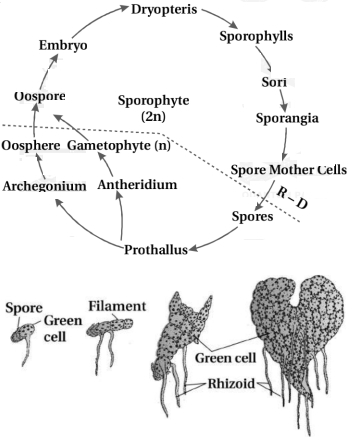
(N/A) $\rightarrow$ The life cycle of a fern (e.g.,$Dryopteris$) exhibits a clear alternation of generations. The haploid gametophytic stage $(n)$ alternates with the diploid sporophytic stage $(2n)$.
$\rightarrow$ Prothallus: The prothallus of a fern is a small,multicellular,free-living,photosynthetic,thalloid,and haploid structure. It is produced from haploid spores that are formed via meiosis in the sporangia of the sporophyte. Upon germination,the spore develops into a filamentous structure,which eventually grows into a heart-shaped,green,autotrophic gametophyte (prothallus) bearing rhizoids for anchorage and absorption.
$\rightarrow$ Prothallus: The prothallus of a fern is a small,multicellular,free-living,photosynthetic,thalloid,and haploid structure. It is produced from haploid spores that are formed via meiosis in the sporangia of the sporophyte. Upon germination,the spore develops into a filamentous structure,which eventually grows into a heart-shaped,green,autotrophic gametophyte (prothallus) bearing rhizoids for anchorage and absorption.
0 likes
View Solution339
EasyMCQ
Select the correct option for the following statements:
$(i)$ In $Dryopteris$ (fern), the prothallus is $haploid/diploid$.
$(ii)$ In $Pteridophytes$, there are $rhizoids/roots$.
$(i)$ In $Dryopteris$ (fern), the prothallus is $haploid/diploid$.
$(ii)$ In $Pteridophytes$, there are $rhizoids/roots$.
A
$(i)$ Haploid, $(ii)$ Rhizoids
B
$(i)$ Haploid, $(ii)$ Roots
C
$(i)$ Diploid, $(ii)$ Rhizoids
D
$(i)$ Diploid, $(ii)$ Roots
Solution
(B) $(i)$ In $Pteridophytes$ like $Dryopteris$, the main plant body is a sporophyte $(2n)$. The spores produced by the sporophyte germinate to form a small, multicellular, free-living, photosynthetic, thalloid gametophyte called the prothallus. Since the gametophyte is formed from spores via meiosis, it is $haploid$ $(n)$.
$(ii)$ $Pteridophytes$ are the first terrestrial plants to possess vascular tissues ($xylem$ and $phloem$). Unlike $Bryophytes$ which have $rhizoids$, $Pteridophytes$ possess true $roots$, stems, and leaves.
$(ii)$ $Pteridophytes$ are the first terrestrial plants to possess vascular tissues ($xylem$ and $phloem$). Unlike $Bryophytes$ which have $rhizoids$, $Pteridophytes$ possess true $roots$, stems, and leaves.
0 likes
View Solution340
Medium
Describe the method of reproduction in pteridophytes.
Solution
(N/A) $\rightarrow$ Due to specific restricted requirements and the need for water for fertilization,the spread of living pteridophytes is limited and restricted to narrow geographical regions.
$\rightarrow$ The gametophytes bear male and female sex organs called antheridia and archegonia.
$\rightarrow$ Water is required for the transfer of antherozoids.
$\rightarrow$ The male gametes are released from the antheridia to the mouth of the archegonium.
$\rightarrow$ The fusion of the male gamete with the egg present in the archegonium results in the formation of a zygote.
$\rightarrow$ The zygote thereafter produces a multicellular,well-differentiated sporophyte,which is the dominant phase of pteridophytes.
$\rightarrow$ The gametophytes bear male and female sex organs called antheridia and archegonia.
$\rightarrow$ Water is required for the transfer of antherozoids.
$\rightarrow$ The male gametes are released from the antheridia to the mouth of the archegonium.
$\rightarrow$ The fusion of the male gamete with the egg present in the archegonium results in the formation of a zygote.
$\rightarrow$ The zygote thereafter produces a multicellular,well-differentiated sporophyte,which is the dominant phase of pteridophytes.
0 likes
View Solution341
Medium
Define/Explain: Heterosporous.
Solution
(N/A) Heterospory is a condition in plants where two different types of spores are produced,which differ in size and function.
These are known as microspores (small,male) and megaspores (large,female).
This phenomenon is observed in some pteridophytes like $Selaginella$ and $Salvinia$,and in all seed-bearing plants (gymnosperms and angiosperms).
These are known as microspores (small,male) and megaspores (large,female).
This phenomenon is observed in some pteridophytes like $Selaginella$ and $Salvinia$,and in all seed-bearing plants (gymnosperms and angiosperms).
0 likes
View Solution342
MediumMCQ
Strobili or cones are found in
A
Equisetum
B
Salvinia
C
Pteris
D
Marchantia
Solution
(A) In $Pteridophytes$,the sporophytes bear sporangia that are subtended by leaf-like appendages called sporophylls. In some cases,such as in $Equisetum$,these sporophylls may form distinct compact structures called strobili or cones. Therefore,the correct answer is $Equisetum$.
0 likes
View Solution343
EasyMCQ
Strobili or cones are found in:
A
Salvinia
B
Pteris
C
Marchantia
D
Equisetum
Solution
(D) In $Pteridophytes$,the sporophylls may form distinct compact structures called strobili or cones.
$Equisetum$ (a member of $Sphenopsida$) is a well-known example of a pteridophyte that produces strobili at the apex of the stem.
$Salvinia$ is a heterosporous fern but does not form typical cones.
$Pteris$ is a homosporous fern.
$Marchantia$ is a liverwort (Bryophyte) and does not produce strobili.
$Equisetum$ (a member of $Sphenopsida$) is a well-known example of a pteridophyte that produces strobili at the apex of the stem.
$Salvinia$ is a heterosporous fern but does not form typical cones.
$Pteris$ is a homosporous fern.
$Marchantia$ is a liverwort (Bryophyte) and does not produce strobili.
0 likes
View Solution344
EasyMCQ
What is the number of chromosomes in each cell of the root of Ophioglossum?
A
$1260$
B
$630$
C
$380$
D
$680$
Solution
(A) $Ophioglossum$ is a genus of ferns known for having one of the highest chromosome counts among all known organisms.
In $Ophioglossum$ $reticulatum$,the diploid number $(2n)$ of chromosomes is $1260$.
Since the root cells are somatic cells,they are diploid $(2n)$.
Therefore,the number of chromosomes in each cell of the root of $Ophioglossum$ is $1260$.
In $Ophioglossum$ $reticulatum$,the diploid number $(2n)$ of chromosomes is $1260$.
Since the root cells are somatic cells,they are diploid $(2n)$.
Therefore,the number of chromosomes in each cell of the root of $Ophioglossum$ is $1260$.
0 likes
View Solution345
MediumMCQ
Which organisms died and became coal deposits?
A
Bryophytes
B
Gymnosperms
C
Angiosperms
D
Pteridophytes
Solution
(D) During the Carboniferous period,large forests of giant ferns and horsetails (which are $Pteridophytes$) dominated the Earth. When these plants died,they were buried under layers of sediment. Over millions of years,due to high pressure and temperature,these organic remains were converted into coal deposits. Therefore,$Pteridophytes$ are the primary contributors to coal formation.
0 likes
View Solution346
MediumMCQ
Which of the following are homosporous?
A
Salvinia,Equisetum
B
Salvinia,Lycopodium
C
Selaginella,Salvinia
D
Lycopodium,Equisetum
Solution
(D) Homosporous plants are those that produce only one type of spore,which are not differentiated by sex.
Most pteridophytes are homosporous,such as $Lycopodium$ and $Equisetum$.
In contrast,$Selaginella$ and $Salvinia$ are heterosporous,meaning they produce two different types of spores (microspores and megaspores).
Most pteridophytes are homosporous,such as $Lycopodium$ and $Equisetum$.
In contrast,$Selaginella$ and $Salvinia$ are heterosporous,meaning they produce two different types of spores (microspores and megaspores).
0 likes
View Solution347
EasyMCQ
In pteridophytes,the sporophytes consist of leaf-like appendages called
A
Megaphylls
B
Sporophylls
C
Thalli
D
Sporangia
Solution
(B) In pteridophytes,the sporophyte consists of leaf-like appendages called sporophylls.
Sporophylls in some species form distinct compact structures called strobili or cones,$e.g.$,$Selaginella$ and $Equisetum$.
Sporophylls in some species form distinct compact structures called strobili or cones,$e.g.$,$Selaginella$ and $Equisetum$.
0 likes
View Solution348
MediumMCQ
In which group of the following would you place the plants having vascular tissue and lacking seeds?
A
Angiosperms
B
Gymnosperms
C
Bryophytes
D
Pteridophytes
Solution
(D) Pteridophytes constitute a group of cryptogams having well-developed vascular tissue ($xylem$ and $phloem$).
These plants lack seeds, meaning they reproduce via spores, although the precursor to the seed habit is observed in some species like $Selaginella$.
These plants lack seeds, meaning they reproduce via spores, although the precursor to the seed habit is observed in some species like $Selaginella$.
0 likes
View Solution349
EasyMCQ
The kidney-shaped covering of sorus in $Dryopteris$ is called:
A
Placenta
B
Ramentum
C
Sporophyll
D
Indusium
Solution
(D) In $Dryopteris$,the $sorus$ (a cluster of sporangia) is protected by a specialized,kidney-shaped membrane known as the $indusium$. This structure serves to protect the developing sporangia.
0 likes
View Solution350
MediumMCQ
Horse tails and ferns belong to which group?
A
Gymnosperms
B
Bryophytes
C
Mosses
D
Pteridophytes
Solution
(D) Pteridophytes are known as vascular cryptogams,which are seedless vascular plants.
They reproduce by producing spores instead of seeds.
Horse tails (Equisetum) and ferns are classic examples of Pteridophytes.
They reproduce by producing spores instead of seeds.
Horse tails (Equisetum) and ferns are classic examples of Pteridophytes.
0 likes
View SolutionPlant Kingdom — Pteridophytes (General) · Frequently Asked Questions
1Are these Plant Kingdom questions useful for JEE and NEET?
Yes. All questions in this section are mapped to JEE Main and NEET exam patterns. Previous year questions from JEE Main, NEET, GUJCET and state-level exams are included with full solutions.
2Can I switch to Hindi or Gujarati for these questions?
Yes. Use the language tabs in the hero section or the sidebar to view the same questions and solutions in English, Hindi or Gujarati.
3How do I generate a question paper from this subtopic?
Use the Vedclass Exam Paper Generator — select the chapter and subtopic, set difficulty, and generate Sets A, B, C, D automatically. First 3 chapters of every subject are free.
Vedclass Products
For Students
Vedclass Test Series
Mock tests in real JEE/NEET style with performance analysis. 5-day free trial.
Start Free TrialFor Teachers
Exam Paper Generator
Generate Set A/B/C/D papers from this chapter in 2 minutes. 3 chapters free.
Try FreeFor Institutes
Online Exam Module
Live online exams with unlimited students, 360° analytics & white-label branding.
See DemoFor Teachers & Institutes
Generate a Plant Kingdom Exam Paper in 2 Minutes
Select subtopic & difficulty — Sets A, B, C, D auto-generated with No Repeat logic.
First 3 chapters of every subject are free — no payment required.