
A English
Pteridophytes (General) Questions in English
Class 11 Biology · Plant Kingdom · Pteridophytes (General)
417+
Questions
English
Language
100%
With Solutions
Showing 50 of 417 questions in English
351
MediumMCQ
While entering the neck of a fern archegonium,sperms show:
A
Phototaxis
B
Chemotaxis
C
Thermotaxis
D
Cyclosis
Solution
(B) In ferns,approximately $32$ multiflagellate,spirally coiled sperms are produced in the antheridium.
These sperms swim towards the open archegonia due to the presence of malic acid in the archegonial neck,which acts as a chemical stimulus.
This movement of sperms in response to a chemical gradient is known as chemotaxis.
These sperms swim towards the open archegonia due to the presence of malic acid in the archegonial neck,which acts as a chemical stimulus.
This movement of sperms in response to a chemical gradient is known as chemotaxis.
0 likes
View Solution352
EasyMCQ
Indusium is found in
A
Algae
B
Ferns
C
Moss
D
Cycas
Solution
(B) Indusium is a thin,membranous outgrowth of the leaf surface that covers and protects the developing sori (clusters of sporangia) in ferns. It is a characteristic feature of many pteridophytes,specifically ferns.
0 likes
View Solution353
MediumMCQ
Prothallus of the fern produces
A
Spores
B
Gametes
C
Both $(a)$ and $(b)$
D
Cones
Solution
(B) In ferns,the main plant body is a sporophyte,which produces spores through meiosis.
These spores germinate to form a small,multicellular,photosynthetic,free-living,thalloid gametophyte known as the prothallus.
The prothallus bears sex organs called antheridia (male) and archegonia (female),which produce gametes (sperm and eggs,respectively).
Therefore,the prothallus is responsible for the production of gametes.
These spores germinate to form a small,multicellular,photosynthetic,free-living,thalloid gametophyte known as the prothallus.
The prothallus bears sex organs called antheridia (male) and archegonia (female),which produce gametes (sperm and eggs,respectively).
Therefore,the prothallus is responsible for the production of gametes.
0 likes
View Solution354
EasyMCQ
The characteristic feature of a fern is:
A
Circinate vernation
B
Reticulate venation
C
Parallel venation
D
None of these
Solution
(A) The characteristic feature of fern leaves is circinate vernation,in which the young leaves are coiled like a watch spring in the bud stage.
0 likes
View Solution355
EasyMCQ
Antherozoids of $Dryopteris$ are
A
Multiflagellated and coiled
B
Multiflagellated and sickle-shaped
C
Biciliated and coiled
D
Biciliated and sickle-shaped
Solution
(A) $Dryopteris$ is a genus of ferns. The antherozoids (male gametes) produced by the prothallus of $Dryopteris$ are characteristically large,spirally coiled,and multiflagellate structures. They possess a prominent vesicle and a nucleus,which helps them in swimming through the water film to reach the archegonia.
0 likes
View Solution356
MediumMCQ
Which of the following pteridophytes is heterosporous in nature?
A
Selaginella and Salvinia
B
Adiantum and Equisetum
C
Psilotum and Lycopodium
D
Adiantum and Psilotum
Solution
(A) Pteridophytes that produce two kinds of spores,macro (large) and micro (small) spores,are known as heterosporous.
Examples of heterosporous pteridophytes include $Selaginella$ and $Salvinia$.
Most pteridophytes are homosporous,meaning they produce only one type of spore.
Examples of heterosporous pteridophytes include $Selaginella$ and $Salvinia$.
Most pteridophytes are homosporous,meaning they produce only one type of spore.
0 likes
View Solution357
MediumMCQ
Ramenta is the characteristic of
A
Marchantia
B
Laminaria
C
Equisetum
D
Sequoia
Solution
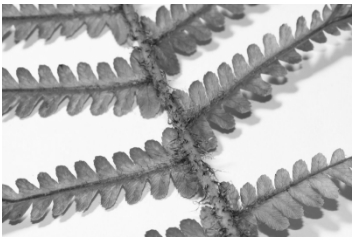
(C) Ramenta are thin,brown,scale-like or hair-like outgrowths that cover the stems,petioles,and young leaves of many ferns (pteridophytes).
Among the given options,$Marchantia$ is a bryophyte (liverwort),$Laminaria$ is an alga (brown algae),$Sequoia$ is a gymnosperm,and $Equisetum$ is a pteridophyte (horsetail). While ramenta are most typically associated with true ferns (Filicopsida),$Equisetum$ is the only pteridophyte listed here,and it is the most appropriate choice in the context of plant morphology studies involving these groups.
Among the given options,$Marchantia$ is a bryophyte (liverwort),$Laminaria$ is an alga (brown algae),$Sequoia$ is a gymnosperm,and $Equisetum$ is a pteridophyte (horsetail). While ramenta are most typically associated with true ferns (Filicopsida),$Equisetum$ is the only pteridophyte listed here,and it is the most appropriate choice in the context of plant morphology studies involving these groups.
0 likes
View Solution358
MediumMCQ
The heart-shaped form of prothallus represents:
A
Dioecious
B
Monoecious sporophyte
C
Monoecious gametophyte
D
None of the above
Solution
(C) The heart-shaped prothallus is the independent,photosynthetic gametophytic stage in the life cycle of ferns (Pteridophytes).
It bears both male reproductive organs (antheridia) and female reproductive organs (archegonia) on the same thallus.
Therefore,it is a monoecious gametophyte.
It bears both male reproductive organs (antheridia) and female reproductive organs (archegonia) on the same thallus.
Therefore,it is a monoecious gametophyte.
0 likes
View Solution359
EasyMCQ
Pteridophytes are also known as
A
Cryptogams
B
Vascular cryptogams
C
Amphibious plants
D
Phanerogams
Solution
(B) Pteridophytes are called vascular cryptogams because,among cryptogams,vascular tissues are present only in pteridophytes.
All the vegetative parts of pteridophytes possess vascular tissues,i.e.,$xylem$ and $phloem$.
All the vegetative parts of pteridophytes possess vascular tissues,i.e.,$xylem$ and $phloem$.
0 likes
View Solution360
MediumMCQ
The first vascular plants are:
A
Thallophyta
B
Bryophyta
C
Pteridophyta
D
Spermatophyta
Solution
(C) Pteridophytes are the first group of plants to possess vascular tissues ($xylem$ and $phloem$).
They are spore-forming,non-seed-bearing,and non-flowering vascular plants.
Thallophytes (like algae) do not have vascular tissues.
Bryophytes are also non-vascular plants.
Spermatophytes are seed-bearing vascular plants,which include gymnosperms and angiosperms,and they evolved after pteridophytes.
They are spore-forming,non-seed-bearing,and non-flowering vascular plants.
Thallophytes (like algae) do not have vascular tissues.
Bryophytes are also non-vascular plants.
Spermatophytes are seed-bearing vascular plants,which include gymnosperms and angiosperms,and they evolved after pteridophytes.
0 likes
View Solution361
MediumMCQ
Sporophytic generation is the dominant phase in the life cycle of
A
Marchantia
B
Ferns
C
Mosses
D
Liverworts
Solution
(B) In the life cycle of plants,the dominant phase refers to the generation that is independent,photosynthetic,and long-lived. In bryophytes (like Marchantia,Mosses,and Liverworts),the gametophytic generation is dominant. In Pteridophytes,such as Ferns,the sporophytic generation is the dominant phase,which is differentiated into true roots $(2n)$,stems,and leaves.
0 likes
View Solution362
MediumMCQ
Which of the following pteridophytes belongs to the class $Pteropsida$?
A
$Equisetum$ and $Psilotum$
B
$Lycopodium$ and $Adiantum$
C
$Selaginella$ and $Pteris$
D
$Pteris$ and $Adiantum$
Solution
(D) The class $Pteropsida$ under the division $Pteridophyta$ includes ferns. Common examples of plants belonging to this class are $Dryopteris$,$Pteris$,and $Adiantum$. Therefore,$Pteris$ and $Adiantum$ are the correct representatives of this class.
0 likes
View Solution363
EasyMCQ
Which one of the following is called maiden-hair fern?
A
Dryopteris
B
Pteris
C
Adiantum
D
Lycopodium
Solution
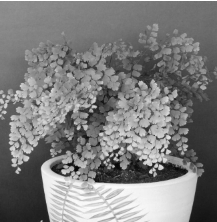
(C) Maidenhair fern is the common name given to the fern $Adiantum$ $capillus-veneris$.
It is known as maidenhair fern or Venus hair fern because of its delicate,long,dark-colored leaf stalks that resemble human hair and its feathery foliage that gently wafts in the breeze.
$Adiantum$ is a genus of about $250$ species of ferns in the family $Pteridaceae$.
It is known as maidenhair fern or Venus hair fern because of its delicate,long,dark-colored leaf stalks that resemble human hair and its feathery foliage that gently wafts in the breeze.
$Adiantum$ is a genus of about $250$ species of ferns in the family $Pteridaceae$.
0 likes
View Solution364
MediumMCQ
Dispersal of spores in fern takes place through
A
Annulus
B
Stomium
C
Both $(a)$ and $(b)$
D
Indusium
Solution
(C) In ferns,the sporangium consists of a stalk and a capsule. The capsule is filled with sporocytes,which undergo meiosis to produce haploid spores.
The one-layered wall of the capsule is thin and features a specialized strip of cells known as the annulus.
The cells of the annulus have thickenings on their inner and radial walls,but in certain regions,the cells are thin-walled. These regions are called the stomium.
Both the annulus and the stomium work together to facilitate the dispersal of spores.
The one-layered wall of the capsule is thin and features a specialized strip of cells known as the annulus.
The cells of the annulus have thickenings on their inner and radial walls,but in certain regions,the cells are thin-walled. These regions are called the stomium.
Both the annulus and the stomium work together to facilitate the dispersal of spores.
0 likes
View Solution365
MediumMCQ
Which has vascular tissue,produces spores but does not have seeds?
A
Bryophyta
B
Pteridophyta
C
Gymnosperms
D
Angiosperms
Solution
(B) Pteridophytes are known as vascular cryptogams.
They possess well-developed vascular tissues (xylem and phloem) for the conduction of water and nutrients.
They reproduce by producing spores and do not form seeds,which distinguishes them from gymnosperms and angiosperms.
They possess well-developed vascular tissues (xylem and phloem) for the conduction of water and nutrients.
They reproduce by producing spores and do not form seeds,which distinguishes them from gymnosperms and angiosperms.
0 likes
View Solution366
MediumMCQ
Which of the following plant groups is considered the first terrestrial plants to possess vascular tissues,$xylem$ and $phloem$?
A
Bryophytes
B
Pteridophytes
C
Gymnosperms
D
Angiosperms
Solution
(B) $Pteridophytes$ are considered the first terrestrial plants to possess vascular tissues ($xylem$ and $phloem$).
All the vegetative parts of $Pteridophytes$ possess vascular tissues,which are organized into definite groups.
All the vegetative parts of $Pteridophytes$ possess vascular tissues,which are organized into definite groups.
0 likes
View Solution367
EasyMCQ
Which of the following has multiflagellate sperms?
A
Equisetum
B
Riccia
C
Lycopodium
D
Anthoceros
Solution
(A) In $Equisetum$,the anterior part of the antherozoid (sperm) is spirally coiled and has numerous flagella,whereas the posterior part is somewhat expanded.
In contrast,the sperms of $Lycopodium$,$Riccia$,and $Anthoceros$ are biflagellated (possess two flagella).
In contrast,the sperms of $Lycopodium$,$Riccia$,and $Anthoceros$ are biflagellated (possess two flagella).
0 likes
View Solution368
MediumMCQ
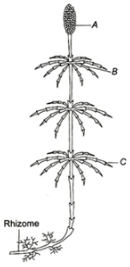
Identify $A, B$ and $C$ in the following figure and choose the correct option.
A
$A-Strobilus, B-Node, C-Leaves$
B
$A-Strobilus, B-Node, C-Branch$
C
$A-Sporophyll, B-Node, C-Internode$
D
$A-Sporophyll, B-Internode, C-Node$
Solution
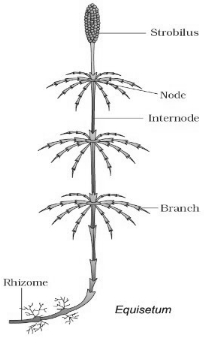
(B) The provided figure represents the pteridophyte $Equisetum$.
In this plant:
$A$ points to the $Strobilus$ (or cone), which is a structure bearing sporangia.
$B$ points to the $Node$, the region on the stem from where branches or leaves arise.
$C$ points to the $Branch$ (or lateral branch), which arises from the node.
Therefore, the correct identification is $A-Strobilus, B-Node, C-Branch$.
In this plant:
$A$ points to the $Strobilus$ (or cone), which is a structure bearing sporangia.
$B$ points to the $Node$, the region on the stem from where branches or leaves arise.
$C$ points to the $Branch$ (or lateral branch), which arises from the node.
Therefore, the correct identification is $A-Strobilus, B-Node, C-Branch$.
0 likes
View Solution369
MediumMCQ
Two very distinct generations are found in the life cycle of
A
Bacteria
B
Spirogyra
C
Volvox
D
Ferns
Solution
(D) Ferns exhibit a life cycle characterized by the alternation of generations,where the dominant,independent sporophyte generation is morphologically very distinct from the small,inconspicuous,and independent gametophyte generation. This is known as a heteromorphic life cycle.
0 likes
View Solution370
MediumMCQ
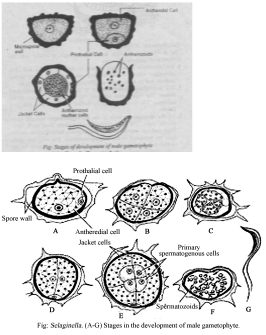
The $13$-celled male gametophyte in Selaginella is
A
$12$ cells of antheridium $+ 1$ prothallial cell
B
$10$ cells of antheridium $+ 3$ prothallial cells
C
$8$ cells of antheridium $+ 2$ prothallial cells
D
None of the above
Solution
(A) In Selaginella,the male gametophyte development begins within the microspore while it is still inside the microsporangium.
The mature $13$-celled male gametophyte consists of:
$1$ prothallial cell (which is the first cell formed).
$4$ jacket cells (which form the outer layer of the antheridium).
$8$ androgonial cells (which eventually produce the spermatozoids).
Thus,the total number of cells is $1 + 4 + 8 = 13$ cells.
This corresponds to $1$ prothallial cell and $12$ antheridial cells ($4$ jacket $+ 8$ androgonial cells).
The mature $13$-celled male gametophyte consists of:
$1$ prothallial cell (which is the first cell formed).
$4$ jacket cells (which form the outer layer of the antheridium).
$8$ androgonial cells (which eventually produce the spermatozoids).
Thus,the total number of cells is $1 + 4 + 8 = 13$ cells.
This corresponds to $1$ prothallial cell and $12$ antheridial cells ($4$ jacket $+ 8$ androgonial cells).
0 likes
View Solution371
MediumMCQ
In the case of heterosporous pteridophytes,the gametophyte is:
A
Always dioecious
B
Monoecious
C
May be monoecious or dioecious
D
Vascular
Solution
(A) Heterosporous pteridophytes,such as $Selaginella$ and $Marsilea$,produce two types of spores: microspores and megaspores.
Microspores germinate to form the male gametophyte,while megaspores germinate to form the female gametophyte.
Since the male and female gametophytes develop from separate spores,the gametophyte is always dioecious.
Microspores germinate to form the male gametophyte,while megaspores germinate to form the female gametophyte.
Since the male and female gametophytes develop from separate spores,the gametophyte is always dioecious.
0 likes
View Solution372
MediumMCQ
In some pteridophytes, sporophylls form distinct compact structures called $A$ in $B$ and $C$. Here $A, B$, and $C$ refer to:
A
$A-sporocarp, B-Pogonatum, C-Selaginella$
B
$A-spikelet, B-Riccia, C-Marchantia$
C
$A-strobilus, B-Selaginella, C-Equisetum$
D
$A-spike, B-Fern, C-Salvinia$
Solution
(C) In some pteridophytes, sporophylls aggregate to form distinct compact structures called cones or strobili $(A)$.
Examples of such pteridophytes include $Selaginella$ $(B)$ and $Equisetum$ $(C)$.
Therefore, $A$ is strobilus, $B$ is $Selaginella$, and $C$ is $Equisetum$.
Examples of such pteridophytes include $Selaginella$ $(B)$ and $Equisetum$ $(C)$.
Therefore, $A$ is strobilus, $B$ is $Selaginella$, and $C$ is $Equisetum$.
0 likes
View Solution373
MediumMCQ
Read carefully the following statements about sexual reproduction in ferns:
$I.$ Water is essential for fertilization.
$II.$ The male gametophyte bears antheridia,while the female gametophyte bears archegonia,which produce antherozoids and egg cells,respectively.
$III.$ Antherozoids and egg cells fuse to give rise to a zygote. The zygote develops into a young embryo. The embryo gives rise to a sporophyte.
Which of the statements given above are correct?
$I.$ Water is essential for fertilization.
$II.$ The male gametophyte bears antheridia,while the female gametophyte bears archegonia,which produce antherozoids and egg cells,respectively.
$III.$ Antherozoids and egg cells fuse to give rise to a zygote. The zygote develops into a young embryo. The embryo gives rise to a sporophyte.
Which of the statements given above are correct?
A
$I$ and $II$
B
$II$ and $III$
C
$I$ and $III$
D
$I, II$ and $III$
Solution
(D) Statement $I$ is correct: In ferns (pteridophytes),water is essential for the transfer of antherozoids to the mouth of the archegonium.
Statement $II$ is correct: The male gametophyte (prothallus) produces antheridia (male sex organs) which release antherozoids,and the female gametophyte produces archegonia (female sex organs) which contain the egg cell.
Statement $III$ is correct: Fertilization involves the fusion of the antherozoid with the egg cell to form a zygote. The zygote undergoes mitotic divisions to form an embryo,which eventually develops into a mature sporophyte plant.
Statement $II$ is correct: The male gametophyte (prothallus) produces antheridia (male sex organs) which release antherozoids,and the female gametophyte produces archegonia (female sex organs) which contain the egg cell.
Statement $III$ is correct: Fertilization involves the fusion of the antherozoid with the egg cell to form a zygote. The zygote undergoes mitotic divisions to form an embryo,which eventually develops into a mature sporophyte plant.
0 likes
View Solution374
EasyMCQ
Antherozoids represent:
A
Male gametophyte
B
Photosynthetic sporophyte
C
Female gametophyte
D
Motile male gametes
Solution
(D) Antherozoids are the flagellated or ciliated male gametes produced in the antheridia of bryophytes,pteridophytes,and some gymnosperms. They are motile and swim through a film of water to reach the female gamete (egg) for fertilization. Therefore,they represent motile male gametes.
0 likes
View Solution375
MediumMCQ
In pteridophytes,spores germinate to give rise to
A
Prothallus
B
Protonema
C
Leafy stage
D
Strobili
Solution
(A) In $Pteridophytes$,the spores germinate to produce a small,multicellular,free-living,mostly photosynthetic thalloid gametophyte called $Prothallus$.
0 likes
View Solution376
MediumMCQ
In $Selaginella$,the embryo develops into:
A
Gametophyte
B
Sporophyte
C
Archegonium
D
Antheridium
Solution
(B) In $Selaginella$,the zygote undergoes division to form an embryo. This embryo subsequently develops into the $sporophyte$ generation,which is the dominant phase in the life cycle of pteridophytes.
0 likes
View Solution377
MediumMCQ
In pteridophytes,the megaspore germinates to form
A
Pollen grain
B
Embryo
C
Seed
D
Female gametophyte
Solution
(D) In pteridophytes,the megaspore germinates to form the female gametophyte. Unlike seed plants,the female gametophyte in pteridophytes is retained on the parent sporophyte for variable periods,but it develops from the megaspore.
0 likes
View Solution378
MediumMCQ
The development of young embryos of pteridophytes within the female gametophytes is a precursor to the
A
Aquatic habit
B
Autotrophic habit
C
Seed habit
D
Parasitic habit
Solution
(C) In pteridophytes,the zygote develops into a young embryo within the female gametophyte. This retention and development of the embryo within the female gametophyte is an evolutionary step that eventually led to the development of the seed habit in higher plants (spermatophytes).
0 likes
View Solution379
MediumMCQ
Which of the following possess vascular tissues but lacks seeds?
A
Mosses
B
Volvox
C
Ferns
D
Liverworts
Solution
(C) Pteridophytes are the first terrestrial plants to possess vascular tissues ($xylem$ and $phloem$) but they do not produce seeds.
Among the given options,Ferns belong to the group Pteridophytes.
Mosses and Liverworts are Bryophytes,which lack vascular tissues.
Volvox is an Alga.
Among the given options,Ferns belong to the group Pteridophytes.
Mosses and Liverworts are Bryophytes,which lack vascular tissues.
Volvox is an Alga.
0 likes
View Solution380
MediumMCQ
The main plant body is differentiated into true root,stem,and leaves in:
A
Green algae
B
Bryophytes
C
Blue-green algae
D
Pteridophytes
Solution
(D) In the plant kingdom,the main plant body is differentiated into true root,stem,and leaves starting from the group $Pteridophytes$.
$1$. Green algae and Blue-green algae (Cyanobacteria) have a thalloid body structure.
$2$. Bryophytes have a plant body that is thallus-like or leaf-like but lacks true roots,stems,or leaves.
$3$. Pteridophytes are the first group of land plants to possess true roots,stems,and leaves along with a well-developed vascular system.
$1$. Green algae and Blue-green algae (Cyanobacteria) have a thalloid body structure.
$2$. Bryophytes have a plant body that is thallus-like or leaf-like but lacks true roots,stems,or leaves.
$3$. Pteridophytes are the first group of land plants to possess true roots,stems,and leaves along with a well-developed vascular system.
0 likes
View Solution381
EasyMCQ
Evolutionarily, the first terrestrial plants to possess vascular tissues are
A
Green algae
B
Pteridophytes
C
Brown algae
D
Bryophytes
Solution
(B) Pteridophytes are the first terrestrial plants to possess vascular tissues ($xylem$ and $phloem$). While bryophytes are the first land plants, they lack true vascular tissues. Pteridophytes represent the evolutionary transition where complex transport systems first appeared in land plants.
0 likes
View Solution382
MediumMCQ
In pteridophytes,fusion of gametes takes place in
A
External medium
B
Antheridium
C
Sporangium
D
Archegonium
Solution
(D) In pteridophytes,the male gametes (antherozoids) are released from the antheridium and travel through water to reach the archegonium. The fusion of the male gamete with the egg cell occurs inside the archegonium,resulting in the formation of a zygote.
0 likes
View Solution383
MediumMCQ
Find the correct statement for the prothallus of a fern.
A
Monoecious,protandrous with multicellular rhizoids.
B
Monoecious,protandrous with unicellular rhizoids.
C
Dioecious,with unicellular rhizoids.
D
Monoecious,protandrous with apical antheridia and basal archegonia on the ventral surface.
Solution
(B) The prothallus of a fern is a heart-shaped,photosynthetic,independent gametophyte. It is monoecious (bisexual),meaning it bears both male and female sex organs. It is protandrous,meaning the antheridia (male sex organs) mature before the archegonia (female sex organs). It is anchored to the substrate by unicellular rhizoids.
0 likes
View Solution384
MediumMCQ
In $Pteridophytes$, reduction division occurs when:
A
Prothallus is formed
B
Sex organs are formed
C
Spores are formed
D
Gametes are formed
Solution
(C) In $Pteridophytes$, the main plant body is a $sporophyte$ $(2n)$, which is differentiated into true root, stem, and leaves.
These plants possess specialized structures called $sporangia$ that produce spores.
Inside the $sporangia$, the spore mother cells undergo $meiosis$ (reduction division) to produce haploid $(n)$ spores.
Therefore, reduction division occurs during the formation of spores.
These plants possess specialized structures called $sporangia$ that produce spores.
Inside the $sporangia$, the spore mother cells undergo $meiosis$ (reduction division) to produce haploid $(n)$ spores.
Therefore, reduction division occurs during the formation of spores.
0 likes
View Solution385
MediumMCQ
The evolutionary advanced features of $Selaginella$ are:
$(a)$ Heterospory
$(b)$ Endosporic development of gametophyte
$(c)$ Reduced gametophyte
$(d)$ Localization of sporangium-bearing appendages in strobili
$(e)$ Unisexual gametophytes
$(f)$ Fertilization with the help of water
$(a)$ Heterospory
$(b)$ Endosporic development of gametophyte
$(c)$ Reduced gametophyte
$(d)$ Localization of sporangium-bearing appendages in strobili
$(e)$ Unisexual gametophytes
$(f)$ Fertilization with the help of water
A
All are correct
B
All except $(f)$ are correct
C
All except $(e)$ and $(f)$ are correct
D
All except $(c)$ are correct
Solution
(B) $Selaginella$ exhibits several evolutionary advancements that bridge the gap between Pteridophytes and Seed plants.
$(a)$ Heterospory (production of two types of spores) is a significant evolutionary step towards the seed habit.
$(b)$ Endosporic development of the gametophyte means the gametophyte develops within the spore wall,which is an advanced trait.
$(c)$ The gametophyte is highly reduced compared to primitive Pteridophytes.
$(d)$ The formation of strobili (cones) is an advanced feature for spore protection and dispersal.
$(e)$ Unisexual gametophytes are an evolutionary advancement.
$(f)$ Fertilization with the help of water is a primitive trait,not an advanced one,as it keeps the plant dependent on external water sources for reproduction.
Therefore,all features except $(f)$ are considered evolutionary advancements.
$(a)$ Heterospory (production of two types of spores) is a significant evolutionary step towards the seed habit.
$(b)$ Endosporic development of the gametophyte means the gametophyte develops within the spore wall,which is an advanced trait.
$(c)$ The gametophyte is highly reduced compared to primitive Pteridophytes.
$(d)$ The formation of strobili (cones) is an advanced feature for spore protection and dispersal.
$(e)$ Unisexual gametophytes are an evolutionary advancement.
$(f)$ Fertilization with the help of water is a primitive trait,not an advanced one,as it keeps the plant dependent on external water sources for reproduction.
Therefore,all features except $(f)$ are considered evolutionary advancements.
0 likes
View Solution386
MediumMCQ
How many structures listed below are diploid $(2n)$ for a typical fern member?
$a.$ Indusium cell
$b.$ Stomium cell
$c.$ $NCC$ (Neck Canal Cell)
$d.$ Rhizome cell
$e.$ Sporophyll cell
$f.$ Prothallus cell
$g.$ $SMC$ (Spore Mother Cell)
$h.$ Spore
$i.$ Antherozoid mother cell
$a.$ Indusium cell
$b.$ Stomium cell
$c.$ $NCC$ (Neck Canal Cell)
$d.$ Rhizome cell
$e.$ Sporophyll cell
$f.$ Prothallus cell
$g.$ $SMC$ (Spore Mother Cell)
$h.$ Spore
$i.$ Antherozoid mother cell
A
Nine
B
Six
C
Five
D
Seven
Solution
(C) In a typical fern (Pteridophyte),the main plant body is the sporophyte $(2n)$.
Let us analyze the ploidy of each structure:
$a.$ Indusium cell: Part of the sporophyte $(2n)$.
$b.$ Stomium cell: Part of the sporangium wall,sporophytic $(2n)$.
$c.$ $NCC$: Neck Canal Cell,part of the female gametophyte $(n)$.
$d.$ Rhizome cell: Part of the sporophytic stem $(2n)$.
$e.$ Sporophyll cell: Leaf bearing sporangia,sporophytic $(2n)$.
$f.$ Prothallus cell: The gametophyte stage $(n)$.
$g.$ $SMC$: Spore Mother Cell,undergoes meiosis,sporophytic $(2n)$.
$h.$ Spore: Product of meiosis,gametophytic $(n)$.
$i.$ Antherozoid mother cell: Part of the gametophyte $(n)$.
The diploid structures are $a, b, d, e,$ and $g$. Total count = $5$.
Let us analyze the ploidy of each structure:
$a.$ Indusium cell: Part of the sporophyte $(2n)$.
$b.$ Stomium cell: Part of the sporangium wall,sporophytic $(2n)$.
$c.$ $NCC$: Neck Canal Cell,part of the female gametophyte $(n)$.
$d.$ Rhizome cell: Part of the sporophytic stem $(2n)$.
$e.$ Sporophyll cell: Leaf bearing sporangia,sporophytic $(2n)$.
$f.$ Prothallus cell: The gametophyte stage $(n)$.
$g.$ $SMC$: Spore Mother Cell,undergoes meiosis,sporophytic $(2n)$.
$h.$ Spore: Product of meiosis,gametophytic $(n)$.
$i.$ Antherozoid mother cell: Part of the gametophyte $(n)$.
The diploid structures are $a, b, d, e,$ and $g$. Total count = $5$.
0 likes
View Solution387
MediumMCQ
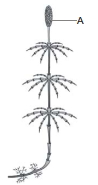
Mark the correct statement for the organism given below in the figure.
A
The structure labelled $A$ is a male cone.
B
It is a member of Sphenopsida.
C
Nodes are hollow while internodes are solid.
D
This is commonly called as stonewort.
Solution
(B) The organism shown in the figure is Equisetum,which is commonly known as horsetail.
It belongs to the class Sphenopsida of the division Pteridophyta.
Structure $A$ represents a strobilus or cone,which is bisexual in Equisetum,not exclusively a male cone.
Therefore,the statement 'It is a member of Sphenopsida' is the correct statement.
It belongs to the class Sphenopsida of the division Pteridophyta.
Structure $A$ represents a strobilus or cone,which is bisexual in Equisetum,not exclusively a male cone.
Therefore,the statement 'It is a member of Sphenopsida' is the correct statement.
0 likes
View Solution388
MediumMCQ
$A$: Seeds are formed by some species of spike moss.
$R$: All conditions for seed habit are fulfilled by these species of spike moss.
$R$: All conditions for seed habit are fulfilled by these species of spike moss.
A
Assertion and Reason both are correct and Reason is the correct explanation of Assertion.
B
Assertion and Reason both are correct but Reason is not the correct explanation of Assertion.
C
Assertion is correct,but Reason is incorrect.
D
Both Assertion and Reason are incorrect.
Solution
(D) The Assertion is incorrect because spike moss $(Selaginella)$ belongs to the group Pteridophyta,which are seedless vascular plants. While $Selaginella$ exhibits the 'seed habit' (heterospory and retention of the megaspore),it does not produce true seeds.
The Reason is also incorrect because,although $Selaginella$ shows precursors to seed habit,it does not fulfill all conditions required for the formation of a true seed (such as the development of an integumented megasporangium or ovule that matures into a seed).
Therefore,both the Assertion and the Reason are incorrect.
The Reason is also incorrect because,although $Selaginella$ shows precursors to seed habit,it does not fulfill all conditions required for the formation of a true seed (such as the development of an integumented megasporangium or ovule that matures into a seed).
Therefore,both the Assertion and the Reason are incorrect.
0 likes
View Solution389
MediumMCQ
$A$: Events precursor to the seed habit are seen in some members of pteridophytes.
$R$: Development of the zygotes into young embryos takes place within the female gametophyte.
$R$: Development of the zygotes into young embryos takes place within the female gametophyte.
A
Assertion and Reason both are correct and Reason is the correct explanation of Assertion.
B
Assertion and Reason both are correct but Reason is not the correct explanation of Assertion.
C
Assertion is correct,but Reason is incorrect.
D
Both Assertion and Reason are incorrect.
Solution
(A) In pteridophytes like $Selaginella$ and $Salvinia$,which are heterosporous,the female gametophytes are retained on the parent sporophytes for variable periods.
The development of the zygotes into young embryos takes place within the female gametophytes retained on the parent sporophytes.
This event is a precursor to the seed habit,considered an important step in evolution.
Therefore,both the Assertion and the Reason are correct,and the Reason provides the correct explanation for the Assertion.
The development of the zygotes into young embryos takes place within the female gametophytes retained on the parent sporophytes.
This event is a precursor to the seed habit,considered an important step in evolution.
Therefore,both the Assertion and the Reason are correct,and the Reason provides the correct explanation for the Assertion.
0 likes
View Solution390
EasyMCQ
In $Selaginella$,the adaxial outgrowth,from the base of the leaf,is called:
A
Ligule
B
Velum
C
Rhizophore
D
Glossopodium
Solution
(A) The leaves of $Selaginella$ are microphyllous. Each leaf is traversed by a single unbranched midrib. $A$ ligule arises from the base of each leaf (ligulate) as an adaxial outgrowth. It is a delicate,scale-like structure,often green,with an entire or serrate margin and an acute apex.
0 likes
View Solution391
EasyMCQ
Apogamy is
A
Reproduction of virus
B
Failure of fusion of gametes
C
Development of bacteria
D
Loss of function of reproduction
Solution
(B) Apogamy was first reported by $Farlow$ $(1874)$.
It is defined as the development of a sporophyte directly from the gametophyte without the intervention of sex organs and gametes.
It is defined as the development of a sporophyte directly from the gametophyte without the intervention of sex organs and gametes.
0 likes
View Solution392
MediumMCQ
Which of the following is the first vascular plant to be represented by an extinct group?
A
Bryophytes
B
Lycopods
C
Conifers
D
Cycads
Solution
(B) The $Cooksonia$ is considered the oldest known vascular plant.
It belongs to the group $Rhyniophyta$,which is an extinct group of early vascular plants.
These plants appeared during the $Silurian$ period and were prevalent in the $Devonian$ period.
$Cooksonia$ was a small plant,approximately $6.5 \ cm$ tall,with dichotomously branched leafless stems and terminal sporangia.
Since $Rhyniophytes$ are entirely extinct,they represent the earliest vascular plants that have no living descendants.
It belongs to the group $Rhyniophyta$,which is an extinct group of early vascular plants.
These plants appeared during the $Silurian$ period and were prevalent in the $Devonian$ period.
$Cooksonia$ was a small plant,approximately $6.5 \ cm$ tall,with dichotomously branched leafless stems and terminal sporangia.
Since $Rhyniophytes$ are entirely extinct,they represent the earliest vascular plants that have no living descendants.
0 likes
View Solution393
EasyMCQ
Some genera like $Selaginella$ and $Salvinia$ produce two kinds of spores. What are such plants called?
A
Homosporous
B
Heterosporous
C
Isosporous
D
Heterosorous
Solution
(B) Plants that produce two different kinds of spores,namely microspores and megaspores,are known as heterosporous plants.
$Selaginella$ and $Salvinia$ are classic examples of pteridophytes that exhibit heterospory.
This phenomenon is considered a precursor to the seed habit in higher plants.
$Selaginella$ and $Salvinia$ are classic examples of pteridophytes that exhibit heterospory.
This phenomenon is considered a precursor to the seed habit in higher plants.
0 likes
View Solution394
MediumMCQ
Match the following columns:
| Column-$I$ | Column-$II$ |
| $P$. Psilopsida | $I$. Psilotum |
| $Q$. Lycopsida | $II$. Selaginella,Lycopodium |
| $R$. Sphenopsida | $III$. Equisetum |
| $S$. Pteropsida | $IV$. Dryopteris,Pteris,Adiantum |
A
$(P-I), (Q-II), (R-III), (S-IV)$
B
$(P-I), (Q-II), (R-IV), (S-III)$
C
$(P-I), (Q-III), (R-II), (S-IV)$
D
$(P-I), (Q-IV), (R-III), (S-II)$
Solution
(A) The classification of Pteridophytes into four classes is as follows:
$1$. Psilopsida: Includes primitive forms like $Psilotum$.
$2$. Lycopsida: Includes plants like $Selaginella$ and $Lycopodium$.
$3$. Sphenopsida: Includes $Equisetum$ (horsetails).
$4$. Pteropsida: Includes ferns like $Dryopteris$,$Pteris$,and $Adiantum$.
Therefore,the correct matching is $(P-I), (Q-II), (R-III), (S-IV)$.
$1$. Psilopsida: Includes primitive forms like $Psilotum$.
$2$. Lycopsida: Includes plants like $Selaginella$ and $Lycopodium$.
$3$. Sphenopsida: Includes $Equisetum$ (horsetails).
$4$. Pteropsida: Includes ferns like $Dryopteris$,$Pteris$,and $Adiantum$.
Therefore,the correct matching is $(P-I), (Q-II), (R-III), (S-IV)$.
0 likes
View Solution395
MediumMCQ
Horsetails and ferns belong to which of the following groups?
A
Algae
B
Bryophytes
C
Pteridophytes
D
Gymnosperms
Solution
(C) Horsetails (Equisetum) and ferns are classified under the group $Pteridophytes$.
$Pteridophytes$ are the first terrestrial plants to possess vascular tissues ($xylem$ and $phloem$).
They are commonly used for medicinal purposes and as soil-binders,and are frequently grown as ornamentals.
$Pteridophytes$ are the first terrestrial plants to possess vascular tissues ($xylem$ and $phloem$).
They are commonly used for medicinal purposes and as soil-binders,and are frequently grown as ornamentals.
0 likes
View Solution396
MediumMCQ
What are the uses of Pteridophytes?
A
Soil binders
B
Medicinal purposes
C
Ornamental purposes
D
All of the above
Solution
(D) Pteridophytes are useful in various ways:
$1$. As soil binders: They help in preventing soil erosion by binding the soil particles together.
$2$. Medicinal purposes: Many pteridophytes are used in traditional medicine for treating various ailments.
$3$. Ornamental purposes: Pteridophytes,especially ferns,are widely grown as ornamental plants due to their aesthetic appeal.
Therefore,the correct option is $D$.
$1$. As soil binders: They help in preventing soil erosion by binding the soil particles together.
$2$. Medicinal purposes: Many pteridophytes are used in traditional medicine for treating various ailments.
$3$. Ornamental purposes: Pteridophytes,especially ferns,are widely grown as ornamental plants due to their aesthetic appeal.
Therefore,the correct option is $D$.
0 likes
View Solution397
MediumMCQ
Which of the following are seedless plants that possess vascular tissues?
A
Bryophytes
B
Pteridophytes
C
Gymnosperms
D
Angiosperms
Solution
(B) The plant kingdom is classified based on the presence or absence of vascular tissues and seeds.
$1$. Bryophytes are non-vascular, seedless plants.
$2$. Pteridophytes are the first terrestrial plants to possess vascular tissues ($Xylem$ and $Phloem$) but they do not produce seeds; they reproduce via spores.
$3$. Gymnosperms and Angiosperms are seed-bearing plants (Spermatophytes).
Therefore, Pteridophytes are the correct answer.
$1$. Bryophytes are non-vascular, seedless plants.
$2$. Pteridophytes are the first terrestrial plants to possess vascular tissues ($Xylem$ and $Phloem$) but they do not produce seeds; they reproduce via spores.
$3$. Gymnosperms and Angiosperms are seed-bearing plants (Spermatophytes).
Therefore, Pteridophytes are the correct answer.
0 likes
View Solution398
MediumMCQ
Select the incorrect statement for $Pteridophytes$.
A
They are the first terrestrial plants.
B
They are known as amphibians of the plant kingdom.
C
They are found in cool,damp,and shady places.
D
They thrive well in sandy soil.
Solution
(D) The correct answer is $D$.
$Pteridophytes$ are the first terrestrial plants to possess vascular tissues ($xylem$ and $phloem$).
They are found in cool,damp,and shady places.
They are $NOT$ known as the 'amphibians of the plant kingdom'; this term is reserved for $Bryophytes$ because they require water for fertilization despite being terrestrial.
$Pteridophytes$ do not thrive well in sandy soil; they prefer moist,shady habitats.
$Pteridophytes$ are the first terrestrial plants to possess vascular tissues ($xylem$ and $phloem$).
They are found in cool,damp,and shady places.
They are $NOT$ known as the 'amphibians of the plant kingdom'; this term is reserved for $Bryophytes$ because they require water for fertilization despite being terrestrial.
$Pteridophytes$ do not thrive well in sandy soil; they prefer moist,shady habitats.
0 likes
View Solution399
MediumMCQ
The plant body is differentiated into true roots, stems, and leaves in:
A
Pteridophytes - Sporophyte
B
Bryophytes - Sporophyte
C
Pteridophytes - Gametophyte
D
Bryophytes - Gametophyte
Solution
(A) In the plant kingdom, $Pteridophytes$ are the first terrestrial plants to possess vascular tissues ($xylem$ and $phloem$).
Their main plant body is a $sporophyte$, which is well-differentiated into true roots, stems, and leaves.
In contrast, $Bryophytes$ have a thallus-like body that is not differentiated into true roots, stems, or leaves.
Therefore, the correct answer is $Pteridophytes - Sporophyte$.
Their main plant body is a $sporophyte$, which is well-differentiated into true roots, stems, and leaves.
In contrast, $Bryophytes$ have a thallus-like body that is not differentiated into true roots, stems, or leaves.
Therefore, the correct answer is $Pteridophytes - Sporophyte$.
0 likes
View Solution400
MediumMCQ
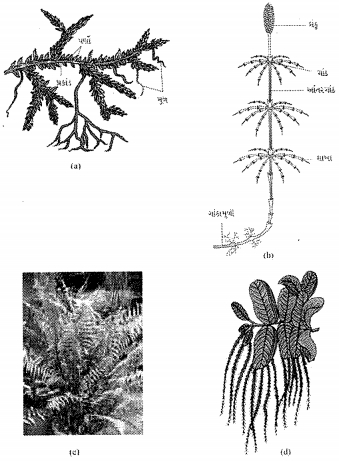
Identify the given pteridophytes in the image.
A
$A$: Selaginella,$B$: Equisetum,$C$: Fern (Dryopteris),$D$: Salvinia
B
$A$: Equisetum,$B$: Selaginella,$C$: Salvinia,$D$: Fern (Dryopteris)
C
$A$: Equisetum,$B$: Selaginella,$C$: Fern (Dryopteris),$D$: Salvinia
D
$A$: Selaginella,$B$: Equisetum,$C$: Fern (Dryopteris),$D$: Salvinia
Solution
(A) Based on the $NCERT$ textbook diagrams of Pteridophytes:
$(a)$ represents Selaginella,which shows a creeping habit with small leaves.
$(b)$ represents Equisetum,characterized by its jointed stem and strobilus.
$(c)$ represents a Fern (Dryopteris),showing typical fronds.
$(d)$ represents Salvinia,an aquatic pteridophyte.
Therefore,the correct sequence is $A$: Selaginella,$B$: Equisetum,$C$: Fern,$D$: Salvinia.
$(a)$ represents Selaginella,which shows a creeping habit with small leaves.
$(b)$ represents Equisetum,characterized by its jointed stem and strobilus.
$(c)$ represents a Fern (Dryopteris),showing typical fronds.
$(d)$ represents Salvinia,an aquatic pteridophyte.
Therefore,the correct sequence is $A$: Selaginella,$B$: Equisetum,$C$: Fern,$D$: Salvinia.
0 likes
View SolutionPlant Kingdom — Pteridophytes (General) · Frequently Asked Questions
1Are these Plant Kingdom questions useful for JEE and NEET?
Yes. All questions in this section are mapped to JEE Main and NEET exam patterns. Previous year questions from JEE Main, NEET, GUJCET and state-level exams are included with full solutions.
2Can I switch to Hindi or Gujarati for these questions?
Yes. Use the language tabs in the hero section or the sidebar to view the same questions and solutions in English, Hindi or Gujarati.
3How do I generate a question paper from this subtopic?
Use the Vedclass Exam Paper Generator — select the chapter and subtopic, set difficulty, and generate Sets A, B, C, D automatically. First 3 chapters of every subject are free.
Vedclass Products
For Students
Vedclass Test Series
Mock tests in real JEE/NEET style with performance analysis. 5-day free trial.
Start Free TrialFor Teachers
Exam Paper Generator
Generate Set A/B/C/D papers from this chapter in 2 minutes. 3 chapters free.
Try FreeFor Institutes
Online Exam Module
Live online exams with unlimited students, 360° analytics & white-label branding.
See DemoFor Teachers & Institutes
Generate a Plant Kingdom Exam Paper in 2 Minutes
Select subtopic & difficulty — Sets A, B, C, D auto-generated with No Repeat logic.
First 3 chapters of every subject are free — no payment required.