
A English
Pteridophytes (General) Questions in English
Class 11 Biology · Plant Kingdom · Pteridophytes (General)
417+
Questions
English
Language
100%
With Solutions
Showing 17 of 417 questions in English
401
MediumMCQ
Sporangia are associated with sporophylls. In $P$ plants,sporophylls are distinct,while in $Q$ plants,sporophylls form compact structures called strobili or cones.
$P \quad Q$
$P \quad Q$
A
$Selaginella, Equisetum \quad Pteris$
B
$Pteris \quad Selaginella, Equisetum$
C
$Pteris, Selaginella \quad Equisetum$
D
$Equisetum \quad Pteris, Selaginella$
Solution
(B) In Pteridophytes,the sporangia are subtended by leaf-like appendages called sporophylls.
In some cases,such as in $Pteris$ (fern),the sporophylls may form distinct,separate structures.
In many other cases,such as in $Selaginella$ and $Equisetum$,the sporophylls may form distinct compact structures called strobili or cones.
Therefore,$P$ represents $Pteris$ and $Q$ represents $Selaginella$ and $Equisetum$.
In some cases,such as in $Pteris$ (fern),the sporophylls may form distinct,separate structures.
In many other cases,such as in $Selaginella$ and $Equisetum$,the sporophylls may form distinct compact structures called strobili or cones.
Therefore,$P$ represents $Pteris$ and $Q$ represents $Selaginella$ and $Equisetum$.
0 likes
View Solution402
DifficultMCQ
Select the incorrect statement regarding the prothallus of Pteridophytes:
A
It is an inconspicuous,multicellular,free-living,photosynthetic gametophyte.
B
It requires cool,damp,and shady places to grow.
C
It requires water for fertilization.
D
It is formed from a diploid spore.
Solution
(D) The prothallus in Pteridophytes is the gametophytic stage.
$1$. It is a small,inconspicuous,multicellular,free-living,and photosynthetic structure,which is haploid $(n)$.
$2$. Because of its specific growth requirements,it is restricted to cool,damp,and shady places.
$3$. Pteridophytes require water for the transfer of male gametes (antherozoids) to the archegonium for fertilization.
$4$. The prothallus develops from a haploid spore $(n)$ produced by the sporophyte via meiosis,not from a diploid spore. Therefore,the statement that it is formed from a diploid spore is incorrect.
$1$. It is a small,inconspicuous,multicellular,free-living,and photosynthetic structure,which is haploid $(n)$.
$2$. Because of its specific growth requirements,it is restricted to cool,damp,and shady places.
$3$. Pteridophytes require water for the transfer of male gametes (antherozoids) to the archegonium for fertilization.
$4$. The prothallus develops from a haploid spore $(n)$ produced by the sporophyte via meiosis,not from a diploid spore. Therefore,the statement that it is formed from a diploid spore is incorrect.
0 likes
View Solution403
MediumMCQ
Identify the Pteridophytes based on their spores.
Homosporous $\quad$ Heterosporous
Homosporous $\quad$ Heterosporous
A
Equisetum,Dryopteris $\quad$ Selaginella,Salvinia
B
Selaginella,Salvinia $\quad$ Equisetum,Dryopteris
C
Dryopteris,Selaginella $\quad$ Equisetum,Salvinia
D
Equisetum,Salvinia $\quad$ Dryopteris,Selaginella
Solution
(A) Pteridophytes are classified based on the type of spores they produce:
$1$. Homosporous: These plants produce spores of only one kind. Examples include Equisetum and Dryopteris (Ferns).
$2$. Heterosporous: These plants produce two kinds of spores,macro (large) and micro (small) spores. Examples include Selaginella and Salvinia.
Therefore,the correct classification is: Homosporous ($Equisetum$,$Dryopteris$) and Heterosporous ($Selaginella$,$Salvinia$).
$1$. Homosporous: These plants produce spores of only one kind. Examples include Equisetum and Dryopteris (Ferns).
$2$. Heterosporous: These plants produce two kinds of spores,macro (large) and micro (small) spores. Examples include Selaginella and Salvinia.
Therefore,the correct classification is: Homosporous ($Equisetum$,$Dryopteris$) and Heterosporous ($Selaginella$,$Salvinia$).
0 likes
View Solution404
EasyMCQ
Identify the pair of heterosporous pteridophytes among the following:
A
Equisetum and Salvinia
B
Lycopodium and Selaginella
C
Selaginella and Salvinia
D
Psilotum and Salvinia
Solution
(C) Pteridophytes that produce two different kinds of spores,known as microspores and megaspores,are called heterosporous.
$Selaginella$ and $Salvinia$ are well-known examples of heterosporous pteridophytes.
In contrast,$Psilotum$,$Lycopodium$,and $Equisetum$ are homosporous,meaning they produce only one type of spore.
$Selaginella$ and $Salvinia$ are well-known examples of heterosporous pteridophytes.
In contrast,$Psilotum$,$Lycopodium$,and $Equisetum$ are homosporous,meaning they produce only one type of spore.
0 likes
View Solution405
MediumMCQ
Given below are the stages in the life cycle of pteridophytes. Arrange the following stages in the correct sequence.
$A.$ Prothallus stage
$B.$ Meiosis in spore mother cells
$C.$ Fertilisation
$D.$ Formation of archegonia and antheridia in gametophyte.
$E.$ Transfer of antherozoids to the archegonia in presence of water.
Choose the correct answer from the options given below.
$A.$ Prothallus stage
$B.$ Meiosis in spore mother cells
$C.$ Fertilisation
$D.$ Formation of archegonia and antheridia in gametophyte.
$E.$ Transfer of antherozoids to the archegonia in presence of water.
Choose the correct answer from the options given below.
A
$B, A, D, E, C$
B
$B, A, E, C, D$
C
$D, E, C, A, B$
D
$E, D, C, B, A$
Solution
(A) The life cycle of pteridophytes follows these steps:
$1$. $B.$ Meiosis occurs in spore mother cells to produce haploid spores.
$2$. $A.$ These spores germinate to form a multicellular,free-living,photosynthetic thalloid gametophyte called the prothallus.
$3$. $D.$ The prothallus bears sex organs,namely the archegonia (female) and antheridia (male).
$4$. $E.$ Antherozoids are released from antheridia and transferred to the archegonia in the presence of water.
$5$. $C.$ Fertilisation occurs to form a zygote,which develops into a sporophyte.
Therefore,the correct sequence is $B \rightarrow A \rightarrow D \rightarrow E \rightarrow C$.
$1$. $B.$ Meiosis occurs in spore mother cells to produce haploid spores.
$2$. $A.$ These spores germinate to form a multicellular,free-living,photosynthetic thalloid gametophyte called the prothallus.
$3$. $D.$ The prothallus bears sex organs,namely the archegonia (female) and antheridia (male).
$4$. $E.$ Antherozoids are released from antheridia and transferred to the archegonia in the presence of water.
$5$. $C.$ Fertilisation occurs to form a zygote,which develops into a sporophyte.
Therefore,the correct sequence is $B \rightarrow A \rightarrow D \rightarrow E \rightarrow C$.
0 likes
View Solution406
MediumMCQ
Which of the following is a heterosporous fern?
A
Salvia
B
Salvinia
C
Selaginella
D
$2$ and $3$ both
Solution
(B) Heterospory is the production of two different types of spores,namely microspores and megaspores.
Among the given options,$Salvinia$ and $Selaginella$ are heterosporous.
However,$Selaginella$ is a pteridophyte belonging to the class Lycopsida,often called a 'spike moss',and is not considered a true fern.
$Salvinia$ is a member of the class Pteropsida and is a true aquatic fern that exhibits heterospory.
$Salvia$ is an angiosperm (flowering plant).
Therefore,$Salvinia$ is the correct answer.
Among the given options,$Salvinia$ and $Selaginella$ are heterosporous.
However,$Selaginella$ is a pteridophyte belonging to the class Lycopsida,often called a 'spike moss',and is not considered a true fern.
$Salvinia$ is a member of the class Pteropsida and is a true aquatic fern that exhibits heterospory.
$Salvia$ is an angiosperm (flowering plant).
Therefore,$Salvinia$ is the correct answer.
0 likes
View Solution407
MediumMCQ
Archegonia and antheridia in homosporous pteridophytes are present in:
A
Main sporophyte plant
B
Independent multicellular prothallus
C
Dependent multicellular prothallus
D
Independent unicellular prothallus
Solution
(B) In homosporous pteridophytes,the spores germinate to produce a small,inconspicuous,photosynthetic,and free-living (independent) gametophyte known as the prothallus.
This prothallus is multicellular and bears the sex organs,namely the antheridia (male) and archegonia (female).
Therefore,the correct answer is an independent multicellular prothallus.
This prothallus is multicellular and bears the sex organs,namely the antheridia (male) and archegonia (female).
Therefore,the correct answer is an independent multicellular prothallus.
0 likes
View Solution408
MediumMCQ
Microspore and megaspore are found in $-$
A
Psilotum
B
Equisetum
C
Dryopteris
D
Azolla
Solution
(D) The phenomenon of producing two different types of spores,microspores and megaspores,is known as heterospory.
Among the given options,$Psilotum$,$Equisetum$,and $Dryopteris$ are homosporous,meaning they produce only one type of spore.
$Azolla$ is a genus of aquatic ferns that is heterosporous,producing both microspores and megaspores.
Therefore,the correct option is $D$.
Among the given options,$Psilotum$,$Equisetum$,and $Dryopteris$ are homosporous,meaning they produce only one type of spore.
$Azolla$ is a genus of aquatic ferns that is heterosporous,producing both microspores and megaspores.
Therefore,the correct option is $D$.
0 likes
View Solution409
EasyMCQ
Prothallus is $:-$
A
Sporophytic generation of moss
B
Gametophytic generation of moss
C
Gametophytic generation of ferns
D
Sporophytic generation of ferns
Solution
(C) In Pteridophytes,such as ferns,the main plant body is a sporophyte.
When the spores germinate,they produce a small,inconspicuous,multicellular,free-living,mostly photosynthetic thalloid structure called the prothallus.
The prothallus represents the gametophytic generation in ferns.
It bears the sex organs,namely antheridia and archegonia,which produce gametes.
When the spores germinate,they produce a small,inconspicuous,multicellular,free-living,mostly photosynthetic thalloid structure called the prothallus.
The prothallus represents the gametophytic generation in ferns.
It bears the sex organs,namely antheridia and archegonia,which produce gametes.
0 likes
View Solution410
MediumMCQ
The development of the zygote into young embryos takes place within the female gametophyte; this event is a precursor of the $:-$
A
Seed habit
B
Fruit habit
C
Vascular habit
D
Tissue habit
Solution
(A) In $Pteridophytes$ like $Selaginella$ and $Salvinia$, the development of the zygote into young embryos takes place within the female gametophyte.
This retention and germination of the megaspore within the parent sporophyte is a significant evolutionary step.
This phenomenon is considered a precursor to the $Seed \text{ } habit$, which is a characteristic feature of higher plants like $Gymnosperms$ and $Angiosperms$.
This retention and germination of the megaspore within the parent sporophyte is a significant evolutionary step.
This phenomenon is considered a precursor to the $Seed \text{ } habit$, which is a characteristic feature of higher plants like $Gymnosperms$ and $Angiosperms$.
0 likes
View Solution411
MediumMCQ
Match the following columns $:-$
| Column-$I$ | Column-$II$ |
| $A$. Psilopsida | $i$. Dryopteris |
| $B$. Lycopsida | $ii$. Equisetum |
| $C$. Sphenopsida | $iii$. Selaginella |
| $D$. Pteropsida | $iv$. Psilotum |
A
$A \rightarrow iv; B \rightarrow iii; C \rightarrow ii; D \rightarrow i$
B
$A \rightarrow iii; B \rightarrow ii; C \rightarrow i; D \rightarrow iv$
C
$A \rightarrow ii; B \rightarrow i; C \rightarrow iv; D \rightarrow iii$
D
$A \rightarrow i; B \rightarrow iv; C \rightarrow iii; D \rightarrow ii$
Solution
(A) The classification of Pteridophytes is as follows:
$1$. Psilopsida: Includes primitive forms like $Psilotum$ $(A \rightarrow iv)$.
$2$. Lycopsida: Includes club mosses like $Selaginella$ $(B \rightarrow iii)$.
$3$. Sphenopsida: Includes horsetails like $Equisetum$ $(C \rightarrow ii)$.
$4$. Pteropsida: Includes ferns like $Dryopteris$ $(D \rightarrow i)$.
Therefore,the correct matching is $A \rightarrow iv, B \rightarrow iii, C \rightarrow ii, D \rightarrow i$.
$1$. Psilopsida: Includes primitive forms like $Psilotum$ $(A \rightarrow iv)$.
$2$. Lycopsida: Includes club mosses like $Selaginella$ $(B \rightarrow iii)$.
$3$. Sphenopsida: Includes horsetails like $Equisetum$ $(C \rightarrow ii)$.
$4$. Pteropsida: Includes ferns like $Dryopteris$ $(D \rightarrow i)$.
Therefore,the correct matching is $A \rightarrow iv, B \rightarrow iii, C \rightarrow ii, D \rightarrow i$.
0 likes
View Solution412
EasyMCQ
Assertion : Pteridophytes are limited in geographical distribution.
Reason : Prothallus require cool,damp and moist place to grow.
Reason : Prothallus require cool,damp and moist place to grow.
A
Both Assertion and Reason are true but Reason is $\text{NOT}$ the correct explanation of Assertion.
B
Assertion is true but Reason is false.
C
Assertion is false but Reason is true.
D
Both Assertion and Reason are true and Reason is the correct explanation of Assertion.
Solution
(D) Pteridophytes require water for fertilization,as their male gametes (antherozoids) are flagellated and need a medium to swim to the female gamete (egg) in the archegonium.
Additionally,the gametophyte stage,known as the prothallus,is free-living but delicate and requires cool,damp,and shady places to survive and develop.
Because of these specific environmental requirements for fertilization and the growth of the prothallus,Pteridophytes are restricted to specific,moist habitats,which limits their geographical distribution.
Therefore,both the Assertion and the Reason are true,and the Reason is the correct explanation of the Assertion.
Additionally,the gametophyte stage,known as the prothallus,is free-living but delicate and requires cool,damp,and shady places to survive and develop.
Because of these specific environmental requirements for fertilization and the growth of the prothallus,Pteridophytes are restricted to specific,moist habitats,which limits their geographical distribution.
Therefore,both the Assertion and the Reason are true,and the Reason is the correct explanation of the Assertion.
0 likes
View Solution413
EasyMCQ
Which of the following is incorrect?
A
Pinus is Monoecious
B
Equisetum is Homosporous
C
Salvinia is Homosporous
D
Cycas is Dioecious
Solution
(C) The correct answer is $C$.
$Salvinia$ is a heterosporous pteridophyte,meaning it produces two different types of spores: microspores and megaspores.
$Pinus$ is monoecious,meaning both male and female cones are present on the same plant.
$Equisetum$ is homosporous,meaning it produces only one type of spore.
$Cycas$ is dioecious,meaning male and female reproductive structures are present on separate plants.
$Salvinia$ is a heterosporous pteridophyte,meaning it produces two different types of spores: microspores and megaspores.
$Pinus$ is monoecious,meaning both male and female cones are present on the same plant.
$Equisetum$ is homosporous,meaning it produces only one type of spore.
$Cycas$ is dioecious,meaning male and female reproductive structures are present on separate plants.
0 likes
View Solution414
EasyMCQ
The gametophyte of pteridophytes requires to grow$-$
A
Warm,damp and shady place
B
Cool,damp and shady place
C
Warm,dry and shady place
D
Cool,dry and place of well sunshine
Solution
(B) The gametophyte of pteridophytes,also known as the prothallus,is a small,free-living,mostly photosynthetic thalloid structure.
Because pteridophytes require water for fertilization (as the male gametes are flagellated and need to swim to the female gametes),their gametophytes are restricted to specific environmental conditions.
They require cool,damp,and shady places to grow and survive,as these conditions prevent desiccation and facilitate the movement of sperm to the egg.
Because pteridophytes require water for fertilization (as the male gametes are flagellated and need to swim to the female gametes),their gametophytes are restricted to specific environmental conditions.
They require cool,damp,and shady places to grow and survive,as these conditions prevent desiccation and facilitate the movement of sperm to the egg.
0 likes
View Solution415
EasyMCQ
How many of the following statements are true about $Azolla$?
$(a)$ It is free-floating.
$(b)$ It has bilobed leaves.
$(c)$ It is nitrogen-fixing.
$(d)$ It is a climber.
$(e)$ It has Aerenchyma in the ventral lobe of the leaf.
$(a)$ It is free-floating.
$(b)$ It has bilobed leaves.
$(c)$ It is nitrogen-fixing.
$(d)$ It is a climber.
$(e)$ It has Aerenchyma in the ventral lobe of the leaf.
A
$(b)$ and $(c)$ only
B
$(a)$,$(b)$ and $(c)$ only
C
$(d)$ and $(e)$ only
D
$(a)$ and $(b)$ only
Solution
(B) $Azolla$ is a genus of seven species of aquatic ferns in the family $Salviniaceae$.
$(a)$ $Azolla$ is a free-floating aquatic fern. (True)
$(b)$ It has bilobed leaves,where each leaf consists of a dorsal lobe and a ventral lobe. (True)
$(c)$ It has a symbiotic relationship with the cyanobacterium $Anabaena$ $azollae$,which fixes atmospheric nitrogen. (True)
$(d)$ It is not a climber; it is a free-floating plant. (False)
$(e)$ The dorsal lobe contains the cyanobacteria,while the ventral lobe is thin and lacks Aerenchyma. (False)
Therefore,statements $(a)$,$(b)$,and $(c)$ are true.
$(a)$ $Azolla$ is a free-floating aquatic fern. (True)
$(b)$ It has bilobed leaves,where each leaf consists of a dorsal lobe and a ventral lobe. (True)
$(c)$ It has a symbiotic relationship with the cyanobacterium $Anabaena$ $azollae$,which fixes atmospheric nitrogen. (True)
$(d)$ It is not a climber; it is a free-floating plant. (False)
$(e)$ The dorsal lobe contains the cyanobacteria,while the ventral lobe is thin and lacks Aerenchyma. (False)
Therefore,statements $(a)$,$(b)$,and $(c)$ are true.
0 likes
View Solution416
EasyMCQ
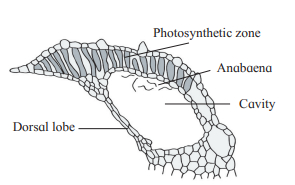
The figure given below is the $T.S.$ of an $Azolla$ leaf. The filaments present in the cavity of the leaf are of . . . . . . .
A
Tolypothrix
B
Nostoc
C
Anabaena
D
Oscillatoria
Solution
(C) $Azolla$ is a free-floating aquatic fern that maintains a symbiotic relationship with the nitrogen-fixing cyanobacterium $Anabaena$ $azollae$.
This cyanobacterium resides within the specialized leaf cavities of the $Azolla$ plant.
The provided figure clearly labels the filaments within the leaf cavity as $Anabaena$.
Therefore,the correct option is $C$.
This cyanobacterium resides within the specialized leaf cavities of the $Azolla$ plant.
The provided figure clearly labels the filaments within the leaf cavity as $Anabaena$.
Therefore,the correct option is $C$.
0 likes
View Solution417
EasyMCQ
Pteridophytes are called vascular cryptogams because they are non-seeded plants containing:
A
xylem and phloem
B
xylem only
C
phloem only
D
neither xylem nor phloem
Solution
(A) - xylem and phloem.
Pteridophytes are known as vascular cryptogams because they are seedless plants that possess a well-developed vascular system consisting of both xylem and phloem.
The xylem is responsible for the conduction of water and minerals,while the phloem is responsible for the translocation of food materials.
This vascular tissue allows them to grow taller and survive in diverse terrestrial habitats compared to bryophytes.
Pteridophytes are known as vascular cryptogams because they are seedless plants that possess a well-developed vascular system consisting of both xylem and phloem.
The xylem is responsible for the conduction of water and minerals,while the phloem is responsible for the translocation of food materials.
This vascular tissue allows them to grow taller and survive in diverse terrestrial habitats compared to bryophytes.
0 likes
View SolutionPlant Kingdom — Pteridophytes (General) · Frequently Asked Questions
1Are these Plant Kingdom questions useful for JEE and NEET?
Yes. All questions in this section are mapped to JEE Main and NEET exam patterns. Previous year questions from JEE Main, NEET, GUJCET and state-level exams are included with full solutions.
2Can I switch to Hindi or Gujarati for these questions?
Yes. Use the language tabs in the hero section or the sidebar to view the same questions and solutions in English, Hindi or Gujarati.
3How do I generate a question paper from this subtopic?
Use the Vedclass Exam Paper Generator — select the chapter and subtopic, set difficulty, and generate Sets A, B, C, D automatically. First 3 chapters of every subject are free.
Vedclass Products
For Students
Vedclass Test Series
Mock tests in real JEE/NEET style with performance analysis. 5-day free trial.
Start Free TrialFor Teachers
Exam Paper Generator
Generate Set A/B/C/D papers from this chapter in 2 minutes. 3 chapters free.
Try FreeFor Institutes
Online Exam Module
Live online exams with unlimited students, 360° analytics & white-label branding.
See DemoFor Teachers & Institutes
Generate a Plant Kingdom Exam Paper in 2 Minutes
Select subtopic & difficulty — Sets A, B, C, D auto-generated with No Repeat logic.
First 3 chapters of every subject are free — no payment required.