
A English
Pteridophytes (General) Questions in English
Class 11 Biology · Plant Kingdom · Pteridophytes (General)
417+
Questions
English
Language
100%
With Solutions
Showing 50 of 417 questions in English
201
MediumMCQ
Which of the following are heterosporous pteridophytes?
A
$Lycopodium$
B
$Selaginella$
C
$Pteridium$
D
$Dryopteris$
Solution
(B) Pteridophytes are generally homosporous,meaning they produce only one type of spore. However,some genera are heterosporous,meaning they produce two types of spores: microspores and megaspores. Examples of heterosporous pteridophytes include $Selaginella$ and $Salvinia$. $Lycopodium$,$Pteridium$,and $Dryopteris$ are typically homosporous.
0 likes
View Solution202
MediumMCQ
Plants that possess vascular tissues but lack seeds are known as .......
A
Bryophytes
B
Pteridophytes
C
Gymnosperms
D
Angiosperms
Solution
(B) The plant kingdom is classified based on the presence or absence of vascular tissues and seeds.
$1$. Bryophytes are non-vascular plants that do not produce seeds.
$2$. Pteridophytes are the first terrestrial plants to possess vascular tissues ($Xylem$ and $Phloem$) but they do not produce seeds; they reproduce via spores.
$3$. Gymnosperms and Angiosperms are seed-bearing plants.
Therefore,plants with vascular tissues but lacking seeds are classified as $Pteridophytes$.
$1$. Bryophytes are non-vascular plants that do not produce seeds.
$2$. Pteridophytes are the first terrestrial plants to possess vascular tissues ($Xylem$ and $Phloem$) but they do not produce seeds; they reproduce via spores.
$3$. Gymnosperms and Angiosperms are seed-bearing plants.
Therefore,plants with vascular tissues but lacking seeds are classified as $Pteridophytes$.
0 likes
View Solution203
MediumMCQ
The success and dominance of vascular plants on Earth are due to:
A
Development of roots
B
Development of water-resistant substances like cutin on the surface
C
Development of vascular tissues
D
All of the above
Solution
(D) The success and dominance of vascular plants (Tracheophytes) on land are attributed to several key evolutionary adaptations:
$1$. Development of vascular tissues ($Xylem$ and $Phloem$): These tissues allow for the efficient transport of water,minerals,and food over long distances,enabling plants to grow tall.
$2$. Development of roots: Roots provide firm anchorage to the soil and facilitate the absorption of water and minerals.
$3$. Development of water-resistant substances: The presence of a waxy layer called $Cutin$ on the epidermis (cuticle) helps in preventing excessive water loss through transpiration,allowing plants to survive in diverse terrestrial environments.
Since all these factors contributed to their evolutionary success,the correct option is $D$.
$1$. Development of vascular tissues ($Xylem$ and $Phloem$): These tissues allow for the efficient transport of water,minerals,and food over long distances,enabling plants to grow tall.
$2$. Development of roots: Roots provide firm anchorage to the soil and facilitate the absorption of water and minerals.
$3$. Development of water-resistant substances: The presence of a waxy layer called $Cutin$ on the epidermis (cuticle) helps in preventing excessive water loss through transpiration,allowing plants to survive in diverse terrestrial environments.
Since all these factors contributed to their evolutionary success,the correct option is $D$.
0 likes
View Solution204
MediumMCQ
Pteridophytes that produce strobili (cones) are .....
A
Lycopsida and Psilopsida
B
Filicopsida and Lycopsida
C
Filicopsida and Sphenopsida
D
Lycopsida and Sphenopsida
Solution
(D) In Pteridophytes,the sporophytes bear sporangia that are subtended by leaf-like appendages called sporophylls.
In some cases,sporophylls may form distinct compact structures called strobili or cones.
This condition is characteristically observed in members of the classes $Lycopsida$ (e.g.,$Selaginella$) and $Sphenopsida$ (e.g.,$Equisetum$).
In some cases,sporophylls may form distinct compact structures called strobili or cones.
This condition is characteristically observed in members of the classes $Lycopsida$ (e.g.,$Selaginella$) and $Sphenopsida$ (e.g.,$Equisetum$).
0 likes
View Solution205
MediumMCQ
Which of the following statements is correct?
A
In Pteridophytes,antheridiophores and archegoniophores are present.
B
In Pteridophytes,the origin of the seed habit can be traced.
C
In Pteridophytes,the gametophyte consists of protonema and leafy stages.
D
In Gymnosperms,the female gametophyte is free-living.
Solution
(B) The correct statement is that the origin of the seed habit can be traced in Pteridophytes.
This is observed in heterosporous species like $Selaginella$ and $Salvinia$,where the development of the zygotes into young embryos takes place within the female gametophytes retained on the parent sporophytes.
Option $A$ is incorrect because antheridiophores and archegoniophores are characteristic of Bryophytes (e.g.,$Marchantia$).
Option $C$ is incorrect because the protonema and leafy stages are characteristic of the moss gametophyte (Bryophytes).
Option $D$ is incorrect because in Gymnosperms,the female gametophyte is not free-living; it is retained within the megasporangium.
This is observed in heterosporous species like $Selaginella$ and $Salvinia$,where the development of the zygotes into young embryos takes place within the female gametophytes retained on the parent sporophytes.
Option $A$ is incorrect because antheridiophores and archegoniophores are characteristic of Bryophytes (e.g.,$Marchantia$).
Option $C$ is incorrect because the protonema and leafy stages are characteristic of the moss gametophyte (Bryophytes).
Option $D$ is incorrect because in Gymnosperms,the female gametophyte is not free-living; it is retained within the megasporangium.
0 likes
View Solution206
EasyMCQ
$Anabaena$ is associated with the .......... of $Azolla$.
A
Stem
B
Leaves
C
Roots
D
Flowers
Solution
(B) $Anabaena$ is a genus of filamentous cyanobacteria that exists as plankton. It is known for its nitrogen-fixing capabilities. In the case of the aquatic fern $Azolla$,$Anabaena$ (specifically $Anabaena$ $azollae$) lives in symbiotic association within the cavities of the $Azolla$ leaves. This association is highly beneficial for $Azolla$ as the cyanobacteria provide fixed nitrogen to the plant,allowing it to grow rapidly in nitrogen-poor environments.
0 likes
View Solution207
EasyMCQ
The antherozoids of Dryopteris are .......
A
Uniflagellate
B
Biflagellate
C
Quadriflagellate
D
Multiflagellate
Solution
(D) Dryopteris is a genus of ferns belonging to the class Pteridopsida.
In ferns,the male gametes,known as antherozoids,are spirally coiled and multiflagellate.
These flagella help the antherozoids swim in a film of water to reach the archegonia for fertilization.
Therefore,the correct option is $D$.
In ferns,the male gametes,known as antherozoids,are spirally coiled and multiflagellate.
These flagella help the antherozoids swim in a film of water to reach the archegonia for fertilization.
Therefore,the correct option is $D$.
0 likes
View Solution208
MediumMCQ
In most of the pteridophytes,all the spores are of similar kind. Such plants are called ......
A
Heterosporous
B
Homosporous
C
Prothallus
D
Protonema
Solution
(B) In the plant kingdom,specifically within the group $Pteridophyta$,plants that produce spores of only one kind are known as $Homosporous$ plants. Examples include $Psilotum$ and $Dryopteris$. In contrast,plants that produce two different kinds of spores (macrospores and microspores) are called $Heterosporous$ plants,such as $Selaginella$ and $Salvinia$. Therefore,the correct term for plants with similar spores is $Homosporous$.
0 likes
View Solution209
MediumMCQ
The first evolution of roots occurred in .........
A
Algae
B
Fungi
C
Bryophytes
D
Pteridophytes
Solution
(D) The evolution of true roots,stems,and leaves first appeared in the group $Pteridophyta$.
Algae,fungi,and bryophytes lack true vascular tissues and true roots.
$Pteridophytes$ are the first terrestrial plants to possess vascular tissues ($xylem$ and $phloem$) and true roots,which allow them to absorb water and minerals efficiently from the soil.
Algae,fungi,and bryophytes lack true vascular tissues and true roots.
$Pteridophytes$ are the first terrestrial plants to possess vascular tissues ($xylem$ and $phloem$) and true roots,which allow them to absorb water and minerals efficiently from the soil.
0 likes
View Solution210
MediumMCQ
Pteridophytes differ from bryophytes in the presence of ........
A
Vascular tissue
B
Archegonia
C
Alternation of generations
D
Motile sperms
Solution
(A) Pteridophytes are the first terrestrial plants to possess vascular tissues ($xylem$ and $phloem$).
Bryophytes lack true vascular tissues,which is a key evolutionary difference between the two groups.
Both groups possess archegonia,exhibit alternation of generations,and have motile sperms (antherozoids) that require water for fertilization.
Bryophytes lack true vascular tissues,which is a key evolutionary difference between the two groups.
Both groups possess archegonia,exhibit alternation of generations,and have motile sperms (antherozoids) that require water for fertilization.
0 likes
View Solution211
MediumMCQ
Independent alternation of generations is found in .......
A
Pteridophyta
B
Spermatophyta
C
Thallophyta
D
Bryophyta
Solution
(A) In $Pteridophyta$, both the gametophytic and sporophytic phases are independent and free-living.
In $Bryophyta$, the sporophyte is dependent on the gametophyte.
In $Spermatophyta$ (Gymnosperms and Angiosperms), the gametophyte is reduced and dependent on the sporophyte.
Therefore, $Pteridophyta$ is the group that exhibits an independent alternation of generations.
In $Bryophyta$, the sporophyte is dependent on the gametophyte.
In $Spermatophyta$ (Gymnosperms and Angiosperms), the gametophyte is reduced and dependent on the sporophyte.
Therefore, $Pteridophyta$ is the group that exhibits an independent alternation of generations.
0 likes
View Solution212
EasyMCQ
Vascular cryptogams or seedless vascular plants are included in .......
A
Bryophyta
B
Pteridophyta
C
Thallophyta
D
Spermatophyta
Solution
(B) Vascular cryptogams are plants that possess vascular tissues ($Xylem$ and $Phloem$) but do not produce seeds.
$Pteridophytes$ are the first terrestrial plants to possess vascular tissues.
$Bryophytes$ lack vascular tissues.
$Thallophytes$ (like algae) are simple,non-vascular plants.
$Spermatophytes$ are seed-bearing plants (Gymnosperms and Angiosperms).
Therefore,$Pteridophyta$ are known as vascular cryptogams.
$Pteridophytes$ are the first terrestrial plants to possess vascular tissues.
$Bryophytes$ lack vascular tissues.
$Thallophytes$ (like algae) are simple,non-vascular plants.
$Spermatophytes$ are seed-bearing plants (Gymnosperms and Angiosperms).
Therefore,$Pteridophyta$ are known as vascular cryptogams.
0 likes
View Solution213
MediumMCQ
In pteridophytes,the main plant body is .........
A
Sporophyte
B
Gametophyte
C
Haploid
D
None of the above
Solution
(A) In pteridophytes,the main plant body is a sporophyte,which is differentiated into true root,stem,and leaves.
These organs possess well-differentiated vascular tissues.
The sporophyte is diploid $(2n)$ and represents the dominant phase in the life cycle of pteridophytes.
The gametophyte,known as the prothallus,is small,inconspicuous,and multicellular,representing a much shorter phase in the life cycle.
These organs possess well-differentiated vascular tissues.
The sporophyte is diploid $(2n)$ and represents the dominant phase in the life cycle of pteridophytes.
The gametophyte,known as the prothallus,is small,inconspicuous,and multicellular,representing a much shorter phase in the life cycle.
0 likes
View Solution214
MediumMCQ
Which of the following is not heterosporous?
A
$Selaginella$
B
$Pinus$
C
$Pteridium$
D
$Cycas$
Solution
(C) Heterospory is the production of two types of spores,microspores and megaspores.
$Selaginella$ is a pteridophyte that is heterosporous.
$Pinus$ and $Cycas$ are gymnosperms,and all gymnosperms are heterosporous.
$Pteridium$ (a type of fern) is homosporous,meaning it produces only one type of spore.
Therefore,$Pteridium$ is not heterosporous.
$Selaginella$ is a pteridophyte that is heterosporous.
$Pinus$ and $Cycas$ are gymnosperms,and all gymnosperms are heterosporous.
$Pteridium$ (a type of fern) is homosporous,meaning it produces only one type of spore.
Therefore,$Pteridium$ is not heterosporous.
0 likes
View Solution215
MediumMCQ
The seed habit was first established in .........
A
Pteridophytes
B
Gymnosperms
C
Angiosperms
D
None of the above
Solution
(A) The seed habit is an evolutionary process that began in certain $Pteridophytes$ (e.g.,$Selaginella$).
It involves the retention of the megaspore within the megasporangium and the development of the embryo from the zygote while still attached to the parent plant.
Although it originated in $Pteridophytes$,it was fully established and became a characteristic feature in $Gymnosperms$.
It involves the retention of the megaspore within the megasporangium and the development of the embryo from the zygote while still attached to the parent plant.
Although it originated in $Pteridophytes$,it was fully established and became a characteristic feature in $Gymnosperms$.
0 likes
View Solution216
MediumMCQ
Which of the following is considered an important step in the development of the seed habit?
A
Free-living gametophyte
B
Dependent sporophyte
C
Heterospory
D
Haplontic life cycle
Solution
(C) The development of the seed habit is a significant evolutionary trend in plants.
$1$. Heterospory is the production of two different types of spores,microspores and megaspores,which is a prerequisite for the seed habit.
$2$. In heterosporous plants,the megaspore is retained within the parent sporophyte for development into the female gametophyte.
$3$. This retention and germination of the megaspore within the megasporangium provides protection and nutrition,eventually leading to the formation of the seed.
Therefore,heterospory is considered the most important precursor to the seed habit.
$1$. Heterospory is the production of two different types of spores,microspores and megaspores,which is a prerequisite for the seed habit.
$2$. In heterosporous plants,the megaspore is retained within the parent sporophyte for development into the female gametophyte.
$3$. This retention and germination of the megaspore within the megasporangium provides protection and nutrition,eventually leading to the formation of the seed.
Therefore,heterospory is considered the most important precursor to the seed habit.
0 likes
View Solution217
MediumMCQ
In vascular cryptogams,the antherozoids and the egg cells mature at different times,which results in:
A
Prevention of self-fertilization
B
No change in the success rate of fertilization
C
High levels of sterility
D
Conclusion that the plant is genetically incompatible
Solution
(A) In many vascular cryptogams (such as Pteridophytes),the phenomenon where male gametes (antherozoids) and female gametes (egg cells) mature at different times is known as $dichogamy$.
This mechanism is an evolutionary adaptation to prevent self-fertilization and promote cross-fertilization,thereby increasing genetic diversity within the population.
Therefore,the correct consequence of this asynchronous maturation is the prevention of self-fertilization.
This mechanism is an evolutionary adaptation to prevent self-fertilization and promote cross-fertilization,thereby increasing genetic diversity within the population.
Therefore,the correct consequence of this asynchronous maturation is the prevention of self-fertilization.
0 likes
View Solution218
EasyMCQ
What is the type of vascular bundle found in the roots of ferns (Dryopteris)?
A
Hadrocentric
B
Leptocentric
C
Conjoint collateral
D
Radial
Solution
(D) In the roots of ferns like $Dryopteris$,the vascular bundles are of the $Radial$ type.
In a $Radial$ vascular bundle,xylem and phloem are arranged in alternate radii as separate bundles.
This is a characteristic feature of the root anatomy in most vascular plants,including pteridophytes like ferns.
In a $Radial$ vascular bundle,xylem and phloem are arranged in alternate radii as separate bundles.
This is a characteristic feature of the root anatomy in most vascular plants,including pteridophytes like ferns.
0 likes
View Solution219
EasyMCQ
The species that grows on open rocks is known as:
A
Selaginella lepidophylla
B
Myrothamnus
C
Craterostigma
D
Nepenthes
Solution
(A) The species that grows on open rocks is known as a lithophyte. Among the given options, $Selaginella \text{ } lepidophylla$ is a well-known resurrection plant that can survive extreme desiccation and is often found growing on rocky substrates. It is also known as the 'resurrection plant' or 'rose of Jericho'.
0 likes
View Solution220
MediumMCQ
Which of the following is considered an important step in the evolution of the seed habit?
A
Heterospory
B
Haplontic life cycle
C
Free-living gametophyte
D
Secondary spore
Solution
(A) The evolution of the seed habit is a significant milestone in plant evolution.
$1$. Heterospory,the production of two different types of spores (microspores and megaspores),is considered the precursor to seed development.
$2$. In heterosporous plants,the megaspore is retained within the parent sporophyte for a variable period,which allows for the development of the female gametophyte and subsequent fertilization and embryo development.
$3$. This retention and nourishment of the embryo by the parent plant is the fundamental basis of the seed habit.
Therefore,heterospory is the correct answer.
$1$. Heterospory,the production of two different types of spores (microspores and megaspores),is considered the precursor to seed development.
$2$. In heterosporous plants,the megaspore is retained within the parent sporophyte for a variable period,which allows for the development of the female gametophyte and subsequent fertilization and embryo development.
$3$. This retention and nourishment of the embryo by the parent plant is the fundamental basis of the seed habit.
Therefore,heterospory is the correct answer.
0 likes
View Solution221
MediumMCQ
Spindle-shaped male gametes are found in:
A
$Lycopodium$
B
$Pteris$
C
$Pteridium$
D
$Selaginella$
Solution
(D) In the life cycle of $Selaginella$,the male gametes (antherozoids) are biflagellate and spindle-shaped. $Selaginella$ is a heterosporous pteridophyte that produces microspores which develop into male gametophytes,eventually releasing these spindle-shaped antherozoids.
0 likes
View Solution222
MediumMCQ
Why is $Adiantum$ known as the 'walking fern'?
A
Locomotory ability
B
Vegetative propagation
C
Motile antherozoids
D
All of the above
Solution
(B) $Adiantum$ is commonly known as the 'walking fern' because it propagates vegetatively through the tips of its fronds (leaves). When the tip of a frond touches the soil,it develops adventitious roots and buds,giving rise to a new plant. This process allows the plant to 'walk' or spread across the ground over time.
0 likes
View Solution223
DifficultMCQ
The first evolution of the seed habit occurred in which of the following?
A
Pteridophyte ancestors like $Selaginella$
B
Pteridophyte ancestors like $Psilotum$
C
Angiosperms
D
Mosses
Solution
(A) The evolution of the seed habit is a significant event in plant evolution. It first appeared in certain pteridophytes,specifically those belonging to the genus $Selaginella$. These plants exhibit heterospory (production of two types of spores: microspores and megaspores) and the retention of the megaspore within the megasporangium for a period,which are considered the precursors to the development of the seed habit.
0 likes
View Solution224
MediumMCQ
Which of the following pteridophytes exhibits secondary growth?
A
$Azolla$
B
$Salvinia$
C
$Isoetes$
D
$Selaginella$
Solution
(C) Secondary growth is a characteristic feature of seed-bearing plants (gymnosperms and angiosperms). However,among pteridophytes,the genus $Isoetes$ is a notable exception.
$Isoetes$ exhibits secondary growth due to the presence of a unique cambium in its corm-like stem,which produces secondary xylem and secondary phloem. This allows the plant to increase in girth,a feature not typically found in other pteridophytes.
$Isoetes$ exhibits secondary growth due to the presence of a unique cambium in its corm-like stem,which produces secondary xylem and secondary phloem. This allows the plant to increase in girth,a feature not typically found in other pteridophytes.
0 likes
View Solution225
DifficultMCQ
In $Lycopodium$,the antherozoids are .......
A
Biflagellate
B
Multiflagellate
C
Multiciliate
D
Non-motile
Solution
(A) The genus $Lycopodium$ belongs to the division $Pteridophyta$. In $Lycopodium$,the male gametes,known as antherozoids,are biflagellate,meaning they possess two flagella that enable them to swim in water to reach the female gamete (egg) for fertilization. Therefore,the correct option is $A$.
0 likes
View Solution226
MediumMCQ
The presence of rhizoids in saprophytic plants is a characteristic of which group?
A
Bryopsida
B
Sphenopsida
C
Cycadophyta
D
Psilopsida
Solution
(D) The presence of rhizoids in saprophytic plants is a characteristic feature of $Psilopsida$. $Psilopsida$ (e.g.,$Psilotum$) are primitive pteridophytes that lack true roots; instead,they possess rhizoids for anchorage and absorption. They are often saprophytic or epiphytic in nature.
0 likes
View Solution227
DifficultMCQ
Spore-bearing tracheophytes are known as:
A
Pteridophytes
B
Gymnosperms
C
Angiosperms
D
All of the above
Solution
(A) Tracheophytes are plants that possess vascular tissues ($Xylem$ and $Phloem$).
$Pteridophytes$ are the first terrestrial plants to possess vascular tissues and they reproduce via spores.
$Gymnosperms$ and $Angiosperms$ are also tracheophytes,but they are seed-bearing plants,not primarily defined by spore-bearing in the same context as $Pteridophytes$.
However,in a broad biological classification,all these groups possess vascular tissues.
Since $Pteridophytes$ are specifically known as the 'spore-bearing tracheophytes' (as they do not produce seeds),the most accurate answer is $Pteridophytes$.
$Pteridophytes$ are the first terrestrial plants to possess vascular tissues and they reproduce via spores.
$Gymnosperms$ and $Angiosperms$ are also tracheophytes,but they are seed-bearing plants,not primarily defined by spore-bearing in the same context as $Pteridophytes$.
However,in a broad biological classification,all these groups possess vascular tissues.
Since $Pteridophytes$ are specifically known as the 'spore-bearing tracheophytes' (as they do not produce seeds),the most accurate answer is $Pteridophytes$.
0 likes
View Solution228
EasyMCQ
In which of the following is the stem clearly differentiated into nodes and internodes?
A
Psilopsida
B
Lycopsida
C
Sphenopsida
D
Pteropsida
Solution
(C) The $Pteridophytes$ are classified into four classes: $Psilopsida$,$Lycopsida$,$Sphenopsida$,and $Pteropsida$.
In the class $Sphenopsida$ (e.g.,$Equisetum$),the stem is distinctly differentiated into nodes and internodes.
The stem of $Equisetum$ is ribbed and jointed,which is a characteristic feature of this group.
Therefore,the correct option is $C$.
In the class $Sphenopsida$ (e.g.,$Equisetum$),the stem is distinctly differentiated into nodes and internodes.
The stem of $Equisetum$ is ribbed and jointed,which is a characteristic feature of this group.
Therefore,the correct option is $C$.
0 likes
View Solution229
EasyMCQ
Which of the following is known as the 'Adder's tongue fern'?
A
$Cyathea$
B
$Marsilea$
C
$Ophioglossum$
D
$Adiantum$
Solution
(C) $Ophioglossum$ is commonly known as the 'Adder's tongue fern'.
This name is derived from the shape of its fertile spike,which resembles the tongue of a snake (adder).
It belongs to the family $Ophioglossaceae$ within the Pteridophytes.
This name is derived from the shape of its fertile spike,which resembles the tongue of a snake (adder).
It belongs to the family $Ophioglossaceae$ within the Pteridophytes.
0 likes
View Solution230
MediumMCQ
Why is $Adiantum$ known as the walking fern?
A
Dispersal by animals
B
Reproduction by spores
C
Vegetative propagation
D
Locomotion
Solution
(C) The $Adiantum$ plant is commonly known as the walking fern because it reproduces vegetatively through the tips of its fronds (leaves).
When the tips of the fronds touch the soil,they develop adventitious roots and new plantlets,which allows the plant to spread or 'walk' across the ground.
Therefore,this phenomenon is a type of vegetative propagation.
When the tips of the fronds touch the soil,they develop adventitious roots and new plantlets,which allows the plant to spread or 'walk' across the ground.
Therefore,this phenomenon is a type of vegetative propagation.
0 likes
View Solution231
DifficultMCQ
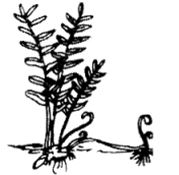
Identify the plant shown in the given figure.
A
Fern (Dryopteris)
B
Riccia
C
Moss
D
Rhynia
Solution
(A) The figure shows a plant with pinnately compound leaves (fronds) arising from a rhizome,which is characteristic of a fern (e.g.,Dryopteris).
Ferns are pteridophytes that possess true roots,stems,and leaves.
Riccia is a liverwort (bryophyte),Moss is a bryophyte,and Rhynia is an extinct fossil pteridophyte.
Therefore,the correct option is $A$.
Ferns are pteridophytes that possess true roots,stems,and leaves.
Riccia is a liverwort (bryophyte),Moss is a bryophyte,and Rhynia is an extinct fossil pteridophyte.
Therefore,the correct option is $A$.
0 likes
View Solution232
DifficultMCQ
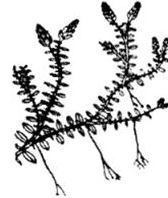
Identify the plant shown in the given figure.
A
Equisetum
B
Rhynia
C
Selaginella
D
Nephrolepis
Solution
(C) The figure shows a plant with small leaves and strobili (cones) at the tips of the branches. This is a characteristic feature of the pteridophyte $Selaginella$.
$Selaginella$ is a heterosporous pteridophyte,meaning it produces two types of spores.
Therefore,the correct option is $C$.
$Selaginella$ is a heterosporous pteridophyte,meaning it produces two types of spores.
Therefore,the correct option is $C$.
0 likes
View Solution233
DifficultMCQ
To which group does the given plant belong?
A
Bryophytes
B
Pteridophytes
C
Gymnosperms
D
Angiosperms
Solution
(B) The image shows a plant with a stem,leaves,and strobili (cones) at the tips,which is characteristic of the genus $Selaginella$.
$Selaginella$ is a well-known member of the group Pteridophytes.
Therefore,the correct option is $B$.
$Selaginella$ is a well-known member of the group Pteridophytes.
Therefore,the correct option is $B$.
0 likes
View Solution234
DifficultMCQ
What is true for the plant shown in the given figure?
A
Homosporous
B
Heterosporous
C
Fossil
D
Common
Solution
(B) The figure shows the pteridophyte $Selaginella$.
$Selaginella$ is a heterosporous plant,meaning it produces two types of spores: microspores and megaspores.
This is a significant evolutionary step towards the seed habit in plants.
$Selaginella$ is a heterosporous plant,meaning it produces two types of spores: microspores and megaspores.
This is a significant evolutionary step towards the seed habit in plants.
0 likes
View Solution235
DifficultMCQ
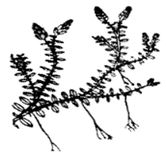
Which of the following statements is correct for the given figure?
A
Diplontic life cycle
B
Sporophytic stage is short-lived
C
First terrestrial plants
D
Vascular tissues are present
Solution
(D) The figure shows Selaginella,which belongs to the group Pteridophyta.
$1$. Pteridophytes are the first terrestrial plants to possess vascular tissues (xylem and phloem).
$2$. They exhibit a haplodiplontic life cycle,where the sporophytic plant body is dominant,independent,and long-lived,while the gametophytic stage is short-lived.
$3$. Therefore,the statement 'Vascular tissues are present' is correct for Pteridophytes.
$1$. Pteridophytes are the first terrestrial plants to possess vascular tissues (xylem and phloem).
$2$. They exhibit a haplodiplontic life cycle,where the sporophytic plant body is dominant,independent,and long-lived,while the gametophytic stage is short-lived.
$3$. Therefore,the statement 'Vascular tissues are present' is correct for Pteridophytes.
0 likes
View Solution236
MediumMCQ
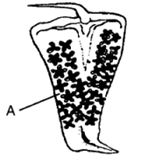
The given figure shows the reproductive organ of a plant from which of the following divisions?
A
Pteridophyta
B
Bryophyta
C
Gymnosperm
D
Thallophyta
Solution
(A) The provided figure represents a $Equisetum$ strobilus (cone),which is a characteristic reproductive structure of the division $Pteridophyta$.
In $Equisetum$,the sporangia are borne on strobili (cones) which are compact structures formed by the aggregation of sporophylls.
Label $A$ points to the sporangia containing spores.
Therefore,the correct division is $Pteridophyta$.
In $Equisetum$,the sporangia are borne on strobili (cones) which are compact structures formed by the aggregation of sporophylls.
Label $A$ points to the sporangia containing spores.
Therefore,the correct division is $Pteridophyta$.
0 likes
View Solution237
MediumMCQ
Which pteridophytes produce microsporophylls and megasporophylls?
A
Bryophytes
B
Dicotyledons
C
Pteridophytes
D
Thallophytes
Solution
(C) The pteridophytes that produce two kinds of spores,macro (large) and micro (small) spores,are known as heterosporous.
Examples of such heterosporous pteridophytes include $Selaginella$ and $Salvinia$.
In these plants,the leaves that bear these spores are called sporophylls.
The leaves bearing microspores are called microsporophylls,and those bearing megaspores are called megasporophylls.
Therefore,the correct group is Pteridophytes.
Examples of such heterosporous pteridophytes include $Selaginella$ and $Salvinia$.
In these plants,the leaves that bear these spores are called sporophylls.
The leaves bearing microspores are called microsporophylls,and those bearing megaspores are called megasporophylls.
Therefore,the correct group is Pteridophytes.
0 likes
View Solution238
MediumMCQ
Which of the following is not an example of a Pteridophyte?
A
Dryopteris (Fern)
B
Anthoceros
C
Selaginella
D
Equisetum
Solution
(B) Pteridophytes include plants like $Selaginella$,$Equisetum$,and ferns (e.g.,$Dryopteris$).
$Anthoceros$ belongs to the class Anthocerotopsida,which is a group of Bryophytes (hornworts),not Pteridophytes.
Therefore,$Anthoceros$ is not an example of a Pteridophyte.
$Anthoceros$ belongs to the class Anthocerotopsida,which is a group of Bryophytes (hornworts),not Pteridophytes.
Therefore,$Anthoceros$ is not an example of a Pteridophyte.
0 likes
View Solution239
MediumMCQ
Assertion $(A)$: In $Equisetum$,sexual reproduction occurs through sex organs like antheridia and archegonia.
Reason $(R)$: In pteridophytes,the gametophytic phase is long-lived and responsible for sexual reproduction.
Reason $(R)$: In pteridophytes,the gametophytic phase is long-lived and responsible for sexual reproduction.
A
$A$ and $R$ are both true,and $R$ is the correct explanation of $A$.
B
$A$ and $R$ are both true,but $R$ is not the correct explanation of $A$.
C
$A$ is true,but $R$ is false.
D
$A$ is false,but $R$ is true.
Solution
(C) Assertion $(A)$ is true because $Equisetum$ is a pteridophyte that produces sex organs known as antheridia (male) and archegonia (female).
Reason $(R)$ is false because in pteridophytes,the dominant phase is the sporophyte,not the gametophyte. The gametophyte (prothallus) is usually small,inconspicuous,and short-lived,although it is responsible for sexual reproduction. Therefore,the statement that the gametophytic phase is long-lived is incorrect.
Reason $(R)$ is false because in pteridophytes,the dominant phase is the sporophyte,not the gametophyte. The gametophyte (prothallus) is usually small,inconspicuous,and short-lived,although it is responsible for sexual reproduction. Therefore,the statement that the gametophytic phase is long-lived is incorrect.
0 likes
View Solution240
MediumMCQ
Which of the following is associated with the sporophytic phase in $Pteridophytes$?
A
Spores are produced in sporangia.
B
It is responsible for asexual reproduction.
C
It is the dominant phase.
D
All of the above.
Solution
(D) In $Pteridophytes$,the main plant body is the sporophyte,which is differentiated into true roots,stems,and leaves.
$1$. The sporophytic phase bears sporangia,which produce spores.
$2$. Asexual reproduction occurs through these spores.
$3$. The sporophytic phase is the dominant phase in the life cycle of $Pteridophytes$.
Therefore,all the given options are correct.
$1$. The sporophytic phase bears sporangia,which produce spores.
$2$. Asexual reproduction occurs through these spores.
$3$. The sporophytic phase is the dominant phase in the life cycle of $Pteridophytes$.
Therefore,all the given options are correct.
0 likes
View Solution241
MediumMCQ
In which of the following aspects do the pteridophytes $Equisetum$ and $Selaginella$ differ?
A
$Equisetum$ is non-flowering and $Selaginella$ is flowering.
B
$Equisetum$ is flowering and $Selaginella$ is non-flowering.
C
$Equisetum$ is heterosporous and $Selaginella$ is homosporous.
D
$Equisetum$ is homosporous and $Selaginella$ is heterosporous.
Solution
(D) Pteridophytes are seedless vascular plants.
$Equisetum$ (horsetails) is a homosporous pteridophyte,meaning it produces only one type of spore.
$Selaginella$ is a heterosporous pteridophyte,meaning it produces two types of spores: microspores and megaspores.
Therefore,the correct distinction is that $Equisetum$ is homosporous and $Selaginella$ is heterosporous.
$Equisetum$ (horsetails) is a homosporous pteridophyte,meaning it produces only one type of spore.
$Selaginella$ is a heterosporous pteridophyte,meaning it produces two types of spores: microspores and megaspores.
Therefore,the correct distinction is that $Equisetum$ is homosporous and $Selaginella$ is heterosporous.
0 likes
View Solution242
MediumMCQ
What is the shape of the strobili or cones in Pteridophytes?
A
Spherical
B
Cup-shaped
C
Cone-shaped
D
Umbrella-shaped
Solution
(C) In many Pteridophytes,the sporophylls may form distinct compact structures called strobili or cones. The term 'strobili' is synonymous with 'cones' in this context,which are typically conical in shape. Examples include $Selaginella$ and $Equisetum$.
0 likes
View Solution243
MediumMCQ
In which of the following plants is the gametophytic stage considered secondary or reduced?
A
Nephrolepis
B
Funaria
C
Anthoceros
D
Both Funaria and Anthoceros
Solution
(A) In the plant kingdom,the life cycle involves an alternation of generations between a haploid gametophyte and a diploid sporophyte.
In Bryophytes (like $Funaria$ and $Anthoceros$),the gametophyte is the dominant,independent,and photosynthetic phase.
In Pteridophytes (like $Nephrolepis$),the main plant body is a sporophyte,which is dominant,independent,and photosynthetic.
The gametophyte in Pteridophytes is small,inconspicuous,and often short-lived,making it the secondary or reduced stage compared to the sporophyte.
Therefore,$Nephrolepis$ (a fern) is the correct answer.
In Bryophytes (like $Funaria$ and $Anthoceros$),the gametophyte is the dominant,independent,and photosynthetic phase.
In Pteridophytes (like $Nephrolepis$),the main plant body is a sporophyte,which is dominant,independent,and photosynthetic.
The gametophyte in Pteridophytes is small,inconspicuous,and often short-lived,making it the secondary or reduced stage compared to the sporophyte.
Therefore,$Nephrolepis$ (a fern) is the correct answer.
0 likes
View Solution244
MediumMCQ
How many types of sporophylls are found in Pteridophytes?
A
Three
B
Four
C
Two
D
Many
Solution
(C) In $Pteridophytes$,the sporophytes bear sporangia that are subtended by leaf-like appendages called sporophylls. Based on the type of spores produced,$Pteridophytes$ are categorized into two types: $1.$ Homosporous (producing one type of spore) and $2.$ Heterosporous (producing two types of spores,i.e.,microspores and megaspores). Correspondingly,the sporophylls are also of two types: microsporophylls and megasporophylls.
0 likes
View Solution245
EasyMCQ
Which of the following stages is dominant in Pteridophytes?
A
Gametophyte
B
Sporophyte
C
Prothallus
D
None of the above
Solution
(B) In $Pteridophytes$, the main plant body is a $Sporophyte$, which is differentiated into true root, stem, and leaves.
This $Sporophyte$ is the dominant phase in their life cycle.
The $Gametophyte$ phase is small, inconspicuous, and short-lived, often referred to as a $Prothallus$.
This $Sporophyte$ is the dominant phase in their life cycle.
The $Gametophyte$ phase is small, inconspicuous, and short-lived, often referred to as a $Prothallus$.
0 likes
View Solution246
MediumMCQ
Which of the following plants possesses vascular tissues?
A
Mucor
B
Usnea
C
Riccia
D
Equisetum
Solution
(D) Vascular tissues ($Xylem$ and $Phloem$) are first observed in $Pteridophytes$.
$Mucor$ is a fungus $(Fungi)$.
$Usnea$ is a lichen $(Lichen)$.
$Riccia$ is a liverwort $(Bryophyte)$.
$Equisetum$ is a $Pteridophyte$,which contains well-developed vascular tissues for the conduction of water and nutrients. Therefore,the correct option is $D$.
$Mucor$ is a fungus $(Fungi)$.
$Usnea$ is a lichen $(Lichen)$.
$Riccia$ is a liverwort $(Bryophyte)$.
$Equisetum$ is a $Pteridophyte$,which contains well-developed vascular tissues for the conduction of water and nutrients. Therefore,the correct option is $D$.
0 likes
View Solution247
MediumMCQ
Which of the following is a correctly matched pair?
A
$Equisetum$ - Absence of vascular tissue
B
$Selaginella$ - Heterosporous
C
$Fern$ - Vegetative reproduction by gemmae
D
$Rhynia$ - Primitive embryophyte
Solution
(B) $1$. $Equisetum$ (Horsetail) is a pteridophyte and possesses well-developed vascular tissues (xylem and phloem). Thus,option $A$ is incorrect.
$2$. $Selaginella$ is a pteridophyte that produces two types of spores (microspores and megaspores),a condition known as heterospory. Thus,option $B$ is correct.
$3$. Ferns typically reproduce vegetatively through rhizomes or adventitious buds,not gemmae (which are characteristic of liverworts like $Marchantia$). Thus,option $C$ is incorrect.
$4$. $Rhynia$ is a fossil pteridophyte,but the term 'primitive embryophyte' is more broadly applied to bryophytes. While $Rhynia$ is an early vascular plant,$Selaginella$ being heterosporous is the most distinct and textbook-defined characteristic. Thus,option $B$ is the best answer.
$2$. $Selaginella$ is a pteridophyte that produces two types of spores (microspores and megaspores),a condition known as heterospory. Thus,option $B$ is correct.
$3$. Ferns typically reproduce vegetatively through rhizomes or adventitious buds,not gemmae (which are characteristic of liverworts like $Marchantia$). Thus,option $C$ is incorrect.
$4$. $Rhynia$ is a fossil pteridophyte,but the term 'primitive embryophyte' is more broadly applied to bryophytes. While $Rhynia$ is an early vascular plant,$Selaginella$ being heterosporous is the most distinct and textbook-defined characteristic. Thus,option $B$ is the best answer.
0 likes
View Solution248
MediumMCQ
Which of the following is $NOT$ associated with the gametophytic phase in $Pteridophytes$?
A
It is a secondary phase.
B
It produces short-lived gametes.
C
It is responsible for asexual reproduction.
D
It is responsible for sexual reproduction.
Solution
(C) In $Pteridophytes$,the main plant body is a sporophyte,which is diploid $(2n)$.
The gametophyte is a small,inconspicuous,and free-living structure known as the prothallus.
The gametophyte is responsible for sexual reproduction as it produces male and female sex organs (antheridia and archegonia) that form gametes.
Therefore,the gametophyte is $NOT$ responsible for asexual reproduction; asexual reproduction occurs via spores produced by the sporophyte.
The gametophyte is a small,inconspicuous,and free-living structure known as the prothallus.
The gametophyte is responsible for sexual reproduction as it produces male and female sex organs (antheridia and archegonia) that form gametes.
Therefore,the gametophyte is $NOT$ responsible for asexual reproduction; asexual reproduction occurs via spores produced by the sporophyte.
0 likes
View Solution249
MediumMCQ
Which of the following is considered the first terrestrial plant?
A
Riccia
B
Funaria
C
Strigula
D
Selaginella
Solution
(D) The first true terrestrial plants are considered to be the $Pteridophytes$. Among the given options,$Selaginella$ belongs to the group $Pteridophyta$. While $Bryophytes$ (like $Riccia$ and $Funaria$) are often called 'amphibians of the plant kingdom' because they require water for fertilization,$Pteridophytes$ were the first plants to evolve vascular tissues ($xylem$ and $phloem$) and successfully colonize land. Therefore,$Selaginella$ is the correct answer.
0 likes
View Solution250
EasyMCQ
Which of the following represents the correct sequence in Pteridophytes?
A
Sporangium $\rightarrow$ Sporophyll $\rightarrow$ Spore $\rightarrow$ Strobilus
B
Spore $\rightarrow$ Sporophyll $\rightarrow$ Sporangium $\rightarrow$ Strobilus
C
Spore $\rightarrow$ Sporangium $\rightarrow$ Strobilus $\rightarrow$ Sporophyll
D
Spore $\rightarrow$ Sporangium $\rightarrow$ Sporophyll $\rightarrow$ Strobilus
Solution
(D) In Pteridophytes,the life cycle involves the production of spores.
$1$. Spores are produced inside the sporangia.
$2$. Sporangia are borne on specialized leaves called sporophylls.
$3$. In many Pteridophytes (like Selaginella or Equisetum),these sporophylls may form distinct compact structures called strobili or cones.
Therefore,the correct sequence is: Spore $\rightarrow$ Sporangium $\rightarrow$ Sporophyll $\rightarrow$ Strobilus.
$1$. Spores are produced inside the sporangia.
$2$. Sporangia are borne on specialized leaves called sporophylls.
$3$. In many Pteridophytes (like Selaginella or Equisetum),these sporophylls may form distinct compact structures called strobili or cones.
Therefore,the correct sequence is: Spore $\rightarrow$ Sporangium $\rightarrow$ Sporophyll $\rightarrow$ Strobilus.
0 likes
View SolutionPlant Kingdom — Pteridophytes (General) · Frequently Asked Questions
1Are these Plant Kingdom questions useful for JEE and NEET?
Yes. All questions in this section are mapped to JEE Main and NEET exam patterns. Previous year questions from JEE Main, NEET, GUJCET and state-level exams are included with full solutions.
2Can I switch to Hindi or Gujarati for these questions?
Yes. Use the language tabs in the hero section or the sidebar to view the same questions and solutions in English, Hindi or Gujarati.
3How do I generate a question paper from this subtopic?
Use the Vedclass Exam Paper Generator — select the chapter and subtopic, set difficulty, and generate Sets A, B, C, D automatically. First 3 chapters of every subject are free.
Vedclass Products
For Students
Vedclass Test Series
Mock tests in real JEE/NEET style with performance analysis. 5-day free trial.
Start Free TrialFor Teachers
Exam Paper Generator
Generate Set A/B/C/D papers from this chapter in 2 minutes. 3 chapters free.
Try FreeFor Institutes
Online Exam Module
Live online exams with unlimited students, 360° analytics & white-label branding.
See DemoFor Teachers & Institutes
Generate a Plant Kingdom Exam Paper in 2 Minutes
Select subtopic & difficulty — Sets A, B, C, D auto-generated with No Repeat logic.
First 3 chapters of every subject are free — no payment required.