
A English
Pteridophytes (General) Questions in English
Class 11 Biology · Plant Kingdom · Pteridophytes (General)
417+
Questions
English
Language
100%
With Solutions
Showing 50 of 417 questions in English
251
MediumMCQ
What is the nature of the gametophytic stage in Pteridophytes?
A
Secondary
B
Main
C
Dominant
D
Reduced
Solution
(D) In Pteridophytes,the main plant body is a sporophyte,which is differentiated into true root,stem,and leaves. The gametophytic stage is small,inconspicuous,and multicellular,often referred to as a prothallus. Because it is small and short-lived compared to the sporophyte,it is considered a reduced stage.
0 likes
View Solution252
EasyMCQ
Assertion $(A)$: The sporophyte phase of ferns is long-lived and dominant.
Reason $(R)$: In ferns,the sporophyte phase exists as a thallus.
Reason $(R)$: In ferns,the sporophyte phase exists as a thallus.
A
$A$ and $R$ are both true,and $R$ is the correct explanation of $A$.
B
$A$ and $R$ are both true,but $R$ is not the correct explanation of $A$.
C
$A$ is true,but $R$ is false.
D
$A$ is false,but $R$ is true.
Solution
(C) In Pteridophytes (ferns),the main plant body is a sporophyte,which is differentiated into true roots,stems,and leaves. This phase is long-lived and dominant.
In contrast,the gametophyte phase is small,inconspicuous,and often referred to as a prothallus (a thallus-like structure).
Therefore,the assertion that the sporophyte is dominant is true,but the reason stating that the sporophyte is a thallus is false,as the thallus structure is characteristic of the gametophyte phase.
In contrast,the gametophyte phase is small,inconspicuous,and often referred to as a prothallus (a thallus-like structure).
Therefore,the assertion that the sporophyte is dominant is true,but the reason stating that the sporophyte is a thallus is false,as the thallus structure is characteristic of the gametophyte phase.
0 likes
View Solution253
MediumMCQ
They possess roots,stems,and leaves.
A
Thallophyta
B
Bryophyta
C
Pteridophyta
D
Lichen
Solution
(C) The plant body of $Pteridophytes$ is well-differentiated into true roots,stems,and leaves.
$Thallophyta$ (algae) have a thallus-like body without true roots,stems,or leaves.
$Bryophyta$ have root-like,stem-like,and leaf-like structures but lack true vascular tissues and true roots.
$Lichens$ are symbiotic associations between algae and fungi and do not possess true roots,stems,or leaves.
$Thallophyta$ (algae) have a thallus-like body without true roots,stems,or leaves.
$Bryophyta$ have root-like,stem-like,and leaf-like structures but lack true vascular tissues and true roots.
$Lichens$ are symbiotic associations between algae and fungi and do not possess true roots,stems,or leaves.
0 likes
View Solution254
EasyMCQ
Which of the following is a characteristic of $Pteridophytes$?
A
They always grow in terrestrial,moist,and shady habitats.
B
The gametophytic phase is the dominant phase.
C
They lack well-developed vascular tissues.
D
They are classified into three types.
Solution
(A) The correct answer is $A$.
$1$. $Pteridophytes$ are typically found in cool,damp,and shady places,although some species may thrive in sandy soil conditions.
$2$. In $Pteridophytes$,the main plant body is the $Sporophyte$,which is differentiated into true roots,stems,and leaves.
$3$. These plants possess well-developed vascular tissues ($Xylem$ and $Phloem$).
$4$. Therefore,among the given options,$A$ is the correct characteristic of $Pteridophytes$.
$1$. $Pteridophytes$ are typically found in cool,damp,and shady places,although some species may thrive in sandy soil conditions.
$2$. In $Pteridophytes$,the main plant body is the $Sporophyte$,which is differentiated into true roots,stems,and leaves.
$3$. These plants possess well-developed vascular tissues ($Xylem$ and $Phloem$).
$4$. Therefore,among the given options,$A$ is the correct characteristic of $Pteridophytes$.
0 likes
View Solution255
MediumMCQ
The first group of plants to possess well-developed vascular tissues is ........
A
Bryophytes
B
Thallophytes
C
Gymnosperms
D
Pteridophytes
Solution
(D) The plant kingdom is classified into various groups based on their structural complexity.
$1$. Thallophytes (Algae) lack differentiated plant bodies and vascular tissues.
$2$. Bryophytes are the first land plants but lack true vascular tissues ($Xylem$ and $Phloem$).
$3$. Pteridophytes are the first group of plants to possess well-developed vascular tissues ($Xylem$ and $Phloem$) for the conduction of water and nutrients.
$4$. Gymnosperms and Angiosperms also possess vascular tissues, but Pteridophytes were the first to evolve them.
$1$. Thallophytes (Algae) lack differentiated plant bodies and vascular tissues.
$2$. Bryophytes are the first land plants but lack true vascular tissues ($Xylem$ and $Phloem$).
$3$. Pteridophytes are the first group of plants to possess well-developed vascular tissues ($Xylem$ and $Phloem$) for the conduction of water and nutrients.
$4$. Gymnosperms and Angiosperms also possess vascular tissues, but Pteridophytes were the first to evolve them.
0 likes
View Solution256
MediumMCQ
What is the gametophytic stage of Pteridophytes?
A
It is the main stage. As a diploid plant,it is long-lived and produces spores.
B
It is a secondary stage. It is haploid,autotrophic,and produces gametes.
C
It is the main stage. It is haploid,autotrophic,and produces gametes.
D
It is a secondary stage. It is diploid,heterotrophic,and produces spores.
Solution
(B) In Pteridophytes,the main plant body is a sporophyte,which is diploid $(2n)$ and produces spores. The gametophytic stage is a small,inconspicuous,but free-living,mostly photosynthetic thalloid structure called a prothallus. This stage is haploid $(n)$ and is responsible for the production of gametes (male and female sex organs). Therefore,it is considered a secondary or reduced stage compared to the dominant sporophytic phase.
0 likes
View Solution257
MediumMCQ
Which of the following is a homosporous pteridophyte?
A
Dryopteris
B
Equisetum
C
Selaginella
D
Rhynia
Solution
(A) Pteridophytes are classified based on the type of spores they produce.
$1$. Homosporous pteridophytes produce only one type of spores,which are morphologically identical. Examples include $Dryopteris$,$Pteris$,and $Lycopodium$.
$2$. Heterosporous pteridophytes produce two types of spores: microspores and megaspores. Examples include $Selaginella$ and $Salvinia$.
$3$. $Equisetum$ is also generally considered homosporous.
$4$. $Rhynia$ is an extinct fossil pteridophyte,which was also homosporous.
However,in the context of standard $NCERT$ examples,$Dryopteris$ is a classic example of a homosporous pteridophyte,while $Selaginella$ is the primary example of a heterosporous one.
$1$. Homosporous pteridophytes produce only one type of spores,which are morphologically identical. Examples include $Dryopteris$,$Pteris$,and $Lycopodium$.
$2$. Heterosporous pteridophytes produce two types of spores: microspores and megaspores. Examples include $Selaginella$ and $Salvinia$.
$3$. $Equisetum$ is also generally considered homosporous.
$4$. $Rhynia$ is an extinct fossil pteridophyte,which was also homosporous.
However,in the context of standard $NCERT$ examples,$Dryopteris$ is a classic example of a homosporous pteridophyte,while $Selaginella$ is the primary example of a heterosporous one.
0 likes
View Solution258
EasyMCQ
Which of the following is a heterosporous pteridophyte?
A
Dryopteris
B
Selaginella
C
Equisetum
D
Rhynia
Solution
(B) Pteridophytes are generally homosporous,meaning they produce only one type of spore. However,some genera like $Selaginella$ and $Salvinia$ are heterosporous,as they produce two different types of spores: macrospores and microspores. $Dryopteris$ and $Equisetum$ are examples of homosporous pteridophytes,while $Rhynia$ is an extinct genus.
0 likes
View Solution259
MediumMCQ
Statement $S$: In Pteridophytes,spores are produced in sporangia. Statement $R$: In Pteridophytes,sporangia are produced on sporophylls.
A
$S$ and $R$ are both true,and $R$ is the correct explanation of $S$.
B
$S$ and $R$ are both true,but $R$ is not the correct explanation of $S$.
C
$S$ is true and $R$ is false.
D
$S$ is false and $R$ is true.
Solution
(A) In Pteridophytes,the main plant body is a sporophyte which differentiates into true root,stem,and leaves.
These leaves are known as sporophylls when they bear sporangia.
Inside these sporangia,spore mother cells undergo meiosis to produce spores.
Therefore,statement $S$ is true because spores are produced in sporangia,and statement $R$ is also true because these sporangia are borne on specialized leaves called sporophylls.
Since the production of spores in sporangia is directly facilitated by their location on sporophylls,$R$ is the correct explanation of $S$.
These leaves are known as sporophylls when they bear sporangia.
Inside these sporangia,spore mother cells undergo meiosis to produce spores.
Therefore,statement $S$ is true because spores are produced in sporangia,and statement $R$ is also true because these sporangia are borne on specialized leaves called sporophylls.
Since the production of spores in sporangia is directly facilitated by their location on sporophylls,$R$ is the correct explanation of $S$.
0 likes
View Solution260
EasyMCQ
Which of the following terms describes a plant that produces only one type of spore?
A
Homosporous
B
Heterosporous
C
Saptaparni
D
Monosporous
Solution
(A) Plants that produce only one type of spore are called $Homosporous$ plants. These spores germinate to produce gametophytes that may be monoecious or dioecious. In contrast,$Heterosporous$ plants produce two types of spores: microspores and megaspores.
0 likes
View Solution261
MediumMCQ
Which of the following plant groups possesses spores and vascular tissues but is seedless?
A
Pteridophytes
B
Bryophytes
C
Gymnosperms
D
Algae
Solution
(A) The plant kingdom is classified based on the presence or absence of vascular tissues and seeds.
$1$. Algae and Bryophytes lack specialized vascular tissues ($xylem$ and $phloem$).
$2$. Pteridophytes are the first terrestrial plants to possess vascular tissues ($xylem$ and $phloem$) and reproduce via spores, but they do not produce seeds.
$3$. Gymnosperms and Angiosperms are seed-bearing plants.
Therefore, Pteridophytes are the group that has vascular tissues and spores but is seedless.
$1$. Algae and Bryophytes lack specialized vascular tissues ($xylem$ and $phloem$).
$2$. Pteridophytes are the first terrestrial plants to possess vascular tissues ($xylem$ and $phloem$) and reproduce via spores, but they do not produce seeds.
$3$. Gymnosperms and Angiosperms are seed-bearing plants.
Therefore, Pteridophytes are the group that has vascular tissues and spores but is seedless.
0 likes
View Solution262
MediumMCQ
What type of sporophylls are found in Pteridophytes?
A
Heterosporous
B
Homosporous
C
Both $(A)$ and $(B)$
D
Either $(A)$ or $(B)$
Solution
(C) Pteridophytes are plants that reproduce by spores.
Based on the type of spores produced,they are classified into two categories:
$1$. Homosporous: Most Pteridophytes (e.g.,$Dryopteris$,$Adiantum$) produce only one type of spore.
$2$. Heterosporous: Some Pteridophytes (e.g.,$Selaginella$,$Salvinia$) produce two different types of spores,known as microspores and megaspores.
Therefore,Pteridophytes can be either homosporous or heterosporous.
Based on the type of spores produced,they are classified into two categories:
$1$. Homosporous: Most Pteridophytes (e.g.,$Dryopteris$,$Adiantum$) produce only one type of spore.
$2$. Heterosporous: Some Pteridophytes (e.g.,$Selaginella$,$Salvinia$) produce two different types of spores,known as microspores and megaspores.
Therefore,Pteridophytes can be either homosporous or heterosporous.
0 likes
View Solution263
MediumMCQ
In $Pteridophytes$,meiosis occurs during which of the following processes?
A
Gametogenesis
B
Spore formation
C
Post-gametogenesis
D
Post-spore formation
Solution
(B) In $Pteridophytes$,the main plant body is a $sporophyte$ $(2n)$,which is differentiated into true root,stem,and leaves.
These plants produce sporangia that are subtended by leaf-like appendages called $sporophylls$.
Inside the sporangia,spore mother cells undergo $meiosis$ (reduction division) to produce haploid $(n)$ spores.
Therefore,meiosis occurs during the process of spore formation.
These plants produce sporangia that are subtended by leaf-like appendages called $sporophylls$.
Inside the sporangia,spore mother cells undergo $meiosis$ (reduction division) to produce haploid $(n)$ spores.
Therefore,meiosis occurs during the process of spore formation.
0 likes
View Solution264
MediumMCQ
Which of the following is not a pteridophyte?
A
Selaginella
B
Equisetum
C
Salvinia
D
Polytrichum
Solution
(D) The plant kingdom is classified into various groups such as Thallophyta,Bryophyta,Pteridophyta,Gymnosperms,and Angiosperms.
$Selaginella$,$Equisetum$,and $Salvinia$ are well-known examples of Pteridophytes.
$Polytrichum$ belongs to the group Bryophyta (specifically,it is a moss).
Therefore,$Polytrichum$ is not a pteridophyte.
$Selaginella$,$Equisetum$,and $Salvinia$ are well-known examples of Pteridophytes.
$Polytrichum$ belongs to the group Bryophyta (specifically,it is a moss).
Therefore,$Polytrichum$ is not a pteridophyte.
0 likes
View Solution265
MediumMCQ
Assertion $(A)$: $Selaginella$ is heterosporous.
Reason $(R)$: The strobili of $Selaginella$ are unisexual.
Reason $(R)$: The strobili of $Selaginella$ are unisexual.
A
$A$ and $R$ are true,and $R$ is the correct explanation of $A$.
B
$A$ and $R$ are true,but $R$ is not the correct explanation of $A$.
C
$A$ is true,but $R$ is false.
D
$A$ is false,but $R$ is true.
Solution
(C) $Selaginella$ is a pteridophyte that is heterosporous,meaning it produces two types of spores: microspores and megaspores.
This heterospory is a significant evolutionary step towards the seed habit.
The strobili (cones) in $Selaginella$ are typically bisexual,containing both microsporangia and megasporangia,rather than being unisexual.
Therefore,the assertion $(A)$ is true,but the reason $(R)$ is false.
This heterospory is a significant evolutionary step towards the seed habit.
The strobili (cones) in $Selaginella$ are typically bisexual,containing both microsporangia and megasporangia,rather than being unisexual.
Therefore,the assertion $(A)$ is true,but the reason $(R)$ is false.
0 likes
View Solution266
MediumMCQ
In which plant group is the gametophytic phase reduced, haploid, short-lived, and subterranean?
A
Angiosperms
B
Gymnosperms
C
Bryophytes
D
Pteridophytes
Solution
(D) In $Pteridophytes$, the main plant body is a sporophyte, which is diploid and differentiated into true roots, stems, and leaves.
The gametophyte (prothallus) is small, inconspicuous, multicellular, free-living, and usually photosynthetic.
However, in some specific contexts or when comparing with higher plants, the gametophyte is described as reduced and short-lived compared to the dominant sporophyte.
Among the given options, $Pteridophytes$ represent the group where the gametophyte is independent but significantly reduced compared to the sporophyte generation.
The gametophyte (prothallus) is small, inconspicuous, multicellular, free-living, and usually photosynthetic.
However, in some specific contexts or when comparing with higher plants, the gametophyte is described as reduced and short-lived compared to the dominant sporophyte.
Among the given options, $Pteridophytes$ represent the group where the gametophyte is independent but significantly reduced compared to the sporophyte generation.
0 likes
View Solution267
EasyMCQ
How many classes does the division Pteridophyta contain?
A
One
B
Six
C
Three
D
Four
Solution
(D) The division $Pteridophyta$ is classified into four main classes based on the standard $NCERT$ biology curriculum.
These classes are:
$1$. $Psilopsida$
$2$. $Lycopsida$
$3$. $Sphenopsida$
$4$. $Pteropsida$
Therefore,the division $Pteridophyta$ contains $4$ classes.
These classes are:
$1$. $Psilopsida$
$2$. $Lycopsida$
$3$. $Sphenopsida$
$4$. $Pteropsida$
Therefore,the division $Pteridophyta$ contains $4$ classes.
0 likes
View Solution268
MediumMCQ
In $Pteridophytes$, the main plant body is $........$.
A
Diploid
B
Long-lived
C
Parasitic
D
Photosynthetic
Solution
(A) In $Pteridophytes$, the main plant body is a $sporophyte$, which is $diploid$ $(2n)$.
This $sporophyte$ is differentiated into true roots, stems, and leaves.
These organs possess well-differentiated vascular tissues ($xylem$ and $phloem$).
Therefore, the correct characteristic describing the main plant body is that it is $diploid$.
This $sporophyte$ is differentiated into true roots, stems, and leaves.
These organs possess well-differentiated vascular tissues ($xylem$ and $phloem$).
Therefore, the correct characteristic describing the main plant body is that it is $diploid$.
0 likes
View Solution269
MediumMCQ
Assertion $(A)$: $Nephrolepis$ is a cryptogam.
Reason $(R)$: It is a bryophyte.
Reason $(R)$: It is a bryophyte.
A
$A$ and $R$ are both true,and $R$ is the correct explanation of $A$.
B
$A$ and $R$ are both true,but $R$ is not the correct explanation of $A$.
C
$A$ is true,but $R$ is false.
D
$A$ is false,but $R$ is true.
Solution
(C) $Nephrolepis$ is a genus of ferns,which are pteridophytes. Pteridophytes are cryptogams (non-flowering plants).
Therefore,Assertion $(A)$ is true.
However,$Nephrolepis$ is a pteridophyte,not a bryophyte. Bryophytes are a different group of plants (e.g.,mosses and liverworts).
Therefore,Reason $(R)$ is false.
Thus,the correct option is $C$.
Therefore,Assertion $(A)$ is true.
However,$Nephrolepis$ is a pteridophyte,not a bryophyte. Bryophytes are a different group of plants (e.g.,mosses and liverworts).
Therefore,Reason $(R)$ is false.
Thus,the correct option is $C$.
0 likes
View Solution270
EasyMCQ
Match the Pteridophytes in Column-$I$ with their characteristics in Column-$II$ and select the correct option.
| Column-$I$ | Column-$II$ |
| $A$. Dryopteris (Fern) | $p$. Homosporous |
| $B$. Selaginella | $q$. Fossil |
| $C$. Equisetum | $r$. Heterosporous |
| $D$. Rhynia | $s$. Common |
A
$A-s, B-p, C-r, D-q$
B
$A-s, B-r, C-p, D-q$
C
$A-r, B-p, C-q, D-s$
D
$A-q, B-r, C-p, D-s$
Solution
(B) The correct matching is as follows:
$1$. $A$. Dryopteris (Fern) is a common Pteridophyte, which is homosporous $(s)$.
$2$. $B$. Selaginella is a heterosporous Pteridophyte $(r)$.
$3$. $C$. Equisetum is a homosporous Pteridophyte $(p)$.
$4$. $D$. Rhynia is an extinct fossil Pteridophyte $(q)$.
Thus, the correct sequence is $A-s, B-r, C-p, D-q$.
$1$. $A$. Dryopteris (Fern) is a common Pteridophyte, which is homosporous $(s)$.
$2$. $B$. Selaginella is a heterosporous Pteridophyte $(r)$.
$3$. $C$. Equisetum is a homosporous Pteridophyte $(p)$.
$4$. $D$. Rhynia is an extinct fossil Pteridophyte $(q)$.
Thus, the correct sequence is $A-s, B-r, C-p, D-q$.
0 likes
View Solution271
EasyMCQ
In the prothallus of $Dryopteris$ (fern),the sex organs are located as follows:
A
Antheridia and archegonia on the lower surface
B
Antheridia and archegonia on the upper surface
C
Antheridia on the upper surface and archegonia on the lower surface
D
Antheridia on the lower surface and archegonia on the upper surface
Solution
(A) The prothallus of a fern $(Dryopteris)$ is a heart-shaped,photosynthetic,independent gametophyte.
It is monoecious,meaning it bears both male and female sex organs.
The sex organs,namely the antheridia (male) and archegonia (female),are typically found on the ventral (lower) surface of the prothallus.
This location helps in the protection of the reproductive structures and facilitates fertilization,as the antherozoids require a film of water to swim towards the archegonia.
It is monoecious,meaning it bears both male and female sex organs.
The sex organs,namely the antheridia (male) and archegonia (female),are typically found on the ventral (lower) surface of the prothallus.
This location helps in the protection of the reproductive structures and facilitates fertilization,as the antherozoids require a film of water to swim towards the archegonia.
0 likes
View Solution272
EasyMCQ
In Pteridophytes,how are the sporophylls arranged?
A
In the form of filaments
B
In the form of a line
C
In the form of a sphere
D
In the form of a cone or strobili
Solution
(D) In many Pteridophytes,the sporophylls (spore-bearing leaves) may form distinct compact structures called strobili or cones (e.g.,in Selaginella and Equisetum).
These structures are formed by the aggregation of sporophylls around a central axis.
These structures are formed by the aggregation of sporophylls around a central axis.
0 likes
View Solution273
EasyMCQ
What is the dominant phase of a pteridophyte?
A
Thallus
B
Sporangium
C
Plant body
D
Zygote
Solution
(C) In pteridophytes,the main plant body is a sporophyte,which is differentiated into true root,stem,and leaves. This sporophyte is the dominant phase in their life cycle,whereas the gametophyte is small and inconspicuous. Therefore,the dominant phase is the plant body (sporophyte).
0 likes
View Solution274
EasyMCQ
In Pteridophytes,the main plant body is responsible for which of the following?
A
Spore formation
B
Asexual reproduction
C
Both $(A)$ and $(B)$
D
Vegetative propagation
Solution
(C) In Pteridophytes,the main plant body is a sporophyte,which is differentiated into true root,stem,and leaves.
These organs possess sporangia that are subtended by leaf-like appendages called sporophylls.
In some cases,sporophylls may form distinct compact structures called strobili or cones.
The sporangia produce spores by meiosis in spore mother cells.
Since the sporophyte produces spores,it is responsible for spore formation,which is a key part of the asexual phase of their life cycle.
Therefore,both $(A)$ and $(B)$ are correct.
These organs possess sporangia that are subtended by leaf-like appendages called sporophylls.
In some cases,sporophylls may form distinct compact structures called strobili or cones.
The sporangia produce spores by meiosis in spore mother cells.
Since the sporophyte produces spores,it is responsible for spore formation,which is a key part of the asexual phase of their life cycle.
Therefore,both $(A)$ and $(B)$ are correct.
0 likes
View Solution275
EasyMCQ
What is the chromosomal status of the sporophyte stage in Pteridophytes?
A
Haploid
B
Diploid
C
Triploid
D
All $(A), (B)$ and $(C)$
Solution
(B) In the life cycle of Pteridophytes,the plant body is a sporophyte,which is differentiated into true root,stem,and leaves.
These organs possess vascular tissues.
The sporophyte generation is the dominant phase in Pteridophytes.
Chromosomally,the sporophyte is diploid $(2n)$ because it is formed by the fusion of male and female gametes (fertilization).
Therefore,the correct option is $B$.
These organs possess vascular tissues.
The sporophyte generation is the dominant phase in Pteridophytes.
Chromosomally,the sporophyte is diploid $(2n)$ because it is formed by the fusion of male and female gametes (fertilization).
Therefore,the correct option is $B$.
0 likes
View Solution276
EasyMCQ
What is the chromosomal status of the gametophytic phase in pteridophytes?
A
Haploid
B
Diploid
C
Triploid
D
$A, B$ and $C$ all
Solution
(A) In the life cycle of pteridophytes,the main plant body is a sporophyte,which is diploid $(2n)$.
The sporophyte produces spores through meiosis,which are haploid $(n)$.
These spores germinate to form a small,multicellular,free-living,photosynthetic thalloid structure called the prothallus.
The prothallus represents the gametophytic phase of the pteridophyte life cycle.
Since the prothallus develops from haploid spores via mitosis,the gametophytic phase is haploid $(n)$.
The sporophyte produces spores through meiosis,which are haploid $(n)$.
These spores germinate to form a small,multicellular,free-living,photosynthetic thalloid structure called the prothallus.
The prothallus represents the gametophytic phase of the pteridophyte life cycle.
Since the prothallus develops from haploid spores via mitosis,the gametophytic phase is haploid $(n)$.
0 likes
View Solution277
EasyMCQ
In $Pteridophytes$,the gametophytic stage is represented by which of the following?
A
Plant body
B
Prothallus
C
Sporangium
D
None of these
Solution
(B) In $Pteridophytes$,the main plant body is a sporophyte,which is differentiated into true root,stem,and leaves.
The gametophytic stage is small,inconspicuous,and free-living,which is known as the $Prothallus$.
The $Prothallus$ is a heart-shaped,photosynthetic,and multicellular structure that bears sex organs ($Antheridia$ and $Archegonia$).
The gametophytic stage is small,inconspicuous,and free-living,which is known as the $Prothallus$.
The $Prothallus$ is a heart-shaped,photosynthetic,and multicellular structure that bears sex organs ($Antheridia$ and $Archegonia$).
0 likes
View Solution278
EasyMCQ
Which of the following pteridophytes is homosporous?
A
Salvinia
B
Equisetum
C
Selaginella
D
Rhynia
Solution
(B) Pteridophytes are classified based on the type of spores they produce.
Most pteridophytes produce only one type of spore,known as homosporous (e.g.,Equisetum,Dryopteris,Pteris).
Genera like Selaginella and Salvinia are heterosporous,meaning they produce two kinds of spores: macrospores and microspores.
Rhynia is an extinct genus,but it is generally considered homosporous. However,in the context of standard biology curriculum,Equisetum is the classic example of a homosporous pteridophyte.
Most pteridophytes produce only one type of spore,known as homosporous (e.g.,Equisetum,Dryopteris,Pteris).
Genera like Selaginella and Salvinia are heterosporous,meaning they produce two kinds of spores: macrospores and microspores.
Rhynia is an extinct genus,but it is generally considered homosporous. However,in the context of standard biology curriculum,Equisetum is the classic example of a homosporous pteridophyte.
0 likes
View Solution279
EasyMCQ
Into how many classes is the subphylum Pteridophyta divided?
A
Two
B
Four
C
Three
D
Six
Solution
(B) The subphylum Pteridophyta is divided into four classes:
$1$. Psilopsida (e.g.,Psilotum)
$2$. Lycopsida (e.g.,Selaginella)
$3$. Sphenopsida (e.g.,Equisetum)
$4$. Pteropsida (e.g.,Dryopteris,Pteris,Adiantum)
$1$. Psilopsida (e.g.,Psilotum)
$2$. Lycopsida (e.g.,Selaginella)
$3$. Sphenopsida (e.g.,Equisetum)
$4$. Pteropsida (e.g.,Dryopteris,Pteris,Adiantum)
0 likes
View Solution280
MediumMCQ
$A:$ In Pteridophytes,spores are produced in sporangia. $R:$ In Pteridophytes,sporangia are subtended by leaf-like appendages called sporophylls.
A
$A$ and $R$ are true and $R$ is the correct explanation of $A$.
B
$A$ and $R$ are true but $R$ is not the correct explanation of $A$.
C
$A$ is true and $R$ is false.
D
$A$ is false and $R$ is true.
Solution
(A) In Pteridophytes,the main plant body is a sporophyte,which differentiates into true root,stem,and leaves. The sporophytes bear sporangia that are subtended by leaf-like appendages called sporophylls. Inside the sporangia,spore mother cells undergo meiosis to produce spores. Thus,both statements are correct,and the presence of sporophylls explains the structural arrangement of sporangia in these plants.
0 likes
View Solution281
MediumMCQ
Statement $X :$ $Selaginella$ is a heterosporous,gymnosperm plant.
Statement $Y :$ It produces two different types of spores.
Statement $Y :$ It produces two different types of spores.
A
Both statements $X$ and $Y$ are correct.
B
Statement $Y$ is correct and statement $X$ is incorrect.
C
Statement $X$ is correct and statement $Y$ is incorrect.
D
Both statements $X$ and $Y$ are incorrect.
Solution
(B) $Selaginella$ is a member of the $Pteridophyta$ division,not $Gymnospermae$. Therefore,statement $X$ is incorrect because it misclassifies the plant.
$Selaginella$ is indeed heterosporous,meaning it produces two different types of spores: microspores and megaspores. Thus,statement $Y$ is correct.
$Selaginella$ is indeed heterosporous,meaning it produces two different types of spores: microspores and megaspores. Thus,statement $Y$ is correct.
0 likes
View Solution282
MediumMCQ
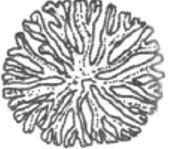
What is required for fertilization in the plant shown in the given figure?
A
Water
B
Wind
C
Insects
D
All of the above $(A), (B)$ and $(C)$
Solution
(A) The figure shows a prothallus of a fern (Pteridophyte).
In Pteridophytes,the male gametes (antherozoids) are flagellated and require water to swim to the female gametes (archegonia) for fertilization.
Therefore,water is essential for the fertilization process in these plants.
In Pteridophytes,the male gametes (antherozoids) are flagellated and require water to swim to the female gametes (archegonia) for fertilization.
Therefore,water is essential for the fertilization process in these plants.
0 likes
View Solution283
MediumMCQ
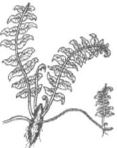
To which group does the plant shown in the given figure belong?
A
Bryophytes
B
Thallophytes
C
Angiosperms
D
Pteridophytes
Solution
(D) The figure shows a fern,which is a characteristic member of the group Pteridophyta.
Ferns are vascular plants that reproduce via spores and have neither seeds nor flowers.
They possess a well-differentiated plant body into true roots,stems,and leaves.
Therefore,the correct group is Pteridophytes.
Ferns are vascular plants that reproduce via spores and have neither seeds nor flowers.
They possess a well-differentiated plant body into true roots,stems,and leaves.
Therefore,the correct group is Pteridophytes.
0 likes
View Solution284
EasyMCQ
In the plant shown in the given figure,which is the independent and dominant phase?
A
Sporophyte
B
Gametophyte
C
Alternation of generation
D
None of these
Solution
(A) The plant shown in the figure is a fern,which belongs to the group Pteridophyta.
In Pteridophytes,the main plant body is a sporophyte,which is differentiated into true root,stem,and leaves.
The sporophyte is independent,photosynthetic,and represents the dominant phase in the life cycle.
The gametophyte (prothallus) is small,inconspicuous,and multicellular,but it is not the dominant phase.
Therefore,the correct answer is the sporophyte.
In Pteridophytes,the main plant body is a sporophyte,which is differentiated into true root,stem,and leaves.
The sporophyte is independent,photosynthetic,and represents the dominant phase in the life cycle.
The gametophyte (prothallus) is small,inconspicuous,and multicellular,but it is not the dominant phase.
Therefore,the correct answer is the sporophyte.
0 likes
View Solution285
MediumMCQ
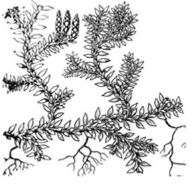
What type of spores are produced by the plant shown in the given figure?
A
Heterosporous
B
Homosporous
C
Common
D
None of these
Solution
(A) The plant shown in the figure is $Selaginella$.
$Selaginella$ is a pteridophyte that exhibits heterospory,meaning it produces two different types of spores: microspores and megaspores.
Therefore,the correct option is $A$.
$Selaginella$ is a pteridophyte that exhibits heterospory,meaning it produces two different types of spores: microspores and megaspores.
Therefore,the correct option is $A$.
0 likes
View Solution286
MediumMCQ
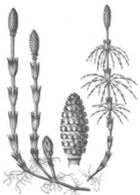
Identify the plant shown in the given figure.
A
Dryopteris
B
Rhynia
C
Selaginella
D
Equisetum
Solution
(D) The figure shows a plant with a jointed stem,whorls of leaves at the nodes,and a terminal strobilus or cone. This morphology is characteristic of the genus $Equisetum$,which belongs to the class $Sphenopsida$ of the division $Pteridophyta$.
0 likes
View Solution287
MediumMCQ
In the plant shown in the given figure,which is the haploid,short-lived stage as a gametophyte?
A
Alternation of generation
B
Sporophyte
C
Gametophyte
D
$(A), (B)$ and $(C)$ all
Solution
(C) The plant shown in the figure is Equisetum,which belongs to the group Pteridophytes.
In Pteridophytes,the main plant body is a sporophyte $(2n)$,which is differentiated into true root,stem,and leaves.
The gametophyte $(n)$ in Pteridophytes is small,inconspicuous,and usually short-lived,often called prothallus.
Therefore,the correct option is $(C)$ Gametophyte.
In Pteridophytes,the main plant body is a sporophyte $(2n)$,which is differentiated into true root,stem,and leaves.
The gametophyte $(n)$ in Pteridophytes is small,inconspicuous,and usually short-lived,often called prothallus.
Therefore,the correct option is $(C)$ Gametophyte.
0 likes
View Solution288
MediumMCQ
What type of spores are produced by the plant shown in the given figure?
A
Normal
B
Homosporous
C
Heterosporous
D
All $(A)$,$(B)$ and $(C)$
Solution
(B) The plant shown in the figure is Equisetum,which belongs to the class Sphenopsida of Pteridophytes.
Equisetum is a homosporous plant,meaning it produces spores of only one kind.
Therefore,the correct option is $(B)$.
Equisetum is a homosporous plant,meaning it produces spores of only one kind.
Therefore,the correct option is $(B)$.
0 likes
View Solution289
EasyMCQ
Which of the following is an inconsistent option regarding asexual reproduction in Pteridophytes?
A
Homosporous
B
Heterosporous
C
Antheridium
D
Microsporangium
Solution
(C) In Pteridophytes,reproduction occurs through the formation of spores. Most Pteridophytes are homosporous (producing one type of spore),while some are heterosporous (producing two types of spores: microspores and megaspores). Antheridium is a male sex organ involved in sexual reproduction,not asexual reproduction. Microsporangium is a structure that produces microspores,which is part of the heterosporous life cycle. However,among the given options,'Antheridium' is the most distinct as it is a reproductive organ for sexual reproduction,whereas the others relate to spore production types or structures.
0 likes
View Solution290
EasyMCQ
Which of the following is considered significant in the process of seed development?
A
Heterospory
B
Haplontic life cycle
C
Free-living gametophyte
D
Secondary spore
Solution
(A) The process of seed development is considered an evolutionary precursor to the seed habit in plants.
$1$. Heterospory is the production of two different types of spores (microspores and megaspores) by the plant.
$2$. In heterosporous plants,the megaspore is retained within the parent sporophyte for variable periods.
$3$. The development of the zygote into young embryos takes place within the female gametophytes retained on the parent sporophytes.
$4$. This event is a precursor to the seed habit considered an important step in evolution,which is found in plants like $Selaginella$ and $Salvinia$.
$1$. Heterospory is the production of two different types of spores (microspores and megaspores) by the plant.
$2$. In heterosporous plants,the megaspore is retained within the parent sporophyte for variable periods.
$3$. The development of the zygote into young embryos takes place within the female gametophytes retained on the parent sporophytes.
$4$. This event is a precursor to the seed habit considered an important step in evolution,which is found in plants like $Selaginella$ and $Salvinia$.
0 likes
View Solution291
EasyMCQ
What is a fernery?
A
Cultivation of Bryophytes
B
Cultivation of Gymnosperms
C
Cultivation of Pteridophytes
D
Cultivation of Monocots
Solution
(C) fernery is a specialized garden or a section of a botanical garden dedicated to the cultivation and display of ferns.
Ferns belong to the group of plants known as Pteridophytes.
Therefore,a fernery is essentially the cultivation of Pteridophytes.
Ferns belong to the group of plants known as Pteridophytes.
Therefore,a fernery is essentially the cultivation of Pteridophytes.
0 likes
View Solution292
MediumMCQ
Which one of the following is a correct statement?
A
Pteridophyte gametophyte has a protonemal and leafy stage.
B
In gymnosperms,female gametophyte is free-living.
C
Antheridiophores and archegoniophores are present in pteridophytes.
D
Origin of seed habit can be traced in pteridophytes.
Solution
(D) : In the majority of pteridophytes,all spores are of similar kinds; such plants are called homosporous. Genera like $Selaginella$ and $Salvinia$,which produce two kinds of spores,macro (large) and micro (small) spores,are known as heterosporous. The megaspores and microspores germinate and give rise to female and male gametophytes,respectively. The female gametophytes in these plants are retained on the parent sporophytes for variable periods. The development of the zygotes into young embryos takes place within the female gametophytes. This event is a precursor to the seed habit,which is considered an important step in evolution.
0 likes
View Solution293
MediumMCQ
Compared with the gametophytes of the bryophytes,the gametophytes of vascular plants tend to be
A
smaller but to have larger sex organs
B
larger but to have smaller sex organs
C
larger and to have larger sex organs
D
smaller and to have smaller sex organs.
Solution
(D) : In bryophytes,the dominant phase of the life cycle is the gametophytic plant body.
In contrast,vascular plants (pteridophytes,gymnosperms,and angiosperms) have a sporophytic plant body as the dominant phase of their life cycle.
Consequently,the gametophyte in vascular plants is highly reduced,smaller in size,and possesses smaller sex organs (antheridia and archegonia) compared to the relatively larger and more independent gametophytes of bryophytes.
In contrast,vascular plants (pteridophytes,gymnosperms,and angiosperms) have a sporophytic plant body as the dominant phase of their life cycle.
Consequently,the gametophyte in vascular plants is highly reduced,smaller in size,and possesses smaller sex organs (antheridia and archegonia) compared to the relatively larger and more independent gametophytes of bryophytes.
0 likes
View Solution294
MediumMCQ
$Selaginella$ and $Salvinia$ are considered to represent a significant step toward the evolution of seed habit because
A
female gametophyte is free and gets dispersed like seeds.
B
female gametophyte lacks archegonia.
C
megaspores possess endosperm and embryo surrounded by seed coat.
D
embryo develops in female gametophyte which is retained on parent sporophyte.
Solution
(D) : In the majority of pteridophytes,all spores are of similar kinds; such plants are called homosporous.
Genera like $Selaginella$ and $Salvinia$,which produce two kinds of spores,macro (large) and micro (small) spores,are known as heterosporous.
The megaspores and microspores germinate and give rise to female and male gametophytes,respectively.
The female gametophytes in these plants are retained on the parent sporophytes for variable periods.
The development of the zygotes into young embryos takes place within the female gametophytes.
This event is a precursor to the seed habit,which is considered an important step in evolution.
Genera like $Selaginella$ and $Salvinia$,which produce two kinds of spores,macro (large) and micro (small) spores,are known as heterosporous.
The megaspores and microspores germinate and give rise to female and male gametophytes,respectively.
The female gametophytes in these plants are retained on the parent sporophytes for variable periods.
The development of the zygotes into young embryos takes place within the female gametophytes.
This event is a precursor to the seed habit,which is considered an important step in evolution.
0 likes
View Solution295
MediumMCQ
Which one of the following is a vascular cryptogam?
A
Ginkgo
B
Marchantia
C
Cedrus
D
Equisetum
Solution
(D) : Pteridophytes are known as vascular cryptogams ($Gk$ $kryptos$ = hidden + $gamos$ = wedded). They reproduce by spores rather than seeds. They are the first vascular land plants.
$Equisetum$ is a pteridophyte belonging to the Class $Sphenopsida$. All its vegetative parts possess vascular tissues ($i.e.$, hadrome equivalent to xylem and leptome equivalent to phloem) organized in definite groups of steles.
$Equisetum$ is a pteridophyte belonging to the Class $Sphenopsida$. All its vegetative parts possess vascular tissues ($i.e.$, hadrome equivalent to xylem and leptome equivalent to phloem) organized in definite groups of steles.
0 likes
View Solution296
MediumMCQ
Which one of the following is considered important in the development of seed habit?
A
Heterospory
B
Haplontic life cycle
C
Free-living gametophyte
D
Dependent sporophyte
Solution
(A) : The differentiation of spores into microspores and megaspores,known as heterospory,is a crucial evolutionary step. The retention of the megaspore within the megasporangium on the parent sporophyte for development into the female gametophyte is considered an essential prerequisite for the formation of seeds,which is a characteristic feature of spermatophytes. This process allows the embryo to develop while being protected and nourished by the parent plant.
0 likes
View Solution297
EasyMCQ
Which one of the following is heterosporous?
A
Adiantum
B
Equisetum
C
Dryopteris
D
Salvinia
Solution
(D) The correct answer is $D$.
In pteridophytes,the sporophyte produces spores inside sporangia.
Most pteridophytes produce only one type of spore,known as homosporous (e.g.,$Equisetum$,$Adiantum$,$Dryopteris$).
However,some genera like $Salvinia$,$Selaginella$,$Azolla$,$Marsilea$,and $Isoetes$ produce two different types of spores,known as heterosporous.
Therefore,$Salvinia$ is heterosporous.
In pteridophytes,the sporophyte produces spores inside sporangia.
Most pteridophytes produce only one type of spore,known as homosporous (e.g.,$Equisetum$,$Adiantum$,$Dryopteris$).
However,some genera like $Salvinia$,$Selaginella$,$Azolla$,$Marsilea$,and $Isoetes$ produce two different types of spores,known as heterosporous.
Therefore,$Salvinia$ is heterosporous.
0 likes
View Solution298
MediumMCQ
In the prothallus of a vascular cryptogam,the antherozoids and eggs mature at different times. As a result
A
there is high degree of sterility
B
one can conclude that the plant is apomictic
C
self fertilization is prevented
D
there is no change in success rate of fertilization.
Solution
(C) The phenomenon where male and female reproductive organs mature at different times is known as dichogamy. In the prothallus of vascular cryptogams (like ferns),the antherozoids and eggs mature at different times. This temporal separation ensures that the sperm from one prothallus fertilizes the egg of another,thereby preventing self-fertilization and promoting cross-fertilization.
0 likes
View Solution299
MediumMCQ
Which of the following organisms fell to form coal deposits?
A
Pteridophytes
B
Dinosaur
C
Lobefins
D
All given
Solution
(A) Coal deposits are formed from the remains of ancient plants that lived millions of years ago.
Specifically,large quantities of Pteridophytes (ferns and fern-allies) grew in swampy forests during the Carboniferous period.
When these plants died,they were buried under layers of sediment,and over millions of years,heat and pressure converted them into coal.
Therefore,Pteridophytes are the primary contributors to coal deposits.
Specifically,large quantities of Pteridophytes (ferns and fern-allies) grew in swampy forests during the Carboniferous period.
When these plants died,they were buried under layers of sediment,and over millions of years,heat and pressure converted them into coal.
Therefore,Pteridophytes are the primary contributors to coal deposits.
0 likes
View Solution300
MediumMCQ
Pteridophytes are further classified into $4$ groups.
A
$1$
B
$2$
C
$3$
D
$4$
Solution
(D) Pteridophytes are a diverse group of seedless vascular plants. Based on their morphological and evolutionary characteristics,they are classified into $4$ main classes:
$1$. Psilopsida (e.g.,Psilotum)
$2$. Lycopsida (e.g.,Selaginella,Lycopodium)
$3$. Sphenopsida (e.g.,Equisetum)
$4$. Pteropsida (e.g.,Dryopteris,Pteris,Adiantum)
Therefore,the correct answer is $4$.
$1$. Psilopsida (e.g.,Psilotum)
$2$. Lycopsida (e.g.,Selaginella,Lycopodium)
$3$. Sphenopsida (e.g.,Equisetum)
$4$. Pteropsida (e.g.,Dryopteris,Pteris,Adiantum)
Therefore,the correct answer is $4$.
0 likes
View SolutionPlant Kingdom — Pteridophytes (General) · Frequently Asked Questions
1Are these Plant Kingdom questions useful for JEE and NEET?
Yes. All questions in this section are mapped to JEE Main and NEET exam patterns. Previous year questions from JEE Main, NEET, GUJCET and state-level exams are included with full solutions.
2Can I switch to Hindi or Gujarati for these questions?
Yes. Use the language tabs in the hero section or the sidebar to view the same questions and solutions in English, Hindi or Gujarati.
3How do I generate a question paper from this subtopic?
Use the Vedclass Exam Paper Generator — select the chapter and subtopic, set difficulty, and generate Sets A, B, C, D automatically. First 3 chapters of every subject are free.
Vedclass Products
For Students
Vedclass Test Series
Mock tests in real JEE/NEET style with performance analysis. 5-day free trial.
Start Free TrialFor Teachers
Exam Paper Generator
Generate Set A/B/C/D papers from this chapter in 2 minutes. 3 chapters free.
Try FreeFor Institutes
Online Exam Module
Live online exams with unlimited students, 360° analytics & white-label branding.
See DemoFor Teachers & Institutes
Generate a Plant Kingdom Exam Paper in 2 Minutes
Select subtopic & difficulty — Sets A, B, C, D auto-generated with No Repeat logic.
First 3 chapters of every subject are free — no payment required.