
A English
Mix Examples- Plant Kingdom Questions in English
Class 11 Biology · Plant Kingdom · Mix Examples- Plant Kingdom
272+
Questions
English
Language
100%
With Solutions
Showing 50 of 272 questions in English
201
MediumMCQ
Heterospory and seed formation are usually discussed in the context of which structure?
A
Spathe
B
Bract
C
Petal
D
Ligule
Solution
(B) Heterospory is the production of two different types of spores (microspores and megaspores). This phenomenon is a precursor to the seed habit in plants. In the context of plant morphology and evolution,the development of seeds is closely associated with the evolution of the $Bract$ (or specialized leaf-like structures) that protect the developing sporangia. Among the given options,the $Bract$ is the structure most commonly associated with the evolutionary context of seed-bearing plants.
0 likes
View Solution202
MediumMCQ
Which one is $wrongly$ matched?
A
Uniflagellate gametes - $Polysiphonia$
B
Unicellular organism - $Chlorella$
C
Gemma cups - $Marchantia$
D
Biflagellate zoospores - Brown algae
Solution
(A) The correct answer is $A$.
$Polysiphonia$ is a red alga (Rhodophyceae).
Red algae are characterized by the complete absence of flagellated stages in their life cycle; they produce non-motile gametes.
Therefore,the statement 'Uniflagellate gametes - $Polysiphonia$' is incorrect.
$Chlorella$ is a well-known unicellular green alga.
$Marchantia$ is a liverwort that reproduces asexually via gemmae produced in gemma cups.
Brown algae (Phaeophyceae) typically produce biflagellate zoospores that are pear-shaped and have two laterally attached unequal flagella.
$Polysiphonia$ is a red alga (Rhodophyceae).
Red algae are characterized by the complete absence of flagellated stages in their life cycle; they produce non-motile gametes.
Therefore,the statement 'Uniflagellate gametes - $Polysiphonia$' is incorrect.
$Chlorella$ is a well-known unicellular green alga.
$Marchantia$ is a liverwort that reproduces asexually via gemmae produced in gemma cups.
Brown algae (Phaeophyceae) typically produce biflagellate zoospores that are pear-shaped and have two laterally attached unequal flagella.
0 likes
View Solution203
DifficultMCQ
Assertion $(A)$: Algae and fungi are classified as thallophytes.
Reason $(R)$: They both are autotrophs.
Reason $(R)$: They both are autotrophs.
A
If both Assertion and Reason are correct and the Reason is a correct explanation of the Assertion.
B
If both Assertion and Reason are correct but Reason is not a correct explanation of the Assertion.
C
If the Assertion is correct but Reason is incorrect.
D
If both the Assertion and Reason are incorrect.
Solution
(C) Thallophytes are plants whose body is not differentiated into root,stem,and leaves.
Algae and fungi both possess a thalloid plant body,hence they are classified as thallophytes.
Algae are autotrophs,meaning they can synthesize their own food through photosynthesis.
Fungi are heterotrophs,meaning they cannot synthesize their own food and depend on other organic sources.
Therefore,the Assertion is correct,but the Reason is incorrect.
Algae and fungi both possess a thalloid plant body,hence they are classified as thallophytes.
Algae are autotrophs,meaning they can synthesize their own food through photosynthesis.
Fungi are heterotrophs,meaning they cannot synthesize their own food and depend on other organic sources.
Therefore,the Assertion is correct,but the Reason is incorrect.
0 likes
View Solution204
MediumMCQ
Match the following:
| List-$I$ | List-$II$ |
|---|---|
| $A$. Coleorhiza | $I$. Development of sporophyte directly from gametophyte without intervention of gametes |
| $B$. Apogamy | $II$. Development of gametophyte directly from sporophyte without the involvement of reduction division |
| $C$. Indusium | $III$. An unbranched columnar stem with a crown of leaves |
| $D$. Caudex | $IV$. Protective covering of radicle |
| - | $V$. Protective structure of a sorus |
A
$A-V, B-II, C-IV, D-I$
B
$A-IV, B-I, C-V, D-III$
C
$A-III, B-V, C-II, D-IV$
D
$A-II, B-III, C-I, D-V$
Solution
(B) The correct matches are as follows:
- $A$. Coleorhiza: It is the protective sheath covering the radicle in monocot seeds $(IV)$.
- $B$. Apogamy: It is the development of a sporophyte directly from a gametophyte without the fusion of gametes $(I)$.
- $C$. Indusium: It is the thin,membranous protective covering of a sorus in ferns $(V)$.
- $D$. Caudex: It refers to an unbranched,columnar stem,often seen in palms or cycads,bearing a crown of leaves $(III)$.
Thus,the correct sequence is $A-IV, B-I, C-V, D-III$.
- $A$. Coleorhiza: It is the protective sheath covering the radicle in monocot seeds $(IV)$.
- $B$. Apogamy: It is the development of a sporophyte directly from a gametophyte without the fusion of gametes $(I)$.
- $C$. Indusium: It is the thin,membranous protective covering of a sorus in ferns $(V)$.
- $D$. Caudex: It refers to an unbranched,columnar stem,often seen in palms or cycads,bearing a crown of leaves $(III)$.
Thus,the correct sequence is $A-IV, B-I, C-V, D-III$.
0 likes
View Solution205
Difficult
When and where does reduction division (meiosis) take place in the life cycle of a liverwort,a moss,a fern,a gymnosperm,and an angiosperm?
Solution
(N/A) Liverwort: The main plant body is haploid (gametophytic). Reduction division occurs in the capsule of the sporophyte to produce haploid spores.
Moss: The main plant body is gametophytic. Reduction division occurs in the capsule of the sporophyte to produce haploid spores.
Fern: The main plant body is sporophytic. Reduction division occurs in the sporangia located on the sporophylls to produce haploid spores.
Gymnosperm: The main plant body is sporophytic. Reduction division occurs in the microsporangia (producing pollen grains) and megasporangia (producing megaspores) located on the sporophylls.
Angiosperm: The main plant body is sporophytic. Reduction division occurs in the anthers (producing microspores/pollen grains) and in the ovules within the ovary (producing megaspores).
Moss: The main plant body is gametophytic. Reduction division occurs in the capsule of the sporophyte to produce haploid spores.
Fern: The main plant body is sporophytic. Reduction division occurs in the sporangia located on the sporophylls to produce haploid spores.
Gymnosperm: The main plant body is sporophytic. Reduction division occurs in the microsporangia (producing pollen grains) and megasporangia (producing megaspores) located on the sporophylls.
Angiosperm: The main plant body is sporophytic. Reduction division occurs in the anthers (producing microspores/pollen grains) and in the ovules within the ovary (producing megaspores).
0 likes
View Solution206
Difficult
Name three groups of plants that bear archegonia. Briefly describe the life cycle of any one of them.
Solution
(N/A) Archegonium is the female sex organ that produces the female gamete or egg. It is present in the life cycles of bryophytes,pteridophytes,and gymnosperms.
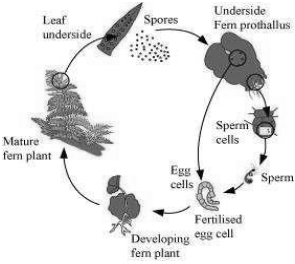
Life cycle of a fern (pteridophyte):
The main plant body of a fern is a sporophyte,which is diploid $(2n)$. The sporophyte bears sporangia on the underside of its mature leaves. Inside the sporangia,spore mother cells undergo meiosis to produce haploid $(n)$ spores. Upon maturation,these spores are released and germinate to form a small,heart-shaped,photosynthetic,free-living gametophyte called a prothallus.
The prothallus bears both male sex organs (antheridia) and female sex organs (archegonia). The antheridia produce motile sperms that require water to swim and reach the archegonia,which contain the egg. Fertilization results in the formation of a diploid zygote. The zygote develops into an embryo,which eventually grows into a new sporophyte plant,completing the life cycle.
Life cycle of a fern (pteridophyte):
The main plant body of a fern is a sporophyte,which is diploid $(2n)$. The sporophyte bears sporangia on the underside of its mature leaves. Inside the sporangia,spore mother cells undergo meiosis to produce haploid $(n)$ spores. Upon maturation,these spores are released and germinate to form a small,heart-shaped,photosynthetic,free-living gametophyte called a prothallus.
The prothallus bears both male sex organs (antheridia) and female sex organs (archegonia). The antheridia produce motile sperms that require water to swim and reach the archegonia,which contain the egg. Fertilization results in the formation of a diploid zygote. The zygote develops into an embryo,which eventually grows into a new sporophyte plant,completing the life cycle.
0 likes
View Solution207
Easy
Mention the ploidy of the following: protonemal cell of a moss; primary endosperm nucleus in a dicot; leaf cell of a moss; prothallus cell of a fern; gemma cell in Marchantia; meristem cell of a monocot; ovum of a liverwort; and zygote of a fern.
Solution
(N/A) Protonemal cell of a moss: Haploid $(n)$
$(b)$ Primary endosperm nucleus in a dicot: Triploid $(3n)$
$(c)$ Leaf cell of a moss: Haploid $(n)$
$(d)$ Prothallus cell of a fern: Haploid $(n)$
$(e)$ Gemma cell in Marchantia: Haploid $(n)$
$(f)$ Meristem cell of a monocot: Diploid $(2n)$
$(g)$ Ovum of a liverwort: Haploid $(n)$
$(h)$ Zygote of a fern: Diploid $(2n)$
$(b)$ Primary endosperm nucleus in a dicot: Triploid $(3n)$
$(c)$ Leaf cell of a moss: Haploid $(n)$
$(d)$ Prothallus cell of a fern: Haploid $(n)$
$(e)$ Gemma cell in Marchantia: Haploid $(n)$
$(f)$ Meristem cell of a monocot: Diploid $(2n)$
$(g)$ Ovum of a liverwort: Haploid $(n)$
$(h)$ Zygote of a fern: Diploid $(2n)$
0 likes
View Solution208
Easy
Write a note on the economic importance of algae and gymnosperms.
Solution
(N/A) Algae have diverse economic uses. They perform half of the total carbon dioxide fixation on earth by photosynthesis,acting as primary producers in aquatic habitats.
Economic importance of algae:
$(a)$ Food source: Many species of marine algae such as Porphyra,Sargassum,and Laminaria are edible. Chlorella and Spirulina are rich in proteins and are used as food supplements.
$(b)$ Commercial importance: Agar is used in the preparation of jellies and ice cream. It is obtained from Gelidium and Gracilaria. Carrageenin is used as an emulsifier in chocolates,paints,and toothpastes,obtained from red algae.
$(c)$ Medicines: Many red algae such as Corallina are used in treating worm infections.
Economic importance of gymnosperms:
$(a)$ Construction purposes: Many conifers such as pine and cedar are sources of softwood used in construction and packing.
$(b)$ Medicinal uses: An anticancer drug,Taxol,is obtained from Taxus. Many species of Ephedra produce ephedrine,which is used in the treatment of asthma and bronchitis.
$(c)$ Food source: The seeds of Pinus gerardiana (known as chilgoza) are edible.
$(d)$ Source of resins: Resins are used commercially for manufacturing sealing waxes and waterproof paints. $A$ type of resin known as turpentine is obtained from various species of Pinus.
Economic importance of algae:
$(a)$ Food source: Many species of marine algae such as Porphyra,Sargassum,and Laminaria are edible. Chlorella and Spirulina are rich in proteins and are used as food supplements.
$(b)$ Commercial importance: Agar is used in the preparation of jellies and ice cream. It is obtained from Gelidium and Gracilaria. Carrageenin is used as an emulsifier in chocolates,paints,and toothpastes,obtained from red algae.
$(c)$ Medicines: Many red algae such as Corallina are used in treating worm infections.
Economic importance of gymnosperms:
$(a)$ Construction purposes: Many conifers such as pine and cedar are sources of softwood used in construction and packing.
$(b)$ Medicinal uses: An anticancer drug,Taxol,is obtained from Taxus. Many species of Ephedra produce ephedrine,which is used in the treatment of asthma and bronchitis.
$(c)$ Food source: The seeds of Pinus gerardiana (known as chilgoza) are edible.
$(d)$ Source of resins: Resins are used commercially for manufacturing sealing waxes and waterproof paints. $A$ type of resin known as turpentine is obtained from various species of Pinus.
0 likes
View Solution209
EasyMCQ
Both gymnosperms and angiosperms bear seeds,then why are they classified separately?
A
Gymnosperms have naked seeds,while angiosperms have seeds enclosed within fruits.
B
Gymnosperms are non-flowering,while angiosperms are flowering plants.
C
The endosperm in gymnosperms is haploid,while in angiosperms,it is triploid.
D
All of the above.
Solution
(D) Gymnosperms and angiosperms are both seed-producing plants,but they differ significantly in their reproductive structures and development.
$1$. In gymnosperms,the ovules are not enclosed by any ovary wall and remain exposed,both before and after fertilization. The seeds that develop post-fertilization are not covered,i.e.,they are naked.
$2$. In angiosperms,the pollen grains and ovules are developed in specialized structures called flowers. The seeds are enclosed inside fruits,which develop from the ovary after fertilization.
$3$. The endosperm in gymnosperms is formed before fertilization and is haploid $(n)$,whereas in angiosperms,the endosperm is formed after fertilization through double fertilization and is triploid $(3n)$.
$1$. In gymnosperms,the ovules are not enclosed by any ovary wall and remain exposed,both before and after fertilization. The seeds that develop post-fertilization are not covered,i.e.,they are naked.
$2$. In angiosperms,the pollen grains and ovules are developed in specialized structures called flowers. The seeds are enclosed inside fruits,which develop from the ovary after fertilization.
$3$. The endosperm in gymnosperms is formed before fertilization and is haploid $(n)$,whereas in angiosperms,the endosperm is formed after fertilization through double fertilization and is triploid $(3n)$.
0 likes
View Solution210
Easy
Explain briefly the following terms with suitable examples:
$(i)$ protonema
$(ii)$ antheridium
$(iii)$ archegonium
$(iv)$ diplontic
$(v)$ sporophyll
$(vi)$ isogamy
$(i)$ protonema
$(ii)$ antheridium
$(iii)$ archegonium
$(iv)$ diplontic
$(v)$ sporophyll
$(vi)$ isogamy
Solution
(N/A) $(i)$ Protonema: It is the first stage in the life cycle of a moss,developing directly from the spore. It consists of creeping,green,branched,and often filamentous structures.
$(ii)$ Antheridium: It is the male sex organ present in bryophytes and pteridophytes,surrounded by a jacket of sterile cells. It encloses the sperm mother cells,which give rise to the male gametes.
$(iii)$ Archegonium: It is the female sex organ present in bryophytes,pteridophytes,and gymnosperms. It typically has a swollen venter and a tubular neck,containing the female gamete (egg).
$(iv)$ Diplontic: This term describes the life cycle of seed-bearing plants (gymnosperms and angiosperms). In these plants,the diploid sporophyte is the dominant,photosynthetic,and independent phase,while the gametophyte is highly reduced.
$(v)$ Sporophyll: In pteridophytes,the sporophytic plant body bears sporangia,which are subtended by leaf-like appendages called sporophylls. In gymnosperms,these are differentiated into microsporophylls and megasporophylls.
$(vi)$ Isogamy: It is a type of sexual reproduction involving the fusion of morphologically similar gametes. These gametes are of the same size. This is commonly observed in $Spirogyra$.
$(ii)$ Antheridium: It is the male sex organ present in bryophytes and pteridophytes,surrounded by a jacket of sterile cells. It encloses the sperm mother cells,which give rise to the male gametes.
$(iii)$ Archegonium: It is the female sex organ present in bryophytes,pteridophytes,and gymnosperms. It typically has a swollen venter and a tubular neck,containing the female gamete (egg).
$(iv)$ Diplontic: This term describes the life cycle of seed-bearing plants (gymnosperms and angiosperms). In these plants,the diploid sporophyte is the dominant,photosynthetic,and independent phase,while the gametophyte is highly reduced.
$(v)$ Sporophyll: In pteridophytes,the sporophytic plant body bears sporangia,which are subtended by leaf-like appendages called sporophylls. In gymnosperms,these are differentiated into microsporophylls and megasporophylls.
$(vi)$ Isogamy: It is a type of sexual reproduction involving the fusion of morphologically similar gametes. These gametes are of the same size. This is commonly observed in $Spirogyra$.
2 likes
View Solution211
Easy
Match the following (Column $I$ with Column $II$):
| Column $I$ | Column $II$ |
| $(a)$ Chlamydomonas | $(i)$ Moss |
| $(b)$ Cycas | $(ii)$ Pteridophyte |
| $(c)$ Selaginella | $(iii)$ Algae |
| $(d)$ Sphagnum | $(iv)$ Gymnosperm |
Solution
(A) The correct matches are as follows:
$1$. $Chlamydomonas$ is a unicellular green alga.
$2$. $Cycas$ is a well-known gymnosperm.
$3$. $Selaginella$ is a heterosporous pteridophyte.
$4$. $Sphagnum$ is a moss belonging to the class Bryopsida.
| Column $I$ | Column $II$ |
| $(a)$ Chlamydomonas | $(iii)$ Algae |
| $(b)$ Cycas | $(iv)$ Gymnosperm |
| $(c)$ Selaginella | $(ii)$ Pteridophyte |
| $(d)$ Sphagnum | $(i)$ Moss |
$1$. $Chlamydomonas$ is a unicellular green alga.
$2$. $Cycas$ is a well-known gymnosperm.
$3$. $Selaginella$ is a heterosporous pteridophyte.
$4$. $Sphagnum$ is a moss belonging to the class Bryopsida.
0 likes
View Solution212
Medium
Make a list of algae and fungi that have commercial value as a source of food,chemicals,medicines,and fodder.
Solution
(N/A) $\rightarrow$ Some algae of commercial importance are:
$(1)$ Agar: It is derived from red algae $Gelidium$ and $Gracilaria$.
$\rightarrow$ Use: It is used as a culture medium in laboratories.
$(2)$ Algin and Carrageen: Algin is derived from brown algae and Carrageen is derived from red algae.
$\rightarrow$ Use: Used as a gelling agent in food and medical dressings.
$(3)$ Food: Many species of $Porphyra$,$Laminaria$,and $Sargassum$.
$\rightarrow$ Use: These marine algae are used as food items,especially in East Asian nations.
$(4)$ Fodder: Some brown algae like $Fucus$,$Sargassum$,$Laminaria$,$Macrocystis$,and $Rhodymenia$ are important fodder for cattle.
$(5)$ Alginic acid: $A$ phycocolloid obtained from brown algae such as $Alaria$,$Macrocystis$,$Ascophyllum$,and $Laminaria$. It is used as an emulsifier,thickener,and gelling agent in toothpastes,shaving creams,ice creams,emulsion paints,and shampoos.
$(6)$ Iodine source: $Fucus$ and $Laminaria$ are rich in iodine.
$(7)$ Medicinal: Some algae like $Corallina$ and $Polysiphonia$ have medicinal properties.
$(8)$ Protein supplements: Protein-rich algae like $Chlorella$ and $Spirulina$ are used as food supplements by sailors and space travelers.
$\rightarrow$ Some fungi of commercial importance:
$(1)$ Medicine: The fungus $Penicillium$ $notatum$ is used for producing antibiotics of the penicillin group.
$(2)$ Food processing: Yeast ($Saccharomyces$ $cerevisiae$) has been used for ages for fermentation. Alcoholic beverages and bakery items are produced via yeast fermentation.
$(3)$ Food: Some varieties of $Agaricus$ (mushrooms) are used as food in many countries.
$(1)$ Agar: It is derived from red algae $Gelidium$ and $Gracilaria$.
$\rightarrow$ Use: It is used as a culture medium in laboratories.
$(2)$ Algin and Carrageen: Algin is derived from brown algae and Carrageen is derived from red algae.
$\rightarrow$ Use: Used as a gelling agent in food and medical dressings.
$(3)$ Food: Many species of $Porphyra$,$Laminaria$,and $Sargassum$.
$\rightarrow$ Use: These marine algae are used as food items,especially in East Asian nations.
$(4)$ Fodder: Some brown algae like $Fucus$,$Sargassum$,$Laminaria$,$Macrocystis$,and $Rhodymenia$ are important fodder for cattle.
$(5)$ Alginic acid: $A$ phycocolloid obtained from brown algae such as $Alaria$,$Macrocystis$,$Ascophyllum$,and $Laminaria$. It is used as an emulsifier,thickener,and gelling agent in toothpastes,shaving creams,ice creams,emulsion paints,and shampoos.
$(6)$ Iodine source: $Fucus$ and $Laminaria$ are rich in iodine.
$(7)$ Medicinal: Some algae like $Corallina$ and $Polysiphonia$ have medicinal properties.
$(8)$ Protein supplements: Protein-rich algae like $Chlorella$ and $Spirulina$ are used as food supplements by sailors and space travelers.
$\rightarrow$ Some fungi of commercial importance:
$(1)$ Medicine: The fungus $Penicillium$ $notatum$ is used for producing antibiotics of the penicillin group.
$(2)$ Food processing: Yeast ($Saccharomyces$ $cerevisiae$) has been used for ages for fermentation. Alcoholic beverages and bakery items are produced via yeast fermentation.
$(3)$ Food: Some varieties of $Agaricus$ (mushrooms) are used as food in many countries.
0 likes
View Solution213
Medium
Give differences: Bryophytes and Pteridophytes.
Solution
(N/A)
| Bryophytes | Pteridophytes |
|---|---|
| $(1)$ The plant body is thallus-like and lacks true roots,stems,and leaves. | $(1)$ The plant body is well-differentiated into true roots,stems,and leaves. |
| $(2)$ True roots are absent; they possess rhizoids for anchorage. | $(2)$ True roots are present. |
| $(3)$ The gametophytic stage is dominant,while the sporophyte is dependent on the gametophyte. | $(3)$ The sporophytic stage is dominant,while the gametophytic stage is short-lived but independent. |
| $(4)$ Vascular tissues (xylem and phloem) are absent. | $(4)$ Vascular tissues (xylem and phloem) are present. |
| $(5)$ Examples: $Riccia$,$Marchantia$,$Moss$ $(Funaria)$. | $(5)$ Examples: $Nephrolepis$,$Selaginella$,$Lycopodium$. |
0 likes
View Solution214
Medium
Differentiate between Gymnosperms and Angiosperms.
Solution
(N/A)
| Gymnosperms | Angiosperms |
| $(1)$ Seeds are naked and not enclosed by an ovary wall. | $(1)$ Seeds are enclosed within fruits (ovary wall). |
| $(2)$ They exhibit single fertilization. | $(2)$ They exhibit double fertilization. |
| $(3)$ They lack true flowers; reproductive structures are cones or strobili. | $(3)$ They possess true flowers with petals and sepals. |
| $(4)$ Endosperm is haploid $(n)$ and formed before fertilization. | $(4)$ Endosperm is triploid $(3n)$ and formed after fertilization. |
| $(5)$ Xylem lacks vessels (except Gnetales) and phloem lacks companion cells. | $(5)$ Xylem contains vessels and phloem contains companion cells. |
| $(6)$ Pollination is primarily anemophilous (wind). | $(6)$ Pollination occurs via various agents like wind,water,insects,and animals. |
0 likes
View Solution215
EasyMCQ
What is the importance of Agar-Agar?
A
Used in the preparation of ice-creams and jellies.
B
Used to grow microbes in laboratories.
C
Both $A$ and $B$.
D
None of the above.
Solution
(C) Agar-Agar is a commercial product obtained from red algae,specifically $Gelidium$ and $Gracilaria$.
It is widely used in the laboratory for the culture of microorganisms (microbial growth media).
Additionally,it is used in the food industry for the preparation of ice-creams and jellies.
It is widely used in the laboratory for the culture of microorganisms (microbial growth media).
Additionally,it is used in the food industry for the preparation of ice-creams and jellies.
0 likes
View Solution216
Easy
How are the male and female gametophytes of pteridophytes and gymnosperms different from each other?
Solution
(N/A) $\rightarrow$ The male and female gametophytes of pteridophytes and gymnosperms differ in the following ways:
| Male gametophyte in Pteridophytes | Male gametophyte in Gymnosperms |
| $(i)$ Reduced and short-lived. | $(i)$ Highly reduced and dependent on the sporophyte. |
| $(ii)$ Male gametes are flagellated (motile). | $(ii)$ Male gametes are non-flagellated (non-motile). |
| $(iii)$ Requires water for fertilization. | $(iii)$ Does not require water; fertilization occurs via a pollen tube. |
| Female gametophyte in Pteridophytes | Female gametophyte in Gymnosperms |
| $(i)$ Often independent and photosynthetic. | $(i)$ Completely dependent on the parent sporophyte. |
| $(ii)$ Not retained within the parent sporophyte. | $(ii)$ Retained within the megasporangium (ovule). |
| $(iii)$ Does not form a seed. | $(iii)$ Develops into a seed after fertilization. |
0 likes
View Solution217
Easy
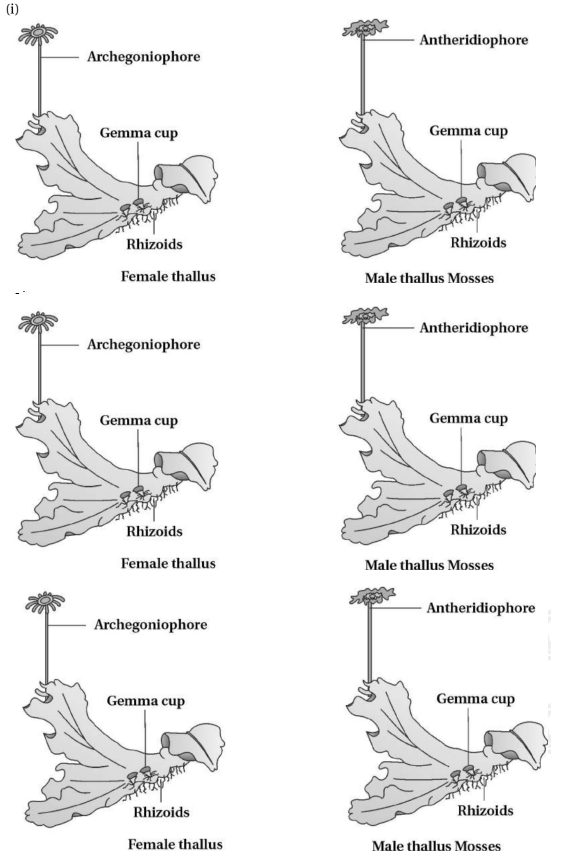
Draw labelled diagrams of:
$(a)$ Female and male thallus of a liverwort.
$(b)$ Gametophyte and sporophyte of Funaria.
$(c)$ Alternation of generation in angiosperm.
$(a)$ Female and male thallus of a liverwort.
$(b)$ Gametophyte and sporophyte of Funaria.
$(c)$ Alternation of generation in angiosperm.
Solution
(N/A) The requested diagrams are provided in the reference image.
$(a)$ Liverworts (e.g.,Marchantia) show a thalloid body. The female thallus bears archegoniophores,while the male thallus bears antheridiophores. Both possess gemma cups and rhizoids.
$(b)$ In Funaria (a moss),the gametophyte is the dominant,independent,green,leafy stage. The sporophyte is differentiated into a foot,seta,and capsule,and it remains attached to the gametophyte for nutrition.
$(c)$ Angiosperms exhibit a diplontic life cycle where the sporophyte $(2n)$ is the dominant phase. The gametophyte $(n)$ is highly reduced. The cycle involves the production of microspores and megaspores,leading to fertilization and the development of the embryo within the seed.
$(a)$ Liverworts (e.g.,Marchantia) show a thalloid body. The female thallus bears archegoniophores,while the male thallus bears antheridiophores. Both possess gemma cups and rhizoids.
$(b)$ In Funaria (a moss),the gametophyte is the dominant,independent,green,leafy stage. The sporophyte is differentiated into a foot,seta,and capsule,and it remains attached to the gametophyte for nutrition.
$(c)$ Angiosperms exhibit a diplontic life cycle where the sporophyte $(2n)$ is the dominant phase. The gametophyte $(n)$ is highly reduced. The cycle involves the production of microspores and megaspores,leading to fertilization and the development of the embryo within the seed.
0 likes
View Solution218
MediumMCQ
Provide the missing terms for the following analogy-type questions:
$(i)$ Angiosperms : Flower :: Conifers : ...
(ii) Moss : Protonema :: Fern : ...
$(i)$ Angiosperms : Flower :: Conifers : ...
(ii) Moss : Protonema :: Fern : ...
A
$(i)$ Cone,(ii) Prothallus
B
$(i)$ Fruit,(ii) Protonema
C
$(i)$ Cone,(ii) Sporangia
D
$(i)$ Flower,(ii) Thallus
Solution
(A) $(i)$ Angiosperms bear flowers as their reproductive structures,whereas Conifers (Gymnosperms) bear cones.
(ii) In the life cycle of Mosses,the protonema is the juvenile stage. In Ferns (Pteridophytes),the gametophyte stage is represented by a heart-shaped structure called the prothallus.
(ii) In the life cycle of Mosses,the protonema is the juvenile stage. In Ferns (Pteridophytes),the gametophyte stage is represented by a heart-shaped structure called the prothallus.
0 likes
View Solution219
Easy
Provide the appropriate terms for the following analogies:
$(i)$ Fern : Prothallus :: Moss : ....
$(ii)$ Angiosperms : Root :: Brown Algae : ....
$(i)$ Fern : Prothallus :: Moss : ....
$(ii)$ Angiosperms : Root :: Brown Algae : ....
Solution
(A) $(i)$ Protonema
$(ii)$ Holdfast
$(ii)$ Holdfast
0 likes
View Solution220
Medium
Provide the appropriate terms for the following analogies:
$(i)$ In Gymnosperms : Diplontic life cycle :: In Pteridophytes : .......
(ii) Ectocarpus : Haplodiplontic life cycle :: Fucus : ..........
$(i)$ In Gymnosperms : Diplontic life cycle :: In Pteridophytes : .......
(ii) Ectocarpus : Haplodiplontic life cycle :: Fucus : ..........
Solution
(A) $(i)$ Haplodiplontic life cycle: Pteridophytes exhibit a haplodiplontic life cycle where both the sporophytic and gametophytic phases are multicellular and free-living.
(ii) Diplontic life cycle: Fucus is a brown alga that exhibits a diplontic life cycle,where the diploid sporophyte is the dominant,photosynthetic phase.
(ii) Diplontic life cycle: Fucus is a brown alga that exhibits a diplontic life cycle,where the diploid sporophyte is the dominant,photosynthetic phase.
0 likes
View Solution221
Easy
Select the correct option for the following statements:
$(i)$ Like bryophytes and pteridophytes,in gymnosperms,the male and female gametophytes do/do not have an independent free-living existence.
$(ii)$ Non-motile isogamous gametes are found in Spirogyra/Volvox.
$(i)$ Like bryophytes and pteridophytes,in gymnosperms,the male and female gametophytes do/do not have an independent free-living existence.
$(ii)$ Non-motile isogamous gametes are found in Spirogyra/Volvox.
Solution
(A) $(i)$ In gymnosperms,the male and female gametophytes do not have an independent free-living existence. They remain within the sporangia retained on the sporophytes.
$(ii)$ Spirogyra exhibits non-motile isogamous gametes,whereas Volvox exhibits oogamous reproduction with motile male gametes.
$(ii)$ Spirogyra exhibits non-motile isogamous gametes,whereas Volvox exhibits oogamous reproduction with motile male gametes.
0 likes
View Solution222
Medium
Most algal genera show a haplontic life cycle. Name an alga which is:
$(a)$ Haplo-diplontic
$(b)$ Diplontic
$(a)$ Haplo-diplontic
$(b)$ Diplontic
Solution
(N/A) $\rightarrow$ Haplo-diplontic life cycle is observed in $Ectocarpus$,$Polysiphonia$,and $Kelps$. In this type,the multicellular sporophyte alternates with the multicellular gametophyte.
$\rightarrow$ In $Fucus$,the main plant body is diploid (sporophytic),and it exhibits a diplontic type of life cycle.
$\rightarrow$ In $Fucus$,the main plant body is diploid (sporophytic),and it exhibits a diplontic type of life cycle.
0 likes
View Solution223
MediumMCQ
What is required for the transfer of gametes in bryophytes and pteridophytes?
A
Wind
B
Water
C
Honey bees
D
Beetles
Solution
(B) In bryophytes and pteridophytes,the male gametes (antherozoids) are flagellated and motile.
They require a film of water to swim to the female gametes (egg cells) for fertilization.
Therefore,water is essential for the transfer of gametes in these plant groups.
They require a film of water to swim to the female gametes (egg cells) for fertilization.
Therefore,water is essential for the transfer of gametes in these plant groups.
0 likes
View Solution224
MediumMCQ
According to the five-kingdom system,gymnosperms and angiosperms are grouped under the kingdom:
A
Monera
B
Protista
C
Fungi
D
Plantae
Solution
(D) The five-kingdom classification system was proposed by $R.H. Whittaker$.
In this system,all multicellular,photosynthetic,eukaryotic organisms that possess a cell wall are placed under the kingdom $Plantae$.
Gymnosperms and angiosperms are both multicellular,photosynthetic,and eukaryotic plants; therefore,they are classified under the kingdom $Plantae$.
In this system,all multicellular,photosynthetic,eukaryotic organisms that possess a cell wall are placed under the kingdom $Plantae$.
Gymnosperms and angiosperms are both multicellular,photosynthetic,and eukaryotic plants; therefore,they are classified under the kingdom $Plantae$.
0 likes
View Solution225
MediumMCQ
Select the incorrect statement.
A
Cuscuta is a parasitic plant.
B
Bladderwort and Venus fly trap are examples of insectivorous plants.
C
Plantae includes algae,bryophytes,pteridophytes,gymnosperms and angiosperms.
D
The mode of nutrition in plants is holozoic.
Solution
(D) Cuscuta $(Amarbel)$ is a parasitic plant that derives nutrients from other plants.
Bladderwort and Venus fly trap are specialized insectivorous plants that trap insects to supplement their nitrogen requirements.
The kingdom $Plantae$ includes algae,bryophytes,pteridophytes,gymnosperms,and angiosperms.
The mode of nutrition in plants is primarily autotrophic (photosynthetic),not holozoic. Holozoic nutrition is characteristic of animals.
Bladderwort and Venus fly trap are specialized insectivorous plants that trap insects to supplement their nitrogen requirements.
The kingdom $Plantae$ includes algae,bryophytes,pteridophytes,gymnosperms,and angiosperms.
The mode of nutrition in plants is primarily autotrophic (photosynthetic),not holozoic. Holozoic nutrition is characteristic of animals.
0 likes
View Solution226
MediumMCQ
$Spirogyra$,$Volvox$ and $Chlamydomonas$ show:
A
Haplontic life cycle
B
Diplontic life cycle
C
Haplo-diplontic life cycle
D
Diplobiontic life cycle
Solution
(A) The $Haplontic$ life cycle is considered a primitive type of life cycle.
In this cycle,the dominant phase is the free-living gametophyte $(n)$,while the sporophyte generation is represented only by the one-celled zygote $(2n)$.
$Spirogyra$,$Volvox$,and $Chlamydomonas$ are examples of algae that exhibit this $Haplontic$ life cycle.
In this cycle,the dominant phase is the free-living gametophyte $(n)$,while the sporophyte generation is represented only by the one-celled zygote $(2n)$.
$Spirogyra$,$Volvox$,and $Chlamydomonas$ are examples of algae that exhibit this $Haplontic$ life cycle.
0 likes
View Solution227
MediumMCQ
$A$ fern differs from a moss in having
A
Swimming archegonia
B
Swimming antherozoids
C
Independent gametophytes
D
Independent sporophytes
Solution
(D) fern $(Pteridophyte)$ differs from a moss $(Bryophyte)$ in the presence of an independent sporophyte.
In mosses,the sporophyte is simpler than the gametophyte and remains attached to the parent gametophyte throughout its life.
This sporophyte is dependent upon the gametophyte partially or wholly for its nutrition.
In contrast,ferns possess a well-developed,independent sporophyte that is the dominant phase of their life cycle.
In mosses,the sporophyte is simpler than the gametophyte and remains attached to the parent gametophyte throughout its life.
This sporophyte is dependent upon the gametophyte partially or wholly for its nutrition.
In contrast,ferns possess a well-developed,independent sporophyte that is the dominant phase of their life cycle.
0 likes
View Solution228
MediumMCQ
Read carefully the following statements:
$I.$ Funaria possesses unicellular and unbranched rhizoids.
$II.$ Gemmae are asexual buds, which originate from small receptacles called gemma cups.
$III.$ The Sphagnum plants have a magnificent property of retaining water.
$IV.$ Mosses along with lichens are the first organisms to colonise rocks.
Which of the statements given above are correct?
$I.$ Funaria possesses unicellular and unbranched rhizoids.
$II.$ Gemmae are asexual buds, which originate from small receptacles called gemma cups.
$III.$ The Sphagnum plants have a magnificent property of retaining water.
$IV.$ Mosses along with lichens are the first organisms to colonise rocks.
Which of the statements given above are correct?
A
$I, II$ and $III$
B
$I, III$ and $IV$
C
$II, III$ and $IV$
D
$I, II, III$ and $IV$
Solution
(C) Statement $I$ is incorrect because the rhizoids in $Funaria$ are multicellular and branched, not unicellular and unbranched.
Statement $II$ is correct. Gemmae are asexual buds that develop in small receptacles called gemma cups, commonly found in liverworts like $Marchantia$.
Statement $III$ is correct. $Sphagnum$ (peat moss) has a high water-holding capacity and is used as packing material for the transport of living plant material.
Statement $IV$ is correct. Mosses, along with lichens, are pioneer species that colonise barren rocks and contribute to soil formation.
Therefore, statements $II, III,$ and $IV$ are correct.
Statement $II$ is correct. Gemmae are asexual buds that develop in small receptacles called gemma cups, commonly found in liverworts like $Marchantia$.
Statement $III$ is correct. $Sphagnum$ (peat moss) has a high water-holding capacity and is used as packing material for the transport of living plant material.
Statement $IV$ is correct. Mosses, along with lichens, are pioneer species that colonise barren rocks and contribute to soil formation.
Therefore, statements $II, III,$ and $IV$ are correct.
0 likes
View Solution229
MediumMCQ
Algae,bryophytes,and pteridophytes resemble each other in which one of the following features?
A
Gametophytic plant body
B
Dependence on water for fertilization
C
Haplontic alternation of generation
D
Presence of embryo
Solution
(B) Algae,bryophytes,and pteridophytes all share a common requirement for water to complete their life cycle.
Specifically,they depend on water for the process of fertilization,as their male gametes (antherozoids) are motile and require a liquid medium to swim to the female gametes (egg cells).
Specifically,they depend on water for the process of fertilization,as their male gametes (antherozoids) are motile and require a liquid medium to swim to the female gametes (egg cells).
0 likes
View Solution230
MediumMCQ
The dominant photosynthetic phase in the life cycle of pteridophyta is equivalent to the
A
Gametophytic phase of bryophyta
B
Sporophytic phase of bryophyta
C
Gametophytic phase of pteridophytes
D
Gametophytic phase of gymnosperm
Solution
(A) In the life cycle of $Pteridophyta$,the main plant body is a sporophyte,which is differentiated into true root,stem,and leaves. This sporophytic phase is dominant and photosynthetic. In $Bryophyta$,the main plant body is a gametophyte,which is also photosynthetic and dominant. Therefore,the dominant photosynthetic sporophytic phase of $Pteridophyta$ is equivalent to the dominant photosynthetic gametophytic phase of $Bryophyta$.
0 likes
View Solution231
MediumMCQ
Which of the given sets are matched correctly?
$a.$ $Chondrus$ - Algin
$b.$ $Gracilaria$ - Agar
$c.$ $Cycas$ - Coralloid root
$d.$ $Pinus$ - Canada balsam
$e.$ $Adiantum$ - Walking fern
$f.$ $Lycopodium$ - Cord moss
$g.$ $Cedrus$ - Independent gametophyte
$h.$ $Sequoia$ - Tallest gymnosperm
$a.$ $Chondrus$ - Algin
$b.$ $Gracilaria$ - Agar
$c.$ $Cycas$ - Coralloid root
$d.$ $Pinus$ - Canada balsam
$e.$ $Adiantum$ - Walking fern
$f.$ $Lycopodium$ - Cord moss
$g.$ $Cedrus$ - Independent gametophyte
$h.$ $Sequoia$ - Tallest gymnosperm
A
$b, c, e, h$
B
$a, b, c, e, f$
C
$b, c, e, g, h$
D
$b, c, d, e, h$
Solution
(A) The correct matches are:
$b.$ $Gracilaria$ produces Agar.
$c.$ $Cycas$ possesses Coralloid roots for nitrogen fixation.
$e.$ $Adiantum$ is known as the Walking fern.
$h.$ $Sequoia$ is the tallest gymnosperm.
Incorrect matches:
$a.$ $Chondrus$ produces Carrageen,not Algin.
$d.$ $Pinus$ does not produce Canada balsam (it is obtained from $Abies$ $balsamea$).
$f.$ $Lycopodium$ is Club moss,not Cord moss ($Funaria$ is Cord moss).
$g.$ $Cedrus$ is a gymnosperm,and its gametophyte is dependent,not independent.
$b.$ $Gracilaria$ produces Agar.
$c.$ $Cycas$ possesses Coralloid roots for nitrogen fixation.
$e.$ $Adiantum$ is known as the Walking fern.
$h.$ $Sequoia$ is the tallest gymnosperm.
Incorrect matches:
$a.$ $Chondrus$ produces Carrageen,not Algin.
$d.$ $Pinus$ does not produce Canada balsam (it is obtained from $Abies$ $balsamea$).
$f.$ $Lycopodium$ is Club moss,not Cord moss ($Funaria$ is Cord moss).
$g.$ $Cedrus$ is a gymnosperm,and its gametophyte is dependent,not independent.
0 likes
View Solution232
MediumMCQ
The gametophytic plant body is nonvascular in which of the following?
A
Algae and liverworts
B
Mosses and ferns
C
Gymnosperms and angiosperms
D
All of these
Solution
(A) In the plant kingdom,the gametophytic phase represents the haploid $(n)$ generation. Vascular tissues ($xylem$ and $phloem$) are specialized structures found only in the sporophytic generation of tracheophytes (pteridophytes,gymnosperms,and angiosperms). Since the gametophyte is a haploid,independent,or dependent structure that does not possess complex vascular tissues,the gametophytic plant body is nonvascular in all plant groups,including algae,bryophytes (liverworts and mosses),and the gametophytic stages of vascular plants.
0 likes
View Solution233
MediumMCQ
Identify the correct statements among the following:
$A.$ Heterospory is found in all members of Pteropsida.
$B.$ Selaginella is advanced among pteridophytes as it produces seeds.
$C.$ Pinus leaves are monomorphic,pinnate compound and have sunken stomata as an adaptation against transpiration.
$D.$ Sporic meiosis is characteristic of the life cycle in many organisms like Volvox,Chlamydomonas and Ulothrix.
$A.$ Heterospory is found in all members of Pteropsida.
$B.$ Selaginella is advanced among pteridophytes as it produces seeds.
$C.$ Pinus leaves are monomorphic,pinnate compound and have sunken stomata as an adaptation against transpiration.
$D.$ Sporic meiosis is characteristic of the life cycle in many organisms like Volvox,Chlamydomonas and Ulothrix.
A
All are incorrect
B
Both $B$ and $C$ are correct
C
Only $B$ is correct
D
Only $D$ is incorrect
Solution
(A) $A.$ Incorrect: Heterospory is not found in all members of Pteropsida; it is primarily associated with specific genera like Selaginella and Salvinia.
$B.$ Incorrect: Selaginella is a precursor to the seed habit,but it does not produce true seeds.
$C.$ Incorrect: Pinus leaves are needle-like (not pinnate compound) and are dimorphic (dwarf and long shoots).
$D.$ Incorrect: Volvox,Chlamydomonas,and Ulothrix exhibit haplontic life cycles where zygotic meiosis occurs,not sporic meiosis.
Therefore,all statements are incorrect.
$B.$ Incorrect: Selaginella is a precursor to the seed habit,but it does not produce true seeds.
$C.$ Incorrect: Pinus leaves are needle-like (not pinnate compound) and are dimorphic (dwarf and long shoots).
$D.$ Incorrect: Volvox,Chlamydomonas,and Ulothrix exhibit haplontic life cycles where zygotic meiosis occurs,not sporic meiosis.
Therefore,all statements are incorrect.
0 likes
View Solution234
EasyMCQ
Which of the following is not an insectivorous plant?
A
Drosera
B
Nepenthes
C
Monotropa
D
Utricularia
Solution
(C) $Monotropa$ is a saprophytic plant,whereas $Nepenthes$,$Drosera$,and $Utricularia$ are insectivorous plants.
0 likes
View Solution235
EasyMCQ
Cycas and Azolla plants are associated with
A
Bacillus
B
Klebsiella
C
Anabaena
D
Rhizobium
Solution
(C) $Cycas$ and $Azolla$ plants are associated with the cyanobacterium $Anabaena$.
In $Cycas$,$Anabaena$ lives in the coralloid roots and fixes atmospheric nitrogen.
In $Azolla$ (a water fern),$Anabaena$ $azollae$ lives in the leaf cavities and provides fixed nitrogen to the plant.
In $Cycas$,$Anabaena$ lives in the coralloid roots and fixes atmospheric nitrogen.
In $Azolla$ (a water fern),$Anabaena$ $azollae$ lives in the leaf cavities and provides fixed nitrogen to the plant.
0 likes
View Solution236
EasyMCQ
Which of the following have a haploid body in most of the organisms?
A
Monera
B
Fungi
C
Algae and Bryophytes
D
All of the above
Solution
(D) In biological classification,organisms exhibit different ploidy levels in their main plant or vegetative body.
$1$. Monera (e.g.,bacteria) are prokaryotic and possess a single circular chromosome,which is effectively haploid.
$2$. Fungi,Algae,and Bryophytes typically have a haploid $(n)$ plant body as their dominant phase in the life cycle.
$3$. Therefore,all the groups mentioned ($Monera$,$Fungi$,$Algae$,and $Bryophytes$) exhibit a haploid body structure in most of their constituent organisms.
Thus,the correct option is $D$.
$1$. Monera (e.g.,bacteria) are prokaryotic and possess a single circular chromosome,which is effectively haploid.
$2$. Fungi,Algae,and Bryophytes typically have a haploid $(n)$ plant body as their dominant phase in the life cycle.
$3$. Therefore,all the groups mentioned ($Monera$,$Fungi$,$Algae$,and $Bryophytes$) exhibit a haploid body structure in most of their constituent organisms.
Thus,the correct option is $D$.
0 likes
View Solution237
EasyMCQ
Which of the following require water for gamete transfer?
A
Algae,bryophytes and pteridophytes
B
Pteridophytes only
C
Gymnosperms
D
Angiosperms
Solution
(A) In many lower plant groups such as $Algae$,$Bryophytes$,and $Pteridophytes$,water is essential for the process of fertilization.
These plants produce motile male gametes (antherozoids) that require a medium of water to swim and reach the female gamete (egg) for fusion.
In contrast,$Gymnosperms$ and $Angiosperms$ have evolved mechanisms like pollination to transfer male gametes,making them independent of water for fertilization.
These plants produce motile male gametes (antherozoids) that require a medium of water to swim and reach the female gamete (egg) for fusion.
In contrast,$Gymnosperms$ and $Angiosperms$ have evolved mechanisms like pollination to transfer male gametes,making them independent of water for fertilization.
0 likes
View Solution238
EasyMCQ
Thick-walled resistant zygote can be produced in the life cycle of:
A
Algae, fungi
B
Bryophytes, pteridophytes
C
Gymnosperms, algae
D
Angiosperms, fungi
Solution
(A) In organisms belonging to the kingdoms $Algae$ and $Fungi$, the zygote develops a thick wall that is resistant to desiccation and damage. This allows the organism to survive unfavorable environmental conditions. During favorable conditions, the zygote undergoes germination to produce a new organism.
0 likes
View Solution239
MediumMCQ
Which of the following plant groups shows internal fertilization only?
A
$(b)$ and $(c)$
B
$(a)$ and $(b)$
C
$(c)$ and $(d)$
D
$(a)$ and $(c)$
Solution
(A) In bryophytes and pteridophytes,the male gametes are released and travel to the female sex organ (archegonium) where fertilization occurs internally. In contrast,many algae and fungi exhibit external fertilization,where gametes are released into the surrounding water or environment.
0 likes
View Solution240
MediumMCQ
Choose the correct option with respect to the features of different plant groups.
Group $\quad$ Embryo $\quad$ Gametes $\quad$ Asexual spore
Group $\quad$ Embryo $\quad$ Gametes $\quad$ Asexual spore
A
Bryophytes $\quad$ Present $\quad$ Homogamete $\quad$ Absent
B
Pteridophytes $\quad$ Present $\quad$ Homogamete $\quad$ Present
C
Ulothrix $\quad$ Absent $\quad$ Homogamete $\quad$ Present
D
Gymnosperms $\quad$ Absent $\quad$ Homogamete $\quad$ Present
Solution
(C) $1$. Bryophytes: They produce embryos,but their gametes are typically heterogamous (antherozoids and eggs),not homogamous. They do not produce asexual spores in the same way as algae.
$2$. Pteridophytes: They produce embryos and have heterogamous gametes. They produce spores,but the gametes are not homogamous.
$3$. Ulothrix: It is an alga. It does not form an embryo (embryo formation is a characteristic of Embryophyta). It produces homogametes (isogametes) and reproduces via asexual spores (zoospores). Thus,this option is correct.
$4$. Gymnosperms: They produce embryos and are heterosporous with heterogamous gametes. They do not produce asexual spores.
$2$. Pteridophytes: They produce embryos and have heterogamous gametes. They produce spores,but the gametes are not homogamous.
$3$. Ulothrix: It is an alga. It does not form an embryo (embryo formation is a characteristic of Embryophyta). It produces homogametes (isogametes) and reproduces via asexual spores (zoospores). Thus,this option is correct.
$4$. Gymnosperms: They produce embryos and are heterosporous with heterogamous gametes. They do not produce asexual spores.
0 likes
View Solution241
MediumMCQ
What is the carrier of the male gamete in Pinus, Marchantia, Mango, Chara, and Funaria, respectively?
[where $A = \text{Pollen tube}$, $B = H_2O$]
[where $A = \text{Pollen tube}$, $B = H_2O$]
A
$A, B, B, A, A$
B
$A, B, A, B, B$
C
$B, A, A, B, A$
D
$A, B, A, A, B$
Solution
(B) The transport of male gametes in plants depends on their evolutionary group and habitat:
$1$. Pinus (Gymnosperm): Male gametes are carried by the pollen tube $(A)$.
$2$. Marchantia (Bryophyte): Male gametes (antherozoids) are flagellated and require water $(B)$ to reach the female gamete.
$3$. Mango (Angiosperm): Male gametes are carried by the pollen tube $(A)$.
$4$. Chara (Alga): Male gametes (antherozoids) are motile and require water $(B)$ for fertilization.
$5$. Funaria (Bryophyte): Male gametes are flagellated and require water $(B)$ for fertilization.
Therefore, the sequence is $A, B, A, B, B$.
$1$. Pinus (Gymnosperm): Male gametes are carried by the pollen tube $(A)$.
$2$. Marchantia (Bryophyte): Male gametes (antherozoids) are flagellated and require water $(B)$ to reach the female gamete.
$3$. Mango (Angiosperm): Male gametes are carried by the pollen tube $(A)$.
$4$. Chara (Alga): Male gametes (antherozoids) are motile and require water $(B)$ for fertilization.
$5$. Funaria (Bryophyte): Male gametes are flagellated and require water $(B)$ for fertilization.
Therefore, the sequence is $A, B, A, B, B$.
0 likes
View Solution242
MediumMCQ
Match the plant with the kind of life cycle it exhibits:
Choose the correct answer from the options given below:
| List-$I$ | List-$II$ |
| $(a)$ Spirogyra | $(i)$ Dominant diploid sporophyte vascular plant,with highly reduced male or female gametophyte |
| $(b)$ Fern | $(ii)$ Dominant haploid free-living gametophyte |
| $(c)$ Funaria | $(iii)$ Dominant diploid sporophyte alternating with reduced gametophyte called prothallus |
| $(d)$ Cycas | $(iv)$ Dominant haploid leafy gametophyte alternating with partially dependent sporophyte |
Choose the correct answer from the options given below:
A
$(a) - (ii), (b) - (iii), (c) - (iv), (d) - (i)$
B
$(a) - (iii), (b) - (iv), (c) - (i), (d) - (ii)$
C
$(a) - (ii), (b) - (iv), (c) - (i), (d) - (iii)$
D
$(a) - (iv), (b) - (i), (c) - (ii), (d) - (iii)$
Solution
$(A)$ Spirogyra is an alga that exhibits a haplontic life cycle,where the dominant phase is the haploid gametophyte $(ii)$.
$(b)$ Ferns are pteridophytes that exhibit a diplohaplontic life cycle with a dominant diploid sporophyte and a reduced gametophyte known as prothallus $(iii)$.
$(c)$ Funaria is a bryophyte (moss) that exhibits a haplodiplontic life cycle with a dominant haploid leafy gametophyte and a partially dependent sporophyte $(iv)$.
$(d)$ Cycas is a gymnosperm that exhibits a diplontic life cycle with a dominant diploid sporophyte and highly reduced gametophytes $(i)$.
Therefore,the correct matching is $(a)-(ii), (b)-(iii), (c)-(iv), (d)-(i)$.
$(b)$ Ferns are pteridophytes that exhibit a diplohaplontic life cycle with a dominant diploid sporophyte and a reduced gametophyte known as prothallus $(iii)$.
$(c)$ Funaria is a bryophyte (moss) that exhibits a haplodiplontic life cycle with a dominant haploid leafy gametophyte and a partially dependent sporophyte $(iv)$.
$(d)$ Cycas is a gymnosperm that exhibits a diplontic life cycle with a dominant diploid sporophyte and highly reduced gametophytes $(i)$.
Therefore,the correct matching is $(a)-(ii), (b)-(iii), (c)-(iv), (d)-(i)$.
0 likes
View Solution243
MediumMCQ
According to the five-kingdom classification system,how many of the following organisms are included in the Kingdom Plantae?
Fungi,Bryophytes,Monera,Pteridophytes,Gymnosperms,Protista,Blue-green algae,Angiosperms,Algae
Fungi,Bryophytes,Monera,Pteridophytes,Gymnosperms,Protista,Blue-green algae,Angiosperms,Algae
A
$4$
B
$5$
C
$6$
D
$7$
Solution
(B) According to the five-kingdom classification system proposed by $R$.$H$. Whittaker,the organisms are categorized as follows:
$1$. Fungi: Kingdom Fungi
$2$. Bryophytes: Kingdom Plantae
$3$. Monera: Kingdom Monera
$4$. Pteridophytes: Kingdom Plantae
$5$. Gymnosperms: Kingdom Plantae
$6$. Protista: Kingdom Protista
$7$. Blue-green algae (Cyanobacteria): Kingdom Monera
$8$. Angiosperms: Kingdom Plantae
$9$. Algae: Kingdom Plantae
The organisms included in Kingdom Plantae are: Bryophytes,Pteridophytes,Gymnosperms,Angiosperms,and Algae.
Total count = $5$.
$1$. Fungi: Kingdom Fungi
$2$. Bryophytes: Kingdom Plantae
$3$. Monera: Kingdom Monera
$4$. Pteridophytes: Kingdom Plantae
$5$. Gymnosperms: Kingdom Plantae
$6$. Protista: Kingdom Protista
$7$. Blue-green algae (Cyanobacteria): Kingdom Monera
$8$. Angiosperms: Kingdom Plantae
$9$. Algae: Kingdom Plantae
The organisms included in Kingdom Plantae are: Bryophytes,Pteridophytes,Gymnosperms,Angiosperms,and Algae.
Total count = $5$.
0 likes
View Solution244
MediumMCQ
What is the main plant body of Bryophytes and Pteridophytes,respectively?
A
Gametophyte $\quad\quad$ Gametophyte
B
Sporophyte $\quad\quad$ Gametophyte
C
Gametophyte $\quad\quad$ Sporophyte
D
Sporophyte $\quad\quad$ Sporophyte
Solution
(C) In Bryophytes,the dominant,independent,and photosynthetic phase is the gametophyte $(n)$. The sporophyte $(2n)$ is dependent on the gametophyte for nutrition.
In Pteridophytes,the main plant body is a sporophyte $(2n)$,which is differentiated into true roots,stems,and leaves. The gametophyte is small,inconspicuous,and free-living (prothallus).
Therefore,the main plant body for Bryophytes is the gametophyte and for Pteridophytes is the sporophyte.
In Pteridophytes,the main plant body is a sporophyte $(2n)$,which is differentiated into true roots,stems,and leaves. The gametophyte is small,inconspicuous,and free-living (prothallus).
Therefore,the main plant body for Bryophytes is the gametophyte and for Pteridophytes is the sporophyte.
0 likes
View Solution245
MediumMCQ
The foot,seta,and capsule are parts of the ......... stage.
A
Liverwort - Sporophyte
B
Moss - Sporophyte
C
Pteridophyte - Sporophyte
D
Both $A$ and $B$
Solution
(D) In $Bryophytes$,the plant body is a gametophyte. The sporophyte is not free-living but attached to the photosynthetic gametophyte and derives nourishment from it.
In both liverworts and mosses,the sporophyte is differentiated into three parts: foot,seta,and capsule.
Therefore,the foot,seta,and capsule are parts of the sporophyte stage in both liverworts and mosses.
In both liverworts and mosses,the sporophyte is differentiated into three parts: foot,seta,and capsule.
Therefore,the foot,seta,and capsule are parts of the sporophyte stage in both liverworts and mosses.
0 likes
View Solution246
MediumMCQ
All plants in this group are heterosporous.
A
Pteridophytes
B
Gymnosperms
C
Angiosperms
D
Both $B$ and $C$
Solution
(D) Heterospory is the production of two different types of spores,microspores and megaspores.
In the plant kingdom,all $Gymnosperms$ and $Angiosperms$ are heterosporous.
While some $Pteridophytes$ (like $Selaginella$ and $Salvinia$) are heterosporous,others are homosporous.
Therefore,the group where all members are heterosporous includes both $Gymnosperms$ and $Angiosperms$.
In the plant kingdom,all $Gymnosperms$ and $Angiosperms$ are heterosporous.
While some $Pteridophytes$ (like $Selaginella$ and $Salvinia$) are heterosporous,others are homosporous.
Therefore,the group where all members are heterosporous includes both $Gymnosperms$ and $Angiosperms$.
0 likes
View Solution247
MediumMCQ
In which of the following plant groups does the gametophyte remain attached to the sporophyte?
A
Pteridophytes
B
Gymnosperms
C
Angiosperms
D
$B$ and $C$ both
Solution
(D) In $Gymnosperms$ and $Angiosperms$, the male and female gametophytes do not have an independent free-living existence.
They remain within the sporangia which are retained on the sporophytes.
Therefore, the gametophyte remains attached to the sporophyte throughout its development.
They remain within the sporangia which are retained on the sporophytes.
Therefore, the gametophyte remains attached to the sporophyte throughout its development.
0 likes
View Solution248
MediumMCQ
Which of the following plants does not exhibit a haplo-diplontic life cycle?
A
Ectocarpus
B
Polysiphonia
C
Kelp
D
Fucus
Solution
(D) In a haplo-diplontic life cycle,both the haploid and diploid phases are multicellular and often free-living. This is characteristic of most algae,including Ectocarpus,Polysiphonia,and Kelps.
Fucus,a brown alga,exhibits a diplontic life cycle,where the diploid sporophyte is the dominant,photosynthetic phase,and the gametes represent the only haploid stage.
Therefore,Fucus does not exhibit a haplo-diplontic life cycle.
Fucus,a brown alga,exhibits a diplontic life cycle,where the diploid sporophyte is the dominant,photosynthetic phase,and the gametes represent the only haploid stage.
Therefore,Fucus does not exhibit a haplo-diplontic life cycle.
0 likes
View Solution249
MediumMCQ
Which of the following algae is an exception regarding its life cycle?
A
Chlamydomonas
B
Ectocarpus
C
Polysiphonia
D
Kelp
Solution
(A) In most algae,the zygote undergoes meiosis to form haploid spores,resulting in a haplontic life cycle (e.g.,Chlamydomonas).
However,some algae exhibit different patterns.
Ectocarpus,Polysiphonia,and Kelps (large brown algae) exhibit a haplo-diplontic life cycle,where both haploid and diploid phases are multicellular.
Chlamydomonas is the exception here as it exhibits a strictly haplontic life cycle,whereas the others listed are examples of haplo-diplontic life cycles.
However,some algae exhibit different patterns.
Ectocarpus,Polysiphonia,and Kelps (large brown algae) exhibit a haplo-diplontic life cycle,where both haploid and diploid phases are multicellular.
Chlamydomonas is the exception here as it exhibits a strictly haplontic life cycle,whereas the others listed are examples of haplo-diplontic life cycles.
0 likes
View Solution250
EasyMCQ
In which of the following groups are male gametes transported through the medium of water?
A
Algae
B
Bryophytes
C
Pteridophytes
D
All of the above
Solution
(D) In many lower plant groups such as $Algae$,$Bryophytes$,and $Pteridophytes$,water is the medium through which male gametes move to reach the female gametes.
This is because these plants require an external aquatic environment for fertilization to occur.
Therefore,all the mentioned groups rely on water for the transport of male gametes.
This is because these plants require an external aquatic environment for fertilization to occur.
Therefore,all the mentioned groups rely on water for the transport of male gametes.
0 likes
View SolutionPlant Kingdom — Mix Examples- Plant Kingdom · Frequently Asked Questions
1Are these Plant Kingdom questions useful for JEE and NEET?
Yes. All questions in this section are mapped to JEE Main and NEET exam patterns. Previous year questions from JEE Main, NEET, GUJCET and state-level exams are included with full solutions.
2Can I switch to Hindi or Gujarati for these questions?
Yes. Use the language tabs in the hero section or the sidebar to view the same questions and solutions in English, Hindi or Gujarati.
3How do I generate a question paper from this subtopic?
Use the Vedclass Exam Paper Generator — select the chapter and subtopic, set difficulty, and generate Sets A, B, C, D automatically. First 3 chapters of every subject are free.
Vedclass Products
For Students
Vedclass Test Series
Mock tests in real JEE/NEET style with performance analysis. 5-day free trial.
Start Free TrialFor Teachers
Exam Paper Generator
Generate Set A/B/C/D papers from this chapter in 2 minutes. 3 chapters free.
Try FreeFor Institutes
Online Exam Module
Live online exams with unlimited students, 360° analytics & white-label branding.
See DemoFor Teachers & Institutes
Generate a Plant Kingdom Exam Paper in 2 Minutes
Select subtopic & difficulty — Sets A, B, C, D auto-generated with No Repeat logic.
First 3 chapters of every subject are free — no payment required.