
A English
Mix Examples- Plant Kingdom Questions in English
Class 11 Biology · Plant Kingdom · Mix Examples- Plant Kingdom
272+
Questions
English
Language
100%
With Solutions
Showing 50 of 272 questions in English
101
DifficultMCQ
Match the items in Column-$I$ with those in Column-$II$:
| Column-$I$ | Column-$II$ |
| $(a)$ Peritrichous flagellation | $(j)$ Ginkgo |
| $(b)$ Living fossil | $(k)$ Macrocystis |
| $(c)$ Rhizophore | $(l)$ $E. coli$ |
| $(d)$ Smallest flowering plant | $(m)$ Selaginella |
| $(e)$ Largest flowering plant | $(n)$ Wolffia |
A
$a-l, b-j, c-m, d-n, e-k$
B
$a-j, b-k, c-n, d-l, e-k$
C
$a-n, b-l, c-k, d-n, e-j$
D
$a-k, b-j, c-l, d-m, e-n$
Solution
(A) The correct matches are as follows:
$(a)$ Peritrichous flagellation is found in $E. coli$ $(l)$.
$(b)$ $Ginkgo$ is a well-known living fossil $(j)$.
$(c)$ Rhizophore is a characteristic feature of $Selaginella$ $(m)$.
$(d)$ $Wolffia$ is the smallest flowering plant $(n)$.
$(e)$ $Macrocystis$ $(k)$ is a giant kelp, often considered the largest among algae, but in the context of flowering plants, the question implies the largest plant form; however, based on the provided options, the correct sequence is $a-l, b-j, c-m, d-n, e-k$.
$(a)$ Peritrichous flagellation is found in $E. coli$ $(l)$.
$(b)$ $Ginkgo$ is a well-known living fossil $(j)$.
$(c)$ Rhizophore is a characteristic feature of $Selaginella$ $(m)$.
$(d)$ $Wolffia$ is the smallest flowering plant $(n)$.
$(e)$ $Macrocystis$ $(k)$ is a giant kelp, often considered the largest among algae, but in the context of flowering plants, the question implies the largest plant form; however, based on the provided options, the correct sequence is $a-l, b-j, c-m, d-n, e-k$.
0 likes
View Solution102
DifficultMCQ
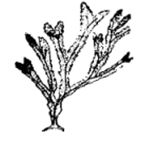
What type of life cycle is exhibited by the alga shown in the figure?
A
Haplontic
B
Haplo-diplontic
C
Diplontic
D
Triplontic
Solution
(C) The alga shown in the figure is Fucus,which is a brown alga (Phaeophyceae).
Most algae exhibit a haplontic life cycle,but Fucus is an exception.
Fucus exhibits a diplontic life cycle,where the diploid sporophyte is the dominant,photosynthetic phase of the plant body.
The gametes are produced through meiosis,representing the only haploid stage in the life cycle.
Most algae exhibit a haplontic life cycle,but Fucus is an exception.
Fucus exhibits a diplontic life cycle,where the diploid sporophyte is the dominant,photosynthetic phase of the plant body.
The gametes are produced through meiosis,representing the only haploid stage in the life cycle.
0 likes
View Solution103
MediumMCQ
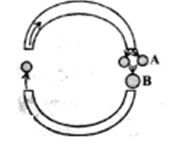
In the given figure,what do $''A''$ and $''B''$ represent respectively?
A
Spore and Gamete
B
Gamete and Spore
C
Zygote and Meiosis
D
Meiosis and Zygote
Solution
(B) The provided figure illustrates the life cycle of a plant,specifically showing the process of sexual reproduction.
In this cycle,$A$ represents gametes (haploid cells) that fuse together during fertilization.
The fusion of two gametes results in the formation of $B$,which is a zygote (diploid cell).
Therefore,$A$ represents gametes and $B$ represents a zygote.
In this cycle,$A$ represents gametes (haploid cells) that fuse together during fertilization.
The fusion of two gametes results in the formation of $B$,which is a zygote (diploid cell).
Therefore,$A$ represents gametes and $B$ represents a zygote.
0 likes
View Solution104
DifficultMCQ
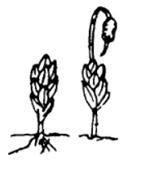
Which of the following statements is correct for the given figure?
A
Haplodiplontic life cycle
B
Gametophytic stage is photosynthetic
C
Sporophytic stage is parasitic
D
All of the above $(A), (B)$ and $(C)$
Solution
(D) The given figure represents the moss $Funaria$.
Bryophytes like $Funaria$ exhibit a haplodiplontic life cycle,where both haploid and diploid phases are multicellular.
The dominant,independent,and photosynthetic phase is the gametophyte.
The sporophyte is dependent (parasitic) on the gametophyte for nutrition and anchorage.
Therefore,all the given statements are correct.
Bryophytes like $Funaria$ exhibit a haplodiplontic life cycle,where both haploid and diploid phases are multicellular.
The dominant,independent,and photosynthetic phase is the gametophyte.
The sporophyte is dependent (parasitic) on the gametophyte for nutrition and anchorage.
Therefore,all the given statements are correct.
0 likes
View Solution105
MediumMCQ
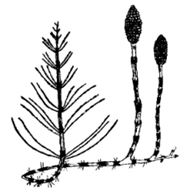
What is true for the given figure?
A
Possesses well-developed vascular tissues
B
Homosporous
C
Haplodiplontic life cycle
D
All of the above $(A), (B)$ and $(C)$
Solution
(D) The figure shows $Equisetum$,which is a member of the Pteridophytes.
$1$. Pteridophytes are the first terrestrial plants to possess well-developed vascular tissues (xylem and phloem).
$2$. Most Pteridophytes,including $Equisetum$,are homosporous (produce only one type of spore).
$3$. Pteridophytes exhibit a haplodiplontic life cycle,where both the haploid gametophyte and diploid sporophyte phases are multicellular and free-living.
Therefore,all the given statements are correct.
$1$. Pteridophytes are the first terrestrial plants to possess well-developed vascular tissues (xylem and phloem).
$2$. Most Pteridophytes,including $Equisetum$,are homosporous (produce only one type of spore).
$3$. Pteridophytes exhibit a haplodiplontic life cycle,where both the haploid gametophyte and diploid sporophyte phases are multicellular and free-living.
Therefore,all the given statements are correct.
0 likes
View Solution106
MediumMCQ
Which of the following is true for the given plant?
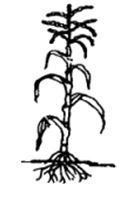
A
Flowers are trimerous.
B
The class of this plant does not contain any order.
C
The embryo contains one cotyledon.
D
All of the above $(A), (B)$ and $(C)$.
Solution
(C) The plant shown in the image is Maize ($Zea$ $mays$),which is a monocotyledonous plant.
$1$. Monocots typically have trimerous flowers (floral parts in multiples of $3$).
$2$. In biological classification,every class must contain at least one order. Therefore,statement $(B)$ is incorrect.
$3$. Monocots possess an embryo with a single cotyledon.
Since statement $(B)$ is false,option $(D)$ is incorrect. Among the given choices,$(A)$ and $(C)$ are characteristic features of monocots. However,in many standard contexts for this specific question,the intended answer focuses on the monocot nature. Given the options,$(C)$ is the most definitive and accurate characteristic of a monocot embryo.
$1$. Monocots typically have trimerous flowers (floral parts in multiples of $3$).
$2$. In biological classification,every class must contain at least one order. Therefore,statement $(B)$ is incorrect.
$3$. Monocots possess an embryo with a single cotyledon.
Since statement $(B)$ is false,option $(D)$ is incorrect. Among the given choices,$(A)$ and $(C)$ are characteristic features of monocots. However,in many standard contexts for this specific question,the intended answer focuses on the monocot nature. Given the options,$(C)$ is the most definitive and accurate characteristic of a monocot embryo.
0 likes
View Solution107
MediumMCQ
Which of the following is not a group of flowering plants (Angiosperms)?
A
Angiosperms
B
Gymnosperms
C
Pteridophytes
D
Dicotyledons
Solution
(C) Flowering plants are known as Angiosperms.
$A$. Angiosperms are flowering plants.
$B$. Gymnosperms are non-flowering plants with naked seeds.
$C$. Pteridophytes are vascular cryptogams that do not produce flowers or seeds; they reproduce via spores.
$D$. Dicotyledons are a class within Angiosperms.
Therefore,Pteridophytes are not a group of flowering plants.
$A$. Angiosperms are flowering plants.
$B$. Gymnosperms are non-flowering plants with naked seeds.
$C$. Pteridophytes are vascular cryptogams that do not produce flowers or seeds; they reproduce via spores.
$D$. Dicotyledons are a class within Angiosperms.
Therefore,Pteridophytes are not a group of flowering plants.
0 likes
View Solution108
MediumMCQ
Into which groups are seed-bearing plants (Spermatophytes) classified?
A
Thallophyta and Embryophyta
B
Dicotyledons and Monocotyledons
C
Bryophyta and Pteridophyta
D
Gymnosperms and Angiosperms
Solution
(D) Seed-bearing plants,known as $Spermatophytes$,are classified based on whether their seeds are naked or enclosed within fruits.
$1$. $Gymnosperms$: These are plants in which the ovules are not enclosed by any ovary wall and remain exposed,both before and after fertilization.
$2$. $Angiosperms$: These are flowering plants in which the seeds are developed inside an organ which is modified to become a fruit.
$1$. $Gymnosperms$: These are plants in which the ovules are not enclosed by any ovary wall and remain exposed,both before and after fertilization.
$2$. $Angiosperms$: These are flowering plants in which the seeds are developed inside an organ which is modified to become a fruit.
0 likes
View Solution109
EasyMCQ
How many major groups have modern researchers classified the plant kingdom into?
A
One
B
Two
C
Three
D
Five
Solution
(D) Modern researchers and taxonomists classify the plant kingdom into $5$ major groups: $1$. Algae,$2$. Bryophytes,$3$. Pteridophytes,$4$. Gymnosperms,and $5$. Angiosperms. This classification is based on evolutionary relationships and morphological characteristics.
0 likes
View Solution110
MediumMCQ
Which of the following plants are embryophytes?
A
Bryophytes
B
Pteridophytes
C
Spermatophytes (Seed-bearing plants)
D
All of the above
Solution
(D) Embryophytes are a group of plants that produce embryos during their life cycle.
This group includes Bryophytes,Pteridophytes,Gymnosperms,and Angiosperms.
Since Bryophytes,Pteridophytes,and Spermatophytes (Gymnosperms and Angiosperms) all form embryos,the correct answer is 'All of the above'.
This group includes Bryophytes,Pteridophytes,Gymnosperms,and Angiosperms.
Since Bryophytes,Pteridophytes,and Spermatophytes (Gymnosperms and Angiosperms) all form embryos,the correct answer is 'All of the above'.
0 likes
View Solution111
EasyMCQ
Algae,fungi,and lichens are included in ...........
A
Protista
B
Phycobiont
C
Bryophyta
D
Thallophyta
Solution
(D) In the $2$-kingdom classification system proposed by Carolus Linnaeus,the plant kingdom included organisms that possess a cell wall and are autotrophic or saprophytic.
Algae,fungi,and lichens were grouped together under the division $Thallophyta$ because their plant body is a thallus,meaning it is not differentiated into true roots,stems,and leaves.
Algae,fungi,and lichens were grouped together under the division $Thallophyta$ because their plant body is a thallus,meaning it is not differentiated into true roots,stems,and leaves.
0 likes
View Solution112
EasyMCQ
Into how many groups are the non-flowering plants (Cryptogams) classified?
A
One
B
Three
C
Five
D
Four
Solution
(B) The non-flowering plants,also known as $Cryptogams$,are classified into $3$ main groups based on their body structure and reproductive characteristics. These groups are:
$1$. $Thallophyta$ (e.g.,Algae)
$2$. $Bryophyta$ (e.g.,Mosses and Liverworts)
$3$. $Pteridophyta$ (e.g.,Ferns).
Therefore,the correct answer is $3$.
$1$. $Thallophyta$ (e.g.,Algae)
$2$. $Bryophyta$ (e.g.,Mosses and Liverworts)
$3$. $Pteridophyta$ (e.g.,Ferns).
Therefore,the correct answer is $3$.
0 likes
View Solution113
MediumMCQ
Which of the following plants are referred to as cryptogams?
A
Seedless and flowerless
B
Seed-bearing and flowerless
C
Seedless and flower-bearing
D
Seed-bearing and flower-bearing
Solution
(A) The term $Cryptogamae$ (from Greek: $kryptos$ = hidden,$gamos$ = marriage) refers to plants that reproduce by spores and do not produce seeds or flowers.
These plants are commonly known as 'flowerless' and 'seedless' plants.
Examples include Thallophytes (Algae),Bryophytes,and Pteridophytes.
Therefore,the correct description is seedless and flowerless.
These plants are commonly known as 'flowerless' and 'seedless' plants.
Examples include Thallophytes (Algae),Bryophytes,and Pteridophytes.
Therefore,the correct description is seedless and flowerless.
0 likes
View Solution114
EasyMCQ
The kingdom characterized by the presence of a rigid cell wall and the formation of an embryo is ......... .
A
Protista
B
Plantae
C
Monera
D
Animalia
Solution
(B) The kingdom $Plantae$ is characterized by the presence of a rigid cell wall (made of cellulose) and the ability to undergo embryogenesis (formation of an embryo).
$1$. $Monera$ consists of prokaryotes without a true nucleus or complex cell walls like plants.
$2$. $Protista$ includes unicellular eukaryotes,most of which do not form embryos.
$3$. $Animalia$ lacks a cell wall.
Therefore,the correct answer is $Plantae$.
$1$. $Monera$ consists of prokaryotes without a true nucleus or complex cell walls like plants.
$2$. $Protista$ includes unicellular eukaryotes,most of which do not form embryos.
$3$. $Animalia$ lacks a cell wall.
Therefore,the correct answer is $Plantae$.
0 likes
View Solution115
MediumMCQ
Match the following columns correctly:
| Column $I$ | Column $II$ | Column $III$ |
|---|---|---|
| $1$. Phycocyanin | $p$. Brown algae | $x$. Batrachospermum |
| $2$. Phycoerythrin | $q$. Blue-green algae | $y$. Sargassum |
| $3$. Fucoxanthin | $r$. Red algae | $z$. Nostoc |
A
$1-q-y, 2-r-x, 3-p-z$
B
$1-q-z, 2-r-x, 3-p-y$
C
$1-r-z, 2-p-x, 3-q-y$
D
$1-r-y, 2-p-x, 3-q-z$
Solution
(B) The correct matching is as follows:
$1$. Phycocyanin is a pigment found in Blue-green algae $(q)$,and an example is Nostoc $(z)$. Thus,$1-q-z$.
$2$. Phycoerythrin is a pigment found in Red algae $(r)$,and an example is Batrachospermum $(x)$. Thus,$2-r-x$.
$3$. Fucoxanthin is a pigment found in Brown algae $(p)$,and an example is Sargassum $(y)$. Thus,$3-p-y$.
Therefore,the correct sequence is $1-q-z, 2-r-x, 3-p-y$.
$1$. Phycocyanin is a pigment found in Blue-green algae $(q)$,and an example is Nostoc $(z)$. Thus,$1-q-z$.
$2$. Phycoerythrin is a pigment found in Red algae $(r)$,and an example is Batrachospermum $(x)$. Thus,$2-r-x$.
$3$. Fucoxanthin is a pigment found in Brown algae $(p)$,and an example is Sargassum $(y)$. Thus,$3-p-y$.
Therefore,the correct sequence is $1-q-z, 2-r-x, 3-p-y$.
0 likes
View Solution116
MediumMCQ
In which of the following plants does fertilization occur only in the presence of water?
A
Both $B$ and $C$
B
Pteridophytes
C
Bryophytes
D
Angiosperms
Solution
(A) In both $Bryophytes$ and $Pteridophytes$,water is essential for the process of fertilization.
In $Bryophytes$,the male gametes (antherozoids) are flagellated and require a film of water to swim to the archegonium to fertilize the egg.
Similarly,in $Pteridophytes$,the male gametes need water to reach the female gametes.
Therefore,both groups depend on water for fertilization.
In $Bryophytes$,the male gametes (antherozoids) are flagellated and require a film of water to swim to the archegonium to fertilize the egg.
Similarly,in $Pteridophytes$,the male gametes need water to reach the female gametes.
Therefore,both groups depend on water for fertilization.
0 likes
View Solution117
MediumMCQ
Which group of plants requires water for fertilization?
A
Lichens
B
Algae
C
Bryophytes
D
Pteridophytes
Solution
(C) Both $Bryophytes$ and $Pteridophytes$ require water for fertilization because their male gametes (antherozoids) are flagellated and need a water medium to swim to the female gametes (archegonia). However, in the context of standard biology curriculum questions where a single choice is required, $Bryophytes$ are the primary group emphasized for their absolute dependence on water for the completion of their life cycle, often referred to as the 'amphibians of the plant kingdom'.
0 likes
View Solution118
MediumMCQ
Which pair of plant groups is typically found in shade-loving habitats?
A
Algae-Lichens
B
Gymnosperms-Angiosperms
C
Bryophytes-Pteridophytes
D
Monocots-Dicots
Solution
(C) Bryophytes and Pteridophytes are known as shade-loving plants.
Bryophytes are often called the amphibians of the plant kingdom and require moist,shaded areas for their life cycle,particularly for fertilization.
Pteridophytes also thrive in cool,damp,and shady places.
Therefore,the correct pair is Bryophytes-Pteridophytes.
Bryophytes are often called the amphibians of the plant kingdom and require moist,shaded areas for their life cycle,particularly for fertilization.
Pteridophytes also thrive in cool,damp,and shady places.
Therefore,the correct pair is Bryophytes-Pteridophytes.
0 likes
View Solution119
MediumMCQ
Match the following columns:
| Column-$I$ | Column-$II$ |
| $A$. Christmas tree | $i$. Bennettites |
| $B$. Fossil plant | $ii$. Cycas |
| $C$. Ornamental plant | $iii$. Araucaria |
| $D$. Tallest tree | $iv$. Sequoia |
| $v$. Thuja |
A
$A-iii, B-i, C-v, D-iv$
B
$A-i, B-ii, C-iii, D-iv$
C
$A-v, B-iv, C-ii, D-iii$
D
$A-ii, B-v, C-i, D-iii$
Solution
(A) The correct matches are as follows:
$A$. Christmas tree is $Araucaria$ $(iii)$.
$B$. Fossil plant refers to $Bennettites$ $(i)$.
$C$. Ornamental plant is $Thuja$ $(v)$.
$D$. Tallest tree is $Sequoia$ $(iv)$.
Therefore, the correct sequence is $A-iii, B-i, C-v, D-iv$.
$A$. Christmas tree is $Araucaria$ $(iii)$.
$B$. Fossil plant refers to $Bennettites$ $(i)$.
$C$. Ornamental plant is $Thuja$ $(v)$.
$D$. Tallest tree is $Sequoia$ $(iv)$.
Therefore, the correct sequence is $A-iii, B-i, C-v, D-iv$.
0 likes
View Solution120
EasyMCQ
How many orders does the series Inferae contain?
A
$4$
B
$3$
C
$6$
D
$5$
Solution
(B) In the Bentham and Hooker classification system,the series $Inferae$ is part of the subclass $Gamopetalae$. It consists of $3$ orders: $Rubiales$,$Asterales$,and $Campanulales$.
0 likes
View Solution121
EasyMCQ
How many categories does the sub-class '$A$-da' (or '$A$-dae') contain?
A
$8$
B
$7$
C
$6$
D
$4$
Solution
(C) In the classification of the plant kingdom,specifically within the context of certain botanical taxonomic systems,the sub-class '$A$-dae' (often referred to in specific curricula) is categorized into $6$ distinct groups or categories. Therefore,the correct answer is $6$.
0 likes
View Solution122
EasyMCQ
How many orders are contained in the series Calyciflorae?
A
$10$
B
$8$
C
$3$
D
$5$
Solution
(D) In the Bentham and Hooker system of classification,the series Calyciflorae is part of the class Dicotyledonae and the subclass Polypetalae.
This series is characterized by flowers that are perigynous or epigynous,with the stamens and petals inserted on the calyx tube.
The series Calyciflorae consists of $5$ orders: $1$. Rosales,$2$. Myrtales,$3$. Passiflorales,$4$. Ficoidales,and $5$. Umbellales.
This series is characterized by flowers that are perigynous or epigynous,with the stamens and petals inserted on the calyx tube.
The series Calyciflorae consists of $5$ orders: $1$. Rosales,$2$. Myrtales,$3$. Passiflorales,$4$. Ficoidales,and $5$. Umbellales.
0 likes
View Solution123
EasyMCQ
How many orders does the series Disciflorae contain?
A
Seven
B
Eight
C
Three
D
Four
Solution
(D) In the Bentham and Hooker system of classification,the series $Disciflorae$ is placed under the subclass $Polypetalae$. This series is characterized by the presence of a prominent disc-like structure (thalamus) between the stamens and the ovary. The series $Disciflorae$ consists of $4$ orders: $Geraniales$,$Olacales$,$Celastrales$,and $Sapindales$.
0 likes
View Solution124
EasyMCQ
In which of the following plants is the diplontic life cycle observed?
A
Gymnosperms
B
Angiosperms
C
Fucus
D
All of the above
Solution
(D) In a diplontic life cycle,the dominant phase is the diploid $(2n)$ sporophyte. The gametophytic phase is highly reduced and represented by only a few cells. This type of life cycle is characteristic of all seed-bearing plants,i.e.,Gymnosperms and Angiosperms. Additionally,some algae,such as Fucus,also exhibit a diplontic life cycle. Therefore,the correct option is $(D)$.
0 likes
View Solution125
MediumMCQ
Assertion $(A)$: In $Volvox$,the zygote undergoes meiosis to form four haploid cells before germination.
Reason $(R)$: $Volvox$ exhibits a haplontic life cycle.
Reason $(R)$: $Volvox$ exhibits a haplontic life cycle.
A
$A$ and $R$ are true,and $R$ is the correct explanation of $A$.
B
$A$ and $R$ are true,but $R$ is not the correct explanation of $A$.
C
$A$ is true,but $R$ is false.
D
$A$ is false,but $R$ is true.
Solution
(A) In $Volvox$,the life cycle is haplontic,meaning the dominant phase is the haploid gametophyte. The zygote is the only diploid stage. Upon formation,the zygote undergoes meiosis to produce haploid zoospores,which then develop into new colonies. Thus,both the assertion and the reason are correct,and the reason explains why the zygote must undergo meiosis (to restore the haploid state characteristic of a haplontic life cycle).
0 likes
View Solution126
EasyMCQ
Assertion $(A)$: $Fucus$ shows a diplontic life cycle.
Reason $(R)$: In $Spirogyra$,the diploid zygote is the dominant and active stage.
Reason $(R)$: In $Spirogyra$,the diploid zygote is the dominant and active stage.
A
Both $A$ and $R$ are true,and $R$ is the correct explanation of $A$.
B
Both $A$ and $R$ are true,but $R$ is not the correct explanation of $A$.
C
$A$ is true,but $R$ is false.
D
$A$ is false,but $R$ is true.
Solution
(C) Assertion $(A)$: $Fucus$ is a brown alga that exhibits a diplontic life cycle,where the diploid sporophyte is the dominant,photosynthetic phase. This statement is true.
Reason $(R)$: In $Spirogyra$,the life cycle is haplontic. The only diploid stage is the zygote,which undergoes meiosis to form haploid spores. The zygote is not the dominant or active stage; rather,the haploid vegetative filament is the dominant stage. Therefore,the reason is false.
Conclusion: Since $A$ is true and $R$ is false,the correct option is $C$.
Reason $(R)$: In $Spirogyra$,the life cycle is haplontic. The only diploid stage is the zygote,which undergoes meiosis to form haploid spores. The zygote is not the dominant or active stage; rather,the haploid vegetative filament is the dominant stage. Therefore,the reason is false.
Conclusion: Since $A$ is true and $R$ is false,the correct option is $C$.
0 likes
View Solution127
EasyMCQ
Which plant group exhibits a haplo-diplontic life cycle pattern?
A
Algae
B
Bryophytes
C
Pteridophytes
D
Both Bryophytes and Pteridophytes
Solution
(D) In the plant kingdom,different groups show different life cycle patterns.
$1$. Haplontic life cycle is shown by many algae like Volvox and Spirogyra.
$2$. Diplontic life cycle is shown by all seed-bearing plants (Gymnosperms and Angiosperms) and some algae like Fucus.
$3$. Haplo-diplontic life cycle is an intermediate condition where both haploid and diploid phases are multicellular.
$4$. This pattern is characteristic of Bryophytes and Pteridophytes. In Bryophytes,the dominant phase is the gametophyte,while in Pteridophytes,the dominant phase is the sporophyte,but both exhibit this intermediate pattern.
$1$. Haplontic life cycle is shown by many algae like Volvox and Spirogyra.
$2$. Diplontic life cycle is shown by all seed-bearing plants (Gymnosperms and Angiosperms) and some algae like Fucus.
$3$. Haplo-diplontic life cycle is an intermediate condition where both haploid and diploid phases are multicellular.
$4$. This pattern is characteristic of Bryophytes and Pteridophytes. In Bryophytes,the dominant phase is the gametophyte,while in Pteridophytes,the dominant phase is the sporophyte,but both exhibit this intermediate pattern.
0 likes
View Solution128
MediumMCQ
Which plant exhibits a haplodiplontic life cycle?
A
Algae (some)
B
Pteridophytes
C
Bryophytes
D
Both $B$ and $C$
Solution
(D) In the plant kingdom,a haplodiplontic life cycle is characterized by an alternation of generations between a multicellular haploid gametophyte and a multicellular diploid sporophyte.
This type of life cycle is observed in both Bryophytes and Pteridophytes.
In Bryophytes,the dominant phase is the gametophyte,while in Pteridophytes,the dominant phase is the sporophyte.
Therefore,both Bryophytes and Pteridophytes exhibit a haplodiplontic life cycle.
This type of life cycle is observed in both Bryophytes and Pteridophytes.
In Bryophytes,the dominant phase is the gametophyte,while in Pteridophytes,the dominant phase is the sporophyte.
Therefore,both Bryophytes and Pteridophytes exhibit a haplodiplontic life cycle.
0 likes
View Solution129
EasyMCQ
What is common between $Rhynia$ and $Bennettites$?
A
Both are angiosperms.
B
Both possess naked ovules and seeds.
C
Both are heterosporous and show double fertilization.
D
Both are fossil plants.
Solution
(D) $Rhynia$ is a primitive vascular plant (pteridophyte) known from the Devonian period. $Bennettites$ is an extinct group of gymnosperms (cycadophytes) from the Mesozoic era. Both of these plant groups are no longer living and are known only through their fossil records. Therefore,the common feature between them is that they are both fossil plants.
0 likes
View Solution130
MediumMCQ
Match Column-$I$ with Column-$II$ and select the correct option.
| Column-$I$ | Column-$II$ |
| $(A)$ Sequoia sempervirens | $(p)$ Smallest gymnosperm |
| $(B)$ Wolffia globosa | $(q)$ Tallest plant of Australia |
| $(C)$ Zamia pygmaea | $(r)$ Tallest inflorescence |
| $(D)$ Eucalyptus (Nilgiri) | $(s)$ Tallest tree in the world |
| $(E)$ Rafflesia arnoldii | $(t)$ Smallest angiosperm |
| $(F)$ Agave (Ramban) | $(u)$ Largest flower |
A
$(A-s), (B-t), (C-p), (D-q), (E-u), (F-r)$
B
$(A-q), (B-p), (C-t), (D-s), (E-u), (F-r)$
C
$(A-s), (B-p), (C-t), (D-u), (E-r), (F-q)$
D
$(A-s), (B-t), (C-p), (D-u), (E-r), (F-q)$
Solution
$(A)$ The correct matches are as follows:
$(A)$ Sequoia sempervirens is the tallest tree in the world $(s)$.
$(B)$ Wolffia globosa is the smallest angiosperm $(t)$.
$(C)$ Zamia pygmaea is the smallest gymnosperm $(p)$.
$(D)$ Eucalyptus (Nilgiri) is one of the tallest plants found in Australia $(q)$.
$(E)$ Rafflesia arnoldii has the largest flower $(u)$.
$(F)$ Agave (Ramban) is known for having the tallest inflorescence $(r)$.
Therefore, the correct sequence is $(A-s), (B-t), (C-p), (D-q), (E-u), (F-r)$.
$(A)$ Sequoia sempervirens is the tallest tree in the world $(s)$.
$(B)$ Wolffia globosa is the smallest angiosperm $(t)$.
$(C)$ Zamia pygmaea is the smallest gymnosperm $(p)$.
$(D)$ Eucalyptus (Nilgiri) is one of the tallest plants found in Australia $(q)$.
$(E)$ Rafflesia arnoldii has the largest flower $(u)$.
$(F)$ Agave (Ramban) is known for having the tallest inflorescence $(r)$.
Therefore, the correct sequence is $(A-s), (B-t), (C-p), (D-q), (E-u), (F-r)$.
0 likes
View Solution131
MediumMCQ
Which option correctly matches the features given in $X$ with the plants given in $Y$?
| $X$ (Feature) | $Y$ (Plant) |
| $1.$ Christmas tree | $p.$ Rhynia |
| $2.$ Fossil pteridophyte | $q.$ Araucaria |
| $3.$ Haplodiplontic life cycle | $r.$ Ectocarpus |
| $4.$ Diplontic life cycle | $s.$ Fucus |
A
$1-r, 2-s, 3-q, 4-p$
B
$1-r, 2-s, 3-p, 4-q$
C
$1-q, 2-p, 3-r, 4-s$
D
$1-q, 2-p, 3-s, 4-r$
Solution
(C) The correct matches are as follows:
$1.$ Christmas tree is the common name for $Araucaria$ $(q)$.
$2.$ $Rhynia$ is a well-known fossil pteridophyte $(p)$.
$3.$ $Ectocarpus$ exhibits a haplodiplontic life cycle $(r)$.
$4.$ $Fucus$ exhibits a diplontic life cycle $(s)$.
Therefore, the correct matching is $1-q, 2-p, 3-r, 4-s$.
$1.$ Christmas tree is the common name for $Araucaria$ $(q)$.
$2.$ $Rhynia$ is a well-known fossil pteridophyte $(p)$.
$3.$ $Ectocarpus$ exhibits a haplodiplontic life cycle $(r)$.
$4.$ $Fucus$ exhibits a diplontic life cycle $(s)$.
Therefore, the correct matching is $1-q, 2-p, 3-r, 4-s$.
0 likes
View Solution132
EasyMCQ
Which of the following is not included in the group of cryptogams (non-flowering plants)?
A
Thallophyta
B
Bryophyta
C
Pteridophyta
D
Gymnosperms
Solution
(D) The plant kingdom is broadly classified into two groups: Cryptogams and Phanerogams.
$1$. Cryptogams are plants without seeds and flowers. This group includes Thallophyta,Bryophyta,and Pteridophyta.
$2$. Phanerogams are seed-bearing plants that produce flowers or cones. This group includes Gymnosperms and Angiosperms.
Therefore,Gymnosperms are not included in the group of cryptogams as they are phanerogams (seed-bearing plants).
$1$. Cryptogams are plants without seeds and flowers. This group includes Thallophyta,Bryophyta,and Pteridophyta.
$2$. Phanerogams are seed-bearing plants that produce flowers or cones. This group includes Gymnosperms and Angiosperms.
Therefore,Gymnosperms are not included in the group of cryptogams as they are phanerogams (seed-bearing plants).
0 likes
View Solution133
EasyMCQ
What do gymnosperms and angiosperms produce respectively for sexual reproduction?
A
Flowers and cones
B
Thallus and cones
C
Cones and flowers
D
Sporophylls and cones
Solution
(C) Gymnosperms are plants where the ovules are not enclosed by any ovary wall and remain exposed. They produce reproductive structures called cones (strobili) for sexual reproduction.
Angiosperms are flowering plants in which the seeds are enclosed within fruits. They produce flowers as their specialized reproductive structures for sexual reproduction.
Therefore,gymnosperms produce cones and angiosperms produce flowers.
Angiosperms are flowering plants in which the seeds are enclosed within fruits. They produce flowers as their specialized reproductive structures for sexual reproduction.
Therefore,gymnosperms produce cones and angiosperms produce flowers.
0 likes
View Solution134
MediumMCQ
Match the following columns:
| Column-$I$ | Column-$II$ |
| $(a)$ Gymnosperms | $(p)$ Trimerous flowers |
| $(b)$ Monocots | $(q)$ Absence of flowers |
| $(c)$ Dicots | $(r)$ Primitive type of flowers |
| $(d)$ Pteridophytes | $(s)$ Tetramerous or pentamerous flowers |
A
$(a-r), (b-s), (c-p), (d-q)$
B
$(a-q), (b-p), (c-s), (d-r)$
C
$(a-r), (b-p), (c-s), (d-q)$
D
$(a-p), (b-q), (c-s), (d-r)$
Solution
(B) The correct matching is as follows:
$(a)$ Gymnosperms: These plants lack flowers and seeds are naked,so they match with $(q)$ Absence of flowers.
$(b)$ Monocots: These typically exhibit trimerous flowers (floral parts in multiples of $3$),so they match with $(p)$ Trimerous flowers.
$(c)$ Dicots: These typically exhibit tetramerous or pentamerous flowers (floral parts in multiples of $4$ or $5$),so they match with $(s)$ Tetramerous or pentamerous flowers.
$(d)$ Pteridophytes: These are primitive vascular plants that do not produce flowers,but in the context of this specific matching set,they are associated with $(r)$ Primitive type of flowers (as they are lower plants compared to angiosperms).
Thus,the correct sequence is $(a-q), (b-p), (c-s), (d-r)$.
$(a)$ Gymnosperms: These plants lack flowers and seeds are naked,so they match with $(q)$ Absence of flowers.
$(b)$ Monocots: These typically exhibit trimerous flowers (floral parts in multiples of $3$),so they match with $(p)$ Trimerous flowers.
$(c)$ Dicots: These typically exhibit tetramerous or pentamerous flowers (floral parts in multiples of $4$ or $5$),so they match with $(s)$ Tetramerous or pentamerous flowers.
$(d)$ Pteridophytes: These are primitive vascular plants that do not produce flowers,but in the context of this specific matching set,they are associated with $(r)$ Primitive type of flowers (as they are lower plants compared to angiosperms).
Thus,the correct sequence is $(a-q), (b-p), (c-s), (d-r)$.
0 likes
View Solution135
MediumMCQ
Select the mismatched pair from the following.
A
Algae - Chlamydomonas
B
Lichen - Parmelia
C
Pteridophytes - Araucaria
D
Bryophytes - Marchantia
Solution
(C) The correct answer is $C$.
$1$. Algae includes organisms like $Chlamydomonas$.
$2$. Lichens are symbiotic associations between algae and fungi,and $Parmelia$ is a type of lichen.
$3$. $Araucaria$ is a Gymnosperm,not a Pteridophyte. Pteridophytes include plants like $Selaginella$ and $Equisetum$.
$4$. $Marchantia$ is a well-known example of a Bryophyte (Liverwort).
$1$. Algae includes organisms like $Chlamydomonas$.
$2$. Lichens are symbiotic associations between algae and fungi,and $Parmelia$ is a type of lichen.
$3$. $Araucaria$ is a Gymnosperm,not a Pteridophyte. Pteridophytes include plants like $Selaginella$ and $Equisetum$.
$4$. $Marchantia$ is a well-known example of a Bryophyte (Liverwort).
0 likes
View Solution136
EasyMCQ
Bryophytes and Pteridophytes resemble each other in all of the following features $EXCEPT$ one.
A
Both possess well-developed vascular tissues.
B
Both exhibit two distinct phases in their life cycle.
C
Both show alternation of generations.
D
Both produce embryos after fertilization.
Solution
(A) Bryophytes (mosses and liverworts) and Pteridophytes (ferns and horsetails) share several characteristics,such as the alternation of generations,the presence of a multicellular embryo stage after fertilization,and a life cycle consisting of two distinct phases (gametophyte and sporophyte).
However,they differ significantly in their internal anatomy. Pteridophytes are the first terrestrial plants to possess well-developed vascular tissues ($xylem$ and $phloem$) for the conduction of water and nutrients. In contrast,Bryophytes lack true vascular tissues and rely on diffusion for transport. Therefore,the statement that both possess well-developed vascular tissues is incorrect.
However,they differ significantly in their internal anatomy. Pteridophytes are the first terrestrial plants to possess well-developed vascular tissues ($xylem$ and $phloem$) for the conduction of water and nutrients. In contrast,Bryophytes lack true vascular tissues and rely on diffusion for transport. Therefore,the statement that both possess well-developed vascular tissues is incorrect.
0 likes
View Solution137
EasyMCQ
Which of the following represents a correct group of Embryophyta (embryo-producing plants)?
A
Thallophyta-Bryophyta
B
Thallophyta-Pteridophyta
C
Thallophyta-Fungi
D
Bryophyta-Pteridophyta
Solution
(D) Embryophyta is a group of plants that produce embryos during their life cycle.
$1$. Thallophyta (algae) do not produce embryos; they are non-embryophytes.
$2$. Bryophytes,Pteridophytes,Gymnosperms,and Angiosperms are collectively known as Embryophyta because they form a multicellular embryo from the zygote.
$3$. Fungi are not plants and do not belong to the plant kingdom.
Therefore,the group consisting of Bryophyta and Pteridophyta represents Embryophyta.
$1$. Thallophyta (algae) do not produce embryos; they are non-embryophytes.
$2$. Bryophytes,Pteridophytes,Gymnosperms,and Angiosperms are collectively known as Embryophyta because they form a multicellular embryo from the zygote.
$3$. Fungi are not plants and do not belong to the plant kingdom.
Therefore,the group consisting of Bryophyta and Pteridophyta represents Embryophyta.
0 likes
View Solution138
MediumMCQ
How do algae differ from bryophytes?
A
Presence of naked sex organs
B
Sex organs covered by sterile jackets
C
Presence of chlorophyll $A$ and $B$
D
Aerobic respiration
Solution
(A) Algae are simple,thalloid,autotrophic,and largely aquatic organisms. Their sex organs are typically unicellular and naked,meaning they lack a sterile protective layer (jacket) around them. In contrast,bryophytes are more complex; their sex organs are multicellular and are always surrounded by a sterile jacket of cells to protect the developing gametes from desiccation. Therefore,the presence of naked sex organs is a characteristic feature of algae that distinguishes them from bryophytes.
0 likes
View Solution139
EasyMCQ
What is the direct formation of a gametophyte from a sporophyte called?
A
Apospory
B
Apogamy
C
Apomixis
D
Parthenogenesis
Solution
(A) The development of a gametophyte directly from the sporophyte tissue without the formation of spores is known as $Apospory$.
In contrast,the development of a sporophyte directly from the gametophyte without fertilization is known as $Apogamy$.
Therefore,the correct term for the formation of a gametophyte from a sporophyte is $Apospory$.
In contrast,the development of a sporophyte directly from the gametophyte without fertilization is known as $Apogamy$.
Therefore,the correct term for the formation of a gametophyte from a sporophyte is $Apospory$.
0 likes
View Solution140
EasyMCQ
Into how many groups are the non-flowering plants (Cryptogams) divided?
A
One
B
Two
C
Three
D
Five
Solution
(C) The non-flowering plants, also known as $Cryptogams$, are divided into three main groups based on their body structure and reproductive characteristics.
These three groups are:
$1$. $Thallophyta$ (e.g., Algae)
$2$. $Bryophyta$ (e.g., Mosses and Liverworts)
$3$. $Pteridophyta$ (e.g., Ferns)
Therefore, the correct answer is $Three$.
These three groups are:
$1$. $Thallophyta$ (e.g., Algae)
$2$. $Bryophyta$ (e.g., Mosses and Liverworts)
$3$. $Pteridophyta$ (e.g., Ferns)
Therefore, the correct answer is $Three$.
0 likes
View Solution141
MediumMCQ
Into which group are the non-flowering plants (Cryptogams) divided?
A
Thallophyta
B
Bryophyta
C
Pteridophyta
D
All of the above
Solution
(D) Non-flowering plants,also known as $Cryptogams$,are plants that do not produce flowers,fruits,or seeds.
According to the classification of the plant kingdom,$Cryptogams$ are divided into three main groups:
$1$. $Thallophyta$: Simple,thallus-like body structure (e.g.,Algae).
$2$. $Bryophyta$: Amphibians of the plant kingdom,lacking true vascular tissues.
$3$. $Pteridophyta$: First vascular plants that reproduce via spores.
Therefore,all the given options are correct categories of $Cryptogams$.
According to the classification of the plant kingdom,$Cryptogams$ are divided into three main groups:
$1$. $Thallophyta$: Simple,thallus-like body structure (e.g.,Algae).
$2$. $Bryophyta$: Amphibians of the plant kingdom,lacking true vascular tissues.
$3$. $Pteridophyta$: First vascular plants that reproduce via spores.
Therefore,all the given options are correct categories of $Cryptogams$.
0 likes
View Solution142
MediumMCQ
Which of the following is not a group of cryptogams (non-flowering plants)?
A
Thallophyta
B
Angiosperms
C
Bryophyta
D
Pteridophyta
Solution
(B) Cryptogams are plants that do not produce seeds or flowers. They reproduce through spores. The group includes Thallophyta,Bryophyta,and Pteridophyta. Angiosperms are phanerogams (seed-bearing plants) that produce flowers and seeds enclosed within fruits. Therefore,Angiosperms are not cryptogams.
0 likes
View Solution143
MediumMCQ
Which of the following is not a group of flowering plants (Angiosperms)?
A
Angiosperms
B
Gymnosperms
C
Pteridophytes
D
None of these
Solution
(C) Flowering plants are scientifically known as $Angiosperms$.
$Gymnosperms$ are plants with naked seeds and are not considered flowering plants.
$Pteridophytes$ are vascular cryptogams that reproduce via spores and do not produce flowers or seeds.
Therefore,both $Gymnosperms$ and $Pteridophytes$ are not groups of flowering plants.
However,in the context of typical multiple-choice questions where one must identify the group that is definitely not flowering,$Pteridophytes$ (Option $C$) is the most distinct non-flowering group compared to $Gymnosperms$ (which are often studied alongside Angiosperms as seed plants).
Given the options,$Pteridophytes$ is the correct answer as they are non-seed-bearing plants.
$Gymnosperms$ are plants with naked seeds and are not considered flowering plants.
$Pteridophytes$ are vascular cryptogams that reproduce via spores and do not produce flowers or seeds.
Therefore,both $Gymnosperms$ and $Pteridophytes$ are not groups of flowering plants.
However,in the context of typical multiple-choice questions where one must identify the group that is definitely not flowering,$Pteridophytes$ (Option $C$) is the most distinct non-flowering group compared to $Gymnosperms$ (which are often studied alongside Angiosperms as seed plants).
Given the options,$Pteridophytes$ is the correct answer as they are non-seed-bearing plants.
0 likes
View Solution144
MediumMCQ
Which of the following is a characteristic of Cryptogams?
A
Seed-bearing
B
Seedless
C
Autotrophic
D
Heterotrophic
Solution
(B) Cryptogams are plants that reproduce by spores and do not produce seeds or flowers. The term 'Cryptogamae' means 'hidden reproduction' (Greek: $kryptos$ = hidden,$gamos$ = marriage). Examples include algae,bryophytes,and pteridophytes. Therefore,the characteristic feature among the given options is that they are seedless.
0 likes
View Solution145
EasyMCQ
Which of the following characteristics is common to both gymnosperms and angiosperms?
A
Both possess a sporophytic plant body.
B
Both are pollinated by wind.
C
Both exhibit double fertilization.
D
Both possess enclosed ovules.
Solution
(A) Gymnosperms and angiosperms are both seed-bearing plants (spermatophytes) and belong to the group of tracheophytes.
In both groups,the dominant phase of the life cycle is the sporophyte,which is differentiated into roots,stems,and leaves.
Double fertilization is a unique characteristic of angiosperms only.
Enclosed ovules (ovaries) are a characteristic feature of angiosperms,whereas gymnosperms have naked ovules.
Pollination by wind is common in many gymnosperms,but it is not a universal characteristic shared by all members of both groups.
In both groups,the dominant phase of the life cycle is the sporophyte,which is differentiated into roots,stems,and leaves.
Double fertilization is a unique characteristic of angiosperms only.
Enclosed ovules (ovaries) are a characteristic feature of angiosperms,whereas gymnosperms have naked ovules.
Pollination by wind is common in many gymnosperms,but it is not a universal characteristic shared by all members of both groups.
0 likes
View Solution146
EasyMCQ
Into how many groups are the Thallophytes divided?
A
Two
B
Three
C
Four
D
Five
Solution
(A) Thallophytes are simple,non-vascular plants that do not have a differentiated body structure. They are primarily divided into two main groups: $1.$ Algae and $2.$ Fungi. Therefore,the correct answer is $A$.
0 likes
View Solution147
MediumMCQ
Match Column $X$ with Column $Y$ and select the correct option:
| Column $X$ | Column $Y$ |
| $(1)$ Bryophytes | $(P)$ Equisetum |
| $(2)$ Gymnosperms | $(Q)$ Onion |
| $(3)$ Angiosperms | $(R)$ Anthoceros |
| $(4)$ Pteridophytes | $(S)$ Thuja |
A
$(1)-(P), (2)-(Q), (3)-(R), (4)-(S)$
B
$(1)-(S), (2)-(R), (3)-(Q), (4)-(P)$
C
$(1)-(R), (2)-(S), (3)-(Q), (4)-(P)$
D
$(1)-(Q), (2)-(S), (3)-(R), (4)-(P)$
Solution
(C) The correct matching is as follows:
$(1)$ Bryophytes: $Anthoceros$ is a member of Bryophyta (Hornworts).
$(2)$ Gymnosperms: $Thuja$ is a well-known gymnosperm.
$(3)$ Angiosperms: Onion ($Allium$ $cepa$) is a monocotyledonous angiosperm.
$(4)$ Pteridophytes: $Equisetum$ is a representative genus of Pteridophyta (Horsetails).
Therefore, the correct sequence is $(1)-(R), (2)-(S), (3)-(Q), (4)-(P)$.
$(1)$ Bryophytes: $Anthoceros$ is a member of Bryophyta (Hornworts).
$(2)$ Gymnosperms: $Thuja$ is a well-known gymnosperm.
$(3)$ Angiosperms: Onion ($Allium$ $cepa$) is a monocotyledonous angiosperm.
$(4)$ Pteridophytes: $Equisetum$ is a representative genus of Pteridophyta (Horsetails).
Therefore, the correct sequence is $(1)-(R), (2)-(S), (3)-(Q), (4)-(P)$.
0 likes
View Solution148
MediumMCQ
Select the correct match between Column $X$ and Column $Y$:
| (Plant Name) | (Characteristic) |
| $(1)$ Oscillatoria | $(P)$ Thallus |
| $(2)$ Cycas | $(Q)$ Cell wall contains chitin mixed with cellulose |
| $(3)$ Fern | $(R)$ Primitive type of flowers |
| $(4)$ Yeast | $(S)$ Food stored as starch |
A
$(1) - (S), (2) - (P), (3) - (R), (4) - (Q)$
B
$(1) - (S), (2) - (R), (3) - (P), (4) - (Q)$
C
$(1) - (Q), (2) - (R), (3) - (P), (4) - (S)$
D
$(1) - (Q), (2) - (P), (3) - (R), (4) - (S)$
Solution
(A) The correct matching is as follows:
$(1)$ Oscillatoria is a Cyanobacteria (Blue-green algae) which stores food in the form of starch (cyanophycean starch). Thus, $(1) - (S)$.
$(2)$ Cycas is a Gymnosperm, which has a plant body differentiated into roots, stems, and leaves, often described as a thallus-like structure in early evolutionary contexts or simply as a complex plant body. However, in this specific context, it represents the plant body structure. Thus, $(2) - (P)$.
$(3)$ Fern (Pteridophyte) shows primitive characteristics, but in many classification contexts, it is associated with the development of vascular tissues. Given the options, $(3) - (R)$ is the best fit for primitive features/structures.
$(4)$ Yeast is a fungus, and its cell wall is composed of chitin. Thus, $(4) - (Q)$.
Therefore, the correct sequence is $(1) - (S), (2) - (P), (3) - (R), (4) - (Q)$.
$(1)$ Oscillatoria is a Cyanobacteria (Blue-green algae) which stores food in the form of starch (cyanophycean starch). Thus, $(1) - (S)$.
$(2)$ Cycas is a Gymnosperm, which has a plant body differentiated into roots, stems, and leaves, often described as a thallus-like structure in early evolutionary contexts or simply as a complex plant body. However, in this specific context, it represents the plant body structure. Thus, $(2) - (P)$.
$(3)$ Fern (Pteridophyte) shows primitive characteristics, but in many classification contexts, it is associated with the development of vascular tissues. Given the options, $(3) - (R)$ is the best fit for primitive features/structures.
$(4)$ Yeast is a fungus, and its cell wall is composed of chitin. Thus, $(4) - (Q)$.
Therefore, the correct sequence is $(1) - (S), (2) - (P), (3) - (R), (4) - (Q)$.
0 likes
View Solution149
MediumMCQ
Match the items in Column $X$ with Column $Y$ and select the correct option:
| Column $X$ (Plant Group) | Column $Y$ (Characteristics) |
| $(1)$ Algae | $(P)$ Mycelium |
| $(2)$ Fungi | $(Q)$ Pollination only by wind |
| $(3)$ Pteridophytes | $(R)$ Thallus filamentous,ribbon-like |
| $(4)$ Gymnosperms | $(S)$ Prothallus flattened |
A
$(1) - (S), (2) - (P), (3) - (Q), (4) - (R)$
B
$(1) - (R), (2) - (P), (3) - (Q), (4) - (S)$
C
$(1) - (R), (2) - (S), (3) - (P), (4) - (Q)$
D
$(1) - (R), (2) - (P), (3) - (S), (4) - (Q)$
Solution
(D) The correct matching is as follows:
$(1)$ Algae: Many algae have a thallus that is filamentous or ribbon-like (e.g.,Spirogyra,Ulva). Thus,$(1) - (R)$.
$(2)$ Fungi: The body of fungi consists of a network of hyphae called mycelium. Thus,$(2) - (P)$.
$(3)$ Pteridophytes: The gametophyte of pteridophytes is called a prothallus,which is small,multicellular,and usually photosynthetic and flattened. Thus,$(3) - (S)$.
$(4)$ Gymnosperms: In gymnosperms,pollination occurs exclusively through the agency of wind (anemophily). Thus,$(4) - (Q)$.
Therefore,the correct sequence is $(1) - (R), (2) - (P), (3) - (S), (4) - (Q)$.
$(1)$ Algae: Many algae have a thallus that is filamentous or ribbon-like (e.g.,Spirogyra,Ulva). Thus,$(1) - (R)$.
$(2)$ Fungi: The body of fungi consists of a network of hyphae called mycelium. Thus,$(2) - (P)$.
$(3)$ Pteridophytes: The gametophyte of pteridophytes is called a prothallus,which is small,multicellular,and usually photosynthetic and flattened. Thus,$(3) - (S)$.
$(4)$ Gymnosperms: In gymnosperms,pollination occurs exclusively through the agency of wind (anemophily). Thus,$(4) - (Q)$.
Therefore,the correct sequence is $(1) - (R), (2) - (P), (3) - (S), (4) - (Q)$.
0 likes
View Solution150
MediumMCQ
Match Column $X$ with Column $Y$ and select the correct option:
| Column $X$ | Column $Y$ |
| $(1)$ Christmas tree | $(P)$ Rhynia |
| $(2)$ Fossil Pteridophyte | $(Q)$ Araucaria |
| $(3)$ Diplontic life cycle | $(R)$ Ectocarpus |
| $(4)$ Haplodiplontic life cycle | $(S)$ Fucus |
A
$(1) - (R), (2) - (S), (3) - (Q), (4) - (P)$
B
$(1) - (R), (2) - (S), (3) - (P), (4) - (Q)$
C
$(1) - (Q), (2) - (S), (3) - (R), (4) - (P)$
D
$(1) - (Q), (2) - (P), (3) - (S), (4) - (R)$
Solution
(D) The correct matches are as follows:
$(1)$ Christmas tree is the common name for $Araucaria$ $(Q)$.
$(2)$ $Rhynia$ is a well-known fossil Pteridophyte $(P)$.
$(3)$ Diplontic life cycle is exhibited by $Fucus$ $(S)$.
$(4)$ Haplodiplontic life cycle is exhibited by $Ectocarpus$ $(R)$.
Therefore, the correct matching is $(1)-(Q), (2)-(P), (3)-(S), (4)-(R)$.
$(1)$ Christmas tree is the common name for $Araucaria$ $(Q)$.
$(2)$ $Rhynia$ is a well-known fossil Pteridophyte $(P)$.
$(3)$ Diplontic life cycle is exhibited by $Fucus$ $(S)$.
$(4)$ Haplodiplontic life cycle is exhibited by $Ectocarpus$ $(R)$.
Therefore, the correct matching is $(1)-(Q), (2)-(P), (3)-(S), (4)-(R)$.
0 likes
View SolutionPlant Kingdom — Mix Examples- Plant Kingdom · Frequently Asked Questions
1Are these Plant Kingdom questions useful for JEE and NEET?
Yes. All questions in this section are mapped to JEE Main and NEET exam patterns. Previous year questions from JEE Main, NEET, GUJCET and state-level exams are included with full solutions.
2Can I switch to Hindi or Gujarati for these questions?
Yes. Use the language tabs in the hero section or the sidebar to view the same questions and solutions in English, Hindi or Gujarati.
3How do I generate a question paper from this subtopic?
Use the Vedclass Exam Paper Generator — select the chapter and subtopic, set difficulty, and generate Sets A, B, C, D automatically. First 3 chapters of every subject are free.
Vedclass Products
For Students
Vedclass Test Series
Mock tests in real JEE/NEET style with performance analysis. 5-day free trial.
Start Free TrialFor Teachers
Exam Paper Generator
Generate Set A/B/C/D papers from this chapter in 2 minutes. 3 chapters free.
Try FreeFor Institutes
Online Exam Module
Live online exams with unlimited students, 360° analytics & white-label branding.
See DemoFor Teachers & Institutes
Generate a Plant Kingdom Exam Paper in 2 Minutes
Select subtopic & difficulty — Sets A, B, C, D auto-generated with No Repeat logic.
First 3 chapters of every subject are free — no payment required.