
A English
Mix Examples- Plant Kingdom Questions in English
Class 11 Biology · Plant Kingdom · Mix Examples- Plant Kingdom
272+
Questions
English
Language
100%
With Solutions
Showing 50 of 272 questions in English
151
MediumMCQ
Marchantia and Marsilea are examples of which plant groups,respectively?
A
Pteridophytes,Bryophytes
B
Bryophytes,Pteridophytes
C
Thallophytes,Bryophytes
D
Bryophytes,Thallophytes
Solution
(B) Marchantia is a genus of liverworts,which belongs to the group $Bryophytes$.
Marsilea is a genus of water ferns,which belongs to the group $Pteridophytes$.
Therefore,Marchantia and Marsilea are examples of $Bryophytes$ and $Pteridophytes$,respectively.
Marsilea is a genus of water ferns,which belongs to the group $Pteridophytes$.
Therefore,Marchantia and Marsilea are examples of $Bryophytes$ and $Pteridophytes$,respectively.
0 likes
View Solution152
MediumMCQ
Find the odd one out from the following:
A
Araucaria
B
Conifer
C
Pinus
D
Parmelia
Solution
(D) The correct answer is $Parmelia$.
$Araucaria$,$Conifer$,and $Pinus$ are all examples of Gymnosperms,which are seed-bearing vascular plants.
$Parmelia$ is a genus of foliose lichens,which is a symbiotic association between a fungus and an alga or cyanobacterium.
Therefore,$Parmelia$ does not belong to the group of Gymnosperms.
$Araucaria$,$Conifer$,and $Pinus$ are all examples of Gymnosperms,which are seed-bearing vascular plants.
$Parmelia$ is a genus of foliose lichens,which is a symbiotic association between a fungus and an alga or cyanobacterium.
Therefore,$Parmelia$ does not belong to the group of Gymnosperms.
0 likes
View Solution153
EasyMCQ
Find the mismatched pair.
A
Parmelia - Lichen
B
Marchantia - Bryophyte
C
Marsilea - Pteridophyte
D
Sargassum - Mold
Solution
(D) The correct answer is $D$.
$1$. $Parmelia$ is a type of lichen.
$2$. $Marchantia$ is a liverwort, which belongs to the group Bryophyta.
$3$. $Marsilea$ is a fern, which belongs to the group Pteridophyta.
$4$. $Sargassum$ is a brown alga (Phaeophyceae), not a mold. Molds are fungi, whereas $Sargassum$ is a photosynthetic protist/alga. Therefore, the pair $Sargassum - \text{Mold}$ is mismatched.
$1$. $Parmelia$ is a type of lichen.
$2$. $Marchantia$ is a liverwort, which belongs to the group Bryophyta.
$3$. $Marsilea$ is a fern, which belongs to the group Pteridophyta.
$4$. $Sargassum$ is a brown alga (Phaeophyceae), not a mold. Molds are fungi, whereas $Sargassum$ is a photosynthetic protist/alga. Therefore, the pair $Sargassum - \text{Mold}$ is mismatched.
0 likes
View Solution154
MediumMCQ
Find the mismatched pair regarding Bentham and Hooker's classification of Polypetalae.
A
Series Thalamiflorae - $6$ Cohorts
B
Series Disciflorae - $4$ Cohorts
C
Series Inferae - $3$ Cohorts
D
Series Bicarpellatae - $5$ Cohorts
Solution
(D) In Bentham and Hooker's classification system for Polypetalae:
$1$. Series Thalamiflorae consists of $6$ cohorts.
$2$. Series Disciflorae consists of $4$ cohorts.
$3$. Series Calyciflorae consists of $5$ cohorts.
$4$. Series Inferae consists of $3$ cohorts.
$5$. Series Bicarpellatae (under Gamopetalae) consists of $4$ cohorts.
Therefore,the pair 'Series Bicarpellatae - $5$ Cohorts' is incorrect because it actually contains $4$ cohorts.
$1$. Series Thalamiflorae consists of $6$ cohorts.
$2$. Series Disciflorae consists of $4$ cohorts.
$3$. Series Calyciflorae consists of $5$ cohorts.
$4$. Series Inferae consists of $3$ cohorts.
$5$. Series Bicarpellatae (under Gamopetalae) consists of $4$ cohorts.
Therefore,the pair 'Series Bicarpellatae - $5$ Cohorts' is incorrect because it actually contains $4$ cohorts.
0 likes
View Solution155
MediumMCQ
Identify the common feature observed in Bryophytes and Pteridophytes.
A
In both,the gametophyte is dependent on the sporophyte.
B
Multicellular reproductive organs are surrounded by a jacket of sterile cells.
C
The sporophyte is the dominant phase.
D
The gametophyte is thalloid in nature.
Solution
(B) Both Bryophytes and Pteridophytes possess multicellular reproductive organs (antheridia and archegonia) that are protected by a sterile jacket of cells. This is a significant evolutionary adaptation to protect the developing gametes from desiccation. Option $A$ is incorrect because in Bryophytes,the sporophyte is dependent on the gametophyte. Option $C$ is incorrect because the sporophyte is dominant only in Pteridophytes,not in Bryophytes. Option $D$ is incorrect because the gametophyte in Pteridophytes is usually a small,independent prothallus,not necessarily thalloid.
0 likes
View Solution156
EasyMCQ
Which scientists conducted in-depth research in the field of plant classification?
A
Linnaeus
B
Aristotle
C
Bentham and Hooker
D
Whittaker
Solution
(C) George Bentham and Joseph Dalton Hooker are renowned for their monumental work, 'Genera Plantarum', which provides a comprehensive and natural system of classification for seed plants. Their system is widely used in herbaria across the world due to its detailed and practical approach to plant taxonomy.
0 likes
View Solution157
MediumMCQ
Plants like mosses and ferns that reproduce through spores are grouped under which category?
A
Thallophyta
B
Cryptogamae
C
Bryophyta
D
Sporophytes
Solution
(B) Plants that reproduce through spores and do not produce seeds or flowers are collectively known as $Cryptogamae$.
$Cryptogamae$ includes $Thallophyta$,$Bryophyta$,and $Pteridophyta$.
Mosses belong to $Bryophyta$ and ferns belong to $Pteridophyta$.
Since both groups reproduce via spores and lack seeds,they are classified under the group $Cryptogamae$.
$Cryptogamae$ includes $Thallophyta$,$Bryophyta$,and $Pteridophyta$.
Mosses belong to $Bryophyta$ and ferns belong to $Pteridophyta$.
Since both groups reproduce via spores and lack seeds,they are classified under the group $Cryptogamae$.
0 likes
View Solution158
MediumMCQ
Which one is a wrong statement?
A
Haploid endosperm is a typical feature of Gymnosperms.
B
Brown algae have chlorophyll $a$ and $c$ and fucoxanthin.
C
Archegonia are found in Bryophyta,Pteridophyta and Gymnosperms.
D
Mucor has biflagellate zoospores.
Solution
(D) : $Mucor$ is a member of $Zygomycetes$ (the conjugation fungi) in which motile cells,e.g.,zoospores or planogametes,are absent.
Asexual reproduction takes place by the formation of non-motile mitospores called sporangiospores.
Sexual reproduction takes place by the formation of non-motile zygospores.
Therefore,the statement that $Mucor$ has biflagellate zoospores is incorrect.
Asexual reproduction takes place by the formation of non-motile mitospores called sporangiospores.
Sexual reproduction takes place by the formation of non-motile zygospores.
Therefore,the statement that $Mucor$ has biflagellate zoospores is incorrect.
0 likes
View Solution159
MediumMCQ
Select the mismatch.
A
Cycas-Dioecious
B
Salvinia-Heterosporous
C
Equisetum-Homosporous
D
Pinus-Dioecious
Solution
(D) $Pinus$ is a monoecious plant,$i.e.$,in $Pinus$ the male and female cones or strobili are borne on the same plant. Therefore,the option $Pinus-Dioecious$ is a mismatch.
0 likes
View Solution160
MediumMCQ
Life cycles of $Ectocarpus$ and $Fucus$ respectively are
A
diplontic,haplodiplontic
B
haplodiplontic,diplontic
C
haplodiplontic,haplontic
D
haplontic,diplontic
Solution
(B) $Ectocarpus$ exhibits a haplodiplontic life cycle,where both haploid and diploid phases are multicellular and often free-living.
$Fucus$ exhibits a diplontic life cycle,where the diploid sporophyte is the dominant,photosynthetic phase,and the gametophytic phase is represented by single to few-celled gametophytes.
$Fucus$ exhibits a diplontic life cycle,where the diploid sporophyte is the dominant,photosynthetic phase,and the gametophytic phase is represented by single to few-celled gametophytes.
0 likes
View Solution161
MediumMCQ
Select the correct statement.
A
Sequoia is one of the tallest trees.
B
The leaves of gymnosperms are not well adapted to extremes of climate.
C
Gymnosperms are both homosporous and heterosporous.
D
Salvinia, Ginkgo and Pinus all are gymnosperms.
Solution
(A) : $Sequoia \text{ } sempervirens$ is the tallest gymnosperm.
$B$: The leaves of gymnosperms are well adapted to extremes of climate (e.g., needle-like leaves, thick cuticle, and sunken stomata), which helps them survive in harsh conditions.
$C$: Gymnosperms are heterosporous, meaning they produce two different kinds of spores: microspores and megaspores.
$D$: $Salvinia$ is an aquatic pteridophyte, not a gymnosperm. $Ginkgo$ and $Pinus$ are gymnosperms.
$B$: The leaves of gymnosperms are well adapted to extremes of climate (e.g., needle-like leaves, thick cuticle, and sunken stomata), which helps them survive in harsh conditions.
$C$: Gymnosperms are heterosporous, meaning they produce two different kinds of spores: microspores and megaspores.
$D$: $Salvinia$ is an aquatic pteridophyte, not a gymnosperm. $Ginkgo$ and $Pinus$ are gymnosperms.
0 likes
View Solution162
EasyMCQ
In bryophytes and pteridophytes,transport of male gametes requires
A
birds
B
water
C
wind
D
insects
Solution
(B) The correct answer is $B$.
In bryophytes and pteridophytes,the male gametes (antherozoids) are flagellated and motile.
They require an external medium,specifically water,to swim and reach the female reproductive organ,the archegonium,for fertilization.
Therefore,water is essential for the transport of male gametes in these plant groups.
In bryophytes and pteridophytes,the male gametes (antherozoids) are flagellated and motile.
They require an external medium,specifically water,to swim and reach the female reproductive organ,the archegonium,for fertilization.
Therefore,water is essential for the transport of male gametes in these plant groups.
0 likes
View Solution163
MediumMCQ
Read the following five statements $(A$ to $E)$ and select the option with all correct statements.
$A.$ Mosses and lichens are the first organisms to colonise a bare rock.
$B.$ Selaginella is a homosporous pteridophyte.
$C.$ Coralloid roots in Cycas have $VAM$.
$D.$ Main plant body in bryophytes is gametophytic,whereas in pteridophytes it is sporophytic.
$E.$ In gymnosperms,male and female gametophytes are present within sporangia located on sporophyte.
$A.$ Mosses and lichens are the first organisms to colonise a bare rock.
$B.$ Selaginella is a homosporous pteridophyte.
$C.$ Coralloid roots in Cycas have $VAM$.
$D.$ Main plant body in bryophytes is gametophytic,whereas in pteridophytes it is sporophytic.
$E.$ In gymnosperms,male and female gametophytes are present within sporangia located on sporophyte.
A
$A, D$ and $E$
B
$B, C$ and $E$
C
$A, C$ and $D$
D
$B, C$ and $D$
Solution
(A) Statement $A$ is correct: Lichens and mosses are pioneer species in primary succession on bare rocks.
Statement $B$ is incorrect: $Selaginella$ is a heterosporous pteridophyte,not homosporous.
Statement $C$ is incorrect: Coralloid roots in $Cycas$ contain nitrogen-fixing cyanobacteria (like $Nostoc$ or $Anabaena$),not $VAM$ (Vesicular Arbuscular Mycorrhiza),which is a fungal association.
Statement $D$ is correct: In bryophytes,the dominant phase is the gametophyte,while in pteridophytes,the dominant phase is the sporophyte.
Statement $E$ is correct: In gymnosperms,the male and female gametophytes do not have an independent free-living existence; they remain within the sporangia retained on the sporophytes.
Therefore,statements $A, D,$ and $E$ are correct.
Statement $B$ is incorrect: $Selaginella$ is a heterosporous pteridophyte,not homosporous.
Statement $C$ is incorrect: Coralloid roots in $Cycas$ contain nitrogen-fixing cyanobacteria (like $Nostoc$ or $Anabaena$),not $VAM$ (Vesicular Arbuscular Mycorrhiza),which is a fungal association.
Statement $D$ is correct: In bryophytes,the dominant phase is the gametophyte,while in pteridophytes,the dominant phase is the sporophyte.
Statement $E$ is correct: In gymnosperms,the male and female gametophytes do not have an independent free-living existence; they remain within the sporangia retained on the sporophytes.
Therefore,statements $A, D,$ and $E$ are correct.
0 likes
View Solution164
MediumMCQ
Read the following statements $(A-E)$ and answer the question which follows them.
$(A)$ In liverworts,mosses and ferns,gametophytes are free-living.
$(B)$ Gymnosperms and some ferns are heterosporous.
$(C)$ Sexual reproduction in Fucus,Volvox and Albugo is oogamous.
$(D)$ The sporophyte in liverworts is more elaborate than that in mosses.
$(E)$ Both,Pinus and Marchantia are dioecious.
How many of the above statements are correct?
$(A)$ In liverworts,mosses and ferns,gametophytes are free-living.
$(B)$ Gymnosperms and some ferns are heterosporous.
$(C)$ Sexual reproduction in Fucus,Volvox and Albugo is oogamous.
$(D)$ The sporophyte in liverworts is more elaborate than that in mosses.
$(E)$ Both,Pinus and Marchantia are dioecious.
How many of the above statements are correct?
A
Three
B
Four
C
One
D
Two
Solution
(A) Let us analyze each statement:
$(A)$ In liverworts,mosses,and ferns,the gametophyte is the independent,free-living stage. This statement is correct.
$(B)$ All gymnosperms are heterosporous,and some ferns (like Salvinia and Selaginella) are also heterosporous. This statement is correct.
$(C)$ Sexual reproduction in $Fucus$ (alga),$Volvox$ (alga),and $Albugo$ (fungus) is oogamous. This statement is correct.
$(D)$ The sporophyte in mosses is more elaborate than that in liverworts. Liverwort sporophytes are simpler (e.g.,in $Riccia$),whereas moss sporophytes have a foot,seta,and capsule. This statement is incorrect.
$(E)$ $Pinus$ is monoecious (male and female cones on the same plant),while $Marchantia$ is dioecious. This statement is incorrect.
Thus,statements $(A)$,$(B)$,and $(C)$ are correct. The total number of correct statements is $3$.
$(A)$ In liverworts,mosses,and ferns,the gametophyte is the independent,free-living stage. This statement is correct.
$(B)$ All gymnosperms are heterosporous,and some ferns (like Salvinia and Selaginella) are also heterosporous. This statement is correct.
$(C)$ Sexual reproduction in $Fucus$ (alga),$Volvox$ (alga),and $Albugo$ (fungus) is oogamous. This statement is correct.
$(D)$ The sporophyte in mosses is more elaborate than that in liverworts. Liverwort sporophytes are simpler (e.g.,in $Riccia$),whereas moss sporophytes have a foot,seta,and capsule. This statement is incorrect.
$(E)$ $Pinus$ is monoecious (male and female cones on the same plant),while $Marchantia$ is dioecious. This statement is incorrect.
Thus,statements $(A)$,$(B)$,and $(C)$ are correct. The total number of correct statements is $3$.
0 likes
View Solution165
MediumMCQ
What is common in all the three,$Funaria$,$Dryopteris$,and $Ginkgo$?
A
Presence of archegonia
B
Well developed vascular tissues
C
Independent gametophyte
D
Independent sporophyte
Solution
(A) The correct answer is $A$.
$Funaria$ belongs to $Bryophyta$,$Dryopteris$ belongs to $Pteridophyta$,and $Ginkgo$ belongs to $Gymnosperms$.
All these three groups share the presence of the female sex organ known as the archegonium.
$Funaria$ lacks well-developed vascular tissues and an independent sporophyte.
$Ginkgo$ does not have an independent gametophyte,as it is dependent on the sporophyte.
$Funaria$ belongs to $Bryophyta$,$Dryopteris$ belongs to $Pteridophyta$,and $Ginkgo$ belongs to $Gymnosperms$.
All these three groups share the presence of the female sex organ known as the archegonium.
$Funaria$ lacks well-developed vascular tissues and an independent sporophyte.
$Ginkgo$ does not have an independent gametophyte,as it is dependent on the sporophyte.
0 likes
View Solution166
MediumMCQ
Which one of the following is wrongly matched?
A
$Spirogyra$ - Motile gametes
B
$Sargassum$ - Chlorophyll
C
$Basidiomycetes$ - Puffballs
D
$Nostoc$ - Water blooms
Solution
(A) : In $Spirogyra$,gametes are non-motile and sexual reproduction takes place by conjugation.
$Sargassum$ belongs to the $Phaeophyceae$ group of algae. They are commonly called 'brown algae' and contain photosynthetic pigments chlorophyll $a$ and $c$.
Puffballs are $Basidiomycetes$ with a stalked rounded structure that releases puffs of spores,e.g.,$Lycoperdon$ $oblongisporum$.
$Nostoc$ is a colonial cyanobacterium. It enriches its habitat with nitrogen by fixing atmospheric nitrogen and also causes water blooms.
$Sargassum$ belongs to the $Phaeophyceae$ group of algae. They are commonly called 'brown algae' and contain photosynthetic pigments chlorophyll $a$ and $c$.
Puffballs are $Basidiomycetes$ with a stalked rounded structure that releases puffs of spores,e.g.,$Lycoperdon$ $oblongisporum$.
$Nostoc$ is a colonial cyanobacterium. It enriches its habitat with nitrogen by fixing atmospheric nitrogen and also causes water blooms.
0 likes
View Solution167
MediumMCQ
Which one of the following is common to multicellular fungi,filamentous algae and protonema of mosses?
A
Diplontic life cycle
B
Members of Kingdom Plantae
C
Mode of nutrition
D
Multiplication by fragmentation
Solution
(D) : Multicellular fungi,filamentous algae,and the protonema of mosses all share the ability to reproduce vegetatively through fragmentation.
$1$. Fungi belong to Kingdom Fungi,while algae and mosses belong to Kingdom Plantae.
$2$. Mosses exhibit a haplodiplontic life cycle,whereas fungi and algae show diverse life cycles.
$3$. Algae and mosses are autotrophic,whereas fungi are heterotrophic.
$4$. Fragmentation is a common method of asexual reproduction in these organisms,allowing them to spread and colonize new areas.
$1$. Fungi belong to Kingdom Fungi,while algae and mosses belong to Kingdom Plantae.
$2$. Mosses exhibit a haplodiplontic life cycle,whereas fungi and algae show diverse life cycles.
$3$. Algae and mosses are autotrophic,whereas fungi are heterotrophic.
$4$. Fragmentation is a common method of asexual reproduction in these organisms,allowing them to spread and colonize new areas.
0 likes
View Solution168
MediumMCQ
Cycas and Adiantum resemble each other in having
A
seeds
B
motile sperms
C
cambium
D
vessels
Solution
(B) $Cycas$ is a gymnosperm and $Adiantum$ is a pteridophyte.
$Cambium$ and seeds are absent in pteridophytes,while vessels are absent in both of these two groups.
Both $Cycas$ and $Adiantum$ resemble each other in having multi-ciliated motile sperms.
$Cambium$ and seeds are absent in pteridophytes,while vessels are absent in both of these two groups.
Both $Cycas$ and $Adiantum$ resemble each other in having multi-ciliated motile sperms.
0 likes
View Solution169
MediumMCQ
Which one of the following pairs is wrongly matched?
A
Ginkgo - Archegonia
B
Salvinia - Prothallus
C
Viroids - $RNA$
D
Mustard - Synergids
Solution
(B) The correct answer is $B$.
$1$. $Ginkgo$ is a gymnosperm,and gymnosperms produce archegonia in their female gametophyte. This is correctly matched.
$2$. $Salvinia$ is a heterosporous pteridophyte. Pteridophytes produce a prothallus,but heterosporous pteridophytes like $Salvinia$ produce reduced gametophytes that do not form a typical independent prothallus structure. Thus,this is wrongly matched.
$3$. $Viroids$ are infectious agents consisting only of a short strand of circular single-stranded $RNA$. This is correctly matched.
$4$. $Mustard$ is an angiosperm. In angiosperms,the embryo sac contains synergids. This is correctly matched.
$1$. $Ginkgo$ is a gymnosperm,and gymnosperms produce archegonia in their female gametophyte. This is correctly matched.
$2$. $Salvinia$ is a heterosporous pteridophyte. Pteridophytes produce a prothallus,but heterosporous pteridophytes like $Salvinia$ produce reduced gametophytes that do not form a typical independent prothallus structure. Thus,this is wrongly matched.
$3$. $Viroids$ are infectious agents consisting only of a short strand of circular single-stranded $RNA$. This is correctly matched.
$4$. $Mustard$ is an angiosperm. In angiosperms,the embryo sac contains synergids. This is correctly matched.
0 likes
View Solution170
MediumMCQ
Read the following five statements $(A-E)$ and answer as asked next to them.
$(A)$ In $Equisetum$, the female gametophyte is retained on the parent sporophyte.
$(B)$ In $Ginkgo$, male gametophyte is not independent.
$(C)$ The sporophyte in $Riccia$ is more developed than that in $Polytrichum$.
$(D)$ Sexual reproduction in $Volvox$ is isogamous.
$(E)$ The spores of slime moulds lack cell walls.
How many of the above statements are correct?
$(A)$ In $Equisetum$, the female gametophyte is retained on the parent sporophyte.
$(B)$ In $Ginkgo$, male gametophyte is not independent.
$(C)$ The sporophyte in $Riccia$ is more developed than that in $Polytrichum$.
$(D)$ Sexual reproduction in $Volvox$ is isogamous.
$(E)$ The spores of slime moulds lack cell walls.
How many of the above statements are correct?
A
Two
B
Three
C
Four
D
One
Solution
$(A)$ Incorrect: In $Equisetum$, the gametophyte is free-living and photosynthetic.
$(B)$ Correct: In $Ginkgo$ (a gymnosperm), the male gametophyte is highly reduced and not independent.
$(C)$ Incorrect: $Riccia$ is a liverwort with a simple sporophyte, while $Polytrichum$ is a moss with a more complex and differentiated sporophyte.
$(D)$ Incorrect: $Volvox$ exhibits oogamous sexual reproduction.
$(E)$ Incorrect: The spores of slime moulds possess true cell walls made of cellulose, which makes them highly resistant to adverse conditions.
Therefore, only statement $(B)$ is correct. Hence, the correct answer is $One$.
$(B)$ Correct: In $Ginkgo$ (a gymnosperm), the male gametophyte is highly reduced and not independent.
$(C)$ Incorrect: $Riccia$ is a liverwort with a simple sporophyte, while $Polytrichum$ is a moss with a more complex and differentiated sporophyte.
$(D)$ Incorrect: $Volvox$ exhibits oogamous sexual reproduction.
$(E)$ Incorrect: The spores of slime moulds possess true cell walls made of cellulose, which makes them highly resistant to adverse conditions.
Therefore, only statement $(B)$ is correct. Hence, the correct answer is $One$.
0 likes
View Solution171
MediumMCQ
Consider the following four statements and determine which are correct or incorrect.
$A.$ The sporophyte in liverworts is more elaborate than that in mosses.
$B.$ Salvinia is heterosporous.
$C.$ The life-cycle in all seed-bearing plants is diplontic.
$D.$ In Pinus,male and female cones are borne on different trees.
Which two statements are incorrect?
$A.$ The sporophyte in liverworts is more elaborate than that in mosses.
$B.$ Salvinia is heterosporous.
$C.$ The life-cycle in all seed-bearing plants is diplontic.
$D.$ In Pinus,male and female cones are borne on different trees.
Which two statements are incorrect?
A
$A$ and $C$
B
$A$ and $D$
C
$B$ and $C$
D
$A$ and $B$
Solution
(B) Statement $A$ is incorrect because the sporophyte in mosses is more elaborate than that in liverworts.
Statement $B$ is correct because Salvinia is a heterosporous pteridophyte.
Statement $C$ is correct because all seed-bearing plants (gymnosperms and angiosperms) exhibit a diplontic life cycle.
Statement $D$ is incorrect because Pinus is monoecious,meaning male and female cones are borne on the same tree.
Therefore,statements $A$ and $D$ are the two incorrect statements.
Statement $B$ is correct because Salvinia is a heterosporous pteridophyte.
Statement $C$ is correct because all seed-bearing plants (gymnosperms and angiosperms) exhibit a diplontic life cycle.
Statement $D$ is incorrect because Pinus is monoecious,meaning male and female cones are borne on the same tree.
Therefore,statements $A$ and $D$ are the two incorrect statements.
0 likes
View Solution172
EasyMCQ
Which one of the following is monoecious?
A
Marchantia
B
Cycas
C
Pinus
D
Date palm
Solution
(C) : Monoecious plants are those that bear both male and female reproductive structures on the same individual plant.
In the case of $Pinus$, both male and female cones (strobili) are produced on the same tree, making it a monoecious plant.
In contrast, $Marchantia$ is dioecious (male and female thalli are separate), and both $Cycas$ and $Date \text{ } palm$ are dioecious, meaning male and female reproductive structures are found on separate plants.
In the case of $Pinus$, both male and female cones (strobili) are produced on the same tree, making it a monoecious plant.
In contrast, $Marchantia$ is dioecious (male and female thalli are separate), and both $Cycas$ and $Date \text{ } palm$ are dioecious, meaning male and female reproductive structures are found on separate plants.
0 likes
View Solution173
MediumMCQ
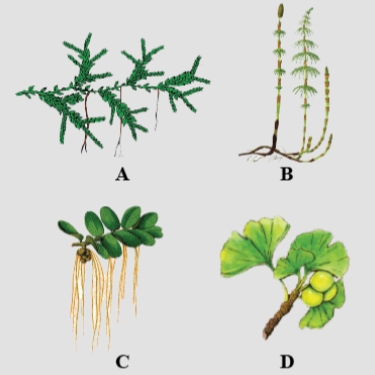
Examine the figures $A, B, C$ and $D$. In which one of the four options are all the items $A, B, C$ and $D$ correctly identified?
A
$A$-Chara,$B$-Marchantia,$C$-Fucus,$D$-Pinus
B
$A$-Equisetum,$B$-Ginkgo,$C$-Selaginella,$D$-Lycopodium
C
$A$-Selaginella,$B$-Equisetum,$C$-Salvinia,$D$-Ginkgo
D
$A$-Funaria,$B$-Adiantum,$C$-Salvinia,$D$-Riccia
Solution
(C) Based on the provided figures:
$A$ represents $Selaginella$,which is a pteridophyte.
$B$ represents $Equisetum$,which is a pteridophyte.
$C$ represents $Salvinia$,which is a heterosporous pteridophyte.
$D$ represents $Ginkgo$,which is a gymnosperm.
Therefore,the correct identification is given in option $C$.
$A$ represents $Selaginella$,which is a pteridophyte.
$B$ represents $Equisetum$,which is a pteridophyte.
$C$ represents $Salvinia$,which is a heterosporous pteridophyte.
$D$ represents $Ginkgo$,which is a gymnosperm.
Therefore,the correct identification is given in option $C$.
0 likes
View Solution174
EasyMCQ
Which one of the following plants is monoecious?
A
Pinus
B
Cycas
C
Papaya
D
Marchantia
Solution
(A) : Monoecious plants have separate male and female reproductive structures on the same individual plant.
$Pinus$ is a monoecious gymnosperm because it bears both male and female cones (strobili) on the same tree.
In contrast,$Cycas$ is dioecious (separate male and female plants),$Papaya$ is typically dioecious,and $Marchantia$ is a dioecious bryophyte.
$Pinus$ is a monoecious gymnosperm because it bears both male and female cones (strobili) on the same tree.
In contrast,$Cycas$ is dioecious (separate male and female plants),$Papaya$ is typically dioecious,and $Marchantia$ is a dioecious bryophyte.
0 likes
View Solution175
MediumMCQ
Flagellated male gametes are present in all the three of which one of the following sets?
A
Zygnema,Saprolegnia and Hydrilla
B
Fucus,Marsilea and Calotropis
C
Riccia,Dryopteris and Cycas
D
Anthoceros,Funaria and Spirogyra
Solution
(C) The correct answer is $C$.
Flagellated male gametes (antherozoids) are typically found in lower plant groups such as algae,bryophytes,and pteridophytes,where water is required for fertilization.
In the set $Riccia$,$Dryopteris$,and $Cycas$:
$1$. $Riccia$ is a bryophyte that produces biflagellate antherozoids.
$2$. $Dryopteris$ is a pteridophyte that produces multiflagellate antherozoids.
$3$. $Cycas$ is a gymnosperm that produces large,multiciliated (flagellated) male gametes.
Other options contain plants like $Spirogyra$ (non-flagellated gametes) or $Calotropis$ (angiosperm,non-flagellated pollen tubes),making them incorrect.
Flagellated male gametes (antherozoids) are typically found in lower plant groups such as algae,bryophytes,and pteridophytes,where water is required for fertilization.
In the set $Riccia$,$Dryopteris$,and $Cycas$:
$1$. $Riccia$ is a bryophyte that produces biflagellate antherozoids.
$2$. $Dryopteris$ is a pteridophyte that produces multiflagellate antherozoids.
$3$. $Cycas$ is a gymnosperm that produces large,multiciliated (flagellated) male gametes.
Other options contain plants like $Spirogyra$ (non-flagellated gametes) or $Calotropis$ (angiosperm,non-flagellated pollen tubes),making them incorrect.
0 likes
View Solution176
EasyMCQ
Which one of the following is linked to the discovery of Bordeaux mixture as a popular fungicide?
A
Loose smut of wheat
B
Black rust of wheat
C
Bacterial leaf blight of rice
D
Downy mildew of grapes
Solution
(D) The correct answer is $D$.
Bordeaux mixture was discovered by $R.M.A. Millardet$ in $1882$ as the first inorganic fungicide.
It was specifically developed to control the downy mildew disease of grapes caused by the pathogen $Plasmopara$ $viticola$.
This mixture is composed of copper sulphate, lime, and water.
Bordeaux mixture was discovered by $R.M.A. Millardet$ in $1882$ as the first inorganic fungicide.
It was specifically developed to control the downy mildew disease of grapes caused by the pathogen $Plasmopara$ $viticola$.
This mixture is composed of copper sulphate, lime, and water.
0 likes
View Solution177
EasyMCQ
Which medium is required for the transport of gametes in Algae,Bryophytes,and Pteridophytes?
A
Air
B
Insect
C
Birds
D
Water
Solution
(D) In $Algae$,$Bryophytes$,and $Pteridophytes$,the male gametes are motile and require a liquid medium to reach the female gametes for fertilization.
Water acts as the essential medium for the transport of these male gametes to the female gametes.
Therefore,the correct option is $D$.
Water acts as the essential medium for the transport of these male gametes to the female gametes.
Therefore,the correct option is $D$.
0 likes
View Solution178
MediumMCQ
$A$ - In bryophytes,the gametophyte is dominant and haploid.
$B$ - In pteridophytes,the gametophyte is multicellular,short-lived,and haploid.
$B$ - In pteridophytes,the gametophyte is multicellular,short-lived,and haploid.
A
Both are incorrect.
B
$A$-correct,$B$-wrong.
C
$A$-wrong,$B$-correct.
D
Both are correct.
Solution
(D) In $Bryophytes$,the main plant body is a haploid gametophyte,which is the dominant phase of the life cycle.
In $Pteridophytes$,the main plant body is a diploid sporophyte. The gametophyte (prothallus) is small,multicellular,free-living,usually photosynthetic,short-lived,and haploid.
Therefore,both statements $A$ and $B$ are correct.
In $Pteridophytes$,the main plant body is a diploid sporophyte. The gametophyte (prothallus) is small,multicellular,free-living,usually photosynthetic,short-lived,and haploid.
Therefore,both statements $A$ and $B$ are correct.
0 likes
View Solution179
MediumMCQ
Identify the correct matching pair from the table below:
| Column-$I$ | Column-$II$ |
| $(1)$ Gymnosperm | $(p)$ Sphagnum |
| $(2)$ Angiosperm | $(q)$ Selaginella |
| $(3)$ Bryophytes | $(r)$ Pinus |
| $(4)$ Pteridophyte | $(s)$ Eucalyptus |
A
$(1-r), (2-s), (3-p), (4-q)$
B
$(1-p), (2-r), (3-q), (4-s)$
C
$(1-r), (2-s), (3-q), (4-p)$
D
$(1-r), (2-q), (3-p), (4-s)$
Solution
(A) To identify the correct pair,let's analyze each group:
$1$. Gymnosperms are plants with naked seeds,such as $Pinus$ $(r)$.
$2$. Angiosperms are flowering plants,such as $Eucalyptus$ $(s)$.
$3$. Bryophytes are non-vascular land plants,such as $Sphagnum$ $(p)$.
$4$. Pteridophytes are vascular cryptogams,such as $Selaginella$ $(q)$.
Matching these gives: $(1-r), (2-s), (3-p), (4-q)$.
$1$. Gymnosperms are plants with naked seeds,such as $Pinus$ $(r)$.
$2$. Angiosperms are flowering plants,such as $Eucalyptus$ $(s)$.
$3$. Bryophytes are non-vascular land plants,such as $Sphagnum$ $(p)$.
$4$. Pteridophytes are vascular cryptogams,such as $Selaginella$ $(q)$.
Matching these gives: $(1-r), (2-s), (3-p), (4-q)$.
0 likes
View Solution180
MediumMCQ
Arrange the following examples from their simple to complex form in ascending order.
$(1)$ Equisetum $(2)$ Chlamydomonas $(3)$ Sphagnum
$(1)$ Equisetum $(2)$ Chlamydomonas $(3)$ Sphagnum
A
$(1), (3), (2)$
B
$(3), (1), (2)$
C
$(2), (1), (3)$
D
$(2), (3), (1)$
Solution
(D) To arrange the organisms from simple to complex,we look at their evolutionary classification:
$(1)$ $Chlamydomonas$ is a unicellular green alga,which is the simplest among the given options.
$(2)$ $Sphagnum$ is a moss,which belongs to Bryophyta. Bryophytes are more complex than algae as they show differentiation into stem-like and leaf-like structures.
$(3)$ $Equisetum$ is a horsetail,which belongs to Pteridophyta. Pteridophytes are more complex than bryophytes as they possess true roots,stems,and leaves,along with a well-developed vascular system.
Therefore,the order from simple to complex is: $Chlamydomonas$ $(2) < Sphagnum$ $(3) < Equisetum$ $(1)$.
The correct sequence is $(2), (3), (1)$.
$(1)$ $Chlamydomonas$ is a unicellular green alga,which is the simplest among the given options.
$(2)$ $Sphagnum$ is a moss,which belongs to Bryophyta. Bryophytes are more complex than algae as they show differentiation into stem-like and leaf-like structures.
$(3)$ $Equisetum$ is a horsetail,which belongs to Pteridophyta. Pteridophytes are more complex than bryophytes as they possess true roots,stems,and leaves,along with a well-developed vascular system.
Therefore,the order from simple to complex is: $Chlamydomonas$ $(2) < Sphagnum$ $(3) < Equisetum$ $(1)$.
The correct sequence is $(2), (3), (1)$.
0 likes
View Solution181
DifficultMCQ
Select the correct option by matching the given groups $(i)$ red algae,$(ii)$ green algae,$(iii)$ bryophytes,and $(iv)$ Pteridophytes with their respective characteristics $(P, Q, R, S)$:
$(P)$ Their gametophyte is called prothallus.
$(Q)$ Rhizoids are present,but they are not true roots.
$(R)$ Pyrenoids contain protein besides starch.
$(S)$ Red pigment,$r$-phycoerythrin,is present in their body.
Match the groups $(i, ii, iii, iv)$ with the characteristics $(P, Q, R, S)$ and select the correct sequence.
$(P)$ Their gametophyte is called prothallus.
$(Q)$ Rhizoids are present,but they are not true roots.
$(R)$ Pyrenoids contain protein besides starch.
$(S)$ Red pigment,$r$-phycoerythrin,is present in their body.
Match the groups $(i, ii, iii, iv)$ with the characteristics $(P, Q, R, S)$ and select the correct sequence.
A
$i-S, ii-R, iii-Q, iv-P$
B
$i-R, ii-S, iii-P, iv-Q$
C
$i-S, ii-Q, iii-R, iv-P$
D
$i-P, ii-Q, iii-R, iv-S$
Solution
(A) The correct matching is as follows:
$(i)$ Red algae: These contain the red pigment $r$-phycoerythrin in their body. Thus,$(i)$ matches with $(S)$.
$(ii)$ Green algae: These contain pyrenoids,which are storage bodies that contain protein besides starch. Thus,$(ii)$ matches with $(R)$.
$(iii)$ Bryophytes: These possess root-like structures called rhizoids,which are not true roots. Thus,$(iii)$ matches with $(Q)$.
$(iv)$ Pteridophytes: The gametophyte of pteridophytes is a small,multicellular,free-living,photosynthetic thallus called a prothallus. Thus,$(iv)$ matches with $(P)$.
Therefore,the correct sequence is $(i-S, ii-R, iii-Q, iv-P)$,which corresponds to option $(A)$.
$(i)$ Red algae: These contain the red pigment $r$-phycoerythrin in their body. Thus,$(i)$ matches with $(S)$.
$(ii)$ Green algae: These contain pyrenoids,which are storage bodies that contain protein besides starch. Thus,$(ii)$ matches with $(R)$.
$(iii)$ Bryophytes: These possess root-like structures called rhizoids,which are not true roots. Thus,$(iii)$ matches with $(Q)$.
$(iv)$ Pteridophytes: The gametophyte of pteridophytes is a small,multicellular,free-living,photosynthetic thallus called a prothallus. Thus,$(iv)$ matches with $(P)$.
Therefore,the correct sequence is $(i-S, ii-R, iii-Q, iv-P)$,which corresponds to option $(A)$.
0 likes
View Solution182
MediumMCQ
Choose the correct pair.
| Column-$I$ | Column-$II$ |
| $1$. Phaeophyceae | $A$. Chara |
| $2$. Chlorophyceae | $B$. Wolffia |
| $3$. Rhodophyceae | $C$. Porphyra |
| $4$. Angiosperms | $D$. Ectocarpus |
A
$(1-D), (2-A), (3-B), (4-C)$
B
$(1-D), (2-C), (3-B), (4-A)$
C
$(1-D), (2-A), (3-C), (4-B)$
D
$(1-C), (2-A), (3-D), (4-B)$
Solution
(C) $1$. Phaeophyceae (Brown algae) includes examples like $Ectocarpus$,$Dictyota$,$Laminaria$,$Sargassum$,and $Fucus$. Thus,$1-D$.
$2$. Chlorophyceae (Green algae) includes examples like $Chlamydomonas$,$Volvox$,$Ulothrix$,$Spirogyra$,and $Chara$. Thus,$2-A$.
$3$. Rhodophyceae (Red algae) includes examples like $Polysiphonia$,$Porphyra$,$Gracilaria$,and $Gelidium$. Thus,$3-C$.
$4$. Angiosperms (Flowering plants) include examples like $Wolffia$ (the smallest angiosperm). Thus,$4-B$.
Therefore,the correct matching is $(1-D), (2-A), (3-C), (4-B)$.
$2$. Chlorophyceae (Green algae) includes examples like $Chlamydomonas$,$Volvox$,$Ulothrix$,$Spirogyra$,and $Chara$. Thus,$2-A$.
$3$. Rhodophyceae (Red algae) includes examples like $Polysiphonia$,$Porphyra$,$Gracilaria$,and $Gelidium$. Thus,$3-C$.
$4$. Angiosperms (Flowering plants) include examples like $Wolffia$ (the smallest angiosperm). Thus,$4-B$.
Therefore,the correct matching is $(1-D), (2-A), (3-C), (4-B)$.
0 likes
View Solution183
MediumMCQ
Compared with the gametophytes of the bryophytes,the gametophytes of vascular plants are:
A
smaller but have larger sex organs
B
larger but have smaller sex organs
C
larger and have larger sex organs
D
smaller and have smaller sex organs
Solution
(D) In bryophytes,the gametophyte is the dominant,independent,and photosynthetic phase of the life cycle. It is relatively large and complex.
In contrast,vascular plants (such as pteridophytes,gymnosperms,and angiosperms) show a shift toward a sporophyte-dominant life cycle.
As a result,the gametophytes of vascular plants are significantly reduced in size compared to those of bryophytes.
Furthermore,the sex organs (antheridia and archegonia) in vascular plants are also smaller and often simplified compared to the more prominent sex organs found in bryophytes.
In contrast,vascular plants (such as pteridophytes,gymnosperms,and angiosperms) show a shift toward a sporophyte-dominant life cycle.
As a result,the gametophytes of vascular plants are significantly reduced in size compared to those of bryophytes.
Furthermore,the sex organs (antheridia and archegonia) in vascular plants are also smaller and often simplified compared to the more prominent sex organs found in bryophytes.
0 likes
View Solution184
MediumMCQ
Consider the following four statements. Which of them are wrong?
$(a)$ The sporophyte in liverworts is more elaborate than that in mosses.
$(b)$ $Salvinia$ is heterosporous.
$(c)$ The life cycle in all seed-bearing plants is diplontic.
$(d)$ In $Pinus$,male and female cones are borne on different trees.
$(a)$ The sporophyte in liverworts is more elaborate than that in mosses.
$(b)$ $Salvinia$ is heterosporous.
$(c)$ The life cycle in all seed-bearing plants is diplontic.
$(d)$ In $Pinus$,male and female cones are borne on different trees.
A
Statement $(a)$ and $(c)$
B
Statement $(a)$ and $(d)$
C
Statement $(b)$ and $(c)$
D
Statement $(a)$ and $(b)$
Solution
(B) Let us analyze each statement:
$(a)$ The sporophyte in liverworts is simpler than that in mosses. Mosses have a more elaborate sporophyte consisting of a foot,seta,and capsule. Thus,statement $(a)$ is wrong.
$(b)$ $Salvinia$ is a pteridophyte that produces two types of spores (microspores and megaspores),making it heterosporous. Thus,statement $(b)$ is correct.
$(c)$ All seed-bearing plants (gymnosperms and angiosperms) exhibit a diplontic life cycle,where the diploid sporophyte is the dominant phase. Thus,statement $(c)$ is correct.
$(d)$ $Pinus$ is monoecious,meaning male and female cones are borne on the same tree. Thus,statement $(d)$ is wrong.
Since statements $(a)$ and $(d)$ are wrong,the correct option is $B$.
$(a)$ The sporophyte in liverworts is simpler than that in mosses. Mosses have a more elaborate sporophyte consisting of a foot,seta,and capsule. Thus,statement $(a)$ is wrong.
$(b)$ $Salvinia$ is a pteridophyte that produces two types of spores (microspores and megaspores),making it heterosporous. Thus,statement $(b)$ is correct.
$(c)$ All seed-bearing plants (gymnosperms and angiosperms) exhibit a diplontic life cycle,where the diploid sporophyte is the dominant phase. Thus,statement $(c)$ is correct.
$(d)$ $Pinus$ is monoecious,meaning male and female cones are borne on the same tree. Thus,statement $(d)$ is wrong.
Since statements $(a)$ and $(d)$ are wrong,the correct option is $B$.
0 likes
View Solution185
MediumMCQ
In which of the following plants are seeds not formed?
A
Nephrolepis,Funaria
B
Funaria,Maize
C
Chlamydomonas,Maize
D
Sunflower,Zamia
Solution
(A) Seeds are characteristic features of Spermatophytes (Gymnosperms and Angiosperms).
$1$. $Funaria$ is a bryophyte,which reproduces via spores and does not produce seeds.
$2$. $Nephrolepis$ is a pteridophyte,which also reproduces via spores and does not produce seeds.
$3$. $Maize$ is an angiosperm,which produces seeds.
$4$. $Sunflower$ is an angiosperm,which produces seeds.
$5$. $Zamia$ is a gymnosperm,which produces seeds.
Therefore,both $Nephrolepis$ and $Funaria$ do not form seeds.
$1$. $Funaria$ is a bryophyte,which reproduces via spores and does not produce seeds.
$2$. $Nephrolepis$ is a pteridophyte,which also reproduces via spores and does not produce seeds.
$3$. $Maize$ is an angiosperm,which produces seeds.
$4$. $Sunflower$ is an angiosperm,which produces seeds.
$5$. $Zamia$ is a gymnosperm,which produces seeds.
Therefore,both $Nephrolepis$ and $Funaria$ do not form seeds.
0 likes
View Solution186
MediumMCQ
What is common in all these three: Bryophytes,Dryopteris,and Ginkgo?
A
Independent sporophyte
B
Presence of archegonia
C
Well developed vascular tissues
D
Independent gametophyte
Solution
(B) The common feature among Bryophytes,Dryopteris (a Pteridophyte),and Ginkgo (a Gymnosperm) is the presence of archegonia.
$1$. Bryophytes: They possess archegonia as the female sex organ.
$2$. Dryopteris (Pteridophytes): They also possess archegonia.
$3$. Ginkgo (Gymnosperms): They possess archegonia,although they are reduced in higher gymnosperms.
- Independent sporophyte is not present in Bryophytes.
- Well-developed vascular tissues are absent in Bryophytes.
- Independent gametophyte is not present in Ginkgo.
$1$. Bryophytes: They possess archegonia as the female sex organ.
$2$. Dryopteris (Pteridophytes): They also possess archegonia.
$3$. Ginkgo (Gymnosperms): They possess archegonia,although they are reduced in higher gymnosperms.
- Independent sporophyte is not present in Bryophytes.
- Well-developed vascular tissues are absent in Bryophytes.
- Independent gametophyte is not present in Ginkgo.
0 likes
View Solution187
MediumMCQ
Read the following statements and answer the question which follows them:
$(1)$ In liverworts,mosses,and ferns,gametophytes are free-living.
$(2)$ Gymnosperms and some ferns are heterosporous.
$(3)$ Sexual reproduction in $Fucus$,$Volvox$,and $Albugo$ is oogamous.
$(4)$ The sporophyte in liverworts is more elaborate than that in mosses.
$(5)$ Both $Pinus$ and $Marchantia$ are dioecious.
How many of the above statements are correct?
$(1)$ In liverworts,mosses,and ferns,gametophytes are free-living.
$(2)$ Gymnosperms and some ferns are heterosporous.
$(3)$ Sexual reproduction in $Fucus$,$Volvox$,and $Albugo$ is oogamous.
$(4)$ The sporophyte in liverworts is more elaborate than that in mosses.
$(5)$ Both $Pinus$ and $Marchantia$ are dioecious.
How many of the above statements are correct?
A
Two
B
Three
C
Four
D
One
Solution
(B) Let us analyze each statement:
$(1)$ In liverworts,mosses,and ferns,the gametophyte is the dominant,free-living phase. This statement is correct.
$(2)$ All gymnosperms are heterosporous,and some ferns (like $Salvinia$ and $Selaginella$) are heterosporous. This statement is correct.
$(3)$ Sexual reproduction in $Fucus$ (algae),$Volvox$ (algae),and $Albugo$ (fungi) is oogamous. This statement is correct.
$(4)$ The sporophyte in mosses is more elaborate than that in liverworts (which is simple and consists of a foot,seta,and capsule). This statement is incorrect.
$(5)$ $Pinus$ is monoecious (male and female cones on the same plant),while $Marchantia$ is dioecious. This statement is incorrect.
Thus,statements $(1)$,$(2)$,and $(3)$ are correct. The total number of correct statements is $3$.
$(1)$ In liverworts,mosses,and ferns,the gametophyte is the dominant,free-living phase. This statement is correct.
$(2)$ All gymnosperms are heterosporous,and some ferns (like $Salvinia$ and $Selaginella$) are heterosporous. This statement is correct.
$(3)$ Sexual reproduction in $Fucus$ (algae),$Volvox$ (algae),and $Albugo$ (fungi) is oogamous. This statement is correct.
$(4)$ The sporophyte in mosses is more elaborate than that in liverworts (which is simple and consists of a foot,seta,and capsule). This statement is incorrect.
$(5)$ $Pinus$ is monoecious (male and female cones on the same plant),while $Marchantia$ is dioecious. This statement is incorrect.
Thus,statements $(1)$,$(2)$,and $(3)$ are correct. The total number of correct statements is $3$.
0 likes
View Solution188
MediumMCQ
In $Funaria$ and $Pteris$,both sperms are released near the archegonium of $Pteris$. Only $Pteris$ sperms enter the archegonium because:
A
$Pteris$ archegonium repels $Funaria$ sperms.
B
$Pteris$ sperms destroy $Funaria$ sperms.
C
$Funaria$ sperms are less motile.
D
$Pteris$ archegonium secretes chemicals that attract only $Pteris$ sperms.
Solution
(D) Fertilization in bryophytes and pteridophytes is dependent on water. In $Pteris$ (a pteridophyte),the archegonium secretes specific chemical substances (chemotaxis) that attract the male gametes (antherozoids) of its own species. This is a specific biological mechanism where the female sex organ recognizes and attracts only the compatible male gametes through chemical signaling. Therefore,even if $Funaria$ sperms are present,they are not attracted to the $Pteris$ archegonium.
0 likes
View Solution189
MediumMCQ
Which of the following is $NOT$ common between $Funaria$ and $Selaginella$?
A
Archegonia
B
Embryo
C
Flagellated sperms
D
Roots
Solution
(D) $Funaria$ is a bryophyte,while $Selaginella$ is a pteridophyte.
$Funaria$ lacks true roots and instead possesses rhizoids.
In contrast,$Selaginella$ possesses true roots,stems,and leaves.
Therefore,'roots' are not common between the two.
$Funaria$ lacks true roots and instead possesses rhizoids.
In contrast,$Selaginella$ possesses true roots,stems,and leaves.
Therefore,'roots' are not common between the two.
0 likes
View Solution190
MediumMCQ
From an evolutionary perspective,which of the following represents the most advanced form?
A
Selaginella
B
Funaria
C
Chlamydomonas
D
Pinus
Solution
(D) The evolutionary sequence of plants from simple to complex is: Algae $(Chlamydomonas)$ $\rightarrow$ Bryophytes $(Funaria)$ $\rightarrow$ Pteridophytes $(Selaginella)$ $\rightarrow$ Gymnosperms $(Pinus)$.
$Chlamydomonas$ is a unicellular green alga (simplest).
$Funaria$ is a moss (bryophyte),which is more complex than algae.
$Selaginella$ is a pteridophyte,which has vascular tissues.
$Pinus$ is a gymnosperm,which produces seeds and is the most advanced among the given options.
$Chlamydomonas$ is a unicellular green alga (simplest).
$Funaria$ is a moss (bryophyte),which is more complex than algae.
$Selaginella$ is a pteridophyte,which has vascular tissues.
$Pinus$ is a gymnosperm,which produces seeds and is the most advanced among the given options.
0 likes
View Solution191
MediumMCQ
$A$ well-developed archegonium with $4-6$ rows of neck canal cells in the neck region is a characteristic feature of:
A
Gymnosperms only
B
Bryophytes and Pteridophytes
C
Pteridophytes and Gymnosperms
D
Gymnosperms and Angiosperms
Solution
(C) The archegonium is the female sex organ in Bryophytes,Pteridophytes,and Gymnosperms.
In Bryophytes and Pteridophytes,the archegonium typically has a neck with a variable number of neck canal cells.
Specifically,in many Pteridophytes and Gymnosperms,the neck region of the archegonium is characterized by the presence of $4-6$ rows of neck canal cells.
Therefore,this feature is commonly observed in both Pteridophytes and Gymnosperms.
In Bryophytes and Pteridophytes,the archegonium typically has a neck with a variable number of neck canal cells.
Specifically,in many Pteridophytes and Gymnosperms,the neck region of the archegonium is characterized by the presence of $4-6$ rows of neck canal cells.
Therefore,this feature is commonly observed in both Pteridophytes and Gymnosperms.
0 likes
View Solution192
MediumMCQ
According to a system of plant classification,which of the following pairs represents the group $Spermatophyta$ correctly?
A
$Rhizopus, Triticum$
B
$Ginkgo, Pisum$
C
$Acacia, Saccharum$
D
$Pinus, Cycas$
Solution
(B) The group $Spermatophyta$ (seed-bearing plants) includes both $Gymnosperms$ and $Angiosperms$.
$Ginkgo$ is a $Gymnosperm$ and $Pisum$ (pea) is an $Angiosperm$.
Both are seed-bearing plants,thus they belong to the $Spermatophyta$ group.
$Rhizopus$ is a fungus,$Pinus$ and $Cycas$ are $Gymnosperms$,and $Acacia$ and $Saccharum$ are $Angiosperms$. However,the pair $Ginkgo$ and $Pisum$ represents the diversity within the $Spermatophyta$ group effectively.
$Ginkgo$ is a $Gymnosperm$ and $Pisum$ (pea) is an $Angiosperm$.
Both are seed-bearing plants,thus they belong to the $Spermatophyta$ group.
$Rhizopus$ is a fungus,$Pinus$ and $Cycas$ are $Gymnosperms$,and $Acacia$ and $Saccharum$ are $Angiosperms$. However,the pair $Ginkgo$ and $Pisum$ represents the diversity within the $Spermatophyta$ group effectively.
0 likes
View Solution193
MediumMCQ
Which of the following pairs of plants does not show seed formation?
A
Ficus and Chlamydomonas
B
Punica and Pinus
C
Dryopteris and Funaria
D
Funaria and Ficus
Solution
(C) Seed formation is a characteristic feature of Spermatophytes (Gymnosperms and Angiosperms).
$1$. $Chlamydomonas$ is an Alga,$Funaria$ is a Bryophyte,and $Dryopteris$ (Fern) is a Pteridophyte. None of these produce seeds.
$2$. $Ficus$ (Angiosperm),$Punica$ (Angiosperm),and $Pinus$ (Gymnosperm) are seed-bearing plants.
$3$. In option $C$,$Dryopteris$ (Pteridophyte) and $Funaria$ (Bryophyte) both reproduce via spores and do not form seeds.
Therefore,the correct pair is $Dryopteris$ and $Funaria$.
$1$. $Chlamydomonas$ is an Alga,$Funaria$ is a Bryophyte,and $Dryopteris$ (Fern) is a Pteridophyte. None of these produce seeds.
$2$. $Ficus$ (Angiosperm),$Punica$ (Angiosperm),and $Pinus$ (Gymnosperm) are seed-bearing plants.
$3$. In option $C$,$Dryopteris$ (Pteridophyte) and $Funaria$ (Bryophyte) both reproduce via spores and do not form seeds.
Therefore,the correct pair is $Dryopteris$ and $Funaria$.
0 likes
View Solution194
MediumMCQ
Match the items in Column-$I$ with Column-$II$ and select the correct option:
| Column-$I$ | Column-$II$ |
|---|---|
| $(a)$ Peritrichous flagellation | $(1)$ Ginkgo |
| $(b)$ Living fossil | $(2)$ Macrocystis |
| $(c)$ Rhizophore | $(3)$ Escherichia coli |
| $(d)$ Smallest flowering plant | $(4)$ Selaginella |
| $(e)$ Largest perennial alga | $(5)$ Wolffia |
A
$a-3, b-1, c-4, d-5, e-2$
B
$a-2, b-1, c-3, d-4, e-5$
C
$a-5, b-3, c-2, d-5, e-1$
D
$a-1, b-2, c-5, d-3, e-2$
Solution
(A) The correct matching is as follows:
$(a)$ Peritrichous flagellation: Found in bacteria like $Escherichia \ coli$ ($E$. coli),where flagella are distributed over the entire surface of the cell. Thus,$(a-3)$.
$(b)$ Living fossil: $Ginkgo \ biloba$ is a classic example of a living fossil among gymnosperms. Thus,$(b-1)$.
$(c)$ Rhizophore: $A$ specialized structure found in the pteridophyte $Selaginella$ that produces roots. Thus,$(c-4)$.
$(d)$ Smallest flowering plant: $Wolffia$ is known as the smallest angiosperm. Thus,$(d-5)$.
$(e)$ Largest perennial alga: $Macrocystis$ (a brown alga or kelp) can grow to massive sizes. Thus,$(e-2)$.
Therefore,the correct sequence is $a-3, b-1, c-4, d-5, e-2$.
$(a)$ Peritrichous flagellation: Found in bacteria like $Escherichia \ coli$ ($E$. coli),where flagella are distributed over the entire surface of the cell. Thus,$(a-3)$.
$(b)$ Living fossil: $Ginkgo \ biloba$ is a classic example of a living fossil among gymnosperms. Thus,$(b-1)$.
$(c)$ Rhizophore: $A$ specialized structure found in the pteridophyte $Selaginella$ that produces roots. Thus,$(c-4)$.
$(d)$ Smallest flowering plant: $Wolffia$ is known as the smallest angiosperm. Thus,$(d-5)$.
$(e)$ Largest perennial alga: $Macrocystis$ (a brown alga or kelp) can grow to massive sizes. Thus,$(e-2)$.
Therefore,the correct sequence is $a-3, b-1, c-4, d-5, e-2$.
0 likes
View Solution195
MediumMCQ
In which of the following sets are flagellated male gametes found?
A
Anthoceros,Funaria and Spirogyra
B
Zygnema,Saprolegnia,Hydrilla
C
Fucus,Marsilea,Calotropis
D
Riccia,Dryopteris,Cycas
Solution
(D) Flagellated male gametes (antherozoids) are typically found in groups that require water for fertilization,such as Bryophytes,Pteridophytes,and some Gymnosperms.
$1$. $Riccia$ is a Bryophyte,which produces flagellated antherozoids.
$2$. $Dryopteris$ is a Pteridophyte,which also produces flagellated antherozoids.
$3$. $Cycas$ is a Gymnosperm,which is unique among seed plants for having flagellated,motile male gametes.
Therefore,the set $Riccia, Dryopteris, Cycas$ contains organisms that all possess flagellated male gametes.
$1$. $Riccia$ is a Bryophyte,which produces flagellated antherozoids.
$2$. $Dryopteris$ is a Pteridophyte,which also produces flagellated antherozoids.
$3$. $Cycas$ is a Gymnosperm,which is unique among seed plants for having flagellated,motile male gametes.
Therefore,the set $Riccia, Dryopteris, Cycas$ contains organisms that all possess flagellated male gametes.
0 likes
View Solution196
MediumMCQ
Cycas and Adiantum resemble each other in having:
A
Seeds
B
Motile male gametes
C
Cambium
D
Vascular tissues
Solution
(B) Cycas is a gymnosperm,and Adiantum is a pteridophyte (fern).
Both Cycas and Adiantum possess motile male gametes (antherozoids) that require water or a fluid medium to reach the female gamete for fertilization.
While both have vascular tissues,the presence of motile male gametes is a specific shared characteristic often highlighted in evolutionary biology comparisons between these groups.
Seeds are present in Cycas but absent in Adiantum.
Cambium is present in Cycas but absent in Adiantum.
Both Cycas and Adiantum possess motile male gametes (antherozoids) that require water or a fluid medium to reach the female gamete for fertilization.
While both have vascular tissues,the presence of motile male gametes is a specific shared characteristic often highlighted in evolutionary biology comparisons between these groups.
Seeds are present in Cycas but absent in Adiantum.
Cambium is present in Cycas but absent in Adiantum.
0 likes
View Solution197
MediumMCQ
Read the following statements and answer the question based on them:
$(1)$ In liverworts,mosses,and ferns,the gametophyte is free-living.
$(2)$ Gymnosperms and some ferns are heterosporous.
$(3)$ Sexual reproduction in Fucus,Volvox,and Albugo is oogamous.
$(4)$ The sporophyte in liverworts is more elaborate than in mosses.
How many of the above statements are correct?
$(1)$ In liverworts,mosses,and ferns,the gametophyte is free-living.
$(2)$ Gymnosperms and some ferns are heterosporous.
$(3)$ Sexual reproduction in Fucus,Volvox,and Albugo is oogamous.
$(4)$ The sporophyte in liverworts is more elaborate than in mosses.
How many of the above statements are correct?
A
$1$
B
$2$
C
$3$
D
$4$
Solution
(C) Statement $(1)$ is correct: In bryophytes (liverworts and mosses) and pteridophytes (ferns),the gametophyte phase is free-living.
Statement $(2)$ is correct: Gymnosperms are heterosporous,and some pteridophytes like Selaginella and Salvinia are also heterosporous.
Statement $(3)$ is correct: In Fucus (algae),Volvox (algae),and Albugo (fungi),sexual reproduction is of the oogamous type.
Statement $(4)$ is incorrect: The sporophyte in mosses is more elaborate than in liverworts.
Therefore,there are $3$ correct statements.
Statement $(2)$ is correct: Gymnosperms are heterosporous,and some pteridophytes like Selaginella and Salvinia are also heterosporous.
Statement $(3)$ is correct: In Fucus (algae),Volvox (algae),and Albugo (fungi),sexual reproduction is of the oogamous type.
Statement $(4)$ is incorrect: The sporophyte in mosses is more elaborate than in liverworts.
Therefore,there are $3$ correct statements.
0 likes
View Solution198
MediumMCQ
Which of the following statements is incorrect?
A
Archegonia are found in bryophytes,pteridophytes,and gymnosperms.
B
Mucor has two flagellated zoospores.
C
Haploid endosperm is a characteristic feature of gymnosperms.
D
Brown algae contain chlorophyll $a$ and $c$ as well as fucoxanthin.
Solution
(B) Statement $B$ is incorrect because $Mucor$ (a member of Zygomycetes) produces non-motile spores called aplanospores,not flagellated zoospores.
Archegonia are indeed present in bryophytes,pteridophytes,and gymnosperms.
Haploid endosperm is a unique characteristic of gymnosperms,formed before fertilization.
Brown algae (Phaeophyceae) contain chlorophyll $a$,$c$,and the pigment fucoxanthin,which gives them their characteristic brown color.
Archegonia are indeed present in bryophytes,pteridophytes,and gymnosperms.
Haploid endosperm is a unique characteristic of gymnosperms,formed before fertilization.
Brown algae (Phaeophyceae) contain chlorophyll $a$,$c$,and the pigment fucoxanthin,which gives them their characteristic brown color.
0 likes
View Solution199
EasyMCQ
In bryophytes and pteridophytes,$.......$ is required for the transport of male gametes.
A
Insects
B
Birds
C
Water
D
Wind
Solution
(C) In bryophytes and pteridophytes,the male gametes (antherozoids) are flagellated and motile. They require a film of water to swim to the female gametes (archegonia) for fertilization. Therefore,water is essential for the transport of male gametes in these plant groups.
0 likes
View Solution200
MediumMCQ
Plants that possess vascular tissue,produce seeds,and have a taproot system are classified as:
A
Monocots
B
Dicots
C
Gymnosperms/Dicots
D
Gymnosperms/Monocots
Solution
(C) $1$. Vascular tissue (xylem and phloem) is present in Pteridophytes,Gymnosperms,and Angiosperms.
$2$. Seed production is a characteristic of Gymnosperms and Angiosperms.
$3$. $A$ taproot system is a characteristic feature of Dicots (a group within Angiosperms) and Gymnosperms.
$4$. Monocots typically possess a fibrous root system.
$5$. Therefore,plants that possess vascular tissue,produce seeds,and have a taproot system are Gymnosperms and Dicots.
$2$. Seed production is a characteristic of Gymnosperms and Angiosperms.
$3$. $A$ taproot system is a characteristic feature of Dicots (a group within Angiosperms) and Gymnosperms.
$4$. Monocots typically possess a fibrous root system.
$5$. Therefore,plants that possess vascular tissue,produce seeds,and have a taproot system are Gymnosperms and Dicots.
0 likes
View SolutionPlant Kingdom — Mix Examples- Plant Kingdom · Frequently Asked Questions
1Are these Plant Kingdom questions useful for JEE and NEET?
Yes. All questions in this section are mapped to JEE Main and NEET exam patterns. Previous year questions from JEE Main, NEET, GUJCET and state-level exams are included with full solutions.
2Can I switch to Hindi or Gujarati for these questions?
Yes. Use the language tabs in the hero section or the sidebar to view the same questions and solutions in English, Hindi or Gujarati.
3How do I generate a question paper from this subtopic?
Use the Vedclass Exam Paper Generator — select the chapter and subtopic, set difficulty, and generate Sets A, B, C, D automatically. First 3 chapters of every subject are free.
Vedclass Products
For Students
Vedclass Test Series
Mock tests in real JEE/NEET style with performance analysis. 5-day free trial.
Start Free TrialFor Teachers
Exam Paper Generator
Generate Set A/B/C/D papers from this chapter in 2 minutes. 3 chapters free.
Try FreeFor Institutes
Online Exam Module
Live online exams with unlimited students, 360° analytics & white-label branding.
See DemoFor Teachers & Institutes
Generate a Plant Kingdom Exam Paper in 2 Minutes
Select subtopic & difficulty — Sets A, B, C, D auto-generated with No Repeat logic.
First 3 chapters of every subject are free — no payment required.