
A English
Mix Examples- Plant Kingdom Questions in English
Class 11 Biology · Plant Kingdom · Mix Examples- Plant Kingdom
272+
Questions
English
Language
100%
With Solutions
Showing 22 of 272 questions in English
251
MediumMCQ
Match List-$I$ with List-$II$:
Choose the correct answer from the options given below:
| List-$I$ | List-$II$ |
|---|---|
| $a$. Chlamydomonas | $i$. Moss |
| $b$. Cycas | $ii$. Pteridophyte |
| $c$. Selaginella | $iii$. Alga |
| $d$. Sphagnum | $iv$. Gymnosperm |
Choose the correct answer from the options given below:
A
$(a) - (iii), (b) - (i), (c) - (ii), (d) - (iv)$
B
$(a) - (iii), (b) - (iv), (c) - (ii), (d) - (i)$
C
$(a) - (iii), (b) - (ii), (c) - (i), (d) - (iv)$
D
$(a) - (ii), (b) - (iii), (c) - (i), (d) - (iv)$
Solution
(B) The correct matching is as follows:
$1$. $Chlamydomonas$ is a unicellular green alga,so $(a) - (iii)$.
$2$. $Cycas$ is a gymnosperm,so $(b) - (iv)$.
$3$. $Selaginella$ is a pteridophyte,so $(c) - (ii)$.
$4$. $Sphagnum$ is a moss (bryophyte),so $(d) - (i)$.
Therefore,the correct sequence is $(a) - (iii), (b) - (iv), (c) - (ii), (d) - (i)$.
$1$. $Chlamydomonas$ is a unicellular green alga,so $(a) - (iii)$.
$2$. $Cycas$ is a gymnosperm,so $(b) - (iv)$.
$3$. $Selaginella$ is a pteridophyte,so $(c) - (ii)$.
$4$. $Sphagnum$ is a moss (bryophyte),so $(d) - (i)$.
Therefore,the correct sequence is $(a) - (iii), (b) - (iv), (c) - (ii), (d) - (i)$.
0 likes
View Solution252
MediumMCQ
Match List-$I$ with List-$II$:
Choose the option with all correct matches:
| List-$I$ | List-$II$ |
| $A$. Pteridophyte | $I$. Salvia |
| $B$. Bryophyte | $II$. Ginkgo |
| $C$. Angiosperm | $III$. Polytrichum |
| $D$. Gymnosperm | $IV$. Salvinia |
Choose the option with all correct matches:
A
$A-III, B-IV, C-II, D-I$
B
$A-IV, B-III, C-I, D-II$
C
$A-III, B-IV, C-I, D-II$
D
$A-IV, B-III, C-II, D-I$
Solution
(B) The correct matches are as follows:
$1$. $A$. Pteridophyte: $IV$. Salvinia is a well-known aquatic pteridophyte.
$2$. $B$. Bryophyte: $III$. Polytrichum is a genus of moss,which belongs to the bryophytes.
$3$. $C$. Angiosperm: $I$. Salvia is a flowering plant,which belongs to the angiosperms.
$4$. $D$. Gymnosperm: $II$. Ginkgo is a living fossil gymnosperm.
Therefore,the correct matching is $A-IV, B-III, C-I, D-II$.
$1$. $A$. Pteridophyte: $IV$. Salvinia is a well-known aquatic pteridophyte.
$2$. $B$. Bryophyte: $III$. Polytrichum is a genus of moss,which belongs to the bryophytes.
$3$. $C$. Angiosperm: $I$. Salvia is a flowering plant,which belongs to the angiosperms.
$4$. $D$. Gymnosperm: $II$. Ginkgo is a living fossil gymnosperm.
Therefore,the correct matching is $A-IV, B-III, C-I, D-II$.
0 likes
View Solution253
MediumMCQ
$(i)$ Selaginella and Salvinia are heterosporous plants.
$(ii)$ The gametophyte of pteridophytes is called a prothallus.
$(iii)$ In Cycas,stems are unbranched.
$(iv)$ Gymnosperms are heterosporous.
How many statement$(s)$ is/are correct?
$(ii)$ The gametophyte of pteridophytes is called a prothallus.
$(iii)$ In Cycas,stems are unbranched.
$(iv)$ Gymnosperms are heterosporous.
How many statement$(s)$ is/are correct?
A
$2$
B
$3$
C
$1$
D
$4$
Solution
(D) $(i)$ Selaginella and Salvinia are indeed heterosporous pteridophytes,as they produce two types of spores (microspores and megaspores). This statement is correct.
$(ii)$ The gametophyte of pteridophytes is a small,free-living,mostly photosynthetic thalloid structure called a prothallus. This statement is correct.
$(iii)$ In Cycas,the stem is typically unbranched,whereas in Pinus and Cedrus,the stems are branched. This statement is correct.
$(iv)$ All gymnosperms are heterosporous; they produce haploid microspores and megaspores. This statement is correct.
Since all four statements are correct,the total number of correct statements is $4$.
$(ii)$ The gametophyte of pteridophytes is a small,free-living,mostly photosynthetic thalloid structure called a prothallus. This statement is correct.
$(iii)$ In Cycas,the stem is typically unbranched,whereas in Pinus and Cedrus,the stems are branched. This statement is correct.
$(iv)$ All gymnosperms are heterosporous; they produce haploid microspores and megaspores. This statement is correct.
Since all four statements are correct,the total number of correct statements is $4$.
0 likes
View Solution254
MediumMCQ
Assertion : Like pteridophytes,sporophyte is a dominant phase in gymnosperms.
Reason : The gametophyte stages are independent in the pteridophytes.
Reason : The gametophyte stages are independent in the pteridophytes.
A
Both assertion and reason are true and the reason is a correct explanation of the assertion.
B
Both assertion and reason are true and reason is not a correct explanation of the assertion.
C
Assertion is true but the reason is false.
D
Assertion is false but the reason is true.
Solution
(B) In both $Pteridophytes$ and $Gymnosperms$,the plant body is a $Sporophyte$ $(2n)$,which is the dominant phase of the life cycle.
In $Pteridophytes$,the $Gametophyte$ (prothallus) is small,multicellular,and usually independent (free-living).
However,in $Gymnosperms$,the $Gametophyte$ is highly reduced and dependent on the $Sporophyte$ for nutrition and protection.
Therefore,the assertion is true because the $Sporophyte$ is indeed the dominant phase in both groups.
The reason is also true because $Pteridophyte$ gametophytes are indeed independent.
However,the independence of the gametophyte in $Pteridophytes$ does not explain why the $Sporophyte$ is dominant in $Gymnosperms$.
Thus,both are true,but the reason is not the correct explanation for the assertion.
In $Pteridophytes$,the $Gametophyte$ (prothallus) is small,multicellular,and usually independent (free-living).
However,in $Gymnosperms$,the $Gametophyte$ is highly reduced and dependent on the $Sporophyte$ for nutrition and protection.
Therefore,the assertion is true because the $Sporophyte$ is indeed the dominant phase in both groups.
The reason is also true because $Pteridophyte$ gametophytes are indeed independent.
However,the independence of the gametophyte in $Pteridophytes$ does not explain why the $Sporophyte$ is dominant in $Gymnosperms$.
Thus,both are true,but the reason is not the correct explanation for the assertion.
0 likes
View Solution255
MediumMCQ
Read the following examples: Cycas,Equisetum,Adiantum,Pinus,Polytrichum,Funaria,Ginkgo,Selaginella,Sphagnum,Polysiphonia,Salvinia,Marchantia. How many examples have a sporophyte with vascular tissue?
A
$3$
B
$5$
C
$7$
D
$8$
Solution
(C) The plants that possess vascular tissue (xylem and phloem) in their sporophyte generation are Pteridophytes,Gymnosperms,and Angiosperms.
$1$. Cycas: Gymnosperm (Vascular)
$2$. Equisetum: Pteridophyte (Vascular)
$3$. Adiantum: Pteridophyte (Vascular)
$4$. Pinus: Gymnosperm (Vascular)
$5$. Ginkgo: Gymnosperm (Vascular)
$6$. Selaginella: Pteridophyte (Vascular)
$7$. Salvinia: Pteridophyte (Vascular)
The remaining examples (Polytrichum,Funaria,Sphagnum,Marchantia) are Bryophytes,which lack vascular tissue. Polysiphonia is an Alga,which also lacks vascular tissue.
Therefore,there are $7$ examples with vascular tissue.
$1$. Cycas: Gymnosperm (Vascular)
$2$. Equisetum: Pteridophyte (Vascular)
$3$. Adiantum: Pteridophyte (Vascular)
$4$. Pinus: Gymnosperm (Vascular)
$5$. Ginkgo: Gymnosperm (Vascular)
$6$. Selaginella: Pteridophyte (Vascular)
$7$. Salvinia: Pteridophyte (Vascular)
The remaining examples (Polytrichum,Funaria,Sphagnum,Marchantia) are Bryophytes,which lack vascular tissue. Polysiphonia is an Alga,which also lacks vascular tissue.
Therefore,there are $7$ examples with vascular tissue.
0 likes
View Solution256
MediumMCQ
Select the mismatch among the following:-
A
Rhodophyta : chlorophyll-$a, d$; Floridean starch
B
Chlorophyta : chlorophyll-$a, b$; Starch
C
Phaeophyta : chlorophyll-$a, c$; Carrageen
D
Chrysophytes : chlorophyll-$a, c$; Silica containing cell wall
Solution
(C) The correct answer is $C$.
$1$. Rhodophyta (Red algae) contain chlorophyll-$a, d$ and store food as Floridean starch. This is correct.
$2$. Chlorophyta (Green algae) contain chlorophyll-$a, b$ and store food as Starch. This is correct.
$3$. Phaeophyta (Brown algae) contain chlorophyll-$a, c$ and Fucoxanthin. They store food as Laminarin or Mannitol. Carrageen is a phycocolloid found in Red algae (Rhodophyta),not Brown algae. Thus,this is the mismatch.
$4$. Chrysophytes (Diatoms and Golden algae) contain chlorophyll-$a, c$ and have cell walls embedded with silica. This is correct.
$1$. Rhodophyta (Red algae) contain chlorophyll-$a, d$ and store food as Floridean starch. This is correct.
$2$. Chlorophyta (Green algae) contain chlorophyll-$a, b$ and store food as Starch. This is correct.
$3$. Phaeophyta (Brown algae) contain chlorophyll-$a, c$ and Fucoxanthin. They store food as Laminarin or Mannitol. Carrageen is a phycocolloid found in Red algae (Rhodophyta),not Brown algae. Thus,this is the mismatch.
$4$. Chrysophytes (Diatoms and Golden algae) contain chlorophyll-$a, c$ and have cell walls embedded with silica. This is correct.
0 likes
View Solution257
MediumMCQ
Match the Column-$I$ with Column-$II$ and choose the correct option.
| Column-$I$ | Column-$II$ |
|---|---|
| $A$. Chlorophyceae | $i$. Polytrichum |
| $B$. Rhodophyceae | $ii$. Marchantia |
| $C$. Liverworts | $iii$. Polysiphonia |
| $D$. Mosses | $iv$. Chara |
A
$A-(iv), B-(iii), C-(i), D-(ii)$
B
$A-(iv), B-(i), C-(ii), D-(iii)$
C
$A-(iv), B-(iii), C-(ii), D-(i)$
D
$A-(iii), B-(ii), C-(i), D-(iv)$
Solution
(C) The correct matches are as follows:
$1$. Chlorophyceae: $Chara$ is a green alga belonging to the class Chlorophyceae.
$2$. Rhodophyceae: $Polysiphonia$ is a red alga belonging to the class Rhodophyceae.
$3$. Liverworts: $Marchantia$ is a well-known example of a liverwort (Bryophyte).
$4$. Mosses: $Polytrichum$ is a common example of a moss (Bryophyte).
Therefore,the correct matching is $A-(iv), B-(iii), C-(ii), D-(i)$.
$1$. Chlorophyceae: $Chara$ is a green alga belonging to the class Chlorophyceae.
$2$. Rhodophyceae: $Polysiphonia$ is a red alga belonging to the class Rhodophyceae.
$3$. Liverworts: $Marchantia$ is a well-known example of a liverwort (Bryophyte).
$4$. Mosses: $Polytrichum$ is a common example of a moss (Bryophyte).
Therefore,the correct matching is $A-(iv), B-(iii), C-(ii), D-(i)$.
0 likes
View Solution258
MediumMCQ
Bryophytes differ from pteridophytes in?
A
Motile antherozoids
B
An independent gametophyte
C
Archegonia
D
Lack of vascular tissue
Solution
(D) Bryophytes and pteridophytes share several characteristics,such as the presence of motile antherozoids,the presence of archegonia,and the requirement of water for fertilization.
However,they differ significantly in their internal structure.
Bryophytes are non-vascular plants,meaning they lack specialized vascular tissues ($xylem$ and $phloem$).
In contrast,pteridophytes are the first terrestrial plants to possess true vascular tissues ($xylem$ and $phloem$).
Therefore,the lack of vascular tissue is a key feature that distinguishes bryophytes from pteridophytes.
However,they differ significantly in their internal structure.
Bryophytes are non-vascular plants,meaning they lack specialized vascular tissues ($xylem$ and $phloem$).
In contrast,pteridophytes are the first terrestrial plants to possess true vascular tissues ($xylem$ and $phloem$).
Therefore,the lack of vascular tissue is a key feature that distinguishes bryophytes from pteridophytes.
0 likes
View Solution259
MediumMCQ
Match List-$I$ with List-$II$.
Choose the correct answer from the options given below.
| List-$I$ | List-$II$ |
|---|---|
| $(A)$ Pinus | $(i)$ Protonema |
| $(B)$ Cycas | $(ii)$ Prothallus |
| $(C)$ Polytrichum | $(iii)$ Mycorrhiza |
| $(D)$ Dryopteris | $(iv)$ Coralloid roots |
Choose the correct answer from the options given below.
A
$(A)-(iv), (B)-(iii), (C)-(ii), (D)-(i)$
B
$(A)-(iii), (B)-(iv), (C)-(i), (D)-(ii)$
C
$(A)-(iii), (B)-(iv), (C)-(ii), (D)-(i)$
D
$(A)-(iv), (B)-(iii), (C)-(i), (D)-(ii)$
Solution
(C) Pinus is a gymnosperm that shows a symbiotic association with fungi known as Mycorrhiza $(iii)$.
$(B)$ Cycas is a gymnosperm that possesses specialized roots called Coralloid roots $(iv)$ which contain nitrogen-fixing cyanobacteria.
$(C)$ Polytrichum is a moss (bryophyte) that develops a filamentous stage in its life cycle called Protonema $(i)$.
$(D)$ Dryopteris is a pteridophyte that produces a heart-shaped,free-living gametophyte known as Prothallus $(ii)$.
Therefore,the correct matching is $(A)-(iii), (B)-(iv), (C)-(i), (D)-(ii)$.
$(B)$ Cycas is a gymnosperm that possesses specialized roots called Coralloid roots $(iv)$ which contain nitrogen-fixing cyanobacteria.
$(C)$ Polytrichum is a moss (bryophyte) that develops a filamentous stage in its life cycle called Protonema $(i)$.
$(D)$ Dryopteris is a pteridophyte that produces a heart-shaped,free-living gametophyte known as Prothallus $(ii)$.
Therefore,the correct matching is $(A)-(iii), (B)-(iv), (C)-(i), (D)-(ii)$.
0 likes
View Solution260
MediumMCQ
List some of the plants is given below $:-$
$(i)$ Marchantia $(ii)$ Sphagnum $(iii)$ Pteris $(iv)$ Polytrichum $(v)$ Pinus $(vi)$ Cycas $(vii)$ Castor
In how many above plants do both male and female gametophytes not have an independent free-living existence?
$(i)$ Marchantia $(ii)$ Sphagnum $(iii)$ Pteris $(iv)$ Polytrichum $(v)$ Pinus $(vi)$ Cycas $(vii)$ Castor
In how many above plants do both male and female gametophytes not have an independent free-living existence?
A
$4$
B
$3$
C
$5$
D
$6$
Solution
(B) To determine which plants have dependent gametophytes,we analyze their life cycles:
$1$. $(i)$ Marchantia (Liverwort) and $(ii)$ Sphagnum,$(iv)$ Polytrichum (Mosses): These are Bryophytes. Their gametophyte is the dominant,independent,free-living phase.
$2$. $(iii)$ Pteris: This is a Pteridophyte. Its gametophyte (prothallus) is small,multicellular,and free-living.
$3$. $(v)$ Pinus,$(vi)$ Cycas (Gymnosperms),and $(vii)$ Castor (Angiosperm): In these seed-bearing plants,the gametophytes are highly reduced and are completely dependent on the sporophyte for nutrition and protection. They do not have an independent free-living existence.
Therefore,the plants where both male and female gametophytes are not independent are $(v)$ Pinus,$(vi)$ Cycas,and $(vii)$ Castor.
The total count is $3$.
$1$. $(i)$ Marchantia (Liverwort) and $(ii)$ Sphagnum,$(iv)$ Polytrichum (Mosses): These are Bryophytes. Their gametophyte is the dominant,independent,free-living phase.
$2$. $(iii)$ Pteris: This is a Pteridophyte. Its gametophyte (prothallus) is small,multicellular,and free-living.
$3$. $(v)$ Pinus,$(vi)$ Cycas (Gymnosperms),and $(vii)$ Castor (Angiosperm): In these seed-bearing plants,the gametophytes are highly reduced and are completely dependent on the sporophyte for nutrition and protection. They do not have an independent free-living existence.
Therefore,the plants where both male and female gametophytes are not independent are $(v)$ Pinus,$(vi)$ Cycas,and $(vii)$ Castor.
The total count is $3$.
0 likes
View Solution261
MediumMCQ
Examine the figure $A, B$ and $C.$ In which one of the four options all $A, B$ and $C$ are correct ?
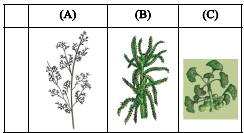
A
$A-$ Fucus $B-$Selaginell $C-$Ginkgo
B
$A-$ Polysiphonia $B-$ Sphagnum $C-$ Ginkgo
C
$A-$ Polysiphonia $B-$ Sphagnum $C-$ Salvinia
D
$A-$ Fucus $B-$ Selaginell $C-$ Salvinia
0 likes
View Solution262
MediumMCQ
Oogamy with non-motile gametes occurs in $:-$
A
Fucus
B
Polysiphonia
C
Gelidium
D
$2$ and $3$ both
Solution
(D) Oogamy is a form of sexual reproduction where a large,non-motile female gamete (egg) is fertilized by a smaller,motile or non-motile male gamete.
In the class $Rhodophyceae$ (Red algae),such as $Polysiphonia$ and $Gelidium$,sexual reproduction is oogamous,and both the male and female gametes are non-motile.
$Fucus$ (a brown alga) also exhibits oogamy,but its male gametes are motile (flagellated).
Therefore,$Polysiphonia$ and $Gelidium$ both exhibit oogamy with non-motile gametes.
In the class $Rhodophyceae$ (Red algae),such as $Polysiphonia$ and $Gelidium$,sexual reproduction is oogamous,and both the male and female gametes are non-motile.
$Fucus$ (a brown alga) also exhibits oogamy,but its male gametes are motile (flagellated).
Therefore,$Polysiphonia$ and $Gelidium$ both exhibit oogamy with non-motile gametes.
0 likes
View Solution263
EasyMCQ
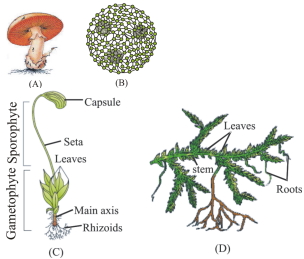
Identify the following figures and choose the correct option $:-$
A
$A \rightarrow$ Mucor,$B \rightarrow$ Laminaria,$C \rightarrow$ Sphagnum,$D \rightarrow$ Salvinia
B
$A \rightarrow$ Mucor,$B \rightarrow$ Volvox,$C \rightarrow$ Funaria,$D \rightarrow$ Sphagnum
C
$A \rightarrow$ Agaricus,$B \rightarrow$ Funaria,$C \rightarrow$ Volvox,$D \rightarrow$ Selaginella
D
$A \rightarrow$ Agaricus,$B \rightarrow$ Volvox,$C \rightarrow$ Funaria,$D \rightarrow$ Selaginella
Solution
(D) Based on the provided figures:
$A$ represents $Agaricus$,a type of mushroom (Basidiomycetes).
$B$ represents $Volvox$,a colonial green alga.
$C$ represents $Funaria$,a moss (Bryophyte) showing both gametophyte and sporophyte stages.
$D$ represents $Selaginella$,a pteridophyte.
Therefore,the correct option is $D$.
$A$ represents $Agaricus$,a type of mushroom (Basidiomycetes).
$B$ represents $Volvox$,a colonial green alga.
$C$ represents $Funaria$,a moss (Bryophyte) showing both gametophyte and sporophyte stages.
$D$ represents $Selaginella$,a pteridophyte.
Therefore,the correct option is $D$.
0 likes
View Solution264
MediumMCQ
Non-motile gametes are formed in $:-$
A
Nostoc
B
Fucus
C
Polysiphonia
D
$(1) \& (3)$ both
Solution
(D) In $Nostoc$ (a cyanobacterium),reproduction occurs through non-motile spores like akinetes,hormogonia,or heterocysts,and gametes are not formed in the traditional sense as it is a prokaryote. However,in the context of algae and related organisms,$Polysiphonia$ (a red alga) is characterized by the complete absence of flagellated or motile stages in its life cycle,meaning its gametes are non-motile. $Fucus$ (a brown alga) produces motile male gametes (sperms). Therefore,both $Nostoc$ and $Polysiphonia$ represent organisms where motile gametes are absent. Thus,the correct option is $(1) \& (3)$.
0 likes
View Solution265
MediumMCQ
What is common among $Porphyra$,$Agaricus$,$Chlorella$,and $Spirulina$?
A
They all are photosynthetic
B
They have eukaryotic cell organization
C
They all are single celled
D
They all are used as food or food supplements
Solution
(D) $Porphyra$ is a red alga,$Agaricus$ is a fungus (mushroom),$Chlorella$ is a unicellular green alga,and $Spirulina$ is a cyanobacterium.
While they differ in their biological classification,cellular organization,and mode of nutrition,they all share the common characteristic of being used as food or food supplements by humans due to their high protein or nutrient content.
$Chlorella$ and $Spirulina$ are unicellular algae used as protein-rich food supplements.
$Porphyra$ is an edible seaweed.
$Agaricus$ is a widely consumed edible mushroom.
While they differ in their biological classification,cellular organization,and mode of nutrition,they all share the common characteristic of being used as food or food supplements by humans due to their high protein or nutrient content.
$Chlorella$ and $Spirulina$ are unicellular algae used as protein-rich food supplements.
$Porphyra$ is an edible seaweed.
$Agaricus$ is a widely consumed edible mushroom.
0 likes
View Solution266
EasyMCQ
Which one of the following statements is wrong?
A
Agar-Agar is obtained from Gelidium and Gracilaria.
B
Chlorella and Spirulina are used as space food.
C
Mannitol is stored food in Phaeophyceae.
D
Algin and Carrageen are products of fungi.
Solution
(D) $1$. Agar-Agar is a commercial product obtained from red algae like Gelidium and Gracilaria. This statement is correct.
$2$. Chlorella and Spirulina are unicellular algae rich in proteins and are used as food supplements by space travelers. This statement is correct.
$3$. In Phaeophyceae (brown algae),the stored food material is in the form of complex carbohydrates,usually in the form of laminarin or mannitol. This statement is correct.
$4$. Algin (from brown algae) and Carrageen (from red algae) are phycocolloids obtained from algae,not fungi. Therefore,the statement that they are products of fungi is incorrect.
$2$. Chlorella and Spirulina are unicellular algae rich in proteins and are used as food supplements by space travelers. This statement is correct.
$3$. In Phaeophyceae (brown algae),the stored food material is in the form of complex carbohydrates,usually in the form of laminarin or mannitol. This statement is correct.
$4$. Algin (from brown algae) and Carrageen (from red algae) are phycocolloids obtained from algae,not fungi. Therefore,the statement that they are products of fungi is incorrect.
0 likes
View Solution267
MediumMCQ
Read the given examples carefully: Gelidium,Chara,Spirulina,Chlorella,Fucus,Gracilaria,Polysiphonia,Laminaria,Sargassum,Sphagnum,Dictyota,Ectocarpus. How many of them belong to Red,Brown,and Green algae respectively?
A
$3, 5 \& 2$
B
$4, 6 \& 2$
C
$2, 5 \& 3$
D
$3, 6 \& 3$
Solution
(A) To determine the classification of the given organisms:
$1$. Red Algae (Rhodophyceae): Gelidium,Gracilaria,Polysiphonia. (Total = $3$)
$2$. Brown Algae (Phaeophyceae): Fucus,Laminaria,Sargassum,Dictyota,Ectocarpus. (Total = $5$)
$3$. Green Algae (Chlorophyceae): Chara,Chlorella. (Total = $2$)
Note: Spirulina is a Cyanobacteria (Blue-green algae) and Sphagnum is a Bryophyte (Moss),so they are excluded from the algae categories mentioned.
Thus,the count is $3$ Red,$5$ Brown,and $2$ Green algae. The correct option is $A$.
$1$. Red Algae (Rhodophyceae): Gelidium,Gracilaria,Polysiphonia. (Total = $3$)
$2$. Brown Algae (Phaeophyceae): Fucus,Laminaria,Sargassum,Dictyota,Ectocarpus. (Total = $5$)
$3$. Green Algae (Chlorophyceae): Chara,Chlorella. (Total = $2$)
Note: Spirulina is a Cyanobacteria (Blue-green algae) and Sphagnum is a Bryophyte (Moss),so they are excluded from the algae categories mentioned.
Thus,the count is $3$ Red,$5$ Brown,and $2$ Green algae. The correct option is $A$.
0 likes
View Solution268
EasyMCQ
Match the Column-$I$ with Column-$II$ and choose the correct option from the following:
| Column-$I$ (Plant groups) | Column-$II$ (Examples) |
|---|---|
| $1$. Bryophyta | $p$. Pinus |
| $2$. Gymnosperm | $q$. Adiantum |
| $3$. Algae | $r$. Sphagnum |
| $4$. Pteridophyta | $s$. Ectocarpus |
A
$1-q, 2-s, 3-p, 4-r$
B
$1-s, 2-q, 3-p, 4-r$
C
$1-r, 2-p, 3-s, 4-q$
D
$1-q, 2-p, 3-s, 4-r$
Solution
(C) The correct matching is as follows:
$1$. Bryophyta: $r$. Sphagnum (a moss).
$2$. Gymnosperm: $p$. Pinus (a conifer).
$3$. Algae: $s$. Ectocarpus (a brown alga).
$4$. Pteridophyta: $q$. Adiantum (a fern).
Therefore,the correct sequence is $1-r, 2-p, 3-s, 4-q$.
$1$. Bryophyta: $r$. Sphagnum (a moss).
$2$. Gymnosperm: $p$. Pinus (a conifer).
$3$. Algae: $s$. Ectocarpus (a brown alga).
$4$. Pteridophyta: $q$. Adiantum (a fern).
Therefore,the correct sequence is $1-r, 2-p, 3-s, 4-q$.
0 likes
View Solution269
EasyMCQ
In which of the following groups do the male and female gametophytes have independent,free-living existence?
A
Bryophytes and gymnosperms
B
Bryophytes and pteridophytes
C
Pteridophytes and gymnosperms
D
Algae and gymnosperms
Solution
(B) The correct answer is $B$.
In $Bryophytes$,the gametophyte is the dominant phase and is independent.
In $Pteridophytes$,the gametophyte (prothallus) is small,multicellular,and usually independent and free-living.
In $Gymnosperms$ and $Angiosperms$,the gametophytes are reduced and dependent on the sporophyte for nutrition and protection.
In $Bryophytes$,the gametophyte is the dominant phase and is independent.
In $Pteridophytes$,the gametophyte (prothallus) is small,multicellular,and usually independent and free-living.
In $Gymnosperms$ and $Angiosperms$,the gametophytes are reduced and dependent on the sporophyte for nutrition and protection.
0 likes
View Solution270
EasyMCQ
Match the plant structures given in Column-$I$ with their plants given in Column-$II$.
| Column-$I$ | Column-$II$ |
|---|---|
| $(A)$ Prothallus | $(q)$ Pteridophytes |
| $(B)$ Microsporophyll | $(s)$ Gymnosperms |
| $(C)$ Protonema | $(p)$ Bryophytes |
| $(D)$ $PEN$ | $(r)$ Angiosperms |
A
$A-r; B-p; C-s; D-q$
B
$A-s; B-r; C-p; D-q$
C
$A-q; B-s; C-r; D-p$
D
$A-q; B-s; C-p; D-r$
Solution
(D) The correct matches are as follows:
$1$. $(A)$ Prothallus: It is the free-living,photosynthetic,thalloid gametophyte stage found in Pteridophytes $(q)$.
$2$. $(B)$ Microsporophyll: These are leaf-like structures that bear microsporangia,characteristic of Gymnosperms $(s)$.
$3$. $(C)$ Protonema: It is the creeping,green,branched,and filamentous stage in the life cycle of mosses,which are Bryophytes $(p)$.
$4$. $(D)$ $PEN$ (Primary Endosperm Nucleus): It is formed by triple fusion during double fertilization,which is a unique feature of Angiosperms $(r)$.
Therefore,the correct matching is $A-q, B-s, C-p, D-r$.
$1$. $(A)$ Prothallus: It is the free-living,photosynthetic,thalloid gametophyte stage found in Pteridophytes $(q)$.
$2$. $(B)$ Microsporophyll: These are leaf-like structures that bear microsporangia,characteristic of Gymnosperms $(s)$.
$3$. $(C)$ Protonema: It is the creeping,green,branched,and filamentous stage in the life cycle of mosses,which are Bryophytes $(p)$.
$4$. $(D)$ $PEN$ (Primary Endosperm Nucleus): It is formed by triple fusion during double fertilization,which is a unique feature of Angiosperms $(r)$.
Therefore,the correct matching is $A-q, B-s, C-p, D-r$.
0 likes
View Solution271
EasyMCQ
Match the storage products listed under Column-$I$ with the organisms given under Column-$II$. Choose the appropriate option from the given choices.
| Column $I$ | Column $II$ |
|---|---|
| $A$. Glycogen | $t$. Agaricus |
| $B$. Pyrenoids | $s$. Spirogyra |
| $C$. Laminarin and mannitol | $p$. Sargassum |
| $D$. Floridean starch | $r$. Polysiphonia |
A
$A-t, B-s, C-p, D-r$
B
$A-r, B-s, C-p, D-t$
C
$A-q, B-p, C-s, D-r$
D
$A-s, B-r, C-t, D-q$
Solution
(A) The correct matching is as follows:
$1$. $A$. Glycogen: It is the stored food material in fungi,such as $Agaricus$ $(t)$.
$2$. $B$. Pyrenoids: These are proteinaceous storage bodies found in the chloroplasts of green algae,such as $Spirogyra$ $(s)$.
$3$. $C$. Laminarin and mannitol: These are the characteristic stored food products of brown algae,such as $Sargassum$ $(p)$.
$4$. $D$. Floridean starch: This is the stored food material in red algae,which is very similar to amylopectin and glycogen in structure,such as $Polysiphonia$ $(r)$.
Therefore,the correct sequence is $A-t, B-s, C-p, D-r$.
$1$. $A$. Glycogen: It is the stored food material in fungi,such as $Agaricus$ $(t)$.
$2$. $B$. Pyrenoids: These are proteinaceous storage bodies found in the chloroplasts of green algae,such as $Spirogyra$ $(s)$.
$3$. $C$. Laminarin and mannitol: These are the characteristic stored food products of brown algae,such as $Sargassum$ $(p)$.
$4$. $D$. Floridean starch: This is the stored food material in red algae,which is very similar to amylopectin and glycogen in structure,such as $Polysiphonia$ $(r)$.
Therefore,the correct sequence is $A-t, B-s, C-p, D-r$.
0 likes
View Solution272
EasyMCQ
Mosses and ferns are
A
Thallophytes of plant kingdom
B
Angiosperms of plant kingdom
C
Gymnosperms of plant kingdom
D
Amphibians of plant kingdom
Solution
(D) Amphibians of plant kingdom.
Mosses (Bryophytes) and ferns (Pteridophytes) are referred to as the "amphibians of the plant kingdom".
This is because they require water for the process of fertilization, as their male gametes are motile and need a water medium to reach the female gametes.
This dependency on water for reproduction is analogous to the life cycle of amphibians in the animal kingdom.
Mosses (Bryophytes) and ferns (Pteridophytes) are referred to as the "amphibians of the plant kingdom".
This is because they require water for the process of fertilization, as their male gametes are motile and need a water medium to reach the female gametes.
This dependency on water for reproduction is analogous to the life cycle of amphibians in the animal kingdom.
0 likes
View SolutionPlant Kingdom — Mix Examples- Plant Kingdom · Frequently Asked Questions
1Are these Plant Kingdom questions useful for JEE and NEET?
Yes. All questions in this section are mapped to JEE Main and NEET exam patterns. Previous year questions from JEE Main, NEET, GUJCET and state-level exams are included with full solutions.
2Can I switch to Hindi or Gujarati for these questions?
Yes. Use the language tabs in the hero section or the sidebar to view the same questions and solutions in English, Hindi or Gujarati.
3How do I generate a question paper from this subtopic?
Use the Vedclass Exam Paper Generator — select the chapter and subtopic, set difficulty, and generate Sets A, B, C, D automatically. First 3 chapters of every subject are free.
Vedclass Products
For Students
Vedclass Test Series
Mock tests in real JEE/NEET style with performance analysis. 5-day free trial.
Start Free TrialFor Teachers
Exam Paper Generator
Generate Set A/B/C/D papers from this chapter in 2 minutes. 3 chapters free.
Try FreeFor Institutes
Online Exam Module
Live online exams with unlimited students, 360° analytics & white-label branding.
See DemoFor Teachers & Institutes
Generate a Plant Kingdom Exam Paper in 2 Minutes
Select subtopic & difficulty — Sets A, B, C, D auto-generated with No Repeat logic.
First 3 chapters of every subject are free — no payment required.