
A English
Inflorescence Questions in English
Class 11 Biology · Morphology of Flowering Plants · Inflorescence
134+
Questions
English
Language
100%
With Solutions
Showing 34 of 134 questions in English
101
MediumMCQ
In which of the following is a cymose inflorescence found?
A
Solanum
B
Sesbania
C
Trifolium
D
Brassica
Solution
(A) In a cymose inflorescence,the main axis terminates in a flower,hence it is limited in growth. The flowers are borne in a basipetal order. Among the given options,$Solanum$ (a member of the Solanaceae family) exhibits a cymose inflorescence. In contrast,$Sesbania$,$Trifolium$,and $Brassica$ exhibit a racemose inflorescence where the main axis continues to grow.
0 likes
View Solution102
MediumMCQ
Composite fruit develops from
A
single ovary
B
inflorescence
C
apocarpous ovary
D
pericarp
Solution
(B) Composite fruits,also known as multiple fruits,develop from the entire inflorescence rather than a single flower.
These are primarily of $2$ types: sorosis and syconus.
$1$. Sorosis develops from spike,spadix,or catkin inflorescences (e.g.,$Ananas$,$Artocarpus$).
$2$. Syconus develops from hypanthodium inflorescence (e.g.,$Ficus$).
These are primarily of $2$ types: sorosis and syconus.
$1$. Sorosis develops from spike,spadix,or catkin inflorescences (e.g.,$Ananas$,$Artocarpus$).
$2$. Syconus develops from hypanthodium inflorescence (e.g.,$Ficus$).
0 likes
View Solution103
Medium
Differentiate between Racemose and Cymose inflorescence.
Solution
(N/A)
| Racemose Inflorescence | Cymose Inflorescence |
| $(1)$ Younger flowers are present at the tip,while older flowers are arranged at the base. This is called acropetal succession. | $(1)$ Younger flowers are present at the base,while older flowers are present at the top. This is called basipetal succession. |
| $(2)$ The main axis continues to grow and produces flowers laterally. | $(2)$ The main axis has limited growth and terminates into a flower. |
0 likes
View Solution104
Difficult
Define the term inflorescence. Explain the basis for the different types of inflorescence in flowering plants.
Solution
(N/A) Inflorescence is defined as the arrangement of flowers on the floral axis.
During the flowering season,the vegetative apex of the stem is modified into a floral meristem.
The basis for the classification of inflorescence is the growth pattern of the floral axis.
If the floral axis continues to grow,it is called racemose inflorescence,where flowers are borne laterally in an acropetal succession.
If the main axis terminates in a flower,it is called cymose inflorescence,where flowers are borne in a basipetal order and growth is limited.
During the flowering season,the vegetative apex of the stem is modified into a floral meristem.
The basis for the classification of inflorescence is the growth pattern of the floral axis.
If the floral axis continues to grow,it is called racemose inflorescence,where flowers are borne laterally in an acropetal succession.
If the main axis terminates in a flower,it is called cymose inflorescence,where flowers are borne in a basipetal order and growth is limited.
0 likes
View Solution105
Medium
What is inflorescence? Describe its types.
Solution
(N/A) $\rightarrow$ $A$ flower is a modified shoot wherein the shoot apical meristem changes to floral meristem. Internodes do not elongate and the axis gets condensed. The apex produces different kinds of floral appendages laterally at successive nodes instead of leaves.
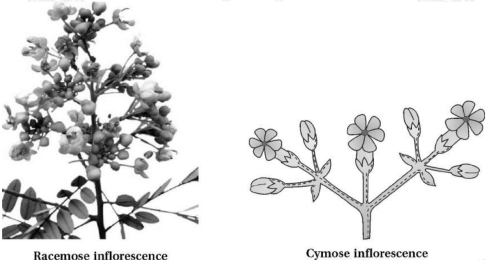
$\rightarrow$ When a shoot tip transforms into a flower,it is always solitary. The arrangement of flowers on the floral axis is termed as inflorescence. Depending on whether the apex gets converted into a flower or continues to grow,two major types of inflorescences are defined: $(i)$ Racemose $(ii)$ Cymose.
$\rightarrow$ Racemose Inflorescence: In the racemose type of inflorescence,the main axis continues to grow,and the flowers are borne laterally in an acropetal succession.
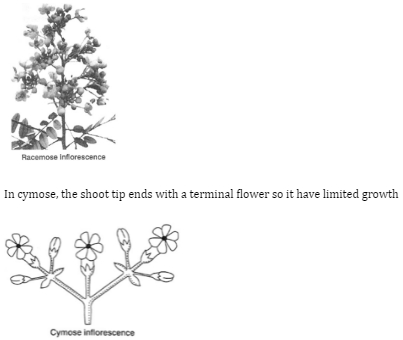
$\rightarrow$ Cymose Inflorescence: In the cymose type of inflorescence,the main axis terminates in a flower,hence its growth is limited. The flowers are borne in a basipetal order.
$\rightarrow$ When a shoot tip transforms into a flower,it is always solitary. The arrangement of flowers on the floral axis is termed as inflorescence. Depending on whether the apex gets converted into a flower or continues to grow,two major types of inflorescences are defined: $(i)$ Racemose $(ii)$ Cymose.
$\rightarrow$ Racemose Inflorescence: In the racemose type of inflorescence,the main axis continues to grow,and the flowers are borne laterally in an acropetal succession.
$\rightarrow$ Cymose Inflorescence: In the cymose type of inflorescence,the main axis terminates in a flower,hence its growth is limited. The flowers are borne in a basipetal order.
0 likes
View Solution106
Easy
Differentiate between Racemose inflorescence and Cymose inflorescence.
Solution
(N/A)
| Racemose Inflorescence | Cymose Inflorescence |
|---|---|
| $1$. The main axis continues to grow and the apical bud is not converted into a flower. | $1$. The main axis terminates in a flower,as the apical bud gets converted into a flower. |
| $2$. The growth of the floral axis is indefinite or continuous. | $2$. The growth of the floral axis is definite or limited. |
| $3$. Flowers are borne in an acropetal succession (older flowers at the base,younger at the tip). | $3$. Flowers are borne in a basipetal succession (older flowers at the tip,younger at the base). |
| $4$. Examples include $Mustard$ and $Radish$. | $4$. Examples include $Jasmine$ and $Begonia$. |
0 likes
View Solution107
Easy
Sunflower is not a single flower. Explain.
Solution
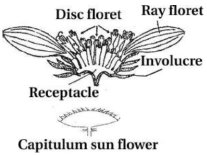
(N/A) $ \Rightarrow $ Sunflower is not a single flower but a type of inflorescence known as a capitulum (or head), in which the receptacle is flattened.
It consists of many small, sessile flowers called florets.
The youngest florets are in the centre, and the oldest are located towards the periphery (centripetal arrangement).
The entire group of florets is surrounded by a whorl of bracts called an involucre.
Two types of florets are seen in a sunflower:
$(i)$ Ray florets: These are arranged on the periphery of the receptacle. They possess large, yellow, strap-like petals. These florets are typically female (pistillate), sessile, and zygomorphic.
$(ii)$ Disc florets: These are located in the centre of the receptacle. They are bisexual and actinomorphic.
It consists of many small, sessile flowers called florets.
The youngest florets are in the centre, and the oldest are located towards the periphery (centripetal arrangement).
The entire group of florets is surrounded by a whorl of bracts called an involucre.
Two types of florets are seen in a sunflower:
$(i)$ Ray florets: These are arranged on the periphery of the receptacle. They possess large, yellow, strap-like petals. These florets are typically female (pistillate), sessile, and zygomorphic.
$(ii)$ Disc florets: These are located in the centre of the receptacle. They are bisexual and actinomorphic.
0 likes
View Solution108
MediumMCQ
Capitulum inflorescence is found in
A
Compositae (Asteraceae)
B
Cruciferae (Brassicaceae)
C
Solanaceae
D
Malvaceae
Solution
(A) The capitulum (or head) inflorescence is a characteristic feature of the family $Compositae$,which is also known as $Asteraceae$. In this type of inflorescence,the main axis becomes flattened to form a receptacle,which bears many small,sessile flowers called florets.
0 likes
View Solution109
EasyMCQ
In cauliflower,the inflorescence is
A
Corymbose
B
Cymose
C
Raceme
D
Capitulum
Solution
(A) In cauliflower,the inflorescence is typically $Corymbose$ at the apex. In this type of inflorescence,the main axis is shortened,and the flowers arise from different levels but reach almost the same height due to the varying lengths of the pedicels.
0 likes
View Solution110
EasyMCQ
Number of female flowers in a $Cyathium$ inflorescence is
A
One
B
Two
C
Three
D
Several
Solution
(A) In a $Cyathium$ inflorescence,the structure consists of a single,centrally located female flower surrounded by numerous male flowers.
These flowers are enclosed within a cup-shaped involucre,which is formed by fused bracts.
These flowers are enclosed within a cup-shaped involucre,which is formed by fused bracts.
0 likes
View Solution111
MediumMCQ
Which of the following pairs is not correct?
A
Corymb-Candytuft
B
Capitulum-Sunflower
C
Catkin-Mulberry
D
Raceme-Wheat
Solution
(D) In a $Raceme$ inflorescence,the main axis is elongated and bears pedicellate flowers in an acropetal succession. Wheat does not have a $Raceme$ inflorescence; instead,it possesses a $Compound$ $Spike$ (or $Spikelet$) inflorescence. Therefore,the pair $Raceme-Wheat$ is incorrect.
0 likes
View Solution112
EasyMCQ
The inflorescence in $Ocimum$ is
A
Cyathium
B
Verticillaster
C
Hypanthodium
D
Raceme
Solution
(B) The inflorescence found in $Ocimum$ (Tulsi) is known as $Verticillaster$.
$Verticillaster$ is a special type of inflorescence characterized by a pair of condensed cymes at the nodes of the stem,which are arranged in opposite axils.
These cymes initially develop as biparous cymes and later continue as uniparous scorpioid cymes on either side.
This type of inflorescence is a characteristic feature of the family $Lamiaceae$ (formerly $Labiatae$).
$Verticillaster$ is a special type of inflorescence characterized by a pair of condensed cymes at the nodes of the stem,which are arranged in opposite axils.
These cymes initially develop as biparous cymes and later continue as uniparous scorpioid cymes on either side.
This type of inflorescence is a characteristic feature of the family $Lamiaceae$ (formerly $Labiatae$).
0 likes
View Solution113
EasyMCQ
The capitulum type of inflorescence is found in
A
Marigold
B
Salvia
C
Euphorbia
D
Jasmine
Solution
(A) The head or capitulum inflorescence consists of mono- or dimorphic florets borne on a condensed axis known as the receptacle.
These florets are arranged in an acropetal manner but appear centripetal due to the significant condensation of the floral axis.
Examples of plants exhibiting this type of inflorescence include $Launea$,$Ageratum$,$Vernonia$,$Dahlia$,$Helianthus$ (sunflower),and $Marigold$.
These florets are arranged in an acropetal manner but appear centripetal due to the significant condensation of the floral axis.
Examples of plants exhibiting this type of inflorescence include $Launea$,$Ageratum$,$Vernonia$,$Dahlia$,$Helianthus$ (sunflower),and $Marigold$.
0 likes
View Solution114
MediumMCQ
Main axis continues to grow,the flowers are borne laterally in acropetal succession. This is a characteristic of which type of inflorescence?
A
Cymose
B
Racemose
C
Either $(a)$ or $(b)$
D
Both $(a)$ and $(b)$
Solution
(B) The correct answer is $B$ (Racemose).
In a $Racemose$ inflorescence,the main axis continues to grow indefinitely and does not terminate in a flower.
The flowers are borne laterally in an acropetal succession,meaning the older flowers are at the base and the younger flowers are towards the apex.
Examples include radish and mustard.
In contrast,in a $Cymose$ inflorescence,the main axis terminates in a flower,resulting in limited growth,and the flowers are borne in a basipetal succession.
In a $Racemose$ inflorescence,the main axis continues to grow indefinitely and does not terminate in a flower.
The flowers are borne laterally in an acropetal succession,meaning the older flowers are at the base and the younger flowers are towards the apex.
Examples include radish and mustard.
In contrast,in a $Cymose$ inflorescence,the main axis terminates in a flower,resulting in limited growth,and the flowers are borne in a basipetal succession.
0 likes
View Solution115
MediumMCQ
In a plant,the peduncle is elongated and it bears pedicillate flowers. The older flowers lie towards the base and the younger ones near the apex. The growth of the peduncle continues and more flowers are added. The inflorescence is
A
Raceme
B
Corymb
C
Umbel
D
Head
Solution
(A) $Raceme$ is a type of racemose inflorescence in which pedicellate (stalked) flowers are arranged acropetally on an elongated,unbranched,and continuously growing peduncle. In this arrangement,the older flowers are located at the base,while the younger flowers are found near the apex. Examples include $Mustard$ and $Radish$.
0 likes
View Solution116
MediumMCQ
Cyathium inflorescence shows
A
Scorpioid cyme showing central female,many peripheral male flowers
B
Scorpioid cyme showing central male,many peripheral female flowers
C
Dichasial cyme showing two whorls of $3$ to $9$ flowers
D
Dichasial cyme showing two whorls,one of male and another of female flowers
Solution
(A) $Cyathium$ inflorescence consists of five involucres that fuse to form a cup-shaped structure.
This structure surrounds a single,large,achlamydeous (sepals and petals absent),pedicellate,tricarpellary,and syncarpous female flower located in the center.
Numerous,achlamydeous,pedicellate,and centrifugally arranged male flowers (each represented by a single stamen) are arranged in a scorpioid cyme pattern surrounding the central female flower.
This type of inflorescence is a characteristic feature of the genus $Euphorbia$ in the family $Euphorbiaceae$.
This structure surrounds a single,large,achlamydeous (sepals and petals absent),pedicellate,tricarpellary,and syncarpous female flower located in the center.
Numerous,achlamydeous,pedicellate,and centrifugally arranged male flowers (each represented by a single stamen) are arranged in a scorpioid cyme pattern surrounding the central female flower.
This type of inflorescence is a characteristic feature of the genus $Euphorbia$ in the family $Euphorbiaceae$.
0 likes
View Solution117
MediumMCQ
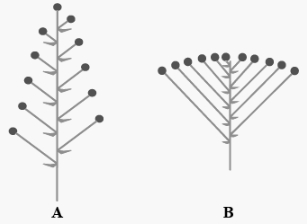
Identify the type of inflorescence in the given diagrams ($A$ and $B$).
A
$A$-Racemose; $B$-Racemose
B
$A$-Racemose; $B$-Cymose
C
$A$-Cymose; $B$-Racemose
D
$A$-Cymose; $B$-Cymose
Solution
(B) Inflorescence is the arrangement of flowers on the floral axis.
$1$. In a Racemose inflorescence (diagram $A$),the main axis continues to grow indefinitely and the flowers are borne laterally in an acropetal succession.
$2$. In a Cymose inflorescence (diagram $B$),the main axis terminates in a flower,hence the growth is limited. The flowers are borne in a basipetal order.
Therefore,$A$ represents Racemose and $B$ represents Cymose inflorescence.
$1$. In a Racemose inflorescence (diagram $A$),the main axis continues to grow indefinitely and the flowers are borne laterally in an acropetal succession.
$2$. In a Cymose inflorescence (diagram $B$),the main axis terminates in a flower,hence the growth is limited. The flowers are borne in a basipetal order.
Therefore,$A$ represents Racemose and $B$ represents Cymose inflorescence.
0 likes
View Solution118
MediumMCQ
Inflorescence in jowar is
A
Corymb
B
Spike
C
Panicle
D
Head
Solution
(C) In jowar $(Sorghum \text{ } vulgare)$, the inflorescence is typically a compact panicle, though it can sometimes be a loose and spreading panicle.
0 likes
View Solution119
MediumMCQ
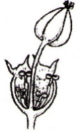
The above inflorescence is a/an
A
Cyathium
B
Dichasial cyme
C
Umbel
D
Panicle
Solution
(A) Cyathium is the characteristic inflorescence of the genus $Euphorbia$ (but not of the family $Euphorbiaceae$).
In a cyathium,five involucres fuse to form a cup-shaped structure.
This structure bears a single large female flower in the center,which is surrounded by numerous,free male flowers.
In a cyathium,five involucres fuse to form a cup-shaped structure.
This structure bears a single large female flower in the center,which is surrounded by numerous,free male flowers.
0 likes
View Solution120
EasyMCQ
Inflorescence with a thick,fleshy axis and large coloured bracts is known as:
A
Spathe
B
Spadix
C
Spikelet
D
Hypanthodium
Solution
(B) $Spadix$ is a type of inflorescence characterized by a thick,fleshy axis (peduncle) that bears small,unisexual flowers. This axis is often enclosed or subtended by a large,leaf-like,and sometimes brightly coloured bract known as a $Spathe$.
0 likes
View Solution121
EasyMCQ
Bisexual,sessile and bracteate flowers develop acropetally in
A
Raceme
B
Panicle
C
Spike
D
Corymb
Solution
(C) In a spike inflorescence,the flowers are bisexual,sessile (without a stalk),and bracteate (possessing a bract). These flowers are arranged on an elongated peduncle in an acropetal manner,meaning the youngest flowers are at the apex and the oldest are at the base.
0 likes
View Solution122
MediumMCQ
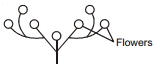
Which kind of inflorescence is shown in the figure given below?
A
Simple dichasial cymose
B
Verticillaster
C
Simple monochasial cymose
D
Polychasial cymose
Solution
(D) The figure illustrates a type of cymose inflorescence where the main axis terminates in a flower. From the base of this terminal flower,two lateral branches arise,each of which also terminates in a flower. This pattern of branching,where two lateral branches are produced from the base of a terminal flower,is characteristic of a dichasial cyme. In the provided diagram,this branching pattern continues,representing a compound or branched dichasial cyme,which is a form of polychasial cyme where multiple branches arise. Therefore,the correct classification for the shown inflorescence is Polychasial cymose.
0 likes
View Solution123
MediumMCQ
Find the odd one (w.r.t. inflorescence axis elongation).
A
Umbel
B
Spike
C
Raceme
D
Catkin
Solution
(A) In $Spike$,$raceme$,and $catkin$,the floral axis (peduncle) is elongated,and flowers are arranged along this axis.
In an $umbel$,the floral axis is highly reduced,and all flowers arise from a single point at the apex of the peduncle.
Therefore,$umbel$ is the odd one out.
In an $umbel$,the floral axis is highly reduced,and all flowers arise from a single point at the apex of the peduncle.
Therefore,$umbel$ is the odd one out.
0 likes
View Solution124
MediumMCQ
The type of inflorescence characterized by having dimorphic flowers is
A
Catkin
B
Umbel
C
Corymb
D
Capitulum
Solution
(D) In a $Capitulum$ (or $Head$) inflorescence,the flowers are arranged on a flattened receptacle. This type of inflorescence is characterized by the presence of dimorphic flowers: the peripheral $Ray$ $florets$ (which are zygomorphic) and the central $Disc$ $florets$ (which are actinomorphic).
0 likes
View Solution125
MediumMCQ
In Head or Capitulum inflorescence,which of the following statements is correct regarding the florets?
A
Ray florets: pistillate and neuter; actinomorphic
B
Disc florets: bisexual; zygomorphic
C
Ray florets: pistillate or neuter; zygomorphic
D
Disc florets: pistillate; actinomorphic
Solution
(C) In a Capitulum or Head inflorescence (characteristic of the family Asteraceae),there are two types of florets:
$1$. Ray florets: These are located at the periphery. They are either pistillate (female) or neuter (sterile) and are zygomorphic (bilaterally symmetrical).
$2$. Disc florets: These are located in the center. They are bisexual (containing both male and female parts) and actinomorphic (radially symmetrical).
$1$. Ray florets: These are located at the periphery. They are either pistillate (female) or neuter (sterile) and are zygomorphic (bilaterally symmetrical).
$2$. Disc florets: These are located in the center. They are bisexual (containing both male and female parts) and actinomorphic (radially symmetrical).
0 likes
View Solution126
MediumMCQ
$A$: In head inflorescence,florets are arranged centrifugally.
$R$: There always occur two types of florets in a head.
$R$: There always occur two types of florets in a head.
A
Assertion and Reason both are correct and Reason is the correct explanation of Assertion.
B
Assertion and Reason both are correct but Reason is not the correct explanation of Assertion.
C
Assertion is correct,but Reason is incorrect.
D
Both Assertion and Reason are incorrect.
Solution
(D) In a head (capitulum) inflorescence,the florets are arranged centripetally,meaning the peripheral florets mature first and the central florets mature later. Thus,Assertion $(A)$ is incorrect.
It is not necessary that there are always two types of florets in a head; sometimes it may contain only one type of floret (e.g.,only ray florets or only disc florets). Thus,Reason $(R)$ is also incorrect.
It is not necessary that there are always two types of florets in a head; sometimes it may contain only one type of floret (e.g.,only ray florets or only disc florets). Thus,Reason $(R)$ is also incorrect.
0 likes
View Solution127
MediumMCQ
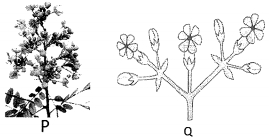
Identify the given types of inflorescence.
$P \quad Q$
$P \quad Q$
A
Racemose $\quad$ Cymose
B
Cymose $\quad$ Racemose
C
Racemose $\quad$ Racemose
D
Cymose $\quad$ Cymose
Solution
(A) In a Racemose inflorescence (represented by $P$),the main axis continues to grow,and the flowers are borne in an acropetal succession.
In a Cymose inflorescence (represented by $Q$),the main axis terminates in a flower,and the flowers are borne in a basipetal succession.
Therefore,$P$ is Racemose and $Q$ is Cymose.
In a Cymose inflorescence (represented by $Q$),the main axis terminates in a flower,and the flowers are borne in a basipetal succession.
Therefore,$P$ is Racemose and $Q$ is Cymose.
0 likes
View Solution128
MediumMCQ
Assertion: The cymose type of inflorescence has limited growth.
Reason: In cymose inflorescence the main axis terminates in a flower.
Reason: In cymose inflorescence the main axis terminates in a flower.
A
Both Assertion and Reason are true and Reason is the correct explanation of Assertion.
B
Both Assertion and Reason are true but Reason is not the correct explanation of Assertion.
C
Assertion is true but Reason is false.
D
Both Assertion and Reason are false.
Solution
(A) In a cymose inflorescence,the main axis terminates in a flower,which limits its growth.
Because the main axis ends in a flower,the growth of the floral axis is determinate or limited.
Therefore,the Assertion is true,and the Reason correctly explains why the growth is limited.
Because the main axis ends in a flower,the growth of the floral axis is determinate or limited.
Therefore,the Assertion is true,and the Reason correctly explains why the growth is limited.
0 likes
View Solution129
MediumMCQ
Development of flowers in a cymose inflorescence is $:-$
A
Centripetal
B
Centrifugal
C
Basipetal
D
Acropetal
Solution
(B) In a cymose inflorescence,the main axis terminates in a flower,hence the growth is limited.
In this type of arrangement,the older flowers are present at the apex (or center) and the younger flowers are produced towards the base (or periphery).
This pattern of development,where the central or terminal flower matures first,is known as centrifugal development.
In contrast,racemose inflorescence shows acropetal development,where younger flowers are at the apex.
In this type of arrangement,the older flowers are present at the apex (or center) and the younger flowers are produced towards the base (or periphery).
This pattern of development,where the central or terminal flower matures first,is known as centrifugal development.
In contrast,racemose inflorescence shows acropetal development,where younger flowers are at the apex.
0 likes
View Solution130
MediumMCQ
In the cymose inflorescence $:-$
A
Floral axis is unlimited in growth
B
Flowers are borne in basipetal order
C
Flowers are borne in acropetal order
D
Spike and catkin are the examples of such inflorescence
Solution
(B) In a cymose inflorescence,the main axis terminates in a flower,hence it is limited in growth.
The flowers are borne in a basipetal order,meaning the older flowers are at the top and the younger flowers are at the base.
In contrast,racemose inflorescence shows acropetal order and unlimited growth of the floral axis.
Spike and catkin are types of racemose inflorescence,not cymose.
The flowers are borne in a basipetal order,meaning the older flowers are at the top and the younger flowers are at the base.
In contrast,racemose inflorescence shows acropetal order and unlimited growth of the floral axis.
Spike and catkin are types of racemose inflorescence,not cymose.
0 likes
View Solution131
MediumMCQ
In racemose type of inflorescence,the main axis continues to grow,and the flowers are borne laterally in an $.......$ order.
A
Basipetal succession
B
Acropetal succession
C
Centripetal order
D
Centrifugal order
Solution
(B) In a racemose inflorescence,the main axis (peduncle) continues to grow indefinitely and does not terminate in a flower.
The flowers are borne laterally in an acropetal succession,which means the older flowers are at the base and the younger buds are towards the apex (tip).
Therefore,the correct answer is $B$.
The flowers are borne laterally in an acropetal succession,which means the older flowers are at the base and the younger buds are towards the apex (tip).
Therefore,the correct answer is $B$.
0 likes
View Solution132
EasyMCQ
In a racemose inflorescence,the main axis $:-$
A
bears solitary flowers
B
terminates in a flower
C
has unlimited growth
D
has limited growth
Solution
(C) In a racemose inflorescence,the main axis continues to grow indefinitely and does not terminate in a flower. The flowers are borne laterally in an acropetal succession,meaning the older flowers are at the base and the younger flowers are at the apex. Therefore,the main axis has unlimited growth.
0 likes
View Solution133
MediumMCQ
Statement-$1$: In cymose type of inflorescence,the main axis terminates in a flower,hence is limited in growth.
Statement-$2$: In racemose type of inflorescence,the flowers are borne laterally in an acropetal succession.
Statement-$2$: In racemose type of inflorescence,the flowers are borne laterally in an acropetal succession.
A
Statement-$1$ is true,Statement-$2$ is false
B
Statement-$1$ is false,Statement-$2$ is true
C
Statement-$1$ is true,Statement-$2$ is true
D
Statement-$1$ is false,Statement-$2$ is false
Solution
(C) In a cymose inflorescence,the main axis terminates in a flower,which restricts its growth. Thus,the growth is limited.
In a racemose inflorescence,the main axis continues to grow,and the flowers are borne laterally in an acropetal succession (younger flowers at the apex and older flowers at the base).
Both statements are scientifically correct.
In a racemose inflorescence,the main axis continues to grow,and the flowers are borne laterally in an acropetal succession (younger flowers at the apex and older flowers at the base).
Both statements are scientifically correct.
0 likes
View Solution134
EasyMCQ
In racemose inflorescence, . . . . . . .
A
$(1)$ the growth is limited
B
$(2)$ flowers are solitary
C
$(3)$ flowers are borne in an acropetal succession
D
$(4)$ the main axis terminates in a flower
Solution
(C) In racemose inflorescence,the main axis continues to grow indefinitely,and flowers are borne in an acropetal succession,meaning older flowers are at the base and younger flowers are towards the apex (tip).
0 likes
View SolutionMorphology of Flowering Plants — Inflorescence · Frequently Asked Questions
1Are these Morphology of Flowering Plants questions useful for JEE and NEET?
Yes. All questions in this section are mapped to JEE Main and NEET exam patterns. Previous year questions from JEE Main, NEET, GUJCET and state-level exams are included with full solutions.
2Can I switch to Hindi or Gujarati for these questions?
Yes. Use the language tabs in the hero section or the sidebar to view the same questions and solutions in English, Hindi or Gujarati.
3How do I generate a question paper from this subtopic?
Use the Vedclass Exam Paper Generator — select the chapter and subtopic, set difficulty, and generate Sets A, B, C, D automatically. First 3 chapters of every subject are free.
Vedclass Products
For Students
Vedclass Test Series
Mock tests in real JEE/NEET style with performance analysis. 5-day free trial.
Start Free TrialFor Teachers
Exam Paper Generator
Generate Set A/B/C/D papers from this chapter in 2 minutes. 3 chapters free.
Try FreeFor Institutes
Online Exam Module
Live online exams with unlimited students, 360° analytics & white-label branding.
See DemoFor Teachers & Institutes
Generate a Morphology of Flowering Plants Exam Paper in 2 Minutes
Select subtopic & difficulty — Sets A, B, C, D auto-generated with No Repeat logic.
First 3 chapters of every subject are free — no payment required.