
A English
Inflorescence Questions in English
Class 11 Biology · Morphology of Flowering Plants · Inflorescence
134+
Questions
English
Language
100%
With Solutions
Showing 50 of 134 questions in English
51
MediumMCQ
In which family is the $Amentum$ (catkin) type of inflorescence commonly found?
A
Cruciferae
B
Papilionoideae
C
Poaceae
D
Salicaceae
Solution
(D) The $Amentum$ (or catkin) is a type of spike inflorescence where the axis is slender and pendulous,bearing unisexual flowers. This type of inflorescence is a characteristic feature of the family $Salicaceae$ (e.g.,$Salix$ and $Populus$). In $Poaceae$,the inflorescence is typically a spikelet. $Cruciferae$ (Brassicaceae) typically shows a raceme,and $Papilionoideae$ (Fabaceae) typically shows a raceme or solitary flowers.
0 likes
View Solution52
MediumMCQ
$A$ cymose inflorescence is present in . . . . . . .
A
Trifolium
B
Brassica
C
Solanum
D
Sesbania
Solution
(C) In a cymose inflorescence,the main axis terminates in a flower,hence it is limited in growth.
Among the given options,$Solanum$ (family $Solanaceae$) exhibits a cymose inflorescence.
$Trifolium$,$Brassica$,and $Sesbania$ belong to the family $Fabaceae$ or $Brassicaceae$,which typically show racemose inflorescence.
Among the given options,$Solanum$ (family $Solanaceae$) exhibits a cymose inflorescence.
$Trifolium$,$Brassica$,and $Sesbania$ belong to the family $Fabaceae$ or $Brassicaceae$,which typically show racemose inflorescence.
0 likes
View Solution53
EasyMCQ
An inflorescence is a cluster of ......... .
A
Petals
B
Stamens
C
Flowers
D
Carpels
Solution
(C) The arrangement of flowers on the floral axis is termed as inflorescence. Therefore,an inflorescence is defined as a cluster or group of flowers arranged on a floral axis.
0 likes
View Solution54
MediumMCQ
The edible part of cauliflower is ............ .
A
Bud
B
Leaves
C
Inflorescence
D
Fruit
Solution
(C) The edible part of cauliflower $(Brassica \text{ } oleracea \text{ } var. \text{ } botrytis)$ is the inflorescence.
It is a modified, fleshy, and compact inflorescence that develops before the flowers open.
This structure is often referred to as the 'curd'.
It is a modified, fleshy, and compact inflorescence that develops before the flowers open.
This structure is often referred to as the 'curd'.
0 likes
View Solution55
EasyMCQ
The spathe is a modification of ..........
A
Bract
B
Sepal
C
Petal
D
Stamen
Solution
(A) spathe is a large,leaf-like bract that encloses an inflorescence,typically a spadix. It is a specialized modification of a bract. Therefore,the correct option is $A$.
0 likes
View Solution56
MediumMCQ
The most advanced type of inflorescence is ...........
A
Corymb
B
Capitulum (Head)
C
Spadix
D
Umbel
Solution
(B) The $Capitulum$ or $Head$ inflorescence is considered the most advanced type of inflorescence in angiosperms.
In this type, the main axis (peduncle) becomes flattened or convex, and the flowers (florets) are sessile and arranged in a centripetal manner.
This arrangement is highly efficient for pollination as it allows many small flowers to be pollinated simultaneously by a single visitor, which is an evolutionary advantage.
In this type, the main axis (peduncle) becomes flattened or convex, and the flowers (florets) are sessile and arranged in a centripetal manner.
This arrangement is highly efficient for pollination as it allows many small flowers to be pollinated simultaneously by a single visitor, which is an evolutionary advantage.
0 likes
View Solution57
EasyMCQ
Capitulum (head) inflorescence is found in ........
A
Compositae (Asteraceae)
B
Cruciferae (Brassicaceae)
C
Solanaceae
D
Malvaceae
Solution
(A) The capitulum or head inflorescence is a characteristic feature of the family $Asteraceae$ (formerly known as $Compositae$).
In this type of inflorescence,the main axis becomes flattened to form a receptacle,which bears many small,sessile flowers called florets.
These florets are arranged in a centripetal manner,with the youngest florets at the center and the oldest at the periphery.
Therefore,the correct option is $A$.
In this type of inflorescence,the main axis becomes flattened to form a receptacle,which bears many small,sessile flowers called florets.
These florets are arranged in a centripetal manner,with the youngest florets at the center and the oldest at the periphery.
Therefore,the correct option is $A$.
0 likes
View Solution58
EasyMCQ
Which part of the cauliflower is edible?
A
Mesocarp
B
Cotyledon
C
Endosperm
D
Inflorescence
Solution
(D) Cauliflower ($Brassica$ $oleracea$ var. $botrytis$) is a member of the family $Brassicaceae$. The edible part of the cauliflower is its immature,hypertrophied,and fleshy inflorescence,which is also known as the curd.
0 likes
View Solution59
MediumMCQ
$A$ cymose inflorescence where the main axis is shortened and flattened is called a/an ......
A
Corymb
B
Umbel
C
Spike
D
Capitulum
Solution
(D) In a cymose inflorescence,the main axis terminates in a flower. When the main axis is shortened and becomes flattened or convex,it is known as a capitulum or head inflorescence. In this type,the flowers are sessile and arranged on a common receptacle. Examples include members of the Asteraceae family,such as sunflower.
0 likes
View Solution60
MediumMCQ
In $Malvaceae$,the inflorescence is typically of which type?
A
Racemose
B
Solitary
C
Cyathium
D
Hypanthodium
Solution
(B) The family $Malvaceae$ (e.g.,$Hibiscus$ or China rose) typically exhibits a $Solitary$ inflorescence.
In a $Solitary$ inflorescence,the flower is borne singly,either at the apex of the main stem or in the axil of a leaf.
$Racemose$ is a type of inflorescence where the main axis continues to grow.
$Cyathium$ is characteristic of the family $Euphorbiaceae$.
$Hypanthodium$ is characteristic of the genus $Ficus$ (family $Moraceae$).
In a $Solitary$ inflorescence,the flower is borne singly,either at the apex of the main stem or in the axil of a leaf.
$Racemose$ is a type of inflorescence where the main axis continues to grow.
$Cyathium$ is characteristic of the family $Euphorbiaceae$.
$Hypanthodium$ is characteristic of the genus $Ficus$ (family $Moraceae$).
0 likes
View Solution61
MediumMCQ
The $Verticillaster$ inflorescence,which is a characteristic feature of the family $Lamiaceae$ (formerly $Labiatae$),is a type of ..........
A
Phyllotaxy
B
Inflorescence
C
Placentation
D
Venation
Solution
(B) The $Verticillaster$ is a specialized type of inflorescence found in the family $Lamiaceae$ (e.g.,$Ocimum$ or Tulsi).
It consists of a pair of dichasial cymes arising from the axils of opposite leaves,which then develop into monochasial scorpioid cymes.
Since it describes the arrangement of flowers on the floral axis,it is classified as a type of inflorescence.
It consists of a pair of dichasial cymes arising from the axils of opposite leaves,which then develop into monochasial scorpioid cymes.
Since it describes the arrangement of flowers on the floral axis,it is classified as a type of inflorescence.
0 likes
View Solution62
EasyMCQ
The umbel inflorescence is found in .........
A
Musa
B
Colocasia
C
Coriandrum
D
Helianthus
Solution
(C) The umbel inflorescence is a type of racemose inflorescence where the main axis is shortened and the flowers arise from a common point,appearing like an umbrella. This type of inflorescence is characteristic of the family Apiaceae (Umbelliferae). Among the given options,$Coriandrum$ (coriander) belongs to the family Apiaceae and exhibits an umbel inflorescence. Therefore,the correct option is $C$.
0 likes
View Solution63
EasyMCQ
The $Hypanthodium$ is a type of .........
A
Flower
B
Inflorescence
C
Stem
D
All of these
Solution
(B) The $Hypanthodium$ is a specialized type of $Inflorescence$.
In this type,the receptacle forms a fleshy,cup-shaped cavity with a small opening called the $ostiole$.
The flowers are borne on the inner wall of this cavity.
It is commonly found in the genus $Ficus$ (e.g.,$Banyan$,$Peepal$,$Fig$).
In this type,the receptacle forms a fleshy,cup-shaped cavity with a small opening called the $ostiole$.
The flowers are borne on the inner wall of this cavity.
It is commonly found in the genus $Ficus$ (e.g.,$Banyan$,$Peepal$,$Fig$).
0 likes
View Solution64
MediumMCQ
In a hypanthodium inflorescence,the ratio of male to female flowers is ........
A
$1:1$
B
$1:\text{many}$
C
$\text{many}:1$
D
$\text{many}:\text{many}$
Solution
(B) The hypanthodium inflorescence is a characteristic feature of the genus $Ficus$ (e.g.,Banyan,Peepal).
In this type of inflorescence,the receptacle forms a hollow,fleshy,pear-shaped structure with a small opening called the ostiole.
The male flowers are usually situated near the ostiole,while the female flowers are located at the base of the cavity.
Typically,there are many female flowers present at the base,while the number of male flowers near the ostiole is relatively small.
Therefore,the ratio of male to female flowers is $1:\text{many}$.
In this type of inflorescence,the receptacle forms a hollow,fleshy,pear-shaped structure with a small opening called the ostiole.
The male flowers are usually situated near the ostiole,while the female flowers are located at the base of the cavity.
Typically,there are many female flowers present at the base,while the number of male flowers near the ostiole is relatively small.
Therefore,the ratio of male to female flowers is $1:\text{many}$.
0 likes
View Solution65
MediumMCQ
Capitulum inflorescence is found in .........
A
Liliaceae
B
Papilionoideae
C
Compositae
D
Rosaceae
Solution
(C) The capitulum or head inflorescence is a characteristic feature of the family $Compositae$ (also known as $Asteraceae$).
In this type of inflorescence,the main axis becomes flattened to form a receptacle,which bears many small,sessile flowers called florets.
These florets are arranged in a centripetal manner,with the youngest florets at the center and the oldest at the periphery.
Therefore,the correct option is $C$.
In this type of inflorescence,the main axis becomes flattened to form a receptacle,which bears many small,sessile flowers called florets.
These florets are arranged in a centripetal manner,with the youngest florets at the center and the oldest at the periphery.
Therefore,the correct option is $C$.
0 likes
View Solution66
MediumMCQ
In a scapigerous umbel,how are the flowers arranged?
A
Spikelet
B
Catkin
C
Umbel
D
Monochasial cyme
Solution
(C) scapigerous umbel is a type of inflorescence where a long,leafless stalk (scape) arises directly from the ground and bears a cluster of flowers at its apex. In this arrangement,all the flower stalks (pedicels) originate from a single point at the tip of the scape,creating an umbel inflorescence. Therefore,the flowers are arranged in an umbel.
0 likes
View Solution67
EasyMCQ
The hypanthodium inflorescence is found in ..........
A
Wheat
B
Oat
C
Mulberry
D
Fig
Solution
(D) The hypanthodium inflorescence is a specialized type of inflorescence where the receptacle forms a fleshy,cup-shaped cavity with a small opening called the ostiole. The flowers are borne on the inner surface of this cavity. This type of inflorescence is characteristic of the genus $Ficus$,which includes plants like the Fig ($Ficus$ $carica$) and Banyan tree. Therefore,the correct option is $D$.
0 likes
View Solution68
MediumMCQ
In a racemose inflorescence,the flowers are arranged in:
A
acropetal succession
B
centrifugal order
C
basipetal succession
D
centripetal order
Solution
(A) In a racemose inflorescence,the main axis continues to grow indefinitely and does not terminate in a flower. The flowers are borne laterally in an acropetal succession,where the younger flowers are at the apex and the older flowers are at the base.
0 likes
View Solution69
MediumMCQ
$A$ dichasial cyme ending in a monochasial cyme is known as:
A
Verticillaster
B
Thyrsus
C
Hypanthodium
D
Cyathium
Solution
(B) $Thyrsus$ is a type of inflorescence where the main axis shows racemose branching,but the lateral branches show dichasial cyme branching which eventually ends in a monochasial cyme (specifically a scorpioid cyme). This is commonly observed in plants like $Grapevine$ $(Vitis)$.
0 likes
View Solution70
MediumMCQ
The edible inflorescence is ..........
A
Brassica rapa
B
Mustard
C
Raphanus sativus
D
Brassica oleracea
Solution
(D) The edible inflorescence is found in $Brassica\, oleracea$ var. $botrytis$ (Cauliflower).
In cauliflower,the inflorescence is a corymbose raceme that becomes fleshy and is consumed as a vegetable.
$Brassica\, rapa$ (Turnip) is a root vegetable,$Mustard$ (Brassica juncea) is grown for seeds/leaves,and $Raphanus\, sativus$ (Radish) is a root vegetable.
In cauliflower,the inflorescence is a corymbose raceme that becomes fleshy and is consumed as a vegetable.
$Brassica\, rapa$ (Turnip) is a root vegetable,$Mustard$ (Brassica juncea) is grown for seeds/leaves,and $Raphanus\, sativus$ (Radish) is a root vegetable.
0 likes
View Solution71
EasyMCQ
Syconus inflorescence is found in .......
A
Jackfruit
B
Mulberry
C
Fig
D
Both $(A)$ and $(B)$
Solution
(C) The syconus inflorescence is a specialized type of inflorescence where the receptacle forms a hollow, flask-shaped cavity with an apical pore.
Inside this cavity, the flowers are borne.
This type of inflorescence is characteristic of the genus $Ficus$, which includes plants like the fig $(Ficus \text{ carica})$, banyan, and peepal.
Therefore, the correct answer is fig.
Inside this cavity, the flowers are borne.
This type of inflorescence is characteristic of the genus $Ficus$, which includes plants like the fig $(Ficus \text{ carica})$, banyan, and peepal.
Therefore, the correct answer is fig.
0 likes
View Solution72
MediumMCQ
Which of the following is a related type of inflorescence?
A
Hypanthodium and Syconus
B
Verticillaster and Cyathium
C
Corymb and Umbel
D
Dichasial cyme and Spike
Solution
(A) Inflorescence types are classified based on the arrangement of flowers on the floral axis.
$A$. Hypanthodium and Syconus are related because the Syconus is the fruit developed from a Hypanthodium inflorescence.
$B$. Verticillaster and Cyathium are distinct types of specialized inflorescences.
$C$. Corymb and Umbel are both types of racemose inflorescences where the main axis is shortened.
$D$. Dichasial cyme is a cymose type,while Spike is a racemose type.
Among the given options,Hypanthodium and Syconus represent a direct developmental relationship where the inflorescence (Hypanthodium) matures into the fruit (Syconus).
$A$. Hypanthodium and Syconus are related because the Syconus is the fruit developed from a Hypanthodium inflorescence.
$B$. Verticillaster and Cyathium are distinct types of specialized inflorescences.
$C$. Corymb and Umbel are both types of racemose inflorescences where the main axis is shortened.
$D$. Dichasial cyme is a cymose type,while Spike is a racemose type.
Among the given options,Hypanthodium and Syconus represent a direct developmental relationship where the inflorescence (Hypanthodium) matures into the fruit (Syconus).
0 likes
View Solution73
MediumMCQ
The inflorescence of Gramineae is represented by small spikelets,which are usually .....
A
Two
B
Three
C
Four
D
Five
Solution
(A) In the family Gramineae (Poaceae),the inflorescence is a spike of spikelets. Each spikelet typically consists of two sterile bracts at the base known as glumes. Therefore,the correct answer is $A$ (Two).
0 likes
View Solution74
MediumMCQ
The inflorescence in $Solanaceae$ is .........
A
Racemose
B
Cymose
C
Hypanthodium
D
Verticillaster
Solution
(B) The family $Solanaceae$ is a large family commonly known as the potato family.
In $Solanaceae$,the inflorescence is typically $Cymose$.
In a $Cymose$ inflorescence,the main axis terminates in a flower,and further growth occurs by lateral buds.
Therefore,the correct option is $B$.
In $Solanaceae$,the inflorescence is typically $Cymose$.
In a $Cymose$ inflorescence,the main axis terminates in a flower,and further growth occurs by lateral buds.
Therefore,the correct option is $B$.
0 likes
View Solution75
MediumMCQ
Cyathium and Hypanthodium inflorescences show similarity in possessing ..........
A
Nectaries
B
Unisexual flowers
C
Both $(A)$ and $(B)$
D
None of the above
Solution
(C) In both Cyathium and Hypanthodium inflorescences,the flowers are unisexual.
In Cyathium,the involucre of bracts often bears nectaries.
In Hypanthodium,the receptacle forms a fleshy cavity with unisexual flowers inside.
Therefore,both types of inflorescences are characterized by the presence of unisexual flowers and often nectaries (especially in Cyathium,though the question asks for the similarity,and both are specialized structures involving unisexual flowers).
Thus,the correct answer is $(C)$.
In Cyathium,the involucre of bracts often bears nectaries.
In Hypanthodium,the receptacle forms a fleshy cavity with unisexual flowers inside.
Therefore,both types of inflorescences are characterized by the presence of unisexual flowers and often nectaries (especially in Cyathium,though the question asks for the similarity,and both are specialized structures involving unisexual flowers).
Thus,the correct answer is $(C)$.
0 likes
View Solution76
MediumMCQ
Verticillaster inflorescence is found in . . . . . . .
A
Solanaceae
B
Cruciferae
C
Fabaceae
D
Labiatae
Solution
(D) verticillaster is a specific type of inflorescence characterized by a pair of opposite cymes at the nodes,which appear as a whorl of flowers around the stem.
This type of inflorescence is a characteristic feature of the family $Lamiaceae$ (also known as $Labiatae$),such as in the genus $Ocimum$ (Tulsi) or $Salvia$.
This type of inflorescence is a characteristic feature of the family $Lamiaceae$ (also known as $Labiatae$),such as in the genus $Ocimum$ (Tulsi) or $Salvia$.
0 likes
View Solution77
DifficultMCQ
The inflorescence of $Gramineae$ (Poaceae) is .....
A
Racemose
B
Spike of spikelets
C
Spikelet
D
Thyrsus
Solution
(B) The family $Gramineae$,now known as $Poaceae$,is characterized by a specific type of inflorescence known as the $spikelet$.
In many grasses,these $spikelets$ are further arranged into a larger inflorescence structure,which is described as a $spike$ of $spikelets$ or a $panicle$ of $spikelets$.
However,the fundamental unit of the inflorescence in this family is the $spikelet$.
In many grasses,these $spikelets$ are further arranged into a larger inflorescence structure,which is described as a $spike$ of $spikelets$ or a $panicle$ of $spikelets$.
However,the fundamental unit of the inflorescence in this family is the $spikelet$.
0 likes
View Solution78
EasyMCQ
In a cyathium inflorescence, the ratio of female flowers to male flowers is .........
A
$1:1$
B
$1:\text{many}$
C
$\text{many}:1$
D
$\text{many}:\text{many}$
Solution
(B) cyathium is a specialized inflorescence found in the genus $Euphorbia$.
It consists of a single female flower located in the center, which is surrounded by numerous male flowers.
Each male flower is represented by a single stamen, and the entire structure is enclosed within a cup-shaped involucre of bracts.
Therefore, the ratio of female flowers to male flowers is $1:\text{many}$.
It consists of a single female flower located in the center, which is surrounded by numerous male flowers.
Each male flower is represented by a single stamen, and the entire structure is enclosed within a cup-shaped involucre of bracts.
Therefore, the ratio of female flowers to male flowers is $1:\text{many}$.
0 likes
View Solution79
EasyMCQ
The number of female flowers in a cyathium inflorescence is ............ .
A
$1$
B
$2$
C
$3$
D
$4$
Solution
(A) cyathium is a specialized type of inflorescence found in the genus $Euphorbia$.
It consists of a single female flower located in the center,which is surrounded by several male flowers.
The female flower is represented by a single pistil (gynoecium) and is often stalked.
Therefore,the number of female flowers in a cyathium is $1$.
It consists of a single female flower located in the center,which is surrounded by several male flowers.
The female flower is represented by a single pistil (gynoecium) and is often stalked.
Therefore,the number of female flowers in a cyathium is $1$.
0 likes
View Solution80
EasyMCQ
An inflorescence axis arising from a single point forms a .........
A
Umbel
B
Cyme
C
Capitulum
D
Verticillaster
Solution
(A) In an umbel inflorescence,the main axis is shortened,and all the flowers appear to arise from a single point at the apex of the peduncle. Each flower has a pedicel of nearly equal length,giving the inflorescence a flat-topped or rounded appearance. Therefore,the correct answer is $A$ (Umbel).
0 likes
View Solution81
MediumMCQ
The zigzag development of flowers on the floral axis is known as ..........
A
Cyathium
B
Capitulum
C
Monochasial cyme
D
Dichasial cyme
Solution
(C) In a $Monochasial$ $cyme$ (also known as a $Scorpioid$ $cyme$),the main axis terminates in a flower,and then a single lateral branch develops,which also terminates in a flower. This pattern repeats,resulting in a zigzag arrangement of flowers on the floral axis. Therefore,the correct answer is $Monochasial$ $cyme$.
0 likes
View Solution82
EasyMCQ
The inflorescence in Musa (banana) is .......
A
Spadix
B
Corymb
C
Spike
D
Multiparous cyme
Solution
(A) The inflorescence in $Musa$ (banana) is a $Spadix$. $A$ $Spadix$ is a type of spike inflorescence with a fleshy or thickened axis (peduncle) and is usually enclosed by a large,often brightly colored bract known as a spathe. In $Musa$,the flowers are arranged on this fleshy axis.
0 likes
View Solution83
MediumMCQ
The axis of an inflorescence is known as ..........
A
Floral formula
B
Peduncle
C
Petiole
D
All of these
Solution
(B) The arrangement of flowers on the floral axis is termed as inflorescence.
The main axis of the inflorescence,which bears the flowers,is called the $Peduncle$.
$Floral formula$ represents the structure of a flower using symbols.
$Petiole$ is the stalk of a leaf.
Therefore,the correct option is $B$.
The main axis of the inflorescence,which bears the flowers,is called the $Peduncle$.
$Floral formula$ represents the structure of a flower using symbols.
$Petiole$ is the stalk of a leaf.
Therefore,the correct option is $B$.
0 likes
View Solution84
MediumMCQ
In the $Hypanthodium$ inflorescence of $Ficus$ (fig),the fleshy receptacle encloses numerous .....
A
Achenes
B
Mesocarp
C
Drupes
D
Samaras
Solution
(A) In the $Hypanthodium$ inflorescence,which is characteristic of the genus $Ficus$ (such as fig),the receptacle forms a hollow,fleshy,flask-shaped structure.
This structure encloses numerous small,unisexual flowers.
After fertilization,these flowers develop into small,dry,one-seeded fruits known as $Achenes$.
Therefore,the fleshy receptacle of the $Hypanthodium$ inflorescence encloses numerous $Achenes$.
This structure encloses numerous small,unisexual flowers.
After fertilization,these flowers develop into small,dry,one-seeded fruits known as $Achenes$.
Therefore,the fleshy receptacle of the $Hypanthodium$ inflorescence encloses numerous $Achenes$.
0 likes
View Solution85
EasyMCQ
In which of the following are the flowers sessile?
A
Spike
B
Spadix
C
Corymb
D
Umbel
Solution
(A) In a $Spike$ inflorescence,the main axis is elongated and bears sessile flowers (flowers without a stalk or pedicel). $Spadix$ is a spike with a fleshy axis and a spathe. $Corymb$ and $Umbel$ have pedicellate (stalked) flowers. Therefore,the correct answer is $Spike$.
0 likes
View Solution86
EasyMCQ
What is the type of inflorescence found in $Ocimum$ (Tulsi)?
A
Cyathium
B
Hypanthodium
C
Verticillaster
D
None of these
Solution
(C) The inflorescence found in $Ocimum$ (Tulsi) is known as $Verticillaster$.
In this type of inflorescence,a cluster of sessile or sub-sessile flowers is present in the axil of a leaf,forming a whorl around the stem.
This is a characteristic feature of the family $Lamiaceae$ (formerly $Labiatae$).
In this type of inflorescence,a cluster of sessile or sub-sessile flowers is present in the axil of a leaf,forming a whorl around the stem.
This is a characteristic feature of the family $Lamiaceae$ (formerly $Labiatae$).
0 likes
View Solution87
EasyMCQ
What is the number of female flowers in a cyathium inflorescence?
A
$1$
B
$2$
C
$3$
D
Several
Solution
(A) cyathium inflorescence is a specialized type of inflorescence found in the genus $Euphorbia$.
It consists of a single female flower surrounded by several male flowers.
The entire structure is enclosed within a cup-shaped involucre of bracts.
Therefore,the number of female flowers in a cyathium inflorescence is $1$.
It consists of a single female flower surrounded by several male flowers.
The entire structure is enclosed within a cup-shaped involucre of bracts.
Therefore,the number of female flowers in a cyathium inflorescence is $1$.
0 likes
View Solution88
MediumMCQ
The fleshy and succulent receptacle of $Ficus$ ($Banyan$ or $Peepal$) encloses many flowers of:
A
Syconus
B
Samara
C
Drupe
D
Mericarp
Solution
(A) The inflorescence in the genus $Ficus$ (such as $Ficus$ $benghalensis$ or $Ficus$ $religiosa$) is known as a $Hypanthodium$.
In this type of inflorescence,the receptacle becomes fleshy and succulent,forming a cup-shaped structure that encloses the flowers.
The fruit that develops from a $Hypanthodium$ inflorescence is specifically called a $Syconus$ (or $Syconium$).
Therefore,the fleshy receptacle of $Ficus$ encloses many flowers of the $Syconus$ type.
In this type of inflorescence,the receptacle becomes fleshy and succulent,forming a cup-shaped structure that encloses the flowers.
The fruit that develops from a $Hypanthodium$ inflorescence is specifically called a $Syconus$ (or $Syconium$).
Therefore,the fleshy receptacle of $Ficus$ encloses many flowers of the $Syconus$ type.
0 likes
View Solution89
EasyMCQ
Which plant has the largest inflorescence?
A
Agave
B
Wolffia
C
Rafflesia
D
Eucalyptus
Solution
(A) The plant $Agave$ (commonly known as Century plant or Ramban) is known for having the largest inflorescence in the plant kingdom.
$Wolffia$ is the smallest flowering plant.
$Rafflesia$ is known for having the largest individual flower,not the largest inflorescence.
$Eucalyptus$ is a tall tree but does not possess the largest inflorescence.
$Wolffia$ is the smallest flowering plant.
$Rafflesia$ is known for having the largest individual flower,not the largest inflorescence.
$Eucalyptus$ is a tall tree but does not possess the largest inflorescence.
0 likes
View Solution90
EasyMCQ
Approximately what height does the inflorescence of the Agave plant reach?
A
$1$ meter
B
$6$ meters
C
$8$ meters
D
$5$ meters
Solution
(B) The Agave plant, commonly known as the Century plant or 'Ramban' in some regions, is known for its massive inflorescence.
It produces a tall, pole-like flowering stalk that can reach a height of approximately $6$ to $8$ meters.
Among the given options, $6$ meters is the most appropriate standard value cited in botanical literature for the height of its inflorescence.
It produces a tall, pole-like flowering stalk that can reach a height of approximately $6$ to $8$ meters.
Among the given options, $6$ meters is the most appropriate standard value cited in botanical literature for the height of its inflorescence.
0 likes
View Solution91
EasyMCQ
Approximately what is the height of the inflorescence of the Century plant (Agave) (in $m$)?
A
$1$
B
$6$
C
$8$
D
$5$
Solution
(B) The Century plant,scientifically known as $Agave$ $americana$,is a monocarpic plant that flowers only once in its lifetime.
It produces a very tall,branched inflorescence (scape) that can reach a height of approximately $6 \ m$ to $10 \ m$.
Among the given options,$6 \ m$ is the most accurate representation of its typical height.
It produces a very tall,branched inflorescence (scape) that can reach a height of approximately $6 \ m$ to $10 \ m$.
Among the given options,$6 \ m$ is the most accurate representation of its typical height.
0 likes
View Solution92
EasyMCQ
Which plant possesses the largest inflorescence?
A
Agave
B
Madhuca
C
Sunflower
D
Hibiscus
Solution
(A) The plant $Agave$ (commonly known as the Century plant or Ramban) is known for having one of the largest inflorescences in the plant kingdom. The inflorescence can reach a height of up to $6-10$ meters. While the sunflower has a large head,it is a capitulum inflorescence,but $Agave$ produces a massive paniculate inflorescence that is significantly larger in overall size.
0 likes
View Solution93
MediumMCQ
Inflorescence is racemose in
A
brinjal
B
tulip
C
aloe
D
soybean
Solution
(D) The correct answer is $D$.
Racemose inflorescence is also known as the indefinite or indeterminate type.
In this type, the growth of the peduncle is indefinite, and the terminal bud does not modify into a flower.
Flowers develop in an acropetal succession, meaning mature flowers are located towards the base, while younger flowers are towards the tip of the peduncle.
Flowers open in a centripetal succession, where the opening proceeds from the periphery towards the center of the inflorescence.
$Soybean$ belongs to the family $Fabaceae$, which is characterized by having a racemose inflorescence.
In contrast, $brinjal$, $tulip$, and $aloe$ typically exhibit different types of inflorescence or solitary flowers.
Racemose inflorescence is also known as the indefinite or indeterminate type.
In this type, the growth of the peduncle is indefinite, and the terminal bud does not modify into a flower.
Flowers develop in an acropetal succession, meaning mature flowers are located towards the base, while younger flowers are towards the tip of the peduncle.
Flowers open in a centripetal succession, where the opening proceeds from the periphery towards the center of the inflorescence.
$Soybean$ belongs to the family $Fabaceae$, which is characterized by having a racemose inflorescence.
In contrast, $brinjal$, $tulip$, and $aloe$ typically exhibit different types of inflorescence or solitary flowers.
0 likes
View Solution94
MediumMCQ
In a cymose inflorescence,the main axis
A
has unlimited growth
B
bears a solitary flower
C
has unlimited growth but lateral branches end in flowers
D
terminates in a flower
Solution
(D) : Cymose inflorescence is also called definite or determinate inflorescence. The growth of the peduncle is limited or definite. Here,the terminal bud is modified into a flower. Flowers develop in basipetal succession,$i.e.$,mature flowers are towards the apex and young flower buds are towards the base. Flowers open in centrifugal sequence,$i.e.$,flowers open from the centre to the periphery of the inflorescence,$e.g.$,$Solanum$,$Ranunculus$,$Datura$,$Gossypium$,etc.
0 likes
View Solution95
MediumMCQ
Cymose inflorescence is present in
A
Solanum
B
Sesbania
C
Trifolium
D
Brassica
Solution
(A) : In cymose inflorescence,the main axis terminates in a flower,hence it is limited in growth.
Flowers are borne in a basipetal order,where the older flowers are at the apex and younger buds are towards the base.
The flowers open in a centrifugal manner,meaning they open from the center towards the periphery.
Examples of plants with cymose inflorescence include $Solanum$,$Ranunculus$,$Datura$,and $Gossypium$.
Flowers are borne in a basipetal order,where the older flowers are at the apex and younger buds are towards the base.
The flowers open in a centrifugal manner,meaning they open from the center towards the periphery.
Examples of plants with cymose inflorescence include $Solanum$,$Ranunculus$,$Datura$,and $Gossypium$.
0 likes
View Solution96
MediumMCQ
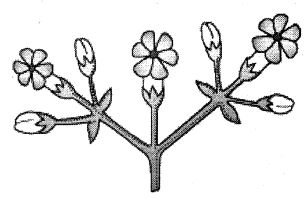
Identify the given figure.
A
Racemose inflorescence
B
Cymose inflorescence
C
Superior ovary
D
Perianth
Solution
(B) The provided figure shows a type of inflorescence where the main axis terminates in a flower,limiting its growth. This is the characteristic feature of a Cymose inflorescence.
In a Cymose inflorescence,the flowers are borne in a basipetal order,meaning the older flowers are at the top and the younger buds are towards the base.
Therefore,the correct option is $B$.
In a Cymose inflorescence,the flowers are borne in a basipetal order,meaning the older flowers are at the top and the younger buds are towards the base.
Therefore,the correct option is $B$.
0 likes
View Solution97
MediumMCQ
In ........... flowers are arranged in basipetal order.
A
Cymose inflorescence
B
Racemose inflorescence
C
$A$ and $B$ correct
D
$A$ and $B$ incorrect
Solution
(A) In a $Cymose$ inflorescence,the main axis terminates in a flower,hence the growth is limited. The flowers are arranged in a $basipetal$ order,meaning the older flowers are at the top and the younger buds are towards the base.
In a $Racemose$ inflorescence,the main axis continues to grow,and the flowers are arranged in an $acropetal$ order,where the younger flowers are at the tip and the older flowers are at the base.
Therefore,the correct answer is $Cymose$ inflorescence.
In a $Racemose$ inflorescence,the main axis continues to grow,and the flowers are arranged in an $acropetal$ order,where the younger flowers are at the tip and the older flowers are at the base.
Therefore,the correct answer is $Cymose$ inflorescence.
0 likes
View Solution98
EasyMCQ
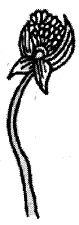
Identify the given figure.
A
Flower of sunflower
B
Inflorescence of Solanum nigrum
C
Flowering twig of pea
D
Inflorescence of onion
Solution
(D) The provided figure represents the inflorescence of an onion ($Allium$ $cepa$).
In an onion,the flowers are arranged in an umbel inflorescence,where the pedicels of the flowers arise from a common point at the apex of the peduncle,often subtended by a whorl of bracts (involucre).
In an onion,the flowers are arranged in an umbel inflorescence,where the pedicels of the flowers arise from a common point at the apex of the peduncle,often subtended by a whorl of bracts (involucre).
0 likes
View Solution99
MediumMCQ
The flowers are borne in acropetal order in.
A
Cymose inflorescence
B
Racemose inflorescence
C
Actinomorphic flower
D
Bisexual flower
Solution
(B) In a $Racemose$ inflorescence,the main axis continues to grow and the flowers are borne laterally in an $acropetal$ succession.
In $acropetal$ succession,the younger flowers are present at the apex (tip) and the older flowers are present at the base.
Conversely,in a $Cymose$ inflorescence,the main axis terminates in a flower and hence is limited in growth,showing $basipetal$ succession.
In $acropetal$ succession,the younger flowers are present at the apex (tip) and the older flowers are present at the base.
Conversely,in a $Cymose$ inflorescence,the main axis terminates in a flower and hence is limited in growth,showing $basipetal$ succession.
0 likes
View Solution100
EasyMCQ
Hypanthodium is a type of...........
A
Thalamus
B
Fruit
C
Inflorescence
D
Ovary
Solution
(C) Hypanthodium is a specialized type of inflorescence. In this type,the receptacle (thalamus) becomes fleshy and forms a cup-shaped cavity with a small opening at the top. The flowers are borne on the inner surface of this cavity. This is commonly observed in the genus $Ficus$ (e.g.,Banyan,Peepal).
0 likes
View SolutionMorphology of Flowering Plants — Inflorescence · Frequently Asked Questions
1Are these Morphology of Flowering Plants questions useful for JEE and NEET?
Yes. All questions in this section are mapped to JEE Main and NEET exam patterns. Previous year questions from JEE Main, NEET, GUJCET and state-level exams are included with full solutions.
2Can I switch to Hindi or Gujarati for these questions?
Yes. Use the language tabs in the hero section or the sidebar to view the same questions and solutions in English, Hindi or Gujarati.
3How do I generate a question paper from this subtopic?
Use the Vedclass Exam Paper Generator — select the chapter and subtopic, set difficulty, and generate Sets A, B, C, D automatically. First 3 chapters of every subject are free.
Vedclass Products
For Students
Vedclass Test Series
Mock tests in real JEE/NEET style with performance analysis. 5-day free trial.
Start Free TrialFor Teachers
Exam Paper Generator
Generate Set A/B/C/D papers from this chapter in 2 minutes. 3 chapters free.
Try FreeFor Institutes
Online Exam Module
Live online exams with unlimited students, 360° analytics & white-label branding.
See DemoFor Teachers & Institutes
Generate a Morphology of Flowering Plants Exam Paper in 2 Minutes
Select subtopic & difficulty — Sets A, B, C, D auto-generated with No Repeat logic.
First 3 chapters of every subject are free — no payment required.