
A English
Description of Some Important Families Questions in English
Class 11 Biology · Morphology of Flowering Plants · Description of Some Important Families
416+
Questions
English
Language
100%
With Solutions
Showing 50 of 416 questions in English
51
MediumMCQ
Which of the following is correct with reference to flowers of family $Solanaceae$?
A
Pentamerous,actinomorphic,unisexual,hypogynous
B
Pentamerous,zygomorphic,bisexual,epigynous
C
Pentamerous,bisexual,actinomorphic,hypogynous
D
Trimerous,actinomorphic,bisexual,hypogynous
Solution
(C) The flowers of the family $Solanaceae$ exhibit the following characteristics:
$1$. They are $pentamerous$ (floral parts in multiples of $5$).
$2$. They are $bisexual$ (containing both male and female reproductive organs).
$3$. They are $actinomorphic$ (radially symmetrical).
$4$. They are $hypogynous$ (ovary is superior,and other floral parts are inserted below it).
Therefore,the correct description is $pentamerous$,$bisexual$,$actinomorphic$,and $hypogynous$.
$1$. They are $pentamerous$ (floral parts in multiples of $5$).
$2$. They are $bisexual$ (containing both male and female reproductive organs).
$3$. They are $actinomorphic$ (radially symmetrical).
$4$. They are $hypogynous$ (ovary is superior,and other floral parts are inserted below it).
Therefore,the correct description is $pentamerous$,$bisexual$,$actinomorphic$,and $hypogynous$.
0 likes
View Solution52
MediumMCQ
Mark the correct statement for $Gramineae$.
A
The carpel has two styles.
B
Spikelets are always in pairs.
C
Palea is the bracteole.
D
Awn is an appendage of the palea.
Solution
(C) In the family $Gramineae$ (also known as $Poaceae$), the flower is enclosed by two bracts: the outer one is called the $Lemma$ and the inner one is called the $Palea$.
$Palea$ is considered to be the modified bracteole.
Therefore, the statement "$Palea$ is the bracteole" is correct.
$Palea$ is considered to be the modified bracteole.
Therefore, the statement "$Palea$ is the bracteole" is correct.
0 likes
View Solution53
MediumMCQ
In $Gramineae$,the perianth is represented by small scaly lodicules which are generally:
A
Two
B
Three
C
Four
D
Five
Solution
(A) In the family $Gramineae$ (also known as $Poaceae$),the perianth is highly reduced.
It is represented by small,scale-like structures known as lodicules.
These lodicules are generally $2$ in number,which swell up to open the floret during anthesis.
It is represented by small,scale-like structures known as lodicules.
These lodicules are generally $2$ in number,which swell up to open the floret during anthesis.
0 likes
View Solution54
MediumMCQ
In the family Gramineae (Poaceae),the inflorescence is:
A
Capitulum
B
Verticellaster
C
Hypanthodium
D
Spike of spikelets
Solution
(D) The family Gramineae,also known as Poaceae,is characterized by a unique type of inflorescence known as the 'spike of spikelets'.
Each spikelet consists of one or more florets protected by bracts called glumes.
These spikelets are arranged in various patterns such as a panicle,raceme,or spike,collectively forming the characteristic inflorescence of grasses.
Each spikelet consists of one or more florets protected by bracts called glumes.
These spikelets are arranged in various patterns such as a panicle,raceme,or spike,collectively forming the characteristic inflorescence of grasses.
0 likes
View Solution55
MediumMCQ
Potato belongs to the family
A
Solanaceae
B
Compositae
C
Gramineae
D
Cruciferae
Solution
(A) Potato $(Solanum \ tuberosum)$ is a member of the family $Solanaceae$. This family is often referred to as the 'potato family' and includes other important plants like tomato,brinjal,and chili.
0 likes
View Solution56
MediumMCQ
$Lycopersicon$ $esculentum$ belongs to:
A
Malvaceae
B
Cruciferae
C
Solanaceae
D
None of the above
Solution
(C) $Lycopersicon$ $esculentum$ is the scientific name for the tomato plant.
It belongs to the family $Solanaceae$,which is commonly known as the potato family.
This family is characterized by flowers with five petals,five sepals,and five stamens,and it includes many economically important plants like potato,brinjal,and chili.
It belongs to the family $Solanaceae$,which is commonly known as the potato family.
This family is characterized by flowers with five petals,five sepals,and five stamens,and it includes many economically important plants like potato,brinjal,and chili.
0 likes
View Solution57
MediumMCQ
The carpels of $Solanum$ flower are obliquely placed because
A
Posterior and anterior carpels turn by $180^o$
B
Posterior and anterior carpels move to the left
C
Posterior carpels turn to right and anterior to the left
D
Posterior carpels turn to left and anterior to the right
Solution
(C) In the family $Solanaceae$,the ovary is bicarpellary and syncarpous.
Due to the shifting of the axis,the carpels are placed obliquely at an angle of about $45^o$ to the median plane.
This oblique placement occurs because the posterior carpel turns to the right and the anterior carpel turns to the left.
Due to the shifting of the axis,the carpels are placed obliquely at an angle of about $45^o$ to the median plane.
This oblique placement occurs because the posterior carpel turns to the right and the anterior carpel turns to the left.
0 likes
View Solution58
MediumMCQ
Datura belongs to which family?
A
Compositae
B
Labiatae
C
Malvaceae
D
Solanaceae
Solution
(D) The plant $Datura$ belongs to the family $Solanaceae$.
This family is commonly known as the potato family.
Key characteristics of $Solanaceae$ include flowers with five petals,five sepals,and five stamens,often with a superior ovary.
$Datura$ is a well-known genus within this family,often recognized for its trumpet-shaped flowers.
This family is commonly known as the potato family.
Key characteristics of $Solanaceae$ include flowers with five petals,five sepals,and five stamens,often with a superior ovary.
$Datura$ is a well-known genus within this family,often recognized for its trumpet-shaped flowers.
0 likes
View Solution59
MediumMCQ
Petals possess a claw in:
A
Solanaceae
B
Liliaceae
C
Malvaceae
D
Cruciferae
Solution
(D) The correct answer is $D$.
In the family $Cruciferae$ (also known as $Brassicaceae$),the petals are $4$ in number and are polypetalous.
These petals are arranged in a single whorl and alternate with the sepals.
Each petal consists of a narrow,stalk-like basal part called a 'claw' and a broad,spreading upper part called a 'limb'.
This specific arrangement,where the petals are spread out in the form of a Greek cross,is known as a cruciform arrangement.
In the family $Cruciferae$ (also known as $Brassicaceae$),the petals are $4$ in number and are polypetalous.
These petals are arranged in a single whorl and alternate with the sepals.
Each petal consists of a narrow,stalk-like basal part called a 'claw' and a broad,spreading upper part called a 'limb'.
This specific arrangement,where the petals are spread out in the form of a Greek cross,is known as a cruciform arrangement.
0 likes
View Solution60
MediumMCQ
The family $Gramineae$ (Poaceae) is closely related to which of the following families?
A
$Cannaceae$
B
$Cyperaceae$
C
$Arecaceae$
D
$Apiaceae$
Solution
(B) The family $Gramineae$,also known as $Poaceae$,belongs to the order $Poales$.
Among the given options,the family $Cyperaceae$ (the sedge family) is the most closely related to $Poaceae$.
Both $Poaceae$ and $Cyperaceae$ are members of the order $Poales$ and share significant morphological similarities,such as wind pollination,reduced flowers,and grass-like growth habits.
Among the given options,the family $Cyperaceae$ (the sedge family) is the most closely related to $Poaceae$.
Both $Poaceae$ and $Cyperaceae$ are members of the order $Poales$ and share significant morphological similarities,such as wind pollination,reduced flowers,and grass-like growth habits.
0 likes
View Solution61
EasyMCQ
Which of the following families possesses a perianth of six coloured tepals?
A
Mimosoideae
B
Solanaceae
C
Liliaceae
D
Malvaceae
Solution
(C) The family $Liliaceae$ is characterized by a perianth consisting of $6$ tepals,usually arranged in two whorls of $3$ each $(3+3)$.
These tepals are often fused at the base and are typically petaloid (coloured).
In contrast,$Mimosoideae$ has distinct sepals and petals,$Solanaceae$ has a calyx and corolla,and $Malvaceae$ also possesses distinct calyx and corolla.
These tepals are often fused at the base and are typically petaloid (coloured).
In contrast,$Mimosoideae$ has distinct sepals and petals,$Solanaceae$ has a calyx and corolla,and $Malvaceae$ also possesses distinct calyx and corolla.
0 likes
View Solution62
EasyMCQ
Marginal placentation is found in
A
Solanaceae
B
Cruciferae
C
Fabaceae/Leguminosae
D
Asteraceae/Compositae
Solution
(C) In marginal placentation,the ovary is monocarpellary and unilocular. The placenta forms a ridge along the ventral suture of the ovary,and the ovules are arranged in two rows along this ridge.
This type of placentation is characteristic of the family $Fabaceae$ (also known as $Leguminosae$).
Examples include $Pisum$ $sativum$ (Pea) and $Cicer$ $arietinum$ (Gram).
This type of placentation is characteristic of the family $Fabaceae$ (also known as $Leguminosae$).
Examples include $Pisum$ $sativum$ (Pea) and $Cicer$ $arietinum$ (Gram).
0 likes
View Solution63
MediumMCQ
Gynobasic style is found in
A
Labiatae
B
Liliaceae
C
Gramineae
D
Compositae
Solution
(A) gynobasic style is a condition where the style arises from the base of the ovary instead of the apex. This is a characteristic feature of the family $Lamiaceae$ (formerly known as $Labiatae$),such as in $Ocimum$ (Tulsi) and $Salvia$.
0 likes
View Solution64
MediumMCQ
Monocarpellary pistil with unilocular ovary and marginal placentation are found in
A
Compositae
B
Leguminosae
C
Cruciferae
D
Solanaceae
Solution
(B) The correct answer is $B$.
In the family $Leguminosae$ (specifically the subfamily $Fabaceae$),the gynoecium is monocarpellary,meaning it consists of a single carpel.
The ovary is unilocular,which means it has a single chamber.
The ovules are arranged along the ventral suture of the ovary,a condition known as marginal placentation.
In the family $Leguminosae$ (specifically the subfamily $Fabaceae$),the gynoecium is monocarpellary,meaning it consists of a single carpel.
The ovary is unilocular,which means it has a single chamber.
The ovules are arranged along the ventral suture of the ovary,a condition known as marginal placentation.
0 likes
View Solution65
EasyMCQ
Staminodes occur in which family?
A
Papilionatae/Arachis
B
Malvaceae/Hibiscus
C
Caesalpinoideae/Cassia
D
Cruciferae/Iberis
Solution
(C) Staminodes are underdeveloped,sterile,and non-functional stamens that do not produce pollen grains. They are commonly found in plants belonging to the family $Caesalpinoideae$,such as $Cassia$ and $Salvia$.
0 likes
View Solution66
MediumMCQ
Cruciferae (Brassicaceae) differ from Malvaceae in the presence of:
A
Multicarpellary unilocular ovary and siliqua fruit
B
Multicarpellary multilocular ovary and capsule fruit
C
Monocarpellary,multilocular ovary with capsule fruit
D
Multicarpellary unilocular ovary and cypsella fruit
Solution
(A) The family $Cruciferae$ (also known as $Brassicaceae$) is characterized by a bicarpellary,syncarpous,superior ovary that is unilocular but becomes bilocular due to the formation of a false septum called a $replum$. The characteristic fruit of this family is a $siliqua$ or $silicula$.
In contrast,the family $Malvaceae$ typically possesses a multicarpellary,syncarpous,and multilocular ovary. The fruit in $Malvaceae$ is usually a $capsule$ or $schizocarp$.
Therefore,$Cruciferae$ differs from $Malvaceae$ primarily in its specific ovary structure and the presence of $siliqua$ fruit.
In contrast,the family $Malvaceae$ typically possesses a multicarpellary,syncarpous,and multilocular ovary. The fruit in $Malvaceae$ is usually a $capsule$ or $schizocarp$.
Therefore,$Cruciferae$ differs from $Malvaceae$ primarily in its specific ovary structure and the presence of $siliqua$ fruit.
0 likes
View Solution67
MediumMCQ
In which of the following families are the stamens concealed within the keel,a condition known as cleistostemonous?
A
Mimosoideae
B
Caesalpinoideae
C
Papilionatae
D
Leguminosae
Solution
(C) The condition where stamens are completely enclosed or concealed within the keel (the two innermost petals) is characteristic of the subfamily $Papilionatae$ (also known as $Faboideae$) of the family $Fabaceae$. This arrangement often promotes self-pollination,as the reproductive organs are protected within the floral structure.
0 likes
View Solution68
MediumMCQ
Gynostegium (fusion of anthers with stigma) and pollinia are present in which family?
A
Apocynaceae
B
Asclepiadaceae
C
Convolvulaceae
D
Solanaceae
Solution
(B) The $Gynostegium$ is a specialized structure formed by the fusion of the stamens (anthers) with the stigma of the gynoecium.
Along with the presence of $pollinia$ (masses of pollen grains),these are characteristic diagnostic features of the family $Asclepiadaceae$ (now often classified under $Apocynaceae$ in the subfamily $Asclepiadoideae$).
Therefore,the correct family is $Asclepiadaceae$.
Along with the presence of $pollinia$ (masses of pollen grains),these are characteristic diagnostic features of the family $Asclepiadaceae$ (now often classified under $Apocynaceae$ in the subfamily $Asclepiadoideae$).
Therefore,the correct family is $Asclepiadaceae$.
0 likes
View Solution69
MediumMCQ
The typical floral formula of Papilionaceae is
A
B
C
D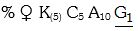
Solution
(C) The family Papilionaceae (now a subfamily of Fabaceae,known as Faboideae) is characterized by zygomorphic flowers (represented by the symbol $\text{\%}$),bisexual flowers $(\text{♀})$,a calyx with $5$ gamosepalous sepals $(K_{(5)})$,a corolla with $5$ petals showing vexillary aestivation ($1$ standard,$2$ wings,$2$ fused keel petals,denoted as $C_{1+2+(2)}$),an androecium with $10$ stamens in a diadelphous condition $(A_{1+(9)})$,and a superior ovary with a single carpel $(\underline{G}_1)$.
0 likes
View Solution70
MediumMCQ
The floral formula of mustard (or Brassicaceae/Cruciferae) is:
A
$ \oplus \, K_{2+2} \, C_{4} \, A_{2+4} \, \underline{G}_{(2)} $
B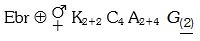
$ \oplus \, K_{2+2} \, C_{4} \, A_{2+4} \, \overline{G}_{(2)} $
C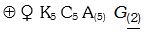
$ \% \, K_{2+2} \, C_{4} \, A_{2+4} \, \underline{G}_{(2)} $
D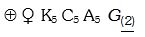
$ \oplus \, K_{4} \, C_{4} \, A_{2+4} \, \underline{G}_{(2)} $
Solution
The floral formula of mustard (Brassicaceae) is $ \oplus \, K_{2+2} \, C_{4} \, A_{2+4} \, \underline{G}_{(2)} $.
0 likes
View Solution71
MediumMCQ
Which of the following families is characterized by $6$ diplostemonous stamens arranged in two whorls?
A
Mimosoideae
B
Solanaceae
C
Malvaceae
D
Liliaceae
Solution
(D) The family $Liliaceae$ is characterized by the presence of $6$ stamens arranged in two whorls of $3$ each, a condition known as diplostemonous.
In this arrangement, the outer whorl of stamens is opposite to the tepals, and the inner whorl is alternate to them.
This is a diagnostic feature of many members of the $Liliaceae$ family.
In this arrangement, the outer whorl of stamens is opposite to the tepals, and the inner whorl is alternate to them.
This is a diagnostic feature of many members of the $Liliaceae$ family.
0 likes
View Solution72
MediumMCQ
The family containing mustard,and its main characters are:
A
Brassicaceae - Tetramerous flowers,six stamens,bicarpellary gynoecium,siliqua type fruit.
B
Brassicaceae - Pentamerous flowers,many stamens,pentacarpellary gynoecium,capsule type fruit.
C
Solanaceae - Pentamerous flowers,five stamens,bicarpellary gynoecium,berry type fruit.
D
Poaceae - Trimerous flowers,three stamens,monocarpellary gynoecium,caryopsis type of fruit.
Solution
(A) Mustard belongs to the family $Brassicaceae$ (also known as $Cruciferae$).
Key characteristics of this family include:
$1$. Flowers are $tetramerous$ (parts in fours).
$2$. Androecium consists of $six$ stamens,arranged in two whorls ($tetradynamous$ condition: $2$ outer short and $4$ inner long).
$3$. Gynoecium is $bicarpellary$ (two carpels),syncarpous,and superior.
$4$. The fruit is typically a $siliqua$ or $silicula$.
Key characteristics of this family include:
$1$. Flowers are $tetramerous$ (parts in fours).
$2$. Androecium consists of $six$ stamens,arranged in two whorls ($tetradynamous$ condition: $2$ outer short and $4$ inner long).
$3$. Gynoecium is $bicarpellary$ (two carpels),syncarpous,and superior.
$4$. The fruit is typically a $siliqua$ or $silicula$.
0 likes
View Solution73
MediumMCQ
The floral formula $\text{Br } \oplus \,\, \text{O}_+ \,\, \text{P}_{3+3} \,\, \text{A}_{3+3} \,\, \underline{\text{G}}_{(3)}$ belongs to which family?
A
Liliaceae (e.g.,Allium cepa)
B
Asteraceae (e.g.,Sunflower)
C
Cucurbitaceae (e.g.,Cucurbita)
D
Brassicaceae (e.g.,Brassica)
Solution
(A) The given floral formula $\text{Br } \oplus \,\, \text{O}_+ \,\, \text{P}_{3+3} \,\, \text{A}_{3+3} \,\, \underline{\text{G}}_{(3)}$ represents the family $Liliaceae$.
$1$. $\text{Br}$: Bracteate flower.
$2$. $\oplus$: Actinomorphic (radial symmetry).
$3$. $\text{O}_+$: Bisexual flower.
$4$. $\text{P}_{3+3}$: Perianth arranged in two whorls of $3$ each.
$5$. $\text{A}_{3+3}$: Androecium arranged in two whorls of $3$ each (epiphyllous).
$6$. $\underline{\text{G}}_{(3)}$: Gynoecium is tricarpellary,syncarpous,and ovary is superior.
$Allium \, cepa$ (Onion) is a well-known member of the family $Liliaceae$.
$1$. $\text{Br}$: Bracteate flower.
$2$. $\oplus$: Actinomorphic (radial symmetry).
$3$. $\text{O}_+$: Bisexual flower.
$4$. $\text{P}_{3+3}$: Perianth arranged in two whorls of $3$ each.
$5$. $\text{A}_{3+3}$: Androecium arranged in two whorls of $3$ each (epiphyllous).
$6$. $\underline{\text{G}}_{(3)}$: Gynoecium is tricarpellary,syncarpous,and ovary is superior.
$Allium \, cepa$ (Onion) is a well-known member of the family $Liliaceae$.
0 likes
View Solution74
EasyMCQ
Beet root $(Beta\, vulgaris)$ belongs to the family:
A
Apocynaceae
B
Cruciferae
C
Chenopodiaceae
D
Asclepiadaceae
Solution
(C) Beet root,scientifically known as $(Beta\, vulgaris)$,is a member of the family $(Chenopodiaceae)$.
In modern botanical classification systems,this family is often included within the larger family $(Amaranthaceae)$.
However,in traditional taxonomy and many textbook contexts,it is classified under $(Chenopodiaceae)$.
In modern botanical classification systems,this family is often included within the larger family $(Amaranthaceae)$.
However,in traditional taxonomy and many textbook contexts,it is classified under $(Chenopodiaceae)$.
0 likes
View Solution75
EasyMCQ
Replum is found in which family?
A
Labiatae
B
Malvaceae
C
Compositae
D
Brassicaceae
Solution
(D) In the family $Brassicaceae$,the ovary is initially unilocular. It later becomes bilocular due to the development of a false septum,which is known as the $replum$.
0 likes
View Solution76
MediumMCQ
Diadelphous stamens are the characteristic features of
A
Ranunculaceae
B
Fabaceae
C
Poaceae
D
Malvaceae
Solution
(B) In diadelphous condition,the stamens are united into two bundles.
This arrangement is a characteristic feature of the family $Fabaceae$ (e.g.,$Pisum$ $sativum$ or pea plant,where $9$ stamens are fused in one bundle and $1$ is free).
This arrangement is a characteristic feature of the family $Fabaceae$ (e.g.,$Pisum$ $sativum$ or pea plant,where $9$ stamens are fused in one bundle and $1$ is free).
0 likes
View Solution77
MediumMCQ
Oblique ovary is found in family
A
Brassicaceae
B
Compositae
C
Leguminosae
D
Solanaceae
Solution
(D) In the family $Solanaceae$, the gynoecium is bicarpellary and syncarpous.
It is bilocular with axile placentation.
A characteristic feature of this family is that the ovary is placed obliquely in the flower, typically at an angle of about $45^{\circ}$ to the median plane.
It is bilocular with axile placentation.
A characteristic feature of this family is that the ovary is placed obliquely in the flower, typically at an angle of about $45^{\circ}$ to the median plane.
0 likes
View Solution78
MediumMCQ
In which of the following plant families is underground food storage commonly observed?
A
Solanaceae and Leguminosae
B
Liliaceae and Cruciferae
C
Cruciferae and Solanaceae
D
Solanaceae and Malvaceae
Solution
(B) The family $Liliaceae$ is well-known for plants that store food in underground structures like bulbs,corms,or rhizomes (e.g.,$Allium$ $cepa$ or onion).
Similarly,the family $Cruciferae$ (also known as $Brassicaceae$) includes plants like radish ($Raphanus$ $sativus$) and turnip ($Brassica$ $rapa$),which store food in their fleshy,underground taproots.
Therefore,the correct combination of families where underground food storage is a characteristic feature is $Liliaceae$ and $Cruciferae$.
Similarly,the family $Cruciferae$ (also known as $Brassicaceae$) includes plants like radish ($Raphanus$ $sativus$) and turnip ($Brassica$ $rapa$),which store food in their fleshy,underground taproots.
Therefore,the correct combination of families where underground food storage is a characteristic feature is $Liliaceae$ and $Cruciferae$.
0 likes
View Solution79
EasyMCQ
The botanical name of Satawar is
A
Smilax
B
Asparagus racemosus
C
Yucca
D
Lilium
Solution
(B) Satawar, also known as Shatavari, is a medicinal plant belonging to the family $Asparagaceae$. Its scientific name is $Asparagus$ $racemosus$. It is widely used in traditional medicine for its various health benefits.
0 likes
View Solution80
MediumMCQ
$K_{2+2} C_{4} A_{2+4} G_{\underline{(2)}}$ is the floral formula of:
A
Allium cepa
B
Solanum nigrum
C
Helianthus annuus
D
Brassica nigra
Solution
(D) The floral formula $K_{2+2} C_{4} A_{2+4} G_{\underline{(2)}}$ represents the family $Brassicaceae$ (formerly $Cruciferae$).
$K_{2+2}$ indicates four sepals arranged in two whorls of two each.
$C_{4}$ indicates four petals arranged in a cruciform manner.
$A_{2+4}$ indicates six stamens arranged in two whorls (tetradynamous condition).
$G_{\underline{(2)}}$ indicates a bicarpellary,syncarpous,superior ovary.
Among the given options,$Brassica$ $nigra$ (Black mustard) belongs to the family $Brassicaceae$.
$K_{2+2}$ indicates four sepals arranged in two whorls of two each.
$C_{4}$ indicates four petals arranged in a cruciform manner.
$A_{2+4}$ indicates six stamens arranged in two whorls (tetradynamous condition).
$G_{\underline{(2)}}$ indicates a bicarpellary,syncarpous,superior ovary.
Among the given options,$Brassica$ $nigra$ (Black mustard) belongs to the family $Brassicaceae$.
0 likes
View Solution81
MediumMCQ
Tetradynamous condition is characteristic of
A
Liliaceae (Allium,Asphodelus)
B
Cruciferae (Mustard,Iberis)
C
Malvaceae (Althea,Hibiscus)
D
Solanaceae (Nicotiana,Petunia)
Solution
(B) The tetradynamous condition refers to the presence of six stamens in a flower,where the inner four stamens are long and the outer two stamens are short.
This arrangement is a diagnostic feature of the family $Cruciferae$ (also known as $Brassicaceae$),which includes plants like Mustard $(Brassica)$ and $Iberis$.
This arrangement is a diagnostic feature of the family $Cruciferae$ (also known as $Brassicaceae$),which includes plants like Mustard $(Brassica)$ and $Iberis$.
0 likes
View Solution82
MediumMCQ
The floral formula of Caesalpinoideae is:
A
$\% \; \text{♀} \; K_{(5)} \; C_{1+2+(2)} \; A_{10} \; \underline{G}_1$
B
$+ \; \text{♀} \; K_{(5)} \; C_{(5)} \; A_5 \; G_1$
C
$\% \; \text{♀} \; K_5 \; C_5 \; A_{10} \; \underline{G}_1$
D
$Br \; \% \; \text{♀} \; K_5 \; C_5 \; A_{5+5} \; \underline{G}_1$
Solution
(C) The subfamily Caesalpinoideae (now often classified under Fabaceae) is characterized by zygomorphic flowers $(\%)$,bisexual condition $(\text{♀})$,five sepals which are gamosepalous $(K_{(5)})$,five petals which are polypetalous $(C_5)$,ten stamens $(A_{10})$,and a superior ovary with a single carpel $(\underline{G}_1)$. Therefore,the correct floral formula is $\% \; \text{♀} \; K_{(5)} \; C_5 \; A_{10} \; \underline{G}_1$. Among the given options,option $C$ represents the most accurate structural representation for this subfamily.
0 likes
View Solution83
MediumMCQ
Bilocular oblique ovary with numerous shining ovules on swollen axile placenta is the characteristic of
A
Cruciferae
B
Solanaceae
C
Liliaceae
D
Malvaceae
Solution
(B) The family $Solanaceae$ is characterized by a bilocular ovary that is placed obliquely at an angle of $45^o$ due to the rotation of the carpels.
The placentation is axile,where the placentae are highly swollen and bear numerous shining ovules.
This specific arrangement of the ovary and the swollen placenta is a diagnostic feature of the $Solanaceae$ family.
The placentation is axile,where the placentae are highly swollen and bear numerous shining ovules.
This specific arrangement of the ovary and the swollen placenta is a diagnostic feature of the $Solanaceae$ family.
0 likes
View Solution84
MediumMCQ
The division of $Leguminosae$ into its subfamilies is based upon,or the $Leguminosae$ is distinguished on the basis of:
A
$K$ and $C$
B
$K$ and $A$
C
$C$ and $A$
D
$A$ and $G$
Solution
(C) The family $Leguminosae$ (now classified under $Fabaceae$) is divided into three subfamilies: $Papilionoideae$,$Caesalpinioideae$,and $Mimosoideae$.
This classification is primarily based on the characteristics of the corolla $(C)$ (such as the symmetry of the flower,the type of petals,their fusion,and aestivation) and the androecium $(A)$ (such as the number of stamens and their arrangement).
Therefore,the correct basis for distinction is $C$ and $A$.
This classification is primarily based on the characteristics of the corolla $(C)$ (such as the symmetry of the flower,the type of petals,their fusion,and aestivation) and the androecium $(A)$ (such as the number of stamens and their arrangement).
Therefore,the correct basis for distinction is $C$ and $A$.
0 likes
View Solution85
MediumMCQ
Vascular bundles are arranged in a ring in the members of which family?
A
Orchidaceae
B
Iridaceae
C
Euphorbiaceae
D
Liliaceae
Solution
(C) In dicotyledonous plants,the vascular bundles are arranged in a ring. Among the given options,$Orchidaceae$,$Iridaceae$,and $Liliaceae$ are monocotyledonous families,which typically have scattered vascular bundles. $Euphorbiaceae$ is a dicotyledonous family,and therefore,its members exhibit vascular bundles arranged in a ring.
0 likes
View Solution86
EasyMCQ
Which of the following members of the family $Solanaceae$ is a rich source of vitamin $C$?
A
Guava
B
Tomato
C
Gooseberry
D
Strawberry
Solution
(B) The family $Solanaceae$ includes several important food crops.
Among the given options,$Tomato$ ($Solanum$ $lycopersicum$) belongs to the family $Solanaceae$.
$Tomato$ is well-known for being a rich source of vitamin $C$ (ascorbic acid) and antioxidants like lycopene.
Guava belongs to the family $Myrtaceae$,Gooseberry (Amla) belongs to $Phyllanthaceae$,and Strawberry belongs to $Rosaceae$.
Among the given options,$Tomato$ ($Solanum$ $lycopersicum$) belongs to the family $Solanaceae$.
$Tomato$ is well-known for being a rich source of vitamin $C$ (ascorbic acid) and antioxidants like lycopene.
Guava belongs to the family $Myrtaceae$,Gooseberry (Amla) belongs to $Phyllanthaceae$,and Strawberry belongs to $Rosaceae$.
0 likes
View Solution87
MediumMCQ
Lady finger belongs to which family?
A
Malvaceae
B
Cucurbitaceae
C
Liliaceae
D
Brassicaceae
Solution
(A) Lady finger, scientifically known as $Abelmoschus$ $\text{esculentus}$, belongs to the family $Malvaceae$.
This family is characterized by features such as epicalyx, mucilaginous sap, and monadelphous stamens, which are commonly observed in plants like Hibiscus and Lady finger.
This family is characterized by features such as epicalyx, mucilaginous sap, and monadelphous stamens, which are commonly observed in plants like Hibiscus and Lady finger.
0 likes
View Solution88
MediumMCQ
The botanical name of 'chana' (gram) is:
A
Cicer arietinum
B
Phaseolus aureus
C
Lablab purpureus
D
Dolichos
Solution
(A) The botanical name of 'chana' (gram) is $Cicer \text{ } arietinum$.
It belongs to the family $Fabaceae$.
$Phaseolus \text{ } aureus$ is the botanical name for green gram (mung bean), while $Lablab \text{ } purpureus$ is the botanical name for hyacinth bean.
It belongs to the family $Fabaceae$.
$Phaseolus \text{ } aureus$ is the botanical name for green gram (mung bean), while $Lablab \text{ } purpureus$ is the botanical name for hyacinth bean.
0 likes
View Solution89
MediumMCQ
Trimerous flower,superior ovary and axile placentation are characteristics of which family?
A
Liliaceae
B
Cucurbitaceae
C
Solanaceae
D
Compositae
Solution
(A) The family $Liliaceae$ is characterized by trimerous flowers (floral parts in multiples of $3$),a superior ovary,and axile placentation.
In $Liliaceae$,the perianth is usually $3+3$,stamens are $3+3$,and the ovary is tricarpellary,syncarpous,and superior with axile placentation.
In $Liliaceae$,the perianth is usually $3+3$,stamens are $3+3$,and the ovary is tricarpellary,syncarpous,and superior with axile placentation.
0 likes
View Solution90
MediumMCQ
Which of the following represents the floral condition seen in the family $Asteraceae$ (formerly $Compositae$)?
A
Superior ovary,syngenesious,single basal ovule
B
Inferior ovary,monoadelphous,basal placentation
C
Inferior ovary,syngenesious,axile placentation
D
Syngenesious,basal placentation and epigynous
Solution
(D) The family $Asteraceae$ (also known as $Compositae$) is characterized by the following floral features:
$1$. The ovary is inferior (epigynous flower).
$2$. The stamens are syngenesious,meaning the anthers are fused while the filaments remain free.
$3$. The placentation is basal,with a single ovule present in the ovary.
Therefore,option $D$ correctly describes these characteristics.
$1$. The ovary is inferior (epigynous flower).
$2$. The stamens are syngenesious,meaning the anthers are fused while the filaments remain free.
$3$. The placentation is basal,with a single ovule present in the ovary.
Therefore,option $D$ correctly describes these characteristics.
0 likes
View Solution91
MediumMCQ
The fruit in members of the family $Solanaceae$ is:
A
Drupe
B
Capsule or berry
C
Siliqua
D
Pod or achene
Solution
(B) The family $Solanaceae$ (also known as the potato family) is characterized by specific floral and vegetative features.
In members of this family,the fruit is typically a $berry$ (e.g.,tomato,brinjal) or a $capsule$ (e.g.,Datura).
Therefore,the correct option is $B$.
In members of this family,the fruit is typically a $berry$ (e.g.,tomato,brinjal) or a $capsule$ (e.g.,Datura).
Therefore,the correct option is $B$.
0 likes
View Solution92
EasyMCQ
Presence of ochreate stipules is a characteristic feature of the family
A
Liliaceae
B
Solanaceae
C
Polygonaceae
D
Moraceae
Solution
(C) The correct answer is $C$.
Ochreate stipules are membranous,tubular structures that ensheath the axillary bud and a portion of the internode.
This structure is formed by the fusion of two stipules.
It is a diagnostic characteristic feature of the family $Polygonaceae$,commonly seen in genera such as $Polygonum$ and $Rumex$.
Ochreate stipules are membranous,tubular structures that ensheath the axillary bud and a portion of the internode.
This structure is formed by the fusion of two stipules.
It is a diagnostic characteristic feature of the family $Polygonaceae$,commonly seen in genera such as $Polygonum$ and $Rumex$.
0 likes
View Solution93
MediumMCQ
Persistent calyx is a characteristic of
A
Allium (Liliaceae)
B
Hibiscus (Malvaceae)
C
Dalbergia (Papilionaceae)
D
Solanum (Solanaceae)
Solution
(D) The correct answer is $D$.
Persistent calyx refers to the condition where the sepals do not wither or fall off after fertilization but remain attached to the developing fruit.
In the family $Solanaceae$,which includes plants like $Solanum$ $melongena$ (Brinjal) and $Capsicum$ (Chillies),the calyx is persistent.
This can be accrescent,where the sepals grow in size and may cover the fruit,or marcescent,where they remain dry and attached to the fruit base.
Persistent calyx refers to the condition where the sepals do not wither or fall off after fertilization but remain attached to the developing fruit.
In the family $Solanaceae$,which includes plants like $Solanum$ $melongena$ (Brinjal) and $Capsicum$ (Chillies),the calyx is persistent.
This can be accrescent,where the sepals grow in size and may cover the fruit,or marcescent,where they remain dry and attached to the fruit base.
0 likes
View Solution94
MediumMCQ
Basifixed monothecous anthers (or anthers with two microsporangia) are characteristic of:
A
Leguminosae (Pea)
B
Malvaceae (Cotton)
C
Solanaceae (Tomato)
D
Liliaceae (Onion)
Solution
(B) The correct answer is $B$. In the family $Malvaceae$ (e.g.,Cotton),the anthers are monothecous,meaning they consist of a single lobe.
Each monothecous anther contains two microsporangia,making it bisporangiate.
The filament is attached to the base of the anther,which is referred to as basifixed.
In contrast,most other angiosperms possess dithecous (two-lobed) anthers with four microsporangia.
Each monothecous anther contains two microsporangia,making it bisporangiate.
The filament is attached to the base of the anther,which is referred to as basifixed.
In contrast,most other angiosperms possess dithecous (two-lobed) anthers with four microsporangia.
0 likes
View Solution95
EasyMCQ
Stylopodium is present in
A
Mustard
B
Petunia
C
Coriander
D
Pea
Solution
(C) The $Stylopodium$ is a specialized structure found in the family $Apiaceae$ (formerly $Umbelliferae$).
It is defined as the swollen,nectar-secreting base of the style that sits atop the ovary.
Among the given options,$Coriander$ belongs to the family $Apiaceae$,whereas $Mustard$ belongs to $Brassicaceae$,$Petunia$ to $Solanaceae$,and $Pea$ to $Fabaceae$.
Therefore,the correct answer is $Coriander$.
It is defined as the swollen,nectar-secreting base of the style that sits atop the ovary.
Among the given options,$Coriander$ belongs to the family $Apiaceae$,whereas $Mustard$ belongs to $Brassicaceae$,$Petunia$ to $Solanaceae$,and $Pea$ to $Fabaceae$.
Therefore,the correct answer is $Coriander$.
0 likes
View Solution96
MediumMCQ
Persistent calyx forms a dry bladder-like structure enclosing an edible berry in
A
Physalis
B
Nicotiana
C
Capsicum
D
Solanum
Solution
(A) In $Physalis$,the calyx is persistent and becomes enlarged and inflated (swollen) as the fruit matures.
This structure forms a dry,bladder-like covering that encloses the edible berry.
This adaptation helps in the dispersal of seeds and protects the fruit.
This structure forms a dry,bladder-like covering that encloses the edible berry.
This adaptation helps in the dispersal of seeds and protects the fruit.
0 likes
View Solution97
MediumMCQ
The condition of stamens in the $Cruciferae$ family is correctly expressed as:
A
$A_6$
B
$A_{2+4}$
C
$A_{4+2}$
D
All of these
Solution
(B) In the $Cruciferae$ (now known as $Brassicaceae$) family,there are $6$ stamens which are polyandrous and exhibit a tetradynamous condition.
This means the stamens are arranged in two whorls: an outer whorl of $2$ short stamens and an inner whorl of $4$ long stamens.
This arrangement is represented as $A_{2+4}$ in the floral formula.
This means the stamens are arranged in two whorls: an outer whorl of $2$ short stamens and an inner whorl of $4$ long stamens.
This arrangement is represented as $A_{2+4}$ in the floral formula.
0 likes
View Solution98
MediumMCQ
Chief features of family $Brassicaceae$ / $Cruciferae$ is the presence of:
A
Latex
B
Pectin
C
Alkaloids
D
Myrosin enzyme
Solution
(D) The correct answer is $D$. In members of the family $Cruciferae$ $(Brassicaceae)$,specialized secretory cells are present that contain the $Myrosin$ enzyme.
This enzyme acts upon sulphur-containing glucosides (glucosinolates) present in the plant tissues.
Upon hydrolysis by $Myrosin$ enzyme,these glucosides are broken down into glucose and isothiocyanates (mustard oils),which are responsible for the characteristic pungent odor and taste of the family.
This enzyme acts upon sulphur-containing glucosides (glucosinolates) present in the plant tissues.
Upon hydrolysis by $Myrosin$ enzyme,these glucosides are broken down into glucose and isothiocyanates (mustard oils),which are responsible for the characteristic pungent odor and taste of the family.
0 likes
View Solution99
MediumMCQ
Tricarpellary axile placentation is characteristic of
A
Solanaceae
B
Malvaceae
C
Liliaceae
D
Cruciferae
Solution
(C) The correct answer is $C$.
In members of the family $Liliaceae$:
$1$. $Tricarpellary$: The gynoecium consists of three carpels.
$2$. $Axile$ $placentation$: The ovary is syncarpous,tricarpellary,and trilocular.
$3$. The placentae bearing ovules are borne on a central axile column where the margins of all carpels fuse.
In members of the family $Liliaceae$:
$1$. $Tricarpellary$: The gynoecium consists of three carpels.
$2$. $Axile$ $placentation$: The ovary is syncarpous,tricarpellary,and trilocular.
$3$. The placentae bearing ovules are borne on a central axile column where the margins of all carpels fuse.
0 likes
View Solution100
MediumMCQ
Bicarpellary syncarpous gynoecium,parietal placentation,tetradynamous stamens and siliqua fruit are characteristic features of which family?
A
Cucurbitaceae
B
Cruciferae
C
Compositae
D
Solanaceae
Solution
(B) The correct answer is $B$ (Cruciferae).
$1$. Bicarpellary syncarpous gynoecium: The gynoecium consists of two carpels that are fused together.
$2$. Parietal placentation: The ovules are attached to the inner wall of the ovary,which is typically unilocular due to the formation of a false septum (replum).
$3$. Tetradynamous stamens: There are $6$ stamens in total,arranged in two whorls. The outer whorl has $2$ short stamens,and the inner whorl has $4$ long stamens.
$4$. Siliqua fruit: This is a characteristic dry dehiscent fruit that develops from a bicarpellary,syncarpous,and superior ovary.
$1$. Bicarpellary syncarpous gynoecium: The gynoecium consists of two carpels that are fused together.
$2$. Parietal placentation: The ovules are attached to the inner wall of the ovary,which is typically unilocular due to the formation of a false septum (replum).
$3$. Tetradynamous stamens: There are $6$ stamens in total,arranged in two whorls. The outer whorl has $2$ short stamens,and the inner whorl has $4$ long stamens.
$4$. Siliqua fruit: This is a characteristic dry dehiscent fruit that develops from a bicarpellary,syncarpous,and superior ovary.
0 likes
View SolutionMorphology of Flowering Plants — Description of Some Important Families · Frequently Asked Questions
1Are these Morphology of Flowering Plants questions useful for JEE and NEET?
Yes. All questions in this section are mapped to JEE Main and NEET exam patterns. Previous year questions from JEE Main, NEET, GUJCET and state-level exams are included with full solutions.
2Can I switch to Hindi or Gujarati for these questions?
Yes. Use the language tabs in the hero section or the sidebar to view the same questions and solutions in English, Hindi or Gujarati.
3How do I generate a question paper from this subtopic?
Use the Vedclass Exam Paper Generator — select the chapter and subtopic, set difficulty, and generate Sets A, B, C, D automatically. First 3 chapters of every subject are free.
Vedclass Products
For Students
Vedclass Test Series
Mock tests in real JEE/NEET style with performance analysis. 5-day free trial.
Start Free TrialFor Teachers
Exam Paper Generator
Generate Set A/B/C/D papers from this chapter in 2 minutes. 3 chapters free.
Try FreeFor Institutes
Online Exam Module
Live online exams with unlimited students, 360° analytics & white-label branding.
See DemoFor Teachers & Institutes
Generate a Morphology of Flowering Plants Exam Paper in 2 Minutes
Select subtopic & difficulty — Sets A, B, C, D auto-generated with No Repeat logic.
First 3 chapters of every subject are free — no payment required.