
A English
Regulation of Kidney Function Questions in English
Class 11 Biology · Excretory Products and their Elimination · Regulation of Kidney Function
166+
Questions
English
Language
100%
With Solutions
Showing 50 of 166 questions in English
51
MediumMCQ
Renin is produced by the kidney and .....
A
induces hemopoiesis
B
converts angiotensinogen to angiotensin
C
induces ultrafiltration
D
all of the above
Solution
(B) Renin is an enzyme secreted by the juxtaglomerular cells of the kidney. Its primary function is to convert the plasma protein angiotensinogen into angiotensin $I$. This is a crucial step in the Renin-Angiotensin-Aldosterone System $(RAAS)$,which regulates blood pressure and fluid balance in the body. Therefore,the correct option is $B$.
0 likes
View Solution52
MediumMCQ
If the level of $ADH$ in the blood decreases,the volume of urine output:
A
Remains unchanged
B
Decreases
C
Increases
D
None of these
Solution
(C) $ADH$ (Antidiuretic Hormone),also known as vasopressin,is released by the posterior pituitary gland.
Its primary function is to facilitate the reabsorption of water from the distal convoluted tubules and collecting ducts of the nephrons in the kidneys.
When the level of $ADH$ in the blood decreases,the permeability of the collecting ducts to water decreases.
As a result,less water is reabsorbed back into the blood,leading to the production of a larger volume of dilute urine.
Therefore,a decrease in $ADH$ leads to an increase in urine output.
Its primary function is to facilitate the reabsorption of water from the distal convoluted tubules and collecting ducts of the nephrons in the kidneys.
When the level of $ADH$ in the blood decreases,the permeability of the collecting ducts to water decreases.
As a result,less water is reabsorbed back into the blood,leading to the production of a larger volume of dilute urine.
Therefore,a decrease in $ADH$ leads to an increase in urine output.
0 likes
View Solution53
MediumMCQ
$A$ decrease in blood pressure/volume will not cause the release of
A
atrial natriuretic factor
B
aldosterone
C
$ADH$
D
renin
Solution
(A) The correct answer is $(A)$.
Atrial natriuretic factor $(ANF)$ is released by the atrial walls of the heart in response to an increase in blood volume and pressure.
It acts as a vasodilator and promotes the excretion of sodium and water,thereby lowering blood pressure and volume.
Conversely,a decrease in blood pressure or volume triggers the release of renin (from $JGA$),$ADH$ (from the posterior pituitary),and aldosterone (from the adrenal cortex) to restore homeostasis.
Therefore,a decrease in blood pressure or volume will not cause the release of $ANF$.
Atrial natriuretic factor $(ANF)$ is released by the atrial walls of the heart in response to an increase in blood volume and pressure.
It acts as a vasodilator and promotes the excretion of sodium and water,thereby lowering blood pressure and volume.
Conversely,a decrease in blood pressure or volume triggers the release of renin (from $JGA$),$ADH$ (from the posterior pituitary),and aldosterone (from the adrenal cortex) to restore homeostasis.
Therefore,a decrease in blood pressure or volume will not cause the release of $ANF$.
0 likes
View Solution54
MediumMCQ
Which of the following does not favour the formation of large quantities of dilute urine?
A
Renin
B
Atrial natriuretic factor
C
Alcohol
D
Caffeine
Solution
(A) The correct answer is $A$.
$Renin$ is a key component of the $Renin-Angiotensin-Aldosterone$ System $(RAAS)$.
When blood pressure or blood volume decreases,$Renin$ is released,which leads to the production of $Angiotensin-II$.
$Angiotensin-II$ stimulates the adrenal cortex to release aldosterone.
Aldosterone increases the reabsorption of $Na^+$ and water from the distal convoluted tubule and collecting duct,thereby reducing urine volume and making it more concentrated.
In contrast,$Atrial$ $natriuretic$ $factor$ $(ANF)$ is a vasodilator that inhibits $Renin$ secretion and promotes $Na^+$ excretion,leading to increased urine volume.
$Alcohol$ and $Caffeine$ are known to inhibit the release of $Antidiuretic$ $Hormone$ $(ADH)$,which leads to the production of large quantities of dilute urine.
$Renin$ is a key component of the $Renin-Angiotensin-Aldosterone$ System $(RAAS)$.
When blood pressure or blood volume decreases,$Renin$ is released,which leads to the production of $Angiotensin-II$.
$Angiotensin-II$ stimulates the adrenal cortex to release aldosterone.
Aldosterone increases the reabsorption of $Na^+$ and water from the distal convoluted tubule and collecting duct,thereby reducing urine volume and making it more concentrated.
In contrast,$Atrial$ $natriuretic$ $factor$ $(ANF)$ is a vasodilator that inhibits $Renin$ secretion and promotes $Na^+$ excretion,leading to increased urine volume.
$Alcohol$ and $Caffeine$ are known to inhibit the release of $Antidiuretic$ $Hormone$ $(ADH)$,which leads to the production of large quantities of dilute urine.
0 likes
View Solution55
MediumMCQ
Which of the following causes an increase in sodium reabsorption in the distal convoluted tubule?
A
Increase in aldosterone levels
B
Increase in antidiuretic hormone levels
C
Decrease in aldosterone levels
D
Decrease in antidiuretic hormone levels
Solution
(A) : Aldosterone is a mineralocorticoid hormone secreted by the adrenal cortex.
When blood pressure or blood volume decreases,the adrenal cortex is stimulated to release aldosterone.
Aldosterone acts on the distal convoluted tubule $(DCT)$ and the collecting duct to increase the reabsorption of $Na^+$ ions and water.
This process helps in maintaining blood pressure and electrolyte balance.
Therefore,an increase in aldosterone levels leads to increased sodium reabsorption.
When blood pressure or blood volume decreases,the adrenal cortex is stimulated to release aldosterone.
Aldosterone acts on the distal convoluted tubule $(DCT)$ and the collecting duct to increase the reabsorption of $Na^+$ ions and water.
This process helps in maintaining blood pressure and electrolyte balance.
Therefore,an increase in aldosterone levels leads to increased sodium reabsorption.
0 likes
View Solution56
MediumMCQ
$A$ fall in glomerular filtration rate $(GFR)$ activates
A
juxtaglomerular cells to release renin
B
adrenal cortex to release aldosterone
C
adrenal medulla to release adrenaline
D
posterior pituitary to release vasopressin.
Solution
(A) : The amount of the filtrate formed by the kidneys per minute is called glomerular filtration rate $(GFR)$. $GFR$ in a healthy individual is approximately $125 \text{ ml/minute}$, $i.e.$, $180 \text{ litres}$ per day.
The kidneys have built-in mechanisms for the regulation of $GFR$. One such efficient mechanism is carried out by the juxtaglomerular apparatus $(JGA)$.
$JGA$ is a special sensitive region formed by cellular modifications in the distal convoluted tubule $(DCT)$ and the afferent arteriole at the location of their contact.
$A$ fall in $GFR$ activates the $JG$ cells to release renin, which converts angiotensinogen in the blood to angiotensin $I$ and further to angiotensin $II$. Angiotensin $II$ is a powerful vasoconstrictor that increases the glomerular blood pressure and thereby brings the $GFR$ back to normal.
The kidneys have built-in mechanisms for the regulation of $GFR$. One such efficient mechanism is carried out by the juxtaglomerular apparatus $(JGA)$.
$JGA$ is a special sensitive region formed by cellular modifications in the distal convoluted tubule $(DCT)$ and the afferent arteriole at the location of their contact.
$A$ fall in $GFR$ activates the $JG$ cells to release renin, which converts angiotensinogen in the blood to angiotensin $I$ and further to angiotensin $II$. Angiotensin $II$ is a powerful vasoconstrictor that increases the glomerular blood pressure and thereby brings the $GFR$ back to normal.
0 likes
View Solution57
MediumMCQ
Which one of the following statements is correct with respect to kidney function regulation?
A
When someone drinks lot of water,$ADH$ release is suppressed.
B
Exposure to cold temperature stimulates $ADH$ release.
C
An increase in glomerular blood flow stimulates formation of angiotensin $II$.
D
During summer when body loses lot of water by evaporation,the release of $ADH$ is suppressed.
Solution
(A) : Antidiuretic hormone $(ADH)$ or vasopressin increases the reabsorption of water in the distal convoluted tubule,collecting tubules,and collecting ducts of the nephrons of the kidneys.
As a result,the reabsorption of water from the glomerular filtrate is increased.
When someone drinks a lot of water,the body's requirement for water reabsorption decreases,and the blood osmolarity drops.
Consequently,the hypothalamus signals the posterior pituitary to suppress the release of $ADH$ to allow for the excretion of excess water as dilute urine.
As a result,the reabsorption of water from the glomerular filtrate is increased.
When someone drinks a lot of water,the body's requirement for water reabsorption decreases,and the blood osmolarity drops.
Consequently,the hypothalamus signals the posterior pituitary to suppress the release of $ADH$ to allow for the excretion of excess water as dilute urine.
0 likes
View Solution58
MediumMCQ
Angiotensinogen is a protein produced and secreted by
A
juxtaglomerular $(JG)$ cells
B
macula densa cells
C
endothelial cells (cells lining the blood vessels)
D
liver cells
Solution
(D) : Angiotensinogen is an $\alpha$-globulin protein produced and secreted by the liver cells.
Renin,which is secreted by the juxtaglomerular $(JG)$ cells,acts as an enzyme to convert the plasma protein angiotensinogen into angiotensin-$I$.
Angiotensin-$II$ (formed from angiotensin-$I$) stimulates the adrenal cortex to produce aldosterone.
Aldosterone acts on the distal convoluted tubules and collecting ducts to increase the reabsorption of $Na^+$ and water,which subsequently increases blood volume and blood pressure.
Renin,which is secreted by the juxtaglomerular $(JG)$ cells,acts as an enzyme to convert the plasma protein angiotensinogen into angiotensin-$I$.
Angiotensin-$II$ (formed from angiotensin-$I$) stimulates the adrenal cortex to produce aldosterone.
Aldosterone acts on the distal convoluted tubules and collecting ducts to increase the reabsorption of $Na^+$ and water,which subsequently increases blood volume and blood pressure.
0 likes
View Solution59
MediumMCQ
The osmoreceptors of the body are activated by....
A
Changes in blood volume.
B
Changes in body fluid volume.
C
Changes in ionic concentration.
D
All of the above conditions.
Solution
(D) Osmoreceptors are specialized sensory neurons located in the hypothalamus that monitor the osmotic pressure of the blood.
These receptors are activated by changes in blood volume,body fluid volume,and ionic concentration (osmolarity).
When these parameters deviate from the normal range,osmoreceptors trigger the release of $ADH$ (Antidiuretic Hormone) from the neurohypophysis to regulate water reabsorption in the kidneys.
Therefore,all the mentioned conditions lead to the activation of osmoreceptors.
These receptors are activated by changes in blood volume,body fluid volume,and ionic concentration (osmolarity).
When these parameters deviate from the normal range,osmoreceptors trigger the release of $ADH$ (Antidiuretic Hormone) from the neurohypophysis to regulate water reabsorption in the kidneys.
Therefore,all the mentioned conditions lead to the activation of osmoreceptors.
0 likes
View Solution60
MediumMCQ
Another effect of angiotensin $II$ is.
A
Contraction of lungs.
B
Secrete gastric juice.
C
Stimulate adrenal cortex.
D
Secrete bile juice from liver.
Solution
(C) Angiotensin $II$ is a powerful vasoconstrictor that increases glomerular blood pressure and thereby $GFR$.
It also activates the adrenal cortex to release aldosterone.
Aldosterone causes reabsorption of $Na^+$ and water from the distal parts of the tubule,which leads to an increase in blood pressure and $GFR$.
Therefore,the correct effect of angiotensin $II$ is to stimulate the adrenal cortex.
It also activates the adrenal cortex to release aldosterone.
Aldosterone causes reabsorption of $Na^+$ and water from the distal parts of the tubule,which leads to an increase in blood pressure and $GFR$.
Therefore,the correct effect of angiotensin $II$ is to stimulate the adrenal cortex.
0 likes
View Solution61
MediumMCQ
Which one of the following statements is correct with respect to kidney function regulation?
A
When someone drinks a lot of water,$ADH$ release is suppressed.
B
Exposure to cold temperature stimulates the formation of Angiotensin $II$.
C
An increase in glomerular blood flow stimulates the formation of Angiotensin $II$.
D
During summer,when the body loses a lot of water by evaporation,the release of $ADH$ is suppressed.
Solution
(A) The regulation of kidney function is primarily controlled by the hypothalamus,the juxtaglomerular apparatus $(JGA)$,and the heart.
$1$. When someone drinks a lot of water,the osmolarity of the blood decreases. This inhibits the release of Antidiuretic Hormone $(ADH)$ from the posterior pituitary gland,leading to increased water excretion (diuresis).
$2$. Exposure to cold temperature causes vasoconstriction,which increases blood pressure,not the formation of Angiotensin $II$.
$3$. An increase in glomerular blood flow (or pressure) inhibits the $JGA$ from releasing renin,thereby reducing the formation of Angiotensin $II$.
$4$. During summer,when the body loses water through sweat,the body needs to conserve water. Therefore,$ADH$ release is increased,not suppressed,to facilitate water reabsorption in the kidneys.
$1$. When someone drinks a lot of water,the osmolarity of the blood decreases. This inhibits the release of Antidiuretic Hormone $(ADH)$ from the posterior pituitary gland,leading to increased water excretion (diuresis).
$2$. Exposure to cold temperature causes vasoconstriction,which increases blood pressure,not the formation of Angiotensin $II$.
$3$. An increase in glomerular blood flow (or pressure) inhibits the $JGA$ from releasing renin,thereby reducing the formation of Angiotensin $II$.
$4$. During summer,when the body loses water through sweat,the body needs to conserve water. Therefore,$ADH$ release is increased,not suppressed,to facilitate water reabsorption in the kidneys.
0 likes
View Solution62
MediumMCQ
In the renal tubules,the permeability of the distal convoluted tubule $(DCT)$ and collecting duct to water is controlled by:
A
Vasopressin
B
Amylase
C
Growth hormone
D
Renin
Solution
(A) The permeability of the distal convoluted tubule $(DCT)$ and the collecting duct to water is regulated by the hormone Vasopressin,also known as Antidiuretic Hormone $(ADH)$.
$ADH$ is released from the posterior pituitary gland in response to an increase in blood osmolarity or a decrease in blood volume.
It acts on the collecting ducts and $DCT$ to increase the reabsorption of water,thereby reducing urine volume and concentrating the urine.
Therefore,the correct option is $A$.
$ADH$ is released from the posterior pituitary gland in response to an increase in blood osmolarity or a decrease in blood volume.
It acts on the collecting ducts and $DCT$ to increase the reabsorption of water,thereby reducing urine volume and concentrating the urine.
Therefore,the correct option is $A$.
0 likes
View Solution63
MediumMCQ
What does the $JGA$ (Juxtaglomerular Apparatus) control?
A
$GFR$ (Glomerular Filtration Rate)
B
Hypertension
C
Blood clotting
D
$RBC$ formation
Solution
(A) The $JGA$ (Juxtaglomerular Apparatus) is a specialized sensitive region formed by cellular modifications in the distal convoluted tubule and the afferent arteriole at the location of their contact.
When there is a fall in $GFR$ (Glomerular Filtration Rate),the $JGA$ cells are activated to release renin.
Renin converts angiotensinogen in the blood to angiotensin $I$ and further to angiotensin $II$.
Angiotensin $II$ acts as a powerful vasoconstrictor,which increases the glomerular blood pressure and thereby increases the $GFR$ back to normal.
Thus,the $JGA$ plays a complex regulatory role in controlling the $GFR$.
When there is a fall in $GFR$ (Glomerular Filtration Rate),the $JGA$ cells are activated to release renin.
Renin converts angiotensinogen in the blood to angiotensin $I$ and further to angiotensin $II$.
Angiotensin $II$ acts as a powerful vasoconstrictor,which increases the glomerular blood pressure and thereby increases the $GFR$ back to normal.
Thus,the $JGA$ plays a complex regulatory role in controlling the $GFR$.
0 likes
View Solution64
MediumMCQ
Which hormone is produced with the help of Angiotensin-$II$?
A
$ANF$
B
Aldosterone
C
$ADH$
D
Peptidase
Solution
(B) The Renin-Angiotensin-Aldosterone System $(RAAS)$ is a critical mechanism for regulating blood pressure and kidney function.
When blood pressure or glomerular filtration rate $(GFR)$ decreases,the juxtaglomerular $(JG)$ cells release renin.
Renin converts angiotensinogen in the blood to angiotensin-$I$,which is further converted to angiotensin-$II$ by angiotensin-converting enzyme $(ACE)$.
Angiotensin-$II$ acts as a powerful vasoconstrictor and also stimulates the adrenal cortex to release the hormone Aldosterone.
Aldosterone promotes the reabsorption of $Na^+$ and water from the distal convoluted tubule $(DCT)$ and collecting duct,thereby increasing blood volume and blood pressure.
When blood pressure or glomerular filtration rate $(GFR)$ decreases,the juxtaglomerular $(JG)$ cells release renin.
Renin converts angiotensinogen in the blood to angiotensin-$I$,which is further converted to angiotensin-$II$ by angiotensin-converting enzyme $(ACE)$.
Angiotensin-$II$ acts as a powerful vasoconstrictor and also stimulates the adrenal cortex to release the hormone Aldosterone.
Aldosterone promotes the reabsorption of $Na^+$ and water from the distal convoluted tubule $(DCT)$ and collecting duct,thereby increasing blood volume and blood pressure.
0 likes
View Solution65
MediumMCQ
Which of the following does not take part in the regulation of kidney function?
A
Hypothalamus
B
$JG$ cells
C
Heart
D
Stomach
Solution
(D) The regulation of kidney function involves complex feedback mechanisms involving the hypothalamus, $JG$ (Juxtaglomerular) apparatus, and the heart.
$1$. $Hypothalamus$: It releases $ADH$ (Antidiuretic Hormone) or vasopressin, which increases water reabsorption from the distal convoluted tubule and collecting duct.
$2$. $JG$ cells: These cells secrete renin in response to a decrease in glomerular blood pressure or flow, activating the Renin-Angiotensin-Aldosterone System $(RAAS)$.
$3$. $Heart$: It releases $ANF$ (Atrial Natriuretic Factor) in response to increased blood flow to the atria, which causes vasodilation and decreases blood pressure.
$4$. $Stomach$: The stomach is part of the digestive system and does not play a direct role in the hormonal regulation of kidney function.
$1$. $Hypothalamus$: It releases $ADH$ (Antidiuretic Hormone) or vasopressin, which increases water reabsorption from the distal convoluted tubule and collecting duct.
$2$. $JG$ cells: These cells secrete renin in response to a decrease in glomerular blood pressure or flow, activating the Renin-Angiotensin-Aldosterone System $(RAAS)$.
$3$. $Heart$: It releases $ANF$ (Atrial Natriuretic Factor) in response to increased blood flow to the atria, which causes vasodilation and decreases blood pressure.
$4$. $Stomach$: The stomach is part of the digestive system and does not play a direct role in the hormonal regulation of kidney function.
0 likes
View Solution66
MediumMCQ
$A$ fall in $GFR$ can activate the $JG$ cells to release ...... which can stimulate the glomerular blood flow and thereby the $GFR$ back to normal.
A
Urea
B
Ammonia
C
Renin
D
Resin
Solution
(C) The $JG$ (Juxtaglomerular) apparatus is a specialized sensitive region formed by cellular modifications in the distal convoluted tubule and the afferent arteriole at the location of their contact.
When there is a fall in the Glomerular Filtration Rate $(GFR)$,the $JG$ cells are activated.
These activated $JG$ cells release an enzyme called $Renin$.
$Renin$ converts angiotensinogen in the blood to angiotensin $I$ and further to angiotensin $II$.
Angiotensin $II$ is a powerful vasoconstrictor that increases the glomerular blood pressure and thereby brings the $GFR$ back to normal.
When there is a fall in the Glomerular Filtration Rate $(GFR)$,the $JG$ cells are activated.
These activated $JG$ cells release an enzyme called $Renin$.
$Renin$ converts angiotensinogen in the blood to angiotensin $I$ and further to angiotensin $II$.
Angiotensin $II$ is a powerful vasoconstrictor that increases the glomerular blood pressure and thereby brings the $GFR$ back to normal.
0 likes
View Solution67
MediumMCQ
An excessive loss of fluid from the body can activate osmoreceptors which stimulate the hypothalamus to release .............. from the neurohypophysis.
A
$ADH$
B
Aldosterone
C
Renin
D
$ANF$
Solution
(A) When there is an excessive loss of fluid from the body,the blood volume and body fluid osmolarity change.
These changes activate osmoreceptors in the body,which stimulate the hypothalamus to release Antidiuretic Hormone $(ADH)$,also known as vasopressin,from the neurohypophysis (posterior pituitary).
$ADH$ facilitates water reabsorption from the later parts of the tubule,thereby preventing diuresis and maintaining fluid balance.
These changes activate osmoreceptors in the body,which stimulate the hypothalamus to release Antidiuretic Hormone $(ADH)$,also known as vasopressin,from the neurohypophysis (posterior pituitary).
$ADH$ facilitates water reabsorption from the later parts of the tubule,thereby preventing diuresis and maintaining fluid balance.
0 likes
View Solution68
MediumMCQ
Angiotensin-$II$ activates the adrenal cortex to release..................
A
Angiotensin-$I$
B
Vasopressin
C
Renin
D
Aldosterone
Solution
(D) The $RAAS$ (Renin-Angiotensin-Aldosterone System) is a critical mechanism for regulating blood pressure and fluid balance.
$1$. When blood pressure or glomerular filtration rate $(GFR)$ decreases,the juxtaglomerular $(JG)$ cells release the enzyme Renin.
$2$. Renin converts Angiotensinogen in the blood to Angiotensin-$I$,which is further converted to Angiotensin-$II$ by Angiotensin-Converting Enzyme $(ACE)$.
$3$. Angiotensin-$II$ acts as a powerful vasoconstrictor and also stimulates the adrenal cortex to release the hormone Aldosterone.
$4$. Aldosterone promotes the reabsorption of $Na^+$ and water from the distal parts of the kidney tubules,which increases blood volume and blood pressure.
$1$. When blood pressure or glomerular filtration rate $(GFR)$ decreases,the juxtaglomerular $(JG)$ cells release the enzyme Renin.
$2$. Renin converts Angiotensinogen in the blood to Angiotensin-$I$,which is further converted to Angiotensin-$II$ by Angiotensin-Converting Enzyme $(ACE)$.
$3$. Angiotensin-$II$ acts as a powerful vasoconstrictor and also stimulates the adrenal cortex to release the hormone Aldosterone.
$4$. Aldosterone promotes the reabsorption of $Na^+$ and water from the distal parts of the kidney tubules,which increases blood volume and blood pressure.
0 likes
View Solution69
MediumMCQ
What is the primary function of $ADH$?
A
Reabsorption of water
B
Digestion
C
Increase $Ca$ level
D
Decrease $CO_2$ level
Solution
(A) $ADH$ stands for Antidiuretic Hormone,also known as Vasopressin.
It is synthesized by the hypothalamus and released by the posterior pituitary gland.
The primary function of $ADH$ is to facilitate the reabsorption of water from the distal convoluted tubules and collecting ducts of the nephrons in the kidneys.
This process reduces the volume of urine produced,thereby helping to maintain water balance and blood pressure in the body.
It is synthesized by the hypothalamus and released by the posterior pituitary gland.
The primary function of $ADH$ is to facilitate the reabsorption of water from the distal convoluted tubules and collecting ducts of the nephrons in the kidneys.
This process reduces the volume of urine produced,thereby helping to maintain water balance and blood pressure in the body.
0 likes
View Solution70
MediumMCQ
Resorption of water and electrolytes by distal tubules of the kidney,thereby reducing the loss of water through urine (diuresis),is performed by:
A
Oxytocin
B
Vasopressin
C
$FSH$
D
$LH$
Solution
(B) Vasopressin,also known as Antidiuretic Hormone $(ADH)$,is secreted by the posterior pituitary gland.
It acts mainly on the kidney and stimulates the reabsorption of water and electrolytes by the distal convoluted tubules $(DCT)$ and collecting ducts.
This process reduces the loss of water through urine,thereby preventing diuresis (excessive urine production).
Therefore,the correct option is $B$.
It acts mainly on the kidney and stimulates the reabsorption of water and electrolytes by the distal convoluted tubules $(DCT)$ and collecting ducts.
This process reduces the loss of water through urine,thereby preventing diuresis (excessive urine production).
Therefore,the correct option is $B$.
0 likes
View Solution71
MediumMCQ
Erythropoietin is secreted by...
A
$RBC$
B
$JG$ cells
C
Heart
D
Lungs
Solution
(B) Erythropoietin is a peptide hormone that stimulates the production of red blood cells $(RBCs)$ in the bone marrow.
It is primarily produced by the juxtaglomerular $(JG)$ cells of the kidney in response to hypoxia or low oxygen levels in the blood.
Therefore,the correct option is $B$.
It is primarily produced by the juxtaglomerular $(JG)$ cells of the kidney in response to hypoxia or low oxygen levels in the blood.
Therefore,the correct option is $B$.
0 likes
View Solution72
MediumMCQ
What is homeostasis?
A
The ability to change with environmental changes.
B
The ability to maintain a constant internal environment despite external changes.
C
Disorder in regulatory control.
D
The use of plant and animal extracts in homeopathy.
Solution
(B) Homeostasis is the ability of an organism to maintain a stable internal environment (such as body temperature,ionic balance,etc.) despite fluctuations in the external environment.
This process is essential for the survival of organisms under changing environmental conditions.
This process is essential for the survival of organisms under changing environmental conditions.
0 likes
View Solution73
MediumMCQ
Angiotensinogen protein is produced and secreted by . . . . . . .
A
Macula densa cells
B
Endothelial cells (blood vessels)
C
Liver cells
D
Juxtaglomerular $(JG)$ cells
Solution
(C) Angiotensinogen is a plasma protein produced and secreted by the liver.
It circulates in the blood and is converted into Angiotensin-$I$ by the enzyme Renin,which is secreted by the Juxtaglomerular $(JG)$ cells of the kidney when blood pressure or glomerular filtration rate $(GFR)$ decreases.
Therefore,the liver is the site of production for the precursor protein Angiotensinogen.
It circulates in the blood and is converted into Angiotensin-$I$ by the enzyme Renin,which is secreted by the Juxtaglomerular $(JG)$ cells of the kidney when blood pressure or glomerular filtration rate $(GFR)$ decreases.
Therefore,the liver is the site of production for the precursor protein Angiotensinogen.
0 likes
View Solution74
MediumMCQ
Which of the following statements is correct regarding the regulation of kidney function?
A
When someone drinks a lot of water,the production of $ADH$ is suppressed.
B
Exposure to cold temperature stimulates the formation of Angiotensin-$II$.
C
An increase in glomerular blood flow stimulates the formation of Angiotensin-$II$.
D
During summer,when the body loses a lot of water through perspiration,the release of $ADH$ is suppressed.
Solution
(A) The regulation of kidney function is primarily controlled by the hormonal feedback mechanism involving the hypothalamus,juxtaglomerular apparatus $(JGA)$,and the heart.
$1$. When a person consumes a large amount of water,the osmolarity of the blood decreases. This inhibits the release of Antidiuretic Hormone $(ADH)$ from the posterior pituitary gland,leading to the excretion of dilute urine.
$2$. Angiotensin-$II$ is formed when the $JGA$ detects a decrease in glomerular blood pressure or flow,not an increase.
$3$. Exposure to cold temperatures typically leads to cold diuresis,which is not primarily mediated by Angiotensin-$II$.
$4$. During summer,water loss leads to increased blood osmolarity,which stimulates the release of $ADH$ to conserve water,not suppress it.
Therefore,the correct statement is that excessive water intake suppresses $ADH$ production.
$1$. When a person consumes a large amount of water,the osmolarity of the blood decreases. This inhibits the release of Antidiuretic Hormone $(ADH)$ from the posterior pituitary gland,leading to the excretion of dilute urine.
$2$. Angiotensin-$II$ is formed when the $JGA$ detects a decrease in glomerular blood pressure or flow,not an increase.
$3$. Exposure to cold temperatures typically leads to cold diuresis,which is not primarily mediated by Angiotensin-$II$.
$4$. During summer,water loss leads to increased blood osmolarity,which stimulates the release of $ADH$ to conserve water,not suppress it.
Therefore,the correct statement is that excessive water intake suppresses $ADH$ production.
0 likes
View Solution75
MediumMCQ
Which of the following factors increases the reabsorption of sodium in the $DCT$?
A
High level of aldosterone
B
Low level of $ADH$
C
Low level of aldosterone
D
None of the above
Solution
(A) Aldosterone is a steroid hormone secreted by the adrenal cortex.
It acts primarily on the distal convoluted tubule $(DCT)$ and the collecting duct of the nephron.
It promotes the reabsorption of sodium ions $(Na^+)$ and water from the renal filtrate back into the blood,while simultaneously promoting the excretion of potassium ions $(K^+)$.
Therefore,a high level of aldosterone increases the reabsorption of sodium in the $DCT$.
It acts primarily on the distal convoluted tubule $(DCT)$ and the collecting duct of the nephron.
It promotes the reabsorption of sodium ions $(Na^+)$ and water from the renal filtrate back into the blood,while simultaneously promoting the excretion of potassium ions $(K^+)$.
Therefore,a high level of aldosterone increases the reabsorption of sodium in the $DCT$.
1 likes
View Solution76
MediumMCQ
$A$ decrease in blood pressure or blood volume does not cause the release of which of the following?
A
Renin
B
Atrial Natriuretic Factor $(ANF)$
C
Aldosterone
D
$ADH$
Solution
(B) The regulation of kidney function is primarily managed by the $RAAS$ (Renin-Angiotensin-Aldosterone System) and $ADH$ mechanisms.
$1$. When blood pressure or blood volume decreases,the juxtaglomerular $(JG)$ apparatus releases renin.
$2$. Renin triggers the formation of angiotensin $II$,which stimulates the adrenal cortex to release aldosterone,increasing sodium and water reabsorption.
$3$. Simultaneously,low blood volume stimulates the posterior pituitary to release $ADH$ (vasopressin) to increase water reabsorption.
$4$. Atrial Natriuretic Factor $(ANF)$ is released by the atrial walls of the heart in response to an increase in blood volume or blood pressure to promote vasodilation and sodium excretion. Therefore,$ANF$ is not released when blood pressure or volume decreases.
$1$. When blood pressure or blood volume decreases,the juxtaglomerular $(JG)$ apparatus releases renin.
$2$. Renin triggers the formation of angiotensin $II$,which stimulates the adrenal cortex to release aldosterone,increasing sodium and water reabsorption.
$3$. Simultaneously,low blood volume stimulates the posterior pituitary to release $ADH$ (vasopressin) to increase water reabsorption.
$4$. Atrial Natriuretic Factor $(ANF)$ is released by the atrial walls of the heart in response to an increase in blood volume or blood pressure to promote vasodilation and sodium excretion. Therefore,$ANF$ is not released when blood pressure or volume decreases.
0 likes
View Solution77
MediumMCQ
Which of the following hormones acts upon the renal tubule and blood capillaries?
A
Glucagon
B
Aldosterone
C
Vasopressin
D
Glucocorticoids
Solution
(C) $ADH$ (also known as vasopressin) is secreted by the posterior pituitary gland.
It acts on the renal tubules (specifically the distal convoluted tubules and collecting ducts) and blood capillaries.
It promotes the reabsorption of water and electrolytes,thereby reducing the loss of water through urine (diuresis) and concentrating the urine.
It acts on the renal tubules (specifically the distal convoluted tubules and collecting ducts) and blood capillaries.
It promotes the reabsorption of water and electrolytes,thereby reducing the loss of water through urine (diuresis) and concentrating the urine.
0 likes
View Solution78
Medium
Explain the autoregulatory mechanism of $GFR$.
Solution
(N/A) The kidney possesses a built-in mechanism for the regulation of glomerular filtration rate $(GFR)$,known as autoregulation.
This process is primarily managed by the juxtaglomerular apparatus $(JGA)$.
The $JGA$ is a specialized microscopic structure located at the contact point between the vascular pole of the renal corpuscle and the distal convoluted tubule $(DCT)$ of the same nephron.
When $GFR$ decreases,the $JGA$ cells are activated to release the enzyme renin.
Renin initiates the renin-angiotensin mechanism,which leads to the constriction of efferent arterioles and systemic vasoconstriction,thereby increasing glomerular blood pressure.
This increase in blood pressure restores the $GFR$ to its normal level.
This process is primarily managed by the juxtaglomerular apparatus $(JGA)$.
The $JGA$ is a specialized microscopic structure located at the contact point between the vascular pole of the renal corpuscle and the distal convoluted tubule $(DCT)$ of the same nephron.
When $GFR$ decreases,the $JGA$ cells are activated to release the enzyme renin.
Renin initiates the renin-angiotensin mechanism,which leads to the constriction of efferent arterioles and systemic vasoconstriction,thereby increasing glomerular blood pressure.
This increase in blood pressure restores the $GFR$ to its normal level.
0 likes
View Solution79
Medium
What is the significance of the juxtaglomerular apparatus $(JGA)$ in kidney function?
Solution
(N/A) The juxtaglomerular apparatus $(JGA)$ is a complex regulatory structure formed by the contact point between the afferent arteriole and the distal convoluted tubule $(DCT)$ of the nephron.
The $JGA$ contains specialized cells in the afferent arteriole known as juxtaglomerular cells. These cells act as baroreceptors that sense changes in blood pressure or glomerular blood flow.
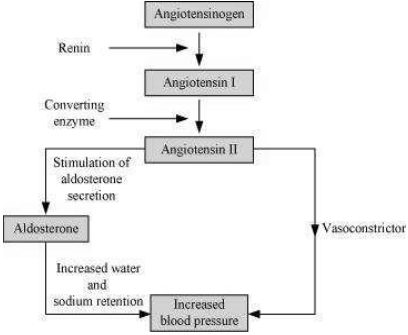
When there is a decrease in glomerular blood flow,glomerular blood pressure,or glomerular filtration rate $(GFR)$,the juxtaglomerular cells are activated to release the enzyme renin.
Renin converts the plasma protein angiotensinogen into angiotensin $I$,which is further converted into angiotensin $II$ by an angiotensin-converting enzyme.
Angiotensin $II$ acts as a powerful vasoconstrictor,which narrows the blood vessels,thereby increasing glomerular blood pressure and $GFR$.
Additionally,angiotensin $II$ stimulates the adrenal cortex to release aldosterone. Aldosterone promotes the reabsorption of sodium ions and water from the distal convoluted tubule and the collecting duct,which increases blood volume and blood pressure,thereby restoring $GFR$ to normal levels. This entire regulatory process is known as the renin-angiotensin-aldosterone system $(RAAS)$.
The $JGA$ contains specialized cells in the afferent arteriole known as juxtaglomerular cells. These cells act as baroreceptors that sense changes in blood pressure or glomerular blood flow.
When there is a decrease in glomerular blood flow,glomerular blood pressure,or glomerular filtration rate $(GFR)$,the juxtaglomerular cells are activated to release the enzyme renin.
Renin converts the plasma protein angiotensinogen into angiotensin $I$,which is further converted into angiotensin $II$ by an angiotensin-converting enzyme.
Angiotensin $II$ acts as a powerful vasoconstrictor,which narrows the blood vessels,thereby increasing glomerular blood pressure and $GFR$.
Additionally,angiotensin $II$ stimulates the adrenal cortex to release aldosterone. Aldosterone promotes the reabsorption of sodium ions and water from the distal convoluted tubule and the collecting duct,which increases blood volume and blood pressure,thereby restoring $GFR$ to normal levels. This entire regulatory process is known as the renin-angiotensin-aldosterone system $(RAAS)$.
0 likes
View Solution80
Easy
Fill in the gaps:
Reabsorption of water from distal parts of the tubules is facilitated by hormone ................... .
Reabsorption of water from distal parts of the tubules is facilitated by hormone ................... .
Solution
(VASOPRESSIN) The reabsorption of water from the distal parts of the renal tubules,specifically the distal convoluted tubule $(DCT)$ and the collecting duct,is facilitated by the hormone vasopressin,also known as Antidiuretic Hormone $(ADH)$.
This hormone increases the permeability of the collecting ducts to water,allowing for the reabsorption of water back into the blood,thereby concentrating the urine.
This hormone increases the permeability of the collecting ducts to water,allowing for the reabsorption of water back into the blood,thereby concentrating the urine.
0 likes
View Solution81
Easy
Indicate whether the following statement is true or false:
$ADH$ helps in water elimination,making the urine hypotonic.
$ADH$ helps in water elimination,making the urine hypotonic.
Solution
(B) The statement is False.
$ADH$ (Antidiuretic Hormone),also known as vasopressin,is released by the posterior pituitary gland.
Its primary function is to increase the reabsorption of water from the distal convoluted tubule $(DCT)$ and the collecting duct of the nephron into the blood.
By promoting water reabsorption,$ADH$ reduces the volume of water excreted in the urine,thereby concentrating the urine and making it hypertonic,not hypotonic.
$ADH$ (Antidiuretic Hormone),also known as vasopressin,is released by the posterior pituitary gland.
Its primary function is to increase the reabsorption of water from the distal convoluted tubule $(DCT)$ and the collecting duct of the nephron into the blood.
By promoting water reabsorption,$ADH$ reduces the volume of water excreted in the urine,thereby concentrating the urine and making it hypertonic,not hypotonic.
0 likes
View Solution82
Medium
How is the function of the kidney regulated?
Solution
(N/A) The functioning of the kidneys is regulated by hormonal feedback mechanisms involving the hypothalamus,$JGA$,and the heart.
$(1)$ Hypothalamus: Osmoreceptors in the body are activated by changes in blood volume,body fluid volume,and ionic concentration. An excessive loss of fluid from the body activates these receptors,which stimulate the hypothalamus to release antidiuretic hormone $(ADH)$ or vasopressin from the neurohypophysis.
- $ADH$ facilitates water reabsorption from the latter parts of the tubule,thereby preventing diuresis.
- An increase in body fluid volume can switch off the osmoreceptors and suppress $ADH$ release to complete the feedback.
- $ADH$ also affects kidney function by its constrictory effects on blood vessels,increasing blood pressure,which in turn increases glomerular blood flow and $GFR$.
$(2)$ Renin-Angiotensin mechanism $(RAAS)$: The $JGA$ plays a complex regulatory role. $A$ fall in glomerular blood flow,glomerular blood pressure,or $GFR$ activates the $JG$ cells to release renin.
- Renin converts angiotensinogen in the blood to angiotensin $I$ and further to angiotensin $II$.
- Angiotensin $II$,being a powerful vasoconstrictor,increases glomerular blood pressure and thereby $GFR$.
- Angiotensin $II$ also activates the adrenal cortex to release aldosterone,which causes reabsorption of $Na^+$ and water from the distal parts of the tubule,leading to an increase in blood pressure and $GFR$.
$(3)$ Atrial Natriuretic Factor $(ANF)$: An increase in blood flow to the atria of the heart causes the release of $ANF$.
- $ANF$ causes vasodilation (dilation of blood vessels),which decreases blood pressure and acts as a check on the $RAAS$ mechanism.
$(1)$ Hypothalamus: Osmoreceptors in the body are activated by changes in blood volume,body fluid volume,and ionic concentration. An excessive loss of fluid from the body activates these receptors,which stimulate the hypothalamus to release antidiuretic hormone $(ADH)$ or vasopressin from the neurohypophysis.
- $ADH$ facilitates water reabsorption from the latter parts of the tubule,thereby preventing diuresis.
- An increase in body fluid volume can switch off the osmoreceptors and suppress $ADH$ release to complete the feedback.
- $ADH$ also affects kidney function by its constrictory effects on blood vessels,increasing blood pressure,which in turn increases glomerular blood flow and $GFR$.
$(2)$ Renin-Angiotensin mechanism $(RAAS)$: The $JGA$ plays a complex regulatory role. $A$ fall in glomerular blood flow,glomerular blood pressure,or $GFR$ activates the $JG$ cells to release renin.
- Renin converts angiotensinogen in the blood to angiotensin $I$ and further to angiotensin $II$.
- Angiotensin $II$,being a powerful vasoconstrictor,increases glomerular blood pressure and thereby $GFR$.
- Angiotensin $II$ also activates the adrenal cortex to release aldosterone,which causes reabsorption of $Na^+$ and water from the distal parts of the tubule,leading to an increase in blood pressure and $GFR$.
$(3)$ Atrial Natriuretic Factor $(ANF)$: An increase in blood flow to the atria of the heart causes the release of $ANF$.
- $ANF$ causes vasodilation (dilation of blood vessels),which decreases blood pressure and acts as a check on the $RAAS$ mechanism.
0 likes
View Solution83
EasyMCQ
What is the function of $ADH$?
A
Stimulates glomerular filtration
B
Facilitates water reabsorption from the latter parts of the tubule
C
Increases sodium excretion
D
Decreases blood pressure
Solution
(B) $ADH$ (Antidiuretic Hormone),also known as vasopressin,is released from the posterior pituitary gland.
Its primary function is to facilitate the reabsorption of water from the latter parts of the kidney tubules (distal convoluted tubule and collecting duct).
By increasing water reabsorption,it reduces the volume of urine produced,thereby preventing diuresis (excessive loss of water through urine).
Its primary function is to facilitate the reabsorption of water from the latter parts of the kidney tubules (distal convoluted tubule and collecting duct).
By increasing water reabsorption,it reduces the volume of urine produced,thereby preventing diuresis (excessive loss of water through urine).
0 likes
View Solution84
Medium
What is erythropoiesis? Which hormone stimulates it?
Solution
(N/A) The process of formation of $R.B.C.$ (Red Blood Cells) is known as erythropoiesis.
It is stimulated by the hormone erythropoietin,which is primarily secreted by the juxtaglomerular cells of the kidney in response to low oxygen levels in the blood.
It is stimulated by the hormone erythropoietin,which is primarily secreted by the juxtaglomerular cells of the kidney in response to low oxygen levels in the blood.
0 likes
View Solution85
Easy
State the importance of the following in the human excretory system:
$(1)$ Nephron
$(2)$ Antidiuretic hormone $(ADH)$
$(1)$ Nephron
$(2)$ Antidiuretic hormone $(ADH)$
Solution
(N/A) $(1)$ Nephron: It is the structural and functional unit of the kidney,responsible for the process of urine formation through filtration,reabsorption,and secretion.
$(2)$ Antidiuretic hormone $(ADH)$: It is released from the posterior pituitary gland and facilitates the reabsorption of water from the distal convoluted tubule and collecting duct,thereby concentrating the urine and preventing water loss.
$(2)$ Antidiuretic hormone $(ADH)$: It is released from the posterior pituitary gland and facilitates the reabsorption of water from the distal convoluted tubule and collecting duct,thereby concentrating the urine and preventing water loss.
0 likes
View Solution86
Easy
Provide the full names for the following abbreviations:
$(1)$ $JGA$
$(2)$ $ADH$
$(1)$ $JGA$
$(2)$ $ADH$
Solution
(N/A) $(1)$ $JGA$ stands for Juxtaglomerular Apparatus. It is a specialized region formed by cellular modifications in the distal convoluted tubule and the afferent arteriole at the location of their contact.
$(2)$ $ADH$ stands for Antidiuretic Hormone,also known as vasopressin. It is secreted by the posterior pituitary gland and plays a crucial role in water reabsorption in the kidney tubules.
$(2)$ $ADH$ stands for Antidiuretic Hormone,also known as vasopressin. It is secreted by the posterior pituitary gland and plays a crucial role in water reabsorption in the kidney tubules.
0 likes
View Solution87
Easy
The following abbreviations are used in the context of excretory functions,what do they stand for?
$(a)$ $ANF$
$(b)$ $ADH$
$(c)$ $GFR$
$(d)$ $DCT$
$(a)$ $ANF$
$(b)$ $ADH$
$(c)$ $GFR$
$(d)$ $DCT$
Solution
(N/A) $ANF$: Atrial Natriuretic Factor
$(b)$ $ADH$: Anti-Diuretic Hormone
$(c)$ $GFR$: Glomerular Filtration Rate
$(d)$ $DCT$: Distal Convoluted Tubule
$(b)$ $ADH$: Anti-Diuretic Hormone
$(c)$ $GFR$: Glomerular Filtration Rate
$(d)$ $DCT$: Distal Convoluted Tubule
0 likes
View Solution88
MediumMCQ
What is the role played by the renin-angiotensin mechanism in the regulation of kidney function?
A
It decreases blood pressure and reduces $GFR$.
B
It activates $JG$ cells to release renin,which increases $GFR$ and stimulates aldosterone secretion.
C
It inhibits the reabsorption of $Na^+$ and water from the $DCT$.
D
It causes vasodilation of the afferent arteriole,decreasing glomerular pressure.
Solution
(B) fall in $GFR$ (Glomerular Filtration Rate) activates the $JG$ (Juxtaglomerular) cells to release the enzyme renin.
Renin converts angiotensinogen in the blood to angiotensin-$I$,which is further converted into angiotensin-$II$.
Angiotensin-$II$ acts as a powerful vasoconstrictor,which increases the glomerular blood pressure and thereby increases the $GFR$.
Additionally,angiotensin-$II$ stimulates the adrenal cortex to release aldosterone,which promotes the reabsorption of $Na^+$ and water from the $DCT$ (Distal Convoluted Tubule),leading to an increase in blood volume and blood pressure.
Renin converts angiotensinogen in the blood to angiotensin-$I$,which is further converted into angiotensin-$II$.
Angiotensin-$II$ acts as a powerful vasoconstrictor,which increases the glomerular blood pressure and thereby increases the $GFR$.
Additionally,angiotensin-$II$ stimulates the adrenal cortex to release aldosterone,which promotes the reabsorption of $Na^+$ and water from the $DCT$ (Distal Convoluted Tubule),leading to an increase in blood volume and blood pressure.
0 likes
View Solution89
Easy
Comment upon the hormonal regulation of selective reabsorption.
Solution
(N/A) The hormonal regulation of selective reabsorption in the kidneys is primarily controlled by the $Renin-Angiotensin-Aldosterone$ $System$ $(RAAS)$ and $Antidiuretic$ $Hormone$ ($ADH$ or $Vasopressin$).
$1$. $RAAS$: When blood pressure or glomerular blood flow decreases,the $Juxtaglomerular$ $(JG)$ cells release $Renin$. $Renin$ converts $Angiotensinogen$ in the blood to $Angiotensin-I$ and further to $Angiotensin-II$. $Angiotensin-II$ is a powerful vasoconstrictor that increases glomerular blood pressure and stimulates the adrenal cortex to release $Aldosterone$. $Aldosterone$ causes the reabsorption of $Na^+$ and water from the distal convoluted tubule $(DCT)$ and collecting duct,thereby increasing blood volume and pressure.
$2$. $ADH$: An increase in body fluid volume or osmolarity triggers the hypothalamus to release $ADH$ from the neurohypophysis. $ADH$ facilitates water reabsorption from the later parts of the tubule (collecting duct),preventing diuresis and maintaining water balance.
$1$. $RAAS$: When blood pressure or glomerular blood flow decreases,the $Juxtaglomerular$ $(JG)$ cells release $Renin$. $Renin$ converts $Angiotensinogen$ in the blood to $Angiotensin-I$ and further to $Angiotensin-II$. $Angiotensin-II$ is a powerful vasoconstrictor that increases glomerular blood pressure and stimulates the adrenal cortex to release $Aldosterone$. $Aldosterone$ causes the reabsorption of $Na^+$ and water from the distal convoluted tubule $(DCT)$ and collecting duct,thereby increasing blood volume and pressure.
$2$. $ADH$: An increase in body fluid volume or osmolarity triggers the hypothalamus to release $ADH$ from the neurohypophysis. $ADH$ facilitates water reabsorption from the later parts of the tubule (collecting duct),preventing diuresis and maintaining water balance.
0 likes
View Solution90
MediumMCQ
Choose the correct option:
$(1)$ Urea is reabsorbed from the lower part of the descending limb / collecting duct.
$(2)$ $ADH$ is secreted by the hypothalamus / posterior pituitary gland.
$(1)$ Urea is reabsorbed from the lower part of the descending limb / collecting duct.
$(2)$ $ADH$ is secreted by the hypothalamus / posterior pituitary gland.
A
$(1)$ Collecting duct,$(2)$ Hypothalamus
B
$(1)$ Descending limb,$(2)$ Posterior pituitary
C
$(1)$ Collecting duct,$(2)$ Posterior pituitary
D
$(1)$ Descending limb,$(2)$ Hypothalamus
Solution
(A) $(1)$ Urea is reabsorbed from the collecting duct to maintain the osmolarity of the medullary interstitium.
$(2)$ $ADH$ (Antidiuretic Hormone) is synthesized by the hypothalamus and released into the blood by the posterior pituitary gland. Therefore,the primary site of secretion (synthesis) is the hypothalamus,while the posterior pituitary acts as the site of release.
$(2)$ $ADH$ (Antidiuretic Hormone) is synthesized by the hypothalamus and released into the blood by the posterior pituitary gland. Therefore,the primary site of secretion (synthesis) is the hypothalamus,while the posterior pituitary acts as the site of release.
0 likes
View Solution91
MediumMCQ
Which of the following would help in the prevention of diuresis?
A
Decrease in secretion of renin by $JG$ cells
B
More water reabsorption due to undersecretion of $ADH$
C
Reabsorption of $Na^+$ and water from renal tubules due to aldosterone
D
Atrial natriuretic factor causes vasoconstriction
Solution
(C) Diuresis refers to an increased production of urine. Aldosterone is a mineralocorticoid hormone secreted by the adrenal cortex. It acts on the distal convoluted tubules and collecting ducts of the kidney to stimulate the reabsorption of $Na^+$ and water. By increasing the reabsorption of water back into the blood,aldosterone reduces the volume of urine produced,thereby preventing diuresis.
0 likes
View Solution92
MediumMCQ
Which of the following inhibits diuresis?
A
Increased water reabsorption due to low secretion of $ADH$.
B
Reabsorption of $Na^+$ and water from the renal tubules due to aldosterone.
C
Atrial Natriuretic Factor $(ANF)$ causes vasoconstriction.
D
Decrease in the secretion of renin by $JG$ cells.
Solution
(B) Diuresis refers to an increased production of urine. Inhibiting diuresis means reducing urine volume,which is primarily achieved by increasing water reabsorption in the kidneys.
$ADH$ (Antidiuretic Hormone),also known as vasopressin,is released from the posterior pituitary. It acts on the distal convoluted tubules $(DCT)$ and collecting ducts to increase the permeability of water,thereby facilitating water reabsorption.
Aldosterone,secreted by the adrenal cortex,promotes the reabsorption of $Na^+$ and water from the distal parts of the renal tubule. This also leads to an increase in blood volume and pressure,effectively reducing urine output.
Therefore,both $ADH$ and aldosterone play roles in inhibiting diuresis by conserving water.
$ADH$ (Antidiuretic Hormone),also known as vasopressin,is released from the posterior pituitary. It acts on the distal convoluted tubules $(DCT)$ and collecting ducts to increase the permeability of water,thereby facilitating water reabsorption.
Aldosterone,secreted by the adrenal cortex,promotes the reabsorption of $Na^+$ and water from the distal parts of the renal tubule. This also leads to an increase in blood volume and pressure,effectively reducing urine output.
Therefore,both $ADH$ and aldosterone play roles in inhibiting diuresis by conserving water.
0 likes
View Solution93
MediumMCQ
Select the correct statement.
A
Reduction in Glomerular Filtration Rate activates $JG$ cells to release renin.
B
Atrial Natriuretic Factor increases the blood pressure.
C
Angiotensin $II$ is a powerful vasodilator.
D
Counter current pattern of blood flow is not observed in vasa recta.
Solution
(A) The correct answer is option $A$ because a fall in $GFR$ or blood flow activates the $JG$ cells to release renin,which initiates the Renin-Angiotensin-Aldosterone System $(RAAS)$.
Option $B$ is incorrect because Atrial Natriuretic Factor $(ANF)$ causes vasodilation,which decreases blood pressure.
Option $C$ is incorrect because Angiotensin $II$ is a powerful vasoconstrictor,not a vasodilator,and it increases blood pressure.
Option $D$ is incorrect because a counter-current pattern of blood flow is indeed observed between the loop of Henle and the vasa recta,which is essential for the concentration of urine.
Option $B$ is incorrect because Atrial Natriuretic Factor $(ANF)$ causes vasodilation,which decreases blood pressure.
Option $C$ is incorrect because Angiotensin $II$ is a powerful vasoconstrictor,not a vasodilator,and it increases blood pressure.
Option $D$ is incorrect because a counter-current pattern of blood flow is indeed observed between the loop of Henle and the vasa recta,which is essential for the concentration of urine.
0 likes
View Solution94
EasyMCQ
Angiotensinogen is a protein secreted by which of the following organs?
A
Salivary Glands
B
Pancreas
C
Liver
D
Gastric Glands
Solution
(C) Angiotensinogen is a plasma protein that is synthesized and secreted into the blood by the liver. It plays a crucial role in the Renin-Angiotensin-Aldosterone System $(RAAS)$,which regulates blood pressure and fluid balance.
0 likes
View Solution95
MediumMCQ
Volume of urine is regulated by
A
Aldosterone
B
Aldosterone and testosterone
C
$ADH$
D
Aldosterone and $ADH$
Solution
(D) Both Aldosterone and $ADH$ regulate the volume of urine.
$ADH$ (antidiuretic hormone) stimulates the reabsorption of water in the distal convoluted tubule $(DCT)$ and collecting duct of the kidney nephron,thereby reducing the water content and the overall volume of urine.
Aldosterone,secreted by the adrenal cortex,increases the reabsorption of sodium ions and water,while promoting the excretion of potassium ions in the $DCT$ and collecting duct,which also influences urine volume.
$ADH$ (antidiuretic hormone) stimulates the reabsorption of water in the distal convoluted tubule $(DCT)$ and collecting duct of the kidney nephron,thereby reducing the water content and the overall volume of urine.
Aldosterone,secreted by the adrenal cortex,increases the reabsorption of sodium ions and water,while promoting the excretion of potassium ions in the $DCT$ and collecting duct,which also influences urine volume.
0 likes
View Solution96
MediumMCQ
$ANF$ (Atrial Natriuretic Factor) is released by
A
Lung
B
Kidney
C
Heart
D
All of the above
Solution
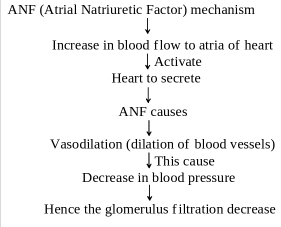
(C) The $ANF$ (Atrial Natriuretic Factor) is a peptide hormone released by the atrial wall of the heart in response to increased blood flow to the atria.
It causes vasodilation (dilation of blood vessels),which leads to a decrease in blood pressure.
Therefore,the $ANF$ mechanism acts as a check on the renin-angiotensin mechanism.
It causes vasodilation (dilation of blood vessels),which leads to a decrease in blood pressure.
Therefore,the $ANF$ mechanism acts as a check on the renin-angiotensin mechanism.
0 likes
View Solution97
MediumMCQ
Renin is released by
A
Hypothalamus
B
Posterior lobe of pituitary
C
Anterior lobe of pituitary
D
$JG$ cells
Solution
(D) Renin is an enzyme secreted by the juxtaglomerular $(JG)$ cells of the kidney.
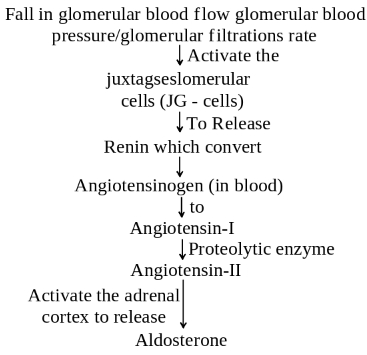
When there is a fall in glomerular blood flow,glomerular blood pressure,or glomerular filtration rate $(GFR)$,the $JG$ cells are activated to release renin.
Renin converts angiotensinogen in the blood to angiotensin-$I$,which is further converted to angiotensin-$II$ by a proteolytic enzyme.
Angiotensin-$II$ acts as a powerful vasoconstrictor,increasing glomerular blood pressure and $GFR$. It also activates the adrenal cortex to release aldosterone,which causes the reabsorption of $Na^+$ and water from the distal parts of the tubule,thereby increasing blood pressure and $GFR$. This complex mechanism is known as the renin-angiotensin mechanism.
When there is a fall in glomerular blood flow,glomerular blood pressure,or glomerular filtration rate $(GFR)$,the $JG$ cells are activated to release renin.
Renin converts angiotensinogen in the blood to angiotensin-$I$,which is further converted to angiotensin-$II$ by a proteolytic enzyme.
Angiotensin-$II$ acts as a powerful vasoconstrictor,increasing glomerular blood pressure and $GFR$. It also activates the adrenal cortex to release aldosterone,which causes the reabsorption of $Na^+$ and water from the distal parts of the tubule,thereby increasing blood pressure and $GFR$. This complex mechanism is known as the renin-angiotensin mechanism.
0 likes
View Solution98
MediumMCQ
Angiotensin-$II$ activates the ....$A$.... and releases ...... $B$......
Choose the correct option for $A$ and $B$ to complete the given statement.
Choose the correct option for $A$ and $B$ to complete the given statement.
A
$A-$adrenal cortex; $B-$aldosterone
B
$A-$adrenal medulla; $B-$aldosterone
C
$A-$adrenal capsule; $B-$aldosterone
D
$A-$adrenal medulla; $B-$oxytocin
Solution
(A) Angiotensin-$II$ is a powerful vasoconstrictor that increases the glomerular blood pressure and thereby $GFR$. It also activates the adrenal cortex to release aldosterone. Aldosterone causes reabsorption of $Na^+$ and water from the distal parts of the tubule. This leads to an increase in blood pressure and blood volume. Therefore,the correct option is $A-$adrenal cortex; $B-$aldosterone.
0 likes
View Solution99
MediumMCQ
Vasopressin released from the neurohypophysis is mainly responsible for
A
Facultative reabsorption of water through Henle's loop
B
Obligatory reabsorption of water through Bowman's capsule
C
Facultative reabsorption of water through $DCT$
D
Obligatory reabsorption of water through $PCT$
Solution
(C) $ADH$ (Vasopressin) released from the neurohypophysis (posterior pituitary) plays a crucial role in regulating the volume of urine excreted by increasing the permeability of the distal convoluted tubule $(DCT)$ and collecting duct to water.
This process of water reabsorption,which is regulated by $ADH$ according to the body's hydration status,is known as facultative water reabsorption.
This process of water reabsorption,which is regulated by $ADH$ according to the body's hydration status,is known as facultative water reabsorption.
0 likes
View Solution100
MediumMCQ
The juxtaglomerular apparatus is a modification in the
A
Afferent arteriole and $PCT$
B
Afferent arteriole and $DCT$
C
Efferent arteriole and $DCT$
D
Efferent arteriole and $PCT$
Solution
(B) The juxtaglomerular apparatus $(JGA)$ is a specialized sensitive region formed by cellular modifications in the distal convoluted tubule $(DCT)$ and the afferent arteriole at the location of their contact.
It plays a crucial role in the regulation of the glomerular filtration rate $(GFR)$ and blood pressure through the renin-angiotensin mechanism.
It plays a crucial role in the regulation of the glomerular filtration rate $(GFR)$ and blood pressure through the renin-angiotensin mechanism.
0 likes
View SolutionExcretory Products and their Elimination — Regulation of Kidney Function · Frequently Asked Questions
1Are these Excretory Products and their Elimination questions useful for JEE and NEET?
Yes. All questions in this section are mapped to JEE Main and NEET exam patterns. Previous year questions from JEE Main, NEET, GUJCET and state-level exams are included with full solutions.
2Can I switch to Hindi or Gujarati for these questions?
Yes. Use the language tabs in the hero section or the sidebar to view the same questions and solutions in English, Hindi or Gujarati.
3How do I generate a question paper from this subtopic?
Use the Vedclass Exam Paper Generator — select the chapter and subtopic, set difficulty, and generate Sets A, B, C, D automatically. First 3 chapters of every subject are free.
Vedclass Products
For Students
Vedclass Test Series
Mock tests in real JEE/NEET style with performance analysis. 5-day free trial.
Start Free TrialFor Teachers
Exam Paper Generator
Generate Set A/B/C/D papers from this chapter in 2 minutes. 3 chapters free.
Try FreeFor Institutes
Online Exam Module
Live online exams with unlimited students, 360° analytics & white-label branding.
See DemoFor Teachers & Institutes
Generate a Excretory Products and their Elimination Exam Paper in 2 Minutes
Select subtopic & difficulty — Sets A, B, C, D auto-generated with No Repeat logic.
First 3 chapters of every subject are free — no payment required.