
A English
Mix Examples- Excretory Products and their Elimination Questions in English
Class 11 Biology · Excretory Products and their Elimination · Mix Examples- Excretory Products and their Elimination
42+
Questions
English
Language
100%
With Solutions
Showing 42 of 42 questions in English
1
MediumMCQ
The blood leaving the kidney is significantly lower in:
A
$O_2$
B
Glucose
C
Urea
D
$CO_2$
Solution
(C) The blood leaving the kidney via the renal vein is significantly lower in urea compared to the blood entering the kidney via the renal artery.
This is because the primary function of the kidney is to filter metabolic wastes,specifically urea,from the blood.
While the blood also contains less $O_2$ and glucose due to the metabolic demands of the kidney tissue,the reduction in urea concentration is the most characteristic and significant change resulting from the excretory process.
This is because the primary function of the kidney is to filter metabolic wastes,specifically urea,from the blood.
While the blood also contains less $O_2$ and glucose due to the metabolic demands of the kidney tissue,the reduction in urea concentration is the most characteristic and significant change resulting from the excretory process.
0 likes
View Solution2
MediumMCQ
Which one of the following body functions is not performed by kidneys?
A
Excretion
B
Osmoregulation
C
Regulation of blood volume
D
Destruction of dead blood corpuscles
Solution
(D) The correct answer is $D$.
Kidneys are primary excretory organs responsible for the filtration of blood,excretion of nitrogenous wastes,maintenance of water and electrolyte balance (osmoregulation),and regulation of blood volume and blood pressure.
The destruction of dead blood corpuscles (specifically red blood cells) is primarily carried out by the spleen,which is known as the 'graveyard of RBCs',and the liver.
Therefore,the destruction of dead blood corpuscles is not a function of the kidneys.
Kidneys are primary excretory organs responsible for the filtration of blood,excretion of nitrogenous wastes,maintenance of water and electrolyte balance (osmoregulation),and regulation of blood volume and blood pressure.
The destruction of dead blood corpuscles (specifically red blood cells) is primarily carried out by the spleen,which is known as the 'graveyard of RBCs',and the liver.
Therefore,the destruction of dead blood corpuscles is not a function of the kidneys.
0 likes
View Solution3
EasyMCQ
In the urinogenital organs of a rabbit,which one of the following parts is present in the male but not in the female?
A
Urethra
B
Fallopian tube
C
Vagina
D
Vasa deferens
Solution
(D) The correct answer is $D$. The $Vasa$ $deferens$ (or sperm duct) is a part of the male reproductive system in rabbits. It arises from the $cauda$ $epididymis$ and transports sperm to the urethra. This structure is exclusively found in males and is absent in females.
0 likes
View Solution4
MediumMCQ
Match the following:
$A$. Loop of Henle: $1$. Carries blood into the kidney
$B$. Renal artery: $2$. Area where a considerable amount of reabsorption takes place
$C$. Proximal convoluted tubule: $3$. Main area of secretion
$D$. Glomerulus: $4$. Filtration of blood
$E$. Distal convoluted tubule: $5$. Plays a role in concentration of urine
The correct pairing sequence is:
$A$. Loop of Henle: $1$. Carries blood into the kidney
$B$. Renal artery: $2$. Area where a considerable amount of reabsorption takes place
$C$. Proximal convoluted tubule: $3$. Main area of secretion
$D$. Glomerulus: $4$. Filtration of blood
$E$. Distal convoluted tubule: $5$. Plays a role in concentration of urine
The correct pairing sequence is:
A
$A-5, B-1, C-2, D-4, E-3$
B
$A-5, B-1, C-2, D-3, E-4$
C
$A-1, B-5, C-3, D-4, E-2$
D
None of the above
Solution
(A) . Loop of Henle plays a significant role in the concentration of urine $(A-5)$.
$B$. Renal artery carries oxygenated blood into the kidney for filtration $(B-1)$.
$C$. Proximal convoluted tubule $(PCT)$ is the primary site where a considerable amount of electrolytes and water are reabsorbed $(C-2)$.
$D$. Glomerulus is the site of ultrafiltration of blood $(D-4)$.
$E$. Distal convoluted tubule $(DCT)$ is the main site for the secretion of ions like $H^+$ and $K^+$ to maintain $pH$ and ionic balance $(E-3)$.
Therefore,the correct sequence is $A-5, B-1, C-2, D-4, E-3$.
$B$. Renal artery carries oxygenated blood into the kidney for filtration $(B-1)$.
$C$. Proximal convoluted tubule $(PCT)$ is the primary site where a considerable amount of electrolytes and water are reabsorbed $(C-2)$.
$D$. Glomerulus is the site of ultrafiltration of blood $(D-4)$.
$E$. Distal convoluted tubule $(DCT)$ is the main site for the secretion of ions like $H^+$ and $K^+$ to maintain $pH$ and ionic balance $(E-3)$.
Therefore,the correct sequence is $A-5, B-1, C-2, D-4, E-3$.
0 likes
View Solution5
MediumMCQ
The maximum quantity of water required per day by a human body is
A
$10$ litres
B
$5$ litres
C
$1$ litres
D
$6$ litres
Solution
(B) The human body requires water for various physiological processes, including thermoregulation, digestion, and the excretion of metabolic wastes. While the exact requirement varies based on activity level, climate, and diet, a healthy adult typically requires approximately $2$ to $3$ litres of water per day. Among the given options, $5$ litres is the most reasonable upper limit for daily intake under normal physiological conditions, as $1$ litre is insufficient and $6$ or $10$ litres are generally excessive for a standard human body.
0 likes
View Solution6
MediumMCQ
Why do we pass more urine in wet and cold seasons?
A
Because uriniferous tubules do not absorb water
B
Kidneys become overactive
C
Not much water is lost from the body through sweating
D
All of the above
Solution
(C) In cold and wet seasons,the ambient temperature is low,which reduces the rate of perspiration (sweating).
Since less water is lost from the body through sweat glands,the body maintains water balance by increasing the volume of urine excreted by the kidneys.
Therefore,the correct option is $C$.
Since less water is lost from the body through sweat glands,the body maintains water balance by increasing the volume of urine excreted by the kidneys.
Therefore,the correct option is $C$.
0 likes
View Solution7
MediumMCQ
Stale urine smells like ammonia because
A
It changes into $NH_3$
B
Its bacterial decay produces $NH_3$
C
It forms ammonium carbonate
D
All the above
Solution
(D) Fresh urine is generally acidic and does not have a strong ammonia smell.
However,when urine is left to stand (stale urine),bacteria from the environment or skin contaminate it.
These bacteria break down the urea present in the urine into ammonia $(NH_3)$ and carbon dioxide.
The ammonia then reacts with water and other components to form ammonium carbonate,which further releases ammonia gas,causing the characteristic pungent smell.
Therefore,all the mentioned processes contribute to the smell of stale urine.
However,when urine is left to stand (stale urine),bacteria from the environment or skin contaminate it.
These bacteria break down the urea present in the urine into ammonia $(NH_3)$ and carbon dioxide.
The ammonia then reacts with water and other components to form ammonium carbonate,which further releases ammonia gas,causing the characteristic pungent smell.
Therefore,all the mentioned processes contribute to the smell of stale urine.
0 likes
View Solution8
MediumMCQ
Urine becomes cloudy when:
A
Alkalinity increases
B
Alkalinity decreases
C
There is a bacterial infection
D
Both $(b)$ and $(c)$
Solution
(A) Urine typically becomes cloudy due to the precipitation of phosphates when the alkalinity of the urine increases. Additionally,a bacterial infection can also cause urine to appear cloudy due to the presence of bacteria,white blood cells,or pus. However,the primary physiological cause related to chemical changes is the increase in alkalinity. Given the options provided,if we consider both factors,the most comprehensive answer is that cloudiness is associated with increased alkalinity or infection.
0 likes
View Solution9
MediumMCQ
Which one of the following statements is not correct?
A
Network of blood vessels paralleling the loop of Henle is called as vasa recta.
B
In proximal convoluted tubule,water,glucose,amino acids,and vitamin $C$ are absorbed without the utilization of energy.
C
Ascending part of loop of Henle is impermeable to water.
D
Fresh water fishes eliminate hypotonic urine in order to get rid of excess water.
Solution
(B) The correct answer is $B$.
In the proximal convoluted tubule $(PCT)$,glucose,amino acids,and certain vitamins are reabsorbed via active transport,which requires the utilization of energy $(ATP)$.
Option $A$ is correct as the peritubular capillaries forming a network around the loop of Henle are known as vasa recta.
Option $C$ is correct because the ascending limb of the loop of Henle is impermeable to water but permeable to electrolytes.
Option $D$ is correct as freshwater fishes live in a hypotonic environment and must excrete large amounts of dilute (hypotonic) urine to maintain osmotic balance.
In the proximal convoluted tubule $(PCT)$,glucose,amino acids,and certain vitamins are reabsorbed via active transport,which requires the utilization of energy $(ATP)$.
Option $A$ is correct as the peritubular capillaries forming a network around the loop of Henle are known as vasa recta.
Option $C$ is correct because the ascending limb of the loop of Henle is impermeable to water but permeable to electrolytes.
Option $D$ is correct as freshwater fishes live in a hypotonic environment and must excrete large amounts of dilute (hypotonic) urine to maintain osmotic balance.
0 likes
View Solution10
MediumMCQ
Match the excretory functions of Section $I$ with the parts of the excretory system in Section $II$. Choose the correct combinations from among the answers given:
| Section $I$ | Section $II$ |
| $(i)$ Ultrafiltration | $(a)$ Henle's loop |
| $(ii)$ Concentration of urine | $(b)$ Ureter |
| $(iii)$ Transport of urine | $(c)$ Urinary bladder |
| $(iv)$ Storage of urine | $(d)$ Malpighian corpuscles |
| $(e)$ Proximal convoluted tubules |
A
$(i)-(d), (ii)-(a), (iii)-(b), (iv)-(c)$
B
$(i)-(d), (ii)-(c), (iii)-(b), (iv)-(a)$
C
$(i)-(e), (ii)-(d), (iii)-(a), (iv)-(c)$
D
$(i)-(e), (ii)-(d), (iii)-(a), (iv)-(b)$
Solution
(A) The correct matching is as follows:
$(i)$ Ultrafiltration occurs in the Malpighian corpuscles (glomerulus + Bowman's capsule).
$(ii)$ Concentration of urine is primarily the function of Henle's loop in the nephron.
$(iii)$ Transport of urine from the kidneys to the urinary bladder is performed by the ureters.
$(iv)$ Storage of urine occurs in the urinary bladder until micturition.
Thus, the correct sequence is $(i)-(d), (ii)-(a), (iii)-(b), (iv)-(c)$.
$(i)$ Ultrafiltration occurs in the Malpighian corpuscles (glomerulus + Bowman's capsule).
$(ii)$ Concentration of urine is primarily the function of Henle's loop in the nephron.
$(iii)$ Transport of urine from the kidneys to the urinary bladder is performed by the ureters.
$(iv)$ Storage of urine occurs in the urinary bladder until micturition.
Thus, the correct sequence is $(i)-(d), (ii)-(a), (iii)-(b), (iv)-(c)$.
0 likes
View Solution11
MediumMCQ
Cholera patients are given saline solution because .......
A
$Na^+$ prevents the loss of water from the body.
B
$NaCl$ acts as a regulatory substance.
C
$NaCl$ produces energy.
D
$NaCl$ is antibacterial.
Solution
(A) Cholera is a severe diarrheal disease caused by the bacterium $Vibrio$ $\text{cholerae}$.
This infection leads to massive loss of water and electrolytes $(Na^+, Cl^-)$ from the body through stool.
Saline solution (Oral Rehydration Solution or intravenous saline) is administered to replace the lost water and electrolytes.
$Na^+$ ions are crucial for maintaining osmotic balance and preventing further dehydration by facilitating water retention in the body.
Therefore, $Na^+$ helps in preventing the loss of water from the body.
This infection leads to massive loss of water and electrolytes $(Na^+, Cl^-)$ from the body through stool.
Saline solution (Oral Rehydration Solution or intravenous saline) is administered to replace the lost water and electrolytes.
$Na^+$ ions are crucial for maintaining osmotic balance and preventing further dehydration by facilitating water retention in the body.
Therefore, $Na^+$ helps in preventing the loss of water from the body.
0 likes
View Solution12
MediumMCQ
Match the following columns:
The correct sequence is:
| Column-$I$ | Column-$II$ |
| $a.$ Loop of Henle | $1.$ Carries blood to the kidney |
| $b.$ Renal artery | $2.$ Region where maximum reabsorption occurs |
| $c.$ Proximal Convoluted Tubule $(PCT)$ | $3.$ Main site of secretion |
| $d.$ Glomerulus | $4.$ Filtration of blood |
| $e.$ Distal Convoluted Tubule $(DCT)$ | $5.$ Plays a significant role in urine concentration |
The correct sequence is:
A
$5, 1, 2, 4, 3$
B
$5, 1, 2, 3, 4$
C
$1, 5, 3, 4, 2$
D
$2, 1, 3, 5, 4$
Solution
(A) The correct matching is as follows:
$a.$ Loop of Henle: Plays a significant role in urine concentration $(5)$.
$b.$ Renal artery: Carries blood to the kidney $(1)$.
$c.$ Proximal Convoluted Tubule $(PCT)$: Region where maximum reabsorption occurs $(2)$.
$d.$ Glomerulus: Filtration of blood $(4)$.
$e.$ Distal Convoluted Tubule $(DCT)$: Main site of secretion $(3)$.
Therefore,the correct sequence is $a-5, b-1, c-2, d-4, e-3$.
$a.$ Loop of Henle: Plays a significant role in urine concentration $(5)$.
$b.$ Renal artery: Carries blood to the kidney $(1)$.
$c.$ Proximal Convoluted Tubule $(PCT)$: Region where maximum reabsorption occurs $(2)$.
$d.$ Glomerulus: Filtration of blood $(4)$.
$e.$ Distal Convoluted Tubule $(DCT)$: Main site of secretion $(3)$.
Therefore,the correct sequence is $a-5, b-1, c-2, d-4, e-3$.
0 likes
View Solution13
MediumMCQ
Which of the following is $NOT$ a function of the kidney?
A
Osmoregulation
B
Regulation of electrolyte balance
C
Excretion
D
Urea formation
Solution
(D) The primary functions of the kidney include osmoregulation (maintaining water balance),regulation of electrolyte balance,and the excretion of metabolic waste products like urea,creatinine,and uric acid.
Urea formation (the Ornithine cycle) occurs in the liver,not the kidney. The liver converts toxic ammonia into urea,which is then transported to the kidneys for excretion. Therefore,urea formation is not a function of the kidney.
Urea formation (the Ornithine cycle) occurs in the liver,not the kidney. The liver converts toxic ammonia into urea,which is then transported to the kidneys for excretion. Therefore,urea formation is not a function of the kidney.
0 likes
View Solution14
EasyMCQ
The primary function of the kidney is ........ .
A
Active absorption
B
Ultrafiltration
C
Selective reabsorption
D
Both $(B)$ and $(C)$
Solution
(D) The kidney performs several vital functions to maintain homeostasis in the body.
$1$. Ultrafiltration: This occurs in the glomerulus,where blood is filtered under high pressure to form a filtrate.
$2$. Selective reabsorption: This occurs in the renal tubules,where essential substances like glucose,amino acids,and water are reabsorbed back into the blood.
Therefore,both ultrafiltration and selective reabsorption are primary functions of the kidney.
$1$. Ultrafiltration: This occurs in the glomerulus,where blood is filtered under high pressure to form a filtrate.
$2$. Selective reabsorption: This occurs in the renal tubules,where essential substances like glucose,amino acids,and water are reabsorbed back into the blood.
Therefore,both ultrafiltration and selective reabsorption are primary functions of the kidney.
0 likes
View Solution15
MediumMCQ
Diuresis is a condition characterized by:
A
Increased volume of urine
B
Increased excretion of sugar
C
Decreased volume of urine
D
Decreased ionic balance
Solution
(A) Diuresis is a physiological process characterized by an increased production and excretion of urine by the kidneys.
This condition can be caused by various factors,such as high fluid intake,the use of diuretics,or certain medical conditions like diabetes mellitus.
Therefore,the correct option is $A$.
This condition can be caused by various factors,such as high fluid intake,the use of diuretics,or certain medical conditions like diabetes mellitus.
Therefore,the correct option is $A$.
0 likes
View Solution16
MediumMCQ
Why do we urinate more frequently during cold and humid weather?
A
Passive absorption of water by the nephrons
B
Kidneys become more active
C
Sweating is significantly reduced
D
Increased secretion of $ADH$
Solution
(C) During cold and humid weather,the body does not need to lose water through sweat to maintain thermoregulation.
As a result,the rate of perspiration (sweating) is significantly reduced.
Since the total volume of water lost through the skin decreases,the body compensates by excreting the excess water through the kidneys.
This leads to an increased volume of urine production and more frequent urination.
As a result,the rate of perspiration (sweating) is significantly reduced.
Since the total volume of water lost through the skin decreases,the body compensates by excreting the excess water through the kidneys.
This leads to an increased volume of urine production and more frequent urination.
0 likes
View Solution17
MediumMCQ
Which one of the following options gives the correct categorization of six animals according to the type of nitrogenous waste they excrete?
| Option | Ammonotelic | Ureotelic | Uricotelic |
|---|---|---|---|
| $a$ | Pigeon,human | Aquatic amphibia,lizards | Cockroach,frog |
| $b$ | Frog,lizards | Aquatic amphibia,humans | Cockroach,pigeon |
| $c$ | Aquatic amphibia | Frog,human | Pigeon,lizards,cockroach |
| $d$ | Aquatic amphibia | Cockroach,humans | Frog,pigeon,lizards |
A
$a$
B
$b$
C
$c$
D
$d$
Solution
(C) The correct classification is based on the primary nitrogenous waste excreted by the animals:
$1$. Ammonotelic animals excrete ammonia,which is highly toxic and requires large amounts of water. Examples include aquatic amphibians.
$2$. Ureotelic animals excrete urea,which is less toxic and requires moderate water. Examples include humans and adult frogs (terrestrial stage).
$3$. Uricotelic animals excrete uric acid,which is the least toxic and requires minimal water. Examples include birds (pigeon),reptiles (lizards),and insects (cockroach).
Therefore,option $c$ correctly categorizes these animals.
$1$. Ammonotelic animals excrete ammonia,which is highly toxic and requires large amounts of water. Examples include aquatic amphibians.
$2$. Ureotelic animals excrete urea,which is less toxic and requires moderate water. Examples include humans and adult frogs (terrestrial stage).
$3$. Uricotelic animals excrete uric acid,which is the least toxic and requires minimal water. Examples include birds (pigeon),reptiles (lizards),and insects (cockroach).
Therefore,option $c$ correctly categorizes these animals.
0 likes
View Solution18
MediumMCQ
Choose the correct pair regarding urine formation.
A
Reabsorption - Occurs in glomerulus
B
Tubular secretion - Secretion of $H^+, K^+$ and ammonia into the filtrate
C
Glomerular filtration - Occurs in $DCT$
D
$GFR$ - $1100$ to $1200 \ ml$ per minute
Solution
(B) Urine formation involves three main processes: Glomerular filtration,Reabsorption,and Tubular secretion.
$1$. Glomerular filtration occurs in the glomerulus,not the $DCT$.
$2$. Reabsorption occurs primarily in the renal tubules ($PCT$,Loop of Henle,$DCT$,and Collecting Duct),not the glomerulus.
$3$. Tubular secretion involves the active secretion of substances like $H^+, K^+$,and ammonia into the filtrate to maintain ionic and acid-base balance.
$4$. The $GFR$ (Glomerular Filtration Rate) is approximately $125 \ ml/min$ (or $180 \ liters$ per day),whereas $1100-1200 \ ml/min$ is the renal blood flow.
$1$. Glomerular filtration occurs in the glomerulus,not the $DCT$.
$2$. Reabsorption occurs primarily in the renal tubules ($PCT$,Loop of Henle,$DCT$,and Collecting Duct),not the glomerulus.
$3$. Tubular secretion involves the active secretion of substances like $H^+, K^+$,and ammonia into the filtrate to maintain ionic and acid-base balance.
$4$. The $GFR$ (Glomerular Filtration Rate) is approximately $125 \ ml/min$ (or $180 \ liters$ per day),whereas $1100-1200 \ ml/min$ is the renal blood flow.
0 likes
View Solution19
MediumMCQ
| Substance | Glomerular filtrate | Reabsorbed | Urine |
|---|---|---|---|
| $(i)$ Proteins | $2 \,g$ | $1.9 \,g$ | $0.1 \,g$ |
| $(ii)$ Glucose | $162 \,g$ | $162 \,g$ | $0 \,g$ |
| $(iii)$ Urea | $54 \,g$ | $24 \,g$ | $30 \,g$ |
| $(iv)$ Creatinine | $1.6 \,g$ | $0 \,g$ | $1.7 \,g$ |
$(a)$ Glucose is completely reabsorbed.
$(b)$ Urea is partially reabsorbed.
$(c)$ Proteins are secreted into urine.
$(d)$ Creatinine is secreted into urine.
Which of the following options,in view of the above statements,is correct?
A
$a, b$ and $c$
B
$b, c$ and $d$
C
$a, b$ and $d$
D
$a, c$ and $d$
Solution
(C) $1$. Statement $(a)$: The table shows $162 \,g$ of glucose in the glomerular filtrate and $162 \,g$ reabsorbed,resulting in $0 \,g$ in the urine. This confirms glucose is completely reabsorbed. Statement $(a)$ is correct.
$2$. Statement $(b)$: The table shows $54 \,g$ of urea in the filtrate and $24 \,g$ reabsorbed,leaving $30 \,g$ in the urine. This indicates partial reabsorption. Statement $(b)$ is correct.
$3$. Statement $(c)$: Proteins are generally not filtered in significant amounts by the glomerulus. The presence of $0.1 \,g$ in urine is negligible and does not indicate active secretion. Statement $(c)$ is incorrect.
$4$. Statement $(d)$: The table shows $1.6 \,g$ of creatinine in the filtrate and $1.7 \,g$ in the urine,with $0 \,g$ reabsorbed. The increase from $1.6 \,g$ to $1.7 \,g$ indicates that creatinine is actively secreted into the renal tubules. Statement $(d)$ is correct.
$5$. Therefore,statements $(a), (b),$ and $(d)$ are correct.
$2$. Statement $(b)$: The table shows $54 \,g$ of urea in the filtrate and $24 \,g$ reabsorbed,leaving $30 \,g$ in the urine. This indicates partial reabsorption. Statement $(b)$ is correct.
$3$. Statement $(c)$: Proteins are generally not filtered in significant amounts by the glomerulus. The presence of $0.1 \,g$ in urine is negligible and does not indicate active secretion. Statement $(c)$ is incorrect.
$4$. Statement $(d)$: The table shows $1.6 \,g$ of creatinine in the filtrate and $1.7 \,g$ in the urine,with $0 \,g$ reabsorbed. The increase from $1.6 \,g$ to $1.7 \,g$ indicates that creatinine is actively secreted into the renal tubules. Statement $(d)$ is correct.
$5$. Therefore,statements $(a), (b),$ and $(d)$ are correct.
0 likes
View Solution20
MediumMCQ
The volume of the filtrate per day is $X$ liters and the volume of urine released per day is $Y$ liters. It means about $Z$ $\%$ of the filtrate is reabsorbed by the process of reabsorption.
A
$X-99, Y-1.5, Z-180$
B
$X-1.5, Y-99, Z-140$
C
$X-180, Y-1.5, Z-99$
D
$X-180, Y-2.5, Z-80$
Solution
(C) The kidneys filter approximately $180$ liters of blood plasma per day,which is the volume of the glomerular filtrate $(X = 180)$.
Out of this,only about $1.5$ liters of urine is excreted per day $(Y = 1.5)$.
This implies that nearly $99$ $\%$ of the filtrate is reabsorbed by the renal tubules back into the blood $(Z = 99)$.
Therefore,the correct values are $X = 180$,$Y = 1.5$,and $Z = 99$.
Out of this,only about $1.5$ liters of urine is excreted per day $(Y = 1.5)$.
This implies that nearly $99$ $\%$ of the filtrate is reabsorbed by the renal tubules back into the blood $(Z = 99)$.
Therefore,the correct values are $X = 180$,$Y = 1.5$,and $Z = 99$.
0 likes
View Solution21
MediumMCQ
Choose the incorrect sentence.
A
Descending limb of Henle's loop is permeable to water.
B
Hydrogen,potassium,and ammonia are secreted by the $DCT$.
C
$H^+$ and $K^+$ are selectively secreted by the collecting duct.
D
Ascending limb of Henle's loop is impermeable to electrolytes.
Solution
(D) The correct answer is $D$.
$1$. The descending limb of the loop of Henle is permeable to water but nearly impermeable to electrolytes,which helps in the concentration of filtrate.
$2$. The distal convoluted tubule $(DCT)$ is capable of reabsorption of $HCO_3^-$ and selective secretion of hydrogen ions $(H^+)$,potassium ions $(K^+)$,and ammonia $(NH_3)$ to maintain the $pH$ and sodium-potassium balance in the blood.
$3$. The collecting duct allows for the passage of small amounts of urea into the medullary interstitium to keep up the osmolarity and also secretes $H^+$ and $K^+$ ions.
$4$. The ascending limb of the loop of Henle is impermeable to water but allows the transport of electrolytes (like $Na^+$,$Cl^-$,and $K^+$) actively or passively. Therefore,the statement that it is impermeable to electrolytes is incorrect.
$1$. The descending limb of the loop of Henle is permeable to water but nearly impermeable to electrolytes,which helps in the concentration of filtrate.
$2$. The distal convoluted tubule $(DCT)$ is capable of reabsorption of $HCO_3^-$ and selective secretion of hydrogen ions $(H^+)$,potassium ions $(K^+)$,and ammonia $(NH_3)$ to maintain the $pH$ and sodium-potassium balance in the blood.
$3$. The collecting duct allows for the passage of small amounts of urea into the medullary interstitium to keep up the osmolarity and also secretes $H^+$ and $K^+$ ions.
$4$. The ascending limb of the loop of Henle is impermeable to water but allows the transport of electrolytes (like $Na^+$,$Cl^-$,and $K^+$) actively or passively. Therefore,the statement that it is impermeable to electrolytes is incorrect.
0 likes
View Solution22
MediumMCQ
An adult human excretes,on average,... liters of urine per day. On an average,... of urea is excreted out per day.
A
$1 - 15 \text{ liters}, 30 - 25 \text{ gm}$
B
$1 - 5 \text{ liters}, 25 - 30 \text{ gm}$
C
$1 - 1.5 \text{ liters}, 25 - 30 \text{ gm}$
D
$1 - 1.5 \text{ liters}, 20 - 25 \text{ gm}$
Solution
(C) An adult human excretes,on average,$1$ to $1.5$ liters of urine per day.
Approximately $25$ to $30$ grams of urea is excreted out per day by an adult human.
These values are standard physiological data provided in the $NCERT$ textbook under the chapter 'Excretory Products and their Elimination'.
Approximately $25$ to $30$ grams of urea is excreted out per day by an adult human.
These values are standard physiological data provided in the $NCERT$ textbook under the chapter 'Excretory Products and their Elimination'.
0 likes
View Solution23
DifficultMCQ
The given figure shows the human excretory system with parts labeled $A$ to $D$. Select the option that correctly identifies these parts and describes their characteristics or functions.
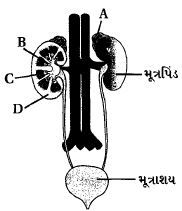
A
$D$ - Cortex - It is the outer part of the kidney and does not contain any parts of the nephrons.
B
$A$ - Adrenal gland - Located at the anterior part of the kidney,it secretes catecholamines which stimulate glycogen breakdown.
C
$B$ - Renal pelvis - $A$ broad,funnel-shaped space inside the hilum,directly connected to the loop of Henle.
D
$C$ - Medulla - The inner part of the kidney that contains the entire nephron structure.
Solution
(B) In the given diagram of the human excretory system:
$A$ represents the Adrenal gland,which is located at the anterior part of the kidney. It secretes hormones like catecholamines (epinephrine and norepinephrine) that stimulate glycogen breakdown (glycogenolysis) to increase blood glucose levels.
$B$ represents the Renal pelvis,which is a broad,funnel-shaped space inside the hilum.
$C$ represents the Medulla,which consists of renal pyramids.
$D$ represents the Cortex,which is the outer layer of the kidney.
Therefore,option $B$ is the correct description.
$A$ represents the Adrenal gland,which is located at the anterior part of the kidney. It secretes hormones like catecholamines (epinephrine and norepinephrine) that stimulate glycogen breakdown (glycogenolysis) to increase blood glucose levels.
$B$ represents the Renal pelvis,which is a broad,funnel-shaped space inside the hilum.
$C$ represents the Medulla,which consists of renal pyramids.
$D$ represents the Cortex,which is the outer layer of the kidney.
Therefore,option $B$ is the correct description.
0 likes
View Solution24
MediumMCQ
Match the items given in Column $I$ with those in Column $II$ and select the correct option given below:
| Column $I$ (Function) | Column $II$ (Part of Excretory System) |
| $(a)$ Ultrafiltration | $(i)$ Henle's loop |
| $(b)$ Concentration of urine | $(ii)$ Ureter |
| $(c)$ Transport of urine | $(iii)$ Urinary bladder |
| $(d)$ Storage of urine | $(iv)$ Malpighian corpuscle |
| $(v)$ Proximal convoluted tubule |
A
$a-v, b-iv, c-i, d-iii$
B
$a-iv, b-v, c-ii, d-iii$
C
$a-v, b-iv, c-i, d-ii$
D
$a-iv, b-i, c-ii, d-iii$
Solution
(D) The correct matching is as follows:
$(a)$ Ultrafiltration occurs in the Malpighian corpuscle (glomerulus + Bowman's capsule),which is $(iv)$.
$(b)$ Concentration of urine is primarily performed by the Henle's loop through the counter-current mechanism,which is $(i)$.
$(c)$ Transport of urine from the kidneys to the urinary bladder is carried out by the ureter,which is $(ii)$.
$(d)$ Storage of urine occurs in the urinary bladder,which is $(iii)$.
Therefore,the correct sequence is $a-iv, b-i, c-ii, d-iii$.
$(a)$ Ultrafiltration occurs in the Malpighian corpuscle (glomerulus + Bowman's capsule),which is $(iv)$.
$(b)$ Concentration of urine is primarily performed by the Henle's loop through the counter-current mechanism,which is $(i)$.
$(c)$ Transport of urine from the kidneys to the urinary bladder is carried out by the ureter,which is $(ii)$.
$(d)$ Storage of urine occurs in the urinary bladder,which is $(iii)$.
Therefore,the correct sequence is $a-iv, b-i, c-ii, d-iii$.
0 likes
View Solution25
MediumMCQ
Assertion : Secreting hypotonic urine is effective in reducing urinary loss of water.
Reason : Hypotonic urine is more concentrated and higher in osmotic pressure than the blood.
Reason : Hypotonic urine is more concentrated and higher in osmotic pressure than the blood.
A
If both Assertion and Reason are correct and the Reason is a correct explanation of the Assertion.
B
If both Assertion and Reason are correct but Reason is not a correct explanation of the Assertion.
C
If the Assertion is correct but Reason is incorrect.
D
If both the Assertion and Reason are incorrect.
Solution
(D) Hypotonic urine refers to urine that has a lower solute concentration than blood plasma.
Hypertonic urine,on the other hand,is more concentrated than blood and possesses a higher osmotic pressure than the blood.
Producing hypertonic urine is the mechanism that helps in reducing the loss of water through urine.
Since the Assertion claims that hypotonic urine reduces water loss (which is false) and the Reason incorrectly defines hypotonic urine as more concentrated than blood (which is also false),both statements are incorrect.
Hypertonic urine,on the other hand,is more concentrated than blood and possesses a higher osmotic pressure than the blood.
Producing hypertonic urine is the mechanism that helps in reducing the loss of water through urine.
Since the Assertion claims that hypotonic urine reduces water loss (which is false) and the Reason incorrectly defines hypotonic urine as more concentrated than blood (which is also false),both statements are incorrect.
0 likes
View Solution26
MediumMCQ
Match the items in Column-$I$ with those in Column-$II$.
Select the correct option from the following:
| Column-$I$ | Column-$II$ |
| $(a)$ Podocytes | $(i)$ Crystallised oxalates |
| $(b)$ Protonephridia | $(ii)$ Annelids |
| $(c)$ Nephridia | $(iii)$ Amphioxus |
| $(d)$ Renal calculi | $(iv)$ Filtration slits |
Select the correct option from the following:
A
$(a)-(iii), (b)-(iv), (c)-(ii), (d)-(i)$
B
$(a)-(iii), (b)-(ii), (c)-(iv), (d)-(i)$
C
$(a)-(iv), (b)-(iii), (c)-(ii), (d)-(i)$
D
$(a)-(iv), (b)-(ii), (c)-(iii), (d)-(i)$
Solution
(C) The correct matching is as follows:
$(a)$ Podocytes: These are specialized cells in the Bowman's capsule of the kidney that form filtration slits, which are essential for ultrafiltration.
$(b)$ Protonephridia: These are excretory structures found in organisms like Amphioxus (Cephalochordates).
$(c)$ Nephridia: These are the tubular excretory organs found in earthworms and other Annelids.
$(d)$ Renal calculi: These are stone-like masses formed in the kidney, typically composed of crystallised oxalates.
Therefore, the correct sequence is $(a)-(iv), (b)-(iii), (c)-(ii), (d)-(i)$.
$(a)$ Podocytes: These are specialized cells in the Bowman's capsule of the kidney that form filtration slits, which are essential for ultrafiltration.
$(b)$ Protonephridia: These are excretory structures found in organisms like Amphioxus (Cephalochordates).
$(c)$ Nephridia: These are the tubular excretory organs found in earthworms and other Annelids.
$(d)$ Renal calculi: These are stone-like masses formed in the kidney, typically composed of crystallised oxalates.
Therefore, the correct sequence is $(a)-(iv), (b)-(iii), (c)-(ii), (d)-(i)$.
0 likes
View Solution27
Easy
Match the items of column $I$ with those of column $II$:
| Column $I$ | Column $II$ |
| $(a)$ Ammonotelism | $(i)$ Birds |
| $(b)$ Bowman's capsule | $(ii)$ Water reabsorption |
| $(c)$ Micturition | $(iii)$ Bony fish |
| $(d)$ Uricotelism | $(iv)$ Urinary bladder |
| $(e)$ $ADH$ | $(v)$ Renal tubule |
Solution
(A) The correct matches are as follows:
$1$. $(a)$ Ammonotelism: Excretion of ammonia, typically seen in aquatic animals like $(iii)$ Bony fish.
$2$. $(b)$ Bowman's capsule: The cup-shaped structure at the beginning of the $(v)$ Renal tubule.
$3$. $(c)$ Micturition: The process of releasing urine from the $(iv)$ Urinary bladder.
$4$. $(d)$ Uricotelism: Excretion of uric acid, seen in $(i)$ Birds.
$5$. $(e)$ $ADH$ (Antidiuretic Hormone): Regulates $(ii)$ Water reabsorption in the kidneys.
Thus, the correct sequence is: $(a-iii, b-v, c-iv, d-i, e-ii)$.
$1$. $(a)$ Ammonotelism: Excretion of ammonia, typically seen in aquatic animals like $(iii)$ Bony fish.
$2$. $(b)$ Bowman's capsule: The cup-shaped structure at the beginning of the $(v)$ Renal tubule.
$3$. $(c)$ Micturition: The process of releasing urine from the $(iv)$ Urinary bladder.
$4$. $(d)$ Uricotelism: Excretion of uric acid, seen in $(i)$ Birds.
$5$. $(e)$ $ADH$ (Antidiuretic Hormone): Regulates $(ii)$ Water reabsorption in the kidneys.
Thus, the correct sequence is: $(a-iii, b-v, c-iv, d-i, e-ii)$.
0 likes
View Solution28
Medium
Complete the following:
$(a)$ Urinary excretion = tubular reabsorption + tubular secretion -..........
$(b)$ Dialysis fluid = Plasma -..........
$(a)$ Urinary excretion = tubular reabsorption + tubular secretion -..........
$(b)$ Dialysis fluid = Plasma -..........
Solution
$(A)$ Glomerular filtration (or filtrate)
$(b)$ Nitrogenous wastes (or excretory substances)
Explanation:
$(a)$ The process of urine formation involves three main steps: glomerular filtration, tubular reabsorption, and tubular secretion. The net amount excreted is calculated as: $\text{Urinary excretion} = \text{Glomerular filtration} + \text{Tubular secretion} - \text{Tubular reabsorption}$. However, based on the provided equation structure, the missing term is the initial filtrate formed at the glomerulus.
$(b)$ Dialysis fluid is designed to mimic the composition of blood plasma but lacks nitrogenous waste products (like urea, uric acid, and creatinine) so that these substances can diffuse out of the patient's blood into the dialysis fluid.
$(b)$ Nitrogenous wastes (or excretory substances)
Explanation:
$(a)$ The process of urine formation involves three main steps: glomerular filtration, tubular reabsorption, and tubular secretion. The net amount excreted is calculated as: $\text{Urinary excretion} = \text{Glomerular filtration} + \text{Tubular secretion} - \text{Tubular reabsorption}$. However, based on the provided equation structure, the missing term is the initial filtrate formed at the glomerulus.
$(b)$ Dialysis fluid is designed to mimic the composition of blood plasma but lacks nitrogenous waste products (like urea, uric acid, and creatinine) so that these substances can diffuse out of the patient's blood into the dialysis fluid.
0 likes
View Solution29
Easy
Explain briefly,micturition and disorders of the excretory system.
Solution
(N/A) Micturition: The process of release of urine is called micturition. The urinary bladder stores urine until a voluntary signal is given by the $CNS$ (Central Nervous System). As the bladder fills,stretch receptors on its walls send signals to the $CNS$. The $CNS$ then sends motor messages to initiate the contraction of the smooth muscles of the bladder and the simultaneous relaxation of the urethral sphincter,causing the release of urine.
Disorders of the Excretory System:
$1$. Uremia: Presence of excessive urea in the blood,often caused by kidney malfunction or infection in the uriniferous tubules.
$2$. Renal Failure: Malfunctioning of the kidneys leading to the inability to excrete waste properly. It can be treated by hemodialysis,where an artificial kidney (haemodialyzer) filters the blood using a cellophane membrane and a dialyzing fluid.
$3$. Kidney Stones: Insoluble masses of crystallized salts (like oxalates) formed within the kidney,which can obstruct the urinary tract and cause acute pain.
$4$. Nephritis: Inflammation of the renal pelvis,interstitial tissues,and calyces,typically caused by bacterial infection. Symptoms include a burning sensation during urination,back pain,and increased frequency of urination.
Disorders of the Excretory System:
$1$. Uremia: Presence of excessive urea in the blood,often caused by kidney malfunction or infection in the uriniferous tubules.
$2$. Renal Failure: Malfunctioning of the kidneys leading to the inability to excrete waste properly. It can be treated by hemodialysis,where an artificial kidney (haemodialyzer) filters the blood using a cellophane membrane and a dialyzing fluid.
$3$. Kidney Stones: Insoluble masses of crystallized salts (like oxalates) formed within the kidney,which can obstruct the urinary tract and cause acute pain.
$4$. Nephritis: Inflammation of the renal pelvis,interstitial tissues,and calyces,typically caused by bacterial infection. Symptoms include a burning sensation during urination,back pain,and increased frequency of urination.
0 likes
View Solution30
Medium
Analogy type question:
$(1)$ Blood filtered by kidneys per minute: $1100-1200 \text{ mL}$ :: $GFR$ in a healthy individual: ............
$(2)$ From sweat glands of the skin: Sweat is produced :: From sebaceous glands: ............
$(1)$ Blood filtered by kidneys per minute: $1100-1200 \text{ mL}$ :: $GFR$ in a healthy individual: ............
$(2)$ From sweat glands of the skin: Sweat is produced :: From sebaceous glands: ............
Solution
(A) $(1)$ The Glomerular Filtration Rate $(GFR)$ in a healthy individual is approximately $125 \text{ mL/min}$ or $180 \text{ L/day}$.
$(2)$ Sebaceous glands are exocrine glands in the skin that secrete an oily or waxy matter called sebum to lubricate and waterproof the skin and hair.
$(2)$ Sebaceous glands are exocrine glands in the skin that secrete an oily or waxy matter called sebum to lubricate and waterproof the skin and hair.
0 likes
View Solution31
MediumMCQ
Find the incorrect option regarding the mechanism of urine formation in humans.
A
The glomerular filtration rate is about $125 \ mL/min$.
B
The ultrafiltration is opposed by the colloidal osmotic pressure of plasma.
C
Tubular secretion takes place in the $PCT$ only.
D
Aldosterone induces greater reabsorption of sodium.
Solution
(C) Tubular secretion is a process where substances like $H^+$,$K^+$,and ammonia are secreted into the filtrate. This process occurs in both the proximal convoluted tubule $(PCT)$ and the distal convoluted tubule $(DCT)$,as well as the collecting duct. Therefore,the statement that tubular secretion takes place in the $PCT$ only is incorrect.
0 likes
View Solution32
EasyMCQ
The average $pH$ of human urine is
A
$7.0$
B
$6.5$
C
$7.5$
D
$6.0$
Solution
(D) The $pH$ of human urine typically ranges from $5.0$ to $7.8$.
The average $pH$ value is approximately $6.0$,which indicates that urine is slightly acidic in nature.
The average $pH$ value is approximately $6.0$,which indicates that urine is slightly acidic in nature.
0 likes
View Solution33
MediumMCQ
Which of the following statements is/are true?
$I.$ Urine is hypertonic while entering distal convoluted tubule.
$II.$ When the urine moves in the collecting tubule,it becomes hypertonic.
$III.$ Urine is isotonic in proximal convoluted tubule.
$IV.$ Urine becomes more and more hypotonic as it passes through the descending Henle's loop.
$I.$ Urine is hypertonic while entering distal convoluted tubule.
$II.$ When the urine moves in the collecting tubule,it becomes hypertonic.
$III.$ Urine is isotonic in proximal convoluted tubule.
$IV.$ Urine becomes more and more hypotonic as it passes through the descending Henle's loop.
A
$I$ and $IV$
B
$I, II$ and $III$
C
$II$ and $III$
D
$I$ only
Solution
(C) $I.$ False: Urine is hypotonic when entering the distal convoluted tubule $(DCT)$ because the ascending limb of the loop of Henle is impermeable to water but permeable to electrolytes,leading to dilution of the filtrate.
$II.$ True: As urine moves through the collecting duct,water is reabsorbed due to the hypertonic medullary interstitium,making the urine hypertonic.
$III.$ True: In the proximal convoluted tubule $(PCT)$,the filtrate remains isotonic to the blood plasma because water and solutes are reabsorbed in equal proportions.
$IV.$ False: Urine becomes more and more hypertonic as it passes through the descending limb of the loop of Henle because water is reabsorbed into the hypertonic medullary interstitium.
$II.$ True: As urine moves through the collecting duct,water is reabsorbed due to the hypertonic medullary interstitium,making the urine hypertonic.
$III.$ True: In the proximal convoluted tubule $(PCT)$,the filtrate remains isotonic to the blood plasma because water and solutes are reabsorbed in equal proportions.
$IV.$ False: Urine becomes more and more hypertonic as it passes through the descending limb of the loop of Henle because water is reabsorbed into the hypertonic medullary interstitium.
0 likes
View Solution34
MediumMCQ
Identify the true statements and choose the correct option accordingly.
$I.$ Blood vessel leading to the glomerulus is called efferent arteriole.
$II.$ Vasa-recta,peritubular capillaries and glomerulus,all have blood.
$III.$ Cortical nephrons have highly reduced vasa-recta.
$IV.$ Vasa-recta runs parallel to the Henle's loop in the juxta-medullary nephron.
$I.$ Blood vessel leading to the glomerulus is called efferent arteriole.
$II.$ Vasa-recta,peritubular capillaries and glomerulus,all have blood.
$III.$ Cortical nephrons have highly reduced vasa-recta.
$IV.$ Vasa-recta runs parallel to the Henle's loop in the juxta-medullary nephron.
A
$I, II$ and $III$
B
$I, II$ and $IV$
C
$I, III$ and $IV$
D
$II, III$ and $IV$
Solution
(D) Statement $I$ is false because the blood vessel leading to the glomerulus is the afferent arteriole,while the efferent arteriole carries blood away from it.
Statement $II$ is true as all these structures are part of the renal circulatory system and contain blood.
Statement $III$ is true because cortical nephrons have a short Henle's loop and the vasa-recta is either highly reduced or absent.
Statement $IV$ is true because in juxta-medullary nephrons,the vasa-recta forms a capillary network that runs parallel to the Henle's loop.
Therefore,statements $II, III,$ and $IV$ are true.
Statement $II$ is true as all these structures are part of the renal circulatory system and contain blood.
Statement $III$ is true because cortical nephrons have a short Henle's loop and the vasa-recta is either highly reduced or absent.
Statement $IV$ is true because in juxta-medullary nephrons,the vasa-recta forms a capillary network that runs parallel to the Henle's loop.
Therefore,statements $II, III,$ and $IV$ are true.
0 likes
View Solution35
EasyMCQ
All of the following processes are performed in a nephron,except:
A
Filtration
B
Secretion
C
Urea synthesis
D
Reabsorption
Solution
(C) The nephron is the functional unit of the kidney responsible for urine formation,which involves three main processes: glomerular filtration,tubular reabsorption,and tubular secretion.
Urea synthesis does not occur in the nephron; instead,it takes place in the hepatocytes (liver cells) through the Ornithine cycle (also known as the Urea cycle).
Urea synthesis does not occur in the nephron; instead,it takes place in the hepatocytes (liver cells) through the Ornithine cycle (also known as the Urea cycle).
0 likes
View Solution36
MediumMCQ
On an average, . . . . . . ml of blood is filtered by the kidneys per minute which constitute roughly . . . . . . of the blood pumped out by each ventricle of the heart in a minute.
A
$500-600, 1/5^{th}$
B
$1100-1200, 1/3^{rd}$
C
$500-600, 1/3^{rd}$
D
$1100-1200, 1/5^{th}$
Solution
(D) The kidneys filter approximately $1100-1200 \; ml$ of blood per minute.
This volume represents roughly $1/5^{th}$ of the total cardiac output,which is the amount of blood pumped out by each ventricle of the heart in a minute (approximately $5000 \; ml$ per minute).
This volume represents roughly $1/5^{th}$ of the total cardiac output,which is the amount of blood pumped out by each ventricle of the heart in a minute (approximately $5000 \; ml$ per minute).
0 likes
View Solution37
MediumMCQ
Consider the following water conservation mechanisms:
$A.$ Nasal countercurrent mechanism
$B.$ Dependence on metabolic water
$C.$ Highly hypertonic urine
$D.$ Living more on protein-rich diet
The kangaroo rat living in the desert can survive without drinking water because of:
$A.$ Nasal countercurrent mechanism
$B.$ Dependence on metabolic water
$C.$ Highly hypertonic urine
$D.$ Living more on protein-rich diet
The kangaroo rat living in the desert can survive without drinking water because of:
A
$A, B$ and $C$
B
$A, B$ and $D$
C
$B, C$ and $D$
D
$A, C$ and $D$
Solution
(A) The kangaroo rat is a desert-dwelling rodent that exhibits specific physiological adaptations to survive without drinking liquid water.
$1$. Nasal countercurrent mechanism: This helps in conserving water by cooling the exhaled air,which causes water vapor to condense in the nasal passages.
$2$. Dependence on metabolic water: The kangaroo rat produces water as a byproduct of the oxidation of fats and carbohydrates during cellular respiration.
$3$. Highly hypertonic urine: Its kidneys are highly efficient at concentrating urine,which minimizes water loss during excretion.
Therefore,mechanisms $A, B,$ and $C$ are correct adaptations for water conservation.
$1$. Nasal countercurrent mechanism: This helps in conserving water by cooling the exhaled air,which causes water vapor to condense in the nasal passages.
$2$. Dependence on metabolic water: The kangaroo rat produces water as a byproduct of the oxidation of fats and carbohydrates during cellular respiration.
$3$. Highly hypertonic urine: Its kidneys are highly efficient at concentrating urine,which minimizes water loss during excretion.
Therefore,mechanisms $A, B,$ and $C$ are correct adaptations for water conservation.
0 likes
View Solution38
DifficultMCQ
$A$: Pregnant women may show some presence of glucose in their post-prandial urine although they have no diabetes.
$R$: In pregnant women,the glomerular filtration rate $(GFR)$ is slightly increased. As a result,the tubular load of glucose exceeds the tubular maximum for glucose reabsorption.
$R$: In pregnant women,the glomerular filtration rate $(GFR)$ is slightly increased. As a result,the tubular load of glucose exceeds the tubular maximum for glucose reabsorption.
A
Assertion and Reason both are correct and Reason is the correct explanation of Assertion.
B
Assertion and Reason both are correct but Reason is not the correct explanation of Assertion.
C
Assertion is correct,but Reason is incorrect.
D
Both Assertion and Reason are incorrect.
Solution
(A) During pregnancy,the glomerular filtration rate $(GFR)$ increases significantly due to physiological changes in the body.
Because of this increased $GFR$,the amount of glucose filtered into the renal tubules (tubular load) increases.
When this load exceeds the renal threshold (tubular maximum) for glucose reabsorption,the excess glucose cannot be reabsorbed and is excreted in the urine,a condition known as glycosuria.
Therefore,both the Assertion and the Reason are correct,and the Reason provides the correct explanation for the Assertion.
Because of this increased $GFR$,the amount of glucose filtered into the renal tubules (tubular load) increases.
When this load exceeds the renal threshold (tubular maximum) for glucose reabsorption,the excess glucose cannot be reabsorbed and is excreted in the urine,a condition known as glycosuria.
Therefore,both the Assertion and the Reason are correct,and the Reason provides the correct explanation for the Assertion.
0 likes
View Solution39
MediumMCQ
$A$: Birds have metanephric kidneys and no urinary bladder.
$R$: South American Ostrich has a urinary bladder.
$R$: South American Ostrich has a urinary bladder.
A
Assertion and Reason both are correct and Reason is the correct explanation of Assertion.
B
Assertion and Reason both are correct but Reason is not the correct explanation of Assertion.
C
Assertion is correct,but Reason is incorrect.
D
Both Assertion and Reason are incorrect.
Solution
(B) Assertion is correct: Birds possess advanced metanephric kidneys. The absence of a urinary bladder is a significant flight adaptation to reduce body weight.
Reason is correct: The South American Ostrich $(Rhea \ \text{americana})$ is a flightless bird and is an exception among birds as it possesses a urinary bladder.
Conclusion: Both Assertion and Reason are true,but the Reason does not explain why birds generally lack a urinary bladder.
Reason is correct: The South American Ostrich $(Rhea \ \text{americana})$ is a flightless bird and is an exception among birds as it possesses a urinary bladder.
Conclusion: Both Assertion and Reason are true,but the Reason does not explain why birds generally lack a urinary bladder.
0 likes
View Solution40
DifficultMCQ
Which of the following diagrams is correct with regard to the proximal $(P)$ and distal $(D)$ tubule of the Nephron?
A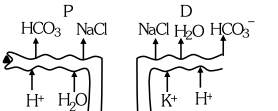
B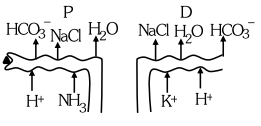
C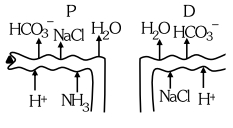
D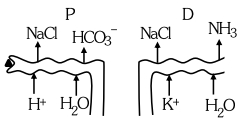
Solution
(B) In the proximal convoluted tubule $(PCT)$,reabsorption of $HCO_3^-$,$NaCl$,and $H_2O$ occurs,while $H^+$ and $NH_3$ are secreted into the filtrate to maintain $pH$ and ionic balance.
In the distal convoluted tubule $(DCT)$,conditional reabsorption of $Na^+$ and $H_2O$ occurs,and there is selective secretion of $H^+$ and $K^+$ ions and $NH_3$ to maintain $pH$ and sodium-potassium balance in the blood.
Comparing the options,Diagram $B$ correctly represents the reabsorption and secretion processes in both the proximal $(P)$ and distal $(D)$ tubules as per standard physiological models.
In the distal convoluted tubule $(DCT)$,conditional reabsorption of $Na^+$ and $H_2O$ occurs,and there is selective secretion of $H^+$ and $K^+$ ions and $NH_3$ to maintain $pH$ and sodium-potassium balance in the blood.
Comparing the options,Diagram $B$ correctly represents the reabsorption and secretion processes in both the proximal $(P)$ and distal $(D)$ tubules as per standard physiological models.
0 likes
View Solution41
EasyMCQ
How much blood is filtered by the kidneys per minute?
A
$125 \text{ ml/minute}$
B
$1100-1200 \text{ ml/minute}$
C
$1/5^{\text{th}}$ of the blood pumped out by each ventricle of the heart in a minute
D
Both $B$ and $C$
Solution
(D) According to $NCERT$,on average,$1100-1200 \text{ ml}$ of blood is filtered by the kidneys per minute.
This volume constitutes roughly $1/5^{\text{th}}$ of the blood pumped out by each ventricle of the heart in a minute.
$125 \text{ ml/minute}$ is the Glomerular Filtration Rate $(GFR)$,which is the volume of filtrate formed per minute,not the total volume of blood filtered by the kidneys.
Therefore,both options $B$ and $C$ are correct,making $D$ the right choice.
This volume constitutes roughly $1/5^{\text{th}}$ of the blood pumped out by each ventricle of the heart in a minute.
$125 \text{ ml/minute}$ is the Glomerular Filtration Rate $(GFR)$,which is the volume of filtrate formed per minute,not the total volume of blood filtered by the kidneys.
Therefore,both options $B$ and $C$ are correct,making $D$ the right choice.
0 likes
View Solution42
EasyMCQ
Urea enters the nephron through . . . . . . .
$i$. Thicker segment of ascending limb of Henle's loop.
$ii$. Thinner segment of ascending limb of Henle's loop.
$iii$. Ultrafiltration into urinary space.
$iv$. Inner medullary segment of collecting tubule.
$v$. Outer medullary segment of collecting tubule.
Select the correct option.
$i$. Thicker segment of ascending limb of Henle's loop.
$ii$. Thinner segment of ascending limb of Henle's loop.
$iii$. Ultrafiltration into urinary space.
$iv$. Inner medullary segment of collecting tubule.
$v$. Outer medullary segment of collecting tubule.
Select the correct option.
A
$i$ and $ii$ only
B
$ii$ and $iii$ only
C
$ii$ and $iv$ only
D
$iii$ and $v$ only
Solution
(C) Urea enters the nephron through two primary mechanisms:
$1$. $iii$. Ultrafiltration: During the process of glomerular filtration,urea is filtered along with water and other solutes into the Bowman's capsule (urinary space).
$2$. $iv$. Inner medullary segment of collecting tubule: Urea is reabsorbed from the collecting duct into the medullary interstitium to maintain the osmolarity gradient. However,it also diffuses back into the thin ascending limb of the loop of Henle and the inner medullary collecting duct to maintain this cycle. Among the given choices,the entry of urea into the nephron occurs via ultrafiltration $(iii)$ and back-diffusion into the inner medullary collecting tubule $(iv)$ or thin ascending limb. Based on standard physiological models,the correct combination is $iii$ and $iv$. Since the provided options are limited,we identify the most accurate physiological pathways. Given the options,$iii$ and $iv$ represent the entry points for urea recycling and filtration.
$1$. $iii$. Ultrafiltration: During the process of glomerular filtration,urea is filtered along with water and other solutes into the Bowman's capsule (urinary space).
$2$. $iv$. Inner medullary segment of collecting tubule: Urea is reabsorbed from the collecting duct into the medullary interstitium to maintain the osmolarity gradient. However,it also diffuses back into the thin ascending limb of the loop of Henle and the inner medullary collecting duct to maintain this cycle. Among the given choices,the entry of urea into the nephron occurs via ultrafiltration $(iii)$ and back-diffusion into the inner medullary collecting tubule $(iv)$ or thin ascending limb. Based on standard physiological models,the correct combination is $iii$ and $iv$. Since the provided options are limited,we identify the most accurate physiological pathways. Given the options,$iii$ and $iv$ represent the entry points for urea recycling and filtration.
0 likes
View SolutionExcretory Products and their Elimination — Mix Examples- Excretory Products and their Elimination · Frequently Asked Questions
1Are these Excretory Products and their Elimination questions useful for JEE and NEET?
Yes. All questions in this section are mapped to JEE Main and NEET exam patterns. Previous year questions from JEE Main, NEET, GUJCET and state-level exams are included with full solutions.
2Can I switch to Hindi or Gujarati for these questions?
Yes. Use the language tabs in the hero section or the sidebar to view the same questions and solutions in English, Hindi or Gujarati.
3How do I generate a question paper from this subtopic?
Use the Vedclass Exam Paper Generator — select the chapter and subtopic, set difficulty, and generate Sets A, B, C, D automatically. First 3 chapters of every subject are free.
Vedclass Products
For Students
Vedclass Test Series
Mock tests in real JEE/NEET style with performance analysis. 5-day free trial.
Start Free TrialFor Teachers
Exam Paper Generator
Generate Set A/B/C/D papers from this chapter in 2 minutes. 3 chapters free.
Try FreeFor Institutes
Online Exam Module
Live online exams with unlimited students, 360° analytics & white-label branding.
See DemoFor Teachers & Institutes
Generate a Excretory Products and their Elimination Exam Paper in 2 Minutes
Select subtopic & difficulty — Sets A, B, C, D auto-generated with No Repeat logic.
First 3 chapters of every subject are free — no payment required.