
A English
Mechanism of Concentration of the Filtrate Questions in English
Class 11 Biology · Excretory Products and their Elimination · Mechanism of Concentration of the Filtrate
76+
Questions
English
Language
100%
With Solutions
Showing 50 of 76 questions in English
1
MediumMCQ
The Loop of Henle is primarily responsible for the reabsorption of which of the following?
A
Potassium
B
Glucose
C
Water
D
$CO_2$
Solution
(C) The Loop of Henle plays a critical role in the concentration of urine.
Its descending limb is permeable to water but nearly impermeable to electrolytes,allowing for the reabsorption of water into the medullary interstitium.
The ascending limb is impermeable to water but allows for the transport of electrolytes.
Therefore,the primary function associated with the concentration mechanism in the Loop of Henle is the reabsorption of water.
Its descending limb is permeable to water but nearly impermeable to electrolytes,allowing for the reabsorption of water into the medullary interstitium.
The ascending limb is impermeable to water but allows for the transport of electrolytes.
Therefore,the primary function associated with the concentration mechanism in the Loop of Henle is the reabsorption of water.
0 likes
View Solution2
MediumMCQ
What is a characteristic feature of the metanephric kidney?
A
Hypotonic urine production
B
Excess secretion of uric acid
C
Presence of the Loop of Henle
D
Hormone production
Solution
(C) The metanephric kidney is the advanced type of kidney found in amniotes,including mammals,birds,and reptiles.
One of the most significant evolutionary adaptations of the metanephric kidney,particularly in mammals,is the presence of the $Loop$ $of$ $Henle$.
The $Loop$ $of$ $Henle$ allows for the counter-current mechanism,which is essential for the concentration of urine and the conservation of water,enabling the production of hypertonic urine.
One of the most significant evolutionary adaptations of the metanephric kidney,particularly in mammals,is the presence of the $Loop$ $of$ $Henle$.
The $Loop$ $of$ $Henle$ allows for the counter-current mechanism,which is essential for the concentration of urine and the conservation of water,enabling the production of hypertonic urine.
0 likes
View Solution3
MediumMCQ
Salmon have gills that are more permeable to water than to salts. Salmon hatch in fresh water streams and then migrate to the ocean. Once they reach the ocean,you would expect the rate of uptake of water into their body through the gills to:
A
Increase
B
Decrease
C
Remain the same
D
First increase then decrease
Solution
(B) Salmon are euryhaline fish that migrate between fresh water and salt water.
Fresh water is hypotonic to the fish's body fluids,meaning water tends to enter the body via osmosis through the gills.
Ocean water is hypertonic to the fish's body fluids.
When the salmon moves from fresh water to the ocean,the external environment changes from a lower solute concentration to a higher solute concentration.
Because the gills are permeable to water,the osmotic gradient now favors the movement of water out of the body rather than into it.
Therefore,the rate of water uptake into the body through the gills decreases significantly as the fish enters the hypertonic marine environment.
Fresh water is hypotonic to the fish's body fluids,meaning water tends to enter the body via osmosis through the gills.
Ocean water is hypertonic to the fish's body fluids.
When the salmon moves from fresh water to the ocean,the external environment changes from a lower solute concentration to a higher solute concentration.
Because the gills are permeable to water,the osmotic gradient now favors the movement of water out of the body rather than into it.
Therefore,the rate of water uptake into the body through the gills decreases significantly as the fish enters the hypertonic marine environment.
0 likes
View Solution4
MediumMCQ
The counter-current multiplier system changes the isotonic glomerular filtrate into
A
Hypertonic urine
B
Hypotonic urine
C
Isotonic urine
D
None of the above
Solution
(A) The counter-current mechanism,involving the Loop of Henle and the vasa recta,creates an osmotic gradient in the renal medulla.
As the isotonic glomerular filtrate passes through the descending limb of the Loop of Henle,water is reabsorbed,making the filtrate hypertonic.
In the ascending limb,electrolytes are actively reabsorbed,making the filtrate hypotonic.
However,the overall effect of the counter-current multiplier system in the presence of $ADH$ is to concentrate the filtrate,ultimately leading to the formation of hypertonic urine.
As the isotonic glomerular filtrate passes through the descending limb of the Loop of Henle,water is reabsorbed,making the filtrate hypertonic.
In the ascending limb,electrolytes are actively reabsorbed,making the filtrate hypotonic.
However,the overall effect of the counter-current multiplier system in the presence of $ADH$ is to concentrate the filtrate,ultimately leading to the formation of hypertonic urine.
0 likes
View Solution5
MediumMCQ
The counter-current mechanism operates in:
A
Vasa recta and Henle's loop
B
Henle's loop
C
Proximal convoluted tubule
D
Distal convoluted tubule
Solution
(A) The counter-current mechanism is a process that helps in concentrating the urine.
It primarily operates through the interaction between the $Henle's$ loop of juxtamedullary nephrons and the $vasa$ $recta$.
The flow of filtrate in the two limbs of $Henle's$ loop is in opposite directions,and the flow of blood in the two limbs of the $vasa$ $recta$ is also in opposite directions.
This arrangement facilitates the maintenance of an increasing osmolarity towards the inner medullary interstitium,which is essential for water reabsorption.
It primarily operates through the interaction between the $Henle's$ loop of juxtamedullary nephrons and the $vasa$ $recta$.
The flow of filtrate in the two limbs of $Henle's$ loop is in opposite directions,and the flow of blood in the two limbs of the $vasa$ $recta$ is also in opposite directions.
This arrangement facilitates the maintenance of an increasing osmolarity towards the inner medullary interstitium,which is essential for water reabsorption.
0 likes
View Solution6
MediumMCQ
The main function of Henle's loop is
A
Conservation of water
B
Filtration of blood
C
Passage of urine
D
Formation of urine
Solution
(A) The loop of Henle is a $U$-shaped segment of the nephron located in the renal medulla.
It plays a crucial role in the concentration of urine by facilitating the reabsorption of water and electrolytes through the counter-current mechanism.
Therefore,its primary function is the conservation of water.
It plays a crucial role in the concentration of urine by facilitating the reabsorption of water and electrolytes through the counter-current mechanism.
Therefore,its primary function is the conservation of water.
0 likes
View Solution7
MediumMCQ
The function of the loop of Henle is:
A
Dilution of urine
B
Removal of water
C
Removal of salt
D
Counter-current multiplier system
Solution
(D) The loop of Henle plays the role of a counter-current multiplier system. It creates an osmotic gradient in the renal medulla,which is essential for the concentration of urine. The vasa recta,on the other hand,acts as a counter-current exchanger.
0 likes
View Solution8
MediumMCQ
Which feature enables the mammalian kidney to concentrate urine in the medullary region?
A
Maintaining a high osmotic pressure in the tissues between the tubules
B
Rapid removal of sodium ions from the medullary tissues
C
Rapid flow of blood through the medulla
D
High oxidative metabolism of medullary cells
Solution
(A) The mammalian kidney concentrates urine primarily through the counter-current mechanism involving the $Loop$ $of$ $Henle$ and the $Vasa$ $recta$.
This mechanism maintains a high osmotic gradient in the medullary interstitium.
By keeping the osmotic pressure high in the tissues surrounding the tubules,water is reabsorbed from the collecting duct,thereby concentrating the urine.
This mechanism maintains a high osmotic gradient in the medullary interstitium.
By keeping the osmotic pressure high in the tissues surrounding the tubules,water is reabsorbed from the collecting duct,thereby concentrating the urine.
0 likes
View Solution9
MediumMCQ
If Henle's loop were absent from mammalian nephron,which of the following is to be expected?
A
The urine will be more dilute.
B
There will be no urine formation.
C
There will be hardly any change in the quality and quantity of urine formed.
D
The urine will be more concentrated.
Solution
(A) The primary function of the loop of Henle is the reabsorption of water and electrolytes,which helps in the concentration of urine.
In the absence of the loop of Henle,the counter-current mechanism cannot function effectively.
Consequently,water cannot be reabsorbed from the filtrate in the collecting duct,leading to the excretion of highly dilute urine.
Therefore,the correct expectation is that the urine will be more dilute.
In the absence of the loop of Henle,the counter-current mechanism cannot function effectively.
Consequently,water cannot be reabsorbed from the filtrate in the collecting duct,leading to the excretion of highly dilute urine.
Therefore,the correct expectation is that the urine will be more dilute.
0 likes
View Solution10
MediumMCQ
If the $Loop$ $of$ $Henle$ is absent from the mammalian nephron,which of the following is likely to occur?
A
Urine will be more concentrated.
B
Urine will be more dilute.
C
There will be no urine formation.
D
There will be little change in the quality and quantity of urine produced.
Solution
(B) The $Loop$ $of$ $Henle$ plays a crucial role in the counter-current mechanism,which is responsible for the concentration of urine in mammals.
It creates a hyperosmotic environment in the renal medulla,allowing water to be reabsorbed from the collecting duct.
If the $Loop$ $of$ $Henle$ is absent,the kidney will lose its ability to concentrate urine.
Consequently,the urine produced will be significantly more dilute compared to normal urine,as the body cannot effectively reabsorb water from the filtrate.
It creates a hyperosmotic environment in the renal medulla,allowing water to be reabsorbed from the collecting duct.
If the $Loop$ $of$ $Henle$ is absent,the kidney will lose its ability to concentrate urine.
Consequently,the urine produced will be significantly more dilute compared to normal urine,as the body cannot effectively reabsorb water from the filtrate.
0 likes
View Solution11
MediumMCQ
If the kidneys fail to reabsorb water,what will be the effect on the tissues?
A
No effect
B
They will shrink and become wrinkled
C
They will absorb water from the blood plasma
D
They will take more $O_2$ from the blood
Solution
(B) If the kidneys fail to reabsorb water,a large volume of water is lost from the body through urine (diuresis).
This leads to a decrease in the volume of blood plasma and extracellular fluid.
As the osmotic pressure of the blood increases,water moves out of the cells and tissues into the blood vessels to compensate for the loss.
Consequently,the cells and tissues lose water,causing them to shrink and become wrinkled.
This leads to a decrease in the volume of blood plasma and extracellular fluid.
As the osmotic pressure of the blood increases,water moves out of the cells and tissues into the blood vessels to compensate for the loss.
Consequently,the cells and tissues lose water,causing them to shrink and become wrinkled.
0 likes
View Solution12
EasyMCQ
Which of the following plays a significant role in maintaining the high osmolarity of the medullary interstitial fluid?
A
Loop of Henle
B
$DCT$
C
$PCT$
D
None of these
Solution
(A) The maintenance of high osmolarity in the medullary interstitial fluid is primarily achieved by the counter-current mechanism.
This mechanism involves the Loop of Henle and the vasa recta.
The descending limb of the Loop of Henle is permeable to water but nearly impermeable to electrolytes,while the ascending limb is impermeable to water but allows transport of electrolytes.
This differential permeability creates a concentration gradient in the medullary interstitium,which is essential for the concentration of urine.
This mechanism involves the Loop of Henle and the vasa recta.
The descending limb of the Loop of Henle is permeable to water but nearly impermeable to electrolytes,while the ascending limb is impermeable to water but allows transport of electrolytes.
This differential permeability creates a concentration gradient in the medullary interstitium,which is essential for the concentration of urine.
0 likes
View Solution13
MediumMCQ
At the bottom of the loop of Henle,the glomerular filtrate is . . . . . . .
A
Isotonic
B
Hypotonic
C
Hypertonic
D
Insoluble
Solution
(C) The loop of Henle plays a crucial role in the concentration of urine.
As the filtrate moves down the descending limb of the loop of Henle,it becomes increasingly concentrated due to the loss of water by osmosis into the hypertonic medullary interstitium.
At the bottom (the hairpin bend) of the loop of Henle,the filtrate reaches its maximum concentration,making it hypertonic relative to the blood plasma.
Therefore,the correct answer is $Hypertonic$.
As the filtrate moves down the descending limb of the loop of Henle,it becomes increasingly concentrated due to the loss of water by osmosis into the hypertonic medullary interstitium.
At the bottom (the hairpin bend) of the loop of Henle,the filtrate reaches its maximum concentration,making it hypertonic relative to the blood plasma.
Therefore,the correct answer is $Hypertonic$.
0 likes
View Solution14
EasyMCQ
The vasa recta are tubular capillaries around the ........
A
Part of the alimentary canal
B
$PCT$
C
Loop of Henle
D
$DCT$
Solution
(C) The vasa recta are minute vessels of the peritubular capillary network that run parallel to the $Loop$ $of$ $Henle$ in the juxtamedullary nephrons. They form a '$U$' shaped capillary loop that plays a crucial role in the counter-current mechanism,which helps in concentrating the urine.
0 likes
View Solution15
MediumMCQ
The concentration of urine depends upon which part of the nephron?
A
Bowman's capsule
B
Length of the loop of Henle
C
$PCT$
D
Peritubular capillary network
Solution
(B) The concentration of urine is primarily regulated by the counter-current mechanism in the kidneys.
This mechanism is highly dependent on the length of the loop of Henle.
Animals that live in arid environments,such as the kangaroo rat,have very long loops of Henle,which allow for greater water reabsorption and the production of highly concentrated urine.
Therefore,the longer the loop of Henle,the greater the ability to concentrate urine.
This mechanism is highly dependent on the length of the loop of Henle.
Animals that live in arid environments,such as the kangaroo rat,have very long loops of Henle,which allow for greater water reabsorption and the production of highly concentrated urine.
Therefore,the longer the loop of Henle,the greater the ability to concentrate urine.
0 likes
View Solution16
MediumMCQ
Human urine is usually . . . . . . compared to human blood.
A
Hypotonic
B
Hypertonic
C
Isotonic
D
All of these
Solution
(B) The human kidney has the ability to produce concentrated urine to conserve water.
Through the counter-current mechanism involving the Loop of Henle and the vasa recta,the interstitial fluid of the renal medulla becomes highly concentrated.
As the filtrate passes through the collecting duct,water is reabsorbed into the hypertonic medullary interstitium under the influence of $ADH$ (Antidiuretic Hormone).
Consequently,the final urine excreted is significantly more concentrated (hypertonic) than the blood plasma.
Through the counter-current mechanism involving the Loop of Henle and the vasa recta,the interstitial fluid of the renal medulla becomes highly concentrated.
As the filtrate passes through the collecting duct,water is reabsorbed into the hypertonic medullary interstitium under the influence of $ADH$ (Antidiuretic Hormone).
Consequently,the final urine excreted is significantly more concentrated (hypertonic) than the blood plasma.
0 likes
View Solution17
MediumMCQ
Which of the following statements is correct?
A
The descending limb of loop of Henle is impermeable to water.
B
The ascending limb of loop of Henle is permeable to water.
C
The descending limb of loop of Henle is permeable to electrolytes.
D
The ascending limb of loop of Henle is impermeable to water.
Solution
(D) The correct statement is that the ascending limb of the loop of Henle is impermeable to water.
$1$. The descending limb of the loop of Henle is permeable to water but impermeable to electrolytes.
$2$. The ascending limb of the loop of Henle is impermeable to water but permeable to electrolytes (solutes like $Na^+$,$Cl^-$).
Therefore,option $D$ is the correct statement.
$1$. The descending limb of the loop of Henle is permeable to water but impermeable to electrolytes.
$2$. The ascending limb of the loop of Henle is impermeable to water but permeable to electrolytes (solutes like $Na^+$,$Cl^-$).
Therefore,option $D$ is the correct statement.
0 likes
View Solution18
MediumMCQ
Which adaptation is shown by desert organisms?
A
Concentrated urine
B
Dilute urine
C
Maximize water loss
D
High number of stomata on the upper surface
Solution
(A) Desert organisms,such as the kangaroo rat,have evolved specific physiological adaptations to survive in water-scarce environments. One of the most critical adaptations is the ability to produce highly concentrated urine to minimize water loss through excretion. This allows them to conserve body water effectively. Conversely,dilute urine is typical of aquatic organisms,and maximizing water loss or having high stomatal density on the upper surface would be detrimental to survival in a desert.
0 likes
View Solution19
MediumMCQ
In the descending limb of the loop of Henle,as the filtrate passes downward,it:
A
Becomes more diluted
B
Becomes more concentrated
C
Shows no change in concentration
D
Decreases in volume
Solution
(B) The descending limb of the loop of Henle is permeable to water but nearly impermeable to electrolytes.
As the filtrate moves down into the hypertonic medullary interstitium,water is reabsorbed from the filtrate into the interstitium by osmosis.
Because water is lost while solutes remain in the tubule,the filtrate becomes increasingly concentrated as it moves toward the bend of the loop.
As the filtrate moves down into the hypertonic medullary interstitium,water is reabsorbed from the filtrate into the interstitium by osmosis.
Because water is lost while solutes remain in the tubule,the filtrate becomes increasingly concentrated as it moves toward the bend of the loop.
0 likes
View Solution20
MediumMCQ
Which structures take part in the counter-current mechanism?
A
Bowman's capsule and glomerulus.
B
$DCT$ and collecting duct.
C
Vasa recta and collecting duct.
D
Henle's loop and vasa recta.
Solution
(D) The counter-current mechanism is essential for concentrating urine in mammals.
It involves two main structures: the loop of Henle and the vasa recta.
The flow of filtrate in the two limbs of the loop of Henle is in opposite directions,forming a counter-current.
The flow of blood through the two limbs of the vasa recta also occurs in a counter-current pattern.
This mechanism helps in maintaining a concentration gradient in the medullary interstitium,which facilitates the reabsorption of water from the collecting duct.
It involves two main structures: the loop of Henle and the vasa recta.
The flow of filtrate in the two limbs of the loop of Henle is in opposite directions,forming a counter-current.
The flow of blood through the two limbs of the vasa recta also occurs in a counter-current pattern.
This mechanism helps in maintaining a concentration gradient in the medullary interstitium,which facilitates the reabsorption of water from the collecting duct.
0 likes
View Solution21
MediumMCQ
Why is a small amount of urea retained in the kidney matrix?
A
To maintain osmolarity
B
To maintain concentration of urea
C
To maintain temperature
D
To maintain the blood circulation
Solution
(A) The kidney matrix,specifically the renal medulla,retains a small amount of urea to maintain the osmolarity of the interstitial fluid.
This high osmolarity is essential for the counter-current mechanism,which allows for the concentration of urine.
By keeping urea in the medullary interstitium,the kidney facilitates the reabsorption of water from the collecting ducts,thereby conserving water in the body.
This high osmolarity is essential for the counter-current mechanism,which allows for the concentration of urine.
By keeping urea in the medullary interstitium,the kidney facilitates the reabsorption of water from the collecting ducts,thereby conserving water in the body.
0 likes
View Solution22
MediumMCQ
If the kidneys fail to reabsorb water,what effect will be observed on the tissues?
A
No change occurs
B
They shrink and shrivel
C
They absorb water from the blood plasma
D
They absorb more $O_2$ from the blood
Solution
(B) If the kidneys fail to reabsorb water,it leads to excessive loss of water from the body through urine (polyuria).
This results in a decrease in the volume of blood plasma and an increase in the osmotic pressure of the blood.
Due to the high osmotic pressure in the blood,water moves out of the body tissues into the blood vessels via osmosis to maintain equilibrium.
As a result,the body tissues lose water and consequently shrink or shrivel.
This results in a decrease in the volume of blood plasma and an increase in the osmotic pressure of the blood.
Due to the high osmotic pressure in the blood,water moves out of the body tissues into the blood vessels via osmosis to maintain equilibrium.
As a result,the body tissues lose water and consequently shrink or shrivel.
0 likes
View Solution23
MediumMCQ
In vertebrates,the ability to produce concentrated urine is generally associated with the ............ .
A
epithelial area of Bowman's capsule
B
length of the loop of Henle
C
length of the proximal convoluted tubule
D
network of capillaries forming the glomerulus
Solution
(B) The ability to concentrate urine in vertebrates is primarily dependent on the counter-current mechanism. This mechanism is facilitated by the $Loop$ $of$ $Henle$ and the $vasa$ $recta$. $A$ longer $Loop$ $of$ $Henle$ allows for a greater osmotic gradient in the renal medulla,which enables more water to be reabsorbed from the collecting duct,resulting in the production of concentrated urine. Therefore,the length of the $Loop$ $of$ $Henle$ is directly associated with the concentration ability of the kidney.
0 likes
View Solution24
MediumMCQ
If the Loop of Henle were absent from the mammalian nephron,which of the following is to be expected?
A
The urine will be more dilute.
B
Urine formation will not take place.
C
There will be little change in the quality and quantity of urine produced.
D
The urine will be more concentrated.
Solution
(A) The Loop of Henle plays a critical role in the counter-current mechanism,which is responsible for the concentration of urine in mammals.
It creates a hyperosmotic medullary interstitium by reabsorbing solutes (mainly $NaCl$) from the filtrate.
If the Loop of Henle were absent,the kidney would lose its ability to create this osmotic gradient.
Consequently,the water reabsorption from the collecting duct would be significantly reduced,leading to the production of highly dilute urine.
It creates a hyperosmotic medullary interstitium by reabsorbing solutes (mainly $NaCl$) from the filtrate.
If the Loop of Henle were absent,the kidney would lose its ability to create this osmotic gradient.
Consequently,the water reabsorption from the collecting duct would be significantly reduced,leading to the production of highly dilute urine.
0 likes
View Solution25
EasyMCQ
Which of the following factors is responsible for the formation of concentrated urine?
A
Low levels of antidiuretic hormone.
B
Maintaining hyperosmolarity towards inner medullary interstitium in the kidneys.
C
Secretion of erythropoietin by juxtaglomerular complex.
D
Hydrostatic pressure during glomerular filtration.
Solution
(B) The formation of concentrated urine is primarily facilitated by the counter-current mechanism.
This mechanism involves the maintenance of a high osmolarity gradient in the inner medullary interstitium of the kidneys.
This gradient is created by the $NaCl$ and urea,which allows water to be reabsorbed from the collecting duct into the interstitium,thereby concentrating the urine.
Antidiuretic hormone $(ADH)$ further enhances this process by increasing the water permeability of the collecting duct.
This mechanism involves the maintenance of a high osmolarity gradient in the inner medullary interstitium of the kidneys.
This gradient is created by the $NaCl$ and urea,which allows water to be reabsorbed from the collecting duct into the interstitium,thereby concentrating the urine.
Antidiuretic hormone $(ADH)$ further enhances this process by increasing the water permeability of the collecting duct.
0 likes
View Solution26
EasyMCQ
If $Henle's$ loop were absent from the mammalian nephron,which of the following is to be expected?
A
There will be no urine formation.
B
There will be hardly any change in the quality and quantity of urine formed.
C
The urine will be more concentrated.
D
The urine will be more dilute.
Solution
(D) $Henle's$ loop plays a crucial role in the counter-current mechanism,which is responsible for the reabsorption of water and sodium chloride from the filtrate to concentrate the urine.
In the absence of $Henle's$ loop,the kidney would lose its ability to create a hypertonic medullary interstitium.
Consequently,the water cannot be reabsorbed efficiently from the collecting duct.
Therefore,the urine produced will be significantly more dilute compared to normal urine.
In the absence of $Henle's$ loop,the kidney would lose its ability to create a hypertonic medullary interstitium.
Consequently,the water cannot be reabsorbed efficiently from the collecting duct.
Therefore,the urine produced will be significantly more dilute compared to normal urine.
0 likes
View Solution27
MediumMCQ
Assertion : In the descending limb of the loop of Henle,the urine is hypertonic,whereas in the ascending limb of the loop of Henle,the urine is hypotonic.
Reason : The descending limb is impermeable to sodium,while the ascending limb is impermeable to water.
Reason : The descending limb is impermeable to sodium,while the ascending limb is impermeable to water.
A
If both Assertion and Reason are correct and the Reason is a correct explanation of the Assertion.
B
If both Assertion and Reason are correct but Reason is not a correct explanation of the Assertion.
C
If the Assertion is correct but Reason is incorrect.
D
If both the Assertion and Reason are incorrect.
Solution
(A) The descending limb of the loop of Henle is permeable to water but impermeable to electrolytes like sodium. As the filtrate moves down,water is reabsorbed into the interstitium,which increases the concentration of solutes,making the filtrate hypertonic.
The ascending limb of the loop of Henle is impermeable to water but permeable to electrolytes like sodium. As the filtrate moves up,electrolytes are actively or passively transported out of the tubule into the interstitium,which decreases the concentration of solutes,making the filtrate hypotonic.
Therefore,both the Assertion and the Reason are correct,and the Reason explains why the tonicity changes in the respective limbs.
The ascending limb of the loop of Henle is impermeable to water but permeable to electrolytes like sodium. As the filtrate moves up,electrolytes are actively or passively transported out of the tubule into the interstitium,which decreases the concentration of solutes,making the filtrate hypotonic.
Therefore,both the Assertion and the Reason are correct,and the Reason explains why the tonicity changes in the respective limbs.
0 likes
View Solution28
Difficult
Give a brief account of the counter current mechanism.
Solution
(N/A) The counter current mechanism operating inside the kidney is the main adaptation for the conservation of water.
There are two counter current mechanisms inside the kidneys: Henle's loop and vasa recta.
Henle's loop is a $U$-shaped part of the nephron. Blood flows in the two limbs of the tube in opposite directions,which gives rise to counter currents.
The vasa recta is a fine capillary network that runs parallel to Henle's loop and is also $U$-shaped.
Blood flows in opposite directions in the two limbs of the vasa recta. As a result,blood entering the renal medulla in the descending limb comes in close contact with the outgoing blood in the ascending limb.
The osmolarity increases from $300 \, mOsmol \, L^{-1}$ in the cortex to $1200 \, mOsmol \, L^{-1}$ in the inner medulla due to the counter current mechanism.
This helps in maintaining a concentration gradient,which facilitates the easy movement of water from the collecting tubules.
The gradient is primarily a result of the movement of $NaCl$ and urea.
There are two counter current mechanisms inside the kidneys: Henle's loop and vasa recta.
Henle's loop is a $U$-shaped part of the nephron. Blood flows in the two limbs of the tube in opposite directions,which gives rise to counter currents.
The vasa recta is a fine capillary network that runs parallel to Henle's loop and is also $U$-shaped.
Blood flows in opposite directions in the two limbs of the vasa recta. As a result,blood entering the renal medulla in the descending limb comes in close contact with the outgoing blood in the ascending limb.
The osmolarity increases from $300 \, mOsmol \, L^{-1}$ in the cortex to $1200 \, mOsmol \, L^{-1}$ in the inner medulla due to the counter current mechanism.
This helps in maintaining a concentration gradient,which facilitates the easy movement of water from the collecting tubules.
The gradient is primarily a result of the movement of $NaCl$ and urea.
0 likes
View Solution29
EasyMCQ
Indicate whether the following statement is true or false:
Henle's loop plays an important role in concentrating the urine.
Henle's loop plays an important role in concentrating the urine.
A
True
B
False
Solution
(A) The statement is True.
The loop of Henle plays a significant role in the concentration of urine through a mechanism known as the counter-current mechanism.
This mechanism involves the creation of an osmotic gradient in the renal medulla,which allows for the reabsorption of water from the collecting duct,thereby concentrating the urine.
The loop of Henle plays a significant role in the concentration of urine through a mechanism known as the counter-current mechanism.
This mechanism involves the creation of an osmotic gradient in the renal medulla,which allows for the reabsorption of water from the collecting duct,thereby concentrating the urine.
0 likes
View Solution30
Easy
Name the following:
$A$ loop of capillary running parallel to the Henle's loop.
$A$ loop of capillary running parallel to the Henle's loop.
Solution
(VASA RECTA) loop of capillary that runs parallel to the Henle's loop is known as the $Vasa$ $recta$.
The $Vasa$ $recta$ is a fine capillary network that arises from the efferent arteriole in juxtamedullary nephrons.
It runs parallel to the Henle's loop and plays a crucial role in the counter-current mechanism, which helps in maintaining a concentration gradient in the medullary interstitium for the concentration of urine.
The $Vasa$ $recta$ is a fine capillary network that arises from the efferent arteriole in juxtamedullary nephrons.
It runs parallel to the Henle's loop and plays a crucial role in the counter-current mechanism, which helps in maintaining a concentration gradient in the medullary interstitium for the concentration of urine.
0 likes
View Solution31
Medium
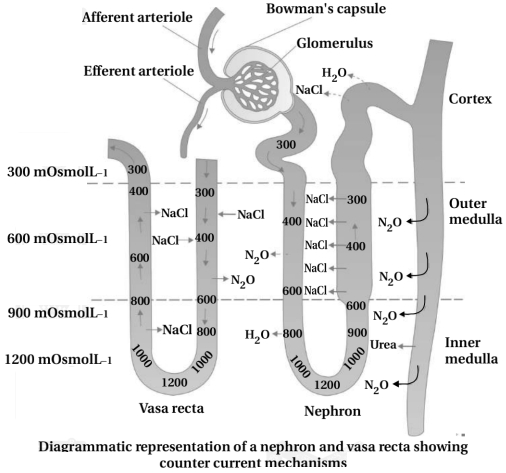
Explain the mechanism of concentration of the filtrate.
Solution
(N/A) The mechanism of concentration of the urine takes place in the kidney.
- Mammals and birds have the ability to produce a concentrated urine; for this,they have developed a counter-current mechanism.
- Henle's loop and vasa recta play a significant role in this process.
- The flow of filtrate in the two limbs of Henle's loop is in opposite directions,thus forming a counter-current.
- The flow of blood through the two limbs of vasa recta is also in a counter-current pattern.
- The proximity between the Henle's loop and vasa recta,as well as the counter-current in them,helps in maintaining an increasing osmolarity towards the inner medullary interstitium,i.e.,from $300 \ mOsmol \ L^{-1}$ in the cortex to about $1200 \ mOsmol \ L^{-1}$ in the inner medulla.
- This gradient is mainly caused by $NaCl$ and urea.
- $NaCl$ is transported by the ascending limb of Henle's loop,which is exchanged with the descending limb of vasa recta.
- Small amounts of urea enter the thin segment of the ascending limb of Henle's loop,which is transported back to the interstitium by the collecting tubule.
- Such transport of substances facilitated by the special arrangement of Henle's loop and vasa recta is called the counter-current mechanism.
- This mechanism helps to maintain a concentration gradient in the medullary interstitium.
- The presence of such an interstitial gradient helps in the easy passage of water from the collecting tubule,thereby concentrating the filtrate (urine).
- Human kidneys can produce urine which is nearly four times more concentrated than the initial filtrate formed.
- Mammals and birds have the ability to produce a concentrated urine; for this,they have developed a counter-current mechanism.
- Henle's loop and vasa recta play a significant role in this process.
- The flow of filtrate in the two limbs of Henle's loop is in opposite directions,thus forming a counter-current.
- The flow of blood through the two limbs of vasa recta is also in a counter-current pattern.
- The proximity between the Henle's loop and vasa recta,as well as the counter-current in them,helps in maintaining an increasing osmolarity towards the inner medullary interstitium,i.e.,from $300 \ mOsmol \ L^{-1}$ in the cortex to about $1200 \ mOsmol \ L^{-1}$ in the inner medulla.
- This gradient is mainly caused by $NaCl$ and urea.
- $NaCl$ is transported by the ascending limb of Henle's loop,which is exchanged with the descending limb of vasa recta.
- Small amounts of urea enter the thin segment of the ascending limb of Henle's loop,which is transported back to the interstitium by the collecting tubule.
- Such transport of substances facilitated by the special arrangement of Henle's loop and vasa recta is called the counter-current mechanism.
- This mechanism helps to maintain a concentration gradient in the medullary interstitium.
- The presence of such an interstitial gradient helps in the easy passage of water from the collecting tubule,thereby concentrating the filtrate (urine).
- Human kidneys can produce urine which is nearly four times more concentrated than the initial filtrate formed.
0 likes
View Solution32
Medium
Describe the counter-current mechanism.
Solution
(N/A) The counter-current mechanism is a specialized process in the kidneys that helps in concentrating the urine. It primarily involves the $Loop$ $of$ $Henle$ and the $Vasa$ $recta$.
$1$. The flow of filtrate in the two limbs of the $Loop$ $of$ $Henle$ is in opposite directions,creating a counter-current.
$2$. The flow of blood through the two limbs of the $Vasa$ $recta$ is also in a counter-current pattern.
$3$. The proximity between the $Loop$ $of$ $Henle$ and $Vasa$ $recta$,as well as the counter-current in them,helps in maintaining an increasing osmolarity towards the inner medullary interstitium (from $300 \ mOsmol/L$ in the cortex to about $1200 \ mOsmol/L$ in the inner medulla).
$4$. This gradient is mainly caused by $NaCl$ and $Urea$.
$5$. $NaCl$ is transported by the ascending limb of the $Loop$ $of$ $Henle$ which is exchanged with the descending limb of the $Vasa$ $recta$.
$6$. $NaCl$ is returned to the interstitium by the ascending portion of the $Vasa$ $recta$.
$7$. Similarly,small amounts of $Urea$ enter the thin segment of the ascending limb of the $Loop$ $of$ $Henle$ and are transported back to the interstitium by the collecting tubule.
$8$. This mechanism helps in water reabsorption from the collecting duct,thereby concentrating the urine.
$1$. The flow of filtrate in the two limbs of the $Loop$ $of$ $Henle$ is in opposite directions,creating a counter-current.
$2$. The flow of blood through the two limbs of the $Vasa$ $recta$ is also in a counter-current pattern.
$3$. The proximity between the $Loop$ $of$ $Henle$ and $Vasa$ $recta$,as well as the counter-current in them,helps in maintaining an increasing osmolarity towards the inner medullary interstitium (from $300 \ mOsmol/L$ in the cortex to about $1200 \ mOsmol/L$ in the inner medulla).
$4$. This gradient is mainly caused by $NaCl$ and $Urea$.
$5$. $NaCl$ is transported by the ascending limb of the $Loop$ $of$ $Henle$ which is exchanged with the descending limb of the $Vasa$ $recta$.
$6$. $NaCl$ is returned to the interstitium by the ascending portion of the $Vasa$ $recta$.
$7$. Similarly,small amounts of $Urea$ enter the thin segment of the ascending limb of the $Loop$ $of$ $Henle$ and are transported back to the interstitium by the collecting tubule.
$8$. This mechanism helps in water reabsorption from the collecting duct,thereby concentrating the urine.
0 likes
View Solution33
MediumMCQ
What is the counter current mechanism?
A
$A$ process to filter blood in the glomerulus.
B
$A$ mechanism to concentrate urine in the kidneys of mammals and birds.
C
$A$ method to regulate blood pressure in the heart.
D
$A$ process of active transport of glucose in the proximal convoluted tubule.
Solution
(B) The counter current mechanism is a specialized physiological process that allows for the concentration of urine in the kidneys.
- Mammals and birds possess the unique ability to produce concentrated urine to conserve water.
- This is achieved through the counter current mechanism,which involves the flow of filtrate in opposite directions within the $Loop$ $of$ $Henle$ and the flow of blood in the $Vasa$ $recta$.
- This mechanism creates an osmotic gradient in the renal medulla,which facilitates the reabsorption of water from the collecting duct,resulting in concentrated urine.
- Mammals and birds possess the unique ability to produce concentrated urine to conserve water.
- This is achieved through the counter current mechanism,which involves the flow of filtrate in opposite directions within the $Loop$ $of$ $Henle$ and the flow of blood in the $Vasa$ $recta$.
- This mechanism creates an osmotic gradient in the renal medulla,which facilitates the reabsorption of water from the collecting duct,resulting in concentrated urine.
0 likes
View Solution34
Easy
If a marine fish is placed in a fresh water aquarium,will the fish be able to survive? Why or why not?
Solution
(N/A) If a marine fish is placed in a fresh water aquarium,it will not be able to survive.
Marine fishes are physiologically adapted to live in high salt concentrations (hypertonic environment).
When placed in fresh water (hypotonic environment),water enters their body cells through the process of osmosis.
Since they lack the necessary osmoregulatory mechanisms to handle such a large influx of water,their cells swell up and may burst,eventually leading to the death of the fish.
Marine fishes are physiologically adapted to live in high salt concentrations (hypertonic environment).
When placed in fresh water (hypotonic environment),water enters their body cells through the process of osmosis.
Since they lack the necessary osmoregulatory mechanisms to handle such a large influx of water,their cells swell up and may burst,eventually leading to the death of the fish.
0 likes
View Solution35
Easy
State the importance of the following:
$(1)$ Sebum
$(2)$ Counter current mechanism
$(1)$ Sebum
$(2)$ Counter current mechanism
Solution
(N/A) $(1)$ Sebum keeps the hair smooth and moist,and it prevents the dryness of the skin.
$(2)$ Counter current mechanism allows birds (Aves) and mammals to excrete hypertonic urine,which helps in maintaining the water balance in the body.
$(2)$ Counter current mechanism allows birds (Aves) and mammals to excrete hypertonic urine,which helps in maintaining the water balance in the body.
0 likes
View Solution36
Medium
Mention the substances that exit from the tubules in order to maintain a concentration gradient in the medullary interstitium.
Solution
(N/A) The substances that exit from the renal tubules to maintain the concentration gradient in the medullary interstitium are $NaCl$,$H_{2}O$,and urea.
$NaCl$ is transported by the ascending limb of the loop of Henle.
$H_{2}O$ is removed from the descending limb of the loop of Henle and the collecting duct.
Urea is transported out of the collecting duct into the medullary interstitium to contribute to the high osmolarity.
$NaCl$ is transported by the ascending limb of the loop of Henle.
$H_{2}O$ is removed from the descending limb of the loop of Henle and the collecting duct.
Urea is transported out of the collecting duct into the medullary interstitium to contribute to the high osmolarity.
0 likes
View Solution37
Medium
Explain the mechanism of formation of concentrated urine in mammals.
Solution
(N/A) The formation of concentrated urine in mammals is primarily achieved through the $Counter-Current$ $Mechanism$ involving the $Loop$ $of$ $Henle$ and the $Vasa$ $Recta$.
$1$. $Counter-Current$ $Multiplier$: The $Loop$ $of$ $Henle$ creates a concentration gradient in the renal medulla. The descending limb is permeable to water but impermeable to electrolytes,while the ascending limb is impermeable to water but allows active transport of electrolytes ($Na^{+}$,$Cl^{-}$). This creates a hyperosmolar medullary interstitium.
$2$. $Counter-Current$ $Exchanger$: The $Vasa$ $Recta$ (capillary network surrounding the $Loop$ $of$ $Henle$) maintains this gradient by preventing the washout of solutes.
$3$. $Hormonal$ $Regulation$: Under the influence of $Antidiuretic$ $Hormone$ ($ADH$ or $Vasopressin$),the collecting duct becomes permeable to water. As the filtrate passes through the hyperosmolar medulla,water is reabsorbed into the blood via osmosis,resulting in the excretion of concentrated urine.
$1$. $Counter-Current$ $Multiplier$: The $Loop$ $of$ $Henle$ creates a concentration gradient in the renal medulla. The descending limb is permeable to water but impermeable to electrolytes,while the ascending limb is impermeable to water but allows active transport of electrolytes ($Na^{+}$,$Cl^{-}$). This creates a hyperosmolar medullary interstitium.
$2$. $Counter-Current$ $Exchanger$: The $Vasa$ $Recta$ (capillary network surrounding the $Loop$ $of$ $Henle$) maintains this gradient by preventing the washout of solutes.
$3$. $Hormonal$ $Regulation$: Under the influence of $Antidiuretic$ $Hormone$ ($ADH$ or $Vasopressin$),the collecting duct becomes permeable to water. As the filtrate passes through the hyperosmolar medulla,water is reabsorbed into the blood via osmosis,resulting in the excretion of concentrated urine.
0 likes
View Solution38
Easy
The glomerular filtrate in the loop of Henle gets concentrated in the descending and then gets diluted in the ascending limbs. Explain.
Solution
(N/A) Descending Limb of the Loop of Henle: This part is highly permeable to $H_2O$ (water) but impermeable to electrolytes. As the filtrate moves down into the hypertonic medullary interstitium,water is reabsorbed by osmosis,which concentrates the filtrate.
Ascending Limb of the Loop of Henle: This part is impermeable to water but allows the transport of electrolytes (like $Na^+$,$Cl^-$) either actively or passively. As the concentrated filtrate moves upward,the removal of electrolytes causes the filtrate to become diluted.
Ascending Limb of the Loop of Henle: This part is impermeable to water but allows the transport of electrolytes (like $Na^+$,$Cl^-$) either actively or passively. As the concentrated filtrate moves upward,the removal of electrolytes causes the filtrate to become diluted.
0 likes
View Solution39
MediumMCQ
Select the correct option:
$(1)$ The counter-current mechanism is maintained by the Loop of Henle and the vasa recta.
$(2)$ The ascending limb of the Loop of Henle is impermeable to water.
$(1)$ The counter-current mechanism is maintained by the Loop of Henle and the vasa recta.
$(2)$ The ascending limb of the Loop of Henle is impermeable to water.
A
Both $(1)$ and $(2)$ are correct.
B
Only $(1)$ is correct.
C
Only $(2)$ is correct.
D
Both $(1)$ and $(2)$ are incorrect.
Solution
(A) $(1)$ The counter-current mechanism in the kidneys is established by the interaction between the Loop of Henle and the vasa recta,which helps in concentrating the urine.
$(2)$ The descending limb of the Loop of Henle is permeable to water but impermeable to electrolytes,whereas the ascending limb is impermeable to water but allows the transport of electrolytes. Therefore,statement $(2)$ is correct.
Since both statements are correct,the correct option is $(A)$.
$(2)$ The descending limb of the Loop of Henle is permeable to water but impermeable to electrolytes,whereas the ascending limb is impermeable to water but allows the transport of electrolytes. Therefore,statement $(2)$ is correct.
Since both statements are correct,the correct option is $(A)$.
0 likes
View Solution40
EasyMCQ
The increase in osmolarity from outer to inner medullary interstitium is maintained due to:
$(i)$ Close proximity between Henle's loop and vasa recta
$(ii)$ Counter current mechanism
$(iii)$ Selective secretion of $HCO_{3}^{-}$ and hydrogen ions in $PCT$
$(iv)$ Higher blood pressure in glomerular capillaries
$(i)$ Close proximity between Henle's loop and vasa recta
$(ii)$ Counter current mechanism
$(iii)$ Selective secretion of $HCO_{3}^{-}$ and hydrogen ions in $PCT$
$(iv)$ Higher blood pressure in glomerular capillaries
A
$(i)$ and $(ii)$
B
Only $(ii)$
C
$(iii)$ and $(iv)$
D
$(i), (ii)$ and $(iii)$
Solution
(A) The correct answer is option $(A)$ because both statements $(i)$ and $(ii)$ are correct.
The counter current mechanism is based on the close proximity and the parallel arrangement of the Henle's loop and the vasa recta.
This mechanism helps in maintaining a concentration gradient in the medullary interstitium,which is essential for the concentration of urine.
Statement $(iii)$ is incorrect because the $PCT$ (Proximal Convoluted Tubule) is involved in the selective secretion of $H^{+}$,ammonia,and $K^{+}$ ions,and the reabsorption of $HCO_{3}^{-}$,but it does not contribute to the medullary osmotic gradient.
Statement $(iv)$ is incorrect because the high blood pressure in the glomerular capillaries is responsible for the process of glomerular filtration,not for the counter current mechanism.
The counter current mechanism is based on the close proximity and the parallel arrangement of the Henle's loop and the vasa recta.
This mechanism helps in maintaining a concentration gradient in the medullary interstitium,which is essential for the concentration of urine.
Statement $(iii)$ is incorrect because the $PCT$ (Proximal Convoluted Tubule) is involved in the selective secretion of $H^{+}$,ammonia,and $K^{+}$ ions,and the reabsorption of $HCO_{3}^{-}$,but it does not contribute to the medullary osmotic gradient.
Statement $(iv)$ is incorrect because the high blood pressure in the glomerular capillaries is responsible for the process of glomerular filtration,not for the counter current mechanism.
0 likes
View Solution41
MediumMCQ
Mammals have the ability to produce
A
Isotonic urine
B
Hypertonic urine
C
Hypotonic urine
D
Acidic urine
Solution
(B) Mammals have the ability to produce concentrated urine to conserve water.
This process is facilitated by the counter-current mechanism involving the $Henle's$ loop and the $vasa$ $recta$.
These structures create an osmotic gradient in the renal medulla,which allows for the reabsorption of water from the collecting duct,resulting in the excretion of hypertonic urine.
This process is facilitated by the counter-current mechanism involving the $Henle's$ loop and the $vasa$ $recta$.
These structures create an osmotic gradient in the renal medulla,which allows for the reabsorption of water from the collecting duct,resulting in the excretion of hypertonic urine.
0 likes
View Solution42
MediumMCQ
Henle's loop of nephron plays a significant role in maintaining a high osmolarity in
A
Interstitial fluid of hilum
B
Medullary interstitial fluid
C
Cortex interstitial fluid
D
All of the above
Solution
(B) The Henle's loop of the nephron is crucial for the counter-current mechanism.
As the filtrate moves through the descending limb of the loop of Henle,water is reabsorbed into the medullary interstitium,making the filtrate concentrated.
Conversely,the ascending limb is impermeable to water but allows the transport of electrolytes like $NaCl$ into the medullary interstitium.
This continuous movement of water and electrolytes creates and maintains a high osmolarity in the medullary interstitial fluid,which is essential for the concentration of urine.
As the filtrate moves through the descending limb of the loop of Henle,water is reabsorbed into the medullary interstitium,making the filtrate concentrated.
Conversely,the ascending limb is impermeable to water but allows the transport of electrolytes like $NaCl$ into the medullary interstitium.
This continuous movement of water and electrolytes creates and maintains a high osmolarity in the medullary interstitial fluid,which is essential for the concentration of urine.
0 likes
View Solution43
MediumMCQ
Urine is concentrated in which part of the nephron?
A
$CT$
B
$PCT$
C
Bowman's capsule
D
$JGA$
Solution
(A) The concentration of urine primarily occurs in the collecting duct $(CT)$ due to the reabsorption of water under the influence of antidiuretic hormone $(ADH)$.
As the filtrate passes through the collecting duct,water is reabsorbed into the medullary interstitium,resulting in the formation of concentrated urine.
As the filtrate passes through the collecting duct,water is reabsorbed into the medullary interstitium,resulting in the formation of concentrated urine.
0 likes
View Solution44
MediumMCQ
Human urine as compared to human blood is
A
Hypotonic
B
Hypertonic
C
Isotonic
D
All of these
Solution
(B) The human kidney has the ability to concentrate urine to conserve water.
As a result,human urine is hypertonic compared to human blood plasma,meaning it has a higher concentration of solutes and higher osmotic pressure.
As a result,human urine is hypertonic compared to human blood plasma,meaning it has a higher concentration of solutes and higher osmotic pressure.
0 likes
View Solution45
MediumMCQ
The function of Henle's loop is
A
Passage of urine
B
Formation of urine
C
Conservation of water
D
Filtration of water
Solution
(C) The loop of Henle,also known as the nephron loop,is a $U$-shaped portion of the nephron that extends from the proximal convoluted tubule. Its primary function is to create a concentration gradient in the medulla of the kidney,which facilitates the reabsorption of water from the collecting duct. By maintaining this osmotic gradient,the loop of Henle plays a critical role in the concentration of urine and the conservation of water in the body.
0 likes
View Solution46
MediumMCQ
Human kidneys can produce urine nearly
A
Three times concentrated than initial filtrate
B
Four times concentrated than initial filtrate
C
Five times concentrated than initial filtrate
D
Six times concentrated than initial filtrate
Solution
(B) The presence of an interstitial gradient in the renal medulla helps in the passive reabsorption of water from the collecting tubule,thereby concentrating the filtrate (urine).
Human kidneys are capable of producing urine that is nearly $4$ times more concentrated than the initial filtrate formed in the glomerulus.
Human kidneys are capable of producing urine that is nearly $4$ times more concentrated than the initial filtrate formed in the glomerulus.
0 likes
View Solution47
EasyMCQ
The shape of vasa recta is
A
$L-$shaped
B
$U-$shaped
C
$S-$shaped
D
$J-$shaped
Solution
(B) Vasa recta are $U-$shaped blood vessels that run parallel to the loop of Henle,forming a counter-current system in the juxtamedullary nephron.
These vessels are the continuation of efferent arterioles.
The slow blood flow in the vasa recta is responsible for maintaining the hyperosmolarity of the medullary interstitium.
These vessels are the continuation of efferent arterioles.
The slow blood flow in the vasa recta is responsible for maintaining the hyperosmolarity of the medullary interstitium.
0 likes
View Solution48
EasyMCQ
The longest loop of Henle is found in
A
Kangaroo rat
B
Opossum
C
Rhesus monkey
D
All of these
Solution
(A) In the kangaroo rat,the loop of Henle is significantly longer as it descends deeper into the renal medulla.
This structural adaptation creates a steeper concentration gradient in the surrounding interstitial fluid.
This high concentration gradient allows for greater water reabsorption from the filtrate,enabling the animal to produce highly concentrated urine and survive in arid environments with minimal water intake.
This structural adaptation creates a steeper concentration gradient in the surrounding interstitial fluid.
This high concentration gradient allows for greater water reabsorption from the filtrate,enabling the animal to produce highly concentrated urine and survive in arid environments with minimal water intake.
0 likes
View Solution49
MediumMCQ
Medullary gradient is mainly developed due to
A
$NaCl$ and urea
B
$NaCl$ and glucose
C
Glucose and urea
D
Ammonia and glucose
Solution
(A) The medullary gradient in the kidney is primarily maintained by the concentration of $NaCl$ and urea in the renal medulla.
This gradient is established and maintained by the counter-current mechanism involving the loop of Henle and the vasa recta.
This gradient is established and maintained by the counter-current mechanism involving the loop of Henle and the vasa recta.
0 likes
View Solution50
MediumMCQ
The proximity between Henle's loop and vasa-recta as well as the counter-current in them help in maintaining an ...$A$... in molarity towards the inner medullary interstitium,i.e.,from ...$B$... $mOsmol \ L^{-1}$ in the cortex to about ...$C$... $mOsmol \ L^{-1}$ in the inner medulla. Here $A$,$B$,and $C$ refer to:
A
$A-$increasing,$B-500, C-800$
B
$A-$decreasing,$B-300, C-1200$
C
$A-$decreasing,$B-1200, C-300$
D
$A-$increasing,$B-300, C-1200$
Solution
(D) The counter-current mechanism involving the loop of Henle and the vasa recta creates a concentration gradient in the renal medulla.
This mechanism helps in maintaining an increasing gradient in molarity towards the inner medullary interstitium.
The osmolarity ranges from $300 \ mOsmol \ L^{-1}$ in the cortex to about $1200 \ mOsmol \ L^{-1}$ in the inner medulla.
Therefore,$A$ is increasing,$B$ is $300$,and $C$ is $1200$.
This mechanism helps in maintaining an increasing gradient in molarity towards the inner medullary interstitium.
The osmolarity ranges from $300 \ mOsmol \ L^{-1}$ in the cortex to about $1200 \ mOsmol \ L^{-1}$ in the inner medulla.
Therefore,$A$ is increasing,$B$ is $300$,and $C$ is $1200$.
0 likes
View SolutionExcretory Products and their Elimination — Mechanism of Concentration of the Filtrate · Frequently Asked Questions
1Are these Excretory Products and their Elimination questions useful for JEE and NEET?
Yes. All questions in this section are mapped to JEE Main and NEET exam patterns. Previous year questions from JEE Main, NEET, GUJCET and state-level exams are included with full solutions.
2Can I switch to Hindi or Gujarati for these questions?
Yes. Use the language tabs in the hero section or the sidebar to view the same questions and solutions in English, Hindi or Gujarati.
3How do I generate a question paper from this subtopic?
Use the Vedclass Exam Paper Generator — select the chapter and subtopic, set difficulty, and generate Sets A, B, C, D automatically. First 3 chapters of every subject are free.
Vedclass Products
For Students
Vedclass Test Series
Mock tests in real JEE/NEET style with performance analysis. 5-day free trial.
Start Free TrialFor Teachers
Exam Paper Generator
Generate Set A/B/C/D papers from this chapter in 2 minutes. 3 chapters free.
Try FreeFor Institutes
Online Exam Module
Live online exams with unlimited students, 360° analytics & white-label branding.
See DemoFor Teachers & Institutes
Generate a Excretory Products and their Elimination Exam Paper in 2 Minutes
Select subtopic & difficulty — Sets A, B, C, D auto-generated with No Repeat logic.
First 3 chapters of every subject are free — no payment required.