
A English
Regulation of Kidney Function Questions in English
Class 11 Biology · Excretory Products and their Elimination · Regulation of Kidney Function
166+
Questions
English
Language
100%
With Solutions
Showing 50 of 166 questions in English
101
MediumMCQ
Renin is secreted from
A
Juxtaglomerular cells
B
Podocytes
C
Nephridia
D
Stomach
Solution
(A) Renin is an enzyme secreted by the $Juxtaglomerular$ $(JG)$ cells of the kidneys.
These cells are located in the afferent arteriole of the nephron.
Renin is released in response to a decrease in blood pressure or blood flow to the kidneys.
It initiates the Renin-Angiotensin-Aldosterone System $(RAAS)$,which helps in increasing blood pressure and the reabsorption of sodium and water.
These cells are located in the afferent arteriole of the nephron.
Renin is released in response to a decrease in blood pressure or blood flow to the kidneys.
It initiates the Renin-Angiotensin-Aldosterone System $(RAAS)$,which helps in increasing blood pressure and the reabsorption of sodium and water.
0 likes
View Solution102
MediumMCQ
Juxtaglomerular cells of renal cortex synthesize an enzyme called
A
$ADH$
B
Oxytocin
C
Renin
D
Urochrome
Solution
(C) Juxtaglomerular cells of the kidney secrete an enzyme called renin.
This enzyme converts angiotensinogen produced by the liver into angiotensin-$I$.
Subsequently,angiotensin-$I$ is converted into angiotensin-$II$.
The renin-angiotensin pathway stimulates the adrenal cortex to produce aldosterone.
Aldosterone helps in maintaining $Na^{+}$ and water concentration in the body,thereby regulating blood pressure.
This enzyme converts angiotensinogen produced by the liver into angiotensin-$I$.
Subsequently,angiotensin-$I$ is converted into angiotensin-$II$.
The renin-angiotensin pathway stimulates the adrenal cortex to produce aldosterone.
Aldosterone helps in maintaining $Na^{+}$ and water concentration in the body,thereby regulating blood pressure.
0 likes
View Solution103
MediumMCQ
Reabsorption of water in $DCT$ and $CT$ part of nephron is a function of
A
Prolactin
B
Oxytocin
C
Vasopressin
D
Luteinising hormone
Solution
(C) The reabsorption of water in the distal convoluted tubule $(DCT)$ and collecting tubule $(CT)$ of the nephron is regulated by the hormone Vasopressin,also known as Antidiuretic Hormone $(ADH)$.
Vasopressin is released from the posterior pituitary gland.
It increases the permeability of the $DCT$ and $CT$ to water,allowing for greater water reabsorption back into the blood,thereby concentrating the urine and preventing dehydration.
Vasopressin is released from the posterior pituitary gland.
It increases the permeability of the $DCT$ and $CT$ to water,allowing for greater water reabsorption back into the blood,thereby concentrating the urine and preventing dehydration.
0 likes
View Solution104
MediumMCQ
Which of the following is responsible for the excretion of dilute urine?
A
More secretion of insulin
B
Less secretion of vasopressin
C
More secretion of Aldosterone
D
Less secretion of glucagon
Solution
(B) $ADH$ (Antidiuretic hormone),also known as vasopressin,is produced in the hypothalamus and released into the bloodstream from the posterior pituitary gland.
It enhances fluid retention by stimulating the kidneys to reabsorb more water from the distal convoluted tubules and collecting ducts.
When there is a decrease in the secretion of vasopressin (hyposecretion),the permeability of the collecting ducts to water decreases.
This leads to reduced water reabsorption,resulting in the excretion of large amounts of dilute urine.
It enhances fluid retention by stimulating the kidneys to reabsorb more water from the distal convoluted tubules and collecting ducts.
When there is a decrease in the secretion of vasopressin (hyposecretion),the permeability of the collecting ducts to water decreases.
This leads to reduced water reabsorption,resulting in the excretion of large amounts of dilute urine.
0 likes
View Solution105
MediumMCQ
$ANF$ mechanism checks on
A
Oxytocin-renin mechanism
B
Counter-current mechanism
C
Renin-angiotensin mechanism
D
Oxytocin-angiotensin mechanism
Solution
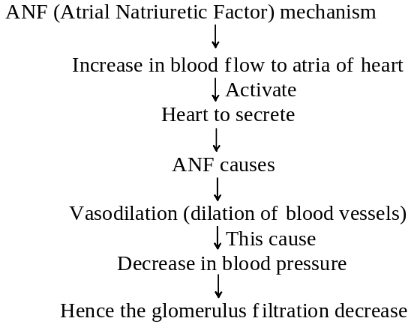
(C) The $ANF$ (Atrial Natriuretic Factor) is released by the atrial wall of the heart in response to increased blood flow to the atria.
$ANF$ causes vasodilation (dilation of blood vessels),which leads to a decrease in blood pressure.
This mechanism acts as a check on the renin-angiotensin mechanism,which is responsible for increasing blood pressure and glomerular filtration rate $(GFR)$.
Therefore,$ANF$ counteracts the effects of the renin-angiotensin system.
$ANF$ causes vasodilation (dilation of blood vessels),which leads to a decrease in blood pressure.
This mechanism acts as a check on the renin-angiotensin mechanism,which is responsible for increasing blood pressure and glomerular filtration rate $(GFR)$.
Therefore,$ANF$ counteracts the effects of the renin-angiotensin system.
0 likes
View Solution106
MediumMCQ
What is activated by a decrease in the $GFR$ rate?
A
$JG$ cells release renin
B
$JG$ cells release aldosterone
C
$JG$ cells release epinephrine
D
$JG$ cells release norepinephrine
Solution
(A) The kidneys have built-in mechanisms for the regulation of the Glomerular Filtration Rate $(GFR)$.
One such efficient mechanism is carried out by the Juxtaglomerular Apparatus $(JGA)$.
$JGA$ is a special sensitive region formed by cellular modifications in the Distal Convoluted Tubule $(DCT)$ and the afferent arteriole at the location of their contact.
$A$ fall in $GFR$ activates the $JG$ cells to release renin,which stimulates the glomerular blood flow and thereby brings the $GFR$ back to normal levels.
One such efficient mechanism is carried out by the Juxtaglomerular Apparatus $(JGA)$.
$JGA$ is a special sensitive region formed by cellular modifications in the Distal Convoluted Tubule $(DCT)$ and the afferent arteriole at the location of their contact.
$A$ fall in $GFR$ activates the $JG$ cells to release renin,which stimulates the glomerular blood flow and thereby brings the $GFR$ back to normal levels.
0 likes
View Solution107
MediumMCQ
The functioning of the kidneys is efficiently monitored and regulated by the hormonal feedback mechanism involving
A
Hypothalamus
B
$JGA$
C
Heart
D
All of the above
Solution
(D) The functioning of the kidneys is regulated by three main hormonal feedback mechanisms:
$(i)$ The $Hypothalamus$ regulates water balance through the release of $ADH$ (Antidiuretic Hormone) or vasopressin.
$(ii)$ The $JGA$ (Juxtaglomerular Apparatus) regulates blood pressure and glomerular filtration rate through the renin-angiotensin-aldosterone mechanism.
$(iii)$ The $Heart$ regulates blood volume and pressure by releasing $ANF$ (Atrial Natriuretic Factor),which acts as a vasodilator and inhibits renin secretion.
Therefore,all these organs are involved in the hormonal regulation of kidney function.
$(i)$ The $Hypothalamus$ regulates water balance through the release of $ADH$ (Antidiuretic Hormone) or vasopressin.
$(ii)$ The $JGA$ (Juxtaglomerular Apparatus) regulates blood pressure and glomerular filtration rate through the renin-angiotensin-aldosterone mechanism.
$(iii)$ The $Heart$ regulates blood volume and pressure by releasing $ANF$ (Atrial Natriuretic Factor),which acts as a vasodilator and inhibits renin secretion.
Therefore,all these organs are involved in the hormonal regulation of kidney function.
0 likes
View Solution108
MediumMCQ
$RAAS$ stimulates the release of which of the following hormones?
A
Mineralocorticoids
B
Glucocorticoids
C
Both $(a)$ and $(b)$
D
None of the above
Solution
(A) The Juxtaglomerular apparatus $(JGA)$ activates the Renin-Angiotensin-Aldosterone System $(RAAS)$.
$JGA$ releases the enzyme renin into the blood,which triggers a cascade of chemical reactions leading to the production of Angiotensin-$II$.
Angiotensin-$II$ acts as a potent stimulator for the adrenal cortex to release aldosterone,which is a mineralocorticoid.
Aldosterone helps in the reabsorption of $Na^+$ and water from the distal parts of the tubule,thereby increasing blood pressure and blood volume.
$JGA$ releases the enzyme renin into the blood,which triggers a cascade of chemical reactions leading to the production of Angiotensin-$II$.
Angiotensin-$II$ acts as a potent stimulator for the adrenal cortex to release aldosterone,which is a mineralocorticoid.
Aldosterone helps in the reabsorption of $Na^+$ and water from the distal parts of the tubule,thereby increasing blood pressure and blood volume.
0 likes
View Solution109
MediumMCQ
Which of the following features activates the $JG$ cells?
$I.$ Fall in $GBP$
$II.$ Fall in $GBF$
$III.$ Fall in $GFR$
Choose the correct option.
$I.$ Fall in $GBP$
$II.$ Fall in $GBF$
$III.$ Fall in $GFR$
Choose the correct option.
A
$I$ and $II$
B
$II$ and $III$
C
$I$ and $III$
D
$I, II$ and $III$
Solution
(D) The juxtaglomerular $(JG)$ cells are specialized cells in the kidney that act as baroreceptors.
They are activated by a decrease in Glomerular Blood Pressure $(GBP)$,a decrease in Glomerular Blood Flow $(GBF)$,or a decrease in the Glomerular Filtration Rate $(GFR)$.
When these values fall,the $JG$ cells release the enzyme renin,which initiates the Renin-Angiotensin-Aldosterone System $(RAAS)$ to restore blood pressure and filtration rates.
Therefore,all three conditions ($I, II,$ and $III$) lead to the activation of $JG$ cells.
They are activated by a decrease in Glomerular Blood Pressure $(GBP)$,a decrease in Glomerular Blood Flow $(GBF)$,or a decrease in the Glomerular Filtration Rate $(GFR)$.
When these values fall,the $JG$ cells release the enzyme renin,which initiates the Renin-Angiotensin-Aldosterone System $(RAAS)$ to restore blood pressure and filtration rates.
Therefore,all three conditions ($I, II,$ and $III$) lead to the activation of $JG$ cells.
0 likes
View Solution110
MediumMCQ
Osmoreceptors in the body are activated by changes in:
$I.$ blood volume
$II.$ body fluid volume
$III.$ ionic concentration
Which of the following options contains the correct statements?
$I.$ blood volume
$II.$ body fluid volume
$III.$ ionic concentration
Which of the following options contains the correct statements?
A
$I$ and $II$
B
$I$ and $III$
C
$II$ and $III$
D
All of these
Solution
(D) The correct answer is $D$ (All of these).
Osmoreceptors in the body are specialized sensory neurons that are activated by changes in blood volume,body fluid volume,and ionic concentration (osmolarity).
An excessive loss of fluid from the body leads to an increase in blood osmolarity and a decrease in blood volume,which activates these receptors.
Once activated,these osmoreceptors stimulate the hypothalamus to release $ADH$ (Antidiuretic Hormone),also known as vasopressin,from the neurohypophysis (posterior lobe of the pituitary gland).
$ADH$ facilitates the reabsorption of water from the distal convoluted tubule and collecting duct of the nephron,thereby preventing further water loss and maintaining fluid balance in the body.
Osmoreceptors in the body are specialized sensory neurons that are activated by changes in blood volume,body fluid volume,and ionic concentration (osmolarity).
An excessive loss of fluid from the body leads to an increase in blood osmolarity and a decrease in blood volume,which activates these receptors.
Once activated,these osmoreceptors stimulate the hypothalamus to release $ADH$ (Antidiuretic Hormone),also known as vasopressin,from the neurohypophysis (posterior lobe of the pituitary gland).
$ADH$ facilitates the reabsorption of water from the distal convoluted tubule and collecting duct of the nephron,thereby preventing further water loss and maintaining fluid balance in the body.
0 likes
View Solution111
MediumMCQ
$JGA$ (Juxta Glomerular Apparatus),a sensitive region,which regulates the glomerular filtration rate,is present near the:
A
$DCT$ and $PCT$
B
$DCT$ and efferent arteriole
C
$DCT$ and afferent arteriole
D
Loop of Henle and $DCT$
Solution
(C) The kidneys have built-in mechanisms for the regulation of the glomerular filtration rate $(GFR)$.
One such efficient mechanism is carried out by the juxta glomerular apparatus $(JGA)$.
$JGA$ is a special sensitive region formed by cellular modifications in the distal convoluted tubule $(DCT)$ and the afferent arteriole at the location of their contact.
$A$ fall in $GFR$ can activate the $JG$ cells to release renin,which can stimulate the glomerular blood flow and thereby bring $GFR$ back to normal.
One such efficient mechanism is carried out by the juxta glomerular apparatus $(JGA)$.
$JGA$ is a special sensitive region formed by cellular modifications in the distal convoluted tubule $(DCT)$ and the afferent arteriole at the location of their contact.
$A$ fall in $GFR$ can activate the $JG$ cells to release renin,which can stimulate the glomerular blood flow and thereby bring $GFR$ back to normal.
0 likes
View Solution112
MediumMCQ
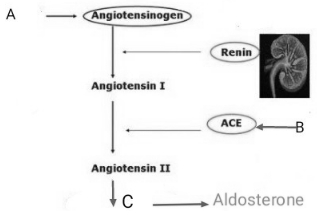
Choose the correct option for $A, B, C$ from the given options based on the provided flowchart of the Renin-Angiotensin-Aldosterone System $(RAAS)$.
A
$A-$Adrenal cortex,$B-$Liver,$C-$Lung
B
$A-$Lung,$B-$Liver,$C-$Adrenal cortex
C
$A-$Liver,$B-$Lung,$C-$Adrenal cortex
D
$A-$Lungs,$B-$Adrenal cortex,$C-$Liver
Solution
(C) The Renin-Angiotensin-Aldosterone System $(RAAS)$ functions as follows:
$1$. The liver produces and secretes the inactive plasma protein Angiotensinogen $(A)$.
$2$. Renin (secreted by the juxtaglomerular cells of the kidney) converts Angiotensinogen into Angiotensin $I$.
$3$. Angiotensin-Converting Enzyme $(ACE)$,which is primarily produced in the lungs $(B)$,converts Angiotensin $I$ into the active hormone Angiotensin $II$.
$4$. Angiotensin $II$ stimulates the adrenal cortex $(C)$ to release the hormone Aldosterone,which increases sodium and water reabsorption in the kidneys.
Therefore,$A$ is Liver,$B$ is Lung,and $C$ is Adrenal cortex.
$1$. The liver produces and secretes the inactive plasma protein Angiotensinogen $(A)$.
$2$. Renin (secreted by the juxtaglomerular cells of the kidney) converts Angiotensinogen into Angiotensin $I$.
$3$. Angiotensin-Converting Enzyme $(ACE)$,which is primarily produced in the lungs $(B)$,converts Angiotensin $I$ into the active hormone Angiotensin $II$.
$4$. Angiotensin $II$ stimulates the adrenal cortex $(C)$ to release the hormone Aldosterone,which increases sodium and water reabsorption in the kidneys.
Therefore,$A$ is Liver,$B$ is Lung,and $C$ is Adrenal cortex.
0 likes
View Solution113
MediumMCQ
An increase in blood flow to the atria of the heart can cause the release of $A$, which causes $B$ and thereby decreases the blood pressure. The $ANF$ mechanism therefore acts as a check on $C$. Here, $A-C$ refers to:
A
$A-ANF, B-\text{vasoconstriction}, C-\text{renin-angiotensin mechanism}$
B
$A-ANF, B-\text{vasodilation}, C-\text{renin-angiotensin mechanism}$
C
$A-\text{vasopressin}, B-\text{vasodilation}, C-\text{renin-angiotensin mechanism}$
D
$A-\text{vasopressin}, B-\text{vasoconstriction}, C-\text{renin-angiotensin mechanism}$
Solution
(B) An increase in blood flow to the atria of the heart causes the release of Atrial Natriuretic Factor $(ANF)$.
$ANF$ causes vasodilation (dilation of blood vessels), which reduces blood pressure.
This mechanism acts as a check on the Renin-Angiotensin mechanism, which is responsible for increasing blood pressure.
Therefore, $A = ANF$, $B = \text{vasodilation}$, and $C = \text{renin-angiotensin mechanism}$.
$ANF$ causes vasodilation (dilation of blood vessels), which reduces blood pressure.
This mechanism acts as a check on the Renin-Angiotensin mechanism, which is responsible for increasing blood pressure.
Therefore, $A = ANF$, $B = \text{vasodilation}$, and $C = \text{renin-angiotensin mechanism}$.
0 likes
View Solution114
EasyMCQ
Which one is the vasoconstrictor?
A
$ANF$
B
$Renin$
C
$Angiotensin-II$
D
$Histamine$
Solution
(C) Vasoconstrictors are substances that narrow blood vessels,increasing blood pressure. $Angiotensin-II$ is a potent vasoconstrictor.
$ANF$ (Atrial Natriuretic Factor) and histamine act as vasodilators,which widen blood vessels.
$Renin$ is an enzyme secreted by the juxtaglomerular cells that initiates the conversion of angiotensinogen to $Angiotensin-I$,which is subsequently converted to $Angiotensin-II$.
$ANF$ (Atrial Natriuretic Factor) and histamine act as vasodilators,which widen blood vessels.
$Renin$ is an enzyme secreted by the juxtaglomerular cells that initiates the conversion of angiotensinogen to $Angiotensin-I$,which is subsequently converted to $Angiotensin-II$.
0 likes
View Solution115
EasyMCQ
Aldosterone stimulates the reabsorption of
A
$Na^+$ ions
B
$K^+$ ions
C
Glucose
D
$Ca^{2+}$ ions
Solution
(A) Aldosterone is a steroid hormone secreted by the adrenal cortex. It acts on the distal convoluted tubules and collecting ducts of the nephrons to stimulate the reabsorption of $Na^+$ ions and water,while promoting the excretion of $K^+$ ions and phosphate ions. This process helps in maintaining blood pressure and electrolyte balance.
0 likes
View Solution116
MediumMCQ
Which of the following statements is incorrect?
A
$ADH$ is a vasoconstrictor
B
Aldosterone facilitates water reabsorption
C
$ANF$ enhances sodium reabsorption
D
$ANF$ causes vasodilation
Solution
(C) $ANF$ (Atrial Natriuretic Factor) is secreted by the atrial wall of the heart in response to increased blood flow or blood pressure. It acts as an antagonist to the Renin-Angiotensin mechanism. $ANF$ causes vasodilation (dilation of blood vessels) and promotes the excretion of $Na^+$ (sodium) and water in urine,thereby decreasing blood pressure. Therefore,the statement that $ANF$ enhances sodium reabsorption is incorrect.
0 likes
View Solution117
MediumMCQ
Which one influences the activity of the kidney?
A
Vasopressin
B
Thyroxine
C
Vasopressin and aldosterone
D
Gonadotrophin
Solution
(C) The activity of the kidney is regulated by hormonal feedback mechanisms involving the hypothalamus, $JGA$ (Juxtaglomerular apparatus), and the heart.
$1$. $Vasopressin$ (also known as $ADH$ or Antidiuretic Hormone) is released from the neurohypophysis and facilitates water reabsorption from the later parts of the tubule, thereby preventing diuresis.
$2$. $Aldosterone$ is a mineralocorticoid released from the adrenal cortex. It acts on the distal convoluted tubule $(DCT)$ and collecting duct to increase the reabsorption of $Na^+$ and water, which helps in maintaining blood volume and blood pressure.
Therefore, both $Vasopressin$ and $Aldosterone$ play a crucial role in influencing kidney function.
$1$. $Vasopressin$ (also known as $ADH$ or Antidiuretic Hormone) is released from the neurohypophysis and facilitates water reabsorption from the later parts of the tubule, thereby preventing diuresis.
$2$. $Aldosterone$ is a mineralocorticoid released from the adrenal cortex. It acts on the distal convoluted tubule $(DCT)$ and collecting duct to increase the reabsorption of $Na^+$ and water, which helps in maintaining blood volume and blood pressure.
Therefore, both $Vasopressin$ and $Aldosterone$ play a crucial role in influencing kidney function.
0 likes
View Solution118
MediumMCQ
The kidneys not only remove the waste products from the blood but also play a very important role in maintaining:
A
Equilibrium of the body
B
Temperature of the body
C
Constant composition of the blood irrespective of the nature of the food or fluid intake
D
Blood pressure constant
Solution
(C) The kidneys perform the vital function of osmoregulation,which involves maintaining the constant composition and volume of the blood and extracellular fluids. Regardless of the intake of food or fluids,the kidneys regulate the concentration of electrolytes and water,ensuring that the internal environment remains stable. This process is essential for homeostasis.
0 likes
View Solution119
MediumMCQ
Angiotensin $- II$ increases the blood volume by
A
Signalling $PCT$ to reabsorb more $NaCl$ and water
B
Stimulating adrenal gland to release aldosterone
C
By stimulating the release of $ADH$
D
More than one option is correct
Solution
(D) Angiotensin $II$ increases blood volume through multiple mechanisms:
$(i)$ It stimulates the adrenal cortex to release aldosterone,which promotes the reabsorption of $Na^+$ and water from the distal convoluted tubule $(DCT)$ and collecting duct.
$(ii)$ It acts directly on the proximal convoluted tubule $(PCT)$ to increase the reabsorption of $NaCl$ and water.
Since both options $(A)$ and $(B)$ are correct,the correct answer is $(D)$.
$(i)$ It stimulates the adrenal cortex to release aldosterone,which promotes the reabsorption of $Na^+$ and water from the distal convoluted tubule $(DCT)$ and collecting duct.
$(ii)$ It acts directly on the proximal convoluted tubule $(PCT)$ to increase the reabsorption of $NaCl$ and water.
Since both options $(A)$ and $(B)$ are correct,the correct answer is $(D)$.
0 likes
View Solution120
MediumMCQ
When the volume of body fluid falls below normal,$ADH$:
A
Decreases permeability of distal convoluted tubule and collecting tubule
B
Increases permeability of distal convoluted tubule and collecting tubule
C
Has nothing to do with permeability of convoluted tubule
D
Decreases permeability of proximal convoluted tubule
Solution
(B) When the volume of body fluid falls below normal,the osmoreceptors are stimulated,which causes the release of $ADH$ (Antidiuretic Hormone) from the neurohypophysis.
$ADH$ facilitates water reabsorption from the later parts of the tubule,specifically the distal convoluted tubule $(DCT)$ and the collecting duct.
This increases the permeability of these tubules to water,thereby preventing diuresis and conserving body water.
$ADH$ facilitates water reabsorption from the later parts of the tubule,specifically the distal convoluted tubule $(DCT)$ and the collecting duct.
This increases the permeability of these tubules to water,thereby preventing diuresis and conserving body water.
0 likes
View Solution121
MediumMCQ
$A :$ Atrial Natriuretic Factor $(ANF)$ is released by the wall of the atria.
$R :$ It inhibits the release of renin from the Juxtaglomerular $(JG)$ apparatus.
$R :$ It inhibits the release of renin from the Juxtaglomerular $(JG)$ apparatus.
A
Assertion and Reason both are correct and Reason is the correct explanation of Assertion.
B
Assertion and Reason both are correct but Reason is not the correct explanation of Assertion.
C
Assertion is correct,but Reason is incorrect.
D
Both Assertion and Reason are incorrect.
Solution
(A) The Atrial Natriuretic Factor $(ANF)$ is a peptide hormone released by the atrial walls of the heart in response to an increase in blood flow or blood pressure.
$ANF$ acts as a vasodilator and promotes the excretion of sodium and water,thereby reducing blood volume and pressure.
It functions as a check on the Renin-Angiotensin-Aldosterone System $(RAAS)$ by inhibiting the release of renin from the Juxtaglomerular $(JG)$ apparatus.
Therefore,both the Assertion and the Reason are correct,and the Reason is the correct explanation of the Assertion.
$ANF$ acts as a vasodilator and promotes the excretion of sodium and water,thereby reducing blood volume and pressure.
It functions as a check on the Renin-Angiotensin-Aldosterone System $(RAAS)$ by inhibiting the release of renin from the Juxtaglomerular $(JG)$ apparatus.
Therefore,both the Assertion and the Reason are correct,and the Reason is the correct explanation of the Assertion.
0 likes
View Solution122
MediumMCQ
$ADH$ regulates the permeability of
A
Proximal convoluted tubule
B
Collecting tubule and distal convoluted tubule
C
Ascending limb of loop of Henle
D
Descending limb of loop of Henle
Solution
(B) Vasopressin or $ADH$ (Antidiuretic Hormone) is secreted by the posterior lobe of the pituitary gland.
It acts primarily on the collecting ducts and the distal convoluted tubules of the nephron.
It increases the permeability of these segments to water,facilitating the reabsorption of water back into the blood.
This process reduces the volume of water excreted in the urine,thereby preventing diuresis,which is why it is called an antidiuretic hormone.
It acts primarily on the collecting ducts and the distal convoluted tubules of the nephron.
It increases the permeability of these segments to water,facilitating the reabsorption of water back into the blood.
This process reduces the volume of water excreted in the urine,thereby preventing diuresis,which is why it is called an antidiuretic hormone.
0 likes
View Solution123
MediumMCQ
Angiotensinogen $\stackrel{X}{\longrightarrow}$ Angiotensin-$I$. $X$ in the given statement refers to:
A
Angiotensin-$II$
B
Aldosterone
C
Renin
D
Rennin
Solution
(C) The conversion of Angiotensinogen to Angiotensin-$I$ is catalyzed by the enzyme Renin.
Renin is secreted by the juxtaglomerular cells of the kidney in response to a decrease in blood pressure or blood flow.
Rennin (with double 'n') is a proteolytic enzyme found in the stomach of infants that helps in the digestion of milk proteins.
Renin is secreted by the juxtaglomerular cells of the kidney in response to a decrease in blood pressure or blood flow.
Rennin (with double 'n') is a proteolytic enzyme found in the stomach of infants that helps in the digestion of milk proteins.
0 likes
View Solution124
MediumMCQ
$A$: Ethanol is a diuretic agent.
$R$: It inhibits vasopressin secretion.
$R$: It inhibits vasopressin secretion.
A
Assertion and Reason both are correct and Reason is the correct explanation of Assertion.
B
Assertion and Reason both are correct but Reason is not the correct explanation of Assertion.
C
Assertion is correct,but Reason is incorrect.
D
Both Assertion and Reason are incorrect.
Solution
(A) Ethanol acts as a diuretic agent because it suppresses the release of $ADH$ (Antidiuretic Hormone),also known as vasopressin,from the posterior pituitary gland.
Vasopressin is responsible for the reabsorption of water from the distal convoluted tubules and collecting ducts of the nephrons.
When ethanol inhibits the secretion of vasopressin,the permeability of the collecting ducts to water decreases,leading to increased urine production (diuresis).
Therefore,both the Assertion and the Reason are correct,and the Reason is the correct explanation for the Assertion.
Vasopressin is responsible for the reabsorption of water from the distal convoluted tubules and collecting ducts of the nephrons.
When ethanol inhibits the secretion of vasopressin,the permeability of the collecting ducts to water decreases,leading to increased urine production (diuresis).
Therefore,both the Assertion and the Reason are correct,and the Reason is the correct explanation for the Assertion.
0 likes
View Solution125
MediumMCQ
Erythropoietin hormone which stimulates $R.B.C.$ formation is produced by :
A
Alpha cells of pancreas
B
The cells of rostral adenohypophysis
C
The cells of bone marrow
D
Juxtaglomerular cells of the kidney
Solution
(D) Erythropoietin is a glycoprotein hormone that plays a crucial role in erythropoiesis,which is the production of red blood cells $(R.B.C.)$.
This hormone is primarily synthesized and secreted by the juxtaglomerular cells (specifically the interstitial fibroblasts) of the kidney in response to hypoxia or low oxygen levels in the blood.
Once released into the bloodstream,it travels to the bone marrow,where it stimulates the differentiation and proliferation of erythroid progenitor cells into mature red blood cells.
Therefore,the correct answer is the juxtaglomerular cells of the kidney.
This hormone is primarily synthesized and secreted by the juxtaglomerular cells (specifically the interstitial fibroblasts) of the kidney in response to hypoxia or low oxygen levels in the blood.
Once released into the bloodstream,it travels to the bone marrow,where it stimulates the differentiation and proliferation of erythroid progenitor cells into mature red blood cells.
Therefore,the correct answer is the juxtaglomerular cells of the kidney.
0 likes
View Solution126
EasyMCQ
What is $JGA$?
A
Juxtaglomerular apparatus
B
Juxtamedullary glomerular area
C
Joint glomerular area
D
Juxtaglomerular artery
Solution
(A) $JGA$ stands for Juxtaglomerular apparatus.
It is a special sensitive region formed by cellular modifications in the distal convoluted tubule $(DCT)$ and the afferent arteriole at the location of their contact.
It plays a significant role in the regulation of the kidney function,specifically in the Renin-Angiotensin-Aldosterone System $(RAAS)$.
It is a special sensitive region formed by cellular modifications in the distal convoluted tubule $(DCT)$ and the afferent arteriole at the location of their contact.
It plays a significant role in the regulation of the kidney function,specifically in the Renin-Angiotensin-Aldosterone System $(RAAS)$.
0 likes
View Solution127
MediumMCQ
What is $RAAS$?
A
Renin-Angiotensin-Aldosterone System
B
Renal-Arterial-Absorption System
C
Renin-Aldosterone-Arterial System
D
Renal-Angiotensin-Absorption System
Solution
(A) $RAAS$ stands for Renin-Angiotensin-Aldosterone System.
When there is a drop in glomerular blood flow,glomerular blood pressure,or $GFR$,the juxtaglomerular $(JG)$ cells release renin.
Renin converts angiotensinogen in the blood to angiotensin $I$ and further to angiotensin $II$.
Angiotensin $II$ acts as a powerful vasoconstrictor,which increases glomerular blood pressure and thereby $GFR$.
Angiotensin $II$ also activates the adrenal cortex to release aldosterone.
Aldosterone causes the reabsorption of $Na^{+}$ and water from the distal parts of the renal tubule,which leads to an increase in blood pressure and $GFR$.
When there is a drop in glomerular blood flow,glomerular blood pressure,or $GFR$,the juxtaglomerular $(JG)$ cells release renin.
Renin converts angiotensinogen in the blood to angiotensin $I$ and further to angiotensin $II$.
Angiotensin $II$ acts as a powerful vasoconstrictor,which increases glomerular blood pressure and thereby $GFR$.
Angiotensin $II$ also activates the adrenal cortex to release aldosterone.
Aldosterone causes the reabsorption of $Na^{+}$ and water from the distal parts of the renal tubule,which leads to an increase in blood pressure and $GFR$.
0 likes
View Solution128
MediumMCQ
When $GFR$ (Glomerular Filtration Rate) $.....P......$,the $JG$ (Juxtaglomerular) cells release $.....Q.....$ hormone.
$P\quad\quad Q$
$P\quad\quad Q$
A
Decrease $\quad$ $\quad$ Aldosterone
B
Decrease $\quad$ $\quad$ Renin
C
Increase $\quad$ $\quad$ Renin
D
Increase $\quad$ $\quad$ Aldosterone
Solution
(B) The $JG$ apparatus is a special sensitive region formed by cellular modifications in the distal convoluted tubule and the afferent arteriole at the location of their contact.
$A$ fall in $GFR$ (Glomerular Filtration Rate) can activate the $JG$ cells to release $Renin$,which converts angiotensinogen in blood to angiotensin $I$ and further to angiotensin $II$.
Angiotensin $II$ being a powerful vasoconstrictor increases the glomerular blood pressure and thereby $GFR$. It also activates the adrenal cortex to release aldosterone.
Therefore,when $GFR$ decreases,$JG$ cells release renin.
$A$ fall in $GFR$ (Glomerular Filtration Rate) can activate the $JG$ cells to release $Renin$,which converts angiotensinogen in blood to angiotensin $I$ and further to angiotensin $II$.
Angiotensin $II$ being a powerful vasoconstrictor increases the glomerular blood pressure and thereby $GFR$. It also activates the adrenal cortex to release aldosterone.
Therefore,when $GFR$ decreases,$JG$ cells release renin.
0 likes
View Solution129
MediumMCQ
How is the $JGA$ (Juxtaglomerular Apparatus) formed?
A
By the cellular modifications of the distal convoluted tubule and the contact point of the afferent arteriole.
B
By the cellular modifications of the distal convoluted tubule and the contact point of the efferent arteriole.
C
By the cellular modifications of the proximal convoluted tubule and the contact point of the efferent arteriole.
D
By the cellular modifications of the proximal convoluted tubule and the contact point of the afferent arteriole.
Solution
(A) The $JGA$ (Juxtaglomerular Apparatus) is a specialized sensitive region formed by cellular modifications in the distal convoluted tubule $(DCT)$ and the afferent arteriole at the location of their contact.
It plays a significant role in the regulation of the kidney function,specifically in the renin-angiotensin-aldosterone system.
It plays a significant role in the regulation of the kidney function,specifically in the renin-angiotensin-aldosterone system.
0 likes
View Solution130
MediumMCQ
Select the odd one out regarding blood pressure regulation.
A
$ANF$
B
$ADH$
C
Renin
D
Aldosterone
Solution
(A) The correct answer is $ANF$ (Atrial Natriuretic Factor).
$ANF$ is released by the atrial wall of the heart in response to increased blood flow or blood pressure,and it acts as a vasodilator to decrease blood pressure.
In contrast,$ADH$ (Antidiuretic Hormone),Renin,and Aldosterone are part of the Renin-Angiotensin-Aldosterone System $(RAAS)$ which functions to increase blood pressure and blood volume.
Therefore,$ANF$ is the odd one out as it is the only factor among the options that decreases blood pressure.
$ANF$ is released by the atrial wall of the heart in response to increased blood flow or blood pressure,and it acts as a vasodilator to decrease blood pressure.
In contrast,$ADH$ (Antidiuretic Hormone),Renin,and Aldosterone are part of the Renin-Angiotensin-Aldosterone System $(RAAS)$ which functions to increase blood pressure and blood volume.
Therefore,$ANF$ is the odd one out as it is the only factor among the options that decreases blood pressure.
0 likes
View Solution131
MediumMCQ
When are the osmoreceptors in the body activated?
A
Changes in blood volume or body fluid volume
B
Changes in ionic concentration
C
Excessive loss of water from the body
D
All of the above
Solution
(D) Osmoreceptors are specialized sensory neurons located in the hypothalamus that monitor the osmotic pressure of the blood.
They are activated by changes in blood volume,body fluid volume,and excessive ionic concentration (osmolarity).
Excessive loss of water from the body (e.g.,due to sweating or dehydration) leads to an increase in blood osmolarity and a decrease in blood volume.
Since all these factors trigger the osmoreceptors to stimulate the release of $ADH$ (Antidiuretic Hormone) from the neurohypophysis,the correct answer is $D$.
They are activated by changes in blood volume,body fluid volume,and excessive ionic concentration (osmolarity).
Excessive loss of water from the body (e.g.,due to sweating or dehydration) leads to an increase in blood osmolarity and a decrease in blood volume.
Since all these factors trigger the osmoreceptors to stimulate the release of $ADH$ (Antidiuretic Hormone) from the neurohypophysis,the correct answer is $D$.
0 likes
View Solution132
MediumMCQ
What is the effect of aldosterone on the renal tubules?
A
Reabsorption of $Na^+$ and water in the distal parts of the renal tubules
B
Reabsorption of $Na^+$ and water in the proximal parts of the renal tubules
C
Secretion of $Na^+$ and water in the proximal parts of the renal tubules
D
Secretion of $Na^+$ and water in the distal parts of the renal tubules
Solution
(A) Aldosterone is a steroid hormone secreted by the adrenal cortex.
It acts primarily on the distal convoluted tubule $(DCT)$ and the collecting duct of the nephron.
Its main function is to stimulate the reabsorption of sodium ions $(Na^+)$ and water from the renal filtrate back into the blood.
This process helps in maintaining blood pressure,body fluid volume,and electrolyte balance.
Therefore,the correct effect is the reabsorption of $Na^+$ and water in the distal parts of the renal tubules.
It acts primarily on the distal convoluted tubule $(DCT)$ and the collecting duct of the nephron.
Its main function is to stimulate the reabsorption of sodium ions $(Na^+)$ and water from the renal filtrate back into the blood.
This process helps in maintaining blood pressure,body fluid volume,and electrolyte balance.
Therefore,the correct effect is the reabsorption of $Na^+$ and water in the distal parts of the renal tubules.
0 likes
View Solution133
MediumMCQ
Select the correct option for the regulation of kidney function.
A
Excess of water in body $\rightarrow$ Osmoreceptors $\rightarrow$ Neurohypophysis $\rightarrow$ $ADH$ $\rightarrow$ Water secretion in distal parts of tubules $\rightarrow$ Decrease in blood pressure
B
Loss of water from body $\rightarrow$ Osmoreceptors $\rightarrow$ Neurohypophysis $\rightarrow$ $ADH$ $\rightarrow$ Reabsorption of water in distal parts of tubules $\rightarrow$ Increase in blood pressure
C
Loss of water from body $\rightarrow$ Osmoreceptors $\rightarrow$ Adenohypophysis $\rightarrow$ $ADH$ $\rightarrow$ Reabsorption of water in distal parts of tubules $\rightarrow$ Increase in blood pressure
D
Excess of water in body $\rightarrow$ Osmoreceptors $\rightarrow$ Adenohypophysis $\rightarrow$ $ADH$ $\rightarrow$ Water secretion in distal parts of tubules $\rightarrow$ Decrease in blood pressure
Solution
(B) When there is a loss of water from the body,the body fluid volume decreases,which stimulates osmoreceptors in the hypothalamus.
These osmoreceptors stimulate the neurohypophysis (posterior pituitary) to release $ADH$ (Antidiuretic Hormone or Vasopressin).
$ADH$ acts on the distal parts of the kidney tubules (distal convoluted tubule and collecting duct) to facilitate the reabsorption of water.
This reabsorption prevents diuresis and helps in increasing the blood volume and blood pressure,thereby maintaining homeostasis.
These osmoreceptors stimulate the neurohypophysis (posterior pituitary) to release $ADH$ (Antidiuretic Hormone or Vasopressin).
$ADH$ acts on the distal parts of the kidney tubules (distal convoluted tubule and collecting duct) to facilitate the reabsorption of water.
This reabsorption prevents diuresis and helps in increasing the blood volume and blood pressure,thereby maintaining homeostasis.
0 likes
View Solution134
MediumMCQ
Select the incorrect option for $ADH$.
A
It causes vasoconstriction.
B
It is secreted when blood pressure increases.
C
It increases the $GFR$.
D
It facilitates water reabsorption from the later parts of the tubule.
Solution
(B) $ADH$ (Antidiuretic Hormone),also known as vasopressin,is released from the posterior pituitary gland.
It is secreted in response to a decrease in blood volume or blood pressure,or an increase in blood osmolarity,not when blood pressure increases.
$ADH$ causes vasoconstriction of blood vessels,which increases blood pressure.
It facilitates water reabsorption from the distal convoluted tubule $(DCT)$ and collecting duct,thereby reducing urine volume.
It does not directly increase the $GFR$ (Glomerular Filtration Rate); in fact,its primary role is water conservation.
It is secreted in response to a decrease in blood volume or blood pressure,or an increase in blood osmolarity,not when blood pressure increases.
$ADH$ causes vasoconstriction of blood vessels,which increases blood pressure.
It facilitates water reabsorption from the distal convoluted tubule $(DCT)$ and collecting duct,thereby reducing urine volume.
It does not directly increase the $GFR$ (Glomerular Filtration Rate); in fact,its primary role is water conservation.
0 likes
View Solution135
MediumMCQ
Which enzyme converts angiotensinogen into angiotensin-$I$?
A
Angiotensin-$II$
B
Renin
C
$ACE$
D
Aldosterone
Solution
(B) The $Renin-Angiotensin-Aldosterone$ System $(RAAS)$ is a critical mechanism for regulating blood pressure and fluid balance.
When blood pressure or glomerular blood flow decreases,the juxtaglomerular $(JG)$ cells release the enzyme $Renin$ into the bloodstream.
$Renin$ acts on the plasma protein $Angiotensinogen$ (produced by the liver) and converts it into $Angiotensin-I$.
Subsequently,$Angiotensin-I$ is converted into $Angiotensin-II$ by the $Angiotensin-Converting$ $Enzyme$ $(ACE)$,which is primarily found in the lungs.
When blood pressure or glomerular blood flow decreases,the juxtaglomerular $(JG)$ cells release the enzyme $Renin$ into the bloodstream.
$Renin$ acts on the plasma protein $Angiotensinogen$ (produced by the liver) and converts it into $Angiotensin-I$.
Subsequently,$Angiotensin-I$ is converted into $Angiotensin-II$ by the $Angiotensin-Converting$ $Enzyme$ $(ACE)$,which is primarily found in the lungs.
0 likes
View Solution136
EasyMCQ
Which enzyme converts Angiotensin-$I$ into Angiotensin-$II$?
A
Angiotensinogen
B
Renin
C
$ACE$
D
Aldosterone
Solution
(C) The Renin-Angiotensin-Aldosterone System $(RAAS)$ is a critical mechanism for regulating blood pressure and fluid balance.
$1$. When blood pressure or blood flow to the kidneys decreases,the juxtaglomerular $(JG)$ cells release the enzyme Renin.
$2$. Renin converts the plasma protein Angiotensinogen (produced by the liver) into Angiotensin-$I$.
$3$. Angiotensin-$I$ is then converted into the active hormone Angiotensin-$II$ by the Angiotensin-Converting Enzyme $(ACE)$,which is primarily found in the capillaries of the lungs.
$4$. Angiotensin-$II$ acts as a potent vasoconstrictor and stimulates the release of Aldosterone from the adrenal cortex.
$1$. When blood pressure or blood flow to the kidneys decreases,the juxtaglomerular $(JG)$ cells release the enzyme Renin.
$2$. Renin converts the plasma protein Angiotensinogen (produced by the liver) into Angiotensin-$I$.
$3$. Angiotensin-$I$ is then converted into the active hormone Angiotensin-$II$ by the Angiotensin-Converting Enzyme $(ACE)$,which is primarily found in the capillaries of the lungs.
$4$. Angiotensin-$II$ acts as a potent vasoconstrictor and stimulates the release of Aldosterone from the adrenal cortex.
0 likes
View Solution137
MediumMCQ
Select the incorrect option for Angiotensin-$II$.
A
It is a powerful vasoconstrictor.
B
It increases glomerular blood pressure and $GFR$.
C
It stimulates the adrenal medulla to release aldosterone.
D
Angiotensin is a peptide hormone.
Solution
(C) Angiotensin-$II$ is a powerful vasoconstrictor that increases glomerular blood pressure and thereby $GFR$ (Glomerular Filtration Rate).
It activates the adrenal cortex (not the adrenal medulla) to release aldosterone.
Aldosterone causes reabsorption of $Na^+$ and water from the distal parts of the tubule,which leads to an increase in blood pressure and $GFR$.
Therefore,the statement that it stimulates the adrenal medulla to release aldosterone is incorrect.
It activates the adrenal cortex (not the adrenal medulla) to release aldosterone.
Aldosterone causes reabsorption of $Na^+$ and water from the distal parts of the tubule,which leads to an increase in blood pressure and $GFR$.
Therefore,the statement that it stimulates the adrenal medulla to release aldosterone is incorrect.
0 likes
View Solution138
MediumMCQ
Which of the following hormones is not associated with the $RAAS$ system?
A
Aldosterone
B
Renin
C
$ADH$
D
Angiotensin
Solution
(C) The $RAAS$ ($Renin-Angiotensin-Aldosterone$ System) is a hormone system that regulates blood pressure and fluid balance.
$1$. $Renin$ is released by the juxtaglomerular cells in response to low blood pressure.
$2$. $Renin$ converts $Angiotensinogen$ into $Angiotensin-I$,which is then converted to $Angiotensin-II$.
$3$. $Angiotensin-II$ stimulates the adrenal cortex to release $Aldosterone$.
$4$. $ADH$ ($Antidiuretic$ $Hormone$ or $Vasopressin$) is released by the posterior pituitary in response to high blood osmolarity,which acts independently of the $RAAS$ pathway to increase water reabsorption in the kidneys.
$1$. $Renin$ is released by the juxtaglomerular cells in response to low blood pressure.
$2$. $Renin$ converts $Angiotensinogen$ into $Angiotensin-I$,which is then converted to $Angiotensin-II$.
$3$. $Angiotensin-II$ stimulates the adrenal cortex to release $Aldosterone$.
$4$. $ADH$ ($Antidiuretic$ $Hormone$ or $Vasopressin$) is released by the posterior pituitary in response to high blood osmolarity,which acts independently of the $RAAS$ pathway to increase water reabsorption in the kidneys.
0 likes
View Solution139
DifficultMCQ
What happens when a person is injected with $ADH$?
A
Urine output decreases
B
Urine output increases
C
Blood glucose decreases
D
Blood glucose increases
Solution
(A) $ADH$ (Antidiuretic Hormone),also known as vasopressin,is synthesized by the hypothalamus and released by the posterior pituitary gland.
Its primary function is to facilitate the reabsorption of water and electrolytes from the distal convoluted tubules $(DCT)$ and collecting ducts of the nephrons in the kidneys.
By increasing water reabsorption back into the blood,$ADH$ reduces the volume of urine produced.
Therefore,injecting $ADH$ leads to a decrease in urine output.
Its primary function is to facilitate the reabsorption of water and electrolytes from the distal convoluted tubules $(DCT)$ and collecting ducts of the nephrons in the kidneys.
By increasing water reabsorption back into the blood,$ADH$ reduces the volume of urine produced.
Therefore,injecting $ADH$ leads to a decrease in urine output.
0 likes
View Solution140
MediumMCQ
Select the incorrect statement regarding the $ADH$ hormone.
A
It is also known as vasopressin.
B
It prevents water loss from the body.
C
It increases the water reabsorption capacity of the kidneys.
D
Its deficiency causes diabetes mellitus.
Solution
(D) $ADH$ (Antidiuretic Hormone),also known as vasopressin,is synthesized by the hypothalamus and released by the posterior pituitary gland.
It acts mainly at the kidney and stimulates the reabsorption of water and electrolytes by the distal tubules,thereby reducing water loss through urine (diuresis).
$A$ deficiency of $ADH$ leads to a condition called diabetes insipidus,which is characterized by the excretion of large amounts of dilute urine.
Diabetes mellitus is caused by a deficiency of insulin,not $ADH$.
Therefore,the statement that its deficiency causes diabetes mellitus is incorrect.
It acts mainly at the kidney and stimulates the reabsorption of water and electrolytes by the distal tubules,thereby reducing water loss through urine (diuresis).
$A$ deficiency of $ADH$ leads to a condition called diabetes insipidus,which is characterized by the excretion of large amounts of dilute urine.
Diabetes mellitus is caused by a deficiency of insulin,not $ADH$.
Therefore,the statement that its deficiency causes diabetes mellitus is incorrect.
0 likes
View Solution141
MediumMCQ
Select the correct option for Erythropoietin.
$\quad\quad\quad$ Secretion $\quad\quad\quad$ Effect
$\quad\quad\quad$ Secretion $\quad\quad\quad$ Effect
A
Juxtaglomerular cells $\quad$ Bone marrow
B
Juxtaglomerular cells $\quad$ Kidney
C
Gastrointestinal tract $\quad$ Pancreas
D
Gastrointestinal tract $\quad$ Kidney
Solution
(A) Erythropoietin is a peptide hormone produced by the juxtaglomerular cells of the kidney.
It acts on the bone marrow to stimulate the process of erythropoiesis (the production of red blood cells).
Therefore,the correct secretion site is the juxtaglomerular cells and the target site (effect) is the bone marrow.
It acts on the bone marrow to stimulate the process of erythropoiesis (the production of red blood cells).
Therefore,the correct secretion site is the juxtaglomerular cells and the target site (effect) is the bone marrow.
0 likes
View Solution142
MediumMCQ
Identify the incorrect statement regarding Atrial Natriuretic Factor $(ANF)$.
A
$ANF$ is secreted when blood pressure decreases.
B
It causes vasodilation,thereby reducing blood pressure.
C
$ANF$ hormones cannot pass through the cell membrane.
D
It is produced by the atrial wall of the heart.
Solution
(A) The Atrial Natriuretic Factor $(ANF)$ is a peptide hormone secreted by the atrial wall of the heart.
When blood pressure increases,the atrial wall releases $ANF$ to counteract the effect.
$ANF$ causes vasodilation (dilation of blood vessels),which decreases blood pressure.
Since $ANF$ is a peptide hormone,it cannot pass through the lipid bilayer of the cell membrane and instead binds to cell-surface receptors.
Therefore,statement $(A)$ is incorrect because $ANF$ is secreted when blood pressure increases,not when it decreases.
When blood pressure increases,the atrial wall releases $ANF$ to counteract the effect.
$ANF$ causes vasodilation (dilation of blood vessels),which decreases blood pressure.
Since $ANF$ is a peptide hormone,it cannot pass through the lipid bilayer of the cell membrane and instead binds to cell-surface receptors.
Therefore,statement $(A)$ is incorrect because $ANF$ is secreted when blood pressure increases,not when it decreases.
0 likes
View Solution143
MediumMCQ
An increase in blood pressure causes the release of:
A
$ANF$
B
$ADH$
C
Erythropoietin
D
Both $A$ and $B$
Solution
(A) When blood pressure increases,the walls of the atria of the heart are stretched.
This stretching stimulates the cardiac wall to secrete a peptide hormone called Atrial Natriuretic Factor $(ANF)$.
$ANF$ acts as a vasodilator (dilates blood vessels) and promotes the excretion of sodium and water,thereby reducing blood pressure.
Conversely,$ADH$ (Antidiuretic Hormone) is released when blood pressure is low or blood osmolarity is high to conserve water and increase blood pressure.
Therefore,an increase in blood pressure specifically triggers the release of $ANF$.
This stretching stimulates the cardiac wall to secrete a peptide hormone called Atrial Natriuretic Factor $(ANF)$.
$ANF$ acts as a vasodilator (dilates blood vessels) and promotes the excretion of sodium and water,thereby reducing blood pressure.
Conversely,$ADH$ (Antidiuretic Hormone) is released when blood pressure is low or blood osmolarity is high to conserve water and increase blood pressure.
Therefore,an increase in blood pressure specifically triggers the release of $ANF$.
0 likes
View Solution144
DifficultMCQ
Select the correct statements.
$(a)$ Angiotensin $II$ activates the cortex of adrenal gland to release aldosterone.
$(b)$ Aldosterone leads to increase in blood pressure.
$(c)$ $ANF$ acts as a check on renin-angiotensin mechanism.
$(d)$ $ADH$ causes vasodilation.
$(e)$ Vasopressin is released from adenohypophysis.
Choose the most appropriate answer from the options given below:
$(a)$ Angiotensin $II$ activates the cortex of adrenal gland to release aldosterone.
$(b)$ Aldosterone leads to increase in blood pressure.
$(c)$ $ANF$ acts as a check on renin-angiotensin mechanism.
$(d)$ $ADH$ causes vasodilation.
$(e)$ Vasopressin is released from adenohypophysis.
Choose the most appropriate answer from the options given below:
A
$(a), (b)$ and $(c)$ only
B
$(c), (d)$ and $(e)$ only
C
$(b), (c)$ and $(d)$ only
D
$(a), (b)$ and $(e)$ only
Solution
(A) Angiotensin $II$ is a powerful vasoconstrictor that stimulates the adrenal cortex to release aldosterone. This statement is correct.
$(b)$ Aldosterone promotes the reabsorption of $Na^+$ and water from the distal parts of the kidney tubules,which increases blood volume and blood pressure. This statement is correct.
$(c)$ Atrial Natriuretic Factor $(ANF)$ is released by the heart in response to increased blood flow/pressure and acts as a check (antagonist) on the renin-angiotensin mechanism. This statement is correct.
$(d)$ $ADH$ (Antidiuretic Hormone) causes vasoconstriction,not vasodilation. This statement is incorrect.
$(e)$ Vasopressin $(ADH)$ is synthesized by the hypothalamus and released from the neurohypophysis (posterior pituitary),not the adenohypophysis. This statement is incorrect.
Therefore,statements $(a), (b),$ and $(c)$ are correct.
$(b)$ Aldosterone promotes the reabsorption of $Na^+$ and water from the distal parts of the kidney tubules,which increases blood volume and blood pressure. This statement is correct.
$(c)$ Atrial Natriuretic Factor $(ANF)$ is released by the heart in response to increased blood flow/pressure and acts as a check (antagonist) on the renin-angiotensin mechanism. This statement is correct.
$(d)$ $ADH$ (Antidiuretic Hormone) causes vasoconstriction,not vasodilation. This statement is incorrect.
$(e)$ Vasopressin $(ADH)$ is synthesized by the hypothalamus and released from the neurohypophysis (posterior pituitary),not the adenohypophysis. This statement is incorrect.
Therefore,statements $(a), (b),$ and $(c)$ are correct.
0 likes
View Solution145
MediumMCQ
Which of the following statements are correct?
$A$. An excessive loss of body fluid from the body switches off osmoreceptors.
$B$. $ADH$ facilitates water reabsorption to prevent diuresis.
$C$. $ANF$ causes vasodilation.
$D$. $ADH$ causes increase in blood pressure.
$E$. $ADH$ is responsible for decrease in $GFR$.
Choose the correct answer from the options given below:
$A$. An excessive loss of body fluid from the body switches off osmoreceptors.
$B$. $ADH$ facilitates water reabsorption to prevent diuresis.
$C$. $ANF$ causes vasodilation.
$D$. $ADH$ causes increase in blood pressure.
$E$. $ADH$ is responsible for decrease in $GFR$.
Choose the correct answer from the options given below:
A
$C, D$ and $E$ only
B
$A$ and $B$ only
C
$B, C$ and $D$ only
D
$A, B$ and $E$ only
Solution
(C) Statement $A$ is incorrect because an excessive loss of body fluid switches $ON$ the osmoreceptors,not $OFF$.
Statement $B$ is correct because $ADH$ (Antidiuretic Hormone) facilitates water reabsorption from the distal parts of the tubule,thereby preventing diuresis.
Statement $C$ is correct because $ANF$ (Atrial Natriuretic Factor) is released by the atrial wall of the heart in response to increased blood flow and causes vasodilation (dilation of blood vessels) to decrease blood pressure.
Statement $D$ is correct because $ADH$ increases water reabsorption,which increases blood volume and consequently increases blood pressure.
Statement $E$ is incorrect because $ADH$ does not cause a decrease in $GFR$ (Glomerular Filtration Rate); rather,it helps in maintaining water balance.
Therefore,statements $B, C$ and $D$ are correct.
Statement $B$ is correct because $ADH$ (Antidiuretic Hormone) facilitates water reabsorption from the distal parts of the tubule,thereby preventing diuresis.
Statement $C$ is correct because $ANF$ (Atrial Natriuretic Factor) is released by the atrial wall of the heart in response to increased blood flow and causes vasodilation (dilation of blood vessels) to decrease blood pressure.
Statement $D$ is correct because $ADH$ increases water reabsorption,which increases blood volume and consequently increases blood pressure.
Statement $E$ is incorrect because $ADH$ does not cause a decrease in $GFR$ (Glomerular Filtration Rate); rather,it helps in maintaining water balance.
Therefore,statements $B, C$ and $D$ are correct.
0 likes
View Solution146
EasyMCQ
Both Angiotensin-$II$ and $\text{ADH}$ can $..........$
A
Cross target cell membrane and influence gene activity.
B
Cause vasoconstriction
C
Be secreted by postganglionic sympathetic neurons
D
Increase blood glucose level
Solution
(B) Angiotensin-$II$ is a powerful vasoconstrictor that increases the glomerular blood pressure and thereby $GFR$.
$\text{ADH}$ (Antidiuretic Hormone),also known as vasopressin,primarily acts on the kidney to facilitate water reabsorption from the later parts of the tubule,but at high concentrations,it also causes constriction of blood vessels (vasoconstriction).
Therefore,both hormones share the physiological effect of causing vasoconstriction.
$\text{ADH}$ (Antidiuretic Hormone),also known as vasopressin,primarily acts on the kidney to facilitate water reabsorption from the later parts of the tubule,but at high concentrations,it also causes constriction of blood vessels (vasoconstriction).
Therefore,both hormones share the physiological effect of causing vasoconstriction.
0 likes
View Solution147
MediumMCQ
If a person drinks excess water,then $\text{ADH}$ release will be $:$
A
Stimulated
B
Suppressed
C
Not affected
D
First stimulate then suppressed
Solution
(B) When a person drinks excess water,the osmolarity of the blood decreases (blood becomes more dilute).
This change is detected by osmoreceptors in the hypothalamus.
In response,the hypothalamus signals the posterior pituitary gland to decrease the secretion of Antidiuretic Hormone $(\text{ADH})$,also known as vasopressin.
Reduced $\text{ADH}$ levels lead to decreased water reabsorption in the distal convoluted tubules and collecting ducts of the kidneys,resulting in the production of dilute urine to eliminate the excess water.
Therefore,$\text{ADH}$ release is suppressed.
This change is detected by osmoreceptors in the hypothalamus.
In response,the hypothalamus signals the posterior pituitary gland to decrease the secretion of Antidiuretic Hormone $(\text{ADH})$,also known as vasopressin.
Reduced $\text{ADH}$ levels lead to decreased water reabsorption in the distal convoluted tubules and collecting ducts of the kidneys,resulting in the production of dilute urine to eliminate the excess water.
Therefore,$\text{ADH}$ release is suppressed.
0 likes
View Solution148
DifficultMCQ
Which of the following are related to the control of human kidney functions?
$A.$ Osmoreceptors in the body get activated by excess loss of fluid,which results in the inhibition of $\text{ADH}$ secretion.
$B.$ $A$ fall in $\text{GFR}$ can activate the release of renin.
$C.$ Low blood flow to the atria stimulates the secretion of $\text{ANF}$.
$D.$ $\text{ANF}$ acts as a check on the renin-angiotensin mechanism.
$E.$ $\text{ADH}$ can also affect kidney function by its constrictory effect on blood vessels.
Choose the correct answer from the options given below:
$A.$ Osmoreceptors in the body get activated by excess loss of fluid,which results in the inhibition of $\text{ADH}$ secretion.
$B.$ $A$ fall in $\text{GFR}$ can activate the release of renin.
$C.$ Low blood flow to the atria stimulates the secretion of $\text{ANF}$.
$D.$ $\text{ANF}$ acts as a check on the renin-angiotensin mechanism.
$E.$ $\text{ADH}$ can also affect kidney function by its constrictory effect on blood vessels.
Choose the correct answer from the options given below:
A
$B, D$ and $E$ only
B
$B, C$ and $E$ only
C
$D, A$ and $E$ only
D
$A, C$ and $E$ only
Solution
(A) Let's analyze each statement:
$A.$ Incorrect. Osmoreceptors are activated by excess loss of fluid,but this leads to the stimulation (not inhibition) of $\text{ADH}$ secretion to conserve water.
$B.$ Correct. $A$ fall in Glomerular Filtration Rate $(\text{GFR})$ activates the juxtaglomerular cells to release renin.
$C.$ Incorrect. $\text{ANF}$ (Atrial Natriuretic Factor) is secreted in response to an increase in blood flow or pressure in the atria,not a decrease.
$D.$ Correct. $\text{ANF}$ acts as a check (antagonist) on the renin-angiotensin mechanism by causing vasodilation and decreasing blood pressure.
$E.$ Correct. $\text{ADH}$ (Vasopressin) causes constriction of blood vessels,which increases blood pressure and influences kidney function.
Therefore,statements $B, D,$ and $E$ are correct.
$A.$ Incorrect. Osmoreceptors are activated by excess loss of fluid,but this leads to the stimulation (not inhibition) of $\text{ADH}$ secretion to conserve water.
$B.$ Correct. $A$ fall in Glomerular Filtration Rate $(\text{GFR})$ activates the juxtaglomerular cells to release renin.
$C.$ Incorrect. $\text{ANF}$ (Atrial Natriuretic Factor) is secreted in response to an increase in blood flow or pressure in the atria,not a decrease.
$D.$ Correct. $\text{ANF}$ acts as a check (antagonist) on the renin-angiotensin mechanism by causing vasodilation and decreasing blood pressure.
$E.$ Correct. $\text{ADH}$ (Vasopressin) causes constriction of blood vessels,which increases blood pressure and influences kidney function.
Therefore,statements $B, D,$ and $E$ are correct.
0 likes
View Solution149
MediumMCQ
$ADH$ is:
A
Enzyme that hydrolyses peptides
B
Hormone released by pituitary that promotes reabsorption of water from glomerular filtrate
C
Hormone that promotes glycogenolysis
D
Energy rich compound connected with muscle contraction.
Solution
(B) $ADH$ stands for Antidiuretic Hormone,also known as Vasopressin.
It is synthesized by the hypothalamus and stored and released by the posterior pituitary gland (neurohypophysis).
Its primary function is to act on the kidney tubules (specifically the distal convoluted tubule and collecting duct) to promote the reabsorption of water from the glomerular filtrate back into the blood.
This process helps in reducing the loss of water through urine,thereby maintaining the body's water balance.
It is synthesized by the hypothalamus and stored and released by the posterior pituitary gland (neurohypophysis).
Its primary function is to act on the kidney tubules (specifically the distal convoluted tubule and collecting duct) to promote the reabsorption of water from the glomerular filtrate back into the blood.
This process helps in reducing the loss of water through urine,thereby maintaining the body's water balance.
0 likes
View Solution150
EasyMCQ
Angiotensinogen is secreted by . . . . . . .
A
Beta cells of pancreas
B
Alpha cells of islets of Langerhans
C
Kupffer cells of Liver
D
Hepatocytes of Liver
Solution
(D) Angiotensinogen is a plasma protein (globulin) produced and secreted into the blood by the liver cells,known as hepatocytes.
When blood pressure or blood volume decreases,the juxtaglomerular $(JG)$ apparatus of the kidneys releases an enzyme called renin.
Renin converts angiotensinogen into angiotensin-$I$,which is further converted into angiotensin-$II$ by angiotensin-converting enzyme $(ACE)$.
Angiotensin-$II$ acts as a powerful vasoconstrictor and stimulates the adrenal cortex to release aldosterone,thereby helping to regulate blood pressure and electrolyte balance.
When blood pressure or blood volume decreases,the juxtaglomerular $(JG)$ apparatus of the kidneys releases an enzyme called renin.
Renin converts angiotensinogen into angiotensin-$I$,which is further converted into angiotensin-$II$ by angiotensin-converting enzyme $(ACE)$.
Angiotensin-$II$ acts as a powerful vasoconstrictor and stimulates the adrenal cortex to release aldosterone,thereby helping to regulate blood pressure and electrolyte balance.
0 likes
View SolutionExcretory Products and their Elimination — Regulation of Kidney Function · Frequently Asked Questions
1Are these Excretory Products and their Elimination questions useful for JEE and NEET?
Yes. All questions in this section are mapped to JEE Main and NEET exam patterns. Previous year questions from JEE Main, NEET, GUJCET and state-level exams are included with full solutions.
2Can I switch to Hindi or Gujarati for these questions?
Yes. Use the language tabs in the hero section or the sidebar to view the same questions and solutions in English, Hindi or Gujarati.
3How do I generate a question paper from this subtopic?
Use the Vedclass Exam Paper Generator — select the chapter and subtopic, set difficulty, and generate Sets A, B, C, D automatically. First 3 chapters of every subject are free.
Vedclass Products
For Students
Vedclass Test Series
Mock tests in real JEE/NEET style with performance analysis. 5-day free trial.
Start Free TrialFor Teachers
Exam Paper Generator
Generate Set A/B/C/D papers from this chapter in 2 minutes. 3 chapters free.
Try FreeFor Institutes
Online Exam Module
Live online exams with unlimited students, 360° analytics & white-label branding.
See DemoFor Teachers & Institutes
Generate a Excretory Products and their Elimination Exam Paper in 2 Minutes
Select subtopic & difficulty — Sets A, B, C, D auto-generated with No Repeat logic.
First 3 chapters of every subject are free — no payment required.