
A English
Human excretory system Questions in English
Class 11 Biology · Excretory Products and their Elimination · Human excretory system
164+
Questions
English
Language
100%
With Solutions
Showing 50 of 164 questions in English
101
MediumMCQ
Each nephron has two parts, which are
A
Bowman's capsule and $PCT$
B
Glomerulus and renal tubule
C
Glomerulus and Bowman's capsule
D
Bowman's capsule and renal tubule
Solution
(B) The nephron is the structural and functional unit of the kidney.
Each nephron consists of two major parts: the $Glomerulus$ and the $Renal \text{ } tubule$.
The $Glomerulus$ is a tuft of capillaries formed by the afferent arteriole.
The $Renal \text{ } tubule$ begins with a double-walled cup-like structure called $Bowman's \text{ } capsule$, which further continues into a highly coiled network consisting of the $Proximal \text{ } Convoluted \text{ } Tubule$ $(PCT)$, $Henle's \text{ } loop$, and $Distal \text{ } Convoluted \text{ } Tubule$ $(DCT)$.
Each nephron consists of two major parts: the $Glomerulus$ and the $Renal \text{ } tubule$.
The $Glomerulus$ is a tuft of capillaries formed by the afferent arteriole.
The $Renal \text{ } tubule$ begins with a double-walled cup-like structure called $Bowman's \text{ } capsule$, which further continues into a highly coiled network consisting of the $Proximal \text{ } Convoluted \text{ } Tubule$ $(PCT)$, $Henle's \text{ } loop$, and $Distal \text{ } Convoluted \text{ } Tubule$ $(DCT)$.
0 likes
View Solution102
MediumMCQ
The collecting duct of the nephron extends from the cortex of the kidney to the:
A
Capsule region
B
Inner part of the medulla
C
Outer part of the medulla
D
Middle part of the medulla
Solution
(B) The collecting duct is a long duct that extends from the cortex of the kidney to the inner parts of the medulla.
$(i)$ It plays a crucial role in the reabsorption of a large amount of water.
$(ii)$ It is responsible for the production of concentrated urine.
$(iii)$ Therefore,the correct extension of the collecting duct is into the inner part of the medulla.
$(i)$ It plays a crucial role in the reabsorption of a large amount of water.
$(ii)$ It is responsible for the production of concentrated urine.
$(iii)$ Therefore,the correct extension of the collecting duct is into the inner part of the medulla.
0 likes
View Solution103
MediumMCQ
Identify the correct statements:
$I.$ The outer layer of the kidney is called a capsule.
$II.$ The kidney is divided into an outer cortex and an inner medulla.
$III.$ The medulla is divided into medullary pyramids.
$IV.$ The cortex extends in between the medullary pyramids,which is called the columns of Bertini.
Choose the correct option accordingly.
$I.$ The outer layer of the kidney is called a capsule.
$II.$ The kidney is divided into an outer cortex and an inner medulla.
$III.$ The medulla is divided into medullary pyramids.
$IV.$ The cortex extends in between the medullary pyramids,which is called the columns of Bertini.
Choose the correct option accordingly.
A
$I, III$ and $IV$
B
$I$ and $IV$
C
$I, II$ and $III$
D
$I, II, III$ and $IV$
Solution
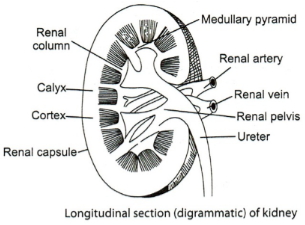
(D) The outer layer of the kidney is a tough capsule.
Inside the kidney,there are two zones: the cortex and the medulla.
The medulla is divided into a few conical masses called medullary pyramids.
The cortex extends in between the medullary pyramids as renal columns,which are known as the columns of Bertini.
Since all four statements $(I, II, III, IV)$ are correct,the correct option is $D$.
Inside the kidney,there are two zones: the cortex and the medulla.
The medulla is divided into a few conical masses called medullary pyramids.
The cortex extends in between the medullary pyramids as renal columns,which are known as the columns of Bertini.
Since all four statements $(I, II, III, IV)$ are correct,the correct option is $D$.
0 likes
View Solution104
EasyMCQ
Arrange the following parts of the nephron in a sequential manner and select the correct option accordingly.
$I.$ Glomerulus
$II.$ Bowman's capsule
$III.$ Henle's loop
$IV.$ Proximal convoluted tubule $(PCT)$
$V.$ Collecting duct
$VI.$ Distal convoluted tubule $(DCT)$
$I.$ Glomerulus
$II.$ Bowman's capsule
$III.$ Henle's loop
$IV.$ Proximal convoluted tubule $(PCT)$
$V.$ Collecting duct
$VI.$ Distal convoluted tubule $(DCT)$
A
$I \rightarrow II \rightarrow III \rightarrow IV \rightarrow V \rightarrow VI$
B
$I \rightarrow II \rightarrow IV \rightarrow III \rightarrow VI \rightarrow V$
C
$I \rightarrow II \rightarrow IV \rightarrow III \rightarrow V \rightarrow VI$
D
$VI \rightarrow III \rightarrow II \rightarrow I \rightarrow VI \rightarrow V$
Solution
(B) The flow of filtrate through the nephron follows a specific anatomical sequence:
$1$. The process begins at the $I.$ Glomerulus,where blood is filtered.
$2$. The filtrate enters the $II.$ Bowman's capsule.
$3$. From there,it moves into the $IV.$ Proximal convoluted tubule $(PCT)$.
$4$. The filtrate then travels down into the $III.$ Henle's loop.
$5$. It subsequently passes through the $VI.$ Distal convoluted tubule $(DCT)$.
$6$. Finally,it reaches the $V.$ Collecting duct.
Thus,the correct sequence is $I \rightarrow II \rightarrow IV \rightarrow III \rightarrow VI \rightarrow V$.
$1$. The process begins at the $I.$ Glomerulus,where blood is filtered.
$2$. The filtrate enters the $II.$ Bowman's capsule.
$3$. From there,it moves into the $IV.$ Proximal convoluted tubule $(PCT)$.
$4$. The filtrate then travels down into the $III.$ Henle's loop.
$5$. It subsequently passes through the $VI.$ Distal convoluted tubule $(DCT)$.
$6$. Finally,it reaches the $V.$ Collecting duct.
Thus,the correct sequence is $I \rightarrow II \rightarrow IV \rightarrow III \rightarrow VI \rightarrow V$.
0 likes
View Solution105
MediumMCQ
Which one of the following correctly explains the function of a specific part of a human nephron?
A
Henle's loop $-$ Most reabsorption of the major substances from the glomerular filtrate
B
Distal convoluted tubule $-$ Reabsorption of ions into the surrounding blood capillaries
C
Afferent arteriole $-$ Carries the blood away from the glomerulus towards renal vein
D
Podocytes $-$ Create minute spaces (slit pores) for the filtration of blood into the Bowman's capsule
Solution
(D) Podocytes are specialized cells found in the visceral layer of Bowman's capsule in the kidney.
These cells are arranged in an intricate manner so as to leave some minute spaces called filtration slits or slit pores.
Blood is filtered so finely through these membranes that almost all the constituents of the plasma except the proteins pass onto the lumen of the Bowman's capsule.
Therefore,option $D$ is the correct explanation.
These cells are arranged in an intricate manner so as to leave some minute spaces called filtration slits or slit pores.
Blood is filtered so finely through these membranes that almost all the constituents of the plasma except the proteins pass onto the lumen of the Bowman's capsule.
Therefore,option $D$ is the correct explanation.
0 likes
View Solution106
MediumMCQ
Identify the wrong statements about the human excretory system and choose the option accordingly.
$I.$ Kidneys are reddish-brown and bean-shaped structures.
$II.$ Kidneys are situated between the last thoracic and third lumbar vertebrae.
$III.$ Each kidney of an adult human measures $10-12 \, cm$ in length,$5-7 \, cm$ in width,$2-3 \, cm$ in thickness,and has an average weight of $120-170 \, g$.
$I.$ Kidneys are reddish-brown and bean-shaped structures.
$II.$ Kidneys are situated between the last thoracic and third lumbar vertebrae.
$III.$ Each kidney of an adult human measures $10-12 \, cm$ in length,$5-7 \, cm$ in width,$2-3 \, cm$ in thickness,and has an average weight of $120-170 \, g$.
A
$I$ and $II$
B
$II$ and $III$
C
$III$ and $I$
D
None of these
Solution
(D) The human excretory system consists of a pair of kidneys,ureters,urinary bladder,and urethra.
Kidneys are reddish-brown,bean-shaped structures situated between the levels of the last thoracic and third lumbar vertebrae,close to the dorsal inner wall of the abdominal cavity.
Each kidney of an adult human measures $10-12 \, cm$ in length,$5-7 \, cm$ in width,and $2-3 \, cm$ in thickness,with an average weight of $120-170 \, g$.
Since all the given statements ($I, II,$ and $III$) are factually correct,there are no wrong statements.
Kidneys are reddish-brown,bean-shaped structures situated between the levels of the last thoracic and third lumbar vertebrae,close to the dorsal inner wall of the abdominal cavity.
Each kidney of an adult human measures $10-12 \, cm$ in length,$5-7 \, cm$ in width,and $2-3 \, cm$ in thickness,with an average weight of $120-170 \, g$.
Since all the given statements ($I, II,$ and $III$) are factually correct,there are no wrong statements.
0 likes
View Solution107
MediumMCQ
$I.$ Ureter,$II.$ Renal pelvis,$III.$ Calyx,$IV.$ Urinary bladder,$V.$ Urethra. Choose the correct sequence of the urine route to the outside.
A
$I \rightarrow II \rightarrow III \rightarrow IV \rightarrow V$
B
$V \rightarrow IV \rightarrow III \rightarrow II \rightarrow I$
C
$V \rightarrow III \rightarrow IV \rightarrow I \rightarrow II$
D
$III \rightarrow II \rightarrow I \rightarrow IV \rightarrow V$
Solution
(D) The urine is formed in the nephrons and collected in the calyces.
From the calyces,it moves into the renal pelvis.
From the renal pelvis,it travels through the ureter to reach the urinary bladder.
Finally,it is expelled from the body through the urethra.
The correct sequence is: $III \rightarrow II \rightarrow I \rightarrow IV \rightarrow V$.
From the calyces,it moves into the renal pelvis.
From the renal pelvis,it travels through the ureter to reach the urinary bladder.
Finally,it is expelled from the body through the urethra.
The correct sequence is: $III \rightarrow II \rightarrow I \rightarrow IV \rightarrow V$.
0 likes
View Solution108
MediumMCQ
Which of the following structures are situated in the cortical region of the kidney?
$I.$ Malpighian corpuscle
$II.$ $PCT$ (Proximal Convoluted Tubules)
$III.$ $DCT$ (Distal Convoluted Tubules)
$IV.$ Loop of Henle
$V.$ Collecting duct
$I.$ Malpighian corpuscle
$II.$ $PCT$ (Proximal Convoluted Tubules)
$III.$ $DCT$ (Distal Convoluted Tubules)
$IV.$ Loop of Henle
$V.$ Collecting duct
A
$I, II$ and $III$
B
$III, IV$ and $V$
C
$II, III$ and $IV$
D
$IV, V$ and $I$
Solution
(A) The nephron consists of two main parts: the glomerulus and the renal tubule.
The Malpighian corpuscle (glomerulus + Bowman's capsule),the Proximal Convoluted Tubule $(PCT)$,and the Distal Convoluted Tubule $(DCT)$ are located in the cortical region of the kidney.
The Loop of Henle extends into the medullary region of the kidney.
The collecting duct starts in the cortex but extends deep into the medulla.
Therefore,the structures situated in the cortical region are the Malpighian corpuscle,$PCT$,and $DCT$ ($I, II,$ and $III$).
The Malpighian corpuscle (glomerulus + Bowman's capsule),the Proximal Convoluted Tubule $(PCT)$,and the Distal Convoluted Tubule $(DCT)$ are located in the cortical region of the kidney.
The Loop of Henle extends into the medullary region of the kidney.
The collecting duct starts in the cortex but extends deep into the medulla.
Therefore,the structures situated in the cortical region are the Malpighian corpuscle,$PCT$,and $DCT$ ($I, II,$ and $III$).
0 likes
View Solution109
MediumMCQ
In juxta-medullary nephrons,
A
Vasa recta is prominent
B
Loop of Henle is long
C
Loop of Henle runs deep into the medulla
D
All of the above
Solution
(D) Juxta-medullary nephrons have the following characteristics:
$(i)$ The $Vasa$ $recta$ is prominent.
$(ii)$ The $Loop$ $of$ $Henle$ is long.
$(iii)$ The $Loop$ $of$ $Henle$ extends deep into the medulla.
$(iv)$ These are typically found in animals adapted to arid environments,such as camels,kangaroo rats,and desert rodents,to facilitate water conservation through the counter-current mechanism.
$(i)$ The $Vasa$ $recta$ is prominent.
$(ii)$ The $Loop$ $of$ $Henle$ is long.
$(iii)$ The $Loop$ $of$ $Henle$ extends deep into the medulla.
$(iv)$ These are typically found in animals adapted to arid environments,such as camels,kangaroo rats,and desert rodents,to facilitate water conservation through the counter-current mechanism.
0 likes
View Solution110
MediumMCQ
Choose the correct statement.
A
The juxta medullary nephrons have reduced Henle's loop.
B
Vasa recta is well developed in cortical nephrons.
C
The $PCT$ and $DCT$ are situated in the medulla of the kidney.
D
The ascending limb of the Henle's loop extends as the $DCT$.
Solution
(D) The ascending limb of Henle's loop continues as another highly coiled tubular region called the Distal Convoluted Tubule $(DCT)$.
Juxtamedullary nephrons have long Henle's loops that extend deep into the medulla.
Vasa recta is absent or highly reduced in cortical nephrons.
The Malpighian corpuscles,Proximal Convoluted Tubule $(PCT)$,and Distal Convoluted Tubule $(DCT)$ are situated in the cortical region of the kidney,whereas the Henle's loop is primarily located in the medulla.
Juxtamedullary nephrons have long Henle's loops that extend deep into the medulla.
Vasa recta is absent or highly reduced in cortical nephrons.
The Malpighian corpuscles,Proximal Convoluted Tubule $(PCT)$,and Distal Convoluted Tubule $(DCT)$ are situated in the cortical region of the kidney,whereas the Henle's loop is primarily located in the medulla.
0 likes
View Solution111
MediumMCQ
Malpighian body or renal corpuscle is
A
Glomerulus along with collecting duct
B
Glomerulus along with $DCT$
C
Glomerulus along with Bowman's capsule
D
Glomerulus along with Loop of Henle
Solution
(C) The Malpighian body,also known as the renal corpuscle,is the filtration unit of the nephron.
It consists of two main structures: the glomerulus (a tuft of capillaries) and the Bowman's capsule (a double-walled cup-like structure that surrounds the glomerulus).
Therefore,Malpighian body = Glomerulus + Bowman's capsule.
It consists of two main structures: the glomerulus (a tuft of capillaries) and the Bowman's capsule (a double-walled cup-like structure that surrounds the glomerulus).
Therefore,Malpighian body = Glomerulus + Bowman's capsule.
0 likes
View Solution112
EasyMCQ
The part through which arteries and veins enter or leave the kidney is called:
A
Hilus
B
Renal papilla
C
Major calyces
D
Minor calyces
Solution
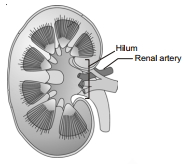
(A) The kidney has a notch on its inner concave margin called the hilum (or hilus).
Through this hilum,the renal artery,renal vein,and ureter enter or leave the kidney.
Therefore,the correct answer is Hilus.
Through this hilum,the renal artery,renal vein,and ureter enter or leave the kidney.
Therefore,the correct answer is Hilus.
0 likes
View Solution113
MediumMCQ
Podocyte cells occur in
A
Glomerular capillaries
B
Neck region of nephron
C
Inner wall of Bowman's capsule
D
Outer wall of Bowman's capsule
Solution
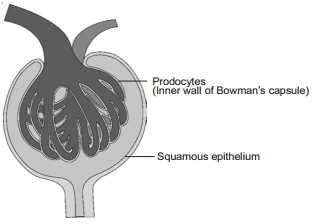
(C) The Bowman's capsule is a double-walled cup-like structure that surrounds the glomerulus.
It consists of two layers: an outer parietal layer and an inner visceral layer.
The inner visceral layer is composed of specialized cells called podocytes.
These podocytes are arranged in an intricate manner so as to leave some minute spaces called filtration slits or slit pores.
Blood is filtered so finely through these membranes that almost all the constituents of the plasma except the proteins pass onto the lumen of the Bowman's capsule.
Therefore,podocyte cells are present in the inner wall of the Bowman's capsule.
It consists of two layers: an outer parietal layer and an inner visceral layer.
The inner visceral layer is composed of specialized cells called podocytes.
These podocytes are arranged in an intricate manner so as to leave some minute spaces called filtration slits or slit pores.
Blood is filtered so finely through these membranes that almost all the constituents of the plasma except the proteins pass onto the lumen of the Bowman's capsule.
Therefore,podocyte cells are present in the inner wall of the Bowman's capsule.
0 likes
View Solution114
EasyMCQ
Kidneys are reddish-brown,bean-shaped structures situated between the levels of . . . . . . thoracic and . . . . . . lumbar vertebrae.
A
$11^{th}; 1^{st}$
B
$12^{th}; 3^{rd}$
C
$10^{th}; 2^{nd}$
D
$12^{th}; 5^{th}$
Solution
(B) The kidneys are reddish-brown,bean-shaped structures located in the abdominal cavity.
They are situated between the levels of the $12^{th}$ thoracic and $3^{rd}$ lumbar vertebrae.
They are covered by the peritoneum only on the ventral side,meaning they are fused with the posterior body wall.
This specific anatomical arrangement is known as the retroperitoneal arrangement.
They are situated between the levels of the $12^{th}$ thoracic and $3^{rd}$ lumbar vertebrae.
They are covered by the peritoneum only on the ventral side,meaning they are fused with the posterior body wall.
This specific anatomical arrangement is known as the retroperitoneal arrangement.
0 likes
View Solution115
MediumMCQ
The parts of the nephron situated in the cortical region of the kidney are:
A
Loop of Henle,$PCT$ and collecting duct
B
Collecting duct,$PCT$ and Malpighian corpuscle
C
$PCT, DCT$ and Loop of Henle
D
$PCT, DCT$ and Malpighian corpuscle
Solution
(D) The kidney is divided into an outer cortex and an inner medulla.
In the cortex,the following parts of the nephron are located: $PCT$ (Proximal Convoluted Tubule),$DCT$ (Distal Convoluted Tubule),and the Malpighian corpuscle (Glomerulus + Bowman's capsule).
The Loop of Henle primarily extends into the medulla.
In the cortex,the following parts of the nephron are located: $PCT$ (Proximal Convoluted Tubule),$DCT$ (Distal Convoluted Tubule),and the Malpighian corpuscle (Glomerulus + Bowman's capsule).
The Loop of Henle primarily extends into the medulla.
0 likes
View Solution116
MediumMCQ
Which one of the following statements is incorrect?
A
The medullary zone of the kidney is divided into a few conical masses called medullary pyramids projecting into calyces.
B
Inside the kidney,the cortical region extends in between the medullary pyramids as the renal pelvis.
C
The glomerulus along with Bowman's capsule is called the renal corpuscle.
D
The renal corpuscle,proximal convoluted tubule $(PCT)$,and distal convoluted tubule $(DCT)$ of the nephron are situated in the cortical region of the kidney.
Solution
(B) The statement in option $B$ is incorrect. Inside the kidney,the cortical region extends in between the medullary pyramids as renal columns,which are known as the columns of Bertini. The renal pelvis is a funnel-shaped space located towards the inner concave side of the kidney,not the extension of the cortex between pyramids.
0 likes
View Solution117
MediumMCQ
Henle's loops are found in those animals which excrete hypertonic urine. One of the following does not have Henle's loop.
A
Birds
B
Mammals
C
Frogs
D
Reptiles
Solution
(C) The loop of Henle is a specialized structure in the nephron responsible for the concentration of urine,allowing animals to excrete hypertonic urine to conserve water.
It is a characteristic feature of mammals and birds (to some extent).
Frogs (amphibians) possess mesonephric kidneys and primarily excrete dilute (hypotonic) urine as they live in aquatic or moist environments where water conservation is not as critical as in terrestrial mammals.
Therefore,the loop of Henle is absent in frogs.
It is a characteristic feature of mammals and birds (to some extent).
Frogs (amphibians) possess mesonephric kidneys and primarily excrete dilute (hypotonic) urine as they live in aquatic or moist environments where water conservation is not as critical as in terrestrial mammals.
Therefore,the loop of Henle is absent in frogs.
0 likes
View Solution118
MediumMCQ
Which of the following is correct?
A
Afferent arteriole is narrower than the efferent arteriole
B
Efferent venule is narrower than vein
C
Efferent arteriole is narrower than afferent arteriole
D
Both afferent and efferent arteriole are of same diameter
Solution
(C) The afferent arteriole brings blood into the glomerulus,while the efferent arteriole carries it away.
The diameter of the afferent arteriole is larger than that of the efferent arteriole.
This difference in diameter creates a high hydrostatic pressure within the glomerulus,which is essential for the process of ultrafiltration.
The diameter of the afferent arteriole is larger than that of the efferent arteriole.
This difference in diameter creates a high hydrostatic pressure within the glomerulus,which is essential for the process of ultrafiltration.
0 likes
View Solution119
MediumMCQ
$A:$ The inner wall of Bowman's capsule is lined with specialized cells called podocytes,which have a number of projections.
$R:$ These projections increase the surface area for absorption.
$R:$ These projections increase the surface area for absorption.
A
Assertion and Reason both are correct and Reason is the correct explanation of Assertion.
B
Assertion and Reason both are correct but Reason is not the correct explanation of Assertion.
C
Assertion is correct,but Reason is incorrect.
D
Both Assertion and Reason are incorrect.
Solution
(C) The inner wall of the Bowman's capsule is indeed lined with specialized cells known as podocytes,which are arranged in an intricate manner so as to leave some minute spaces called filtration slits or slit pores.
These podocytes are involved in the process of ultrafiltration,where they act as a sieve to filter blood.
The projections (foot processes) of podocytes do not increase the surface area for absorption; rather,they help in creating filtration slits that allow the passage of water and small solutes while preventing the passage of large molecules like proteins.
Therefore,the Assertion is correct,but the Reason is incorrect.
These podocytes are involved in the process of ultrafiltration,where they act as a sieve to filter blood.
The projections (foot processes) of podocytes do not increase the surface area for absorption; rather,they help in creating filtration slits that allow the passage of water and small solutes while preventing the passage of large molecules like proteins.
Therefore,the Assertion is correct,but the Reason is incorrect.
0 likes
View Solution120
MediumMCQ
$A :$ Kidneys are retroperitoneal in position.
$R :$ Kidneys are covered with peritoneum only on the ventral surface.
$R :$ Kidneys are covered with peritoneum only on the ventral surface.
A
Assertion and Reason both are correct and Reason is the correct explanation of Assertion.
B
Assertion and Reason both are correct but Reason is not the correct explanation of Assertion.
C
Assertion is correct,but Reason is incorrect.
D
Both Assertion and Reason are incorrect.
Solution
(A) The kidneys are located outside the peritoneal cavity,attached to the dorsal abdominal wall.
Because they are fused to the dorsal wall,the peritoneum covers only their ventral (anterior) surface.
This specific anatomical arrangement is known as the retroperitoneal position.
Therefore,both the Assertion and the Reason are correct,and the Reason provides the correct explanation for the Assertion.
Because they are fused to the dorsal wall,the peritoneum covers only their ventral (anterior) surface.
This specific anatomical arrangement is known as the retroperitoneal position.
Therefore,both the Assertion and the Reason are correct,and the Reason provides the correct explanation for the Assertion.
0 likes
View Solution121
EasyMCQ
What is hilum?
A
$A$ notch on the concave surface of the kidney
B
The outer layer of the kidney
C
The functional unit of the kidney
D
The storage area for urine
Solution
(A) The $L.s.$ (longitudinal section) of the kidney reveals a notch on its concave surface,which is known as the hilum. Through this hilum,the ureter,blood vessels,and nerves enter the kidney.
0 likes
View Solution122
EasyMCQ
How many nephrons are present in each kidney?
A
About $100,000$
B
About $500,000$
C
About $1,000,000$
D
About $5,000,000$
Solution
(C) Each human kidney contains approximately $1,000,000$ (one million) nephrons.
Nephrons are the structural and functional units of the kidney,responsible for the filtration of blood and the formation of urine.
Nephrons are the structural and functional units of the kidney,responsible for the filtration of blood and the formation of urine.
0 likes
View Solution123
EasyMCQ
How is the glomerulus formed?
A
By the efferent arteriole
B
By the afferent arteriole
C
By the renal vein
D
By the peritubular capillaries
Solution
(B) The glomerulus is a tuft of capillaries formed by the afferent arteriole,which is a fine branch of the renal artery.
These capillaries then reunite to form the efferent arteriole,which carries blood away from the glomerulus.
These capillaries then reunite to form the efferent arteriole,which carries blood away from the glomerulus.
0 likes
View Solution124
Easy
State the location and function of podocyte.
Solution
(N/A) Location: Podocytes are specialized epithelial cells located in the inner (visceral) layer of the Bowman's capsule in the kidney.
Function: They are arranged in an intricate manner so as to leave some minute spaces called filtration slits or slit pores. These pores allow the filtration of blood from the glomerular capillaries into the Bowman's space,ensuring that proteins and blood cells are retained in the blood while water and small solutes pass through.
Function: They are arranged in an intricate manner so as to leave some minute spaces called filtration slits or slit pores. These pores allow the filtration of blood from the glomerular capillaries into the Bowman's space,ensuring that proteins and blood cells are retained in the blood while water and small solutes pass through.
0 likes
View Solution125
MediumMCQ
The color of the human kidney is ...... .
A
Yellow
B
Reddish brown
C
Red
D
Green
Solution
(B) The human kidney is a bean-shaped organ located in the abdominal cavity.
Its color is characteristically described as reddish brown due to the high vascularity and the presence of numerous blood vessels involved in the filtration of blood.
Its color is characteristically described as reddish brown due to the high vascularity and the presence of numerous blood vessels involved in the filtration of blood.
0 likes
View Solution126
MediumMCQ
The weight of a human kidney is approximately ....... grams.
A
$120-170$
B
$220-270$
C
$250-290$
D
$150-190$
Solution
(A) In an adult human,each kidney is a bean-shaped organ.
The average weight of a human kidney typically ranges between $120$ grams and $170$ grams.
Therefore,the correct option is $A$.
The average weight of a human kidney typically ranges between $120$ grams and $170$ grams.
Therefore,the correct option is $A$.
0 likes
View Solution127
MediumMCQ
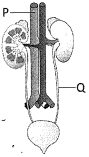
The following figure shows the human excretory system. Identify $P$ and $Q$.
$P \quad Q$
$P \quad Q$
A
Dorsal aorta $\quad$ Ureter
B
Inferior vena cava $\quad$ Ureter
C
Dorsal aorta $\quad$ Urethra
D
Inferior vena cava $\quad$ Urethra
Solution
(A) In the provided diagram of the human excretory system:
$1$. $P$ represents the large blood vessel running centrally,which is the Dorsal aorta (carrying oxygenated blood to the kidneys).
$2$. $Q$ represents the tube emerging from the kidney and leading to the urinary bladder,which is the Ureter.
Therefore,$P$ is the Dorsal aorta and $Q$ is the Ureter.
$1$. $P$ represents the large blood vessel running centrally,which is the Dorsal aorta (carrying oxygenated blood to the kidneys).
$2$. $Q$ represents the tube emerging from the kidney and leading to the urinary bladder,which is the Ureter.
Therefore,$P$ is the Dorsal aorta and $Q$ is the Ureter.
0 likes
View Solution128
EasyMCQ
Select the correct dimensions for the human kidney (Length,Width,Thickness).
A
$15-17 \,cm, 10-12 \,cm, 5-7 \,cm$
B
$5-7 \,cm, 10-12 \,cm, 2-3 \,cm$
C
$10-12 \,cm, 5-7 \,cm, 2-3 \,cm$
D
$10-12 \,cm, 15-17 \,cm, 5-7 \,cm$
Solution
(C) The human kidneys are bean-shaped structures located in the abdominal cavity.
According to the $NCERT$ textbook,the dimensions of a healthy adult human kidney are:
Length: $10-12 \,cm$
Width: $5-7 \,cm$
Thickness: $2-3 \,cm$
Therefore,option $C$ is the correct choice.
According to the $NCERT$ textbook,the dimensions of a healthy adult human kidney are:
Length: $10-12 \,cm$
Width: $5-7 \,cm$
Thickness: $2-3 \,cm$
Therefore,option $C$ is the correct choice.
0 likes
View Solution129
EasyMCQ
What is the shape of the human kidney?
A
Round
B
Cone
C
Pea
D
Bean
Solution
(D) The human kidneys are reddish-brown,bean-shaped structures situated between the levels of the last thoracic and third lumbar vertebra close to the dorsal inner wall of the abdominal cavity.
0 likes
View Solution130
MediumMCQ
State the location of the kidneys.
A
Between the levels of the last thoracic and third lumbar vertebra,close to the dorsal inner wall of the abdominal cavity.
B
Between the levels of the last thoracic and third lumbar vertebra,close to the dorsal inner wall of the thoracic cavity.
C
Between the levels of the third thoracic and last lumbar vertebra,close to the dorsal inner wall of the thoracic cavity.
D
Between the levels of the third thoracic and last lumbar vertebra,close to the dorsal inner wall of the abdominal cavity.
Solution
(A) The kidneys are reddish-brown,bean-shaped structures situated between the levels of the last thoracic $(T_{12})$ and third lumbar $(L_3)$ vertebra,close to the dorsal inner wall of the abdominal cavity.
0 likes
View Solution131
MediumMCQ
Which of the following enters the hilum of the kidney?
A
Ureter
B
Blood vessels
C
Nerves
D
All of the above
Solution
(D) The hilum is a notch on the concave medial border of the kidney.
Through this notch,the ureter,blood vessels,and nerves enter the kidney.
Therefore,all the listed structures enter the kidney through the hilum.
Through this notch,the ureter,blood vessels,and nerves enter the kidney.
Therefore,all the listed structures enter the kidney through the hilum.
0 likes
View Solution132
MediumMCQ
The wide funnel-shaped space inside the hilum of the kidney is called the .....
A
Renal cortex
B
Renal medulla
C
Renal pelvis
D
Calyces
Solution
(C) The kidney has an inner concave margin called the hilum,which serves as the entry and exit point for blood vessels,nerves,and the ureter.
Inside the hilum,there is a broad,funnel-shaped space known as the renal pelvis.
The renal pelvis further branches into projections called calyces.
Therefore,the correct answer is the renal pelvis.
Inside the hilum,there is a broad,funnel-shaped space known as the renal pelvis.
The renal pelvis further branches into projections called calyces.
Therefore,the correct answer is the renal pelvis.
0 likes
View Solution133
MediumMCQ
Renal pyramids are parts of the ...... .
A
Renal cortex
B
Renal medulla
C
Renal pelvis
D
Calyces
Solution
(B) The human kidney is divided into two main zones: an outer $Renal \text{ cortex}$ and an inner $Renal \text{ medulla}$.
Inside the $Renal \text{ medulla}$, there are several conical projections called $Renal \text{ pyramids}$.
These pyramids project into the $Calyces$ and are separated by the $Renal \text{ columns}$ of $Bertini$.
Therefore, the renal pyramids are part of the renal medulla.
Inside the $Renal \text{ medulla}$, there are several conical projections called $Renal \text{ pyramids}$.
These pyramids project into the $Calyces$ and are separated by the $Renal \text{ columns}$ of $Bertini$.
Therefore, the renal pyramids are part of the renal medulla.
0 likes
View Solution134
MediumMCQ
The renal columns of Bertin are extensions of the ...... into the renal medulla.
A
Renal cortex
B
Renal medulla
C
Renal pelvis
D
Calyces
Solution
(A) The renal cortex extends in between the renal pyramids as renal columns called columns of Bertin. These columns project into the renal medulla,separating the renal pyramids from each other. Therefore,the renal columns are extensions of the renal cortex.
0 likes
View Solution135
MediumMCQ
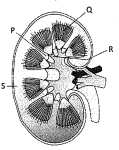
The following figure shows a longitudinal section of the kidney. Which part represents the renal column?
A
$P$
B
$Q$
C
$R$
D
$S$
Solution
(A) In the longitudinal section of the human kidney:
$P$ represents the renal column (also known as the column of Bertini),which is an extension of the renal cortex between the renal pyramids.
$Q$ represents the renal pyramid (medullary pyramid).
$R$ represents the renal pelvis.
$S$ represents the renal cortex.
Therefore,the correct option is $P$.
$P$ represents the renal column (also known as the column of Bertini),which is an extension of the renal cortex between the renal pyramids.
$Q$ represents the renal pyramid (medullary pyramid).
$R$ represents the renal pelvis.
$S$ represents the renal cortex.
Therefore,the correct option is $P$.
0 likes
View Solution136
MediumMCQ
How many nephrons are present in the human body?
A
$1$ million
B
$2$ million
C
$3$ million
D
$4$ million
Solution
(B) Each kidney in the human body contains approximately $1$ million nephrons. Since there are two kidneys, the total number of nephrons in the human body is approximately $2$ million. Therefore, the correct option is $B$.
0 likes
View Solution137
EasyMCQ
What is the structural and functional unit of the kidney?
A
Nephridium
B
Protonephridia
C
Nephron
D
Neuron
Solution
(C) The kidney is the primary excretory organ in humans. Each kidney contains approximately $1$ million complex tubular structures called nephrons. The nephron is considered the structural and functional unit of the kidney because it is responsible for the filtration of blood,reabsorption of essential nutrients,and the formation of urine. Therefore,the correct option is $C$.
0 likes
View Solution138
MediumMCQ
Select the correct sequence of blood flow in the kidney.
A
Renal artery $\rightarrow$ Afferent arteriole $\rightarrow$ Glomerulus $\rightarrow$ Efferent arteriole $\rightarrow$ Renal vein
B
Renal vein $\rightarrow$ Afferent arteriole $\rightarrow$ Glomerulus $\rightarrow$ Efferent arteriole $\rightarrow$ Renal artery
C
Renal artery $\rightarrow$ Efferent arteriole $\rightarrow$ Glomerulus $\rightarrow$ Afferent arteriole $\rightarrow$ Renal vein
D
Renal vein $\rightarrow$ Efferent arteriole $\rightarrow$ Glomerulus $\rightarrow$ Afferent arteriole $\rightarrow$ Renal artery
Solution
(A) The blood flow in the nephron follows a specific pathway:
$1$. The $Renal artery$ brings oxygenated blood to the kidney.
$2$. This branches into the $Afferent arteriole$, which enters the Bowman's capsule.
$3$. The $Afferent arteriole$ forms a network of capillaries called the $Glomerulus$, where filtration occurs.
$4$. Blood leaves the $Glomerulus$ through the $Efferent arteriole$.
$5$. Finally, the blood is collected and drained out of the kidney through the $Renal vein$.
Therefore, the correct sequence is: $Renal artery \rightarrow Afferent arteriole \rightarrow Glomerulus \rightarrow Efferent arteriole \rightarrow Renal vein$.
$1$. The $Renal artery$ brings oxygenated blood to the kidney.
$2$. This branches into the $Afferent arteriole$, which enters the Bowman's capsule.
$3$. The $Afferent arteriole$ forms a network of capillaries called the $Glomerulus$, where filtration occurs.
$4$. Blood leaves the $Glomerulus$ through the $Efferent arteriole$.
$5$. Finally, the blood is collected and drained out of the kidney through the $Renal vein$.
Therefore, the correct sequence is: $Renal artery \rightarrow Afferent arteriole \rightarrow Glomerulus \rightarrow Efferent arteriole \rightarrow Renal vein$.
0 likes
View Solution139
MediumMCQ
Which of the following structures has a hairpin shape?
A
Proximal Convoluted Tubule $(PCT)$
B
Distal Convoluted Tubule $(DCT)$
C
Loop of Henle
D
Collecting Duct
Solution
(C) The nephron consists of a glomerulus and a renal tubule. The renal tubule begins with a double-walled Bowman's capsule,followed by the Proximal Convoluted Tubule $(PCT)$. The next part is the Loop of Henle,which is a hairpin-shaped structure that extends into the renal medulla. Finally,the tubule continues as the Distal Convoluted Tubule $(DCT)$ and the Collecting Duct. Therefore,the correct answer is the Loop of Henle.
0 likes
View Solution140
DifficultMCQ
Match the following columns:
| Column-$I$ | Column-$II$ |
| $P$. Structures in renal cortex | $I$. Descending limb of Henle |
| $Q$. Structures in renal medulla | $II$. Proximal convoluted tubule $(PCT)$ |
| $III$. Distal convoluted tubule $(DCT)$ | |
| $IV$. Ascending limb of Henle | |
| $V$. Collecting duct | |
| $VI$. Duct of Bellini | |
| $VII$. Afferent arteriole | |
| $VIII$. Efferent arteriole |
A
$(P - I, II, III, IV, V), (Q - VI, VII, VIII)$
B
$(P - II, III, VII, VIII), (Q - I, IV, V, VI)$
C
$(P - I, IV, V, VI), (Q - II, III, VII, VIII)$
D
$(P - VI, VII, VIII), (Q - I, II, III, IV, V)$
Solution
(B) The renal cortex contains the Malpighian corpuscle, Proximal Convoluted Tubule $(PCT)$, and Distal Convoluted Tubule $(DCT)$. The afferent and efferent arterioles are also associated with the glomerulus located in the cortex.
The renal medulla contains the Loop of Henle (descending and ascending limbs), the collecting duct, and the ducts of Bellini.
Therefore, structures in the renal cortex $(P)$ are: $II$ $(PCT)$, $III$ $(DCT)$, $VII$ (Afferent arteriole), and $VIII$ (Efferent arteriole).
Structures in the renal medulla $(Q)$ are: $I$ (Descending limb of Henle), $IV$ (Ascending limb of Henle), $V$ (Collecting duct), and $VI$ (Duct of Bellini).
Thus, the correct match is $(P - II, III, VII, VIII)$ and $(Q - I, IV, V, VI)$.
The renal medulla contains the Loop of Henle (descending and ascending limbs), the collecting duct, and the ducts of Bellini.
Therefore, structures in the renal cortex $(P)$ are: $II$ $(PCT)$, $III$ $(DCT)$, $VII$ (Afferent arteriole), and $VIII$ (Efferent arteriole).
Structures in the renal medulla $(Q)$ are: $I$ (Descending limb of Henle), $IV$ (Ascending limb of Henle), $V$ (Collecting duct), and $VI$ (Duct of Bellini).
Thus, the correct match is $(P - II, III, VII, VIII)$ and $(Q - I, IV, V, VI)$.
0 likes
View Solution141
MediumMCQ
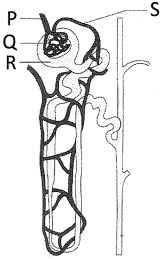
The diagram of a nephron is given below. Which of the following structures together form the renal corpuscle (Malpighian body)?
A
$Q$ and $R$
B
$P$ and $R$
C
$R$ and $S$
D
$P$ and $S$
Solution
(A) The renal corpuscle,also known as the Malpighian body,is the filtration unit of the nephron.
It consists of two main parts: the glomerulus and Bowman's capsule.
In the provided diagram:
$Q$ represents the glomerulus (a tuft of capillaries).
$R$ represents the Bowman's capsule (the cup-shaped structure surrounding the glomerulus).
Together,$Q$ and $R$ form the renal corpuscle.
Therefore,the correct option is $A$.
It consists of two main parts: the glomerulus and Bowman's capsule.
In the provided diagram:
$Q$ represents the glomerulus (a tuft of capillaries).
$R$ represents the Bowman's capsule (the cup-shaped structure surrounding the glomerulus).
Together,$Q$ and $R$ form the renal corpuscle.
Therefore,the correct option is $A$.
0 likes
View Solution142
MediumMCQ
The Malpighian body (renal corpuscle) is equal to $.......$
A
Bowman's capsule $+$ Glomerulus
B
Bowman's capsule
C
Glomerulus
D
Bowman's capsule $+$ Glomerulus $+$ Afferent arteriole
Solution
(A) The Malpighian body,also known as the renal corpuscle,is the filtration unit of the nephron.
It consists of two main structures: the Glomerulus and the Bowman's capsule.
The Glomerulus is a tuft of capillaries formed by the afferent arteriole,and the Bowman's capsule is a double-walled cup-like structure that surrounds the glomerulus.
Therefore,Malpighian body = Glomerulus $+$ Bowman's capsule.
It consists of two main structures: the Glomerulus and the Bowman's capsule.
The Glomerulus is a tuft of capillaries formed by the afferent arteriole,and the Bowman's capsule is a double-walled cup-like structure that surrounds the glomerulus.
Therefore,Malpighian body = Glomerulus $+$ Bowman's capsule.
0 likes
View Solution143
MediumMCQ
In $....... P .......$ type of nephrons, the loop of Henle is too short. In $....... Q .......$ type of nephrons, the loop of Henle is very long. Choose the correct option for $P$ and $Q$.
$P \quad Q$
$P \quad Q$
A
Cortical nephron $\quad$ Juxtamedullary nephron
B
Juxtamedullary nephron $\quad$ Juxtamedullary nephron
C
Cortical nephron $\quad$ Juxtamedullary nephron
D
Juxtamedullary nephron $\quad$ Cortical nephron
Solution
(A) Nephrons are of two types based on the position of the glomerulus and the length of the loop of Henle:
$1$. $\text{Cortical}$ $\text{nephrons}$: In these, the glomerulus is located in the outer cortex and the loop of Henle is very short, extending only a little into the medulla.
$2$. $\text{Juxtamedullary}$ $\text{nephrons}$: In these, the glomerulus is located near the corticomedullary junction and the loop of Henle is very long, running deep into the medulla.
Therefore, $P$ is $\text{Cortical}$ $\text{nephron}$ and $Q$ is $\text{Juxtamedullary}$ $\text{nephron}$.
$1$. $\text{Cortical}$ $\text{nephrons}$: In these, the glomerulus is located in the outer cortex and the loop of Henle is very short, extending only a little into the medulla.
$2$. $\text{Juxtamedullary}$ $\text{nephrons}$: In these, the glomerulus is located near the corticomedullary junction and the loop of Henle is very long, running deep into the medulla.
Therefore, $P$ is $\text{Cortical}$ $\text{nephron}$ and $Q$ is $\text{Juxtamedullary}$ $\text{nephron}$.
0 likes
View Solution144
MediumMCQ
The duct of Bellini opens into the ........ .
A
Ureter
B
Major calyx
C
Renal pyramid
D
Minor calyx
Solution
(D) The duct of Bellini,also known as the papillary duct,is the final portion of the collecting duct system in the kidney.
These ducts collect urine from the distal convoluted tubules and collecting ducts.
The ducts of Bellini open into the minor calyx at the renal papilla,which is the apex of the renal pyramid.
Therefore,the correct option is $D$.
These ducts collect urine from the distal convoluted tubules and collecting ducts.
The ducts of Bellini open into the minor calyx at the renal papilla,which is the apex of the renal pyramid.
Therefore,the correct option is $D$.
0 likes
View Solution145
EasyMCQ
The $Bellini$ ducts transport which of the following?
A
Blood
B
Filtrate
C
Urine
D
Lymph
Solution
(C) The $Bellini$ ducts,also known as the papillary ducts,are the final segments of the renal collecting ducts.
They open into the renal calyces at the renal papillae.
Since the fluid passing through the collecting ducts has undergone final modifications and concentration,it is referred to as urine.
Therefore,the $Bellini$ ducts transport urine into the renal pelvis.
They open into the renal calyces at the renal papillae.
Since the fluid passing through the collecting ducts has undergone final modifications and concentration,it is referred to as urine.
Therefore,the $Bellini$ ducts transport urine into the renal pelvis.
0 likes
View Solution146
DifficultMCQ
The amount of blood filtered by both kidneys per minute is equal to what fraction of the blood pumped out by each ventricle of the heart in one minute?
A
$1/2$
B
$1/5$
C
$1/10$
D
$1/15$
Solution
(B) The volume of blood pumped by each ventricle of the heart per minute is known as Cardiac Output,which is approximately $5000 \ mL$ $(5 \ L)$.
On average,the kidneys receive about $1100-1200 \ mL$ of blood per minute,which constitutes the Renal Blood Flow $(RBF)$.
To find the fraction,we calculate the ratio of Renal Blood Flow to Cardiac Output:
$\text{Fraction} = \frac{1100-1200 \ mL}{5000 \ mL} \approx 0.2-0.24$.
This value is approximately equal to $1/5$ of the total cardiac output.
Therefore,the correct option is $B$.
On average,the kidneys receive about $1100-1200 \ mL$ of blood per minute,which constitutes the Renal Blood Flow $(RBF)$.
To find the fraction,we calculate the ratio of Renal Blood Flow to Cardiac Output:
$\text{Fraction} = \frac{1100-1200 \ mL}{5000 \ mL} \approx 0.2-0.24$.
This value is approximately equal to $1/5$ of the total cardiac output.
Therefore,the correct option is $B$.
0 likes
View Solution147
MediumMCQ
Where are podocytes found?
A
Outer wall of Bowman's capsule
B
Inner wall of Bowman's capsule
C
Inner wall of Proximal Convoluted Tubule
D
Outer wall of Proximal Convoluted Tubule
Solution
(B) Podocytes are specialized epithelial cells found in the inner (visceral) layer of Bowman's capsule in the kidney. These cells are arranged in an intricate manner so as to leave some minute spaces called filtration slits or slit pores. Blood is filtered so finely through these membranes that almost all the constituents of the plasma except the proteins pass onto the lumen of the Bowman's capsule. Therefore,the correct option is $B$.
0 likes
View Solution148
MediumMCQ
What is the $pH$ of human urine?
A
$5.0$
B
$1.0-1.5$
C
$6.0$
D
$9.0$
Solution
(C) The $pH$ of human urine typically ranges from $4.5$ to $8.0$,but it is generally slightly acidic,with an average value of approximately $6.0$. This acidity helps in the excretion of metabolic waste products and plays a role in maintaining the body's acid-base balance.
0 likes
View Solution149
MediumMCQ
What is the color of human urine?
A
Light yellow
B
Reddish brown
C
Colorless
D
Grey
Solution
(A) The color of human urine is typically light yellow. This coloration is primarily due to the presence of a pigment called $Urochrome$ (also known as $Urobilin$),which is a breakdown product of hemoglobin.
0 likes
View Solution150
MediumMCQ
Which muscles are present in the wall of the urinary bladder?
A
Smooth muscle
B
Striated muscle
C
Cardiac muscle
D
All of the above
Solution
(A) The wall of the urinary bladder is composed of smooth muscles,specifically known as the $detrusor$ muscle.
These muscles are involuntary in nature,allowing the bladder to expand as it fills with urine and contract during the process of micturition to expel urine from the body.
Striated muscles are typically found in skeletal muscles,and cardiac muscles are exclusive to the heart.
These muscles are involuntary in nature,allowing the bladder to expand as it fills with urine and contract during the process of micturition to expel urine from the body.
Striated muscles are typically found in skeletal muscles,and cardiac muscles are exclusive to the heart.
0 likes
View SolutionExcretory Products and their Elimination — Human excretory system · Frequently Asked Questions
1Are these Excretory Products and their Elimination questions useful for JEE and NEET?
Yes. All questions in this section are mapped to JEE Main and NEET exam patterns. Previous year questions from JEE Main, NEET, GUJCET and state-level exams are included with full solutions.
2Can I switch to Hindi or Gujarati for these questions?
Yes. Use the language tabs in the hero section or the sidebar to view the same questions and solutions in English, Hindi or Gujarati.
3How do I generate a question paper from this subtopic?
Use the Vedclass Exam Paper Generator — select the chapter and subtopic, set difficulty, and generate Sets A, B, C, D automatically. First 3 chapters of every subject are free.
Vedclass Products
For Students
Vedclass Test Series
Mock tests in real JEE/NEET style with performance analysis. 5-day free trial.
Start Free TrialFor Teachers
Exam Paper Generator
Generate Set A/B/C/D papers from this chapter in 2 minutes. 3 chapters free.
Try FreeFor Institutes
Online Exam Module
Live online exams with unlimited students, 360° analytics & white-label branding.
See DemoFor Teachers & Institutes
Generate a Excretory Products and their Elimination Exam Paper in 2 Minutes
Select subtopic & difficulty — Sets A, B, C, D auto-generated with No Repeat logic.
First 3 chapters of every subject are free — no payment required.