
A English
Human excretory system Questions in English
Class 11 Biology · Excretory Products and their Elimination · Human excretory system
164+
Questions
English
Language
100%
With Solutions
Showing 14 of 164 questions in English
151
MediumMCQ
Given below are two statements: one is labelled as Assertion $A$ and the other is labelled as Reason $R$.
Assertion $A$: Nephrons are of two types: Cortical and Juxta-medullary,based on their relative position in the cortex and medulla.
Reason $R$: Juxta-medullary nephrons have a short loop of Henle,whereas cortical nephrons have a longer loop of Henle.
In the light of the above statements,choose the correct answer from the options given below:
Assertion $A$: Nephrons are of two types: Cortical and Juxta-medullary,based on their relative position in the cortex and medulla.
Reason $R$: Juxta-medullary nephrons have a short loop of Henle,whereas cortical nephrons have a longer loop of Henle.
In the light of the above statements,choose the correct answer from the options given below:
A
$A$ is false but $R$ is true.
B
Both $A$ and $R$ are true and $R$ is the correct explanation of $A$.
C
Both $A$ and $R$ are true but $R$ is $NOT$ the correct explanation of $A$.
D
$A$ is true but $R$ is false.
Solution
(D) The Assertion $A$ is true because nephrons are classified into two types,cortical and juxtamedullary,based on their relative position in the cortex and medulla.
The Reason $R$ is false because juxtamedullary nephrons have a very long loop of Henle that extends deep into the medulla,which helps in concentrating the urine.
Conversely,cortical nephrons have a very short loop of Henle that extends only slightly into the medulla.
Therefore,the correct answer is that $A$ is true but $R$ is false.
The Reason $R$ is false because juxtamedullary nephrons have a very long loop of Henle that extends deep into the medulla,which helps in concentrating the urine.
Conversely,cortical nephrons have a very short loop of Henle that extends only slightly into the medulla.
Therefore,the correct answer is that $A$ is true but $R$ is false.
0 likes
View Solution152
MediumMCQ
Choose the correct statement given below regarding juxta medullary nephron.
A
Renal corpuscle of juxta medullary nephron lies in the outer portion of the renal medulla.
B
Loop of Henle of juxta medullary nephron runs deep into medulla.
C
Juxta medullary nephrons outnumber the cortical nephrons.
D
Juxta medullary nephrons are located in the columns of Bertini.
Solution
(B) The correct answer is option $B$ because the loop of Henle of the juxta medullary nephron is significantly longer than that of the cortical nephron and extends deep into the renal medulla.
Option $A$ is incorrect because the renal corpuscle of the juxta medullary nephron is located in the inner cortical region,near the corticomedullary junction,not in the renal medulla.
Option $C$ is incorrect because juxta medullary nephrons are fewer in number compared to cortical nephrons,which constitute the majority of nephrons in the kidney.
Option $D$ is incorrect because the columns of Bertini are extensions of the renal cortex into the renal medulla,and nephrons are not specifically located within them.
Option $A$ is incorrect because the renal corpuscle of the juxta medullary nephron is located in the inner cortical region,near the corticomedullary junction,not in the renal medulla.
Option $C$ is incorrect because juxta medullary nephrons are fewer in number compared to cortical nephrons,which constitute the majority of nephrons in the kidney.
Option $D$ is incorrect because the columns of Bertini are extensions of the renal cortex into the renal medulla,and nephrons are not specifically located within them.
0 likes
View Solution153
MediumMCQ
In the given diagram,choose the correct option for the labelled parts $:-$
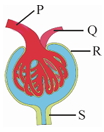
A
$P \longrightarrow$ Afferent arteriole
B
$Q \longrightarrow$ Efferent arteriole
C
$R \longrightarrow$ Bowman's capsule
D
$S \longrightarrow$ Proximal convoluted tubule $(PCT)$
Solution
(C) The given diagram represents the Malpighian body (Renal corpuscle) of a nephron.
$P$ represents the Afferent arteriole,which brings blood into the glomerulus.
$Q$ represents the Efferent arteriole,which carries blood away from the glomerulus.
$R$ represents Bowman's capsule,the cup-like structure surrounding the glomerulus.
$S$ represents the Proximal convoluted tubule $(PCT)$,which is the continuation of the Bowman's capsule.
Therefore,all options $A, B, C,$ and $D$ are technically correct labels for the structures shown in the diagram. However,in the context of standard multiple-choice questions where one must be selected,$C$ is a primary identification of the structure $R$ (Bowman's capsule).
$P$ represents the Afferent arteriole,which brings blood into the glomerulus.
$Q$ represents the Efferent arteriole,which carries blood away from the glomerulus.
$R$ represents Bowman's capsule,the cup-like structure surrounding the glomerulus.
$S$ represents the Proximal convoluted tubule $(PCT)$,which is the continuation of the Bowman's capsule.
Therefore,all options $A, B, C,$ and $D$ are technically correct labels for the structures shown in the diagram. However,in the context of standard multiple-choice questions where one must be selected,$C$ is a primary identification of the structure $R$ (Bowman's capsule).
0 likes
View Solution154
EasyMCQ
Which of the following epithelium is not present in the nephron?
A
Squamous epithelium
B
Brush bordered cuboidal epithelium
C
Ciliated columnar epithelium
D
Cuboidal epithelium
Solution
(C) The nephron is the functional unit of the kidney. Its structure consists of various types of epithelial tissues:
$1$. The Bowman's capsule is lined by simple squamous epithelium.
$2$. The Proximal Convoluted Tubule $(PCT)$ is lined by brush-bordered cuboidal epithelium.
$3$. The Loop of Henle and distal parts contain cuboidal epithelium.
$4$. Ciliated columnar epithelium is typically found in the lining of the respiratory tract,fallopian tubes,and ventricles of the brain,but it is $NOT$ present in the nephron.
$1$. The Bowman's capsule is lined by simple squamous epithelium.
$2$. The Proximal Convoluted Tubule $(PCT)$ is lined by brush-bordered cuboidal epithelium.
$3$. The Loop of Henle and distal parts contain cuboidal epithelium.
$4$. Ciliated columnar epithelium is typically found in the lining of the respiratory tract,fallopian tubes,and ventricles of the brain,but it is $NOT$ present in the nephron.
0 likes
View Solution155
MediumMCQ
Find out the incorrect statement:
A
In humans,nearly $25 \, gm$ of urea is excreted per day.
B
Columns of Bertini are the extensions of medulla into the cortex.
C
$PCT$ is the major site of reabsorption.
D
$GFR$ in a healthy individual is approx. $180 \, L/day$.
Solution
(B) $1$. In humans,approximately $25-30 \, gm$ of urea is excreted per day,so statement $A$ is correct.
$2$. The renal cortex extends in between the renal pyramids as renal columns called Columns of Bertini. Therefore,the statement that they are extensions of medulla into the cortex is incorrect; they are extensions of the cortex into the medulla.
$3$. The Proximal Convoluted Tubule $(PCT)$ is the major site of reabsorption,where $70-80 \%$ of electrolytes and water are reabsorbed,so statement $C$ is correct.
$4$. The Glomerular Filtration Rate $(GFR)$ in a healthy individual is approximately $125 \, mL/min$,which amounts to $180 \, L$ per day,so statement $D$ is correct.
Thus,statement $B$ is the incorrect statement.
$2$. The renal cortex extends in between the renal pyramids as renal columns called Columns of Bertini. Therefore,the statement that they are extensions of medulla into the cortex is incorrect; they are extensions of the cortex into the medulla.
$3$. The Proximal Convoluted Tubule $(PCT)$ is the major site of reabsorption,where $70-80 \%$ of electrolytes and water are reabsorbed,so statement $C$ is correct.
$4$. The Glomerular Filtration Rate $(GFR)$ in a healthy individual is approximately $125 \, mL/min$,which amounts to $180 \, L$ per day,so statement $D$ is correct.
Thus,statement $B$ is the incorrect statement.
0 likes
View Solution156
MediumMCQ
Read the following four statements $(A-D)$ and select the correct ones:
$(A)$ The medulla of the kidney is divided into a few conical masses projecting into the calyces.
$(B)$ The cortex of the kidney extends in between the medullary pyramids as renal columns called columns of Bertini.
$(C)$ The kidneys are situated in the ventral part of the thoracic region in the human body.
$(D)$ Each kidney of an adult human measures $10-12 \ cm$ in length,$5-7 \ cm$ in width,$2-3 \ cm$ in thickness,with an average weight of $120-170 \ gm$.
$(A)$ The medulla of the kidney is divided into a few conical masses projecting into the calyces.
$(B)$ The cortex of the kidney extends in between the medullary pyramids as renal columns called columns of Bertini.
$(C)$ The kidneys are situated in the ventral part of the thoracic region in the human body.
$(D)$ Each kidney of an adult human measures $10-12 \ cm$ in length,$5-7 \ cm$ in width,$2-3 \ cm$ in thickness,with an average weight of $120-170 \ gm$.
A
Statements $A, B$ and $C$
B
Statements $B, C$ and $D$
C
Statements $A, B$ and $D$
D
Statements $B$ and $C$
Solution
(C) Statement $(A)$ is correct: The medulla of the kidney is divided into a few conical masses called medullary pyramids projecting into the calyces.
Statement $(B)$ is correct: The cortex extends in between the medullary pyramids as renal columns called columns of Bertini.
Statement $(C)$ is incorrect: Kidneys are situated close to the dorsal inner wall of the abdominal cavity,not the ventral part of the thoracic region.
Statement $(D)$ is correct: The dimensions and weight provided for an adult human kidney are accurate ($10-12 \ cm$ length,$5-7 \ cm$ width,$2-3 \ cm$ thickness,$120-170 \ gm$ weight).
Therefore,statements $(A), (B),$ and $(D)$ are correct.
Statement $(B)$ is correct: The cortex extends in between the medullary pyramids as renal columns called columns of Bertini.
Statement $(C)$ is incorrect: Kidneys are situated close to the dorsal inner wall of the abdominal cavity,not the ventral part of the thoracic region.
Statement $(D)$ is correct: The dimensions and weight provided for an adult human kidney are accurate ($10-12 \ cm$ length,$5-7 \ cm$ width,$2-3 \ cm$ thickness,$120-170 \ gm$ weight).
Therefore,statements $(A), (B),$ and $(D)$ are correct.
0 likes
View Solution157
EasyMCQ
Complete the analogy.
$Renal \text{ } pelvis : \text{ } ureter :: \text{ } Renal \text{ } cortex : \text{ } . . . . . . $
$Renal \text{ } pelvis : \text{ } ureter :: \text{ } Renal \text{ } cortex : \text{ } . . . . . . $
A
column of Bertini
B
renal pyramid
C
collecting duct
D
renal fascia
Solution
(A) The analogy is based on the anatomical continuity within the kidney structure.
$1$. The $Renal \text{ } pelvis$ is the funnel-shaped structure that collects urine from the kidney and leads directly into the $ureter$.
$2$. Similarly, the $Renal \text{ } cortex$ extends into the $Renal \text{ } medulla$ as projections between the renal pyramids, which are known as the $columns \text{ } of \text{ } Bertini$ (or renal columns).
$3$. Therefore, the relationship represents the structural extension or continuity within the kidney.
$1$. The $Renal \text{ } pelvis$ is the funnel-shaped structure that collects urine from the kidney and leads directly into the $ureter$.
$2$. Similarly, the $Renal \text{ } cortex$ extends into the $Renal \text{ } medulla$ as projections between the renal pyramids, which are known as the $columns \text{ } of \text{ } Bertini$ (or renal columns).
$3$. Therefore, the relationship represents the structural extension or continuity within the kidney.
0 likes
View Solution158
EasyMCQ
The total number of minor calyces in a human kidney is equal to the number of:
A
columns of Bertini
B
major calyces
C
renal pyramids
D
collecting ducts
Solution
(C) In the human kidney,the renal medulla is divided into several conical masses called renal pyramids.
Each renal pyramid projects into a minor calyx.
Therefore,the number of minor calyces corresponds directly to the number of renal pyramids present in the kidney.
Typically,there are about $8$ to $18$ renal pyramids,and thus an equal number of minor calyces.
Each renal pyramid projects into a minor calyx.
Therefore,the number of minor calyces corresponds directly to the number of renal pyramids present in the kidney.
Typically,there are about $8$ to $18$ renal pyramids,and thus an equal number of minor calyces.
0 likes
View Solution159
EasyMCQ
The correct arrangement of layers of detrusor muscles in the wall of the urinary bladder is . . . . . . .
A
| Option | Arrangement (Outer,Middle,Inner) |
|---|---|
| $A$ | Longitudinal,Longitudinal,Circular |
B
| Option | Arrangement (Outer,Middle,Inner) |
|---|---|
| $B$ | Longitudinal,Circular,Longitudinal |
C
| Option | Arrangement (Outer,Middle,Inner) |
|---|---|
| $C$ | Circular,Longitudinal,Circular |
D
| Option | Arrangement (Outer,Middle,Inner) |
|---|---|
| $D$ | Longitudinal,Circular,Oblique |
Solution
(B) The wall of the urinary bladder consists of three layers of smooth muscle collectively known as the detrusor muscle.
These layers are arranged as follows:
$1$. Outer layer: Longitudinal muscle fibers.
$2$. Middle layer: Circular muscle fibers.
$3$. Inner layer: Longitudinal muscle fibers.
Therefore,the correct arrangement from outer to inner is Longitudinal,Circular,and Longitudinal.
These layers are arranged as follows:
$1$. Outer layer: Longitudinal muscle fibers.
$2$. Middle layer: Circular muscle fibers.
$3$. Inner layer: Longitudinal muscle fibers.
Therefore,the correct arrangement from outer to inner is Longitudinal,Circular,and Longitudinal.
0 likes
View Solution160
EasyMCQ
Given below are two statements:
Statement $I$: At the base of the urinary bladder,there is an inverted triangular area called the trigone.
Statement $II$: Three layers of dartos tunic muscles are present in the wall of the urinary bladder.
In the light of the above two statements,choose the correct option.
Statement $I$: At the base of the urinary bladder,there is an inverted triangular area called the trigone.
Statement $II$: Three layers of dartos tunic muscles are present in the wall of the urinary bladder.
In the light of the above two statements,choose the correct option.
A
Both statement $I$ and statement $II$ are correct.
B
Both statement $I$ and statement $II$ are incorrect.
C
Statement $I$ is correct but statement $II$ is incorrect.
D
Statement $I$ is incorrect but statement $II$ is correct.
Solution
(C) Statement $I$ is correct: The trigone is a smooth,inverted triangular region located at the base of the urinary bladder,formed by the two ureteral orifices and the internal urethral orifice.
Statement $II$ is incorrect: The wall of the urinary bladder consists of three layers: the outer serosa (peritoneum),the middle muscular layer known as the detrusor muscle (which consists of three layers of smooth muscle fibers),and the inner mucosa (transitional epithelium). The term 'dartos tunic' refers to the smooth muscle layer found in the scrotum,not the urinary bladder.
Statement $II$ is incorrect: The wall of the urinary bladder consists of three layers: the outer serosa (peritoneum),the middle muscular layer known as the detrusor muscle (which consists of three layers of smooth muscle fibers),and the inner mucosa (transitional epithelium). The term 'dartos tunic' refers to the smooth muscle layer found in the scrotum,not the urinary bladder.
0 likes
View Solution161
EasyMCQ
Select the correct statements from the following.
$(i)$ Renal papilla is a narrow tip of the medullary pyramid.
(ii) Renal cortex is red-coloured and striated.
(iii) Longitudinal-circular-longitudinal arrangement of smooth muscles is observed in the renal pelvis at its origin.
(iv) Ureter is a long,non-muscular hollow tube that communicates with the renal pelvis at its origin.
$(i)$ Renal papilla is a narrow tip of the medullary pyramid.
(ii) Renal cortex is red-coloured and striated.
(iii) Longitudinal-circular-longitudinal arrangement of smooth muscles is observed in the renal pelvis at its origin.
(iv) Ureter is a long,non-muscular hollow tube that communicates with the renal pelvis at its origin.
A
$(i)$ and (ii)
B
$(i)$ and (iii)
C
(iii) and (iv)
D
(ii) and (iii)
Solution
(B) Statement $(i)$ is correct: The renal papilla is the apex or narrow tip of the medullary pyramid that projects into the minor calyx.
Statement (ii) is incorrect: The renal cortex is a reddish-brown granular layer,not striated. The medulla is the region that appears striated due to the presence of loops of Henle and collecting ducts.
Statement (iii) is correct: The wall of the renal pelvis contains smooth muscles arranged in longitudinal,circular,and longitudinal layers to facilitate the movement of urine.
Statement (iv) is incorrect: The ureter is a muscular tube,not non-muscular. It is responsible for transporting urine from the renal pelvis to the urinary bladder via peristaltic contractions.
Statement (ii) is incorrect: The renal cortex is a reddish-brown granular layer,not striated. The medulla is the region that appears striated due to the presence of loops of Henle and collecting ducts.
Statement (iii) is correct: The wall of the renal pelvis contains smooth muscles arranged in longitudinal,circular,and longitudinal layers to facilitate the movement of urine.
Statement (iv) is incorrect: The ureter is a muscular tube,not non-muscular. It is responsible for transporting urine from the renal pelvis to the urinary bladder via peristaltic contractions.
0 likes
View Solution162
EasyMCQ
Which of the following statements is $CORRECT$ with reference to the nephron?
A
$ADH$ hormone increases the permeability of $PCT$ cells to reabsorb water.
B
Efferent arteriole forms a peritubular capillary network around the renal tubule.
C
Podocytes occur in the ascending limb of the loop of Henle.
D
The descending limb of the loop of Henle is impermeable to water.
Solution
(B) The correct statement is that the efferent arteriole forms a peritubular capillary network around the renal tubule.
$1$. $ADH$ (Antidiuretic Hormone) acts primarily on the collecting duct and distal convoluted tubule $(DCT)$,not the $PCT$,to increase water reabsorption.
$2$. The efferent arteriole emerging from the glomerulus forms a fine capillary network around the renal tubule called the peritubular capillary network.
$3$. Podocytes are specialized cells found in the Bowman's capsule,not in the loop of Henle.
$4$. The descending limb of the loop of Henle is permeable to water but nearly impermeable to electrolytes,whereas the ascending limb is impermeable to water.
$1$. $ADH$ (Antidiuretic Hormone) acts primarily on the collecting duct and distal convoluted tubule $(DCT)$,not the $PCT$,to increase water reabsorption.
$2$. The efferent arteriole emerging from the glomerulus forms a fine capillary network around the renal tubule called the peritubular capillary network.
$3$. Podocytes are specialized cells found in the Bowman's capsule,not in the loop of Henle.
$4$. The descending limb of the loop of Henle is permeable to water but nearly impermeable to electrolytes,whereas the ascending limb is impermeable to water.
0 likes
View Solution163
EasyMCQ
The wall of the urinary bladder in humans shows a thick layer of smooth muscle called . . . . . . .
A
Dartos
B
Detrusor
C
Deltoid
D
Depressor
Solution
(B) The wall of the urinary bladder is composed of three layers: the mucosa,the submucosa,and the muscularis layer.
The muscularis layer consists of smooth muscle fibers arranged in longitudinal and circular patterns,collectively known as the $Detrusor$ muscle.
This muscle is responsible for the contraction of the bladder during micturition (urination) to expel urine.
The muscularis layer consists of smooth muscle fibers arranged in longitudinal and circular patterns,collectively known as the $Detrusor$ muscle.
This muscle is responsible for the contraction of the bladder during micturition (urination) to expel urine.
0 likes
View Solution164
EasyMCQ
Kidneys lie outside the peritoneum,hence they are called
A
Orthoperitoneal
B
Intraperitoneal
C
Supraperitoneal
D
Retroperitoneal
Solution
(D) The peritoneum is a serous membrane that lines the abdominal cavity and covers most of the abdominal organs.
Organs that are located behind the peritoneum are known as retroperitoneal organs.
The kidneys are situated in the abdominal cavity between the levels of the last thoracic and third lumbar vertebra,close to the dorsal inner wall of the abdominal cavity.
Because they are positioned behind the parietal peritoneum,they are classified as retroperitoneal organs.
Organs that are located behind the peritoneum are known as retroperitoneal organs.
The kidneys are situated in the abdominal cavity between the levels of the last thoracic and third lumbar vertebra,close to the dorsal inner wall of the abdominal cavity.
Because they are positioned behind the parietal peritoneum,they are classified as retroperitoneal organs.
0 likes
View SolutionExcretory Products and their Elimination — Human excretory system · Frequently Asked Questions
1Are these Excretory Products and their Elimination questions useful for JEE and NEET?
Yes. All questions in this section are mapped to JEE Main and NEET exam patterns. Previous year questions from JEE Main, NEET, GUJCET and state-level exams are included with full solutions.
2Can I switch to Hindi or Gujarati for these questions?
Yes. Use the language tabs in the hero section or the sidebar to view the same questions and solutions in English, Hindi or Gujarati.
3How do I generate a question paper from this subtopic?
Use the Vedclass Exam Paper Generator — select the chapter and subtopic, set difficulty, and generate Sets A, B, C, D automatically. First 3 chapters of every subject are free.
Vedclass Products
For Students
Vedclass Test Series
Mock tests in real JEE/NEET style with performance analysis. 5-day free trial.
Start Free TrialFor Teachers
Exam Paper Generator
Generate Set A/B/C/D papers from this chapter in 2 minutes. 3 chapters free.
Try FreeFor Institutes
Online Exam Module
Live online exams with unlimited students, 360° analytics & white-label branding.
See DemoFor Teachers & Institutes
Generate a Excretory Products and their Elimination Exam Paper in 2 Minutes
Select subtopic & difficulty — Sets A, B, C, D auto-generated with No Repeat logic.
First 3 chapters of every subject are free — no payment required.