
A English
Human excretory system Questions in English
Class 11 Biology · Excretory Products and their Elimination · Human excretory system
164+
Questions
English
Language
100%
With Solutions
Showing 50 of 164 questions in English
1
MediumMCQ
Both the kidneys of human are not in the same plane and axis. This is due to the presence of
A
Spleen
B
Liver
C
Caecum and colon
D
Rectum
Solution
(B) In humans,the right kidney is located slightly lower than the left kidney. This asymmetry is primarily due to the presence of the large right lobe of the liver,which occupies a significant portion of the upper right quadrant of the abdominal cavity,pushing the right kidney downwards.
0 likes
View Solution2
MediumMCQ
Which of the following veins has the least amount of urea?
A
Pulmonary vein
B
Hepatic portal vein
C
Hepatic vein
D
Renal vein
Solution
(D) The correct answer is $D$. The renal vein carries blood away from the kidneys after the process of filtration.
Since the kidneys are responsible for filtering urea out of the blood to form urine,the blood exiting the kidneys via the renal vein contains the lowest concentration of urea compared to other major veins in the body.
Since the kidneys are responsible for filtering urea out of the blood to form urine,the blood exiting the kidneys via the renal vein contains the lowest concentration of urea compared to other major veins in the body.
0 likes
View Solution3
EasyMCQ
What percentage of the total blood pumped by the heart goes to the kidneys?
A
$20-25\%$
B
$50\%$
C
$75\%$
D
$40\%$
Solution
(A) The kidneys receive a significant portion of the cardiac output to facilitate the filtration of blood and the formation of urine.
On average,the kidneys receive approximately $20-25\%$ of the total cardiac output (the volume of blood pumped by the heart per minute).
This high rate of blood flow is essential for the effective removal of metabolic wastes and the regulation of body fluid composition.
On average,the kidneys receive approximately $20-25\%$ of the total cardiac output (the volume of blood pumped by the heart per minute).
This high rate of blood flow is essential for the effective removal of metabolic wastes and the regulation of body fluid composition.
0 likes
View Solution4
MediumMCQ
Columns of Bertini in the kidney of mammals are formed as the extension of
A
Medulla into cortex
B
Cortex into medulla
C
Medulla into pelvis
D
Pelvis into ureter
Solution
(B) The renal columns of Bertini are extensions of the renal cortex that project into the renal medulla between the renal pyramids. These columns contain blood vessels and connective tissue,serving as a structural support for the kidney.
0 likes
View Solution5
MediumMCQ
Each human kidney has nearly
A
$10,000$ nephrons
B
$50,000$ nephrons
C
$1,00,000$ nephrons
D
$1$ million nephrons
Solution
(D) The correct answer is $D$.
Nephrons are the structural and functional units of the kidney.
Each human kidney contains approximately $1$ million $(10^6)$ nephrons.
Nephrons are the structural and functional units of the kidney.
Each human kidney contains approximately $1$ million $(10^6)$ nephrons.
0 likes
View Solution6
MediumMCQ
Bowman's capsule and glomerulus together constitute
A
Nothing
B
$A$ nephron
C
Malpighian corpuscle
D
Nephric corpuscle
Solution
(C) The Malpighian corpuscle (also known as the renal corpuscle) is the initial blood-filtering component of a nephron.
It consists of two main structures: the glomerulus (a network of capillaries) and the Bowman's capsule (a cup-like sac that surrounds the glomerulus).
Therefore,Bowman's capsule and glomerulus together constitute the Malpighian corpuscle.
It consists of two main structures: the glomerulus (a network of capillaries) and the Bowman's capsule (a cup-like sac that surrounds the glomerulus).
Therefore,Bowman's capsule and glomerulus together constitute the Malpighian corpuscle.
0 likes
View Solution7
MediumMCQ
The Loop of Henle is concerned with which of the following systems?
A
Excretory system
B
Reproductive system
C
Nervous system
D
Muscular system
Solution
(A) The Loop of Henle is a $U$-shaped portion of the tubule that conducts urine within each nephron of the kidney.
It plays a critical role in the concentration of urine through the counter-current mechanism.
Since it is a structural component of the nephron,it is an integral part of the excretory system.
It plays a critical role in the concentration of urine through the counter-current mechanism.
Since it is a structural component of the nephron,it is an integral part of the excretory system.
0 likes
View Solution8
MediumMCQ
Kidneys of mammals are present on either side of the vertebral column at the level of:
A
$10^{th}$ thoracic to $3^{rd}$ lumbar vertebrae
B
$12^{th}$ thoracic to $5^{th}$ lumbar vertebrae
C
$12^{th}$ thoracic to $3^{rd}$ lumbar vertebrae
D
$10^{th}$ thoracic to $5^{th}$ lumbar vertebrae
Solution
(C) The kidneys are reddish-brown,bean-shaped structures situated between the levels of the last thoracic $(12^{th})$ and third lumbar $(3^{rd})$ vertebrae,close to the dorsal inner wall of the abdominal cavity.
Therefore,the correct anatomical position of the kidneys is between the $12^{th}$ thoracic and $3^{rd}$ lumbar vertebrae.
Therefore,the correct anatomical position of the kidneys is between the $12^{th}$ thoracic and $3^{rd}$ lumbar vertebrae.
0 likes
View Solution9
MediumMCQ
In humans,the kidneys are of which type?
A
Archinephros
B
Pronephros
C
Mesonephros
D
Metanephros
Solution
(D) The kidneys in humans are of the $Metanephros$ type.
During embryonic development,the kidney develops from the posterior part of the nephrogenic cord,known as the $Metanephros$.
$Pronephros$ is the most primitive type found in cyclostomes and embryonic stages of some vertebrates.
$Mesonephros$ is found in adult fishes and amphibians.
$Metanephros$ is the advanced type found in reptiles,birds,and mammals,which is characterized by the presence of a permanent kidney.
During embryonic development,the kidney develops from the posterior part of the nephrogenic cord,known as the $Metanephros$.
$Pronephros$ is the most primitive type found in cyclostomes and embryonic stages of some vertebrates.
$Mesonephros$ is found in adult fishes and amphibians.
$Metanephros$ is the advanced type found in reptiles,birds,and mammals,which is characterized by the presence of a permanent kidney.
0 likes
View Solution10
MediumMCQ
Podocytes are the cells present in
A
Bowman's capsule
B
Loop of Henle
C
Duct of Bellini
D
Distal convoluted tubule
Solution
(A) The inner wall of the $Bowman's$ capsule is lined by specialized cells known as $Podocytes$.
These cells are arranged in an intricate manner so as to leave some minute spaces called filtration slits or slit pores.
$Podocytes$ wrap around the glomerular capillaries and play a crucial role in the process of ultrafiltration of blood.
These cells are arranged in an intricate manner so as to leave some minute spaces called filtration slits or slit pores.
$Podocytes$ wrap around the glomerular capillaries and play a crucial role in the process of ultrafiltration of blood.
0 likes
View Solution11
MediumMCQ
In the mammalian kidney,the loop of Henle is present in:
A
Cortex
B
Caput epididymis
C
Medulla
D
Ureter
Solution
(C) The mammalian kidney is divided into an outer cortex and an inner medulla.
$1$. The renal cortex contains the Malpighian corpuscles,proximal convoluted tubules $(PCT)$,and distal convoluted tubules $(DCT)$.
$2$. The loop of Henle,collecting tubules,and the ducts of Bellini are primarily located in the renal medulla.
Therefore,the correct option is $C$.
$1$. The renal cortex contains the Malpighian corpuscles,proximal convoluted tubules $(PCT)$,and distal convoluted tubules $(DCT)$.
$2$. The loop of Henle,collecting tubules,and the ducts of Bellini are primarily located in the renal medulla.
Therefore,the correct option is $C$.
0 likes
View Solution12
MediumMCQ
Human kidney has
A
Ciliated nephron
B
No loop of Henle
C
Mesonephric duct
D
Glomeruli concentrated in the cortex
Solution
(D) The human kidney is a metanephric kidney.
In the human kidney,the nephrons are organized such that the glomeruli are located in the renal cortex,while the loops of Henle extend into the renal medulla.
Therefore,the statement that glomeruli are concentrated in the cortex is correct.
In the human kidney,the nephrons are organized such that the glomeruli are located in the renal cortex,while the loops of Henle extend into the renal medulla.
Therefore,the statement that glomeruli are concentrated in the cortex is correct.
0 likes
View Solution13
MediumMCQ
In the kidney of the rabbit,the $Loop$ of $Henle$ is the part of:
A
Glomerulus
B
Collecting duct
C
Bowman's capsule
D
Uriniferous tubule
Solution
(D) The $Uriniferous$ $tubule$ (or $Nephron$) is the structural and functional unit of the kidney.
It consists of two main parts: the $Glomerulus$ and the $Renal$ $tubule$.
The $Renal$ $tubule$ further consists of the $Bowman's$ $capsule$,$Proximal$ $Convoluted$ $Tubule$ $(PCT)$,$Loop$ of $Henle$,and $Distal$ $Convoluted$ $Tubule$ $(DCT)$.
Therefore,the $Loop$ of $Henle$ is a component of the $Uriniferous$ $tubule$.
It consists of two main parts: the $Glomerulus$ and the $Renal$ $tubule$.
The $Renal$ $tubule$ further consists of the $Bowman's$ $capsule$,$Proximal$ $Convoluted$ $Tubule$ $(PCT)$,$Loop$ of $Henle$,and $Distal$ $Convoluted$ $Tubule$ $(DCT)$.
Therefore,the $Loop$ of $Henle$ is a component of the $Uriniferous$ $tubule$.
0 likes
View Solution14
EasyMCQ
In a rabbit,the urinary bladder opens into:
A
Uterus
B
Urethra
C
Ureter
D
Vestibule
Solution
(B) In mammals,including the rabbit,the urinary bladder stores urine temporarily. The urine is then transported out of the body through a tube called the urethra. Therefore,the urinary bladder opens into the urethra.
0 likes
View Solution15
MediumMCQ
The Bowman's capsule is
A
$A$ part of the uriniferous tubule and is the site of filtration of various blood constituents during the formation of urine
B
$A$ part of the uriniferous tubule and is the site of reabsorption of water and glucose
C
Present in the liver and is the site of secretion of the bile juice
D
Associated with the liver and is the site of the storage of the bile juice
Solution
(A) The Bowman's capsule is a cup-shaped,double-walled structure that forms the beginning of the nephron (uriniferous tubule).
It encloses the glomerulus,which is a tuft of capillaries.
Together,the Bowman's capsule and the glomerulus form the Malpighian body or renal corpuscle.
Its primary function is the ultrafiltration of blood,where water,salts,glucose,and nitrogenous wastes are filtered from the blood into the lumen of the nephron.
It encloses the glomerulus,which is a tuft of capillaries.
Together,the Bowman's capsule and the glomerulus form the Malpighian body or renal corpuscle.
Its primary function is the ultrafiltration of blood,where water,salts,glucose,and nitrogenous wastes are filtered from the blood into the lumen of the nephron.
0 likes
View Solution16
MediumMCQ
The glomeruli are confined to the
A
Medulla
B
Calyces
C
Cortex
D
Renal capsule
Solution
(C) The correct answer is $C$.
The kidney is divided into two main regions: the outer renal cortex and the inner renal medulla.
The glomeruli,along with the Bowman's capsule (together forming the renal corpuscle),are located exclusively in the renal cortex.
The renal medulla contains the loops of Henle and the collecting ducts,while the renal capsule is the outermost fibrous covering of the kidney.
The kidney is divided into two main regions: the outer renal cortex and the inner renal medulla.
The glomeruli,along with the Bowman's capsule (together forming the renal corpuscle),are located exclusively in the renal cortex.
The renal medulla contains the loops of Henle and the collecting ducts,while the renal capsule is the outermost fibrous covering of the kidney.
0 likes
View Solution17
EasyMCQ
The kidneys of adult mammals are
A
Opisthonephros
B
Pronephros
C
Mesonephros
D
Metanephros
Solution
(D) In amniotes $(reptiles, birds, and mammals)$, the kidneys are $mesonephros$ during embryonic development but develop into $metanephros$ in the adult stage.
$Metanephros$ is the most advanced type of kidney, characterized by the presence of a ureter and a complex filtration system, which is an adaptation to terrestrial life.
$Metanephros$ is the most advanced type of kidney, characterized by the presence of a ureter and a complex filtration system, which is an adaptation to terrestrial life.
0 likes
View Solution18
MediumMCQ
Cortical nephrons are ...... in number compared to juxtamedullary nephrons.
A
More
B
Less
C
Equal
D
Depends on species to species
Solution
(A) In a mammalian kidney,nephrons are classified into two types based on their position in the cortex: cortical nephrons and juxtamedullary nephrons.
Cortical nephrons are more numerous,accounting for approximately $80\%$ of the total nephrons.
Juxtamedullary nephrons are fewer in number,accounting for approximately $20\%$ of the total nephrons.
Therefore,cortical nephrons are more in number compared to juxtamedullary nephrons.
Cortical nephrons are more numerous,accounting for approximately $80\%$ of the total nephrons.
Juxtamedullary nephrons are fewer in number,accounting for approximately $20\%$ of the total nephrons.
Therefore,cortical nephrons are more in number compared to juxtamedullary nephrons.
0 likes
View Solution19
MediumMCQ
Bowman's capsule is part of
A
Uriniferous tubule
B
Renal artery
C
Renal portal vein
D
Ureter
Solution
(A) The nephron,also known as the uriniferous tubule,is the structural and functional unit of the kidney.
It consists of two main parts: the glomerulus and the renal tubule.
The renal tubule begins with a double-walled cup-like structure called Bowman's capsule,which encloses the glomerulus.
Therefore,Bowman's capsule is an integral part of the uriniferous tubule.
It consists of two main parts: the glomerulus and the renal tubule.
The renal tubule begins with a double-walled cup-like structure called Bowman's capsule,which encloses the glomerulus.
Therefore,Bowman's capsule is an integral part of the uriniferous tubule.
0 likes
View Solution20
MediumMCQ
All Bowman's capsules of the kidney are found in
A
Cortex
B
Medulla
C
Pelvis
D
None of these
Solution
(A) The kidney is divided into two main regions: the outer $Cortex$ and the inner $Medulla$.
Bowman's capsules,along with the glomeruli and the convoluted tubules ($PCT$ and $DCT$),are located in the renal $Cortex$.
The $Medulla$ primarily contains the loops of Henle and the collecting ducts.
Therefore,all Bowman's capsules are found in the $Cortex$.
Bowman's capsules,along with the glomeruli and the convoluted tubules ($PCT$ and $DCT$),are located in the renal $Cortex$.
The $Medulla$ primarily contains the loops of Henle and the collecting ducts.
Therefore,all Bowman's capsules are found in the $Cortex$.
0 likes
View Solution21
MediumMCQ
The basic functional unit of the human kidney is:
A
Nephron
B
Pyramid
C
Nephridia
D
Henle's loop
Solution
(A) The $Nephron$ is the structural and functional unit of the kidney, which extracts waste products from the blood.
Each kidney contains approximately one million nephrons.
It is composed of two main parts: the $Bowman's$ capsule and the renal tubule.
Therefore, the correct option is $A$.
Each kidney contains approximately one million nephrons.
It is composed of two main parts: the $Bowman's$ capsule and the renal tubule.
Therefore, the correct option is $A$.
0 likes
View Solution22
MediumMCQ
In the diagram of the human excretory system given below,different parts have been indicated by alphabets. Choose the answer in which these alphabets have been correctly matched with the parts they represent.
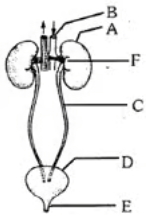
A
$A$ = Kidney,$B$ = Abdominal aorta,$C$ = Ureters,$D$ = Urinary bladder,$E$ = Urethra,$F$ = Renal pelvis
B
$A$ = Kidney,$B$ = Abdominal aorta,$C$ = Urethra,$D$ = Urinary bladder,$E$ = Ureters,$F$ = Renal pelvis
C
$A$ = Kidney,$B$ = Renal pelvis,$C$ = Urethra,$D$ = Urinary bladder,$E$ = Ureters,$F$ = Abdominal aorta
D
$A$ = Kidney,$B$ = Abdominal aorta,$C$ = Urethra,$D$ = Urinary bladder,$E$ = Renal pelvis,$F$ = Ureters
Solution
(A) Based on the anatomical diagram of the human excretory system:
$A$ points to the Kidney.
$B$ points to the Abdominal aorta (or dorsal aorta).
$C$ points to the Ureters.
$D$ points to the Urinary bladder.
$E$ points to the Urethra.
$F$ points to the Renal pelvis.
Therefore,the correct matching is $A$ = Kidney,$B$ = Abdominal aorta,$C$ = Ureters,$D$ = Urinary bladder,$E$ = Urethra,$F$ = Renal pelvis.
$A$ points to the Kidney.
$B$ points to the Abdominal aorta (or dorsal aorta).
$C$ points to the Ureters.
$D$ points to the Urinary bladder.
$E$ points to the Urethra.
$F$ points to the Renal pelvis.
Therefore,the correct matching is $A$ = Kidney,$B$ = Abdominal aorta,$C$ = Ureters,$D$ = Urinary bladder,$E$ = Urethra,$F$ = Renal pelvis.
0 likes
View Solution23
MediumMCQ
The $pH$ value of human urine is:
A
$7.5$
B
$4.5$
C
$6.0$
D
$2.0$
Solution
(C) The $pH$ range of human urine typically varies between $5.0$ and $7.5$.
Normal human urine is slightly acidic,with an average $pH$ value of approximately $6.0$.
Normal human urine is slightly acidic,with an average $pH$ value of approximately $6.0$.
0 likes
View Solution24
MediumMCQ
$A$ man excretes about ........ urine in $24$ hours.
A
$1$ litre
B
$1.5$ litres
C
$2$ litres
D
$2.5$ litres
Solution
(B) The correct option is $B$.
An average healthy adult human excretes approximately $1.5$ litres of urine in a $24$-hour period.
This volume can vary depending on the intake of water, environmental conditions, and the physiological state of the individual.
An average healthy adult human excretes approximately $1.5$ litres of urine in a $24$-hour period.
This volume can vary depending on the intake of water, environmental conditions, and the physiological state of the individual.
0 likes
View Solution25
MediumMCQ
The vessel leading blood (containing nitrogenous waste) into the Bowman's capsule is known as:
A
Afferent arteriole
B
Efferent arteriole
C
Renal artery
D
Renal vein
Solution
(A) The process of urine formation begins with the filtration of blood in the glomerulus.
Blood enters the glomerulus through a fine branch of the renal artery known as the $Afferent$ $arteriole$.
This vessel carries blood containing nitrogenous waste into the Bowman's capsule.
After filtration,the blood leaves the glomerulus through the $Efferent$ $arteriole$.
Therefore,the correct vessel leading blood into the Bowman's capsule is the $Afferent$ $arteriole$.
Blood enters the glomerulus through a fine branch of the renal artery known as the $Afferent$ $arteriole$.
This vessel carries blood containing nitrogenous waste into the Bowman's capsule.
After filtration,the blood leaves the glomerulus through the $Efferent$ $arteriole$.
Therefore,the correct vessel leading blood into the Bowman's capsule is the $Afferent$ $arteriole$.
0 likes
View Solution26
MediumMCQ
The normal blood flowing through the renal arteries in a human being is about
A
$10$ litres/hour
B
$25$ litres/hour
C
$50$ litres/hour
D
$100$ litres/hour
Solution
(C) The kidneys receive approximately $1100-1200 \text{ ml}$ of blood per minute,which constitutes about $1/5$th to $1/4$th of the blood pumped out by each ventricle of the heart in a minute.
To calculate the flow per hour: $1200 \text{ ml/minute} \times 60 \text{ minutes} = 72,000 \text{ ml/hour}$.
$72,000 \text{ ml/hour} = 72 \text{ litres/hour}$.
Among the given options,$50$ litres/hour is the closest approximation to the physiological range of renal blood flow.
To calculate the flow per hour: $1200 \text{ ml/minute} \times 60 \text{ minutes} = 72,000 \text{ ml/hour}$.
$72,000 \text{ ml/hour} = 72 \text{ litres/hour}$.
Among the given options,$50$ litres/hour is the closest approximation to the physiological range of renal blood flow.
0 likes
View Solution27
MediumMCQ
Which of the following statements is correct?
A
Afferent arteriole is narrower than efferent arteriole.
B
Afferent venule is narrower than efferent venule.
C
Efferent arteriole is narrower than afferent arteriole.
D
Efferent venule is narrower than afferent venule.
Solution
(C) The correct answer is $C$. The afferent arteriole brings blood into the glomerulus,while the efferent arteriole carries blood away from it. To maintain high hydrostatic pressure in the glomerulus for ultrafiltration,the diameter of the afferent arteriole is significantly larger than that of the efferent arteriole. Therefore,the efferent arteriole is narrower than the afferent arteriole.
0 likes
View Solution28
MediumMCQ
Which of the following blood vessels contains the minimum concentration of urea in the blood?
A
Renal arteries
B
Renal vein
C
Aortic arteries
D
Vena cava
Solution
(B) The $Renal$ $vein$ carries blood away from the kidneys after the process of filtration and urine formation has occurred.
Since the kidneys filter metabolic wastes,including urea,from the blood,the blood exiting the kidneys through the $Renal$ $vein$ has the lowest concentration of urea compared to any other major blood vessel in the body.
Therefore,the correct option is $B$.
Since the kidneys filter metabolic wastes,including urea,from the blood,the blood exiting the kidneys through the $Renal$ $vein$ has the lowest concentration of urea compared to any other major blood vessel in the body.
Therefore,the correct option is $B$.
0 likes
View Solution29
MediumMCQ
Which one of the four parts mentioned below does not constitute a part of a single uriniferous tubule?
A
Bowman's capsule
B
Distal convoluted tubule
C
Loop of Henle
D
Collecting duct
Solution
(D) nephron (or uriniferous tubule) consists of the glomerulus and the renal tubule. The renal tubule includes the Bowman's capsule,proximal convoluted tubule $(PCT)$,loop of Henle,and distal convoluted tubule $(DCT)$. The collecting duct is a separate structure that receives the filtrate from the $DCT$ of several nephrons. Therefore,the collecting duct is not a part of a single uriniferous tubule.
0 likes
View Solution30
MediumMCQ
What will happen if one kidney of a person is removed?
A
He will still survive and remain normal
B
He will die due to blood poisoning
C
Urea will go on accumulating in blood
D
Urination will stop
Solution
(A) If one kidney is removed,the remaining kidney undergoes a process called $compensatory\, hypertrophy$. In this process,the functional kidney increases in size and capacity to handle the entire workload of filtration and excretion,allowing the person to survive and lead a normal life.
0 likes
View Solution31
MediumMCQ
The main function of the renal pyramids of the kidney is to:
A
Contain collecting tubules of the kidney
B
Direct the urine to flow into the ureter
C
Support the openings of collecting canals
D
Store fats and proteins
Solution
(A) The renal pyramids are cone-shaped tissues located in the medulla of the kidney.
They primarily contain the loops of Henle and the collecting tubules (collecting ducts) of the nephrons.
The collecting ducts within the pyramids converge at the renal papillae to drain urine into the minor calyces,which then lead to the ureter.
Therefore,their primary function is to house the collecting tubules that transport urine toward the renal pelvis.
They primarily contain the loops of Henle and the collecting tubules (collecting ducts) of the nephrons.
The collecting ducts within the pyramids converge at the renal papillae to drain urine into the minor calyces,which then lead to the ureter.
Therefore,their primary function is to house the collecting tubules that transport urine toward the renal pelvis.
0 likes
View Solution32
MediumMCQ
Glomerulus is formed by
A
Branch from renal vein
B
Branch from renal artery
C
Uriniferous tubule
D
Coiling of proximal part of uriniferous tubule
Solution
(B) The glomerulus is a tuft of capillaries formed by the afferent arteriole,which is a fine branch of the renal artery.
Blood enters the glomerulus through the afferent arteriole and leaves through the efferent arteriole.
The glomerulus,along with Bowman's capsule,forms the renal corpuscle (also known as the Malpighian corpuscle).
Blood enters the glomerulus through the afferent arteriole and leaves through the efferent arteriole.
The glomerulus,along with Bowman's capsule,forms the renal corpuscle (also known as the Malpighian corpuscle).
0 likes
View Solution33
MediumMCQ
The origin of the kidney and ureter in $Rana$ $tigrina$ is:
A
All mesodermal
B
All endodermal
C
Ectodermal and mesodermal
D
Mesodermal and endodermal
Solution
(A) In $Rana$ $tigrina$ (frog),the excretory system,including the kidneys and the ureters,is derived from the mesodermal germ layer during embryonic development.
Specifically,the kidneys develop from the intermediate mesoderm,and the ureters (or Wolffian ducts) also originate from the mesodermal tissue.
Therefore,both the kidney and the ureter are entirely mesodermal in origin.
Specifically,the kidneys develop from the intermediate mesoderm,and the ureters (or Wolffian ducts) also originate from the mesodermal tissue.
Therefore,both the kidney and the ureter are entirely mesodermal in origin.
0 likes
View Solution34
EasyMCQ
Nephrons are found in the ........
A
Stomach
B
Testes
C
Ovaries
D
Kidneys
Solution
(D) Nephrons are the structural and functional units of the kidneys. Each kidney contains approximately $1$ million nephrons. They are responsible for the filtration of blood and the formation of urine.
0 likes
View Solution35
MediumMCQ
Which of the following correctly explains the function of a specific part of the human nephron?
A
Podocytes: Create minute spaces (slit pores) for the filtration of blood into Bowman's capsule.
B
Loop of Henle: Reabsorption of the majority of substances from the glomerular filtrate.
C
Distal Convoluted Tubule $(DCT)$: Reabsorption of ions into the surrounding peritubular capillaries.
D
Afferent arteriole: Carries blood away from the glomerulus towards the renal vein.
Solution
(A) $1$. Podocytes are specialized cells in the inner wall of Bowman's capsule that arrange themselves in an intricate manner to leave some minute spaces called filtration slits or slit pores,which are essential for the ultrafiltration of blood.
$2$. The Loop of Henle is primarily responsible for the concentration of urine,not the reabsorption of the majority of substances (which occurs in the Proximal Convoluted Tubule).
$3$. The Distal Convoluted Tubule $(DCT)$ is involved in the conditional reabsorption of $Na^+$ and water and selective secretion of hydrogen and potassium ions.
$4$. The Afferent arteriole brings blood into the glomerulus,while the Efferent arteriole carries blood away from it.
$2$. The Loop of Henle is primarily responsible for the concentration of urine,not the reabsorption of the majority of substances (which occurs in the Proximal Convoluted Tubule).
$3$. The Distal Convoluted Tubule $(DCT)$ is involved in the conditional reabsorption of $Na^+$ and water and selective secretion of hydrogen and potassium ions.
$4$. The Afferent arteriole brings blood into the glomerulus,while the Efferent arteriole carries blood away from it.
0 likes
View Solution36
MediumMCQ
In humans,both kidneys are located such that:
A
They are located beside the ovaries.
B
They are located on the same side.
C
The left kidney is at a higher level than the right kidney.
D
The right kidney is at a higher level than the left kidney.
Solution
(C) In humans,the two kidneys are located on either side of the vertebral column in the abdominal cavity.
Due to the presence of the liver on the right side of the abdominal cavity,the right kidney is pushed slightly downwards.
Consequently,the left kidney is positioned at a slightly higher level than the right kidney.
Due to the presence of the liver on the right side of the abdominal cavity,the right kidney is pushed slightly downwards.
Consequently,the left kidney is positioned at a slightly higher level than the right kidney.
0 likes
View Solution37
MediumMCQ
Which blood vessel contains the least amount of urea?
A
Hepatic vein
B
Renal vein
C
Hepatic portal vein
D
Renal artery
Solution
(B) The $Renal \text{ } vein$ carries blood away from the kidneys after the process of filtration and reabsorption has occurred.
Since the kidneys are responsible for filtering metabolic wastes like urea from the blood, the blood exiting the kidneys via the $Renal \text{ } vein$ has the lowest concentration of urea compared to other major blood vessels.
The $Renal \text{ } artery$ brings blood to the kidneys with a high concentration of urea, while the $Hepatic \text{ } vein$ and $Hepatic \text{ } portal \text{ } vein$ are involved in the transport of blood related to the liver, where urea is produced.
Since the kidneys are responsible for filtering metabolic wastes like urea from the blood, the blood exiting the kidneys via the $Renal \text{ } vein$ has the lowest concentration of urea compared to other major blood vessels.
The $Renal \text{ } artery$ brings blood to the kidneys with a high concentration of urea, while the $Hepatic \text{ } vein$ and $Hepatic \text{ } portal \text{ } vein$ are involved in the transport of blood related to the liver, where urea is produced.
0 likes
View Solution38
MediumMCQ
If one kidney is removed from a human body,then:
A
Death due to toxic effects
B
Uremia and death
C
Cessation of urination
D
Nothing happens; the person will survive and the remaining kidney will become hypertrophied.
Solution
(D) The human body possesses two kidneys,which are sufficient to filter the blood and maintain homeostasis. If one kidney is removed (nephrectomy),the remaining kidney undergoes a process called compensatory hypertrophy. This means the remaining kidney increases in size and functional capacity to handle the entire workload of filtration,ensuring that the individual survives without significant health issues.
0 likes
View Solution39
EasyMCQ
The blood vessel that carries blood into the Bowman's capsule is the ........ .
A
Afferent arteriole
B
Efferent arteriole
C
Renal vein
D
Renal portal vein
Solution
(A) The renal artery enters the kidney and branches into smaller arterioles. The vessel that enters the Bowman's capsule to form the glomerulus is known as the $Afferent \text{ } arteriole$. The vessel that carries blood away from the glomerulus is the $Efferent \text{ } arteriole$. Therefore, the correct answer is the $Afferent \text{ } arteriole$.
0 likes
View Solution40
EasyMCQ
The afferent and efferent arterioles are . . . . . . .
A
arterial in nature
B
venous in nature
C
one arterial and one venous
D
none of the above
Solution
(A) The afferent arteriole brings blood into the glomerulus,and the efferent arteriole carries blood away from the glomerulus. Both of these vessels are branches of the renal artery and are therefore arterial in nature. They are not veins.
0 likes
View Solution41
MediumMCQ
Which of the following parts is not a part of the nephron?
A
Bowman's capsule
B
Distal convoluted tubule
C
Loop of Henle
D
Collecting duct
Solution
(D) The nephron is the structural and functional unit of the kidney. It consists of two main parts: the renal corpuscle (glomerulus and Bowman's capsule) and the renal tubule (proximal convoluted tubule,loop of Henle,and distal convoluted tubule).
The collecting duct is not considered a part of the nephron because it receives filtrate from several nephrons and is not derived from the same embryonic structure as the nephron itself. Therefore,the correct answer is $D$.
The collecting duct is not considered a part of the nephron because it receives filtrate from several nephrons and is not derived from the same embryonic structure as the nephron itself. Therefore,the correct answer is $D$.
0 likes
View Solution42
MediumMCQ
Malpighian corpuscles are found in the ........ .
A
Medulla
B
Cortex
C
Pelvis
D
Pyramid
Solution
(B) The Malpighian corpuscle,also known as the renal corpuscle,consists of the glomerulus and Bowman's capsule.
In the human kidney,these structures are located exclusively in the renal cortex.
The renal medulla contains the loops of Henle and collecting ducts,while the renal pelvis is the funnel-shaped space that collects urine.
Therefore,the correct option is $B$.
In the human kidney,these structures are located exclusively in the renal cortex.
The renal medulla contains the loops of Henle and collecting ducts,while the renal pelvis is the funnel-shaped space that collects urine.
Therefore,the correct option is $B$.
0 likes
View Solution43
MediumMCQ
Bowman's capsule is lined by ........
A
Ciliated cuboidal epithelium
B
Squamous epithelium
C
Non-ciliated cuboidal epithelium
D
Non-ciliated columnar epithelium
Solution
(B) Bowman's capsule is a cup-shaped structure that forms the beginning of the nephron in the kidney.
It consists of two layers: an outer parietal layer and an inner visceral layer.
The parietal layer of Bowman's capsule is composed of simple squamous epithelium,which is a single layer of flat,scale-like cells.
This thin layer allows for the efficient filtration of blood plasma into the capsular space.
It consists of two layers: an outer parietal layer and an inner visceral layer.
The parietal layer of Bowman's capsule is composed of simple squamous epithelium,which is a single layer of flat,scale-like cells.
This thin layer allows for the efficient filtration of blood plasma into the capsular space.
0 likes
View Solution44
EasyMCQ
The functional and structural unit of the kidney is ........ .
A
Nephron
B
Vas deferens
C
Acini
D
None of these
Solution
(A) The kidney is the primary excretory organ in humans.
Each kidney contains approximately $1$ million complex tubular structures called nephrons.
Nephrons are considered the structural and functional units of the kidney because they are responsible for the filtration of blood and the formation of urine.
Therefore,the correct answer is Nephron.
Each kidney contains approximately $1$ million complex tubular structures called nephrons.
Nephrons are considered the structural and functional units of the kidney because they are responsible for the filtration of blood and the formation of urine.
Therefore,the correct answer is Nephron.
0 likes
View Solution45
MediumMCQ
Reabsorption of $Na^+$ and $K^+$ ions does not occur in which of the following?
A
Bowman's capsule
B
Loop of Henle
C
Distal convoluted tubule
D
Proximal convoluted tubule
Solution
(A) The process of urine formation involves filtration, reabsorption, and secretion.
$1$. In the Proximal Convoluted Tubule $(PCT)$, significant reabsorption of $Na^+$ and $K^+$ occurs.
$2$. In the Loop of Henle, reabsorption of $Na^+$ and $K^+$ occurs, particularly in the ascending limb.
$3$. In the Distal Convoluted Tubule $(DCT)$, conditional reabsorption of $Na^+$ and $K^+$ takes place under the influence of hormones like aldosterone.
$4$. The Bowman's capsule is the site of ultrafiltration of blood, where water and small solutes are filtered into the lumen, but no active or passive reabsorption of ions occurs here.
$1$. In the Proximal Convoluted Tubule $(PCT)$, significant reabsorption of $Na^+$ and $K^+$ occurs.
$2$. In the Loop of Henle, reabsorption of $Na^+$ and $K^+$ occurs, particularly in the ascending limb.
$3$. In the Distal Convoluted Tubule $(DCT)$, conditional reabsorption of $Na^+$ and $K^+$ takes place under the influence of hormones like aldosterone.
$4$. The Bowman's capsule is the site of ultrafiltration of blood, where water and small solutes are filtered into the lumen, but no active or passive reabsorption of ions occurs here.
0 likes
View Solution46
EasyMCQ
In the kidney,the ureter,blood vessels,and nerves enter through the ..........
A
Renal pelvis
B
Hilum
C
Renal cortex
D
None of these
Solution
(B) The kidney has a notch on its inner concave surface called the $Hilum$.
Through this $Hilum$,the ureter,blood vessels,and nerves enter the kidney.
Therefore,the correct option is $B$.
Through this $Hilum$,the ureter,blood vessels,and nerves enter the kidney.
Therefore,the correct option is $B$.
0 likes
View Solution47
EasyMCQ
The notch on the medial side of the kidney is known as the ........
A
Ureter
B
Pelvis
C
Hilum
D
Pyramid
Solution
(C) The kidney has a concave medial border.
Near the center of this concave border is a notch called the $Hilum$.
Through the $Hilum$,the ureter,blood vessels,and nerves enter the kidney.
Therefore,the correct option is $C$.
Near the center of this concave border is a notch called the $Hilum$.
Through the $Hilum$,the ureter,blood vessels,and nerves enter the kidney.
Therefore,the correct option is $C$.
0 likes
View Solution48
EasyMCQ
$A$ well-developed Loop of Henle is found in:
A
Amphibians
B
Reptiles
C
Birds
D
Mammals
Solution
(D) The Loop of Henle is a critical component of the nephron responsible for the concentration of urine.
It is primarily found in mammals and birds,which are capable of producing hypertonic (concentrated) urine to conserve water.
Among the given options,mammals possess a highly developed and long Loop of Henle,which allows for the efficient reabsorption of water,a key adaptation for terrestrial life.
Therefore,the correct answer is $D$ (Mammals).
It is primarily found in mammals and birds,which are capable of producing hypertonic (concentrated) urine to conserve water.
Among the given options,mammals possess a highly developed and long Loop of Henle,which allows for the efficient reabsorption of water,a key adaptation for terrestrial life.
Therefore,the correct answer is $D$ (Mammals).
0 likes
View Solution49
EasyMCQ
Podocytes are located in the ........ .
A
Afferent arteriole
B
Efferent arteriole
C
Peritubular capillary network
D
Bowman's capsule
Solution
(D) Podocytes are specialized epithelial cells found in the visceral layer of the Bowman's capsule in the kidney.
These cells are arranged in an intricate manner so as to leave some minute spaces called filtration slits or slit pores.
Blood is filtered so finely through these membranes that almost all the constituents of the plasma except the proteins pass onto the lumen of the Bowman's capsule.
Therefore,the correct option is $D$.
These cells are arranged in an intricate manner so as to leave some minute spaces called filtration slits or slit pores.
Blood is filtered so finely through these membranes that almost all the constituents of the plasma except the proteins pass onto the lumen of the Bowman's capsule.
Therefore,the correct option is $D$.
0 likes
View Solution50
MediumMCQ
Which blood vessel contains the least amount of urea?
A
Hepatic artery
B
Renal vein
C
Renal artery
D
Posterior vena cava
Solution
(B) The $Renal \text{ } vein$ carries blood away from the kidneys after the process of filtration and urine formation has occurred.
Since the kidneys filter urea and other nitrogenous wastes out of the blood to form urine, the blood exiting the kidneys through the $Renal \text{ } vein$ has the lowest concentration of urea compared to any other major blood vessel in the body.
Therefore, the correct option is $B$.
Since the kidneys filter urea and other nitrogenous wastes out of the blood to form urine, the blood exiting the kidneys through the $Renal \text{ } vein$ has the lowest concentration of urea compared to any other major blood vessel in the body.
Therefore, the correct option is $B$.
0 likes
View SolutionExcretory Products and their Elimination — Human excretory system · Frequently Asked Questions
1Are these Excretory Products and their Elimination questions useful for JEE and NEET?
Yes. All questions in this section are mapped to JEE Main and NEET exam patterns. Previous year questions from JEE Main, NEET, GUJCET and state-level exams are included with full solutions.
2Can I switch to Hindi or Gujarati for these questions?
Yes. Use the language tabs in the hero section or the sidebar to view the same questions and solutions in English, Hindi or Gujarati.
3How do I generate a question paper from this subtopic?
Use the Vedclass Exam Paper Generator — select the chapter and subtopic, set difficulty, and generate Sets A, B, C, D automatically. First 3 chapters of every subject are free.
Vedclass Products
For Students
Vedclass Test Series
Mock tests in real JEE/NEET style with performance analysis. 5-day free trial.
Start Free TrialFor Teachers
Exam Paper Generator
Generate Set A/B/C/D papers from this chapter in 2 minutes. 3 chapters free.
Try FreeFor Institutes
Online Exam Module
Live online exams with unlimited students, 360° analytics & white-label branding.
See DemoFor Teachers & Institutes
Generate a Excretory Products and their Elimination Exam Paper in 2 Minutes
Select subtopic & difficulty — Sets A, B, C, D auto-generated with No Repeat logic.
First 3 chapters of every subject are free — no payment required.