
A English
Prokaryotic cell Questions in English
Class 11 Biology · Cell: The Unit of Life · Prokaryotic cell
227+
Questions
English
Language
100%
With Solutions
Showing 50 of 227 questions in English
151
MediumMCQ
Identify the error in the following sentence:
"In prokaryotic cell internal extension structure called mesosome."
"In prokaryotic cell internal extension structure called mesosome."
A
No specification of cell wall.
B
No specification of vacuole membrane.
C
No specification of nuclear membrane.
D
No specification of plasma membrane.
Solution
(D) The sentence is grammatically and biologically incomplete because it fails to specify that mesosomes are extensions of the $plasma \ membrane$.
Mesosomes are specialized membranous structures formed by the extensions of the $plasma \ membrane$ into the cell in the form of vesicles, tubules, and lamellae.
Therefore, the correct description should be: "In prokaryotic cells, the internal extension structure of the $plasma \ membrane$ is called a mesosome."
Mesosomes are specialized membranous structures formed by the extensions of the $plasma \ membrane$ into the cell in the form of vesicles, tubules, and lamellae.
Therefore, the correct description should be: "In prokaryotic cells, the internal extension structure of the $plasma \ membrane$ is called a mesosome."
0 likes
View Solution152
MediumMCQ
In the cytoplasm,high numbers of inclusion bodies are called........
A
Storage particles
B
Intermediate filaments
C
Microtubules
D
Mesosomes
Solution
(A) Inclusion bodies are non-membrane bound structures found in the cytoplasm of prokaryotic cells.
They serve as reserve material for the cell and are stored in the cytoplasm in the form of particles.
These are collectively referred to as storage particles (e.g.,phosphate granules,cyanophycean granules,and glycogen granules).
Therefore,the correct option is $A$.
They serve as reserve material for the cell and are stored in the cytoplasm in the form of particles.
These are collectively referred to as storage particles (e.g.,phosphate granules,cyanophycean granules,and glycogen granules).
Therefore,the correct option is $A$.
0 likes
View Solution153
MediumMCQ
Which is not an example of a prokaryotic cell?
A
Bacteria
B
Mycoplasma
C
Egg of ostrich
D
$PPLO$
Solution
(C) Prokaryotic cells are defined by the absence of a membrane-bound nucleus and other membrane-bound organelles.
Bacteria,$Mycoplasma$,and $PPLO$ (Pleuro Pneumonia-Like Organisms) are classic examples of prokaryotic organisms.
The egg of an ostrich is a single cell,but it is a eukaryotic cell,as it contains a well-defined nucleus and membrane-bound organelles.
Therefore,the egg of an ostrich is not an example of a prokaryotic cell.
Bacteria,$Mycoplasma$,and $PPLO$ (Pleuro Pneumonia-Like Organisms) are classic examples of prokaryotic organisms.
The egg of an ostrich is a single cell,but it is a eukaryotic cell,as it contains a well-defined nucleus and membrane-bound organelles.
Therefore,the egg of an ostrich is not an example of a prokaryotic cell.
0 likes
View Solution154
EasyMCQ
The outermost layer in bacteria is:
A
Cell membrane
B
Nuclear membrane
C
Glycocalyx
D
Cell wall
Solution
(C) In bacteria, the cell envelope consists of a tightly linked three-layered structure: the outermost $Glycocalyx$, followed by the $Cell \text{ } wall$, and then the $Plasma \text{ } membrane$.
$Glycocalyx$ is the outermost layer, which can be in the form of a loose sheath called the $slime \text{ } layer$ or a thick and tough layer called the $capsule$.
Therefore, the correct answer is $Glycocalyx$.
$Glycocalyx$ is the outermost layer, which can be in the form of a loose sheath called the $slime \text{ } layer$ or a thick and tough layer called the $capsule$.
Therefore, the correct answer is $Glycocalyx$.
0 likes
View Solution155
MediumMCQ
Which of the following is not a characteristic of prokaryotic cells?
A
Circular $DNA$
B
Mesosome
C
Ribosomes
D
Foldings in genetic material of third stage
Solution
(D) Prokaryotic cells are characterized by the absence of a well-defined nucleus and membrane-bound organelles.
$A$. Circular $DNA$ is a characteristic feature of prokaryotic cells.
$B$. Mesosomes are specialized membranous structures formed by the extensions of the plasma membrane into the cell,which is a characteristic of prokaryotes.
$C$. Ribosomes are present in prokaryotic cells (specifically $70S$ type).
$D$. The term 'foldings in genetic material of third stage' is scientifically incorrect and does not describe any known feature of prokaryotic cells. Therefore,it is not a characteristic of prokaryotic cells.
$A$. Circular $DNA$ is a characteristic feature of prokaryotic cells.
$B$. Mesosomes are specialized membranous structures formed by the extensions of the plasma membrane into the cell,which is a characteristic of prokaryotes.
$C$. Ribosomes are present in prokaryotic cells (specifically $70S$ type).
$D$. The term 'foldings in genetic material of third stage' is scientifically incorrect and does not describe any known feature of prokaryotic cells. Therefore,it is not a characteristic of prokaryotic cells.
0 likes
View Solution156
MediumMCQ
Identify the correct group of prokaryotic cells from the following list:
$1.$ Egg of ostrich,$2.$ $PPLO$,$3.$ Tracheid,$4.$ Blue-green algae,$5.$ Bacteria,$6.$ Animal cells.
$1.$ Egg of ostrich,$2.$ $PPLO$,$3.$ Tracheid,$4.$ Blue-green algae,$5.$ Bacteria,$6.$ Animal cells.
A
$1, 2, 3$
B
$4, 5, 6$
C
$3, 2, 5, 6$
D
$2, 4, 5$
Solution
(D) Prokaryotic cells are characterized by the absence of a membrane-bound nucleus and membrane-bound organelles.
$1.$ The egg of an ostrich is a single eukaryotic cell.
$2.$ $PPLO$ (Pleuro Pneumonia-Like Organisms) are prokaryotic.
$3.$ Tracheids are specialized eukaryotic cells found in the xylem of plants.
$4.$ Blue-green algae (Cyanobacteria) are prokaryotic organisms.
$5.$ Bacteria are prokaryotic organisms.
$6.$ Animal cells are eukaryotic cells.
Therefore,the group consisting of prokaryotic cells is $2, 4,$ and $5$.
$1.$ The egg of an ostrich is a single eukaryotic cell.
$2.$ $PPLO$ (Pleuro Pneumonia-Like Organisms) are prokaryotic.
$3.$ Tracheids are specialized eukaryotic cells found in the xylem of plants.
$4.$ Blue-green algae (Cyanobacteria) are prokaryotic organisms.
$5.$ Bacteria are prokaryotic organisms.
$6.$ Animal cells are eukaryotic cells.
Therefore,the group consisting of prokaryotic cells is $2, 4,$ and $5$.
0 likes
View Solution157
EasyMCQ
It is formed by the extensions of plasma membrane into the cell in prokaryotes.
A
Lysosome
B
Ribosomes
C
Peroxisomes
D
Mesosomes
Solution
(D) In prokaryotic cells,the plasma membrane undergoes invagination to form specialized structures known as $Mesosomes$.
These extensions can take the form of vesicles,tubules,or lamellae.
$Mesosomes$ play a crucial role in various cellular processes such as $DNA$ replication,cell wall formation,respiration,and secretion.
These extensions can take the form of vesicles,tubules,or lamellae.
$Mesosomes$ play a crucial role in various cellular processes such as $DNA$ replication,cell wall formation,respiration,and secretion.
0 likes
View Solution158
EasyMCQ
In prokaryotes,resistance to antibiotics is due to the presence of which of the following?
A
Mesosome
B
Plasmid
C
Glycocalyx
D
Flagella
Solution
(B) In prokaryotes,especially bacteria,resistance to antibiotics is primarily conferred by the presence of $Plasmid$.
$Plasmids$ are small,circular,double-stranded $DNA$ molecules that are distinct from the cell's chromosomal $DNA$.
They often carry genes that provide advantages to the bacteria,such as antibiotic resistance genes,which allow the bacteria to survive in the presence of specific antibiotics.
$Mesosomes$ are involved in respiration and cell wall formation,$Glycocalyx$ provides protection and adhesion,and $Flagella$ are responsible for motility.
$Plasmids$ are small,circular,double-stranded $DNA$ molecules that are distinct from the cell's chromosomal $DNA$.
They often carry genes that provide advantages to the bacteria,such as antibiotic resistance genes,which allow the bacteria to survive in the presence of specific antibiotics.
$Mesosomes$ are involved in respiration and cell wall formation,$Glycocalyx$ provides protection and adhesion,and $Flagella$ are responsible for motility.
0 likes
View Solution159
EasyMCQ
The true sequence for the cell envelope from outer to inner in prokaryotes is:
A
Cell wall $\rightarrow$ cell membrane $\rightarrow$ glycocalyx
B
Cell membrane $\rightarrow$ glycocalyx $\rightarrow$ cell wall
C
Glycocalyx $\rightarrow$ cell membrane $\rightarrow$ cell wall
D
Glycocalyx $\rightarrow$ cell wall $\rightarrow$ cell membrane
Solution
(D) In prokaryotic cells,the cell envelope consists of a tightly linked three-layered structure.
Starting from the outermost layer to the innermost layer,the sequence is:
$1$. Glycocalyx (outermost layer)
$2$. Cell wall (middle layer)
$3$. Cell membrane (innermost layer)
Therefore,the correct sequence is Glycocalyx $\rightarrow$ Cell wall $\rightarrow$ Cell membrane.
Starting from the outermost layer to the innermost layer,the sequence is:
$1$. Glycocalyx (outermost layer)
$2$. Cell wall (middle layer)
$3$. Cell membrane (innermost layer)
Therefore,the correct sequence is Glycocalyx $\rightarrow$ Cell wall $\rightarrow$ Cell membrane.
0 likes
View Solution160
EasyMCQ
The correct sequence of layers of the bacterial cell envelope is:
A
Cell membrane - Glycocalyx - Cell wall
B
Glycocalyx - Cell wall - Cell membrane
C
Glycocalyx - Cell membrane - Cell wall
D
Cell wall - Glycocalyx - Cell membrane
Solution
(B) The bacterial cell envelope consists of a tightly linked three-layered structure.
Starting from the outermost layer to the innermost layer,the sequence is:
$1$. Glycocalyx (outermost layer)
$2$. Cell wall (middle layer)
$3$. Cell membrane (innermost layer)
Therefore,the correct sequence is Glycocalyx - Cell wall - Cell membrane.
Starting from the outermost layer to the innermost layer,the sequence is:
$1$. Glycocalyx (outermost layer)
$2$. Cell wall (middle layer)
$3$. Cell membrane (innermost layer)
Therefore,the correct sequence is Glycocalyx - Cell wall - Cell membrane.
0 likes
View Solution161
MediumMCQ
The genophore,bacterial genome,or nucleoid is made up of ...........
A
Histones and non-histones
B
$RNA$ and histones
C
$A$ single double-stranded $DNA$
D
$A$ single-stranded $DNA$
Solution
(C) The bacterial genome,also known as the genophore or nucleoid,consists of a single,circular,double-stranded $DNA$ molecule. Unlike eukaryotic cells,prokaryotic $DNA$ is not enclosed within a nuclear membrane and lacks histone proteins,which are characteristic of eukaryotic chromatin. Therefore,the correct description is a single double-stranded $DNA$.
0 likes
View Solution162
MediumMCQ
Plasmids are ....................
A
Help in respiration.
B
Genes present in the nucleus.
C
Components of the bacterial cell wall.
D
Extra-chromosomal genetic material in microorganisms.
Solution
(D) Plasmids are small,circular,double-stranded $DNA$ molecules that are distinct from a cell's chromosomal $DNA$.
They are naturally found in bacterial cells and some eukaryotes like yeast.
Plasmids are considered extra-chromosomal genetic material because they replicate independently of the chromosomal $DNA$.
They often carry genes that provide advantages to the host,such as antibiotic resistance.
They are naturally found in bacterial cells and some eukaryotes like yeast.
Plasmids are considered extra-chromosomal genetic material because they replicate independently of the chromosomal $DNA$.
They often carry genes that provide advantages to the host,such as antibiotic resistance.
0 likes
View Solution163
EasyMCQ
The nucleic acid polymer in the chromosome of bacteria is $..........$.
A
Linear $DNA$ molecule
B
Circular $DNA$ molecule
C
Two types of $DNA$ and $RNA$
D
Linear $RNA$ molecule
Solution
(B) Bacteria are prokaryotic organisms. The genetic material in bacteria is typically a single,large,circular $DNA$ molecule,which is often referred to as the bacterial chromosome or nucleoid.
Unlike eukaryotes,it is not enclosed within a nuclear membrane and does not contain histones.
Unlike eukaryotes,it is not enclosed within a nuclear membrane and does not contain histones.
0 likes
View Solution164
MediumMCQ
The site of respiration in bacteria is ................
A
Episome
B
Mesosome
C
Ribosome
D
Microsome
Solution
(B) In prokaryotic cells like bacteria,membrane-bound organelles such as mitochondria are absent.
Mesosomes are specialized membranous structures formed by the extensions of the plasma membrane into the cell in the form of vesicles,tubules,and lamellae.
These structures play a crucial role in cellular respiration,$DNA$ replication,and the secretion process.
Therefore,the mesosome acts as the site of respiration in bacteria.
Mesosomes are specialized membranous structures formed by the extensions of the plasma membrane into the cell in the form of vesicles,tubules,and lamellae.
These structures play a crucial role in cellular respiration,$DNA$ replication,and the secretion process.
Therefore,the mesosome acts as the site of respiration in bacteria.
0 likes
View Solution165
MediumMCQ
In photosynthetic bacteria,pigments are present in ..........
A
Leucoplasts
B
Chloroplasts
C
Chromoplasts
D
Chromatophores
Solution
(D) Photosynthetic bacteria are prokaryotic organisms that lack membrane-bound organelles like chloroplasts.
Instead,they possess specialized membranous structures called $Chromatophores$ that extend into the cytoplasm.
These $Chromatophores$ contain the pigments necessary for photosynthesis,allowing the bacteria to capture light energy.
Instead,they possess specialized membranous structures called $Chromatophores$ that extend into the cytoplasm.
These $Chromatophores$ contain the pigments necessary for photosynthesis,allowing the bacteria to capture light energy.
0 likes
View Solution166
MediumMCQ
The number of chromosomes in bacterial cells is $1-3$ and they are ..........
A
can be circular or linear in the same cell.
B
always circular.
C
always linear.
D
can be circular or linear but not both in the same cell.
Solution
(D) Bacterial cells typically contain a single,circular,double-stranded $DNA$ molecule,which is often referred to as the bacterial chromosome or nucleoid. While most bacteria possess a single circular chromosome,some species have been found to contain linear chromosomes or multiple chromosomes. However,within a single bacterial cell,the chromosomal structure is consistent,meaning they are either circular or linear,but not both simultaneously.
0 likes
View Solution167
EasyMCQ
Which of the following structures in bacteria helps in attachment to rocks in streams and also to the host tissues?
A
Root hairs
B
Fimbriae
C
Mesosomes
D
Holdfast
Solution
(B) In bacteria, $Fimbriae$ are small, bristle-like fibers sprouting out of the cell. They are known to help bacteria attach to rocks in streams and also to the host tissues. $Root hairs$ are found in plants, $Mesosomes$ are infoldings of the plasma membrane in bacteria involved in respiration and secretion, and $Holdfast$ is a structure found in algae for attachment.
0 likes
View Solution168
MediumMCQ
The genophore/bacterial genome or nucleoid is made up of:
A
Histones and non-histones
B
$RNA$ and histones
C
$A$ single double-stranded $DNA$
D
Single-stranded $DNA$
Solution
(C) The bacterial genome,often referred to as the genophore or nucleoid,consists of a single,circular,double-stranded $DNA$ molecule. Unlike eukaryotic cells,prokaryotic cells lack a defined nucleus and do not contain histone proteins to package their $DNA$. Therefore,the correct description is a single double-stranded $DNA$ molecule.
0 likes
View Solution169
MediumMCQ
In which of the following are Golgi bodies absent?
A
Higher plants
B
Yeast
C
Bacteria and Blue-green algae
D
None of these
Solution
(C) Golgi bodies are membrane-bound organelles found in eukaryotic cells.
Prokaryotic cells,such as $Bacteria$ and $Blue-green$ $algae$ $(Cyanobacteria)$,lack membrane-bound organelles,including the Golgi apparatus.
Therefore,Golgi bodies are absent in bacteria and blue-green algae.
Prokaryotic cells,such as $Bacteria$ and $Blue-green$ $algae$ $(Cyanobacteria)$,lack membrane-bound organelles,including the Golgi apparatus.
Therefore,Golgi bodies are absent in bacteria and blue-green algae.
0 likes
View Solution170
MediumMCQ
What is the structure of a prokaryotic flagellum?
A
It is composed of a single membrane-bound filament.
B
It is composed of proteinaceous filaments.
C
Its structure consists of a $9 + 2$ arrangement.
D
Protein molecules are arranged in a helical manner.
Solution
(D) The prokaryotic flagellum is a thin,hair-like appendage that extends from the cell surface.
It is composed of a protein called flagellin.
Unlike eukaryotic flagella,which have a $9 + 2$ microtubule arrangement,the prokaryotic flagellum is a helical structure made of protein subunits arranged in a spiral or helical fashion.
Therefore,the correct description is that the protein molecules are arranged in a helical manner.
It is composed of a protein called flagellin.
Unlike eukaryotic flagella,which have a $9 + 2$ microtubule arrangement,the prokaryotic flagellum is a helical structure made of protein subunits arranged in a spiral or helical fashion.
Therefore,the correct description is that the protein molecules are arranged in a helical manner.
0 likes
View Solution171
MediumMCQ
Which of the following structures is $NOT$ found in a prokaryotic cell?
A
Plasma membrane
B
Nuclear membrane
C
Ribosomes
D
Mesosomes
Solution
(B) Prokaryotic cells are characterized by the absence of a membrane-bound nucleus and other membrane-bound organelles.
In prokaryotes,the genetic material is present as a naked circular $DNA$ molecule in the nucleoid region,not enclosed by a nuclear membrane.
Plasma membrane,ribosomes,and mesosomes are all characteristic structures found in prokaryotic cells.
Therefore,the nuclear membrane is the structure that is $NOT$ found in a prokaryotic cell.
In prokaryotes,the genetic material is present as a naked circular $DNA$ molecule in the nucleoid region,not enclosed by a nuclear membrane.
Plasma membrane,ribosomes,and mesosomes are all characteristic structures found in prokaryotic cells.
Therefore,the nuclear membrane is the structure that is $NOT$ found in a prokaryotic cell.
0 likes
View Solution172
MediumMCQ
Which of the following components gives a sticky character to the bacterial cell?
A
Cell wall
B
Nuclear membrane
C
Cell membrane
D
Glycocalyx
Solution
(D) In bacteria,the glycocalyx is an outer layer composed of polysaccharides and/or polypeptides.
It provides a sticky or slimy character to the bacterial cell,which helps in adhesion to surfaces and protects the cell from phagocytosis by the host immune system.
Therefore,the correct option is $D$.
It provides a sticky or slimy character to the bacterial cell,which helps in adhesion to surfaces and protects the cell from phagocytosis by the host immune system.
Therefore,the correct option is $D$.
0 likes
View Solution173
MediumMCQ
The genetic material present in $E. coli$ bacteria is .......
A
Single-stranded $RNA$
B
Double-stranded $RNA$
C
Single-stranded $DNA$
D
Double-stranded $DNA$
Solution
(D) $E. coli$ (Escherichia coli) is a prokaryotic organism.
In all prokaryotes,the genetic material consists of a single,circular,double-stranded $DNA$ molecule.
Therefore,the genetic material in $E. coli$ is double-stranded $DNA$.
In all prokaryotes,the genetic material consists of a single,circular,double-stranded $DNA$ molecule.
Therefore,the genetic material in $E. coli$ is double-stranded $DNA$.
0 likes
View Solution174
EasyMCQ
In bacterial cells,the number of chromosomes ranges from $1-3$ and they are:
A
Either circular or linear,but never both in the same cell.
B
Both circular and linear in the same cell.
C
Always circular.
D
Always linear.
Solution
(C) Bacterial chromosomes are typically circular $DNA$ molecules. While the vast majority of bacteria possess a single circular chromosome,some species may contain $1-3$ chromosomes. These chromosomes are consistently circular in structure and are not linear. Therefore,the correct description is that they are always circular.
0 likes
View Solution175
MediumMCQ
In bacteria,$DNA$ replication occurs in .........
A
During $S$-phase
B
Inside the nucleolus
C
Before cell division
D
Before transcription
Solution
(C) In bacteria (prokaryotes),$DNA$ replication is a continuous process that occurs in the cytoplasm. Unlike eukaryotes,bacteria do not have a distinct $S$-phase in their cell cycle. $DNA$ replication must be completed before the cell undergoes binary fission to ensure that each daughter cell receives a complete copy of the genome. Therefore,$DNA$ replication occurs before cell division.
0 likes
View Solution176
DifficultMCQ
In prokaryotes,chromatophores are
A
specialized granules responsible for colouration of cells
B
structures responsible for organizing the shape of the organism
C
inclusion bodies lying free inside the cells for carrying out various metabolic activities
D
internal membrane systems that may become extensive and complex in photosynthetic bacteria
Solution
(D) In prokaryotes,chromatophores are internal membrane systems that may become extensive and complex in photosynthetic bacteria. They contain pigments and are structurally and functionally similar to the thylakoids found in eukaryotic chloroplasts,facilitating photosynthesis.
0 likes
View Solution177
MediumMCQ
Assertion: Plasmids are single-stranded extra chromosomal $DNA$.
Reason: Plasmids are usually present in eukaryotic cells.
Reason: Plasmids are usually present in eukaryotic cells.
A
If both Assertion and Reason are correct and the Reason is a correct explanation of the Assertion.
B
If both Assertion and Reason are correct but Reason is not a correct explanation of the Assertion.
C
If both the Assertion and Reason are incorrect.
D
If the Assertion is correct but Reason is incorrect.
Solution
(C) Plasmids are small,circular,double-stranded extra-chromosomal $DNA$ molecules found in prokaryotic cells,such as bacteria.
$1$. The Assertion is incorrect because plasmids are double-stranded,not single-stranded.
$2$. The Reason is incorrect because plasmids are typically found in prokaryotic cells,not eukaryotic cells.
Therefore,both the Assertion and the Reason are incorrect.
$1$. The Assertion is incorrect because plasmids are double-stranded,not single-stranded.
$2$. The Reason is incorrect because plasmids are typically found in prokaryotic cells,not eukaryotic cells.
Therefore,both the Assertion and the Reason are incorrect.
0 likes
View Solution178
MediumMCQ
Which of the following nucleic acids is present in an organism having $70S$ ribosomes only?
A
Single stranded $DNA$ with protein coat
B
Double stranded circular naked $DNA$
C
Double stranded $DNA$ enclosed in nuclear membrane
D
Double stranded circular $DNA$ with histone proteins
Solution
(B) Organisms that possess only $70S$ ribosomes are prokaryotes (e.g.,bacteria).
Prokaryotic cells lack a well-defined nucleus and membrane-bound organelles.
The genetic material in prokaryotes consists of a single,double-stranded,circular $DNA$ molecule that is not associated with histone proteins (naked $DNA$).
Therefore,option $B$ is the correct description of the genetic material found in such organisms.
Prokaryotic cells lack a well-defined nucleus and membrane-bound organelles.
The genetic material in prokaryotes consists of a single,double-stranded,circular $DNA$ molecule that is not associated with histone proteins (naked $DNA$).
Therefore,option $B$ is the correct description of the genetic material found in such organisms.
0 likes
View Solution179
Medium
What is a mesosome in a prokaryotic cell? Mention the functions that it performs.
Solution
(N/A) mesosome is a convoluted membranous structure formed in a prokaryotic cell by the invagination of the plasma membrane.
Its functions are as follows:
$1$. It aids in the synthesis of the cell wall and the replication of $DNA$.
$2$. It assists in the equal distribution of chromosomes into daughter cells.
$3$. It increases the surface area of the plasma membrane to facilitate various enzymatic activities.
$4$. It plays a role in secretion processes and bacterial respiration.
Its functions are as follows:
$1$. It aids in the synthesis of the cell wall and the replication of $DNA$.
$2$. It assists in the equal distribution of chromosomes into daughter cells.
$3$. It increases the surface area of the plasma membrane to facilitate various enzymatic activities.
$4$. It plays a role in secretion processes and bacterial respiration.
0 likes
View Solution180
Difficult
What are the characteristics of prokaryotic cells?
Solution
(A) Prokaryotic cells are unicellular organisms that lack membrane-bound organelles.
The characteristics of prokaryotic cells are as follows:
$1$. Most of them are unicellular.
$2$. They are generally small in size,typically ranging from $0.5-5 \mu m$.
$3$. The nuclear region is poorly defined due to the absence of a nuclear membrane; hence,they lack a true nucleus.
$4$. The genetic material is naked,consisting of a single,circular chromosome. In addition to genomic $DNA$,they often contain small,circular plasmid $DNA$.
$5$. They possess specialized membranous structures called mesosomes,formed by the invagination of the cell membrane. These assist in cell wall synthesis,$DNA$ replication,and the distribution of chromosomes to daughter cells.
$6$. Membrane-bound organelles such as mitochondria,plastids,and the endoplasmic reticulum are absent.
$7$. Most prokaryotic cells have a three-layered cell envelope: the outermost glycocalyx,the middle cell wall,and the innermost plasma membrane,which acts as a protective unit.
$8$. Examples include bacteria and blue-green algae.
The characteristics of prokaryotic cells are as follows:
$1$. Most of them are unicellular.
$2$. They are generally small in size,typically ranging from $0.5-5 \mu m$.
$3$. The nuclear region is poorly defined due to the absence of a nuclear membrane; hence,they lack a true nucleus.
$4$. The genetic material is naked,consisting of a single,circular chromosome. In addition to genomic $DNA$,they often contain small,circular plasmid $DNA$.
$5$. They possess specialized membranous structures called mesosomes,formed by the invagination of the cell membrane. These assist in cell wall synthesis,$DNA$ replication,and the distribution of chromosomes to daughter cells.
$6$. Membrane-bound organelles such as mitochondria,plastids,and the endoplasmic reticulum are absent.
$7$. Most prokaryotic cells have a three-layered cell envelope: the outermost glycocalyx,the middle cell wall,and the innermost plasma membrane,which acts as a protective unit.
$8$. Examples include bacteria and blue-green algae.
0 likes
View Solution181
Medium
Describe the structure of a prokaryotic cell.
Solution
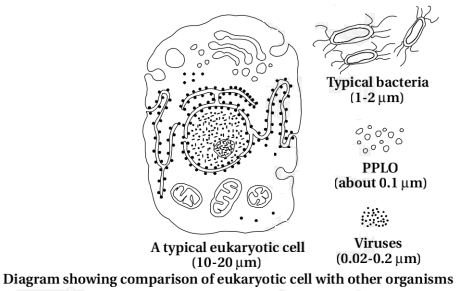
(N/A) $\Rightarrow$ Prokaryotic cells are represented by bacteria,blue-green algae,mycoplasma,and $PPLO.$
$\Rightarrow$ They are generally smaller and multiply more rapidly than eukaryotic cells.
$\Rightarrow$ They vary greatly in shape and size. The four basic shapes of bacteria are bacillus,coccus,vibrio,and spirillum.
$\Rightarrow$ The organization of the prokaryotic cell is fundamentally similar even though prokaryotes exhibit a wide variety of shapes and functions.
$\Rightarrow$ All prokaryotes have a cell wall surrounding the cell membrane.
$\Rightarrow$ The fluid matrix filling the cell is the cytoplasm.
$\Rightarrow$ There is no well-defined nucleus. The genetic material is naked,not enveloped by a nuclear membrane.
$\Rightarrow$ Many bacteria have small circular $DNA$ outside the genomic $DNA$. These are called plasmids.
$\Rightarrow$ The plasmid $DNA$ confers certain unique phenotypic characters to such bacteria,such as resistance to antibiotics.
$\Rightarrow$ Plasmid $DNA$ is also used to monitor bacterial transformation with foreign $DNA.$
$\Rightarrow$ $A$ nuclear membrane is not found in prokaryotic cells.
$\Rightarrow$ Cell organelles like endoplasmic reticulum,Golgi bodies,and mitochondria are not present,except for ribosomes.
$\Rightarrow$ $A$ specialized differentiated form of the cell membrane called a mesosome is a characteristic of prokaryotes. They are essentially infoldings of the cell membrane.
$\Rightarrow$ They are generally smaller and multiply more rapidly than eukaryotic cells.
$\Rightarrow$ They vary greatly in shape and size. The four basic shapes of bacteria are bacillus,coccus,vibrio,and spirillum.
$\Rightarrow$ The organization of the prokaryotic cell is fundamentally similar even though prokaryotes exhibit a wide variety of shapes and functions.
$\Rightarrow$ All prokaryotes have a cell wall surrounding the cell membrane.
$\Rightarrow$ The fluid matrix filling the cell is the cytoplasm.
$\Rightarrow$ There is no well-defined nucleus. The genetic material is naked,not enveloped by a nuclear membrane.
$\Rightarrow$ Many bacteria have small circular $DNA$ outside the genomic $DNA$. These are called plasmids.
$\Rightarrow$ The plasmid $DNA$ confers certain unique phenotypic characters to such bacteria,such as resistance to antibiotics.
$\Rightarrow$ Plasmid $DNA$ is also used to monitor bacterial transformation with foreign $DNA.$
$\Rightarrow$ $A$ nuclear membrane is not found in prokaryotic cells.
$\Rightarrow$ Cell organelles like endoplasmic reticulum,Golgi bodies,and mitochondria are not present,except for ribosomes.
$\Rightarrow$ $A$ specialized differentiated form of the cell membrane called a mesosome is a characteristic of prokaryotes. They are essentially infoldings of the cell membrane.
0 likes
View Solution182
Easy
In which organisms are prokaryotic cells found? Give information about the diversity of their shapes.
Solution
(N/A) $\Rightarrow$ Prokaryotic cells are found in bacteria,blue-green algae,mycoplasma,and $PPLO$ (Pleuro Pneumonia-Like Organisms).
$\Rightarrow$ They are generally smaller and multiply more rapidly than eukaryotic cells.
$\Rightarrow$ They vary greatly in shape and size. The four basic shapes of bacteria are:
$(i)$ Bacillus (rod-like)
$(ii)$ Coccus (spherical)
$(iii)$ Vibrio (comma-shaped)
$(iv)$ Spirillum (spiral)
$\Rightarrow$ Despite their diversity in shape and function,the fundamental organization of the prokaryotic cell remains consistent.
$\Rightarrow$ All prokaryotes have a cell wall surrounding the cell membrane (except in mycoplasma).
$\Rightarrow$ The fluid matrix filling the cell is the cytoplasm.
$\Rightarrow$ There is no well-defined nucleus. The genetic material is naked and not enveloped by a nuclear membrane.
$\Rightarrow$ Many bacteria have small circular $DNA$ outside the genomic $DNA$,called plasmids. These confer unique phenotypic characters like antibiotic resistance.
$\Rightarrow$ They are generally smaller and multiply more rapidly than eukaryotic cells.
$\Rightarrow$ They vary greatly in shape and size. The four basic shapes of bacteria are:
$(i)$ Bacillus (rod-like)
$(ii)$ Coccus (spherical)
$(iii)$ Vibrio (comma-shaped)
$(iv)$ Spirillum (spiral)
$\Rightarrow$ Despite their diversity in shape and function,the fundamental organization of the prokaryotic cell remains consistent.
$\Rightarrow$ All prokaryotes have a cell wall surrounding the cell membrane (except in mycoplasma).
$\Rightarrow$ The fluid matrix filling the cell is the cytoplasm.
$\Rightarrow$ There is no well-defined nucleus. The genetic material is naked and not enveloped by a nuclear membrane.
$\Rightarrow$ Many bacteria have small circular $DNA$ outside the genomic $DNA$,called plasmids. These confer unique phenotypic characters like antibiotic resistance.
0 likes
View Solution183
Medium
Provide information about the structure of the prokaryotic cell envelope and its specific functions.
Solution
(N/A) $\Rightarrow$ Prokaryotic cells possess a chemically complex cell envelope.
$\Rightarrow$ The cell envelope consists of a tightly bound three-layered structure: $(i)$ the outermost glycocalyx,$(ii)$ the cell wall,and $(iii)$ the plasma membrane.
$\Rightarrow$ Although each layer of the envelope performs a distinct function,they act together as a single protective unit.
$\Rightarrow$ Bacteria are classified into two groups based on differences in their cell envelopes and their response to the Gram staining procedure:
$(i)$ Gram-positive bacteria: Those that take up the Gram stain.
$(ii)$ Gram-negative bacteria: Those that do not take up the Gram stain.
$(i)$ Glycocalyx: The outermost layer. It varies in composition and thickness among different bacteria. It can be a loose sheath called the slime layer or a thick,tough layer called the capsule.
$(ii)$ Cell wall: It determines the shape of the cell and provides strong structural support to prevent the bacterium from bursting or collapsing.
$(iii)$ Plasma membrane: It is semi-permeable and interacts with the external environment. Structurally,it is similar to that of eukaryotes.
$\Rightarrow$ Mesosomes: Special membranous structures formed by the extensions of the plasma membrane into the cell in the form of vesicles,tubules,and lamellae. They assist in cell wall formation,$DNA$ replication,distribution to daughter cells,respiration,secretion,and increasing the surface area of the plasma membrane and enzymatic content.
$\Rightarrow$ Chromatophores: In some prokaryotes like cyanobacteria,there are other membranous extensions into the cytoplasm containing pigments.
$\Rightarrow$ The cell envelope consists of a tightly bound three-layered structure: $(i)$ the outermost glycocalyx,$(ii)$ the cell wall,and $(iii)$ the plasma membrane.
$\Rightarrow$ Although each layer of the envelope performs a distinct function,they act together as a single protective unit.
$\Rightarrow$ Bacteria are classified into two groups based on differences in their cell envelopes and their response to the Gram staining procedure:
$(i)$ Gram-positive bacteria: Those that take up the Gram stain.
$(ii)$ Gram-negative bacteria: Those that do not take up the Gram stain.
$(i)$ Glycocalyx: The outermost layer. It varies in composition and thickness among different bacteria. It can be a loose sheath called the slime layer or a thick,tough layer called the capsule.
$(ii)$ Cell wall: It determines the shape of the cell and provides strong structural support to prevent the bacterium from bursting or collapsing.
$(iii)$ Plasma membrane: It is semi-permeable and interacts with the external environment. Structurally,it is similar to that of eukaryotes.
$\Rightarrow$ Mesosomes: Special membranous structures formed by the extensions of the plasma membrane into the cell in the form of vesicles,tubules,and lamellae. They assist in cell wall formation,$DNA$ replication,distribution to daughter cells,respiration,secretion,and increasing the surface area of the plasma membrane and enzymatic content.
$\Rightarrow$ Chromatophores: In some prokaryotes like cyanobacteria,there are other membranous extensions into the cytoplasm containing pigments.
0 likes
View Solution184
Easy
Give information about inclusion bodies.
Solution
(N/A) $\Rightarrow$ Reserve materials in prokaryotic cells are stored in the cytoplasm in the form of inclusion bodies.
$\Rightarrow$ These are not bounded by any membrane system and lie free in the cytoplasm.
$\Rightarrow$ Examples include phosphate granules,cyanophycean granules,and glycogen granules.
$\Rightarrow$ Gas vacuoles are found in blue-green,purple,and green photosynthetic bacteria.
$\Rightarrow$ These are not bounded by any membrane system and lie free in the cytoplasm.
$\Rightarrow$ Examples include phosphate granules,cyanophycean granules,and glycogen granules.
$\Rightarrow$ Gas vacuoles are found in blue-green,purple,and green photosynthetic bacteria.
0 likes
View Solution185
Easy
Define the following terms:
$(i)$ Totipotency
$(ii)$ Prokaryotic cell
$(i)$ Totipotency
$(ii)$ Prokaryotic cell
Solution
(N/A) $(i)$ Totipotency: It is the ability of a single cell to divide and produce all the differentiated cells in an organism,thereby having the potential to form a complete new organism.
$(ii)$ Prokaryotic cell: $A$ cell that lacks a membrane-bound nucleus and other membrane-bound organelles is called a prokaryotic cell.
$(ii)$ Prokaryotic cell: $A$ cell that lacks a membrane-bound nucleus and other membrane-bound organelles is called a prokaryotic cell.
0 likes
View Solution186
Medium
Define the following terms:
$(i)$ Eukaryotic cell
$(ii)$ Plasmid
$(i)$ Eukaryotic cell
$(ii)$ Plasmid
Solution
(N/A) $(i)$ $A$ eukaryotic cell is a cell that possesses a clearly defined,membrane-bound nucleus and other membrane-bound organelles,such as mitochondria and the endoplasmic reticulum.
$(ii)$ $A$ plasmid is a small,circular,double-stranded $DNA$ molecule that is distinct from a cell's chromosomal $DNA$. Plasmids are naturally found in bacterial cells and can replicate independently.
$(ii)$ $A$ plasmid is a small,circular,double-stranded $DNA$ molecule that is distinct from a cell's chromosomal $DNA$. Plasmids are naturally found in bacterial cells and can replicate independently.
0 likes
View Solution187
Easy
Define/Explain the following terms:
$(i)$ Active transport
$(ii)$ Polysome
$(iii)$ Inclusion bodies
$(i)$ Active transport
$(ii)$ Polysome
$(iii)$ Inclusion bodies
Solution
(N/A) $(i)$ Active transport occurs against the concentration gradient. This process requires the expenditure of metabolic energy,typically in the form of $ATP$.
$(ii)$ When multiple ribosomes are attached to a single $mRNA$ strand,they form a chain-like structure known as a polysome or polyribosome. This structure facilitates the simultaneous translation of a single $mRNA$ into multiple polypeptide chains.
$(iii)$ Inclusion bodies are non-membrane-bound structures found in the cytoplasm of prokaryotic cells. They serve as storage sites for reserve materials such as glycogen granules,phosphate granules,and cyanophycean granules. Note: The original prompt's description regarding enzymes and presence in eukaryotic cells is incorrect; in standard biology,inclusion bodies are characteristic of prokaryotes.
$(ii)$ When multiple ribosomes are attached to a single $mRNA$ strand,they form a chain-like structure known as a polysome or polyribosome. This structure facilitates the simultaneous translation of a single $mRNA$ into multiple polypeptide chains.
$(iii)$ Inclusion bodies are non-membrane-bound structures found in the cytoplasm of prokaryotic cells. They serve as storage sites for reserve materials such as glycogen granules,phosphate granules,and cyanophycean granules. Note: The original prompt's description regarding enzymes and presence in eukaryotic cells is incorrect; in standard biology,inclusion bodies are characteristic of prokaryotes.
0 likes
View Solution188
Medium
Identify the location and function of the following structures in prokaryotic cells:
$(i)$ Peptidoglycan
$(ii)$ Mesosome
$(i)$ Peptidoglycan
$(ii)$ Mesosome
Solution
(N/A) $(i)$ Peptidoglycan:
Location: It is a component of the bacterial cell wall,providing structural support.
Function: It provides protection against osmotic lysis and mechanical stress.
$(ii)$ Mesosome:
Location: These are specialized membranous structures formed by the extensions of the plasma membrane into the cell in prokaryotes.
Function: They play a crucial role in cell wall formation,$DNA$ replication,distribution of $DNA$ to daughter cells,respiration,secretion processes,and increasing the surface area of the plasma membrane and enzymatic content.
Location: It is a component of the bacterial cell wall,providing structural support.
Function: It provides protection against osmotic lysis and mechanical stress.
$(ii)$ Mesosome:
Location: These are specialized membranous structures formed by the extensions of the plasma membrane into the cell in prokaryotes.
Function: They play a crucial role in cell wall formation,$DNA$ replication,distribution of $DNA$ to daughter cells,respiration,secretion processes,and increasing the surface area of the plasma membrane and enzymatic content.
0 likes
View Solution189
EasyMCQ
Identify the correct terms for the following analogy-based questions:
$(i)$ Smallest cell : $Mycoplasma$ :: Largest cell : ......
$(ii)$ Loose sheath in bacteria : $Slime$ layer :: Thick and tough sheath : ....
$(i)$ Smallest cell : $Mycoplasma$ :: Largest cell : ......
$(ii)$ Loose sheath in bacteria : $Slime$ layer :: Thick and tough sheath : ....
A
Ostrich egg,Capsule
B
Nerve cell,Cell wall
C
Ostrich egg,Mesosome
D
$RBC$,Capsule
Solution
(A) $(i)$ The smallest cell is $Mycoplasma$ (about $0.3 \ \mu m$ in length),while the largest isolated single cell is the egg of an ostrich.
$(ii)$ In bacteria,the glycocalyx can be a loose sheath called the $Slime$ layer,or it can be thick and tough,which is called the $Capsule$.
$(ii)$ In bacteria,the glycocalyx can be a loose sheath called the $Slime$ layer,or it can be thick and tough,which is called the $Capsule$.
0 likes
View Solution190
EasyMCQ
Select the correct option for the following statements:
$(i)$ The living cytoplasmic structures are called cell organelles / cell inclusions.
$(ii)$ Nucleoid is found in prokaryotic / eukaryotic cells.
$(i)$ The living cytoplasmic structures are called cell organelles / cell inclusions.
$(ii)$ Nucleoid is found in prokaryotic / eukaryotic cells.
A
$(i)$ Cell organelles,$(ii)$ Prokaryotic
B
$(i)$ Cell inclusions,$(ii)$ Eukaryotic
C
$(i)$ Cell organelles,$(ii)$ Eukaryotic
D
$(i)$ Cell inclusions,$(ii)$ Prokaryotic
Solution
(A) $(i)$ Living cytoplasmic structures that perform specific functions are known as cell organelles. Cell inclusions are non-living storage products like glycogen or fat droplets.
$(ii)$ $A$ nucleoid is a region containing genetic material in prokaryotic cells,which lacks a nuclear membrane. Eukaryotic cells possess a well-defined nucleus with a nuclear envelope.
$(ii)$ $A$ nucleoid is a region containing genetic material in prokaryotic cells,which lacks a nuclear membrane. Eukaryotic cells possess a well-defined nucleus with a nuclear envelope.
0 likes
View Solution191
EasyMCQ
Select the correct option for the following statements:
$(i)$ The essential infoldings of the plasma membrane in bacteria are called $Mesosomes$ / $Polysomes$.
$(ii)$ The structures found in long $Gram-negative$ bacteria that help in conjugation are called $Pili$ / $Fimbriae$.
$(i)$ The essential infoldings of the plasma membrane in bacteria are called $Mesosomes$ / $Polysomes$.
$(ii)$ The structures found in long $Gram-negative$ bacteria that help in conjugation are called $Pili$ / $Fimbriae$.
A
$(i) Mesosomes, (ii) Pili$
B
$(i) Polysomes, (ii) Fimbriae$
C
$(i) Mesosomes, (ii) Fimbriae$
D
$(i) Polysomes, (ii) Pili$
Solution
(A) $(i)$ In prokaryotic cells like bacteria,the plasma membrane extends into the cytoplasm to form structures called $Mesosomes$. These are involved in cell wall formation,$DNA$ replication,and respiration.
$(ii)$ $Pili$ are elongated,tubular structures made of a special protein called $pilin$. They are found in many bacteria and are specifically involved in the process of conjugation,which is the transfer of genetic material between bacteria.
$(ii)$ $Pili$ are elongated,tubular structures made of a special protein called $pilin$. They are found in many bacteria and are specifically involved in the process of conjugation,which is the transfer of genetic material between bacteria.
0 likes
View Solution192
EasyMCQ
Which of the following statements about inclusion bodies is incorrect?
A
These represent reserve material in the cytoplasm.
B
They are not bound by any membrane.
C
These are involved in the ingestion of food particles.
D
They lie free in the cytoplasm.
Solution
(C) Inclusion bodies are non-membrane-bound structures found in prokaryotic cells that serve as storage sites for reserve materials like glycogen granules,phosphate granules,and cyanophycean granules. They lie free in the cytoplasm. They are not involved in the ingestion of food particles; therefore,statement $C$ is incorrect.
0 likes
View Solution193
MediumMCQ
Which of the following statements is incorrect regarding inclusion bodies?
A
They are not bound by any membrane.
B
They are involved in the ingestion of food particles.
C
They lie free in the cytoplasm.
D
They represent reserve material in the cytoplasm.
Solution
(B) Inclusion bodies are non-membrane-bound structures found in the cytoplasm of prokaryotic cells.
They serve as storage sites for reserve materials such as phosphate granules,cyanophycean granules,and glycogen granules.
They lie free in the cytoplasm and are not involved in the ingestion of food particles; ingestion is typically a process associated with eukaryotic cells (e.g.,phagocytosis).
Therefore,the statement that they are involved in the ingestion of food particles is incorrect.
They serve as storage sites for reserve materials such as phosphate granules,cyanophycean granules,and glycogen granules.
They lie free in the cytoplasm and are not involved in the ingestion of food particles; ingestion is typically a process associated with eukaryotic cells (e.g.,phagocytosis).
Therefore,the statement that they are involved in the ingestion of food particles is incorrect.
0 likes
View Solution194
MediumMCQ
What is the region in a prokaryotic cell where $DNA$ is located called?
A
Nucleoprotein
B
Nucleus
C
Nucleolus
D
Nucleoid
Solution
(D) In prokaryotic cells,the genetic material is not enclosed within a membrane-bound nucleus. Instead,the $DNA$ is organized in a region known as the nucleoid. This region contains the circular $DNA$ molecule and associated proteins,but it lacks a nuclear envelope.
0 likes
View Solution195
EasyMCQ
In prokaryotes,where do transcription and translation occur?
A
Nucleus
B
Cell membrane
C
Cytoplasm
D
Mesosome
Solution
(C) In prokaryotic cells,there is no well-defined nucleus or membrane-bound organelles.
Transcription (the synthesis of $mRNA$ from $DNA$) and translation (the synthesis of proteins from $mRNA$) both take place in the cytoplasm.
Because there is no nuclear envelope to separate the genetic material from the ribosomes,these two processes can even occur simultaneously.
Transcription (the synthesis of $mRNA$ from $DNA$) and translation (the synthesis of proteins from $mRNA$) both take place in the cytoplasm.
Because there is no nuclear envelope to separate the genetic material from the ribosomes,these two processes can even occur simultaneously.
0 likes
View Solution196
MediumMCQ
Which of the following processes occurs in the nucleus of $PPLO$?
A
Replication
B
Transcription
C
Translation
D
None of the above
Solution
(D) $PPLO$ stands for Pleuro-Pneumonia-Like Organisms,which are also known as $Mycoplasma$.
$Mycoplasma$ are prokaryotic organisms.
Prokaryotic cells lack a well-defined nucleus and membrane-bound organelles.
Since $PPLO$ do not possess a nucleus,none of the processes like replication,transcription,or translation occur within a nucleus.
Therefore,the correct answer is $D$.
$Mycoplasma$ are prokaryotic organisms.
Prokaryotic cells lack a well-defined nucleus and membrane-bound organelles.
Since $PPLO$ do not possess a nucleus,none of the processes like replication,transcription,or translation occur within a nucleus.
Therefore,the correct answer is $D$.
0 likes
View Solution197
EasyMCQ
What does the bacterial nucleoid contain?
A
Single-stranded helical $DNA$
B
Double-stranded helical $DNA$
C
Single-stranded circular $DNA$
D
Double-stranded circular $DNA$
Solution
(D) The bacterial nucleoid is the region within a prokaryotic cell that contains the genetic material.
In bacteria,the genetic material consists of a single,double-stranded,circular $DNA$ molecule.
This $DNA$ is not enclosed within a nuclear membrane,which is why it is referred to as a nucleoid.
Therefore,the correct description is a double-stranded circular $DNA$.
In bacteria,the genetic material consists of a single,double-stranded,circular $DNA$ molecule.
This $DNA$ is not enclosed within a nuclear membrane,which is why it is referred to as a nucleoid.
Therefore,the correct description is a double-stranded circular $DNA$.
0 likes
View Solution198
EasyMCQ
Inclusion bodies of blue-green,purple,and green photosynthetic bacteria are:
A
Microtubules
B
Contractile vacuoles
C
Gas vacuoles
D
Centrioles
Solution
(C) In prokaryotic cells,inclusion bodies serve as reserve material storage. In blue-green,purple,and green photosynthetic bacteria,these inclusion bodies are specifically known as gas vacuoles (or gas vesicles),which provide buoyancy to the cells.
0 likes
View Solution199
MediumMCQ
$70S$ ribosomes,chromatophores,and circular $DNA$ are found in:
A
All eukaryotes
B
All prokaryotes
C
Some prokaryotes
D
Some eukaryotes and some prokaryotes
Solution
(C) The correct answer is $C$.
- $70S$ ribosomes are characteristic of prokaryotic cells.
- Chromatophores are specialized membrane-bound vesicles containing pigments found in some photosynthetic prokaryotes (e.g.,Cyanobacteria).
- Circular $DNA$ is a hallmark of prokaryotic organisms.
- Since chromatophores are not present in all prokaryotes (only in photosynthetic ones),these features collectively are found in some prokaryotes.
- $70S$ ribosomes are characteristic of prokaryotic cells.
- Chromatophores are specialized membrane-bound vesicles containing pigments found in some photosynthetic prokaryotes (e.g.,Cyanobacteria).
- Circular $DNA$ is a hallmark of prokaryotic organisms.
- Since chromatophores are not present in all prokaryotes (only in photosynthetic ones),these features collectively are found in some prokaryotes.
0 likes
View Solution200
MediumMCQ
Golgi apparatus is absent in
A
higher plants
B
yeast
C
bacteria and blue-green algae
D
None of the above
Solution
(C) Bacteria and blue-green algae are $PROKARYOTIC$ unicellular organisms which are devoid of a membrane-bound nucleus and membrane-bound organelles.
Golgi apparatus is present in plant cells as single units known as $DICTYOSOMES$.
Golgi apparatus is present in plant cells as single units known as $DICTYOSOMES$.
0 likes
View SolutionCell: The Unit of Life — Prokaryotic cell · Frequently Asked Questions
1Are these Cell: The Unit of Life questions useful for JEE and NEET?
Yes. All questions in this section are mapped to JEE Main and NEET exam patterns. Previous year questions from JEE Main, NEET, GUJCET and state-level exams are included with full solutions.
2Can I switch to Hindi or Gujarati for these questions?
Yes. Use the language tabs in the hero section or the sidebar to view the same questions and solutions in English, Hindi or Gujarati.
3How do I generate a question paper from this subtopic?
Use the Vedclass Exam Paper Generator — select the chapter and subtopic, set difficulty, and generate Sets A, B, C, D automatically. First 3 chapters of every subject are free.
Vedclass Products
For Students
Vedclass Test Series
Mock tests in real JEE/NEET style with performance analysis. 5-day free trial.
Start Free TrialFor Teachers
Exam Paper Generator
Generate Set A/B/C/D papers from this chapter in 2 minutes. 3 chapters free.
Try FreeFor Institutes
Online Exam Module
Live online exams with unlimited students, 360° analytics & white-label branding.
See DemoFor Teachers & Institutes
Generate a Cell: The Unit of Life Exam Paper in 2 Minutes
Select subtopic & difficulty — Sets A, B, C, D auto-generated with No Repeat logic.
First 3 chapters of every subject are free — no payment required.