
A English
Prokaryotic cell Questions in English
Class 11 Biology · Cell: The Unit of Life · Prokaryotic cell
227+
Questions
English
Language
100%
With Solutions
Showing 50 of 227 questions in English
51
MediumMCQ
The smallest prokaryotic cell is .......
A
Mycoplasma
B
Cyanobacteria
C
Bacteria
D
Bacillus
Solution
(A) Mycoplasma are the smallest known living cells that can survive without oxygen. They lack a cell wall and are pleomorphic in nature. Their size is approximately $0.3 \mu m$ in length. In contrast, typical bacteria range from $3$ to $5 \mu m$.
0 likes
View Solution52
MediumMCQ
The function of mesosomes in prokaryotes is .........
A
Aerobic respiration
B
Cell wall formation
C
Both $(A)$ and $(B)$
D
Nitrogen fixation
Solution
(C) Mesosomes are specialized membranous structures formed by the extensions of the plasma membrane into the cell in the form of vesicles,tubules,and lamellae.
These structures perform several important functions in prokaryotic cells:
$1$. They help in cell wall formation.
$2$. They assist in $DNA$ replication and distribution to daughter cells.
$3$. They participate in respiration and secretion processes.
$4$. They increase the surface area of the plasma membrane and enzymatic content.
Therefore,mesosomes are involved in both aerobic respiration and cell wall formation.
These structures perform several important functions in prokaryotic cells:
$1$. They help in cell wall formation.
$2$. They assist in $DNA$ replication and distribution to daughter cells.
$3$. They participate in respiration and secretion processes.
$4$. They increase the surface area of the plasma membrane and enzymatic content.
Therefore,mesosomes are involved in both aerobic respiration and cell wall formation.
0 likes
View Solution53
MediumMCQ
Which of the following is a characteristic of a prokaryotic cell?
A
Presence of membrane-bound cell organelles
B
Presence of a true nucleus
C
Nucleus is not distinct and the cell wall is made of mucopeptide
D
Cytoplasm contains $80S$ type of ribosomes
Solution
(C) Prokaryotic cells are characterized by the absence of a well-defined,membrane-bound nucleus. Instead,their genetic material is present in a region called the nucleoid. They also lack membrane-bound organelles like mitochondria,chloroplasts,or the endoplasmic reticulum. The cell wall in prokaryotes (like bacteria) is typically composed of peptidoglycan or mucopeptide. In contrast,eukaryotic cells have a true nucleus and $80S$ ribosomes,whereas prokaryotes possess $70S$ ribosomes.
0 likes
View Solution54
MediumMCQ
The bacterial flagella are composed of .......
A
Carbohydrates
B
Lipids
C
Proteins
D
Amides
Solution
(C) The bacterial flagellum is a hair-like appendage that provides motility to the cell.
It is composed of a specialized protein called $Flagellin$.
Unlike eukaryotic flagella,which are composed of tubulin and have a $9+2$ microtubule arrangement,bacterial flagella are simpler structures made of protein subunits arranged in a helical shape.
It is composed of a specialized protein called $Flagellin$.
Unlike eukaryotic flagella,which are composed of tubulin and have a $9+2$ microtubule arrangement,bacterial flagella are simpler structures made of protein subunits arranged in a helical shape.
0 likes
View Solution55
EasyMCQ
The $DNA$ of a prokaryotic cell is:
A
Circular and double-stranded.
B
Circular and single-stranded.
C
Linear and double-stranded.
D
Double-stranded $RNA$ in the form of nucleic acid.
Solution
(A) In prokaryotic cells,the genetic material is typically organized as a single,large,circular molecule of $DNA$. This $DNA$ is double-stranded and is not enclosed within a membrane-bound nucleus; instead,it resides in a region called the nucleoid. Therefore,the correct description is circular and double-stranded.
0 likes
View Solution56
MediumMCQ
The prokaryotic genetic system contains . . . . . . .
A
$DNA$ and histones
B
$RNA$ and histones
C
$DNA$ or histones
D
$DNA$ but no histones
Solution
(D) In prokaryotes,the genetic material is a single circular $DNA$ molecule,often referred to as the nucleoid. Unlike eukaryotes,prokaryotic $DNA$ is not organized into chromatin by histone proteins. Instead,it is organized by other proteins such as polyamines. Therefore,prokaryotic genetic systems contain $DNA$ but lack histones.
0 likes
View Solution57
MediumMCQ
During $DNA$ replication in prokaryotes,$DNA$ is attached to the........
A
Chromosome
B
Mesosome
C
Nucleolus
D
Ribosome
Solution
(B) In prokaryotes,the cell lacks a well-defined nucleus. The $DNA$ is not associated with histones but is organized in a structure called the nucleoid. During $DNA$ replication,the $DNA$ molecule is attached to the mesosome,which is an infolding of the plasma membrane. This attachment helps in the separation of replicated $DNA$ molecules and also plays a role in cell wall formation.
0 likes
View Solution58
EasyMCQ
The absence of which of the following results in the absence of a true chromosome in prokaryotes?
A
Nucleus
B
Nucleolus
C
Histones
D
All of the above
Solution
(C) Prokaryotes lack a well-defined nucleus and membrane-bound organelles.
In eukaryotes,$DNA$ is wrapped around basic proteins called histones to form chromatin,which condenses into chromosomes.
Prokaryotes lack these histone proteins,which is why their genetic material (nucleoid) does not form a structured chromosome like that found in eukaryotes.
Therefore,the absence of histones is a primary reason for the absence of a true chromosome in prokaryotes.
In eukaryotes,$DNA$ is wrapped around basic proteins called histones to form chromatin,which condenses into chromosomes.
Prokaryotes lack these histone proteins,which is why their genetic material (nucleoid) does not form a structured chromosome like that found in eukaryotes.
Therefore,the absence of histones is a primary reason for the absence of a true chromosome in prokaryotes.
0 likes
View Solution59
EasyMCQ
The genetic material of a prokaryotic cell is known as .........?
A
Nucleus
B
Nucleolus
C
Nucleoid
D
Centrosome
Solution
(C) In prokaryotic cells,the genetic material is not enclosed by a nuclear membrane. It is found in a specific region of the cytoplasm called the $Nucleoid$. This region contains the circular $DNA$ molecule and associated proteins,but it lacks the complex structure of a true nucleus found in eukaryotic cells.
0 likes
View Solution60
EasyMCQ
In a bacterial cell,the enzymes for respiration are found in the .........
A
Mitochondria
B
Chondriosome
C
Mesosome
D
Centrosome
Solution
(C) In prokaryotic cells like bacteria,membrane-bound organelles such as mitochondria are absent.
Respiration in bacteria occurs through specialized infoldings of the plasma membrane known as mesosomes.
These mesosomes contain respiratory enzymes and are functionally analogous to the mitochondria of eukaryotic cells.
Respiration in bacteria occurs through specialized infoldings of the plasma membrane known as mesosomes.
These mesosomes contain respiratory enzymes and are functionally analogous to the mitochondria of eukaryotic cells.
0 likes
View Solution61
MediumMCQ
In prokaryotes,the mesosome performs a function similar to that of a:
A
Mitochondrion
B
Peroxisome
C
Lysosome
D
Ribosome
Solution
(A) Mesosomes are specialized membranous structures formed by the extensions of the plasma membrane into the cell in the form of vesicles,tubules,and lamellae.
These structures are functionally analogous to the mitochondria in eukaryotic cells because they are involved in cellular respiration,$DNA$ replication,and the secretion processes of the prokaryotic cell.
These structures are functionally analogous to the mitochondria in eukaryotic cells because they are involved in cellular respiration,$DNA$ replication,and the secretion processes of the prokaryotic cell.
0 likes
View Solution62
MediumMCQ
Which of the following is true for a prokaryotic cell?
A
Chromosomes,nuclear membrane,and nucleus are absent.
B
Chromosomes,nuclear membrane,and mitochondria are present.
C
Golgi bodies,nuclear membrane,and mitochondria are absent.
D
Golgi bodies,nuclear membrane,and mitochondria are present.
Solution
(C) Prokaryotic cells are characterized by the absence of a well-defined nucleus and membrane-bound organelles.
Specifically,they lack a nuclear membrane,mitochondria,Golgi bodies,endoplasmic reticulum,and lysosomes.
While they do contain genetic material (a single circular chromosome or nucleoid),they do not have a true nucleus defined by a nuclear envelope.
Therefore,option $C$ is the most accurate description among the choices provided,as it correctly identifies the absence of these membrane-bound structures.
Specifically,they lack a nuclear membrane,mitochondria,Golgi bodies,endoplasmic reticulum,and lysosomes.
While they do contain genetic material (a single circular chromosome or nucleoid),they do not have a true nucleus defined by a nuclear envelope.
Therefore,option $C$ is the most accurate description among the choices provided,as it correctly identifies the absence of these membrane-bound structures.
0 likes
View Solution63
MediumMCQ
Which of the following is a characteristic of a prokaryotic cell?
A
Presence of nucleus,mitochondria,and plastids
B
Absence of cell wall,$DNA$ strand,and plastids
C
Presence of spindle fibers,$DNA$ strand,and Golgi bodies
D
Absence of endoplasmic reticulum,Golgi bodies,and spindle fibers
Solution
(D) Prokaryotic cells are characterized by the absence of membrane-bound organelles such as the nucleus,mitochondria,endoplasmic reticulum,and Golgi apparatus. They also lack spindle fibers during cell division. Therefore,the absence of endoplasmic reticulum,Golgi bodies,and spindle fibers is a characteristic feature of prokaryotic cells.
0 likes
View Solution64
MediumMCQ
Prokaryotic cells lack a/an ...... .
A
Cell wall
B
Cell membrane
C
Cytoplasm
D
Nucleolus
Solution
(D) Prokaryotic cells are characterized by the absence of a well-defined,membrane-bound nucleus.
In these cells,the genetic material is not enclosed within a nuclear envelope,and they lack membrane-bound organelles such as the nucleolus,mitochondria,and endoplasmic reticulum.
While prokaryotes possess a cell wall,cell membrane,and cytoplasm,they specifically lack a true nucleus and a nucleolus.
In these cells,the genetic material is not enclosed within a nuclear envelope,and they lack membrane-bound organelles such as the nucleolus,mitochondria,and endoplasmic reticulum.
While prokaryotes possess a cell wall,cell membrane,and cytoplasm,they specifically lack a true nucleus and a nucleolus.
0 likes
View Solution65
MediumMCQ
Which cell organelle is absent in anaerobic bacteria?
A
Mitochondria
B
Golgi apparatus
C
Endoplasmic reticulum
D
All of the above
Solution
(D) Bacteria are prokaryotic organisms. Prokaryotic cells lack membrane-bound organelles such as mitochondria,Golgi apparatus,and endoplasmic reticulum. Therefore,all these organelles are absent in anaerobic bacteria.
0 likes
View Solution66
MediumMCQ
In which of the following are intercellular compartments absent?
A
Eukaryotic cell
B
Meristematic tissue
C
Parenchyma cell
D
Prokaryotic cell
Solution
(D) Prokaryotic cells are characterized by the absence of membrane-bound organelles and a well-defined nucleus.
Due to the lack of these membrane-bound structures,they do not possess distinct intercellular compartments or internal compartmentalization.
In contrast,eukaryotic cells contain various membrane-bound organelles like mitochondria,chloroplasts,and the endoplasmic reticulum,which create distinct internal compartments.
Due to the lack of these membrane-bound structures,they do not possess distinct intercellular compartments or internal compartmentalization.
In contrast,eukaryotic cells contain various membrane-bound organelles like mitochondria,chloroplasts,and the endoplasmic reticulum,which create distinct internal compartments.
0 likes
View Solution67
DifficultMCQ
Which of the following organisms respire using the cell membrane?
A
Bacteria
B
Mycoplasma
C
Fungi
D
All of the above
Solution
(D) In prokaryotic organisms like $Bacteria$ and $Mycoplasma$,specialized membrane structures called $Mesosomes$ are formed by the extensions of the plasma membrane into the cell. These $Mesosomes$ are functionally analogous to mitochondria in eukaryotes and are involved in cellular respiration,$DNA$ replication,and secretion processes. Since both $Bacteria$ and $Mycoplasma$ are prokaryotes,they utilize their cell membrane (via mesosomes) for respiration. Fungi are eukaryotes and possess mitochondria for respiration,not the cell membrane. Therefore,the correct answer is $A$ and $B$ are correct,but since the question asks for the organism that uses the cell membrane for respiration,and both bacteria and mycoplasma are prokaryotes,the most appropriate answer in a multiple-choice context where both are listed is often 'All of the above' if the context implies prokaryotic nature,but strictly speaking,$Bacteria$ and $Mycoplasma$ are the correct groups. Given the options,$D$ is the intended answer as it encompasses the prokaryotic groups.
0 likes
View Solution68
MediumMCQ
Which of the following statements is correct?
A
When volutin granules are stained with basic dyes,they show different colors; hence,they are called metachromatic granules.
B
Volutin granules are polymers of phosphate and act as storage sites for phosphate.
C
The $DNA$ of bacteria is attached to the plasma membrane,and this membrane is involved in the segregation of duplicated $DNA$ into daughter cells during division.
D
All of the above.
Solution
(D) Volutin granules (also known as metachromatic granules) are storage structures found in many bacteria.
$1$. They exhibit metachromasy,meaning they change the color of basic dyes (like methylene blue) when stained,appearing reddish-purple instead of blue.
$2$. Chemically,they are composed of polyphosphate chains,serving as a reserve of phosphate for the cell.
$3$. In prokaryotes,the bacterial chromosome $(DNA)$ is attached to the plasma membrane (mesosome),which plays a crucial role in the separation of replicated $DNA$ molecules into daughter cells during binary fission.
Since all statements are scientifically accurate,the correct option is $D$.
$1$. They exhibit metachromasy,meaning they change the color of basic dyes (like methylene blue) when stained,appearing reddish-purple instead of blue.
$2$. Chemically,they are composed of polyphosphate chains,serving as a reserve of phosphate for the cell.
$3$. In prokaryotes,the bacterial chromosome $(DNA)$ is attached to the plasma membrane (mesosome),which plays a crucial role in the separation of replicated $DNA$ molecules into daughter cells during binary fission.
Since all statements are scientifically accurate,the correct option is $D$.
0 likes
View Solution69
EasyMCQ
$A$ cell that lacks a membrane-bound nucleus is called a ............. .
A
Prokaryotic cell
B
Eukaryotic cell
C
Germ cell
D
Somatic cell
Solution
(A) Cells that lack a membrane-bound nucleus and membrane-bound organelles are known as $Prokaryotic$ cells.
In these cells,the genetic material is present in a region called the $nucleoid$,which is not enclosed by a nuclear envelope.
Examples include bacteria and blue-green algae.
In contrast,$Eukaryotic$ cells possess a well-defined nucleus enclosed by a nuclear membrane.
In these cells,the genetic material is present in a region called the $nucleoid$,which is not enclosed by a nuclear envelope.
Examples include bacteria and blue-green algae.
In contrast,$Eukaryotic$ cells possess a well-defined nucleus enclosed by a nuclear membrane.
0 likes
View Solution70
EasyMCQ
Which is the smallest cell?
A
Prokaryotic cell
B
Macroplasma
C
Mycoplasma
D
$PPLO$
Solution
(C) The smallest known cells are $Mycoplasma$ (also known as $PPLO$ - Pleuro Pneumonia-Like Organisms).
They lack a cell wall and can survive without oxygen.
Their size is approximately $0.3 \ \mu m$ in length.
They lack a cell wall and can survive without oxygen.
Their size is approximately $0.3 \ \mu m$ in length.
0 likes
View Solution71
EasyMCQ
Which of the following has the smallest cell?
A
Euglena
B
Yeast
C
Mycoplasma
D
Bacteria
Solution
(C) Mycoplasma are the smallest known living cells that can survive without oxygen. They lack a cell wall and are typically about $0.3 \ \mu m$ in length. In comparison,typical bacteria are $3$ to $5 \ \mu m$ in length. Therefore,Mycoplasma is the correct answer.
0 likes
View Solution72
EasyMCQ
Which of the following is a characteristic of a prokaryotic cell?
A
Lack of a true nucleus
B
Lack of a nuclear membrane
C
$DNA$ without histones
D
All of the above
Solution
(D) Prokaryotic cells are characterized by the following features:
$1$. They lack a well-defined,membrane-bound nucleus (nucleoid is present instead).
$2$. They lack a nuclear membrane surrounding the genetic material.
$3$. Their genetic material consists of circular $DNA$ that is not associated with histone proteins.
Therefore,all the given options are correct characteristics of a prokaryotic cell.
$1$. They lack a well-defined,membrane-bound nucleus (nucleoid is present instead).
$2$. They lack a nuclear membrane surrounding the genetic material.
$3$. Their genetic material consists of circular $DNA$ that is not associated with histone proteins.
Therefore,all the given options are correct characteristics of a prokaryotic cell.
0 likes
View Solution73
EasyMCQ
Which cell lacks a nucleus and cytoplasm within the plasma membrane?
A
Fungi
B
Algae
C
Bacteria
D
Both $A$ and $B$
Solution
(C) The question asks for a cell that lacks a membrane-bound nucleus and organized cytoplasm (organelles).
$1$. Fungi and Algae are eukaryotes,meaning they possess a well-defined nucleus and membrane-bound organelles.
$2$. Bacteria are prokaryotes. While they do contain cytoplasm,they lack a membrane-bound nucleus and membrane-bound organelles.
$3$. However,the phrasing 'lacks a nucleus and cytoplasm' is technically incorrect for any living cell,as cytoplasm is essential for life. If the question implies the lack of a 'membrane-bound nucleus' and 'membrane-bound organelles',then Bacteria is the correct answer. Given the options,$C$ is the most appropriate choice as it represents a prokaryotic organism.
$1$. Fungi and Algae are eukaryotes,meaning they possess a well-defined nucleus and membrane-bound organelles.
$2$. Bacteria are prokaryotes. While they do contain cytoplasm,they lack a membrane-bound nucleus and membrane-bound organelles.
$3$. However,the phrasing 'lacks a nucleus and cytoplasm' is technically incorrect for any living cell,as cytoplasm is essential for life. If the question implies the lack of a 'membrane-bound nucleus' and 'membrane-bound organelles',then Bacteria is the correct answer. Given the options,$C$ is the most appropriate choice as it represents a prokaryotic organism.
0 likes
View Solution74
EasyMCQ
Which type of cell lacks a membrane-bound nucleus?
A
Eukaryotic
B
Prokaryotic
C
Acellular
D
None of these
Solution
(B) Cells are broadly classified into two types based on the presence or absence of a membrane-bound nucleus: $1$. Eukaryotic cells,which possess a well-defined,membrane-bound nucleus. $2$. Prokaryotic cells,which lack a membrane-bound nucleus and membrane-bound organelles. The genetic material in prokaryotic cells is present in a region called the nucleoid. Therefore,the correct answer is $B$ (Prokaryotic).
0 likes
View Solution75
EasyMCQ
Which of the following organelles is present in a prokaryotic cell?
A
Membrane-less nucleus
B
Golgi apparatus
C
Mitochondria
D
Microtubules
Solution
(A) Prokaryotic cells are characterized by the absence of membrane-bound organelles such as the Golgi apparatus,mitochondria,and endoplasmic reticulum.
They also lack a well-defined nucleus enclosed by a nuclear membrane.
Instead,they possess a nucleoid,which is a region containing genetic material that is not enclosed by a nuclear membrane,often referred to as a membrane-less nucleus or naked $DNA$.
Therefore,the correct option is $A$.
They also lack a well-defined nucleus enclosed by a nuclear membrane.
Instead,they possess a nucleoid,which is a region containing genetic material that is not enclosed by a nuclear membrane,often referred to as a membrane-less nucleus or naked $DNA$.
Therefore,the correct option is $A$.
0 likes
View Solution76
EasyMCQ
Which of the following is absent in a prokaryotic cell?
A
Nucleolus
B
Centriole
C
Membrane-bound organelles
D
All of the above
Solution
(D) Prokaryotic cells are characterized by the absence of a well-defined nucleus and membrane-bound organelles.
$1$. Nucleolus: Since prokaryotes lack a true nucleus,they also lack a nucleolus.
$2$. Centriole: Centrioles are typically found in eukaryotic cells and are absent in prokaryotes.
$3$. Membrane-bound organelles: Prokaryotes do not possess organelles like mitochondria,chloroplasts,endoplasmic reticulum,or Golgi apparatus.
Therefore,all the listed structures are absent in a prokaryotic cell.
$1$. Nucleolus: Since prokaryotes lack a true nucleus,they also lack a nucleolus.
$2$. Centriole: Centrioles are typically found in eukaryotic cells and are absent in prokaryotes.
$3$. Membrane-bound organelles: Prokaryotes do not possess organelles like mitochondria,chloroplasts,endoplasmic reticulum,or Golgi apparatus.
Therefore,all the listed structures are absent in a prokaryotic cell.
0 likes
View Solution77
EasyMCQ
Which of the following is known as a prokaryotic cell?
A
$PPLO$
B
Mycoplasma
C
Blue-green algae
D
All of the above $(A, B, C)$
Solution
(D) Prokaryotic cells are defined by the absence of a membrane-bound nucleus and membrane-bound organelles.
$PPLO$ ($Pleuro-Pneumonia-Like$ Organisms),Mycoplasma,and Blue-green algae (Cyanobacteria) are all examples of prokaryotic organisms.
Therefore,all the given options represent prokaryotic cells.
$PPLO$ ($Pleuro-Pneumonia-Like$ Organisms),Mycoplasma,and Blue-green algae (Cyanobacteria) are all examples of prokaryotic organisms.
Therefore,all the given options represent prokaryotic cells.
0 likes
View Solution78
EasyMCQ
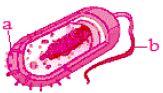
In the given figure,what do $a$ and $b$ represent respectively?
A
Pili,Flagellum
B
Ribosomes,Pili
C
Cell wall,Nucleoid
D
Flagellum,Capsule
Solution
(A) The provided figure represents a typical bacterial cell.
In this diagram,the structure labeled '$a$' represents the Pili,which are surface appendages involved in attachment and conjugation.
The structure labeled '$b$' represents the Flagellum,which is a long,whip-like structure responsible for bacterial motility.
Therefore,'$a$' and '$b$' represent Pili and Flagellum respectively.
In this diagram,the structure labeled '$a$' represents the Pili,which are surface appendages involved in attachment and conjugation.
The structure labeled '$b$' represents the Flagellum,which is a long,whip-like structure responsible for bacterial motility.
Therefore,'$a$' and '$b$' represent Pili and Flagellum respectively.
0 likes
View Solution79
EasyMCQ
In which aspect does a prokaryotic cell differ from a eukaryotic cell?
A
Mitochondria and nucleus
B
Cell wall and $DNA$
C
Ribosomes and plasma membrane
D
Cell wall and plasma membrane
Solution
(A) Prokaryotic cells are characterized by the absence of membrane-bound organelles such as mitochondria,chloroplasts,and a well-defined nucleus.
In contrast,eukaryotic cells possess a distinct nucleus enclosed by a nuclear envelope and various membrane-bound organelles like mitochondria.
While both cell types have a cell wall (in many prokaryotes and plant/fungal eukaryotes) and ribosomes (though of different sizes,$70S$ vs $80S$),the fundamental difference lies in the presence of membrane-bound structures like the nucleus and mitochondria in eukaryotes.
In contrast,eukaryotic cells possess a distinct nucleus enclosed by a nuclear envelope and various membrane-bound organelles like mitochondria.
While both cell types have a cell wall (in many prokaryotes and plant/fungal eukaryotes) and ribosomes (though of different sizes,$70S$ vs $80S$),the fundamental difference lies in the presence of membrane-bound structures like the nucleus and mitochondria in eukaryotes.
0 likes
View Solution80
EasyMCQ
What is absent in a prokaryotic cell?
A
Nucleus
B
Centriole
C
Membrane-bound organelles
D
All of the above
Solution
(D) Prokaryotic cells are characterized by the absence of a well-defined nucleus (they have a nucleoid instead).
They also lack membrane-bound organelles such as mitochondria,chloroplasts,endoplasmic reticulum,and Golgi apparatus.
Additionally,centrioles are typically absent in prokaryotic cells.
Therefore,all the listed components are absent in a prokaryotic cell.
They also lack membrane-bound organelles such as mitochondria,chloroplasts,endoplasmic reticulum,and Golgi apparatus.
Additionally,centrioles are typically absent in prokaryotic cells.
Therefore,all the listed components are absent in a prokaryotic cell.
0 likes
View Solution81
EasyMCQ
Which of the following is a structure found in prokaryotes?
A
Ribosome
B
Peroxisome
C
Rough Endoplasmic Reticulum
D
Mesosome
Solution
(D) Prokaryotic cells lack membrane-bound organelles such as the nucleus,mitochondria,endoplasmic reticulum,and peroxisomes.
However,they contain ribosomes,which are non-membrane-bound organelles responsible for protein synthesis.
Mesosomes are specialized membranous structures formed by the extensions of the plasma membrane into the cell,which are characteristic of prokaryotic cells like bacteria.
Therefore,both ribosomes and mesosomes are found in prokaryotes,but mesosomes are unique structural features specific to prokaryotic cells.
However,they contain ribosomes,which are non-membrane-bound organelles responsible for protein synthesis.
Mesosomes are specialized membranous structures formed by the extensions of the plasma membrane into the cell,which are characteristic of prokaryotic cells like bacteria.
Therefore,both ribosomes and mesosomes are found in prokaryotes,but mesosomes are unique structural features specific to prokaryotic cells.
0 likes
View Solution82
EasyMCQ
In a prokaryotic cell,which structure provides protection against phagocytes and viral attacks?
A
Plasma membrane
B
Cell wall
C
Glycocalyx (Capsule)
D
Fimbriae
Solution
(C) In prokaryotic cells,the outermost layer is the glycocalyx.
It exists in two forms: a loose sheath called the slime layer or a thick,tough layer called the capsule.
The capsule provides protection to the cell against phagocytosis by white blood cells and also protects it from viral attacks (bacteriophages).
Therefore,the correct answer is $C$ (Glycocalyx/Capsule).
It exists in two forms: a loose sheath called the slime layer or a thick,tough layer called the capsule.
The capsule provides protection to the cell against phagocytosis by white blood cells and also protects it from viral attacks (bacteriophages).
Therefore,the correct answer is $C$ (Glycocalyx/Capsule).
0 likes
View Solution83
EasyMCQ
In many bacterial cells,there is a small circular $DNA$ outside the genomic $DNA$. What is it called?
A
Plasmid
B
Cosmid
C
Capsid
D
Solenoid
Solution
(A) In many bacteria,small circular $DNA$ molecules are present in addition to the genomic $DNA$ (the chromosomal $DNA$).
These small circular $DNA$ molecules are known as plasmids.
Plasmids are extrachromosomal,self-replicating,and often carry genes that provide unique phenotypic characters,such as antibiotic resistance.
These small circular $DNA$ molecules are known as plasmids.
Plasmids are extrachromosomal,self-replicating,and often carry genes that provide unique phenotypic characters,such as antibiotic resistance.
0 likes
View Solution84
EasyMCQ
Cell division in prokaryotic cells is ........... compared to cell division in eukaryotic cells.
A
much slower
B
slower
C
much faster
D
not different
Solution
(C) Prokaryotic cells,such as bacteria,have a simpler structure and lack a membrane-bound nucleus or complex organelles. Their cell division process,primarily binary fission,is significantly less complex than the mitotic or meiotic processes found in eukaryotic cells. Consequently,prokaryotic cells can divide much more rapidly than eukaryotic cells,often doubling their population in a very short time under favorable conditions.
0 likes
View Solution85
EasyMCQ
How many distinct layers can be identified in the cell envelope of a bacterium?
A
$3$
B
$2$
C
$4$
D
$5$
Solution
(A) The bacterial cell envelope consists of a tightly linked three-layered structure.
These layers are:
$1$. The outermost Glycocalyx.
$2$. The middle Cell wall.
$3$. The innermost Plasma membrane.
Although each layer of the envelope performs a distinct function,they act together as a single protective unit.
These layers are:
$1$. The outermost Glycocalyx.
$2$. The middle Cell wall.
$3$. The innermost Plasma membrane.
Although each layer of the envelope performs a distinct function,they act together as a single protective unit.
0 likes
View Solution86
EasyMCQ
Assertion $A$: Prokaryotic organisms do not undergo development and differentiation into multicellular forms.
Reason $R$: Prokaryotic organisms are unicellular.
Which option is correct for Assertion $A$ and Reason $R$?
Reason $R$: Prokaryotic organisms are unicellular.
Which option is correct for Assertion $A$ and Reason $R$?
A
$A$ and $R$ are both true and $R$ is the correct explanation of $A$.
B
$A$ and $R$ are both true but $R$ is not the correct explanation of $A$.
C
$A$ is true and $R$ is false.
D
$A$ is false and $R$ is true.
Solution
(A) Prokaryotic organisms (such as bacteria and cyanobacteria) are unicellular and lack complex cellular organization required for multicellularity.
Because they are unicellular,they do not undergo the complex processes of development and differentiation that lead to the formation of multicellular structures.
Therefore,Assertion $A$ is true because prokaryotes remain unicellular.
Reason $R$ is also true as it correctly states that prokaryotes are unicellular.
Since the unicellular nature of prokaryotes is the fundamental reason why they cannot form multicellular structures,$R$ is the correct explanation of $A$.
Because they are unicellular,they do not undergo the complex processes of development and differentiation that lead to the formation of multicellular structures.
Therefore,Assertion $A$ is true because prokaryotes remain unicellular.
Reason $R$ is also true as it correctly states that prokaryotes are unicellular.
Since the unicellular nature of prokaryotes is the fundamental reason why they cannot form multicellular structures,$R$ is the correct explanation of $A$.
0 likes
View Solution87
EasyMCQ
What is the outermost layer of the cell envelope in prokaryotes made of?
A
Chitin mixed with cellulose
B
Glycocalyx
C
Glycoprotein
D
Cellulose
Solution
(B) The cell envelope in prokaryotic cells consists of a tightly linked three-layered structure: the outermost glycocalyx,followed by the cell wall,and the innermost plasma membrane.
$1$. The glycocalyx is the outermost layer,which can be in the form of a loose sheath called the slime layer or a thick and tough layer called the capsule.
$2$. It is primarily composed of polysaccharides and sometimes proteins.
$3$. Therefore,the outermost layer of the cell envelope is the glycocalyx.
$1$. The glycocalyx is the outermost layer,which can be in the form of a loose sheath called the slime layer or a thick and tough layer called the capsule.
$2$. It is primarily composed of polysaccharides and sometimes proteins.
$3$. Therefore,the outermost layer of the cell envelope is the glycocalyx.
0 likes
View Solution88
EasyMCQ
Which of the following is formed due to the extension of the plasma membrane into the cell in prokaryotes?
A
Ribosomes
B
Mesosomes
C
Lysosomes
D
Dictyosomes
Solution
(B) In prokaryotic cells,such as bacteria,the plasma membrane undergoes invagination or extension into the cell to form specialized structures known as $Mesosomes$.
These structures can be in the form of vesicles,tubules,or lamellae.
$Mesosomes$ play a crucial role in various cellular processes,including $DNA$ replication,cell wall formation,respiration,and increasing the surface area of the plasma membrane for enzymatic activity.
These structures can be in the form of vesicles,tubules,or lamellae.
$Mesosomes$ play a crucial role in various cellular processes,including $DNA$ replication,cell wall formation,respiration,and increasing the surface area of the plasma membrane for enzymatic activity.
0 likes
View Solution89
EasyMCQ
Which of the following is $NOT$ included in the structural regions of a prokaryotic cell?
A
Appendages
B
Cell envelope
C
Cytoplasmic region
D
Nucleus
Solution
(D) Prokaryotic cells are characterized by the absence of a well-defined,membrane-bound nucleus.
Their structural organization typically consists of three main regions:
$1$. The cell envelope (consisting of the glycocalyx,cell wall,and plasma membrane).
$2$. The cytoplasmic region (containing ribosomes,inclusion bodies,and the nucleoid).
$3$. Appendages (such as flagella,pili,and fimbriae).
Since prokaryotic cells lack a true membrane-bound nucleus,the nucleus is not a structural component of these cells.
Their structural organization typically consists of three main regions:
$1$. The cell envelope (consisting of the glycocalyx,cell wall,and plasma membrane).
$2$. The cytoplasmic region (containing ribosomes,inclusion bodies,and the nucleoid).
$3$. Appendages (such as flagella,pili,and fimbriae).
Since prokaryotic cells lack a true membrane-bound nucleus,the nucleus is not a structural component of these cells.
0 likes
View Solution90
EasyMCQ
Which of the following structures in a prokaryotic cell is $NOT$ formed by the extension of the plasma membrane?
A
Mesosome
B
Vacuole
C
Capsule
D
Lamella
Solution
(C) In prokaryotic cells,the plasma membrane can extend into the cytoplasm to form specialized structures such as $Mesosomes$,$Lamellae$,and $Vacuoles$ (like gas vacuoles in some bacteria). These structures help in respiration,secretion,and increasing surface area for enzymatic activities. The $Capsule$ is a protective outer layer made of polysaccharides or proteins that lies outside the cell wall. It is not an extension of the plasma membrane.
0 likes
View Solution91
MediumMCQ
In bacteria,when does the single chromosome attach to a specific site on the plasma membrane?
A
At the onset of sporulation in bacteria
B
When the plasma membrane expands into a membranous structure
C
At the initiation of replication
D
During the production of extracellular polymers
Solution
(C) In bacteria,the genetic material is present as a single circular chromosome.
During the process of binary fission,the initiation of $DNA$ replication is a critical step.
At the onset of replication,the single chromosome attaches to a specific site on the plasma membrane (often associated with mesosomes).
This attachment ensures that as the cell elongates and the membrane grows,the replicated chromosomes are pulled apart to opposite poles,facilitating equal distribution into daughter cells.
During the process of binary fission,the initiation of $DNA$ replication is a critical step.
At the onset of replication,the single chromosome attaches to a specific site on the plasma membrane (often associated with mesosomes).
This attachment ensures that as the cell elongates and the membrane grows,the replicated chromosomes are pulled apart to opposite poles,facilitating equal distribution into daughter cells.
0 likes
View Solution92
EasyMCQ
Which structure in the bacterial cell envelope provides protection?
A
Cell wall
B
Plasma membrane
C
Capsule
D
Glycolipid layer
Solution
(C) The bacterial cell envelope consists of a tightly linked three-layered structure: the outermost glycocalyx,followed by the cell wall,and the innermost plasma membrane.
Among these,the glycocalyx can take the form of a loose sheath called the slime layer or a thick,tough layer called the capsule.
The capsule provides protection to the cell and also helps in adhesion to surfaces and escaping from the host immune system.
Among these,the glycocalyx can take the form of a loose sheath called the slime layer or a thick,tough layer called the capsule.
The capsule provides protection to the cell and also helps in adhesion to surfaces and escaping from the host immune system.
0 likes
View Solution93
EasyMCQ
Which of the following inclusion bodies are absent in the cytoplasm of bacteria?
A
Phosphate granules
B
Sulphate granules
C
Cyanophycean granules
D
Glycogen granules
Solution
(B) In prokaryotic cells,such as bacteria,reserve materials are stored in the cytoplasm in the form of inclusion bodies.
These bodies are not bounded by any membrane system and lie free in the cytoplasm.
Common examples of inclusion bodies in bacteria include phosphate granules,cyanophycean granules,and glycogen granules.
Sulphate granules are not recognized as standard inclusion bodies in bacterial cytoplasm according to $NCERT$ biology textbooks.
Therefore,the correct answer is $B$.
These bodies are not bounded by any membrane system and lie free in the cytoplasm.
Common examples of inclusion bodies in bacteria include phosphate granules,cyanophycean granules,and glycogen granules.
Sulphate granules are not recognized as standard inclusion bodies in bacterial cytoplasm according to $NCERT$ biology textbooks.
Therefore,the correct answer is $B$.
0 likes
View Solution94
EasyMCQ
In prokaryotic cells,inclusion bodies are:
A
Storage granules.
B
Membrane-less structures.
C
Free in the cytoplasm.
D
All of the above.
Solution
(D) In prokaryotic cells,reserve materials are stored in the cytoplasm in the form of inclusion bodies.
These structures are not bounded by any membrane and lie free in the cytoplasm.
Examples include phosphate granules,cyanophycean granules,and glycogen granules.
Therefore,all the given options are correct.
These structures are not bounded by any membrane and lie free in the cytoplasm.
Examples include phosphate granules,cyanophycean granules,and glycogen granules.
Therefore,all the given options are correct.
0 likes
View Solution95
EasyMCQ
In bacteria,the mesosome is a specialized structure formed by the invagination of which component?
A
Cell wall
B
Plasma membrane
C
Single chromosome
D
Plasmid $DNA$
Solution
(B) In prokaryotic cells like bacteria,the mesosome is a specialized membranous structure.
It is formed by the extensions of the plasma membrane into the cell.
These extensions take the form of vesicles,tubules,and lamellae.
They play a crucial role in cell wall formation,$DNA$ replication,and respiration.
It is formed by the extensions of the plasma membrane into the cell.
These extensions take the form of vesicles,tubules,and lamellae.
They play a crucial role in cell wall formation,$DNA$ replication,and respiration.
0 likes
View Solution96
EasyMCQ
$PPLO$ stands for ...
A
Pleuro Pneumonia Like Organism
B
Pleuro Pneumonia Like Organelle
C
Papilloma Like Organism
D
Plasma Pili Like Organelle
Solution
(A) $PPLO$ stands for Pleuro Pneumonia Like Organism. These are the smallest living cells known,which lack a cell wall and can survive without oxygen. They are also known as Mycoplasma.
0 likes
View Solution97
MediumMCQ
Which of the following is $NOT$ a function of the plasma membrane in prokaryotes?
A
Energy production
B
Site for chromosome attachment
C
Extracellular polymer production
D
Site for electron transport during photophosphorylation
Solution
(D) In prokaryotes,the plasma membrane performs several functions similar to organelles in eukaryotes.
$1$. It acts as a site for energy production (respiration) via the electron transport chain.
$2$. It serves as an attachment site for chromosomes during $DNA$ replication and cell division.
$3$. It is involved in the secretion of extracellular polymers.
$4$. However,photophosphorylation (the synthesis of $ATP$ using light energy) in photosynthetic prokaryotes occurs in specialized membrane structures called chromatophores or thylakoids,not the general plasma membrane. Therefore,providing a site for electron transport during photophosphorylation is not a primary function of the general plasma membrane.
$1$. It acts as a site for energy production (respiration) via the electron transport chain.
$2$. It serves as an attachment site for chromosomes during $DNA$ replication and cell division.
$3$. It is involved in the secretion of extracellular polymers.
$4$. However,photophosphorylation (the synthesis of $ATP$ using light energy) in photosynthetic prokaryotes occurs in specialized membrane structures called chromatophores or thylakoids,not the general plasma membrane. Therefore,providing a site for electron transport during photophosphorylation is not a primary function of the general plasma membrane.
0 likes
View Solution98
MediumMCQ
In a prokaryotic cell,the production of extracellular polymers is $NOT$ carried out by which of the following?
A
Catalysis by cell wall enzymes
B
Catalysis by capsule enzymes
C
Catalysis by plasma membrane enzymes
D
Catalysis by extracellular fluid enzymes
Solution
(D) In prokaryotic cells,the synthesis of extracellular polymers (such as slime layers or capsules) is primarily mediated by enzymes located on the plasma membrane or within the cell wall.
Extracellular fluid $(ECF)$ does not contain the metabolic machinery or the specific enzymes required to synthesize these complex polymers.
Therefore,the production of extracellular polymers is not carried out by enzymes in the extracellular fluid.
Extracellular fluid $(ECF)$ does not contain the metabolic machinery or the specific enzymes required to synthesize these complex polymers.
Therefore,the production of extracellular polymers is not carried out by enzymes in the extracellular fluid.
0 likes
View Solution99
EasyMCQ
Which type of ribosomes are present in prokaryotes (in $S$)?
A
$80$
B
$90$
C
$70$
D
$60$
Solution
(C) Ribosomes are the sites of protein synthesis in cells.
In prokaryotic cells,ribosomes are of the $70S$ type.
These $70S$ ribosomes consist of two subunits: a larger $50S$ subunit and a smaller $30S$ subunit.
In contrast,eukaryotic cells contain $80S$ ribosomes in their cytoplasm,which are composed of $60S$ and $40S$ subunits.
In prokaryotic cells,ribosomes are of the $70S$ type.
These $70S$ ribosomes consist of two subunits: a larger $50S$ subunit and a smaller $30S$ subunit.
In contrast,eukaryotic cells contain $80S$ ribosomes in their cytoplasm,which are composed of $60S$ and $40S$ subunits.
0 likes
View Solution100
EasyMCQ
Nucleoid is present in:
A
Plant cell
B
Animal cell
C
Bacterial cell
D
Virus
Solution
(C) nucleoid is an irregularly shaped region within the cell of a prokaryote that contains all or most of the genetic material.
Since bacteria are prokaryotic organisms,they possess a nucleoid instead of a membrane-bound nucleus.
Plant and animal cells are eukaryotic and contain a well-defined nucleus.
Viruses are acellular entities and do not possess a nucleoid.
Since bacteria are prokaryotic organisms,they possess a nucleoid instead of a membrane-bound nucleus.
Plant and animal cells are eukaryotic and contain a well-defined nucleus.
Viruses are acellular entities and do not possess a nucleoid.
0 likes
View SolutionCell: The Unit of Life — Prokaryotic cell · Frequently Asked Questions
1Are these Cell: The Unit of Life questions useful for JEE and NEET?
Yes. All questions in this section are mapped to JEE Main and NEET exam patterns. Previous year questions from JEE Main, NEET, GUJCET and state-level exams are included with full solutions.
2Can I switch to Hindi or Gujarati for these questions?
Yes. Use the language tabs in the hero section or the sidebar to view the same questions and solutions in English, Hindi or Gujarati.
3How do I generate a question paper from this subtopic?
Use the Vedclass Exam Paper Generator — select the chapter and subtopic, set difficulty, and generate Sets A, B, C, D automatically. First 3 chapters of every subject are free.
Vedclass Products
For Students
Vedclass Test Series
Mock tests in real JEE/NEET style with performance analysis. 5-day free trial.
Start Free TrialFor Teachers
Exam Paper Generator
Generate Set A/B/C/D papers from this chapter in 2 minutes. 3 chapters free.
Try FreeFor Institutes
Online Exam Module
Live online exams with unlimited students, 360° analytics & white-label branding.
See DemoFor Teachers & Institutes
Generate a Cell: The Unit of Life Exam Paper in 2 Minutes
Select subtopic & difficulty — Sets A, B, C, D auto-generated with No Repeat logic.
First 3 chapters of every subject are free — no payment required.