
A English
Prokaryotic cell Questions in English
Class 11 Biology · Cell: The Unit of Life · Prokaryotic cell
227+
Questions
English
Language
100%
With Solutions
Showing 27 of 227 questions in English
201
EasyMCQ
What is the primary difference between prokaryotic and eukaryotic cells regarding their structure?
A
Cell wall
B
Nuclear membrane
C
Ribosome
D
None of these
Solution
(B) Prokaryotic cells lack a well-defined nucleus and are characterized by the absence of a nuclear membrane surrounding their genetic material.
In contrast,eukaryotic cells possess a well-organized nucleus enclosed by a distinct nuclear membrane.
In contrast,eukaryotic cells possess a well-organized nucleus enclosed by a distinct nuclear membrane.
0 likes
View Solution202
MediumMCQ
The extension of the plasma membrane in a prokaryotic cell is known as:
A
mesosome
B
haploid
C
ribosome
D
none of these
Solution
(A) In prokaryotic cells,such as bacteria,the plasma membrane undergoes special modifications to form extensions called mesosomes.
These extensions are formed by the invagination of the plasma membrane into the cell.
Mesosomes can be in the form of vesicles,tubules,and lamellae.
They play crucial roles in cell wall formation,$DNA$ replication,and distribution to daughter cells,as well as in respiration and secretion processes.
These extensions are formed by the invagination of the plasma membrane into the cell.
Mesosomes can be in the form of vesicles,tubules,and lamellae.
They play crucial roles in cell wall formation,$DNA$ replication,and distribution to daughter cells,as well as in respiration and secretion processes.
0 likes
View Solution203
MediumMCQ
Which one of the following combinations is mismatched?
A
Glycocalyx - May be capsule or slime layer
B
Pili - Reproduction
C
Cell wall - Protective,determines shape,prevents from bursting
D
Flagella,pili and fimbriae - Surface structures of bacterial cell
Solution
(B) The correct answer is $B$. Pili are elongated tubular structures made of a special protein called pilin. They are primarily involved in the attachment of bacteria to surfaces or to other bacteria (conjugation),rather than reproduction itself. While they play a role in the transfer of genetic material during conjugation,they are not reproductive organs. Glycocalyx,cell wall,and the classification of flagella,pili,and fimbriae as surface structures are all correctly described.
0 likes
View Solution204
MediumMCQ
Which of the following statements about a bacterial cell is/are correct?
$(i)$ Mesosome is formed by the extensions of plasma membrane into the cell.
$(ii)$ The pili are elongated tubular structures made up of a protein.
$(iii)$ Flagellum is composed of filament,hook,and basal body.
$(iv)$ Ribosomes are about $30 \; nm$ by $50 \; nm$ in size.
$(i)$ Mesosome is formed by the extensions of plasma membrane into the cell.
$(ii)$ The pili are elongated tubular structures made up of a protein.
$(iii)$ Flagellum is composed of filament,hook,and basal body.
$(iv)$ Ribosomes are about $30 \; nm$ by $50 \; nm$ in size.
A
$(i), (ii)$ and $(iii)$
B
All of the above
C
$(ii)$ and $(iv)$
D
None of the above
Solution
(A) Statement $(i)$ is correct: Mesosomes are indeed infoldings or extensions of the plasma membrane into the cell.
Statement $(ii)$ is correct: Pili are elongated tubular structures made of a special protein called pilin.
Statement $(iii)$ is correct: The bacterial flagellum consists of three parts: filament,hook,and basal body.
Statement $(iv)$ is incorrect: Ribosomes in prokaryotes are $70S$ type,and their size is approximately $15 \; nm$ by $20 \; nm$,not $30 \; nm$ by $50 \; nm$.
Therefore,statements $(i), (ii),$ and $(iii)$ are correct.
Statement $(ii)$ is correct: Pili are elongated tubular structures made of a special protein called pilin.
Statement $(iii)$ is correct: The bacterial flagellum consists of three parts: filament,hook,and basal body.
Statement $(iv)$ is incorrect: Ribosomes in prokaryotes are $70S$ type,and their size is approximately $15 \; nm$ by $20 \; nm$,not $30 \; nm$ by $50 \; nm$.
Therefore,statements $(i), (ii),$ and $(iii)$ are correct.
0 likes
View Solution205
MediumMCQ
Choose the wrong statements regarding bacterial cell.
$(i)$ Glycocalyx is the outermost envelope in bacteria.
$(ii)$ The glycocalyx could be a loose sheath called capsule.
$(iii)$ The glycocalyx may be thick and tough called slime layer.
$(iv)$ $A$ special structure formed by the plasma membrane is called mesosome.
$(v)$ Small bristle like fibres sprouting out of the cell are called fimbriae.
$(i)$ Glycocalyx is the outermost envelope in bacteria.
$(ii)$ The glycocalyx could be a loose sheath called capsule.
$(iii)$ The glycocalyx may be thick and tough called slime layer.
$(iv)$ $A$ special structure formed by the plasma membrane is called mesosome.
$(v)$ Small bristle like fibres sprouting out of the cell are called fimbriae.
A
$(i)$ and $(iii)$
B
$(i)$ and $(ii)$
C
$(ii)$ and $(iii)$
D
$(i)$ and $(iv)$
Solution
(C) Statement $(i)$ is correct: The glycocalyx is the outermost layer of the bacterial cell envelope.
Statement $(ii)$ is incorrect: $A$ loose sheath of glycocalyx is called a slime layer,not a capsule.
Statement $(iii)$ is incorrect: $A$ thick and tough layer of glycocalyx is called a capsule,not a slime layer.
Statement $(iv)$ is correct: Mesosomes are specialized membranous structures formed by the extensions of the plasma membrane into the cell.
Statement $(v)$ is correct: Fimbriae are small bristle-like fibers sprouting out of the cell that help bacteria attach to rocks in streams and also to host tissues.
Therefore,statements $(ii)$ and $(iii)$ are wrong.
Statement $(ii)$ is incorrect: $A$ loose sheath of glycocalyx is called a slime layer,not a capsule.
Statement $(iii)$ is incorrect: $A$ thick and tough layer of glycocalyx is called a capsule,not a slime layer.
Statement $(iv)$ is correct: Mesosomes are specialized membranous structures formed by the extensions of the plasma membrane into the cell.
Statement $(v)$ is correct: Fimbriae are small bristle-like fibers sprouting out of the cell that help bacteria attach to rocks in streams and also to host tissues.
Therefore,statements $(ii)$ and $(iii)$ are wrong.
0 likes
View Solution206
EasyMCQ
Which of the following structures is present only in a prokaryotic cell?
A
Plasmid
B
Nucleus
C
Mitochondria
D
Ribosomes
Solution
(A) $Plasmid$ is a small, circular, double-stranded $DNA$ molecule that is distinct from a cell's chromosomal $DNA$. It is primarily found in prokaryotic cells, such as bacteria. While most eukaryotes lack plasmids, $Saccharomyces \text{ } cerevisiae$ (yeast) is a notable exception that contains them. Nuclei, mitochondria, and ribosomes are found in eukaryotic cells, and ribosomes are also present in prokaryotes.
0 likes
View Solution207
MediumMCQ
The genomic $DNA$ of a bacterium is
A
Circular
B
Linear
C
Segmented
D
Rod shaped
Solution
(A) The genomic $DNA$ of a bacterium is typically a single,circular,double-stranded molecule. Unlike eukaryotic cells,which have linear chromosomes contained within a nucleus,the bacterial genome is not enclosed in a membrane-bound nucleus and exists as a closed loop,often referred to as the nucleoid.
0 likes
View Solution208
EasyMCQ
The genetic material of a prokaryotic cell is known as
A
Nucleus
B
Centrosome
C
Nucleoid
D
Mesosome
Solution
(C) In prokaryotic cells,the genetic material is not enclosed by a nuclear envelope. This region containing the genetic material is referred to as the $Nucleoid$.
0 likes
View Solution209
MediumMCQ
Which of the following is not a structure of prokaryotic flagella?
A
Filament
B
Centriole
C
Hook
D
Basal body
Solution
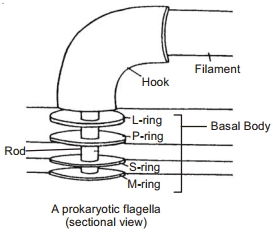
(B) The prokaryotic flagellum is composed of three main parts: the filament,the hook,and the basal body.
$1$. The filament is the long,tubular structure that extends from the cell surface.
$2$. The hook is a curved structure that connects the filament to the basal body.
$3$. The basal body is a complex structure embedded in the cell envelope that acts as a motor.
Centrioles are microtubule-based structures found in eukaryotic cells,typically involved in spindle formation during cell division,and are not part of the prokaryotic flagellum.
$1$. The filament is the long,tubular structure that extends from the cell surface.
$2$. The hook is a curved structure that connects the filament to the basal body.
$3$. The basal body is a complex structure embedded in the cell envelope that acts as a motor.
Centrioles are microtubule-based structures found in eukaryotic cells,typically involved in spindle formation during cell division,and are not part of the prokaryotic flagellum.
0 likes
View Solution210
MediumMCQ
The . . . . . . are small bristle-like fibres sprouting out of the bacterial cell.
A
Pili
B
Mesosomes
C
Cilia
D
Fimbriae
Solution
(D) Fimbriae are small bristle-like fibres sprouting out of the bacterial cell. They are known to help attach bacteria to rocks in streams and also to the host tissues.
$Pili$ are elongated tubular structures made of a special protein called $pilin$.
$Mesosomes$ are infoldings of the plasma membrane into the cell,which help in respiration,secretion,and $DNA$ replication.
$Cilia$ are fine hair-like outgrowths of the cell membrane,primarily found in eukaryotic cells.
$Pili$ are elongated tubular structures made of a special protein called $pilin$.
$Mesosomes$ are infoldings of the plasma membrane into the cell,which help in respiration,secretion,and $DNA$ replication.
$Cilia$ are fine hair-like outgrowths of the cell membrane,primarily found in eukaryotic cells.
0 likes
View Solution211
MediumMCQ
Gas vacuole,Single envelope system,Cytoskeleton,Non-cellulosic wall,Microfilaments,Cytoplasmic streaming,Lack of any cell organelles.
How many of the above features are associated with a prokaryotic cell?
How many of the above features are associated with a prokaryotic cell?
A
One
B
Four
C
Two
D
Three
Solution
(D) The features associated with a prokaryotic cell are:
$1$. Gas vacuole: Present in many prokaryotes.
$2$. Single envelope system: Prokaryotes typically have a single envelope system (cell wall and plasma membrane).
$3$. Non-cellulosic wall: Prokaryotic cell walls are made of peptidoglycan,not cellulose.
Features like cytoskeleton,microfilaments,cytoplasmic streaming,and the presence of membrane-bound cell organelles are characteristic of eukaryotic cells.
Therefore,there are $3$ features associated with a prokaryotic cell.
$1$. Gas vacuole: Present in many prokaryotes.
$2$. Single envelope system: Prokaryotes typically have a single envelope system (cell wall and plasma membrane).
$3$. Non-cellulosic wall: Prokaryotic cell walls are made of peptidoglycan,not cellulose.
Features like cytoskeleton,microfilaments,cytoplasmic streaming,and the presence of membrane-bound cell organelles are characteristic of eukaryotic cells.
Therefore,there are $3$ features associated with a prokaryotic cell.
0 likes
View Solution212
MediumMCQ
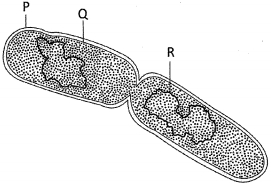
The figure below shows a dividing bacterium. Label $P, Q$ and $R$.
A
Cell wall,Cell membrane and $RNA$
B
Cell wall,Cell membrane and $DNA$
C
Cell membrane,Cell wall and $RNA$
D
Cell membrane,Cell wall and $DNA$
Solution
(B) In the given diagram of a dividing bacterium:
$P$ points to the outermost protective layer,which is the Cell wall.
$Q$ points to the layer just inside the cell wall,which is the Cell membrane.
$R$ points to the central genetic material,which is the bacterial $DNA$ (nucleoid).
Therefore,the correct sequence is Cell wall,Cell membrane,and $DNA$.
$P$ points to the outermost protective layer,which is the Cell wall.
$Q$ points to the layer just inside the cell wall,which is the Cell membrane.
$R$ points to the central genetic material,which is the bacterial $DNA$ (nucleoid).
Therefore,the correct sequence is Cell wall,Cell membrane,and $DNA$.
0 likes
View Solution213
MediumMCQ
Which of the following statements is incorrect regarding prokaryotic cells?
A
Bacteria,blue-green algae,mycoplasma,$PPLO$,and viruses are examples of prokaryotes.
B
They are generally smaller in size than eukaryotic cells.
C
They multiply more rapidly than eukaryotic cells.
D
Bacteria are primarily found in four basic shapes.
Solution
(A) The statement in option $A$ is incorrect because viruses are not considered cells. They are acellular entities that lack the cellular machinery required for independent life and reproduction,thus they are not classified as prokaryotic cells. Prokaryotic cells include bacteria,blue-green algae,mycoplasma,and $PPLO$. Options $B$,$C$,and $D$ are correct characteristics of prokaryotic cells: they are smaller,divide faster,and exhibit four basic shapes (bacillus,coccus,vibrio,and spirillum).
0 likes
View Solution214
MediumMCQ
Select the correct statement regarding prokaryotic cells.
A
Prokaryotic cells have a fundamentally similar organization.
B
Prokaryotic cells have similar functions.
C
Prokaryotic cells have similar shapes.
D
Prokaryotic cells contain membrane-bound organelles.
Solution
(A) Prokaryotic cells (such as bacteria,blue-green algae,mycoplasma,and $PPLO$) represent a group of organisms that share a fundamentally similar organization,despite showing wide variations in shape and function.
They lack a well-defined nucleus and membrane-bound organelles.
Therefore,the statement that they have a fundamentally similar organization is correct.
They lack a well-defined nucleus and membrane-bound organelles.
Therefore,the statement that they have a fundamentally similar organization is correct.
0 likes
View Solution215
EasyMCQ
What is the small,extra-chromosomal $DNA$ found in bacteria called?
A
Nucleoid
B
Genomic $DNA$
C
Cellular $DNA$
D
Plasmid
Solution
(D) Bacteria often contain small,circular,double-stranded $DNA$ molecules that are distinct from their chromosomal $DNA$.
These molecules are known as plasmids.
Plasmids are extra-chromosomal and can replicate independently within the bacterial cell.
They often carry genes that provide advantages,such as antibiotic resistance.
These molecules are known as plasmids.
Plasmids are extra-chromosomal and can replicate independently within the bacterial cell.
They often carry genes that provide advantages,such as antibiotic resistance.
0 likes
View Solution216
EasyMCQ
Mesosomes are the infoldings of $..............$.
A
Cell wall
B
Plasmid
C
Plasma membrane
D
All of the above
Solution
(C) Mesosomes are specialized membranous structures formed by the extensions of the plasma membrane into the cell in the form of vesicles,tubules,and lamellae. These extensions are essentially infoldings of the plasma membrane in prokaryotic cells.
0 likes
View Solution217
EasyMCQ
In a prokaryotic cell,identify the correct sequence of layers from the outside to the inside.
A
Glycocalyx $\rightarrow$ Cell wall $\rightarrow$ Plasma membrane
B
Plasma membrane $\rightarrow$ Cell wall $\rightarrow$ Glycocalyx
C
Glycocalyx $\rightarrow$ Plasma membrane $\rightarrow$ Cell wall
D
Cell wall $\rightarrow$ Plasma membrane $\rightarrow$ Glycocalyx
Solution
(A) In prokaryotic cells,specifically bacteria,the cell envelope consists of a tightly linked three-layered structure.
From the outermost layer to the innermost layer,the sequence is as follows:
$1$. Glycocalyx (outermost layer).
$2$. Cell wall (middle layer).
$3$. Plasma membrane (innermost layer).
Therefore,the correct sequence from outside to inside is Glycocalyx $\rightarrow$ Cell wall $\rightarrow$ Plasma membrane.
From the outermost layer to the innermost layer,the sequence is as follows:
$1$. Glycocalyx (outermost layer).
$2$. Cell wall (middle layer).
$3$. Plasma membrane (innermost layer).
Therefore,the correct sequence from outside to inside is Glycocalyx $\rightarrow$ Cell wall $\rightarrow$ Plasma membrane.
0 likes
View Solution218
EasyMCQ
Glycocalyx is loose - $P$
Glycocalyx is thick and tough - $Q$
Select the correct option for $P$ and $Q$.
Glycocalyx is thick and tough - $Q$
Select the correct option for $P$ and $Q$.
A
Slime layer,Capsule
B
Capsule,Slime layer
C
Slime layer,Cell wall
D
Cell wall,Slime layer
Solution
(A) In prokaryotic cells, the glycocalyx is an outer envelope that varies in composition and thickness.
$1$. When the glycocalyx is loose and sheath-like, it is known as the $\text{Slime layer}$.
$2$. When the glycocalyx is thick and tough, it is known as the $\text{Capsule}$.
Therefore, $P$ corresponds to the $\text{Slime layer}$ and $Q$ corresponds to the $\text{Capsule}$.
$1$. When the glycocalyx is loose and sheath-like, it is known as the $\text{Slime layer}$.
$2$. When the glycocalyx is thick and tough, it is known as the $\text{Capsule}$.
Therefore, $P$ corresponds to the $\text{Slime layer}$ and $Q$ corresponds to the $\text{Capsule}$.
0 likes
View Solution219
MediumMCQ
Read the following statements regarding Mesosomes:
$I -$ They are in the form of vesicles,tubules,and lamellae.
$II -$ They are formed by the extensions of the cell wall.
$III -$ They help in increasing the enzymatic content.
$IV -$ They are associated with respiration and secretory processes.
Which of the following options is correct for Mesosomes?
$I -$ They are in the form of vesicles,tubules,and lamellae.
$II -$ They are formed by the extensions of the cell wall.
$III -$ They help in increasing the enzymatic content.
$IV -$ They are associated with respiration and secretory processes.
Which of the following options is correct for Mesosomes?
A
$I, II, III, IV$
B
$I, III, IV$
C
$I, IV$
D
$I, II, IV$
Solution
(B) Mesosomes are characteristic structures found in prokaryotic cells,specifically bacteria.
$1.$ They are formed by the extensions of the plasma membrane into the cell,not the cell wall. Thus,statement $II$ is incorrect.
$2.$ They exist in the form of vesicles,tubules,and lamellae. Thus,statement $I$ is correct.
$3.$ They help in increasing the surface area of the plasma membrane,which in turn helps in enzymatic content increase and metabolic activities. Thus,statement $III$ is correct.
$4.$ They are involved in cell wall formation,$DNA$ replication,distribution to daughter cells,respiration,and secretion processes. Thus,statement $IV$ is correct.
Therefore,statements $I, III,$ and $IV$ are correct.
$1.$ They are formed by the extensions of the plasma membrane into the cell,not the cell wall. Thus,statement $II$ is incorrect.
$2.$ They exist in the form of vesicles,tubules,and lamellae. Thus,statement $I$ is correct.
$3.$ They help in increasing the surface area of the plasma membrane,which in turn helps in enzymatic content increase and metabolic activities. Thus,statement $III$ is correct.
$4.$ They are involved in cell wall formation,$DNA$ replication,distribution to daughter cells,respiration,and secretion processes. Thus,statement $IV$ is correct.
Therefore,statements $I, III,$ and $IV$ are correct.
0 likes
View Solution220
EasyMCQ
Which of the following is incorrect regarding the inclusion bodies found in prokaryotic cells?
A
They are present in the cytoplasm.
B
They are membrane-bound organelles.
C
They store food materials.
D
Phosphate granules,cyanophycean granules,and glycogen granules are examples of these.
Solution
(B) Inclusion bodies are reserve materials in prokaryotic cells which are stored in the cytoplasm in the form of particles.
These are not bound by any membrane system and lie free in the cytoplasm.
Examples include phosphate granules,cyanophycean granules,and glycogen granules.
Therefore,the statement that they are membrane-bound organelles is incorrect.
These are not bound by any membrane system and lie free in the cytoplasm.
Examples include phosphate granules,cyanophycean granules,and glycogen granules.
Therefore,the statement that they are membrane-bound organelles is incorrect.
0 likes
View Solution221
EasyMCQ
Which structure helps in cell division in bacteria?
A
Capsule
B
Ribosomes
C
Mesosomes
D
Centriole
Solution
(C) In bacteria,$Mesosomes$ are specialized membranous structures formed by the extensions of the plasma membrane into the cell. These extensions are in the form of vesicles,tubules,and lamellae. $Mesosomes$ play a crucial role in cell wall formation,$DNA$ replication,and distribution to daughter cells. They also help in respiration,secretion processes,and increasing the surface area of the plasma membrane and enzymatic content. Therefore,they are essential for cell division in prokaryotes like bacteria.
0 likes
View Solution222
EasyMCQ
Choose the correct option for the nucleoid.
A
It is the genetic material of bacteria.
B
In prokaryotes,$DNA$ is organized in large loops held by proteins in a region termed as 'nucleoid'.
C
The $DNA$ in nucleoids is organized in large loops and held by proteins.
D
All of the above.
Solution
(D) In prokaryotic cells,such as bacteria,the genetic material is not enclosed within a nuclear membrane.
Instead,the $DNA$ is organized in large loops and held by proteins in a specific region of the cytoplasm known as the nucleoid.
Therefore,all the given statements correctly describe the nucleoid.
Instead,the $DNA$ is organized in large loops and held by proteins in a specific region of the cytoplasm known as the nucleoid.
Therefore,all the given statements correctly describe the nucleoid.
0 likes
View Solution223
EasyMCQ
$A$ specialised membranous structure in a prokaryotic cell which helps in cell wall formation,$\text{DNA}$ replication and respiration is :
A
Mesosome
B
Chromatophores
C
Cristae
D
Endoplasmic Reticulum
Solution
(A) In prokaryotic cells,the plasma membrane undergoes infoldings to form specialised structures called $Mesosomes$.
These structures are formed by the extensions of the plasma membrane into the cell in the form of vesicles,tubules,and lamellae.
$Mesosomes$ play a crucial role in various cellular processes,including cell wall formation,$\text{DNA}$ replication,and the distribution of daughter cells.
They also help in respiration,secretion processes,and increasing the surface area of the plasma membrane for enzymatic content.
These structures are formed by the extensions of the plasma membrane into the cell in the form of vesicles,tubules,and lamellae.
$Mesosomes$ play a crucial role in various cellular processes,including cell wall formation,$\text{DNA}$ replication,and the distribution of daughter cells.
They also help in respiration,secretion processes,and increasing the surface area of the plasma membrane for enzymatic content.
0 likes
View Solution224
EasyMCQ
The reserve material in prokaryotic cells is stored in the cytoplasm in the form of:
A
Exclusion and inclusion bodies
B
Fat bodies
C
Exclusion bodies
D
Inclusion bodies
Solution
(D) Inclusion bodies.
In prokaryotic cells,reserve materials are stored in the cytoplasm in the form of inclusion bodies. These are not bound by any membrane system and lie free in the cytoplasm. Examples include phosphate granules,cyanophycean granules,and glycogen granules.
In prokaryotic cells,reserve materials are stored in the cytoplasm in the form of inclusion bodies. These are not bound by any membrane system and lie free in the cytoplasm. Examples include phosphate granules,cyanophycean granules,and glycogen granules.
0 likes
View Solution225
EasyMCQ
$A$ bacterial flagellum is composed of
A
filament,hook and basal body
B
vesicles,tubules and lamellae
C
pili,fimbriae and filament
D
hook,tubules and fimbriae
Solution
(A) The correct answer is $A$.
$A$ bacterial flagellum is composed of three distinct parts:
$1$. The basal body: This is the structure that anchors the flagellum into the cell wall and plasma membrane.
$2$. The hook: This is a curved structure that connects the basal body to the filament.
$3$. The filament: This is the longest portion that extends from the cell surface into the surrounding medium and is responsible for bacterial motility.
$A$ bacterial flagellum is composed of three distinct parts:
$1$. The basal body: This is the structure that anchors the flagellum into the cell wall and plasma membrane.
$2$. The hook: This is a curved structure that connects the basal body to the filament.
$3$. The filament: This is the longest portion that extends from the cell surface into the surrounding medium and is responsible for bacterial motility.
0 likes
View Solution226
EasyMCQ
In $Prokaryotes$,the $glycocalyx$ when it is thick is called:
A
capsule
B
slime layer
C
cell wall
D
mesosome
Solution
(A) The correct answer is $A$ (capsule).
$Glycocalyx$ varies in composition and thickness among different bacteria.
If the $glycocalyx$ is loose and thin,it is known as the $slime$ $layer$.
If the $glycocalyx$ is thick and tough,it is known as the $capsule$.
$Glycocalyx$ varies in composition and thickness among different bacteria.
If the $glycocalyx$ is loose and thin,it is known as the $slime$ $layer$.
If the $glycocalyx$ is thick and tough,it is known as the $capsule$.
0 likes
View Solution227
EasyMCQ
Which of the following statements is correct?
A
In prokaryotes,there are no membrane-bound cell organelles.
B
Cells of all living organisms have a nucleus.
C
Cells are formed de novo from abiotic materials.
D
Both animal and plant cells have a well-defined cell wall.
Solution
(A) The correct statement is $A$.
Prokaryotes are unicellular organisms that lack membrane-bound cell organelles such as mitochondria,chloroplasts,and the endoplasmic reticulum.
Option $B$ is incorrect because prokaryotic cells lack a true nucleus.
Option $C$ is incorrect because cells arise from pre-existing cells (Omnis cellula-e cellula).
Option $D$ is incorrect because animal cells lack a cell wall.
Prokaryotes are unicellular organisms that lack membrane-bound cell organelles such as mitochondria,chloroplasts,and the endoplasmic reticulum.
Option $B$ is incorrect because prokaryotic cells lack a true nucleus.
Option $C$ is incorrect because cells arise from pre-existing cells (Omnis cellula-e cellula).
Option $D$ is incorrect because animal cells lack a cell wall.
0 likes
View SolutionCell: The Unit of Life — Prokaryotic cell · Frequently Asked Questions
1Are these Cell: The Unit of Life questions useful for JEE and NEET?
Yes. All questions in this section are mapped to JEE Main and NEET exam patterns. Previous year questions from JEE Main, NEET, GUJCET and state-level exams are included with full solutions.
2Can I switch to Hindi or Gujarati for these questions?
Yes. Use the language tabs in the hero section or the sidebar to view the same questions and solutions in English, Hindi or Gujarati.
3How do I generate a question paper from this subtopic?
Use the Vedclass Exam Paper Generator — select the chapter and subtopic, set difficulty, and generate Sets A, B, C, D automatically. First 3 chapters of every subject are free.
Vedclass Products
For Students
Vedclass Test Series
Mock tests in real JEE/NEET style with performance analysis. 5-day free trial.
Start Free TrialFor Teachers
Exam Paper Generator
Generate Set A/B/C/D papers from this chapter in 2 minutes. 3 chapters free.
Try FreeFor Institutes
Online Exam Module
Live online exams with unlimited students, 360° analytics & white-label branding.
See DemoFor Teachers & Institutes
Generate a Cell: The Unit of Life Exam Paper in 2 Minutes
Select subtopic & difficulty — Sets A, B, C, D auto-generated with No Repeat logic.
First 3 chapters of every subject are free — no payment required.