
A English
Prokaryotic cell Questions in English
Class 11 Biology · Cell: The Unit of Life · Prokaryotic cell
227+
Questions
English
Language
100%
With Solutions
Showing 50 of 227 questions in English
101
EasyMCQ
Which of the following statements is inconsistent with prokaryotes?
A
Some organisms develop as filaments or colonies of cells.
B
Cells remain attached to other cells.
C
They do not develop or differentiate into multicellular forms.
D
They develop and differentiate into both unicellular and multicellular forms.
Solution
(D) Prokaryotes are primarily unicellular organisms. While some prokaryotes like cyanobacteria can form filaments or colonies where cells remain attached to each other,they do not undergo true multicellular development or differentiation into complex tissues or organs. Therefore,the statement that they develop and differentiate into both unicellular and multicellular forms is incorrect and inconsistent with the biological nature of prokaryotes.
0 likes
View Solution102
MediumMCQ
Which of the following is $NOT$ a part of the prokaryotic cell envelope?
A
Appendages
B
Nuclear region
C
Cytoplasmic region
D
Cell envelope
Solution
(B) The prokaryotic cell envelope consists of a tightly linked three-layered structure: the outermost glycocalyx,followed by the cell wall,and then the plasma membrane.
Appendages like pili and fimbriae are surface structures,but the 'Nuclear region' (nucleoid) and 'Cytoplasmic region' are internal components of the cell,not part of the cell envelope itself.
Among the given options,the 'Nuclear region' is the most distinct internal structure that is definitely not part of the envelope.
Appendages like pili and fimbriae are surface structures,but the 'Nuclear region' (nucleoid) and 'Cytoplasmic region' are internal components of the cell,not part of the cell envelope itself.
Among the given options,the 'Nuclear region' is the most distinct internal structure that is definitely not part of the envelope.
0 likes
View Solution103
EasyMCQ
The part of the appendage that extends into the cytoplasm is:
A
Pili
B
Fimbriae
C
Basal body
D
Cilia
Solution
(C) In prokaryotic cells,the flagellum is composed of three parts: the filament,the hook,and the basal body.
The filament is the longest portion and extends from the cell surface to the outside.
The basal body is the structure that anchors the flagellum into the cell wall and the plasma membrane,extending into the cytoplasm.
Therefore,the basal body is the part of the appendage that extends into the cytoplasm.
The filament is the longest portion and extends from the cell surface to the outside.
The basal body is the structure that anchors the flagellum into the cell wall and the plasma membrane,extending into the cytoplasm.
Therefore,the basal body is the part of the appendage that extends into the cytoplasm.
0 likes
View Solution104
EasyMCQ
Which structure is attached to the surface of bacteria?
A
Pili
B
Flagella
C
Fimbriae
D
Cilia
Solution
(C) In bacteria,$Pili$ and $Fimbriae$ are surface structures. However,$Fimbriae$ are small bristle-like fibers sprouting out of the cell,which are specifically known to help bacteria attach to rocks in streams and also to the host tissues. $Pili$ are elongated tubular structures made of a special protein,primarily involved in conjugation. Among the given options,$Fimbriae$ are the structures specifically described as being involved in attachment to surfaces.
0 likes
View Solution105
EasyMCQ
In prokaryotes,the region formed by the cell wall and the plasma membrane is known as:
A
Appendages
B
Cell envelope
C
Cytoplasmic region
D
Nuclear region
Solution
(B) In prokaryotic cells,the cell envelope consists of a tightly linked three-layered structure: the outermost glycocalyx,followed by the cell wall,and the innermost plasma membrane. Together,these layers act as a single protective unit and are referred to as the cell envelope.
0 likes
View Solution106
EasyMCQ
Which of the following is a membrane-bound specialized structure found in prokaryotes?
A
Ribosomes
B
$DNA$
C
Mitochondria
D
Mesosome
Solution
(D) In prokaryotic cells,membrane-bound organelles like mitochondria,chloroplasts,or the nucleus are absent.
However,prokaryotes possess a specialized membranous structure called the $Mesosome$.
This structure is formed by the extensions of the plasma membrane into the cell in the form of vesicles,tubules,and lamellae.
It plays a crucial role in cell wall formation,$DNA$ replication,and respiration.
However,prokaryotes possess a specialized membranous structure called the $Mesosome$.
This structure is formed by the extensions of the plasma membrane into the cell in the form of vesicles,tubules,and lamellae.
It plays a crucial role in cell wall formation,$DNA$ replication,and respiration.
0 likes
View Solution107
EasyMCQ
How many layers are present in the cell envelope of a bacterium?
A
Two
B
Three
C
Four
D
One
Solution
(B) The bacterial cell envelope consists of a tightly linked three-layered structure.
These layers are:
$1$. The outermost Glycocalyx (slime layer or capsule).
$2$. The middle Cell wall.
$3$. The innermost Plasma membrane.
Although each layer performs a distinct function,they act together as a single protective unit.
These layers are:
$1$. The outermost Glycocalyx (slime layer or capsule).
$2$. The middle Cell wall.
$3$. The innermost Plasma membrane.
Although each layer performs a distinct function,they act together as a single protective unit.
0 likes
View Solution108
EasyMCQ
What is the outermost layer of a prokaryotic cell made of?
A
Glycoprotein
B
Glycolipid
C
Glycocalyx
D
Cellulose
Solution
(C) In prokaryotic cells,the cell envelope consists of a tightly bound three-layered structure: the outermost glycocalyx,followed by the cell wall,and then the plasma membrane. The glycocalyx is the outermost layer,which can be in the form of a loose sheath called the slime layer or a thick and tough layer called the capsule.
0 likes
View Solution109
EasyMCQ
In prokaryotes,which layer is the second layer of the cell envelope?
A
Cell wall
B
Plasma membrane
C
Glycocalyx
D
Cytoplasmic membrane
Solution
(A) The cell envelope in prokaryotes consists of a tightly linked three-layered structure.
$1$. The outermost layer is the $Glycocalyx$.
$2$. The middle layer is the $Cell \ wall$.
$3$. The innermost layer is the $Plasma \ membrane$.
Therefore,the second layer of the cell envelope is the $Cell \ wall$.
$1$. The outermost layer is the $Glycocalyx$.
$2$. The middle layer is the $Cell \ wall$.
$3$. The innermost layer is the $Plasma \ membrane$.
Therefore,the second layer of the cell envelope is the $Cell \ wall$.
0 likes
View Solution110
EasyMCQ
The outermost loose sheath layer in bacteria is known as:
A
Cell membrane
B
Capsule
C
Slime layer
D
Cell wall
Solution
(C) In bacteria, the cell envelope consists of a tightly bound three-layered structure: the outermost glycocalyx, followed by the cell wall and the plasma membrane.
The glycocalyx differs in composition and thickness among different bacteria.
It could be a loose sheath called the $Slime layer$ in some bacteria, while in others, it may be thick and tough, called the $Capsule$.
Therefore, the outermost loose sheath layer is the $Slime layer$.
The glycocalyx differs in composition and thickness among different bacteria.
It could be a loose sheath called the $Slime layer$ in some bacteria, while in others, it may be thick and tough, called the $Capsule$.
Therefore, the outermost loose sheath layer is the $Slime layer$.
0 likes
View Solution111
EasyMCQ
The outermost,thick,and tough layer in bacteria is:
A
Cell wall
B
Slime layer
C
Plasma membrane
D
Glycocalyx (Capsule)
Solution
(D) In bacteria,the cell envelope consists of a tightly linked three-layered structure: the outermost glycocalyx,followed by the cell wall and the plasma membrane.
$1$. The glycocalyx differs in composition and thickness among different bacteria.
$2$. It could be a loose sheath called the 'slime layer' in some,or it may be thick and tough,called the 'capsule'.
$3$. Therefore,the outermost,thick,and tough layer is the capsule,which is a specialized form of the glycocalyx.
$1$. The glycocalyx differs in composition and thickness among different bacteria.
$2$. It could be a loose sheath called the 'slime layer' in some,or it may be thick and tough,called the 'capsule'.
$3$. Therefore,the outermost,thick,and tough layer is the capsule,which is a specialized form of the glycocalyx.
0 likes
View Solution112
EasyMCQ
The elongated tubular structures extending from the surface of bacteria are known as:
A
Flagella
B
Cilia
C
Pili
D
Fimbriae
Solution
(C) In bacteria,the surface structures include flagella,pili,and fimbriae.
$1$. Flagella are long,thin,whip-like structures responsible for motility.
$2$. Pili are elongated,tubular structures made of a special protein called pilin.
$3$. Fimbriae are small,bristle-like fibers sprouting out of the cell.
Therefore,the elongated tubular structures are known as pili.
$1$. Flagella are long,thin,whip-like structures responsible for motility.
$2$. Pili are elongated,tubular structures made of a special protein called pilin.
$3$. Fimbriae are small,bristle-like fibers sprouting out of the cell.
Therefore,the elongated tubular structures are known as pili.
0 likes
View Solution113
MediumMCQ
The structures present in large numbers in the cytoplasm are:
A
Storage granules
B
Cytoplasmic bodies
C
Inclusion bodies
D
Lipid bodies
Solution
(C) In prokaryotic cells,many structures are present in the cytoplasm that are not bounded by any membrane system. These are called $Inclusion \ bodies$. They serve as storage reservoirs for reserve materials in the cell. Examples include phosphate granules,cyanophycean granules,and glycogen granules.
0 likes
View Solution114
MediumMCQ
Which of the following is not a storage granule in prokaryotic cells?
A
Blood corpuscle
B
Phosphate granule
C
Cyanophycean granule
D
Glycogen granule
Solution
(A) In prokaryotic cells,reserve material is stored in the cytoplasm in the form of inclusion bodies or storage granules.
Common examples of these storage granules include phosphate granules,cyanophycean granules,and glycogen granules.
Blood corpuscles are cellular components of blood found in animals and are not storage granules in prokaryotic cells.
Therefore,the correct answer is $A$.
Common examples of these storage granules include phosphate granules,cyanophycean granules,and glycogen granules.
Blood corpuscles are cellular components of blood found in animals and are not storage granules in prokaryotic cells.
Therefore,the correct answer is $A$.
0 likes
View Solution115
EasyMCQ
In prokaryotic cells,the region where genetic material is found is known as:
A
Appendages
B
Cell envelope
C
Nucleoid
D
All of the above
Solution
(C) In prokaryotic cells,the genetic material is not enclosed by a nuclear membrane.
This region,where the naked circular $DNA$ is located,is called the $Nucleoid$ or $Genophore$ or $Incipient$ $nucleus$.
Therefore,the correct option is $C$.
This region,where the naked circular $DNA$ is located,is called the $Nucleoid$ or $Genophore$ or $Incipient$ $nucleus$.
Therefore,the correct option is $C$.
0 likes
View Solution116
EasyMCQ
Which of the following exhibits the presence of a nucleoid?
A
Plant cell
B
Animal cell
C
Bacterial cell
D
Virus
Solution
(C) nucleoid is an irregularly shaped region within the cell of a prokaryote that contains all or most of the genetic material.
Since bacteria are prokaryotic organisms,they possess a nucleoid instead of a membrane-bound nucleus.
Plant and animal cells are eukaryotic and contain a well-defined nucleus enclosed by a nuclear envelope.
Viruses are acellular and do not possess a nucleoid or a true nucleus.
Since bacteria are prokaryotic organisms,they possess a nucleoid instead of a membrane-bound nucleus.
Plant and animal cells are eukaryotic and contain a well-defined nucleus enclosed by a nuclear envelope.
Viruses are acellular and do not possess a nucleoid or a true nucleus.
0 likes
View Solution117
EasyMCQ
Which of the following is $NOT$ found in a prokaryotic cell?
A
Plasma membrane
B
Cell wall
C
Nuclear membrane
D
Ribosome
Solution
(C) Prokaryotic cells are characterized by the absence of a well-defined nucleus and membrane-bound organelles.
$1$. Plasma membrane: Present in all prokaryotes.
$2$. Cell wall: Present in most prokaryotes (except Mycoplasma).
$3$. Nuclear membrane: Prokaryotes lack a true nucleus; therefore,they do not have a nuclear membrane.
$4$. Ribosome: Present in prokaryotes (specifically $70S$ type).
Thus,the nuclear membrane is the correct answer.
$1$. Plasma membrane: Present in all prokaryotes.
$2$. Cell wall: Present in most prokaryotes (except Mycoplasma).
$3$. Nuclear membrane: Prokaryotes lack a true nucleus; therefore,they do not have a nuclear membrane.
$4$. Ribosome: Present in prokaryotes (specifically $70S$ type).
Thus,the nuclear membrane is the correct answer.
0 likes
View Solution118
EasyMCQ
Pili or fimbriae are associated with which process?
A
Locomotion
B
Movement
C
Conjugation
D
Ingestion
Solution
(C) Pili are elongated,tubular structures made of a special protein called pilin. They are found in many bacteria. Their primary function is to facilitate the process of bacterial conjugation,which is a mechanism of horizontal gene transfer where genetic material is transferred from one bacterium to another through direct contact. Fimbriae are small bristle-like fibers sprouting out of the cell,which help bacteria attach to rocks in streams and also to the host tissues.
0 likes
View Solution119
MediumMCQ
The appendages of bacteria are called ..........
A
Pili
B
Flagella
C
Both $(A)$ and $(B)$
D
None of these
Solution
(C) Bacteria possess various surface appendages that aid in movement and attachment.
$1$. Flagella are long,filamentous extensions that are primarily responsible for bacterial motility.
$2$. Pili and fimbriae are surface structures that help in attachment to surfaces or other bacteria (e.g.,during conjugation).
Since both pili and flagella are considered appendages of the bacterial cell surface,the correct answer is $(C)$.
$1$. Flagella are long,filamentous extensions that are primarily responsible for bacterial motility.
$2$. Pili and fimbriae are surface structures that help in attachment to surfaces or other bacteria (e.g.,during conjugation).
Since both pili and flagella are considered appendages of the bacterial cell surface,the correct answer is $(C)$.
0 likes
View Solution120
MediumMCQ
Which of the following is $NOT$ a structure derived from the plasma membrane of a bacterium?
A
Mesosome
B
Ribosome
C
Vacuole
D
Tubules and lamellae
Solution
(B) In prokaryotic cells like bacteria,the plasma membrane can extend into the cytoplasm to form specialized structures.
$1$. Mesosomes are infoldings of the plasma membrane that help in respiration,$DNA$ replication,and secretion.
$2$. Tubules and lamellae are also extensions of the plasma membrane found in some photosynthetic bacteria.
$3$. Vacuoles (gas vacuoles) are found in some prokaryotes but are not derived from the plasma membrane.
$4$. Ribosomes are non-membrane-bound organelles found in the cytoplasm and are not derived from the plasma membrane.
Since the question asks for structures $NOT$ derived from the plasma membrane,both Ribosomes and Vacuoles fit this description. However,in the context of standard biology curriculum regarding membrane extensions,Ribosomes are the most distinct non-membranous structures. Given the options,Ribosomes $(B)$ is the standard answer.
$1$. Mesosomes are infoldings of the plasma membrane that help in respiration,$DNA$ replication,and secretion.
$2$. Tubules and lamellae are also extensions of the plasma membrane found in some photosynthetic bacteria.
$3$. Vacuoles (gas vacuoles) are found in some prokaryotes but are not derived from the plasma membrane.
$4$. Ribosomes are non-membrane-bound organelles found in the cytoplasm and are not derived from the plasma membrane.
Since the question asks for structures $NOT$ derived from the plasma membrane,both Ribosomes and Vacuoles fit this description. However,in the context of standard biology curriculum regarding membrane extensions,Ribosomes are the most distinct non-membranous structures. Given the options,Ribosomes $(B)$ is the standard answer.
0 likes
View Solution121
MediumMCQ
The membrane-less structure$(s)$ in a prokaryotic cell is/are ........
A
Cyanophycean granules
B
Phosphate granules
C
Glycogen granules
D
All of the above $(A), (B)$ and $(C)$
Solution
(D) In prokaryotic cells,certain materials are stored in the cytoplasm in the form of inclusion bodies.
These inclusion bodies are not bounded by any membrane system and lie free in the cytoplasm.
Examples of such inclusion bodies include phosphate granules,cyanophycean granules,and glycogen granules.
Therefore,all the given options represent membrane-less structures found in prokaryotic cells.
These inclusion bodies are not bounded by any membrane system and lie free in the cytoplasm.
Examples of such inclusion bodies include phosphate granules,cyanophycean granules,and glycogen granules.
Therefore,all the given options represent membrane-less structures found in prokaryotic cells.
0 likes
View Solution122
MediumMCQ
$A$: Some bacteria possess unique phenotypic characters.
$R$: Many bacterial cells contain plasmid $DNA$ in addition to genomic $DNA$.
$R$: Many bacterial cells contain plasmid $DNA$ in addition to genomic $DNA$.
A
$A$ and $R$ are both true and $R$ is the correct explanation of $A$.
B
$A$ and $R$ are both true,but $R$ is not the correct explanation of $A$.
C
$A$ is true and $R$ is false.
D
$A$ is false and $R$ is true.
Solution
(A) Assertion $(A)$ is true because bacteria exhibit diverse phenotypic characters such as antibiotic resistance,which are often conferred by plasmids.
Reason $(R)$ is true because many bacteria contain small,circular,extrachromosomal $DNA$ molecules known as plasmids,in addition to their genomic $DNA$.
Plasmids provide unique phenotypic characters (like resistance to antibiotics) to the bacteria.
Therefore,$R$ is the correct explanation of $A$.
Reason $(R)$ is true because many bacteria contain small,circular,extrachromosomal $DNA$ molecules known as plasmids,in addition to their genomic $DNA$.
Plasmids provide unique phenotypic characters (like resistance to antibiotics) to the bacteria.
Therefore,$R$ is the correct explanation of $A$.
0 likes
View Solution123
EasyMCQ
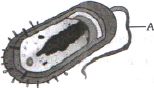
The given figure represents the structure of which organism?
A
Acellular
B
Prokaryotic
C
Eukaryotic
D
All of the above $(A), (B)$ and $(C)$
Solution
(B) The provided figure shows a bacterial cell.
Bacterial cells are characterized by the absence of a well-defined nucleus and membrane-bound organelles.
Such cells are classified as prokaryotic cells.
Therefore,the correct option is $(B)$.
Bacterial cells are characterized by the absence of a well-defined nucleus and membrane-bound organelles.
Such cells are classified as prokaryotic cells.
Therefore,the correct option is $(B)$.
0 likes
View Solution124
EasyMCQ
In the given figure,what structure does $A$ indicate?
A
Cilia
B
Flagellum
C
Pili
D
Mesosome
Solution
(B) The provided figure shows a bacterial cell. The structure labeled $A$ is a long,whip-like appendage extending from the cell surface,which is responsible for bacterial motility. This structure is known as the flagellum. Cilia are typically shorter and more numerous,pili are hair-like appendages involved in attachment or conjugation,and mesosomes are infoldings of the plasma membrane.
0 likes
View Solution125
EasyMCQ
Which of the following is $NOT$ correct for prokaryotic organisms?
A
Absence of nuclear membrane,chromosomes,and nucleolus.
B
Membrane-bound organelles are absent.
C
They do not develop or differentiate into multicellular forms.
D
Cells separate from each other after cell division.
Solution
(D) Prokaryotic organisms lack a well-defined nucleus,meaning they do not have a nuclear membrane,nucleolus,or membrane-bound organelles.
They are typically unicellular and do not differentiate into complex multicellular structures.
Option $D$ states that cells separate from each other after cell division. This is not a universal characteristic of prokaryotes,as many prokaryotic organisms (such as cyanobacteria) remain attached to each other in colonies or filamentous forms after division.
Therefore,the statement in option $D$ is not correct as a general feature of prokaryotic organisms.
They are typically unicellular and do not differentiate into complex multicellular structures.
Option $D$ states that cells separate from each other after cell division. This is not a universal characteristic of prokaryotes,as many prokaryotic organisms (such as cyanobacteria) remain attached to each other in colonies or filamentous forms after division.
Therefore,the statement in option $D$ is not correct as a general feature of prokaryotic organisms.
0 likes
View Solution126
MediumMCQ
Statement $X$: Prokaryotic cells do not separate after division.
Statement $Y$: They are surrounded by a slimy substance secreted by the cell.
Statement $Y$: They are surrounded by a slimy substance secreted by the cell.
A
Statement $X$ and Statement $Y$ are mutually inconsistent.
B
Statement $Y$ is the reason for Statement $X$.
C
Statement $X$ is the reason for Statement $Y$.
D
Statement $Y$ is not the reason for Statement $X$.
Solution
(B) Many prokaryotic cells,such as bacteria,often remain attached to each other after cell division due to the presence of a slimy layer or capsule secreted by the cells.
This slimy substance acts as a binding agent,preventing the daughter cells from separating immediately after binary fission.
Therefore,Statement $Y$ provides the biological explanation for the phenomenon described in Statement $X$.
This slimy substance acts as a binding agent,preventing the daughter cells from separating immediately after binary fission.
Therefore,Statement $Y$ provides the biological explanation for the phenomenon described in Statement $X$.
0 likes
View Solution127
EasyMCQ
Which cells divide very rapidly?
A
Eukaryotic cells
B
Prokaryotic cells
C
Yeast cells
D
Algal cells
Solution
(B) Prokaryotic cells,such as bacteria,possess a simpler cellular structure compared to eukaryotic cells. They lack a membrane-bound nucleus and complex organelles. Due to their small size and simple organization,they can replicate their $DNA$ and undergo binary fission very quickly,often in as little as $20$ minutes under optimal conditions. Therefore,prokaryotic cells are known for their rapid division.
0 likes
View Solution128
EasyMCQ
Which of the following is a complex cell envelope in bacterial cells?
A
Glycocalyx
B
Cell wall
C
Plasma membrane
D
All of the above
Solution
(D) In bacterial cells,the cell envelope consists of a tightly linked three-layered structure.
These layers are:
$1$. The outermost Glycocalyx.
$2$. The middle Cell wall.
$3$. The innermost Plasma membrane.
Together,these three layers act as a single protective unit,forming the complex cell envelope of the bacterium.
These layers are:
$1$. The outermost Glycocalyx.
$2$. The middle Cell wall.
$3$. The innermost Plasma membrane.
Together,these three layers act as a single protective unit,forming the complex cell envelope of the bacterium.
0 likes
View Solution129
EasyMCQ
Which of the following functions is associated with the cell membrane of a prokaryotic cell?
A
Converts $ADP$ into $ATP$.
B
Synthesizes certain polymers of the cell wall and capsule.
C
Acts as an attachment site for chromosomes.
D
All of the above.
0 likes
View Solution130
MediumMCQ
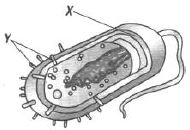
In the given figure,the structural components of $X$ and $Y$ are respectively ......... and ........ .
A
Glycocalyx,Protein
B
Flagellin,Tubulin
C
Protein,Glycocalyx
D
Cellulose,Lipid
Solution
(A) The provided figure represents a bacterial cell.
$X$ points to the outermost layer of the cell envelope,which is the glycocalyx.
$Y$ points to the pili or fimbriae,which are surface appendages primarily composed of protein subunits (pilin).
Therefore,$X$ is glycocalyx and $Y$ is protein.
$X$ points to the outermost layer of the cell envelope,which is the glycocalyx.
$Y$ points to the pili or fimbriae,which are surface appendages primarily composed of protein subunits (pilin).
Therefore,$X$ is glycocalyx and $Y$ is protein.
0 likes
View Solution131
MediumMCQ
Based on the complexity of cellular structure,organisms are classified into which types?
A
Prokaryotes and Eukaryotes
B
Producers and Consumers
C
Unicellular and Multicellular
D
Autotrophs and Heterotrophs
Solution
(A) Based on the complexity of cellular structure,organisms are primarily classified into two types:
$1$. $Prokaryotes$: These are organisms whose cells lack a membrane-bound nucleus and other membrane-bound organelles (e.g.,bacteria).
$2$. $Eukaryotes$: These are organisms whose cells contain a well-defined nucleus and membrane-bound organelles (e.g.,plants,animals,fungi,and protists).
Therefore,the correct classification based on cellular structure is $Prokaryotes$ and $Eukaryotes$.
$1$. $Prokaryotes$: These are organisms whose cells lack a membrane-bound nucleus and other membrane-bound organelles (e.g.,bacteria).
$2$. $Eukaryotes$: These are organisms whose cells contain a well-defined nucleus and membrane-bound organelles (e.g.,plants,animals,fungi,and protists).
Therefore,the correct classification based on cellular structure is $Prokaryotes$ and $Eukaryotes$.
0 likes
View Solution132
EasyMCQ
What is the region in bacteria where the genetic material is located called?
A
Nucleotide
B
Nucleosome
C
Nucleoid
D
Solenoid
Solution
(C) In prokaryotic cells like bacteria,the genetic material is not enclosed by a nuclear membrane. This region,which contains the circular $DNA$,is known as the $Nucleoid$ or $Genophore$. It is also referred to as the $Incipient$ $nucleus$ or $Prochromosome$.
0 likes
View Solution133
EasyMCQ
What is the nucleus of a bacterium known as?
A
Nucleoid
B
Gene
C
Chromosome
D
Nucleohistone
Solution
(A) Bacteria are prokaryotic organisms,meaning they lack a membrane-bound nucleus. The genetic material $(DNA)$ in bacteria is found in a specific region of the cytoplasm,which is not enclosed by a nuclear membrane. This region is known as the $Nucleoid$ (or $Genophore$). Therefore,the correct option is $A$.
0 likes
View Solution134
MediumMCQ
Which of the following components provides a sticky character to the bacterial cell?
A
Nuclear membrane
B
Plasma membrane
C
Glycocalyx
D
Cell wall
Solution
(C) : The $Glycocalyx$ is the outermost layer of the bacterial cell envelope. It is composed of non-cellulosic polysaccharides and may contain proteins. This layer provides a sticky or slimy character to the bacterial cell,which helps in attachment to surfaces and protects the cell from phagocytosis.
0 likes
View Solution135
MediumMCQ
Which structures perform the function of mitochondria in bacteria?
A
Nucleoid
B
Ribosomes
C
Cell wall
D
Mesosomes
Solution
(D) $(D) :$ Mesosomes are characteristic circular or villiform specializations of the bacterial cell membrane that develop as an ingrowth.
They consist of vesicles,tubules,and lamellae.
Mesosomes may be septal or lateral.
Septal mesosomes connect the nucleoid with the plasma membrane and assist in replication and septum formation during cell division.
Lateral mesosomes are not connected to the nucleoid,contain respiratory enzymes,and perform functions similar to eukaryotic mitochondria; hence,they are also called chondrioids.
They also increase the surface area of the plasma membrane and enzymatic contact.
They consist of vesicles,tubules,and lamellae.
Mesosomes may be septal or lateral.
Septal mesosomes connect the nucleoid with the plasma membrane and assist in replication and septum formation during cell division.
Lateral mesosomes are not connected to the nucleoid,contain respiratory enzymes,and perform functions similar to eukaryotic mitochondria; hence,they are also called chondrioids.
They also increase the surface area of the plasma membrane and enzymatic contact.
0 likes
View Solution136
MediumMCQ
In eubacteria,a cellular component that resembles eukaryotic cell is
A
plasma membrane
B
nucleus
C
ribosomes
D
cell wall
Solution
(A) The plasma membrane of eubacteria is structurally and functionally similar to the plasma membrane of eukaryotic cells,as both consist of a phospholipid bilayer with embedded proteins.
In contrast,the nucleus is absent in eubacteria (prokaryotes) while present in eukaryotes.
Ribosomes in eubacteria are $70S$ type,whereas in eukaryotes,they are $80S$ type (in the cytoplasm).
The cell wall of eubacteria is composed of peptidoglycan,whereas eukaryotic cell walls (if present,like in plants) are composed of cellulose.
In contrast,the nucleus is absent in eubacteria (prokaryotes) while present in eukaryotes.
Ribosomes in eubacteria are $70S$ type,whereas in eukaryotes,they are $80S$ type (in the cytoplasm).
The cell wall of eubacteria is composed of peptidoglycan,whereas eukaryotic cell walls (if present,like in plants) are composed of cellulose.
0 likes
View Solution137
MediumMCQ
Select the wrong statement.
A
Bacterial cell wall is made up of peptidoglycan.
B
Pili and fimbriae are mainly involved in motility of bacterial cells.
C
Cyanobacteria lack flagellated cells.
D
Mycoplasma is a wall-less microorganism.
Solution
(B) is the wrong statement. Pili and fimbriae are bacterial surface appendages that are not involved in locomotion.
$1$. Pili are elongated,tubular structures made of a special protein called pilin. They are involved in the formation of conjugation tubes for the transfer of genetic material.
$2$. Fimbriae are small,bristle-like fibers sprouting out of the cell. They are primarily involved in attaching bacteria to rocks in streams and also to the host tissues.
$3$. Bacterial motility is primarily facilitated by flagella,not pili or fimbriae.
$1$. Pili are elongated,tubular structures made of a special protein called pilin. They are involved in the formation of conjugation tubes for the transfer of genetic material.
$2$. Fimbriae are small,bristle-like fibers sprouting out of the cell. They are primarily involved in attaching bacteria to rocks in streams and also to the host tissues.
$3$. Bacterial motility is primarily facilitated by flagella,not pili or fimbriae.
0 likes
View Solution138
EasyMCQ
Which of the following structures is not found in a prokaryotic cell?
A
Mesosome
B
Plasma membrane
C
Nuclear envelope
D
Ribosome
Solution
(C) : $A$ prokaryotic cell is characterized by the absence of an organized nucleus and membrane-bound cell organelles.
$DNA$ is naked,i.e.,without a nuclear envelope,and lies coiled in the cytoplasm,which is commonly called the nucleoid or genophore.
Mesosomes,plasma membrane,and $70S$ ribosomes are present in a prokaryotic cell.
$DNA$ is naked,i.e.,without a nuclear envelope,and lies coiled in the cytoplasm,which is commonly called the nucleoid or genophore.
Mesosomes,plasma membrane,and $70S$ ribosomes are present in a prokaryotic cell.
0 likes
View Solution139
MediumMCQ
Which one of the following is not an inclusion body found in prokaryotes?
A
Glycogen granule
B
Polysome
C
Phosphate granule
D
Cyanophycean granule
Solution
(B) The correct answer is $B$.
Inclusion bodies are non-membrane-bound structures present in the cytoplasm of prokaryotic cells that serve as storage sites for reserve materials.
Examples of inclusion bodies include $Glycogen$ $granules$, $Phosphate$ $granules$, and $Cyanophycean$ $granules$.
$Polysomes$ (or $polyribosomes$) are not inclusion bodies; they are structures formed by the aggregation of multiple ribosomes attached to a single $mRNA$ strand during protein synthesis.
Inclusion bodies are non-membrane-bound structures present in the cytoplasm of prokaryotic cells that serve as storage sites for reserve materials.
Examples of inclusion bodies include $Glycogen$ $granules$, $Phosphate$ $granules$, and $Cyanophycean$ $granules$.
$Polysomes$ (or $polyribosomes$) are not inclusion bodies; they are structures formed by the aggregation of multiple ribosomes attached to a single $mRNA$ strand during protein synthesis.
0 likes
View Solution140
MediumMCQ
The term 'glycocalyx' is used for
A
a layer present between cell wall and membrane of bacteria
B
cell wall of bacteria
C
bacterial cell glyco-engineered to possess $N$-glycosylated proteins
D
a layer surrounding the cell wall of bacteria
Solution
(D) : Glycocalyx is a sticky,gelatinous material that collects outside the cell wall of bacteria to form an additional surface layer.
When this layer is firmly attached to the surface of the cell,it is called a capsule.
If it is loosely distributed around the cell,the glycocalyx is called a slime layer.
When this layer is firmly attached to the surface of the cell,it is called a capsule.
If it is loosely distributed around the cell,the glycocalyx is called a slime layer.
0 likes
View Solution141
EasyMCQ
Nucleoid is present in
A
Animal cell
B
Plant cells
C
Prokaryotes
D
Eukaryotes
Solution
(C) nucleoid is an irregularly shaped region within the cell of a prokaryote that contains all or most of the genetic material.
Unlike the nucleus of a eukaryotic cell,it is not surrounded by a nuclear membrane.
Prokaryotes,such as bacteria,lack a well-defined nucleus,and their genetic material is organized in this nucleoid region.
Therefore,the correct option is $C$.
Unlike the nucleus of a eukaryotic cell,it is not surrounded by a nuclear membrane.
Prokaryotes,such as bacteria,lack a well-defined nucleus,and their genetic material is organized in this nucleoid region.
Therefore,the correct option is $C$.
0 likes
View Solution142
MediumMCQ
Nucleoid is present in
A
Plant cell
B
Prokaryotic cell
C
Animal cell
D
Eukaryotic cell
Solution
(B) nucleoid is an irregularly shaped region within a prokaryotic cell that contains all or most of the genetic material.
Unlike the nucleus of a eukaryotic cell,the nucleoid is not surrounded by a nuclear membrane.
Prokaryotic cells,such as bacteria,lack a well-defined nucleus,and their $DNA$ is organized in this nucleoid region.
Therefore,the correct answer is $B$.
Unlike the nucleus of a eukaryotic cell,the nucleoid is not surrounded by a nuclear membrane.
Prokaryotic cells,such as bacteria,lack a well-defined nucleus,and their $DNA$ is organized in this nucleoid region.
Therefore,the correct answer is $B$.
0 likes
View Solution143
MediumMCQ
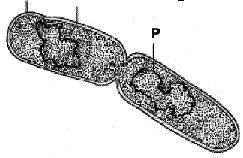
Identify $P$ from the figure.
A
$DNA$
B
$RNA$
C
Cytoplasm
D
Cell-membrane
Solution
(A) The provided figure represents a bacterial cell undergoing binary fission.
In prokaryotic cells like bacteria,the genetic material is not enclosed within a nuclear membrane.
It exists as a circular,double-stranded $DNA$ molecule located in a specific region of the cytoplasm known as the nucleoid.
In the diagram,the label $P$ points to this central,irregularly shaped region containing the genetic material,which is the $DNA$.
In prokaryotic cells like bacteria,the genetic material is not enclosed within a nuclear membrane.
It exists as a circular,double-stranded $DNA$ molecule located in a specific region of the cytoplasm known as the nucleoid.
In the diagram,the label $P$ points to this central,irregularly shaped region containing the genetic material,which is the $DNA$.
0 likes
View Solution144
MediumMCQ
Which one of the following organisms is not an example of a eukaryotic cell?
A
Paramecium caudatum
B
Escherichia coli
C
Euglena viridis
D
Amoeba proteus
Solution
(B) Eukaryotic cells are characterized by the presence of a well-defined nucleus and membrane-bound organelles.
$Paramecium caudatum$,$Euglena viridis$,and $Amoeba proteus$ are all members of the Kingdom Protista,which consists of unicellular eukaryotic organisms.
$Escherichia coli$ $(E. coli)$ is a bacterium,which is a prokaryotic organism.
Prokaryotic cells lack a well-defined nucleus and membrane-bound organelles.
Therefore,$Escherichia coli$ is not an example of a eukaryotic cell.
$Paramecium caudatum$,$Euglena viridis$,and $Amoeba proteus$ are all members of the Kingdom Protista,which consists of unicellular eukaryotic organisms.
$Escherichia coli$ $(E. coli)$ is a bacterium,which is a prokaryotic organism.
Prokaryotic cells lack a well-defined nucleus and membrane-bound organelles.
Therefore,$Escherichia coli$ is not an example of a eukaryotic cell.
0 likes
View Solution145
MediumMCQ
Read the sentences properly and select the correct option for mesosome.
$(i)$ Mesosome is an extension of the plasma membrane.
$(ii)$ These extensions are only in the form of spheres.
$(iii)$ Mesosomes help in cell wall formation and $DNA$ replication (not $RNA$ synthesis).
$(iv)$ They help in respiration.
$(i)$ Mesosome is an extension of the plasma membrane.
$(ii)$ These extensions are only in the form of spheres.
$(iii)$ Mesosomes help in cell wall formation and $DNA$ replication (not $RNA$ synthesis).
$(iv)$ They help in respiration.
A
All four are correct
B
$i, ii$ and $iii$ correct
C
$i, iii$ and $iv$ correct
D
$i, iv$ correct
Solution
(D) Mesosomes are specialized membranous structures formed by the extensions of the plasma membrane into the cell in the form of vesicles,tubules,and lamellae.
Statement $(i)$ is correct: Mesosomes are indeed extensions of the plasma membrane.
Statement $(ii)$ is incorrect: Mesosomes can exist in the form of vesicles,tubules,and lamellae,not just spheres.
Statement $(iii)$ is incorrect: While mesosomes help in cell wall formation,they assist in $DNA$ replication and distribution to daughter cells,not $RNA$ synthesis.
Statement $(iv)$ is correct: They help in respiration,secretion processes,and increasing the surface area of the plasma membrane.
Therefore,statements $(i)$ and $(iv)$ are correct.
Statement $(i)$ is correct: Mesosomes are indeed extensions of the plasma membrane.
Statement $(ii)$ is incorrect: Mesosomes can exist in the form of vesicles,tubules,and lamellae,not just spheres.
Statement $(iii)$ is incorrect: While mesosomes help in cell wall formation,they assist in $DNA$ replication and distribution to daughter cells,not $RNA$ synthesis.
Statement $(iv)$ is correct: They help in respiration,secretion processes,and increasing the surface area of the plasma membrane.
Therefore,statements $(i)$ and $(iv)$ are correct.
0 likes
View Solution146
EasyMCQ
It is an important structure of a bacterial cell that helps bacteria attach to rocks in streams; it is known as:
A
Flagella
B
Pili
C
Fimbriae
D
Plasmid
Solution
(C) Fimbriae are small,bristle-like fibers sprouting out of the cell surface in certain bacteria.
These structures are responsible for attaching bacteria to rocks in streams and also to the host tissues.
Flagella are primarily involved in motility.
Pili are elongated tubular structures made of a special protein,primarily involved in conjugation.
Plasmids are small,circular,extrachromosomal $DNA$ molecules.
These structures are responsible for attaching bacteria to rocks in streams and also to the host tissues.
Flagella are primarily involved in motility.
Pili are elongated tubular structures made of a special protein,primarily involved in conjugation.
Plasmids are small,circular,extrachromosomal $DNA$ molecules.
0 likes
View Solution147
EasyMCQ
What is the small,circular,extrachromosomal $DNA$ molecule found in a bacterial cell,separate from the main genomic $DNA$?
A
Ribosome
B
Plasmid
C
Peroxisome
D
Lysosome
Solution
(B) In bacterial cells,besides the main genomic $DNA$ (nucleoid),there are small,circular,double-stranded $DNA$ molecules present in the cytoplasm. These are known as plasmids. Plasmids are extrachromosomal $DNA$ that replicate independently of the main bacterial chromosome. They often carry genes that provide advantages to the bacteria,such as antibiotic resistance.
0 likes
View Solution148
EasyMCQ
Which of the following is absent in a prokaryotic cell?
A
Ribosomes
B
Cell membrane
C
Cell wall
D
None of the above
Solution
(D) Prokaryotic cells are characterized by the absence of a membrane-bound nucleus and other membrane-bound organelles. However,they possess a cell wall (in most cases),a cell membrane,and ribosomes (specifically $70S$ type) for protein synthesis. Since all the options listed $(A, B, C)$ are present in a typical prokaryotic cell,the correct answer is that none of these are absent.
0 likes
View Solution149
EasyMCQ
In some bacteria,the outer layer is a loose layer,which is known as........
A
Flagella
B
Plasma membrane
C
Slime layer
D
Mantle
Solution
(C) In bacteria,the glycocalyx is an outer covering that varies in composition and thickness among different species.
If the glycocalyx is loose and sheath-like,it is called a $Slime \ layer$.
If the glycocalyx is thick and tough,it is called a $Capsule$.
Therefore,the loose outer layer in some bacteria is known as the $Slime \ layer$.
If the glycocalyx is loose and sheath-like,it is called a $Slime \ layer$.
If the glycocalyx is thick and tough,it is called a $Capsule$.
Therefore,the loose outer layer in some bacteria is known as the $Slime \ layer$.
0 likes
View Solution150
MediumMCQ
Which is absent in a prokaryotic cell?
A
Mesosome
B
Ribosomes
C
Mitochondria
D
Nucleolus
Solution
(C) Prokaryotic cells are characterized by the absence of membrane-bound organelles and a well-defined nucleus.
$1$. $Mitochondria$ are membrane-bound organelles responsible for cellular respiration,which are absent in prokaryotes.
$2$. $Nucleolus$ is a dense region within the nucleus of eukaryotic cells where ribosomal $RNA$ is synthesized; since prokaryotes lack a true nucleus,they also lack a nucleolus.
$3$. $Mesosomes$ are infoldings of the plasma membrane found in prokaryotes.
$4$. $Ribosomes$ are present in both prokaryotic and eukaryotic cells (though of different sizes,$70S$ and $80S$ respectively).
Since both $Mitochondria$ and $Nucleolus$ are absent in prokaryotes,in the context of standard multiple-choice questions,$Mitochondria$ is the most commonly cited membrane-bound organelle absent in prokaryotes. However,$Nucleolus$ is also absent. Given the options,$Mitochondria$ is the standard answer for membrane-bound organelles.
$1$. $Mitochondria$ are membrane-bound organelles responsible for cellular respiration,which are absent in prokaryotes.
$2$. $Nucleolus$ is a dense region within the nucleus of eukaryotic cells where ribosomal $RNA$ is synthesized; since prokaryotes lack a true nucleus,they also lack a nucleolus.
$3$. $Mesosomes$ are infoldings of the plasma membrane found in prokaryotes.
$4$. $Ribosomes$ are present in both prokaryotic and eukaryotic cells (though of different sizes,$70S$ and $80S$ respectively).
Since both $Mitochondria$ and $Nucleolus$ are absent in prokaryotes,in the context of standard multiple-choice questions,$Mitochondria$ is the most commonly cited membrane-bound organelle absent in prokaryotes. However,$Nucleolus$ is also absent. Given the options,$Mitochondria$ is the standard answer for membrane-bound organelles.
0 likes
View SolutionCell: The Unit of Life — Prokaryotic cell · Frequently Asked Questions
1Are these Cell: The Unit of Life questions useful for JEE and NEET?
Yes. All questions in this section are mapped to JEE Main and NEET exam patterns. Previous year questions from JEE Main, NEET, GUJCET and state-level exams are included with full solutions.
2Can I switch to Hindi or Gujarati for these questions?
Yes. Use the language tabs in the hero section or the sidebar to view the same questions and solutions in English, Hindi or Gujarati.
3How do I generate a question paper from this subtopic?
Use the Vedclass Exam Paper Generator — select the chapter and subtopic, set difficulty, and generate Sets A, B, C, D automatically. First 3 chapters of every subject are free.
Vedclass Products
For Students
Vedclass Test Series
Mock tests in real JEE/NEET style with performance analysis. 5-day free trial.
Start Free TrialFor Teachers
Exam Paper Generator
Generate Set A/B/C/D papers from this chapter in 2 minutes. 3 chapters free.
Try FreeFor Institutes
Online Exam Module
Live online exams with unlimited students, 360° analytics & white-label branding.
See DemoFor Teachers & Institutes
Generate a Cell: The Unit of Life Exam Paper in 2 Minutes
Select subtopic & difficulty — Sets A, B, C, D auto-generated with No Repeat logic.
First 3 chapters of every subject are free — no payment required.