
A English
Plastids Questions in English
Class 11 Biology · Cell: The Unit of Life · Plastids
140+
Questions
English
Language
100%
With Solutions
Showing 39 of 140 questions in English
101
DifficultMCQ
What is common between chloroplasts,chromoplasts,and leucoplasts?
A
Presence of pigments
B
Possession of thylakoids and grana
C
Storage of starch,proteins,and lipids
D
Ability to multiply by a fission-like process
Solution
(D) Plastids are organelles found in plant cells and algae. They are classified into three types based on the type of pigments they contain: chloroplasts,chromoplasts,and leucoplasts.
All these plastids originate from proplastids and possess the ability to multiply by a fission-like process.
Chloroplasts contain chlorophyll and carotenoid pigments which are responsible for trapping light energy essential for photosynthesis.
Chromoplasts contain fat-soluble carotenoid pigments like carotene,xanthophylls,and others,which give plants their yellow,orange,or red color.
Leucoplasts are the colourless plastids of varied shapes and sizes with stored nutrients: amyloplasts store carbohydrates (starch),elaioplasts store oils and fats,and aleuroplasts store proteins.
Therefore,the common feature among all these plastids is their origin from proplastids and their ability to divide by fission.
All these plastids originate from proplastids and possess the ability to multiply by a fission-like process.
Chloroplasts contain chlorophyll and carotenoid pigments which are responsible for trapping light energy essential for photosynthesis.
Chromoplasts contain fat-soluble carotenoid pigments like carotene,xanthophylls,and others,which give plants their yellow,orange,or red color.
Leucoplasts are the colourless plastids of varied shapes and sizes with stored nutrients: amyloplasts store carbohydrates (starch),elaioplasts store oils and fats,and aleuroplasts store proteins.
Therefore,the common feature among all these plastids is their origin from proplastids and their ability to divide by fission.
0 likes
View Solution102
EasyMCQ
Many cells function properly and divide mitotically even though they do not have
A
plasma membrane
B
cytoskeleton
C
mitochondria
D
plastids
Solution
(D) Many cells,such as animal cells,function properly and undergo mitotic division even in the absence of plastids. Plastids are organelles found primarily in plant cells and algae,responsible for photosynthesis and storage,but they are not essential for the basic cellular processes of metabolism or mitosis in all cell types.
0 likes
View Solution103
Easy
Where are plastids seen? Explain their types and functions in short.
Solution
(N/A) $\Rightarrow$ Plastids are found in all plant cells and in euglenoids.
$\Rightarrow$ These are easily observed under the microscope as they are large. They bear some specific pigments,thus imparting specific colours to the plants.
$\Rightarrow$ Based on the type of pigments,plastids can be classified into three types:
$(a)$ Chloroplasts,$(b)$ Chromoplasts,and $(c)$ Leucoplasts.
$(a)$ Chloroplasts: These contain chlorophyll and carotenoid pigments,which are responsible for trapping light energy essential for photosynthesis.
$(b)$ Chromoplasts: In these,fat-soluble carotenoid pigments like carotene,xanthophylls,and others are present. This gives the plant parts a yellow,orange,or red colour.
$(c)$ Leucoplasts: These are colourless plastids of varied shapes and sizes with stored nutrients:
$(i)$ Amyloplasts: Store carbohydrates (e.g.,potato).
$(ii)$ Elaioplasts: Store oils and fats.
$(iii)$ Aleuroplasts: Store proteins.
$\Rightarrow$ These are easily observed under the microscope as they are large. They bear some specific pigments,thus imparting specific colours to the plants.
$\Rightarrow$ Based on the type of pigments,plastids can be classified into three types:
$(a)$ Chloroplasts,$(b)$ Chromoplasts,and $(c)$ Leucoplasts.
$(a)$ Chloroplasts: These contain chlorophyll and carotenoid pigments,which are responsible for trapping light energy essential for photosynthesis.
$(b)$ Chromoplasts: In these,fat-soluble carotenoid pigments like carotene,xanthophylls,and others are present. This gives the plant parts a yellow,orange,or red colour.
$(c)$ Leucoplasts: These are colourless plastids of varied shapes and sizes with stored nutrients:
$(i)$ Amyloplasts: Store carbohydrates (e.g.,potato).
$(ii)$ Elaioplasts: Store oils and fats.
$(iii)$ Aleuroplasts: Store proteins.
0 likes
View Solution104
Easy
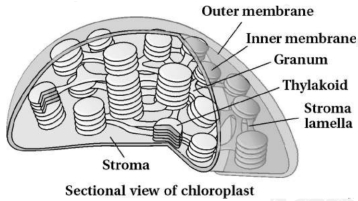
Describe the structure and function of chloroplasts with a diagram.
Solution
(N/A) $ \Rightarrow $ The majority of the chloroplasts of green plants are found in the mesophyll cells of the leaves.
$ \Rightarrow $ These are lens-shaped, oval, spherical, discoid, or even ribbon-like organelles.
$ \Rightarrow $ They have a variable length $(5-10 \mu m)$ and width $(2-4 \mu m)$.
$ \Rightarrow $ Their number varies from $1$ per cell in Chlamydomonas, a green alga, to $20-40$ per cell in the mesophyll.
$ \Rightarrow $ Chloroplasts are double-membrane bound. Of the two, the inner chloroplast membrane is relatively less permeable.
$ \Rightarrow $ The space limited by the inner membrane of the chloroplast is called the stroma. A number of organized flattened membranous sacs called thylakoids are present in the stroma.
$ \Rightarrow $ Thylakoids are arranged in stacks like piles of coins called grana (singular: granum) or the intergranal thylakoids.
$ \Rightarrow $ There are flat membranous tubules called the stroma lamellae connecting the thylakoids of the different grana.
$ \Rightarrow $ The membrane of the thylakoids encloses a space called a lumen.
$ \Rightarrow $ The stroma of the chloroplast contains enzymes required for the synthesis of carbohydrates and proteins.
$ \Rightarrow $ It also contains small, double-stranded circular $DNA$ molecules and ribosomes.
$ \Rightarrow $ The ribosomes of the chloroplasts are smaller $(70S)$ than the cytoplasmic ribosomes $(80S)$.
$ \Rightarrow $ These are lens-shaped, oval, spherical, discoid, or even ribbon-like organelles.
$ \Rightarrow $ They have a variable length $(5-10 \mu m)$ and width $(2-4 \mu m)$.
$ \Rightarrow $ Their number varies from $1$ per cell in Chlamydomonas, a green alga, to $20-40$ per cell in the mesophyll.
$ \Rightarrow $ Chloroplasts are double-membrane bound. Of the two, the inner chloroplast membrane is relatively less permeable.
$ \Rightarrow $ The space limited by the inner membrane of the chloroplast is called the stroma. A number of organized flattened membranous sacs called thylakoids are present in the stroma.
$ \Rightarrow $ Thylakoids are arranged in stacks like piles of coins called grana (singular: granum) or the intergranal thylakoids.
$ \Rightarrow $ There are flat membranous tubules called the stroma lamellae connecting the thylakoids of the different grana.
$ \Rightarrow $ The membrane of the thylakoids encloses a space called a lumen.
$ \Rightarrow $ The stroma of the chloroplast contains enzymes required for the synthesis of carbohydrates and proteins.
$ \Rightarrow $ It also contains small, double-stranded circular $DNA$ molecules and ribosomes.
$ \Rightarrow $ The ribosomes of the chloroplasts are smaller $(70S)$ than the cytoplasmic ribosomes $(80S)$.
0 likes
View Solution105
EasyMCQ
State the types of leucoplasts.
A
Amyloplasts,Elaioplasts,Aleuroplasts
B
Chloroplasts,Chromoplasts,Leucoplasts
C
Amyloplasts,Chloroplasts,Aleuroplasts
D
Elaioplasts,Chromoplasts,Amyloplasts
Solution
(A) Leucoplasts are colorless plastids of varied shapes and sizes with stored nutrients.
$(i)$ $Amyloplasts$: Store carbohydrates (starch),e.g.,potato.
$(ii)$ $Elaioplasts$: Store oils and fats.
$(iii)$ $Aleuroplasts$: Store proteins.
$(i)$ $Amyloplasts$: Store carbohydrates (starch),e.g.,potato.
$(ii)$ $Elaioplasts$: Store oils and fats.
$(iii)$ $Aleuroplasts$: Store proteins.
0 likes
View Solution106
Medium
Explain the structure of the chloroplast.
Solution
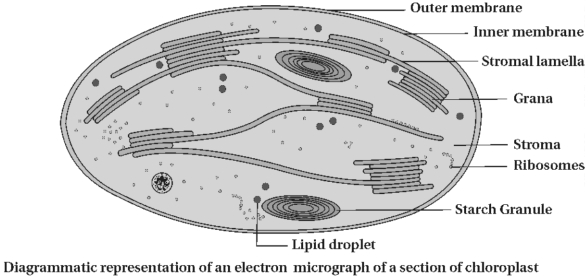
(N/A) The chloroplast is a double-membrane-bound organelle. Its structure consists of the following components:
$1$. Membrane System: It consists of grana,stroma lamellae,and the fluid stroma. The membrane system is responsible for trapping light energy and for the synthesis of $ATP$ and $NADPH$.
$2$. Stroma: The stroma is the fluid-filled matrix where enzymatic reactions occur. These reactions incorporate $CO_{2}$ into the plant,leading to the synthesis of sugar,which is subsequently stored as starch.
$3$. Functional Division: There is a clear division of labour within the chloroplast.
- Light Reactions: The reactions occurring in the membrane system are directly light-driven and are called light reactions.
- Dark Reactions: The reactions occurring in the stroma are not directly light-driven but depend on the products of light reactions ($ATP$ and $NADPH$). By convention,these are called dark reactions,though this does not mean they occur in darkness or are independent of light.
$1$. Membrane System: It consists of grana,stroma lamellae,and the fluid stroma. The membrane system is responsible for trapping light energy and for the synthesis of $ATP$ and $NADPH$.
$2$. Stroma: The stroma is the fluid-filled matrix where enzymatic reactions occur. These reactions incorporate $CO_{2}$ into the plant,leading to the synthesis of sugar,which is subsequently stored as starch.
$3$. Functional Division: There is a clear division of labour within the chloroplast.
- Light Reactions: The reactions occurring in the membrane system are directly light-driven and are called light reactions.
- Dark Reactions: The reactions occurring in the stroma are not directly light-driven but depend on the products of light reactions ($ATP$ and $NADPH$). By convention,these are called dark reactions,though this does not mean they occur in darkness or are independent of light.
0 likes
View Solution107
Medium
Is there a species-specific or region-specific type of plastid? How does one distinguish one from the other?
Solution
(A) $\therefore$ Plastids are found in all plant cells and in euglenoids.
$\Rightarrow$ These are easily observed under the microscope as they are large.
$\Rightarrow$ They contain specific pigments,thus imparting specific colours to the plants.
$\Rightarrow$ Based on the type of pigments,plastids are classified into three types: $(a)$ Chloroplasts,$(b)$ Chromoplasts,and $(c)$ Leucoplasts.
$(a)$ Chloroplasts: These contain chlorophyll and carotenoid pigments,which are responsible for trapping light energy essential for photosynthesis.
$(b)$ Chromoplasts: These contain fat-soluble carotenoid pigments like carotene,xanthophylls,and others. This gives the plant parts a yellow,orange,or red colour.
$(c)$ Leucoplasts: These are colourless plastids of varied shapes and sizes that store nutrients.
$(i)$ Amyloplasts: Store carbohydrates,e.g.,potato.
$(ii)$ Elaioplasts: Store oils and fats.
$(iii)$ Aleuroplasts: Store proteins.
$\Rightarrow$ These are easily observed under the microscope as they are large.
$\Rightarrow$ They contain specific pigments,thus imparting specific colours to the plants.
$\Rightarrow$ Based on the type of pigments,plastids are classified into three types: $(a)$ Chloroplasts,$(b)$ Chromoplasts,and $(c)$ Leucoplasts.
$(a)$ Chloroplasts: These contain chlorophyll and carotenoid pigments,which are responsible for trapping light energy essential for photosynthesis.
$(b)$ Chromoplasts: These contain fat-soluble carotenoid pigments like carotene,xanthophylls,and others. This gives the plant parts a yellow,orange,or red colour.
$(c)$ Leucoplasts: These are colourless plastids of varied shapes and sizes that store nutrients.
$(i)$ Amyloplasts: Store carbohydrates,e.g.,potato.
$(ii)$ Elaioplasts: Store oils and fats.
$(iii)$ Aleuroplasts: Store proteins.
0 likes
View Solution108
Medium
Are the different types of plastids interchangeable? If yes,give examples where they are getting converted from one type to another.
Solution
(N/A) Yes,plastids are interchangeable and can be converted from one form to another based on the physiological requirements of the plant cell.
$(i)$ In $Capsicum$ (chilli),the ovary is initially green (containing chloroplasts),but as the fruit ripens,the chloroplasts are converted into chromoplasts,giving the fruit its red color.
$(ii)$ In potato tubers,leucoplasts (colourless plastids) are present underground. When these tubers are exposed to sunlight,they develop chlorophyll and are converted into chloroplasts,turning the skin green.
$(iii)$ During the ripening of fruits like tomatoes,chloroplasts (green) are converted into chromoplasts (red/orange) due to the synthesis of carotenoids and the breakdown of chlorophyll.
$(i)$ In $Capsicum$ (chilli),the ovary is initially green (containing chloroplasts),but as the fruit ripens,the chloroplasts are converted into chromoplasts,giving the fruit its red color.
$(ii)$ In potato tubers,leucoplasts (colourless plastids) are present underground. When these tubers are exposed to sunlight,they develop chlorophyll and are converted into chloroplasts,turning the skin green.
$(iii)$ During the ripening of fruits like tomatoes,chloroplasts (green) are converted into chromoplasts (red/orange) due to the synthesis of carotenoids and the breakdown of chlorophyll.
0 likes
View Solution109
MediumMCQ
Tomatoes,carrots,and chillies are red in colour due to the presence of a specific pigment. Name the pigment. Is it a photosynthetic pigment?
A
Lycopene; Yes
B
Lycopene; No
C
Chlorophyll; Yes
D
Carotene; No
Solution
(B) The red colour in tomatoes,carrots,and chillies is primarily due to the presence of the pigment $Lycopene$.
$Lycopene$ belongs to the group of pigments known as $Chromoplasts$.
$Chromoplasts$ are plastids that contain carotenoids and are responsible for the yellow,orange,or red colours in various plant parts.
$Lycopene$ is not a photosynthetic pigment because it does not participate in the light-dependent reactions of photosynthesis; it primarily serves as an accessory pigment or for coloration to attract pollinators/seed dispersers.
Photosynthetic pigments are primarily $Chlorophylls$ ($a$ and $b$) and certain accessory pigments like $Carotenoids$ (which include $Xanthophylls$ and $Carotenes$ that aid in light harvesting).
$Lycopene$ belongs to the group of pigments known as $Chromoplasts$.
$Chromoplasts$ are plastids that contain carotenoids and are responsible for the yellow,orange,or red colours in various plant parts.
$Lycopene$ is not a photosynthetic pigment because it does not participate in the light-dependent reactions of photosynthesis; it primarily serves as an accessory pigment or for coloration to attract pollinators/seed dispersers.
Photosynthetic pigments are primarily $Chlorophylls$ ($a$ and $b$) and certain accessory pigments like $Carotenoids$ (which include $Xanthophylls$ and $Carotenes$ that aid in light harvesting).
0 likes
View Solution110
Medium
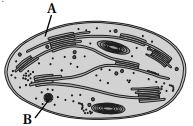
Examine the figure:
$(a)$ Is this structure present in an animal cell or a plant cell?
$(b)$ Can these be passed on to the progeny? How?
$(c)$ Name the metabolic processes taking place in the regions marked $(A)$ and $(B)$.
$(a)$ Is this structure present in an animal cell or a plant cell?
$(b)$ Can these be passed on to the progeny? How?
$(c)$ Name the metabolic processes taking place in the regions marked $(A)$ and $(B)$.
Solution
(N/A) The figure shows a chloroplast,which is a characteristic organelle of plant cells. It contains thylakoids arranged in grana,which are the sites of photosynthesis.
$(b)$ Yes,chloroplasts can be passed on to the progeny. During cell division,chloroplasts are distributed into daughter cells through the cytoplasm. Furthermore,because they contain their own circular $DNA$,they are capable of semi-autonomous replication.
$(c)$ $(A)$ represents the stroma,which is the site of the dark reaction (Calvin cycle or biosynthetic phase) of photosynthesis.
$(B)$ represents the chloroplast $DNA$ (cp$DNA$),which carries genetic information necessary for the synthesis of some chloroplast proteins and is responsible for the semi-autonomous nature of the organelle.
$(b)$ Yes,chloroplasts can be passed on to the progeny. During cell division,chloroplasts are distributed into daughter cells through the cytoplasm. Furthermore,because they contain their own circular $DNA$,they are capable of semi-autonomous replication.
$(c)$ $(A)$ represents the stroma,which is the site of the dark reaction (Calvin cycle or biosynthetic phase) of photosynthesis.
$(B)$ represents the chloroplast $DNA$ (cp$DNA$),which carries genetic information necessary for the synthesis of some chloroplast proteins and is responsible for the semi-autonomous nature of the organelle.
0 likes
View Solution111
MediumMCQ
Match the Column-$I$ with Column-$II$:
| Column-$I$ | Column-$II$ |
|---|---|
| $(i)$ Elaioplast | $(a)$ Storage of starch |
| $(ii)$ Aleuroplast | $(b)$ Storage of fat |
| $(iii)$ Amyloplast | $(c)$ Storage of protein |
| $(iv)$ Chromoplast | $(d)$ Colored pigments |
A
$i-a, ii-c, iii-d, iv-b$
B
$i-d, ii-d, iii-c, iv-a$
C
$i-d, ii-c, iii-d, iv-a$
D
$i-b, ii-c, iii-a, iv-d$
Solution
(D) The correct matching is as follows:
$(i)$ Elaioplast: These are leucoplasts specialized for the storage of fats or oils.
$(ii)$ Aleuroplast: These are leucoplasts specialized for the storage of proteins.
$(iii)$ Amyloplast: These are leucoplasts specialized for the storage of starch (carbohydrates).
$(iv)$ Chromoplast: These contain fat-soluble carotenoid pigments like carotene,xanthophylls,etc.,which provide yellow,orange,or red colors to plant parts.
Therefore,the correct sequence is $(i-b, ii-c, iii-a, iv-d)$.
The correct option is $(D)$.
$(i)$ Elaioplast: These are leucoplasts specialized for the storage of fats or oils.
$(ii)$ Aleuroplast: These are leucoplasts specialized for the storage of proteins.
$(iii)$ Amyloplast: These are leucoplasts specialized for the storage of starch (carbohydrates).
$(iv)$ Chromoplast: These contain fat-soluble carotenoid pigments like carotene,xanthophylls,etc.,which provide yellow,orange,or red colors to plant parts.
Therefore,the correct sequence is $(i-b, ii-c, iii-a, iv-d)$.
The correct option is $(D)$.
0 likes
View Solution112
EasyMCQ
Bright colour of petals is due to the presence of
A
Chloroplast
B
Anthocyanin
C
Chromoplast
D
Leucoplast
Solution
(B) The bright colors of petals are primarily due to the presence of pigments like anthocyanins,which are water-soluble pigments found in the vacuoles of plant cells. While chromoplasts also contain pigments like carotenoids that provide yellow,orange,or red colors,anthocyanins are specifically responsible for many of the vibrant red,purple,and blue hues observed in flowers.
0 likes
View Solution113
MediumMCQ
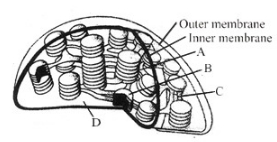
Which of the following options correctly matches $A, B, C,$ and $D$ indicated in the given sectional view of a chloroplast?
A
$A -$ Thylakoid,$B -$ Stromal lamella,$C -$ Stroma,$D -$ Granum
B
$A -$ Granum,$B -$ Thylakoid,$C -$ Stromal lamella,$D -$ Stroma
C
$A -$ Thylakoid,$B -$ Granum,$C -$ Stromal lamella,$D -$ Stroma
D
$A -$ Granum,$B -$ Thylakoid,$C -$ Stroma,$D -$ Stromal lamella
Solution
(B) In the given diagram of a chloroplast,the parts marked as $A, B, C,$ and $D$ are respectively Granum,Thylakoid,Stromal lamella,and Stroma.
$1$. $A$ represents the Granum,which is a stack of thylakoids.
$2$. $B$ represents the Thylakoid,which is a single flattened sac-like membrane.
$3$. $C$ represents the Stromal lamella,which connects the grana of different thylakoid stacks.
$4$. $D$ represents the Stroma,which is the fluid-filled space containing enzymes,$DNA$,and ribosomes.
$1$. $A$ represents the Granum,which is a stack of thylakoids.
$2$. $B$ represents the Thylakoid,which is a single flattened sac-like membrane.
$3$. $C$ represents the Stromal lamella,which connects the grana of different thylakoid stacks.
$4$. $D$ represents the Stroma,which is the fluid-filled space containing enzymes,$DNA$,and ribosomes.
0 likes
View Solution114
MediumMCQ
The given diagram shows the sectional view of a chloroplast. Identify the parts labelled as $A, B, C$ and $D$.
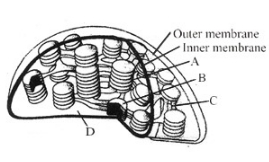
A
$A -$ Thylakoid,$B -$ Stroma lamella,$C -$ Stroma,$D -$ Granum
B
$A -$ Granum,$B -$ Thylakoid,$C -$ Stroma lamella,$D -$ Stroma
C
$A -$ Thylakoid,$B -$ Granum,$C -$ Stroma lamella,$D -$ Stroma
D
$A -$ Granum,$B -$ Thylakoid,$C -$ Stroma,$D -$ Stroma lamella
Solution
(C) In the given diagram of a chloroplast,the structures are labelled as follows:
$A$ represents the Thylakoid,which is a flattened sac-like structure.
$B$ represents the Granum,which is a stack of thylakoids.
$C$ represents the Stroma lamella,which connects the grana of different thylakoids.
$D$ represents the Stroma,which is the fluid-filled space surrounding the thylakoids.
Therefore,the correct identification is $A -$ Thylakoid,$B -$ Granum,$C -$ Stroma lamella,$D -$ Stroma.
$A$ represents the Thylakoid,which is a flattened sac-like structure.
$B$ represents the Granum,which is a stack of thylakoids.
$C$ represents the Stroma lamella,which connects the grana of different thylakoids.
$D$ represents the Stroma,which is the fluid-filled space surrounding the thylakoids.
Therefore,the correct identification is $A -$ Thylakoid,$B -$ Granum,$C -$ Stroma lamella,$D -$ Stroma.
0 likes
View Solution115
MediumMCQ
Plastids are found in
A
all animal cells.
B
some animal cells.
C
all plant cells.
D
all plant cells and euglenoids.
Solution
(D) Plastids are organelles found in the cells of plants and algae. They are responsible for manufacturing and storing food. Plastids are present in all plant cells and in euglenoids (e.g.,Euglena). They are absent in animal cells.
0 likes
View Solution116
MediumMCQ
Plastids storing fat are called
A
Elaioplasts
B
Sphaerosomes
C
Aleuroplasts
D
Pyrenoids
Solution
(A) Elaioplasts are a type of leucoplast that is specialized for the storage of lipids in plants.
Elaioplasts house oil body deposits as rounded plastoglobuli,which are essentially fat droplets.
Elaioplasts house oil body deposits as rounded plastoglobuli,which are essentially fat droplets.
0 likes
View Solution117
MediumMCQ
Which of these is wrongly matched?
A
Chloroplasts - Chlorophyll
B
Elaioplasts - Starch
C
Chromoplasts - Carotenoids
D
Amyloplasts - Carbohydrates
Solution
(B) Elaioplasts are colourless plastids that store oils and fats (lipids).
Amyloplasts are plastids that store carbohydrates like starch.
Chromoplasts contain fat-soluble carotenoid pigments like carotene and xanthophylls,which give yellow,orange,or red colours to plant parts.
Chloroplasts contain chlorophyll and carotenoid pigments,which are responsible for trapping light energy for photosynthesis.
Therefore,the pair $Elaioplasts - Starch$ is wrongly matched because Elaioplasts store lipids,while Amyloplasts store starch.
Amyloplasts are plastids that store carbohydrates like starch.
Chromoplasts contain fat-soluble carotenoid pigments like carotene and xanthophylls,which give yellow,orange,or red colours to plant parts.
Chloroplasts contain chlorophyll and carotenoid pigments,which are responsible for trapping light energy for photosynthesis.
Therefore,the pair $Elaioplasts - Starch$ is wrongly matched because Elaioplasts store lipids,while Amyloplasts store starch.
0 likes
View Solution118
MediumMCQ
Which one of the following cellular parts is correctly matched with its characteristics?
A
Centrioles - Sites for active $RNA$ synthesis.
B
Lysosomes - Optimally active at a $pH$ of about $8.5$.
C
Thylakoids - Flattened membranous sacs forming the grana of chloroplasts.
D
Ribosomes - Those on chloroplasts are larger $(80S)$ while those in the cytoplasm are smaller $(70S)$.
Solution
(C) Centrioles serve as basal bodies for cilia and flagella and are involved in spindle formation during cell division.
Lysosomes are membrane-bound organelles containing hydrolytic enzymes,which are optimally active at an acidic $pH$ (near $pH$ $5$).
Thylakoids are flattened,sac-like membranous structures found within the stroma of chloroplasts. These thylakoids are stacked like coins to form structures called grana.
Ribosomes in the cytoplasm of eukaryotic cells are $80S$,while those in chloroplasts and mitochondria are $70S$.
Lysosomes are membrane-bound organelles containing hydrolytic enzymes,which are optimally active at an acidic $pH$ (near $pH$ $5$).
Thylakoids are flattened,sac-like membranous structures found within the stroma of chloroplasts. These thylakoids are stacked like coins to form structures called grana.
Ribosomes in the cytoplasm of eukaryotic cells are $80S$,while those in chloroplasts and mitochondria are $70S$.
0 likes
View Solution119
EasyMCQ
The plastids which store proteins are
A
Aleuroplasts
B
Elaioplasts
C
Amyloplasts
D
Chromoplasts
Solution
(A) Aleuroplasts are specialized leucoplasts that store proteins.
Elaioplasts are plastids that store oils and fats.
Amyloplasts are plastids that store starch.
Chromoplasts contain pigments like carotene and xanthophylls,providing color to plant parts.
Elaioplasts are plastids that store oils and fats.
Amyloplasts are plastids that store starch.
Chromoplasts contain pigments like carotene and xanthophylls,providing color to plant parts.
0 likes
View Solution120
MediumMCQ
Which of the following plastids is coloured and contains carotenoids?
A
Aleuroplast
B
Elaioplast
C
Amyloplast
D
Chromoplast
Solution
(D) Chromoplasts are coloured plastids that contain fat-soluble carotenoid pigments like carotene and xanthophylls.
These pigments provide yellow,orange,or red colours to various plant parts.
Aleuroplasts store proteins,elaioplasts store oils and fats,and amyloplasts store carbohydrates like starch.
These pigments provide yellow,orange,or red colours to various plant parts.
Aleuroplasts store proteins,elaioplasts store oils and fats,and amyloplasts store carbohydrates like starch.
0 likes
View Solution121
MediumMCQ
The orange colour of carrot root is due to the presence of
A
Aleuroplast
B
Elaioplast
C
Chromoplast
D
Amyloplast
Solution
(C) Plastids are classified based on the type of pigments they contain.
$1$. $Chromoplasts$ contain fat-soluble carotenoid pigments like carotene and xanthophylls, which provide yellow, orange, or red colours to plant parts like carrot roots and flowers.
$2$. $Aleuroplasts$ store proteins.
$3$. $Elaioplasts$ store oils and fats.
$4$. $Amyloplasts$ store carbohydrates like starch.
Therefore, the orange colour of carrot root is due to the presence of $Chromoplasts$.
$1$. $Chromoplasts$ contain fat-soluble carotenoid pigments like carotene and xanthophylls, which provide yellow, orange, or red colours to plant parts like carrot roots and flowers.
$2$. $Aleuroplasts$ store proteins.
$3$. $Elaioplasts$ store oils and fats.
$4$. $Amyloplasts$ store carbohydrates like starch.
Therefore, the orange colour of carrot root is due to the presence of $Chromoplasts$.
0 likes
View Solution122
MediumMCQ
Thylakoids are present in
A
Mitochondria
B
Vacuoles
C
Chloroplast
D
Ribosomes
Solution
(C) Thylakoids are flattened,sac-like membranous structures found within the stroma of chloroplasts.
They contain chlorophyll and other photosynthetic pigments,which are essential for the light-dependent reactions of photosynthesis.
They contain chlorophyll and other photosynthetic pigments,which are essential for the light-dependent reactions of photosynthesis.
0 likes
View Solution123
MediumMCQ
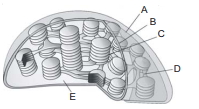
Consider the following five statements $(A$ to $E)$ with respect to the chloroplast shown below. Select the correct option stating which ones are True $(T)$ and which ones are False $(F)$.
$A$. It is impermeable and lacks porins.
$B$. It is selectively permeable,having carrier proteins for transport.
$C$. Stacked thylakoids one over other which is the site of production of assimilatory power.
$D$. Present between two grana and contains enzymes of dark reaction.
$E$. It contains enzymes for the synthesis of sugar and proteins.
$A$. It is impermeable and lacks porins.
$B$. It is selectively permeable,having carrier proteins for transport.
$C$. Stacked thylakoids one over other which is the site of production of assimilatory power.
$D$. Present between two grana and contains enzymes of dark reaction.
$E$. It contains enzymes for the synthesis of sugar and proteins.
| $A$ | $B$ | $C$ | $D$ | $E$ |
A
| $F$ | $T$ | $T$ | $T$ | $T$ |
B
| $F$ | $T$ | $T$ | $F$ | $T$ |
C
| $T$ | $F$ | $T$ | $T$ | $T$ |
D
| $T$ | $F$ | $F$ | $T$ | $T$ |
Solution
(B) . False: The outer membrane of the chloroplast is permeable to small molecules and ions due to the presence of porins.
$B$. True: The inner membrane is selectively permeable and contains specific carrier proteins for transport.
$C$. True: Grana are stacks of thylakoids where the light-dependent reactions occur,producing assimilatory power ($ATP$ and $NADPH$).
$D$. False: $D$ represents the stroma lamellae (or fret channels),which connect grana. They contain $PSI$ and $ATP$ synthase,but the enzymes for the dark reaction (Calvin cycle) are located in the stroma $(E)$.
$E$. True: The stroma contains enzymes required for the synthesis of sugars (Calvin cycle) and proteins (due to the presence of chloroplast $DNA$ and ribosomes).
$B$. True: The inner membrane is selectively permeable and contains specific carrier proteins for transport.
$C$. True: Grana are stacks of thylakoids where the light-dependent reactions occur,producing assimilatory power ($ATP$ and $NADPH$).
$D$. False: $D$ represents the stroma lamellae (or fret channels),which connect grana. They contain $PSI$ and $ATP$ synthase,but the enzymes for the dark reaction (Calvin cycle) are located in the stroma $(E)$.
$E$. True: The stroma contains enzymes required for the synthesis of sugars (Calvin cycle) and proteins (due to the presence of chloroplast $DNA$ and ribosomes).
0 likes
View Solution124
MediumMCQ
$A$: Chromoplasts are coloured plastids found in the corolla and ripened fruits.
$R$: They contain water-soluble chlorophyll and carotenoid pigments.
$R$: They contain water-soluble chlorophyll and carotenoid pigments.
A
Assertion and Reason both are correct and Reason is the correct explanation of Assertion.
B
Assertion and Reason both are correct but Reason is not the correct explanation of Assertion.
C
Assertion is correct,but Reason is incorrect.
D
Both Assertion and Reason are incorrect.
Solution
(C) Chromoplasts are indeed plastids that contain fat-soluble carotenoids and are responsible for the yellow,orange,or red colours in flowers and fruits. This makes the Assertion correct.
However,the Reason is incorrect because chlorophyll and carotenoid pigments are fat-soluble (lipophilic),not water-soluble. Therefore,the statement in the Reason is false.
However,the Reason is incorrect because chlorophyll and carotenoid pigments are fat-soluble (lipophilic),not water-soluble. Therefore,the statement in the Reason is false.
0 likes
View Solution125
MediumMCQ
$A$: Chloroplast is a semi-autonomous organelle.
$R$: The ribosomes of the chloroplast are smaller than cytoplasmic ribosomes.
$R$: The ribosomes of the chloroplast are smaller than cytoplasmic ribosomes.
A
Assertion and Reason both are correct and Reason is the correct explanation of Assertion.
B
Assertion and Reason both are correct but Reason is not the correct explanation of Assertion.
C
Assertion is correct,but Reason is incorrect.
D
Both Assertion and Reason are incorrect.
Solution
(B) Chloroplasts are considered semi-autonomous organelles because they contain their own circular $DNA$ and $70S$ ribosomes,which allow them to synthesize some of their own proteins.
The ribosomes found in chloroplasts are $70S$ type,whereas the ribosomes found in the cytoplasm of eukaryotic cells are $80S$ type.
Since $70S$ ribosomes are smaller than $80S$ ribosomes,the Reason is correct.
However,the fact that chloroplast ribosomes are smaller is not the reason why the chloroplast is semi-autonomous; rather,the presence of its own genetic material $(DNA)$ and protein-synthesizing machinery makes it semi-autonomous.
Therefore,both statements are correct,but the Reason is not the correct explanation of the Assertion.
The ribosomes found in chloroplasts are $70S$ type,whereas the ribosomes found in the cytoplasm of eukaryotic cells are $80S$ type.
Since $70S$ ribosomes are smaller than $80S$ ribosomes,the Reason is correct.
However,the fact that chloroplast ribosomes are smaller is not the reason why the chloroplast is semi-autonomous; rather,the presence of its own genetic material $(DNA)$ and protein-synthesizing machinery makes it semi-autonomous.
Therefore,both statements are correct,but the Reason is not the correct explanation of the Assertion.
0 likes
View Solution126
MediumMCQ
Maximum number of chloroplasts are found in
A
Root
B
Stem
C
Leaves
D
Shoot tip
Solution
(C) Chloroplasts are the organelles responsible for photosynthesis. Since leaves are the primary photosynthetic organs of a plant,they contain the highest density of chloroplasts,particularly within the mesophyll cells.
0 likes
View Solution127
MediumMCQ
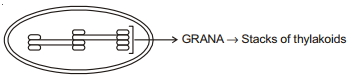
Grana present in chloroplast refers to
A
Stroma lamellae
B
Stacks of quantasomes
C
Stacks of thylakoids
D
Double membranous envelope
Solution
(C) Inside the chloroplast,there is a system of flattened,sac-like structures called thylakoids.
These thylakoids are arranged in piles or stacks,which are known as grana (singular: granum).
Therefore,grana are defined as the stacks of thylakoids where the light-dependent reactions of photosynthesis occur.
These thylakoids are arranged in piles or stacks,which are known as grana (singular: granum).
Therefore,grana are defined as the stacks of thylakoids where the light-dependent reactions of photosynthesis occur.
0 likes
View Solution128
Easy
Explain the structure of a granum.
Solution
(N/A) $\Rightarrow$ Thylakoids are arranged in stacks like piles of coins,which are called grana (singular: granum).
$\Rightarrow$ These stacks are interconnected by flat membranous tubules known as stroma lamellae.
$\Rightarrow$ The membrane of the thylakoids encloses a space called the lumen.
$\Rightarrow$ The stroma of the chloroplast contains enzymes required for the synthesis of carbohydrates and proteins.
$\Rightarrow$ It also contains small,double-stranded circular $DNA$ molecules and ribosomes.
$\Rightarrow$ The ribosomes of the chloroplasts are smaller $(70S)$ than the cytoplasmic ribosomes $(80S)$.
$\Rightarrow$ These stacks are interconnected by flat membranous tubules known as stroma lamellae.
$\Rightarrow$ The membrane of the thylakoids encloses a space called the lumen.
$\Rightarrow$ The stroma of the chloroplast contains enzymes required for the synthesis of carbohydrates and proteins.
$\Rightarrow$ It also contains small,double-stranded circular $DNA$ molecules and ribosomes.
$\Rightarrow$ The ribosomes of the chloroplasts are smaller $(70S)$ than the cytoplasmic ribosomes $(80S)$.
0 likes
View Solution129
MediumMCQ
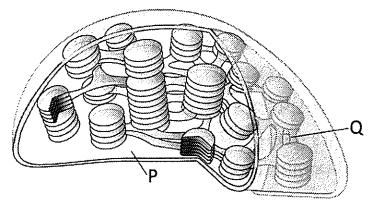
What are $P$ and $Q$ in the given organelle?
A
Stroma,Intergrana lamellae
B
Stroma,Cytoplasm
C
Stroma,Thylakoid
D
Cytoplasm,Thylakoid
Solution
(A) The given organelle is a chloroplast.
In the diagram,$P$ points to the fluid-filled space inside the chloroplast,which is known as the $Stroma$.
$Q$ points to the membrane channels that connect the thylakoids of different grana,which are known as the $Stroma$ $lamellae$ or $Intergrana$ $lamellae$.
In the diagram,$P$ points to the fluid-filled space inside the chloroplast,which is known as the $Stroma$.
$Q$ points to the membrane channels that connect the thylakoids of different grana,which are known as the $Stroma$ $lamellae$ or $Intergrana$ $lamellae$.
0 likes
View Solution130
EasyMCQ
Which of the following plastids lacks pigments?
A
Chromoplasts
B
Chloroplasts
C
Leucoplasts
D
None of these
Solution
(C) Plastids are found in all plant cells and in euglenoids. Based on the type of pigments,plastids are classified into three types:
$1$. Chloroplasts: Contain chlorophyll and carotenoid pigments which are responsible for trapping light energy essential for photosynthesis.
$2$. Chromoplasts: Contain fat-soluble carotenoid pigments like carotene,xanthophylls,and others. This gives the part of the plant a yellow,orange,or red color.
$3$. Leucoplasts: These are colorless plastids of varied shapes and sizes with stored nutrients. Amyloplasts store carbohydrates (starch),elaioplasts store oils and fats,and aleuroplasts store proteins. Since they are colorless,they lack pigments.
$1$. Chloroplasts: Contain chlorophyll and carotenoid pigments which are responsible for trapping light energy essential for photosynthesis.
$2$. Chromoplasts: Contain fat-soluble carotenoid pigments like carotene,xanthophylls,and others. This gives the part of the plant a yellow,orange,or red color.
$3$. Leucoplasts: These are colorless plastids of varied shapes and sizes with stored nutrients. Amyloplasts store carbohydrates (starch),elaioplasts store oils and fats,and aleuroplasts store proteins. Since they are colorless,they lack pigments.
0 likes
View Solution131
MediumMCQ
The color of flowers is due to the presence of $.................$.
A
Chromoplasts
B
Leucoplasts
C
Chloroplasts
D
Mitochondria
Solution
(A) The color of flowers is primarily due to the presence of $Chromoplasts$.
$Chromoplasts$ contain fat-soluble carotenoid pigments like carotene,xanthophylls,and others,which provide yellow,orange,or red colors to various plant parts including flowers and fruits.
$Leucoplasts$ are colorless plastids that store nutrients.
$Chloroplasts$ contain chlorophyll and are responsible for photosynthesis.
$Mitochondria$ are the powerhouses of the cell and are not responsible for pigmentation.
$Chromoplasts$ contain fat-soluble carotenoid pigments like carotene,xanthophylls,and others,which provide yellow,orange,or red colors to various plant parts including flowers and fruits.
$Leucoplasts$ are colorless plastids that store nutrients.
$Chloroplasts$ contain chlorophyll and are responsible for photosynthesis.
$Mitochondria$ are the powerhouses of the cell and are not responsible for pigmentation.
0 likes
View Solution132
MediumMCQ
Match the following columns:
| Column-$I$ | Column-$II$ |
|---|---|
| $P$. Amyloplast | $I$. Fats |
| $Q$. Elaioplast | $II$. Starch |
| $R$. Aleuroplast | $III$. Protein |
A
$P-I, Q-II, R-III$
B
$P-II, Q-I, R-III$
C
$P-III, Q-I, R-II$
D
$P-III, Q-II, R-I$
Solution
(B) Plastids are organelles found in plant cells that store various nutrients.
They are classified based on the type of pigment or storage material they contain:
$1$. Amyloplasts $(P)$ are leucoplasts that store carbohydrates like starch $(II)$.
$2$. Elaioplasts $(Q)$ are leucoplasts that store oils and fats $(I)$.
$3$. Aleuroplasts $(R)$ are leucoplasts that store proteins $(III)$.
Therefore,the correct matching is $P-II, Q-I, R-III$.
They are classified based on the type of pigment or storage material they contain:
$1$. Amyloplasts $(P)$ are leucoplasts that store carbohydrates like starch $(II)$.
$2$. Elaioplasts $(Q)$ are leucoplasts that store oils and fats $(I)$.
$3$. Aleuroplasts $(R)$ are leucoplasts that store proteins $(III)$.
Therefore,the correct matching is $P-II, Q-I, R-III$.
0 likes
View Solution133
MediumMCQ
Which cell contains the highest number of chloroplasts?
A
Chlamydomonas
B
Mesophyll cell
C
Euglena
D
Epidermal cell
Solution
(B) The $Mesophyll$ cells of leaves are specialized for photosynthesis and contain a large number of chloroplasts,typically ranging from $20$ to $100$ per cell.
$Chlamydomonas$ and $Euglena$ are unicellular organisms that contain only one or a few large chloroplasts.
$Epidermal$ cells generally lack chloroplasts as their primary function is protection.
$Chlamydomonas$ and $Euglena$ are unicellular organisms that contain only one or a few large chloroplasts.
$Epidermal$ cells generally lack chloroplasts as their primary function is protection.
0 likes
View Solution134
MediumMCQ
Which of the following is incorrect regarding the stroma of the chloroplast?
A
Small double-stranded circular $DNA$ molecules
B
$80S$ ribosomes
C
Enzymes for carbohydrate and protein synthesis
D
All of the above
Solution
(B) The stroma of the chloroplast contains enzymes required for the synthesis of carbohydrates and proteins. It also contains small,double-stranded circular $DNA$ molecules and ribosomes. However,the ribosomes present in the chloroplast stroma are $70S$ type,not $80S$. Therefore,the statement '$80S$ ribosomes' is incorrect regarding the stroma of the chloroplast.
0 likes
View Solution135
MediumMCQ
Select the correct option for the size of the chloroplast.
A
Length $- 5$ to $10 \mu m$,Width $- 2$ to $4 \mu m$
B
Length $- 2$ to $4 \mu m$,Width $- 5$ to $10 \mu m$
C
Length $- 5$ to $10 \, nm$,Width $- 2$ to $4 \, nm$
D
Length $- 2$ to $4 \, nm$,Width $- 5$ to $10 \, nm$
Solution
(A) Chloroplasts are double-membrane-bound organelles found in plant cells and algae.
According to the $NCERT$ textbook,the size of chloroplasts varies significantly.
Their length typically ranges from $5$ to $10 \mu m$ and their width ranges from $2$ to $4 \mu m$.
Therefore,option $A$ is the correct description of the dimensions of a chloroplast.
According to the $NCERT$ textbook,the size of chloroplasts varies significantly.
Their length typically ranges from $5$ to $10 \mu m$ and their width ranges from $2$ to $4 \mu m$.
Therefore,option $A$ is the correct description of the dimensions of a chloroplast.
0 likes
View Solution136
MediumMCQ
The $DNA$ present in chloroplast is:
A
Circular,double stranded
B
Linear,single stranded
C
Circular,single stranded
D
Linear,double stranded
Solution
(A) The $DNA$ present in chloroplast is circular and double-stranded. This is similar to the $DNA$ found in prokaryotes and mitochondria,which supports the endosymbiotic theory of the origin of these organelles.
0 likes
View Solution137
EasyMCQ
Statement $- I :-$ Plastids are found in all plant and animal cells.
Statement $- II :-$ Aleuroplast store carbohydrate.
Statement $- II :-$ Aleuroplast store carbohydrate.
A
Statement $I$ and $II$ both are correct
B
Statement $I$ and $II$ both are incorrect
C
Only Statement $I$ is correct
D
Only Statement $II$ is correct
Solution
(B) Statement $- I$ is incorrect because plastids are found only in plant cells and euglenoids,not in animal cells.
Statement $- II$ is incorrect because aleuroplasts store proteins,whereas amyloplasts store carbohydrates (starch).
Therefore,both statements are incorrect.
Statement $- II$ is incorrect because aleuroplasts store proteins,whereas amyloplasts store carbohydrates (starch).
Therefore,both statements are incorrect.
0 likes
View Solution138
MediumMCQ
Which of the following is not a part of the endomembrane system?
A
Endoplasmic reticulum
B
Golgi body
C
Chloroplast
D
Lysosome
Solution
(C) The endomembrane system includes organelles whose functions are coordinated. These include the endoplasmic reticulum,Golgi complex,lysosomes,and vacuoles. Since the functions of the mitochondria and chloroplasts are not coordinated with the above components,they are not considered part of the endomembrane system. Therefore,the chloroplast is the correct answer.
0 likes
View Solution139
MediumMCQ
Which of the following statements are correct?
$(A)$ The number of chloroplasts varies from $1$ per cell in $Chlamydomonas$, a green alga, to $20-40$ per cell in the mesophyll.
$(B)$ Out of the two membranes of chloroplasts and mitochondria, the inner membrane is relatively less permeable.
$(C)$ Thylakoids are arranged in stacks like the piles of coins called grana (singular: granum) or the intergranal thylakoids.
$(D)$ The stroma of the chloroplast contains enzymes required for the synthesis of carbohydrates and proteins.
$(A)$ The number of chloroplasts varies from $1$ per cell in $Chlamydomonas$, a green alga, to $20-40$ per cell in the mesophyll.
$(B)$ Out of the two membranes of chloroplasts and mitochondria, the inner membrane is relatively less permeable.
$(C)$ Thylakoids are arranged in stacks like the piles of coins called grana (singular: granum) or the intergranal thylakoids.
$(D)$ The stroma of the chloroplast contains enzymes required for the synthesis of carbohydrates and proteins.
A
$A, B$ and $C$ only
B
$B, C$ and $D$ only
C
$A, C$ and $D$ only
D
$A, B, C$ and $D$ all
Solution
$(D)$ Statement $(A)$ is correct: The number of chloroplasts varies significantly; for example, $Chlamydomonas$ has $1$ chloroplast per cell, while mesophyll cells contain $20-40$ chloroplasts per cell.
Statement $(B)$ is correct: Both chloroplasts and mitochondria are double-membrane organelles. In both, the inner membrane is less permeable than the outer membrane, which contains porins.
Statement $(C)$ is correct: Thylakoids are flattened sac-like structures arranged in stacks known as grana (singular: granum). These stacks are connected by stroma lamellae or intergranal thylakoids.
Statement $(D)$ is correct: The stroma is the fluid-filled space within the chloroplast that contains enzymes necessary for the Calvin cycle (carbohydrate synthesis) and also contains small circular $DNA$ and ribosomes for protein synthesis.
Therefore, all statements $(A, B, C, D)$ are correct.
Statement $(B)$ is correct: Both chloroplasts and mitochondria are double-membrane organelles. In both, the inner membrane is less permeable than the outer membrane, which contains porins.
Statement $(C)$ is correct: Thylakoids are flattened sac-like structures arranged in stacks known as grana (singular: granum). These stacks are connected by stroma lamellae or intergranal thylakoids.
Statement $(D)$ is correct: The stroma is the fluid-filled space within the chloroplast that contains enzymes necessary for the Calvin cycle (carbohydrate synthesis) and also contains small circular $DNA$ and ribosomes for protein synthesis.
Therefore, all statements $(A, B, C, D)$ are correct.
0 likes
View SolutionCell: The Unit of Life — Plastids · Frequently Asked Questions
1Are these Cell: The Unit of Life questions useful for JEE and NEET?
Yes. All questions in this section are mapped to JEE Main and NEET exam patterns. Previous year questions from JEE Main, NEET, GUJCET and state-level exams are included with full solutions.
2Can I switch to Hindi or Gujarati for these questions?
Yes. Use the language tabs in the hero section or the sidebar to view the same questions and solutions in English, Hindi or Gujarati.
3How do I generate a question paper from this subtopic?
Use the Vedclass Exam Paper Generator — select the chapter and subtopic, set difficulty, and generate Sets A, B, C, D automatically. First 3 chapters of every subject are free.
Vedclass Products
For Students
Vedclass Test Series
Mock tests in real JEE/NEET style with performance analysis. 5-day free trial.
Start Free TrialFor Teachers
Exam Paper Generator
Generate Set A/B/C/D papers from this chapter in 2 minutes. 3 chapters free.
Try FreeFor Institutes
Online Exam Module
Live online exams with unlimited students, 360° analytics & white-label branding.
See DemoFor Teachers & Institutes
Generate a Cell: The Unit of Life Exam Paper in 2 Minutes
Select subtopic & difficulty — Sets A, B, C, D auto-generated with No Repeat logic.
First 3 chapters of every subject are free — no payment required.