
A English
Plastids Questions in English
Class 11 Biology · Cell: The Unit of Life · Plastids
140+
Questions
English
Language
100%
With Solutions
Showing 50 of 140 questions in English
51
EasyMCQ
Which pigments are responsible for the various colors of flowers,fruits,and seeds?
A
Carotene
B
Xanthophyll
C
Anthocyanin
D
All of the above
Solution
(D) Chromoplasts are a type of plastid that contain fat-soluble carotenoid pigments like carotene,xanthophylls,and others.
These pigments are responsible for giving yellow,orange,or red colors to various plant parts such as flowers,fruits,and seeds.
Anthocyanins are water-soluble vacuolar pigments that also contribute to the red,purple,or blue colors in plants.
Since all these pigments (carotene,xanthophyll,and anthocyanin) contribute to the coloration of flowers,fruits,and seeds,the correct answer is $D$.
These pigments are responsible for giving yellow,orange,or red colors to various plant parts such as flowers,fruits,and seeds.
Anthocyanins are water-soluble vacuolar pigments that also contribute to the red,purple,or blue colors in plants.
Since all these pigments (carotene,xanthophyll,and anthocyanin) contribute to the coloration of flowers,fruits,and seeds,the correct answer is $D$.
0 likes
View Solution52
MediumMCQ
Which of the following is not responsible for the color of the plant parts?
A
Leaf
B
Flower
C
Fruit
D
Seed
Solution
(A) Chromoplasts are plastids that contain fat-soluble carotenoid pigments like carotene,xanthophylls,and others. These provide yellow,orange,or red colors to various plant parts such as flowers,fruits,and seeds. Leaves,however,primarily contain chloroplasts (containing chlorophyll) for photosynthesis,which gives them their green color. While chromoplasts are responsible for the vibrant colors in flowers,fruits,and seeds,they are not the primary reason for the green color of leaves. Therefore,the leaf is the correct answer as it is primarily associated with chlorophyll-containing chloroplasts rather than chromoplasts.
0 likes
View Solution53
EasyMCQ
Which plastids do not contain any pigments?
A
Chromoplasts
B
Leucoplasts
C
Chloroplasts
D
None of these
Solution
(B) Plastids are found in all plant cells and in euglenoids. Based on the type of pigments,plastids can be classified into three types:
$1$. Chloroplasts: Contain chlorophyll and carotenoid pigments which are responsible for trapping light energy essential for photosynthesis.
$2$. Chromoplasts: Contain fat-soluble carotenoid pigments like carotene,xanthophylls,and others. This gives the part of the plant a yellow,orange,or red color.
$3$. Leucoplasts: These are the colourless plastids of varied shapes and sizes with stored nutrients. They do not contain any pigments. They are further classified based on the type of nutrients they store (e.g.,Amyloplasts store starch,Elaioplasts store oils and fats,and Aleuroplasts store proteins).
$1$. Chloroplasts: Contain chlorophyll and carotenoid pigments which are responsible for trapping light energy essential for photosynthesis.
$2$. Chromoplasts: Contain fat-soluble carotenoid pigments like carotene,xanthophylls,and others. This gives the part of the plant a yellow,orange,or red color.
$3$. Leucoplasts: These are the colourless plastids of varied shapes and sizes with stored nutrients. They do not contain any pigments. They are further classified based on the type of nutrients they store (e.g.,Amyloplasts store starch,Elaioplasts store oils and fats,and Aleuroplasts store proteins).
0 likes
View Solution54
EasyMCQ
What are the starch-storing plastids called?
A
Amyloplasts
B
Elaioplasts
C
Aleuroplasts
D
Chloroplasts
Solution
(A) Plastids are organelles found in plant cells that are classified based on the type of pigments or storage materials they contain.
$1$. Amyloplasts are leucoplasts that store carbohydrates (starch),such as in potato tubers.
$2$. Elaioplasts store oils and fats.
$3$. Aleuroplasts store proteins.
$4$. Chloroplasts contain chlorophyll and are involved in photosynthesis.
Therefore,the correct answer is Amyloplasts.
$1$. Amyloplasts are leucoplasts that store carbohydrates (starch),such as in potato tubers.
$2$. Elaioplasts store oils and fats.
$3$. Aleuroplasts store proteins.
$4$. Chloroplasts contain chlorophyll and are involved in photosynthesis.
Therefore,the correct answer is Amyloplasts.
0 likes
View Solution55
EasyMCQ
Which of the following is a food-storing plastid?
A
Chromoplast
B
Chloroplast
C
Leucoplast
D
Both $(A)$ and $(B)$
Solution
(C) Plastids are classified into three types based on the type of pigments they contain:
$1$. Chloroplasts: Contain chlorophyll and carotenoid pigments which are responsible for trapping light energy essential for photosynthesis.
$2$. Chromoplasts: Contain fat-soluble carotenoid pigments like carotene,xanthophylls,and others,which give yellow,orange,or red colors to plant parts.
$3$. Leucoplasts: These are colorless plastids of varied shapes and sizes with stored nutrients. They are further classified into:
- Amyloplasts: Store carbohydrates (starch).
- Elaioplasts: Store oils and fats.
- Aleuroplasts: Store proteins.
Therefore,leucoplasts are the plastids primarily responsible for the storage of food materials.
$1$. Chloroplasts: Contain chlorophyll and carotenoid pigments which are responsible for trapping light energy essential for photosynthesis.
$2$. Chromoplasts: Contain fat-soluble carotenoid pigments like carotene,xanthophylls,and others,which give yellow,orange,or red colors to plant parts.
$3$. Leucoplasts: These are colorless plastids of varied shapes and sizes with stored nutrients. They are further classified into:
- Amyloplasts: Store carbohydrates (starch).
- Elaioplasts: Store oils and fats.
- Aleuroplasts: Store proteins.
Therefore,leucoplasts are the plastids primarily responsible for the storage of food materials.
0 likes
View Solution56
MediumMCQ
Which of the following plastids stores proteins?
A
Aleuroplasts
B
Amyloplasts
C
Elaioplasts
D
Chromoplasts
Solution
(A) Plastids are classified based on the type of pigments or stored materials they contain:
$1$. $Amyloplasts$: Store carbohydrates (starch),e.g.,potato.
$2$. $Elaioplasts$: Store oils and fats.
$3$. $Aleuroplasts$ (or $Proteinoplasts$): Store proteins.
$4$. $Chromoplasts$: Contain fat-soluble carotenoid pigments like carotene and xanthophylls,providing yellow,orange,or red colors to plant parts.
Therefore,the correct answer is $Aleuroplasts$.
$1$. $Amyloplasts$: Store carbohydrates (starch),e.g.,potato.
$2$. $Elaioplasts$: Store oils and fats.
$3$. $Aleuroplasts$ (or $Proteinoplasts$): Store proteins.
$4$. $Chromoplasts$: Contain fat-soluble carotenoid pigments like carotene and xanthophylls,providing yellow,orange,or red colors to plant parts.
Therefore,the correct answer is $Aleuroplasts$.
0 likes
View Solution57
EasyMCQ
Which plastid is responsible for the process of photosynthesis?
A
Chromoplast
B
Chloroplast
C
Leucoplast
D
Elaioplast
Solution
(B) The plastid responsible for photosynthesis is the $Chloroplast$.
$Chloroplasts$ contain the green pigment $Chlorophyll$ and other carotenoid pigments,which are essential for trapping light energy required for the synthesis of food in plants.
$Chromoplasts$ contain fat-soluble carotenoid pigments like $Carotene$ and $Xanthophyll$,providing yellow,orange,or red colors.
$Leucoplasts$ are colorless plastids of varied shapes and sizes with stored nutrients; $Elaioplasts$ are a type of $Leucoplast$ that store oils and fats.
$Chloroplasts$ contain the green pigment $Chlorophyll$ and other carotenoid pigments,which are essential for trapping light energy required for the synthesis of food in plants.
$Chromoplasts$ contain fat-soluble carotenoid pigments like $Carotene$ and $Xanthophyll$,providing yellow,orange,or red colors.
$Leucoplasts$ are colorless plastids of varied shapes and sizes with stored nutrients; $Elaioplasts$ are a type of $Leucoplast$ that store oils and fats.
0 likes
View Solution58
MediumMCQ
Which of the following is not a shape of the chloroplast?
A
Spiral
B
Spherical
C
Oval
D
Ribbon-shaped
Solution
(B) Chloroplasts in algae show variable shapes. They can be discoid,plate-like,reticulate,cup-shaped,spiral,or ribbon-shaped. However,'spherical' is not a standard shape described for chloroplasts in the context of plant or algal cells in the $NCERT$ curriculum. Therefore,the correct answer is $B$.
0 likes
View Solution59
MediumMCQ
The number of chloroplasts in a mesophyll cell is:
A
$20$ to $40$
B
$2$ to $100$
C
$40$ to $60$
D
$10$ to $20$
Solution
(A) In plant cells,the number of chloroplasts varies depending on the species. In a typical mesophyll cell of a green plant,the number of chloroplasts ranges from $20$ to $40$ per cell. This allows the cell to perform photosynthesis efficiently.
0 likes
View Solution60
MediumMCQ
What is the length of a chloroplast?
A
$2$ to $4 \mu m$
B
$5$ to $10 \mu m$
C
$0.2$ to $1.0 \mu m$
D
$1.0$ to $4.1 \mu m$
Solution
(B) Chloroplasts are a type of plastid found in plant cells.
According to the $NCERT$ textbook,the length of chloroplasts typically ranges from $5$ to $10 \mu m$ and their width ranges from $2$ to $4 \mu m$.
Therefore,the correct option is $B$.
According to the $NCERT$ textbook,the length of chloroplasts typically ranges from $5$ to $10 \mu m$ and their width ranges from $2$ to $4 \mu m$.
Therefore,the correct option is $B$.
0 likes
View Solution61
MediumMCQ
What is the width of the chloroplast?
A
$2$ to $4 \mu m$
B
$5$ to $10 \mu m$
C
$1.0 \mu m$ to $4.1 \mu m$
D
$2.0 \mu m$ to $4.0 \mu m$
Solution
(A) According to the $NCERT$ textbook,chloroplasts are lens-shaped,oval,spherical,discoid,or even ribbon-like organelles.
Their length varies from $5$ to $10 \mu m$ and their width varies from $2$ to $4 \mu m$.
Therefore,the correct option is $A$.
Their length varies from $5$ to $10 \mu m$ and their width varies from $2$ to $4 \mu m$.
Therefore,the correct option is $A$.
0 likes
View Solution62
MediumMCQ
What structure does the membranous system form in the chloroplast?
A
Intergrana lamellae
B
Stroma
C
Matrix
D
Grana
Solution
(A) In the chloroplast,the membranous system consists of the grana,the stroma lamellae,and the fluid stroma.
Specifically,the thylakoids are arranged in stacks called grana.
The membranes connecting the thylakoids of different grana are known as the intergrana lamellae or stroma lamellae.
Therefore,the membranous system of the chloroplast is primarily composed of these thylakoid structures.
Specifically,the thylakoids are arranged in stacks called grana.
The membranes connecting the thylakoids of different grana are known as the intergrana lamellae or stroma lamellae.
Therefore,the membranous system of the chloroplast is primarily composed of these thylakoid structures.
0 likes
View Solution63
EasyMCQ
What is the part of the chloroplast other than the grana called?
A
Stroma
B
Intergranal membrane
C
Granum
D
Thylakoid
Solution
(A) The chloroplast is a double-membrane-bound organelle found in plant cells.
Inside the chloroplast,there are flattened,sac-like structures called thylakoids,which are stacked like coins to form structures known as grana.
The fluid-filled space surrounding the grana within the chloroplast is called the stroma.
The stroma contains enzymes required for the synthesis of carbohydrates and proteins,as well as small,double-stranded circular $DNA$ molecules and ribosomes.
Inside the chloroplast,there are flattened,sac-like structures called thylakoids,which are stacked like coins to form structures known as grana.
The fluid-filled space surrounding the grana within the chloroplast is called the stroma.
The stroma contains enzymes required for the synthesis of carbohydrates and proteins,as well as small,double-stranded circular $DNA$ molecules and ribosomes.
0 likes
View Solution64
EasyMCQ
The flattened sac-like structures arranged like a stack of coins in the grana are called:
A
Granum
B
Intergrana lamellae
C
Thylakoids
D
Stroma
Solution
(C) In chloroplasts,the $grana$ are formed by the stacking of flattened,membrane-bound,sac-like structures known as $thylakoids$.
These $thylakoids$ are arranged like a stack of coins,which is referred to as a $granum$ (plural: $grana$).
The $thylakoid$ membrane contains chlorophyll pigments,which are essential for the light-dependent reactions of photosynthesis.
Therefore,the correct answer is $C$.
These $thylakoids$ are arranged like a stack of coins,which is referred to as a $granum$ (plural: $grana$).
The $thylakoid$ membrane contains chlorophyll pigments,which are essential for the light-dependent reactions of photosynthesis.
Therefore,the correct answer is $C$.
0 likes
View Solution65
EasyMCQ
The number of grana in a single chloroplast is:
A
$20$ to $40$
B
$40$ to $60$
C
$40$ to $80$
D
$20$ to $100$
Solution
(C) chloroplast typically contains a number of grana (stacks of thylakoids) embedded in the stroma.
Scientific studies and standard biological references indicate that the number of grana in a single chloroplast usually ranges from $40$ to $80$.
Each granum consists of several thylakoids stacked like coins,which are the sites for the light-dependent reactions of photosynthesis.
Scientific studies and standard biological references indicate that the number of grana in a single chloroplast usually ranges from $40$ to $80$.
Each granum consists of several thylakoids stacked like coins,which are the sites for the light-dependent reactions of photosynthesis.
0 likes
View Solution66
EasyMCQ
How many thylakoids does each granum contain?
A
$2$ to $100$
B
$20$ to $40$
C
$40$ to $60$
D
$40$ to $80$
Solution
(A) In chloroplasts,the thylakoids are flattened sac-like structures that are stacked like piles of coins to form structures called grana (singular: granum).
Each granum typically contains a stack of $2$ to $100$ thylakoids.
Therefore,the correct range representing the number of thylakoids in a granum is $2$ to $100$.
Each granum typically contains a stack of $2$ to $100$ thylakoids.
Therefore,the correct range representing the number of thylakoids in a granum is $2$ to $100$.
0 likes
View Solution67
MediumMCQ
What is present in the stroma of the chloroplast,excluding the grana?
A
Proteins,ribosomes $(80S)$,helical $DNA$
B
Proteins,ribosomes $(70S)$,circular $DNA$,enzymes
C
Ribosomes,circular $DNA$
D
Proteins,circular $DNA$
Solution
(B) The chloroplast consists of a double membrane-bound structure. The fluid-filled space inside the chloroplast is called the stroma.
Inside the stroma,structures like grana (stacks of thylakoids) are embedded.
Apart from the grana,the stroma contains enzymes required for the synthesis of carbohydrates and proteins.
It also contains small,double-stranded circular $DNA$ molecules and ribosomes of the $70S$ type,which are responsible for protein synthesis within the organelle.
Inside the stroma,structures like grana (stacks of thylakoids) are embedded.
Apart from the grana,the stroma contains enzymes required for the synthesis of carbohydrates and proteins.
It also contains small,double-stranded circular $DNA$ molecules and ribosomes of the $70S$ type,which are responsible for protein synthesis within the organelle.
0 likes
View Solution68
MediumMCQ
$S -$ Statement: The flattened sac-like structures arranged like a stack of coins are called grana.
$R -$ Reason: There are $40$ to $60$ grana in a chloroplast.
$R -$ Reason: There are $40$ to $60$ grana in a chloroplast.
A
$S$ and $R$ are both true,and $R$ is the correct explanation of $S$.
B
$S$ and $R$ are both true,but $R$ is not the correct explanation of $S$.
C
$S$ is true and $R$ is false.
D
$S$ is false and $R$ is true.
Solution
(D) The flattened sac-like structures arranged like a stack of coins are called thylakoids. $A$ stack of thylakoids is called a granum (plural: grana).
Therefore,Statement $S$ is false because it identifies the stack as 'grana' instead of 'thylakoids' or defines the stack itself as the structure rather than the individual unit.
In a typical chloroplast,there are $40$ to $60$ grana present.
Thus,Statement $S$ is false and Reason $R$ is true.
Therefore,Statement $S$ is false because it identifies the stack as 'grana' instead of 'thylakoids' or defines the stack itself as the structure rather than the individual unit.
In a typical chloroplast,there are $40$ to $60$ grana present.
Thus,Statement $S$ is false and Reason $R$ is true.
0 likes
View Solution69
MediumMCQ
$S$ - Statement: Aleuroplasts are food storage plastids.
$R$ - Reason: Aleuroplasts lack pigments and store proteins.
$R$ - Reason: Aleuroplasts lack pigments and store proteins.
A
$S$ and $R$ are both true,$R$ is the correct explanation of $S$.
B
$S$ and $R$ are both true,but $R$ is not the correct explanation of $S$.
C
$S$ is true and $R$ is false.
D
$S$ is false and $R$ is true.
Solution
(A) $1$. Plastids are classified into three types based on the type of pigments: Chloroplasts,Chromoplasts,and Leucoplasts.
$2$. Leucoplasts are colorless plastids of varied shapes and sizes with stored nutrients.
$3$. Leucoplasts are further classified into: Amyloplasts (store carbohydrates like starch),Elaioplasts (store oils and fats),and Aleuroplasts (store proteins).
$4$. Since Aleuroplasts are a type of Leucoplast,they lack pigments and are specialized for protein storage.
$5$. Therefore,both the statement and the reason are correct,and the reason correctly explains why Aleuroplasts are considered food storage plastids.
$2$. Leucoplasts are colorless plastids of varied shapes and sizes with stored nutrients.
$3$. Leucoplasts are further classified into: Amyloplasts (store carbohydrates like starch),Elaioplasts (store oils and fats),and Aleuroplasts (store proteins).
$4$. Since Aleuroplasts are a type of Leucoplast,they lack pigments and are specialized for protein storage.
$5$. Therefore,both the statement and the reason are correct,and the reason correctly explains why Aleuroplasts are considered food storage plastids.
0 likes
View Solution70
MediumMCQ
In the given figure,what does the part labeled '$a$' represent and what does it contain?

A
Grana,Thylakoid
B
Thylakoid,Pigments
C
Granum,Grana
D
Grana,Granum
Solution
(A) The provided figure shows the structure of a chloroplast. The part labeled '$a$' points to the stacks of flattened membrane-bound sacs known as the grana (singular: granum). Each individual flattened sac within the stack is called a thylakoid. The membrane of the thylakoid contains photosynthetic pigments (like chlorophyll) which are essential for the light-dependent reactions of photosynthesis. Therefore,'$a$' represents the grana,and they contain thylakoids which hold the pigments.
0 likes
View Solution71
EasyMCQ
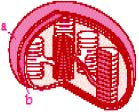
In the given figure,what do '$a$' and '$b$' represent respectively?
A
Stroma,Granum
B
Space,Outer membrane
C
Outer membrane,Inner membrane
D
Outer membrane,Grana
Solution
(C) The provided figure represents the structure of a chloroplast.
In the diagram,'$a$' points to the outer boundary of the organelle,which is the outer membrane.
'$b$' points to the membrane immediately inside the outer membrane,which is the inner membrane.
Therefore,'$a$' and '$b$' represent the outer membrane and inner membrane respectively.
In the diagram,'$a$' points to the outer boundary of the organelle,which is the outer membrane.
'$b$' points to the membrane immediately inside the outer membrane,which is the inner membrane.
Therefore,'$a$' and '$b$' represent the outer membrane and inner membrane respectively.
0 likes
View Solution72
MediumMCQ
These are plastids that contain pigments other than chlorophyll.
A
Carotene
B
Xanthophyll
C
Anthocyanin
D
All of the above $(A), (B), (C)$
Solution
(D) Plastids are classified based on the type of pigments they contain into chloroplasts,chromoplasts,and leucoplasts.
Chromoplasts contain fat-soluble carotenoid pigments like carotene,xanthophylls,and others.
Anthocyanins are water-soluble pigments found in the vacuole,not in plastids.
However,in the context of typical multiple-choice questions regarding plastid pigments,carotene and xanthophyll are the primary examples of pigments found in chromoplasts.
Since the question asks for pigments other than chlorophyll,and both carotene and xanthophyll fit this description,the most appropriate answer is that these are types of pigments found in chromoplasts.
Chromoplasts contain fat-soluble carotenoid pigments like carotene,xanthophylls,and others.
Anthocyanins are water-soluble pigments found in the vacuole,not in plastids.
However,in the context of typical multiple-choice questions regarding plastid pigments,carotene and xanthophyll are the primary examples of pigments found in chromoplasts.
Since the question asks for pigments other than chlorophyll,and both carotene and xanthophyll fit this description,the most appropriate answer is that these are types of pigments found in chromoplasts.
0 likes
View Solution73
EasyMCQ
Elaioplasts store which of the following substances?
A
Proteins
B
Carbohydrates
C
Fats
D
All of the above
Solution
(C) Elaioplasts are a type of leucoplast,which are specialized plastids found in plant cells.
Leucoplasts are colorless plastids that store nutrients.
They are classified into three types based on the type of nutrient stored:
$1$. Amyloplasts: Store carbohydrates (starch).
$2$. Elaioplasts: Store fats and oils (lipids).
$3$. Aleuroplasts (or Proteinoplasts): Store proteins.
Therefore,Elaioplasts are responsible for the storage of fats.
Leucoplasts are colorless plastids that store nutrients.
They are classified into three types based on the type of nutrient stored:
$1$. Amyloplasts: Store carbohydrates (starch).
$2$. Elaioplasts: Store fats and oils (lipids).
$3$. Aleuroplasts (or Proteinoplasts): Store proteins.
Therefore,Elaioplasts are responsible for the storage of fats.
0 likes
View Solution74
EasyMCQ
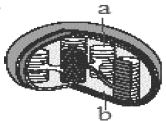
In the given figure,what do $a$ and $b$ represent respectively?
A
Granum,Thylakoid
B
Stroma,Thylakoid
C
Granum,Stroma
D
Lumen,Granum
Solution
(C) The provided figure represents the structure of a chloroplast.
In the chloroplast,the stack of flattened,membrane-bound sacs is called a granum (plural: grana),which is indicated by label $a$.
The fluid-filled space surrounding the grana is called the stroma,which is indicated by label $b$.
Therefore,$a$ represents the granum and $b$ represents the stroma.
In the chloroplast,the stack of flattened,membrane-bound sacs is called a granum (plural: grana),which is indicated by label $a$.
The fluid-filled space surrounding the grana is called the stroma,which is indicated by label $b$.
Therefore,$a$ represents the granum and $b$ represents the stroma.
0 likes
View Solution75
EasyMCQ
Which of the following is $NOT$ a food storage granule?
A
Elaioplast
B
Ribosome granule
C
Amyloplast
D
Aleuroplast
Solution
(B) In plant cells,leucoplasts are specialized plastids that store nutrients.
$1$. $Elaioplasts$ store oils and fats.
$2$. $Amyloplasts$ store carbohydrates like starch.
$3$. $Aleuroplasts$ store proteins.
$4$. $Ribosomes$ are cellular organelles responsible for protein synthesis and are not involved in food storage. Therefore,ribosome granules are not food storage granules.
$1$. $Elaioplasts$ store oils and fats.
$2$. $Amyloplasts$ store carbohydrates like starch.
$3$. $Aleuroplasts$ store proteins.
$4$. $Ribosomes$ are cellular organelles responsible for protein synthesis and are not involved in food storage. Therefore,ribosome granules are not food storage granules.
0 likes
View Solution76
EasyMCQ
Select the correct match for $X$ and $Y$:
| Column $X$ | Column $Y$ |
| $(1)$ Chromoplast | $(P)$ Protein storage |
| $(2)$ Chloroplast | $(Q)$ Site of photosynthesis |
| $(3)$ Leucoplast | $(R)$ Responsible for color of flowers,fruits,and seeds |
| $(4)$ Aleuroplast | $(S)$ Food storage |
A
$(1-R), (2-Q), (3-S), (4-P)$
B
$(1-P), (2-R), (3-Q), (4-S)$
C
$(1-Q), (2-S), (3-P), (4-R)$
D
$(1-S), (2-P), (3-R), (4-Q)$
Solution
(A) The correct matches are as follows:
$(1)$ Chromoplast: These contain fat-soluble carotenoid pigments like carotene and xanthophylls,which provide yellow,orange,or red color to flowers,fruits,and seeds. Thus,$(1-R)$.
$(2)$ Chloroplast: These contain chlorophyll and carotenoid pigments which are responsible for trapping light energy essential for photosynthesis. Thus,$(2-Q)$.
$(3)$ Leucoplast: These are colorless plastids of varied shapes and sizes with stored nutrients. They are primarily involved in food storage. Thus,$(3-S)$.
$(4)$ Aleuroplast: These are a specific type of leucoplast that stores proteins. Thus,$(4-P)$.
Therefore,the correct sequence is $(1-R), (2-Q), (3-S), (4-P)$.
$(1)$ Chromoplast: These contain fat-soluble carotenoid pigments like carotene and xanthophylls,which provide yellow,orange,or red color to flowers,fruits,and seeds. Thus,$(1-R)$.
$(2)$ Chloroplast: These contain chlorophyll and carotenoid pigments which are responsible for trapping light energy essential for photosynthesis. Thus,$(2-Q)$.
$(3)$ Leucoplast: These are colorless plastids of varied shapes and sizes with stored nutrients. They are primarily involved in food storage. Thus,$(3-S)$.
$(4)$ Aleuroplast: These are a specific type of leucoplast that stores proteins. Thus,$(4-P)$.
Therefore,the correct sequence is $(1-R), (2-Q), (3-S), (4-P)$.
0 likes
View Solution77
EasyMCQ
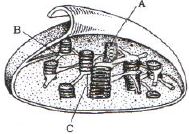
What cell structure is suggested by the given figure?
A
Nucleus
B
Chloroplast
C
Mitochondrion
D
Lysosome
Solution
(B) The provided figure shows a double-membrane-bound organelle containing stacks of thylakoids (grana) connected by stroma lamellae.
This structure is characteristic of a chloroplast,which is the site of photosynthesis in plant cells.
Label $A$ represents a granum,label $B$ represents the outer membrane,and label $C$ represents the stroma lamellae.
This structure is characteristic of a chloroplast,which is the site of photosynthesis in plant cells.
Label $A$ represents a granum,label $B$ represents the outer membrane,and label $C$ represents the stroma lamellae.
0 likes
View Solution78
EasyMCQ
In the given figure,what does $B$ represent?
A
Granum
B
Stroma
C
Intermembrane space
D
Thylakoid
Solution
(B) The provided figure shows the structure of a chloroplast.
$A$ points to a stack of thylakoids,which is known as a granum.
$B$ points to the fluid-filled matrix of the chloroplast,which is called the stroma.
$C$ points to the thylakoid membrane itself.
Therefore,$B$ represents the stroma.
$A$ points to a stack of thylakoids,which is known as a granum.
$B$ points to the fluid-filled matrix of the chloroplast,which is called the stroma.
$C$ points to the thylakoid membrane itself.
Therefore,$B$ represents the stroma.
0 likes
View Solution79
MediumMCQ
In the given figure,which components are present in the part labeled $B$?
A
Circular $DNA$
B
Ribosomes
C
Enzymes for dark reaction
D
All of $(A)$,$(B)$,and $(C)$
Solution
(D) The given figure represents the structure of a chloroplast. The part labeled $B$ points to the stroma,which is the fluid-filled matrix of the chloroplast. The stroma contains enzymes required for the synthesis of carbohydrates and proteins. It also contains small,double-stranded circular $DNA$ molecules and ribosomes (70S) for protein synthesis. Therefore,all the mentioned components are present in the stroma.
0 likes
View Solution80
EasyMCQ
Which pigments are found in plastids other than chlorophyll?
A
Carotene
B
Xanthophyll
C
Anthocyanin
D
All of the above
Solution
(D) Plastids are classified into three types based on the type of pigments they contain: Chloroplasts,Chromoplasts,and Leucoplasts.
Chromoplasts contain fat-soluble carotenoid pigments like carotene,xanthophylls,and others.
Anthocyanins are water-soluble vacuolar pigments that are also responsible for various colors in plants.
Therefore,all the mentioned pigments are found in plant cells,contributing to non-green coloration.
Chromoplasts contain fat-soluble carotenoid pigments like carotene,xanthophylls,and others.
Anthocyanins are water-soluble vacuolar pigments that are also responsible for various colors in plants.
Therefore,all the mentioned pigments are found in plant cells,contributing to non-green coloration.
0 likes
View Solution81
MediumMCQ
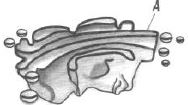
What is the diameter of $A$ in the given figure?
A
$0.5 \ mm$ to $1 \ mm$
B
$1 \ mm$ to $2 \ mm$
C
$0.2 \ mm$ to $1 \ mm$
D
$1 \ mm$ to $4.1 \ mm$
Solution
(D) The figure shows a chloroplast,and $A$ represents the thylakoid or a granum structure. However,based on standard biological measurements for chloroplasts or their components in typical textbook contexts,the diameter of a chloroplast is generally $2-4 \ \mu m$ in width and $5-10 \ \mu m$ in length. Given the options provided,there seems to be a discrepancy in units (mm vs $\mu m$). Assuming the question refers to the size range of a typical chloroplast or its components as per standard curriculum,the most appropriate range for the diameter of a chloroplast is $1-4 \ \mu m$. If we treat the provided options as having a typo in units (mm instead of $\mu m$),option $D$ ($1 \ mm$ to $4.1 \ mm$,interpreted as $1-4 \ \mu m$) is the most scientifically accurate choice for the diameter of a chloroplast.
0 likes
View Solution82
MediumMCQ
The structures that are formed by stacking of organised flattened membranous sacs in the chloroplasts are
A
stroma lamellae
B
stroma
C
cristae
D
grana
Solution
(D) The correct answer is $D$.
In chloroplasts,the inner membrane encloses a fluid-filled space called the stroma.
Within the stroma,there are organized,flattened,membranous sacs called thylakoids.
These thylakoids are stacked like a pile of coins to form structures known as grana (singular: granum).
Stroma lamellae are the membrane channels that connect the thylakoids of different grana.
Cristae are the infoldings of the inner mitochondrial membrane,not chloroplasts.
In chloroplasts,the inner membrane encloses a fluid-filled space called the stroma.
Within the stroma,there are organized,flattened,membranous sacs called thylakoids.
These thylakoids are stacked like a pile of coins to form structures known as grana (singular: granum).
Stroma lamellae are the membrane channels that connect the thylakoids of different grana.
Cristae are the infoldings of the inner mitochondrial membrane,not chloroplasts.
0 likes
View Solution83
MediumMCQ
Which of the following types of plastid does not contain stored food material?
A
Chromoplasts
B
Elaioplasts
C
Aleuroplasts
D
Amyloplasts
Solution
(A) : Chromoplasts are yellow or reddish in color due to the presence of carotenoid pigments. They do not contain stored food material.
Chromoplasts are formed either from leucoplasts or chloroplasts.
Chromoplasts provide color to many flowers for attracting pollinating insects.
They provide bright red or orange color to fruits for attracting animals for seed dispersal.
Chromoplasts are formed either from leucoplasts or chloroplasts.
Chromoplasts provide color to many flowers for attracting pollinating insects.
They provide bright red or orange color to fruits for attracting animals for seed dispersal.
0 likes
View Solution84
MediumMCQ
Where are thylakoids present?
A
Mitochondria
B
Lysosome
C
Chloroplast
D
Golgi body
Solution
(C) Thylakoids are flattened, sac-like membranous structures found inside the $Chloroplast$.
They are organized into stacks called $grana$ (singular: $granum$).
Thylakoids contain chlorophyll pigments and are the sites where the light-dependent reactions of photosynthesis occur.
They are organized into stacks called $grana$ (singular: $granum$).
Thylakoids contain chlorophyll pigments and are the sites where the light-dependent reactions of photosynthesis occur.
0 likes
View Solution85
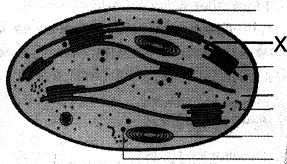
MediumMCQ
Identify $X$ from the given figure of a chloroplast.
A
Grana
B
Stromal lamella
C
Stroma
D
Inner membrane
Solution
(B) The provided figure represents the structure of a chloroplast.
In the diagram,the label $X$ points to the membrane channels that connect the thylakoid stacks (grana) of different grana. These are known as stromal lamellae or fret membranes.
Therefore,the correct option is $B$.
In the diagram,the label $X$ points to the membrane channels that connect the thylakoid stacks (grana) of different grana. These are known as stromal lamellae or fret membranes.
Therefore,the correct option is $B$.
0 likes
View Solution86
MediumMCQ
Which of the following is correctly represented as a cellular organelle and its function?
A
Centrosome $\rightarrow$ site of active $RNA$ synthesis
B
Lysosome $\rightarrow$ vesicle released from nucleoplasm
C
Chloroplast $\rightarrow$ photosynthesis
D
Ribosome $\rightarrow$ possess $DNA$
Solution
(C) The correct representation is $Chloroplast \rightarrow photosynthesis$.
$1$. $Chloroplasts$ are specialized organelles found in plant cells that contain chlorophyll and are the primary sites for photosynthesis.
$2$. $Centrosomes$ are involved in cell division and microtubule organization, not $RNA$ synthesis.
$3$. $Lysosomes$ are membrane-bound vesicles containing digestive enzymes, typically derived from the Golgi apparatus, not the nucleoplasm.
$4$. $Ribosomes$ are composed of $rRNA$ and proteins; they do not contain $DNA$.
$1$. $Chloroplasts$ are specialized organelles found in plant cells that contain chlorophyll and are the primary sites for photosynthesis.
$2$. $Centrosomes$ are involved in cell division and microtubule organization, not $RNA$ synthesis.
$3$. $Lysosomes$ are membrane-bound vesicles containing digestive enzymes, typically derived from the Golgi apparatus, not the nucleoplasm.
$4$. $Ribosomes$ are composed of $rRNA$ and proteins; they do not contain $DNA$.
1 likes
View Solution87
MediumMCQ
Granum and stroma are parts of...
A
Mitochondria
B
Chloroplast
C
$ER$
D
Vacuole
Solution
(B) The $Chloroplast$ is a type of plastid found in plant cells and algae that performs photosynthesis.
It consists of a double membrane envelope.
The space inside the chloroplast is called the $Stroma$.
Within the $Stroma$,there are organized flattened membranous sacs called $Thylakoids$.
Stacks of $Thylakoids$ are referred to as $Grana$ (singular: $Granum$).
Therefore,both $Granum$ and $Stroma$ are integral parts of the $Chloroplast$.
It consists of a double membrane envelope.
The space inside the chloroplast is called the $Stroma$.
Within the $Stroma$,there are organized flattened membranous sacs called $Thylakoids$.
Stacks of $Thylakoids$ are referred to as $Grana$ (singular: $Granum$).
Therefore,both $Granum$ and $Stroma$ are integral parts of the $Chloroplast$.
0 likes
View Solution88
MediumMCQ
It is present in plant cell but absent in animal cell.
A
Chloroplast
B
Lysosomes
C
Mitochondria
D
Cytoplasm
Solution
(A) The $Chloroplast$ is a type of plastid found in plant cells and some algae, which is responsible for photosynthesis.
Animal cells do not contain chloroplasts as they are heterotrophic and do not perform photosynthesis.
$Lysosomes$, $Mitochondria$, and $Cytoplasm$ are present in both plant and animal cells.
Animal cells do not contain chloroplasts as they are heterotrophic and do not perform photosynthesis.
$Lysosomes$, $Mitochondria$, and $Cytoplasm$ are present in both plant and animal cells.
0 likes
View Solution89
EasyMCQ
Granum and stroma are parts of........
A
Mitochondria
B
Chloroplast
C
Endoplasmic reticulum
D
Vacuoles
Solution
(B) The $Chloroplast$ is a type of plastid found in plant cells that performs photosynthesis.
It consists of a double-membrane envelope and a fluid-filled space called the $Stroma$.
Inside the $Stroma$, there are organized flattened membranous sacs called $Thylakoids$, which are stacked like coins to form structures known as $Grana$ (singular: $Granum$).
Therefore, both $Granum$ and $Stroma$ are integral components of the $Chloroplast$.
It consists of a double-membrane envelope and a fluid-filled space called the $Stroma$.
Inside the $Stroma$, there are organized flattened membranous sacs called $Thylakoids$, which are stacked like coins to form structures known as $Grana$ (singular: $Granum$).
Therefore, both $Granum$ and $Stroma$ are integral components of the $Chloroplast$.
0 likes
View Solution90
MediumMCQ
Choose the correct sentence.
A
Plastids are found in euglenoids.
B
Diameter of cisternae of Golgi body is $1.0 \mu m$ to $4.1 \mu m$.
C
Chloroplast is also seen in animal cells.
D
Arrangement of tubules in centriole is $9+2$.
Solution
(A) $1$. Plastids are organelles found in plant cells and euglenoids. Euglenoids are photosynthetic protists that contain chloroplasts,making option $A$ correct.
$2$. The diameter of the cisternae of the Golgi body typically ranges from $0.5 \mu m$ to $1.0 \mu m$,not $1.0 \mu m$ to $4.1 \mu m$.
$3$. Chloroplasts are specific to plant cells and certain algae; they are not found in animal cells.
$4$. The arrangement of microtubules in a centriole is $9+0$,whereas the $9+2$ arrangement is characteristic of cilia and flagella.
$2$. The diameter of the cisternae of the Golgi body typically ranges from $0.5 \mu m$ to $1.0 \mu m$,not $1.0 \mu m$ to $4.1 \mu m$.
$3$. Chloroplasts are specific to plant cells and certain algae; they are not found in animal cells.
$4$. The arrangement of microtubules in a centriole is $9+0$,whereas the $9+2$ arrangement is characteristic of cilia and flagella.
0 likes
View Solution91
EasyMCQ
Aleuroplast stores....
A
Fat
B
Protein
C
Starch
D
Water
Solution
(B) Leucoplasts are colorless plastids which store nutrients. They are classified into three types based on the type of nutrient they store:
$1$. Amyloplasts: Store carbohydrates (starch),e.g.,potato.
$2$. Elaioplasts: Store oils and fats.
$3$. Aleuroplasts: Store proteins.
$1$. Amyloplasts: Store carbohydrates (starch),e.g.,potato.
$2$. Elaioplasts: Store oils and fats.
$3$. Aleuroplasts: Store proteins.
0 likes
View Solution92
MediumMCQ
Where is starch stored in the plant cell?
A
Golgi bodies
B
Specific plastids
C
Chromoplasts
D
Aleuroplast
Solution
(B) Plastids are organelles found in plant cells that are responsible for the storage and synthesis of various substances.
Among them,leucoplasts are colorless plastids that store nutrients.
Specifically,amyloplasts are a type of leucoplast that store starch.
Since amyloplasts are a type of plastid,the correct answer is specific plastids.
Among them,leucoplasts are colorless plastids that store nutrients.
Specifically,amyloplasts are a type of leucoplast that store starch.
Since amyloplasts are a type of plastid,the correct answer is specific plastids.
0 likes
View Solution93
MediumMCQ
Select the correct pair.
A
Ribosomes - Mechanical Support
B
Cytoskeleton - composed of $RNA$ & protein
C
Leucoplast - Colourless Plastids
D
Mitochondria - $80S$ ribosomes
Solution
(C) The correct pair is $Leucoplast - \text{Colourless Plastids}$.
$Leucoplasts$ are a type of plastid that lack pigments and are primarily involved in the storage of nutrients like starch, oil, and proteins.
$Ribosomes$ are the sites of protein synthesis, not mechanical support.
$Cytoskeleton$ is composed of proteinaceous filaments like microtubules and microfilaments, not $RNA$ and protein.
$Mitochondria$ contain $70S$ ribosomes, not $80S$ ribosomes.
$Leucoplasts$ are a type of plastid that lack pigments and are primarily involved in the storage of nutrients like starch, oil, and proteins.
$Ribosomes$ are the sites of protein synthesis, not mechanical support.
$Cytoskeleton$ is composed of proteinaceous filaments like microtubules and microfilaments, not $RNA$ and protein.
$Mitochondria$ contain $70S$ ribosomes, not $80S$ ribosomes.
0 likes
View Solution94
MediumMCQ
Which of the following are found in all plant cells and in euglenoids?
A
Mitochondria
B
Plastids
C
Vacuoles
D
Lysosomes
Solution
(B) Plastids are organelles found in all plant cells and in euglenoids.
They contain pigments that help in photosynthesis and storage of food.
These are easily observed under a microscope due to their large size.
Based on the type of pigments,plastids are classified into chloroplasts,chromoplasts,and leucoplasts.
They contain pigments that help in photosynthesis and storage of food.
These are easily observed under a microscope due to their large size.
Based on the type of pigments,plastids are classified into chloroplasts,chromoplasts,and leucoplasts.
0 likes
View Solution95
MediumMCQ
Which of the following is not found in the stroma of a chloroplast?
A
Thylakoids
B
Circular $DNA$
C
Vacuole
D
Ribosomes
Solution
(C) The chloroplast is a double-membrane organelle found in plant cells.
Inside the chloroplast,the fluid-filled space is known as the stroma.
The stroma contains enzymes for the dark reaction of photosynthesis,circular $DNA$,and $70S$ ribosomes.
Thylakoids are membrane-bound sac-like structures found within the stroma,where the light reaction occurs.
$A$ vacuole is a separate membrane-bound organelle found in the cytoplasm of plant cells,not within the stroma of a chloroplast.
Inside the chloroplast,the fluid-filled space is known as the stroma.
The stroma contains enzymes for the dark reaction of photosynthesis,circular $DNA$,and $70S$ ribosomes.
Thylakoids are membrane-bound sac-like structures found within the stroma,where the light reaction occurs.
$A$ vacuole is a separate membrane-bound organelle found in the cytoplasm of plant cells,not within the stroma of a chloroplast.
0 likes
View Solution96
MediumMCQ
Which leucoplasts are found more in number in potato?
A
Amyloplasts
B
Elaioplasts
C
$A$ and $B$ correct
D
$A$ and $B$ incorrect
Solution
(A) Leucoplasts are colorless plastids which store nutrients.
They are classified into three types based on the type of nutrient stored:
$1$. Amyloplasts: These store carbohydrates (starch),such as in potato tubers.
$2$. Elaioplasts: These store oils and fats.
$3$. Aleuroplasts: These store proteins.
Since potato tubers are rich in starch,they contain a large number of amyloplasts.
They are classified into three types based on the type of nutrient stored:
$1$. Amyloplasts: These store carbohydrates (starch),such as in potato tubers.
$2$. Elaioplasts: These store oils and fats.
$3$. Aleuroplasts: These store proteins.
Since potato tubers are rich in starch,they contain a large number of amyloplasts.
0 likes
View Solution97
MediumMCQ
All plastids have similar structures because they ..........
A
store starch,lipids,and proteins.
B
can be converted from one type to another.
C
perform the same function.
D
are present together.
Solution
(B) Plastids are organelles found in plant cells and euglenoids. They are classified into chloroplasts,chromoplasts,and leucoplasts based on the type of pigments they contain. All these plastids originate from the same precursor organelle called the proplastid. Because they share a common developmental origin and can be converted from one type to another (e.g.,a chloroplast can turn into a chromoplast during fruit ripening),they possess similar structural features,such as a double-membrane envelope and an internal matrix.
0 likes
View Solution98
MediumMCQ
Where is chlorophyll present in the chloroplast?
A
Outer membrane
B
Inner membrane
C
Thylakoids
D
Stroma
Solution
(C) Chloroplasts are double-membrane-bound organelles found in plant cells.
Inside the chloroplast,there is a system of flattened,sac-like structures called thylakoids.
The pigments,including chlorophyll,are embedded within the thylakoid membranes.
These pigments are essential for capturing light energy during the process of photosynthesis.
Therefore,the correct location of chlorophyll is the thylakoids.
Inside the chloroplast,there is a system of flattened,sac-like structures called thylakoids.
The pigments,including chlorophyll,are embedded within the thylakoid membranes.
These pigments are essential for capturing light energy during the process of photosynthesis.
Therefore,the correct location of chlorophyll is the thylakoids.
0 likes
View Solution99
MediumMCQ
$A$ normal green male maize plant is crossed with a colorless female plant. The offspring are albino (colorless). This is because:
A
The trait for albinism is dominant.
B
The albino plant contains a chemical that destroys the pigments coming from the green male.
C
Plastids are inherited from the female parent.
D
The green pigments of the male have mutated.
0 likes
View Solution100
DifficultMCQ
What is common between chloroplasts,chromoplasts,and leucoplasts?
A
Presence of pigments
B
Possession of thylakoids and grana
C
Storage of starch,proteins,and lipids
D
Ability to multiply by a fission-like process
Solution
(D) Plastids are organelles found in plant cells and algae. They are classified into three types based on the type of pigments they contain: chloroplasts,chromoplasts,and leucoplasts.
All these plastids originate from proplastids and possess the ability to multiply by a fission-like process.
Chloroplasts contain chlorophyll and carotenoid pigments which are responsible for trapping light energy essential for photosynthesis.
Chromoplasts contain fat-soluble carotenoid pigments like carotene,xanthophylls,and others,which give plants their yellow,orange,or red color.
Leucoplasts are the colourless plastids of varied shapes and sizes with stored nutrients: amyloplasts store carbohydrates (starch),elaioplasts store oils and fats,and aleuroplasts store proteins.
Therefore,the common feature among all these plastids is their origin from proplastids and their ability to divide by fission.
All these plastids originate from proplastids and possess the ability to multiply by a fission-like process.
Chloroplasts contain chlorophyll and carotenoid pigments which are responsible for trapping light energy essential for photosynthesis.
Chromoplasts contain fat-soluble carotenoid pigments like carotene,xanthophylls,and others,which give plants their yellow,orange,or red color.
Leucoplasts are the colourless plastids of varied shapes and sizes with stored nutrients: amyloplasts store carbohydrates (starch),elaioplasts store oils and fats,and aleuroplasts store proteins.
Therefore,the common feature among all these plastids is their origin from proplastids and their ability to divide by fission.
0 likes
View SolutionCell: The Unit of Life — Plastids · Frequently Asked Questions
1Are these Cell: The Unit of Life questions useful for JEE and NEET?
Yes. All questions in this section are mapped to JEE Main and NEET exam patterns. Previous year questions from JEE Main, NEET, GUJCET and state-level exams are included with full solutions.
2Can I switch to Hindi or Gujarati for these questions?
Yes. Use the language tabs in the hero section or the sidebar to view the same questions and solutions in English, Hindi or Gujarati.
3How do I generate a question paper from this subtopic?
Use the Vedclass Exam Paper Generator — select the chapter and subtopic, set difficulty, and generate Sets A, B, C, D automatically. First 3 chapters of every subject are free.
Vedclass Products
For Students
Vedclass Test Series
Mock tests in real JEE/NEET style with performance analysis. 5-day free trial.
Start Free TrialFor Teachers
Exam Paper Generator
Generate Set A/B/C/D papers from this chapter in 2 minutes. 3 chapters free.
Try FreeFor Institutes
Online Exam Module
Live online exams with unlimited students, 360° analytics & white-label branding.
See DemoFor Teachers & Institutes
Generate a Cell: The Unit of Life Exam Paper in 2 Minutes
Select subtopic & difficulty — Sets A, B, C, D auto-generated with No Repeat logic.
First 3 chapters of every subject are free — no payment required.