
A English
Plastids Questions in English
Class 11 Biology · Cell: The Unit of Life · Plastids
140+
Questions
English
Language
100%
With Solutions
Showing 50 of 140 questions in English
1
MediumMCQ
Which cell organelles are found only in plants?
A
Golgi complex
B
Mitochondria
C
Plastids
D
Ribosomes
Solution
(C) Plants are autotrophs and synthesize their food through the process of photosynthesis.
This process occurs with the help of specialized organelles called plastids (specifically chloroplasts).
Golgi complex,mitochondria,and ribosomes are found in both plant and animal cells.
This process occurs with the help of specialized organelles called plastids (specifically chloroplasts).
Golgi complex,mitochondria,and ribosomes are found in both plant and animal cells.
0 likes
View Solution2
MediumMCQ
The green pigment (chlorophyll) present in plants is found in:
A
Chromoplast
B
Chloroplast
C
Ribosome
D
Lysosome
Solution
(B) The green pigment,chlorophyll,is responsible for the green color of plants.
It is specifically located within the thylakoid membranes of the chloroplast,which is a type of plastid found in plant cells.
Therefore,the correct option is $B$.
It is specifically located within the thylakoid membranes of the chloroplast,which is a type of plastid found in plant cells.
Therefore,the correct option is $B$.
0 likes
View Solution3
MediumMCQ
The bright colours of ripe fruits are due to
A
Leucoplasts
B
Chloroplasts
C
Amyloplasts
D
Chromoplasts
Solution
(D) $Chromoplasts$ develop from proplastids,leucoplasts,and chloroplasts.
Transformation from chloroplasts is observed during the ripening of fruits (e.g.,tomato,chilli) when they change their colour from green to reddish-orange.
$Chromoplasts$ contain fat-soluble carotenoid pigments like carotene and xanthophylls,which provide yellow,orange,or red colours to various plant parts.
Transformation from chloroplasts is observed during the ripening of fruits (e.g.,tomato,chilli) when they change their colour from green to reddish-orange.
$Chromoplasts$ contain fat-soluble carotenoid pigments like carotene and xanthophylls,which provide yellow,orange,or red colours to various plant parts.
0 likes
View Solution4
MediumMCQ
Which of the following organelles is bounded by two unit membranes?
A
Golgi complex
B
Peroxisome
C
Chloroplast
D
Lysosome
Solution
(C) The cell organelles are classified based on the number of membranes surrounding them.
$1$. Double-membrane bound organelles include the nucleus,mitochondria,and chloroplasts.
$2$. Single-membrane bound organelles include the Golgi complex,lysosomes,vacuoles,and peroxisomes.
$3$. Non-membrane bound organelles include ribosomes and centrioles.
Therefore,the chloroplast is bounded by two unit membranes.
$1$. Double-membrane bound organelles include the nucleus,mitochondria,and chloroplasts.
$2$. Single-membrane bound organelles include the Golgi complex,lysosomes,vacuoles,and peroxisomes.
$3$. Non-membrane bound organelles include ribosomes and centrioles.
Therefore,the chloroplast is bounded by two unit membranes.
0 likes
View Solution5
MediumMCQ
Thylakoids are constituents of
A
Chloroplasts
B
Mitochondria
C
$ER$
D
Ribosomes
Solution
(A) Thylakoids are flattened,sac-like membranous structures found inside the chloroplasts.
They are arranged in stacks called grana (singular: granum) within the stroma of the chloroplast.
Thylakoids contain chlorophyll pigments and are the sites of the light-dependent reactions of photosynthesis.
Therefore,thylakoids are constituents of chloroplasts.
They are arranged in stacks called grana (singular: granum) within the stroma of the chloroplast.
Thylakoids contain chlorophyll pigments and are the sites of the light-dependent reactions of photosynthesis.
Therefore,thylakoids are constituents of chloroplasts.
0 likes
View Solution6
EasyMCQ
$A$ well-organised system of grana and stroma in the plastids of a normal barley plant was reported by
A
de Von Wettstein
B
Peter Satir
C
$P$. Armond
D
Grell
Solution
(A) The well-organised system of grana and stroma in the chloroplasts of a normal barley plant was first described and reported by $D$. $Von$ $Wettstein$ in $1959$. This study was significant in understanding the ultrastructure of chloroplasts and their development in higher plants.
0 likes
View Solution7
MediumMCQ
Plant cells differ from animal cells in having
A
Centrosome
B
Golgi body
C
Vacuole
D
Plastid
Solution
(D) Plant cells and animal cells have several structural differences.
$1$. Plastids are organelles found in plant cells and some algae,but they are absent in animal cells.
$2$. Centrosomes are typically present in animal cells but absent in most higher plant cells.
$3$. While vacuoles are present in both,plant cells typically contain a large central vacuole,whereas animal cells have small,temporary vacuoles.
$4$. Golgi bodies are present in both cell types.
Therefore,the presence of plastids is a distinguishing feature of plant cells.
$1$. Plastids are organelles found in plant cells and some algae,but they are absent in animal cells.
$2$. Centrosomes are typically present in animal cells but absent in most higher plant cells.
$3$. While vacuoles are present in both,plant cells typically contain a large central vacuole,whereas animal cells have small,temporary vacuoles.
$4$. Golgi bodies are present in both cell types.
Therefore,the presence of plastids is a distinguishing feature of plant cells.
0 likes
View Solution8
MediumMCQ
From recent studies,it has been found that pre-existing plastids arise from:
A
Bodies called proplastids
B
The nucleus
C
The vacuole
D
The cell wall
Solution
(A) Plastids are semi-autonomous organelles that contain their own $DNA$ and ribosomes.
According to the cell biology studies,plastids are not formed de novo but develop from small,undifferentiated,precursor organelles known as proplastids.
Proplastids are found in meristematic cells and can differentiate into various types of plastids such as chloroplasts,chromoplasts,or leucoplasts depending on the needs of the cell.
According to the cell biology studies,plastids are not formed de novo but develop from small,undifferentiated,precursor organelles known as proplastids.
Proplastids are found in meristematic cells and can differentiate into various types of plastids such as chloroplasts,chromoplasts,or leucoplasts depending on the needs of the cell.
0 likes
View Solution9
EasyMCQ
The term $chromatophore$ was coined by
A
Schmitz
B
Comparethi
C
$W$. Pfeffer
D
Singer and Nicolson
Solution
(A) The term $chromatophore$ was coined by the German botanist $F. \text{Schmitz}$ in $1882$.
$Chromatophores$ are pigment-containing and light-reflecting cells, or groups of cells, found in a wide range of animals including amphibians, fish, crustaceans, cephalopods, and reptiles.
In plants, the term was historically used to describe plastids containing pigments.
$Chromatophores$ are pigment-containing and light-reflecting cells, or groups of cells, found in a wide range of animals including amphibians, fish, crustaceans, cephalopods, and reptiles.
In plants, the term was historically used to describe plastids containing pigments.
0 likes
View Solution10
EasyMCQ
Amyloplast is concerned with
A
Absorption of water
B
Absorption of light
C
Store fat
D
Store starch
Solution
(D) Amyloplasts are a type of leucoplast,which are non-pigmented plastids found in plant cells.
They are specialized for the storage of starch granules.
They are commonly found in storage organs such as tubers,roots,and seeds.
Therefore,the correct function of an amyloplast is to store starch.
They are specialized for the storage of starch granules.
They are commonly found in storage organs such as tubers,roots,and seeds.
Therefore,the correct function of an amyloplast is to store starch.
0 likes
View Solution11
EasyMCQ
Which organelle is known as the factory for the synthesis of sugars in autotrophic eukaryotes?
A
Chloroplast
B
Mitochondrion
C
Endoplasmic reticulum
D
Ribosome
Solution
(A) The synthesis of sugars (glucose) occurs during the process of photosynthesis.
Photosynthesis takes place within the chloroplasts of autotrophic eukaryotes.
Chloroplasts contain chlorophyll and other pigments that capture light energy to convert carbon dioxide and water into carbohydrates (sugars).
Therefore,the chloroplast is the factory for the synthesis of sugars.
Photosynthesis takes place within the chloroplasts of autotrophic eukaryotes.
Chloroplasts contain chlorophyll and other pigments that capture light energy to convert carbon dioxide and water into carbohydrates (sugars).
Therefore,the chloroplast is the factory for the synthesis of sugars.
0 likes
View Solution12
MediumMCQ
Stroma is the ground material of which of the following?
A
Lysosomes
B
Ribosomes
C
Chloroplasts
D
Mitochondria
Solution
(C) The $Chloroplast$ is a double-membrane-bound organelle found in plant cells.
Inside the $Chloroplast$, the space limited by the inner membrane is filled with a fluid-filled matrix called the $Stroma$.
$Stroma$ contains enzymes required for the synthesis of carbohydrates and proteins, as well as small double-stranded circular $DNA$ molecules and $70S$ ribosomes.
Therefore, $Stroma$ is the ground substance of $Chloroplasts$.
Inside the $Chloroplast$, the space limited by the inner membrane is filled with a fluid-filled matrix called the $Stroma$.
$Stroma$ contains enzymes required for the synthesis of carbohydrates and proteins, as well as small double-stranded circular $DNA$ molecules and $70S$ ribosomes.
Therefore, $Stroma$ is the ground substance of $Chloroplasts$.
0 likes
View Solution13
EasyMCQ
Periplastidial space is found in
A
Between two membranes of a chloroplast
B
Between two thylakoids
C
Between two intergrana lamellae
D
Between two chloroplasts of a cell
Solution
(A) The periplastidial space is the space located between the two membranes of the chloroplast envelope.
It is the region between the outer and inner membranes of the chloroplast,which is analogous to the intermembrane space in mitochondria.
It is the region between the outer and inner membranes of the chloroplast,which is analogous to the intermembrane space in mitochondria.
0 likes
View Solution14
MediumMCQ
Amyloplast is
A
Green plastid
B
Yellow plastid
C
Red plastid
D
Colourless plastid
Solution
(D) Amyloplast is a type of leucoplast,which is a colourless plastid.
It is primarily responsible for the storage of starch in plant cells.
It is primarily responsible for the storage of starch in plant cells.
0 likes
View Solution15
MediumMCQ
When green tomato fruits turn red,then
A
Chloroplasts are disintegrated and get converted into chromoplasts
B
New chromoplasts are formed
C
Chromoplasts are changed to chloroplasts
D
None of the above
Solution
(A) During the ripening process of tomato fruits,the chloroplasts,which contain chlorophyll and are responsible for the green color,undergo a structural transformation.
As the fruit matures,the thylakoid system of the chloroplasts disintegrates,and the chlorophyll pigment is degraded.
Simultaneously,the synthesis of carotenoids (such as lycopene) increases,and the plastids differentiate into chromoplasts,which provide the characteristic red color to the ripe fruit.
As the fruit matures,the thylakoid system of the chloroplasts disintegrates,and the chlorophyll pigment is degraded.
Simultaneously,the synthesis of carotenoids (such as lycopene) increases,and the plastids differentiate into chromoplasts,which provide the characteristic red color to the ripe fruit.
0 likes
View Solution16
MediumMCQ
All plastids have essentially the same structure because
A
They have to perform the same function
B
They are localized in the aerial parts of the plant
C
All plastids store starch,lipid,and proteins
D
One type of plastid can be differentiated into another type of plastid depending on cell requirements
Solution
(D) Plastids are organelles found in plant cells that are easily observed under a microscope. Based on the type of pigments,plastids can be classified into chloroplasts,chromoplasts,and leucoplasts. These plastids are derived from the same precursor organelle called proplastids. Depending on the specific requirements of the cell,one type of plastid can differentiate into another type,which is why they share a common structural foundation.
0 likes
View Solution17
MediumMCQ
Chromoplasts may be of which color?
A
Orange color
B
Red color
C
Yellow color
D
All of the above
Solution
(D) Chromoplasts are a type of plastid that contain fat-soluble carotenoid pigments like carotene,xanthophylls,and others.
These pigments give yellow,orange,or red colors to various plant parts such as flowers and fruits.
Therefore,chromoplasts can be orange,red,or yellow in color.
These pigments give yellow,orange,or red colors to various plant parts such as flowers and fruits.
Therefore,chromoplasts can be orange,red,or yellow in color.
0 likes
View Solution18
MediumMCQ
The thylakoids in chloroplasts are arranged as
A
Interconnected discs
B
Interconnected sacs
C
Stacked discs
D
None of these
Solution
(C) The thylakoids in chloroplasts are flattened,membrane-bound sacs that are arranged in stacks,similar to a pile of coins. These stacks are known as grana (singular: granum). Therefore,they are described as stacked discs.
0 likes
View Solution19
MediumMCQ
To which of the following is the aleuroplast concerned?
A
Photosynthesis
B
Protein storage
C
Lipid storage
D
$ATP$ storage
Solution
(B) Aleuroplasts are a type of leucoplast specialized for the storage of proteins. They contain aleurone grains,which are proteinaceous storage bodies found in seeds and other plant tissues. Therefore,they are primarily concerned with protein storage.
0 likes
View Solution20
EasyMCQ
The amyloplasts look like:
A
Proplastids
B
Elaioplasts
C
Aleuroplasts
D
Chloroplasts
Solution
(A) Amyloplasts are a type of leucoplast that store starch. Morphologically,they resemble proplastids,which are undifferentiated plastids found in meristematic cells. They serve as storage organelles for starch over a long period.
0 likes
View Solution21
MediumMCQ
If we separate the cell organelles of a living cell,then which of the following parts would be considered semi-autonomous and capable of independent activity?
A
Endoplasmic reticulum
B
Chloroplast
C
Cell wall
D
Ribosome
Solution
(B) The correct answer is $B$.
Chloroplasts are considered semi-autonomous cell organelles because they possess their own circular $DNA$,$RNA$,and $70S$ ribosomes.
Due to the presence of their own genetic material and protein-synthesizing machinery,they are capable of replicating independently and performing protein synthesis within the cell.
Chloroplasts are considered semi-autonomous cell organelles because they possess their own circular $DNA$,$RNA$,and $70S$ ribosomes.
Due to the presence of their own genetic material and protein-synthesizing machinery,they are capable of replicating independently and performing protein synthesis within the cell.
0 likes
View Solution22
MediumMCQ
Extranuclear $DNA$ is found in
A
Chloroplast
B
Ribosome
C
Endoplasmic reticulum
D
Golgi apparatus
Solution
(A) Extranuclear $DNA$ refers to genetic material present outside the nucleus of a eukaryotic cell.
Chloroplasts and mitochondria are semi-autonomous organelles that contain their own circular $DNA$ and ribosomes,which allows them to synthesize some of their own proteins.
Ribosomes,endoplasmic reticulum,and Golgi apparatus do not contain $DNA$.
Chloroplasts and mitochondria are semi-autonomous organelles that contain their own circular $DNA$ and ribosomes,which allows them to synthesize some of their own proteins.
Ribosomes,endoplasmic reticulum,and Golgi apparatus do not contain $DNA$.
0 likes
View Solution23
EasyMCQ
Red colour of tomato is due to
A
$\beta$-carotene
B
Anthocyanin
C
Lycopene
D
Erythrocyanin
Solution
(C) The red colour of tomato is due to the presence of a pigment called $Lycopene$.
$Lycopene$ is a red-coloured carotenoid pigment found in the chromoplasts of tomato cells.
Chromoplasts are plastids that contain fat-soluble carotenoid pigments like xanthophylls and carotenes,which provide yellow,orange,or red colours to various plant parts.
$Lycopene$ is a red-coloured carotenoid pigment found in the chromoplasts of tomato cells.
Chromoplasts are plastids that contain fat-soluble carotenoid pigments like xanthophylls and carotenes,which provide yellow,orange,or red colours to various plant parts.
0 likes
View Solution24
MediumMCQ
The main function of amyloplast is:
A
Water absorption
B
Light absorption
C
Fat accumulation
D
Starch accumulation
Solution
(D) Plastids are organelles found in plant cells and are classified based on the type of pigments or storage materials they contain.
Amyloplasts are a type of leucoplast,which are colorless plastids.
The primary function of amyloplasts is the storage of starch granules in plant tissues,such as in potato tubers.
Amyloplasts are a type of leucoplast,which are colorless plastids.
The primary function of amyloplasts is the storage of starch granules in plant tissues,such as in potato tubers.
0 likes
View Solution25
EasyMCQ
Osmophilic granules are present in
A
Plasma membrane
B
Cytoplasm
C
Chloroplast
D
Ribosomes
Solution
(C) Osmophilic granules (also known as plastoglobuli) are lipid-containing droplets found within the stroma of the chloroplast.
These granules are involved in the storage of lipids and are associated with the thylakoid membranes.
These granules are involved in the storage of lipids and are associated with the thylakoid membranes.
0 likes
View Solution26
MediumMCQ
All plastids have essentially the same structure because
A
They have to perform the same function
B
They are localized in the aerial parts of plants
C
All plastids store starch,lipid,and proteins
D
One type of plastid can differentiate into another type of plastid depending on cell requirements
Solution
(D) Plastids are organelles found in plant cells that share a common developmental origin from proplastids.
Because they originate from the same precursor,they possess a similar basic structure.
Furthermore,plastids exhibit plasticity,meaning one type of plastid (e.g.,a chloroplast) can differentiate into another type (e.g.,a chromoplast or leucoplast) based on the specific physiological requirements of the plant cell.
Because they originate from the same precursor,they possess a similar basic structure.
Furthermore,plastids exhibit plasticity,meaning one type of plastid (e.g.,a chloroplast) can differentiate into another type (e.g.,a chromoplast or leucoplast) based on the specific physiological requirements of the plant cell.
0 likes
View Solution27
EasyMCQ
Quantasomes are found in
A
Surface of cristae
B
Surface of plasma membrane
C
Surface of nuclear membrane
D
Surface of thylakoids
Solution
(D) Quantasomes are granular structures found on the surface of the thylakoid membranes within the chloroplasts of plants. They are considered the photosynthetic units that contain chlorophyll and other pigments necessary for the light-dependent reactions of photosynthesis.
0 likes
View Solution28
EasyMCQ
What is the percentage of chlorophyll in a typical chloroplast?
A
$5-10\%$
B
$40-50\%$
C
$65-75\%$
D
$90-95\%$
Solution
(A) In a typical chloroplast,the chemical composition consists of proteins $(40-50\%)$,lipids $(25-30\%)$,chlorophyll $(5-10\%)$,and carotenoids $(1-2\%)$. Therefore,chlorophyll accounts for approximately $5-10\%$ of the total composition.
0 likes
View Solution29
EasyMCQ
Which cell organelle contains chlorophyll?
A
Cell wall
B
Cytoplasm
C
Chloroplast
D
Vacuole
Solution
(C) Chlorophyll is the green pigment responsible for photosynthesis in plants. This pigment is located within specialized cell organelles known as chloroplasts. Chloroplasts are found in the cells of green plants and algae,where they capture light energy to convert carbon dioxide and water into glucose.
0 likes
View Solution30
EasyMCQ
Which cell organelle releases oxygen?
A
Mitochondria
B
Golgi apparatus
C
Chloroplast
D
Ribosome
Solution
(C) During the process of photosynthesis, light energy is used to split water molecules $(H_2O)$ into oxygen, protons, and electrons in a process called photolysis. This reaction occurs within the thylakoid membranes of the $Chloroplast$. Therefore, the $Chloroplast$ is the organelle responsible for the release of oxygen as a byproduct.
0 likes
View Solution31
EasyMCQ
The red color of tomatoes and chilies is due to the presence of which of the following?
A
Xanthophyll in chloroplasts
B
Xanthophyll in chromoplasts
C
Lycopene in chromoplasts
D
Anthocyanin in leucoplasts
Solution
(C) Chromoplasts are a type of plastid that contain fat-soluble carotenoid pigments like carotene,xanthophylls,and others.
These pigments provide yellow,orange,or red colors to various plant parts.
Specifically,the red color in tomatoes and chilies is primarily due to the presence of the pigment $Lycopene$,which is a type of carotenoid found within the chromoplasts.
These pigments provide yellow,orange,or red colors to various plant parts.
Specifically,the red color in tomatoes and chilies is primarily due to the presence of the pigment $Lycopene$,which is a type of carotenoid found within the chromoplasts.
0 likes
View Solution32
EasyMCQ
The colourless part of the chloroplast is called ......
A
Thylakoid
B
Grana
C
Stroma
D
Lamellae
Solution
(C) The chloroplast is a double-membrane bound organelle found in plant cells.
It contains a fluid-filled matrix called the $Stroma$.
The $Stroma$ is the colourless,protein-rich ground substance of the chloroplast where the dark reactions (Calvin cycle) of photosynthesis occur.
$Thylakoids$,$Grana$,and $Lamellae$ are internal membrane structures embedded within the $Stroma$ that contain pigments like chlorophyll,making them green,not colourless.
It contains a fluid-filled matrix called the $Stroma$.
The $Stroma$ is the colourless,protein-rich ground substance of the chloroplast where the dark reactions (Calvin cycle) of photosynthesis occur.
$Thylakoids$,$Grana$,and $Lamellae$ are internal membrane structures embedded within the $Stroma$ that contain pigments like chlorophyll,making them green,not colourless.
0 likes
View Solution33
EasyMCQ
The grana and stroma lamellae are parts of the .....
A
Mitochondria
B
Chloroplast
C
Endoplasmic reticulum
D
Vacuole
Solution
(B) The chloroplast is a type of plastid found in plant cells and algae.
It consists of a double membrane envelope and an internal space called the stroma.
Inside the stroma,there are flattened,sac-like structures called thylakoids,which are stacked to form grana.
The stroma lamellae are the membrane channels that connect the grana of different thylakoid stacks.
Therefore,both grana and stroma lamellae are integral components of the chloroplast.
It consists of a double membrane envelope and an internal space called the stroma.
Inside the stroma,there are flattened,sac-like structures called thylakoids,which are stacked to form grana.
The stroma lamellae are the membrane channels that connect the grana of different thylakoid stacks.
Therefore,both grana and stroma lamellae are integral components of the chloroplast.
0 likes
View Solution34
EasyMCQ
Which of the following contains extra-nuclear genetic material?
A
Plastid
B
Ribosome
C
Chromosome
D
Golgi complex
Solution
(A) Extra-nuclear genetic material is found in semi-autonomous organelles like mitochondria and plastids. These organelles contain their own circular $DNA$,which is independent of the nuclear $DNA$. Among the given options,plastids (such as chloroplasts) possess their own $DNA$,making them the correct answer.
0 likes
View Solution35
MediumMCQ
Many cells function properly and divide by mitosis even though they lack ..........
A
Cell membrane
B
Cytoskeleton
C
Mitochondria
D
Plastids
Solution
(D) Many cells, such as certain specialized cells or cells in specific organisms, can function and undergo mitosis even in the absence of $Plastids$. $Plastids$ are organelles primarily found in plant cells and algae, responsible for photosynthesis and storage. Since mitosis is a fundamental process of cell division involving the replication of $DNA$ and segregation of chromosomes, it does not strictly require the presence of $Plastids$ to occur. In contrast, components like the $Cell \text{ } membrane$, $Cytoskeleton$, and $Mitochondria$ are essential for the structural integrity, movement, and energy supply required during the cell cycle.
0 likes
View Solution36
EasyMCQ
Which of the following is not found in an animal cell?
A
Nucleus
B
Golgi apparatus
C
Chloroplast
D
Mitochondria
Solution
(C) Animal cells are eukaryotic cells that lack a cell wall and chloroplasts. Chloroplasts are specialized organelles found in plant cells and algae that are responsible for photosynthesis. Nucleus,Golgi apparatus,and mitochondria are present in both plant and animal cells.
0 likes
View Solution37
EasyMCQ
Which cell organelle can be observed under a light compound microscope?
A
Golgi apparatus
B
Ribosomes
C
Chloroplast
D
All of the above
Solution
(C) light compound microscope has a limited resolution (approximately $0.2 \mu m$).
Among the given options, the chloroplast is a relatively large organelle (typically $2-10 \mu m$ in length) that can be easily visualized under a light microscope, especially in plant cells.
Golgi apparatus and ribosomes are much smaller and require an electron microscope for detailed observation.
Among the given options, the chloroplast is a relatively large organelle (typically $2-10 \mu m$ in length) that can be easily visualized under a light microscope, especially in plant cells.
Golgi apparatus and ribosomes are much smaller and require an electron microscope for detailed observation.
0 likes
View Solution38
EasyMCQ
Which plastid is present in the mesophyll tissue of a leaf?
A
Amyloplast
B
Chromoplast
C
Chloroplast
D
Elaioplast
Solution
(C) The mesophyll tissue of a leaf is the primary site of photosynthesis.
Chloroplasts are the specific type of plastids that contain chlorophyll pigments,which are essential for capturing light energy to perform photosynthesis.
Amyloplasts store starch,chromoplasts contain carotenoid pigments (giving red,yellow,or orange colors),and elaioplasts store oils and fats.
Therefore,chloroplasts are the correct plastids found in the mesophyll cells.
Chloroplasts are the specific type of plastids that contain chlorophyll pigments,which are essential for capturing light energy to perform photosynthesis.
Amyloplasts store starch,chromoplasts contain carotenoid pigments (giving red,yellow,or orange colors),and elaioplasts store oils and fats.
Therefore,chloroplasts are the correct plastids found in the mesophyll cells.
0 likes
View Solution39
MediumMCQ
What is absent in the stroma of a chloroplast?
A
Ribosomes
B
Circular $DNA$
C
Enzymes
D
$80S$ Ribosomes
Solution
(D) The stroma of a chloroplast contains enzymes required for the synthesis of carbohydrates and proteins,small double-stranded circular $DNA$ molecules,and $70S$ ribosomes.
$80S$ ribosomes are characteristic of the eukaryotic cytoplasm and are absent in the chloroplast stroma.
$80S$ ribosomes are characteristic of the eukaryotic cytoplasm and are absent in the chloroplast stroma.
0 likes
View Solution40
EasyMCQ
How many grana are typically present in a single chloroplast?
A
$20-40$
B
$40-60$
C
$60-80$
D
$10-20$
Solution
(B) single chloroplast typically contains between $20$ and $60$ grana. Each granum is a stack of thylakoids,which are flattened,disc-like structures. These grana are connected by stroma lamellae. The light-dependent reactions of photosynthesis occur within the thylakoid membranes of the grana.
0 likes
View Solution41
EasyMCQ
Into how many types are plastids classified?
A
$5$
B
$4$
C
$2$
D
$3$
Solution
(D) Plastids are found in all plant cells and in euglenoids. Based on the type of pigments they contain,plastids are classified into $3$ types:
$1$. Chloroplasts: Contain chlorophyll and carotenoid pigments which are responsible for trapping light energy essential for photosynthesis.
$2$. Chromoplasts: Contain fat-soluble carotenoid pigments like carotene,xanthophylls,and others,which give yellow,orange,or red color to plant parts.
$3$. Leucoplasts: These are colorless plastids of varied shapes and sizes with stored nutrients,including amyloplasts (store carbohydrates),elaioplasts (store oils and fats),and aleuroplasts (store proteins).
$1$. Chloroplasts: Contain chlorophyll and carotenoid pigments which are responsible for trapping light energy essential for photosynthesis.
$2$. Chromoplasts: Contain fat-soluble carotenoid pigments like carotene,xanthophylls,and others,which give yellow,orange,or red color to plant parts.
$3$. Leucoplasts: These are colorless plastids of varied shapes and sizes with stored nutrients,including amyloplasts (store carbohydrates),elaioplasts (store oils and fats),and aleuroplasts (store proteins).
0 likes
View Solution42
EasyMCQ
What is the folded membranous system of the inner membrane of the chloroplast called?
A
Stroma
B
Matrix
C
Grana
D
Inter-granum
Solution
(C) The chloroplast is a double-membrane-bound organelle. The inner membrane of the chloroplast encloses a space called the stroma. Within the stroma,there are organized flattened membranous sacs called thylakoids. These thylakoids are arranged in stacks like piles of coins,which are collectively referred to as $Grana$ (singular: $Granum$). Therefore,the folded membranous system within the chloroplast is known as $Grana$.
0 likes
View Solution43
EasyMCQ
Which types of pigments are present in chromoplasts?
A
Carotene
B
Xanthophyll
C
Anthocyanin
D
All of the above
Solution
(D) Chromoplasts are a type of plastid that contain fat-soluble carotenoid pigments like carotene,xanthophylls,and others.
These pigments provide yellow,orange,or red colors to various plant parts like flowers and fruits.
Anthocyanins are water-soluble pigments found in the vacuole,not in the chromoplasts.
However,in many biological contexts and standard textbooks,chromoplasts are described as containing various carotenoids including carotene and xanthophyll.
Since the question asks for pigments in chromoplasts and includes multiple carotenoids,the most appropriate answer is 'All of the above' as it encompasses the common pigments associated with these plastids.
These pigments provide yellow,orange,or red colors to various plant parts like flowers and fruits.
Anthocyanins are water-soluble pigments found in the vacuole,not in the chromoplasts.
However,in many biological contexts and standard textbooks,chromoplasts are described as containing various carotenoids including carotene and xanthophyll.
Since the question asks for pigments in chromoplasts and includes multiple carotenoids,the most appropriate answer is 'All of the above' as it encompasses the common pigments associated with these plastids.
0 likes
View Solution44
MediumMCQ
Which of the following statements is incorrect?
A
Each granum contains $2$ to $100$ thylakoids.
B
The inner membrane of the chloroplast forms the endomembrane system.
C
The stroma of mitochondria and chloroplasts contains ribosomes and circular $DNA$.
D
Photophosphorylation and dark reactions occur in the chloroplast.
Solution
(B) The correct answer is $B$.
In chloroplasts,the inner membrane does not form the endomembrane system; rather,the inner membrane encloses the stroma and gives rise to the thylakoid system. The endomembrane system typically refers to the endoplasmic reticulum,Golgi complex,lysosomes,and vacuoles.
Option $A$ is correct as a granum consists of a stack of $2$ to $100$ thylakoids.
Option $C$ is correct as both mitochondria and chloroplasts are semi-autonomous organelles containing $70S$ ribosomes and circular double-stranded $DNA$.
Option $D$ is correct as the light-dependent reaction (photophosphorylation) occurs in the thylakoids and the light-independent reaction (dark reaction or Calvin cycle) occurs in the stroma of the chloroplast.
In chloroplasts,the inner membrane does not form the endomembrane system; rather,the inner membrane encloses the stroma and gives rise to the thylakoid system. The endomembrane system typically refers to the endoplasmic reticulum,Golgi complex,lysosomes,and vacuoles.
Option $A$ is correct as a granum consists of a stack of $2$ to $100$ thylakoids.
Option $C$ is correct as both mitochondria and chloroplasts are semi-autonomous organelles containing $70S$ ribosomes and circular double-stranded $DNA$.
Option $D$ is correct as the light-dependent reaction (photophosphorylation) occurs in the thylakoids and the light-independent reaction (dark reaction or Calvin cycle) occurs in the stroma of the chloroplast.
0 likes
View Solution45
MediumMCQ
Which of the following acts as a food storage plastid?
A
Leucoplast
B
Chloroplast
C
Chromoplast
D
$F_1$ particle
Solution
(A) Plastids are found in all plant cells and in euglenoids. Based on the type of pigments,plastids can be classified into chloroplasts,chromoplasts,and leucoplasts.
$1$. Chloroplasts contain chlorophyll and carotenoid pigments which are responsible for trapping light energy essential for photosynthesis.
$2$. Chromoplasts contain fat-soluble carotenoid pigments like carotene,xanthophylls,and others,which give yellow,orange,or red colors to plant parts.
$3$. Leucoplasts are the colorless plastids of varied shapes and sizes with stored nutrients. They include amyloplasts (store carbohydrates like starch),elaioplasts (store oils and fats),and aleuroplasts (store proteins). Therefore,leucoplasts act as food storage plastids.
$1$. Chloroplasts contain chlorophyll and carotenoid pigments which are responsible for trapping light energy essential for photosynthesis.
$2$. Chromoplasts contain fat-soluble carotenoid pigments like carotene,xanthophylls,and others,which give yellow,orange,or red colors to plant parts.
$3$. Leucoplasts are the colorless plastids of varied shapes and sizes with stored nutrients. They include amyloplasts (store carbohydrates like starch),elaioplasts (store oils and fats),and aleuroplasts (store proteins). Therefore,leucoplasts act as food storage plastids.
0 likes
View Solution46
EasyMCQ
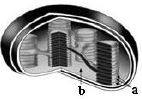
Identify the correct option for $a$ and $b$ in the given figure of a chloroplast.
A
$a-$ Thylakoid,$b-$ Stroma
B
$a-$ Thylakoid,$b-$ Stroma lamellae
C
$a-$ Granum,$b-$ Stroma
D
$a-$ Outer membrane,$b-$ Stroma
Solution
(A) In the provided diagram of a chloroplast:
$1$. Label '$a$' points to the flattened sac-like structures stacked together,which are known as thylakoids.
$2$. Label '$b$' points to the fluid-filled space surrounding the thylakoid stacks,which is known as the stroma.
Therefore,$a$ represents the thylakoid and $b$ represents the stroma.
$1$. Label '$a$' points to the flattened sac-like structures stacked together,which are known as thylakoids.
$2$. Label '$b$' points to the fluid-filled space surrounding the thylakoid stacks,which is known as the stroma.
Therefore,$a$ represents the thylakoid and $b$ represents the stroma.
0 likes
View Solution47
MediumMCQ
An amyloplast stores .......... .
A
Starch
B
Fats
C
Sugars
D
Proteins
Solution
(A) Amyloplasts are a type of leucoplast,which are colourless plastids.
They are specialized for the storage of starch granules in plant cells.
Other types of leucoplasts include elaioplasts (which store oils and fats) and aleuroplasts (which store proteins).
They are specialized for the storage of starch granules in plant cells.
Other types of leucoplasts include elaioplasts (which store oils and fats) and aleuroplasts (which store proteins).
0 likes
View Solution48
EasyMCQ
Based on the type of pigments,which types of plastids can be classified in plants?
A
Chromoplasts
B
Chloroplasts
C
Leucoplasts
D
All of the above
Solution
(D) Plastids are found in all plant cells and in euglenoids. Based on the type of pigments,plastids can be classified into three types:
$1$. Chloroplasts: Contain chlorophyll and carotenoid pigments which are responsible for trapping light energy essential for photosynthesis.
$2$. Chromoplasts: Contain fat-soluble carotenoid pigments like carotene,xanthophylls,and others. This gives the part of the plant a yellow,orange,or red color.
$3$. Leucoplasts: These are colorless plastids of varied shapes and sizes with stored nutrients. They include amyloplasts (store carbohydrates),elaioplasts (store oils and fats),and aleuroplasts (store proteins).
Therefore,all the given options are correct types of plastids.
$1$. Chloroplasts: Contain chlorophyll and carotenoid pigments which are responsible for trapping light energy essential for photosynthesis.
$2$. Chromoplasts: Contain fat-soluble carotenoid pigments like carotene,xanthophylls,and others. This gives the part of the plant a yellow,orange,or red color.
$3$. Leucoplasts: These are colorless plastids of varied shapes and sizes with stored nutrients. They include amyloplasts (store carbohydrates),elaioplasts (store oils and fats),and aleuroplasts (store proteins).
Therefore,all the given options are correct types of plastids.
0 likes
View Solution49
EasyMCQ
Which plastids contain pigments other than chlorophyll?
A
Chloroplasts
B
Chromoplasts
C
Leucoplasts
D
Elaioplasts
Solution
(B) Plastids are classified based on the type of pigments they contain:
$1$. $Chloroplasts$: Contain chlorophyll and carotenoid pigments which are responsible for trapping light energy for photosynthesis.
$2$. $Chromoplasts$: Contain fat-soluble carotenoid pigments like carotene,xanthophylls,and others. These provide yellow,orange,or red colors to various plant parts.
$3$. $Leucoplasts$: These are colorless plastids of varied shapes and sizes with stored nutrients. $Elaioplasts$ are a type of leucoplast that store oils and fats.
Therefore,$Chromoplasts$ are the plastids that contain pigments other than chlorophyll.
$1$. $Chloroplasts$: Contain chlorophyll and carotenoid pigments which are responsible for trapping light energy for photosynthesis.
$2$. $Chromoplasts$: Contain fat-soluble carotenoid pigments like carotene,xanthophylls,and others. These provide yellow,orange,or red colors to various plant parts.
$3$. $Leucoplasts$: These are colorless plastids of varied shapes and sizes with stored nutrients. $Elaioplasts$ are a type of leucoplast that store oils and fats.
Therefore,$Chromoplasts$ are the plastids that contain pigments other than chlorophyll.
0 likes
View Solution50
MediumMCQ
Which of the following pigments is not found in plastids?
A
Carotene
B
Chlorophyll
C
Xanthophyll
D
Anthocyanin
Solution
(D) Plastids are organelles found in plant cells that contain various pigments.
Chloroplasts contain chlorophyll (green pigment) and carotenoids (carotene and xanthophyll).
Anthocyanins are water-soluble vacuolar pigments that appear red,purple,or blue depending on the pH.
They are not found in plastids but are stored in the cell vacuole.
Therefore,the correct answer is $D$.
Chloroplasts contain chlorophyll (green pigment) and carotenoids (carotene and xanthophyll).
Anthocyanins are water-soluble vacuolar pigments that appear red,purple,or blue depending on the pH.
They are not found in plastids but are stored in the cell vacuole.
Therefore,the correct answer is $D$.
0 likes
View SolutionCell: The Unit of Life — Plastids · Frequently Asked Questions
1Are these Cell: The Unit of Life questions useful for JEE and NEET?
Yes. All questions in this section are mapped to JEE Main and NEET exam patterns. Previous year questions from JEE Main, NEET, GUJCET and state-level exams are included with full solutions.
2Can I switch to Hindi or Gujarati for these questions?
Yes. Use the language tabs in the hero section or the sidebar to view the same questions and solutions in English, Hindi or Gujarati.
3How do I generate a question paper from this subtopic?
Use the Vedclass Exam Paper Generator — select the chapter and subtopic, set difficulty, and generate Sets A, B, C, D automatically. First 3 chapters of every subject are free.
Vedclass Products
For Students
Vedclass Test Series
Mock tests in real JEE/NEET style with performance analysis. 5-day free trial.
Start Free TrialFor Teachers
Exam Paper Generator
Generate Set A/B/C/D papers from this chapter in 2 minutes. 3 chapters free.
Try FreeFor Institutes
Online Exam Module
Live online exams with unlimited students, 360° analytics & white-label branding.
See DemoFor Teachers & Institutes
Generate a Cell: The Unit of Life Exam Paper in 2 Minutes
Select subtopic & difficulty — Sets A, B, C, D auto-generated with No Repeat logic.
First 3 chapters of every subject are free — no payment required.