
A English
Mitochondria Questions in English
Class 11 Biology · Cell: The Unit of Life · Mitochondria
173+
Questions
English
Language
100%
With Solutions
Showing 49 of 173 questions in English
101
EasyMCQ
In mitochondria,the structures known as '$F_1$ particles' are present on:
A
Matrix
B
Outer membrane
C
Cristae
D
All of the above
Solution
(C) The mitochondria consist of an outer membrane and an inner membrane. The inner membrane of the mitochondria forms several infoldings called cristae. On the surface of these cristae,there are numerous stalked particles known as '$F_1$ particles' or oxysomes. These particles are involved in the synthesis of $ATP$.
0 likes
View Solution102
EasyMCQ
Which organelle is known as the powerhouse of the cell?
A
Ribosome
B
Mitochondria
C
Golgi apparatus
D
Chloroplast
Solution
(B) Mitochondria are known as the powerhouse of the cell because they produce cellular energy in the form of $ATP$ (Adenosine Triphosphate) through the process of aerobic respiration.
0 likes
View Solution103
MediumMCQ
$P -$ Assertion: The inner membrane of the mitochondria forms a number of infoldings called cristae,which contain $F_1$ particles.
$Q -$ Reason: Cristae contain the components necessary for oxidative phosphorylation.
$Q -$ Reason: Cristae contain the components necessary for oxidative phosphorylation.
A
$P$ and $Q$ are true,and $P$ is the correct explanation of $Q$.
B
$P$ and $Q$ are true,but $P$ is not the correct explanation of $Q$.
C
$P$ is true,but $Q$ is false.
D
$P$ is false,but $Q$ is true.
Solution
(A) The inner membrane of the mitochondria is folded into structures called cristae,which increase the surface area for biochemical reactions. These cristae are studded with $F_1$ particles (also known as oxysomes or $ATP$ synthase complexes). These particles are essential for the synthesis of $ATP$ during oxidative phosphorylation. Therefore,both the assertion and the reason are correct,and the presence of $F_1$ particles on the cristae is the reason why they are the site of oxidative phosphorylation. Thus,$P$ is the correct explanation of $Q$.
0 likes
View Solution104
EasyMCQ
In the given figure,what do $a$ and $b$ represent respectively?
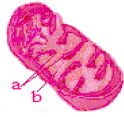
A
Cristae,Outer membrane
B
Matrix,Inner membrane
C
Cristae,Matrix
D
Inner membrane,Outer membrane
Solution
(C) The provided image shows the structure of a mitochondrion.
In the diagram,the label '$a$' points to the inward folds of the inner mitochondrial membrane,which are known as cristae.
The label '$b$' points to the fluid-filled space enclosed by the inner membrane,which is known as the matrix.
Therefore,'$a$' represents cristae and '$b$' represents the matrix.
In the diagram,the label '$a$' points to the inward folds of the inner mitochondrial membrane,which are known as cristae.
The label '$b$' points to the fluid-filled space enclosed by the inner membrane,which is known as the matrix.
Therefore,'$a$' represents cristae and '$b$' represents the matrix.
0 likes
View Solution105
MediumMCQ
Which of the following statements is $NOT$ true regarding mitochondria?
A
They have a diameter of $0.2 - 1.0 \, \mu m$ and a length of $1.0 - 4.1 \, \mu m$.
B
They contain cristae.
C
They store and release energy.
D
They contain $DNA$.
Solution
(A) Mitochondria are double-membrane-bound organelles.
Their dimensions typically range from $0.2 - 1.0 \, \mu m$ in diameter and $1.0 - 4.1 \, \mu m$ in length.
They contain inner folds called cristae, which increase the surface area for biochemical reactions.
They are known as the 'powerhouse of the cell' because they produce energy in the form of $ATP$ through aerobic respiration.
They also contain their own circular $DNA$ and ribosomes.
Option $A$ is incorrect because the provided range in the question $(0.02 - 1.0 \, \mu m)$ is inaccurate compared to the standard biological range $(0.2 - 1.0 \, \mu m)$.
Their dimensions typically range from $0.2 - 1.0 \, \mu m$ in diameter and $1.0 - 4.1 \, \mu m$ in length.
They contain inner folds called cristae, which increase the surface area for biochemical reactions.
They are known as the 'powerhouse of the cell' because they produce energy in the form of $ATP$ through aerobic respiration.
They also contain their own circular $DNA$ and ribosomes.
Option $A$ is incorrect because the provided range in the question $(0.02 - 1.0 \, \mu m)$ is inaccurate compared to the standard biological range $(0.2 - 1.0 \, \mu m)$.
0 likes
View Solution106
MediumMCQ
Read the statements $P$ and $Q$:
$P$: The number of mitochondria in each cell does not depend on the physiological activity of the cell.
$Q$: Mitochondria are present in both plant and animal cells.
Select the correct option from the given choices.
$P$: The number of mitochondria in each cell does not depend on the physiological activity of the cell.
$Q$: Mitochondria are present in both plant and animal cells.
Select the correct option from the given choices.
A
Statement $P$ is true,$Q$ is false.
B
Both statements $P$ and $Q$ are true.
C
Statement $Q$ is true,$P$ is false.
D
Both statements $P$ and $Q$ are false.
Solution
(C) Statement $P$ is false because the number of mitochondria per cell is variable and depends on the physiological activity of the cell. Cells with higher energy requirements,such as muscle cells,contain a higher number of mitochondria.
Statement $Q$ is true because mitochondria are semi-autonomous organelles found in almost all eukaryotic cells,including both plants and animals.
Therefore,statement $P$ is false and statement $Q$ is true.
Statement $Q$ is true because mitochondria are semi-autonomous organelles found in almost all eukaryotic cells,including both plants and animals.
Therefore,statement $P$ is false and statement $Q$ is true.
0 likes
View Solution107
MediumMCQ
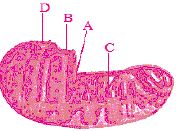
In the given diagram of a mitochondrion,four parts are labeled $A, B, C, D$. Select the correct match between the part and its function.
A
$D -$ Outer membrane: Gives rise to the inner membrane upon rupture.
B
$B -$ Inner membrane: Forms infoldings called cristae.
C
$C -$ Cristae: Contains a circular $DNA$ molecule and ribosomes.
D
$A -$ Matrix: Major site for respiratory enzymes.
Solution
(B) Based on the structure of the mitochondrion:
$A$ represents the Matrix,which is the site of the Krebs cycle and contains enzymes for cellular respiration.
$B$ represents the Inner membrane,which forms infoldings known as cristae to increase surface area.
$C$ represents the Cristae (or the inner space/matrix area depending on the specific pointer,but in this context,it points to the inner membrane folds).
$D$ represents the Outer membrane,which forms the continuous limiting boundary of the organelle.
Therefore,option $B$ correctly identifies that $B$ is the inner membrane which forms infoldings called cristae.
$A$ represents the Matrix,which is the site of the Krebs cycle and contains enzymes for cellular respiration.
$B$ represents the Inner membrane,which forms infoldings known as cristae to increase surface area.
$C$ represents the Cristae (or the inner space/matrix area depending on the specific pointer,but in this context,it points to the inner membrane folds).
$D$ represents the Outer membrane,which forms the continuous limiting boundary of the organelle.
Therefore,option $B$ correctly identifies that $B$ is the inner membrane which forms infoldings called cristae.
0 likes
View Solution108
MediumMCQ
Which pair of organelles in a eukaryotic cell contains circular $DNA$?
A
Lysosome-Ribosome
B
Ribosome-Chloroplast
C
Chloroplast-Mitochondria
D
Mitochondria-Lysosome
Solution
(C) In eukaryotic cells,most of the $DNA$ is located in the nucleus. However,semi-autonomous organelles like chloroplasts and mitochondria contain their own circular $DNA$ molecules,which are similar to prokaryotic $DNA$. This supports the endosymbiotic theory. Therefore,the correct pair is chloroplast and mitochondria.
0 likes
View Solution109
MediumMCQ
$A$: Mitochondria are the powerhouses of the cell.
$R$: The sites of the Krebs cycle and oxidative phosphorylation in cellular respiration are within the mitochondria.
$R$: The sites of the Krebs cycle and oxidative phosphorylation in cellular respiration are within the mitochondria.
A
$A$ and $R$ are both true and $R$ is the correct explanation of $A$.
B
$A$ and $R$ are both true,but $R$ is not the correct explanation of $A$.
C
$A$ is true and $R$ is false.
D
$A$ is false and $R$ is true.
Solution
(A) $1$. Mitochondria are known as the powerhouses of the cell because they produce cellular energy in the form of $ATP$ (Adenosine Triphosphate).
$2$. This energy production occurs through cellular respiration.
$3$. The matrix of the mitochondria is the site for the Krebs cycle ($TCA$ cycle),while the inner mitochondrial membrane is the site for the electron transport system and oxidative phosphorylation.
$4$. Since the energy production ($ATP$ synthesis) is directly dependent on these processes occurring within the mitochondria,$R$ is the correct explanation for $A$.
$2$. This energy production occurs through cellular respiration.
$3$. The matrix of the mitochondria is the site for the Krebs cycle ($TCA$ cycle),while the inner mitochondrial membrane is the site for the electron transport system and oxidative phosphorylation.
$4$. Since the energy production ($ATP$ synthesis) is directly dependent on these processes occurring within the mitochondria,$R$ is the correct explanation for $A$.
0 likes
View Solution110
EasyMCQ
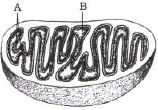
Which cell structure is shown in the given figure?
A
Chloroplast
B
Mitochondrion
C
Nucleus
D
Nucleolus
Solution
(B) The provided figure shows a double-membrane-bound organelle with internal foldings called cristae $(A)$ and an inner matrix $(B)$. This structure is characteristic of a mitochondrion,which is known as the powerhouse of the cell. Chloroplasts have thylakoids,while the nucleus has a nuclear envelope and chromatin,and the nucleolus is a dense region within the nucleus. Therefore,the correct option is $B$.
0 likes
View Solution111
EasyMCQ
In the given figure,what does $A$ represent?
A
Inner membrane
B
Ribosome
C
Cristae
D
Outer membrane
Solution
(C) The provided figure shows the structure of a mitochondrion.
In this diagram,the label $A$ points to the folds of the inner mitochondrial membrane,which are known as cristae.
These folds increase the surface area for biochemical reactions.
Therefore,$A$ represents cristae.
In this diagram,the label $A$ points to the folds of the inner mitochondrial membrane,which are known as cristae.
These folds increase the surface area for biochemical reactions.
Therefore,$A$ represents cristae.
0 likes
View Solution112
EasyMCQ
In the given figure,what does $B$ represent?
A
Inner membrane
B
Matrix
C
Circular $DNA$
D
Outer membrane
Solution
(B) The provided figure shows the structure of a mitochondrion.
In this diagram,label $A$ points to the cristae (folds of the inner membrane),and label $B$ points to the inner space of the mitochondrion,which is known as the matrix.
The matrix contains enzymes,ribosomes,and circular $DNA$ required for mitochondrial function.
Therefore,$B$ represents the matrix.
In this diagram,label $A$ points to the cristae (folds of the inner membrane),and label $B$ points to the inner space of the mitochondrion,which is known as the matrix.
The matrix contains enzymes,ribosomes,and circular $DNA$ required for mitochondrial function.
Therefore,$B$ represents the matrix.
0 likes
View Solution113
MediumMCQ
In the given figure, what is present in the part labeled $B$?
A
Ribosomes
B
Circular $DNA$
C
Enzymes for the Krebs cycle
D
All of the above $(A, B, \text{and } C)$
Solution
(D) The given figure represents a mitochondrion.
Part $A$ points to the cristae (inner membrane folds), while part $B$ points to the matrix.
The mitochondrial matrix contains a single circular $DNA$ molecule, a few $RNA$ molecules, ribosomes $(70S)$, and the enzymes required for the Krebs cycle (citric acid cycle).
Therefore, all the components mentioned in options $A, B,$ and $C$ are present in the matrix $(B)$.
Part $A$ points to the cristae (inner membrane folds), while part $B$ points to the matrix.
The mitochondrial matrix contains a single circular $DNA$ molecule, a few $RNA$ molecules, ribosomes $(70S)$, and the enzymes required for the Krebs cycle (citric acid cycle).
Therefore, all the components mentioned in options $A, B,$ and $C$ are present in the matrix $(B)$.
0 likes
View Solution114
EasyMCQ
What is the other name for the cell structure shown in the given figure?
A
Suicidal bag
B
Powerhouse of the cell
C
Kitchen of the cell
D
All of the above
Solution
(B) The figure shows a mitochondrion,which is a double-membrane-bound organelle.
It is commonly known as the 'powerhouse of the cell' because it produces cellular energy in the form of $ATP$ through aerobic respiration.
'Suicidal bag' refers to lysosomes,and 'kitchen of the cell' refers to chloroplasts.
Therefore,the correct name for the structure shown is the powerhouse of the cell.
It is commonly known as the 'powerhouse of the cell' because it produces cellular energy in the form of $ATP$ through aerobic respiration.
'Suicidal bag' refers to lysosomes,and 'kitchen of the cell' refers to chloroplasts.
Therefore,the correct name for the structure shown is the powerhouse of the cell.
0 likes
View Solution115
MediumMCQ
Which of the following cell organelles is responsible for extracting energy from carbohydrates to form $ATP$?
A
Ribosome
B
Chloroplast
C
Mitochondrion
D
Lysosome
Solution
(C) : Mitochondria are miniature biochemical factories where food substances or respiratory substrates are completely oxidized to carbon dioxide and water.
The energy liberated in this process is initially stored in the form of reduced coenzymes and reduced prosthetic groups.
These subsequently undergo oxidation to form energy-rich $ATP$.
$ATP$ is released from the mitochondria and helps perform various energy-requiring processes of the cell,such as muscle contraction,nerve impulse conduction,biosynthesis,membrane transport,cell division,and movement.
Because of the formation of $ATP$,mitochondria are known as the powerhouses of the cell.
The energy liberated in this process is initially stored in the form of reduced coenzymes and reduced prosthetic groups.
These subsequently undergo oxidation to form energy-rich $ATP$.
$ATP$ is released from the mitochondria and helps perform various energy-requiring processes of the cell,such as muscle contraction,nerve impulse conduction,biosynthesis,membrane transport,cell division,and movement.
Because of the formation of $ATP$,mitochondria are known as the powerhouses of the cell.
0 likes
View Solution116
EasyMCQ
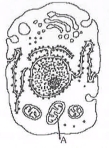
Select the alternative giving correct identification and function of the organelle '$A$' in the diagram.
A
Mitochondria - Produce cellular energy in the form of $ATP$
B
Golgi body - Provides packaging material
C
Lysosomes - Secrete hydrolytic enzymes
D
Endoplasmic reticulum - Synthesis of lipids
Solution
(A) The organelle labeled '$A$' in the diagram is the Mitochondrion.
Mitochondria are miniature biochemical factories where food stuffs or respiratory substrates are completely oxidised to carbon dioxide and water.
The energy liberated in the process is initially stored in the form of reduced coenzymes and reduced prosthetic groups.
The latter soon undergo oxidation and form energy-rich $ATP$.
$ATP$ comes out of mitochondria and helps perform various energy-requiring processes of the cell like muscle contraction,nerve impulse conduction,biosynthesis,membrane transport,cell division,movement,etc.
Because of the formation of $ATP$,the mitochondria are called powerhouses of the cell.
Mitochondria are miniature biochemical factories where food stuffs or respiratory substrates are completely oxidised to carbon dioxide and water.
The energy liberated in the process is initially stored in the form of reduced coenzymes and reduced prosthetic groups.
The latter soon undergo oxidation and form energy-rich $ATP$.
$ATP$ comes out of mitochondria and helps perform various energy-requiring processes of the cell like muscle contraction,nerve impulse conduction,biosynthesis,membrane transport,cell division,movement,etc.
Because of the formation of $ATP$,the mitochondria are called powerhouses of the cell.
0 likes
View Solution117
MediumMCQ
The figure below shows the structure of a mitochondrion with its four parts labelled $A, B, C$ and $D$. Select the part correctly matched with its function.
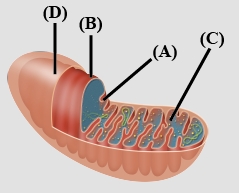
A
$D$ (outer membrane) - gives rise to inner membrane by splitting
B
$B$ (inner membrane) - forms infoldings called cristae
C
$C$ (crista) - possesses single circular $DNA$ molecule and ribosomes
D
$A$ (matrix) - major site for respiratory chain enzymes
Solution
(B) The correct answer is $B$.
Each mitochondrion is a double membrane-bound structure with the outer membrane and the inner membrane dividing its lumen distinctly into two aqueous compartments,$i.e.$,the outer compartment and the inner compartment.
The inner compartment is called the matrix.
The outer membrane forms the continuous limiting boundary of the organelle.
The inner membrane forms a number of infoldings called the cristae towards the matrix.
The cristae increase the surface area.
The two membranes have their own specific enzymes associated with the mitochondrial function.
Each mitochondrion is a double membrane-bound structure with the outer membrane and the inner membrane dividing its lumen distinctly into two aqueous compartments,$i.e.$,the outer compartment and the inner compartment.
The inner compartment is called the matrix.
The outer membrane forms the continuous limiting boundary of the organelle.
The inner membrane forms a number of infoldings called the cristae towards the matrix.
The cristae increase the surface area.
The two membranes have their own specific enzymes associated with the mitochondrial function.
0 likes
View Solution118
EasyMCQ
Which one of the following has its own $DNA$?
A
Mitochondria
B
Dictyosome
C
Lysosome
D
Peroxisome
Solution
(A) The correct answer is $A$.
Both mitochondria and chloroplasts are semi-autonomous organelles.
They contain their own circular $DNA$,which is responsible for producing their own $mRNA$,$tRNA$,and $rRNA$.
These organelles also possess their own $70S$ ribosomes,which allow them to synthesize some of their own proteins independently of the nucleus.
Both mitochondria and chloroplasts are semi-autonomous organelles.
They contain their own circular $DNA$,which is responsible for producing their own $mRNA$,$tRNA$,and $rRNA$.
These organelles also possess their own $70S$ ribosomes,which allow them to synthesize some of their own proteins independently of the nucleus.
0 likes
View Solution119
MediumMCQ
Which of the following statements regarding mitochondrial membrane is not correct?
A
The outer membrane resembles a sieve.
B
The outer membrane is permeable to all kinds of molecules.
C
The enzymes of the electron transfer chain are embedded in the outer membrane.
D
The inner membrane is highly convoluted forming a series of infoldings.
Solution
(C) : The outer membrane of the mitochondrion is smooth,freely permeable to most small molecules,contains fewer enzymes,and is poor in proteins. It has porin proteins which form channels for the passage of molecules. It allows the uptake of substrates and the release of $ATP$. The inner membrane is semipermeable and regulates the passage of materials into and out of the mitochondrion. It is rich in enzymes and carrier proteins (permeases). It is usually produced into numerous infolds called cristae (singular: crista). It bears minute,regularly spaced,lollipop-shaped particles known as oxysomes. The inner membrane contains the electron carrier molecules of the electron transport chain,not the outer membrane.
0 likes
View Solution120
MediumMCQ
Identify $X$ from the given figure of a plant cell.
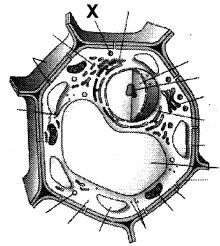
A
Mesosome
B
Lysosome
C
Mitochondrion
D
Membrane
Solution
(C) The provided figure represents a plant cell.
In the diagram,the label $X$ points to a small,double-membrane-bound organelle typically found in the cytoplasm,which is the mitochondrion.
$A$ Mesosome is a characteristic feature of prokaryotic cells,not eukaryotic plant cells.
$B$ Lysosomes are rare in plant cells,as their function is often performed by the large central vacuole.
$D$ The membrane refers to the plasma membrane or cell wall,which is not what $X$ is pointing to.
Therefore,the correct identification for $X$ is the mitochondrion.
In the diagram,the label $X$ points to a small,double-membrane-bound organelle typically found in the cytoplasm,which is the mitochondrion.
$A$ Mesosome is a characteristic feature of prokaryotic cells,not eukaryotic plant cells.
$B$ Lysosomes are rare in plant cells,as their function is often performed by the large central vacuole.
$D$ The membrane refers to the plasma membrane or cell wall,which is not what $X$ is pointing to.
Therefore,the correct identification for $X$ is the mitochondrion.
0 likes
View Solution121
EasyMCQ
What are the inner folds of the mitochondria called?
A
Cristae
B
Matrix
C
Cisternae
D
Stroma
Solution
(A) The mitochondria are double-membrane-bound organelles. The inner membrane of the mitochondria forms a number of infoldings called $Cristae$ towards the matrix. These folds increase the surface area for the attachment of enzymes involved in the electron transport chain and $ATP$ synthesis.
0 likes
View Solution122
EasyMCQ
$F_1$ particles are present in
A
Mitochondria
B
Vacuole
C
Chloroplast
D
Lysosome
Solution
(A) $F_1$ particles,also known as $F_1$ subunits or oxysomes,are located on the inner mitochondrial membrane.
These particles are part of the $F_0-F_1$ $ATP$ synthase complex,which is responsible for the synthesis of $ATP$ during oxidative phosphorylation.
Therefore,the correct location for $F_1$ particles is the mitochondria.
These particles are part of the $F_0-F_1$ $ATP$ synthase complex,which is responsible for the synthesis of $ATP$ during oxidative phosphorylation.
Therefore,the correct location for $F_1$ particles is the mitochondria.
0 likes
View Solution123
Medium
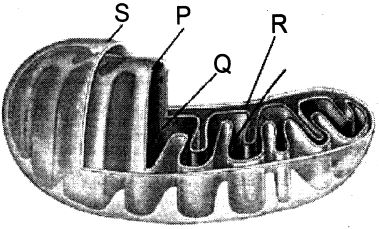
In the given figure of a mitochondrion,which alphabet indicates the location of the matrix where circular $DNA$ is present?
Solution
(B) The provided figure represents the structure of a mitochondrion.
$S$ points to the outer membrane.
$P$ points to the matrix,which is the inner compartment of the mitochondrion.
$Q$ points to the cristae (folds of the inner membrane).
$R$ points to the inner membrane.
The matrix $(P)$ contains a single circular $DNA$ molecule,a few $RNA$ molecules,ribosomes $(70S)$,and the enzymes required for the synthesis of proteins.
Therefore,the alphabet $P$ indicates the location of the matrix where circular $DNA$ is present.
$S$ points to the outer membrane.
$P$ points to the matrix,which is the inner compartment of the mitochondrion.
$Q$ points to the cristae (folds of the inner membrane).
$R$ points to the inner membrane.
The matrix $(P)$ contains a single circular $DNA$ molecule,a few $RNA$ molecules,ribosomes $(70S)$,and the enzymes required for the synthesis of proteins.
Therefore,the alphabet $P$ indicates the location of the matrix where circular $DNA$ is present.
0 likes
View Solution124
MediumMCQ
Identify the $X, Y$ and $Z$ parts from the given figure of a mitochondrion:
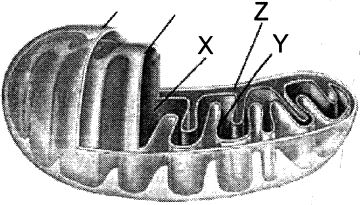
A
$X-$ Matrix,$Y-$ Crista,$Z-$ Intermembrane space
B
$X-$ Outer membrane,$Y-$ Matrix,$Z-$ Crista
C
$X-$ Crista,$Y-$ Matrix,$Z-$ Inner membrane
D
$X-$ Outer membrane,$Y-$ Inner membrane,$Z-$ Matrix
Solution
(C) The provided figure shows the ultrastructure of a mitochondrion.
$1$. $X$ points to the inner fluid-filled compartment,which is the Matrix.
$2$. $Y$ points to the infoldings of the inner membrane,known as Cristae (singular: Crista).
$3$. $Z$ points to the Inner membrane itself,which forms these folds.
Therefore,the correct identification is $X-$ Matrix,$Y-$ Crista,$Z-$ Inner membrane. However,looking at the options provided,option $C$ matches this description best.
$1$. $X$ points to the inner fluid-filled compartment,which is the Matrix.
$2$. $Y$ points to the infoldings of the inner membrane,known as Cristae (singular: Crista).
$3$. $Z$ points to the Inner membrane itself,which forms these folds.
Therefore,the correct identification is $X-$ Matrix,$Y-$ Crista,$Z-$ Inner membrane. However,looking at the options provided,option $C$ matches this description best.
0 likes
View Solution125
EasyMCQ
They are the sites of aerobic respiration.
A
Chloroplast
B
Golgi body
C
Lysosome
D
Mitochondria
Solution
(D) Mitochondria are known as the powerhouses of the cell because they are the primary sites of aerobic respiration.
During aerobic respiration,mitochondria utilize oxygen to break down glucose and other nutrients to produce energy in the form of $ATP$ (Adenosine Triphosphate).
This process involves the Krebs cycle and the electron transport chain,which occur within the mitochondrial matrix and inner membrane,respectively.
During aerobic respiration,mitochondria utilize oxygen to break down glucose and other nutrients to produce energy in the form of $ATP$ (Adenosine Triphosphate).
This process involves the Krebs cycle and the electron transport chain,which occur within the mitochondrial matrix and inner membrane,respectively.
0 likes
View Solution126
MediumMCQ
On which structure are the $F_0-F_1$ particles of oxysomes located?
A
Thylakoids
B
Surface of mitochondria
C
Inner mitochondrial membrane
D
Surface of chloroplast
Solution
(C) The $F_0-F_1$ particles,also known as oxysomes or elementary particles,are found on the inner mitochondrial membrane.
These particles are involved in the process of oxidative phosphorylation,where they synthesize $ATP$ using the proton gradient generated across the inner mitochondrial membrane.
The $F_1$ headpiece projects into the mitochondrial matrix,while the $F_0$ base is embedded within the inner membrane.
These particles are involved in the process of oxidative phosphorylation,where they synthesize $ATP$ using the proton gradient generated across the inner mitochondrial membrane.
The $F_1$ headpiece projects into the mitochondrial matrix,while the $F_0$ base is embedded within the inner membrane.
0 likes
View Solution127
MediumMCQ
The mitochondrial cristae are the sites for which of the following?
A
Breakdown of macromolecules
B
Protein synthesis
C
Phosphorylation of flavoproteins
D
Oxidation-reduction reactions
Solution
(D) Mitochondrial cristae are the inner membrane folds of the mitochondria.
These cristae significantly increase the surface area of the inner mitochondrial membrane.
The inner mitochondrial membrane contains the components of the Electron Transport System $(ETS)$ and $ATP$ synthase.
These components facilitate various oxidation-reduction (redox) reactions,which are essential for the process of oxidative phosphorylation to generate $ATP$.
Therefore,the cristae are the specific sites for these oxidation-reduction reactions.
These cristae significantly increase the surface area of the inner mitochondrial membrane.
The inner mitochondrial membrane contains the components of the Electron Transport System $(ETS)$ and $ATP$ synthase.
These components facilitate various oxidation-reduction (redox) reactions,which are essential for the process of oxidative phosphorylation to generate $ATP$.
Therefore,the cristae are the specific sites for these oxidation-reduction reactions.
0 likes
View Solution128
MediumMCQ
What are the infoldings of the inner mitochondrial membrane called?
A
Lamellae
B
Thylakoids
C
Grana
D
Cristae
Solution
(D) The inner membrane of the mitochondrion forms a number of infoldings called $Cristae$ towards the matrix.
These infoldings increase the surface area of the inner membrane,which is essential for the attachment of enzymes involved in the electron transport chain and $ATP$ synthesis.
Therefore,the correct option is $D$.
These infoldings increase the surface area of the inner membrane,which is essential for the attachment of enzymes involved in the electron transport chain and $ATP$ synthesis.
Therefore,the correct option is $D$.
0 likes
View Solution129
EasyMCQ
Microtubules are absent in which of the following?
A
Mitochondria
B
Centriole
C
Flagella
D
Spindle fibers
Solution
(A) Microtubules are cytoskeletal components made of tubulin protein. They are structural components of centrioles,cilia,flagella,and spindle fibers. Mitochondria are double-membrane-bound organelles involved in cellular respiration and do not contain microtubules.
0 likes
View Solution130
MediumMCQ
Which of the following statements is $NOT$ true regarding the mitochondrial membranes?
A
The outer membrane contains enzymes of the electron transport chain.
B
The inner membrane forms a series of infoldings called cristae.
C
The outer membrane contains porins.
D
The outer membrane is permeable to all types of molecules.
Solution
(A) The mitochondrial outer membrane is not permeable to all types of molecules. It contains large protein channels called $porins$ that allow the passage of small molecules like ions,$ATP$,and small proteins,but it is not permeable to all molecules. The electron transport chain enzymes are located in the inner mitochondrial membrane,not the outer membrane. Therefore,statement $A$ is incorrect as the electron transport chain is in the inner membrane,and statement $D$ is incorrect as the outer membrane is selectively permeable.
0 likes
View Solution131
EasyMCQ
Which of the following structures contains its own $DNA$?
A
Mitochondria
B
Dictyosome
C
Lysosome
D
Peroxisome
Solution
(A) Mitochondria are semi-autonomous organelles that contain their own circular $DNA$,$RNA$,and $70S$ ribosomes. This allows them to synthesize some of their own proteins independently of the nucleus. Other organelles like lysosomes,dictyosomes (Golgi apparatus),and peroxisomes do not contain their own $DNA$.
0 likes
View Solution132
MediumMCQ
Which of the following cell organelles is responsible for generating $ATP$ by extracting energy from carbohydrates?
A
Lysosomes
B
Ribosomes
C
Chloroplasts
D
Mitochondria
Solution
(D) Mitochondria are known as the '$powerhouse$ of the cell'.
They are the sites of aerobic respiration,where they perform the oxidation of carbohydrates to release energy in the form of $ATP$ (Adenosine Triphosphate).
Lysosomes are involved in digestion,ribosomes in protein synthesis,and chloroplasts in photosynthesis.
They are the sites of aerobic respiration,where they perform the oxidation of carbohydrates to release energy in the form of $ATP$ (Adenosine Triphosphate).
Lysosomes are involved in digestion,ribosomes in protein synthesis,and chloroplasts in photosynthesis.
0 likes
View Solution133
EasyMCQ
Which of the following statements regarding mitochondria is incorrect?
A
Outer membrane is permeable to monomers of carbohydrates,fats,and proteins.
B
Enzymes of electron transport are embedded in the outer membrane.
C
Inner membrane is convoluted with infoldings.
D
Mitochondrial matrix contains a single circular $DNA$ molecule and ribosomes.
Solution
(B) The correct answer is $B$. The enzymes of the electron transport chain $(ETC)$ are embedded in the inner mitochondrial membrane,not the outer membrane. The outer membrane is permeable to small molecules like ions,$ATP$,and nutrients due to the presence of porins. The inner membrane forms infoldings called cristae,which increase the surface area for biochemical reactions. The mitochondrial matrix contains a single circular $DNA$ molecule,a few $RNA$ molecules,and $70S$ ribosomes.
0 likes
View Solution134
MediumMCQ
Assertion : Power house of cell is mitochondria.
Reason : $ATP$ is produced in mitochondria.
Reason : $ATP$ is produced in mitochondria.
A
If both Assertion and Reason are correct but Reason is not a correct explanation of the Assertion.
B
If both Assertion and Reason are correct and the Reason is a correct explanation of the Assertion.
C
If the Assertion is correct but Reason is incorrect.
D
If both the Assertion and Reason are incorrect.
Solution
(B) Mitochondria are known as the power house of the cell because they are the sites of aerobic respiration.
They produce a large amount of energy in the form of $ATP$ (Adenosine Triphosphate) through the process of oxidative phosphorylation.
Since the production of $ATP$ is the direct reason why mitochondria are termed the power house,the Reason correctly explains the Assertion.
They produce a large amount of energy in the form of $ATP$ (Adenosine Triphosphate) through the process of oxidative phosphorylation.
Since the production of $ATP$ is the direct reason why mitochondria are termed the power house,the Reason correctly explains the Assertion.
0 likes
View Solution135
MediumMCQ
Assertion : Mitochondria and chloroplasts are semi-autonomous organelles.
Reason : They are formed by division of preexisting organelles as well as contain $DNA$ but lack protein-synthesizing machinery.
Reason : They are formed by division of preexisting organelles as well as contain $DNA$ but lack protein-synthesizing machinery.
A
If both Assertion and Reason are correct and the Reason is a correct explanation of the Assertion.
B
If both Assertion and Reason are correct but Reason is not a correct explanation of the Assertion.
C
If the Assertion is correct but Reason is incorrect.
D
If both the Assertion and Reason are incorrect.
Solution
(C) Mitochondria and chloroplasts are considered semi-autonomous organelles because they contain their own $DNA$ and ribosomes,which allow them to synthesize some of their own proteins.
They are formed by the division of preexisting organelles.
However,the statement that they 'lack protein-synthesizing machinery' is incorrect because they possess $70S$ ribosomes,which are essential for protein synthesis.
Therefore,the Assertion is correct,but the Reason is incorrect.
They are formed by the division of preexisting organelles.
However,the statement that they 'lack protein-synthesizing machinery' is incorrect because they possess $70S$ ribosomes,which are essential for protein synthesis.
Therefore,the Assertion is correct,but the Reason is incorrect.
0 likes
View Solution136
MediumMCQ
Assertion: Mitochondria helps in photosynthesis.
Reason: Mitochondria have enzymes for dark reaction.
Reason: Mitochondria have enzymes for dark reaction.
A
If both Assertion and Reason are correct and the Reason is a correct explanation of the Assertion.
B
If both Assertion and Reason are correct but Reason is not a correct explanation of the Assertion.
C
If the Assertion is correct but Reason is incorrect.
D
If both the Assertion and Reason are incorrect.
Solution
(D) The Assertion is incorrect because mitochondria are the sites of cellular respiration,not photosynthesis. Photosynthesis occurs in chloroplasts.
The Reason is also incorrect because the enzymes for the dark reaction (Calvin cycle) are located in the stroma of the chloroplast,not in the mitochondria.
Therefore,both the Assertion and the Reason are incorrect.
The Reason is also incorrect because the enzymes for the dark reaction (Calvin cycle) are located in the stroma of the chloroplast,not in the mitochondria.
Therefore,both the Assertion and the Reason are incorrect.
0 likes
View Solution137
MediumMCQ
Which of the following representations correctly explains the function of a mitochondrion?
A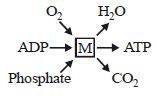
B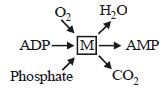
C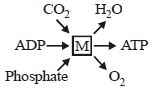
D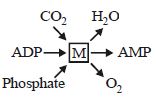
Solution
(A) The mitochondrion is the site of aerobic cellular respiration. During this process,oxygen $(O_2)$ is consumed,and organic substrates are oxidized to release energy. This energy is used to synthesize $ATP$ from $ADP$ and inorganic phosphate $(Pi)$. The byproducts of this process include carbon dioxide $(CO_2)$ and water $(H_2O)$. Therefore,the correct representation is that $O_2$ and $ADP$ + Phosphate enter the mitochondrion,while $ATP$,$CO_2$,and $H_2O$ are produced and released. This corresponds to the process shown in option $A$.
0 likes
View Solution138
Easy
Give information about the structure,location,and function of mitochondria.
Solution
(N/A) $\Rightarrow$ Mitochondria are stained specifically to be observed under a microscope.
$\Rightarrow$ The number of mitochondria per cell is variable,depending on the physiological activity of the cells.
$\Rightarrow$ In terms of shape and size also,a considerable degree of variability is observed.
$\Rightarrow$ Typically,it is sausage-shaped or cylindrical,having a diameter of $0.2-1.0 \mu m$ (average $0.5 \mu m$) and a length of $1.0-4.1 \mu m$.
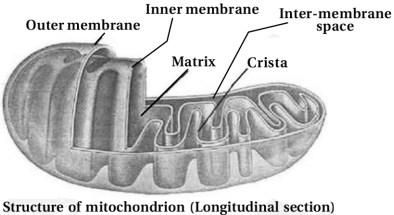
$\Rightarrow$ Each mitochondrion is a double membrane-bound structure,with the outer membrane and the inner membrane dividing its lumen distinctly into two aqueous compartments,i.e.,the outer compartment and the inner compartment.
$\Rightarrow$ The inner compartment is called the matrix. The inner membrane forms a number of infoldings called cristae towards the matrix. The cristae increase the surface area.
$\Rightarrow$ The two membranes have their own specific enzymes associated with the mitochondrial function.
$\Rightarrow$ Mitochondria are the sites of aerobic respiration. They produce cellular energy in the form of $ATP$,hence they are called the 'powerhouses' of the cell.
$\Rightarrow$ The matrix also possesses a single circular $DNA$ molecule,a few $RNA$ molecules,ribosomes $(70S)$,and the components required for the synthesis of proteins.
$\Rightarrow$ The mitochondria divide by fission.
$\Rightarrow$ The number of mitochondria per cell is variable,depending on the physiological activity of the cells.
$\Rightarrow$ In terms of shape and size also,a considerable degree of variability is observed.
$\Rightarrow$ Typically,it is sausage-shaped or cylindrical,having a diameter of $0.2-1.0 \mu m$ (average $0.5 \mu m$) and a length of $1.0-4.1 \mu m$.
$\Rightarrow$ Each mitochondrion is a double membrane-bound structure,with the outer membrane and the inner membrane dividing its lumen distinctly into two aqueous compartments,i.e.,the outer compartment and the inner compartment.
$\Rightarrow$ The inner compartment is called the matrix. The inner membrane forms a number of infoldings called cristae towards the matrix. The cristae increase the surface area.
$\Rightarrow$ The two membranes have their own specific enzymes associated with the mitochondrial function.
$\Rightarrow$ Mitochondria are the sites of aerobic respiration. They produce cellular energy in the form of $ATP$,hence they are called the 'powerhouses' of the cell.
$\Rightarrow$ The matrix also possesses a single circular $DNA$ molecule,a few $RNA$ molecules,ribosomes $(70S)$,and the components required for the synthesis of proteins.
$\Rightarrow$ The mitochondria divide by fission.
0 likes
View Solution139
MediumMCQ
Mitochondria and chloroplasts have their own $DNA$ (genetic material). What is known about their fate during nuclear division like mitosis?
A
They replicate independently of the nucleus.
B
They are destroyed during mitosis.
C
They are distributed randomly into daughter cells.
D
They are not involved in the process of mitosis.
Solution
(D) Mitochondria and chloroplasts contain their own circular $DNA$,which is independent of the nuclear $DNA$.
During mitosis,the process of karyokinesis (nuclear division) specifically involves the replication and segregation of nuclear chromosomes.
The organelles like mitochondria and chloroplasts replicate independently through binary fission and are distributed into the daughter cells during cytokinesis,not through the mitotic spindle mechanism used for nuclear $DNA$.
During mitosis,the process of karyokinesis (nuclear division) specifically involves the replication and segregation of nuclear chromosomes.
The organelles like mitochondria and chloroplasts replicate independently through binary fission and are distributed into the daughter cells during cytokinesis,not through the mitotic spindle mechanism used for nuclear $DNA$.
0 likes
View Solution140
Medium
Give scientific reason: Mitochondria is called the powerhouse of the cell.
Solution
(N/A) $\Rightarrow$ Mitochondria contain proteins,lipids,enzymes for carbohydrate metabolism,and small amounts of $RNA$ and $DNA$.
$\Rightarrow$ Mitochondria perform three main functions:
$(i)$ Produce cellular energy in the form of $ATP$ and release it as needed.
$(ii)$ Collect,transform,and translocate $ATP$ energy.
$(iii)$ Regulate the active transport of substances across the cell membrane.
$\Rightarrow$ Mitochondria are considered small biochemical factories that generate $ATP$ from food,$ADP$,and oxygen.
$\Rightarrow$ During the chemical process of cellular respiration,glucose molecules are oxidized,yielding $38$ molecules of $ATP$.
$\Rightarrow$ The matrix of the mitochondria contains the necessary enzymes for the Krebs cycle,where $ATP$ is synthesized.
$\Rightarrow$ Therefore,mitochondria are called the powerhouse of the cell.
$\Rightarrow$ Mitochondria perform three main functions:
$(i)$ Produce cellular energy in the form of $ATP$ and release it as needed.
$(ii)$ Collect,transform,and translocate $ATP$ energy.
$(iii)$ Regulate the active transport of substances across the cell membrane.
$\Rightarrow$ Mitochondria are considered small biochemical factories that generate $ATP$ from food,$ADP$,and oxygen.
$\Rightarrow$ During the chemical process of cellular respiration,glucose molecules are oxidized,yielding $38$ molecules of $ATP$.
$\Rightarrow$ The matrix of the mitochondria contains the necessary enzymes for the Krebs cycle,where $ATP$ is synthesized.
$\Rightarrow$ Therefore,mitochondria are called the powerhouse of the cell.
0 likes
View Solution141
Easy
Justify the statement, "Mitochondria are powerhouses of the cell".
Solution
(N/A) Mitochondria are referred to as the "powerhouses of the cell" because they are the primary sites for cellular respiration.
$1$. They perform aerobic respiration to produce energy in the form of $ATP$ $(Adenosine Triphosphate)$ through the process of oxidative phosphorylation.
$2$. The inner membrane of the mitochondria is folded into structures called cristae, which increase the surface area for the attachment of enzymes involved in the electron transport chain.
$3$. Since $ATP$ is the energy currency used by the cell to perform various metabolic activities, the mitochondria are essential for providing the necessary energy for cellular functions.
$1$. They perform aerobic respiration to produce energy in the form of $ATP$ $(Adenosine Triphosphate)$ through the process of oxidative phosphorylation.
$2$. The inner membrane of the mitochondria is folded into structures called cristae, which increase the surface area for the attachment of enzymes involved in the electron transport chain.
$3$. Since $ATP$ is the energy currency used by the cell to perform various metabolic activities, the mitochondria are essential for providing the necessary energy for cellular functions.
0 likes
View Solution142
MediumMCQ
Identify the location and function of the following structures:
$(1)$ Cristae
$(2)$ ATPase
$(1)$ Cristae
$(2)$ ATPase
A
Cristae: Inner mitochondrial membrane,$ATP$ synthesis; ATPase: Inner mitochondrial membrane,Electron transport
B
Cristae: Inner mitochondrial membrane,Increases surface area for $ETS$; ATPase: Inner mitochondrial membrane,Synthesis of $ATP$
C
Cristae: Outer mitochondrial membrane,Protein synthesis; ATPase: Matrix,Krebs cycle
D
Cristae: Matrix,Glycolysis; ATPase: Outer mitochondrial membrane,$ATP$ hydrolysis
Solution
(B) $(1)$ Cristae:
Location: Infoldings of the inner mitochondrial membrane.
Function: They significantly increase the surface area of the inner membrane to accommodate more enzymes and complexes required for the Electron Transport System $(ETS)$ and oxidative phosphorylation.
$(2)$ ATPase ($F_0-F_1$ particle):
Location: Embedded in the inner mitochondrial membrane.
Function: It acts as a channel for the facilitated diffusion of protons $(H^+)$ from the intermembrane space into the mitochondrial matrix,providing the energy required for the synthesis of $ATP$ from $ADP$ and inorganic phosphate $(Pi)$.
Location: Infoldings of the inner mitochondrial membrane.
Function: They significantly increase the surface area of the inner membrane to accommodate more enzymes and complexes required for the Electron Transport System $(ETS)$ and oxidative phosphorylation.
$(2)$ ATPase ($F_0-F_1$ particle):
Location: Embedded in the inner mitochondrial membrane.
Function: It acts as a channel for the facilitated diffusion of protons $(H^+)$ from the intermembrane space into the mitochondrial matrix,providing the energy required for the synthesis of $ATP$ from $ADP$ and inorganic phosphate $(Pi)$.
0 likes
View Solution143
MediumMCQ
Why do we consider chloroplasts and mitochondria to be semi-autonomous organelles?
A
They possess their own $DNA$ and ribosomes.
B
They can synthesize all their required proteins.
C
They are independent of the nucleus for all functions.
D
They can survive outside the cell.
Solution
(A) Chloroplasts and mitochondria are considered semi-autonomous organelles because they possess their own circular genomic $DNA$ and $70S$ ribosomes.
Due to the presence of their own $DNA$,they are capable of self-replication.
Whenever the cell requires more of these organelles,they can duplicate themselves independently of the cell cycle.
However,they are still dependent on the nuclear genome for the synthesis of many of their proteins,which is why they are termed 'semi-autonomous' rather than fully autonomous.
Due to the presence of their own $DNA$,they are capable of self-replication.
Whenever the cell requires more of these organelles,they can duplicate themselves independently of the cell cycle.
However,they are still dependent on the nuclear genome for the synthesis of many of their proteins,which is why they are termed 'semi-autonomous' rather than fully autonomous.
0 likes
View Solution144
EasyMCQ
Which of the following contains extranuclear genes?
A
Ribosomes
B
Golgi apparatus
C
Mitochondria
D
$E.R.$
Solution
(C) Extranuclear genes are genes located outside the nucleus of a cell.
In eukaryotic cells,extranuclear $DNA$ is primarily found in organelles such as mitochondria and chloroplasts.
These organelles possess their own circular $DNA$,which is independent of the nuclear genome.
Therefore,mitochondria contain extranuclear genes.
In eukaryotic cells,extranuclear $DNA$ is primarily found in organelles such as mitochondria and chloroplasts.
These organelles possess their own circular $DNA$,which is independent of the nuclear genome.
Therefore,mitochondria contain extranuclear genes.
0 likes
View Solution145
MediumMCQ
Which statement is incorrect regarding mitochondria?
A
Site of aerobic respiration
B
Supported by double unit membrane
C
Infolding of inner membrane forms cristae
D
Many circular $DNA$ and few ribosomes are found in matrix.
Solution
(D) Mitochondria are double-membrane-bound organelles. They contain a single circular $DNA$ molecule and a few $70S$ ribosomes in their matrix,not many circular $DNA$ molecules. Therefore,statement $D$ is incorrect.
0 likes
View Solution146
MediumMCQ
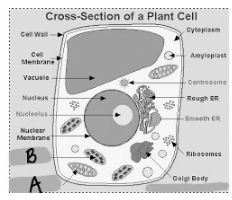
Identify the parts highlighted as $A$ and $B$ and explain why they are called semiautonomous organelles.
A
$A -$ Mitochondria,$B -$ Chloroplast; because both the organelles are double membrane-bound structures.
B
$A -$ Mitochondria,$B -$ Chloroplast; because they both are capable of synthesis of their own proteins only.
C
$A -$ Mitochondria,$B -$ Chloroplast; because they are capable of synthesis of their own proteins and contain their own $DNA$.
D
$A -$ Mitochondria,$B -$ Chloroplast; because they contain their own $DNA$ to transfer the genetic information from one generation to another.
Solution
(C) and $B$ are mitochondria and chloroplast,respectively.
They are called semiautonomous organelles because they possess their own $DNA$ and ribosomes,which allow them to synthesize some of their own proteins.
However,they are not fully independent as they still rely on the nuclear genome and cytoplasmic machinery for many of their functions.
They are called semiautonomous organelles because they possess their own $DNA$ and ribosomes,which allow them to synthesize some of their own proteins.
However,they are not fully independent as they still rely on the nuclear genome and cytoplasmic machinery for many of their functions.
0 likes
View Solution147
MediumMCQ
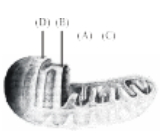
The figure below shows the structure of a mitochondrion with its four parts labelled $(A), (B), (C)$ and $(D).$ Select the part correctly matched with its function.
A
$Part (D):$ Outer membrane - Gives rise to inner membrane by splitting.
B
$Part (B):$ Inner membrane - Forms infoldings called cristae.
C
$Part (C):$ Cristae - Possess single circular $DNA$ molecule and ribosomes.
D
$Part (A):$ Matrix - Major site for respiratory chain enzymes.
Solution
(B) The mitochondrial inner membrane forms infoldings known as cristae,which allow greater surface area for proteins such as cytochromes to function properly and efficiently.
In the given diagram:
$(D)$ represents the outer membrane.
$(B)$ represents the inner membrane,which forms infoldings called cristae.
$(C)$ represents the matrix.
$(A)$ represents the intermembrane space.
Therefore,the correct match is $Part (B)$.
In the given diagram:
$(D)$ represents the outer membrane.
$(B)$ represents the inner membrane,which forms infoldings called cristae.
$(C)$ represents the matrix.
$(A)$ represents the intermembrane space.
Therefore,the correct match is $Part (B)$.
0 likes
View Solution148
MediumMCQ
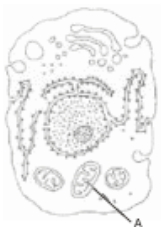
In the given figure of an animal cell, one organelle is marked as $A$. Select the correct identification and function of the organelle '$A$' from the given options.
A
Endoplasmic reticulum - Synthesis of lipids.
B
Mitochondria - Produce cellular energy in the form of $ATP$.
C
Golgi body - Provides packaging material.
D
Lysosomes - Secrete hydrolytic enzymes.
Solution
(B) In the figure, $(A)$ shows the cell organelle mitochondria.
The mitochondria are bounded by two membranes, i.e., an outer membrane and an inner membrane.
Mitochondria are referred to as the "powerhouse" of the cell as they produce the majority of cellular $ATP$.
This energy is produced during the breakdown of food molecules, which involves processes like glycolysis, oxidative decarboxylation, and oxidative phosphorylation (Krebs cycle and respiratory chain).
The mitochondria are bounded by two membranes, i.e., an outer membrane and an inner membrane.
Mitochondria are referred to as the "powerhouse" of the cell as they produce the majority of cellular $ATP$.
This energy is produced during the breakdown of food molecules, which involves processes like glycolysis, oxidative decarboxylation, and oxidative phosphorylation (Krebs cycle and respiratory chain).
0 likes
View Solution149
MediumMCQ
Both the membranes of mitochondrion are
A
structurally different but functionally similar.
B
structurally as well as functionally different.
C
structurally similar but functionally different.
D
structurally different but functionally similar.
Solution
(B) The mitochondrion is a double membrane-bound organelle found in most eukaryotic cells.
It consists of an outer and an inner membrane,both composed of phospholipid bilayers and proteins.
The two membranes possess distinct structural and functional properties.
The outer membrane is smooth and contains porins,making it permeable to small molecules.
The inner membrane is highly folded into structures called cristae,which increase the surface area for biochemical reactions like the electron transport chain and $ATP$ synthesis.
Due to these differences in composition and specialized roles,the membranes are considered structurally as well as functionally different.
It consists of an outer and an inner membrane,both composed of phospholipid bilayers and proteins.
The two membranes possess distinct structural and functional properties.
The outer membrane is smooth and contains porins,making it permeable to small molecules.
The inner membrane is highly folded into structures called cristae,which increase the surface area for biochemical reactions like the electron transport chain and $ATP$ synthesis.
Due to these differences in composition and specialized roles,the membranes are considered structurally as well as functionally different.
0 likes
View SolutionCell: The Unit of Life — Mitochondria · Frequently Asked Questions
1Are these Cell: The Unit of Life questions useful for JEE and NEET?
Yes. All questions in this section are mapped to JEE Main and NEET exam patterns. Previous year questions from JEE Main, NEET, GUJCET and state-level exams are included with full solutions.
2Can I switch to Hindi or Gujarati for these questions?
Yes. Use the language tabs in the hero section or the sidebar to view the same questions and solutions in English, Hindi or Gujarati.
3How do I generate a question paper from this subtopic?
Use the Vedclass Exam Paper Generator — select the chapter and subtopic, set difficulty, and generate Sets A, B, C, D automatically. First 3 chapters of every subject are free.
Vedclass Products
For Students
Vedclass Test Series
Mock tests in real JEE/NEET style with performance analysis. 5-day free trial.
Start Free TrialFor Teachers
Exam Paper Generator
Generate Set A/B/C/D papers from this chapter in 2 minutes. 3 chapters free.
Try FreeFor Institutes
Online Exam Module
Live online exams with unlimited students, 360° analytics & white-label branding.
See DemoFor Teachers & Institutes
Generate a Cell: The Unit of Life Exam Paper in 2 Minutes
Select subtopic & difficulty — Sets A, B, C, D auto-generated with No Repeat logic.
First 3 chapters of every subject are free — no payment required.