
A English
Mitochondria Questions in English
Class 11 Biology · Cell: The Unit of Life · Mitochondria
173+
Questions
English
Language
100%
With Solutions
Showing 50 of 173 questions in English
51
MediumMCQ
Which of the following observations most strongly supports the view that mitochondria contain electron transfer enzymes aggregated into compact associations?
A
$A$ contractile protein capable of utilizing $ATP$ has been obtained from mitochondria.
B
Mitochondria have a highly folded inner wall.
C
Disruption of mitochondria yields membrane fragments which are able to synthesize $ATP$.
D
Mitochondria in animal embryos have a tendency to concentrate in cells which are to become part of locomotory structures.
Solution
(C) The electron transport system $(ETS)$ is located in the inner mitochondrial membrane.
When mitochondria are disrupted,the inner membrane breaks into smaller vesicles called submitochondrial particles or $F_1-F_0$ particles.
These fragments retain the structural integrity of the electron transport chain and the $ATP$ synthase complex.
Because these fragments are still capable of synthesizing $ATP$ in the presence of substrates and oxygen,it provides strong evidence that the enzymes involved in electron transfer and oxidative phosphorylation are organized into compact,functional associations within the membrane.
When mitochondria are disrupted,the inner membrane breaks into smaller vesicles called submitochondrial particles or $F_1-F_0$ particles.
These fragments retain the structural integrity of the electron transport chain and the $ATP$ synthase complex.
Because these fragments are still capable of synthesizing $ATP$ in the presence of substrates and oxygen,it provides strong evidence that the enzymes involved in electron transfer and oxidative phosphorylation are organized into compact,functional associations within the membrane.
0 likes
View Solution52
MediumMCQ
Food is converted to energy in
A
Chloroplast
B
Nucleus
C
Mitochondria
D
None of the above
Solution
(C) The process of cellular respiration occurs within the cell to produce energy in the form of $ATP$.
$Mitochondria$ are known as the 'powerhouse of the cell' because they are the primary sites where aerobic respiration takes place, converting glucose and oxygen into energy $(ATP)$ through the $Krebs$ cycle and the electron transport chain.
$Mitochondria$ are known as the 'powerhouse of the cell' because they are the primary sites where aerobic respiration takes place, converting glucose and oxygen into energy $(ATP)$ through the $Krebs$ cycle and the electron transport chain.
0 likes
View Solution53
EasyMCQ
Cellular energy is provided through respiration and oxidation by
A
Golgi apparatus
B
Endoplasmic reticulum
C
Ribosomes
D
Mitochondria
Solution
(D) Mitochondria are known as the powerhouses of the cell.
They are the sites of aerobic respiration,where the oxidation of respiratory substrates (like glucose) occurs to produce energy in the form of $ATP$ (Adenosine Triphosphate).
This process is known as oxidative phosphorylation.
They are the sites of aerobic respiration,where the oxidation of respiratory substrates (like glucose) occurs to produce energy in the form of $ATP$ (Adenosine Triphosphate).
This process is known as oxidative phosphorylation.
0 likes
View Solution54
EasyMCQ
Where does cellular respiration take place?
A
Lysosomes
B
Ribosomes
C
Mitochondria
D
Endoplasmic reticulum
Solution
(C) Cellular respiration is a metabolic process that occurs in the cell to produce energy in the form of $ATP$. The primary site for aerobic cellular respiration,specifically the Krebs cycle and electron transport chain,is the mitochondria. Therefore,mitochondria are often referred to as the 'powerhouse of the cell'.
0 likes
View Solution55
EasyMCQ
Mitochondria in the living cell can readily be identified from other organelles of the cell through a light microscope by using:
A
Cotton blue
B
Osmic acid
C
Janus green-$B$
D
Lead citrate
Solution
(C) Janus green-$B$ is a vital stain used to identify mitochondria in living cells.
It is a basic dye that specifically stains mitochondria blue-green because of the presence of cytochrome oxidase,which keeps the dye in its oxidized (colored) state within the mitochondria,while it remains colorless in the cytoplasm.
It is a basic dye that specifically stains mitochondria blue-green because of the presence of cytochrome oxidase,which keeps the dye in its oxidized (colored) state within the mitochondria,while it remains colorless in the cytoplasm.
0 likes
View Solution56
MediumMCQ
In mitochondria,protons accumulate in the ........ .
A
Matrix
B
Outer membrane
C
Inner membrane
D
Intermembrane space
Solution
(D) During the process of oxidative phosphorylation in mitochondria,the electron transport system $(ETS)$ is located in the inner mitochondrial membrane.
As electrons pass through the complexes of the $ETS$,energy is released and used to pump protons $(H^+)$ from the mitochondrial matrix into the intermembrane space.
This creates a high concentration of protons in the intermembrane space,establishing a proton gradient (electrochemical gradient) across the inner mitochondrial membrane.
This gradient drives the synthesis of $ATP$ through the enzyme $ATP$ synthase.
As electrons pass through the complexes of the $ETS$,energy is released and used to pump protons $(H^+)$ from the mitochondrial matrix into the intermembrane space.
This creates a high concentration of protons in the intermembrane space,establishing a proton gradient (electrochemical gradient) across the inner mitochondrial membrane.
This gradient drives the synthesis of $ATP$ through the enzyme $ATP$ synthase.
0 likes
View Solution57
EasyMCQ
The mitochondrion is the site of .........
A
$CO$ production
B
Cell division
C
Energy release during respiration
D
None of the above
Solution
(C) Mitochondria are known as the '$powerhouse$ of the cell'.
They are the primary sites for aerobic respiration,where the process of oxidative phosphorylation occurs.
During this process,nutrients like glucose are broken down to release energy in the form of $ATP$ (Adenosine Triphosphate).
Therefore,mitochondria are the sites for energy release during respiration.
They are the primary sites for aerobic respiration,where the process of oxidative phosphorylation occurs.
During this process,nutrients like glucose are broken down to release energy in the form of $ATP$ (Adenosine Triphosphate).
Therefore,mitochondria are the sites for energy release during respiration.
0 likes
View Solution58
EasyMCQ
The organelle in which the oxidative process of respiration occurs is known as ......
A
Chloroplast
B
Ribosomes
C
Mitochondria
D
Endoplasmic reticulum
Solution
(C) The oxidative process of cellular respiration,specifically the Krebs cycle and the electron transport chain,occurs within the mitochondria. Mitochondria are often referred to as the 'powerhouse of the cell' because they generate most of the cell's supply of adenosine triphosphate $(ATP)$,which is used as a source of chemical energy.
0 likes
View Solution59
MediumMCQ
Which of the following statements is $NOT$ true for the mitochondrial membrane?
A
The inner membrane is highly convoluted,forming a series of infoldings.
B
The outer membrane resembles a sieve.
C
The outer membrane is permeable to all types of molecules.
D
The enzymes of the electron transport chain are embedded in the outer membrane.
Solution
(D) The correct answer is $D$.
$1$. The inner mitochondrial membrane is highly folded into structures called cristae,which increase the surface area for biochemical reactions.
$2$. The outer membrane is porous and acts like a sieve,allowing the passage of small molecules and ions.
$3$. However,the outer membrane is not permeable to all types of molecules; it is selectively permeable to proteins and larger molecules.
$4$. Most importantly,the enzymes of the electron transport chain $(ETC)$ are located in the inner mitochondrial membrane,not the outer membrane.
$1$. The inner mitochondrial membrane is highly folded into structures called cristae,which increase the surface area for biochemical reactions.
$2$. The outer membrane is porous and acts like a sieve,allowing the passage of small molecules and ions.
$3$. However,the outer membrane is not permeable to all types of molecules; it is selectively permeable to proteins and larger molecules.
$4$. Most importantly,the enzymes of the electron transport chain $(ETC)$ are located in the inner mitochondrial membrane,not the outer membrane.
0 likes
View Solution60
EasyMCQ
Extranuclear $DNA$ is found in.........
A
Lysosomes and Chloroplasts
B
Chloroplasts and Mitochondria
C
Mitochondria and Lysosomes
D
Golgi apparatus and $E.R.$
Solution
(B) Extranuclear $DNA$ refers to the genetic material present outside the nucleus of a eukaryotic cell.
In eukaryotic cells,$DNA$ is primarily located in the nucleus.
However,certain semi-autonomous organelles contain their own circular $DNA$ molecules,which are independent of the nuclear genome.
These organelles are the mitochondria (the powerhouses of the cell) and chloroplasts (the sites of photosynthesis in plants).
Therefore,extranuclear $DNA$ is found in chloroplasts and mitochondria.
In eukaryotic cells,$DNA$ is primarily located in the nucleus.
However,certain semi-autonomous organelles contain their own circular $DNA$ molecules,which are independent of the nuclear genome.
These organelles are the mitochondria (the powerhouses of the cell) and chloroplasts (the sites of photosynthesis in plants).
Therefore,extranuclear $DNA$ is found in chloroplasts and mitochondria.
0 likes
View Solution61
EasyMCQ
Circular and double-stranded $DNA$ is found in:
A
Golgi apparatus
B
Mitochondria
C
Nucleus
D
Cytoplasm
Solution
(B) Mitochondria and chloroplasts are semi-autonomous organelles that contain their own genetic material. This genetic material is present in the form of circular,double-stranded $DNA$ molecules,which is similar to the $DNA$ found in prokaryotic cells. The $DNA$ in the nucleus is typically linear and associated with histones.
0 likes
View Solution62
MediumMCQ
Mitochondrial $DNA$ is.....
A
Naked
B
Circular
C
Double-stranded
D
All of the above
Solution
(D) Mitochondria contain their own genetic material,which is referred to as mitochondrial $DNA$ $(mtDNA)$.
$1$. It is 'naked' because it lacks associated histone proteins,unlike nuclear $DNA$.
$2$. It is 'circular' in structure,similar to prokaryotic $DNA$.
$3$. It is 'double-stranded' in nature.
Therefore,all the given statements are correct.
$1$. It is 'naked' because it lacks associated histone proteins,unlike nuclear $DNA$.
$2$. It is 'circular' in structure,similar to prokaryotic $DNA$.
$3$. It is 'double-stranded' in nature.
Therefore,all the given statements are correct.
0 likes
View Solution63
EasyMCQ
The power house of the cell is ......
A
Nucleus
B
$DNA$
C
Mitochondria
D
$ATP$
Solution
(C) Mitochondria are known as the power house of the cell because they produce cellular energy in the form of $ATP$ (Adenosine Triphosphate) through the process of aerobic respiration.
0 likes
View Solution64
MediumMCQ
The matrix of the mitochondrion contains .......
A
Enzymes for the Krebs cycle and protein synthesis
B
Structure of white blood cells
C
Enzymes for the Calvin cycle
D
None of the above
Solution
(A) The mitochondrial matrix is the space enclosed by the inner mitochondrial membrane. It contains a complex mixture of enzymes,including those required for the Krebs cycle (also known as the citric acid cycle or $TCA$ cycle). Additionally,the matrix contains its own circular $DNA$,$RNA$,and ribosomes,which are essential for protein synthesis within the mitochondrion.
0 likes
View Solution65
EasyMCQ
Mitochondria are also known as .......
A
Lipochondria
B
Sarcoplasm
C
Chondriosomes
D
Microstructures
Solution
(C) Mitochondria are double-membrane-bound organelles found in most eukaryotic organisms.
They were historically referred to as $Chondriosomes$ (from the Greek $chondrion$ meaning 'granule' and $soma$ meaning 'body') due to their granular appearance under a microscope.
Therefore,the correct term among the given options is $Chondriosomes$.
They were historically referred to as $Chondriosomes$ (from the Greek $chondrion$ meaning 'granule' and $soma$ meaning 'body') due to their granular appearance under a microscope.
Therefore,the correct term among the given options is $Chondriosomes$.
0 likes
View Solution66
EasyMCQ
The $F_1$ particle is a component of which of the following?
A
Pigment
B
$ATP$
C
$ATP\text{ase}$
D
$FMN$
Solution
(C) The $F_1$ particle,also known as the headpiece,is a part of the $ATP\text{synthase}$ enzyme complex (also called $F_0-F_1$ complex) located on the inner mitochondrial membrane.
This complex is responsible for the synthesis of $ATP$ from $ADP$ and inorganic phosphate during oxidative phosphorylation.
The $F_1$ headpiece contains the catalytic sites for $ATP$ synthesis,while the $F_0$ portion acts as a proton channel.
This complex is responsible for the synthesis of $ATP$ from $ADP$ and inorganic phosphate during oxidative phosphorylation.
The $F_1$ headpiece contains the catalytic sites for $ATP$ synthesis,while the $F_0$ portion acts as a proton channel.
0 likes
View Solution67
MediumMCQ
Which statement is correct regarding mitochondria?
A
They vary in size and shape and exhibit both types of division.
B
They do not change shape but exhibit division.
C
They do not change in size or shape and do not exhibit division.
D
They change shape,but division is not observed.
Solution
(A) Mitochondria are highly variable in their size and shape. They are typically sausage-shaped or cylindrical,but their morphology can change depending on the physiological state of the cell. Furthermore,mitochondria are semi-autonomous organelles that contain their own $DNA$ and ribosomes,allowing them to replicate through binary fission.
0 likes
View Solution68
EasyMCQ
Which of the following is a double-membrane bound organelle?
A
Mitochondria
B
Ribosomes
C
Lysosomes
D
Centrioles
Solution
(A) double-membrane bound organelle consists of two lipid bilayer membranes.
$1$. Mitochondria are double-membrane bound organelles involved in cellular respiration and $ATP$ production.
$2$. Ribosomes are non-membrane bound organelles.
$3$. Lysosomes are single-membrane bound organelles.
$4$. Centrioles are non-membrane bound structures.
Therefore,the correct option is $A$.
$1$. Mitochondria are double-membrane bound organelles involved in cellular respiration and $ATP$ production.
$2$. Ribosomes are non-membrane bound organelles.
$3$. Lysosomes are single-membrane bound organelles.
$4$. Centrioles are non-membrane bound structures.
Therefore,the correct option is $A$.
0 likes
View Solution69
EasyMCQ
Mitochondrial $DNA$ is - ..........
A
Circular
B
Linear
C
Double-stranded
D
All of the above
Solution
(C) Mitochondria contain their own genetic material,which is known as mitochondrial $DNA$ $(mtDNA)$.
This $DNA$ is typically circular in shape and double-stranded,similar to the $DNA$ found in prokaryotic cells.
Therefore,the correct description of mitochondrial $DNA$ is that it is double-stranded and circular.
This $DNA$ is typically circular in shape and double-stranded,similar to the $DNA$ found in prokaryotic cells.
Therefore,the correct description of mitochondrial $DNA$ is that it is double-stranded and circular.
0 likes
View Solution70
MediumMCQ
The fluid-filled matrix present inside the mitochondria is called .......
A
Matrix
B
Stroma
C
Cytosol
D
Cytoplasm
Solution
(A) The mitochondria are double-membrane-bound structures. The inner membrane divides the lumen into two distinct aqueous compartments: the outer compartment and the inner compartment. The inner compartment is filled with a dense,homogeneous substance called the matrix. Therefore,the correct answer is $A$.
0 likes
View Solution71
EasyMCQ
The cellular furnace of the cell is $......$.
A
Chloroplast
B
Mitochondria
C
Ribosome
D
Nucleus
Solution
(B) The $Mitochondria$ are known as the 'powerhouse' or 'cellular furnace' of the cell.
This is because they are the sites of aerobic respiration, where $ATP$ (Adenosine Triphosphate) is produced through the oxidation of carbohydrates and fats.
Since $ATP$ provides the energy required for various cellular activities, the $Mitochondria$ are essential for the energy metabolism of the cell.
This is because they are the sites of aerobic respiration, where $ATP$ (Adenosine Triphosphate) is produced through the oxidation of carbohydrates and fats.
Since $ATP$ provides the energy required for various cellular activities, the $Mitochondria$ are essential for the energy metabolism of the cell.
0 likes
View Solution72
MediumMCQ
How do mitochondria provide all the energy required by the cell?
A
By breaking down lipids
B
By reducing $NADP$
C
By oxidizing the substrates of the $TCA$ cycle
D
By breaking down proteins
Solution
(C) Mitochondria are known as the powerhouses of the cell because they produce energy in the form of $ATP$.
This process occurs through cellular respiration,specifically the $TCA$ cycle (also known as the Krebs cycle) and the electron transport chain.
In the $TCA$ cycle,substrates like pyruvate (derived from glucose) are oxidized to release energy,which is then used to synthesize $ATP$.
Therefore,the oxidation of $TCA$ cycle substrates is the primary mechanism for energy production.
This process occurs through cellular respiration,specifically the $TCA$ cycle (also known as the Krebs cycle) and the electron transport chain.
In the $TCA$ cycle,substrates like pyruvate (derived from glucose) are oxidized to release energy,which is then used to synthesize $ATP$.
Therefore,the oxidation of $TCA$ cycle substrates is the primary mechanism for energy production.
0 likes
View Solution73
MediumMCQ
Which organelle is responsible for aerobic respiration?
A
Chloroplast
B
Mitochondria
C
Ribosome
D
Golgi apparatus
Solution
(B) Aerobic respiration is a metabolic process that occurs in the presence of oxygen to produce energy in the form of $ATP$.
$Mitochondria$ are known as the 'powerhouse of the cell' because they are the primary sites where the Krebs cycle and electron transport chain occur, facilitating aerobic respiration.
$Chloroplasts$ are involved in photosynthesis, $Ribosomes$ in protein synthesis, and the $Golgi$ $apparatus$ in packaging and secretion.
$Mitochondria$ are known as the 'powerhouse of the cell' because they are the primary sites where the Krebs cycle and electron transport chain occur, facilitating aerobic respiration.
$Chloroplasts$ are involved in photosynthesis, $Ribosomes$ in protein synthesis, and the $Golgi$ $apparatus$ in packaging and secretion.
0 likes
View Solution74
MediumMCQ
In which organisms are mitochondria found?
A
Only in aerobic organisms
B
In aerobic and facultative anaerobic organisms
C
Only in facultative anaerobic organisms
D
Only in angiosperms
Solution
(B) Mitochondria are the sites of aerobic respiration,where $ATP$ is produced through the Krebs cycle and electron transport chain. Aerobic organisms rely entirely on this process. Facultative anaerobes can perform aerobic respiration in the presence of oxygen using mitochondria,but can switch to fermentation in the absence of oxygen. Therefore,mitochondria are present in both aerobic and facultative anaerobic organisms.
0 likes
View Solution75
EasyMCQ
The presence of genes for extranuclear inheritance is found in....
A
Lysosomes and Ribosomes
B
Mitochondria and Chloroplasts
C
Endoplasmic Reticulum and Mitochondria
D
Ribosomes and Chloroplasts
Solution
(B) Extranuclear inheritance,also known as cytoplasmic inheritance,refers to the transmission of genes that are located outside the nucleus.
In eukaryotic cells,the organelles that contain their own $DNA$ (extranuclear $DNA$) are the mitochondria and chloroplasts.
This $DNA$ is independent of the nuclear genome and is inherited through the cytoplasm,typically from the maternal parent.
Therefore,the correct option is $B$.
In eukaryotic cells,the organelles that contain their own $DNA$ (extranuclear $DNA$) are the mitochondria and chloroplasts.
This $DNA$ is independent of the nuclear genome and is inherited through the cytoplasm,typically from the maternal parent.
Therefore,the correct option is $B$.
0 likes
View Solution76
EasyMCQ
Which of the following dyes is used to stain cell organelles and mitochondria?
A
Janus Green
B
Safranin
C
Azure $B$
D
Crystal Violet
Solution
(A) $Janus \ Green$ is a vital stain used in histology and cytology to stain mitochondria.
It is a basic dye that acts as a redox indicator.
In its oxidized state,it is blue,and in its reduced state,it is colorless.
Since mitochondria are the sites of cellular respiration,they maintain the dye in its oxidized (blue) state,allowing them to be visualized under a microscope.
It is a basic dye that acts as a redox indicator.
In its oxidized state,it is blue,and in its reduced state,it is colorless.
Since mitochondria are the sites of cellular respiration,they maintain the dye in its oxidized (blue) state,allowing them to be visualized under a microscope.
0 likes
View Solution77
MediumMCQ
The function of the $Mitochondria$ is .....
A
Excretion
B
Respiration
C
Digestion
D
Excretion and Respiration
Solution
(B) $Mitochondria$ are known as the powerhouses of the cell.
They are the sites of aerobic respiration, where they produce cellular energy in the form of $ATP$ $(Adenosine \text{ } Triphosphate)$ through the process of oxidative phosphorylation.
Therefore, the primary function of $Mitochondria$ is cellular respiration.
They are the sites of aerobic respiration, where they produce cellular energy in the form of $ATP$ $(Adenosine \text{ } Triphosphate)$ through the process of oxidative phosphorylation.
Therefore, the primary function of $Mitochondria$ is cellular respiration.
0 likes
View Solution78
MediumMCQ
The largest cell organelle present in an animal cell is . . . . . . .
A
Plastid
B
Mitochondrion
C
Lysosome
D
Golgi apparatus
Solution
(B) In an animal cell,the nucleus is the largest cell organelle. However,among the options provided,the mitochondrion is the largest. Plastids are absent in animal cells. Lysosomes and Golgi apparatus are smaller than mitochondria in terms of overall volume and structural prominence in most animal cells.
0 likes
View Solution79
MediumMCQ
Mitochondria are associated with ..........
A
Eukaryotic cell
B
Plasmid
C
Prion
D
Virus
Solution
(A) Mitochondria are membrane-bound cell organelles found in the cytoplasm of eukaryotic cells. They are known as the 'powerhouse of the cell' because they generate most of the cell's supply of adenosine triphosphate $(ATP)$,used as a source of chemical energy. Prokaryotic cells,plasmids,prions,and viruses lack mitochondria.
0 likes
View Solution80
EasyMCQ
What is the energy currency of the cell?
A
Mitochondria
B
Golgi apparatus
C
$DNA$
D
$ATP$
Solution
(D) $ATP$ (Adenosine Triphosphate) is known as the energy currency of the cell.
It is a nucleotide that stores and transfers energy within cells to drive various biological processes.
When the cell needs energy,it breaks down $ATP$ into $ADP$ (Adenosine Diphosphate) and an inorganic phosphate,releasing energy in the process.
It is a nucleotide that stores and transfers energy within cells to drive various biological processes.
When the cell needs energy,it breaks down $ATP$ into $ADP$ (Adenosine Diphosphate) and an inorganic phosphate,releasing energy in the process.
0 likes
View Solution81
EasyMCQ
In which of the following are mitochondria found?
A
All cells
B
Only plant cells
C
Only animal cells
D
All eukaryotic cells
Solution
(D) Mitochondria are membrane-bound cell organelles that are essential for aerobic respiration and the production of $ATP$ (adenosine triphosphate).
They are present in almost all eukaryotic cells,including both plants and animals.
They are absent in prokaryotic cells (like bacteria) and mature mammalian red blood cells $(RBCs)$.
They are present in almost all eukaryotic cells,including both plants and animals.
They are absent in prokaryotic cells (like bacteria) and mature mammalian red blood cells $(RBCs)$.
0 likes
View Solution82
MediumMCQ
What do the cristae in mitochondria contain?
A
Circular $DNA$
B
$F_1$ particles
C
Ribosomes
D
Enzymes required for the $Krebs$ cycle
Solution
(B) The inner mitochondrial membrane forms infoldings known as cristae.
These cristae significantly increase the surface area of the inner membrane.
Attached to the cristae are numerous stalked particles known as $F_0-F_1$ particles or oxysomes.
These $F_1$ particles are the sites of $ATP$ synthesis via oxidative phosphorylation.
These cristae significantly increase the surface area of the inner membrane.
Attached to the cristae are numerous stalked particles known as $F_0-F_1$ particles or oxysomes.
These $F_1$ particles are the sites of $ATP$ synthesis via oxidative phosphorylation.
0 likes
View Solution83
MediumMCQ
What is the diameter of the mitochondria?
A
$0.2 - 1.0 \mu m$
B
$1.0 - 4.1 \mu m$
C
$0.1 - 2.0 \mu m$
D
$0.4 - 4.1 \mu m$
Solution
(A) According to the $NCERT$ textbook,mitochondria are sausage-shaped or cylindrical structures having a diameter of $0.2 - 1.0 \mu m$ (average $0.5 \mu m$) and a length of $1.0 - 4.1 \mu m$. Therefore,the correct option is $A$.
0 likes
View Solution84
MediumMCQ
Which of the following is a self-replicating organelle?
A
Lysosomes
B
Endoplasmic reticulum
C
Mitochondria
D
Peroxisome
Solution
(C) Mitochondria and chloroplasts are considered semi-autonomous or self-replicating organelles because they contain their own circular $DNA$ and ribosomes $(70S)$,which allow them to synthesize some of their own proteins and replicate independently of the cell cycle. Therefore,the correct option is $C$.
0 likes
View Solution85
MediumMCQ
Assertion $A$: Mitochondria are the powerhouse of the cell.
Reason $R$: The sites for cellular respiration,specifically the $Krebs$ cycle and oxidative phosphorylation,are located within the mitochondria.
Which option is correct for Assertion $A$ and Reason $R$?
Reason $R$: The sites for cellular respiration,specifically the $Krebs$ cycle and oxidative phosphorylation,are located within the mitochondria.
Which option is correct for Assertion $A$ and Reason $R$?
A
$A$ and $R$ are both true and $R$ is the correct explanation of $A$.
B
$A$ and $R$ are both true but $R$ is not the correct explanation of $A$.
C
$A$ is true and $R$ is false.
D
$A$ is false and $R$ is true.
Solution
(A) Mitochondria are known as the powerhouse of the cell because they generate most of the cell's supply of adenosine triphosphate $(ATP)$,which is used as a source of chemical energy.
The $Krebs$ cycle (citric acid cycle) occurs in the mitochondrial matrix,and the electron transport chain (leading to oxidative phosphorylation) occurs on the inner mitochondrial membrane.
Since these processes are responsible for the production of $ATP$ through cellular respiration,the reason $R$ correctly explains why mitochondria are called the powerhouse of the cell.
The $Krebs$ cycle (citric acid cycle) occurs in the mitochondrial matrix,and the electron transport chain (leading to oxidative phosphorylation) occurs on the inner mitochondrial membrane.
Since these processes are responsible for the production of $ATP$ through cellular respiration,the reason $R$ correctly explains why mitochondria are called the powerhouse of the cell.
0 likes
View Solution86
EasyMCQ
The infoldings of the inner membrane of the mitochondria are called .......
A
Cristae
B
Matrix
C
Cisternae
D
Fimbriae
Solution
(A) The mitochondria consist of an outer membrane and an inner membrane. The inner membrane is folded into a number of infoldings called $Cristae$ towards the matrix. These $Cristae$ increase the surface area of the inner membrane,which is essential for the attachment of enzymes involved in the electron transport chain and $ATP$ synthesis.
0 likes
View Solution87
EasyMCQ
Which of the following is a self-replicating organelle?
A
Lysosome
B
Golgi apparatus
C
Mitochondrion
D
Vesicle
Solution
(C) Mitochondria and chloroplasts are known as semi-autonomous organelles because they contain their own circular $DNA$ and $70S$ ribosomes,which allow them to synthesize some of their own proteins and replicate independently of the cell cycle. Therefore,they are referred to as self-replicating organelles.
0 likes
View Solution88
EasyMCQ
The number of mitochondria in each cell is dependent on which of the following activities?
A
Metabolic activity
B
Physiological activity
C
Self-replication
D
Digestion
Solution
(A) Mitochondria are known as the powerhouses of the cell because they generate $ATP$ through cellular respiration.
Their number per cell is highly variable and depends on the metabolic activity of the cell.
Cells that require more energy,such as muscle cells or liver cells,contain a significantly higher number of mitochondria compared to cells with lower energy demands.
Therefore,the metabolic activity of the cell determines the mitochondrial count.
Their number per cell is highly variable and depends on the metabolic activity of the cell.
Cells that require more energy,such as muscle cells or liver cells,contain a significantly higher number of mitochondria compared to cells with lower energy demands.
Therefore,the metabolic activity of the cell determines the mitochondrial count.
0 likes
View Solution89
EasyMCQ
Which organelle is characteristically filamentous,cylindrical,or granular in shape?
A
Mitochondria
B
Lysosome
C
Vacuole
D
Golgi apparatus
Solution
(A) Mitochondria are membrane-bound cell organelles.
They are typically sausage-shaped or cylindrical,having a diameter of $0.2-1.0 \mu m$ (average $0.5 \mu m$) and a length of $1.0-4.1 \mu m$.
Depending on the physiological activity of the cell,their shape can vary,appearing as filamentous,granular,or cylindrical structures.
They are typically sausage-shaped or cylindrical,having a diameter of $0.2-1.0 \mu m$ (average $0.5 \mu m$) and a length of $1.0-4.1 \mu m$.
Depending on the physiological activity of the cell,their shape can vary,appearing as filamentous,granular,or cylindrical structures.
0 likes
View Solution90
EasyMCQ
What is the diameter of the mitochondrion?
A
$1.0 \, \mu m - 4.1 \, \mu m$
B
$0.2 \, \mu m - 1.0 \, \mu m$
C
$0.5 \, \mu m - 1.0 \, \mu m$
D
$0.2 \, \mu m - 4.1 \, \mu m$
Solution
(B) According to the $NCERT$ textbook,the diameter of the mitochondrion is $0.2 \, \mu m - 1.0 \, \mu m$ (average $0.5 \, \mu m$) and its length is $1.0 \, \mu m - 4.1 \, \mu m$. Therefore,the correct option is $B$.
0 likes
View Solution91
MediumMCQ
What is the length of the mitochondria?
A
$1.0 \, \mu m - 4.1 \, \mu m$
B
$0.2 \, \mu m - 1.0 \, \mu m$
C
$0.5 \, \mu m - 1.0 \, \mu m$
D
$0.2 \, \mu m - 4.1 \, \mu m$
Solution
(A) According to the $NCERT$ textbook,mitochondria are sausage-shaped or cylindrical structures having a diameter of $0.2 \, \mu m - 1.0 \, \mu m$ (average $0.5 \, \mu m$) and a length of $1.0 \, \mu m - 4.1 \, \mu m$.
0 likes
View Solution92
EasyMCQ
What are the infoldings of the inner membrane of the mitochondria called?
A
Cisternae
B
Vesicles
C
Cristae
D
Matrix
Solution
(C) The mitochondria consist of an outer membrane and an inner membrane. The inner membrane forms a number of infoldings called $Cristae$ towards the matrix. These infoldings increase the surface area of the inner membrane,which is essential for the attachment of enzymes involved in the electron transport chain and $ATP$ synthesis.
0 likes
View Solution93
MediumMCQ
What is present in the area of the mitochondria other than the cristae?
A
Circular $DNA$,ribosomes
B
Coiled $DNA$,proteins
C
Proteins,ribosomes,$DNA$
D
Proteins,ribosomes
Solution
(C) The mitochondria is a double-membrane-bound organelle. The inner membrane forms infoldings called cristae towards the matrix. The space enclosed by the inner membrane is called the matrix. The matrix contains a single circular $DNA$ molecule,a few $RNA$ molecules,ribosomes $(70S)$,and the enzymes required for the synthesis of proteins.
0 likes
View Solution94
EasyMCQ
Which of the following statements is $NOT$ associated with mitochondria?
A
Cristae contain structures known as '$F_1$ particles'.
B
The infoldings or tubular/flat projections are called cristae.
C
The stroma contains proteins,ribosomes,and circular $DNA$.
D
They have a diameter of $0.2$ to $1.0 \mu m$ and a length of $1.0$ to $4.1 \mu m$.
Solution
(C) Mitochondria are double-membrane-bound organelles.
Option $A$ is correct as the inner membrane forms infoldings called cristae,which bear '$F_1$ particles' ($ATP$ synthase).
Option $B$ is correct as these infoldings are indeed called cristae.
Option $D$ is correct as the dimensions of mitochondria typically range from $0.2$ to $1.0 \mu m$ in diameter and $1.0$ to $4.1 \mu m$ in length.
Option $C$ is incorrect because the fluid-filled space inside mitochondria is called the 'matrix',not the 'stroma'. The term 'stroma' is specifically used for the fluid-filled space inside chloroplasts.
Option $A$ is correct as the inner membrane forms infoldings called cristae,which bear '$F_1$ particles' ($ATP$ synthase).
Option $B$ is correct as these infoldings are indeed called cristae.
Option $D$ is correct as the dimensions of mitochondria typically range from $0.2$ to $1.0 \mu m$ in diameter and $1.0$ to $4.1 \mu m$ in length.
Option $C$ is incorrect because the fluid-filled space inside mitochondria is called the 'matrix',not the 'stroma'. The term 'stroma' is specifically used for the fluid-filled space inside chloroplasts.
0 likes
View Solution95
MediumMCQ
Which of the following organelles contains a system of folded membranes?
A
Mitochondria
B
Golgi apparatus
C
Chloroplast
D
Lysosome
Solution
(A) The mitochondria contain a system of folded membranes known as cristae. These folds increase the surface area of the inner mitochondrial membrane,which is essential for the electron transport chain and $ATP$ synthesis during cellular respiration.
0 likes
View Solution96
MediumMCQ
$Assertion (S):$ $F_1$ particles contain the components necessary for oxidative phosphorylation.
$Reason (R):$ The mitochondrial matrix contains enzymes required for glycolysis.
$Reason (R):$ The mitochondrial matrix contains enzymes required for glycolysis.
A
$S$ and $R$ are both true,and $R$ is the correct explanation of $S$.
B
$S$ and $R$ are both true,but $R$ is not the correct explanation of $S$.
C
$S$ is true and $R$ is false.
D
$S$ is false and $R$ is true.
Solution
(C) $F_1$ particles (also known as $F_0-F_1$ complex or $ATP$ synthase) are located on the inner mitochondrial membrane and are responsible for $ATP$ synthesis via oxidative phosphorylation. Thus,statement $S$ is true.
Glycolysis occurs in the cytoplasm of the cell,not in the mitochondrial matrix. The mitochondrial matrix contains enzymes for the Krebs cycle ($TCA$ cycle) and fatty acid oxidation. Thus,statement $R$ is false.
Therefore,$S$ is true and $R$ is false.
Glycolysis occurs in the cytoplasm of the cell,not in the mitochondrial matrix. The mitochondrial matrix contains enzymes for the Krebs cycle ($TCA$ cycle) and fatty acid oxidation. Thus,statement $R$ is false.
Therefore,$S$ is true and $R$ is false.
0 likes
View Solution97
MediumMCQ
Which of the following is a correctly matched pair?
A
Cisternae: $0.5 \mu m$ to $0.8 \mu m$
B
Mitochondria: $0.2 \mu m$ to $5.1 \mu m$ diameter
C
Chloroplast: $2 \mu m$ to $4 \mu m$
D
Mitochondria: $1 \mu m$ to $5.1 \mu m$ length
Solution
(D) According to the $NCERT$ textbook,the dimensions of cell organelles are as follows:
$1$. Mitochondria are typically sausage-shaped or cylindrical,having a diameter of $0.2 \mu m$ to $1.0 \mu m$ (average $0.5 \mu m$) and a length of $1.0 \mu m$ to $4.1 \mu m$.
$2$. Option $D$ states the length of mitochondria as $1 \mu m$ to $5.1 \mu m$,which is the closest and most accurate representation of the standard biological data provided in the curriculum.
$3$. Other options contain incorrect units or values for the specified organelles.
$1$. Mitochondria are typically sausage-shaped or cylindrical,having a diameter of $0.2 \mu m$ to $1.0 \mu m$ (average $0.5 \mu m$) and a length of $1.0 \mu m$ to $4.1 \mu m$.
$2$. Option $D$ states the length of mitochondria as $1 \mu m$ to $5.1 \mu m$,which is the closest and most accurate representation of the standard biological data provided in the curriculum.
$3$. Other options contain incorrect units or values for the specified organelles.
0 likes
View Solution98
MediumMCQ
Which process occurs in the part labeled 'a' in the given figure?
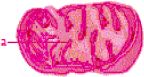
A
Oxidative phosphorylation
B
Glycolysis
C
Krebs cycle
D
Photosynthesis
Solution
(A) The figure shows a mitochondrion. The part labeled 'a' points to the inner mitochondrial membrane (cristae). The Krebs cycle occurs in the mitochondrial matrix,while oxidative phosphorylation takes place on the inner mitochondrial membrane. Therefore,the correct process occurring at the site labeled 'a' is oxidative phosphorylation.
0 likes
View Solution99
EasyMCQ
The site of cellular respiration in a cell is:
A
Nucleus
B
Mitochondria
C
Ribosome
D
Lysosome
Solution
(B) Cellular respiration is the process by which cells generate energy in the form of $ATP$ (Adenosine Triphosphate) by breaking down glucose.
$Mitochondria$ are known as the 'powerhouse of the cell' because they are the primary sites where aerobic respiration occurs.
Within the $mitochondria$, the Krebs cycle and the electron transport chain take place to produce energy.
Therefore, the correct option is $B$.
$Mitochondria$ are known as the 'powerhouse of the cell' because they are the primary sites where aerobic respiration occurs.
Within the $mitochondria$, the Krebs cycle and the electron transport chain take place to produce energy.
Therefore, the correct option is $B$.
0 likes
View Solution100
MediumMCQ
Cristae are . . . . . . .
A
Infoldings of the inner mitochondrial membrane
B
Infoldings of the outer mitochondrial membrane
C
Branches of the endoplasmic reticulum
D
Golgi apparatus
Solution
(A) The mitochondria consist of an outer membrane and an inner membrane,dividing its lumen into two distinct aqueous compartments: the outer compartment and the inner compartment. The inner membrane forms a number of infoldings called $cristae$ towards the matrix. These $cristae$ increase the surface area of the inner membrane,which is essential for the attachment of enzymes involved in the electron transport chain and $ATP$ synthesis.
0 likes
View SolutionCell: The Unit of Life — Mitochondria · Frequently Asked Questions
1Are these Cell: The Unit of Life questions useful for JEE and NEET?
Yes. All questions in this section are mapped to JEE Main and NEET exam patterns. Previous year questions from JEE Main, NEET, GUJCET and state-level exams are included with full solutions.
2Can I switch to Hindi or Gujarati for these questions?
Yes. Use the language tabs in the hero section or the sidebar to view the same questions and solutions in English, Hindi or Gujarati.
3How do I generate a question paper from this subtopic?
Use the Vedclass Exam Paper Generator — select the chapter and subtopic, set difficulty, and generate Sets A, B, C, D automatically. First 3 chapters of every subject are free.
Vedclass Products
For Students
Vedclass Test Series
Mock tests in real JEE/NEET style with performance analysis. 5-day free trial.
Start Free TrialFor Teachers
Exam Paper Generator
Generate Set A/B/C/D papers from this chapter in 2 minutes. 3 chapters free.
Try FreeFor Institutes
Online Exam Module
Live online exams with unlimited students, 360° analytics & white-label branding.
See DemoFor Teachers & Institutes
Generate a Cell: The Unit of Life Exam Paper in 2 Minutes
Select subtopic & difficulty — Sets A, B, C, D auto-generated with No Repeat logic.
First 3 chapters of every subject are free — no payment required.