
A English
Mitochondria Questions in English
Class 11 Biology · Cell: The Unit of Life · Mitochondria
173+
Questions
English
Language
100%
With Solutions
Showing 23 of 173 questions in English
151
EasyMCQ
Which of the following stains is used to observe mitochondria?
A
Methylene blue
B
Safranin
C
Janus green
D
Gram stain
Solution
(C) Janus green $B$ is a vital stain specifically used to observe mitochondria in living cells. It acts as an indicator of the respiratory activity of the mitochondria,turning from blue to colorless when reduced.
0 likes
View Solution152
EasyMCQ
Which of the following cell organelles is known as the powerhouse of the cell?
A
Golgi apparatus
B
$ER$
C
Lysosome
D
Mitochondrion
Solution
(D) The cell organelle known as the powerhouse of the cell is the $Mitochondrion$.
It is called the powerhouse because it produces cellular energy in the form of $ATP$ $(Adenosine Triphosphate)$ through the process of aerobic respiration.
It is called the powerhouse because it produces cellular energy in the form of $ATP$ $(Adenosine Triphosphate)$ through the process of aerobic respiration.
0 likes
View Solution153
EasyMCQ
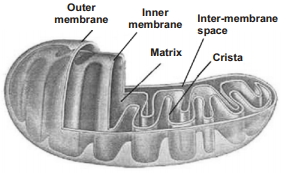
The inner membrane of mitochondria forms a number of infoldings called
A
Cisternae
B
Cristae
C
Microtubules
D
Mesosomes
Solution
(B) The inner membrane of the mitochondrion forms a number of infoldings known as cristae.
$1$. Cristae: These are the infoldings of the inner mitochondrial membrane that increase the surface area for biochemical reactions.
$2$. Cisternae: These are long,flattened,parallel,sac-like interconnected structures found in the Golgi apparatus or endoplasmic reticulum.
$3$. Microtubules: These are proteinaceous structures that form part of the cytoskeleton of the cell.
$4$. Mesosomes: These are the invaginations of the plasma membrane in bacterial cells,which help in respiration and $DNA$ replication.
$1$. Cristae: These are the infoldings of the inner mitochondrial membrane that increase the surface area for biochemical reactions.
$2$. Cisternae: These are long,flattened,parallel,sac-like interconnected structures found in the Golgi apparatus or endoplasmic reticulum.
$3$. Microtubules: These are proteinaceous structures that form part of the cytoskeleton of the cell.
$4$. Mesosomes: These are the invaginations of the plasma membrane in bacterial cells,which help in respiration and $DNA$ replication.
0 likes
View Solution154
MediumMCQ
Select the incorrect statement w.r.t. mitochondria.
A
They divide by fission.
B
The matrix possesses single circular $DNA$.
C
The cristae decrease the surface area.
D
They produce cellular energy in the form of $ATP$.
Solution
(C) Mitochondria are semi-autonomous organelles that divide by fission. Their matrix contains a single circular $DNA$ molecule and ribosomes. The inner membrane of the mitochondria forms infoldings called cristae,which significantly increase the surface area for the attachment of enzymes involved in the electron transport chain and $ATP$ synthesis. Therefore,the statement that cristae decrease the surface area is incorrect.
0 likes
View Solution155
EasyMCQ
Which structure is/are considered as semi-autonomous organelle?
A
Ribosome
B
Golgi body
C
Mitochondria and chloroplast
D
Mitochondria only
Solution
(C) Mitochondria and chloroplast are considered semi-autonomous organelles because they contain their own circular $DNA$ and $70S$ ribosomes,allowing them to synthesize some of their own proteins.
0 likes
View Solution156
MediumMCQ
Mitochondria and chloroplasts are semi-autonomous as they possess
A
$DNA$
B
$DNA + RNA$
C
$DNA + RNA + \text{ribosomes}$
D
$Proteins$
Solution
(C) Mitochondria and chloroplasts are considered semi-autonomous organelles because they contain their own genetic material in the form of $DNA$, as well as $RNA$ and $ribosomes$ for protein synthesis.
Despite this, they are still dependent on the nuclear genome for many of their proteins and functional requirements.
Despite this, they are still dependent on the nuclear genome for many of their proteins and functional requirements.
0 likes
View Solution157
MediumMCQ
The endosymbiont hypothesis suggests that there are similarities between prokaryotes,mitochondria,and chloroplasts,such as:
A
Presence of circular $DNA$ associated with histones and $70S$ ribosomes
B
Presence of circular $DNA$ not associated with histones and $70S$ ribosomes
C
$50S$ ribosomes and $DNA$
D
$30S$ ribosomes and $DNA$
Solution
(B) The endosymbiont hypothesis proposes that mitochondria and chloroplasts originated from free-living prokaryotes that were engulfed by a host cell.
Key similarities supporting this include:
$1$. Both mitochondria and chloroplasts contain circular $DNA$,which is similar to the bacterial genome.
$2$. This $DNA$ is not associated with histone proteins,a characteristic feature of prokaryotic $DNA$.
$3$. They possess $70S$ ribosomes,which are characteristic of prokaryotes,rather than the $80S$ ribosomes found in the eukaryotic cytoplasm.
Key similarities supporting this include:
$1$. Both mitochondria and chloroplasts contain circular $DNA$,which is similar to the bacterial genome.
$2$. This $DNA$ is not associated with histone proteins,a characteristic feature of prokaryotic $DNA$.
$3$. They possess $70S$ ribosomes,which are characteristic of prokaryotes,rather than the $80S$ ribosomes found in the eukaryotic cytoplasm.
0 likes
View Solution158
MediumMCQ
How many organelles of a eukaryotic cell are considered to have had an independent existence during the early events of evolution?
A
$1$
B
$2$
C
$3$
D
$4$
Solution
(B) According to the Endosymbiotic Theory,mitochondria and chloroplasts are considered to have originated from independent prokaryotic organisms that were engulfed by a host cell. Therefore,there are $2$ such organelles.
0 likes
View Solution159
MediumMCQ
$A$: Janus green $B$ is a vital stain for locating mitochondria.
$R$: Janus green is oxidised by cytochrome oxidase present in mitochondria.
$R$: Janus green is oxidised by cytochrome oxidase present in mitochondria.
A
Assertion and Reason both are correct and Reason is the correct explanation of Assertion.
B
Assertion and Reason both are correct but Reason is not the correct explanation of Assertion.
C
Assertion is correct,but Reason is incorrect.
D
Both Assertion and Reason are incorrect.
Solution
(A) vital stain is a dye used to stain living cells without killing them. Janus green $B$ is a specific vital stain used to identify mitochondria in living cells.
In its oxidized state,Janus green $B$ is blue-green,and in its reduced state,it is colorless.
Inside the mitochondria,the enzyme cytochrome oxidase (part of the electron transport chain) keeps the dye in its oxidized (blue-green) state,thereby making the mitochondria visible under a microscope.
Since the Reason correctly explains the mechanism behind why Janus green $B$ stains mitochondria,both statements are correct and the Reason is the correct explanation of the Assertion.
In its oxidized state,Janus green $B$ is blue-green,and in its reduced state,it is colorless.
Inside the mitochondria,the enzyme cytochrome oxidase (part of the electron transport chain) keeps the dye in its oxidized (blue-green) state,thereby making the mitochondria visible under a microscope.
Since the Reason correctly explains the mechanism behind why Janus green $B$ stains mitochondria,both statements are correct and the Reason is the correct explanation of the Assertion.
0 likes
View Solution160
MediumMCQ
Majority of energy carrier molecules are oxidized or reduced in the
A
Nucleus
B
Mitochondria and chloroplast
C
Ribosome
D
Golgi body
Solution
(B) Mitochondria and chloroplast are the organelles that synthesize $ATP$ in living systems.
In both systems,the electron transport system $(ETS)$ is present,through which electrons are transferred by carrier molecules via a series of redox reactions.
Therefore,energy carrier molecules are continuously oxidized and reduced within the mitochondria and chloroplasts.
In both systems,the electron transport system $(ETS)$ is present,through which electrons are transferred by carrier molecules via a series of redox reactions.
Therefore,energy carrier molecules are continuously oxidized and reduced within the mitochondria and chloroplasts.
0 likes
View Solution161
MediumMCQ
Respiratory enzymes are present in the following organelle:
A
Peroxisome
B
Chloroplast
C
Mitochondrion
D
Lysosome
Solution
(C) Cellular respiration involves four major phases: glycolysis,link reaction,Krebs' cycle,and oxidative phosphorylation.
Glycolysis occurs in the cytoplasm,while the remaining three phases take place within the mitochondrion.
The enzymes for the Krebs' cycle are located in the mitochondrial matrix,and the enzymes for oxidative phosphorylation are embedded in the inner mitochondrial membrane.
Therefore,the mitochondrion is the primary site for respiratory enzymes.
Glycolysis occurs in the cytoplasm,while the remaining three phases take place within the mitochondrion.
The enzymes for the Krebs' cycle are located in the mitochondrial matrix,and the enzymes for oxidative phosphorylation are embedded in the inner mitochondrial membrane.
Therefore,the mitochondrion is the primary site for respiratory enzymes.
0 likes
View Solution162
MediumMCQ
The organelle associated with aerobic respiration is
A
Chloroplast
B
Centriole
C
Nucleus
D
Mitochondria
Solution
(D) Mitochondria are known as the powerhouses of the cell because food materials are gradually oxidized within them,and the generated energy is stored in the form of $ATP$.
The enzymes required for the Krebs' cycle (aerobic respiration) and fatty acid oxidation are located in the mitochondrial matrix.
The enzymes required for the Krebs' cycle (aerobic respiration) and fatty acid oxidation are located in the mitochondrial matrix.
0 likes
View Solution163
MediumMCQ
In which part of mitochondria does $ATP$ synthesis occur?
A
$F_{1}$ particle
B
$F_{0}$ particle
C
Cristae
D
Inner membrane of mitochondria
Solution
(A) During the process of oxidative phosphorylation,which occurs in the inner mitochondrial membrane,an electron transport system is active.
This process releases a significant amount of free energy.
This energy is utilized by the $F_{1}$ sub-units (also known as the headpiece of the $F_{0}-F_{1}$ complex) located on the inner mitochondrial membrane.
The $F_{1}$ particle contains the $ATP$ synthase enzyme,which catalyzes the synthesis of $ATP$ molecules from $ADP$ and inorganic phosphate.
This process releases a significant amount of free energy.
This energy is utilized by the $F_{1}$ sub-units (also known as the headpiece of the $F_{0}-F_{1}$ complex) located on the inner mitochondrial membrane.
The $F_{1}$ particle contains the $ATP$ synthase enzyme,which catalyzes the synthesis of $ATP$ molecules from $ADP$ and inorganic phosphate.
0 likes
View Solution164
EasyMCQ
Which organelle is known as the powerhouse of the cell?
A
Mitochondria
B
Chloroplast
C
Vacuole
D
Endoplasmic Reticulum
Solution
(A) Mitochondria are known as the powerhouse of the cell because they generate most of the cell's supply of adenosine triphosphate $(ATP)$,which is used as a source of chemical energy.
0 likes
View Solution165
MediumMCQ
Which membrane of the mitochondrion has a greater surface area?
A
Outer membrane
B
Inner membrane
C
Both membranes have equal surface area
D
None of the above
Solution
(B) The mitochondrion is a double-membrane-bound organelle.
The outer membrane forms the continuous limiting boundary of the organelle.
The inner membrane is folded into a number of infoldings called $cristae$ towards the matrix.
These $cristae$ significantly increase the surface area of the inner membrane to accommodate more enzymes for the electron transport chain and $ATP$ synthesis.
Therefore,the inner membrane has a much greater surface area than the outer membrane.
The outer membrane forms the continuous limiting boundary of the organelle.
The inner membrane is folded into a number of infoldings called $cristae$ towards the matrix.
These $cristae$ significantly increase the surface area of the inner membrane to accommodate more enzymes for the electron transport chain and $ATP$ synthesis.
Therefore,the inner membrane has a much greater surface area than the outer membrane.
0 likes
View Solution166
EasyMCQ
Select the correct option for the dimensions of mitochondria.
A
Diameter - $0.2$ to $1.0 \ nm$,Length - $1.0$ to $4.1 \ nm$
B
Diameter - $1.0$ to $4.1 \ nm$,Length - $0.2$ to $1.0 \ nm$
C
Diameter - $0.2$ to $1.0 \ \mu m$,Length - $1.0$ to $4.1 \ \mu m$
D
Diameter - $1.0$ to $4.1 \ \mu m$,Length - $0.2$ to $1.0 \ \mu m$
Solution
(C) Mitochondria are typically sausage-shaped or cylindrical structures.
According to the $NCERT$ textbook,the dimensions of mitochondria are as follows:
Diameter: $0.2$ to $1.0 \ \mu m$ (average $0.5 \ \mu m$).
Length: $1.0$ to $4.1 \ \mu m$.
Therefore,option $C$ is the correct choice.
According to the $NCERT$ textbook,the dimensions of mitochondria are as follows:
Diameter: $0.2$ to $1.0 \ \mu m$ (average $0.5 \ \mu m$).
Length: $1.0$ to $4.1 \ \mu m$.
Therefore,option $C$ is the correct choice.
0 likes
View Solution167
EasyMCQ
Cristae are formed by $..............$.
A
Inner membrane of mitochondria
B
Outer membrane of mitochondria
C
Inner membrane of chloroplast
D
Outer membrane of chloroplast
Solution
(A) Mitochondria are double-membrane bound organelles. The inner membrane of the mitochondria forms a number of infoldings called cristae towards the matrix. These cristae increase the surface area for various biochemical reactions,such as the electron transport chain,which is essential for $ATP$ production.
0 likes
View Solution168
EasyMCQ
What is the location of $F_1$ particles?
A
Inner mitochondrial membrane
B
Outer mitochondrial membrane
C
Inner chloroplast membrane
D
Outer chloroplast membrane
Solution
(A) $F_1$ particles,also known as oxysomes or $F_0-F_1$ complexes,are located on the inner mitochondrial membrane.
These particles project into the mitochondrial matrix.
They are responsible for $ATP$ synthesis during oxidative phosphorylation.
These particles project into the mitochondrial matrix.
They are responsible for $ATP$ synthesis during oxidative phosphorylation.
0 likes
View Solution169
MediumMCQ
Select the incorrect statement regarding mitochondria.
A
The number of mitochondria in a cell depends on the physiological activity of the cell.
B
Mitochondria divide by multiple fission.
C
Mitochondria are the sites of aerobic respiration.
D
Mitochondria are the sites for $ATP$ production.
Solution
(B) Mitochondria are semi-autonomous organelles that divide by binary fission,not multiple fission. Therefore,the statement that they divide by multiple fission is incorrect. Mitochondria are indeed the sites of aerobic respiration where $ATP$ is produced,and their number per cell varies based on the metabolic demand of the cell.
0 likes
View Solution170
EasyMCQ
Which organelle is responsible for aerobic respiration?
A
Mitochondria
B
Chloroplast
C
Nucleus
D
Ribosomes
Solution
(A) Aerobic respiration involves the complete oxidation of organic substances in the presence of oxygen,releasing $CO_2$,water,and a large amount of energy in the form of $ATP$.
This process occurs in the mitochondria of eukaryotic cells.
The Krebs cycle and the Electron Transport System $(ETS)$ take place within the mitochondria,making it the site of aerobic respiration.
This process occurs in the mitochondria of eukaryotic cells.
The Krebs cycle and the Electron Transport System $(ETS)$ take place within the mitochondria,making it the site of aerobic respiration.
0 likes
View Solution171
MediumMCQ
The process by which $ATP$ is synthesized in a cell is named phosphorylation. Which organelles are involved in this process?
A
Leucoplast
B
Chloroplast only
C
Chloroplast and mitochondria
D
Mitochondria and all plastids
Solution
(C) Phosphorylation is the process of adding a phosphate group to a molecule,typically $ADP$,to form $ATP$.
In eukaryotic cells,this occurs primarily through two mechanisms: photophosphorylation and oxidative phosphorylation.
$1$. Photophosphorylation occurs in the chloroplasts during photosynthesis,where light energy is used to synthesize $ATP$.
$2$. Oxidative phosphorylation occurs in the mitochondria during cellular respiration,where energy released from the electron transport chain is used to synthesize $ATP$.
Therefore,both chloroplasts and mitochondria are the key organelles involved in the synthesis of $ATP$ via phosphorylation.
In eukaryotic cells,this occurs primarily through two mechanisms: photophosphorylation and oxidative phosphorylation.
$1$. Photophosphorylation occurs in the chloroplasts during photosynthesis,where light energy is used to synthesize $ATP$.
$2$. Oxidative phosphorylation occurs in the mitochondria during cellular respiration,where energy released from the electron transport chain is used to synthesize $ATP$.
Therefore,both chloroplasts and mitochondria are the key organelles involved in the synthesis of $ATP$ via phosphorylation.
0 likes
View Solution172
MediumMCQ
Which of the following is not necessarily found in all living cells?
A
Cytoplasm
B
Genetic material
C
Mitochondria
D
Plasma membrane
Solution
(C) All living cells possess a plasma membrane,cytoplasm,and genetic material ($DNA$ or $RNA$).
However,mitochondria are membrane-bound organelles found only in eukaryotic cells.
Prokaryotic cells,such as bacteria,lack membrane-bound organelles like mitochondria.
Therefore,mitochondria are not necessarily found in all living cells.
However,mitochondria are membrane-bound organelles found only in eukaryotic cells.
Prokaryotic cells,such as bacteria,lack membrane-bound organelles like mitochondria.
Therefore,mitochondria are not necessarily found in all living cells.
0 likes
View Solution173
EasyMCQ
Which of the following statements is not true with reference to mitochondria?
A
They contain $DNA$
B
They divide in synchrony with cell cycle
C
They store and release chemical energy
D
They contain cristae
Solution
(B) is the correct answer because mitochondria do not divide in synchrony with the cell cycle.
Mitochondria are semi-autonomous organelles that replicate independently of the cell cycle through a process similar to binary fission in prokaryotes.
They contain their own circular $DNA$ ($A$ is true).
They are the sites of aerobic respiration where they store and release chemical energy in the form of $ATP$ ($C$ is true).
They contain inner membrane folds called cristae which increase the surface area for biochemical reactions ($D$ is true).
Mitochondria are semi-autonomous organelles that replicate independently of the cell cycle through a process similar to binary fission in prokaryotes.
They contain their own circular $DNA$ ($A$ is true).
They are the sites of aerobic respiration where they store and release chemical energy in the form of $ATP$ ($C$ is true).
They contain inner membrane folds called cristae which increase the surface area for biochemical reactions ($D$ is true).
0 likes
View SolutionCell: The Unit of Life — Mitochondria · Frequently Asked Questions
1Are these Cell: The Unit of Life questions useful for JEE and NEET?
Yes. All questions in this section are mapped to JEE Main and NEET exam patterns. Previous year questions from JEE Main, NEET, GUJCET and state-level exams are included with full solutions.
2Can I switch to Hindi or Gujarati for these questions?
Yes. Use the language tabs in the hero section or the sidebar to view the same questions and solutions in English, Hindi or Gujarati.
3How do I generate a question paper from this subtopic?
Use the Vedclass Exam Paper Generator — select the chapter and subtopic, set difficulty, and generate Sets A, B, C, D automatically. First 3 chapters of every subject are free.
Vedclass Products
For Students
Vedclass Test Series
Mock tests in real JEE/NEET style with performance analysis. 5-day free trial.
Start Free TrialFor Teachers
Exam Paper Generator
Generate Set A/B/C/D papers from this chapter in 2 minutes. 3 chapters free.
Try FreeFor Institutes
Online Exam Module
Live online exams with unlimited students, 360° analytics & white-label branding.
See DemoFor Teachers & Institutes
Generate a Cell: The Unit of Life Exam Paper in 2 Minutes
Select subtopic & difficulty — Sets A, B, C, D auto-generated with No Repeat logic.
First 3 chapters of every subject are free — no payment required.