
A English
Meiosis Questions in English
Class 11 Biology · Cell Cycle and Cell Division · Meiosis
492+
Questions
English
Language
100%
With Solutions
Showing 50 of 492 questions in English
401
MediumMCQ
In meiosis,the chromosome number becomes
A
Half of its parent chromosome
B
Same as that of parent chromosome
C
One fourth of its parent chromosome
D
None of the above
Solution
(A) Meiosis is a reductional division that occurs in germ cells.
During meiosis-$I$,the homologous chromosomes separate,which reduces the chromosome number to half of the parent cell.
Therefore,the daughter cells produced at the end of meiosis have half the number of chromosomes compared to the parent cell.
During meiosis-$I$,the homologous chromosomes separate,which reduces the chromosome number to half of the parent cell.
Therefore,the daughter cells produced at the end of meiosis have half the number of chromosomes compared to the parent cell.
0 likes
View Solution402
EasyMCQ
Crossing over is the exchange of genetic material between
A
Non-sister chromatids of the homologous chromosomes
B
Sister chromatids of the homologous chromosome
C
Chromatids of non-homologous chromosomes
D
The genes those are completely linked
Solution
(A) Crossing over is a biological process that produces new combinations of genes by exchanging segments between non-sister chromatids of homologous chromosomes.
It occurs between homologous chromosomes at the four-stranded stage during the pachytene sub-stage of prophase-$I$ of meiosis-$I$.
It occurs between homologous chromosomes at the four-stranded stage during the pachytene sub-stage of prophase-$I$ of meiosis-$I$.
0 likes
View Solution403
MediumMCQ
The stage between two meiotic divisions is called
A
Interphase
B
Cytokinesis
C
Interkinesis
D
Karyokinesis
Solution
(C) The stage between two meiotic divisions is called interkinesis.
It is generally short-lived and is followed by prophase-$II$,which is a much simpler prophase than prophase-$I$ of meiosis-$I$.
It is generally short-lived and is followed by prophase-$II$,which is a much simpler prophase than prophase-$I$ of meiosis-$I$.
0 likes
View Solution404
MediumMCQ
During which stage of meiosis,do tetrads line up at the equator?
A
Prophase-$I$
B
Telophase-$I$
C
Metaphase-$I$
D
Anaphase-$I$
Solution
(C) During $Metaphase-I$ of meiosis,the homologous chromosome pairs,known as tetrads or bivalents,align along the equatorial plate (metaphase plate) of the cell. This alignment is a characteristic feature of $Metaphase-I$ and ensures that homologous chromosomes are properly segregated to opposite poles during the subsequent $Anaphase-I$.
0 likes
View Solution405
EasyMCQ
In meiosis,the chromosome number
A
Reduces by half
B
Increases by twice
C
Increases by four times
D
Reduces by one-fourth
Solution
(A) Meiosis is a type of cell division that reduces the number of chromosomes in the parent cell by half and produces four gamete cells. This process is required to produce egg and sperm cells for sexual reproduction. When a haploid sperm $(n)$ fuses with a haploid egg $(n)$ during fertilization,the resulting zygote is diploid $(2n)$,thereby restoring the original chromosome number.
0 likes
View Solution406
EasyMCQ
The term '$meiosis$' was given by
A
Rusk
B
Flemming
C
Johannsen
D
Farmer and Moore
Solution
(D) Meiosis occurs in a diploid cell. It is a double division which gives rise to four haploid cells,each having half the number of chromosomes as compared to the parent cell. The term '$meiosis$' was coined by Farmer and Moore in $1905$.
0 likes
View Solution407
EasyMCQ
Synapsis occurs in which phase of meiosis?
A
Zygotene
B
Diplotene
C
Pachytene
D
Leptotene
Solution
(A) Synapsis is the process of pairing of homologous chromosomes. This phenomenon occurs during the $Zygotene$ stage of $Prophase-I$ in meiosis. During this phase,chromosomes derived from both parents (maternal and paternal) align and pair up to form bivalents or tetrads.
0 likes
View Solution408
MediumMCQ
Meiosis occurs in which of the following cells?
A
Germ cells
B
Unicellular organisms
C
Liver cells
D
All of these
Solution
(A) Meiosis is a specialized type of cell division that reduces the chromosome number by half,resulting in the production of haploid daughter cells.
It specifically occurs in germ cells (also known as meiocytes) to produce gametes (eggs or sperm) for sexual reproduction.
Somatic cells like liver cells undergo mitosis,and most unicellular organisms primarily reproduce via mitosis or binary fission.
It specifically occurs in germ cells (also known as meiocytes) to produce gametes (eggs or sperm) for sexual reproduction.
Somatic cells like liver cells undergo mitosis,and most unicellular organisms primarily reproduce via mitosis or binary fission.
0 likes
View Solution409
MediumMCQ
What is not seen during mitosis in somatic cells?
A
Spindle fibre
B
Chromosomes movement
C
Disappearance of nucleolus
D
Synapsis
Solution
(D) Synapsis is the pairing of homologous chromosomes that occurs during the $zygotene$ stage of $prophase-I$ of $meiosis-I$. Since mitosis is a process of equational division that occurs in somatic cells and does not involve the pairing of homologous chromosomes,synapsis is not observed during mitosis.
0 likes
View Solution410
EasyMCQ
The chromosome number is reduced in which phase of meiosis?
A
Anaphase-$I$
B
Anaphase-$II$
C
Telophase-$I$
D
Telophase-$II$
Solution
(A) Meiosis is a reductional division. During Anaphase-$I$,the homologous chromosomes separate and move to opposite poles. As a result,each daughter cell receives only half the number of chromosomes compared to the parent cell. Therefore,the reduction in chromosome number occurs during Anaphase-$I$.
0 likes
View Solution411
MediumMCQ
In $Meiosis-I$,a bivalent is an association of
A
Four chromatids and four centromeres
B
Two chromatids and two centromeres
C
Two chromatids and one centromere
D
Four chromatids and two centromeres
Solution
(D) $Meiosis$ is a reductional division that occurs in a diploid cell,resulting in four haploid daughter cells.
During the $Prophase-I$ stage of $Meiosis-I$,homologous chromosomes pair up to form a structure known as a bivalent or tetrad.
$A$ bivalent consists of two homologous chromosomes,where each chromosome is composed of two sister chromatids.
Therefore,a bivalent contains a total of four chromatids and two centromeres.
During the $Prophase-I$ stage of $Meiosis-I$,homologous chromosomes pair up to form a structure known as a bivalent or tetrad.
$A$ bivalent consists of two homologous chromosomes,where each chromosome is composed of two sister chromatids.
Therefore,a bivalent contains a total of four chromatids and two centromeres.
0 likes
View Solution412
MediumMCQ
The non-sister chromatids twist around and exchange segments with each other during
A
Diplotene
B
Diakinesis
C
Leptotene
D
Pachytene
Solution
(D) Pachytene,also known as the thick thread stage,is the third and longest substage of prophase-$I$ of meiosis. It is characterized by the process of crossing over,during which non-sister chromatids of homologous chromosomes twist around each other and exchange genetic segments through the breakage and subsequent fusion of $DNA$ strands.
0 likes
View Solution413
MediumMCQ
Identify the phases of meiosis from the given options.
A
$I-$ reductional and $II-$ equational
B
$I-$ equational and $II-$ reductional
C
Both reductional
D
Both equational
Solution
(A) Meiosis is divided into two stages: Meiosis-$I$ and Meiosis-$II$.
In Meiosis-$I$,the chromosome number is reduced to half,hence it is known as the reductional division.
In Meiosis-$II$,the chromosome number remains the same as in the parent cell,similar to mitosis,hence it is known as the equational division.
In Meiosis-$I$,the chromosome number is reduced to half,hence it is known as the reductional division.
In Meiosis-$II$,the chromosome number remains the same as in the parent cell,similar to mitosis,hence it is known as the equational division.
0 likes
View Solution414
MediumMCQ
Which one of the following stages corresponds to Mendel's law of independent assortment?
A
Anaphase-$II$
B
Anaphase-$I$
C
Metaphase-$I$
D
Telophase-$I$
Solution
(B) Independent Assortment of Chromosomes: The paternal and maternal chromosomes of each homologous pair segregate during Anaphase-$I$ independently of the other chromosomes.
Anaphase-$I$ is the cytological event that corresponds to Mendel's law of independent assortment.
Although the paternal and maternal chromosomes of a homologous pair have the genes for the same traits,either chromosome of a pair may carry different alleles of the same genes.
Therefore,independent assortment of homologous chromosomes in Anaphase-$I$ introduces genetic variability.
Anaphase-$I$ is the cytological event that corresponds to Mendel's law of independent assortment.
Although the paternal and maternal chromosomes of a homologous pair have the genes for the same traits,either chromosome of a pair may carry different alleles of the same genes.
Therefore,independent assortment of homologous chromosomes in Anaphase-$I$ introduces genetic variability.
0 likes
View Solution415
MediumMCQ
Chiasmata are formed due to
A
Crossing over of same part between homologous chromosomes
B
Crossing over of same part between non-homologous chromosomes
C
Duplication of homologous and non-homologous chromosomes
D
Loss of some part of chromosomes
Solution
(A) Chiasmata are $X$-shaped structures that form between homologous chromosomes during the diplotene stage of prophase-$I$ of meiosis. They represent the sites where crossing over has occurred,which involves the exchange of genetic material between non-sister chromatids of homologous chromosomes. As the synaptonemal complex dissolves,the homologous chromosomes begin to separate but remain attached at these crossover points,known as chiasmata.
0 likes
View Solution416
MediumMCQ
Recombination is involved in the process of
A
Cytokinesis
B
Spindle formation
C
Crossing over
D
Chromosome duplication
Solution
(C) During the pachytene substage of prophase-$I$ of meiosis,the non-sister chromatids of homologous chromosomes exchange genetic segments between themselves.
This exchange of chromatid segments is known as crossing over.
Crossing over involves the breakage of $DNA$ strands followed by their fusion with the opposite chromatid,which leads to genetic recombination.
This exchange of chromatid segments is known as crossing over.
Crossing over involves the breakage of $DNA$ strands followed by their fusion with the opposite chromatid,which leads to genetic recombination.
0 likes
View Solution417
MediumMCQ
In meiosis,the daughter cells are not similar to that of parent because of
A
Crossing over
B
Synapsis
C
Both $(A)$ and $(B)$
D
None of these
Solution
(A) In meiosis,the daughter cells are not genetically similar to the parent cell primarily due to the process of crossing over.
Crossing over involves the mutual exchange of genetic material between non-sister chromatids of homologous chromosomes during the pachytene stage of prophase-$I$ of meiosis.
This process results in new combinations of genes (recombination),leading to genetic variation in the daughter cells.
Crossing over involves the mutual exchange of genetic material between non-sister chromatids of homologous chromosomes during the pachytene stage of prophase-$I$ of meiosis.
This process results in new combinations of genes (recombination),leading to genetic variation in the daughter cells.
0 likes
View Solution418
MediumMCQ
Meiosis can be observed in
A
tapetal cells
B
Megaspores
C
Microspores
D
Spore mother cells
Solution
(D) Meiosis is a reductional division,in which the chromosome number is reduced to half,resulting in haploid cells.
It is primarily observed in reproductive cells during gametogenesis or sporogenesis.
In plants,meiosis occurs in spore mother cells (such as microspore mother cells or megaspore mother cells) to produce haploid spores.
Tapetal cells are somatic cells,while megaspores and microspores are already haploid products of meiosis.
It is primarily observed in reproductive cells during gametogenesis or sporogenesis.
In plants,meiosis occurs in spore mother cells (such as microspore mother cells or megaspore mother cells) to produce haploid spores.
Tapetal cells are somatic cells,while megaspores and microspores are already haploid products of meiosis.
0 likes
View Solution419
MediumMCQ
Which of the following statement$(s)$ is/are not correct about meiosis?
$I.$ Meiosis involves pairing of homologous chromosomes and recombination between them.
$II.$ Two diploid cells are formed at the end of meiosis-$II$.
$III.$ Meiosis involves two sequential cycles of nuclear and cell division called meiosis-$I$ and meiosis-$II$,but only a single cycle of $DNA$ replication.
$IV.$ Meiosis-$I$ is initiated after the parental chromosome replication which produces identical sister chromatids at the $S$-phase.
The correct option is
$I.$ Meiosis involves pairing of homologous chromosomes and recombination between them.
$II.$ Two diploid cells are formed at the end of meiosis-$II$.
$III.$ Meiosis involves two sequential cycles of nuclear and cell division called meiosis-$I$ and meiosis-$II$,but only a single cycle of $DNA$ replication.
$IV.$ Meiosis-$I$ is initiated after the parental chromosome replication which produces identical sister chromatids at the $S$-phase.
The correct option is
A
$I$ only
B
$II$ only
C
$III$ only
D
$IV$ only
Solution
(B) Statement $I$ is correct: Meiosis involves the pairing of homologous chromosomes (synapsis) and recombination (crossing over) between non-sister chromatids.
Statement $II$ is incorrect: Meiosis results in the formation of four haploid daughter cells,not two diploid cells.
Statement $III$ is correct: Meiosis consists of two successive nuclear and cell divisions (meiosis-$I$ and meiosis-$II$) but only one cycle of $DNA$ replication during the $S$-phase.
Statement $IV$ is correct: Meiosis-$I$ begins after the $DNA$ replication in the $S$-phase,which results in the formation of identical sister chromatids.
Therefore,only statement $II$ is incorrect.
Statement $II$ is incorrect: Meiosis results in the formation of four haploid daughter cells,not two diploid cells.
Statement $III$ is correct: Meiosis consists of two successive nuclear and cell divisions (meiosis-$I$ and meiosis-$II$) but only one cycle of $DNA$ replication during the $S$-phase.
Statement $IV$ is correct: Meiosis-$I$ begins after the $DNA$ replication in the $S$-phase,which results in the formation of identical sister chromatids.
Therefore,only statement $II$ is incorrect.
0 likes
View Solution420
MediumMCQ
Arrange the following events of meiosis in the correct sequence.
$I.$ Terminalization $II.$ Crossing over
$III.$ Synapsis $IV.$ Disjunction of genomes
The correct sequence is
$I.$ Terminalization $II.$ Crossing over
$III.$ Synapsis $IV.$ Disjunction of genomes
The correct sequence is
A
$I, II, III, IV$
B
$III, II, I, IV$
C
$II, I, IV, III$
D
$I, IV, III, II$
Solution
(B) The events of meiosis $I$ occur in the following order:
$1.$ $\text{Synapsis}$ $(III)$: Homologous chromosomes pair up during the $\text{Zygotene}$ stage.
$2.$ $\text{Crossing}$ $\text{over}$ $(II)$: Exchange of genetic material between non-sister chromatids occurs during the $\text{Pachytene}$ stage.
$3.$ $\text{Terminalization}$ $(I)$: Chiasmata move towards the ends of the chromosomes during the $\text{Diakinesis}$ stage.
$4.$ $\text{Disjunction}$ $\text{of}$ $\text{genomes}$ $(IV)$: Homologous chromosomes separate during $\text{Anaphase}$ $I$.
Therefore, the correct sequence is $III \rightarrow II \rightarrow I \rightarrow IV$.
$1.$ $\text{Synapsis}$ $(III)$: Homologous chromosomes pair up during the $\text{Zygotene}$ stage.
$2.$ $\text{Crossing}$ $\text{over}$ $(II)$: Exchange of genetic material between non-sister chromatids occurs during the $\text{Pachytene}$ stage.
$3.$ $\text{Terminalization}$ $(I)$: Chiasmata move towards the ends of the chromosomes during the $\text{Diakinesis}$ stage.
$4.$ $\text{Disjunction}$ $\text{of}$ $\text{genomes}$ $(IV)$: Homologous chromosomes separate during $\text{Anaphase}$ $I$.
Therefore, the correct sequence is $III \rightarrow II \rightarrow I \rightarrow IV$.
0 likes
View Solution421
MediumMCQ
Give the name of the phases of meiosis,in which
$I.$ the chromosome number is reduced to haploid state
$II.$ the amount of $DNA$ is reduced to haploid state
The correct option is
$I.$ the chromosome number is reduced to haploid state
$II.$ the amount of $DNA$ is reduced to haploid state
The correct option is
A
$Anaphase-II$; $Anaphase-I$
B
$Anaphase-I$,$Metaphase-II$
C
$Anaphase-I$,$Anaphase-II$
D
$Anaphase-II$,$Metaphase-I$
Solution
(C) The correct option is $C$.
$I.$ In $Anaphase-I$,the homologous chromosomes separate and move to opposite poles,which reduces the chromosome number to half (haploid state) in each daughter cell.
$II.$ In $Anaphase-II$,the sister chromatids separate and move to opposite poles,which reduces the amount of $DNA$ to the haploid state in the resulting gametes.
$I.$ In $Anaphase-I$,the homologous chromosomes separate and move to opposite poles,which reduces the chromosome number to half (haploid state) in each daughter cell.
$II.$ In $Anaphase-II$,the sister chromatids separate and move to opposite poles,which reduces the amount of $DNA$ to the haploid state in the resulting gametes.
0 likes
View Solution422
MediumMCQ
When the number of chromosomes is already reduced to half in the first reductional division of meiosis,what is the necessity of the second meiotic division?
A
The division is required for the formation of four gametes.
B
Division ensures equal distribution of haploid chromosomes.
C
Division ensures equal distribution of genes on chromosomes.
D
Division is required for the segregation of replicated chromosomes.
Solution
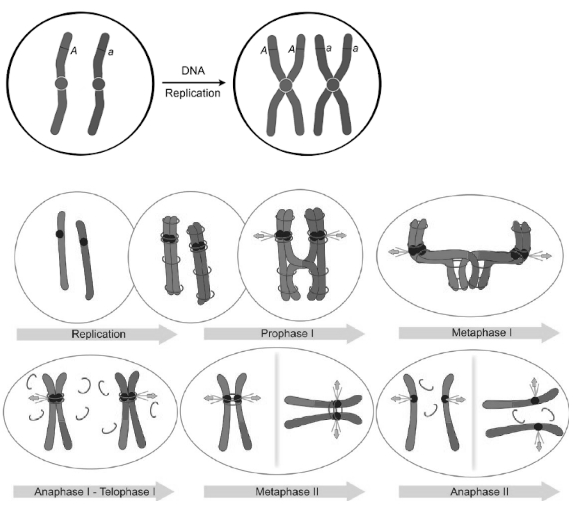
(D) Meiosis-$I$ is a reductional division where homologous chromosomes separate,reducing the chromosome number to half.
However,each chromosome still consists of two sister chromatids (replicated $DNA$).
Meiosis-$II$ is an equational division similar to mitosis,which is necessary to separate these sister chromatids so that each daughter cell receives a single chromatid (a complete set of unreplicated chromosomes).
However,each chromosome still consists of two sister chromatids (replicated $DNA$).
Meiosis-$II$ is an equational division similar to mitosis,which is necessary to separate these sister chromatids so that each daughter cell receives a single chromatid (a complete set of unreplicated chromosomes).
0 likes
View Solution423
EasyMCQ
$A$ type of cell division which reduces the chromosome number to half is
A
Mitosis
B
Multiple fission
C
Fragmentation
D
Meiosis
Solution
(D) Meiosis,also known as reductional division,is a process where one diploid cell divides to form $4$ haploid daughter cells. This process reduces the chromosome number by half in the resulting cells.
0 likes
View Solution424
MediumMCQ
In meiosis-$I$,condensation and coiling of chromatin fibres started during
A
Metaphase
B
Leptotene
C
Diakinesis
D
Diplotene
Solution
(B) In meiosis-$I$,the prophase-$I$ is divided into five sub-stages: Leptotene,Zygotene,Pachytene,Diplotene,and Diakinesis.
During the Leptotene stage,the chromatin fibres begin to condense and coil to form compact chromosomes.
Therefore,the condensation and coiling of chromatin fibres start during the Leptotene stage.
During the Leptotene stage,the chromatin fibres begin to condense and coil to form compact chromosomes.
Therefore,the condensation and coiling of chromatin fibres start during the Leptotene stage.
0 likes
View Solution425
MediumMCQ
In pachytene,each tetrad contains
A
Two chromatids
B
One chromatid
C
Four chromatids
D
Three chromatids
Solution
(C) During the pachytene stage of meiosis-$I$,homologous chromosomes pair up to form a bivalent or tetrad.
Each bivalent consists of two homologous chromosomes.
Since each chromosome has already replicated during the $S$-phase,it consists of two sister chromatids.
Therefore,a tetrad (bivalent) contains a total of $4$ chromatids (two from each homologous chromosome).
Each bivalent consists of two homologous chromosomes.
Since each chromosome has already replicated during the $S$-phase,it consists of two sister chromatids.
Therefore,a tetrad (bivalent) contains a total of $4$ chromatids (two from each homologous chromosome).

0 likes
View Solution426
EasyMCQ
The homologous chromosomes move towards the opposite poles during
A
Anaphase $I$
B
Anaphase $II$
C
Leptotene
D
Pachytene
Solution
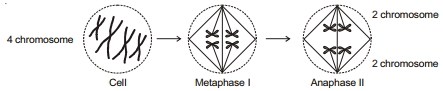
(A) During Meiosis-$I$,specifically in Anaphase-$I$,the homologous chromosomes separate and move towards opposite poles of the cell.
This process is responsible for the reduction in the number of chromosomes in the daughter cells,which is a hallmark of Meiosis-$I$ (reductional division).
In contrast,during Anaphase-$II$,it is the sister chromatids that separate and move towards opposite poles.
This process is responsible for the reduction in the number of chromosomes in the daughter cells,which is a hallmark of Meiosis-$I$ (reductional division).
In contrast,during Anaphase-$II$,it is the sister chromatids that separate and move towards opposite poles.
0 likes
View Solution427
EasyMCQ
..................... marks the site where crossing over has occurred.
A
Diakinesis
B
Synapsis
C
Chiasmata
D
Leptotene
Solution
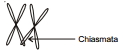
(C) During the pachytene stage of prophase-$I$ of meiosis,crossing over occurs between non-sister chromatids of homologous chromosomes.
Following this,in the diplotene stage,the homologous chromosomes begin to separate from each other except at the sites of crossovers.
These $X$-shaped structures,which mark the sites where crossing over has occurred,are known as chiasmata.
Following this,in the diplotene stage,the homologous chromosomes begin to separate from each other except at the sites of crossovers.
These $X$-shaped structures,which mark the sites where crossing over has occurred,are known as chiasmata.
0 likes
View Solution428
MediumMCQ
Terminalisation of chiasmata occurs during
A
Prophase-$I$
B
Metaphase-$I$
C
Anaphase-$I$
D
Telophase-$I$
Solution
(A) The process of meiosis $I$ is divided into several stages within Prophase-$I$: Leptotene,Zygotene,Pachytene,Diplotene,and Diakinesis.
During the Diplotene stage,the synaptonemal complex dissolves and the homologous chromosomes of the bivalents start to separate from each other except at the sites of crossovers.
These $X$-shaped structures are called chiasmata.
In the final stage of Prophase-$I$,which is Diakinesis,the terminalisation of chiasmata occurs,where the chiasmata move towards the ends of the chromosomes.
During the Diplotene stage,the synaptonemal complex dissolves and the homologous chromosomes of the bivalents start to separate from each other except at the sites of crossovers.
These $X$-shaped structures are called chiasmata.
In the final stage of Prophase-$I$,which is Diakinesis,the terminalisation of chiasmata occurs,where the chiasmata move towards the ends of the chromosomes.

0 likes
View Solution429
MediumMCQ
Bivalent chromosomes align themselves at the equator during
A
Metaphase $I$
B
Prophase $I$
C
Metaphase $II$
D
Anaphase $II$
Solution
(A) During meiosis,homologous chromosomes pair up to form bivalents (or tetrads) during prophase $I$.
These bivalent chromosomes then align themselves at the equatorial plate (metaphase plate) during metaphase $I$.
This alignment is a characteristic feature of metaphase $I$,where spindle fibers from opposite poles attach to the kinetochores of homologous chromosomes.
These bivalent chromosomes then align themselves at the equatorial plate (metaphase plate) during metaphase $I$.
This alignment is a characteristic feature of metaphase $I$,where spindle fibers from opposite poles attach to the kinetochores of homologous chromosomes.

0 likes
View Solution430
MediumMCQ
If there are $30$ chromosomes in $G_1$ phase,then what will be the number of bivalents in the zygotene stage?
A
$30$
B
$15$
C
$45$
D
$60$
Solution
(B) In the $G_1$ phase,the number of chromosomes is $2n = 30$.
During the $S$ phase,$DNA$ replication occurs,but the number of chromosomes remains the same $(2n = 30)$.
In the zygotene stage of Prophase-$I$ of meiosis,homologous chromosomes pair up to form bivalents (or tetrads).
The number of bivalents is equal to half the number of chromosomes,which is $n$.
Therefore,the number of bivalents = $30 / 2 = 15$.
During the $S$ phase,$DNA$ replication occurs,but the number of chromosomes remains the same $(2n = 30)$.
In the zygotene stage of Prophase-$I$ of meiosis,homologous chromosomes pair up to form bivalents (or tetrads).
The number of bivalents is equal to half the number of chromosomes,which is $n$.
Therefore,the number of bivalents = $30 / 2 = 15$.
0 likes
View Solution431
MediumMCQ
What will be the amount of $DNA$ in meiosis $II$ products if a meiocyte contains $30 \; pg$ $DNA$ in the $G_1$ phase (in $; pg$)?
A
$30$
B
$60$
C
$15$
D
$120$
Solution
(C) In the $G_1$ phase,the meiocyte is diploid $(2n)$ and contains $2c$ amount of $DNA$. Given that $2c = 30 \; pg$.
During the $S$ phase,$DNA$ replication occurs,doubling the $DNA$ content to $4c$ $(60 \; pg)$.
After meiosis $I$,two daughter cells are formed,each with $n$ chromosomes and $2c$ amount of $DNA$ $(30 \; pg)$.
After meiosis $II$,each of these cells divides again to form four haploid daughter cells,each containing $n$ chromosomes and $c$ amount of $DNA$.
Since $2c = 30 \; pg$,then $c = 15 \; pg$.
Therefore,the amount of $DNA$ in each meiosis $II$ product is $15 \; pg$.
During the $S$ phase,$DNA$ replication occurs,doubling the $DNA$ content to $4c$ $(60 \; pg)$.
After meiosis $I$,two daughter cells are formed,each with $n$ chromosomes and $2c$ amount of $DNA$ $(30 \; pg)$.
After meiosis $II$,each of these cells divides again to form four haploid daughter cells,each containing $n$ chromosomes and $c$ amount of $DNA$.
Since $2c = 30 \; pg$,then $c = 15 \; pg$.
Therefore,the amount of $DNA$ in each meiosis $II$ product is $15 \; pg$.
0 likes
View Solution432
MediumMCQ
All are the essential stages that take place during meiosis,except:
A
Two successive divisions without any $DNA$ replication occurring between them
B
Formation of chiasmata and crossing over
C
Segregation of homologous chromosomes
D
Number of chromosomes in daughter cells after meiosis $II$ is reduced to half but the amount of $DNA$ remains the same
Solution
(D) Meiosis consists of two successive nuclear and cell divisions ($Meiosis-I$ and $Meiosis-II$) with a single cycle of $DNA$ replication.
During $Meiosis-I$,homologous chromosomes segregate,and chiasmata formation occurs during prophase-$I$.
After $Meiosis-II$,both the number of chromosomes and the amount of $DNA$ in the daughter cells are reduced to half compared to the parent cell.
Therefore,the statement that the amount of $DNA$ remains the same after $Meiosis-II$ is incorrect.
During $Meiosis-I$,homologous chromosomes segregate,and chiasmata formation occurs during prophase-$I$.
After $Meiosis-II$,both the number of chromosomes and the amount of $DNA$ in the daughter cells are reduced to half compared to the parent cell.
Therefore,the statement that the amount of $DNA$ remains the same after $Meiosis-II$ is incorrect.
0 likes
View Solution433
MediumMCQ
In the meiotic cell division,$4$ daughter cells are produced by two successive divisions in which
A
First division is equational,second is reductional
B
First division is reductional,and second is equational
C
Both divisions are reductional
D
Both divisions are equational
Solution
(B) Meiosis is a type of cell division that reduces the chromosome number by half. It consists of two successive nuclear divisions:
$1$. Meiosis $I$: This is the reductional division where the chromosome number is halved.
$2$. Meiosis $II$: This is the equational division,similar to mitosis,where the chromosome number remains the same as the daughter cells produced in Meiosis $I$.
$1$. Meiosis $I$: This is the reductional division where the chromosome number is halved.
$2$. Meiosis $II$: This is the equational division,similar to mitosis,where the chromosome number remains the same as the daughter cells produced in Meiosis $I$.
0 likes
View Solution434
MediumMCQ
Find out the wrong statement.
A
Each metaphasic plate in heterotypic division of meiosis contains half the number of diploid set of chromosomes.
B
Interkinesis is generally short-lived.
C
Synaptonemal complex and nuclear membrane completely disappear in diplotene.
D
Homologous chromosomes move to respective poles in anaphase-$I$.
Solution
(C) The correct statement is that the synaptonemal complex and nuclear envelope completely disappear at the end of diakinesis,not diplotene. In diplotene,the synaptonemal complex dissolves,but the nuclear envelope remains intact until the end of diakinesis.
0 likes
View Solution435
MediumMCQ
All chromosomes of a cell are directed towards one side and are attached to the nuclear membrane,can be observed in
A
Leptotene
B
Zygotene
C
Pachytene
D
Diplotene
Solution
(A) During the $Leptotene$ stage of $Meiosis-I$,the chromosomes become gradually visible under a light microscope.
In this stage,the chromosomes are often oriented with their ends directed towards the nuclear envelope,a configuration known as the $Bouquet$ stage.
This specific arrangement is a characteristic feature of the $Leptotene$ phase.
In this stage,the chromosomes are often oriented with their ends directed towards the nuclear envelope,a configuration known as the $Bouquet$ stage.
This specific arrangement is a characteristic feature of the $Leptotene$ phase.
0 likes
View Solution436
MediumMCQ
The diplotene phase of meiosis is also characterised by:
$a$. Desynapsis
$b$. Complete terminalisation of chiasmata
$c$. Dictyotene stage
$d$. Complete disappearance of nuclear membrane and nucleoli
$e$. Complete development of astral rays and aster
$f$. Longest phase of prophase-$I$
$a$. Desynapsis
$b$. Complete terminalisation of chiasmata
$c$. Dictyotene stage
$d$. Complete disappearance of nuclear membrane and nucleoli
$e$. Complete development of astral rays and aster
$f$. Longest phase of prophase-$I$
A
$(a), (b), (c)$ and $(e)$
B
$(b), (d), (e)$ and $(f)$
C
$(a), (c)$ and $(f)$
D
$(b), (d)$ and $(f)$
Solution
(C) The diplotene stage of prophase-$I$ is characterized by the following features:
$1$. Desynapsis: The homologous chromosomes begin to separate from each other except at the sites of crossovers (chiasmata).
$2$. Dictyotene stage: In some vertebrates (like human oocytes),the diplotene stage can last for months or years,which is known as the dictyotene stage.
$3$. Longest phase of prophase-$I$: Diplotene is recognized as the longest sub-stage of prophase-$I$ in many organisms.
Therefore,the correct characteristics are $(a)$,$(c)$,and $(f)$.
$1$. Desynapsis: The homologous chromosomes begin to separate from each other except at the sites of crossovers (chiasmata).
$2$. Dictyotene stage: In some vertebrates (like human oocytes),the diplotene stage can last for months or years,which is known as the dictyotene stage.
$3$. Longest phase of prophase-$I$: Diplotene is recognized as the longest sub-stage of prophase-$I$ in many organisms.
Therefore,the correct characteristics are $(a)$,$(c)$,and $(f)$.
1 likes
View Solution437
MediumMCQ
The recombination nodules which mediate for chromosome recombination appear at intervals on the synaptonemal complex during
A
Zygotene stage
B
Meiosis
C
Pachytene stage
D
Diplotene stage
Solution
(C) The recombination nodules are the sites where crossing over occurs between non-sister chromatids of homologous chromosomes.
These nodules appear on the synaptonemal complex specifically during the $Pachytene$ stage of $Meiosis-I$.
Therefore,the correct stage is the $Pachytene$ stage.
These nodules appear on the synaptonemal complex specifically during the $Pachytene$ stage of $Meiosis-I$.
Therefore,the correct stage is the $Pachytene$ stage.
0 likes
View Solution438
MediumMCQ
In oocytes,which stage can last for months or years,since at this stage the chromosomes decondense and are engaged in $RNA$ synthesis?
A
Diakinesis
B
Telophase-$I$
C
Diplotene
D
Intrameiotic interphase
Solution
(C) The $Diplotene$ stage of $Prophase-I$ is characterized by the dissolution of the synaptonemal complex and the separation of homologous chromosomes,except at the sites of crossovers called $chiasmata$. In many vertebrate oocytes,the $Diplotene$ stage can last for months or years. During this prolonged phase,the chromosomes decondense to form lampbrush chromosomes and become actively engaged in $RNA$ synthesis.
0 likes
View Solution439
MediumMCQ
When synapsis is complete all along the chromosome,the cells are said to have entered a stage of prophase $I$,where exchange of genetic material takes place between homologous chromosomes. The stage is called
A
Zygotene
B
Pachytene
C
Diplotene
D
Diakinesis
Solution
(B) Prophase $I$ of meiosis is divided into five sub-stages: Leptotene,Zygotene,Pachytene,Diplotene,and Diakinesis.
$1$. During Zygotene,homologous chromosomes pair up,a process known as synapsis.
$2$. When synapsis is complete,the cell enters the Pachytene stage.
$3$. In the Pachytene stage,the bivalent chromosomes clearly appear as tetrads,and crossing over (exchange of genetic material between non-sister chromatids of homologous chromosomes) occurs.
$4$. Therefore,the stage described is Pachytene.
$1$. During Zygotene,homologous chromosomes pair up,a process known as synapsis.
$2$. When synapsis is complete,the cell enters the Pachytene stage.
$3$. In the Pachytene stage,the bivalent chromosomes clearly appear as tetrads,and crossing over (exchange of genetic material between non-sister chromatids of homologous chromosomes) occurs.
$4$. Therefore,the stage described is Pachytene.

0 likes
View Solution440
MediumMCQ
The beginning of which stage of prophase is marked by complete terminalisation of chiasmata and inhibition of $RNA$ synthesis?
A
Pachytene
B
Diplotene
C
Diakinesis
D
Zygotene
Solution
(C) Diakinesis is the final stage of meiotic prophase-$I$.
During this stage,the chromosomes are fully condensed and the meiotic spindle is assembled to prepare the homologous chromosomes for separation.
The most characteristic feature of diakinesis is the complete terminalisation of chiasmata,where the chiasmata move towards the ends of the chromatids.
Additionally,the nucleolus disappears and the nuclear envelope breaks down.
$RNA$ synthesis is also inhibited during this stage as the chromosomes become highly condensed and transcriptionally inactive.
During this stage,the chromosomes are fully condensed and the meiotic spindle is assembled to prepare the homologous chromosomes for separation.
The most characteristic feature of diakinesis is the complete terminalisation of chiasmata,where the chiasmata move towards the ends of the chromatids.
Additionally,the nucleolus disappears and the nuclear envelope breaks down.
$RNA$ synthesis is also inhibited during this stage as the chromosomes become highly condensed and transcriptionally inactive.
0 likes
View Solution441
EasyMCQ
The temporarily suspended stage of diplotene during meiosis-$I$ is known as:
A
Leptotene
B
Diakinesis
C
Dictyotene
D
Pachytene
Solution
(C) In the oocytes of many vertebrates,the diplotene stage of prophase-$I$ is temporarily arrested for an extended period. This prolonged,suspended diplotene stage is specifically referred to as the $Dictyotene$ stage. During this phase,the chromosomes decondense and become transcriptionally active,allowing for the accumulation of maternal resources required for future embryonic development.
0 likes
View Solution442
MediumMCQ
$A$: Synaptonemal complex develops between two synapsed homologous chromosomes.
$R$: Mitosis cannot be completed without the synaptonemal complex.
$R$: Mitosis cannot be completed without the synaptonemal complex.
A
Assertion and Reason both are correct and Reason is the correct explanation of Assertion.
B
Assertion and Reason both are correct but Reason is not the correct explanation of Assertion.
C
Assertion is correct,but Reason is incorrect.
D
Both Assertion and Reason are incorrect.
Solution
(C) The synaptonemal complex is a protein structure that forms between homologous chromosomes during the pachytene stage of prophase-$I$ of meiosis.
It facilitates the pairing (synapsis) of homologous chromosomes and is essential for crossing over.
Therefore,the Assertion is correct.
However,the synaptonemal complex is specific to meiosis,not mitosis.
Mitosis involves the division of somatic cells where homologous chromosomes do not pair up or form a synaptonemal complex.
Thus,the Reason is incorrect.
It facilitates the pairing (synapsis) of homologous chromosomes and is essential for crossing over.
Therefore,the Assertion is correct.
However,the synaptonemal complex is specific to meiosis,not mitosis.
Mitosis involves the division of somatic cells where homologous chromosomes do not pair up or form a synaptonemal complex.
Thus,the Reason is incorrect.
0 likes
View Solution443
MediumMCQ
$A$: Each chromosome of a bivalent attaches with two spindles in metaphase.
$R$: In metaphase,bivalents migrate towards the metaphasic plate.
$R$: In metaphase,bivalents migrate towards the metaphasic plate.
A
Assertion and Reason both are correct and Reason is the correct explanation of Assertion.
B
Assertion and Reason both are correct but Reason is not the correct explanation of Assertion.
C
Assertion is correct,but Reason is incorrect.
D
Both Assertion and Reason are incorrect.
Solution
(C) In Metaphase $I$ of meiosis,each chromosome of a bivalent attaches to a single spindle fiber from one pole,not two. This is because the kinetochores of sister chromatids are oriented towards the same pole.
Therefore,the Assertion is incorrect.
In Metaphase $I$,the bivalents (homologous pairs) align at the equatorial plate (metaphasic plate). Thus,the Reason is correct.
Hence,the correct option is $C$.
Therefore,the Assertion is incorrect.
In Metaphase $I$,the bivalents (homologous pairs) align at the equatorial plate (metaphasic plate). Thus,the Reason is correct.
Hence,the correct option is $C$.
0 likes
View Solution444
MediumMCQ
$A$ : Anaphase-$I$ is the actual phase of reduction in the number of chromosomes.
$R$ : Homologous chromosomes move to the opposite poles with both their chromatids.
$R$ : Homologous chromosomes move to the opposite poles with both their chromatids.
A
Assertion and Reason both are correct and Reason is the correct explanation of Assertion.
B
Assertion and Reason both are correct but Reason is not the correct explanation of Assertion.
C
Assertion is correct,but Reason is incorrect.
D
Both Assertion and Reason are incorrect.
Solution
(A) In Meiosis-$I$,the homologous chromosomes separate and move to opposite poles,while the sister chromatids remain attached at the centromere.
Because the homologous pairs separate,the number of chromosomes in each daughter cell is reduced to half compared to the parent cell.
Therefore,Anaphase-$I$ is indeed the phase where the reduction in chromosome number occurs.
The Reason statement correctly describes the movement of homologous chromosomes to opposite poles with their chromatids intact.
Thus,both statements are correct,and the Reason explains why the chromosome number is reduced.
Because the homologous pairs separate,the number of chromosomes in each daughter cell is reduced to half compared to the parent cell.
Therefore,Anaphase-$I$ is indeed the phase where the reduction in chromosome number occurs.
The Reason statement correctly describes the movement of homologous chromosomes to opposite poles with their chromatids intact.
Thus,both statements are correct,and the Reason explains why the chromosome number is reduced.
0 likes
View Solution445
MediumMCQ
$A$ : Chiasmata counting stage is diplotene.
$R$ : Dissolution of the synaptonemal complex occurs except at the sites of crossovers.
$R$ : Dissolution of the synaptonemal complex occurs except at the sites of crossovers.
A
Assertion and Reason both are correct and Reason is the correct explanation of Assertion.
B
Assertion and Reason both are correct but Reason is not the correct explanation of Assertion.
C
Assertion is correct,but Reason is incorrect.
D
Both Assertion and Reason are incorrect.
Solution
(A) The diplotene stage of prophase-$I$ of meiosis is characterized by the dissolution of the synaptonemal complex.
However,the homologous chromosomes do not separate completely at the sites of crossing over.
These $X$-shaped structures are called chiasmata.
Therefore,the diplotene stage is the stage where chiasmata become visible and can be counted.
Since the reason explains why chiasmata are visible and countable at this stage,both statements are correct and the reason is the correct explanation.
However,the homologous chromosomes do not separate completely at the sites of crossing over.
These $X$-shaped structures are called chiasmata.
Therefore,the diplotene stage is the stage where chiasmata become visible and can be counted.
Since the reason explains why chiasmata are visible and countable at this stage,both statements are correct and the reason is the correct explanation.
0 likes
View Solution446
EasyMCQ
Meiosis takes place in:
A
Conidia
B
Gemmule
C
Megaspore
D
Meiocyte
Solution
(D) Meiosis is a specialized type of cell division that reduces the chromosome number by half,resulting in the production of haploid daughter cells.
In sexually reproducing organisms,meiosis occurs in specialized cells called meiocytes.
$A$ meiocyte is a diploid $(2n)$ cell that undergoes meiosis to produce haploid $(n)$ gametes.
Conidia and gemmules are structures involved in asexual reproduction,where mitosis occurs.
Megaspores are haploid cells produced after meiosis,not the site where meiosis occurs.
In sexually reproducing organisms,meiosis occurs in specialized cells called meiocytes.
$A$ meiocyte is a diploid $(2n)$ cell that undergoes meiosis to produce haploid $(n)$ gametes.
Conidia and gemmules are structures involved in asexual reproduction,where mitosis occurs.
Megaspores are haploid cells produced after meiosis,not the site where meiosis occurs.
0 likes
View Solution447
MediumMCQ
Meiotic cell division takes place during
A
Gametogenesis
B
Embryogenesis
C
Organogenesis
D
Parthenogenesis
Solution
(A) Meiosis is a specialized type of cell division that reduces the chromosome number by half,resulting in the production of haploid cells.
This process is essential during gametogenesis to ensure that gametes (sperm and egg) contain half the number of chromosomes compared to the parent organism.
When fertilization occurs,the fusion of these haploid gametes restores the diploid chromosome number in the zygote.
Therefore,meiotic cell division occurs specifically during gametogenesis.
This process is essential during gametogenesis to ensure that gametes (sperm and egg) contain half the number of chromosomes compared to the parent organism.
When fertilization occurs,the fusion of these haploid gametes restores the diploid chromosome number in the zygote.
Therefore,meiotic cell division occurs specifically during gametogenesis.
0 likes
View Solution448
MediumMCQ
Gamete mother cells with the chromosome constitution $44+XY$ suffer from non-disjunction at the first meiotic division. Which of the following sets of gametes would result?
A
$22+XX, 22+XY$,and $22, 22$
B
$22+XY, 22+XY$,and $22, 22$
C
$22+X, 22+Y$,and $22+Y, 22$
D
$22+XY, 22+0$ (or $22$)
Solution
(D) Non-disjunction is the failure of homologous chromosomes or sister chromatids to separate properly during cell division.
In a male with $44+XY$ chromosomes,the first meiotic division involves the separation of the $X$ and $Y$ chromosomes.
If non-disjunction occurs during the first meiotic division,the $XY$ pair fails to separate and moves into one daughter cell,while the other daughter cell receives no sex chromosomes.
Consequently,after the second meiotic division,the resulting gametes will have genotypes $22+XY$ and $22+0$ (which is $22$).
In a male with $44+XY$ chromosomes,the first meiotic division involves the separation of the $X$ and $Y$ chromosomes.
If non-disjunction occurs during the first meiotic division,the $XY$ pair fails to separate and moves into one daughter cell,while the other daughter cell receives no sex chromosomes.
Consequently,after the second meiotic division,the resulting gametes will have genotypes $22+XY$ and $22+0$ (which is $22$).
0 likes
View Solution449
EasyMCQ
In which stage of meiosis does the splitting of the centromere occur?
A
Metaphase-$I$
B
Metaphase-$II$
C
Anaphase-$II$
D
Telophase-$II$
Solution
(C) Meiosis is a reductional division consisting of two stages: Meiosis-$I$ and Meiosis-$II$.
In Meiosis-$I$,homologous chromosomes separate,but the centromeres remain intact.
In Anaphase-$II$,the centromere of each chromosome splits,allowing the sister chromatids to separate and move toward opposite poles.
Therefore,the splitting of the centromere is a characteristic feature of Anaphase-$II$.
In Meiosis-$I$,homologous chromosomes separate,but the centromeres remain intact.
In Anaphase-$II$,the centromere of each chromosome splits,allowing the sister chromatids to separate and move toward opposite poles.
Therefore,the splitting of the centromere is a characteristic feature of Anaphase-$II$.
0 likes
View Solution450
EasyMCQ
Which stage of meiotic prophase shows terminalisation of chiasmata as its distinctive feature?
A
Leptotene
B
Zygotene
C
Diakinesis
D
Pachytene
Solution
(C) The prophase of meiosis-$I$ is divided into five sub-stages: $Leptotene$, $Zygotene$, $Pachytene$, $Diplotene$, and $Diakinesis$.
$1$. $Leptotene$: Chromosomes become visible as compact threads.
$2$. $Zygotene$: Synapsis occurs between homologous chromosomes.
$3$. $Pachytene$: Crossing over takes place between non-sister chromatids.
$4$. $Diplotene$: The dissolution of the synaptonemal complex occurs, and homologous chromosomes separate except at the sites of crossovers, forming $Chiasmata$.
$5$. $Diakinesis$: This is the final stage of meiotic prophase-$I$. The distinctive feature of this stage is the $terminalisation$ of $chiasmata$. The chromosomes are fully condensed, and the meiotic spindle is assembled to prepare the homologous chromosomes for separation.
$1$. $Leptotene$: Chromosomes become visible as compact threads.
$2$. $Zygotene$: Synapsis occurs between homologous chromosomes.
$3$. $Pachytene$: Crossing over takes place between non-sister chromatids.
$4$. $Diplotene$: The dissolution of the synaptonemal complex occurs, and homologous chromosomes separate except at the sites of crossovers, forming $Chiasmata$.
$5$. $Diakinesis$: This is the final stage of meiotic prophase-$I$. The distinctive feature of this stage is the $terminalisation$ of $chiasmata$. The chromosomes are fully condensed, and the meiotic spindle is assembled to prepare the homologous chromosomes for separation.
0 likes
View SolutionCell Cycle and Cell Division — Meiosis · Frequently Asked Questions
1Are these Cell Cycle and Cell Division questions useful for JEE and NEET?
Yes. All questions in this section are mapped to JEE Main and NEET exam patterns. Previous year questions from JEE Main, NEET, GUJCET and state-level exams are included with full solutions.
2Can I switch to Hindi or Gujarati for these questions?
Yes. Use the language tabs in the hero section or the sidebar to view the same questions and solutions in English, Hindi or Gujarati.
3How do I generate a question paper from this subtopic?
Use the Vedclass Exam Paper Generator — select the chapter and subtopic, set difficulty, and generate Sets A, B, C, D automatically. First 3 chapters of every subject are free.
Vedclass Products
For Students
Vedclass Test Series
Mock tests in real JEE/NEET style with performance analysis. 5-day free trial.
Start Free TrialFor Teachers
Exam Paper Generator
Generate Set A/B/C/D papers from this chapter in 2 minutes. 3 chapters free.
Try FreeFor Institutes
Online Exam Module
Live online exams with unlimited students, 360° analytics & white-label branding.
See DemoFor Teachers & Institutes
Generate a Cell Cycle and Cell Division Exam Paper in 2 Minutes
Select subtopic & difficulty — Sets A, B, C, D auto-generated with No Repeat logic.
First 3 chapters of every subject are free — no payment required.