
A English
Meiosis Questions in English
Class 11 Biology · Cell Cycle and Cell Division · Meiosis
492+
Questions
English
Language
100%
With Solutions
Showing 50 of 492 questions in English
301
MediumMCQ
In oocytes of some vertebrates,this stage can last for months or years.
A
Pachytene
B
Diakinesis
C
Leptotene
D
Diplotene
Solution
(D) The $Diplotene$ stage of $Meiosis-I$ is characterized by the dissolution of the synaptonemal complex and the tendency of the recombined homologous chromosomes to separate from each other except at the sites of crossovers.
These $X$-shaped structures are called $Chiasmata$.
In oocytes of some vertebrates,the $Diplotene$ stage can last for months or years,during which the chromosomes decondense and become active in transcription,a state known as the $Dictyotene$ stage.
These $X$-shaped structures are called $Chiasmata$.
In oocytes of some vertebrates,the $Diplotene$ stage can last for months or years,during which the chromosomes decondense and become active in transcription,a state known as the $Dictyotene$ stage.
0 likes
View Solution302
MediumMCQ
Which of the following processes does not occur in mitosis?
A
Condensation of chromosomes
B
Arrangement of chromosomes at the equator
C
Formation of chiasmata
D
Centromere movement to opposite poles
Solution
(C) Mitosis is a type of cell division that results in two daughter cells each having the same number and kind of chromosomes as the parent nucleus.
$1$. Condensation of chromosomes occurs during prophase of mitosis.
$2$. Arrangement of chromosomes at the equator occurs during metaphase of mitosis.
$3$. Formation of chiasmata is a characteristic feature of prophase-$I$ of meiosis,where non-sister chromatids of homologous chromosomes exchange genetic material. This does not occur in mitosis.
$4$. Centromere movement to opposite poles occurs during anaphase of mitosis.
$1$. Condensation of chromosomes occurs during prophase of mitosis.
$2$. Arrangement of chromosomes at the equator occurs during metaphase of mitosis.
$3$. Formation of chiasmata is a characteristic feature of prophase-$I$ of meiosis,where non-sister chromatids of homologous chromosomes exchange genetic material. This does not occur in mitosis.
$4$. Centromere movement to opposite poles occurs during anaphase of mitosis.
0 likes
View Solution303
MediumMCQ
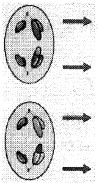
Identify the figure:
A
Prophase
B
Interphase
C
Metaphase $-I$
D
Anaphase $-II$
Solution
(D) The provided figure shows two cells undergoing cell division. In each cell,the sister chromatids are separating and moving towards opposite poles of the cell. This specific movement of sister chromatids is the characteristic feature of Anaphase $-II$ of meiosis. In Anaphase $-I$,homologous chromosomes separate,whereas in Anaphase $-II$,the centromeres split and sister chromatids move to opposite poles.
0 likes
View Solution304
EasyMCQ
This stage is marked by the terminalization of chiasmata.
A
Leptotene
B
Diakinesis
C
Pachytene
D
Telophase
Solution
(B) The process of meiosis $I$ is divided into several stages.
During the $Prophase-I$ stage,specifically in the $Diakinesis$ sub-stage,the chromosomes are fully condensed and the meiotic spindle is assembled to prepare the homologous chromosomes for separation.
$Diakinesis$ is characterized by the terminalization of chiasmata,which means the chiasmata move towards the ends of the chromatids.
Therefore,the correct option is $B$.
During the $Prophase-I$ stage,specifically in the $Diakinesis$ sub-stage,the chromosomes are fully condensed and the meiotic spindle is assembled to prepare the homologous chromosomes for separation.
$Diakinesis$ is characterized by the terminalization of chiasmata,which means the chiasmata move towards the ends of the chromatids.
Therefore,the correct option is $B$.
0 likes
View Solution305
EasyMCQ
Meiosis involves.....
A
One nuclear and cell division and two cycles of $DNA$ replication
B
Two sequential cycles of nuclear and cell division and two cycles of $DNA$ replication
C
One cycle of nuclear and cell division and one cycle of $DNA$ replication
D
Two sequential cycles of nuclear and cell division but only a single cycle of $DNA$ replication
Solution
(D) Meiosis is a specialized type of cell division that reduces the chromosome number by half,resulting in the production of haploid daughter cells.
It involves two sequential cycles of nuclear and cell division,known as Meiosis-$I$ and Meiosis-$II$.
However,these two divisions are preceded by only a single cycle of $DNA$ replication during the $S$-phase of interphase.
Therefore,the correct description is two sequential cycles of nuclear and cell division but only a single cycle of $DNA$ replication.
It involves two sequential cycles of nuclear and cell division,known as Meiosis-$I$ and Meiosis-$II$.
However,these two divisions are preceded by only a single cycle of $DNA$ replication during the $S$-phase of interphase.
Therefore,the correct description is two sequential cycles of nuclear and cell division but only a single cycle of $DNA$ replication.
0 likes
View Solution306
MediumMCQ
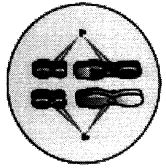
Identify the figure:
A
Telophase-$I$
B
Prophase-$I$
C
Metaphase-$I$
D
Prophase-$II$
Solution
(C) The provided figure shows homologous chromosomes arranged at the equatorial plate.
In Meiosis-$I$,during Metaphase-$I$,the bivalent chromosomes (homologous pairs) align at the equatorial plate.
Spindle fibers from opposite poles attach to the kinetochores of the homologous chromosomes.
This specific arrangement of homologous pairs at the equator is the characteristic feature of Metaphase-$I$.
In Meiosis-$I$,during Metaphase-$I$,the bivalent chromosomes (homologous pairs) align at the equatorial plate.
Spindle fibers from opposite poles attach to the kinetochores of the homologous chromosomes.
This specific arrangement of homologous pairs at the equator is the characteristic feature of Metaphase-$I$.
0 likes
View Solution307
EasyMCQ
The stage between the two meiotic divisions is called:
A
Synaptonemal complex
B
Interkinesis
C
Chiasmata
D
$G_0$ phase
Solution
(B) The stage between the two meiotic divisions (Meiosis-$I$ and Meiosis-$II$) is known as Interkinesis.
Interkinesis is a short-lived resting phase that occurs after Meiosis-$I$ and before Meiosis-$II$.
During this phase,there is no replication of $DNA$,but the cell may grow and prepare for the second meiotic division.
Therefore,the correct option is $B$.
Interkinesis is a short-lived resting phase that occurs after Meiosis-$I$ and before Meiosis-$II$.
During this phase,there is no replication of $DNA$,but the cell may grow and prepare for the second meiotic division.
Therefore,the correct option is $B$.
0 likes
View Solution308
MediumMCQ
In the initial stage of meiosis,a cell has $42$ chromosomes. How many chromosomes are present at the end of meiosis-$II$?
A
$42$
B
$40$
C
$10$
D
$21$
Solution
(D) Meiosis is a reductional division that occurs in two stages: meiosis-$I$ and meiosis-$II$.
In meiosis-$I$,the chromosome number is reduced to half. If a cell starts with $42$ chromosomes,after meiosis-$I$,each daughter cell will have $21$ chromosomes.
Meiosis-$II$ is an equational division,similar to mitosis,where the chromosome number remains the same as the parent cell entering this phase.
Therefore,since the cells entering meiosis-$II$ have $21$ chromosomes,the daughter cells produced at the end of meiosis-$II$ will also have $21$ chromosomes.
In meiosis-$I$,the chromosome number is reduced to half. If a cell starts with $42$ chromosomes,after meiosis-$I$,each daughter cell will have $21$ chromosomes.
Meiosis-$II$ is an equational division,similar to mitosis,where the chromosome number remains the same as the parent cell entering this phase.
Therefore,since the cells entering meiosis-$II$ have $21$ chromosomes,the daughter cells produced at the end of meiosis-$II$ will also have $21$ chromosomes.
0 likes
View Solution309
EasyMCQ
The function of recombinase is found in which stage of meiosis?
A
Pachytene
B
Cytokinesis
C
Leptotene
D
Interphase
Solution
(A) The enzyme $Recombinase$ is essential for the process of crossing over during meiosis.
Crossing over is the exchange of genetic material between non-sister chromatids of homologous chromosomes.
This process occurs specifically during the $Pachytene$ stage of Prophase-$I$ in meiosis.
Therefore,the function of recombinase is observed in the $Pachytene$ stage.
Crossing over is the exchange of genetic material between non-sister chromatids of homologous chromosomes.
This process occurs specifically during the $Pachytene$ stage of Prophase-$I$ in meiosis.
Therefore,the function of recombinase is observed in the $Pachytene$ stage.
0 likes
View Solution310
MediumMCQ
Identify the correct pair:
A
Prophase-$II$ $\rightarrow$ The nuclear membrane disappears by the end of this phase
B
Metaphase-$II$ $\rightarrow$ Chromatids move towards opposite poles of the cell
C
Telophase-$I$ $\rightarrow$ The bivalent chromosome align to the equatorial plate
D
Anaphase $\rightarrow$ Nuclear envelope assembles around the chromosome clusters
Solution
(A) In $Meiosis-II$,$Prophase-II$ is initiated immediately after cytokinesis. During this phase,the nuclear membrane disappears,and the chromosomes become compact.
Option $A$ is correct because the nuclear membrane and endoplasmic reticulum disappear by the end of $Prophase-II$.
Option $B$ is incorrect because chromatids move towards opposite poles during $Anaphase-II$,not $Metaphase-II$.
Option $C$ is incorrect because bivalent chromosomes align at the equatorial plate during $Metaphase-I$,not $Telophase-I$.
Option $D$ is incorrect because the nuclear envelope assembles around chromosome clusters during $Telophase$,not $Anaphase$.
Option $A$ is correct because the nuclear membrane and endoplasmic reticulum disappear by the end of $Prophase-II$.
Option $B$ is incorrect because chromatids move towards opposite poles during $Anaphase-II$,not $Metaphase-II$.
Option $C$ is incorrect because bivalent chromosomes align at the equatorial plate during $Metaphase-I$,not $Telophase-I$.
Option $D$ is incorrect because the nuclear envelope assembles around chromosome clusters during $Telophase$,not $Anaphase$.
0 likes
View Solution311
EasyMCQ
Haploid $(n)$ cell formation from diploid $(2n)$ cell is known as.......
A
Meiosis
B
Mitosis
C
$A$ & $B$ correct
D
$A$ & $B$ incorrect
Solution
(A) Meiosis is a specialized type of cell division that reduces the chromosome number by half,resulting in the production of haploid $(n)$ daughter cells from a diploid $(2n)$ parent cell.
This process is essential for sexual reproduction to maintain the constant chromosome number across generations.
In contrast,mitosis is an equational division where the chromosome number remains the same in daughter cells as in the parent cell.
This process is essential for sexual reproduction to maintain the constant chromosome number across generations.
In contrast,mitosis is an equational division where the chromosome number remains the same in daughter cells as in the parent cell.
0 likes
View Solution312
EasyMCQ
Crossing over is..........
A
The exchange of genetic material between two homologous chromosomes.
B
The exchange of genetic material between non-homologous chromosomes.
C
Chromosomes are moved to the spindle equator.
D
The process in which $DNA$ replication occurs two times.
Solution
(A) Crossing over is a biological process that occurs during $Prophase-I$ of $Meiosis-I$.
It involves the exchange of genetic material between non-sister chromatids of homologous chromosomes.
This process leads to genetic recombination,which is essential for creating genetic diversity in offspring.
Therefore,the correct definition is the exchange of genetic material between two homologous chromosomes.
It involves the exchange of genetic material between non-sister chromatids of homologous chromosomes.
This process leads to genetic recombination,which is essential for creating genetic diversity in offspring.
Therefore,the correct definition is the exchange of genetic material between two homologous chromosomes.
0 likes
View Solution313
MediumMCQ
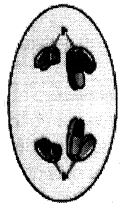
Identify the stage of meiosis shown in the figure.
A
Prophase $- I$
B
Metaphase $- I$
C
Telophase $- I$
D
Anaphase $- I$
Solution
(D) The figure shows homologous chromosomes being pulled apart towards opposite poles of the cell.
In $Meiosis-I$,the homologous chromosomes separate,while the sister chromatids remain attached at their centromeres.
This specific movement of homologous chromosomes to opposite poles is the characteristic feature of $Anaphase-I$.
In $Meiosis-I$,the homologous chromosomes separate,while the sister chromatids remain attached at their centromeres.
This specific movement of homologous chromosomes to opposite poles is the characteristic feature of $Anaphase-I$.
0 likes
View Solution314
MediumMCQ
Identify the stage of meiosis characterized by the following features:
- Marked by terminalisation of chiasmata.
- Chromosomes are fully condensed.
- By the end of this stage,the nucleolus disappears.
- Marked by terminalisation of chiasmata.
- Chromosomes are fully condensed.
- By the end of this stage,the nucleolus disappears.
A
Zygotene
B
Pachytene
C
Diplotene
D
Diakinesis
Solution
(D) The stage described is $Diakinesis$.
$1$. $Diakinesis$ is the final stage of meiotic prophase $I$.
$2$. During this stage,the chiasmata (the points where homologous chromosomes remain attached) undergo terminalisation,meaning they move towards the ends of the chromosomes.
$3$. The chromosomes reach their maximum level of condensation.
$4$. By the end of $Diakinesis$,the nucleolus disappears,and the nuclear envelope breaks down to prepare the cell for metaphase $I$.
$1$. $Diakinesis$ is the final stage of meiotic prophase $I$.
$2$. During this stage,the chiasmata (the points where homologous chromosomes remain attached) undergo terminalisation,meaning they move towards the ends of the chromosomes.
$3$. The chromosomes reach their maximum level of condensation.
$4$. By the end of $Diakinesis$,the nucleolus disappears,and the nuclear envelope breaks down to prepare the cell for metaphase $I$.
0 likes
View Solution315
MediumMCQ
The process involved only in meiosis.
A
Pairing of homologous chromosomes.
B
Condensation of chromosomes.
C
Reformation of nuclear envelope.
D
Splitting of centromere.
Solution
(A) The process of pairing of homologous chromosomes,also known as synapsis,occurs exclusively during the prophase-$I$ stage of meiosis.
Condensation of chromosomes occurs in both mitosis and meiosis.
Reformation of the nuclear envelope occurs in both mitosis (telophase) and meiosis (telophase-$I$ and telophase-$II$).
Splitting of the centromere occurs during anaphase of mitosis and anaphase-$II$ of meiosis.
Condensation of chromosomes occurs in both mitosis and meiosis.
Reformation of the nuclear envelope occurs in both mitosis (telophase) and meiosis (telophase-$I$ and telophase-$II$).
Splitting of the centromere occurs during anaphase of mitosis and anaphase-$II$ of meiosis.
0 likes
View Solution316
MediumMCQ
$A -$ Meiosis is called the reduction division.
$R -$ It reduces the chromosome number by half while making the gametes.
$R -$ It reduces the chromosome number by half while making the gametes.
A
$A$ and $R$ are both correct.
B
$A$ and $R$ are both incorrect.
C
$A$ is correct and $R$ is incorrect.
D
$A$ is incorrect and $R$ is correct.
Solution
(A) Meiosis is a type of cell division that reduces the number of chromosomes in the parent cell by half and produces four gamete cells.
This process is required to produce egg and sperm cells for sexual reproduction.
Because the chromosome number is reduced from diploid $(2n)$ to haploid $(n)$,it is known as the reduction division.
Therefore,both the assertion $(A)$ and the reason $(R)$ are correct,and $R$ is the correct explanation of $A$.
This process is required to produce egg and sperm cells for sexual reproduction.
Because the chromosome number is reduced from diploid $(2n)$ to haploid $(n)$,it is known as the reduction division.
Therefore,both the assertion $(A)$ and the reason $(R)$ are correct,and $R$ is the correct explanation of $A$.
0 likes
View Solution317
MediumMCQ
$A-$ In meiosis,during anaphase $I$,homologous chromosomes move to the opposite poles.
$R-$ Each pole receives half the number of chromatids in anaphase $I$.
$R-$ Each pole receives half the number of chromatids in anaphase $I$.
A
$A$ and $R$ are both correct.
B
$A$ and $R$ are both incorrect.
C
$A$ is correct and $R$ is incorrect.
D
$A$ is incorrect and $R$ is correct.
Solution
(C) Assertion $(A)$: In meiosis $I$,during anaphase $I$,the homologous chromosomes separate and move to opposite poles. This statement is correct.
Reason $(R)$: In anaphase $I$,the homologous chromosomes separate,but the sister chromatids remain attached at the centromere. Therefore,each pole receives a complete set of chromosomes (each consisting of two chromatids),not half the number of chromatids. The reduction in chromosome number occurs,but the number of chromatids per chromosome remains the same as the parent cell at the start of division. Thus,the statement that each pole receives half the number of chromatids is incorrect.
Therefore,$A$ is correct and $R$ is incorrect.
Reason $(R)$: In anaphase $I$,the homologous chromosomes separate,but the sister chromatids remain attached at the centromere. Therefore,each pole receives a complete set of chromosomes (each consisting of two chromatids),not half the number of chromatids. The reduction in chromosome number occurs,but the number of chromatids per chromosome remains the same as the parent cell at the start of division. Thus,the statement that each pole receives half the number of chromatids is incorrect.
Therefore,$A$ is correct and $R$ is incorrect.
0 likes
View Solution318
EasyMCQ
The enzyme recombinase is required at which stage of meiosis?
A
Pachytene
B
Metaphase
C
Anaphase
D
Zygotene
Solution
(A) The enzyme recombinase is essential for the process of crossing over during meiosis.
Crossing over is the exchange of genetic material between non-sister chromatids of homologous chromosomes.
This process occurs specifically during the $Pachytene$ stage of $Prophase-I$ in meiosis.
Therefore,the correct stage is $Pachytene$.
Crossing over is the exchange of genetic material between non-sister chromatids of homologous chromosomes.
This process occurs specifically during the $Pachytene$ stage of $Prophase-I$ in meiosis.
Therefore,the correct stage is $Pachytene$.
0 likes
View Solution319
MediumMCQ
The simultaneous splitting of the centromere of each chromosome allowing them to move toward opposite poles of the cell is a change shown in......
A
Metaphase-$I$
B
Anaphase-$I$
C
Telophase-$II$
D
Anaphase-$II$
Solution
(D) In $Anaphase-II$,the centromere of each chromosome splits,allowing the sister chromatids to separate.
These separated chromatids,now referred to as chromosomes of the daughter nuclei,move toward opposite poles of the cell.
In contrast,during $Anaphase-I$,homologous chromosomes separate,but the centromeres do not split.
These separated chromatids,now referred to as chromosomes of the daughter nuclei,move toward opposite poles of the cell.
In contrast,during $Anaphase-I$,homologous chromosomes separate,but the centromeres do not split.
0 likes
View Solution320
MediumMCQ
Meiosis-$II$ resembles which of the following processes?
A
Interphase
B
Synapsis
C
Mitosis
D
Endomitosis
Solution
(C) Meiosis-$II$ is known as equational division because the number of chromosomes remains the same as in the parent cell.
During Meiosis-$II$,sister chromatids separate,which is a process identical to the mechanism of Mitosis.
Unlike Meiosis-$I$,there is no reduction in chromosome number,and the stages (prophase-$II$,metaphase-$II$,anaphase-$II$,and telophase-$II$) follow a pattern similar to mitotic division.
During Meiosis-$II$,sister chromatids separate,which is a process identical to the mechanism of Mitosis.
Unlike Meiosis-$I$,there is no reduction in chromosome number,and the stages (prophase-$II$,metaphase-$II$,anaphase-$II$,and telophase-$II$) follow a pattern similar to mitotic division.
0 likes
View Solution321
MediumMCQ
The final stage of meiotic prophase-$I$ is ......
A
Diplotene
B
Diakinesis
C
Zygotene
D
Pachytene
Solution
(B) Meiotic prophase-$I$ is a long and complex phase divided into five sub-stages: Leptotene,Zygotene,Pachytene,Diplotene,and Diakinesis.
$1$. Leptotene: Chromosomes become visible.
$2$. Zygotene: Synapsis of homologous chromosomes occurs.
$3$. Pachytene: Crossing over takes place.
$4$. Diplotene: Dissolution of the synaptonemal complex occurs.
$5$. Diakinesis: This is the final stage of prophase-$I$,characterized by the termination of chiasmata and the disappearance of the nucleolus and nuclear envelope.
$1$. Leptotene: Chromosomes become visible.
$2$. Zygotene: Synapsis of homologous chromosomes occurs.
$3$. Pachytene: Crossing over takes place.
$4$. Diplotene: Dissolution of the synaptonemal complex occurs.
$5$. Diakinesis: This is the final stage of prophase-$I$,characterized by the termination of chiasmata and the disappearance of the nucleolus and nuclear envelope.
0 likes
View Solution322
EasyMCQ
During gamete formation,the enzyme recombinase participates during
A
Metaphase-$I$
B
Anaphase-$II$
C
Prophase-$I$
D
Prophase-$II$
Solution
(C) The enzyme recombinase is essential for the process of genetic recombination,which occurs during the pachytene stage of Prophase-$I$ of meiosis.
During this stage,non-sister chromatids of homologous chromosomes exchange genetic material,a process known as crossing over.
This process is mediated by the enzyme recombinase,which facilitates the breaking and rejoining of $DNA$ strands.
Therefore,the correct phase is Prophase-$I$.
During this stage,non-sister chromatids of homologous chromosomes exchange genetic material,a process known as crossing over.
This process is mediated by the enzyme recombinase,which facilitates the breaking and rejoining of $DNA$ strands.
Therefore,the correct phase is Prophase-$I$.
0 likes
View Solution323
EasyMCQ
Which process occurs in telophase $-I$ of meiosis?
A
Nucleolus and nuclear membrane reappear.
B
Nucleolus and nuclear membrane disintegrate.
C
Development of spindle fibers.
D
Chromosomes are arranged in the metaphase plate.
Solution
(A) In telophase $-I$ of meiosis,the chromosomes reach the poles.
Nuclear membrane and nucleolus reappear,and the nucleus is reconstituted.
This stage is followed by cytokinesis,resulting in two daughter cells.
Options $B$,$C$,and $D$ describe events that occur during prophase,prometaphase,and metaphase,respectively.
Nuclear membrane and nucleolus reappear,and the nucleus is reconstituted.
This stage is followed by cytokinesis,resulting in two daughter cells.
Options $B$,$C$,and $D$ describe events that occur during prophase,prometaphase,and metaphase,respectively.
0 likes
View Solution324
EasyMCQ
The process of synapsis is observed in which phase?
A
Diakinesis
B
Diplotene
C
Zygotene
D
Leptotene
Solution
(C) Synapsis is the pairing of homologous chromosomes during meiosis.
This process occurs specifically during the $Zygotene$ sub-stage of Prophase-$I$ in meiosis.
During this stage,homologous chromosomes begin to pair together,forming structures known as bivalents or tetrads.
This process occurs specifically during the $Zygotene$ sub-stage of Prophase-$I$ in meiosis.
During this stage,homologous chromosomes begin to pair together,forming structures known as bivalents or tetrads.
0 likes
View Solution325
EasyMCQ
Synaptonemal complex is characteristic of ......
A
Leptotene
B
Zygotene
C
Interphase
D
Metaphase
Solution
(B) The synaptonemal complex is a protein structure that forms between homologous chromosomes during meiosis.
It is specifically formed during the $Zygotene$ stage of Prophase-$I$ of meiosis.
During this stage,homologous chromosomes undergo pairing,a process known as synapsis,which is facilitated by the formation of the synaptonemal complex.
It is specifically formed during the $Zygotene$ stage of Prophase-$I$ of meiosis.
During this stage,homologous chromosomes undergo pairing,a process known as synapsis,which is facilitated by the formation of the synaptonemal complex.
0 likes
View Solution326
EasyMCQ
The time duration between meiosis-$I$ and meiosis-$II$ is known as:
A
Interphase
B
Interkinesis
C
Diakinesis
D
None of these
Solution
(B) The stage between the two meiotic divisions,meiosis-$I$ and meiosis-$II$,is called interkinesis.
Interkinesis is a short-lived resting phase.
Unlike the typical interphase,there is no replication of $DNA$ during interkinesis.
It is followed by prophase-$II$.
Interkinesis is a short-lived resting phase.
Unlike the typical interphase,there is no replication of $DNA$ during interkinesis.
It is followed by prophase-$II$.
0 likes
View Solution327
MediumMCQ
If $n=16$ in a plant cell,then how many chromosomes are present in each cell in metaphase-$I$ of meiosis?
A
$16$ chromosomes
B
$32$ chromosomes
C
$8$ chromosomes
D
$32$ chromatids
Solution
(B) In a plant cell,if the haploid number is $n=16$,then the diploid number $(2n)$ is $32$.
During meiosis,the cell undergoes $DNA$ replication in the $S$-phase of interphase,but the number of chromosomes remains the same as the parent cell $(2n = 32)$ at the beginning of meiosis.
In metaphase-$I$ of meiosis,homologous chromosomes pair up to form bivalents and align at the equatorial plate.
Since the cell is diploid $(2n)$,it contains $32$ chromosomes arranged as $16$ bivalents.
Therefore,the number of chromosomes present in the cell during metaphase-$I$ is $32$.
During meiosis,the cell undergoes $DNA$ replication in the $S$-phase of interphase,but the number of chromosomes remains the same as the parent cell $(2n = 32)$ at the beginning of meiosis.
In metaphase-$I$ of meiosis,homologous chromosomes pair up to form bivalents and align at the equatorial plate.
Since the cell is diploid $(2n)$,it contains $32$ chromosomes arranged as $16$ bivalents.
Therefore,the number of chromosomes present in the cell during metaphase-$I$ is $32$.
0 likes
View Solution328
EasyMCQ
The synaptonemal complex is formed between........
A
Two homologous chromosomes
B
Male and female gametes
C
$m-RNA$ and ribosome
D
Spindle fibers and centromere
Solution
(A) The synaptonemal complex is a protein structure that forms between two homologous chromosomes during the $zygotene$ stage of $prophase-I$ of $meiosis$.
It facilitates the process of synapsis,which is the pairing of homologous chromosomes.
This structure is essential for the subsequent process of crossing over between non-sister chromatids.
It facilitates the process of synapsis,which is the pairing of homologous chromosomes.
This structure is essential for the subsequent process of crossing over between non-sister chromatids.
0 likes
View Solution329
EasyMCQ
In meiosis,the number of chromosomes in the daughter cells compared to the parent cell is:
A
Half of the parent cell's chromosome number.
B
The same as the parent cell's chromosome number.
C
One-fourth of the parent cell's chromosome number.
D
None of the above.
Solution
(A) Meiosis is a type of cell division that reduces the number of chromosomes in the parent cell by half and produces four gamete cells.
This process is required to produce egg and sperm cells for sexual reproduction.
During meiosis,the cell undergoes one round of $DNA$ replication followed by two separate cycles of nuclear division (Meiosis $I$ and Meiosis $II$).
As a result,the daughter cells produced contain exactly half the number of chromosomes as the original parent cell (haploid condition).
This process is required to produce egg and sperm cells for sexual reproduction.
During meiosis,the cell undergoes one round of $DNA$ replication followed by two separate cycles of nuclear division (Meiosis $I$ and Meiosis $II$).
As a result,the daughter cells produced contain exactly half the number of chromosomes as the original parent cell (haploid condition).
0 likes
View Solution330
EasyMCQ
In which phase of meiosis nuclear membrane and nucleolus are reformed?
A
Telophase-$I$
B
Metaphase-$I$
C
Anaphase-$I$
D
Prophase-$I$
Solution
(A) In meiosis,the process of nuclear envelope and nucleolus reformation occurs during Telophase-$I$ and Telophase-$II$.
During Telophase-$I$,the chromosomes reach the poles,and the nuclear membrane and nucleolus reappear around the daughter nuclei,although in many species,the chromosomes may undergo some degree of decondensation.
During Telophase-$I$,the chromosomes reach the poles,and the nuclear membrane and nucleolus reappear around the daughter nuclei,although in many species,the chromosomes may undergo some degree of decondensation.
0 likes
View Solution331
MediumMCQ
In which phase does the synapsis process start?
A
End of $3^{rd}$ stage of prophase $-I$
B
Starting of $1^{st}$ stage of prophase $-I$
C
During $2^{nd}$ stage of prophase $-I$
D
Starting of $5^{th}$ stage of prophase $-I$
Solution
(C) The process of synapsis,which involves the pairing of homologous chromosomes,occurs during the $2^{nd}$ stage of prophase $-I$ of meiosis,known as zygotene.
Prophase $-I$ is divided into five sub-stages: leptotene,zygotene,pachytene,diplotene,and diakinesis.
During the zygotene stage,chromosomes start pairing together,and this process of association is called synapsis.
Therefore,the correct option is $C$.
Prophase $-I$ is divided into five sub-stages: leptotene,zygotene,pachytene,diplotene,and diakinesis.
During the zygotene stage,chromosomes start pairing together,and this process of association is called synapsis.
Therefore,the correct option is $C$.
0 likes
View Solution332
MediumMCQ
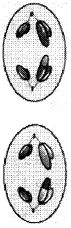
Identify the given figure.
A
Prophase-$II$
B
Metaphase-$I$
C
Telophase-$II$
D
Anaphase-$II$
Solution
(D) The provided figure shows the splitting of centromeres and the movement of sister chromatids towards opposite poles.
In Meiosis-$II$,the centromere of each chromosome splits,and the sister chromatids separate and move towards opposite poles of the cell.
This stage is characteristic of Anaphase-$II$.
Therefore,the correct option is $D$.
In Meiosis-$II$,the centromere of each chromosome splits,and the sister chromatids separate and move towards opposite poles of the cell.
This stage is characteristic of Anaphase-$II$.
Therefore,the correct option is $D$.
0 likes
View Solution333
MediumMCQ
Choose the correct pair.
A
Metaphase-$II$: The centromeres of all chromosomes are arranged on the equatorial plate.
B
Metaphase-$I$: The centromeres of all chromosomes are arranged on one surface.
C
Metaphase: Homologous chromosomes are arranged in two equatorial plates of the cell.
D
Anaphase-$I$: At the end of this phase,the nucleus is seen.
Solution
(A) In $Metaphase-II$,the chromosomes align at the equatorial plate,and the centromeres of all chromosomes are arranged on the equatorial plane of the cell. This is the characteristic feature of $Metaphase-II$ where each chromosome is attached to spindle fibers from opposite poles. Option $A$ correctly describes this alignment. $Metaphase-I$ involves the alignment of homologous pairs,not just centromeres on one surface. $Anaphase-I$ involves the separation of homologous chromosomes,and the nucleus is not reformed until the end of $Telophase$.
0 likes
View Solution334
MediumMCQ
In which phase,pairs of homologous chromosomes become arranged at the equatorial plane of the cell?
A
Metaphase-$II$
B
Metaphase-$I$
C
Anaphase-$II$
D
Anaphase-$I$
Solution
(B) During Meiosis-$I$,the homologous chromosomes pair up to form bivalents or tetrads.
In the Metaphase-$I$ stage,these bivalent pairs of homologous chromosomes align themselves along the equatorial plate (metaphase plate) of the cell.
This alignment is a characteristic feature of Metaphase-$I$,which ensures that homologous chromosomes are separated into different daughter cells during Anaphase-$I$.
In the Metaphase-$I$ stage,these bivalent pairs of homologous chromosomes align themselves along the equatorial plate (metaphase plate) of the cell.
This alignment is a characteristic feature of Metaphase-$I$,which ensures that homologous chromosomes are separated into different daughter cells during Anaphase-$I$.
0 likes
View Solution335
MediumMCQ
$A -$ During the formation of reproductive cells,meiotic cell division occurs.
$R -$ During meiosis,the genetic material is replicated twice and the cell divides twice.
$R -$ During meiosis,the genetic material is replicated twice and the cell divides twice.
A
$A$ and $R$ both are correct
B
$A$ and $R$ both are incorrect
C
$A$ is correct and $R$ is incorrect
D
$A$ is incorrect and $R$ is correct
Solution
(C) Assertion $(A)$ is correct because meiosis is the specialized cell division that reduces the chromosome number by half,resulting in the production of haploid gametes (reproductive cells).
Reason $(R)$ is incorrect because,in meiosis,the genetic material $(DNA)$ is replicated only once during the $S$-phase of interphase,although the cell undergoes two successive nuclear and cytoplasmic divisions (meiosis $I$ and meiosis $II$).
Reason $(R)$ is incorrect because,in meiosis,the genetic material $(DNA)$ is replicated only once during the $S$-phase of interphase,although the cell undergoes two successive nuclear and cytoplasmic divisions (meiosis $I$ and meiosis $II$).
0 likes
View Solution336
MediumMCQ
Choose the correct sentences.
$1.$ Meiosis is an important process for evolution.
$2.$ In meiosis-$II$,the mother cell is haploid.
$3.$ In anaphase-$II$,homologous chromosomes are separated.
$4.$ After meiosis,each daughter cell has the same $DNA$ strands.
$1.$ Meiosis is an important process for evolution.
$2.$ In meiosis-$II$,the mother cell is haploid.
$3.$ In anaphase-$II$,homologous chromosomes are separated.
$4.$ After meiosis,each daughter cell has the same $DNA$ strands.
A
Only $1$
B
$2$ and $4$
C
$1$ and $2$
D
$1$ and $3$
Solution
(C) $1.$ Meiosis introduces genetic variation through crossing over and independent assortment,which is essential for evolution. This statement is correct.
$2.$ Meiosis-$I$ results in two haploid daughter cells. These cells enter meiosis-$II$,so the mother cell for meiosis-$II$ is indeed haploid. This statement is correct.
$3.$ In anaphase-$II$,sister chromatids separate,not homologous chromosomes. Homologous chromosomes separate during anaphase-$I$. This statement is incorrect.
$4.$ After meiosis,each daughter cell is genetically unique due to recombination and independent assortment,so they do not have the same $DNA$ strands. This statement is incorrect.
Therefore,statements $1$ and $2$ are correct.
$2.$ Meiosis-$I$ results in two haploid daughter cells. These cells enter meiosis-$II$,so the mother cell for meiosis-$II$ is indeed haploid. This statement is correct.
$3.$ In anaphase-$II$,sister chromatids separate,not homologous chromosomes. Homologous chromosomes separate during anaphase-$I$. This statement is incorrect.
$4.$ After meiosis,each daughter cell is genetically unique due to recombination and independent assortment,so they do not have the same $DNA$ strands. This statement is incorrect.
Therefore,statements $1$ and $2$ are correct.
0 likes
View Solution337
MediumMCQ
After meiosis-$I$,the two chromatids of a chromosome are:
A
Genetically similar
B
Genetically different
C
Each chromosome has only one chromatid
D
Chromosomes are in pairs only
Solution
(B) During meiosis-$I$,crossing over occurs between non-sister chromatids of homologous chromosomes during the pachytene stage of prophase-$I$.
This process involves the exchange of genetic material between homologous chromosomes.
As a result,the two sister chromatids of each chromosome are no longer identical because they now contain different combinations of alleles.
Therefore,after meiosis-$I$,the two chromatids of a chromosome are genetically different.
This process involves the exchange of genetic material between homologous chromosomes.
As a result,the two sister chromatids of each chromosome are no longer identical because they now contain different combinations of alleles.
Therefore,after meiosis-$I$,the two chromatids of a chromosome are genetically different.
0 likes
View Solution338
MediumMCQ
Choose the correct pair.
| Column-$I$ | Column-$II$ |
| $1$. Leptotene | $p$. Homologous chromosomes are separated |
| $2$. Diakinesis | $q$. Nucleolus reappears |
| $3$. Pachytene | $r$. Chromosomes can be observed in a microscope |
| $4$. Anaphase-$I$ | $s$. Nucleolus disappears |
| $t$. Crossing over |
A
$(1-r), (2-s), (3-t), (4-p)$
B
$(1-t), (2-q), (3-r), (4-s)$
C
$(1-p), (2-r), (3-r), (4-s)$
D
$(1-q), (2-r), (3-s), (4-t)$
Solution
(A) The correct matching is as follows:
$1$. Leptotene: During this stage,chromosomes become gradually visible under a light microscope $(r)$.
$2$. Diakinesis: This is the final stage of meiotic prophase-$I$,where the nucleolus disappears $(s)$.
$3$. Pachytene: This stage is characterized by the occurrence of crossing over between non-sister chromatids of homologous chromosomes $(t)$.
$4$. Anaphase-$I$: In this stage,homologous chromosomes separate,while sister chromatids remain associated at their centromeres $(p)$.
Therefore,the correct matching is $(1-r), (2-s), (3-t), (4-p)$.
$1$. Leptotene: During this stage,chromosomes become gradually visible under a light microscope $(r)$.
$2$. Diakinesis: This is the final stage of meiotic prophase-$I$,where the nucleolus disappears $(s)$.
$3$. Pachytene: This stage is characterized by the occurrence of crossing over between non-sister chromatids of homologous chromosomes $(t)$.
$4$. Anaphase-$I$: In this stage,homologous chromosomes separate,while sister chromatids remain associated at their centromeres $(p)$.
Therefore,the correct matching is $(1-r), (2-s), (3-t), (4-p)$.
0 likes
View Solution339
EasyMCQ
The synaptonemal complex is first seen in ...........
A
Leptotene
B
Pachytene
C
Zygotene
D
Diplotene
Solution
(C) The synaptonemal complex is a protein structure that forms between homologous chromosomes during meiosis.
It begins to form during the $Zygotene$ stage of Prophase-$I$,where homologous chromosomes undergo pairing,a process known as synapsis.
Therefore,the synaptonemal complex is first observed during the $Zygotene$ stage.
It begins to form during the $Zygotene$ stage of Prophase-$I$,where homologous chromosomes undergo pairing,a process known as synapsis.
Therefore,the synaptonemal complex is first observed during the $Zygotene$ stage.
0 likes
View Solution340
MediumMCQ
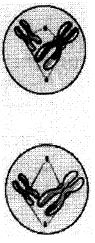
Identify the given figure.
A
Early prophase
B
Telophase
C
Metaphase $-II$
D
Prophase $-II$
Solution
(C) The provided figure shows chromosomes aligned at the equatorial plate of the cell,with spindle fibers attached to the kinetochores of the sister chromatids. This characteristic arrangement is a hallmark of Metaphase $-II$ of meiosis. In Metaphase $-II$,the chromosomes align at the equator,and the microtubules from opposite poles of the spindle get attached to the kinetochores of sister chromatids.
0 likes
View Solution341
MediumMCQ
Choose the correct statements from the following:
$(I)$ Diakinesis is the middle phase of prophase-$I$.
$(II)$ Diakinesis is marked by the terminalization of chiasmata.
$(III)$ Meiotic spindle is not formed during diakinesis.
$(IV)$ By the end of diakinesis,the nucleolus disappears.
$(I)$ Diakinesis is the middle phase of prophase-$I$.
$(II)$ Diakinesis is marked by the terminalization of chiasmata.
$(III)$ Meiotic spindle is not formed during diakinesis.
$(IV)$ By the end of diakinesis,the nucleolus disappears.
A
Only $I$
B
$II$ and $IV$
C
$I, II$ and $III$
D
$I, III$ and $IV$
Solution
(B) Statement $(I)$ is incorrect because diakinesis is the final stage of prophase-$I$,not the middle phase.
Statement $(II)$ is correct; the characteristic feature of diakinesis is the terminalization of chiasmata.
Statement $(III)$ is incorrect because the meiotic spindle is assembled during diakinesis to prepare for the separation of homologous chromosomes.
Statement $(IV)$ is correct; by the end of diakinesis,the nucleolus disappears and the nuclear envelope also breaks down.
Therefore,statements $(II)$ and $(IV)$ are correct.
Statement $(II)$ is correct; the characteristic feature of diakinesis is the terminalization of chiasmata.
Statement $(III)$ is incorrect because the meiotic spindle is assembled during diakinesis to prepare for the separation of homologous chromosomes.
Statement $(IV)$ is correct; by the end of diakinesis,the nucleolus disappears and the nuclear envelope also breaks down.
Therefore,statements $(II)$ and $(IV)$ are correct.
0 likes
View Solution342
MediumMCQ
During which phase is the enzyme recombinase active?
A
The end of the $3^{rd}$ phase of prophase-$I$
B
In the beginning of the $1^{st}$ phase of prophase-$I$
C
The $3^{rd}$ phase of prophase-$I$
D
In the beginning of the $5^{th}$ phase of prophase-$I$
Solution
(C) The enzyme recombinase is involved in the process of crossing over during meiosis-$I$.
Crossing over occurs during the pachytene stage of prophase-$I$.
Prophase-$I$ is divided into five sub-stages: leptotene $(1^{st})$,zygotene $(2^{nd})$,pachytene $(3^{rd})$,diplotene $(4^{th})$,and diakinesis $(5^{th})$.
Therefore,the presence and activity of recombinase are associated with the $3^{rd}$ phase of prophase-$I$,which is the pachytene stage.
Crossing over occurs during the pachytene stage of prophase-$I$.
Prophase-$I$ is divided into five sub-stages: leptotene $(1^{st})$,zygotene $(2^{nd})$,pachytene $(3^{rd})$,diplotene $(4^{th})$,and diakinesis $(5^{th})$.
Therefore,the presence and activity of recombinase are associated with the $3^{rd}$ phase of prophase-$I$,which is the pachytene stage.
0 likes
View Solution343
MediumMCQ
Meiosis-$I$ is a reductional division. Meiosis-$II$ is an equational division because ...........
A
Pairing of homologous chromosomes occurs.
B
Crossing over takes place.
C
Separation of chromatids occurs.
D
Separation of homologous chromosomes occurs.
Solution
(C) Meiosis-$I$ is called a reductional division because the number of chromosomes is reduced to half in the daughter cells.
Meiosis-$II$ is called an equational division because it is similar to mitosis,where the number of chromosomes remains the same in the daughter cells as in the parent cell.
This happens because,during Meiosis-$II$,the sister chromatids of each chromosome separate and move to opposite poles,similar to the separation of chromatids in mitosis.
Meiosis-$II$ is called an equational division because it is similar to mitosis,where the number of chromosomes remains the same in the daughter cells as in the parent cell.
This happens because,during Meiosis-$II$,the sister chromatids of each chromosome separate and move to opposite poles,similar to the separation of chromatids in mitosis.
0 likes
View Solution344
MediumMCQ
What does a dyad represent?
A
Two chromatids and one centromere
B
Two chromatids and two centromeres
C
Four chromatids and two centromeres
D
Four chromatids and four centromeres
Solution
(A) dyad refers to a chromosome that has replicated during the $S$-phase of the cell cycle,consisting of two sister chromatids joined at a single centromere.
During meiosis $I$,these dyads pair up to form bivalents or tetrads.
Therefore,a dyad is composed of two chromatids and one centromere.
During meiosis $I$,these dyads pair up to form bivalents or tetrads.
Therefore,a dyad is composed of two chromatids and one centromere.
0 likes
View Solution345
MediumMCQ
In meiosis,how do the daughter cells differ from the parent cell and from each other?
A
Segregation,independent assortment,and crossing over
B
Segregation and crossing over
C
Independent assortment and crossing over
D
Segregation and independent assortment only
Solution
(A) Meiosis is a specialized type of cell division that reduces the chromosome number by half,resulting in the production of haploid daughter cells.
$1$. Segregation: During $Anaphase-I$,homologous chromosomes separate,ensuring that each daughter cell receives only one allele for each gene.
$2$. Independent Assortment: During $Metaphase-I$,the random alignment of homologous chromosome pairs leads to different combinations of chromosomes in the gametes.
$3$. Crossing Over: During $Prophase-I$,the exchange of genetic material between non-sister chromatids of homologous chromosomes creates new combinations of alleles.
These three processes collectively ensure that the daughter cells are genetically distinct from the parent cell and from each other.
$1$. Segregation: During $Anaphase-I$,homologous chromosomes separate,ensuring that each daughter cell receives only one allele for each gene.
$2$. Independent Assortment: During $Metaphase-I$,the random alignment of homologous chromosome pairs leads to different combinations of chromosomes in the gametes.
$3$. Crossing Over: During $Prophase-I$,the exchange of genetic material between non-sister chromatids of homologous chromosomes creates new combinations of alleles.
These three processes collectively ensure that the daughter cells are genetically distinct from the parent cell and from each other.
0 likes
View Solution346
MediumMCQ
What does Meiosis-$II$ represent?
A
Separation of sex chromosomes
B
Synthesis of $DNA$ and centromeres
C
Separation of homologous chromosomes
D
Separation of chromatids
Solution
(D) Meiosis-$II$ is known as an equational division,similar to mitosis.
During Meiosis-$II$,the sister chromatids of each chromosome separate at the centromere.
This process results in the formation of four haploid daughter cells from the two haploid cells produced in Meiosis-$I$.
Therefore,the primary event in Meiosis-$II$ is the separation of chromatids.
During Meiosis-$II$,the sister chromatids of each chromosome separate at the centromere.
This process results in the formation of four haploid daughter cells from the two haploid cells produced in Meiosis-$I$.
Therefore,the primary event in Meiosis-$II$ is the separation of chromatids.
0 likes
View Solution347
MediumMCQ
Lampbrush chromosomes occur during which of the following stages?
A
Prophase of mitosis
B
Diplotene stage of meiosis
C
Metaphase of meiosis
D
Interphase
Solution
(B) Lampbrush chromosomes are a special type of chromosome found in the growing oocytes (immature eggs) of most animals,except mammals.
They are observed during the $Diplotene$ stage of $Meiosis-I$.
During this stage,the chromosomes are highly extended and exhibit a characteristic 'lampbrush' appearance due to the presence of lateral loops of chromatin,which are sites of active transcription.
They are observed during the $Diplotene$ stage of $Meiosis-I$.
During this stage,the chromosomes are highly extended and exhibit a characteristic 'lampbrush' appearance due to the presence of lateral loops of chromatin,which are sites of active transcription.
0 likes
View Solution348
EasyMCQ
During the first meiotic division, the exchange of genetic material between the chromatids of homologous chromosomes occurs. What is this process called?
A
Transformation
B
Chiasmata
C
Crossing over
D
Synapsis
Solution
(C) During the $Pachytene$ stage of $Prophase-I$ of meiosis, the exchange of genetic material between non-sister chromatids of homologous chromosomes takes place. This process is known as $Crossing$ $over$.
$Synapsis$ refers to the pairing of homologous chromosomes, while $Chiasmata$ are the $X$-shaped structures formed at the sites where crossing over has occurred.
$Synapsis$ refers to the pairing of homologous chromosomes, while $Chiasmata$ are the $X$-shaped structures formed at the sites where crossing over has occurred.
0 likes
View Solution349
MediumMCQ
In higher organisms,crossing over that results in genetic recombination occurs between .......
A
Sister chromatids of a bivalent
B
Non-sister chromatids of a bivalent
C
Two daughter nuclei
D
Two different bivalents
Solution
(B) Crossing over is a biological process that occurs during the $pachytene$ stage of $prophase-I$ of $meiosis$.
It involves the exchange of genetic material between non-sister chromatids of homologous chromosomes.
This process leads to genetic recombination,which is essential for creating genetic diversity in offspring.
Therefore,the correct answer is the non-sister chromatids of a bivalent.
It involves the exchange of genetic material between non-sister chromatids of homologous chromosomes.
This process leads to genetic recombination,which is essential for creating genetic diversity in offspring.
Therefore,the correct answer is the non-sister chromatids of a bivalent.
0 likes
View Solution350
MediumMCQ
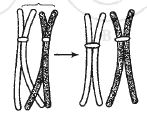
The following image shows certain events occurring during a specific stage of cell division. Which stage is this?
A
Prophase-$I$ of meiosis
B
Prophase-$II$ of meiosis
C
Prophase of mitosis
D
Prophase and Metaphase of mitosis
Solution
(A) The image shows the process of crossing over between non-sister chromatids of homologous chromosomes.
Crossing over is a characteristic feature of the pachytene sub-stage of Prophase-$I$ of meiosis.
During this process,genetic material is exchanged between homologous chromosomes,which leads to genetic recombination.
Therefore,the correct stage is Prophase-$I$ of meiosis.
Crossing over is a characteristic feature of the pachytene sub-stage of Prophase-$I$ of meiosis.
During this process,genetic material is exchanged between homologous chromosomes,which leads to genetic recombination.
Therefore,the correct stage is Prophase-$I$ of meiosis.
0 likes
View SolutionCell Cycle and Cell Division — Meiosis · Frequently Asked Questions
1Are these Cell Cycle and Cell Division questions useful for JEE and NEET?
Yes. All questions in this section are mapped to JEE Main and NEET exam patterns. Previous year questions from JEE Main, NEET, GUJCET and state-level exams are included with full solutions.
2Can I switch to Hindi or Gujarati for these questions?
Yes. Use the language tabs in the hero section or the sidebar to view the same questions and solutions in English, Hindi or Gujarati.
3How do I generate a question paper from this subtopic?
Use the Vedclass Exam Paper Generator — select the chapter and subtopic, set difficulty, and generate Sets A, B, C, D automatically. First 3 chapters of every subject are free.
Vedclass Products
For Students
Vedclass Test Series
Mock tests in real JEE/NEET style with performance analysis. 5-day free trial.
Start Free TrialFor Teachers
Exam Paper Generator
Generate Set A/B/C/D papers from this chapter in 2 minutes. 3 chapters free.
Try FreeFor Institutes
Online Exam Module
Live online exams with unlimited students, 360° analytics & white-label branding.
See DemoFor Teachers & Institutes
Generate a Cell Cycle and Cell Division Exam Paper in 2 Minutes
Select subtopic & difficulty — Sets A, B, C, D auto-generated with No Repeat logic.
First 3 chapters of every subject are free — no payment required.