
A English
Meiosis Questions in English
Class 11 Biology · Cell Cycle and Cell Division · Meiosis
492+
Questions
English
Language
100%
With Solutions
Showing 50 of 492 questions in English
351
MediumMCQ
During gamete formation,the enzyme recombinase participates during:
A
Metaphase-$I$
B
Anaphase-$I$
C
Prophase-$I$
D
Prophase-$II$
Solution
(C) The enzyme recombinase is involved in the process of crossing over during meiosis.
Crossing over is the exchange of genetic material between non-sister chromatids of homologous chromosomes.
This process occurs specifically during the pachytene stage of Prophase-$I$ of meiosis-$I$.
Therefore,the recombinase enzyme participates during Prophase-$I$.
Crossing over is the exchange of genetic material between non-sister chromatids of homologous chromosomes.
This process occurs specifically during the pachytene stage of Prophase-$I$ of meiosis-$I$.
Therefore,the recombinase enzyme participates during Prophase-$I$.
0 likes
View Solution352
MediumMCQ
Meiosis occurs in -
A
Megaspore
B
Meiocyte
C
Microspore
D
Gemmule
Solution
(B) Meiosis is a specialized type of cell division that reduces the chromosome number by half,resulting in the production of haploid daughter cells.
In sexually reproducing organisms,meiosis occurs in specialized diploid cells known as $Meiocytes$.
$Meiocytes$ are the cells that undergo meiosis to produce gametes.
Megaspores and microspores are the products of meiosis,not the sites where it occurs.
Gemmules are asexual reproductive units found in sponges and do not undergo meiosis.
In sexually reproducing organisms,meiosis occurs in specialized diploid cells known as $Meiocytes$.
$Meiocytes$ are the cells that undergo meiosis to produce gametes.
Megaspores and microspores are the products of meiosis,not the sites where it occurs.
Gemmules are asexual reproductive units found in sponges and do not undergo meiosis.
0 likes
View Solution353
EasyMCQ
The structure formed by a pair of synapsed homologous chromosomes is called:
A
Axoneme
B
Equatorial plate
C
Kinetochore
D
Bivalent
Solution
(D) During the $Zygotene$ stage of $Prophase-I$ in $Meiosis$,homologous chromosomes pair up in a process called $Synapsis$.
This pair of synapsed homologous chromosomes is known as a $Bivalent$ or a $Tetrad$.
$Axoneme$ is the core structure of cilia and flagella.
$Equatorial$ $plate$ is the plane where chromosomes align during $Metaphase$.
$Kinetochore$ is the protein structure on chromatids where spindle fibers attach.
This pair of synapsed homologous chromosomes is known as a $Bivalent$ or a $Tetrad$.
$Axoneme$ is the core structure of cilia and flagella.
$Equatorial$ $plate$ is the plane where chromosomes align during $Metaphase$.
$Kinetochore$ is the protein structure on chromatids where spindle fibers attach.
0 likes
View Solution354
EasyMCQ
In which stage of meiosis is the enzyme recombinase required?
A
Pachytene
B
Zygotene
C
Diplotene
D
Diakinesis
Solution
(A) The enzyme $Recombinase$ is essential for the process of crossing over during meiosis.
Crossing over is the exchange of genetic material between non-sister chromatids of homologous chromosomes.
This process occurs specifically during the $Pachytene$ stage of $Prophase-I$ in meiosis.
Therefore,the correct stage is $Pachytene$.
Crossing over is the exchange of genetic material between non-sister chromatids of homologous chromosomes.
This process occurs specifically during the $Pachytene$ stage of $Prophase-I$ in meiosis.
Therefore,the correct stage is $Pachytene$.
0 likes
View Solution355
MediumMCQ
Arrange the following stages of meiosis $I$ in the correct sequence:
$(a)$ Crossing over
$(b)$ Synapsis
$(c)$ Terminalization of chiasmata
$(d)$ Disappearance of nucleolus
$(a)$ Crossing over
$(b)$ Synapsis
$(c)$ Terminalization of chiasmata
$(d)$ Disappearance of nucleolus
A
$(b), (c), (d), (a)$
B
$(b), (a), (d), (c)$
C
$(b), (a), (c), (d)$
D
$(a), (b), (c), (d)$
Solution
(C) The stages of Prophase $I$ of meiosis occur in the following order:
$1$. Synapsis $(b)$: Homologous chromosomes pair up during the Zygotene stage.
$2$. Crossing over $(a)$: Exchange of genetic material between non-sister chromatids occurs during the Pachytene stage.
$3$. Terminalization of chiasmata $(c)$: The chiasmata shift towards the ends of the chromosomes during the Diakinesis stage.
$4$. Disappearance of nucleolus $(d)$: The nucleolus and nuclear envelope disappear during the final phase of Diakinesis.
Therefore,the correct sequence is $(b), (a), (c), (d)$.
$1$. Synapsis $(b)$: Homologous chromosomes pair up during the Zygotene stage.
$2$. Crossing over $(a)$: Exchange of genetic material between non-sister chromatids occurs during the Pachytene stage.
$3$. Terminalization of chiasmata $(c)$: The chiasmata shift towards the ends of the chromosomes during the Diakinesis stage.
$4$. Disappearance of nucleolus $(d)$: The nucleolus and nuclear envelope disappear during the final phase of Diakinesis.
Therefore,the correct sequence is $(b), (a), (c), (d)$.
0 likes
View Solution356
MediumMCQ
The various stages of meiosis are given in Column-$I$. Match them with the characteristics of the various stages of meiosis in Column-$II$ and select the correct option using the codes given below.
| Column-$I$ | Column-$II$ |
| $A$. Pachytene | $i$. Pairing of homologous chromosomes |
| $B$. Metaphase-$I$ | $ii$. Terminalization of chiasmata |
| $C$. Diakinesis | $iii$. Crossing over occurs |
| $D$. Zygotene | $iv$. Alignment at the equatorial plate |
A
$A-ii, B-iv, C-iii, D-i$
B
$A-iv, B-iii, C-i, D-ii$
C
$A-iii, B-iv, C-ii, D-i$
D
$A-i, B-iv, C-ii, D-iii$
Solution
(C) The correct matching is as follows:
$A$. Pachytene: Crossing over occurs $(iii)$.
$B$. Metaphase-$I$: Homologous pairs align at the equatorial plate $(iv)$.
$C$. Diakinesis: Terminalization of chiasmata occurs $(ii)$.
$D$. Zygotene: Pairing of homologous chromosomes (synapsis) occurs $(i)$.
Therefore, the correct sequence is $A-iii, B-iv, C-ii, D-i$.
$A$. Pachytene: Crossing over occurs $(iii)$.
$B$. Metaphase-$I$: Homologous pairs align at the equatorial plate $(iv)$.
$C$. Diakinesis: Terminalization of chiasmata occurs $(ii)$.
$D$. Zygotene: Pairing of homologous chromosomes (synapsis) occurs $(i)$.
Therefore, the correct sequence is $A-iii, B-iv, C-ii, D-i$.
0 likes
View Solution357
EasyMCQ
In which stage of meiosis does crossing over begin?
A
Leptotene
B
Zygotene
C
Diplotene
D
Pachytene
Solution
(D) Meiosis $I$ consists of several stages in Prophase $I$: Leptotene,Zygotene,Pachytene,Diplotene,and Diakinesis.
$1$. Leptotene: Chromosomes become visible.
$2$. Zygotene: Pairing of homologous chromosomes (synapsis) occurs.
$3$. Pachytene: This stage is characterized by the occurrence of crossing over between non-sister chromatids of homologous chromosomes.
$4$. Diplotene: The synaptonemal complex dissolves,and homologous chromosomes begin to separate,revealing chiasmata.
Therefore,the process of crossing over occurs during the Pachytene stage.
$1$. Leptotene: Chromosomes become visible.
$2$. Zygotene: Pairing of homologous chromosomes (synapsis) occurs.
$3$. Pachytene: This stage is characterized by the occurrence of crossing over between non-sister chromatids of homologous chromosomes.
$4$. Diplotene: The synaptonemal complex dissolves,and homologous chromosomes begin to separate,revealing chiasmata.
Therefore,the process of crossing over occurs during the Pachytene stage.
0 likes
View Solution358
EasyMCQ
The stage during which separation of the paired homologous chromosomes begins is
A
Zygotene
B
Diplotene
C
Pachytene
D
Diakinesis
Solution
(B) During the $Meiosis-I$ process,specifically in the $Prophase-I$ stage,homologous chromosomes undergo pairing (synapsis) during the $Zygotene$ phase.
In the subsequent phase,$Pachytene$,crossing over occurs.
In the $Diplotene$ phase,the synaptonemal complex dissolves,and the paired homologous chromosomes begin to separate from each other,except at the sites of crossovers,which are known as $Chiasmata$.
Therefore,the separation of paired homologous chromosomes begins in the $Diplotene$ stage.
In the subsequent phase,$Pachytene$,crossing over occurs.
In the $Diplotene$ phase,the synaptonemal complex dissolves,and the paired homologous chromosomes begin to separate from each other,except at the sites of crossovers,which are known as $Chiasmata$.
Therefore,the separation of paired homologous chromosomes begins in the $Diplotene$ stage.
0 likes
View Solution359
MediumMCQ
During which stages (or prophase $I$ substages) of meiosis do you expect to find the bivalents and $DNA$ replication respectively?
A
Pachytene and interphase (between two meiotic divisions)
B
Pachytene and interphase (just prior to prophase $I$)
C
Pachytene and $S$ phase (of interphase just prior to prophase $I$)
D
Zygotene and $S$ phase (of interphase prior to prophase $I$)
Solution
(D) Bivalents are pairs of homologous chromosomes formed during the $zygotene$ substage of $prophase-I$ of meiosis through a process called synapsis.
$DNA$ replication occurs during the $S$ phase (synthesis phase) of the interphase, which takes place just prior to the onset of meiosis (prophase $I$).
$DNA$ replication occurs during the $S$ phase (synthesis phase) of the interphase, which takes place just prior to the onset of meiosis (prophase $I$).
0 likes
View Solution360
MediumMCQ
Which stage of meiosis involves the separation of the centromere?
A
metaphase $I$
B
metaphase $II$
C
anaphase $I$
D
anaphase $II$
Solution
(D) In meiosis,the process is divided into two stages: meiosis $I$ and meiosis $II$.
During anaphase $I$ of meiosis $I$,homologous chromosomes separate,but the sister chromatids remain attached at their centromeres.
During anaphase $II$ of meiosis $II$,the centromere of each chromosome splits,allowing the sister chromatids to separate and move toward opposite poles of the cell.
Therefore,the separation of the centromere occurs during anaphase $II$.
During anaphase $I$ of meiosis $I$,homologous chromosomes separate,but the sister chromatids remain attached at their centromeres.
During anaphase $II$ of meiosis $II$,the centromere of each chromosome splits,allowing the sister chromatids to separate and move toward opposite poles of the cell.
Therefore,the separation of the centromere occurs during anaphase $II$.
0 likes
View Solution361
DifficultMCQ
Assertion: Meiosis results in the production of haploid cells.
Reason: Synapsis occurs during leptotene.
Reason: Synapsis occurs during leptotene.
A
If both Assertion and Reason are correct and the Reason is a correct explanation of the Assertion.
B
If both Assertion and Reason are correct but the Reason is not a correct explanation of the Assertion.
C
If the Assertion is correct but the Reason is incorrect.
D
If both the Assertion and Reason are incorrect.
Solution
(C) The Assertion is correct because meiosis is a reductional division that reduces the chromosome number by half,resulting in the formation of haploid cells.
The Reason is incorrect because synapsis,which is the pairing of homologous chromosomes,occurs during the $zygotene$ stage of prophase-$I$,not during the $leptotene$ stage. $Leptotene$ is characterized by the compaction of chromosomes.
The Reason is incorrect because synapsis,which is the pairing of homologous chromosomes,occurs during the $zygotene$ stage of prophase-$I$,not during the $leptotene$ stage. $Leptotene$ is characterized by the compaction of chromosomes.
0 likes
View Solution362
MediumMCQ
Assertion : Meiosis $II$ is known as equational or homotypic division.
Reason : Meiosis $II$ produces the same number of chromosomes in the daughter cells as in the parent cell.
Reason : Meiosis $II$ produces the same number of chromosomes in the daughter cells as in the parent cell.
A
If both Assertion and Reason are correct and the Reason is a correct explanation of the Assertion.
B
If both Assertion and Reason are correct but Reason is not a correct explanation of the Assertion.
C
If the Assertion is correct but Reason is incorrect.
D
If both the Assertion and Reason are incorrect.
Solution
(A) Meiosis $II$ is known as equational or homotypic division because it resembles mitosis.
In this process,the sister chromatids separate,and the number of chromosomes in the resulting daughter cells remains the same as that in the parent cell that entered meiosis $II$.
Therefore,both the Assertion and the Reason are correct,and the Reason correctly explains why it is called an equational division.
In this process,the sister chromatids separate,and the number of chromosomes in the resulting daughter cells remains the same as that in the parent cell that entered meiosis $II$.
Therefore,both the Assertion and the Reason are correct,and the Reason correctly explains why it is called an equational division.
0 likes
View Solution363
MediumMCQ
Assertion : During zygotene,chromosomes show bivalent stage.
Reason : Bivalent is half the number of chromosomes.
Reason : Bivalent is half the number of chromosomes.
A
If both Assertion and Reason are correct and the Reason is a correct explanation of the Assertion.
B
If both Assertion and Reason are correct but Reason is not a correct explanation of the Assertion.
C
If the Assertion is correct but Reason is incorrect.
D
If both the Assertion and Reason are incorrect.
Solution
(A) During the zygotene stage of Prophase-$I$ of meiosis,homologous chromosomes undergo pairing,a process known as synapsis.
Each pair of homologous chromosomes is referred to as a bivalent or a tetrad.
Because the homologous chromosomes pair up,the number of observable units (bivalents) is half the original diploid number of chromosomes $(2n)$.
Therefore,the Assertion is correct as chromosomes appear as bivalents,and the Reason is also correct as it accurately describes the numerical reduction of observable chromosomal units during this stage.
Each pair of homologous chromosomes is referred to as a bivalent or a tetrad.
Because the homologous chromosomes pair up,the number of observable units (bivalents) is half the original diploid number of chromosomes $(2n)$.
Therefore,the Assertion is correct as chromosomes appear as bivalents,and the Reason is also correct as it accurately describes the numerical reduction of observable chromosomal units during this stage.
0 likes
View Solution364
MediumMCQ
Assertion : The stage between two mitotic divisions is called interkinesis.
Reason : Interkinesis is generally short lived.
Reason : Interkinesis is generally short lived.
A
If both Assertion and Reason are correct and the Reason is a correct explanation of the Assertion.
B
If both Assertion and Reason are correct but Reason is not a correct explanation of the Assertion.
C
If the Assertion is correct but Reason is incorrect.
D
If both the Assertion and Reason are incorrect.
Solution
(D) Interkinesis is the stage between two meiotic divisions (meiosis $I$ and meiosis $II$),not between two mitotic divisions. Therefore,the Assertion is incorrect.
Interkinesis is indeed a short-lived stage where no $DNA$ replication occurs. Thus,the Reason is correct.
Since the Assertion is incorrect and the Reason is correct,the correct option is $D$.
Interkinesis is indeed a short-lived stage where no $DNA$ replication occurs. Thus,the Reason is correct.
Since the Assertion is incorrect and the Reason is correct,the correct option is $D$.
0 likes
View Solution365
EasyMCQ
Assertion : Diplotene is characterized by the presence of chiasmata.
Reason : Diplotene can last for months and years in oocytes of some vertebrates.
Reason : Diplotene can last for months and years in oocytes of some vertebrates.
A
If both Assertion and Reason are correct and the Reason is a correct explanation of the Assertion.
B
If both Assertion and Reason are correct but Reason is not a correct explanation of the Assertion.
C
If the Assertion is correct but Reason is incorrect.
D
If both the Assertion and Reason are incorrect.
Solution
(B) Diplotene is the longest and most active subphase of prophase $I$ of meiosis.
The beginning of diplotene is recognized by the dissolution of the synaptonemal complex and the tendency of the recombined homologous chromosomes of the bivalents to separate from each other except at the sites of crossovers.
These $X$-shaped structures are called chiasmata.
Additionally,in the oocytes of some vertebrates,the diplotene stage can remain suspended for months or even years,a state known as dictyotene.
Since both statements are factually correct but the duration of the stage does not explain why chiasmata are present,the correct option is $B$.
The beginning of diplotene is recognized by the dissolution of the synaptonemal complex and the tendency of the recombined homologous chromosomes of the bivalents to separate from each other except at the sites of crossovers.
These $X$-shaped structures are called chiasmata.
Additionally,in the oocytes of some vertebrates,the diplotene stage can remain suspended for months or even years,a state known as dictyotene.
Since both statements are factually correct but the duration of the stage does not explain why chiasmata are present,the correct option is $B$.
0 likes
View Solution366
EasyMCQ
After meiosis $I$,the resultant daughter cells have
A
Same amount of $DNA$ as in the parent cell in $S$ phase
B
Twice the amount of $DNA$ in comparison to haploid gamete
C
Same amount of $DNA$ in comparison to haploid gamete
D
Four times the amount of $DNA$ in comparison to haploid gamete
Solution
(B) In meiosis $I$,the homologous chromosomes separate,but the sister chromatids remain attached at the centromere.
Starting with a diploid cell $(2n)$ with $4C$ amount of $DNA$ (after $S$ phase),meiosis $I$ results in two daughter cells.
Each daughter cell receives one set of chromosomes,but each chromosome still consists of two sister chromatids.
Therefore,each daughter cell has $n$ chromosomes and $2C$ amount of $DNA$.
$A$ haploid gamete (formed after meiosis $II$) has $n$ chromosomes and $1C$ amount of $DNA$.
Thus,the daughter cells after meiosis $I$ have twice the amount of $DNA$ $(2C)$ compared to a haploid gamete $(1C)$.
Starting with a diploid cell $(2n)$ with $4C$ amount of $DNA$ (after $S$ phase),meiosis $I$ results in two daughter cells.
Each daughter cell receives one set of chromosomes,but each chromosome still consists of two sister chromatids.
Therefore,each daughter cell has $n$ chromosomes and $2C$ amount of $DNA$.
$A$ haploid gamete (formed after meiosis $II$) has $n$ chromosomes and $1C$ amount of $DNA$.
Thus,the daughter cells after meiosis $I$ have twice the amount of $DNA$ $(2C)$ compared to a haploid gamete $(1C)$.
0 likes
View Solution367
DifficultMCQ
Crossing over takes place between which chromatids and in which stage of the cell cycle?
A
Non-sister chromatids of non-homologous chromosomes at Zygotene stage of prophase $I$.
B
Non-sister chromatids of homologous chromosomes at Pachytene stage of prophase $I$.
C
Non-sister chromatids of homologous chromosomes at Zygotene stage of prophase $I$.
D
Non-sister chromatids of non-homologous chromosomes at Pachytene stage of prophase $I$.
Solution
(B) Crossing over is the exchange of genetic material between non-sister chromatids of homologous chromosomes.
This process occurs during the Pachytene stage of Prophase $I$ of meiosis.
During this stage,the bivalent chromosomes or tetrads become clearly visible,and the recombination nodules appear at the sites where crossing over occurs.
This process occurs during the Pachytene stage of Prophase $I$ of meiosis.
During this stage,the bivalent chromosomes or tetrads become clearly visible,and the recombination nodules appear at the sites where crossing over occurs.
0 likes
View Solution368
Difficult
Describe the following:
$(a)$ Synapsis
$(b)$ Bivalent
$(c)$ Chiasmata
Draw a diagram to illustrate your answer.
$(a)$ Synapsis
$(b)$ Bivalent
$(c)$ Chiasmata
Draw a diagram to illustrate your answer.
Solution
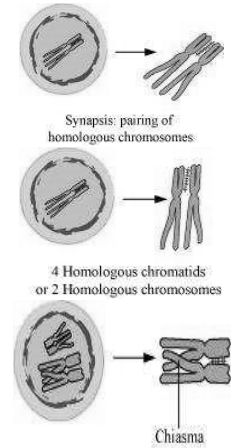
(N/A) Synapsis: The pairing of homologous chromosomes is called synapsis. This process occurs during the zygotene stage of prophase $I$ of meiosis.
$(b)$ Bivalent: $A$ bivalent or tetrad is a pair of synapsed homologous chromosomes. They are formed during the zygotene stage of prophase $I$ of meiosis.
$(c)$ Chiasmata: Chiasmata are the $X$-shaped sites where non-sister chromatids of homologous chromosomes have exchanged genetic material (crossed over). They become visible during the diplotene stage of prophase $I$ of meiosis.
$(b)$ Bivalent: $A$ bivalent or tetrad is a pair of synapsed homologous chromosomes. They are formed during the zygotene stage of prophase $I$ of meiosis.
$(c)$ Chiasmata: Chiasmata are the $X$-shaped sites where non-sister chromatids of homologous chromosomes have exchanged genetic material (crossed over). They become visible during the diplotene stage of prophase $I$ of meiosis.
0 likes
View Solution369
Medium
What is Meiosis? Give the key features of it and explain them.
Solution
(N/A) $\Rightarrow$ The production of offspring by sexual reproduction includes the fusion of two gametes,each with a complete haploid set of chromosomes. Gametes are formed from specialised diploid cells.
$\Rightarrow$ This specialised kind of cell division that reduces the chromosome number by half results in the production of haploid daughter cells; this kind of division is called Meiosis.
$\Rightarrow$ Meiosis ensures the production of a haploid phase in the life cycle of sexually reproducing organisms,whereas fertilisation restores the diploid phase.
$\Rightarrow$ In plants and animals,meiosis during gametogenesis leads to the formation of haploid gametes.
$\Rightarrow$ The key features of meiosis are as follows:
$\Rightarrow$ Meiosis involves two sequential cycles of nuclear and cell division called Meiosis $I$ and Meiosis $II$,but only a single cycle of $DNA$ replication.
$\Rightarrow$ Meiosis $I$ is initiated after the parental chromosomes have replicated to produce identical sister chromatids at the $S$ phase.
$\Rightarrow$ Meiosis involves the pairing of homologous chromosomes and recombination between them.
$\Rightarrow$ Four haploid cells are formed at the end of Meiosis $II$.
$\Rightarrow$ Meiotic events can be grouped under the following phases:
$\Rightarrow$ This specialised kind of cell division that reduces the chromosome number by half results in the production of haploid daughter cells; this kind of division is called Meiosis.
$\Rightarrow$ Meiosis ensures the production of a haploid phase in the life cycle of sexually reproducing organisms,whereas fertilisation restores the diploid phase.
$\Rightarrow$ In plants and animals,meiosis during gametogenesis leads to the formation of haploid gametes.
$\Rightarrow$ The key features of meiosis are as follows:
$\Rightarrow$ Meiosis involves two sequential cycles of nuclear and cell division called Meiosis $I$ and Meiosis $II$,but only a single cycle of $DNA$ replication.
$\Rightarrow$ Meiosis $I$ is initiated after the parental chromosomes have replicated to produce identical sister chromatids at the $S$ phase.
$\Rightarrow$ Meiosis involves the pairing of homologous chromosomes and recombination between them.
$\Rightarrow$ Four haploid cells are formed at the end of Meiosis $II$.
$\Rightarrow$ Meiotic events can be grouped under the following phases:
| Meiosis $I$ | Meiosis $II$ |
| Prophase $I$ | Prophase $II$ |
| Metaphase $I$ | Metaphase $II$ |
| Anaphase $I$ | Anaphase $II$ |
| Telophase $I$ | Telophase $II$ |
0 likes
View Solution370
Medium
Describe various subphases of prophase - $I$ of Meiosis - $I$.
Solution
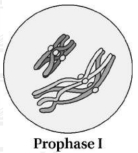
(N/A) $ \Rightarrow $ Prophase - $I$ of Meiosis - $I$: It is longer and more complex. It has been subdivided into five subphases based on chromosomal behavior.
$(i)$ Leptotene: This is the first phase of meiosis. During this phase,the chromosomes become gradually visible. The compaction of chromosomes continues throughout Leptotene.
$ \Rightarrow $ Each chromosome is made up of two chromatids and a centromere attached to them. However,the chromatids are tangled with each other,so their dual form is not clearly seen.
$(ii)$ Zygotene: During this stage,chromosomes start pairing together,and this process of association is called synapsis. Such paired chromosomes are called homologous chromosomes.
$ \Rightarrow $ This process proceeds further like a zipper. The complex formed by a pair of synapsed homologous chromosomes is called a bivalent or a tetrad.
$(iii)$ Pachytene: During this stage,bivalent chromosomes clearly appear as tetrads. The non-sister chromatids of the homologous chromosomes are entangled with each other.
$ \Rightarrow $ This stage is characterized by the appearance of recombination nodules.
$ \Rightarrow $ Crossing over occurs between non-sister chromatids of the homologous chromosomes.
$ \Rightarrow $ Crossing over is the exchange of genetic material between two homologous chromosomes,which is an enzyme-mediated process involving the enzyme recombinase.
$ \Rightarrow $ Crossing over leads to the recombination of genetic material on the two chromosomes,forming new combinations.
$(iv)$ Diplotene: The beginning of diplotene is recognized by the dissolution of the synaptonemal complex and the tendency of the recombined homologous chromosomes of the bivalents to separate from each other,except at the sites of crossing over.
$ \Rightarrow $ These $X$-shaped structures are called chiasmata.
$ \Rightarrow $ The number of chiasmata depends on the length of the chromosomes.
$(v)$ Diakinesis: This is the final stage of meiotic prophase - $I$. The chiasmata terminate. The nucleolus disappears and the nuclear envelope breaks down. The chromosomes are fully condensed and the meiotic spindle is assembled to prepare the homologous chromosomes for separation.
$(i)$ Leptotene: This is the first phase of meiosis. During this phase,the chromosomes become gradually visible. The compaction of chromosomes continues throughout Leptotene.
$ \Rightarrow $ Each chromosome is made up of two chromatids and a centromere attached to them. However,the chromatids are tangled with each other,so their dual form is not clearly seen.
$(ii)$ Zygotene: During this stage,chromosomes start pairing together,and this process of association is called synapsis. Such paired chromosomes are called homologous chromosomes.
$ \Rightarrow $ This process proceeds further like a zipper. The complex formed by a pair of synapsed homologous chromosomes is called a bivalent or a tetrad.
$(iii)$ Pachytene: During this stage,bivalent chromosomes clearly appear as tetrads. The non-sister chromatids of the homologous chromosomes are entangled with each other.
$ \Rightarrow $ This stage is characterized by the appearance of recombination nodules.
$ \Rightarrow $ Crossing over occurs between non-sister chromatids of the homologous chromosomes.
$ \Rightarrow $ Crossing over is the exchange of genetic material between two homologous chromosomes,which is an enzyme-mediated process involving the enzyme recombinase.
$ \Rightarrow $ Crossing over leads to the recombination of genetic material on the two chromosomes,forming new combinations.
$(iv)$ Diplotene: The beginning of diplotene is recognized by the dissolution of the synaptonemal complex and the tendency of the recombined homologous chromosomes of the bivalents to separate from each other,except at the sites of crossing over.
$ \Rightarrow $ These $X$-shaped structures are called chiasmata.
$ \Rightarrow $ The number of chiasmata depends on the length of the chromosomes.
$(v)$ Diakinesis: This is the final stage of meiotic prophase - $I$. The chiasmata terminate. The nucleolus disappears and the nuclear envelope breaks down. The chromosomes are fully condensed and the meiotic spindle is assembled to prepare the homologous chromosomes for separation.
0 likes
View Solution371
Medium
Describe Metaphase-$I$,Anaphase-$I$,and Telophase-$I$ of Meiosis-$I$.
Solution
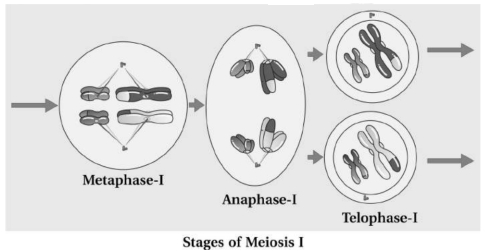
(N/A) Metaphase-$I$: The bivalent chromosomes align on the equatorial plate. The microtubules from the opposite poles of the spindle attach to the pair of homologous chromosomes.
Anaphase-$I$: The homologous chromosomes separate,while sister chromatids remain associated at their centromeres.
Telophase-$I$: The nuclear membrane and nucleolus reappear. Cytokinesis follows,and this is called a dyad of cells.
The stage between the two meiotic divisions is called interkinesis and is generally short-lived.
Anaphase-$I$: The homologous chromosomes separate,while sister chromatids remain associated at their centromeres.
Telophase-$I$: The nuclear membrane and nucleolus reappear. Cytokinesis follows,and this is called a dyad of cells.
The stage between the two meiotic divisions is called interkinesis and is generally short-lived.
0 likes
View Solution372
Medium
Describe the changes and various phases seen during Meiosis-$II$ with a diagram.
Solution
(N/A) Meiosis-$II$ takes place in four sub-phases.
$\Rightarrow$ Meiosis-$II$ resembles a normal mitosis. The behavior of chromosomes is maintained in its sub-phases/stages:
$\Rightarrow$ $(i)$ Prophase-$II$,$(ii)$ Metaphase-$II$,$(iii)$ Anaphase-$II$,and $(iv)$ Telophase-$II$ are seen.
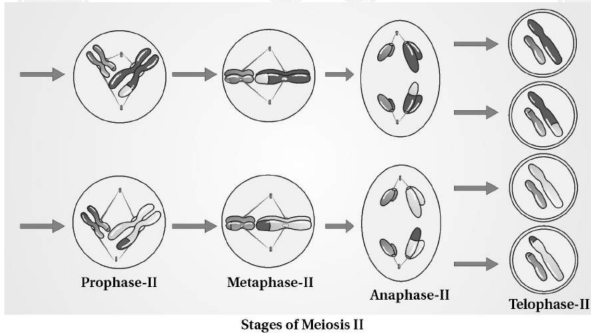
$(i)$ Prophase-$II$: Meiosis-$II$ is initiated immediately after cytokinesis. The nuclear membrane disappears by the end of Prophase-$II$. The chromosomes again become compact.
$(ii)$ Metaphase-$II$: The chromosomes align at the equator,and microtubules from opposite poles of the spindle get attached to the kinetochores of sister chromatids.
$(iii)$ Anaphase-$II$: It begins with the simultaneous splitting of the centromere of each chromosome (which was holding the sister chromatids together),allowing them to move toward the opposite poles of the cell.
$(iv)$ Telophase-$II$: Meiosis ends with Telophase-$II$,in which the two groups of chromosomes once again get enclosed by a nuclear envelope.
$\Rightarrow$ Cytokinesis follows,resulting in the formation of a tetrad of cells,i.e.,four haploid daughter cells.
$\Rightarrow$ Meiosis-$II$ resembles a normal mitosis. The behavior of chromosomes is maintained in its sub-phases/stages:
$\Rightarrow$ $(i)$ Prophase-$II$,$(ii)$ Metaphase-$II$,$(iii)$ Anaphase-$II$,and $(iv)$ Telophase-$II$ are seen.
$(i)$ Prophase-$II$: Meiosis-$II$ is initiated immediately after cytokinesis. The nuclear membrane disappears by the end of Prophase-$II$. The chromosomes again become compact.
$(ii)$ Metaphase-$II$: The chromosomes align at the equator,and microtubules from opposite poles of the spindle get attached to the kinetochores of sister chromatids.
$(iii)$ Anaphase-$II$: It begins with the simultaneous splitting of the centromere of each chromosome (which was holding the sister chromatids together),allowing them to move toward the opposite poles of the cell.
$(iv)$ Telophase-$II$: Meiosis ends with Telophase-$II$,in which the two groups of chromosomes once again get enclosed by a nuclear envelope.
$\Rightarrow$ Cytokinesis follows,resulting in the formation of a tetrad of cells,i.e.,four haploid daughter cells.
0 likes
View Solution373
MediumMCQ
What is meiosis?
A
$A$ process of cell division resulting in two identical daughter cells.
B
$A$ specialized type of cell division that reduces the chromosome number by half.
C
$A$ process of cell growth and $DNA$ replication.
D
$A$ process of asexual reproduction in prokaryotes.
Solution
(B) Meiosis is a specialized type of cell division that reduces the chromosome number by half,resulting in the production of haploid daughter cells.
In sexual reproduction,the fusion of two gametes occurs,each containing a complete haploid set of chromosomes.
These gametes are formed from specialized diploid cells through the process of meiosis,ensuring that the chromosome number remains constant across generations.
In sexual reproduction,the fusion of two gametes occurs,each containing a complete haploid set of chromosomes.
These gametes are formed from specialized diploid cells through the process of meiosis,ensuring that the chromosome number remains constant across generations.
0 likes
View Solution374
Medium
List the phases of meiosis.
Solution
(N/A) Meiosis is divided into two main stages: Meiosis-$I$ and Meiosis-$II$. Each stage consists of specific phases as follows:
| Meiosis-$I$ | Meiosis-$II$ |
|---|---|
| Prophase-$I$ | Prophase-$II$ |
| Metaphase-$I$ | Metaphase-$II$ |
| Anaphase-$I$ | Anaphase-$II$ |
| Telophase-$I$ | Telophase-$II$ |
0 likes
View Solution375
Medium
Differentiate between Metaphase-$I$ of Meiosis and Metaphase-$II$ of Meiosis.
Solution
(N/A)
| Metaphase-$I$ of Meiosis | Metaphase-$II$ of Meiosis |
|---|---|
| $(i)$ The centromere does not divide. | $(i)$ The centromere divides. |
| $(ii)$ Homologous chromosome pairs are aligned at the equatorial plate. | $(ii)$ Individual chromosomes are aligned at the equatorial plate. |
| $(iii)$ Each chromosome of the homologous pair is attached to spindle fibers from opposite poles. | $(iii)$ The sister chromatids of each chromosome are attached to spindle fibers from opposite poles. |
| $(iv)$ Homologous chromosomes separate during Anaphase-$I$. | $(iv)$ Sister chromatids separate during Anaphase-$II$. |
0 likes
View Solution376
Medium
Can you recall meiosis and indicate at what stage a recombinant $DNA$ is made?
Solution
(N/A) Meiosis $I$ occurs in stages. Recombinant $DNA$ is formed during the $Pachytene$ sub-stage of $Prophase$ $I$.
This occurs when recombination nodules appear after the formation of the synaptonemal complex,facilitating the exchange of genetic material between non-sister chromatids of homologous chromosomes.
This occurs when recombination nodules appear after the formation of the synaptonemal complex,facilitating the exchange of genetic material between non-sister chromatids of homologous chromosomes.
0 likes
View Solution377
Medium
What are the various stages of meiotic prophase-$I$? Enumerate the chromosomal events during each stage.
Solution
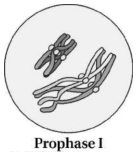
(N/A) $(i)$ Leptotene: This is the first phase of meiosis. During this phase,chromosomes become gradually visible. The compaction of chromosomes continues throughout Leptotene.
$\Rightarrow$ Each chromosome consists of two chromatids attached to a centromere,but they are tangled,so their dual nature is not clearly visible.
$(ii)$ Zygotene: During this stage,homologous chromosomes start pairing together,a process called synapsis. The complex formed by a pair of synapsed homologous chromosomes is called a bivalent or a tetrad.
$(iii)$ Pachytene: During this stage,bivalent chromosomes clearly appear as tetrads. This stage is characterized by the appearance of recombination nodules.
$\Rightarrow$ Crossing over occurs between non-sister chromatids of homologous chromosomes,which is an enzyme-mediated process involving the enzyme recombinase.
$\Rightarrow$ Crossing over leads to the recombination of genetic material between the two chromosomes.
$(iv)$ Diplotene: The beginning of diplotene is recognized by the dissolution of the synaptonemal complex and the tendency of the recombined homologous chromosomes of the bivalents to separate from each other,except at the sites of crossing over.
$\Rightarrow$ These $X$-shaped structures are called chiasmata.
$(v)$ Diakinesis: This is the final stage of meiotic prophase-$I$. The chiasmata terminate,and the chromosomes are fully condensed. The nucleolus disappears,and the nuclear envelope breaks down.
$\Rightarrow$ Each chromosome consists of two chromatids attached to a centromere,but they are tangled,so their dual nature is not clearly visible.
$(ii)$ Zygotene: During this stage,homologous chromosomes start pairing together,a process called synapsis. The complex formed by a pair of synapsed homologous chromosomes is called a bivalent or a tetrad.
$(iii)$ Pachytene: During this stage,bivalent chromosomes clearly appear as tetrads. This stage is characterized by the appearance of recombination nodules.
$\Rightarrow$ Crossing over occurs between non-sister chromatids of homologous chromosomes,which is an enzyme-mediated process involving the enzyme recombinase.
$\Rightarrow$ Crossing over leads to the recombination of genetic material between the two chromosomes.
$(iv)$ Diplotene: The beginning of diplotene is recognized by the dissolution of the synaptonemal complex and the tendency of the recombined homologous chromosomes of the bivalents to separate from each other,except at the sites of crossing over.
$\Rightarrow$ These $X$-shaped structures are called chiasmata.
$(v)$ Diakinesis: This is the final stage of meiotic prophase-$I$. The chiasmata terminate,and the chromosomes are fully condensed. The nucleolus disappears,and the nuclear envelope breaks down.
0 likes
View Solution378
Medium
Write a brief note on the following:
$(a)$ Synaptonemal complex
$(b)$ Metaphase plate
$(a)$ Synaptonemal complex
$(b)$ Metaphase plate
Solution
(N/A) Synaptonemal complex: During the prophase-$I$ of meiosis,a zipper-like proteinaceous structure forms between homologous chromosomes. This is called the synaptonemal complex. It facilitates the pairing (synapsis) of homologous chromosomes and is essential for the process of crossing over,which involves the exchange of genetic material between non-sister chromatids.
$(b)$ Metaphase plate: During metaphase,the chromosomes align themselves at the equatorial plane of the cell. This imaginary plane of alignment is known as the metaphase plate. The centromeres of the chromosomes are positioned on this plate,and the spindle fibers from opposite poles of the cell attach to the kinetochores of the chromosomes to facilitate their future separation.
$(b)$ Metaphase plate: During metaphase,the chromosomes align themselves at the equatorial plane of the cell. This imaginary plane of alignment is known as the metaphase plate. The centromeres of the chromosomes are positioned on this plate,and the spindle fibers from opposite poles of the cell attach to the kinetochores of the chromosomes to facilitate their future separation.
0 likes
View Solution379
Difficult
An organism has two pairs of chromosomes (i.e.,chromosome number $= 4$). Diagrammatically represent the chromosomal arrangement during different phases of meiosis-$II$.
Solution
(N/A) $\Rightarrow$ Meiosis-$II$ is an equational division similar to mitosis,where the number of chromosomes remains the same as in the parent cell of this phase (haploid,$n=2$).
$\Rightarrow$ Prophase-$II$: The nuclear membrane disappears,and chromosomes become compact. Each chromosome consists of two sister chromatids attached at the centromere.
$\Rightarrow$ Metaphase-$II$: The chromosomes align at the equatorial plate. Microtubules from opposite poles of the spindle get attached to the kinetochores of sister chromatids.
$\Rightarrow$ Anaphase-$II$: The centromere of each chromosome splits,allowing the sister chromatids to move toward opposite poles. These are now referred to as individual chromosomes.
$\Rightarrow$ Telophase-$II$: The chromosomes arrive at the poles,and the nuclear envelope reforms around each set of chromosomes,resulting in four haploid daughter cells.
$\Rightarrow$ Prophase-$II$: The nuclear membrane disappears,and chromosomes become compact. Each chromosome consists of two sister chromatids attached at the centromere.
$\Rightarrow$ Metaphase-$II$: The chromosomes align at the equatorial plate. Microtubules from opposite poles of the spindle get attached to the kinetochores of sister chromatids.
$\Rightarrow$ Anaphase-$II$: The centromere of each chromosome splits,allowing the sister chromatids to move toward opposite poles. These are now referred to as individual chromosomes.
$\Rightarrow$ Telophase-$II$: The chromosomes arrive at the poles,and the nuclear envelope reforms around each set of chromosomes,resulting in four haploid daughter cells.
0 likes
View Solution380
MediumMCQ
Choose the correct option:
$(1)$ Meiosis occurs in human germ cells / zygotes.
$(2)$ The process of pairing of homologous chromosomes is called synapsis / desynapsis.
$(1)$ Meiosis occurs in human germ cells / zygotes.
$(2)$ The process of pairing of homologous chromosomes is called synapsis / desynapsis.
A
$(1)$ Germ cells,$(2)$ Synapsis
B
$(1)$ Zygotes,$(2)$ Synapsis
C
$(1)$ Germ cells,$(2)$ Desynapsis
D
$(1)$ Zygotes,$(2)$ Desynapsis
Solution
(A) $(1)$ Meiosis is a reductional division that occurs in germ cells to produce haploid gametes. Zygotes undergo mitosis for development.
$(2)$ Synapsis is the pairing of two homologous chromosomes that occurs during the prophase $I$ stage of meiosis.
$(2)$ Synapsis is the pairing of two homologous chromosomes that occurs during the prophase $I$ stage of meiosis.
0 likes
View Solution381
EasyMCQ
Which tissue of animals and plants exhibits meiosis?
A
Somatic tissue
B
Reproductive tissue
C
Meristematic tissue
D
Connective tissue
Solution
(B) Meiosis is a specialized type of cell division that reduces the chromosome number by half,resulting in the production of haploid gametes.
In animals,meiosis occurs in the germ cells located within the gonads (testes and ovaries) to produce sperm and eggs.
In plants,meiosis occurs in the reproductive tissues (specifically in the microspore mother cells and megaspore mother cells) to produce haploid spores,which eventually develop into gametophytes.
Therefore,reproductive tissues are the sites where meiosis takes place.
In animals,meiosis occurs in the germ cells located within the gonads (testes and ovaries) to produce sperm and eggs.
In plants,meiosis occurs in the reproductive tissues (specifically in the microspore mother cells and megaspore mother cells) to produce haploid spores,which eventually develop into gametophytes.
Therefore,reproductive tissues are the sites where meiosis takes place.
0 likes
View Solution382
MediumMCQ
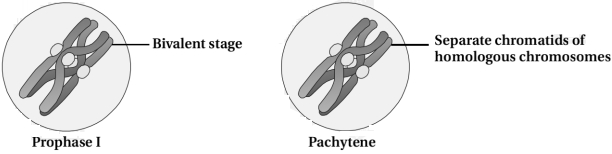
The diagram shows a bivalent at prophase-$I$ of meiosis. Which of the four chromatids can cross over?
A
Sister chromatids
B
Non-sister chromatids
C
All four chromatids
D
Only two chromatids of the same chromosome
Solution
(B) Crossing over is the exchange of genetic material between non-sister chromatids of homologous chromosomes.
It occurs during the pachytene stage of prophase-$I$ of meiosis.
Therefore,the non-sister chromatids are the ones that participate in the process of crossing over.
It occurs during the pachytene stage of prophase-$I$ of meiosis.
Therefore,the non-sister chromatids are the ones that participate in the process of crossing over.
0 likes
View Solution383
Medium
In which phase of meiosis are the following formed? Choose the answers from the hint points given below.
$(a)$ Synaptonemal complex
$(b)$ Recombination nodules
$(c)$ Appearance / activation of enzyme recombinase
$(d)$ Termination of chiasmata
$(e)$ Interkinesis
$(f)$ Formation of dyad of cells
$(a)$ Synaptonemal complex
$(b)$ Recombination nodules
$(c)$ Appearance / activation of enzyme recombinase
$(d)$ Termination of chiasmata
$(e)$ Interkinesis
$(f)$ Formation of dyad of cells
Solution
(A) Synaptonemal complex: Formed during the Zygotene stage of Prophase-$I$.
$(b)$ Recombination nodules: Appear during the Pachytene stage of Prophase-$I$.
$(c)$ Appearance / activation of enzyme recombinase: Occurs during the Pachytene stage of Prophase-$I$.
$(d)$ Termination of chiasmata: Occurs during the Diakinesis stage of Prophase-$I$.
$(e)$ Interkinesis: The stage between Meiosis-$I$ and Meiosis-$II$.
$(f)$ Formation of dyad of cells: Occurs at the end of Telophase-$I$.
$(b)$ Recombination nodules: Appear during the Pachytene stage of Prophase-$I$.
$(c)$ Appearance / activation of enzyme recombinase: Occurs during the Pachytene stage of Prophase-$I$.
$(d)$ Termination of chiasmata: Occurs during the Diakinesis stage of Prophase-$I$.
$(e)$ Interkinesis: The stage between Meiosis-$I$ and Meiosis-$II$.
$(f)$ Formation of dyad of cells: Occurs at the end of Telophase-$I$.
0 likes
View Solution384
EasyMCQ
Match the following stages of meiosis with their characteristic events:
$(a)$ Zygotene $(i)$ Terminalization
$(b)$ Pachytene $(ii)$ Chiasmata
$(c)$ Diplotene $(iii)$ Crossing over
$(d)$ Diakinesis $(iv)$ Synapsis
Select the correct option from the following:
$(a)$ Zygotene $(i)$ Terminalization
$(b)$ Pachytene $(ii)$ Chiasmata
$(c)$ Diplotene $(iii)$ Crossing over
$(d)$ Diakinesis $(iv)$ Synapsis
Select the correct option from the following:
A
$(ii), (iv), (iii), (i)$
B
$(iii), (iv), (i), (ii)$
C
$(iv), (iii), (ii), (i)$
D
$(i), (ii), (iv), (iii)$
Solution
(C) The correct matching is as follows:
$(a)$ Zygotene: Synapsis occurs,where homologous chromosomes pair up $(iv)$.
$(b)$ Pachytene: Crossing over occurs between non-sister chromatids of homologous chromosomes $(iii)$.
$(c)$ Diplotene: The dissolution of the synaptonemal complex occurs,and chiasmata become visible $(ii)$.
$(d)$ Diakinesis: The final stage of prophase-$I$ where terminalization of chiasmata occurs $(i)$.
Therefore,the correct sequence is $(a)-(iv), (b)-(iii), (c)-(ii), (d)-(i)$.
$(a)$ Zygotene: Synapsis occurs,where homologous chromosomes pair up $(iv)$.
$(b)$ Pachytene: Crossing over occurs between non-sister chromatids of homologous chromosomes $(iii)$.
$(c)$ Diplotene: The dissolution of the synaptonemal complex occurs,and chiasmata become visible $(ii)$.
$(d)$ Diakinesis: The final stage of prophase-$I$ where terminalization of chiasmata occurs $(i)$.
Therefore,the correct sequence is $(a)-(iv), (b)-(iii), (c)-(ii), (d)-(i)$.
0 likes
View Solution385
EasyMCQ
Dissolution of the synaptonemal complex occurs during
A
Leptotene
B
Pachytene
C
Zygotene
D
Diplotene
Solution
(D) The synaptonemal complex is a protein structure that forms between homologous chromosomes during meiosis $I$.
$1$. During $Zygotene$,the synaptonemal complex forms,facilitating the pairing of homologous chromosomes (synapsis).
$2$. During $Pachytene$,crossing over occurs between non-sister chromatids.
$3$. During $Diplotene$,the synaptonemal complex dissolves,and the homologous chromosomes begin to separate from each other except at the sites of crossovers,known as chiasmata.
$1$. During $Zygotene$,the synaptonemal complex forms,facilitating the pairing of homologous chromosomes (synapsis).
$2$. During $Pachytene$,crossing over occurs between non-sister chromatids.
$3$. During $Diplotene$,the synaptonemal complex dissolves,and the homologous chromosomes begin to separate from each other except at the sites of crossovers,known as chiasmata.
0 likes
View Solution386
EasyMCQ
The dissolution of the synaptonemal complex occurs during which phase of meiosis?
A
Pachytene
B
Zygotene
C
Diplotene
D
Leptotene
Solution
(C) The process of meiosis $I$ involves several stages of prophase $I$.
$1$. Leptotene: Chromosomes become visible.
$2$. Zygotene: Synapsis occurs,and the synaptonemal complex is formed.
$3$. Pachytene: Crossing over takes place.
$4$. Diplotene: The synaptonemal complex dissolves,and the homologous chromosomes begin to separate from each other,except at the sites of crossovers,which are known as chiasmata.
Therefore,the dissolution of the synaptonemal complex is a characteristic feature of the diplotene stage.
$1$. Leptotene: Chromosomes become visible.
$2$. Zygotene: Synapsis occurs,and the synaptonemal complex is formed.
$3$. Pachytene: Crossing over takes place.
$4$. Diplotene: The synaptonemal complex dissolves,and the homologous chromosomes begin to separate from each other,except at the sites of crossovers,which are known as chiasmata.
Therefore,the dissolution of the synaptonemal complex is a characteristic feature of the diplotene stage.
0 likes
View Solution387
MediumMCQ
Match the following stages of meiosis with their respective events:
Select the correct option: $a \quad b \quad c \quad d$
| List-$I$ | List-$II$ |
|---|---|
| $a$. Zygotene | $i$. Terminalization |
| $b$. Pachytene | $ii$. Chiasmata |
| $c$. Diplotene | $iii$. Crossing over |
| $d$. Diakinesis | $iv$. Synapsis |
Select the correct option: $a \quad b \quad c \quad d$
A
$iii \quad iv \quad i \quad ii$
B
$iv \quad iii \quad ii \quad i$
C
$i \quad ii \quad iv \quad iii$
D
$ii \quad iv \quad iii \quad i$
Solution
(B) The correct matching is as follows:
$a$. Zygotene: During this stage,homologous chromosomes pair up,a process known as synapsis $(iv)$.
$b$. Pachytene: This stage is characterized by the occurrence of crossing over between non-sister chromatids of homologous chromosomes $(iii)$.
$c$. Diplotene: In this stage,the synaptonemal complex dissolves,and homologous chromosomes begin to separate,remaining attached at points called chiasmata $(ii)$.
$d$. Diakinesis: This is the final stage of prophase-$I$ where the chiasmata undergo terminalization $(i)$.
Therefore,the correct sequence is $a-iv, b-iii, c-ii, d-i$.
$a$. Zygotene: During this stage,homologous chromosomes pair up,a process known as synapsis $(iv)$.
$b$. Pachytene: This stage is characterized by the occurrence of crossing over between non-sister chromatids of homologous chromosomes $(iii)$.
$c$. Diplotene: In this stage,the synaptonemal complex dissolves,and homologous chromosomes begin to separate,remaining attached at points called chiasmata $(ii)$.
$d$. Diakinesis: This is the final stage of prophase-$I$ where the chiasmata undergo terminalization $(i)$.
Therefore,the correct sequence is $a-iv, b-iii, c-ii, d-i$.
0 likes
View Solution388
MediumMCQ
Through which process are gametes formed in germ cells?
A
Meiosis
B
Mitosis
C
Amitosis
D
Cell fission
Solution
(A) Gametes are haploid cells produced from diploid germ cells. The process of cell division that reduces the chromosome number by half is known as meiosis. Therefore,meiosis is the essential process for gametogenesis in germ cells.
0 likes
View Solution389
EasyMCQ
During $Meiosis-I$,in which stage does synapsis take place?
A
Leptotene
B
Pachytene
C
Zygotene
D
Diplotene
Solution
(C) Synapsis is the process by which homologous chromosomes pair up side by side.
This process occurs specifically during the $Zygotene$ stage of $Prophase-I$ in $Meiosis-I$.
This process occurs specifically during the $Zygotene$ stage of $Prophase-I$ in $Meiosis-I$.
0 likes
View Solution390
DifficultMCQ
Match the stages of meiosis in Column $I$ to their characteristic features in Column $II$ and select the correct option using the codes given below.
Codes:
$A \quad B \quad C \quad D$
| Column $I$ | Column $II$ |
| $A$. Diakinesis | $1$. Crossing over takes place |
| $B$. Pachytene | $2$. Terminalisation of chiasmata |
| $C$. Zygotene | $3$. Chromosomes align at equatorial plate |
| $D$. Metaphase | $4$. Pairing of homologous chromosomes |
Codes:
$A \quad B \quad C \quad D$
A
$1 \quad 2 \quad 3 \quad 4$
B
$2 \quad 4 \quad 1 \quad 3$
C
$4 \quad 3 \quad 1 \quad 3$
D
$2 \quad 1 \quad 4 \quad 3$
Solution
(B) . Diakinesis: During this stage, the chiasmata undergo terminalisation.
$B$. Pachytene: This stage is characterized by the occurrence of crossing over between non-sister chromatids of homologous chromosomes.
$C$. Zygotene: During this stage, homologous chromosomes pair up, a process known as synapsis.
$D$. Metaphase: In this stage, the bivalent chromosomes align at the equatorial plate.
Therefore, the correct matching is $A-2, B-1, C-4, D-3$.
$B$. Pachytene: This stage is characterized by the occurrence of crossing over between non-sister chromatids of homologous chromosomes.
$C$. Zygotene: During this stage, homologous chromosomes pair up, a process known as synapsis.
$D$. Metaphase: In this stage, the bivalent chromosomes align at the equatorial plate.
Therefore, the correct matching is $A-2, B-1, C-4, D-3$.
0 likes
View Solution391
EasyMCQ
At the end of meiosis-$II$,the number of haploid cells formed is:
A
Two
B
Four
C
Eight
D
None of these
Solution
(B) Meiosis is a reductional division that occurs in two stages: meiosis-$I$ and meiosis-$II$.
Meiosis-$I$ results in two haploid daughter cells.
Meiosis-$II$ is similar to mitosis,where each of the two haploid cells formed in meiosis-$I$ divides again.
Therefore,at the end of meiosis-$II$,a total of four haploid cells are produced from a single diploid parent cell.
Meiosis-$I$ results in two haploid daughter cells.
Meiosis-$II$ is similar to mitosis,where each of the two haploid cells formed in meiosis-$I$ divides again.
Therefore,at the end of meiosis-$II$,a total of four haploid cells are produced from a single diploid parent cell.
0 likes
View Solution392
EasyMCQ
During $meiosis-I$,the bivalent chromosomes clearly appear as tetrads during
A
Diakinesis
B
Diplotene
C
Leptotene
D
Pachytene
Solution
(D) During the $pachytene$ stage of $meiosis-I$,the bivalent chromosomes clearly appear as tetrads. This occurs because the homologous chromosomes have already undergone synapsis during the $zygotene$ stage,and by the $pachytene$ stage,each bivalent consists of four chromatids,hence the term $tetrad$.
0 likes
View Solution393
EasyMCQ
The longest phase of meiosis is
A
$Prophase-I$
B
$Prophase-II$
C
$Anaphase-I$
D
$Metaphase-II$
Solution
(A) Meiosis is a type of cell division necessary for the formation of gametes in animals and spores in plants.
$Prophase-I$ is the longest phase of meiosis.
It is further subdivided into five distinct stages: leptotene,zygotene,pachytene,diplotene,and diakinesis.
$Prophase-I$ is the longest phase of meiosis.
It is further subdivided into five distinct stages: leptotene,zygotene,pachytene,diplotene,and diakinesis.
0 likes
View Solution394
EasyMCQ
Crossing over occurs during
A
Leptotene
B
Diplotene
C
Pachytene
D
Zygotene
Solution
(C) Crossing over occurs during the $Pachytene$ (also known as the thick thread or $Pachynema$) substage of $Prophase-I$ of meiosis.
During this stage, an exchange of genetic material between non-sister chromatids of homologous chromosomes takes place.
This process is mediated by the enzyme recombinase and results in genetic recombination.
During this stage, an exchange of genetic material between non-sister chromatids of homologous chromosomes takes place.
This process is mediated by the enzyme recombinase and results in genetic recombination.
0 likes
View Solution395
MediumMCQ
Which of the following stages of meiosis is responsible for deciding the genetic constitution of gametes?
A
$Metaphase-II$
B
$Anaphase-II$
C
$Metaphase-I$
D
$Anaphase-I$
Solution
(D) The paternal and maternal chromosomes of each homologous pair segregate during $Anaphase-I$.
Although both maternal and paternal chromosomes of a homologous pair contain genes for the same traits,they may carry different alleles of those genes.
Therefore,the random segregation of homologous chromosomes during $Anaphase-I$ determines the genetic constitution of the resulting gametes and introduces genetic variability.
Although both maternal and paternal chromosomes of a homologous pair contain genes for the same traits,they may carry different alleles of those genes.
Therefore,the random segregation of homologous chromosomes during $Anaphase-I$ determines the genetic constitution of the resulting gametes and introduces genetic variability.
0 likes
View Solution396
MediumMCQ
During which stage of meiosis,do the sister chromatids begin to move towards the poles?
A
$Prophase-I$
B
$Telophase-I$
C
$Anaphase-II$
D
$Anaphase-I$
Solution
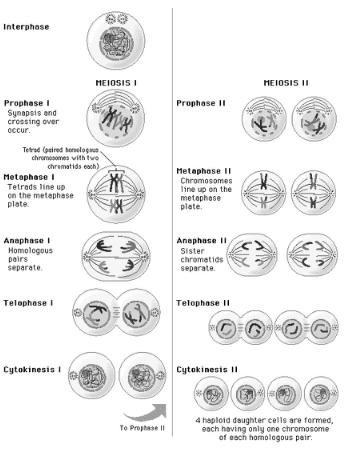
(C) In meiosis,the separation of sister chromatids occurs during $Anaphase-II$.
During $Anaphase-I$,homologous chromosomes separate,but sister chromatids remain attached at their centromeres.
During $Anaphase-II$,the centromeres split,allowing the sister chromatids to separate and move towards opposite poles,similar to the process in mitosis.
During $Anaphase-I$,homologous chromosomes separate,but sister chromatids remain attached at their centromeres.
During $Anaphase-II$,the centromeres split,allowing the sister chromatids to separate and move towards opposite poles,similar to the process in mitosis.
0 likes
View Solution397
MediumMCQ
Chiasma shows the sites of
A
Spindle formation
B
Synapsis
C
Crossing over
D
None of these
Solution
(C) Chiasma is the point of attachment between two non-sister chromatids of homologous chromosomes during the diplotene stage of prophase-$I$ of meiosis.
These $X$-shaped structures represent the sites where genetic material is exchanged between non-sister chromatids,a process known as crossing over.
These $X$-shaped structures represent the sites where genetic material is exchanged between non-sister chromatids,a process known as crossing over.
0 likes
View Solution398
MediumMCQ
Crossing over occurs at
A
Single strand stage
B
Two strand stage
C
Four strand stage
D
Eight strand stage
Solution
(C) During the pachytene substage of prophase-$I$ of meiosis,the homologous chromosomes form a bivalent or tetrad structure.
This structure consists of four chromatids (two chromatids per chromosome).
Crossing over occurs during this stage,which involves the exchange of genetic material between non-sister chromatids of homologous chromosomes.
Therefore,crossing over occurs at the four-strand stage.
This structure consists of four chromatids (two chromatids per chromosome).
Crossing over occurs during this stage,which involves the exchange of genetic material between non-sister chromatids of homologous chromosomes.
Therefore,crossing over occurs at the four-strand stage.
0 likes
View Solution399
MediumMCQ
Crossing over is also an enzyme-mediated process,and the enzyme involved is called:
A
Ligase
B
Polymerase
C
Recombinase
D
Endonuclease
Solution
(C) Crossing over is a process that occurs during the pachytene stage of prophase-$I$ of meiosis. It involves the exchange of genetic material between non-sister chromatids of homologous chromosomes. This process is mediated by an enzyme complex known as recombinase.
0 likes
View Solution400
MediumMCQ
What is the nature of cells formed at the end of meiosis-$II$?
A
Haploid
B
Diploid
C
Tetrad
D
None of these
Solution
(A) Meiosis is a reductional division that reduces the chromosome number by half.
Meiosis starts with one diploid cell containing two copies of each chromosome,one inherited from the mother and one from the father.
The cell undergoes two successive divisions,meiosis-$I$ and meiosis-$II$.
At the end of meiosis-$II$,four daughter cells are produced,each of which is haploid $(n)$,containing only one copy of each chromosome.
Meiosis starts with one diploid cell containing two copies of each chromosome,one inherited from the mother and one from the father.
The cell undergoes two successive divisions,meiosis-$I$ and meiosis-$II$.
At the end of meiosis-$II$,four daughter cells are produced,each of which is haploid $(n)$,containing only one copy of each chromosome.
0 likes
View SolutionCell Cycle and Cell Division — Meiosis · Frequently Asked Questions
1Are these Cell Cycle and Cell Division questions useful for JEE and NEET?
Yes. All questions in this section are mapped to JEE Main and NEET exam patterns. Previous year questions from JEE Main, NEET, GUJCET and state-level exams are included with full solutions.
2Can I switch to Hindi or Gujarati for these questions?
Yes. Use the language tabs in the hero section or the sidebar to view the same questions and solutions in English, Hindi or Gujarati.
3How do I generate a question paper from this subtopic?
Use the Vedclass Exam Paper Generator — select the chapter and subtopic, set difficulty, and generate Sets A, B, C, D automatically. First 3 chapters of every subject are free.
Vedclass Products
For Students
Vedclass Test Series
Mock tests in real JEE/NEET style with performance analysis. 5-day free trial.
Start Free TrialFor Teachers
Exam Paper Generator
Generate Set A/B/C/D papers from this chapter in 2 minutes. 3 chapters free.
Try FreeFor Institutes
Online Exam Module
Live online exams with unlimited students, 360° analytics & white-label branding.
See DemoFor Teachers & Institutes
Generate a Cell Cycle and Cell Division Exam Paper in 2 Minutes
Select subtopic & difficulty — Sets A, B, C, D auto-generated with No Repeat logic.
First 3 chapters of every subject are free — no payment required.