
A English
Meiosis Questions in English
Class 11 Biology · Cell Cycle and Cell Division · Meiosis
492+
Questions
English
Language
100%
With Solutions
Showing 42 of 492 questions in English
451
Medium
Give scientific reason: Meiosis and gametogenesis are always interlinked.
Solution
(N/A) Gametogenesis is the process of formation of male and female gametes.
All gametes are haploid,meaning they possess a single set of chromosomes $(n)$.
These gametes are formed as a result of meiosis,which is a reductional division.
Meiosis reduces the chromosome number to half in the gametes,ensuring that the diploid number $(2n)$ is restored during fertilization.
Therefore,meiosis and gametogenesis are fundamentally interlinked.
All gametes are haploid,meaning they possess a single set of chromosomes $(n)$.
These gametes are formed as a result of meiosis,which is a reductional division.
Meiosis reduces the chromosome number to half in the gametes,ensuring that the diploid number $(2n)$ is restored during fertilization.
Therefore,meiosis and gametogenesis are fundamentally interlinked.
0 likes
View Solution452
MediumMCQ
The appearance of recombination nodules on homologous chromosomes during meiosis characterizes:
A
Bivalent
B
Sites at which crossing over occurs
C
Terminalization
D
Synaptonemal complex
Solution
(B) During the $pachytene$ stage of $prophase-I$ in meiosis,the phenomenon of crossing over takes place.
Recombination nodules are protein complexes that appear on the synaptonemal complex at the sites where crossing over occurs.
These nodules facilitate the exchange of genetic material between non-sister chromatids of homologous chromosomes.
Therefore,the appearance of recombination nodules characterizes the sites at which crossing over occurs.
Recombination nodules are protein complexes that appear on the synaptonemal complex at the sites where crossing over occurs.
These nodules facilitate the exchange of genetic material between non-sister chromatids of homologous chromosomes.
Therefore,the appearance of recombination nodules characterizes the sites at which crossing over occurs.
0 likes
View Solution453
MediumMCQ
Regarding Meiosis,which of the statements is incorrect?
A
$DNA$ replication occurs in $S$ phase of Meiosis-$II$
B
Pairing of homologous chromosomes and recombination occurs in Meiosis-$I$
C
Four haploid cells are formed at the end of Meiosis-$II$
D
There are two stages in Meiosis,Meiosis-$I$ and $II$
Solution
(A) Meiosis is a reductional division that occurs in two sequential stages: Meiosis-$I$ and Meiosis-$II$.
$DNA$ replication occurs during the $S$ phase of Interphase,which precedes Meiosis-$I$. There is no $S$ phase or $DNA$ replication in Meiosis-$II$.
Pairing of homologous chromosomes (synapsis) and recombination (crossing over) are characteristic features of Prophase-$I$ of Meiosis-$I$.
At the end of Meiosis-$II$,four haploid daughter cells are produced from a single diploid parent cell.
Therefore,the statement that $DNA$ replication occurs in the $S$ phase of Meiosis-$II$ is incorrect.
$DNA$ replication occurs during the $S$ phase of Interphase,which precedes Meiosis-$I$. There is no $S$ phase or $DNA$ replication in Meiosis-$II$.
Pairing of homologous chromosomes (synapsis) and recombination (crossing over) are characteristic features of Prophase-$I$ of Meiosis-$I$.
At the end of Meiosis-$II$,four haploid daughter cells are produced from a single diploid parent cell.
Therefore,the statement that $DNA$ replication occurs in the $S$ phase of Meiosis-$II$ is incorrect.
0 likes
View Solution454
EasyMCQ
During meiosis,how many cells are formed from a single cell?
A
$2$
B
$4$
C
$6$
D
$8$
Solution
(B) Meiosis is a type of cell division that reduces the number of chromosomes in the parent cell by half and produces four gamete cells.
This process involves two successive nuclear divisions,known as meiosis-$I$ and meiosis-$II$.
Starting from a single diploid $(2n)$ cell,the process results in the formation of four haploid $(n)$ daughter cells.
This process involves two successive nuclear divisions,known as meiosis-$I$ and meiosis-$II$.
Starting from a single diploid $(2n)$ cell,the process results in the formation of four haploid $(n)$ daughter cells.
0 likes
View Solution455
MediumMCQ
The genetic constitution of chromosomes changes after this type of cell division.
A
Mitosis
B
Meiosis
C
Both
D
None of these
Solution
(B) During $Meiosis$, specifically in $Prophase-I$, the process of $crossing-over$ occurs between non-sister chromatids of homologous chromosomes.
This process leads to the exchange of genetic material, resulting in new combinations of genes (recombination).
Therefore, the genetic constitution of the chromosomes is altered in the daughter cells compared to the parent cell.
In contrast, $Mitosis$ is an equational division where the genetic constitution remains identical.
This process leads to the exchange of genetic material, resulting in new combinations of genes (recombination).
Therefore, the genetic constitution of the chromosomes is altered in the daughter cells compared to the parent cell.
In contrast, $Mitosis$ is an equational division where the genetic constitution remains identical.
0 likes
View Solution456
MediumMCQ
Which phase of meiosis is the longest?
A
Prophase-$I$
B
Prophase-$II$
C
Metaphase-$I$
D
Metaphase-$II$
Solution
(A) Meiosis-$I$ is a reductional division,and its prophase-$I$ is significantly longer and more complex than the prophase of mitosis or prophase-$II$ of meiosis.
Prophase-$I$ is further subdivided into five distinct stages: Leptotene,Zygotene,Pachytene,Diplotene,and Diakinesis.
These stages involve complex processes such as synapsis,crossing over,and the formation of chiasmata,which require a substantial amount of time to complete.
Therefore,Prophase-$I$ is considered the longest phase of meiosis.
Prophase-$I$ is further subdivided into five distinct stages: Leptotene,Zygotene,Pachytene,Diplotene,and Diakinesis.
These stages involve complex processes such as synapsis,crossing over,and the formation of chiasmata,which require a substantial amount of time to complete.
Therefore,Prophase-$I$ is considered the longest phase of meiosis.
0 likes
View Solution457
EasyMCQ
The sub-stages of Prophase-$I$ are given in order.
A
Leptotene $\rightarrow$ Zygotene $\rightarrow$ Pachytene $\rightarrow$ Diakinesis $\rightarrow$ Diplotene
B
Leptotene $\rightarrow$ Zygotene $\rightarrow$ Pachytene $\rightarrow$ Diplotene $\rightarrow$ Diakinesis
C
Leptotene $\rightarrow$ Pachytene $\rightarrow$ Zygotene $\rightarrow$ Diakinesis $\rightarrow$ Diplotene
D
Leptotene $\rightarrow$ Pachytene $\rightarrow$ Zygotene $\rightarrow$ Diplotene $\rightarrow$ Diakinesis
Solution
(B) Prophase-$I$ of meiosis is a complex and long phase compared to the prophase of mitosis. It is subdivided into five distinct stages based on chromosomal behavior:
$1$. Leptotene: Chromosomes become visible as compact threads.
$2$. Zygotene: Pairing of homologous chromosomes occurs (synapsis).
$3$. Pachytene: Crossing over takes place between non-sister chromatids of homologous chromosomes.
$4$. Diplotene: The synaptonemal complex dissolves,and homologous chromosomes start to separate,revealing chiasmata.
$5$. Diakinesis: The final stage where chromosomes are fully condensed and the nucleolus disappears,preparing for metaphase-$I$.
Therefore,the correct sequence is Leptotene $\rightarrow$ Zygotene $\rightarrow$ Pachytene $\rightarrow$ Diplotene $\rightarrow$ Diakinesis.
$1$. Leptotene: Chromosomes become visible as compact threads.
$2$. Zygotene: Pairing of homologous chromosomes occurs (synapsis).
$3$. Pachytene: Crossing over takes place between non-sister chromatids of homologous chromosomes.
$4$. Diplotene: The synaptonemal complex dissolves,and homologous chromosomes start to separate,revealing chiasmata.
$5$. Diakinesis: The final stage where chromosomes are fully condensed and the nucleolus disappears,preparing for metaphase-$I$.
Therefore,the correct sequence is Leptotene $\rightarrow$ Zygotene $\rightarrow$ Pachytene $\rightarrow$ Diplotene $\rightarrow$ Diakinesis.
0 likes
View Solution458
EasyMCQ
The enzyme recombinase is required in which stage of meiosis?
A
Zygotene
B
Pachytene
C
Diplotene
D
Leptotene
Solution
(B) The process of crossing over occurs during the $Pachytene$ stage of $Prophase-I$ in meiosis.
Crossing over is the exchange of genetic material between non-sister chromatids of homologous chromosomes.
This process is mediated by the enzyme $Recombinase$,which facilitates the breakage and reunion of $DNA$ strands.
Therefore,the enzyme $Recombinase$ is required during the $Pachytene$ stage.
Crossing over is the exchange of genetic material between non-sister chromatids of homologous chromosomes.
This process is mediated by the enzyme $Recombinase$,which facilitates the breakage and reunion of $DNA$ strands.
Therefore,the enzyme $Recombinase$ is required during the $Pachytene$ stage.
0 likes
View Solution459
MediumMCQ
Chromosomes are arranged in pairs on the metaphase plate during:
A
Metaphase
B
Metaphase-$I$
C
Metaphase-$II$
D
All of the above
Solution
(B) During $Metaphase-I$ of meiosis,homologous chromosomes pair up (synapsis) to form bivalents or tetrads. These pairs align along the metaphase plate (equatorial plate). In contrast,during $Metaphase$ of mitosis and $Metaphase-II$ of meiosis,individual chromosomes (not pairs) align on the metaphase plate.
0 likes
View Solution460
MediumMCQ
How do chromosomes appear during the pachytene stage of meiosis?
A
$Dyad$ and $Monovalent$
B
$Tetrad$ and $Bivalent$
C
$Dyad$ and $Bivalent$
D
$Tetrad$ and $Monovalent$
Solution
(B) During the pachytene stage of prophase-$I$ in meiosis,the process of crossing over occurs between non-sister chromatids of homologous chromosomes.
At this stage,the bivalent chromosomes (pairs of homologous chromosomes) clearly appear as tetrads,meaning they consist of four chromatids.
Therefore,the chromosomes are described as $Tetrad$ and $Bivalent$.
At this stage,the bivalent chromosomes (pairs of homologous chromosomes) clearly appear as tetrads,meaning they consist of four chromatids.
Therefore,the chromosomes are described as $Tetrad$ and $Bivalent$.
0 likes
View Solution461
MediumMCQ
Chromosomes start pairing up,which is called $.....P.....$,and this occurs during the $.....Q....$ stage.
A
Synapsis,Zygotene
B
Crossing over,Zygotene
C
Synapsis,Leptotene
D
Crossing over,Leptotene
Solution
(A) During the process of meiosis,specifically in Prophase-$I$,the chromosomes begin to pair up. This pairing process is known as $Synapsis$. This event is the characteristic feature of the $Zygotene$ stage of Prophase-$I$. Therefore,$P$ is $Synapsis$ and $Q$ is $Zygotene$.
0 likes
View Solution462
MediumMCQ
Select the correct option for a chromosome in Anaphase-$II$ regarding the number of centromeres,chromatids,and kinetochores.
A
$1, 1, 1$
B
$1, 1, 2$
C
$1, 2, 1$
D
$1, 2, 2$
Solution
(A) During Anaphase-$II$,the centromere of each chromosome splits,and the sister chromatids separate.
Each separated chromatid is now considered an individual chromosome.
$1$. Centromere: Since the centromere splits,each daughter chromosome has $1$ centromere.
$2$. Chromatid: After the split,the structure is referred to as a chromosome,not a chromatid; however,in the context of the separated unit,it represents $1$ chromatid.
$3$. Kinetochore: Each centromere has $2$ kinetochores (one on each side),but since the centromere has split,each daughter chromosome retains $1$ kinetochore facing the pole to which it is being pulled.
Therefore,for each daughter chromosome in Anaphase-$II$,the count is $1$ centromere,$1$ chromatid,and $1$ kinetochore.
Each separated chromatid is now considered an individual chromosome.
$1$. Centromere: Since the centromere splits,each daughter chromosome has $1$ centromere.
$2$. Chromatid: After the split,the structure is referred to as a chromosome,not a chromatid; however,in the context of the separated unit,it represents $1$ chromatid.
$3$. Kinetochore: Each centromere has $2$ kinetochores (one on each side),but since the centromere has split,each daughter chromosome retains $1$ kinetochore facing the pole to which it is being pulled.
Therefore,for each daughter chromosome in Anaphase-$II$,the count is $1$ centromere,$1$ chromatid,and $1$ kinetochore.
0 likes
View Solution463
MediumMCQ
Select the incorrect statement for the diplotene stage.
A
The synaptonemal complex dissolves.
B
Homologous chromosomes begin to move away from each other.
C
The connection is maintained at the site where crossing over has occurred.
D
In the diplotene stage,homologous chromosomes completely separate and chiasmata disappear.
Solution
(D) The diplotene stage is characterized by the dissolution of the synaptonemal complex. The homologous chromosomes of the bivalents start to separate from each other except at the sites of crossovers. These $X$-shaped structures are called chiasmata. In oocytes of some vertebrates,diplotene can last for months or years (dictyotene stage). Statement $D$ is incorrect because homologous chromosomes do not completely separate; they remain attached at the chiasmata.
0 likes
View Solution464
MediumMCQ
Crossing over occurs between which of the following?
A
Non-sister chromatids of homologous chromosomes
B
Sister chromatids of homologous chromosomes
C
Non-sister chromatids of non-homologous chromosomes
D
Sister chromatids of non-homologous chromosomes
Solution
(A) Crossing over is a biological process that occurs during the $pachytene$ stage of $prophase-I$ of $meiosis$.
It involves the exchange of genetic material between the non-sister chromatids of homologous chromosomes.
This process leads to genetic recombination,which is essential for creating genetic diversity in sexually reproducing organisms.
Therefore,the correct option is $A$.
It involves the exchange of genetic material between the non-sister chromatids of homologous chromosomes.
This process leads to genetic recombination,which is essential for creating genetic diversity in sexually reproducing organisms.
Therefore,the correct option is $A$.
0 likes
View Solution465
MediumMCQ
Select the correct option for the $Pachytene$ stage.
A
Crossing over occurs in this stage.
B
Bivalent chromosomes clearly appear as tetrads.
C
Recombination nodules become visible.
D
All of the above.
0 likes
View Solution466
MediumMCQ
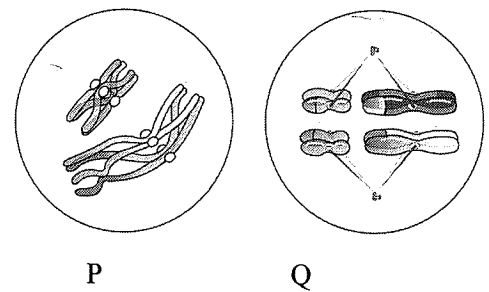
Identify the stages of meiosis shown below.
A
Prophase,Metaphase
B
Prophase-$I$,Metaphase-$I$
C
Prophase-$II$,Metaphase-$II$
D
Prophase-$I$,Metaphase-$II$
Solution
(B) In image $P$,we can observe homologous chromosomes pairing up to form bivalents or tetrads,which is a characteristic feature of Prophase-$I$ of meiosis.
In image $Q$,the homologous pairs (bivalents) are aligned at the equatorial plate,and spindle fibers are attached to the kinetochores of the homologous chromosomes. This alignment of bivalents at the metaphase plate is a characteristic feature of Metaphase-$I$ of meiosis.
Therefore,the correct stages are Prophase-$I$ and Metaphase-$I$.
In image $Q$,the homologous pairs (bivalents) are aligned at the equatorial plate,and spindle fibers are attached to the kinetochores of the homologous chromosomes. This alignment of bivalents at the metaphase plate is a characteristic feature of Metaphase-$I$ of meiosis.
Therefore,the correct stages are Prophase-$I$ and Metaphase-$I$.
0 likes
View Solution467
MediumMCQ
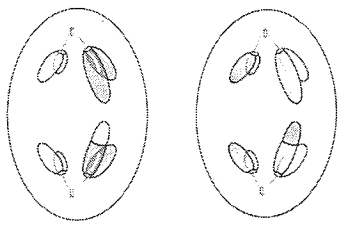
Identify the cell stage shown below.
A
Metaphase
B
Anaphase-$I$
C
Anaphase-$II$
D
Anaphase
Solution
(C) The image shows two cells undergoing cell division. In each cell,the sister chromatids are being pulled apart towards opposite poles. This separation of sister chromatids is the characteristic feature of Anaphase-$II$ of meiosis or Anaphase of mitosis. However,since the chromosomes are shown as single chromatids moving towards the poles,it represents Anaphase-$II$ of meiosis. In Anaphase-$I$,homologous chromosomes separate,not sister chromatids. Therefore,the correct stage is Anaphase-$II$.
0 likes
View Solution468
EasyMCQ
In which stage does crossing over occur?
A
Pachytene
B
Zygotene
C
Diplotene
D
Leptotene
Solution
(A) Crossing over is the exchange of genetic material between non-sister chromatids of homologous chromosomes.
It occurs during the $Pachytene$ stage of $Prophase-I$ of $Meiosis-I$.
During this stage,the bivalent chromosomes become clearly visible as tetrads,and the phenomenon of recombination is mediated by the enzyme recombinase.
It occurs during the $Pachytene$ stage of $Prophase-I$ of $Meiosis-I$.
During this stage,the bivalent chromosomes become clearly visible as tetrads,and the phenomenon of recombination is mediated by the enzyme recombinase.
0 likes
View Solution469
MediumMCQ
Select the incorrect statement regarding meiosis.
A
It introduces variations in gametes.
B
Meiosis always occurs in diploid cells.
C
Meiosis occurs in the formation of egg and sperm cells.
D
Since the body of algae is haploid,meiosis never occurs in the life cycle of algae.
Solution
(D) Meiosis is a reductional division that reduces the chromosome number by half.
$A$. Meiosis involves crossing over during prophase-$I$,which introduces genetic variation in gametes.
$B$. Meiosis typically occurs in diploid $(2n)$ cells to produce haploid $(n)$ gametes.
$C$. In animals,meiosis is specifically involved in gametogenesis (formation of eggs and sperm).
$D$. This statement is incorrect. While the vegetative body of many algae is haploid $(n)$,they undergo zygotic meiosis after fertilization (fusion of gametes) to restore the haploid state. Therefore,meiosis does occur in the life cycle of algae.
$A$. Meiosis involves crossing over during prophase-$I$,which introduces genetic variation in gametes.
$B$. Meiosis typically occurs in diploid $(2n)$ cells to produce haploid $(n)$ gametes.
$C$. In animals,meiosis is specifically involved in gametogenesis (formation of eggs and sperm).
$D$. This statement is incorrect. While the vegetative body of many algae is haploid $(n)$,they undergo zygotic meiosis after fertilization (fusion of gametes) to restore the haploid state. Therefore,meiosis does occur in the life cycle of algae.
0 likes
View Solution470
MediumMCQ
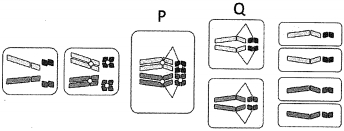
The diagram shows meiosis and gamete formation in a cell with four chromosomes. Identify the stages $P$ and $Q$.
A
Metaphase-$I$,Metaphase-$II$
B
Anaphase-$I$,Anaphase-$II$
C
Metaphase-$I$,Anaphase-$II$
D
Anaphase-$I$,Metaphase-$II$
Solution
(C) In the given diagram,stage $P$ shows homologous chromosomes aligned at the equatorial plate,which is characteristic of Metaphase-$I$ of meiosis.
Stage $Q$ shows the splitting of centromeres and the movement of sister chromatids towards opposite poles,which is characteristic of Anaphase-$II$ of meiosis.
Therefore,$P$ is Metaphase-$I$ and $Q$ is Anaphase-$II$.
Stage $Q$ shows the splitting of centromeres and the movement of sister chromatids towards opposite poles,which is characteristic of Anaphase-$II$ of meiosis.
Therefore,$P$ is Metaphase-$I$ and $Q$ is Anaphase-$II$.
0 likes
View Solution471
MediumMCQ
Which stage of meiosis can last for months or years in the oocytes of some vertebrates?
A
Leptotene
B
Pachytene
C
Diplotene
D
Diakinesis
Solution
(C) In the oocytes of some vertebrates,the $Diplotene$ stage of $Meiosis-I$ can remain suspended for months or even years.
This prolonged stage is known as the $Dictyotene$ stage.
During this phase,the chromosomes decondense and become transcriptionally active to synthesize materials required for the growth of the oocyte.
Therefore,the correct option is $C$.
This prolonged stage is known as the $Dictyotene$ stage.
During this phase,the chromosomes decondense and become transcriptionally active to synthesize materials required for the growth of the oocyte.
Therefore,the correct option is $C$.
0 likes
View Solution472
EasyMCQ
In meiosis,crossing over and exchange of genetic material between homologous chromosomes are catalyzed by the enzyme.
A
Phosphorylase
B
Recombinase
C
Transferase
D
Polymerase
Solution
(B) During the $pachytene$ stage of $prophase-I$ in meiosis,the phenomenon of crossing over occurs.
Crossing over is the exchange of genetic material between non-sister chromatids of homologous chromosomes.
This process is mediated and catalyzed by an enzyme complex known as $recombinase$.
$Recombinase$ facilitates the breaking and rejoining of $DNA$ strands,ensuring genetic recombination.
Crossing over is the exchange of genetic material between non-sister chromatids of homologous chromosomes.
This process is mediated and catalyzed by an enzyme complex known as $recombinase$.
$Recombinase$ facilitates the breaking and rejoining of $DNA$ strands,ensuring genetic recombination.
1 likes
View Solution473
MediumMCQ
Identify the correct sequence of events during Prophase $I$ of meiosis :
$(a)$ Synapsis of homologous chromosomes
$(b)$ Chromosomes become gradually visible under microscope
$(c)$ Crossing over between non-sister chromatids of homologous chromosomes
$(d)$ Terminalisation of chiasmata
$(e)$ Dissolution of synaptonemal complex
Choose the correct answer from the options given below :
$(a)$ Synapsis of homologous chromosomes
$(b)$ Chromosomes become gradually visible under microscope
$(c)$ Crossing over between non-sister chromatids of homologous chromosomes
$(d)$ Terminalisation of chiasmata
$(e)$ Dissolution of synaptonemal complex
Choose the correct answer from the options given below :
A
$(a), (b), (c), (d), (e)$
B
$(b), (c), (d), (e), (a)$
C
$(b), (a), (c), (e), (d)$
D
$(a), (c), (d), (e), (b)$
Solution
(C) Prophase $I$ of meiosis is divided into five sub-stages: Leptotene,Zygotene,Pachytene,Diplotene,and Diakinesis.
$1$. $(b)$ Chromosomes become gradually visible under the microscope occurs during Leptotene.
$2$. $(a)$ Synapsis of homologous chromosomes occurs during Zygotene.
$3$. $(c)$ Crossing over between non-sister chromatids occurs during Pachytene.
$4$. $(e)$ Dissolution of the synaptonemal complex occurs during Diplotene.
$5$. $(d)$ Terminalisation of chiasmata occurs during Diakinesis.
Therefore,the correct sequence is $(b), (a), (c), (e), (d)$.
$1$. $(b)$ Chromosomes become gradually visible under the microscope occurs during Leptotene.
$2$. $(a)$ Synapsis of homologous chromosomes occurs during Zygotene.
$3$. $(c)$ Crossing over between non-sister chromatids occurs during Pachytene.
$4$. $(e)$ Dissolution of the synaptonemal complex occurs during Diplotene.
$5$. $(d)$ Terminalisation of chiasmata occurs during Diakinesis.
Therefore,the correct sequence is $(b), (a), (c), (e), (d)$.
0 likes
View Solution474
MediumMCQ
Bivalent or Tetrad formation is a characteristic feature observed during:
A
Synaptonemal complex in zygotene stage
B
Chiasmata in Diplotene stage
C
Synaptonemal complex in Pachytene stage
D
Chiasmata in zygotene stage
Solution
(A) During the $Zygotene$ stage of $Meiosis-I$,homologous chromosomes pair up,a process known as $Synapsis$.
This pairing is facilitated by the formation of a $Synaptonemal$ $complex$.
The paired homologous chromosomes are called $Bivalents$ or $Tetrads$.
Therefore,the formation of $Bivalents$ or $Tetrads$ is a characteristic feature of the $Zygotene$ stage,associated with the $Synaptonemal$ $complex$.
This pairing is facilitated by the formation of a $Synaptonemal$ $complex$.
The paired homologous chromosomes are called $Bivalents$ or $Tetrads$.
Therefore,the formation of $Bivalents$ or $Tetrads$ is a characteristic feature of the $Zygotene$ stage,associated with the $Synaptonemal$ $complex$.
0 likes
View Solution475
EasyMCQ
Which of the following stages of meiosis involves division of the centromere?
A
Telophase
B
Metaphase $I$
C
Metaphase $II$
D
Anaphase $II$
Solution
(D) The splitting of the centromere occurs during the anaphase of mitosis or anaphase $II$ of meiosis.
During Metaphase $I$ and $II$,chromosomes align at the equatorial plate.
During telophase,chromosomes reach their respective poles and decondense.
During Metaphase $I$ and $II$,chromosomes align at the equatorial plate.
During telophase,chromosomes reach their respective poles and decondense.
0 likes
View Solution476
EasyMCQ
The process of appearance of recombination nodules occurs at which sub-stage of prophase $I$ in meiosis?
A
Diakinesis
B
Zygotene
C
Pachytene
D
Diplotene
Solution
(C) The process of recombination occurs at the Pachytene stage of prophase $I$.
This stage is characterized by the appearance of recombination nodules,which are sites at which crossing over occurs between non-sister chromatids of homologous chromosomes.
This stage is characterized by the appearance of recombination nodules,which are sites at which crossing over occurs between non-sister chromatids of homologous chromosomes.
0 likes
View Solution477
MediumMCQ
Given below are two statements:
Statement $I$: Chromosomes become gradually visible under light microscope during leptotene stage.
Statement $II$: The beginning of diplotene stage is recognized by dissolution of synaptonemal complex.
In the light of the above statements,choose the correct answer from the options given below:
Statement $I$: Chromosomes become gradually visible under light microscope during leptotene stage.
Statement $II$: The beginning of diplotene stage is recognized by dissolution of synaptonemal complex.
In the light of the above statements,choose the correct answer from the options given below:
A
Both Statement $I$ and Statement $II$ are false
B
Statement $I$ is true but Statement $II$ is false
C
Statement $I$ is false but Statement $II$ is true
D
Both Statement $I$ and Statement $II$ are true
Solution
(D) - During the leptotene stage,the chromosomes become gradually visible under the light microscope as they begin to condense.
- The beginning of the diplotene stage is recognized by the dissolution of the synaptonemal complex and the tendency of the recombined homologous chromosomes of the bivalents to separate from each other,except at the sites of crossovers (chiasmata).
- Therefore,both Statement $I$ and Statement $II$ are true.
- The beginning of the diplotene stage is recognized by the dissolution of the synaptonemal complex and the tendency of the recombined homologous chromosomes of the bivalents to separate from each other,except at the sites of crossovers (chiasmata).
- Therefore,both Statement $I$ and Statement $II$ are true.
0 likes
View Solution478
MediumMCQ
Match List-$I$ with List-$II$ :
Choose the correct answer from the options given below:
| List-$I$ (Sub Phases of Prophase-$I$) | List-$II$ |
| $A$. Diakinesis | $I$. Synaptonemal complex formation |
| $B$. Pachytene | $II$. Completion of terminalisation of chiasmata |
| $C$. Zygotene | $III$. Chromosomes look like thin threads |
| $D$. Leptotene | $IV$. Appearance of recombination nodules |
Choose the correct answer from the options given below:
A
$A-I, B-II, C-IV, D-III$
B
$A-II, B-IV, C-I, D-III$
C
$A-IV, B-III, C-II, D-I$
D
$A-IV, B-II, C-III, D-I$
Solution
$(B)$ The correct matching is as follows:
$(A)$ Diakinesis: This is the final stage of meiotic prophase-$I$, characterized by the completion of terminalisation of chiasmata.
$(B)$ Pachytene: This stage is characterized by the appearance of recombination nodules, which are the sites at which crossing over occurs between non-sister chromatids of homologous chromosomes.
$(C)$ Zygotene: During this stage, homologous chromosomes pair up, a process called synapsis, which is accompanied by the formation of a complex structure called the synaptonemal complex.
$(D)$ Leptotene: During this stage, the chromosomes become gradually visible under the light microscope and look like thin threads.
Therefore, the correct sequence is $A-II, B-IV, C-I, D-III$.
$(A)$ Diakinesis: This is the final stage of meiotic prophase-$I$, characterized by the completion of terminalisation of chiasmata.
$(B)$ Pachytene: This stage is characterized by the appearance of recombination nodules, which are the sites at which crossing over occurs between non-sister chromatids of homologous chromosomes.
$(C)$ Zygotene: During this stage, homologous chromosomes pair up, a process called synapsis, which is accompanied by the formation of a complex structure called the synaptonemal complex.
$(D)$ Leptotene: During this stage, the chromosomes become gradually visible under the light microscope and look like thin threads.
Therefore, the correct sequence is $A-II, B-IV, C-I, D-III$.
0 likes
View Solution479
EasyMCQ
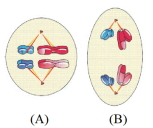
Identify $A$ and $B$ respectively.
A
Anaphase$-I$,Metaphase$-I$
B
Metaphase$-I$,Anaphase$-I$
C
Metaphase$-II$,Anaphase$-I$
D
Anaphase,Metaphase
Solution
(B) In the provided image,$A$ represents Metaphase$-I$ of meiosis,where homologous chromosomes align at the equatorial plate.
$B$ represents Anaphase$-I$ of meiosis,where homologous chromosomes separate and move towards opposite poles,while sister chromatids remain attached at their centromeres.
Therefore,the correct identification is Metaphase$-I$ and Anaphase$-I$.
$B$ represents Anaphase$-I$ of meiosis,where homologous chromosomes separate and move towards opposite poles,while sister chromatids remain attached at their centromeres.
Therefore,the correct identification is Metaphase$-I$ and Anaphase$-I$.
0 likes
View Solution480
EasyMCQ
'Chiasmata' is formed between a cross-shaped configuration of:
A
sister chromatids of homologous chromosomes.
B
sister chromatids of non-homologous chromosomes.
C
non-sister chromatids of homologous chromosomes.
D
non-sister chromatids of non-homologous chromosomes.
Solution
(C) During the $Pachytene$ stage of $Meiosis-I$,crossing over occurs between the non-sister chromatids of homologous chromosomes. As the cell progresses into the $Diplotene$ stage,the synaptonemal complex dissolves,and the homologous chromosomes begin to separate from each other. However,they remain attached at the sites where crossing over occurred. These $X$-shaped structures are known as $Chiasmata$.
0 likes
View Solution481
MediumMCQ
At which phase of meiosis,bivalent chromosomes align on the equatorial plate $:-$
A
Anaphase-$I$
B
Metaphase-$I$
C
Metaphase-$II$
D
Anaphase-$II$
Solution
(B) In meiosis-$I$,the homologous chromosomes pair up to form bivalents or tetrads.
During Metaphase-$I$,these bivalent chromosomes align on the equatorial plate (metaphase plate).
This alignment is crucial for the subsequent separation of homologous chromosomes during Anaphase-$I$.
Therefore,the correct phase is Metaphase-$I$.
During Metaphase-$I$,these bivalent chromosomes align on the equatorial plate (metaphase plate).
This alignment is crucial for the subsequent separation of homologous chromosomes during Anaphase-$I$.
Therefore,the correct phase is Metaphase-$I$.
0 likes
View Solution482
EasyMCQ
Which one of the following is $INCORRECT$ about homologous chromosomes?
A
They are morphologically similar.
B
They synapse during meiosis.
C
Have identical gene loci bearing alleles.
D
Both the homologous chromosomes are usually inherited from mother.
Solution
(D) Homologous chromosomes are a pair of chromosomes,one of which is inherited from the mother and the other from the father. Therefore,the statement that both homologous chromosomes are inherited from the mother is incorrect.
0 likes
View Solution483
EasyMCQ
Which one of the following is a normal condition of chromosomes in gametes?
A
Hypoploidy
B
Hyperploidy
C
Monoploidy
D
Aneuploidy
Solution
(C) Gametes are reproductive cells that contain half the number of chromosomes compared to somatic cells.
This condition is known as haploidy or monoploidy,represented as $n$.
Hypoploidy,Hyperploidy,and Aneuploidy are abnormal conditions involving the loss or gain of specific chromosomes,which are not characteristic of normal gametes.
This condition is known as haploidy or monoploidy,represented as $n$.
Hypoploidy,Hyperploidy,and Aneuploidy are abnormal conditions involving the loss or gain of specific chromosomes,which are not characteristic of normal gametes.
0 likes
View Solution484
EasyMCQ
Match the stages of prophase $I$ given in Column-$I$ with their features in Column-$II$ and choose the correct options from the choices given below:
| Column $I$ | Column $II$ |
|---|---|
| $A$. Leptotene | $i$. Chromosomes visible under light microscope |
| $B$. Zygotene | $ii$. Chromosomes start pairing together |
| $C$. Pachytene | $iii$. Exchange of genetic materials between non-sister chromatids of the homologous chromosomes. |
| $D$. Diplotene | $iv$. Dissolution of synaptonemal complex |
| $E$. Diakinesis | $v$. Terminalisation of chiasmata |
A
$A-ii, B-iv, C-i, D-iii, E-v$
B
$A-i, B-ii, C-iii, D-iv, E-v$
C
$A-iv, B-i, C-ii, D-iii, E-v$
D
$A-v, B-iv, C-i, D-iii, E-ii$
Solution
(B) The correct matching is as follows:
$A$. Leptotene: During this stage, chromosomes become visible under a light microscope.
$B$. Zygotene: During this stage, homologous chromosomes start pairing together, a process called synapsis.
$C$. Pachytene: During this stage, crossing over occurs, which is the exchange of genetic material between non-sister chromatids of homologous chromosomes.
$D$. Diplotene: During this stage, the synaptonemal complex dissolves, and homologous chromosomes begin to separate except at the sites of crossovers (chiasmata).
$E$. Diakinesis: This is the final stage of prophase $I$, characterized by the terminalisation of chiasmata.
Therefore, the correct sequence is $A-i, B-ii, C-iii, D-iv, E-v$.
$A$. Leptotene: During this stage, chromosomes become visible under a light microscope.
$B$. Zygotene: During this stage, homologous chromosomes start pairing together, a process called synapsis.
$C$. Pachytene: During this stage, crossing over occurs, which is the exchange of genetic material between non-sister chromatids of homologous chromosomes.
$D$. Diplotene: During this stage, the synaptonemal complex dissolves, and homologous chromosomes begin to separate except at the sites of crossovers (chiasmata).
$E$. Diakinesis: This is the final stage of prophase $I$, characterized by the terminalisation of chiasmata.
Therefore, the correct sequence is $A-i, B-ii, C-iii, D-iv, E-v$.
0 likes
View Solution485
EasyMCQ
The enzyme $Recombinase$ is required at which stage of $Meiosis \ I$?
A
Pachytene
B
Zygotene
C
Diplotene
D
Diakinesis
Solution
(A) The correct answer is $A$ (Pachytene).
$Recombinase$ is an enzyme that facilitates the process of crossing over between non-sister chromatids of homologous chromosomes.
This process occurs specifically during the $Pachytene$ stage of $Prophase \ I$ in $Meiosis \ I$.
$Recombinase$ is an enzyme that facilitates the process of crossing over between non-sister chromatids of homologous chromosomes.
This process occurs specifically during the $Pachytene$ stage of $Prophase \ I$ in $Meiosis \ I$.
0 likes
View Solution486
EasyMCQ
The complex formed by a pair of synapsed homologous chromosomes is called,
A
Univalent
B
Pentavalent
C
Triad
D
Bivalent
Solution
(D) The correct answer is $D$.
During the $zygotene$ stage of $prophase-I$ in $meiosis$,homologous chromosomes pair up in a process known as $synapsis$.
This pair of synapsed homologous chromosomes is referred to as a $bivalent$ or a $tetrad$ (because it consists of four chromatids).
During the $zygotene$ stage of $prophase-I$ in $meiosis$,homologous chromosomes pair up in a process known as $synapsis$.
This pair of synapsed homologous chromosomes is referred to as a $bivalent$ or a $tetrad$ (because it consists of four chromatids).
0 likes
View Solution487
EasyMCQ
The enzyme involved in crossing over is:
A
endonuclease
B
recombinase
C
ligase
D
polymerase
Solution
(B) The correct answer is $B$.
Crossing over is a process that occurs during the pachytene stage of prophase $I$ of meiosis.
It involves the exchange of genetic material between non-sister chromatids of homologous chromosomes.
The enzyme complex responsible for catalyzing this recombination event is known as recombinase.
Crossing over is a process that occurs during the pachytene stage of prophase $I$ of meiosis.
It involves the exchange of genetic material between non-sister chromatids of homologous chromosomes.
The enzyme complex responsible for catalyzing this recombination event is known as recombinase.
0 likes
View Solution488
EasyMCQ
The correct sequence of events in prophase $I$ is
A
Synapsis $\rightarrow$ Crossing over $\rightarrow$ Chiasmata $\rightarrow$ Terminalisation
B
Crossing over $\rightarrow$ Synapsis $\rightarrow$ Chiasmata $\rightarrow$ Terminalisation
C
Chiasmata $\rightarrow$ Synapsis $\rightarrow$ Crossing over $\rightarrow$ Terminalisation
D
Chiasmata $\rightarrow$ Crossing over $\rightarrow$ Synapsis $\rightarrow$ Terminalisation
Solution
(A) is the correct sequence: Synapsis $\rightarrow$ Crossing over $\rightarrow$ Chiasmata $\rightarrow$ Terminalisation.
Prophase $I$ of meiosis is divided into $5$ sub-stages: leptotene,zygotene,pachytene,diplotene,and diakinesis.
$1$. Synapsis: Pairing of homologous chromosomes occurs during the zygotene stage.
$2$. Crossing over: Exchange of genetic material between non-sister chromatids of homologous chromosomes occurs during the pachytene stage.
$3$. Chiasmata: The $X$-shaped structures formed at the sites of crossing over become visible during the diplotene stage.
$4$. Terminalisation: The shifting of chiasmata towards the ends of the chromosomes occurs during the diakinesis stage.
Prophase $I$ of meiosis is divided into $5$ sub-stages: leptotene,zygotene,pachytene,diplotene,and diakinesis.
$1$. Synapsis: Pairing of homologous chromosomes occurs during the zygotene stage.
$2$. Crossing over: Exchange of genetic material between non-sister chromatids of homologous chromosomes occurs during the pachytene stage.
$3$. Chiasmata: The $X$-shaped structures formed at the sites of crossing over become visible during the diplotene stage.
$4$. Terminalisation: The shifting of chiasmata towards the ends of the chromosomes occurs during the diakinesis stage.
0 likes
View Solution489
EasyMCQ
Identify the event in meiosis mediated by the enzyme recombinase.
A
Interkinesis
B
Synaptic pairing
C
Terminalisation
D
Crossing over
Solution
(D) The correct answer is $D$.
Crossing over is the process of exchange of genetic material between non-sister chromatids of homologous chromosomes.
This process occurs during the pachytene stage of prophase-$I$ of meiosis.
It is an enzyme-mediated process,and the enzyme involved in this process is known as recombinase.
Crossing over is the process of exchange of genetic material between non-sister chromatids of homologous chromosomes.
This process occurs during the pachytene stage of prophase-$I$ of meiosis.
It is an enzyme-mediated process,and the enzyme involved in this process is known as recombinase.
0 likes
View Solution490
EasyMCQ
What is the function of the enzyme 'recombinase' during meiosis?
A
Formation of synaptonemal complex
B
Crossing over between non-sister chromatids
C
Condensation of chromosomes
D
Alignment of bivalent chromosomes on equatorial plate
Solution
(B) The correct answer is $B$.
During the pachytene stage of prophase-$I$ of meiosis,the process of crossing over occurs.
Crossing over involves the exchange of genetic material between non-sister chromatids of homologous chromosomes.
This process is mediated by the enzyme 'recombinase',which facilitates the breakage and reunion of $DNA$ strands.
During the pachytene stage of prophase-$I$ of meiosis,the process of crossing over occurs.
Crossing over involves the exchange of genetic material between non-sister chromatids of homologous chromosomes.
This process is mediated by the enzyme 'recombinase',which facilitates the breakage and reunion of $DNA$ strands.
0 likes
View Solution491
EasyMCQ
$A$ bivalent of meiosis $I$ consists of
A
four chromatids and two centromeres
B
two chromatids and one centromere
C
two chromatids and two centromeres
D
four chromatids and four centromeres
Solution
(A) The correct answer is $A$.
During the prophase $I$ of meiosis,homologous chromosomes pair up to form a structure known as a bivalent or tetrad.
Each homologous chromosome consists of two sister chromatids joined by a single centromere.
Since a bivalent consists of two homologous chromosomes,it contains a total of $4$ chromatids ($2$ from each chromosome) and $2$ centromeres ($1$ from each chromosome).
During the prophase $I$ of meiosis,homologous chromosomes pair up to form a structure known as a bivalent or tetrad.
Each homologous chromosome consists of two sister chromatids joined by a single centromere.
Since a bivalent consists of two homologous chromosomes,it contains a total of $4$ chromatids ($2$ from each chromosome) and $2$ centromeres ($1$ from each chromosome).
0 likes
View Solution492
EasyMCQ
Visible expression of the genetic phenomenon of crossing over is called
A
recombination
B
condensation
C
chiasmata
D
spiralisation
Solution
(C) The correct answer is $C$.
Crossing over is the process of exchange of genetic material between non-sister chromatids of homologous chromosomes during the $pachytene$ stage of $prophase-I$ of $meiosis$.
The visible manifestation or expression of this crossing over,which can be observed under a microscope during the $diplotene$ stage,is known as $chiasmata$ (singular: $chiasma$).
These $X$-shaped structures represent the sites where the physical exchange of $DNA$ segments has occurred.
Crossing over is the process of exchange of genetic material between non-sister chromatids of homologous chromosomes during the $pachytene$ stage of $prophase-I$ of $meiosis$.
The visible manifestation or expression of this crossing over,which can be observed under a microscope during the $diplotene$ stage,is known as $chiasmata$ (singular: $chiasma$).
These $X$-shaped structures represent the sites where the physical exchange of $DNA$ segments has occurred.
0 likes
View SolutionCell Cycle and Cell Division — Meiosis · Frequently Asked Questions
1Are these Cell Cycle and Cell Division questions useful for JEE and NEET?
Yes. All questions in this section are mapped to JEE Main and NEET exam patterns. Previous year questions from JEE Main, NEET, GUJCET and state-level exams are included with full solutions.
2Can I switch to Hindi or Gujarati for these questions?
Yes. Use the language tabs in the hero section or the sidebar to view the same questions and solutions in English, Hindi or Gujarati.
3How do I generate a question paper from this subtopic?
Use the Vedclass Exam Paper Generator — select the chapter and subtopic, set difficulty, and generate Sets A, B, C, D automatically. First 3 chapters of every subject are free.
Vedclass Products
For Students
Vedclass Test Series
Mock tests in real JEE/NEET style with performance analysis. 5-day free trial.
Start Free TrialFor Teachers
Exam Paper Generator
Generate Set A/B/C/D papers from this chapter in 2 minutes. 3 chapters free.
Try FreeFor Institutes
Online Exam Module
Live online exams with unlimited students, 360° analytics & white-label branding.
See DemoFor Teachers & Institutes
Generate a Cell Cycle and Cell Division Exam Paper in 2 Minutes
Select subtopic & difficulty — Sets A, B, C, D auto-generated with No Repeat logic.
First 3 chapters of every subject are free — no payment required.