
A English
Meiosis Questions in English
Class 11 Biology · Cell Cycle and Cell Division · Meiosis
492+
Questions
English
Language
100%
With Solutions
Showing 49 of 492 questions in English
251
EasyMCQ
What is the pairing of homologous chromosomes during the zygotene stage called?
A
Synapse
B
Synapsida
C
Synapsis
D
Crossing over
Solution
(C) During the $zygotene$ stage of $prophase-I$ of meiosis,homologous chromosomes start pairing together. This process of association is known as $synapsis$. Such paired chromosomes are called homologous chromosomes. These pairs are also referred to as bivalents or tetrads.
0 likes
View Solution252
MediumMCQ
In which stage of meiosis do homologous chromosomes separate,while sister chromatids remain associated at their centromeres?
A
Metaphase-$I$
B
Metaphase-$II$
C
Anaphase-$I$
D
Anaphase-$II$
Solution
(C) In meiosis-$I$,specifically during Anaphase-$I$,the homologous chromosomes separate and move towards opposite poles of the cell.
However,the sister chromatids remain attached to each other at their centromeres throughout this process.
In contrast,during Anaphase-$II$,the centromeres split,and the sister chromatids separate.
Therefore,the correct stage where homologous chromosomes separate while sister chromatids remain associated is Anaphase-$I$.
However,the sister chromatids remain attached to each other at their centromeres throughout this process.
In contrast,during Anaphase-$II$,the centromeres split,and the sister chromatids separate.
Therefore,the correct stage where homologous chromosomes separate while sister chromatids remain associated is Anaphase-$I$.
0 likes
View Solution253
MediumMCQ
Which process induces genetic variation in species?
A
Centromere
B
Chromatid
C
Crossing over
D
Synapsis
Solution
(C) Genetic variation in sexually reproducing organisms is primarily caused by the process of $Crossing over$.
$Crossing over$ occurs during the $Pachytene$ stage of $Prophase-I$ of $Meiosis$.
During this process, non-sister chromatids of homologous chromosomes exchange genetic material, resulting in new combinations of genes (recombination).
$Synapsis$ is the pairing of homologous chromosomes, while $Crossing over$ is the actual exchange of segments that leads to variation.
$Crossing over$ occurs during the $Pachytene$ stage of $Prophase-I$ of $Meiosis$.
During this process, non-sister chromatids of homologous chromosomes exchange genetic material, resulting in new combinations of genes (recombination).
$Synapsis$ is the pairing of homologous chromosomes, while $Crossing over$ is the actual exchange of segments that leads to variation.
0 likes
View Solution254
MediumMCQ
How does the genetic composition of the new cells produced in meiosis compare to that of the parent cell?
A
It is identical to the parent cell.
B
It is different from the parent cell.
C
It has double the genetic material of the parent cell.
D
It has four times the genetic material of the parent cell.
Solution
(B) Meiosis is a type of cell division that reduces the number of chromosomes by half in the daughter cells compared to the parent cell.
During meiosis,the genetic material undergoes recombination (crossing over) and independent assortment,which leads to genetic variation.
Therefore,the genetic composition of the daughter cells produced in meiosis is different from that of the parent cell.
During meiosis,the genetic material undergoes recombination (crossing over) and independent assortment,which leads to genetic variation.
Therefore,the genetic composition of the daughter cells produced in meiosis is different from that of the parent cell.
0 likes
View Solution255
EasyMCQ
In which of the following cells does meiosis occur?
A
Root apex
B
Shoot apex
C
Pollen mother cell
D
Leaf apex
Solution
(C) Meiosis is a type of cell division that reduces the chromosome number by half, resulting in the production of haploid gametes.
It occurs specifically in germ cells or reproductive cells.
Among the given options, the $Pollen$ mother cell $(PMC)$ is a diploid cell found in the anther of flowering plants that undergoes meiosis to produce haploid microspores (pollen grains).
Root apex, shoot apex, and leaf apex are parts of the vegetative body (somatic cells) and undergo mitosis for growth and development.
It occurs specifically in germ cells or reproductive cells.
Among the given options, the $Pollen$ mother cell $(PMC)$ is a diploid cell found in the anther of flowering plants that undergoes meiosis to produce haploid microspores (pollen grains).
Root apex, shoot apex, and leaf apex are parts of the vegetative body (somatic cells) and undergo mitosis for growth and development.
0 likes
View Solution256
EasyMCQ
Which type of cell division is observed in germ cells?
A
Meiosis
B
Mitosis
C
Equational division
D
Amitosis
Solution
(A) Germ cells (or gamete mother cells) undergo $Meiosis$ to produce gametes. $Meiosis$ is a reductional division where the chromosome number is reduced to half,ensuring that the diploid number is restored upon fertilization. Therefore,the correct answer is $Meiosis$.
0 likes
View Solution257
EasyMCQ
Which of the following statements is consistent with meiosis?
A
The parent cell divides twice to produce four haploid cells.
B
The parent cell divides once to produce two diploid cells.
C
The parent cell divides once to produce two haploid cells.
D
The parent cell divides once to produce four diploid cells.
Solution
(A) Meiosis is a specialized type of cell division that reduces the chromosome number by half.
It involves two successive nuclear and cytoplasmic divisions,known as Meiosis-$I$ and Meiosis-$II$.
In Meiosis-$I$,the homologous chromosomes separate,and in Meiosis-$II$,the sister chromatids separate.
As a result,a single diploid $(2n)$ parent cell undergoes two rounds of division to produce four genetically distinct haploid $(n)$ daughter cells.
It involves two successive nuclear and cytoplasmic divisions,known as Meiosis-$I$ and Meiosis-$II$.
In Meiosis-$I$,the homologous chromosomes separate,and in Meiosis-$II$,the sister chromatids separate.
As a result,a single diploid $(2n)$ parent cell undergoes two rounds of division to produce four genetically distinct haploid $(n)$ daughter cells.
0 likes
View Solution258
MediumMCQ
$S$ - Statement: Meiosis occurs during the formation of reproductive cells. $R$ - Reason: During meiosis,the genetic material replicates twice,and the cell divides twice.
A
$S$ and $R$ are both true,and $R$ is the correct explanation of $S$.
B
$S$ and $R$ are both true,but $R$ is not the correct explanation of $S$.
C
$S$ is true,but $R$ is false.
D
$S$ is false,but $R$ is true.
Solution
(C) Statement $S$ is true because meiosis is the specialized type of cell division that reduces the chromosome number by half,resulting in the production of haploid gametes (reproductive cells).
Reason $R$ is false because,in meiosis,the genetic material $(DNA)$ replicates only once during the $S$-phase of interphase,while the cell undergoes two successive nuclear and cytoplasmic divisions (meiosis $I$ and meiosis $II$). Therefore,the correct answer is $C$.
Reason $R$ is false because,in meiosis,the genetic material $(DNA)$ replicates only once during the $S$-phase of interphase,while the cell undergoes two successive nuclear and cytoplasmic divisions (meiosis $I$ and meiosis $II$). Therefore,the correct answer is $C$.
0 likes
View Solution259
EasyMCQ
Meiosis in a single cell results in the formation of how many cells (in $cells$)?
A
$4$
B
$2$
C
$8$
D
$6$
Solution
(A) Meiosis is a type of cell division that reduces the chromosome number by half, resulting in the production of four haploid daughter cells from a single diploid parent cell.
This process involves two successive nuclear divisions, known as Meiosis-$I$ and Meiosis-$II$, but only one round of $DNA$ replication.
Therefore, one cell undergoing meiosis produces $4$ genetically distinct daughter cells.
This process involves two successive nuclear divisions, known as Meiosis-$I$ and Meiosis-$II$, but only one round of $DNA$ replication.
Therefore, one cell undergoing meiosis produces $4$ genetically distinct daughter cells.
0 likes
View Solution260
EasyMCQ
What is observed during complete meiosis?
A
Interphase occurs twice.
B
Karyokinesis occurs twice.
C
Chromosome number is reduced twice.
D
Chromosome division occurs twice.
Solution
(B) Meiosis is a type of cell division that reduces the chromosome number by half,resulting in four haploid daughter cells.
It consists of two successive nuclear divisions known as Meiosis-$I$ and Meiosis-$II$.
In Meiosis-$I$,the homologous chromosomes separate,reducing the chromosome number to half.
In Meiosis-$II$,the sister chromatids separate,similar to mitosis.
Therefore,karyokinesis (nuclear division) occurs twice during the entire process of meiosis.
It consists of two successive nuclear divisions known as Meiosis-$I$ and Meiosis-$II$.
In Meiosis-$I$,the homologous chromosomes separate,reducing the chromosome number to half.
In Meiosis-$II$,the sister chromatids separate,similar to mitosis.
Therefore,karyokinesis (nuclear division) occurs twice during the entire process of meiosis.
0 likes
View Solution261
EasyMCQ
Which of the following statements is incorrect?
A
During interkinesis,each daughter nucleus prepares for meiosis $II$ division.
B
Replication of chromosomal $DNA$ occurs during interkinesis.
C
Separation of chromosomes occurs during anaphase $II$.
D
Interkinesis is a short-lived stage between meiosis $I$ and meiosis $II$ division.
Solution
(B) Interkinesis is the stage between meiosis $I$ and meiosis $II$.
It is a short-lived phase.
During interkinesis,there is no replication of $DNA$.
Chromosomal $DNA$ replication occurs during the $S$-phase of interphase,which precedes meiosis $I$.
Therefore,the statement that 'Replication of chromosomal $DNA$ occurs during interkinesis' is incorrect.
It is a short-lived phase.
During interkinesis,there is no replication of $DNA$.
Chromosomal $DNA$ replication occurs during the $S$-phase of interphase,which precedes meiosis $I$.
Therefore,the statement that 'Replication of chromosomal $DNA$ occurs during interkinesis' is incorrect.
0 likes
View Solution262
EasyMCQ
When a pair of homologous chromosomes (bivalent) is formed,it consists of:
A
Two chromatids
B
Two chromatids in each chromosome
C
Four chromatids
D
$Both (b) and (c)$
Solution
(D) bivalent is a pair of homologous chromosomes formed during the $Zygotene$ stage of $Prophase-I$ of meiosis.
Each chromosome in the pair consists of two sister chromatids.
Since a bivalent consists of two homologous chromosomes,and each chromosome has two chromatids,the total number of chromatids in a bivalent is $2 \times 2 = 4$.
These four chromatids are collectively referred to as a tetrad.
Therefore,a bivalent consists of two chromosomes,each having two chromatids,resulting in a total of four chromatids.
Each chromosome in the pair consists of two sister chromatids.
Since a bivalent consists of two homologous chromosomes,and each chromosome has two chromatids,the total number of chromatids in a bivalent is $2 \times 2 = 4$.
These four chromatids are collectively referred to as a tetrad.
Therefore,a bivalent consists of two chromosomes,each having two chromatids,resulting in a total of four chromatids.
0 likes
View Solution263
MediumMCQ
Which event occurs during the $Pachytene$ stage of $Meiosis-I$?
A
Synapsis
B
Appearance of recombination nodules
C
Tetrad formation
D
Both $(b)$ and $(c)$
Solution
(D) The $Pachytene$ stage is the third stage of $Prophase-I$ in $Meiosis-I$.
During this stage,the process of crossing over occurs between non-sister chromatids of homologous chromosomes.
This process is facilitated by the appearance of recombination nodules at the sites where crossing over occurs.
While synapsis (pairing of homologous chromosomes) begins in the $Zygotene$ stage,the bivalents or tetrads become clearly visible during the $Pachytene$ stage.
Therefore,both the appearance of recombination nodules and the clear visibility of tetrads are characteristic events of the $Pachytene$ stage.
During this stage,the process of crossing over occurs between non-sister chromatids of homologous chromosomes.
This process is facilitated by the appearance of recombination nodules at the sites where crossing over occurs.
While synapsis (pairing of homologous chromosomes) begins in the $Zygotene$ stage,the bivalents or tetrads become clearly visible during the $Pachytene$ stage.
Therefore,both the appearance of recombination nodules and the clear visibility of tetrads are characteristic events of the $Pachytene$ stage.
0 likes
View Solution264
EasyMCQ
In meiosis,during which phase does the replication of genetic material occur?
A
During interphase before meiosis $I$
B
During interphase before meiosis $II$
C
Both $(A)$ and $(B)$
D
None of these
Solution
(A) Meiosis is a type of cell division that reduces the chromosome number by half.
Like mitosis,meiosis is preceded by an interphase stage.
During the $S$-phase (Synthesis phase) of this interphase,the $DNA$ replication occurs.
This interphase occurs before meiosis $I$.
Meiosis $II$ is similar to mitosis but is not preceded by a $DNA$ replication phase (interphase).
Therefore,the replication of genetic material occurs only during the interphase before meiosis $I$.
Like mitosis,meiosis is preceded by an interphase stage.
During the $S$-phase (Synthesis phase) of this interphase,the $DNA$ replication occurs.
This interphase occurs before meiosis $I$.
Meiosis $II$ is similar to mitosis but is not preceded by a $DNA$ replication phase (interphase).
Therefore,the replication of genetic material occurs only during the interphase before meiosis $I$.
0 likes
View Solution265
EasyMCQ
What is always observed between Meiosis-$I$ and Meiosis-$II$?
A
Cytokinesis
B
Cell cycle
C
Interkinesis
D
All of the above
Solution
(C) The stage between Meiosis-$I$ and Meiosis-$II$ is known as Interkinesis.
It is a short-lived resting phase.
During Interkinesis,there is no replication of $DNA$.
However,the cell may undergo some growth and synthesis of proteins and $RNA$.
Therefore,the correct option is $C$.
It is a short-lived resting phase.
During Interkinesis,there is no replication of $DNA$.
However,the cell may undergo some growth and synthesis of proteins and $RNA$.
Therefore,the correct option is $C$.
0 likes
View Solution266
EasyMCQ
In Metaphase $II$,each chromosome is:
A
Attached to spindle fibers from both poles.
B
Attached to spindle fibers from one pole only.
C
Attached to spindle fibers from both poles in a pair.
D
None of these.
Solution
(A) In Metaphase $II$ of meiosis,the chromosomes align at the equatorial plate. Each chromosome consists of two sister chromatids. The kinetochores of the sister chromatids are attached to spindle fibers from opposite poles. Therefore,each chromosome is attached to spindle fibers from both poles.
0 likes
View Solution267
EasyMCQ
How does $Anaphase-I$ differ from $Anaphase-II$?
A
Separation of homologous chromosomes
B
Splitting of the centromere of each chromosome
C
Contraction of spindle fibers
D
All of the above $(a), (b)$ and $(c)$
Solution
(A) In $Anaphase-I$ of meiosis,the homologous chromosomes separate,while the sister chromatids remain associated at their centromeres.
In $Anaphase-II$,the centromeres split,and the sister chromatids (now individual chromosomes) move toward opposite poles.
Therefore,the primary difference is the separation of homologous chromosomes in $Anaphase-I$ versus the splitting of centromeres in $Anaphase-II$.
In $Anaphase-II$,the centromeres split,and the sister chromatids (now individual chromosomes) move toward opposite poles.
Therefore,the primary difference is the separation of homologous chromosomes in $Anaphase-I$ versus the splitting of centromeres in $Anaphase-II$.
0 likes
View Solution268
DifficultMCQ
$A$: In the diplotene sub-stage,the two chromosomes of a homologous pair move away from each other.
$R$: The connection is maintained at the site where crossing over has occurred in homologous chromosomes.
$R$: The connection is maintained at the site where crossing over has occurred in homologous chromosomes.
A
$A$ and $R$ are both true and $R$ is the correct explanation of $A$.
B
$A$ and $R$ are both true,but $R$ is not the correct explanation of $A$.
C
$A$ is true and $R$ is false.
D
$A$ is false and $R$ is true.
Solution
(A) During the diplotene stage of prophase-$I$ of meiosis,the synaptonemal complex dissolves,causing the homologous chromosomes to separate from each other except at the sites of crossovers.
These $X$-shaped structures are called chiasmata.
Therefore,the statement $A$ is true because the chromosomes move away from each other due to the dissolution of the synaptonemal complex.
Statement $R$ is also true because the chiasmata (the sites of crossing over) hold the homologous chromosomes together,preventing complete separation at this stage.
Thus,$R$ provides the correct explanation for why the chromosomes remain connected despite moving apart.
These $X$-shaped structures are called chiasmata.
Therefore,the statement $A$ is true because the chromosomes move away from each other due to the dissolution of the synaptonemal complex.
Statement $R$ is also true because the chiasmata (the sites of crossing over) hold the homologous chromosomes together,preventing complete separation at this stage.
Thus,$R$ provides the correct explanation for why the chromosomes remain connected despite moving apart.
0 likes
View Solution269
MediumMCQ
$A$: Meiosis occurs only in diploid $(2n)$ cells.
$R$: Meiosis-$I$ is known as reductional division.
$R$: Meiosis-$I$ is known as reductional division.
A
$A$ and $R$ are true and $R$ is the correct explanation of $A$.
B
$A$ and $R$ are true,but $R$ is not the correct explanation of $A$.
C
$A$ is true and $R$ is false.
D
$A$ is false and $R$ is true.
Solution
(B) Assertion $A$ is true because meiosis is a specialized type of cell division that reduces the chromosome number by half,which is only possible in diploid $(2n)$ cells to produce haploid $(n)$ gametes.
Reason $R$ is also true because during meiosis-$I$,the homologous chromosomes separate,resulting in the reduction of the chromosome number from diploid to haploid,hence it is called reductional division.
However,the reason $R$ explains why meiosis is a reductional division,but it does not directly explain why meiosis is restricted to diploid cells. Therefore,$R$ is not the correct explanation of $A$.
Reason $R$ is also true because during meiosis-$I$,the homologous chromosomes separate,resulting in the reduction of the chromosome number from diploid to haploid,hence it is called reductional division.
However,the reason $R$ explains why meiosis is a reductional division,but it does not directly explain why meiosis is restricted to diploid cells. Therefore,$R$ is not the correct explanation of $A$.
0 likes
View Solution270
MediumMCQ
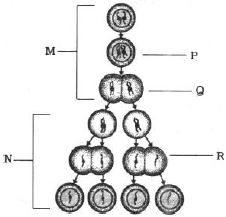
What process is indicated by the given figure?
A
Mitosis
B
Meiosis
C
Amitosis
D
All of the above
Solution
(B) The given figure shows two successive rounds of nuclear and cytoplasmic division,resulting in four daughter cells from a single parent cell.
This is the characteristic feature of meiosis,where a diploid cell undergoes two divisions (Meiosis-$I$ and Meiosis-$II$) to produce four haploid daughter cells.
In the figure,$M$ represents Meiosis-$I$ and $N$ represents Meiosis-$II$.
This is the characteristic feature of meiosis,where a diploid cell undergoes two divisions (Meiosis-$I$ and Meiosis-$II$) to produce four haploid daughter cells.
In the figure,$M$ represents Meiosis-$I$ and $N$ represents Meiosis-$II$.
0 likes
View Solution271
MediumMCQ
In the given figure,which process occurs in the cell labeled $P$?
A
$DNA$ replication
B
Splitting of centromere
C
Recombination
D
Both $(A)$ and $(C)$
Solution
(C) The provided figure illustrates the process of meiosis.
$M$ represents meiosis-$I$ and $N$ represents meiosis-$II$.
In meiosis-$I$,homologous chromosomes pair up and undergo recombination (crossing over) during prophase-$I$.
Cell $P$ is in the prophase-$I$ stage of meiosis-$I$,where the process of recombination occurs between homologous chromosomes.
Therefore,the correct process occurring in cell $P$ is recombination.
$M$ represents meiosis-$I$ and $N$ represents meiosis-$II$.
In meiosis-$I$,homologous chromosomes pair up and undergo recombination (crossing over) during prophase-$I$.
Cell $P$ is in the prophase-$I$ stage of meiosis-$I$,where the process of recombination occurs between homologous chromosomes.
Therefore,the correct process occurring in cell $P$ is recombination.
0 likes
View Solution272
MediumMCQ
In the given figure,what is the ploidy of the chromosomes in the cell labeled $Q$?
A
Diploid
B
Haploid
C
Both $(A)$ and $(B)$
D
None of these
Solution
(B) The provided figure represents the process of meiosis.
Meiosis $I$ $(M)$ is a reductional division where the diploid parent cell divides into two haploid daughter cells.
Cell $P$ represents the end of Meiosis $I$ (or late anaphase/telophase $I$),and cell $Q$ represents the two daughter cells formed after the completion of Meiosis $I$.
Since Meiosis $I$ reduces the chromosome number to half,the cells formed at stage $Q$ are haploid $(n)$.
Meiosis $I$ $(M)$ is a reductional division where the diploid parent cell divides into two haploid daughter cells.
Cell $P$ represents the end of Meiosis $I$ (or late anaphase/telophase $I$),and cell $Q$ represents the two daughter cells formed after the completion of Meiosis $I$.
Since Meiosis $I$ reduces the chromosome number to half,the cells formed at stage $Q$ are haploid $(n)$.
0 likes
View Solution273
MediumMCQ
In the given figure,what type of cell division is observed in the cell labeled $R$?
A
Mitosis
B
Meiosis
C
Amitosis
D
All $(a)$,$(b)$,and $(c)$
Solution
(B) The provided figure illustrates the process of meiosis.
$M$ represents meiosis-$I$,where the homologous chromosomes separate.
$N$ represents meiosis-$II$,which is similar to mitosis.
Specifically,the cell labeled $R$ is undergoing meiosis-$II$,where sister chromatids separate,resulting in the formation of haploid daughter cells.
$M$ represents meiosis-$I$,where the homologous chromosomes separate.
$N$ represents meiosis-$II$,which is similar to mitosis.
Specifically,the cell labeled $R$ is undergoing meiosis-$II$,where sister chromatids separate,resulting in the formation of haploid daughter cells.
0 likes
View Solution274
MediumMCQ
In the given figure,which phase is represented by the part labeled $M$?
A
Meiosis $II$
B
Cytokinesis
C
Meiosis $I$
D
None of these
Solution
(C) The provided figure illustrates the process of meiosis.
Meiosis is divided into two stages: Meiosis $I$ and Meiosis $II$.
In Meiosis $I$,homologous chromosomes separate,resulting in two haploid daughter cells. This is represented by the section labeled $M$.
Meiosis $II$ involves the separation of sister chromatids,similar to mitosis,resulting in four haploid daughter cells,which is represented by the section labeled $N$.
Therefore,the part labeled $M$ represents Meiosis $I$.
Meiosis is divided into two stages: Meiosis $I$ and Meiosis $II$.
In Meiosis $I$,homologous chromosomes separate,resulting in two haploid daughter cells. This is represented by the section labeled $M$.
Meiosis $II$ involves the separation of sister chromatids,similar to mitosis,resulting in four haploid daughter cells,which is represented by the section labeled $N$.
Therefore,the part labeled $M$ represents Meiosis $I$.
0 likes
View Solution275
MediumMCQ
In the given figure,which phase is represented by the part labeled $N$?
A
Meiosis $II$
B
Cytokinesis
C
Meiosis $I$
D
All $(a)$,$(b)$ and $(c)$
Solution
(A) The provided figure illustrates the process of meiosis.
Meiosis is divided into two main stages: Meiosis $I$ and Meiosis $II$.
The part labeled $M$ represents Meiosis $I$,where the homologous chromosomes separate,resulting in two haploid daughter cells.
The part labeled $N$ represents Meiosis $II$,which is similar to mitosis. In this stage,the sister chromatids separate,and the two haploid cells formed in Meiosis $I$ divide further to produce four haploid daughter cells.
Therefore,the part labeled $N$ indicates Meiosis $II$.
Meiosis is divided into two main stages: Meiosis $I$ and Meiosis $II$.
The part labeled $M$ represents Meiosis $I$,where the homologous chromosomes separate,resulting in two haploid daughter cells.
The part labeled $N$ represents Meiosis $II$,which is similar to mitosis. In this stage,the sister chromatids separate,and the two haploid cells formed in Meiosis $I$ divide further to produce four haploid daughter cells.
Therefore,the part labeled $N$ indicates Meiosis $II$.
0 likes
View Solution276
EasyMCQ
Which substage of Prophase $I$ is indicated by the given figure?

A
Zygotene
B
Leptotene
C
Pachytene
D
Diplotene
Solution
(B) The given figure shows the chromosomes appearing as thin,thread-like structures within the nucleus. This characteristic appearance,where chromosomes begin to condense and become visible as long,thin threads,is the hallmark of the Leptotene stage of Prophase $I$ in meiosis. During this stage,the chromosomes are not yet fully condensed,and the pairing of homologous chromosomes (synapsis) has not yet occurred,which distinguishes it from the subsequent Zygotene stage.
0 likes
View Solution277
MediumMCQ
Which of the following statements are correct regarding meiosis?
A
It is the division that occurs during the formation of gametes.
B
The genetic material replicates only once.
C
The cell divides twice.
D
All of the above.
Solution
(D) Meiosis is a specialized type of cell division that reduces the chromosome number by half,resulting in the production of haploid daughter cells.
$1$. It occurs during the formation of gametes (gametogenesis) in sexually reproducing organisms.
$2$. During the cell cycle,$DNA$ replication occurs only once during the $S$-phase of interphase,preceding the two successive nuclear divisions (Meiosis $I$ and Meiosis $II$).
$3$. The cell undergoes two successive divisions,resulting in four daughter cells.
Therefore,all the given statements are correct.
$1$. It occurs during the formation of gametes (gametogenesis) in sexually reproducing organisms.
$2$. During the cell cycle,$DNA$ replication occurs only once during the $S$-phase of interphase,preceding the two successive nuclear divisions (Meiosis $I$ and Meiosis $II$).
$3$. The cell undergoes two successive divisions,resulting in four daughter cells.
Therefore,all the given statements are correct.
0 likes
View Solution278
EasyMCQ
Find the mismatched pair.
A
Thin thread-like chromosomes - Leptotene
B
Synapsis process - Zygotene
C
Formation of chiasmata - Pachytene
D
Formation of bipolar spindle - Diplotene
Solution
(D) In Meiosis-$I$,Prophase-$I$ is divided into five sub-stages: Leptotene,Zygotene,Pachytene,Diplotene,and Diakinesis.
$1$. Leptotene: Chromosomes appear as thin,thread-like structures.
$2$. Zygotene: Homologous chromosomes pair up,a process known as synapsis.
$3$. Pachytene: Crossing over occurs between non-sister chromatids of homologous chromosomes. Chiasmata are $X$-shaped structures that become visible during the next stage,Diplotene.
$4$. Diplotene: The chiasmata become clearly visible as the homologous chromosomes begin to separate. The formation of the bipolar spindle typically occurs during Prometaphase or Metaphase,not Diplotene.
Therefore,the pair 'Formation of chiasmata - Pachytene' is technically mismatched because chiasmata are the physical manifestation of crossing over that becomes visible in Diplotene,and 'Formation of bipolar spindle - Diplotene' is also incorrect as it occurs later.
$1$. Leptotene: Chromosomes appear as thin,thread-like structures.
$2$. Zygotene: Homologous chromosomes pair up,a process known as synapsis.
$3$. Pachytene: Crossing over occurs between non-sister chromatids of homologous chromosomes. Chiasmata are $X$-shaped structures that become visible during the next stage,Diplotene.
$4$. Diplotene: The chiasmata become clearly visible as the homologous chromosomes begin to separate. The formation of the bipolar spindle typically occurs during Prometaphase or Metaphase,not Diplotene.
Therefore,the pair 'Formation of chiasmata - Pachytene' is technically mismatched because chiasmata are the physical manifestation of crossing over that becomes visible in Diplotene,and 'Formation of bipolar spindle - Diplotene' is also incorrect as it occurs later.
0 likes
View Solution279
MediumMCQ
What is the number of chromatids in each chromosome during synapsis?
A
$4$
B
$2$
C
$6$
D
$8$
Solution
(B) During the process of synapsis in Prophase-$I$ of Meiosis,homologous chromosomes pair up to form a bivalent or tetrad.
Each chromosome consists of two sister chromatids.
Since a bivalent consists of two homologous chromosomes,and each chromosome has two chromatids,the total number of chromatids in a bivalent is $2 + 2 = 4$.
Therefore,each chromosome involved in synapsis contains $2$ chromatids.
Each chromosome consists of two sister chromatids.
Since a bivalent consists of two homologous chromosomes,and each chromosome has two chromatids,the total number of chromatids in a bivalent is $2 + 2 = 4$.
Therefore,each chromosome involved in synapsis contains $2$ chromatids.
0 likes
View Solution280
MediumMCQ
What is the number of chromatids in a bivalent of homologous chromosomes during synapsis?
A
$4$
B
$2$
C
$6$
D
$8$
Solution
(A) During the process of meiosis,specifically in the pachytene stage of prophase-$I$,homologous chromosomes pair up to form a structure called a bivalent or tetrad.
Each chromosome consists of two sister chromatids.
Since a bivalent is composed of two homologous chromosomes,and each chromosome has two chromatids,the total number of chromatids in a bivalent is $2 + 2 = 4$.
Therefore,a bivalent is also known as a tetrad because it contains four chromatids.
Each chromosome consists of two sister chromatids.
Since a bivalent is composed of two homologous chromosomes,and each chromosome has two chromatids,the total number of chromatids in a bivalent is $2 + 2 = 4$.
Therefore,a bivalent is also known as a tetrad because it contains four chromatids.
0 likes
View Solution281
MediumMCQ
In meiosis,at which stage does the chromosome number actually become halved?
A
Metaphase-$I$
B
Anaphase-$I$
C
Metaphase-$II$
D
Anaphase-$II$
Solution
(B) Meiosis is a reductional division that occurs in two stages: Meiosis-$I$ and Meiosis-$II$.
During Anaphase-$I$,the homologous chromosomes separate and move to opposite poles,while the sister chromatids remain attached at the centromere.
As a result,each pole receives only half the number of chromosomes compared to the parent cell.
Therefore,the reduction in chromosome number from diploid $(2n)$ to haploid $(n)$ is completed during Anaphase-$I$.
During Anaphase-$I$,the homologous chromosomes separate and move to opposite poles,while the sister chromatids remain attached at the centromere.
As a result,each pole receives only half the number of chromosomes compared to the parent cell.
Therefore,the reduction in chromosome number from diploid $(2n)$ to haploid $(n)$ is completed during Anaphase-$I$.
0 likes
View Solution282
EasyMCQ
In the $Anaphase-II$ stage,.........
A
Homologous chromosomes separate.
B
Sister chromatids separate due to the splitting of the centromere.
C
The number of chromosomes is halved.
D
None of the above.
Solution
(B) During $Meiosis-II$,the $Anaphase-II$ stage is characterized by the splitting of the centromere of each chromosome.
This allows the sister chromatids to separate and move towards opposite poles of the cell.
This process is similar to the $Anaphase$ of $Mitosis$.
Therefore,the correct statement is that sister chromatids separate due to the splitting of the centromere.
This allows the sister chromatids to separate and move towards opposite poles of the cell.
This process is similar to the $Anaphase$ of $Mitosis$.
Therefore,the correct statement is that sister chromatids separate due to the splitting of the centromere.
0 likes
View Solution283
MediumMCQ
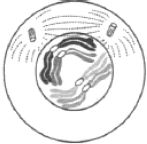
Which stage of meiosis is shown in the figure below?
A
Leptotene
B
Zygotene
C
Pachytene
D
Diakinesis
Solution
(B) The figure shows the pairing of homologous chromosomes,a process known as synapsis.
This pairing of homologous chromosomes is the characteristic feature of the Zygotene stage of Prophase-$I$ of meiosis.
During this stage,the formation of synaptonemal complexes occurs between the homologous chromosomes.
This pairing of homologous chromosomes is the characteristic feature of the Zygotene stage of Prophase-$I$ of meiosis.
During this stage,the formation of synaptonemal complexes occurs between the homologous chromosomes.
0 likes
View Solution284
MediumMCQ
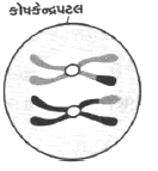
At the end of which stage of Prophase-$I$ do homologous chromosomes appear as shown in the figure?
A
Leptotene
B
Zygotene
C
Pachytene
D
Diakinesis
Solution
(C) The figure shows homologous chromosomes that have undergone crossing over,as evidenced by the exchange of segments between non-sister chromatids. Crossing over is the characteristic feature of the Pachytene stage of Prophase-$I$ in Meiosis. During this stage,the bivalent chromosomes clearly appear as tetrads,and the recombination nodules facilitate the exchange of genetic material.
0 likes
View Solution285
MediumMCQ
Match the stages of meiosis in Column-$I$ to their characteristic features in Column-$II$ and select the correct option using the codes given below.
| Column-$I$ | Column-$II$ |
| $(A)$ Pachytene | $(i)$ Pairing of homologous chromosomes |
| $(B)$ Metaphase-$I$ | $(ii)$ Terminalisation of chiasmata |
| $(C)$ Diakinesis | $(iii)$ Crossing-over takes place |
| $(D)$ Zygotene | $(iv)$ Chromosomes align at equatorial plate |
A
$A-(iii), B-(iv), C-(ii), D-(i)$
B
$A-(i), B-(iv), C-(ii), D-(iii)$
C
$A-(ii), B-(iv), C-(iii), D-(i)$
D
$A-(iv), B-(iii), C-(ii), D-(i)$
Solution
(A) The correct matching is as follows:
$(A)$ Pachytene: During this stage, crossing-over occurs between non-sister chromatids of homologous chromosomes $(iii)$.
$(B)$ Metaphase-$I$: During this stage, the bivalent chromosomes align at the equatorial plate $(iv)$.
$(C)$ Diakinesis: This is the final stage of meiotic prophase-$I$, characterized by the terminalisation of chiasmata $(ii)$.
$(D)$ Zygotene: During this stage, the pairing of homologous chromosomes occurs, known as synapsis $(i)$.
Thus, the correct sequence is $A-(iii), B-(iv), C-(ii), D-(i)$.
$(A)$ Pachytene: During this stage, crossing-over occurs between non-sister chromatids of homologous chromosomes $(iii)$.
$(B)$ Metaphase-$I$: During this stage, the bivalent chromosomes align at the equatorial plate $(iv)$.
$(C)$ Diakinesis: This is the final stage of meiotic prophase-$I$, characterized by the terminalisation of chiasmata $(ii)$.
$(D)$ Zygotene: During this stage, the pairing of homologous chromosomes occurs, known as synapsis $(i)$.
Thus, the correct sequence is $A-(iii), B-(iv), C-(ii), D-(i)$.
0 likes
View Solution286
MediumMCQ
Which of the following is not a characteristic feature during mitosis in somatic cells?
A
Chromosome movement
B
Synapsis
C
Spindle fibres
D
Disappearance of nucleolus
Solution
(B) : Synapsis is the process of pairing of homologous chromosomes. It occurs specifically during the zygotene stage of prophase $I$ of meiosis. This phenomenon is not observed during mitosis,as mitosis involves the division of somatic cells without the pairing of homologous chromosomes.
0 likes
View Solution287
MediumMCQ
In meiosis,crossing over is initiated at:
A
zygotene
B
diplotene
C
pachytene
D
leptotene
Solution
(C) : Crossing over is a process of exchange of genetic material or chromatid segments between two homologous chromosomes. It is initiated during the pachytene stage of meiosis $I$.
0 likes
View Solution288
MediumMCQ
Arrange the following events of meiosis in the correct sequence:
$(i)$ Crossing over
$(ii)$ Synapsis
$(iii)$ Terminalisation of chiasmata
$(iv)$ Disappearance of nucleolus
$(i)$ Crossing over
$(ii)$ Synapsis
$(iii)$ Terminalisation of chiasmata
$(iv)$ Disappearance of nucleolus
A
$(i), (ii), (iii), (iv)$
B
$(ii), (iii), (iv), (i)$
C
$(ii), (i), (iv), (iii)$
D
$(ii), (i), (iii), (iv)$
Solution
(D) The correct sequence is $(ii), (i), (iii), (iv)$.
Prophase-$I$ of meiosis is divided into five sub-stages: Leptotene,Zygotene,Pachytene,Diplotene,and Diakinesis.
$(ii)$ Synapsis (pairing of homologous chromosomes) occurs during the Zygotene stage.
$(i)$ Crossing over (exchange of genetic material between non-sister chromatids) occurs during the Pachytene stage.
$(iii)$ Terminalisation of chiasmata (shifting of chiasmata towards the ends of chromosomes) occurs during the Diakinesis stage.
$(iv)$ Disappearance of the nucleolus also occurs during the Diakinesis stage,marking the end of Prophase-$I$.
Prophase-$I$ of meiosis is divided into five sub-stages: Leptotene,Zygotene,Pachytene,Diplotene,and Diakinesis.
$(ii)$ Synapsis (pairing of homologous chromosomes) occurs during the Zygotene stage.
$(i)$ Crossing over (exchange of genetic material between non-sister chromatids) occurs during the Pachytene stage.
$(iii)$ Terminalisation of chiasmata (shifting of chiasmata towards the ends of chromosomes) occurs during the Diakinesis stage.
$(iv)$ Disappearance of the nucleolus also occurs during the Diakinesis stage,marking the end of Prophase-$I$.
0 likes
View Solution289
MediumMCQ
The enzyme recombinase is required at which stage of meiosis?
A
Pachytene
B
Zygotene
C
Diplotene
D
Diakinesis
Solution
(A) The $Pachytene$ stage is characterized by the appearance of recombination nodules,which are the sites where crossing over occurs between non-sister chromatids of homologous chromosomes.
These nodules contain a multienzyme complex known as $Recombinase$.
$Recombinase$ is composed of various enzymes such as endonuclease,exonuclease,unwindase,and $R$-protein,which facilitate the exchange of genetic material.
These nodules contain a multienzyme complex known as $Recombinase$.
$Recombinase$ is composed of various enzymes such as endonuclease,exonuclease,unwindase,and $R$-protein,which facilitate the exchange of genetic material.
0 likes
View Solution290
MediumMCQ
The complex formed by a pair of synapsed homologous chromosomes is called
A
bivalent
B
axoneme
C
equatorial plate
D
kinetochore
Solution
(A) During the $zygotene$ stage of $Meiosis-I$,homologous chromosomes start pairing together,a process known as $synapsis$.
These paired chromosomes are referred to as homologous chromosomes.
The electron micrographs of this stage reveal that the pairing is accompanied by the formation of a complex structure known as the $synaptonemal$ $complex$.
The complex formed by a pair of synapsed homologous chromosomes is specifically called a $bivalent$ or a $tetrad$.
These paired chromosomes are referred to as homologous chromosomes.
The electron micrographs of this stage reveal that the pairing is accompanied by the formation of a complex structure known as the $synaptonemal$ $complex$.
The complex formed by a pair of synapsed homologous chromosomes is specifically called a $bivalent$ or a $tetrad$.
0 likes
View Solution291
MediumMCQ
During meiosis $I$,the chromosomes start pairing at
A
zygotene
B
pachytene
C
diplotene
D
leptotene
Solution
(A) The correct answer is $A$.
During the $zygotene$ stage of prophase $I$ of meiosis,the chromosomes begin to pair up.
This process of pairing of homologous chromosomes is known as $synapsis$.
Each pair of homologous chromosomes is referred to as a $bivalent$ or a $tetrad$.
During the $zygotene$ stage of prophase $I$ of meiosis,the chromosomes begin to pair up.
This process of pairing of homologous chromosomes is known as $synapsis$.
Each pair of homologous chromosomes is referred to as a $bivalent$ or a $tetrad$.
0 likes
View Solution292
MediumMCQ
During gamete formation,the enzyme recombinase participates during
A
metaphase $I$
B
anaphase $II$
C
prophase $I$
D
prophase $II$
Solution
(C) The correct answer is $C$.
During gamete formation,the enzyme recombinase participates during the pachytene stage of prophase $I$.
This stage is characterized by the appearance of recombination nodules,which are the sites where crossing over occurs between non-sister chromatids of homologous chromosomes.
Crossing over is the exchange of genetic material between two homologous chromosomes.
Crossing over is an enzyme-mediated process,and the enzyme involved in this process is called recombinase.
During gamete formation,the enzyme recombinase participates during the pachytene stage of prophase $I$.
This stage is characterized by the appearance of recombination nodules,which are the sites where crossing over occurs between non-sister chromatids of homologous chromosomes.
Crossing over is the exchange of genetic material between two homologous chromosomes.
Crossing over is an enzyme-mediated process,and the enzyme involved in this process is called recombinase.
0 likes
View Solution293
MediumMCQ
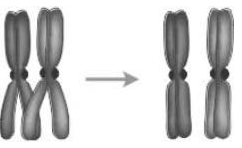
The given figure is the representation of a certain event at a particular stage of a type of cell division. Which is this stage?
A
Prophase $I$ during meiosis
B
Prophase $II$ during meiosis
C
Prophase of mitosis
D
Both prophase and metaphase of mitosis
Solution
(A) The given figure shows crossing over,$i.e.$,the exchange of genetic segments between two non-sister chromatids of homologous chromosomes.
Crossing over is a characteristic feature of meiosis and occurs specifically during the pachytene stage of prophase $I$.
Crossing over is a characteristic feature of meiosis and occurs specifically during the pachytene stage of prophase $I$.
0 likes
View Solution294
MediumMCQ
Identify the meiotic stage in which the homologous chromosomes separate while the sister chromatids remain associated at their centromeres.
A
Metaphase $I$
B
Metaphase $II$
C
Anaphase $I$
D
Anaphase $II$
Solution
(C) During $Anaphase I$,the homologous chromosomes of each bivalent (tetrad) separate and move toward opposite poles of the cell.
In this stage,the sister chromatids remain associated at their centromeres,meaning the centromeres do not split.
This process ensures that each pole receives only one chromosome from each homologous pair,effectively reducing the chromosome number by half.
In contrast,during $Anaphase II$,the centromeres split and sister chromatids separate.
In this stage,the sister chromatids remain associated at their centromeres,meaning the centromeres do not split.
This process ensures that each pole receives only one chromosome from each homologous pair,effectively reducing the chromosome number by half.
In contrast,during $Anaphase II$,the centromeres split and sister chromatids separate.
0 likes
View Solution295
EasyMCQ
Synapsis occurs between
A
$mRNA$ and ribosomes
B
spindle fibres and centromere
C
two homologous chromosomes
D
a male and a female gamete.
Solution
(C) The correct answer is $C$.
During the $zygotene$ or $zygonema$ stage of meiotic $prophase-I$, the chromosomes become shorter and thicker.
The homologous chromosomes come to lie side-by-side in pairs.
This pairing of homologous chromosomes is known as $synapsis$ or $syndesis$.
$A$ pair of homologous chromosomes lying together is called a $bivalent$.
During the $zygotene$ or $zygonema$ stage of meiotic $prophase-I$, the chromosomes become shorter and thicker.
The homologous chromosomes come to lie side-by-side in pairs.
This pairing of homologous chromosomes is known as $synapsis$ or $syndesis$.
$A$ pair of homologous chromosomes lying together is called a $bivalent$.
0 likes
View Solution296
MediumMCQ
Meiosis can be observed in
A
Primary spermatocytes
B
Secondary spermatocytes
C
Both $A$ and $B$
D
Mature sperm
Solution
(C) Meiosis is a type of cell division that reduces the chromosome number by half.
In the process of spermatogenesis,the $2n$ primary spermatocytes undergo Meiosis-$I$ to form two haploid $(n)$ secondary spermatocytes.
These secondary spermatocytes then undergo Meiosis-$II$ to form spermatids,which eventually differentiate into mature sperm.
Therefore,Meiosis-$I$ occurs in primary spermatocytes and Meiosis-$II$ occurs in secondary spermatocytes.
Thus,both primary and secondary spermatocytes are involved in the process of meiosis.
In the process of spermatogenesis,the $2n$ primary spermatocytes undergo Meiosis-$I$ to form two haploid $(n)$ secondary spermatocytes.
These secondary spermatocytes then undergo Meiosis-$II$ to form spermatids,which eventually differentiate into mature sperm.
Therefore,Meiosis-$I$ occurs in primary spermatocytes and Meiosis-$II$ occurs in secondary spermatocytes.
Thus,both primary and secondary spermatocytes are involved in the process of meiosis.
0 likes
View Solution297
EasyMCQ
Synapsis occurs during:
A
Zygotene
B
Diakinesis
C
Leptotene
D
Interphase
Solution
(A) Synapsis is the pairing of homologous chromosomes that occurs during the $Zygotene$ stage of $Prophase-I$ in meiosis.
During this stage,chromosomes start pairing together,and this process of association is called synapsis.
Such paired chromosomes are called homologous chromosomes.
$Leptotene$ is the stage where chromosomes become visible.
$Diakinesis$ is the final stage of meiotic prophase $I$ where terminalization of chiasmata occurs.
$Interphase$ is the phase between two successive cell divisions.
During this stage,chromosomes start pairing together,and this process of association is called synapsis.
Such paired chromosomes are called homologous chromosomes.
$Leptotene$ is the stage where chromosomes become visible.
$Diakinesis$ is the final stage of meiotic prophase $I$ where terminalization of chiasmata occurs.
$Interphase$ is the phase between two successive cell divisions.
0 likes
View Solution298
MediumMCQ
Choose the correct pair:
A
Telophase-$I$ $\rightarrow$ Nuclear membrane and nucleolus reappear.
B
Anaphase-$II$ $\rightarrow$ Chromosomes align at the equator.
C
Metaphase-$II$ $\rightarrow$ Splitting of the centromere of each chromosome.
D
Prophase-$II$ $\rightarrow$ Chromatids move towards opposite poles of the cell.
Solution
(A) In Telophase-$I$,the nuclear membrane and nucleolus reappear,and the chromosomes undergo some decondensation. This is a correct description of the phase.
In Anaphase-$II$,the centromeres split and sister chromatids move towards opposite poles,not alignment at the equator.
In Metaphase-$II$,chromosomes align at the equator,not the splitting of the centromere.
In Prophase-$II$,the nuclear membrane disappears and chromosomes condense,not the movement of chromatids to poles.
In Anaphase-$II$,the centromeres split and sister chromatids move towards opposite poles,not alignment at the equator.
In Metaphase-$II$,chromosomes align at the equator,not the splitting of the centromere.
In Prophase-$II$,the nuclear membrane disappears and chromosomes condense,not the movement of chromatids to poles.
0 likes
View Solution299
MediumMCQ
Identify the given figure:
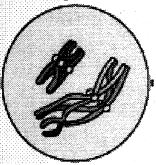
A
Prophase $- I$
B
Metaphase $- II$
C
Telophase
D
Cytokinesis
Solution
(A) The provided figure shows homologous chromosomes pairing up and forming bivalents or tetrads.
This pairing process,known as synapsis,is a characteristic feature of the prophase stage of meiosis $- I$.
Specifically,it occurs during the zygotene sub-stage of prophase $- I$.
Therefore,the correct identification for the given figure is prophase $- I$.
This pairing process,known as synapsis,is a characteristic feature of the prophase stage of meiosis $- I$.
Specifically,it occurs during the zygotene sub-stage of prophase $- I$.
Therefore,the correct identification for the given figure is prophase $- I$.
0 likes
View SolutionCell Cycle and Cell Division — Meiosis · Frequently Asked Questions
1Are these Cell Cycle and Cell Division questions useful for JEE and NEET?
Yes. All questions in this section are mapped to JEE Main and NEET exam patterns. Previous year questions from JEE Main, NEET, GUJCET and state-level exams are included with full solutions.
2Can I switch to Hindi or Gujarati for these questions?
Yes. Use the language tabs in the hero section or the sidebar to view the same questions and solutions in English, Hindi or Gujarati.
3How do I generate a question paper from this subtopic?
Use the Vedclass Exam Paper Generator — select the chapter and subtopic, set difficulty, and generate Sets A, B, C, D automatically. First 3 chapters of every subject are free.
Vedclass Products
For Students
Vedclass Test Series
Mock tests in real JEE/NEET style with performance analysis. 5-day free trial.
Start Free TrialFor Teachers
Exam Paper Generator
Generate Set A/B/C/D papers from this chapter in 2 minutes. 3 chapters free.
Try FreeFor Institutes
Online Exam Module
Live online exams with unlimited students, 360° analytics & white-label branding.
See DemoFor Teachers & Institutes
Generate a Cell Cycle and Cell Division Exam Paper in 2 Minutes
Select subtopic & difficulty — Sets A, B, C, D auto-generated with No Repeat logic.
First 3 chapters of every subject are free — no payment required.