
A English
Transport of gases Questions in English
Class 11 Biology · Breathing and Exchange of Gases · Transport of gases
251+
Questions
English
Language
100%
With Solutions
Showing 50 of 251 questions in English
151
MediumMCQ
$A$ major percentage $(97 \%)$ of $O_{2}$ is transported by RBCs in the blood. How is the remaining percentage $(3 \%)$ of $O_{2}$ transported?
A
Bound to hemoglobin
B
Dissolved in blood plasma
C
As bicarbonate ions
D
Bound to plasma proteins
Solution
(B) In the human body,$97 \%$ of $O_{2}$ is transported by erythrocytes (RBCs) in the form of oxyhemoglobin.
The remaining $3 \%$ of $O_{2}$ is transported in a dissolved state through the blood plasma.
The remaining $3 \%$ of $O_{2}$ is transported in a dissolved state through the blood plasma.
0 likes
View Solution152
Medium
State the different modes of $CO_{2}$ transport in blood.
Solution
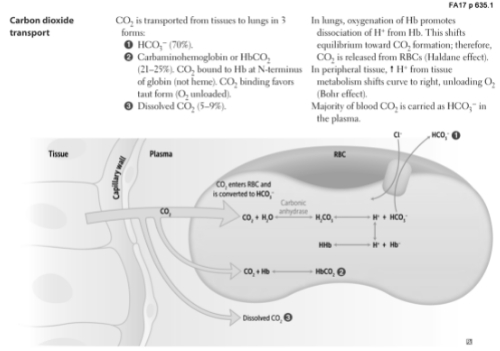
(N/A) $CO_{2}$ is carried by blood in three main forms:
$1$. As Carbamino-haemoglobin: About $20-25$ percent of $CO_{2}$ is carried by haemoglobin. This binding is related to the partial pressure of $CO_{2}$. $pO_{2}$ is a major factor which affects this binding. When $pCO_{2}$ is high and $pO_{2}$ is low (as in tissues),more $CO_{2}$ binds to haemoglobin. Conversely,when $pCO_{2}$ is low and $pO_{2}$ is high (as in alveoli),$CO_{2}$ dissociates from haemoglobin.
$2$. As Bicarbonates: About $70$ percent of $CO_{2}$ is transported as bicarbonates $(HCO_{3}^{-})$. $RBCs$ contain a high concentration of the enzyme carbonic anhydrase,which facilitates the reaction: $CO_{2} + H_{2}O \rightleftharpoons H_{2}CO_{3} \rightleftharpoons HCO_{3}^{-} + H^{+}$. At the tissue site,$CO_{2}$ diffuses into blood and forms $HCO_{3}^{-}$ and $H^{+}$. At the alveolar site,the reaction proceeds in the opposite direction to release $CO_{2}$.
$3$. Dissolved in Plasma: About $7$ percent of $CO_{2}$ is carried in a dissolved state through the blood plasma.
$1$. As Carbamino-haemoglobin: About $20-25$ percent of $CO_{2}$ is carried by haemoglobin. This binding is related to the partial pressure of $CO_{2}$. $pO_{2}$ is a major factor which affects this binding. When $pCO_{2}$ is high and $pO_{2}$ is low (as in tissues),more $CO_{2}$ binds to haemoglobin. Conversely,when $pCO_{2}$ is low and $pO_{2}$ is high (as in alveoli),$CO_{2}$ dissociates from haemoglobin.
$2$. As Bicarbonates: About $70$ percent of $CO_{2}$ is transported as bicarbonates $(HCO_{3}^{-})$. $RBCs$ contain a high concentration of the enzyme carbonic anhydrase,which facilitates the reaction: $CO_{2} + H_{2}O \rightleftharpoons H_{2}CO_{3} \rightleftharpoons HCO_{3}^{-} + H^{+}$. At the tissue site,$CO_{2}$ diffuses into blood and forms $HCO_{3}^{-}$ and $H^{+}$. At the alveolar site,the reaction proceeds in the opposite direction to release $CO_{2}$.
$3$. Dissolved in Plasma: About $7$ percent of $CO_{2}$ is carried in a dissolved state through the blood plasma.
0 likes
View Solution153
EasyMCQ
Identify the wrong statement with reference to transport of oxygen.
A
Low $pCO_2$ in alveoli favours the formation of oxyhaemoglobin.
B
Binding of oxygen with haemoglobin is mainly related to partial pressure of $O_2$.
C
Partial pressure of $CO_2$ can interfere with $O_2$ binding with haemoglobin.
D
Higher $H^+$ conc. in alveoli favours the formation of oxyhaemoglobin.
Solution
(D) The correct answer is $D$.
In the alveoli,conditions are favourable for the formation of oxyhaemoglobin,which include high $pO_2$,low $pCO_2$,low $H^+$ concentration,and lower temperature.
Conversely,in the tissues,low $pO_2$,high $pCO_2$,high $H^+$ concentration,and higher temperature favour the dissociation of oxygen from oxyhaemoglobin.
Therefore,a higher $H^+$ concentration in the alveoli would actually inhibit the formation of oxyhaemoglobin,making statement $D$ incorrect.
In the alveoli,conditions are favourable for the formation of oxyhaemoglobin,which include high $pO_2$,low $pCO_2$,low $H^+$ concentration,and lower temperature.
Conversely,in the tissues,low $pO_2$,high $pCO_2$,high $H^+$ concentration,and higher temperature favour the dissociation of oxygen from oxyhaemoglobin.
Therefore,a higher $H^+$ concentration in the alveoli would actually inhibit the formation of oxyhaemoglobin,making statement $D$ incorrect.
0 likes
View Solution154
MediumMCQ
Identify the incorrect statement regarding the transport of oxygen:
A
The binding of oxygen with hemoglobin is primarily related to the partial pressure of $O_2$.
B
The partial pressure of $CO_2$ interferes with the binding of $O_2$ with hemoglobin.
C
High concentration of $H^+$ in the alveoli helps in the formation of oxyhemoglobin.
D
Low $P_{CO_2}$ in the alveoli helps in the formation of oxyhemoglobin.
Solution
(C) The formation of oxyhemoglobin is favored in the alveoli where there is high $P_{O_2}$,low $P_{CO_2}$,low $H^+$ concentration,and lower temperature.
Conversely,in the tissues,high $P_{CO_2}$,high $H^+$ concentration,and high temperature favor the dissociation of oxyhemoglobin.
Therefore,the statement that 'High concentration of $H^+$ in the alveoli helps in the formation of oxyhemoglobin' is incorrect,as high $H^+$ concentration promotes dissociation,not formation.
Conversely,in the tissues,high $P_{CO_2}$,high $H^+$ concentration,and high temperature favor the dissociation of oxyhemoglobin.
Therefore,the statement that 'High concentration of $H^+$ in the alveoli helps in the formation of oxyhemoglobin' is incorrect,as high $H^+$ concentration promotes dissociation,not formation.
0 likes
View Solution155
EasyMCQ
Each haemoglobin molecule can carry a maximum of
A
Two molecules of $O_{2}$
B
Three molecules of $O_{2}$
C
Four molecules of $O_{2}$
D
One molecule of $O_{2}$
Solution
(C) Each haemoglobin molecule can carry a maximum of four molecules of $O_{2}$.
The reaction is represented as: $Hb_{4} + 4O_{2} \rightarrow Hb_{4}O_{8}$.
Binding of oxygen with haemoglobin is primarily related to the partial pressure of $O_{2}$,partial pressure of $CO_{2}$,hydrogen ion concentration,and temperature.
The reaction is represented as: $Hb_{4} + 4O_{2} \rightarrow Hb_{4}O_{8}$.
Binding of oxygen with haemoglobin is primarily related to the partial pressure of $O_{2}$,partial pressure of $CO_{2}$,hydrogen ion concentration,and temperature.
0 likes
View Solution156
MediumMCQ
$CO_{2}$ diffuses into ...$A$... and forms $HCO_{3}^{-}$ and $H^{+}$. At the ...$B$... site where $pCO_{2}$ is low, the reaction proceeds in the opposite direction.
Thus, $CO_{2}$ is trapped as ...$C$... at the tissue level and transported to alveoli is released out as ...$D$...
Select the right choice for $A, B, C$ and $D$ to complete the given $NCERT$ statement.
Thus, $CO_{2}$ is trapped as ...$C$... at the tissue level and transported to alveoli is released out as ...$D$...
Select the right choice for $A, B, C$ and $D$ to complete the given $NCERT$ statement.
A
$A-$ $WBC$, $B-$ diffusion, $C-$ carbonate, $D-$ $O_{2}$
B
$A-$ $RBC$, $B-$ alveolar, $C-$ bicarbonate, $D-$ $CO_{2}$
C
$A-$ $RBC$, $B-$ alveolar, $C-$ bicarbonate, $D-$ $O_{2}$
D
$A-$ $RBC$, $B-$ alveolar, $C-$ carbonate, $D-$ $CO_{2}$
Solution
(B) The transport of $CO_{2}$ occurs primarily in the form of bicarbonate ions $(HCO_{3}^{-})$.
$1$. At the tissue level, $CO_{2}$ produced by metabolic activities diffuses into the blood and enters the Red Blood Cells $(RBCs)$ $(A = RBC)$.
$2$. Inside the $RBCs$, $CO_{2}$ reacts with water in the presence of the enzyme carbonic anhydrase to form $HCO_{3}^{-}$ and $H^{+}$ $(C = \text{bicarbonate})$.
$3$. This blood is transported to the lungs. At the alveolar site, the partial pressure of $CO_{2}$ $(pCO_{2})$ is low $(B = \text{alveolar})$.
$4$. Due to low $pCO_{2}$, the reaction proceeds in the opposite direction, converting $HCO_{3}^{-}$ back into $CO_{2}$, which is then released into the alveoli and exhaled $(D = CO_{2})$.
Therefore, the correct sequence is $A = RBC, B = \text{alveolar}, C = \text{bicarbonate}, D = CO_{2}$.
$1$. At the tissue level, $CO_{2}$ produced by metabolic activities diffuses into the blood and enters the Red Blood Cells $(RBCs)$ $(A = RBC)$.
$2$. Inside the $RBCs$, $CO_{2}$ reacts with water in the presence of the enzyme carbonic anhydrase to form $HCO_{3}^{-}$ and $H^{+}$ $(C = \text{bicarbonate})$.
$3$. This blood is transported to the lungs. At the alveolar site, the partial pressure of $CO_{2}$ $(pCO_{2})$ is low $(B = \text{alveolar})$.
$4$. Due to low $pCO_{2}$, the reaction proceeds in the opposite direction, converting $HCO_{3}^{-}$ back into $CO_{2}$, which is then released into the alveoli and exhaled $(D = CO_{2})$.
Therefore, the correct sequence is $A = RBC, B = \text{alveolar}, C = \text{bicarbonate}, D = CO_{2}$.
0 likes
View Solution157
EasyMCQ
The movement of chloride ions into erythrocytes from the plasma to maintain osmotic balance during transport of gases is known as
A
Chlorination
B
Hamburger phenomenon
C
Bicarbonate shift
D
Carbon dioxide transport
Solution
(B) During the transport of $CO_2$,bicarbonate ions $(HCO_3^-)$ formed in the erythrocytes diffuse out into the plasma. To maintain the electrical neutrality of the cells,chloride ions $(Cl^-)$ move from the plasma into the erythrocytes. This process is known as the chloride shift or the Hamburger phenomenon.
0 likes
View Solution158
MediumMCQ
Under normal conditions,what amount of $O_{2}$ is delivered to the tissues by $100\; mL$ of oxygenated blood (in $; mL$)?
A
$5$
B
$4$
C
$3$
D
$2$
Solution
(A) Under normal physiological conditions,$100\; mL$ of oxygenated blood carries approximately $20\; mL$ of $O_{2}$.
Out of this,it delivers approximately $5\; mL$ of $O_{2}$ to the tissues during each circulatory cycle.
Therefore,the correct answer is $5\; mL$.
Out of this,it delivers approximately $5\; mL$ of $O_{2}$ to the tissues during each circulatory cycle.
Therefore,the correct answer is $5\; mL$.
0 likes
View Solution159
MediumMCQ
Carbon dioxide is transported in blood in the form of
A
Haemoglobin
B
Oxyhaemoglobin
C
Carbonate
D
Bicarbonate
Solution
(D) About $7 \%$ of carbon dioxide is transported as dissolved in plasma,$23 \%$ as carbaminohaemoglobin,and $70 \%$ as bicarbonates.
Most of the carbon dioxide that dissolves in blood plasma reacts with water to form carbonic acid.
All carbonic acid in $RBCs$ dissociates into hydrogen and bicarbonate ions,and these bicarbonate ions diffuse from $RBCs$ into the blood plasma.
Most of the carbon dioxide that dissolves in blood plasma reacts with water to form carbonic acid.
All carbonic acid in $RBCs$ dissociates into hydrogen and bicarbonate ions,and these bicarbonate ions diffuse from $RBCs$ into the blood plasma.
0 likes
View Solution160
EasyMCQ
Which of the following combines irreversibly with blood haemoglobin?
A
$SO_2$
B
$O_2$
C
$CO$
D
$CO_2$
Solution
(C) Carbon monoxide $(CO)$ has a very high affinity for haemoglobin,approximately $250$ times greater than that of oxygen $(O_2)$.
When $CO$ binds to haemoglobin,it forms a stable compound called carboxyhaemoglobin.
This binding is essentially irreversible under normal physiological conditions,which prevents haemoglobin from transporting oxygen to the body tissues,leading to carbon monoxide poisoning.
When $CO$ binds to haemoglobin,it forms a stable compound called carboxyhaemoglobin.
This binding is essentially irreversible under normal physiological conditions,which prevents haemoglobin from transporting oxygen to the body tissues,leading to carbon monoxide poisoning.
0 likes
View Solution161
MediumMCQ
Haemoglobin $(Hb)$ is a
A
Reproductive pigment
B
Respiratory pigment
C
Carbohydrate
D
Fat
Solution
(B) Haemoglobin $(Hb)$ is an iron-containing,deep red-coloured respiratory pigment found in red blood cells.
It plays a crucial role in the transport of oxygen from the lungs to the tissues and carbon dioxide from the tissues back to the lungs.
When it combines with oxygen,it forms oxyhaemoglobin,which gives it a bright red colour.
It plays a crucial role in the transport of oxygen from the lungs to the tissues and carbon dioxide from the tissues back to the lungs.
When it combines with oxygen,it forms oxyhaemoglobin,which gives it a bright red colour.
0 likes
View Solution162
MediumMCQ
Transport of $CO_{2}$ by the blood is primarily dependent upon
A
Solubility of $CO_{2}$ in blood
B
Carbonic anhydrase
C
Binding of haemoglobin to $CO_{2}$
D
Binding of haemoglobin to $O_{2}$
Solution
(B) The transport of $CO_{2}$ by blood is primarily dependent upon the enzyme $\text{Carbonic Anhydrase}$.
About $70\%$ of $CO_{2}$ is transported as bicarbonate ions $(HCO_{3}^{-})$.
In the erythrocytes, $CO_{2}$ reacts with water to form carbonic acid $(H_{2}CO_{3})$ in the presence of the enzyme $\text{Carbonic Anhydrase}$.
This $H_{2}CO_{3}$ then dissociates into $H^{+}$ and $HCO_{3}^{-}$ ions.
The reaction is: $CO_{2} + H_{2}O \xrightarrow{\text{Carbonic Anhydrase}} H_{2}CO_{3} \rightleftharpoons HCO_{3}^{-} + H^{+}$.
About $70\%$ of $CO_{2}$ is transported as bicarbonate ions $(HCO_{3}^{-})$.
In the erythrocytes, $CO_{2}$ reacts with water to form carbonic acid $(H_{2}CO_{3})$ in the presence of the enzyme $\text{Carbonic Anhydrase}$.
This $H_{2}CO_{3}$ then dissociates into $H^{+}$ and $HCO_{3}^{-}$ ions.
The reaction is: $CO_{2} + H_{2}O \xrightarrow{\text{Carbonic Anhydrase}} H_{2}CO_{3} \rightleftharpoons HCO_{3}^{-} + H^{+}$.
0 likes
View Solution163
MediumMCQ
Identify the correct group of statements:
$I.$ Oxygen is carried by haemoglobin
$II.$ Oxygen is carried by carbonic anhydrase
$III.$ $CO_{2}$ is carried by haemoglobin
$IV.$ $SO_{2}$ is carried by haemoglobin
$V.$ Only oxygen is transported by the blood
$VI.$ Only $CO_{2}$ is transported by the blood
Choose the correct option.
$I.$ Oxygen is carried by haemoglobin
$II.$ Oxygen is carried by carbonic anhydrase
$III.$ $CO_{2}$ is carried by haemoglobin
$IV.$ $SO_{2}$ is carried by haemoglobin
$V.$ Only oxygen is transported by the blood
$VI.$ Only $CO_{2}$ is transported by the blood
Choose the correct option.
A
$I$ and $VI$
B
$II$ and $III$
C
$IV$ and $V$
D
$I$ and $III$
Solution
(D) Haemoglobin is a respiratory pigment present in red blood cells that plays a crucial role in gas transport.
$I.$ Oxygen binds to haemoglobin to form oxyhaemoglobin,which is the primary method of oxygen transport.
$III.$ Carbon dioxide is also transported by haemoglobin in the form of carbamino-haemoglobin (about $20-25\%$).
Therefore,statements $I$ and $III$ are correct.
$I.$ Oxygen binds to haemoglobin to form oxyhaemoglobin,which is the primary method of oxygen transport.
$III.$ Carbon dioxide is also transported by haemoglobin in the form of carbamino-haemoglobin (about $20-25\%$).
Therefore,statements $I$ and $III$ are correct.
0 likes
View Solution164
MediumMCQ
Chloride shift occurs in response to
A
$HCO_{3}^{-}$
B
$K^{+}$
C
$H^{+}$
D
$Na^{+}$
Solution
(A) Chloride shift,also known as the Hamburger phenomenon,occurs in response to the movement of $HCO_{3}^{-}$ ions.
To maintain the electrostatic neutrality of the plasma,when bicarbonate ions $(HCO_{3}^{-})$ diffuse out of the red blood cells (RBCs) into the plasma,an equivalent number of chloride ions $(Cl^{-})$ diffuse from the plasma into the RBCs.
This exchange ensures that the electrical balance is maintained during the transport of carbon dioxide.
Therefore,the chloride shift is a direct response to the exit of $HCO_{3}^{-}$ ions from the RBCs.
To maintain the electrostatic neutrality of the plasma,when bicarbonate ions $(HCO_{3}^{-})$ diffuse out of the red blood cells (RBCs) into the plasma,an equivalent number of chloride ions $(Cl^{-})$ diffuse from the plasma into the RBCs.
This exchange ensures that the electrical balance is maintained during the transport of carbon dioxide.
Therefore,the chloride shift is a direct response to the exit of $HCO_{3}^{-}$ ions from the RBCs.
0 likes
View Solution165
MediumMCQ
$CO_{2}$ dissociates from carbaminohemoglobin in the alveoli when:
A
$pO_{2} = \text{low}, pCO_{2} = \text{high}$
B
$pO_{2} = \text{high}, pCO_{2} = \text{high}$
C
$pO_{2} = \text{low}, pCO_{2} = \text{low}$
D
$pO_{2} = \text{high}, pCO_{2} = \text{low}$
Solution
(D) Carbaminohemoglobin dissociates in the alveoli because the partial pressure of oxygen $(pO_{2})$ is high and the partial pressure of carbon dioxide $(pCO_{2})$ is low.
Due to this pressure gradient, $CO_{2}$ is released from the hemoglobin, and $O_{2}$ binds to the hemoglobin to form oxyhemoglobin.
Due to this pressure gradient, $CO_{2}$ is released from the hemoglobin, and $O_{2}$ binds to the hemoglobin to form oxyhemoglobin.
0 likes
View Solution166
MediumMCQ
Haemoglobin of the human blood forms a stable complex compound with which of the following gas leading to death?
A
Oxygen
B
Carbon dioxide
C
Carbon monoxide
D
Nitrogen
Solution
(C) $98.5 \%$ of $O_{2}$ is transported by blood with the help of haemoglobin.
Haemoglobin has $250$ times more affinity for $CO$ compared to $O_{2}$.
When $CO$ is inhaled,it binds with haemoglobin to form carboxyhaemoglobin,which is a stable complex.
This prevents the transport of $O_{2}$ to tissues,leading to hypoxia and eventually death.
Haemoglobin has $250$ times more affinity for $CO$ compared to $O_{2}$.
When $CO$ is inhaled,it binds with haemoglobin to form carboxyhaemoglobin,which is a stable complex.
This prevents the transport of $O_{2}$ to tissues,leading to hypoxia and eventually death.
0 likes
View Solution167
EasyMCQ
The dissociation curve of haemoglobin is:
A
Sigmoid
B
Parabolic
C
Straight line
D
Hyperbolic
Solution
(A) The oxygen-haemoglobin dissociation curve represents the relationship between the partial pressure of oxygen $(pO_2)$ and the percentage saturation of haemoglobin with oxygen.
Due to the cooperative binding of oxygen molecules to the haemoglobin subunits,the curve takes a characteristic $S$-shaped or sigmoid form.
Due to the cooperative binding of oxygen molecules to the haemoglobin subunits,the curve takes a characteristic $S$-shaped or sigmoid form.
0 likes
View Solution168
MediumMCQ
$CO_{2}$ is transported in blood combined with haemoglobin as:
A
Carboxyhaemoglobin
B
Carbaminohaemoglobin
C
Carbamidehaemoglobin
D
Deoxyhaemoglobin
Solution
(B) $CO_{2}$ is transported by haemoglobin in the form of carbaminohaemoglobin (approximately $20-25 \%$ of total $CO_{2}$ transport).
This binding is primarily related to the partial pressure of $CO_{2}$. The partial pressure of oxygen $(pO_{2})$ is also a major factor that influences this binding,as high $pO_{2}$ in the alveoli promotes the dissociation of $CO_{2}$ from carbaminohaemoglobin.
This binding is primarily related to the partial pressure of $CO_{2}$. The partial pressure of oxygen $(pO_{2})$ is also a major factor that influences this binding,as high $pO_{2}$ in the alveoli promotes the dissociation of $CO_{2}$ from carbaminohaemoglobin.
0 likes
View Solution169
EasyMCQ
Which is called Hamburger shift?
A
Hydrogen shift
B
Bicarbonate shift
C
Chloride shift
D
Sodium shift
Solution
(C) Chloride shift occurs in response to $HCO_{3}^{-}$ diffusion.
To maintain electrostatic neutrality of the plasma,many chloride ions $(Cl^{-})$ diffuse from the plasma into the $RBCs$,and bicarbonate ions $(HCO_{3}^{-})$ pass out into the plasma.
The chloride content of $RBCs$ increases when oxygenated blood becomes deoxygenated.
This phenomenon is known as the chloride shift or Hamburger shift.
To maintain electrostatic neutrality of the plasma,many chloride ions $(Cl^{-})$ diffuse from the plasma into the $RBCs$,and bicarbonate ions $(HCO_{3}^{-})$ pass out into the plasma.
The chloride content of $RBCs$ increases when oxygenated blood becomes deoxygenated.
This phenomenon is known as the chloride shift or Hamburger shift.
0 likes
View Solution170
MediumMCQ
Oxyhaemoglobin in the blood is formed when
A
$O_2$ binds with $WBC$
B
$O_2$ binds with $RBC$
C
$O_2$ binds with Iron
D
$O_2$ binds with plasma
Solution
(B) $O_2$ binds with $RBC$.
Haemoglobin is a red-coloured,iron-containing pigment present in the $RBCs$ (erythrocytes).
$O_2$ binds with haemoglobin in a reversible manner to form oxyhaemoglobin $(HbO_2)$.
Haemoglobin is a red-coloured,iron-containing pigment present in the $RBCs$ (erythrocytes).
$O_2$ binds with haemoglobin in a reversible manner to form oxyhaemoglobin $(HbO_2)$.
0 likes
View Solution171
MediumMCQ
Why is carbon monoxide $(CO)$ poisonous for humans?
A
It affects the nerves of the lungs
B
It affects the diaphragm and intercostal muscles
C
It reacts with oxygen,reducing the percentage of oxygen in the air
D
Haemoglobin combines with carbon monoxide instead of oxygen,and the product cannot dissociate
Solution
(D) If a person breathes air containing a normal amount of oxygen $(21 \%)$ and a small amount of carbon monoxide,they suffer from suffocation because haemoglobin combines with carbon monoxide to form a stable compound known as carboxyhaemoglobin.
The affinity of haemoglobin for carbon monoxide is about $250$ times greater than its affinity for oxygen.
Even $0.1 \%$ of carbon monoxide can block $50 \%$ of the body's haemoglobin,significantly decreasing the oxygen-carrying capacity of the blood.
This condition,which leads to oxygen deprivation in tissues,is called hypoxia.
The affinity of haemoglobin for carbon monoxide is about $250$ times greater than its affinity for oxygen.
Even $0.1 \%$ of carbon monoxide can block $50 \%$ of the body's haemoglobin,significantly decreasing the oxygen-carrying capacity of the blood.
This condition,which leads to oxygen deprivation in tissues,is called hypoxia.
0 likes
View Solution172
MediumMCQ
Haemoglobin has maximum affinity with
A
Carbon dioxide
B
Carbon monoxide
C
Oxygen
D
Ammonia
Solution
(B) Haemoglobin has approximately $250$ times more affinity for carbon monoxide $(CO)$ compared to oxygen $(O_2)$.
When $CO$ binds to haemoglobin,it forms a stable,cherry-red compound known as carboxyhaemoglobin $(HbCO)$.
This binding prevents oxygen from binding to haemoglobin,leading to hypoxia and potentially fatal carbon monoxide poisoning.
When $CO$ binds to haemoglobin,it forms a stable,cherry-red compound known as carboxyhaemoglobin $(HbCO)$.
This binding prevents oxygen from binding to haemoglobin,leading to hypoxia and potentially fatal carbon monoxide poisoning.
0 likes
View Solution173
MediumMCQ
Every $100\; mL$ of deoxygenated blood delivers approximately?
A
$3\; mL$ of $CO_2$
B
$2\; mL$ of $CO_2$
C
$4\; mL$ of $CO_2$
D
$1\; mL$ of $CO_2$
Solution
(C) Under normal physiological conditions,every $100\; mL$ of deoxygenated blood delivers approximately $4\; mL$ of $CO_2$ to the alveoli for elimination.
0 likes
View Solution174
MediumMCQ
Identify the correct statement with reference to transport of respiratory gases by blood?
A
Haemoglobin is necessary for transport of carbon dioxide and carbonic anhydrase for transport of oxygen
B
Haemoglobin is necessary for transport of oxygen and carbonic anhydrase for transport of carbon dioxide
C
Only oxygen is transported by blood
D
Only carbon dioxide is transported by blood
Solution
(B) The transport of oxygen from the lungs to body tissues and $CO_{2}$ from tissues to the lungs is a vital role of blood.
Transport of carbon dioxide: Most of the $CO_{2}$ that dissolves in blood plasma reacts with water to form carbonic acid:
$CO_{2} + H_{2}O \rightarrow H_{2}CO_{3}$
An enzyme,carbonic anhydrase,is present in RBCs,which accelerates the carbonic acid formation by about $5000$ times. About $70\%$ of the $CO_{2}$ received by blood from the tissues immediately enters into RBCs and is hydrated to carbonic acid. All carbonic acid in RBCs dissociates into hydrogen and bicarbonate ions. The $H^{+}$ ions mostly combine with haemoglobin to maintain the pH of blood $(7.4)$ in a steady state,whereas the bicarbonate ions diffuse from RBCs into the plasma. To maintain the electrostatic neutrality of the plasma,many chloride ions in turn diffuse from the plasma into RBCs. This is termed the chloride shift or Hamburger phenomenon.
Transport of carbon dioxide: Most of the $CO_{2}$ that dissolves in blood plasma reacts with water to form carbonic acid:
$CO_{2} + H_{2}O \rightarrow H_{2}CO_{3}$
An enzyme,carbonic anhydrase,is present in RBCs,which accelerates the carbonic acid formation by about $5000$ times. About $70\%$ of the $CO_{2}$ received by blood from the tissues immediately enters into RBCs and is hydrated to carbonic acid. All carbonic acid in RBCs dissociates into hydrogen and bicarbonate ions. The $H^{+}$ ions mostly combine with haemoglobin to maintain the pH of blood $(7.4)$ in a steady state,whereas the bicarbonate ions diffuse from RBCs into the plasma. To maintain the electrostatic neutrality of the plasma,many chloride ions in turn diffuse from the plasma into RBCs. This is termed the chloride shift or Hamburger phenomenon.
0 likes
View Solution175
MediumMCQ
What happens in Hamburger shift?
A
$HCO_{3}^{-}$ ions move out from $RBC$ and $Cl^{-}$ ions enter into $RBC$.
B
$CO_{3}^{-}$ ions move out from plasma and $Cl^{-}$ ions enter into $RBC$.
C
$H^{+}$ ions move out from plasma and $Cl^{-}$ ions enter into $RBC$.
D
$HCO_{3}$ ions move out from plasma and $H^{+}$ ions enter into $RBC$.
Solution
(A) The process of $CO_{2}$ transport involves the reaction: $CO_{2} + H_{2}O \xrightarrow{\text{Carbonic Anhydrase}} H_{2}CO_{3} \rightleftharpoons HCO_{3}^{-} + H^{+}$.
To maintain the electrical neutrality of the $RBC$ and plasma,$HCO_{3}^{-}$ ions diffuse out of the $RBC$ into the plasma,and an equivalent amount of $Cl^{-}$ ions move from the plasma into the $RBC$. This phenomenon is known as the Hamburger shift or chloride shift.
As a result,the chloride content of the $RBC$ increases when oxygenated blood becomes deoxygenated (venous blood),making the $Cl^{-}$ concentration in venous $RBC$s significantly higher than in arterial $RBC$s.
To maintain the electrical neutrality of the $RBC$ and plasma,$HCO_{3}^{-}$ ions diffuse out of the $RBC$ into the plasma,and an equivalent amount of $Cl^{-}$ ions move from the plasma into the $RBC$. This phenomenon is known as the Hamburger shift or chloride shift.
As a result,the chloride content of the $RBC$ increases when oxygenated blood becomes deoxygenated (venous blood),making the $Cl^{-}$ concentration in venous $RBC$s significantly higher than in arterial $RBC$s.
0 likes
View Solution176
MediumMCQ
Name the enzymes $A$ and $B$ in the following equation:
$CO _2+ H _2 O \underset{B}{\stackrel{A}{\rightleftharpoons}} H _2 CO _3 \underset{B}{\stackrel{A}{\rightleftharpoons}} HCO _3^{-}+ H ^{+}$
$CO _2+ H _2 O \underset{B}{\stackrel{A}{\rightleftharpoons}} H _2 CO _3 \underset{B}{\stackrel{A}{\rightleftharpoons}} HCO _3^{-}+ H ^{+}$
A
$A-$ Carbonic anhydrase,$B-$ Carbonic hydrolase
B
$A-$ Carbonic hydrolase,$B-$ Carbonic anhydrase
C
$A-$ Carbonic anhydrase,$B-$ Carbonic anhydrase
D
$A-$ Carbonic hydroxylase,$B-$ Carbonic hydrolase
Solution
(C) $RBCs$ contain a very high concentration of the enzyme carbonic anhydrase,and minute quantities of the same are also present in the blood plasma.
This enzyme facilitates the following reaction in both directions:
$CO _2+ H _2 O \underset{\text { Carbonic anhydrase }}{\text { Carbonic anhydrase }} H _2 CO _3 \underset{\text { Carbonic anhydrase }}{\stackrel{\text { Carbonic anhydrase }}{\rightleftharpoons}} HCO _3^{-}+ H ^{+}$
Therefore,both enzymes $A$ and $B$ are carbonic anhydrase.
This enzyme facilitates the following reaction in both directions:
$CO _2+ H _2 O \underset{\text { Carbonic anhydrase }}{\text { Carbonic anhydrase }} H _2 CO _3 \underset{\text { Carbonic anhydrase }}{\stackrel{\text { Carbonic anhydrase }}{\rightleftharpoons}} HCO _3^{-}+ H ^{+}$
Therefore,both enzymes $A$ and $B$ are carbonic anhydrase.
0 likes
View Solution177
MediumMCQ
When temperature decreases,the oxyhaemoglobin dissociation curve will become:
A
More steep
B
Straight
C
Parabola
D
All of these
Solution
(A) The oxygen-haemoglobin dissociation curve is sigmoid in shape,representing the relationship between the partial pressure of oxygen $(pO_2)$ and the percentage saturation of haemoglobin with oxygen.
Factors like an increase in temperature,decrease in $pH$,or increase in $pCO_2$ shift the curve to the right (Bohr effect),indicating a lower affinity of haemoglobin for oxygen.
Conversely,when the temperature decreases or $pH$ increases,the affinity of haemoglobin for oxygen increases,causing the curve to shift to the left and become more steep.
Factors like an increase in temperature,decrease in $pH$,or increase in $pCO_2$ shift the curve to the right (Bohr effect),indicating a lower affinity of haemoglobin for oxygen.
Conversely,when the temperature decreases or $pH$ increases,the affinity of haemoglobin for oxygen increases,causing the curve to shift to the left and become more steep.
0 likes
View Solution178
MediumMCQ
During oxygen transport,the oxyhaemoglobin at the tissue level liberates oxygen to the cells because
A
$O_2$ concentration is high and $CO_2$ is low
B
$O_2$ concentration is low and $CO_2$ is high
C
$O_2$ tension is low and $CO_2$ tension is high
D
$O_2$ tension is high and $CO_2$ tension is low
Solution
(C) At the tissue level,the partial pressure of oxygen $(pO_2)$ is low due to continuous metabolic consumption of oxygen by the cells.
Conversely,the partial pressure of carbon dioxide $(pCO_2)$ is high due to cellular respiration.
According to the oxygen-haemoglobin dissociation curve,a low $pO_2$ and high $pCO_2$ (Bohr effect) facilitate the dissociation of oxygen from oxyhaemoglobin.
Therefore,oxyhaemoglobin releases oxygen to the tissues where it is needed for metabolic processes.
Conversely,the partial pressure of carbon dioxide $(pCO_2)$ is high due to cellular respiration.
According to the oxygen-haemoglobin dissociation curve,a low $pO_2$ and high $pCO_2$ (Bohr effect) facilitate the dissociation of oxygen from oxyhaemoglobin.
Therefore,oxyhaemoglobin releases oxygen to the tissues where it is needed for metabolic processes.
0 likes
View Solution179
MediumMCQ
Although much carbon dioxide is carried in blood,yet blood does not become acidic because
A
$CO_2$ is continuously diffused through the tissues and is not allowed to accumulate
B
$CO_2$ combines with water to form $H_2CO_3$,which is neutralized by $Na_2CO_3$
C
In $CO_2$ transport,blood buffers play an important role
D
$CO_2$ is absorbed by leucocytes
Solution
(C) Blood does not become acidic because of the presence of blood buffers.
Carbon dioxide reacts with water to form carbonic acid $(H_2CO_3)$,which dissociates into hydrogen ions $(H^+)$ and bicarbonate ions $(HCO_3^-)$.
The blood contains buffer systems,primarily the bicarbonate buffer system,which neutralizes the excess $H^+$ ions,thereby maintaining the $pH$ of the blood within a narrow range (approximately $7.4$).
Carbon dioxide reacts with water to form carbonic acid $(H_2CO_3)$,which dissociates into hydrogen ions $(H^+)$ and bicarbonate ions $(HCO_3^-)$.
The blood contains buffer systems,primarily the bicarbonate buffer system,which neutralizes the excess $H^+$ ions,thereby maintaining the $pH$ of the blood within a narrow range (approximately $7.4$).
0 likes
View Solution180
MediumMCQ
What is true about $RBCs$ in humans?
A
They carry about $20-25$ per cent of carbon dioxide
B
They transport $99.5$ per cent of oxygen
C
They transport about $80$ per cent oxygen only and the rest $20$ per cent of it is transported in dissolved state in blood plasma
D
They do not carry carbon dioxide at all
Solution
(A) Nearly $20-25 \%$ of carbon dioxide is transported by $RBCs$. It is carried by haemoglobin as carbaminohaemoglobin.
$70 \%$ of carbon dioxide is carried as bicarbonates.
About $97 \%$ of oxygen is transported by $RBCs$ in the blood.
The remaining $3 \%$ of oxygen is carried in a dissolved state through the plasma.
$70 \%$ of carbon dioxide is carried as bicarbonates.
About $97 \%$ of oxygen is transported by $RBCs$ in the blood.
The remaining $3 \%$ of oxygen is carried in a dissolved state through the plasma.
0 likes
View Solution181
MediumMCQ
Blood is a medium to transport $O_{2}$ and $CO_{2}$. About ...$A$... per cent of $O_{2}$ is transported by ...$B$... in the blood and the remaining ...$C$... per cent of $O_{2}$ is carried in a dissolved state through the ...$D$...
Select the right options for $A, B, C$ and $D$ to complete the given statement.
Select the right options for $A, B, C$ and $D$ to complete the given statement.
A
$A-50, B-RBC, C-50, D-plasma$
B
$A-97, B-RBC, C-3, D-plasma$
C
$A-90, B-RBC, C-10, D-plasma$
D
$A-80, B-RBC, C-20, D-plasma$
Solution
(B) In the human body,blood acts as the primary medium for the transport of respiratory gases.
$O_{2}$ is transported in the blood primarily by binding with hemoglobin present in the Red Blood Cells $(RBCs)$.
Approximately $97\%$ of $O_{2}$ is transported by $RBCs$ in the blood in the form of oxyhemoglobin.
The remaining $3\%$ of $O_{2}$ is carried in a dissolved state through the blood plasma.
Therefore,the correct values are $A=97, B=RBC, C=3, D=plasma$.
$O_{2}$ is transported in the blood primarily by binding with hemoglobin present in the Red Blood Cells $(RBCs)$.
Approximately $97\%$ of $O_{2}$ is transported by $RBCs$ in the blood in the form of oxyhemoglobin.
The remaining $3\%$ of $O_{2}$ is carried in a dissolved state through the blood plasma.
Therefore,the correct values are $A=97, B=RBC, C=3, D=plasma$.
0 likes
View Solution182
MediumMCQ
Carbonic anhydrase is found in
A
RBCs
B
Plasma
C
Both $(a)$ and $(b)$
D
None of these
Solution
(C) Carbonic anhydrase is a zinc-containing enzyme that catalyzes the reversible reaction between carbon dioxide and water to form carbonic acid. It is found in very high concentrations within the $RBCs$ (erythrocytes) and in smaller quantities in the blood plasma.
0 likes
View Solution183
MediumMCQ
The effect of $2,3-DPG$ on human blood is that:
A
It increases the affinity of $O_2$ for haemoglobin.
B
It decreases the affinity of $O_2$ for haemoglobin.
C
It increases in the blood in plane areas.
D
None of the above.
Solution
(B) $2,3-DPG$ $(2,3-diphosphoglycerate)$ is an organic phosphate found in human red blood cells.
Its concentration increases in response to low oxygen levels,such as at high altitudes.
$2,3-DPG$ binds to the deoxygenated haemoglobin,which stabilizes the $T$ (tense) state of the molecule.
This binding decreases the affinity of haemoglobin for $O_2$,thereby shifting the oxygen-haemoglobin dissociation curve to the right.
This mechanism facilitates the unloading of $O_2$ from the blood to the peripheral tissues where it is needed most.
Its concentration increases in response to low oxygen levels,such as at high altitudes.
$2,3-DPG$ binds to the deoxygenated haemoglobin,which stabilizes the $T$ (tense) state of the molecule.
This binding decreases the affinity of haemoglobin for $O_2$,thereby shifting the oxygen-haemoglobin dissociation curve to the right.
This mechanism facilitates the unloading of $O_2$ from the blood to the peripheral tissues where it is needed most.
0 likes
View Solution184
MediumMCQ
Under which condition,dissociation of oxygen from oxyhaemoglobin in tissues occurs?
A
Low $pO_{2}$
B
High $pCO_{2}$
C
High $H^{+}$
D
All of these
Solution
(D) In the tissues,the following conditions exist:
$(a)$ Low $pO_{2}$
$(b)$ High $pCO_{2}$
$(c)$ High $H^{+}$ concentration
$(d)$ High temperature
All these conditions shift the oxygen-haemoglobin dissociation curve to the right,which is favourable for the dissociation of oxygen from oxyhaemoglobin.
$(a)$ Low $pO_{2}$
$(b)$ High $pCO_{2}$
$(c)$ High $H^{+}$ concentration
$(d)$ High temperature
All these conditions shift the oxygen-haemoglobin dissociation curve to the right,which is favourable for the dissociation of oxygen from oxyhaemoglobin.
0 likes
View Solution185
MediumMCQ
Dissociation of $CO_{2}$ from carbamino haemoglobin takes place when
A
$pCO_{2}$ is less in alveoli and $pO_{2}$ is high
B
$pCO_{2}$ is low and $pO_{2}$ is high in alveoli
C
$pCO_{2}$ is equal to $pO_{2}$ in lungs,i.e.,low
D
$pCO_{2}$ is equal to $pO_{2}$ in tissue,i.e.,high
Solution
(B) The dissociation of $CO_{2}$ from carbamino haemoglobin occurs when $pCO_{2}$ is low and $pO_{2}$ is high in the alveoli.
In the tissues,where $pCO_{2}$ is high and $pO_{2}$ is low,$CO_{2}$ binds with haemoglobin to form carbamino haemoglobin.
Conversely,in the alveoli,where $pCO_{2}$ is low and $pO_{2}$ is high,the conditions favour the dissociation of $CO_{2}$ from carbamino haemoglobin,allowing $CO_{2}$ to be released into the alveoli for expiration.
In the tissues,where $pCO_{2}$ is high and $pO_{2}$ is low,$CO_{2}$ binds with haemoglobin to form carbamino haemoglobin.
Conversely,in the alveoli,where $pCO_{2}$ is low and $pO_{2}$ is high,the conditions favour the dissociation of $CO_{2}$ from carbamino haemoglobin,allowing $CO_{2}$ to be released into the alveoli for expiration.
0 likes
View Solution186
MediumMCQ
What is Bohr's effect?
A
Raise of $pCO_2$ or fall in $pH$ decreases the oxygen affinity of haemoglobin.
B
Decrease of $pCO_2$ or fall in $pH$ decreases the oxygen affinity of haemoglobin.
C
Raise of $pCO_2$ or increase in $pH$ decreases the oxygen affinity of haemoglobin.
D
Shifting of the oxygen-haemoglobin curve to left.
Solution
(A) Bohr's effect is the phenomenon where a rise in $pCO_2$ or a fall in $pH$ decreases the oxygen affinity of haemoglobin.
This increase in $pCO_2$ and acidity (lower $pH$) promotes the dissociation of oxygen from oxyhaemoglobin,which is represented by a rightward shift of the oxygen-haemoglobin dissociation curve.
This effect facilitates the delivery of oxygen to tissues where metabolic activity is high.
Conversely,a fall in $pCO_2$ and a rise in $pH$ increase the oxygen affinity of haemoglobin.
This increase in $pCO_2$ and acidity (lower $pH$) promotes the dissociation of oxygen from oxyhaemoglobin,which is represented by a rightward shift of the oxygen-haemoglobin dissociation curve.
This effect facilitates the delivery of oxygen to tissues where metabolic activity is high.
Conversely,a fall in $pCO_2$ and a rise in $pH$ increase the oxygen affinity of haemoglobin.
0 likes
View Solution187
MediumMCQ
Which of the following equations is correct regarding the transport of oxygen?
A
$KHbO_{2} + H^{+} \underset{RBC}{\rightleftharpoons} Hb + K^{+} + H_{2}O$
B
$Hb + O_{2} \underset{\text{Dissociation in tissues}}{\stackrel{\text{Association in lungs}}{\rightleftharpoons}} HbO_{2}$
C
$Na^{+} + HCO_{3}^{-} \rightleftharpoons NaHCO_{3}$ (inside erythrocyte)
D
$HbO_{2} \underset{\text{Association in lungs}}{\stackrel{\text{Dissociation in tissues}}{\rightleftharpoons}} Hb + O_{2}$
Solution
(D) The transport of oxygen involves the reversible binding of oxygen with haemoglobin $(Hb)$ to form oxyhaemoglobin $(HbO_{2})$.
In the lungs,the high partial pressure of oxygen $(pO_{2})$ and low partial pressure of carbon dioxide $(pCO_{2})$ favor the association of oxygen with haemoglobin: $Hb + O_{2} \rightarrow HbO_{2}$.
In the tissues,the low partial pressure of oxygen $(pO_{2})$ and high partial pressure of carbon dioxide $(pCO_{2})$ favor the dissociation of oxyhaemoglobin to release oxygen: $HbO_{2} \rightarrow Hb + O_{2}$.
Therefore,the correct reversible equation is $Hb + O_{2} \rightleftharpoons HbO_{2}$,where association occurs in the lungs and dissociation occurs in the tissues. Option $D$ correctly represents this process.
In the lungs,the high partial pressure of oxygen $(pO_{2})$ and low partial pressure of carbon dioxide $(pCO_{2})$ favor the association of oxygen with haemoglobin: $Hb + O_{2} \rightarrow HbO_{2}$.
In the tissues,the low partial pressure of oxygen $(pO_{2})$ and high partial pressure of carbon dioxide $(pCO_{2})$ favor the dissociation of oxyhaemoglobin to release oxygen: $HbO_{2} \rightarrow Hb + O_{2}$.
Therefore,the correct reversible equation is $Hb + O_{2} \rightleftharpoons HbO_{2}$,where association occurs in the lungs and dissociation occurs in the tissues. Option $D$ correctly represents this process.
0 likes
View Solution188
MediumMCQ
Binding of $O_{2}$ with haemoglobin is primarily dependent upon:
$I.$ Partial pressure of $O_{2}$
$II.$ Partial pressure of $CO_{2}$
$III.$ Hydrogen ion concentration
$IV.$ Temperature
Choose the correct option.
$I.$ Partial pressure of $O_{2}$
$II.$ Partial pressure of $CO_{2}$
$III.$ Hydrogen ion concentration
$IV.$ Temperature
Choose the correct option.
A
$I, II$ and $IV$
B
$II, III$ and $IV$
C
$I, III$ and $IV$
D
All of these
Solution
(D) The binding of $O_{2}$ with haemoglobin is a complex process influenced by several factors.
Each haemoglobin molecule can carry a maximum of four molecules of $O_{2}$ as shown by the reaction: $Hb_{4} + 4O_{2} \rightarrow Hb_{4}O_{8}$.
The dissociation of oxygen from oxyhaemoglobin is primarily related to the partial pressure of $O_{2}$ $(pO_{2})$,partial pressure of $CO_{2}$ $(pCO_{2})$,hydrogen ion concentration $(pH)$,and temperature.
High $pO_{2}$,low $pCO_{2}$,low $H^{+}$ concentration,and lower temperature favor the formation of oxyhaemoglobin,whereas opposite conditions favor the dissociation of oxygen from the oxyhaemoglobin.
Therefore,all four factors ($I, II, III,$ and $IV$) play a critical role in the binding and dissociation of oxygen with haemoglobin.
Each haemoglobin molecule can carry a maximum of four molecules of $O_{2}$ as shown by the reaction: $Hb_{4} + 4O_{2} \rightarrow Hb_{4}O_{8}$.
The dissociation of oxygen from oxyhaemoglobin is primarily related to the partial pressure of $O_{2}$ $(pO_{2})$,partial pressure of $CO_{2}$ $(pCO_{2})$,hydrogen ion concentration $(pH)$,and temperature.
High $pO_{2}$,low $pCO_{2}$,low $H^{+}$ concentration,and lower temperature favor the formation of oxyhaemoglobin,whereas opposite conditions favor the dissociation of oxygen from the oxyhaemoglobin.
Therefore,all four factors ($I, II, III,$ and $IV$) play a critical role in the binding and dissociation of oxygen with haemoglobin.
0 likes
View Solution189
MediumMCQ
$I.$ Increased partial pressure of $O_{2}$
$II.$ Increased partial pressure of $CO_{2}$
$III.$ Increased partial pressure of $H^{+}$
$IV.$ Decreased partial pressure of $O_{2}$
All the above situations favour the dissociation of oxyhaemoglobin except:
$II.$ Increased partial pressure of $CO_{2}$
$III.$ Increased partial pressure of $H^{+}$
$IV.$ Decreased partial pressure of $O_{2}$
All the above situations favour the dissociation of oxyhaemoglobin except:
A
$I$ and $II$
B
$II$ and $III$
C
$I$ and $IV$
D
Only $I$
Solution
(D) The dissociation of oxyhaemoglobin is favoured by conditions such as low partial pressure of $O_{2}$,high partial pressure of $CO_{2}$,high concentration of $H^{+}$ ions (low $pH$),and high temperature.
$I.$ Increased partial pressure of $O_{2}$ promotes the binding of oxygen to haemoglobin (formation of oxyhaemoglobin),not its dissociation.
$II.$ Increased partial pressure of $CO_{2}$ promotes dissociation (Bohr effect).
$III.$ Increased partial pressure of $H^{+}$ (lower $pH$) promotes dissociation.
$IV.$ Decreased partial pressure of $O_{2}$ promotes dissociation.
Therefore,only situation $I$ does not favour the dissociation of oxyhaemoglobin.
$I.$ Increased partial pressure of $O_{2}$ promotes the binding of oxygen to haemoglobin (formation of oxyhaemoglobin),not its dissociation.
$II.$ Increased partial pressure of $CO_{2}$ promotes dissociation (Bohr effect).
$III.$ Increased partial pressure of $H^{+}$ (lower $pH$) promotes dissociation.
$IV.$ Decreased partial pressure of $O_{2}$ promotes dissociation.
Therefore,only situation $I$ does not favour the dissociation of oxyhaemoglobin.
0 likes
View Solution190
MediumMCQ
Left shift of the oxyhaemoglobin dissociation curve is noticed under:
A
Normal temperature and $pH$
B
Low temperature and high $pH$
C
Low $pH$ and high temperature
D
Low $pH$ and low temperature
Solution
(B) The oxyhaemoglobin dissociation curve shifts to the right due to factors like increased temperature,decreased $pH$ (increased $H^+$ concentration),and increased $pCO_2$,which facilitate the release of oxygen to tissues.
Conversely,a left shift of the oxyhaemoglobin dissociation curve occurs under conditions of low temperature,high $pH$ (low $H^+$ concentration),and low $pCO_2$. These conditions increase the affinity of haemoglobin for oxygen,making it harder for oxygen to dissociate.
Conversely,a left shift of the oxyhaemoglobin dissociation curve occurs under conditions of low temperature,high $pH$ (low $H^+$ concentration),and low $pCO_2$. These conditions increase the affinity of haemoglobin for oxygen,making it harder for oxygen to dissociate.
0 likes
View Solution191
MediumMCQ
$A$ large proportion of oxygen is left unused in the human blood even after its uptake by the body tissues. This $O_{2}$
A
Raises the $pCO_{2}$ of blood to $75 \; mm \; Hg$
B
Is enough to keep oxyhaemoglobin
C
Helps in releasing more $O_{2}$ to the epithelial tissues
D
Acts as a reserve during muscular exercises
Solution
(D) Under normal physiological conditions,our body tissues utilize only about $25 \%$ of the $O_{2}$ carried by arterial blood.
Consequently,the venous blood remains approximately $75 \%$ saturated with $O_{2}$.
This remaining oxygen serves as a vital reserve,which can be utilized by the body during periods of increased metabolic demand,such as intense muscular exercise.
Consequently,the venous blood remains approximately $75 \%$ saturated with $O_{2}$.
This remaining oxygen serves as a vital reserve,which can be utilized by the body during periods of increased metabolic demand,such as intense muscular exercise.
0 likes
View Solution192
MediumMCQ
Which fact suggests that most oxygen is transported from lungs to the tissues combined with haemoglobin rather than dissolved in blood plasma?
A
Oxygen carrying capacity of whole blood is much higher than that of plasma and oxygen content of blood leaving the lungs is greater than that of blood entering the lungs.
B
Haemoglobin can combine with oxygen.
C
Oxyhaemoglobin can dissociate into haemoglobin and oxygen.
D
Increase in carbon dioxide concentration decreases the oxygen affinity of haemoglobin.
Solution
(A) The oxygen-carrying capacity of whole blood is significantly higher than that of plasma alone. Because the oxygen content of blood leaving the lungs is much greater than that of blood entering the lungs,it indicates that the majority of oxygen is transported in combination with haemoglobin $(HbO_2)$ rather than being dissolved in the blood plasma.
0 likes
View Solution193
EasyMCQ
$O_2$ binds with haemoglobin of $RBC$ to form
A
Carboxyhaemoglobin
B
Oxyhaemoglobin
C
Carbaminohaemoglobin
D
Aminohaemoglobin
Solution
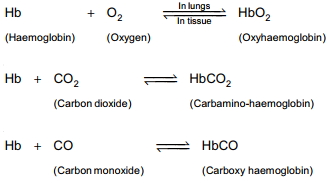
(B) Haemoglobin $(Hb)$ is a red-coloured iron-containing pigment present in the $RBC$s.
$O_2$ can bind with haemoglobin in a reversible manner to form oxyhaemoglobin $(HbO_2)$.
This binding is primarily related to the partial pressure of $O_2$.
In the lungs,high $pO_2$ favours the formation of oxyhaemoglobin,while in the tissues,low $pO_2$ facilitates its dissociation.
Other combinations include:
$1$. $Hb + CO_2 \rightleftharpoons HbCO_2$ (Carbaminohaemoglobin)
$2$. $Hb + CO \rightleftharpoons HbCO$ (Carboxyhaemoglobin)
$O_2$ can bind with haemoglobin in a reversible manner to form oxyhaemoglobin $(HbO_2)$.
This binding is primarily related to the partial pressure of $O_2$.
In the lungs,high $pO_2$ favours the formation of oxyhaemoglobin,while in the tissues,low $pO_2$ facilitates its dissociation.
Other combinations include:
$1$. $Hb + CO_2 \rightleftharpoons HbCO_2$ (Carbaminohaemoglobin)
$2$. $Hb + CO \rightleftharpoons HbCO$ (Carboxyhaemoglobin)
0 likes
View Solution194
EasyMCQ
With which part of $Hb$,$O_2$ molecules bind?
A
Haem
B
Globin
C
Both haem and globin
D
Amino group of globin
Solution
(A) Haemoglobin $(Hb)$ is a conjugated protein consisting of a protein part called globin and a non-protein part called haem.
The haem group contains an iron atom in the ferrous state $(Fe^{2+})$.
This $Fe^{2+}$ ion has a specific affinity for oxygen,allowing $O_2$ molecules to bind directly to the haem group to form oxyhaemoglobin.
The haem group contains an iron atom in the ferrous state $(Fe^{2+})$.
This $Fe^{2+}$ ion has a specific affinity for oxygen,allowing $O_2$ molecules to bind directly to the haem group to form oxyhaemoglobin.
0 likes
View Solution195
MediumMCQ
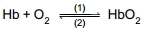
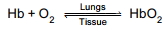
Select $(1)$ and $(2)$ from the given options for the reaction: $Hb + O_2 \rightleftharpoons HbO_2$
A
$(1)$ is tissues and $(2)$ is lungs
B
$(1)$ is lungs and $(2)$ is blood
C
$(1)$ is blood and $(2)$ is lungs
D
$(1)$ is lungs and $(2)$ is tissues
Solution
(D) In the lungs,the partial pressure of oxygen $(pO_2)$ is high,and the partial pressure of carbon dioxide $(pCO_2)$ is low,which favors the formation of oxyhaemoglobin $(HbO_2)$. Thus,the forward reaction occurs in the lungs.
In the tissues,the partial pressure of oxygen $(pO_2)$ is low,and the partial pressure of carbon dioxide $(pCO_2)$ is high,which favors the dissociation of oxyhaemoglobin into haemoglobin $(Hb)$ and oxygen $(O_2)$. Thus,the backward reaction occurs in the tissues.
In the tissues,the partial pressure of oxygen $(pO_2)$ is low,and the partial pressure of carbon dioxide $(pCO_2)$ is high,which favors the dissociation of oxyhaemoglobin into haemoglobin $(Hb)$ and oxygen $(O_2)$. Thus,the backward reaction occurs in the tissues.
0 likes
View Solution196
MediumMCQ
$A$ graph plotted between $pO_{2}$ and the percentage saturation of $Hb$ with $O_{2}$ is known as:
A
$O_{2}$ association curve
B
$CO_{2}-O_{2}$ dissociation curve
C
$O_{2}$ dissociation curve
D
$CO_{2}-O_{2}$ association curve
Solution
(C) graphical representation of the relationship between $pO_{2}$ and the percentage saturation of haemoglobin with $O_{2}$ is known as the oxygen dissociation curve or oxygen-haemoglobin dissociation curve.
It is a sigmoid or $S$-shaped curve.
It is a sigmoid or $S$-shaped curve.
0 likes
View Solution197
MediumMCQ
Which factors affect the dissociation of $O_{2}$ from $Hb$?
A
$pH, pO_{2}, pCO_{2}$ and temperature
B
Only $pH$
C
Salinity,temperature and $pCO_{2}$
D
$HCO_{3}^{-}$ ions concentration,$pH$ and salinity
Solution
(A) The dissociation of oxygen from hemoglobin $(Hb)$ is primarily influenced by conditions in the body tissues where oxygen is released. These factors include:
$1$. Low partial pressure of oxygen $(pO_{2})$.
$2$. High partial pressure of carbon dioxide $(pCO_{2})$.
$3$. Low $pH$ (high concentration of $H^{+}$ ions).
$4$. High temperature.
These conditions shift the oxygen-hemoglobin dissociation curve to the right,facilitating the release of $O_{2}$ to the tissues.
$1$. Low partial pressure of oxygen $(pO_{2})$.
$2$. High partial pressure of carbon dioxide $(pCO_{2})$.
$3$. Low $pH$ (high concentration of $H^{+}$ ions).
$4$. High temperature.
These conditions shift the oxygen-hemoglobin dissociation curve to the right,facilitating the release of $O_{2}$ to the tissues.
0 likes
View Solution198
MediumMCQ
High percentage of $CO_{2}$ is transported in dissolved form as compared to $O_{2}$. This is because
A
$O_{2}$ has high solubility in plasma
B
$CO_{2}$ has high solubility in plasma
C
$pCO_{2}$ is high in blood than $pO_{2}$
D
$CO_{2}$ has low solubility in plasma
Solution
(B) The solubility of $CO_{2}$ in blood plasma is significantly higher than that of $O_{2}$.
The ratio of the solubility of $CO_{2}$ to $O_{2}$ in plasma is approximately $20-25:1$.
Due to this high solubility,a larger percentage of $CO_{2}$ is transported in a dissolved state in the plasma compared to $O_{2}$.
The ratio of the solubility of $CO_{2}$ to $O_{2}$ in plasma is approximately $20-25:1$.
Due to this high solubility,a larger percentage of $CO_{2}$ is transported in a dissolved state in the plasma compared to $O_{2}$.
0 likes
View Solution199
MediumMCQ
Which factor in tissues favours the formation of $HCO_{3}^{-}$ and $H^{+}$ ions in the blood?
A
Low $pCO_{2}$
B
High $pO_{2}$
C
High $pCO_{2}$
D
High alkalinity
Solution
(C) In the tissues,metabolic activities produce $CO_{2}$,which diffuses into the blood.
This leads to a high partial pressure of carbon dioxide $(pCO_{2})$ in the tissues.
The enzyme carbonic anhydrase,present in red blood cells,catalyzes the reaction: $CO_{2} + H_{2}O \rightleftharpoons H_{2}CO_{3} \rightleftharpoons H^{+} + HCO_{3}^{-}$.
According to Le Chatelier's principle,an increase in the concentration of reactants $(CO_{2})$ shifts the equilibrium to the right,thereby favoring the formation of $H^{+}$ and $HCO_{3}^{-}$ ions.
This leads to a high partial pressure of carbon dioxide $(pCO_{2})$ in the tissues.
The enzyme carbonic anhydrase,present in red blood cells,catalyzes the reaction: $CO_{2} + H_{2}O \rightleftharpoons H_{2}CO_{3} \rightleftharpoons H^{+} + HCO_{3}^{-}$.
According to Le Chatelier's principle,an increase in the concentration of reactants $(CO_{2})$ shifts the equilibrium to the right,thereby favoring the formation of $H^{+}$ and $HCO_{3}^{-}$ ions.

0 likes
View Solution200
MediumMCQ
Which enzyme is present in $RBC$s and plasma to catalyse the given reaction: $CO_2 + H_2O \rightleftharpoons H_2CO_3 \rightleftharpoons H^+ + HCO_3^-$?
A
Carbonic anhydrase
B
Catalase
C
Aldolase
D
Carboxylase
Solution
(A) The reaction $CO_2 + H_2O \rightleftharpoons H_2CO_3 \rightleftharpoons H^+ + HCO_3^-$ is catalyzed by the enzyme carbonic anhydrase.
This enzyme is present in very high concentrations within $RBC$s and in smaller quantities in the blood plasma.
It facilitates the rapid conversion of carbon dioxide into bicarbonate ions, which is essential for the transport of $CO_2$ in the blood.
This enzyme is present in very high concentrations within $RBC$s and in smaller quantities in the blood plasma.
It facilitates the rapid conversion of carbon dioxide into bicarbonate ions, which is essential for the transport of $CO_2$ in the blood.
0 likes
View SolutionBreathing and Exchange of Gases — Transport of gases · Frequently Asked Questions
1Are these Breathing and Exchange of Gases questions useful for JEE and NEET?
Yes. All questions in this section are mapped to JEE Main and NEET exam patterns. Previous year questions from JEE Main, NEET, GUJCET and state-level exams are included with full solutions.
2Can I switch to Hindi or Gujarati for these questions?
Yes. Use the language tabs in the hero section or the sidebar to view the same questions and solutions in English, Hindi or Gujarati.
3How do I generate a question paper from this subtopic?
Use the Vedclass Exam Paper Generator — select the chapter and subtopic, set difficulty, and generate Sets A, B, C, D automatically. First 3 chapters of every subject are free.
Vedclass Products
For Students
Vedclass Test Series
Mock tests in real JEE/NEET style with performance analysis. 5-day free trial.
Start Free TrialFor Teachers
Exam Paper Generator
Generate Set A/B/C/D papers from this chapter in 2 minutes. 3 chapters free.
Try FreeFor Institutes
Online Exam Module
Live online exams with unlimited students, 360° analytics & white-label branding.
See DemoFor Teachers & Institutes
Generate a Breathing and Exchange of Gases Exam Paper in 2 Minutes
Select subtopic & difficulty — Sets A, B, C, D auto-generated with No Repeat logic.
First 3 chapters of every subject are free — no payment required.