
A English
Transport of gases Questions in English
Class 11 Biology · Breathing and Exchange of Gases · Transport of gases
251+
Questions
English
Language
100%
With Solutions
Showing 48 of 251 questions in English
101
MediumMCQ
$100 \ ml$ of oxygenated blood contains:
A
$1.34 \ ml$ of $O_2$
B
$5 \ ml$ of $O_2$
C
$15 \ ml$ of $O_2$
D
$20 \ ml$ of $O_2$
Solution
(B) Under normal physiological conditions,every $100 \ ml$ of oxygenated blood can deliver approximately $5 \ ml$ of $O_2$ to the tissues.
While oxygenated blood carries about $20 \ ml$ of $O_2$ in total (bound to hemoglobin and dissolved in plasma),the amount actually released or delivered to the tissues during one systemic circulation is $5 \ ml$.
While oxygenated blood carries about $20 \ ml$ of $O_2$ in total (bound to hemoglobin and dissolved in plasma),the amount actually released or delivered to the tissues during one systemic circulation is $5 \ ml$.
0 likes
View Solution102
MediumMCQ
Which of the following major ions in the blood plays an important role in the transport of $CO_2$?
A
$Mg^{2+}$
B
$Ca^{2+}$
C
$Cl^-$
D
$SO_4^{2-}$
Solution
(C) The transport of $CO_2$ in the blood primarily occurs through the bicarbonate buffer system.
When $CO_2$ diffuses into the red blood cells,it reacts with water to form carbonic acid $(H_2CO_3)$,which dissociates into hydrogen ions $(H^+)$ and bicarbonate ions $(HCO_3^-)$.
To maintain electrical neutrality as bicarbonate ions diffuse out of the red blood cells into the plasma,chloride ions $(Cl^-)$ diffuse from the plasma into the red blood cells.
This phenomenon is known as the chloride shift or the Hamburger phenomenon,which is essential for the efficient transport of $CO_2$ as bicarbonate.
When $CO_2$ diffuses into the red blood cells,it reacts with water to form carbonic acid $(H_2CO_3)$,which dissociates into hydrogen ions $(H^+)$ and bicarbonate ions $(HCO_3^-)$.
To maintain electrical neutrality as bicarbonate ions diffuse out of the red blood cells into the plasma,chloride ions $(Cl^-)$ diffuse from the plasma into the red blood cells.
This phenomenon is known as the chloride shift or the Hamburger phenomenon,which is essential for the efficient transport of $CO_2$ as bicarbonate.
0 likes
View Solution103
EasyMCQ
Which protein is essential for the transport of $O_2$?
A
Chlorophyll
B
Immunoglobulin
C
Hemoglobin
D
Myoglobin
Solution
(C) Hemoglobin is a respiratory pigment present in the red blood cells $(RBCs)$ of vertebrates.
It is a conjugated protein consisting of a protein part called globin and a non-protein part called heme.
Its primary function is to transport $O_2$ from the lungs to the tissues and assist in the transport of $CO_2$ from the tissues back to the lungs.
Chlorophyll is a pigment involved in photosynthesis,Immunoglobulins are antibodies involved in immune response,and Myoglobin is involved in $O_2$ storage in muscles.
It is a conjugated protein consisting of a protein part called globin and a non-protein part called heme.
Its primary function is to transport $O_2$ from the lungs to the tissues and assist in the transport of $CO_2$ from the tissues back to the lungs.
Chlorophyll is a pigment involved in photosynthesis,Immunoglobulins are antibodies involved in immune response,and Myoglobin is involved in $O_2$ storage in muscles.
0 likes
View Solution104
MediumMCQ
The hemoglobin of a human fetus:
A
Has a lower affinity for oxygen than that of an adult.
B
Has the same affinity for oxygen as that of an adult.
C
Has only two protein components instead of four.
D
Has a higher affinity for oxygen than that of an adult.
Solution
(D) The hemoglobin of a human fetus $(HbF)$ has a higher affinity for oxygen compared to adult hemoglobin $(HbA)$.
This is a physiological adaptation that allows the fetus to efficiently extract oxygen from the mother's blood across the placenta.
Because the fetal hemoglobin binds oxygen more strongly,it ensures that the fetus receives adequate oxygen supply even in the low-oxygen environment of the womb.
This is a physiological adaptation that allows the fetus to efficiently extract oxygen from the mother's blood across the placenta.
Because the fetal hemoglobin binds oxygen more strongly,it ensures that the fetus receives adequate oxygen supply even in the low-oxygen environment of the womb.
0 likes
View Solution105
MediumMCQ
Reduction in $pH$ of blood will
A
decrease the affinity of haemoglobin with oxygen
B
release bicarbonate ions by the liver
C
reduce the rate of heart beat
D
reduce the blood supply to the brain
Solution
(A) The correct answer is $A$.
Reduction in $pH$ of blood (increase in $H^+$ ion concentration) causes the oxygen-haemoglobin dissociation curve to shift to the right,a phenomenon known as the Bohr effect.
This shift indicates a decrease in the affinity of haemoglobin for oxygen,facilitating the dissociation of oxygen from haemoglobin at the tissue level where $pH$ is lower.
Reduction in $pH$ of blood (increase in $H^+$ ion concentration) causes the oxygen-haemoglobin dissociation curve to shift to the right,a phenomenon known as the Bohr effect.
This shift indicates a decrease in the affinity of haemoglobin for oxygen,facilitating the dissociation of oxygen from haemoglobin at the tissue level where $pH$ is lower.
0 likes
View Solution106
MediumMCQ
Approximately $70\%$ of carbon dioxide absorbed by the blood is transported to the lungs:
A
as bicarbonate ions
B
in the form of dissolved gas molecules
C
by binding to $RBCs$
D
as carbamino-haemoglobin
Solution
(A) Approximately $70\%$ of $CO_2$ (about $2.5 \ ml$ per $100 \ ml$ of blood) received by the blood from the tissues enters the $RBCs$,where it reacts with water to form carbonic acid $(H_2CO_3)$.
Carbonic anhydrase,an enzyme found exclusively in $RBCs$,speeds up the formation of $H_2CO_3$ and rapidly converts it back to carbon dioxide and water when the blood reaches the lungs.
Almost as rapidly as it is formed,the carbonic acid in $RBCs$ dissociates into hydrogen ions $(H^+)$ and bicarbonate ions $(HCO_3^-)$.
These bicarbonate ions are then transported in the plasma to the lungs.
Carbonic anhydrase,an enzyme found exclusively in $RBCs$,speeds up the formation of $H_2CO_3$ and rapidly converts it back to carbon dioxide and water when the blood reaches the lungs.
Almost as rapidly as it is formed,the carbonic acid in $RBCs$ dissociates into hydrogen ions $(H^+)$ and bicarbonate ions $(HCO_3^-)$.
These bicarbonate ions are then transported in the plasma to the lungs.
0 likes
View Solution107
MediumMCQ
$A$ large proportion of oxygen remains unused in the human blood even after its uptake by the body tissues. This $O_2$
A
acts as a reserve during muscular exercise
B
raises the $pCO_2$ of blood to $75 \ mm \ Hg$
C
is enough to keep oxyhaemoglobin saturation at $96\%$
D
helps in releasing more $O_2$ to the epithelial tissues
Solution
(A) Under normal physiological conditions,only about $25\%$ of the oxygen carried by arterial blood is delivered to the tissues.
This means that a large proportion of oxygen remains bound to hemoglobin in the venous blood.
This residual oxygen acts as a significant reserve,which can be utilized by the body during periods of increased metabolic demand,such as intense muscular exercise.
This means that a large proportion of oxygen remains bound to hemoglobin in the venous blood.
This residual oxygen acts as a significant reserve,which can be utilized by the body during periods of increased metabolic demand,such as intense muscular exercise.
0 likes
View Solution108
MediumMCQ
What is true about $RBCs$ in humans?
A
They carry about $20-25$ percent of $CO_2$.
B
They transport $99.5$ percent of $O_2$.
C
They transport about $80$ percent oxygen only and the rest $20$ percent of it is transported in dissolved state in blood plasma.
D
They do not carry $CO_2$ at all.
Solution
(A) $RBCs$ (Red Blood Cells) play a crucial role in the transport of respiratory gases.
$1$. Oxygen Transport: About $97$ percent of $O_2$ is transported by $RBCs$ in the blood,bound to hemoglobin. The remaining $3$ percent of $O_2$ is carried in a dissolved state through the blood plasma.
$2$. Carbon Dioxide Transport: Nearly $20-25$ percent of $CO_2$ is transported by $RBCs$ (as carbaminohemoglobin). About $70$ percent of $CO_2$ is carried as bicarbonate ions $(HCO_3^-)$,and approximately $7$ percent of $CO_2$ is carried in a dissolved state through the plasma.
Therefore,the statement that $RBCs$ carry about $20-25$ percent of $CO_2$ is correct.
$1$. Oxygen Transport: About $97$ percent of $O_2$ is transported by $RBCs$ in the blood,bound to hemoglobin. The remaining $3$ percent of $O_2$ is carried in a dissolved state through the blood plasma.
$2$. Carbon Dioxide Transport: Nearly $20-25$ percent of $CO_2$ is transported by $RBCs$ (as carbaminohemoglobin). About $70$ percent of $CO_2$ is carried as bicarbonate ions $(HCO_3^-)$,and approximately $7$ percent of $CO_2$ is carried in a dissolved state through the plasma.
Therefore,the statement that $RBCs$ carry about $20-25$ percent of $CO_2$ is correct.
0 likes
View Solution109
MediumMCQ
The haemoglobin of a human foetus:
A
has only $2$ protein subunits instead of $4$
B
has a higher affinity for oxygen than that of an adult
C
has a lower affinity for oxygen than that of the adult
D
its affinity for oxygen is the same as that of an adult
Solution
(B) : Oxygen is required for aerobic respiration and diffuses from a region of high concentration to a region of low concentration from the mother's blood to the blood of the foetus.
The haemoglobin of the foetus $(HbF)$ has a higher affinity for oxygen than that of adult haemoglobin $(HbA)$,which facilitates the efficient transfer of oxygen across the placenta.
Carbon dioxide,a waste product of aerobic respiration,diffuses in the opposite direction from the foetus to the mother.
The haemoglobin of the foetus $(HbF)$ has a higher affinity for oxygen than that of adult haemoglobin $(HbA)$,which facilitates the efficient transfer of oxygen across the placenta.
Carbon dioxide,a waste product of aerobic respiration,diffuses in the opposite direction from the foetus to the mother.
0 likes
View Solution110
MediumMCQ
The majority of carbon dioxide produced by our body cells is transported to the lungs as
A
attached to haemoglobin
B
dissolved in the blood
C
as bicarbonates
D
as carbonates
Solution
(C) The correct answer is $C$.
When systemic arterial blood flows through capillaries,carbon dioxide diffuses from the tissues into the blood.
Some carbon dioxide is dissolved in the blood plasma.
Some carbon dioxide reacts with haemoglobin to form carbaminohaemoglobin.
The remaining and majority of carbon dioxide is converted into bicarbonate ions $(HCO_3^-)$ and hydrogen ions $(H^+)$ within the red blood cells.
Thus,most carbon dioxide is transported through the blood in the form of bicarbonate ions.
When systemic arterial blood flows through capillaries,carbon dioxide diffuses from the tissues into the blood.
Some carbon dioxide is dissolved in the blood plasma.
Some carbon dioxide reacts with haemoglobin to form carbaminohaemoglobin.
The remaining and majority of carbon dioxide is converted into bicarbonate ions $(HCO_3^-)$ and hydrogen ions $(H^+)$ within the red blood cells.
Thus,most carbon dioxide is transported through the blood in the form of bicarbonate ions.
0 likes
View Solution111
MediumMCQ
$A = CO_2$ is carried in the plasma mainly as $HCO_3^-$ ions.
$R =$ Carbonic anhydrase catalyzes the formation of $HCO_3^-$ ions.
$R =$ Carbonic anhydrase catalyzes the formation of $HCO_3^-$ ions.
A
$A$ is true and $R$ is false
B
$A$ is false and $R$ is true
C
Both $A$ and $R$ are true
D
Both $A$ and $R$ are false
Solution
(C) Assertion $(A)$: About $70\%$ of $CO_2$ is carried in the plasma as bicarbonate ions $(HCO_3^-)$. This statement is true.
Reason $(R)$: The enzyme carbonic anhydrase is present in high concentrations in red blood cells and facilitates the reaction: $CO_2 + H_2O \rightleftharpoons H_2CO_3 \rightleftharpoons H^+ + HCO_3^-$. This enzyme catalyzes the formation of bicarbonate ions. This statement is also true.
Since both statements are scientifically accurate and the reason explains the mechanism behind the transport, the correct option is $C$.
Reason $(R)$: The enzyme carbonic anhydrase is present in high concentrations in red blood cells and facilitates the reaction: $CO_2 + H_2O \rightleftharpoons H_2CO_3 \rightleftharpoons H^+ + HCO_3^-$. This enzyme catalyzes the formation of bicarbonate ions. This statement is also true.
Since both statements are scientifically accurate and the reason explains the mechanism behind the transport, the correct option is $C$.
0 likes
View Solution112
MediumMCQ
Identify the correct sentence.
A
When $PCO_2$ is high and $PO_2$ is low as in the tissues,more binding of carbon dioxide occurs.
B
Fibrosis is a disorder of the digestive system.
C
Solubility of $CO_2$ is $20-25$ times lower than that of $O_2$.
D
Carbonic anhydrase is present in much lower concentration in $RBC$ than in plasma.
Solution
(A) $1$. In tissues,$PCO_2$ is high and $PO_2$ is low,which promotes the dissociation of $O_2$ from oxyhemoglobin and facilitates the binding of $CO_2$ to hemoglobin (Haldane effect).
$2$. Fibrosis is a respiratory disorder caused by chronic exposure to dust,not a digestive disorder.
$3$. The solubility of $CO_2$ is $20-25$ times higher than that of $O_2$,not lower.
$4$. Carbonic anhydrase is present in very high concentrations in $RBC$s,not in plasma.
Therefore,the correct statement is option $A$.
$2$. Fibrosis is a respiratory disorder caused by chronic exposure to dust,not a digestive disorder.
$3$. The solubility of $CO_2$ is $20-25$ times higher than that of $O_2$,not lower.
$4$. Carbonic anhydrase is present in very high concentrations in $RBC$s,not in plasma.
Therefore,the correct statement is option $A$.
0 likes
View Solution113
MediumMCQ
$A$ large proportion of oxygen is left unused in the human blood even after its uptake by the body tissues. This $O_2$
A
Acts as a reserve during muscular exercise
B
Raise the $pCO_2$ of blood to $75 \,mm \,Hg.$
C
is enough to keep oxyhaemoglobin saturation at $96\%$
D
Helps in releasing more $O_2$ to the epithelial tissues
Solution
(A) Under normal physiological conditions,every $100 \,mL$ of oxygenated blood can deliver around $5 \,mL$ of $O_2$ to the tissues.
However,the venous blood returning to the heart still contains a significant amount of oxygen (about $75\%$ of the original saturation).
This residual oxygen acts as a vital reserve that can be utilized by the body tissues during periods of high metabolic demand,such as intense muscular exercise,when the oxygen requirement increases significantly.
However,the venous blood returning to the heart still contains a significant amount of oxygen (about $75\%$ of the original saturation).
This residual oxygen acts as a vital reserve that can be utilized by the body tissues during periods of high metabolic demand,such as intense muscular exercise,when the oxygen requirement increases significantly.
0 likes
View Solution114
EasyMCQ
The oxygen dissociation curve of haemoglobin is:
A
Sigmoid
B
Hyperbolic
C
Linear
D
Hypobolic
Solution
(A) The oxygen dissociation curve of haemoglobin is a sigmoid ($S$-shaped) curve.
This curve is obtained when the percentage saturation of haemoglobin with $O_2$ is plotted against the partial pressure of oxygen $(pO_2)$.
The sigmoid shape is due to the cooperative binding of oxygen to the four haem groups of the haemoglobin molecule,where the binding of the first oxygen molecule increases the affinity of the remaining haem groups for subsequent oxygen molecules.
This curve is obtained when the percentage saturation of haemoglobin with $O_2$ is plotted against the partial pressure of oxygen $(pO_2)$.
The sigmoid shape is due to the cooperative binding of oxygen to the four haem groups of the haemoglobin molecule,where the binding of the first oxygen molecule increases the affinity of the remaining haem groups for subsequent oxygen molecules.
0 likes
View Solution115
MediumMCQ
Carbon dioxide is transported via blood to the lungs primarily in which form?
A
Dissolved in blood plasma
B
In the form of carbonic acid only
C
In combination with haemoglobin only
D
As bicarbonates, carbaminohaemoglobin, and dissolved in plasma
Solution
(D) Carbon dioxide $(CO_2)$ is transported in the blood in three main forms:
$1$. As bicarbonates: About $70\%$ of $CO_2$ is transported as bicarbonates $(HCO_3^-)$ in the plasma.
$2$. As carbaminohaemoglobin: About $20-25\%$ of $CO_2$ binds with haemoglobin to form carbaminohaemoglobin.
$3$. Dissolved in plasma: About $7\%$ of $CO_2$ is carried in a dissolved state in the blood plasma.
Since the original options provided were incomplete or inaccurate regarding the total transport mechanism, the most comprehensive answer includes these three forms.
$1$. As bicarbonates: About $70\%$ of $CO_2$ is transported as bicarbonates $(HCO_3^-)$ in the plasma.
$2$. As carbaminohaemoglobin: About $20-25\%$ of $CO_2$ binds with haemoglobin to form carbaminohaemoglobin.
$3$. Dissolved in plasma: About $7\%$ of $CO_2$ is carried in a dissolved state in the blood plasma.
Since the original options provided were incomplete or inaccurate regarding the total transport mechanism, the most comprehensive answer includes these three forms.
0 likes
View Solution116
MediumMCQ
Choose the incorrect sentence from the following.
A
$3 \%$ of $O_2$ is transported by blood plasma,while $97 \%$ of $O_2$ is transported by $RBCs$.
B
$25$ to $30 \%$ of $CO_2$ is transported by hemoglobin in the form of carbaminohemoglobin.
C
$100 \, ml$ of deoxygenated blood transports $4 \, ml$ of $CO_2$ towards the alveolar sac.
D
$70 \%$ of $CO_2$ is carried as bicarbonate.
Solution
(B) Option $B$ is incorrect because $25$ to $30 \%$ of $CO_2$ is transported by hemoglobin as carbaminohemoglobin,but the statement in the option incorrectly links $O_2$ transport to this process. $O_2$ is primarily transported by hemoglobin as oxyhemoglobin $(97 \%)$. The other statements are correct: $3 \%$ of $O_2$ is dissolved in plasma,$100 \, ml$ of deoxygenated blood carries approximately $4 \, ml$ of $CO_2$ to the lungs,and $70 \%$ of $CO_2$ is transported as bicarbonate ions.
0 likes
View Solution117
MediumMCQ
$CO_2$ is carried by haemoglobin as carbamino haemoglobin. This binding of $CO_2$ with $Hb$ is related to the partial pressure of .........
A
$O_2$ and $CO_2$
B
$Hb$ and $RBC$
C
$O_2$ and $Hb$
D
$CO_2$ and $H_2O$
Solution
(A) The binding of $CO_2$ with haemoglobin $(Hb)$ to form carbamino haemoglobin is primarily determined by the partial pressure of $CO_2$ $(pCO_2)$ and the partial pressure of $O_2$ $(pO_2)$.
When $pCO_2$ is high and $pO_2$ is low (as in the tissues),$CO_2$ binds more readily to $Hb$.
Conversely,when $pO_2$ is high and $pCO_2$ is low (as in the alveoli),$CO_2$ dissociates from $Hb$.
Therefore,the binding is related to the partial pressure of both $O_2$ and $CO_2$.
When $pCO_2$ is high and $pO_2$ is low (as in the tissues),$CO_2$ binds more readily to $Hb$.
Conversely,when $pO_2$ is high and $pCO_2$ is low (as in the alveoli),$CO_2$ dissociates from $Hb$.
Therefore,the binding is related to the partial pressure of both $O_2$ and $CO_2$.
0 likes
View Solution118
MediumMCQ
............$\%$ of $O_2$ is transported through the plasma in a dissolved state,nearly ...........$\%$ of $CO_2$ is transported by $RBCs,$ and ...................$\%$ of $CO_2$ is carried as bicarbonate.
A
$97\%, 70\%, 20-25\%$
B
$3\%, 20-25\%, 70\%$
C
$7\%, 3\%, 20-25\%$
D
$20-25\%, 3\%, 70\%$
Solution
(B) The transport of gases in the human body occurs as follows:
$1$. Oxygen $(O_2)$ transport: About $97\%$ of $O_2$ is transported by $RBCs$ (bound to hemoglobin),while only about $3\%$ is transported in a dissolved state through the blood plasma.
$2$. Carbon dioxide $(CO_2)$ transport: $CO_2$ is transported in three forms:
- About $20-25\%$ is transported by $RBCs$ (bound to hemoglobin as carbaminohemoglobin).
- About $70\%$ is transported as bicarbonate ions $(HCO_3^-)$ in the plasma.
- About $7\%$ is carried in a dissolved state through the plasma.
Therefore,the correct sequence is $3\%, 20-25\%, 70\%$.
$1$. Oxygen $(O_2)$ transport: About $97\%$ of $O_2$ is transported by $RBCs$ (bound to hemoglobin),while only about $3\%$ is transported in a dissolved state through the blood plasma.
$2$. Carbon dioxide $(CO_2)$ transport: $CO_2$ is transported in three forms:
- About $20-25\%$ is transported by $RBCs$ (bound to hemoglobin as carbaminohemoglobin).
- About $70\%$ is transported as bicarbonate ions $(HCO_3^-)$ in the plasma.
- About $7\%$ is carried in a dissolved state through the plasma.
Therefore,the correct sequence is $3\%, 20-25\%, 70\%$.
0 likes
View Solution119
MediumMCQ
Haemoglobin is a red-colored,iron-containing pigment present in $RBCs$. $O_2$ binds with it in a reversible manner to form..........
A
Haemoglobin
B
Carbamino-haemoglobin
C
Oxyhaemoglobin
D
Bicarbonate
Solution
(C) Haemoglobin is a red-colored,iron-containing pigment present in the $RBCs$ (Red Blood Cells).
Each haemoglobin molecule can carry a maximum of four molecules of $O_2$.
When $O_2$ binds with haemoglobin in a reversible manner,it forms a compound called oxyhaemoglobin $(HbO_2)$.
This reaction is primarily dependent on the partial pressure of $O_2$ $(pO_2)$.
Each haemoglobin molecule can carry a maximum of four molecules of $O_2$.
When $O_2$ binds with haemoglobin in a reversible manner,it forms a compound called oxyhaemoglobin $(HbO_2)$.
This reaction is primarily dependent on the partial pressure of $O_2$ $(pO_2)$.
0 likes
View Solution120
EasyMCQ
What is true about $RBCs$ in humans?
A
They carry about $20-25$ per cent of $CO_2$
B
They transport only $O_2$
C
They transport about $80$ per cent of excretory waste
D
They do not carry $CO_2$ at all
Solution
(A) In humans,$RBCs$ (Red Blood Cells) play a crucial role in the transport of gases.
$1$. $RBCs$ contain hemoglobin,which binds to $O_2$ to form oxyhemoglobin for oxygen transport.
$2$. Additionally,$RBCs$ are involved in the transport of carbon dioxide $(CO_2)$.
$3$. About $20-25$ percent of $CO_2$ is transported by $RBCs$ in the form of carbaminohemoglobin.
$4$. The majority of $CO_2$ ($70$ percent) is transported as bicarbonates in the plasma,while about $7$ percent is carried in a dissolved state in the plasma.
Therefore,the statement that $RBCs$ carry about $20-25$ percent of $CO_2$ is correct.
$1$. $RBCs$ contain hemoglobin,which binds to $O_2$ to form oxyhemoglobin for oxygen transport.
$2$. Additionally,$RBCs$ are involved in the transport of carbon dioxide $(CO_2)$.
$3$. About $20-25$ percent of $CO_2$ is transported by $RBCs$ in the form of carbaminohemoglobin.
$4$. The majority of $CO_2$ ($70$ percent) is transported as bicarbonates in the plasma,while about $7$ percent is carried in a dissolved state in the plasma.
Therefore,the statement that $RBCs$ carry about $20-25$ percent of $CO_2$ is correct.
0 likes
View Solution121
EasyMCQ
Which enzyme is necessary for the synthesis of carbonic acid?
A
Catalase
B
Carbonic anhydrase
C
Hydrolase
D
Carboxy peptidase
Solution
(B) The reaction involving the synthesis of carbonic acid $(H_2CO_3)$ from carbon dioxide $(CO_2)$ and water $(H_2O)$ is catalyzed by the enzyme Carbonic anhydrase.
This reaction is represented as: $CO_2 + H_2O \xrightarrow{\text{Carbonic anhydrase}} H_2CO_3$.
Carbonic anhydrase is one of the fastest enzymes known, playing a crucial role in the transport of $CO_2$ in the blood.
This reaction is represented as: $CO_2 + H_2O \xrightarrow{\text{Carbonic anhydrase}} H_2CO_3$.
Carbonic anhydrase is one of the fastest enzymes known, playing a crucial role in the transport of $CO_2$ in the blood.
0 likes
View Solution122
EasyMCQ
How many molecules of $H_2CO_3$ are formed due to the presence of carbonic anhydrase in the cytoplasm every second?
A
$200$
B
$6,00,000$
C
$60,000$
D
$50,000$
Solution
(B) Carbonic anhydrase is one of the fastest enzymes known.
In the absence of this enzyme,the reaction between $CO_2$ and $H_2O$ to form $H_2CO_3$ is very slow,with about $200$ molecules being formed in an hour.
However,in the presence of the enzyme carbonic anhydrase,the reaction rate increases dramatically.
It catalyzes the formation of about $6,00,000$ molecules of $H_2CO_3$ every second.
This represents an acceleration of the reaction rate by about $10$ million times.
In the absence of this enzyme,the reaction between $CO_2$ and $H_2O$ to form $H_2CO_3$ is very slow,with about $200$ molecules being formed in an hour.
However,in the presence of the enzyme carbonic anhydrase,the reaction rate increases dramatically.
It catalyzes the formation of about $6,00,000$ molecules of $H_2CO_3$ every second.
This represents an acceleration of the reaction rate by about $10$ million times.
0 likes
View Solution123
EasyMCQ
Carbonic anhydrase is found in .......... .
A
Lymphocytes
B
Blood plasma
C
$R.B.C.$
D
Leukocytes
Solution
(C) Carbonic anhydrase is a zinc-containing enzyme that catalyzes the reversible reaction: $CO_2 + H_2O \rightleftharpoons H_2CO_3 \rightleftharpoons H^+ + HCO_3^-$. This enzyme is present in very high concentrations within the $R.B.C.$ (Red Blood Cells) and in smaller amounts in the blood plasma. However,the primary site of its action for rapid transport of $CO_2$ is the $R.B.C.$
0 likes
View Solution124
MediumMCQ
The transport of carbon dioxide from tissues to the respiratory surface occurs primarily through ..........
A
Plasma and Red Blood Cells
B
Plasma
C
Red Blood Cells
D
Red Blood Cells and White Blood Cells
Solution
(A) Carbon dioxide $(CO_2)$ is transported from tissues to the lungs in three forms:
$1$. As dissolved gas in plasma $(7\%)$.
$2$. As bicarbonate ions $(HCO_3^-)$ in plasma $(70\%)$.
$3$. As carbaminohemoglobin in red blood cells $(23\%)$.
Since both plasma and red blood cells are involved in the transport of $CO_2$,the correct option is $A$.
$1$. As dissolved gas in plasma $(7\%)$.
$2$. As bicarbonate ions $(HCO_3^-)$ in plasma $(70\%)$.
$3$. As carbaminohemoglobin in red blood cells $(23\%)$.
Since both plasma and red blood cells are involved in the transport of $CO_2$,the correct option is $A$.
0 likes
View Solution125
EasyMCQ
The oxygen dissociation curve of hemoglobin is . . . . . . .
A
Sigmoid
B
Hyperbolic
C
Linear
D
Hypobolic
Solution
(A) The oxygen dissociation curve is a plot showing the relationship between the partial pressure of oxygen $(pO_2)$ and the percentage saturation of hemoglobin with oxygen.
This curve is $Sigmoid$ ($S$-shaped) in nature.
This shape is due to the cooperative binding of oxygen to the four heme groups of the hemoglobin molecule,where the binding of one oxygen molecule increases the affinity of the remaining heme groups for oxygen.
This curve is $Sigmoid$ ($S$-shaped) in nature.
This shape is due to the cooperative binding of oxygen to the four heme groups of the hemoglobin molecule,where the binding of one oxygen molecule increases the affinity of the remaining heme groups for oxygen.
0 likes
View Solution126
MediumMCQ
Although a large amount of $CO_2$ is transported in the blood,the blood does not become acidic because:
A
It is absorbed by the white blood cells.
B
Blood buffers play a major role in $CO_2$ transport.
C
It combines with water to form $H_2CO_3$,which is neutralized by $Na_2CO_3$.
D
It diffuses out from the tissues continuously and is not allowed to accumulate.
Solution
(B) The blood maintains a relatively constant $pH$ (approximately $7.4$) despite the transport of large amounts of $CO_2$. This is primarily due to the presence of blood buffers. The bicarbonate buffer system,involving plasma proteins and hemoglobin,acts to neutralize the hydrogen ions $(H^+)$ produced when $CO_2$ reacts with water to form carbonic acid $(H_2CO_3)$. Hemoglobin,in particular,acts as a very effective buffer by binding to $H^+$ ions,thereby preventing the blood from becoming acidic.
0 likes
View Solution127
MediumMCQ
Carbon dioxide is transported in the blood to the lungs in the form of:
A
Dissolved in blood plasma
B
As carbonic acid
C
By binding with hemoglobin
D
As carbaminohemoglobin and bicarbonate ions
Solution
(D) Carbon dioxide $(CO_2)$ is transported in the blood from tissues to the lungs in three main forms:
$1$. As dissolved gas in blood plasma (about $7\%$).
$2$. As carbaminohemoglobin,where $CO_2$ binds to the amino groups of hemoglobin (about $20-25\%$).
$3$. As bicarbonate ions $(HCO_3^-)$,which is the primary method of transport (about $70\%$).
While the provided option $D$ mentions carbaminohemoglobin,it incorrectly lists carbonic acid instead of bicarbonate ions. However,in the context of standard multiple-choice questions,option $D$ is the most appropriate choice as it covers the major transport mechanisms involving hemoglobin and chemical conversion.
$1$. As dissolved gas in blood plasma (about $7\%$).
$2$. As carbaminohemoglobin,where $CO_2$ binds to the amino groups of hemoglobin (about $20-25\%$).
$3$. As bicarbonate ions $(HCO_3^-)$,which is the primary method of transport (about $70\%$).
While the provided option $D$ mentions carbaminohemoglobin,it incorrectly lists carbonic acid instead of bicarbonate ions. However,in the context of standard multiple-choice questions,option $D$ is the most appropriate choice as it covers the major transport mechanisms involving hemoglobin and chemical conversion.
0 likes
View Solution128
MediumMCQ
The process of migration of chloride ions from plasma to $R.B.C.$ and bicarbonate ions from $R.B.C.$ to plasma is known as:
A
Chloride shift
B
Ionic shift
C
Molecular shift
D
$Na^+$ pump
Solution
(A) The process described is known as the Chloride Shift or the Hamburger phenomenon.
When $CO_2$ enters the $R.B.C.$,it reacts with water to form carbonic acid $(H_2CO_3)$,which dissociates into $H^+$ and $HCO_3^-$.
To maintain electrical neutrality,$HCO_3^-$ ions diffuse out of the $R.B.C.$ into the plasma,and an equivalent number of chloride ions $(Cl^-)$ diffuse from the plasma into the $R.B.C.$
This exchange is essential for the transport of carbon dioxide in the blood.
When $CO_2$ enters the $R.B.C.$,it reacts with water to form carbonic acid $(H_2CO_3)$,which dissociates into $H^+$ and $HCO_3^-$.
To maintain electrical neutrality,$HCO_3^-$ ions diffuse out of the $R.B.C.$ into the plasma,and an equivalent number of chloride ions $(Cl^-)$ diffuse from the plasma into the $R.B.C.$
This exchange is essential for the transport of carbon dioxide in the blood.
0 likes
View Solution129
MediumMCQ
Human fetal hemoglobin has:
A
a higher affinity for oxygen than adult hemoglobin.
B
the same $O_2$ affinity as adult hemoglobin.
C
only $2$ protein subunits instead of $4$.
D
a lower affinity for oxygen than adult hemoglobin.
Solution
(A) Fetal hemoglobin $(HbF)$ consists of two alpha and two gamma polypeptide chains,whereas adult hemoglobin $(HbA)$ consists of two alpha and two beta chains.
Due to its structural differences,$HbF$ has a higher affinity for oxygen compared to adult hemoglobin $(HbA)$.
This higher affinity allows the fetus to effectively extract oxygen from the mother's blood across the placenta,ensuring adequate oxygen supply for fetal development.
Due to its structural differences,$HbF$ has a higher affinity for oxygen compared to adult hemoglobin $(HbA)$.
This higher affinity allows the fetus to effectively extract oxygen from the mother's blood across the placenta,ensuring adequate oxygen supply for fetal development.
0 likes
View Solution130
EasyMCQ
How is $70\%$ of carbon dioxide transported by the blood to the lungs?
A
As bicarbonate ions
B
As dissolved gas molecules in plasma
C
Bound to red blood cells
D
As carbaminohemoglobin
Solution
(A) Carbon dioxide $(CO_2)$ is transported in the blood in three forms:
$1$. As dissolved gas in plasma $(7\%)$.
$2$. As carbaminohemoglobin bound to hemoglobin $(20-25\%)$.
$3$. As bicarbonate ions $(HCO_3^-)$ in the plasma $(70\%)$.
Therefore,the majority of $CO_2$ $(70\%)$ is transported as bicarbonate ions.
$1$. As dissolved gas in plasma $(7\%)$.
$2$. As carbaminohemoglobin bound to hemoglobin $(20-25\%)$.
$3$. As bicarbonate ions $(HCO_3^-)$ in the plasma $(70\%)$.
Therefore,the majority of $CO_2$ $(70\%)$ is transported as bicarbonate ions.
0 likes
View Solution131
MediumMCQ
$A$ decrease in the $pH$ of blood leads to:
A
Reduced blood supply to the brain.
B
Decreased affinity of hemoglobin for oxygen.
C
Release of bicarbonate ions by the liver.
D
Decreased heart rate.
Solution
(B) The affinity of hemoglobin for oxygen is affected by several factors,including $pH$,$pCO_2$,and temperature. This phenomenon is known as the $Bohr$ effect. When the $pH$ of the blood decreases (i.e.,the blood becomes more acidic due to an increase in $H^+$ ions or $CO_2$ concentration),the oxygen-hemoglobin dissociation curve shifts to the right. This shift indicates a decrease in the affinity of hemoglobin for oxygen,which facilitates the release of oxygen to the tissues that need it most.
0 likes
View Solution132
MediumMCQ
Oxyhaemoglobin can transport
A
$8\, ml$ of $CO_2/100\, ml$ blood
B
$5\, ml$ of $CO_2/100\, ml$ blood
C
$3\, ml$ of $CO_2/100\, ml$ blood
D
$2\, ml$ of $CO_2/100\, ml$ blood
Solution
(C) Oxyhaemoglobin is the form of haemoglobin that has bound to oxygen.
During the transport of carbon dioxide,haemoglobin also plays a role by binding to $CO_2$ to form carbaminohaemoglobin.
Under normal physiological conditions,every $100\, ml$ of oxygenated blood can deliver about $5\, ml$ of $O_2$ to the tissues,while every $100\, ml$ of deoxygenated blood delivers approximately $4\, ml$ of $CO_2$ to the alveoli.
Specifically,oxyhaemoglobin facilitates the transport of approximately $3\, ml$ of $CO_2$ per $100\, ml$ of blood.
During the transport of carbon dioxide,haemoglobin also plays a role by binding to $CO_2$ to form carbaminohaemoglobin.
Under normal physiological conditions,every $100\, ml$ of oxygenated blood can deliver about $5\, ml$ of $O_2$ to the tissues,while every $100\, ml$ of deoxygenated blood delivers approximately $4\, ml$ of $CO_2$ to the alveoli.
Specifically,oxyhaemoglobin facilitates the transport of approximately $3\, ml$ of $CO_2$ per $100\, ml$ of blood.
0 likes
View Solution133
DifficultMCQ
The presence of $CO_2$ in blood will lower $pH$ because $CO_2$ combines with . . . . . . ,with the rate of reaction increased by . . . . . . .
A
$H_2O$ to form $H^+$ and $HCO_3^-$,carbonic anhydrase
B
$H_2O$ to form only $HCO_3^-$,carbonic anhydrase
C
$H_2O$ to form only $H^+$,carbonic ions
D
$H^+$ to form $HCO_3^-$,oxyhaemoglobin
Solution
(A) Carbon dioxide $(CO_2)$ reacts with water $(H_2O)$ in the blood to form carbonic acid $(H_2CO_3)$,which then dissociates into hydrogen ions $(H^+)$ and bicarbonate ions $(HCO_3^-)$.
This reaction is significantly accelerated by the enzyme carbonic anhydrase,which is present in high concentrations within red blood cells.
The increase in $H^+$ concentration leads to a decrease in the $pH$ of the blood.
This reaction is significantly accelerated by the enzyme carbonic anhydrase,which is present in high concentrations within red blood cells.
The increase in $H^+$ concentration leads to a decrease in the $pH$ of the blood.
0 likes
View Solution134
MediumMCQ
Assertion : Oxyhaemoglobin dissociates near the organ tissue due to Bohr effect and oxygen is released.
Reason : Increased $CO_2$ concentration reduces the affinity of haemoglobin for oxygen.
Reason : Increased $CO_2$ concentration reduces the affinity of haemoglobin for oxygen.
A
If both Assertion and Reason are correct and the Reason is a correct explanation of the Assertion.
B
If both Assertion and Reason are correct but Reason is not a correct explanation of the Assertion.
C
If the Assertion is correct but Reason is incorrect.
D
If both the Assertion and Reason are incorrect.
Solution
(A) The Bohr effect describes how an increase in $CO_2$ concentration and a decrease in $pH$ (increase in $H^+$ ions) shift the oxygen-haemoglobin dissociation curve to the right,thereby reducing the affinity of haemoglobin for oxygen.
Near the organ tissues,the partial pressure of $CO_2$ is high and the partial pressure of $O_2$ is low. This environment promotes the dissociation of oxyhaemoglobin,allowing oxygen to be released into the tissues.
Since the Reason directly explains the mechanism (reduced affinity due to high $CO_2$) that causes the phenomenon described in the Assertion,the Reason is the correct explanation of the Assertion.
Near the organ tissues,the partial pressure of $CO_2$ is high and the partial pressure of $O_2$ is low. This environment promotes the dissociation of oxyhaemoglobin,allowing oxygen to be released into the tissues.
Since the Reason directly explains the mechanism (reduced affinity due to high $CO_2$) that causes the phenomenon described in the Assertion,the Reason is the correct explanation of the Assertion.
0 likes
View Solution135
EasyMCQ
Bulk of carbon dioxide $(CO_2)$ released from body tissues into the blood is present as
A
$70\%$ carbamino-haemoglobin and $30\%$ as bicarbonate
B
carbamino-haemoglobin in $RBCs$
C
bicarbonate in blood plasma and $RBCs$
D
free $CO_2$ in blood plasma
Solution
(C) Carbon dioxide $(CO_2)$ is transported in the blood in three forms:
$1$. As dissolved gas in plasma $(7\%)$.
$2$. As carbamino-haemoglobin bound to haemoglobin $(20-25\%)$.
$3$. As bicarbonate ions $(HCO_3^-)$ in blood plasma and $RBCs$ $(70\%)$.
Since the majority of $CO_2$ is transported as bicarbonate,the correct answer is $C$.
$1$. As dissolved gas in plasma $(7\%)$.
$2$. As carbamino-haemoglobin bound to haemoglobin $(20-25\%)$.
$3$. As bicarbonate ions $(HCO_3^-)$ in blood plasma and $RBCs$ $(70\%)$.
Since the majority of $CO_2$ is transported as bicarbonate,the correct answer is $C$.
0 likes
View Solution136
Difficult
What are the major transport mechanisms for $CO_{2}$? Explain.
Solution
(N/A) Carbon dioxide $(CO_{2})$ is transported in the blood through three main mechanisms:
$(1)$ Dissolved in Plasma:
Approximately $7\%$ of $CO_{2}$ is carried in a dissolved state through blood plasma. It reacts with water to form carbonic acid $(H_{2}CO_{3})$.
$CO_{2} + H_{2}O \to H_{2}CO_{3}$
Since this reaction is slow,only a small amount is transported this way.
$(2)$ As Carbaminohaemoglobin:
About $20-25\%$ of $CO_{2}$ is transported by red blood cells $(RBCs)$ by binding to the amino groups of haemoglobin to form carbaminohaemoglobin.
$(3)$ As Bicarbonate Ions:
Approximately $70\%$ of $CO_{2}$ is transported as bicarbonate $(HCO_{3}^{-})$. $CO_{2}$ diffuses into $RBCs$ and reacts with water in the presence of the enzyme carbonic anhydrase to form carbonic acid,which then dissociates into bicarbonate and hydrogen ions $(H^{+})$.
$CO_{2} + H_{2}O \xrightarrow{\text{Carbonic anhydrase}} H_{2}CO_{3} \to HCO_{3}^{-} + H^{+}$
$(1)$ Dissolved in Plasma:
Approximately $7\%$ of $CO_{2}$ is carried in a dissolved state through blood plasma. It reacts with water to form carbonic acid $(H_{2}CO_{3})$.
$CO_{2} + H_{2}O \to H_{2}CO_{3}$
Since this reaction is slow,only a small amount is transported this way.
$(2)$ As Carbaminohaemoglobin:
About $20-25\%$ of $CO_{2}$ is transported by red blood cells $(RBCs)$ by binding to the amino groups of haemoglobin to form carbaminohaemoglobin.
$(3)$ As Bicarbonate Ions:
Approximately $70\%$ of $CO_{2}$ is transported as bicarbonate $(HCO_{3}^{-})$. $CO_{2}$ diffuses into $RBCs$ and reacts with water in the presence of the enzyme carbonic anhydrase to form carbonic acid,which then dissociates into bicarbonate and hydrogen ions $(H^{+})$.
$CO_{2} + H_{2}O \xrightarrow{\text{Carbonic anhydrase}} H_{2}CO_{3} \to HCO_{3}^{-} + H^{+}$
0 likes
View Solution137
MediumMCQ
What is the effect of $pCO_{2}$ on oxygen transport?
A
High $pCO_{2}$ increases oxygen affinity for haemoglobin.
B
High $pCO_{2}$ promotes the dissociation of oxygen from oxyhaemoglobin.
C
Low $pCO_{2}$ promotes the dissociation of oxygen from oxyhaemoglobin.
D
$pCO_{2}$ has no effect on oxygen transport.
Solution
(B) $pCO_{2}$ plays an important role in the transportation of oxygen.
At the alveolus,the low $pCO_{2}$ and high $pO_{2}$ favour the formation of oxyhaemoglobin.
At the tissues,the high $pCO_{2}$ and low $pO_{2}$ favour the dissociation of oxygen from oxyhaemoglobin (Bohr effect).
Hence,the affinity of haemoglobin for oxygen is enhanced by the decrease of $pCO_{2}$ in blood.
Therefore,oxygen is transported in blood as oxyhaemoglobin and oxygen dissociates from it at the tissues.
At the alveolus,the low $pCO_{2}$ and high $pO_{2}$ favour the formation of oxyhaemoglobin.
At the tissues,the high $pCO_{2}$ and low $pO_{2}$ favour the dissociation of oxygen from oxyhaemoglobin (Bohr effect).
Hence,the affinity of haemoglobin for oxygen is enhanced by the decrease of $pCO_{2}$ in blood.
Therefore,oxygen is transported in blood as oxyhaemoglobin and oxygen dissociates from it at the tissues.
0 likes
View Solution138
Medium
Define oxygen dissociation curve. Can you suggest any reason for its sigmoidal pattern?
Solution
(N/A) The oxygen dissociation curve is a graph showing the percentage saturation of oxyhaemoglobin at various partial pressures of oxygen $(pO_2)$.
The curve represents the equilibrium between oxyhaemoglobin and haemoglobin at different partial pressures.
In the lungs,the partial pressure of oxygen is high,which facilitates the binding of oxygen to haemoglobin to form oxyhaemoglobin.
In the tissues,the partial pressure of oxygen is low,causing oxyhaemoglobin to dissociate and release oxygen.
The sigmoidal ($S$-shaped) pattern of the curve is due to the cooperative binding of oxygen to haemoglobin. When the first oxygen molecule binds to one of the four haem groups of the haemoglobin molecule,it induces a conformational change in the protein structure. This change increases the affinity of the remaining haem groups for subsequent oxygen molecules,making it easier for them to bind.
The curve represents the equilibrium between oxyhaemoglobin and haemoglobin at different partial pressures.
In the lungs,the partial pressure of oxygen is high,which facilitates the binding of oxygen to haemoglobin to form oxyhaemoglobin.
In the tissues,the partial pressure of oxygen is low,causing oxyhaemoglobin to dissociate and release oxygen.
The sigmoidal ($S$-shaped) pattern of the curve is due to the cooperative binding of oxygen to haemoglobin. When the first oxygen molecule binds to one of the four haem groups of the haemoglobin molecule,it induces a conformational change in the protein structure. This change increases the affinity of the remaining haem groups for subsequent oxygen molecules,making it easier for them to bind.
0 likes
View Solution139
EasyMCQ
By whom and in what amount does the transport of gases occur during respiration?
A
Oxygen is transported $97\%$ by RBCs and $3\%$ by plasma; CO2 is transported $20-25\%$ by RBCs, $70\%$ as bicarbonate, and $7\%$ by plasma.
B
Oxygen is transported $90\%$ by RBCs and $10\%$ by plasma; CO2 is transported $30\%$ by RBCs, $60\%$ as bicarbonate, and $10\%$ by plasma.
C
Oxygen is transported $95\%$ by RBCs and $5\%$ by plasma; CO2 is transported $25\%$ by RBCs, $65\%$ as bicarbonate, and $10\%$ by plasma.
D
Oxygen is transported $99\%$ by RBCs and $1\%$ by plasma; CO2 is transported $15\%$ by RBCs, $75\%$ as bicarbonate, and $10\%$ by plasma.
Solution
$(A)$ Blood serves as the medium for the transport of $O_{2}$ and $CO_{2}$.
About $97$ percent of $O_{2}$ is transported by $RBCs$ in the blood. The remaining $3$ percent of $O_{2}$ is carried in a dissolved state through the plasma.
Nearly $20-25$ percent of $CO_{2}$ is transported by $RBCs$, whereas $70$ percent of it is carried as bicarbonate. About $7$ percent of $CO_{2}$ is carried in a dissolved state through the plasma.
About $97$ percent of $O_{2}$ is transported by $RBCs$ in the blood. The remaining $3$ percent of $O_{2}$ is carried in a dissolved state through the plasma.
Nearly $20-25$ percent of $CO_{2}$ is transported by $RBCs$, whereas $70$ percent of it is carried as bicarbonate. About $7$ percent of $CO_{2}$ is carried in a dissolved state through the plasma.
0 likes
View Solution140
Medium
Explain the oxygen dissociation curve. Explain the factors required for the transport of $O_2$ by it.
Solution
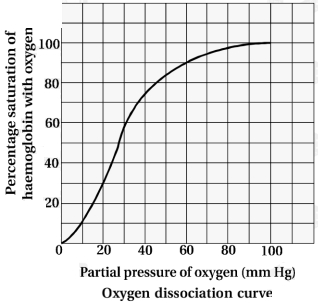
(N/A) Haemoglobin is a red-coloured, iron-containing pigment present in the $RBCs$. $O_2$ can bind with haemoglobin in a reversible manner to form oxyhaemoglobin.
Each haemoglobin molecule can carry a maximum of four molecules of $O_2$. The binding of $O_2$ with haemoglobin is primarily related to the partial pressure of $O_2$ $(pO_2)$.
Partial pressure of $CO_2$ $(pCO_2)$, hydrogen ion concentration $(H^+)$, and temperature are other factors that can interfere with this binding.
A sigmoid curve is obtained when the percentage saturation of haemoglobin with $O_2$ is plotted against the $pO_2$. This curve is called the oxygen dissociation curve.
This curve is highly useful in studying the effect of factors like $pCO_2$ and $H^+$ concentration on the binding of $O_2$ with haemoglobin.
In the alveoli, where there is high $pO_2$, low $pCO_2$, lower $H^+$ concentration, and lower temperature, the conditions are favourable for the formation of oxyhaemoglobin.
In tissues, where low $pO_2$, high $pCO_2$, high $H^+$ concentration, and higher temperature exist, the conditions are favourable for the dissociation of oxygen from the oxyhaemoglobin.
This clearly indicates that $O_2$ gets bound to haemoglobin at the lung surface and gets dissociated at the tissues. Every $100 \text{ ml}$ of oxygenated blood can deliver around $5 \text{ ml}$ of $O_2$ to the tissues under normal physiological conditions.
Each haemoglobin molecule can carry a maximum of four molecules of $O_2$. The binding of $O_2$ with haemoglobin is primarily related to the partial pressure of $O_2$ $(pO_2)$.
Partial pressure of $CO_2$ $(pCO_2)$, hydrogen ion concentration $(H^+)$, and temperature are other factors that can interfere with this binding.
A sigmoid curve is obtained when the percentage saturation of haemoglobin with $O_2$ is plotted against the $pO_2$. This curve is called the oxygen dissociation curve.
This curve is highly useful in studying the effect of factors like $pCO_2$ and $H^+$ concentration on the binding of $O_2$ with haemoglobin.
In the alveoli, where there is high $pO_2$, low $pCO_2$, lower $H^+$ concentration, and lower temperature, the conditions are favourable for the formation of oxyhaemoglobin.
In tissues, where low $pO_2$, high $pCO_2$, high $H^+$ concentration, and higher temperature exist, the conditions are favourable for the dissociation of oxygen from the oxyhaemoglobin.
This clearly indicates that $O_2$ gets bound to haemoglobin at the lung surface and gets dissociated at the tissues. Every $100 \text{ ml}$ of oxygenated blood can deliver around $5 \text{ ml}$ of $O_2$ to the tissues under normal physiological conditions.
0 likes
View Solution141
Medium
Describe: Transport of $CO_{2}$.
Solution
(N/A) $CO_{2}$ is carried by haemoglobin as carbamino-haemoglobin (about $20-25$ percent).
This binding is related to the partial pressure of $CO_{2}$.
$pO_{2}$ is a major factor which could affect this binding.
When $pCO_{2}$ is high and $pO_{2}$ is low as in the tissues, more binding of carbon dioxide occurs, whereas when the $pCO_{2}$ is low and $pO_{2}$ is high as in the alveoli, dissociation of $CO_{2}$ from carbamino-haemoglobin takes place.
$RBCs$ contain a very high concentration of the enzyme, carbonic anhydrase, and minute quantities of the same are present in the plasma too.
This enzyme facilitates the following reaction in both directions:
$CO_{2} + H_{2}O \rightleftharpoons[\text{Carbonic anhydrase}]{\text{Carbonic anhydrase}} H_{2}CO_{3} \rightleftharpoons[\text{Carbonic anhydrase}]{\text{Carbonic anhydrase}} HCO_{3}^{-} + H^{+}$
At the tissue site where partial pressure of $CO_{2}$ is high due to catabolism, $CO_{2}$ diffuses into blood and forms $HCO_{3}^{-}$ and $H^{+}$.
At the alveolar site where $pCO_{2}$ is low, the reaction proceeds in the opposite direction leading to the formation of $CO_{2}$ and $H_{2}O$.
Thus, $CO_{2}$ trapped as bicarbonate at the tissue level and transported to the alveoli is released out.
This binding is related to the partial pressure of $CO_{2}$.
$pO_{2}$ is a major factor which could affect this binding.
When $pCO_{2}$ is high and $pO_{2}$ is low as in the tissues, more binding of carbon dioxide occurs, whereas when the $pCO_{2}$ is low and $pO_{2}$ is high as in the alveoli, dissociation of $CO_{2}$ from carbamino-haemoglobin takes place.
$RBCs$ contain a very high concentration of the enzyme, carbonic anhydrase, and minute quantities of the same are present in the plasma too.
This enzyme facilitates the following reaction in both directions:
$CO_{2} + H_{2}O \rightleftharpoons[\text{Carbonic anhydrase}]{\text{Carbonic anhydrase}} H_{2}CO_{3} \rightleftharpoons[\text{Carbonic anhydrase}]{\text{Carbonic anhydrase}} HCO_{3}^{-} + H^{+}$
At the tissue site where partial pressure of $CO_{2}$ is high due to catabolism, $CO_{2}$ diffuses into blood and forms $HCO_{3}^{-}$ and $H^{+}$.
At the alveolar site where $pCO_{2}$ is low, the reaction proceeds in the opposite direction leading to the formation of $CO_{2}$ and $H_{2}O$.
Thus, $CO_{2}$ trapped as bicarbonate at the tissue level and transported to the alveoli is released out.
0 likes
View Solution142
Easy
State the different modes of $CO_2$ transport in blood.
Solution
(N/A) Carbon dioxide $(CO_2)$ is transported in the blood in three main forms:
$1$. As dissolved gas in plasma: About $7\%$ of $CO_2$ is carried in a dissolved state through the blood plasma.
$2$. As bicarbonate ions $(HCO_3^-)$: Approximately $70\%$ of $CO_2$ is transported as bicarbonate ions. Inside the red blood cells,$CO_2$ reacts with water to form carbonic acid $(H_2CO_3)$,which then dissociates into hydrogen ions $(H^+)$ and bicarbonate ions $(HCO_3^-)$.
$3$. As carbaminohemoglobin: About $20-25\%$ of $CO_2$ binds with the amino group of hemoglobin to form carbaminohemoglobin. This binding is reversible and depends on the partial pressure of $CO_2$ $(pCO_2)$.
$1$. As dissolved gas in plasma: About $7\%$ of $CO_2$ is carried in a dissolved state through the blood plasma.
$2$. As bicarbonate ions $(HCO_3^-)$: Approximately $70\%$ of $CO_2$ is transported as bicarbonate ions. Inside the red blood cells,$CO_2$ reacts with water to form carbonic acid $(H_2CO_3)$,which then dissociates into hydrogen ions $(H^+)$ and bicarbonate ions $(HCO_3^-)$.
$3$. As carbaminohemoglobin: About $20-25\%$ of $CO_2$ binds with the amino group of hemoglobin to form carbaminohemoglobin. This binding is reversible and depends on the partial pressure of $CO_2$ $(pCO_2)$.
0 likes
View Solution143
Easy
Explain the transport of $O_2$ and $CO_2$ between alveoli and tissues with a diagram.
Solution
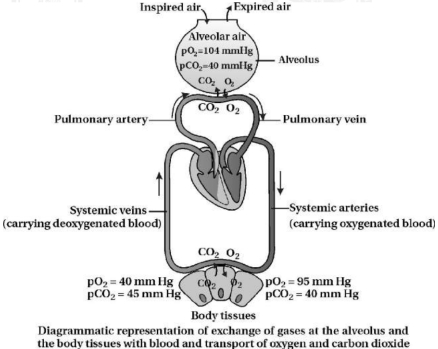
(N/A) Alveoli are the primary sites of exchange of gases. Exchange of gases also occurs between blood and tissues.
$O_2$ and $CO_2$ are exchanged in these sites by simple diffusion,mainly based on pressure/concentration gradients.
Solubility of the gases as well as the thickness of the membranes involved in diffusion are also important factors that affect the rate of diffusion.
Pressure contributed by an individual gas in a mixture of gases is called partial pressure and is represented as $pO_2$ for oxygen and $pCO_2$ for carbon dioxide.
Partial pressures of gases (in $mmHg$) at different sites are given in the table below:
[Diagram: Diagrammatic representation of exchange of gases at the alveolus and the body tissues with blood and transport of oxygen and carbon dioxide]
$O_2$ and $CO_2$ are exchanged in these sites by simple diffusion,mainly based on pressure/concentration gradients.
Solubility of the gases as well as the thickness of the membranes involved in diffusion are also important factors that affect the rate of diffusion.
Pressure contributed by an individual gas in a mixture of gases is called partial pressure and is represented as $pO_2$ for oxygen and $pCO_2$ for carbon dioxide.
Partial pressures of gases (in $mmHg$) at different sites are given in the table below:
| Respiratory Gas | Atmospheric Air | Alveoli | Blood (Deoxygenated) | Blood (Oxygenated) | Tissues |
| $O_2$ | $159$ | $104$ | $40$ | $95$ | $40$ |
| $CO_2$ | $0.3$ | $40$ | $45$ | $40$ | $45$ |
[Diagram: Diagrammatic representation of exchange of gases at the alveolus and the body tissues with blood and transport of oxygen and carbon dioxide]
0 likes
View Solution144
EasyMCQ
Analogy type question:
$(1)$ Carbonic anhydrase : High concentration in $RBC$ :: In blood plasma : .......
$(1)$ Carbonic anhydrase : High concentration in $RBC$ :: In blood plasma : .......
A
High concentration
B
Low concentration
C
Absent
D
Equal concentration
Solution
(B) Carbonic anhydrase is an enzyme that catalyzes the reversible reaction between carbon dioxide and water to form carbonic acid.
This enzyme is present in very high concentrations within red blood cells $(RBCs)$.
However,it is present in very low concentrations (or is almost absent) in the blood plasma.
Therefore,the correct analogy is that while it is in high concentration in $RBCs$,it is in low concentration in blood plasma.
This enzyme is present in very high concentrations within red blood cells $(RBCs)$.
However,it is present in very low concentrations (or is almost absent) in the blood plasma.
Therefore,the correct analogy is that while it is in high concentration in $RBCs$,it is in low concentration in blood plasma.
0 likes
View Solution145
EasyMCQ
Select the correct option:
$(1)$ Approximately $97\%$ of $O_2$ is transported by plasma / RBCs.
$(2)$ The primary site of gas exchange is alveoli / bronchioles.
$(1)$ Approximately $97\%$ of $O_2$ is transported by plasma / RBCs.
$(2)$ The primary site of gas exchange is alveoli / bronchioles.
A
$(1)$ Plasma,$(2)$ Alveoli
B
$(1)$ RBCs,$(2)$ Alveoli
C
$(1)$ Plasma,$(2)$ Bronchioles
D
$(1)$ RBCs,$(2)$ Bronchioles
Solution
(B) $(1)$ Approximately $97\%$ of $O_2$ is transported by Red Blood Cells $(RBCs)$ in the form of oxyhaemoglobin.
$(2)$ The primary site of gas exchange in the human respiratory system is the alveoli,where diffusion of $O_2$ and $CO_2$ occurs between the air and the blood.
$(2)$ The primary site of gas exchange in the human respiratory system is the alveoli,where diffusion of $O_2$ and $CO_2$ occurs between the air and the blood.
0 likes
View Solution146
Medium
Define the $O_{2}$ dissociation curve.
Solution
(N/A) sigmoid curve is obtained when the percentage saturation of haemoglobin with $O_{2}$ is plotted against the partial pressure of oxygen $(pO_{2})$. This curve is known as the oxygen dissociation curve.
0 likes
View Solution147
MediumMCQ
Approximately what amount of $O_{2}$ reaches the tissues via $100 \ ml$ of blood (in $ml$)?
A
$2$
B
$5$
C
$10$
D
$20$
Solution
(B) Under normal physiological conditions,every $100 \ ml$ of oxygenated blood can deliver approximately $5 \ ml$ of $O_{2}$ to the tissues. This occurs because arterial blood carries about $20 \ ml$ of $O_{2}$ per $100 \ ml$,and venous blood returns with about $15 \ ml$ of $O_{2}$ per $100 \ ml$ to the lungs.
0 likes
View Solution148
EasyMCQ
What is the amount of $O_{2}$ supplied to tissues through every $100 \ ml$ of oxygenated blood under normal physiological conditions (in $ml$)?
A
$2$
B
$5$
C
$10$
D
$20$
Solution
(B) Under normal physiological conditions,every $100 \ ml$ of oxygenated blood can deliver approximately $5 \ ml$ of $O_{2}$ to the tissues. This is because arterial blood carries about $20 \ ml$ of $O_{2}$ per $100 \ ml$,while venous blood returns with about $15 \ ml$ of $O_{2}$ per $100 \ ml$.
0 likes
View SolutionBreathing and Exchange of Gases — Transport of gases · Frequently Asked Questions
1Are these Breathing and Exchange of Gases questions useful for JEE and NEET?
Yes. All questions in this section are mapped to JEE Main and NEET exam patterns. Previous year questions from JEE Main, NEET, GUJCET and state-level exams are included with full solutions.
2Can I switch to Hindi or Gujarati for these questions?
Yes. Use the language tabs in the hero section or the sidebar to view the same questions and solutions in English, Hindi or Gujarati.
3How do I generate a question paper from this subtopic?
Use the Vedclass Exam Paper Generator — select the chapter and subtopic, set difficulty, and generate Sets A, B, C, D automatically. First 3 chapters of every subject are free.
Vedclass Products
For Students
Vedclass Test Series
Mock tests in real JEE/NEET style with performance analysis. 5-day free trial.
Start Free TrialFor Teachers
Exam Paper Generator
Generate Set A/B/C/D papers from this chapter in 2 minutes. 3 chapters free.
Try FreeFor Institutes
Online Exam Module
Live online exams with unlimited students, 360° analytics & white-label branding.
See DemoFor Teachers & Institutes
Generate a Breathing and Exchange of Gases Exam Paper in 2 Minutes
Select subtopic & difficulty — Sets A, B, C, D auto-generated with No Repeat logic.
First 3 chapters of every subject are free — no payment required.