
A English
Exchange of gases Questions in English
Class 11 Biology · Breathing and Exchange of Gases · Exchange of gases
116+
Questions
English
Language
100%
With Solutions
Showing 50 of 116 questions in English
1
EasyMCQ
Gaseous exchange in land plants takes place through stomatal openings,while in submerged hydrophytes it takes place by
A
Lenticels
B
Stomata
C
Hydathodes
D
General surface of the cells by diffusion
Solution
(D) In land plants,gaseous exchange occurs primarily through stomata present on the leaves.
However,in submerged hydrophytes,the entire plant body remains underwater.
These plants lack stomata because they are not exposed to the atmosphere.
Instead,they absorb dissolved gases directly from the surrounding water through the general surface of their cells via the process of diffusion.
However,in submerged hydrophytes,the entire plant body remains underwater.
These plants lack stomata because they are not exposed to the atmosphere.
Instead,they absorb dissolved gases directly from the surrounding water through the general surface of their cells via the process of diffusion.
0 likes
View Solution2
MediumMCQ
In which part does gaseous exchange take place in a rabbit?
A
Trachea & alveolar duct
B
Trachea & bronchi
C
Alveolar duct & alveoli
D
Alveoli & tissues
Solution
(D) In mammals like rabbits,the primary site for gaseous exchange is the alveoli,where oxygen enters the blood and carbon dioxide leaves it.
Additionally,gaseous exchange also occurs at the level of body tissues,where oxygen is delivered to cells and carbon dioxide is collected from them.
Therefore,the correct sites for gaseous exchange are the alveoli and the tissues.
Additionally,gaseous exchange also occurs at the level of body tissues,where oxygen is delivered to cells and carbon dioxide is collected from them.
Therefore,the correct sites for gaseous exchange are the alveoli and the tissues.
0 likes
View Solution3
EasyMCQ
The exchange of gases $(O_2 \text{ and } CO_2)$ in a mammal takes place in:
A
Trachea
B
Bronchi
C
Bronchiole
D
Alveoli
Solution
(D) In mammals,the respiratory system is designed for efficient gas exchange.
Air travels through the trachea,bronchi,and bronchioles,which serve as conducting zones.
The actual exchange of gases $(O_2 \text{ and } CO_2)$ occurs by simple diffusion across the respiratory membrane of the alveoli.
Alveoli are thin-walled,sac-like structures surrounded by a dense network of capillaries,providing a large surface area for gas exchange.
Air travels through the trachea,bronchi,and bronchioles,which serve as conducting zones.
The actual exchange of gases $(O_2 \text{ and } CO_2)$ occurs by simple diffusion across the respiratory membrane of the alveoli.
Alveoli are thin-walled,sac-like structures surrounded by a dense network of capillaries,providing a large surface area for gas exchange.
0 likes
View Solution4
EasyMCQ
What is the approximate percentage of oxygen in alveolar air (in $\%$)?
A
$4$
B
$16$
C
$13.6$
D
$78$
Solution
(B) The composition of alveolar air is different from atmospheric air due to the exchange of gases in the lungs.
Atmospheric air contains approximately $21\%$ oxygen,while alveolar air contains approximately $14\%$ to $16\%$ oxygen.
Therefore,$16\%$ is the standard accepted value for oxygen concentration in the alveoli.
Atmospheric air contains approximately $21\%$ oxygen,while alveolar air contains approximately $14\%$ to $16\%$ oxygen.
Therefore,$16\%$ is the standard accepted value for oxygen concentration in the alveoli.
0 likes
View Solution5
MediumMCQ
In lungs,the air is separated from the venous blood through:
A
Squamous epithelium + endothelium of blood vessel
B
Squamous epithelium + tunica media blood vessel
C
Transitional epithelium + tunica external blood vessel
D
None of these
Solution
(A) The diffusion membrane of the lungs is composed of three layers: the thin squamous epithelium of the alveoli,the endothelium of the alveolar capillaries,and the basement substance in between them.
Therefore,the air in the alveoli is separated from the blood in the capillaries by the squamous epithelium of the alveoli and the endothelium of the blood vessel.
Therefore,the air in the alveoli is separated from the blood in the capillaries by the squamous epithelium of the alveoli and the endothelium of the blood vessel.
0 likes
View Solution6
MediumMCQ
The exchange of gases in the alveoli of the lungs takes place by
A
Osmosis
B
Simple diffusion
C
Passive transport
D
Active transport
Solution
(B) The exchange of gases in the alveoli occurs via simple diffusion.
Oxygen moves from the alveolar air into the blood,while $CO_2$ moves from the blood into the alveolar air.
This process is driven by partial pressure gradients of the respective gases across the respiratory membrane.
Oxygen moves from the alveolar air into the blood,while $CO_2$ moves from the blood into the alveolar air.
This process is driven by partial pressure gradients of the respective gases across the respiratory membrane.
0 likes
View Solution7
EasyMCQ
The ${O_2}$ concentration in the exhaled air is approximately:
A
About $8\%$
B
About $10\%$
C
About $15\%$
D
About $20\%$
Solution
(C) The atmospheric air contains approximately $21\%$ of ${O_2}$.
During the process of respiration,the body consumes a portion of this oxygen for cellular metabolism.
As a result,the exhaled air (expired air) contains a lower concentration of ${O_2}$ compared to inhaled air.
Typically,exhaled air contains about $15-16\%$ of ${O_2}$ by volume.
Therefore,the correct option is $C$.
During the process of respiration,the body consumes a portion of this oxygen for cellular metabolism.
As a result,the exhaled air (expired air) contains a lower concentration of ${O_2}$ compared to inhaled air.
Typically,exhaled air contains about $15-16\%$ of ${O_2}$ by volume.
Therefore,the correct option is $C$.
0 likes
View Solution8
MediumMCQ
Which of the following factors is most necessary for an efficient respiratory surface?
A
Moistness
B
Large surface area
C
Rich blood supply
D
Increased thickness
Solution
(D) An efficient respiratory surface must facilitate the rapid diffusion of gases. According to Fick's Law of Diffusion,the rate of diffusion is inversely proportional to the thickness of the membrane. Therefore,a thin membrane is essential for efficient gas exchange. While moistness,large surface area,and rich blood supply are also important characteristics,the thinness of the membrane is a critical physical requirement for the diffusion process to occur effectively.
0 likes
View Solution9
MediumMCQ
The blood leaving the lungs has all its haemoglobin oxygenated. Why does it give up oxygen to the tissues?
A
Tissues can absorb $O_2$ from oxyhaemoglobin.
B
$O_2$ concentration is lower in tissues than in the lungs.
C
Oxyhaemoglobin undergoes reduction.
D
None of these.
Solution
(B) The exchange of gases occurs due to the partial pressure gradient of $O_2$ and $CO_2$.
In the lungs,the partial pressure of oxygen $(pO_2)$ is high,which promotes the binding of $O_2$ with haemoglobin to form oxyhaemoglobin.
As blood reaches the tissues,the $pO_2$ is significantly lower compared to the blood because the tissues continuously consume $O_2$ for cellular respiration.
Due to this lower $pO_2$ in the tissues,the affinity of haemoglobin for $O_2$ decreases,causing the oxyhaemoglobin to dissociate and release $O_2$ into the tissues.
In the lungs,the partial pressure of oxygen $(pO_2)$ is high,which promotes the binding of $O_2$ with haemoglobin to form oxyhaemoglobin.
As blood reaches the tissues,the $pO_2$ is significantly lower compared to the blood because the tissues continuously consume $O_2$ for cellular respiration.
Due to this lower $pO_2$ in the tissues,the affinity of haemoglobin for $O_2$ decreases,causing the oxyhaemoglobin to dissociate and release $O_2$ into the tissues.
0 likes
View Solution10
MediumMCQ
Constant flow of $CO_2$ from the tissues into the blood is due to
A
Less amount of $CO_2$ in tissue cells than in the blood
B
More amount of $CO_2$ in tissue cells than in the blood
C
Equal amount of $CO_2$ in tissue cells and blood
D
Enzymatic reactions
Solution
(B) The exchange of gases like $O_2$ and $CO_2$ between the tissues and the blood occurs primarily through the process of simple diffusion.
Diffusion is driven by a partial pressure gradient.
In metabolically active tissues,cellular respiration produces $CO_2$ as a byproduct,leading to a higher partial pressure of $CO_2$ $(pCO_2)$ in the tissues compared to the blood.
Conversely,the blood arriving at the tissues has a lower $pCO_2$.
Due to this concentration gradient,$CO_2$ moves from the area of higher partial pressure (tissues) to the area of lower partial pressure (blood) until equilibrium is reached.
Diffusion is driven by a partial pressure gradient.
In metabolically active tissues,cellular respiration produces $CO_2$ as a byproduct,leading to a higher partial pressure of $CO_2$ $(pCO_2)$ in the tissues compared to the blood.
Conversely,the blood arriving at the tissues has a lower $pCO_2$.
Due to this concentration gradient,$CO_2$ moves from the area of higher partial pressure (tissues) to the area of lower partial pressure (blood) until equilibrium is reached.
0 likes
View Solution11
MediumMCQ
Which of the following is true regarding $CO_2$ concentration?
A
More in alveolar air than in expired air
B
More in expired air than in alveolar air
C
More in inspired air than in expired air
D
More in inspired air than in alveolar air
Solution
(A) The concentration of $CO_2$ in atmospheric (inspired) air is approximately $0.04\%$.
In alveolar air,the partial pressure of $CO_2$ $(pCO_2)$ is about $40 \ mmHg$.
Expired air is a mixture of alveolar air and dead space air (which is similar to atmospheric air).
Therefore,the $CO_2$ concentration in alveolar air is higher than in expired air because the alveolar air is diluted by the air in the anatomical dead space during expiration.
In alveolar air,the partial pressure of $CO_2$ $(pCO_2)$ is about $40 \ mmHg$.
Expired air is a mixture of alveolar air and dead space air (which is similar to atmospheric air).
Therefore,the $CO_2$ concentration in alveolar air is higher than in expired air because the alveolar air is diluted by the air in the anatomical dead space during expiration.
0 likes
View Solution12
MediumMCQ
Ascent of high mountains may cause altitude sickness in men. The prime cause of this is:
A
Excess of $CO_2$ in blood
B
Decreased efficiency of haemoglobin
C
Decreased partial pressure of oxygen
D
Decreased proportion of oxygen in air
Solution
(C) At high altitudes,the atmospheric pressure decreases,which leads to a decrease in the partial pressure of oxygen $(pO_2)$.
Due to this low $pO_2$ in the inspired air,the oxygen diffusion into the blood in the lungs is reduced.
This results in hypoxia (low oxygen supply to tissues),which manifests as symptoms of altitude sickness such as nausea,fatigue,and heart palpitations.
The proportion of oxygen in the air remains constant at approximately $21\%$,but the reduced barometric pressure makes it harder for oxygen to enter the bloodstream.
Due to this low $pO_2$ in the inspired air,the oxygen diffusion into the blood in the lungs is reduced.
This results in hypoxia (low oxygen supply to tissues),which manifests as symptoms of altitude sickness such as nausea,fatigue,and heart palpitations.
The proportion of oxygen in the air remains constant at approximately $21\%$,but the reduced barometric pressure makes it harder for oxygen to enter the bloodstream.
0 likes
View Solution13
MediumMCQ
Mammalian lungs have an enormous number of minute alveoli (air sacs). This is to allow:
A
More space for increasing the volume of inspired air
B
More surface area for diffusion of gases
C
More spongy texture for keeping lungs in proper shape
D
More nerve supply to keep organs active when working
Solution
(B) The correct answer is $B$. In mammalian lungs,each alveolar duct ends in a passage called an atrium,which leads into a number of rounded alveolar sacs. Each alveolar sac is covered with a large number of minute air sacs known as alveoli. The presence of a vast number of alveoli significantly increases the surface area available for the diffusion of gases ($O_2$ and $CO_2$),which is essential for efficient respiration.
0 likes
View Solution14
MediumMCQ
The blood coming out of the lungs is richer in which of the following compared to the blood entering the lungs?
A
Carbon dioxide
B
Oxygen
C
Both $(a)$ and $(b)$
D
None of these
Solution
(B) The blood entering the lungs (via the pulmonary artery) is deoxygenated,meaning it has a high concentration of $CO_2$ and a low concentration of $O_2$.
In the alveoli of the lungs,gaseous exchange occurs through diffusion.
Oxygen diffuses from the alveoli into the blood,and carbon dioxide diffuses from the blood into the alveoli.
Therefore,the blood leaving the lungs (via the pulmonary vein) is oxygenated,meaning it is richer in oxygen compared to the blood that entered the lungs.
In the alveoli of the lungs,gaseous exchange occurs through diffusion.
Oxygen diffuses from the alveoli into the blood,and carbon dioxide diffuses from the blood into the alveoli.
Therefore,the blood leaving the lungs (via the pulmonary vein) is oxygenated,meaning it is richer in oxygen compared to the blood that entered the lungs.
0 likes
View Solution15
MediumMCQ
Blood leaving the lungs is rich in:
A
Oxygen
B
Haemoglobin
C
Carbon dioxide
D
More number of $RBC$
Solution
(A) During the process of respiration,deoxygenated blood is pumped from the heart to the lungs via the pulmonary artery.
In the lungs,gas exchange occurs at the level of the alveoli.
Oxygen diffuses from the alveoli into the blood,while carbon dioxide diffuses from the blood into the alveoli.
Consequently,the blood leaving the lungs through the pulmonary veins is oxygenated,meaning it is rich in oxygen.
In the lungs,gas exchange occurs at the level of the alveoli.
Oxygen diffuses from the alveoli into the blood,while carbon dioxide diffuses from the blood into the alveoli.
Consequently,the blood leaving the lungs through the pulmonary veins is oxygenated,meaning it is rich in oxygen.
0 likes
View Solution16
MediumMCQ
The number of $RBC$ in a man increases if he lives at a higher altitude because:
A
There is more oxygen
B
There is less oxygen
C
There are no germs in the air
D
More heat is needed to warm the body
Solution
(B) At higher altitudes,the atmospheric pressure decreases,which leads to a lower partial pressure of oxygen $(pO_2)$.
This results in hypoxia (low oxygen availability) in the tissues.
To compensate for this reduced oxygen supply,the body stimulates the kidneys to release the hormone erythropoietin.
Erythropoietin stimulates the bone marrow to increase the production of $RBC$s,thereby increasing the oxygen-carrying capacity of the blood.
This results in hypoxia (low oxygen availability) in the tissues.
To compensate for this reduced oxygen supply,the body stimulates the kidneys to release the hormone erythropoietin.
Erythropoietin stimulates the bone marrow to increase the production of $RBC$s,thereby increasing the oxygen-carrying capacity of the blood.
0 likes
View Solution17
MediumMCQ
Which surface of a plant leaf is better adapted for gas exchange?
A
Lower surface trichomes
B
Multilayered epidermis
C
Waxy cuticle
D
Stomata located on the lower surface away from direct sunlight
Solution
(D) The stomata located on the lower surface of the plant leaf facilitate gas exchange more efficiently while minimizing water loss through transpiration. This adaptation protects the stomata from direct exposure to sunlight,which would otherwise increase the rate of evaporation.
0 likes
View Solution18
EasyMCQ
Why are a very large number of alveoli present in the lungs?
A
To provide a large surface area for greater air intake
B
To provide a large surface area for diffusion
C
To make the organ soft and spongy
D
To provide a greater nerve supply
Solution
(B) The alveoli are the primary sites of gas exchange in the lungs.
They are numerous and spherical in shape,which significantly increases the total surface area available for the diffusion of gases ($O_2$ and $CO_2$).
According to Fick's law of diffusion,the rate of gas exchange is directly proportional to the surface area of the membrane.
Therefore,a large number of alveoli ensure efficient and rapid exchange of gases between the blood and the atmosphere.
They are numerous and spherical in shape,which significantly increases the total surface area available for the diffusion of gases ($O_2$ and $CO_2$).
According to Fick's law of diffusion,the rate of gas exchange is directly proportional to the surface area of the membrane.
Therefore,a large number of alveoli ensure efficient and rapid exchange of gases between the blood and the atmosphere.
0 likes
View Solution19
MediumMCQ
Which of the following statements is $NOT$ correct?
A
The partial pressure of $O_2$ in deoxygenated blood is $40 \, mm \, Hg$.
B
The partial pressure of $O_2$ in oxygenated blood is $95 \, mm \, Hg$.
C
The partial pressure of $O_2$ in alveolar air is $104 \, mm \, Hg$.
D
The partial pressure of $CO_2$ in deoxygenated blood is $95 \, mm \, Hg$.
Solution
(D) In human respiration,the partial pressures of gases are as follows:
$1$. Alveolar air: $pO_2 = 104 \, mm \, Hg$ and $pCO_2 = 40 \, mm \, Hg$.
$2$. Deoxygenated blood: $pO_2 = 40 \, mm \, Hg$ and $pCO_2 = 45 \, mm \, Hg$.
$3$. Oxygenated blood: $pO_2 = 95 \, mm \, Hg$ and $pCO_2 = 40 \, mm \, Hg$.
Comparing these values with the given options,option $D$ states that the partial pressure of $CO_2$ in deoxygenated blood is $95 \, mm \, Hg$,which is incorrect because it is actually $45 \, mm \, Hg$.
$1$. Alveolar air: $pO_2 = 104 \, mm \, Hg$ and $pCO_2 = 40 \, mm \, Hg$.
$2$. Deoxygenated blood: $pO_2 = 40 \, mm \, Hg$ and $pCO_2 = 45 \, mm \, Hg$.
$3$. Oxygenated blood: $pO_2 = 95 \, mm \, Hg$ and $pCO_2 = 40 \, mm \, Hg$.
Comparing these values with the given options,option $D$ states that the partial pressure of $CO_2$ in deoxygenated blood is $95 \, mm \, Hg$,which is incorrect because it is actually $45 \, mm \, Hg$.
0 likes
View Solution20
MediumMCQ
Which of the following is correct regarding the partial pressures of gases ($PO_2$ and $PCO_2$) in different parts of the human respiratory system?
A
Alveoli: $PO_2 = 159 \, mm \, Hg$,Deoxygenated blood: $PCO_2 = 40 \, mm \, Hg$,Tissues: $PCO_2 = 20 \, mm \, Hg$
B
Alveoli: $PCO_2 = 40 \, mm \, Hg$,Deoxygenated blood: $PO_2 = 95 \, mm \, Hg$,Tissues: $PCO_2 = 40 \, mm \, Hg$
C
Alveoli: $PO_2 = 104 \, mm \, Hg$,Deoxygenated blood: $PCO_2 = 45 \, mm \, Hg$,Tissues: $PO_2 = 40 \, mm \, Hg$
D
Alveoli: $PO_2 = 40 \, mm \, Hg$,Deoxygenated blood: $PO_2 = 40 \, mm \, Hg$,Tissues: $PCO_2 = 45 \, mm \, Hg$
Solution
(C) In the human respiratory system,the partial pressures of gases are as follows:
$1$. In the Alveoli: $PO_2 = 104 \, mm \, Hg$ and $PCO_2 = 40 \, mm \, Hg$.
$2$. In Deoxygenated blood (returning to lungs): $PO_2 = 40 \, mm \, Hg$ and $PCO_2 = 45 \, mm \, Hg$.
$3$. In Oxygenated blood (leaving lungs): $PO_2 = 95 \, mm \, Hg$ and $PCO_2 = 40 \, mm \, Hg$.
$4$. In Tissues: $PO_2 = 40 \, mm \, Hg$ and $PCO_2 = 45 \, mm \, Hg$.
Comparing these values with the given options,option $C$ correctly states the values for Alveoli $(PO_2 = 104 \, mm \, Hg)$,Deoxygenated blood $(PCO_2 = 45 \, mm \, Hg)$,and Tissues $(PO_2 = 40 \, mm \, Hg)$.
$1$. In the Alveoli: $PO_2 = 104 \, mm \, Hg$ and $PCO_2 = 40 \, mm \, Hg$.
$2$. In Deoxygenated blood (returning to lungs): $PO_2 = 40 \, mm \, Hg$ and $PCO_2 = 45 \, mm \, Hg$.
$3$. In Oxygenated blood (leaving lungs): $PO_2 = 95 \, mm \, Hg$ and $PCO_2 = 40 \, mm \, Hg$.
$4$. In Tissues: $PO_2 = 40 \, mm \, Hg$ and $PCO_2 = 45 \, mm \, Hg$.
Comparing these values with the given options,option $C$ correctly states the values for Alveoli $(PO_2 = 104 \, mm \, Hg)$,Deoxygenated blood $(PCO_2 = 45 \, mm \, Hg)$,and Tissues $(PO_2 = 40 \, mm \, Hg)$.
0 likes
View Solution21
EasyMCQ
The exchange of gases in the alveoli of the lungs occurs through which process?
A
Active transport
B
Osmosis
C
Simple diffusion
D
Facilitated transport
Solution
(C) The exchange of gases ($O_2$ and $CO_2$) in the alveoli of the lungs occurs primarily through the process of simple diffusion.
This process is driven by the partial pressure gradients of the gases.
Oxygen moves from the alveoli (high partial pressure) into the blood (low partial pressure),while carbon dioxide moves from the blood (high partial pressure) into the alveoli (low partial pressure) across the respiratory membrane.
This process is driven by the partial pressure gradients of the gases.
Oxygen moves from the alveoli (high partial pressure) into the blood (low partial pressure),while carbon dioxide moves from the blood (high partial pressure) into the alveoli (low partial pressure) across the respiratory membrane.
0 likes
View Solution22
MediumMCQ
Under normal physiological conditions,$100 \, mL$ of oxygenated blood delivers how much $CO_2$ to the alveoli?
A
$4 \, mL$ $CO_2$
B
$10 \, mL$ $CO_2$
C
$1.34 \, mL$ $CO_2$
D
$30 \, mL$ $CO_2$
Solution
(A) Under normal physiological conditions,every $100 \, mL$ of oxygenated blood can deliver about $5 \, mL$ of $O_2$ to the tissues.
Conversely,every $100 \, mL$ of deoxygenated blood delivers approximately $4 \, mL$ of $CO_2$ to the alveoli for elimination.
Therefore,the correct answer is $4 \, mL$ of $CO_2$.
Conversely,every $100 \, mL$ of deoxygenated blood delivers approximately $4 \, mL$ of $CO_2$ to the alveoli for elimination.
Therefore,the correct answer is $4 \, mL$ of $CO_2$.
0 likes
View Solution23
EasyMCQ
What is the exchange of bicarbonate and chloride ions between $RBC$s and plasma called?
A
Chloride shift
B
Bohr effect
C
Haldane effect
D
Cellular respiration
Solution
(A) The exchange of bicarbonate $(HCO_3^-)$ ions and chloride $(Cl^-)$ ions between $RBC$s and blood plasma is known as the chloride shift or the Hamburger phenomenon.
When $CO_2$ enters the $RBC$s,it reacts with water to form carbonic acid,which dissociates into $H^+$ and $HCO_3^-$. To maintain electrical neutrality,$Cl^-$ ions move from the plasma into the $RBC$s in exchange for $HCO_3^-$ ions moving out into the plasma.
When $CO_2$ enters the $RBC$s,it reacts with water to form carbonic acid,which dissociates into $H^+$ and $HCO_3^-$. To maintain electrical neutrality,$Cl^-$ ions move from the plasma into the $RBC$s in exchange for $HCO_3^-$ ions moving out into the plasma.
0 likes
View Solution24
MediumMCQ
The blood flowing towards the lungs contains more of which of the following compared to the blood flowing away from the lungs?
A
Oxygen
B
$CO_2$
C
Hydrogen
D
$pH$
Solution
(B) Blood flowing towards the lungs is deoxygenated blood,which is carried by the pulmonary arteries. This blood has a higher concentration of $CO_2$ and a lower concentration of $O_2$ compared to the oxygenated blood that flows away from the lungs via the pulmonary veins. Therefore,blood flowing towards the lungs contains more $CO_2$.
0 likes
View Solution25
MediumMCQ
What is the partial pressure of $CO_2$ in the alveolar air?
A
$40\; mm\; Hg$
B
$42\; mm\; Hg$
C
$44\; mm\; Hg$
D
$46\; mm\; Hg$
Solution
(A) The partial pressure of gases in the respiratory system is crucial for gas exchange.
In the alveoli,the partial pressure of oxygen $(pO_2)$ is approximately $104\; mm\; Hg$.
The partial pressure of carbon dioxide $(pCO_2)$ in the alveolar air is approximately $40\; mm\; Hg$.
This gradient allows $CO_2$ to diffuse from the blood (where $pCO_2$ is $45\; mm\; Hg$) into the alveoli for exhalation.
In the alveoli,the partial pressure of oxygen $(pO_2)$ is approximately $104\; mm\; Hg$.
The partial pressure of carbon dioxide $(pCO_2)$ in the alveolar air is approximately $40\; mm\; Hg$.
This gradient allows $CO_2$ to diffuse from the blood (where $pCO_2$ is $45\; mm\; Hg$) into the alveoli for exhalation.
0 likes
View Solution26
EasyMCQ
Which of the following factors affects the diffusion of gases?
A
Thickness of the membranes involved in diffusion
B
Solubility of the gases
C
Pressure of the gases
D
All of the above
Solution
(D) The diffusion of gases across the alveolar membrane is influenced by several factors:
$1$. Solubility of the gases: Gases with higher solubility (like $CO_2$) diffuse faster than those with lower solubility (like $O_2$).
$2$. Thickness of the membranes: The diffusion membrane is made up of three layers (thin squamous epithelium of alveoli,endothelium of alveolar capillaries,and the basement substance in between). The total thickness is much less than a millimeter,which facilitates diffusion.
$3$. Pressure gradient: The partial pressure gradient of $O_2$ and $CO_2$ across the diffusion membrane is the primary driving force for the exchange of gases.
Therefore,all these factors play a significant role in the diffusion of gases.
$1$. Solubility of the gases: Gases with higher solubility (like $CO_2$) diffuse faster than those with lower solubility (like $O_2$).
$2$. Thickness of the membranes: The diffusion membrane is made up of three layers (thin squamous epithelium of alveoli,endothelium of alveolar capillaries,and the basement substance in between). The total thickness is much less than a millimeter,which facilitates diffusion.
$3$. Pressure gradient: The partial pressure gradient of $O_2$ and $CO_2$ across the diffusion membrane is the primary driving force for the exchange of gases.
Therefore,all these factors play a significant role in the diffusion of gases.
0 likes
View Solution27
MediumMCQ
What is the primary reason why mountaineers experience difficulty at high altitudes?
A
High concentration of $CO_2$ in the blood
B
Decrease in the oxygen-carrying capacity of hemoglobin
C
Decrease in the partial pressure of oxygen
D
Decrease in the percentage of oxygen in the air
Solution
(C) At high altitudes,the atmospheric pressure decreases.
As a result,the partial pressure of oxygen $(pO_2)$ also decreases significantly compared to sea level.
Due to this lower $pO_2$,the diffusion of oxygen into the blood becomes less efficient,leading to hypoxia (lack of oxygen in tissues),which causes symptoms like dizziness,nausea,and fatigue in mountaineers.
Note that the percentage of oxygen in the air remains constant at approximately $21\%$,but the reduced total atmospheric pressure lowers the partial pressure of oxygen.
As a result,the partial pressure of oxygen $(pO_2)$ also decreases significantly compared to sea level.
Due to this lower $pO_2$,the diffusion of oxygen into the blood becomes less efficient,leading to hypoxia (lack of oxygen in tissues),which causes symptoms like dizziness,nausea,and fatigue in mountaineers.
Note that the percentage of oxygen in the air remains constant at approximately $21\%$,but the reduced total atmospheric pressure lowers the partial pressure of oxygen.
0 likes
View Solution28
MediumMCQ
What does the presence of a large number of alveoli around the alveolar duct opening into the bronchioles in mammalian lungs indicate?
A
Inefficient system for the exchange of small amounts of residual air.
B
Inefficient system for the exchange of large amounts of residual air.
C
Efficient system for the exchange in the absence of residual air.
D
Efficient system for the exchange of large amounts of residual air.
Solution
(D) The presence of a large number of alveoli significantly increases the surface area available for the exchange of gases. In mammalian lungs,the alveolar ducts open into numerous alveoli,which are the primary sites of gas exchange. This structural arrangement ensures an efficient system for the exchange of large volumes of air,including the residual air,by maximizing the contact area between the air and the pulmonary capillaries.
0 likes
View Solution29
MediumMCQ
The diffusion membrane of the lungs is made up of which of the following layers?
A
Squamous epithelium + Tunica externa of blood vessel
B
Squamous epithelium + Endothelium of blood vessel
C
Transitional epithelium + Tunica media of blood vessel
D
Columnar epithelium + Three-layered wall of blood vessel
Solution
(B) The diffusion membrane of the lungs,which facilitates the exchange of gases ($O_2$ and $CO_2$),consists of three main layers:
$1$. The thin squamous epithelium of the alveoli.
$2$. The endothelium of the alveolar capillaries.
$3$. The basement substance (basement membrane) in between them.
Therefore,the correct composition is the squamous epithelium of the alveoli and the endothelium of the blood capillaries.
$1$. The thin squamous epithelium of the alveoli.
$2$. The endothelium of the alveolar capillaries.
$3$. The basement substance (basement membrane) in between them.
Therefore,the correct composition is the squamous epithelium of the alveoli and the endothelium of the blood capillaries.
0 likes
View Solution30
EasyMCQ
Through which process is oxygen transported from the lungs to the tissues?
A
Diffusion
B
Facilitated diffusion
C
Transpiration
D
Osmosis
Solution
(A) The exchange of gases like $O_2$ and $CO_2$ between the alveoli of the lungs and the blood,and between the blood and the tissues,occurs primarily by the process of simple diffusion.
Diffusion is driven by the partial pressure gradients of these gases.
Since the partial pressure of $O_2$ is higher in the alveoli compared to the blood,and higher in the blood compared to the tissues,$O_2$ moves from the lungs to the tissues via diffusion.
Diffusion is driven by the partial pressure gradients of these gases.
Since the partial pressure of $O_2$ is higher in the alveoli compared to the blood,and higher in the blood compared to the tissues,$O_2$ moves from the lungs to the tissues via diffusion.
0 likes
View Solution31
MediumMCQ
Which of the following statements is correct regarding the diffusion capacity of gases?
A
The diffusion capacity of $CO_2$ is much higher than that of $O_2$.
B
The diffusion capacity of $O_2$ is much higher than that of $CO_2$.
C
The diffusion capacity of $O_2$ and $CO_2$ is equal.
D
None of the above.
Solution
(A) The diffusion capacity of a gas across the alveolar membrane depends on its solubility and the thickness of the membrane.
According to Fick's law of diffusion,the rate of diffusion is directly proportional to the solubility of the gas.
The solubility of $CO_2$ is $20-25$ times higher than that of $O_2$ in the blood.
Therefore,the amount of $CO_2$ that can diffuse through the diffusion membrane per unit partial pressure difference is much higher than that of $O_2$.
According to Fick's law of diffusion,the rate of diffusion is directly proportional to the solubility of the gas.
The solubility of $CO_2$ is $20-25$ times higher than that of $O_2$ in the blood.
Therefore,the amount of $CO_2$ that can diffuse through the diffusion membrane per unit partial pressure difference is much higher than that of $O_2$.
0 likes
View Solution32
EasyMCQ
What is the primary mechanism responsible for the exchange of gases in the lungs?
A
Simple diffusion
B
Active transport
C
Indirect transport
D
Facilitated diffusion
Solution
(A) The exchange of gases like $O_2$ and $CO_2$ in the lungs occurs across the alveolar membrane. This process is driven by partial pressure gradients. Since gases move from an area of higher partial pressure to an area of lower partial pressure without the expenditure of energy,this process is known as simple diffusion. Therefore,simple diffusion is the primary mechanism for gas exchange in the lungs.
0 likes
View Solution33
MediumMCQ
In rabbits,which part of the lungs is responsible for the exchange of gases?
A
Trachea and alveolar duct
B
Trachea and bronchi
C
Alveolar duct and alveoli
D
Alveoli and trachea
Solution
(C) In mammals like rabbits,the respiratory system consists of a branching network of tubes. The exchange of gases ($O_2$ and $CO_2$) occurs specifically at the respiratory surface. The alveolar ducts and the alveoli (air sacs) are the terminal parts of the respiratory tree where the blood-air barrier is thin enough to allow for the diffusion of gases. Therefore,the exchange of gases takes place in the alveolar ducts and alveoli.
0 likes
View Solution34
EasyMCQ
In humans,where does the exchange of gases take place?
A
Trachea
B
Bronchi
C
Alveoli
D
All of the above
Solution
(C) In the human respiratory system,the exchange of gases ($O_2$ and $CO_2$) occurs primarily in the $Alveoli$.
These are tiny,balloon-like structures at the end of the respiratory tree where the blood capillaries are in close contact with the air,allowing for efficient diffusion of gases across the respiratory membrane.
These are tiny,balloon-like structures at the end of the respiratory tree where the blood capillaries are in close contact with the air,allowing for efficient diffusion of gases across the respiratory membrane.
0 likes
View Solution35
EasyMCQ
What is the percentage of oxygen in expired air (in $\%$)?
A
$10$
B
$16$
C
$19$
D
$4$
Solution
(B) The composition of atmospheric air (inspired air) is approximately $21\%$ oxygen,$0.04\%$ carbon dioxide,and $78\%$ nitrogen.
During the process of respiration,oxygen is consumed by the body cells for cellular respiration,and carbon dioxide is produced as a byproduct.
Expired air (exhaled air) contains approximately $16\%$ oxygen,$4\%$ carbon dioxide,and $79\%$ nitrogen.
Therefore,the correct percentage of oxygen in expired air is $16\%$.
During the process of respiration,oxygen is consumed by the body cells for cellular respiration,and carbon dioxide is produced as a byproduct.
Expired air (exhaled air) contains approximately $16\%$ oxygen,$4\%$ carbon dioxide,and $79\%$ nitrogen.
Therefore,the correct percentage of oxygen in expired air is $16\%$.
0 likes
View Solution36
MediumMCQ
External respiration refers to the exchange of gases between which of the following?
A
Inhaled air and blood
B
Blood and tissue fluid
C
Alveolar air and blood
D
Environmental air and lungs
Solution
(C) External respiration,also known as pulmonary gas exchange,is the process by which oxygen is taken up by the blood from the alveoli and carbon dioxide is released from the blood into the alveoli.
This exchange occurs across the respiratory membrane between the alveolar air and the pulmonary capillaries (blood).
In contrast,internal respiration refers to the exchange of gases between the blood and the tissue cells/fluid.
This exchange occurs across the respiratory membrane between the alveolar air and the pulmonary capillaries (blood).
In contrast,internal respiration refers to the exchange of gases between the blood and the tissue cells/fluid.
0 likes
View Solution37
MediumMCQ
The partial pressure of oxygen in the alveoli of the lungs is
A
equal to that in the blood
B
more than that in the blood
C
less than that in the blood
D
less than that of carbon dioxide.
Solution
(B) The partial pressure of oxygen $(pO_2)$ in the alveoli is approximately $104 \ mm \ Hg$.
In contrast,the $pO_2$ in deoxygenated blood is $40 \ mm \ Hg$ and in oxygenated blood is $95 \ mm \ Hg$.
Since the partial pressure of oxygen in the alveoli is higher than that in the blood,oxygen diffuses from the alveoli into the blood.
Therefore,the correct option is $B$.
In contrast,the $pO_2$ in deoxygenated blood is $40 \ mm \ Hg$ and in oxygenated blood is $95 \ mm \ Hg$.
Since the partial pressure of oxygen in the alveoli is higher than that in the blood,oxygen diffuses from the alveoli into the blood.
Therefore,the correct option is $B$.
0 likes
View Solution38
MediumMCQ
The figure given below shows a small part of human lung where exchange of gases takes place. Select the option which represents labelled part ($A, B, C$ or $D$) correctly identified along with its function.
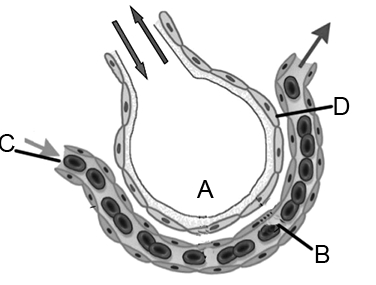
A
$C$: Arterial capillary - passes oxygen to tissues
B
$A$: Alveolar cavity - main site of exchange of respiratory gases
C
$D$: Capillary wall - exchange of $O_2$ and $CO_2$ takes place here
D
$B$: Red blood cells - transport of $CO_2$ mainly
Solution
(B) In the given figure,$A$ represents the alveolar cavity,which is the primary site for the exchange of respiratory gases ($O_2$ and $CO_2$) between the air in the alveoli and the blood in the pulmonary capillaries.
$B$ represents red blood cells (erythrocytes),which are primarily involved in the transport of $O_2$ and $CO_2$.
$C$ represents the arterial end of the capillary.
$D$ represents the wall of the capillary.
Therefore,the correct identification is $A$: Alveolar cavity - main site of exchange of respiratory gases.
$B$ represents red blood cells (erythrocytes),which are primarily involved in the transport of $O_2$ and $CO_2$.
$C$ represents the arterial end of the capillary.
$D$ represents the wall of the capillary.
Therefore,the correct identification is $A$: Alveolar cavity - main site of exchange of respiratory gases.
0 likes
View Solution39
MediumMCQ
People living at sea level have around $5$ million $RBC$ per cubic millimeter of their blood,whereas those living at an altitude of $5400$ metres have around $8$ million. This is because at high altitude:
A
people eat more nutritive food,therefore more $RBCs$ are formed.
B
people get pollution-free air to breathe and more oxygen is available.
C
atmospheric $O_2$ level is less and hence more $RBCs$ are needed to absorb the required amount of $O_2$ to survive.
D
there is more $UV$ radiation which enhances $RBC$ production.
Solution
(C) : At high altitudes,the composition of air remains almost the same as at sea level,but the density (barometric pressure) of air gradually decreases,due to which arterial $pO_2$ is also decreased (hypoxemia).
High altitudes present complex conditions to which the human body has to acclimatize.
The number of red blood cells per unit volume of blood is likely to be higher in a person living at high altitudes.
This is in response to the air being less dense at high altitude.
More red blood cells are needed to trap $O_2$ from rarefied air having low $pO_2$ (partial pressure of oxygen).
High altitudes present complex conditions to which the human body has to acclimatize.
The number of red blood cells per unit volume of blood is likely to be higher in a person living at high altitudes.
This is in response to the air being less dense at high altitude.
More red blood cells are needed to trap $O_2$ from rarefied air having low $pO_2$ (partial pressure of oxygen).
0 likes
View Solution40
MediumMCQ
Lungs have a large number of alveoli for....
A
Having spongy texture and proper shape
B
More surface area for diffusion of gases
C
Less space for increasing volume of inspired air
D
More nerve supply
Solution
(B) The lungs contain millions of alveoli,which are tiny,balloon-like structures at the end of the respiratory tree.
These alveoli significantly increase the total surface area available for the exchange of gases ($O_2$ and $CO_2$) between the air and the blood.
According to Fick's law of diffusion,the rate of diffusion is directly proportional to the surface area available.
Therefore,a large number of alveoli ensures efficient and rapid gas exchange,which is essential for meeting the metabolic demands of the body.
These alveoli significantly increase the total surface area available for the exchange of gases ($O_2$ and $CO_2$) between the air and the blood.
According to Fick's law of diffusion,the rate of diffusion is directly proportional to the surface area available.
Therefore,a large number of alveoli ensures efficient and rapid gas exchange,which is essential for meeting the metabolic demands of the body.
0 likes
View Solution41
EasyMCQ
What is the partial pressure (in $mm \,Hg$) of $O_2$ and $CO_2$ in alveoli?
A
$O_2 = 104, CO_2 = 30$
B
$O_2 = 104, CO_2 = 40$
C
$O_2 = 100, CO_2 = 0.3$
D
$O_2 = 200, CO_2 = 0.3$
Solution
(B) In the human respiratory system,the partial pressure of gases in the alveoli is essential for gas exchange.
According to standard physiological values:
The partial pressure of oxygen $(pO_2)$ in the alveoli is $104 \, mm \, Hg$.
The partial pressure of carbon dioxide $(pCO_2)$ in the alveoli is $40 \, mm \, Hg$.
Therefore,the correct values are $O_2 = 104 \, mm \, Hg$ and $CO_2 = 40 \, mm \, Hg$.
According to standard physiological values:
The partial pressure of oxygen $(pO_2)$ in the alveoli is $104 \, mm \, Hg$.
The partial pressure of carbon dioxide $(pCO_2)$ in the alveoli is $40 \, mm \, Hg$.
Therefore,the correct values are $O_2 = 104 \, mm \, Hg$ and $CO_2 = 40 \, mm \, Hg$.
0 likes
View Solution42
EasyMCQ
What is the partial pressure of Oxygen $(PO_2)$ and Carbon dioxide $(PCO_2)$ in the alveoli?
A
$PO_2 = 159 \, mm \, Hg$ and $PCO_2 = 0.3 \, mm \, Hg$
B
$PO_2 = 104 \, mm \, Hg$ and $PCO_2 = 40 \, mm \, Hg$
C
$PO_2 = 40 \, mm \, Hg$ and $PCO_2 = 45 \, mm \, Hg$
D
$PO_2 = 95 \, mm \, Hg$ and $PCO_2 = 40 \, mm \, Hg$
Solution
(B) In the human respiratory system,the partial pressure of gases in the alveoli is essential for the exchange of gases between the blood and the lungs.
- The partial pressure of Oxygen $(PO_2)$ in the alveoli is approximately $104 \, mm \, Hg$.
- The partial pressure of Carbon dioxide $(PCO_2)$ in the alveoli is approximately $40 \, mm \, Hg$.
- These values create a concentration gradient that allows $O_2$ to diffuse into the blood and $CO_2$ to diffuse out of the blood into the alveoli for exhalation.
- Therefore,option $B$ is the correct answer.
- The partial pressure of Oxygen $(PO_2)$ in the alveoli is approximately $104 \, mm \, Hg$.
- The partial pressure of Carbon dioxide $(PCO_2)$ in the alveoli is approximately $40 \, mm \, Hg$.
- These values create a concentration gradient that allows $O_2$ to diffuse into the blood and $CO_2$ to diffuse out of the blood into the alveoli for exhalation.
- Therefore,option $B$ is the correct answer.
0 likes
View Solution43
MediumMCQ
Identify $X, Y, Z$ from the given figure representing the exchange of gases in the alveoli.
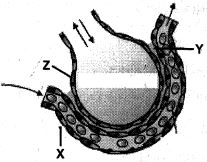
A
$X-$ Blood capillary,$Y-$ Basement substance,$Z-$ Alveolar wall
B
$X-$ $RBC$,$Y-$ Blood capillary,$Z-$ Air
C
$X-$ Air,$Y-$ Alveolar cavity,$Z-$ $RBC$
D
$X-$ Basement substance,$Y-$ Air,$Z-$ $RBC$
Solution
(A) In the provided diagram of the alveolar-capillary membrane:
$1$. $X$ points to the blood capillary,which contains red blood cells.
$2$. $Y$ points to the basement substance (basement membrane) that separates the alveolar wall from the capillary wall.
$3$. $Z$ points to the thin squamous epithelium of the alveolar wall.
Therefore,the correct identification is $X-$ Blood capillary,$Y-$ Basement substance,$Z-$ Alveolar wall.
$1$. $X$ points to the blood capillary,which contains red blood cells.
$2$. $Y$ points to the basement substance (basement membrane) that separates the alveolar wall from the capillary wall.
$3$. $Z$ points to the thin squamous epithelium of the alveolar wall.
Therefore,the correct identification is $X-$ Blood capillary,$Y-$ Basement substance,$Z-$ Alveolar wall.
0 likes
View Solution44
EasyMCQ
What is the actual site of gas exchange in the lungs?
A
Alveoli
B
Pleural fluid
C
Bronchioles
D
Trachea
Solution
(A) The $Alveoli$ are the primary sites of gas exchange in the lungs.
These are thin-walled,bag-like structures surrounded by a dense network of blood capillaries.
Oxygen diffuses from the $Alveoli$ into the blood,and carbon dioxide diffuses from the blood into the $Alveoli$ due to partial pressure gradients.
Other structures like the $Trachea$ and $Bronchioles$ serve as conducting passages for air but do not participate in gas exchange.
These are thin-walled,bag-like structures surrounded by a dense network of blood capillaries.
Oxygen diffuses from the $Alveoli$ into the blood,and carbon dioxide diffuses from the blood into the $Alveoli$ due to partial pressure gradients.
Other structures like the $Trachea$ and $Bronchioles$ serve as conducting passages for air but do not participate in gas exchange.
0 likes
View Solution45
MediumMCQ
Arrange the appropriate pair.
| Column-$I$ | Column-$II$ (Amount of $CO_2$ in $mm \ Hg$) |
| $(a)$ Alveoli | $(1)$ $40$ |
| $(b)$ Tissue | $(2)$ $45$ |
| $(c)$ Blood without $O_2$ (Deoxygenated) | $(3)$ $40$ |
| $(d)$ Blood with $O_2$ (Oxygenated) | $(4)$ $45$ |
A
$a-1, b-2, c-4, d-3$
B
$a-2, b-1, c-3, d-4$
C
$a-4, b-3, c-1, d-2$
D
$a-4, b-1, c-2, d-3$
Solution
(A) The partial pressure of $CO_2$ $(pCO_2)$ in different parts of the respiratory system is as follows:
$1$. Alveoli: The $pCO_2$ is $40 \ mm \ Hg$.
$2$. Tissues: The $pCO_2$ is $45 \ mm \ Hg$ due to metabolic activity.
$3$. Deoxygenated blood (Blood without $O_2$): The $pCO_2$ is $45 \ mm \ Hg$.
$4$. Oxygenated blood (Blood with $O_2$): The $pCO_2$ is $40 \ mm \ Hg$.
Matching these values:
$(a)$ Alveoli - $(1)$ $40 \ mm \ Hg$
$(b)$ Tissue - $(2)$ $45 \ mm \ Hg$
$(c)$ Blood without $O_2$ - $(4)$ $45 \ mm \ Hg$
$(d)$ Blood with $O_2$ - $(3)$ $40 \ mm \ Hg$
Therefore,the correct sequence is $a-1, b-2, c-4, d-3$.
$1$. Alveoli: The $pCO_2$ is $40 \ mm \ Hg$.
$2$. Tissues: The $pCO_2$ is $45 \ mm \ Hg$ due to metabolic activity.
$3$. Deoxygenated blood (Blood without $O_2$): The $pCO_2$ is $45 \ mm \ Hg$.
$4$. Oxygenated blood (Blood with $O_2$): The $pCO_2$ is $40 \ mm \ Hg$.
Matching these values:
$(a)$ Alveoli - $(1)$ $40 \ mm \ Hg$
$(b)$ Tissue - $(2)$ $45 \ mm \ Hg$
$(c)$ Blood without $O_2$ - $(4)$ $45 \ mm \ Hg$
$(d)$ Blood with $O_2$ - $(3)$ $40 \ mm \ Hg$
Therefore,the correct sequence is $a-1, b-2, c-4, d-3$.
0 likes
View Solution46
MediumMCQ
What is correct at the alveoli?
A
High $PO_2$
B
High $PCO_2$
C
High $H^+$ concentration
D
Higher temperature
Solution
(A) At the level of the alveoli,the partial pressure of oxygen $(PO_2)$ is high (approximately $104 \ mmHg$) compared to the deoxygenated blood arriving from the tissues $(40 \ mmHg)$.
This high $PO_2$ facilitates the diffusion of oxygen from the alveoli into the blood.
Conversely,the partial pressure of carbon dioxide $(PCO_2)$ is low in the alveoli $(40 \ mmHg)$ compared to the blood $(45 \ mmHg)$,allowing $CO_2$ to diffuse out of the blood into the alveoli.
Factors like high $PCO_2$,high $H^+$ concentration,and higher temperature are characteristic of tissues,which promote the dissociation of oxygen from hemoglobin (the Bohr effect).
This high $PO_2$ facilitates the diffusion of oxygen from the alveoli into the blood.
Conversely,the partial pressure of carbon dioxide $(PCO_2)$ is low in the alveoli $(40 \ mmHg)$ compared to the blood $(45 \ mmHg)$,allowing $CO_2$ to diffuse out of the blood into the alveoli.
Factors like high $PCO_2$,high $H^+$ concentration,and higher temperature are characteristic of tissues,which promote the dissociation of oxygen from hemoglobin (the Bohr effect).
0 likes
View Solution47
EasyMCQ
What are the partial pressures of oxygen $(PO_2)$ and carbon dioxide $(PCO_2)$ in the alveolar air?
A
$PO_2 = 106\, mmHg, PCO_2 = 42\, mmHg$
B
$PO_2 = 102\, mmHg, PCO_2 = 40\, mmHg$
C
$PO_2 = 100\, mmHg, PCO_2 = 44\, mmHg$
D
$PO_2 = 104\, mmHg, PCO_2 = 40\, mmHg$
Solution
(D) In the human respiratory system,the partial pressure of oxygen $(PO_2)$ in the alveoli is approximately $104\, mmHg$.
The partial pressure of carbon dioxide $(PCO_2)$ in the alveoli is approximately $40\, mmHg$.
These values facilitate the diffusion of oxygen from the alveoli into the blood and carbon dioxide from the blood into the alveoli.
The partial pressure of carbon dioxide $(PCO_2)$ in the alveoli is approximately $40\, mmHg$.
These values facilitate the diffusion of oxygen from the alveoli into the blood and carbon dioxide from the blood into the alveoli.
0 likes
View Solution48
MediumMCQ
Water vapor exits from the leaves of terrestrial plants through open stomata. During photosynthesis,carbon dioxide enters the plant through the same open stomata. Identify the reason for the above statements from the following options.
A
Both processes occur simultaneously because the diffusion coefficients of water and carbon dioxide are different.
B
Both processes are observed only during the night.
C
One process occurs during the day and the other during the night.
D
Both processes do not occur simultaneously.
Solution
(A) During the day,when stomata are open to allow the entry of $CO_2$ for photosynthesis,water vapor also escapes from the leaves due to transpiration.
Although the diffusion coefficients of water vapor and $CO_2$ are different,the concentration gradient for water vapor (from inside the leaf to the outside) and $CO_2$ (from outside to inside) allows both processes to occur simultaneously through the same open stomata.
Therefore,the correct explanation is that both processes happen at the same time because the diffusion rates are governed by their respective concentration gradients despite different diffusion coefficients.
Although the diffusion coefficients of water vapor and $CO_2$ are different,the concentration gradient for water vapor (from inside the leaf to the outside) and $CO_2$ (from outside to inside) allows both processes to occur simultaneously through the same open stomata.
Therefore,the correct explanation is that both processes happen at the same time because the diffusion rates are governed by their respective concentration gradients despite different diffusion coefficients.
0 likes
View Solution49
MediumMCQ
The diffusion membrane of the lungs,through which the exchange of gases occurs,is made up of which of the following layers?
A
Only alveolar epithelium
B
Alveolar epithelium and capillary endothelium
C
Alveolar epithelium,capillary endothelium,and tunica adventitia
D
Alveolar epithelium,capillary endothelium,tunica media,and a thin layer of tunica adventitia
Solution
(B) The diffusion membrane of the lungs is extremely thin and is composed of three major layers:
$1$. The thin squamous epithelium of the alveoli.
$2$. The endothelium of the alveolar capillaries.
$3$. The basement substance (basement membrane) in between them.
Therefore,the exchange of gases occurs through the alveolar epithelium and the capillary endothelium.
$1$. The thin squamous epithelium of the alveoli.
$2$. The endothelium of the alveolar capillaries.
$3$. The basement substance (basement membrane) in between them.
Therefore,the exchange of gases occurs through the alveolar epithelium and the capillary endothelium.
0 likes
View Solution50
EasyMCQ
The exchange of gases in the alveoli of the lungs occurs by .............
A
Simple diffusion
B
Osmosis
C
Active transport
D
Passive transport
Solution
(A) The exchange of gases ($O_2$ and $CO_2$) between the alveoli and the blood in the pulmonary capillaries occurs primarily through the process of simple diffusion.
This process is driven by the partial pressure gradients of the gases.
Oxygen moves from the alveoli (higher partial pressure) into the blood (lower partial pressure),while carbon dioxide moves from the blood (higher partial pressure) into the alveoli (lower partial pressure).
Simple diffusion is a passive process that does not require metabolic energy.
This process is driven by the partial pressure gradients of the gases.
Oxygen moves from the alveoli (higher partial pressure) into the blood (lower partial pressure),while carbon dioxide moves from the blood (higher partial pressure) into the alveoli (lower partial pressure).
Simple diffusion is a passive process that does not require metabolic energy.
0 likes
View SolutionBreathing and Exchange of Gases — Exchange of gases · Frequently Asked Questions
1Are these Breathing and Exchange of Gases questions useful for JEE and NEET?
Yes. All questions in this section are mapped to JEE Main and NEET exam patterns. Previous year questions from JEE Main, NEET, GUJCET and state-level exams are included with full solutions.
2Can I switch to Hindi or Gujarati for these questions?
Yes. Use the language tabs in the hero section or the sidebar to view the same questions and solutions in English, Hindi or Gujarati.
3How do I generate a question paper from this subtopic?
Use the Vedclass Exam Paper Generator — select the chapter and subtopic, set difficulty, and generate Sets A, B, C, D automatically. First 3 chapters of every subject are free.
Vedclass Products
For Students
Vedclass Test Series
Mock tests in real JEE/NEET style with performance analysis. 5-day free trial.
Start Free TrialFor Teachers
Exam Paper Generator
Generate Set A/B/C/D papers from this chapter in 2 minutes. 3 chapters free.
Try FreeFor Institutes
Online Exam Module
Live online exams with unlimited students, 360° analytics & white-label branding.
See DemoFor Teachers & Institutes
Generate a Breathing and Exchange of Gases Exam Paper in 2 Minutes
Select subtopic & difficulty — Sets A, B, C, D auto-generated with No Repeat logic.
First 3 chapters of every subject are free — no payment required.