
A English
Transport of gases Questions in English
Class 11 Biology · Breathing and Exchange of Gases · Transport of gases
251+
Questions
English
Language
100%
With Solutions
Showing 50 of 251 questions in English
201
MediumMCQ
What is the percentage of $O_2$ transported in dissolved form through the plasma?
A
About $7\%$
B
About $3\%$
C
About $20-25\%$
D
About $15\%$
Solution
(B) Oxygen is transported in the blood in two forms:
$1$. As oxyhaemoglobin: About $97\%$ of $O_2$ is transported by red blood cells (RBCs) in combination with haemoglobin.
$2$. In dissolved form: About $3\%$ of $O_2$ is carried in a dissolved state through the blood plasma.
$1$. As oxyhaemoglobin: About $97\%$ of $O_2$ is transported by red blood cells (RBCs) in combination with haemoglobin.
$2$. In dissolved form: About $3\%$ of $O_2$ is carried in a dissolved state through the blood plasma.
0 likes
View Solution202
EasyMCQ
How many $O_2$ molecules can bind with a single molecule of $Hb$?
A
$8$
B
$6$
C
$4$
D
$4.5$
Solution
(C) Haemoglobin consists of four polypeptide chains ($2 \alpha$ and $2 \beta$) having heme as a prosthetic group.
Heme is an iron $(Fe^{2+})$ containing porphyrin ring.
One haemoglobin molecule binds four oxygen molecules,one per heme group,to form oxyhaemoglobin.
The reaction is: $Hb + 4O_2 \rightleftharpoons Hb(O_2)_4$.
Heme is an iron $(Fe^{2+})$ containing porphyrin ring.
One haemoglobin molecule binds four oxygen molecules,one per heme group,to form oxyhaemoglobin.
The reaction is: $Hb + 4O_2 \rightleftharpoons Hb(O_2)_4$.
0 likes
View Solution203
EasyMCQ
To which part of $Hb$,$CO_2$ binds?
A
Haem
B
Amino group of globin
C
Iron of haem group
D
Carboxy group of globin
Solution
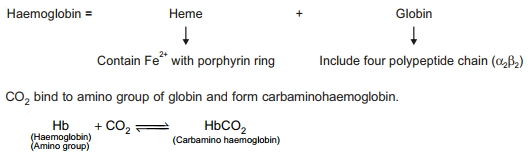
(B) Haemoglobin $(Hb)$ consists of two main parts: the haem group and the globin protein chain.
$CO_2$ does not bind to the iron $(Fe^{2+})$ in the haem group,as that is the site for $O_2$ binding.
Instead,$CO_2$ binds to the amino group of the globin protein chain to form a compound known as carbaminohaemoglobin.
The reaction is represented as: $Hb + CO_2 \rightleftharpoons HbCO_2$ (carbaminohaemoglobin).
$CO_2$ does not bind to the iron $(Fe^{2+})$ in the haem group,as that is the site for $O_2$ binding.
Instead,$CO_2$ binds to the amino group of the globin protein chain to form a compound known as carbaminohaemoglobin.
The reaction is represented as: $Hb + CO_2 \rightleftharpoons HbCO_2$ (carbaminohaemoglobin).
0 likes
View Solution204
MediumMCQ
Which of the following conditions is not responsible for shifting the oxygen-hemoglobin dissociation curve towards the left?
A
High $pO_2$
B
Low $pCO_2$
C
Low temperature
D
High $H^+$ ion concentration
Solution
(D) The oxygen-hemoglobin dissociation curve shifts to the left under conditions that favor the association of oxygen with hemoglobin,typically found in the alveoli.
These conditions include:
$1$. High $pO_2$
$2$. Low $pCO_2$
$3$. Low $H^+$ ion concentration (high $pH$)
$4$. Low temperature
Conversely,a high $H^+$ ion concentration (low $pH$) shifts the curve to the right,which promotes the dissociation of oxygen from hemoglobin (Bohr effect). Therefore,high $H^+$ ion concentration is not responsible for shifting the curve to the left.
These conditions include:
$1$. High $pO_2$
$2$. Low $pCO_2$
$3$. Low $H^+$ ion concentration (high $pH$)
$4$. Low temperature
Conversely,a high $H^+$ ion concentration (low $pH$) shifts the curve to the right,which promotes the dissociation of oxygen from hemoglobin (Bohr effect). Therefore,high $H^+$ ion concentration is not responsible for shifting the curve to the left.
0 likes
View Solution205
MediumMCQ
Which factors favour the binding of $CO_2$ with $Hb$ in tissues?
A
High $pCO_2$ and high $pO_2$
B
Low $pCO_2$ and high $pO_2$
C
Low $pCO_2$ and low $pO_2$
D
High $pCO_2$ and low $pO_2$
Solution
(D) The conditions favourable for the binding of $CO_2$ with $Hb$ (hemoglobin),which also facilitate the dissociation of $O_2$ from $Hb$,are as follows:
$1$. High $pCO_2$ (partial pressure of carbon dioxide).
$2$. Low $pO_2$ (partial pressure of oxygen).
$3$. Higher $H^+$ concentration (lower $pH$).
$4$. High temperature.
These conditions are typically found in the metabolically active tissues,causing the oxygen dissociation curve to shift to the right,a phenomenon known as the Bohr effect.
$1$. High $pCO_2$ (partial pressure of carbon dioxide).
$2$. Low $pO_2$ (partial pressure of oxygen).
$3$. Higher $H^+$ concentration (lower $pH$).
$4$. High temperature.
These conditions are typically found in the metabolically active tissues,causing the oxygen dissociation curve to shift to the right,a phenomenon known as the Bohr effect.
0 likes
View Solution206
MediumMCQ
The amount of oxygen transported by one litre of blood under strenuous condition is approximately (in $ml$)
A
$5$
B
$50$
C
$15$
D
$150$
Solution
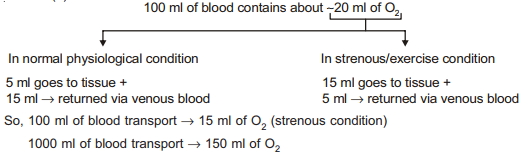
(D) Under normal physiological conditions, $100 \,ml$ of oxygenated blood delivers $5 \,ml$ of $O_2$ to the tissues.
However, under strenuous exercise conditions, the tissues require more oxygen, and $100 \,ml$ of blood delivers approximately $15 \,ml$ of $O_2$ to the tissues.
Since $1 \,litre = 1000 \,ml$, we calculate the oxygen delivery for $1000 \,ml$ of blood as follows:
If $100 \,ml$ of blood delivers $15 \,ml$ of $O_2$, then $1000 \,ml$ of blood will deliver $(15 \,ml / 100 \,ml) \times 1000 \,ml = 150 \,ml$ of $O_2$.
Therefore, the amount of oxygen transported by one litre of blood under strenuous conditions is approximately $150 \,ml$.
However, under strenuous exercise conditions, the tissues require more oxygen, and $100 \,ml$ of blood delivers approximately $15 \,ml$ of $O_2$ to the tissues.
Since $1 \,litre = 1000 \,ml$, we calculate the oxygen delivery for $1000 \,ml$ of blood as follows:
If $100 \,ml$ of blood delivers $15 \,ml$ of $O_2$, then $1000 \,ml$ of blood will deliver $(15 \,ml / 100 \,ml) \times 1000 \,ml = 150 \,ml$ of $O_2$.
Therefore, the amount of oxygen transported by one litre of blood under strenuous conditions is approximately $150 \,ml$.
0 likes
View Solution207
MediumMCQ
$A$: Major part of carbon dioxide is transported in the form of sodium bicarbonate.
$R$: $0.3 \; ml$ of carbon dioxide is transported per $100 \; ml$ of blood in dissolved state in plasma of blood.
$R$: $0.3 \; ml$ of carbon dioxide is transported per $100 \; ml$ of blood in dissolved state in plasma of blood.
A
Assertion and Reason both are correct and Reason is the correct explanation of Assertion.
B
Assertion and Reason both are correct but Reason is not the correct explanation of Assertion.
C
Assertion is incorrect,but Reason is correct.
D
Both Assertion and Reason are incorrect.
Solution
(C) The assertion is incorrect because carbon dioxide is primarily transported in the form of bicarbonate ions $(HCO_3^-)$,not specifically as sodium bicarbonate.
The reason is correct because approximately $7\%$ of $CO_2$ is transported in a dissolved state through the blood plasma,which corresponds to about $0.3 \; ml$ of $CO_2$ per $100 \; ml$ of blood.
Therefore,the correct answer is that the Assertion is incorrect,but the Reason is correct.
The reason is correct because approximately $7\%$ of $CO_2$ is transported in a dissolved state through the blood plasma,which corresponds to about $0.3 \; ml$ of $CO_2$ per $100 \; ml$ of blood.
Therefore,the correct answer is that the Assertion is incorrect,but the Reason is correct.
0 likes
View Solution208
MediumMCQ
$A$: Human blood always contains a higher amount of $CO_2$ than $O_2$.
$R$: The solubility coefficient of $CO_2$ is higher than that of $O_2$.
$R$: The solubility coefficient of $CO_2$ is higher than that of $O_2$.
A
Assertion and Reason both are correct and Reason is the correct explanation of Assertion.
B
Assertion and Reason both are correct but Reason is not the correct explanation of Assertion.
C
Assertion is correct,but Reason is incorrect.
D
Both Assertion and Reason are incorrect.
Solution
(A) The solubility coefficient of $CO_2$ is $20-25$ times higher than that of $O_2$.
Due to this high solubility,$CO_2$ is transported more efficiently in the blood.
In $100 \; ml$ of oxygenated blood,the amount of $O_2$ is approximately $20 \; ml$,whereas the amount of $CO_2$ is approximately $48 \; ml$.
Therefore,human blood always contains a higher amount of $CO_2$ compared to $O_2$,and this is directly due to the higher solubility coefficient of $CO_2$.
Due to this high solubility,$CO_2$ is transported more efficiently in the blood.
In $100 \; ml$ of oxygenated blood,the amount of $O_2$ is approximately $20 \; ml$,whereas the amount of $CO_2$ is approximately $48 \; ml$.
Therefore,human blood always contains a higher amount of $CO_2$ compared to $O_2$,and this is directly due to the higher solubility coefficient of $CO_2$.
0 likes
View Solution209
MediumMCQ
$A$: $100 \; ml$ of venous blood contains $14.4 \; ml$ of $O_2$,meaning it is still $75\%$ saturated with oxygen under normal conditions.
$R$: About $4.6 \; ml$ of $O_2$,i.e.,$25\%$,diffuses from arterial blood into the tissues during resting conditions.
$R$: About $4.6 \; ml$ of $O_2$,i.e.,$25\%$,diffuses from arterial blood into the tissues during resting conditions.
A
Assertion and Reason both are correct and Reason is the correct explanation of Assertion.
B
Assertion and Reason both are correct but Reason is not the correct explanation of Assertion.
C
Assertion is correct,but Reason is incorrect.
D
Both Assertion and Reason are incorrect.
Solution
(C) Under normal physiological conditions,$100 \; ml$ of oxygenated (arterial) blood carries approximately $19 \; ml$ of $O_2$.
When this blood passes through the tissues,about $5 \; ml$ of $O_2$ is delivered to the tissues,leaving $14.4 \; ml$ of $O_2$ in the venous blood.
This means that venous blood remains $75\%$ saturated with oxygen at rest.
The Reason statement provided is slightly inaccurate regarding the context of 'exercise' versus 'resting' conditions,as the $25\%$ delivery is the standard value for resting conditions,not exercise (where delivery increases significantly).
Therefore,the Assertion is correct,but the Reason is technically incorrect due to the mention of 'exercise'.
When this blood passes through the tissues,about $5 \; ml$ of $O_2$ is delivered to the tissues,leaving $14.4 \; ml$ of $O_2$ in the venous blood.
This means that venous blood remains $75\%$ saturated with oxygen at rest.
The Reason statement provided is slightly inaccurate regarding the context of 'exercise' versus 'resting' conditions,as the $25\%$ delivery is the standard value for resting conditions,not exercise (where delivery increases significantly).
Therefore,the Assertion is correct,but the Reason is technically incorrect due to the mention of 'exercise'.
0 likes
View Solution210
AdvancedMCQ
Haemoglobin $(Hb)$ transports oxygen from the lungs to tissues. The partial pressure of oxygen in the lungs is different from that in the tissues. Each $Hb$ can bind to up to four oxygen molecules. Suppose we have an equal number of $Hb$ and oxygen molecules,and all the oxygen molecules are in a bound form. Then,which of the following is true?
A
Almost all the $Hb$ molecules have one bound oxygen molecule.
B
Nearly half of all the $Hb$ molecules are bound to two oxygen molecules.
C
Nearly one-fourth of all the $Hb$ molecules are bound to four oxygen molecules each.
D
Most of the $Hb$ molecules have one bound oxygen molecule each; the rest either have no bound oxygen or have two or more bound oxygen molecules.
Solution
(C) The number of oxygen molecules is equal to the number of haemoglobin molecules. Each haemoglobin molecule can bind up to $4$ oxygen molecules.
Since the binding of oxygen to $Hb$ is cooperative (allosteric) in nature,once the $1^{st}$ oxygen molecule binds to an $Hb$ molecule,the affinity of that $Hb$ molecule for subsequent oxygen molecules increases significantly.
Therefore,if we have $4$ $Hb$ molecules and $4$ oxygen molecules,the $4$ oxygen molecules will preferentially bind to a single $Hb$ molecule until it is saturated $(HbO_8)$,rather than distributing themselves across the other $Hb$ molecules.
As a result,$1/4$ of the total $Hb$ molecules will be fully saturated with $4$ oxygen molecules,while the remaining $3/4$ of the $Hb$ molecules will remain vacant (unbound).
Thus,nearly one-fourth of all the $Hb$ molecules are bound to four oxygen molecules each.
Since the binding of oxygen to $Hb$ is cooperative (allosteric) in nature,once the $1^{st}$ oxygen molecule binds to an $Hb$ molecule,the affinity of that $Hb$ molecule for subsequent oxygen molecules increases significantly.
Therefore,if we have $4$ $Hb$ molecules and $4$ oxygen molecules,the $4$ oxygen molecules will preferentially bind to a single $Hb$ molecule until it is saturated $(HbO_8)$,rather than distributing themselves across the other $Hb$ molecules.
As a result,$1/4$ of the total $Hb$ molecules will be fully saturated with $4$ oxygen molecules,while the remaining $3/4$ of the $Hb$ molecules will remain vacant (unbound).
Thus,nearly one-fourth of all the $Hb$ molecules are bound to four oxygen molecules each.
0 likes
View Solution211
EasyMCQ
Haemoglobin is
A
An oxygen carrier in human blood
B
$A$ protein used as food supplement
C
An oxygen scavenger in root nodules
D
$A$ plant protein with high lysine content
Solution
(A) In the human body,$98.5 \%$ of $O_{2}$ is transported by the respiratory pigment haemoglobin,which is present in the erythrocytes of the blood.
One molecule of haemoglobin can carry four molecules of $O_{2}$.
One molecule of haemoglobin can carry four molecules of $O_{2}$.
0 likes
View Solution212
MediumMCQ
$A$ healthy individual has $A$ grams of haemoglobin in every $B$ mL of blood. These molecules play a significant role in the transport of $C$ gases.
Choose the correct option for $A$, $B$, and $C$.
Choose the correct option for $A$, $B$, and $C$.
A
$A- 12-16, B- 100, C- \text{respiratory}$
B
$A- 6-8, B- 100, C- \text{respiratory}$
C
$A- 7-10, B- 1000, C- \text{respiratory}$
D
$A- 16-20, B- 1000, C- \text{respiratory}$
Solution
(A) In a healthy human adult, the average concentration of haemoglobin is $12-16$ grams per $100$ mL of blood.
Haemoglobin is a red-coloured iron-containing pigment present in the red blood cells $(RBCs)$.
These molecules play a significant role in the transport of respiratory gases, specifically oxygen $(O_2)$ and carbon dioxide $(CO_2)$.
Haemoglobin is a red-coloured iron-containing pigment present in the red blood cells $(RBCs)$.
These molecules play a significant role in the transport of respiratory gases, specifically oxygen $(O_2)$ and carbon dioxide $(CO_2)$.
0 likes
View Solution213
MediumMCQ
People living at sea level have around $5 \; million$ $RBCs$ per cubic millimetre of their blood,whereas those living at an altitude of $5400 \; m$ have around $8 \; million$. This is because at high altitude:
A
People get pollution-free air to breathe and more oxygen is available
B
Atmospheric oxygen level is less and,hence more $RBCs$ are needed to absorb the required amount of oxygen to survive
C
There is more $UV$ radiation,which enhances $RBCs$ production
D
People eat more nutritive food,therefore,more $RBCs$ are formed
Solution
(B) At high altitudes,the atmospheric oxygen level is low.
To compensate for the reduced partial pressure of oxygen,the body increases the production of $RBCs$ to ensure that sufficient oxygen is transported to the tissues.
Therefore,people living at high altitudes have a higher count of $RBCs$ (around $8 \; million/mm^3$) compared to those living at sea level (around $5 \; million/mm^3$).
To compensate for the reduced partial pressure of oxygen,the body increases the production of $RBCs$ to ensure that sufficient oxygen is transported to the tissues.
Therefore,people living at high altitudes have a higher count of $RBCs$ (around $8 \; million/mm^3$) compared to those living at sea level (around $5 \; million/mm^3$).
0 likes
View Solution214
MediumMCQ
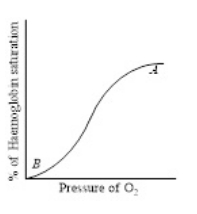
Identify $A$ and $B$ in the given oxygen-haemoglobin dissociation curve and choose the correct option accordingly.
A
$A-$Liver; $B-$Kidney
B
$A-$Lungs; $B-$Tissue
C
$A-$Tissue; $B-$Lungs
D
$A-$Kidney; $B-$Liver
Solution
(B) The given graph represents the oxygen-haemoglobin dissociation curve.
In the lungs,the partial pressure of $O_{2}$ $(pO_{2})$ is high,which facilitates the binding of $O_{2}$ with haemoglobin,leading to high percentage saturation of haemoglobin. This corresponds to point $A$ on the curve.
In the tissues,the partial pressure of $O_{2}$ $(pO_{2})$ is low due to metabolic activity,which causes the dissociation of $O_{2}$ from oxyhaemoglobin,leading to lower percentage saturation. This corresponds to point $B$ on the curve.
Therefore,$A$ represents lungs and $B$ represents tissues.
In the lungs,the partial pressure of $O_{2}$ $(pO_{2})$ is high,which facilitates the binding of $O_{2}$ with haemoglobin,leading to high percentage saturation of haemoglobin. This corresponds to point $A$ on the curve.
In the tissues,the partial pressure of $O_{2}$ $(pO_{2})$ is low due to metabolic activity,which causes the dissociation of $O_{2}$ from oxyhaemoglobin,leading to lower percentage saturation. This corresponds to point $B$ on the curve.
Therefore,$A$ represents lungs and $B$ represents tissues.
0 likes
View Solution215
MediumMCQ
Refer to the following statements:
$I$. Carbonic anhydrase is present in the erythrocytes.
$II$. In erythrocytes,the carbon dioxide combines with water and is transported.
$I$. Carbonic anhydrase is present in the erythrocytes.
$II$. In erythrocytes,the carbon dioxide combines with water and is transported.
A
Statement $I$ is correct and is responsible for statement $II$.
B
Statement $I$ is not correct but statement $II$ is correct.
C
Both statements $I$ and $II$ are wrong.
D
Statement $I$ is correct but not involved in statement $II$.
Solution
(A) Carbonic anhydrase is an enzyme present in high concentrations within the red blood cells (erythrocytes).
It plays a crucial role in the transport of $CO_2$.
Most of the $CO_2$ produced by tissues diffuses into the blood and enters the erythrocytes,where it reacts with water to form carbonic acid $(H_2CO_3)$ in the presence of the enzyme carbonic anhydrase.
This reaction occurs very rapidly inside the erythrocytes,facilitating the conversion of $CO_2$ into bicarbonate ions for transport.
Therefore,statement $I$ is correct and is responsible for the process described in statement $II$.
It plays a crucial role in the transport of $CO_2$.
Most of the $CO_2$ produced by tissues diffuses into the blood and enters the erythrocytes,where it reacts with water to form carbonic acid $(H_2CO_3)$ in the presence of the enzyme carbonic anhydrase.
This reaction occurs very rapidly inside the erythrocytes,facilitating the conversion of $CO_2$ into bicarbonate ions for transport.
Therefore,statement $I$ is correct and is responsible for the process described in statement $II$.
0 likes
View Solution216
EasyMCQ
Each haemoglobin molecule has
A
One heme group
B
Two heme groups
C
Three heme groups
D
Four heme groups
Solution
(D) Haemoglobin is a quaternary protein consisting of four polypeptide chains ($2 \alpha$ and $2 \beta$ chains).
Each polypeptide chain is associated with one heme group.
Therefore,each haemoglobin molecule contains a total of $4$ heme groups.
Each polypeptide chain is associated with one heme group.
Therefore,each haemoglobin molecule contains a total of $4$ heme groups.
0 likes
View Solution217
MediumMCQ
Select the favourable conditions required for the formation of oxyhaemoglobin at the alveoli.
A
High $pO_{2}$,low $pCO_{2}$,less $H^{+}$,lower temperature
B
Low $pO_{2}$,high $pCO_{2}$,more $H^{+}$,higher temperature
C
High $pO_{2}$,high $pCO_{2}$,less $H^{+}$,higher temperature
D
Low $pO_{2}$,low $pCO_{2}$,more $H^{+}$,higher temperature
Solution
(A) In the alveoli,the partial pressure of oxygen $(pO_{2})$ is high and the partial pressure of carbon dioxide $(pCO_{2})$ is low.
These conditions are ideal for the binding of oxygen with haemoglobin to form oxyhaemoglobin.
Additionally,lower concentrations of $H^{+}$ ions (higher $pH$) and lower temperatures further promote the association of oxygen with haemoglobin.
Therefore,the conditions at the alveoli are high $pO_{2}$,low $pCO_{2}$,less $H^{+}$,and lower temperature.
These conditions are ideal for the binding of oxygen with haemoglobin to form oxyhaemoglobin.
Additionally,lower concentrations of $H^{+}$ ions (higher $pH$) and lower temperatures further promote the association of oxygen with haemoglobin.
Therefore,the conditions at the alveoli are high $pO_{2}$,low $pCO_{2}$,less $H^{+}$,and lower temperature.
0 likes
View Solution218
EasyMCQ
Under normal physiological conditions in human beings,every $100 \ ml$ of oxygenated blood can deliver how much $O_2$ to the tissues (in $ml$)?
A
$5$
B
$4$
C
$10$
D
$2$
Solution
(A) In human beings,oxygenated blood leaves the lungs with an oxygen saturation of approximately $97\%$ to $98\%$.
Every $100 \ ml$ of oxygenated blood contains about $20 \ ml$ of $O_2$.
Under normal physiological conditions,when this blood reaches the systemic tissues,it releases approximately $5 \ ml$ of $O_2$ to the tissues for every $100 \ ml$ of blood.
Therefore,the correct answer is $5 \ ml$.
Every $100 \ ml$ of oxygenated blood contains about $20 \ ml$ of $O_2$.
Under normal physiological conditions,when this blood reaches the systemic tissues,it releases approximately $5 \ ml$ of $O_2$ to the tissues for every $100 \ ml$ of blood.
Therefore,the correct answer is $5 \ ml$.
0 likes
View Solution219
MediumMCQ
Select the correct option for the transport of $O_2$. (Plasma : RBCs)
A
$3\% \quad 97\%$
B
$97\% \quad 3\%$
C
$70\% \quad 30\%$
D
$30\% \quad 70\%$
Solution
(A) The transport of oxygen $(O_2)$ in the human body occurs primarily through two methods:
$1$. About $97\%$ of $O_2$ is transported by red blood cells $(RBCs)$ in the blood,where it binds with hemoglobin to form oxyhemoglobin.
$2$. The remaining $3\%$ of $O_2$ is carried in a dissolved state through the blood plasma.
Therefore,the ratio of transport via plasma to transport via $RBCs$ is $3\% : 97\%$.
$1$. About $97\%$ of $O_2$ is transported by red blood cells $(RBCs)$ in the blood,where it binds with hemoglobin to form oxyhemoglobin.
$2$. The remaining $3\%$ of $O_2$ is carried in a dissolved state through the blood plasma.
Therefore,the ratio of transport via plasma to transport via $RBCs$ is $3\% : 97\%$.
0 likes
View Solution220
MediumMCQ
Select the correct option for the transport of $CO_2$ in the blood:
$RBCs \quad Plasma \quad Bicarbonate$
$RBCs \quad Plasma \quad Bicarbonate$
A
$70\% \quad 7\% \quad 20-25\%$
B
$70\% \quad 20-25\% \quad 7\%$
C
$7\% \quad 20-25\% \quad 70\%$
D
$20-25\% \quad 7\% \quad 70\%$
Solution
(D) The transport of $CO_2$ in the blood occurs in three forms:
$1$. As Bicarbonate ions $(HCO_3^-)$: About $70\%$ of $CO_2$ is transported in this form.
$2$. As Carbaminohemoglobin: About $20-25\%$ of $CO_2$ is transported bound to hemoglobin in $RBCs$.
$3$. Dissolved in Plasma: About $7\%$ of $CO_2$ is carried in a dissolved state through blood plasma.
Therefore,the correct sequence for $RBCs$,$Plasma$,and $Bicarbonate$ is $20-25\%$,$7\%$,and $70\%$ respectively.
$1$. As Bicarbonate ions $(HCO_3^-)$: About $70\%$ of $CO_2$ is transported in this form.
$2$. As Carbaminohemoglobin: About $20-25\%$ of $CO_2$ is transported bound to hemoglobin in $RBCs$.
$3$. Dissolved in Plasma: About $7\%$ of $CO_2$ is carried in a dissolved state through blood plasma.
Therefore,the correct sequence for $RBCs$,$Plasma$,and $Bicarbonate$ is $20-25\%$,$7\%$,and $70\%$ respectively.
0 likes
View Solution221
MediumMCQ
Select the incorrect statement regarding hemoglobin.
A
One hemoglobin molecule carries four $O_2$ molecules.
B
It is a red-colored iron-containing pigment.
C
$O_2$ binds with hemoglobin in an irreversible manner.
D
The binding of $O_2$ with hemoglobin is primarily related to partial pressure.
Solution
(C) Hemoglobin is a red-colored iron-containing pigment present in the red blood cells $(RBCs)$.
Each hemoglobin molecule can carry a maximum of four molecules of $O_2$.
The binding of $O_2$ with hemoglobin is primarily related to the partial pressure of $O_2$ $(pO_2)$.
However,the binding of $O_2$ with hemoglobin is a reversible process,not an irreversible one. This reversibility is essential for the transport and release of oxygen to the tissues. Therefore,the statement that $O_2$ binds with hemoglobin in an irreversible manner is incorrect.
Each hemoglobin molecule can carry a maximum of four molecules of $O_2$.
The binding of $O_2$ with hemoglobin is primarily related to the partial pressure of $O_2$ $(pO_2)$.
However,the binding of $O_2$ with hemoglobin is a reversible process,not an irreversible one. This reversibility is essential for the transport and release of oxygen to the tissues. Therefore,the statement that $O_2$ binds with hemoglobin in an irreversible manner is incorrect.
0 likes
View Solution222
EasyMCQ
Identify the given curve.
A
Oxygen association curve
B
Oxygen dissociation curve
C
Carbon dioxide dissociation curve
D
Carbon dioxide association curve
Solution
(B) The curve plotted between the percentage saturation of hemoglobin with oxygen and the partial pressure of oxygen $(pO_2)$ is known as the oxygen dissociation curve.
This curve is typically sigmoid ($S$-shaped) in nature.
It represents the relationship between the affinity of hemoglobin for oxygen and the partial pressure of oxygen in the blood.
Therefore,the correct option is $B$.
This curve is typically sigmoid ($S$-shaped) in nature.
It represents the relationship between the affinity of hemoglobin for oxygen and the partial pressure of oxygen in the blood.
Therefore,the correct option is $B$.
0 likes
View Solution223
MediumMCQ
Plotting the percentage saturation of hemoglobin with $O_2$ against $PO_2$ results in a:
A
$J$-shaped curve
B
$S$-shaped curve
C
$L$-shaped curve
D
None of these
Solution
(B) The relationship between the partial pressure of oxygen $(PO_2)$ and the percentage saturation of hemoglobin with oxygen is represented by the oxygen-hemoglobin dissociation curve.
This curve is sigmoid or $S$-shaped in nature.
This $S$-shaped curve indicates that as the partial pressure of oxygen increases,the binding of oxygen to hemoglobin increases rapidly until it reaches a plateau,reflecting the cooperative binding of oxygen to the four heme groups of the hemoglobin molecule.
This curve is sigmoid or $S$-shaped in nature.
This $S$-shaped curve indicates that as the partial pressure of oxygen increases,the binding of oxygen to hemoglobin increases rapidly until it reaches a plateau,reflecting the cooperative binding of oxygen to the four heme groups of the hemoglobin molecule.
0 likes
View Solution224
MediumMCQ
What are the favorable conditions in the alveoli for the formation of oxyhemoglobin?
A
High $pO_2$,low $pCO_2$,high $H^+$ concentration,high temperature
B
High $pO_2$,low $pCO_2$,low $H^+$ concentration,low temperature
C
Low $pO_2$,high $pCO_2$,high $H^+$ concentration,high temperature
D
Low $pO_2$,high $pCO_2$,low $H^+$ concentration,low temperature
Solution
(B) The formation of oxyhemoglobin occurs in the alveoli where oxygen binds to hemoglobin.
This process is favored by conditions that increase the affinity of hemoglobin for oxygen.
These conditions include:
$1$. High partial pressure of oxygen $(pO_2)$.
$2$. Low partial pressure of carbon dioxide $(pCO_2)$.
$3$. Low concentration of hydrogen ions $(H^+)$ (i.e.,higher pH).
$4$. Lower temperature.
These factors shift the oxygen-hemoglobin dissociation curve to the left,promoting oxygen binding.
This process is favored by conditions that increase the affinity of hemoglobin for oxygen.
These conditions include:
$1$. High partial pressure of oxygen $(pO_2)$.
$2$. Low partial pressure of carbon dioxide $(pCO_2)$.
$3$. Low concentration of hydrogen ions $(H^+)$ (i.e.,higher pH).
$4$. Lower temperature.
These factors shift the oxygen-hemoglobin dissociation curve to the left,promoting oxygen binding.
0 likes
View Solution225
MediumMCQ
Which factors in the tissues favor the dissociation of oxygen from oxyhaemoglobin?
A
High $pO_2$,low $pCO_2$,high $H^+$ concentration,high temperature
B
High $pO_2$,low $pCO_2$,low $H^+$ concentration,low temperature
C
Low $pO_2$,high $pCO_2$,high $H^+$ concentration,high temperature
D
Low $pO_2$,high $pCO_2$,low $H^+$ concentration,low temperature
Solution
(C) The dissociation of oxygen from oxyhaemoglobin is influenced by several factors in the tissues,known as the Bohr effect.
In the tissues,the partial pressure of oxygen $(pO_2)$ is low,while the partial pressure of carbon dioxide $(pCO_2)$ is high due to cellular respiration.
Additionally,the metabolic activity in tissues increases the concentration of $H^+$ ions (lowering the $pH$) and increases the local temperature.
These conditions—low $pO_2$,high $pCO_2$,high $H^+$ concentration,and high temperature—shift the oxygen-haemoglobin dissociation curve to the right,thereby facilitating the release of oxygen from oxyhaemoglobin to the tissues.
In the tissues,the partial pressure of oxygen $(pO_2)$ is low,while the partial pressure of carbon dioxide $(pCO_2)$ is high due to cellular respiration.
Additionally,the metabolic activity in tissues increases the concentration of $H^+$ ions (lowering the $pH$) and increases the local temperature.
These conditions—low $pO_2$,high $pCO_2$,high $H^+$ concentration,and high temperature—shift the oxygen-haemoglobin dissociation curve to the right,thereby facilitating the release of oxygen from oxyhaemoglobin to the tissues.
0 likes
View Solution226
MediumMCQ
Under normal physiological conditions,every $100 \,mL$ of oxygenated blood delivers approximately ......... $mL$ of $O_2$ to the tissues.
A
$3$
B
$4$
C
$5$
D
$6$
Solution
(C) In a healthy individual,every $100 \,mL$ of oxygenated blood contains approximately $20 \,mL$ of $O_2$.
Under normal physiological conditions,this blood delivers approximately $5 \,mL$ of $O_2$ to the tissues during each circulatory cycle.
Therefore,the correct answer is $5 \,mL$.
Under normal physiological conditions,this blood delivers approximately $5 \,mL$ of $O_2$ to the tissues during each circulatory cycle.
Therefore,the correct answer is $5 \,mL$.
0 likes
View Solution227
EasyMCQ
$...\,\% \,CO_2$ is transported as carbaminohemoglobin.
A
$7\, \%$
B
$20-25\, \%$
C
$70\, \%$
D
$97\, \%$
Solution
(B) The transport of $CO_2$ in the blood occurs in three forms:
$1$. As dissolved gas in plasma: About $7\, \%$ of $CO_2$ is transported in a dissolved state through the plasma.
$2$. As carbaminohemoglobin: About $20-25\, \%$ of $CO_2$ binds with hemoglobin to form carbaminohemoglobin.
$3$. As bicarbonate ions: About $70\, \%$ of $CO_2$ is transported as bicarbonate ions $(HCO_3^-)$ in the plasma.
Therefore,the correct percentage of $CO_2$ transported as carbaminohemoglobin is $20-25\, \%$.
$1$. As dissolved gas in plasma: About $7\, \%$ of $CO_2$ is transported in a dissolved state through the plasma.
$2$. As carbaminohemoglobin: About $20-25\, \%$ of $CO_2$ binds with hemoglobin to form carbaminohemoglobin.
$3$. As bicarbonate ions: About $70\, \%$ of $CO_2$ is transported as bicarbonate ions $(HCO_3^-)$ in the plasma.
Therefore,the correct percentage of $CO_2$ transported as carbaminohemoglobin is $20-25\, \%$.
0 likes
View Solution228
MediumMCQ
What conditions in the tissues favor the formation of carbaminohemoglobin?
A
$pCO_2$ high,$pO_2$ high
B
$pCO_2$ low,$pO_2$ low
C
$pCO_2$ high,$pO_2$ low
D
$pCO_2$ low,$pO_2$ high
Solution
(C) The formation of carbaminohemoglobin is primarily dependent on the partial pressure of carbon dioxide $(pCO_2)$ and oxygen $(pO_2)$.
In the tissues,metabolic activities result in a high concentration of $CO_2$ and a low concentration of $O_2$.
$A$ high $pCO_2$ promotes the binding of $CO_2$ with hemoglobin to form carbaminohemoglobin.
Conversely,a low $pO_2$ reduces the affinity of hemoglobin for oxygen,facilitating the release of $O_2$ to the tissues and allowing hemoglobin to bind more readily with $CO_2$.
In the tissues,metabolic activities result in a high concentration of $CO_2$ and a low concentration of $O_2$.
$A$ high $pCO_2$ promotes the binding of $CO_2$ with hemoglobin to form carbaminohemoglobin.
Conversely,a low $pO_2$ reduces the affinity of hemoglobin for oxygen,facilitating the release of $O_2$ to the tissues and allowing hemoglobin to bind more readily with $CO_2$.
0 likes
View Solution229
MediumMCQ
What conditions in the alveoli favor the dissociation of carbon dioxide from carbaminohemoglobin?
A
$pCO_2$ high,$pO_2$ high
B
$pCO_2$ low,$pO_2$ low
C
$pCO_2$ high,$pO_2$ low
D
$pCO_2$ low,$pO_2$ high
Solution
(D) In the alveoli,the partial pressure of oxygen $(pO_2)$ is high and the partial pressure of carbon dioxide $(pCO_2)$ is low.
According to the Haldane effect,the binding of oxygen to hemoglobin in the lungs promotes the dissociation of $CO_2$ from carbaminohemoglobin.
High $pO_2$ facilitates the oxygenation of hemoglobin,which displaces $CO_2$ from the carbamino compounds.
Low $pCO_2$ in the alveoli creates a concentration gradient that allows $CO_2$ to diffuse out of the blood and into the alveoli for exhalation.
Therefore,the conditions $pCO_2$ low and $pO_2$ high are necessary for the dissociation of $CO_2$ from carbaminohemoglobin.
According to the Haldane effect,the binding of oxygen to hemoglobin in the lungs promotes the dissociation of $CO_2$ from carbaminohemoglobin.
High $pO_2$ facilitates the oxygenation of hemoglobin,which displaces $CO_2$ from the carbamino compounds.
Low $pCO_2$ in the alveoli creates a concentration gradient that allows $CO_2$ to diffuse out of the blood and into the alveoli for exhalation.
Therefore,the conditions $pCO_2$ low and $pO_2$ high are necessary for the dissociation of $CO_2$ from carbaminohemoglobin.
0 likes
View Solution230
MediumMCQ
What are $P$ and $Q$ in the given reaction?
$CO _2+ H _2 O \underset{Q}{\stackrel{P}{\rightleftharpoons}} H _2 CO _3 \underset{Q}{\stackrel{P}{\rightleftharpoons}} HCO _3^{-}+ H ^{+}$
$CO _2+ H _2 O \underset{Q}{\stackrel{P}{\rightleftharpoons}} H _2 CO _3 \underset{Q}{\stackrel{P}{\rightleftharpoons}} HCO _3^{-}+ H ^{+}$
A
Carbonic anhydrase $\quad$ Carbonic anhydrase
B
Carbonic isomerase $\quad$ Carbonic isomerase
C
Carbonic isomerase $\quad$ Carbonic anhydrase
D
Carbonic anhydrase $\quad$ Carbonic isomerase
Solution
(A) The reaction $CO_2 + H_2O \rightleftharpoons H_2CO_3 \rightleftharpoons HCO_3^- + H^+$ occurs in the red blood cells $(RBCs)$.
This reaction is catalyzed by the enzyme Carbonic anhydrase.
Carbonic anhydrase is a zinc-containing enzyme that facilitates the hydration of $CO_2$ to form carbonic acid $(H_2CO_3)$ and its subsequent dissociation into bicarbonate $(HCO_3^-)$ and hydrogen ions $(H^+)$.
Both steps of this reversible reaction are catalyzed by the same enzyme,Carbonic anhydrase.
Therefore,both $P$ and $Q$ represent Carbonic anhydrase.
This reaction is catalyzed by the enzyme Carbonic anhydrase.
Carbonic anhydrase is a zinc-containing enzyme that facilitates the hydration of $CO_2$ to form carbonic acid $(H_2CO_3)$ and its subsequent dissociation into bicarbonate $(HCO_3^-)$ and hydrogen ions $(H^+)$.
Both steps of this reversible reaction are catalyzed by the same enzyme,Carbonic anhydrase.
Therefore,both $P$ and $Q$ represent Carbonic anhydrase.
0 likes
View Solution231
MediumMCQ
At which level does the following reaction occur?
$CO_2 + H_2O \rightarrow H_2CO_3 \rightarrow H^+ + HCO_3^-$
$CO_2 + H_2O \rightarrow H_2CO_3 \rightarrow H^+ + HCO_3^-$
A
Tissue level
B
Pulmonary level
C
Both
D
None
Solution
(C) The reaction $CO_2 + H_2O \rightleftharpoons H_2CO_3 \rightleftharpoons H^+ + HCO_3^-$ is catalyzed by the enzyme carbonic anhydrase.
At the tissue level,high $pCO_2$ facilitates the formation of $HCO_3^-$ and $H^+$ ions,which are then transported to the lungs.
At the pulmonary (alveolar) level,the reaction proceeds in the reverse direction due to low $pCO_2$,leading to the formation of $CO_2$ and $H_2O$,which is then exhaled.
Therefore,this reaction occurs at both the tissue and pulmonary levels.
At the tissue level,high $pCO_2$ facilitates the formation of $HCO_3^-$ and $H^+$ ions,which are then transported to the lungs.
At the pulmonary (alveolar) level,the reaction proceeds in the reverse direction due to low $pCO_2$,leading to the formation of $CO_2$ and $H_2O$,which is then exhaled.
Therefore,this reaction occurs at both the tissue and pulmonary levels.
0 likes
View Solution232
MediumMCQ
At which level does the following reaction occur?
$H^+ + HCO_3^- \rightarrow H_2CO_3 \rightarrow H_2O + CO_2$
$H^+ + HCO_3^- \rightarrow H_2CO_3 \rightarrow H_2O + CO_2$
A
Tissue level
B
Pulmonary level
C
Both
D
None
Solution
(B) The reaction $H^+ + HCO_3^- \rightarrow H_2CO_3 \rightarrow H_2O + CO_2$ represents the conversion of bicarbonate ions back into carbon dioxide.
This process occurs at the pulmonary level (in the lungs) where $CO_2$ is released from the blood into the alveoli to be exhaled.
At the tissue level,the reaction proceeds in the opposite direction $(CO_2 + H_2O \rightarrow H_2CO_3 \rightarrow H^+ + HCO_3^-)$ to transport $CO_2$ in the form of bicarbonate ions.
This process occurs at the pulmonary level (in the lungs) where $CO_2$ is released from the blood into the alveoli to be exhaled.
At the tissue level,the reaction proceeds in the opposite direction $(CO_2 + H_2O \rightarrow H_2CO_3 \rightarrow H^+ + HCO_3^-)$ to transport $CO_2$ in the form of bicarbonate ions.
0 likes
View Solution233
EasyMCQ
Approximately how many $mL$ of $CO_2$ is delivered to the alveoli by every $100$ $mL$ of deoxygenated blood?
A
$3$
B
$4$
C
$5$
D
$6$
Solution
(B) The exchange of gases occurs between the blood and the alveoli.
Deoxygenated blood,which reaches the alveoli,contains $CO_2$ that needs to be exhaled.
Every $100$ $mL$ of deoxygenated blood delivers approximately $4$ $mL$ of $CO_2$ to the alveoli for elimination.
Therefore,the correct option is $B$.
Deoxygenated blood,which reaches the alveoli,contains $CO_2$ that needs to be exhaled.
Every $100$ $mL$ of deoxygenated blood delivers approximately $4$ $mL$ of $CO_2$ to the alveoli for elimination.
Therefore,the correct option is $B$.
0 likes
View Solution234
MediumMCQ
Which of the following factors are favourable for the formation of oxyhaemoglobin in alveoli?
A
High $pO_2$ and lesser $H^{+}$ concentration
B
Low $pCO_2$ and high $H^{+}$ concentration
C
Low $pCO_2$ and high temperature
D
High $pO_2$ and high $pCO_2$
Solution
(A) The formation of oxyhaemoglobin in the alveoli is primarily determined by the partial pressure of oxygen $(pO_2)$.
In the alveoli,the conditions are high $pO_2$,low $pCO_2$,low $H^{+}$ concentration,and lower temperature.
These conditions shift the oxygen-haemoglobin dissociation curve to the left,promoting the binding of oxygen to haemoglobin.
Therefore,high $pO_2$ and lesser $H^{+}$ concentration are the favourable factors for the formation of oxyhaemoglobin.
In the alveoli,the conditions are high $pO_2$,low $pCO_2$,low $H^{+}$ concentration,and lower temperature.
These conditions shift the oxygen-haemoglobin dissociation curve to the left,promoting the binding of oxygen to haemoglobin.
Therefore,high $pO_2$ and lesser $H^{+}$ concentration are the favourable factors for the formation of oxyhaemoglobin.
0 likes
View Solution235
MediumMCQ
Which factor is favourable for the formation of oxyhaemoglobin in the alveoli?
A
High $H^+$ concentration
B
High $pCO_2$
C
Lower temperature
D
Low $pO_2$
Solution
(C) In the alveoli,the conditions are favourable for the formation of oxyhaemoglobin.
These conditions include high $pO_2$,low $pCO_2$,lower $H^+$ concentration,and lower temperature.
High $pO_2$ promotes the binding of oxygen with haemoglobin.
Conversely,high $pCO_2$,high $H^+$ concentration,and higher temperature are favourable for the dissociation of oxyhaemoglobin in the tissues.
These conditions include high $pO_2$,low $pCO_2$,lower $H^+$ concentration,and lower temperature.
High $pO_2$ promotes the binding of oxygen with haemoglobin.
Conversely,high $pCO_2$,high $H^+$ concentration,and higher temperature are favourable for the dissociation of oxyhaemoglobin in the tissues.
0 likes
View Solution236
EasyMCQ
Identify enzymes $A$ and $B.$
$CO_2 + H_2O \rightleftharpoons H_2CO_3 \rightleftharpoons HCO_3^- + H^+$
$CO_2 + H_2O \rightleftharpoons H_2CO_3 \rightleftharpoons HCO_3^- + H^+$
A
$A -$ Carbonic anhydrase,$B -$ Oxidase
B
$A -$ Oxidase,$B -$ Carbonic anhydrase
C
$A -$ Carbonic anhydrase,$B -$ Carbonic anhydrase
D
$A -$ Oxidase,$B -$ Oxidase
Solution
(C) The reaction $CO_2 + H_2O \rightleftharpoons H_2CO_3 \rightleftharpoons HCO_3^- + H^+$ is catalyzed by the enzyme Carbonic anhydrase.
This enzyme is present in high concentrations in red blood cells $(RBCs)$.
It facilitates the hydration of $CO_2$ to form carbonic acid $(H_2CO_3)$ and its subsequent dissociation into bicarbonate $(HCO_3^-)$ and hydrogen ions $(H^+)$.
Since the enzyme Carbonic anhydrase catalyzes both steps of this reversible reaction,both $A$ and $B$ are Carbonic anhydrase.
This enzyme is present in high concentrations in red blood cells $(RBCs)$.
It facilitates the hydration of $CO_2$ to form carbonic acid $(H_2CO_3)$ and its subsequent dissociation into bicarbonate $(HCO_3^-)$ and hydrogen ions $(H^+)$.
Since the enzyme Carbonic anhydrase catalyzes both steps of this reversible reaction,both $A$ and $B$ are Carbonic anhydrase.
0 likes
View Solution237
MediumMCQ
Carbonic anhydrase occurs in $-$
A
Lymphocytes
B
Platelets
C
$RBC$
D
Leucocytes
Solution
(C) Carbonic anhydrase is a zinc-containing enzyme that catalyzes the reversible reaction between carbon dioxide $(CO_2)$ and water $(H_2O)$ to form carbonic acid $(H_2CO_3)$.
This enzyme is found in high concentrations within red blood cells $(RBCs)$,also known as erythrocytes.
It plays a crucial role in the transport of $CO_2$ from tissues to the lungs by facilitating the conversion of $CO_2$ into bicarbonate ions $(HCO_3^-)$ in the $RBCs$ and vice versa.
This enzyme is found in high concentrations within red blood cells $(RBCs)$,also known as erythrocytes.
It plays a crucial role in the transport of $CO_2$ from tissues to the lungs by facilitating the conversion of $CO_2$ into bicarbonate ions $(HCO_3^-)$ in the $RBCs$ and vice versa.
0 likes
View Solution238
MediumMCQ
The following statements refer to the transportation of gases. Read them carefully and choose the correct option containing the incorrect statements.
$(i)$ After leaving the lungs, each litre of blood contains about $20 \ ml$ of oxygen.
$(ii)$ When $PCO_2$ rises, the affinity of haemoglobin for oxygen is increased.
$(iii)$ Each litre of arterial blood contains about $4 \ ml$ of $CO_2$.
$(iv)$ The role of oxygen in the regulation of respiratory rhythm is quite significant.
$(i)$ After leaving the lungs, each litre of blood contains about $20 \ ml$ of oxygen.
$(ii)$ When $PCO_2$ rises, the affinity of haemoglobin for oxygen is increased.
$(iii)$ Each litre of arterial blood contains about $4 \ ml$ of $CO_2$.
$(iv)$ The role of oxygen in the regulation of respiratory rhythm is quite significant.
A
$(i)$ and $(ii)$
B
$(ii), (iii)$ and $(iv)$
C
$(i), (iii)$ and $(iv)$
D
$(i), (ii), (iii)$ and $(iv)$
Solution
$(D)$ Let us analyze each statement:
$(i)$ Incorrect: $100 \ ml$ of oxygenated blood carries about $20 \ ml$ of oxygen. Therefore, $1 \ litre$ $(1000 \ ml)$ of blood carries $200 \ ml$ of oxygen, not $20 \ ml$.
$(ii)$ Incorrect: According to the Bohr effect, when $PCO_2$ rises, the affinity of haemoglobin for oxygen decreases, shifting the dissociation curve to the right.
$(iii)$ Incorrect: $100 \ ml$ of arterial blood carries about $4 \ ml$ of $CO_2$. Therefore, $1 \ litre$ of arterial blood carries about $40 \ ml$ of $CO_2$, not $4 \ ml$.
$(iv)$ Incorrect: The role of oxygen in the regulation of respiratory rhythm is considered insignificant compared to the role of $CO_2$ and $H^+$ ions.
Since all four statements are incorrect, the correct option is $(d)$.
$(i)$ Incorrect: $100 \ ml$ of oxygenated blood carries about $20 \ ml$ of oxygen. Therefore, $1 \ litre$ $(1000 \ ml)$ of blood carries $200 \ ml$ of oxygen, not $20 \ ml$.
$(ii)$ Incorrect: According to the Bohr effect, when $PCO_2$ rises, the affinity of haemoglobin for oxygen decreases, shifting the dissociation curve to the right.
$(iii)$ Incorrect: $100 \ ml$ of arterial blood carries about $4 \ ml$ of $CO_2$. Therefore, $1 \ litre$ of arterial blood carries about $40 \ ml$ of $CO_2$, not $4 \ ml$.
$(iv)$ Incorrect: The role of oxygen in the regulation of respiratory rhythm is considered insignificant compared to the role of $CO_2$ and $H^+$ ions.
Since all four statements are incorrect, the correct option is $(d)$.
0 likes
View Solution239
MediumMCQ
Every $100 \ ml$ of deoxygenated blood delivers approximately $.......$ of $CO_2$ to the alveoli $:$ (in $ml$)
A
$5$
B
$4$
C
$1.34$
D
$20$
Solution
(B) Deoxygenated blood carries $CO_2$ from the tissues to the lungs for expiration.
In the human body,every $100 \ ml$ of deoxygenated blood contains approximately $4 \ ml$ of $CO_2$ that is delivered to the alveoli for exchange.
Therefore,the correct option is $B$.
In the human body,every $100 \ ml$ of deoxygenated blood contains approximately $4 \ ml$ of $CO_2$ that is delivered to the alveoli for exchange.
Therefore,the correct option is $B$.
0 likes
View Solution240
MediumMCQ
Every $100 \ ml$ of oxygenated blood can deliver around $............$ of $O_2$ to the tissues under normal physiological conditions. (in $ml$)
A
$4$
B
$5$
C
$13.4$
D
$20$
Solution
(B) Under normal physiological conditions,every $100 \ ml$ of oxygenated blood contains approximately $20 \ ml$ of $O_2$.
However,it delivers only about $5 \ ml$ of $O_2$ to the tissues during one complete circulation.
Therefore,the correct answer is $5 \ ml$.
However,it delivers only about $5 \ ml$ of $O_2$ to the tissues during one complete circulation.
Therefore,the correct answer is $5 \ ml$.
0 likes
View Solution241
EasyMCQ
During $CO_2$ transport,the movement of chloride ions across the membrane of $RBCs$ from plasma is called . . . . . . .
A
Bohr effect
B
Haldane effect
C
Hamburger's phenomenon
D
Sewall Wright effect
Solution
(C) Hamburger's phenomenon,also known as the chloride shift,is the process where chloride ions $(Cl^-)$ move from the plasma into the $RBCs$ to maintain electrical neutrality when bicarbonate ions $(HCO_3^-)$ diffuse out of the $RBCs$ into the plasma during $CO_2$ transport.
0 likes
View Solution242
EasyMCQ
With reference to the oxyhaemoglobin dissociation curve,select the $INCORRECT$ statement/statements.
$I$. $100\%$ saturation is very common.
$II$. $95-97\%$ saturation takes place at $ppO_2 = 100 \text{ mm Hg}$ in alveoli.
$III$. At $30 \text{ mm Hg}$ of $ppO_2$,only $50\%$ saturation can be maintained.
$IV$. The oxyhaemoglobin dissociation curve is $J$-shaped.
Select the correct option.
$I$. $100\%$ saturation is very common.
$II$. $95-97\%$ saturation takes place at $ppO_2 = 100 \text{ mm Hg}$ in alveoli.
$III$. At $30 \text{ mm Hg}$ of $ppO_2$,only $50\%$ saturation can be maintained.
$IV$. The oxyhaemoglobin dissociation curve is $J$-shaped.
Select the correct option.
A
$I$ and $IV$ only
B
$II$ and $III$ only
C
$I$,$II$ and $III$ only
D
$IV$ only
Solution
(A) $I$. $100\%$ saturation of haemoglobin is very rare under physiological conditions because the partial pressure of oxygen in the blood rarely reaches levels that would cause complete saturation.
$II$. In the alveoli,the $ppO_2$ is approximately $100 \text{ mm Hg}$,which results in $95-97\%$ saturation of haemoglobin,which is a correct statement.
$III$. At a $ppO_2$ of $30 \text{ mm Hg}$,the saturation of haemoglobin is approximately $50\%$,which is a correct statement.
$IV$. The oxyhaemoglobin dissociation curve is sigmoidal ($S$-shaped),not $J$-shaped.
Therefore,statements $I$ and $IV$ are incorrect.
$II$. In the alveoli,the $ppO_2$ is approximately $100 \text{ mm Hg}$,which results in $95-97\%$ saturation of haemoglobin,which is a correct statement.
$III$. At a $ppO_2$ of $30 \text{ mm Hg}$,the saturation of haemoglobin is approximately $50\%$,which is a correct statement.
$IV$. The oxyhaemoglobin dissociation curve is sigmoidal ($S$-shaped),not $J$-shaped.
Therefore,statements $I$ and $IV$ are incorrect.
0 likes
View Solution243
EasyMCQ
Out of total oxygen transported,the plasma carries . . . . . . in dissolved state.
A
$0.2$
B
$0.1$
C
$0.03$
D
$0.7$
Solution
(C) Blood transports oxygen from the lungs to the tissues.
Oxygen is transported in the blood in two forms:
$1$. Bound to hemoglobin in red blood cells (about $97\%$).
$2$. Dissolved in the blood plasma (about $3\%$ or $0.03$).
Therefore,the plasma carries $0.03$ of the total oxygen in a dissolved state.
Oxygen is transported in the blood in two forms:
$1$. Bound to hemoglobin in red blood cells (about $97\%$).
$2$. Dissolved in the blood plasma (about $3\%$ or $0.03$).
Therefore,the plasma carries $0.03$ of the total oxygen in a dissolved state.
0 likes
View Solution244
EasyMCQ
If $ppCO_2$ is high and pH is low,then it will result in:
$i$. increase in affinity of haemoglobin for $O_2$
$ii$. decrease in affinity of haemoglobin for $O_2$
$iii$. oxygen dissociation curve shifts to left
$iv$. causes release of $O_2$ for diffusion into tissue cells
$v$. $H^+$ and $HCO_3^-$ ions combine to form carbonic acid
$i$. increase in affinity of haemoglobin for $O_2$
$ii$. decrease in affinity of haemoglobin for $O_2$
$iii$. oxygen dissociation curve shifts to left
$iv$. causes release of $O_2$ for diffusion into tissue cells
$v$. $H^+$ and $HCO_3^-$ ions combine to form carbonic acid
A
$i$ and $ii$ only
B
$ii$ and $iv$ only
C
$ii$ and $iii$ only
D
$iv$ and $v$ only
Solution
(B) When $ppCO_2$ is high and pH is low (acidic conditions),the affinity of haemoglobin for $O_2$ decreases. This phenomenon is known as the Bohr effect.
As a result,the oxygen dissociation curve shifts to the right.
This decrease in affinity facilitates the release of $O_2$ from oxyhaemoglobin,allowing $O_2$ to diffuse into the tissue cells where it is needed for cellular respiration.
Therefore,statements $ii$ and $iv$ are correct.
As a result,the oxygen dissociation curve shifts to the right.
This decrease in affinity facilitates the release of $O_2$ from oxyhaemoglobin,allowing $O_2$ to diffuse into the tissue cells where it is needed for cellular respiration.
Therefore,statements $ii$ and $iv$ are correct.
0 likes
View Solution245
EasyMCQ
Given below are two statements:
Statement $I$: The relationship between $HbO_2$ saturation and oxygen tension $(pO_2)$ is called the oxygen-dissociation curve.
Statement $II$: The oxygen dissociation curve shifts towards the right due to a decrease in $ppCO_2$ and a decrease in temperature.
In the light of the above statements,choose the most appropriate answer from the options given below.
Statement $I$: The relationship between $HbO_2$ saturation and oxygen tension $(pO_2)$ is called the oxygen-dissociation curve.
Statement $II$: The oxygen dissociation curve shifts towards the right due to a decrease in $ppCO_2$ and a decrease in temperature.
In the light of the above statements,choose the most appropriate answer from the options given below.
A
Statement $I$ is correct but Statement $II$ is incorrect.
B
Statement $I$ is incorrect but Statement $II$ is correct.
C
Both Statement $I$ and Statement $II$ are correct.
D
Both Statement $I$ and Statement $II$ are incorrect.
Solution
(A) Statement $I$ is correct because the oxygen-dissociation curve represents the relationship between the percentage saturation of hemoglobin with oxygen $(HbO_2)$ and the partial pressure of oxygen $(pO_2)$.
Statement $II$ is incorrect because the oxygen dissociation curve shifts towards the right (Bohr effect) due to an increase in $ppCO_2$,an increase in hydrogen ion concentration (decrease in $pH$),and an increase in temperature. $A$ decrease in $ppCO_2$ and temperature would cause a leftward shift.
Statement $II$ is incorrect because the oxygen dissociation curve shifts towards the right (Bohr effect) due to an increase in $ppCO_2$,an increase in hydrogen ion concentration (decrease in $pH$),and an increase in temperature. $A$ decrease in $ppCO_2$ and temperature would cause a leftward shift.
0 likes
View Solution246
EasyMCQ
Given below are two statements.
Statement $I$: Carbonic anhydrase enzyme is found in $RBCs$ and is absent in plasma.
Statement $II$: The rate of formation of carbonic acid is very high inside $RBCs$ than in plasma.
In light of the above statements, select the correct answer from the options given below.
Statement $I$: Carbonic anhydrase enzyme is found in $RBCs$ and is absent in plasma.
Statement $II$: The rate of formation of carbonic acid is very high inside $RBCs$ than in plasma.
In light of the above statements, select the correct answer from the options given below.
A
Both statement $I$ and statement $II$ are correct.
B
Both statement $I$ and statement $II$ are incorrect.
C
Statement $I$ is correct and statement $II$ is incorrect.
D
Statement $I$ is incorrect and statement $II$ is correct.
Solution
$(A)$ Carbonic anhydrase is a zinc-containing enzyme that catalyzes the reversible reaction: $CO_2 + H_2O \rightleftharpoons H_2CO_3 \rightleftharpoons H^+ + HCO_3^-$.
This enzyme is present in very high concentrations within $RBCs$ (erythrocytes) and is present in minute quantities in blood plasma.
Statement $I$ is correct because the enzyme is primarily localized within $RBCs$ and is considered absent or negligible in plasma for physiological purposes.
Statement $II$ is correct because the high concentration of carbonic anhydrase in $RBCs$ accelerates the reaction rate significantly compared to plasma, where the enzyme concentration is extremely low.
This enzyme is present in very high concentrations within $RBCs$ (erythrocytes) and is present in minute quantities in blood plasma.
Statement $I$ is correct because the enzyme is primarily localized within $RBCs$ and is considered absent or negligible in plasma for physiological purposes.
Statement $II$ is correct because the high concentration of carbonic anhydrase in $RBCs$ accelerates the reaction rate significantly compared to plasma, where the enzyme concentration is extremely low.
0 likes
View Solution247
EasyMCQ
Oxygen dissociation curve shifts towards left due to increase in . . . . . . during internal respiration.
A
$DPG$
B
Temperature
C
pH
D
$ppCO_2$
Solution
(C) The oxygen dissociation curve is a sigmoid-shaped curve.
It shifts towards the left due to an increase in pH,a decrease in $ppCO_2$,a decrease in temperature,and a decrease in $DPG$ levels.
Since an increase in pH corresponds to a decrease in hydrogen ion concentration (alkalinity),it facilitates the binding of oxygen to hemoglobin,causing a leftward shift.
It shifts towards the left due to an increase in pH,a decrease in $ppCO_2$,a decrease in temperature,and a decrease in $DPG$ levels.
Since an increase in pH corresponds to a decrease in hydrogen ion concentration (alkalinity),it facilitates the binding of oxygen to hemoglobin,causing a leftward shift.
0 likes
View Solution248
EasyMCQ
Select the $INCORRECT$ statement regarding the transport of respiratory gases.
A
$ppO_2$ of capillary blood is $40 \ mm \ Hg$ before oxygenation.
B
Alveolar membrane is equally permeable to oxygen and carbon dioxide.
C
Dissociation of oxyhaemoglobin into haemoglobin and oxygen is favored by low $ppCO_2$.
D
$ppCO_2$ of alveolar air is $45 \ mm \ Hg$.
Solution
(D) The correct $ppCO_2$ of alveolar air is $40 \ mm \ Hg$,not $45 \ mm \ Hg$. Therefore,option $D$ is the incorrect statement. Oxygen and carbon dioxide diffuse across the alveolar membrane based on partial pressure gradients,and the membrane is highly permeable to both gases.
0 likes
View Solution249
EasyMCQ
Carbon monoxide combines with haemoglobin to form . . . . . . .
A
Carbaminohaemoglobin
B
Carbonic acid
C
Carboxyhaemoglobin
D
Cytochrome oxidase
Solution
(C) Carbon monoxide $(CO)$ has a very high affinity for haemoglobin,approximately $200-250$ times greater than that of oxygen $(O_2)$.
When $CO$ binds to haemoglobin,it forms a stable compound known as carboxyhaemoglobin.
This binding prevents haemoglobin from transporting oxygen to the tissues,leading to hypoxia and potentially fatal carbon monoxide poisoning.
Therefore,the correct option is $C$.
When $CO$ binds to haemoglobin,it forms a stable compound known as carboxyhaemoglobin.
This binding prevents haemoglobin from transporting oxygen to the tissues,leading to hypoxia and potentially fatal carbon monoxide poisoning.
Therefore,the correct option is $C$.
0 likes
View Solution250
EasyMCQ
Which of the following factors is favourable for the formation of oxyhaemoglobin in the alveoli of human lungs?
A
High $pCO_2$
B
Lower temperature
C
High $H^+$ concentration
D
Low $pO_2$
Solution
(B) The correct answer is $B$.
In the alveoli,the conditions are high $pO_2$,low $pCO_2$,lower $H^+$ concentration,and lower temperature.
These factors are favourable for the binding of oxygen with haemoglobin to form oxyhaemoglobin.
Conversely,in the tissues,low $pO_2$,high $pCO_2$,high $H^+$ concentration,and higher temperature promote the dissociation of oxygen from oxyhaemoglobin.
Therefore,$O_2$ binds to haemoglobin in the lungs and dissociates in the tissues.
In the alveoli,the conditions are high $pO_2$,low $pCO_2$,lower $H^+$ concentration,and lower temperature.
These factors are favourable for the binding of oxygen with haemoglobin to form oxyhaemoglobin.
Conversely,in the tissues,low $pO_2$,high $pCO_2$,high $H^+$ concentration,and higher temperature promote the dissociation of oxygen from oxyhaemoglobin.
Therefore,$O_2$ binds to haemoglobin in the lungs and dissociates in the tissues.
0 likes
View SolutionBreathing and Exchange of Gases — Transport of gases · Frequently Asked Questions
1Are these Breathing and Exchange of Gases questions useful for JEE and NEET?
Yes. All questions in this section are mapped to JEE Main and NEET exam patterns. Previous year questions from JEE Main, NEET, GUJCET and state-level exams are included with full solutions.
2Can I switch to Hindi or Gujarati for these questions?
Yes. Use the language tabs in the hero section or the sidebar to view the same questions and solutions in English, Hindi or Gujarati.
3How do I generate a question paper from this subtopic?
Use the Vedclass Exam Paper Generator — select the chapter and subtopic, set difficulty, and generate Sets A, B, C, D automatically. First 3 chapters of every subject are free.
Vedclass Products
For Students
Vedclass Test Series
Mock tests in real JEE/NEET style with performance analysis. 5-day free trial.
Start Free TrialFor Teachers
Exam Paper Generator
Generate Set A/B/C/D papers from this chapter in 2 minutes. 3 chapters free.
Try FreeFor Institutes
Online Exam Module
Live online exams with unlimited students, 360° analytics & white-label branding.
See DemoFor Teachers & Institutes
Generate a Breathing and Exchange of Gases Exam Paper in 2 Minutes
Select subtopic & difficulty — Sets A, B, C, D auto-generated with No Repeat logic.
First 3 chapters of every subject are free — no payment required.