
A English
Blood vessel Questions in English
Class 11 Biology · Body Fluids and Circulations · Blood vessel
108+
Questions
English
Language
100%
With Solutions
Showing 8 of 108 questions in English
101
MediumMCQ
Match the following columns:
| Column-$I$ | Column-$II$ |
| $P$. Tunica intima | $I$. Smooth muscle |
| $Q$. Tunica media | $II$. Squamous epithelium |
| $R$. Tunica externa | $III$. Fibrous connective tissue |
A
$(P-III), (Q-II), (R-I)$
B
$(P-I), (Q-II), (R-III)$
C
$(P-II), (Q-II), (R-I)$
D
$(P-II), (Q-I), (R-III)$
Solution
(D) The wall of blood vessels (arteries and veins) consists of three layers:
$1$. Tunica intima: The innermost layer,which is composed of a lining of squamous epithelium (endothelium).
$2$. Tunica media: The middle layer,which is composed of smooth muscle and elastic fibers.
$3$. Tunica externa: The outermost layer,which is composed of fibrous connective tissue with collagen fibers.
Therefore,the correct matching is: $P-II, Q-I, R-III$.
$1$. Tunica intima: The innermost layer,which is composed of a lining of squamous epithelium (endothelium).
$2$. Tunica media: The middle layer,which is composed of smooth muscle and elastic fibers.
$3$. Tunica externa: The outermost layer,which is composed of fibrous connective tissue with collagen fibers.
Therefore,the correct matching is: $P-II, Q-I, R-III$.
0 likes
View Solution102
MediumMCQ
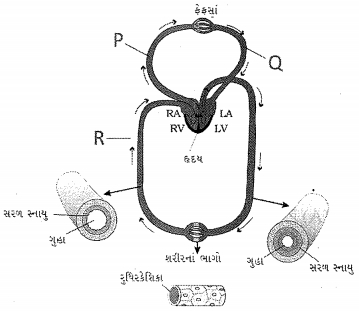
The following diagram shows a schematic outline of human blood circulation. Identify the blood vessels $P, Q$ and $R$.
A
Pulmonary vein,Pulmonary artery,Vena cava
B
Pulmonary artery,Pulmonary vein,Aorta
C
Pulmonary artery,Pulmonary vein,Vena cava
D
Pulmonary vein,Pulmonary artery,Aorta
Solution
(C) In the human circulatory system,the right ventricle $(RV)$ pumps deoxygenated blood to the lungs through the pulmonary artery $(P)$.
Oxygenated blood returns from the lungs to the left atrium $(LA)$ via the pulmonary vein $(Q)$.
The left ventricle $(LV)$ pumps oxygenated blood to the rest of the body through the aorta,while deoxygenated blood from the body returns to the right atrium $(RA)$ through the vena cava $(R)$.
Therefore,$P$ is the pulmonary artery,$Q$ is the pulmonary vein,and $R$ is the vena cava.
Oxygenated blood returns from the lungs to the left atrium $(LA)$ via the pulmonary vein $(Q)$.
The left ventricle $(LV)$ pumps oxygenated blood to the rest of the body through the aorta,while deoxygenated blood from the body returns to the right atrium $(RA)$ through the vena cava $(R)$.
Therefore,$P$ is the pulmonary artery,$Q$ is the pulmonary vein,and $R$ is the vena cava.
0 likes
View Solution103
EasyMCQ
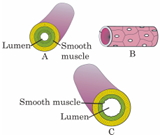
Identify $A, B$ and $C$ in the given diagram and choose the correct option:
A
$A-$ Artery,$B-$ Capillary,$C-$ Vein
B
$A-$ Artery,$B-$ Vein,$C-$ Capillary
C
$A-$ Vein,$B-$ Artery,$C-$ Capillary
D
$A-$ Capillary,$B-$ Artery,$C-$ Vein
Solution
(A) In the given diagram:
$A$ represents an Artery,which has a thick wall and a narrow lumen.
$B$ represents a Capillary,which is a single-layered vessel composed of endothelial cells.
$C$ represents a Vein,which has a thinner wall and a wider lumen compared to an artery.
Therefore,the correct identification is $A-$ Artery,$B-$ Capillary,$C-$ Vein.
$A$ represents an Artery,which has a thick wall and a narrow lumen.
$B$ represents a Capillary,which is a single-layered vessel composed of endothelial cells.
$C$ represents a Vein,which has a thinner wall and a wider lumen compared to an artery.
Therefore,the correct identification is $A-$ Artery,$B-$ Capillary,$C-$ Vein.
0 likes
View Solution104
MediumMCQ
Match the items in Column-$A$ with those in Column-$B$:
| Column-$A$ | Column-$B$ |
| $(1)$ Aorta | $(A)$ Carries deoxygenated blood from the heart to lungs |
| $(2)$ Capillaries | $(B)$ Largest blood vessel |
| $(3)$ Pulmonary artery | $(C)$ Tiny blood vessels where exchange of gases occurs |
| $(4)$ Veins | $(D)$ Blood vessels that carry blood back to heart |
A
$1-B, 2-C, 3-A, 4-D$
B
$1-C, 2-B, 3-D, 4-A$
C
$1-A, 2-B, 3-D, 4-C$
D
$1-D, 2-A, 3-C, 4-B$
Solution
(A) The correct matching is as follows:
- $(1)$ Aorta is the largest artery in the body,which carries oxygenated blood from the left ventricle to the rest of the body. Thus,$(1-B)$.
- $(2)$ Capillaries are microscopic,thin-walled blood vessels where the exchange of gases,nutrients,and waste products occurs between blood and tissues. Thus,$(2-C)$.
- $(3)$ Pulmonary artery is the unique artery that carries deoxygenated blood from the right ventricle to the lungs for oxygenation. Thus,$(3-A)$.
- $(4)$ Veins are blood vessels that collect blood from various organs and carry it back to the heart. Thus,$(4-D)$.
Therefore,the correct sequence is $1-B, 2-C, 3-A, 4-D$.
- $(1)$ Aorta is the largest artery in the body,which carries oxygenated blood from the left ventricle to the rest of the body. Thus,$(1-B)$.
- $(2)$ Capillaries are microscopic,thin-walled blood vessels where the exchange of gases,nutrients,and waste products occurs between blood and tissues. Thus,$(2-C)$.
- $(3)$ Pulmonary artery is the unique artery that carries deoxygenated blood from the right ventricle to the lungs for oxygenation. Thus,$(3-A)$.
- $(4)$ Veins are blood vessels that collect blood from various organs and carry it back to the heart. Thus,$(4-D)$.
Therefore,the correct sequence is $1-B, 2-C, 3-A, 4-D$.
0 likes
View Solution105
EasyMCQ
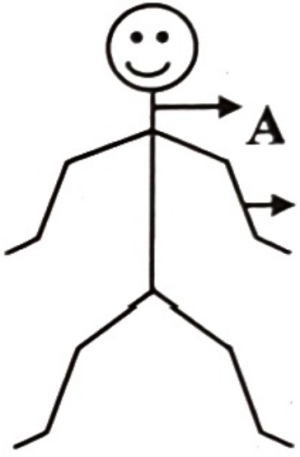
Given below is a diagram of pulse points. Identify '$A$' and '$B$' respectively.
A
Radial and Brachial
B
Brachial and Carotid
C
Carotid and Radial
D
Temporal and Radial
Solution
(B) In the provided diagram,the pulse point labeled '$A$' is located at the neck,which corresponds to the Carotid artery pulse point.
The pulse point labeled '$B$' (indicated by the lower arrow) is located at the upper arm,which corresponds to the Brachial artery pulse point.
However,reviewing the options provided and the standard anatomical locations:
- The arrow at the neck is the Carotid pulse.
- The arrow at the arm is the Brachial pulse.
Given the options,if '$A$' is Carotid and the second point is Brachial,the correct sequence is Carotid and Brachial. Since this specific combination is not explicitly listed as a single option,we re-evaluate the diagram. The arrow at the arm is often used to represent the Brachial pulse. If the question implies '$A$' as Carotid and the second point as Brachial,option '$B$' is 'Brachial and Carotid'. If we look at the options again,'$C$' is 'Carotid and Radial'. Given the standard representation in such diagrams,'$A$' is Carotid and the second point is Brachial. Based on the provided options,there might be a slight mismatch in the labeling of the second point in the options. However,'$A$' is definitely Carotid. Among the choices,'$B$' (Brachial and Carotid) or '$C$' (Carotid and Radial) are candidates. Re-examining the diagram,the second arrow points to the upper arm (Brachial). Thus,'$A$' = Carotid and '$B$' = Brachial. The closest logical match is '$B$' if the order is reversed or '$C$' if the second point is misinterpreted. Given standard textbook diagrams,'$A$' is Carotid and the second point is Brachial. Therefore,the correct identification is Carotid and Brachial.
The pulse point labeled '$B$' (indicated by the lower arrow) is located at the upper arm,which corresponds to the Brachial artery pulse point.
However,reviewing the options provided and the standard anatomical locations:
- The arrow at the neck is the Carotid pulse.
- The arrow at the arm is the Brachial pulse.
Given the options,if '$A$' is Carotid and the second point is Brachial,the correct sequence is Carotid and Brachial. Since this specific combination is not explicitly listed as a single option,we re-evaluate the diagram. The arrow at the arm is often used to represent the Brachial pulse. If the question implies '$A$' as Carotid and the second point as Brachial,option '$B$' is 'Brachial and Carotid'. If we look at the options again,'$C$' is 'Carotid and Radial'. Given the standard representation in such diagrams,'$A$' is Carotid and the second point is Brachial. Based on the provided options,there might be a slight mismatch in the labeling of the second point in the options. However,'$A$' is definitely Carotid. Among the choices,'$B$' (Brachial and Carotid) or '$C$' (Carotid and Radial) are candidates. Re-examining the diagram,the second arrow points to the upper arm (Brachial). Thus,'$A$' = Carotid and '$B$' = Brachial. The closest logical match is '$B$' if the order is reversed or '$C$' if the second point is misinterpreted. Given standard textbook diagrams,'$A$' is Carotid and the second point is Brachial. Therefore,the correct identification is Carotid and Brachial.
0 likes
View Solution106
EasyMCQ
Choose the $INCORRECT$ statement with respect to veins.
A
Veins have a wide lumen.
B
Pulmonary veins carry deoxygenated blood towards the heart.
C
Tunica media is thin in veins.
D
Blood flows with low pressure in veins.
Solution
(B) $1$. Veins are blood vessels that carry blood towards the heart. They generally have a wider lumen compared to arteries.
$2$. The wall of a vein consists of three layers: $Tunica$ $externa$,$Tunica$ $media$,and $Tunica$ $interna$. In veins,the $Tunica$ $media$ is relatively thin compared to arteries.
$3$. Blood pressure in the veins is significantly lower than in the arteries.
$4$. The pulmonary vein is an exception in the circulatory system because it carries oxygenated blood from the lungs to the left atrium of the heart. Therefore,the statement that pulmonary veins carry deoxygenated blood is incorrect.
$2$. The wall of a vein consists of three layers: $Tunica$ $externa$,$Tunica$ $media$,and $Tunica$ $interna$. In veins,the $Tunica$ $media$ is relatively thin compared to arteries.
$3$. Blood pressure in the veins is significantly lower than in the arteries.
$4$. The pulmonary vein is an exception in the circulatory system because it carries oxygenated blood from the lungs to the left atrium of the heart. Therefore,the statement that pulmonary veins carry deoxygenated blood is incorrect.
0 likes
View Solution107
EasyMCQ
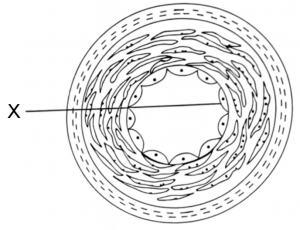
In the following diagram of $T$.$S$. of Artery,the region marked '$X$' is . . . . . .
A
Tunica media
B
Tunica externa
C
Tunica interna
D
Tunica albuginea
Solution
(C) The wall of an artery consists of three layers:
$1$. Tunica externa (outer layer): Made of fibrous connective tissue.
$2$. Tunica media (middle layer): Made of smooth muscle and elastic fibers.
$3$. Tunica interna (inner layer): Made of squamous endothelium.
In the provided diagram,the region marked '$X$' points to the innermost layer of the artery,which is the tunica interna (also known as tunica intima).
$1$. Tunica externa (outer layer): Made of fibrous connective tissue.
$2$. Tunica media (middle layer): Made of smooth muscle and elastic fibers.
$3$. Tunica interna (inner layer): Made of squamous endothelium.
In the provided diagram,the region marked '$X$' points to the innermost layer of the artery,which is the tunica interna (also known as tunica intima).
0 likes
View Solution108
EasyMCQ
Which among the three layers of blood vessel wall—$Tunica \text{ intima}$, $Tunica \text{ media}$, and $Tunica \text{ externa}$—is comparatively thin in the veins?
A
Tunica externa
B
Both tunica media and tunica externa
C
Tunica media
D
Tunica intima
Solution
(C) The wall of blood vessels consists of three layers: $Tunica \text{ intima}$ (innermost), $Tunica \text{ media}$ (middle), and $Tunica \text{ externa}$ (outermost).
In arteries, the $Tunica \text{ media}$ is thick and muscular to withstand high blood pressure.
In veins, the $Tunica \text{ media}$ is comparatively much thinner than in arteries because the blood pressure in the venous system is significantly lower.
Therefore, the $Tunica \text{ media}$ is the layer that is characteristically thin in veins.
In arteries, the $Tunica \text{ media}$ is thick and muscular to withstand high blood pressure.
In veins, the $Tunica \text{ media}$ is comparatively much thinner than in arteries because the blood pressure in the venous system is significantly lower.
Therefore, the $Tunica \text{ media}$ is the layer that is characteristically thin in veins.
0 likes
View SolutionBody Fluids and Circulations — Blood vessel · Frequently Asked Questions
1Are these Body Fluids and Circulations questions useful for JEE and NEET?
Yes. All questions in this section are mapped to JEE Main and NEET exam patterns. Previous year questions from JEE Main, NEET, GUJCET and state-level exams are included with full solutions.
2Can I switch to Hindi or Gujarati for these questions?
Yes. Use the language tabs in the hero section or the sidebar to view the same questions and solutions in English, Hindi or Gujarati.
3How do I generate a question paper from this subtopic?
Use the Vedclass Exam Paper Generator — select the chapter and subtopic, set difficulty, and generate Sets A, B, C, D automatically. First 3 chapters of every subject are free.
Vedclass Products
For Students
Vedclass Test Series
Mock tests in real JEE/NEET style with performance analysis. 5-day free trial.
Start Free TrialFor Teachers
Exam Paper Generator
Generate Set A/B/C/D papers from this chapter in 2 minutes. 3 chapters free.
Try FreeFor Institutes
Online Exam Module
Live online exams with unlimited students, 360° analytics & white-label branding.
See DemoFor Teachers & Institutes
Generate a Body Fluids and Circulations Exam Paper in 2 Minutes
Select subtopic & difficulty — Sets A, B, C, D auto-generated with No Repeat logic.
First 3 chapters of every subject are free — no payment required.