
A English
Proteins Questions in English
Class 11 Biology · Biomolecules · Proteins
439+
Questions
English
Language
100%
With Solutions
Showing 50 of 439 questions in English
101
EasyMCQ
$A$ conjugated protein containing carbohydrates is:
A
Lecithoprotein
B
Glycoprotein
C
Lipoprotein
D
Metalloprotein
Solution
(B) Conjugated proteins are proteins that are covalently bonded to non-protein groups (prosthetic groups).
$1$. Glycoproteins are conjugated proteins where the prosthetic group is a carbohydrate.
$2$. Lecithoproteins contain lipids (lecithin).
$3$. Lipoproteins contain lipids.
$4$. Metalloproteins contain metal ions.
Therefore,the correct option is $B$.
$1$. Glycoproteins are conjugated proteins where the prosthetic group is a carbohydrate.
$2$. Lecithoproteins contain lipids (lecithin).
$3$. Lipoproteins contain lipids.
$4$. Metalloproteins contain metal ions.
Therefore,the correct option is $B$.
0 likes
View Solution102
MediumMCQ
How many iron atoms are present in one quaternary structure of $Hb$ (hemoglobin)?
A
One
B
Two
C
Three
D
Four
Solution
(D) Hemoglobin $(Hb)$ is a quaternary protein consisting of four polypeptide subunits: two $\alpha$-chains and two $\beta$-chains.
Each polypeptide chain contains one heme group.
Each heme group contains one iron $(Fe^{2+})$ atom at its center.
Therefore,since there are four heme groups in one hemoglobin molecule,there are a total of four iron atoms present in one quaternary structure of $Hb$.
Each polypeptide chain contains one heme group.
Each heme group contains one iron $(Fe^{2+})$ atom at its center.
Therefore,since there are four heme groups in one hemoglobin molecule,there are a total of four iron atoms present in one quaternary structure of $Hb$.
0 likes
View Solution103
MediumMCQ
Which amino acid contains a non-polar $R$ group?
A
Alanine
B
Arginine
C
Glycine
D
Tyrosine
Solution
(A) Amino acids are classified based on the nature of their $R$ group.
$1$. Alanine has a methyl group $(-CH_3)$ as its $R$ group,which is non-polar and hydrophobic.
$2$. Arginine has a positively charged,basic $R$ group.
$3$. Glycine has a hydrogen atom $(-H)$ as its $R$ group,which is technically non-polar,but Alanine is the classic example of a non-polar amino acid with a hydrocarbon side chain.
$4$. Tyrosine has a phenolic hydroxyl group,making it polar.
Therefore,Alanine is the most appropriate answer for a standard non-polar $R$ group.
$1$. Alanine has a methyl group $(-CH_3)$ as its $R$ group,which is non-polar and hydrophobic.
$2$. Arginine has a positively charged,basic $R$ group.
$3$. Glycine has a hydrogen atom $(-H)$ as its $R$ group,which is technically non-polar,but Alanine is the classic example of a non-polar amino acid with a hydrocarbon side chain.
$4$. Tyrosine has a phenolic hydroxyl group,making it polar.
Therefore,Alanine is the most appropriate answer for a standard non-polar $R$ group.
0 likes
View Solution104
MediumMCQ
Which of the following exhibits properties of both acids and bases?
A
Amino acids
B
Nucleic acids
C
Both amino acids and nucleic acids
D
Carboxylic acids
Solution
(A) Amino acids are organic compounds that contain both an amino group $(-NH_2)$ and a carboxylic acid group $(-COOH)$ in their structure.
Because of the presence of the basic amino group and the acidic carboxyl group,amino acids can act as both acids and bases.
In a solution,they can exist as zwitterions,where the amino group is protonated $(-NH_3^+)$ and the carboxyl group is deprotonated $(-COO^-)$,allowing them to function as amphoteric molecules.
Because of the presence of the basic amino group and the acidic carboxyl group,amino acids can act as both acids and bases.
In a solution,they can exist as zwitterions,where the amino group is protonated $(-NH_3^+)$ and the carboxyl group is deprotonated $(-COO^-)$,allowing them to function as amphoteric molecules.
0 likes
View Solution105
MediumMCQ
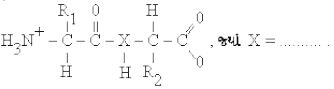
Identify $X$ in the given chemical structure: $H_3N^+ - CH(R_1) - C(=O) - X - CH(R_2) - COO^-$.
A
Oxygen $(O)$
B
Nitrogen $(N)$
C
Carbon $(C)$
D
Hydrogen $(H)$
Solution
(B) The given structure represents a dipeptide formed by the condensation of two amino acids.
In a peptide bond,the carboxyl group $(-COOH)$ of one amino acid reacts with the amino group $(-NH_2)$ of another amino acid.
The peptide bond is represented as $-CO-NH-$.
In the provided structure,the segment between the two alpha-carbon atoms is $-C(=O)-X-$.
Comparing this with the peptide bond structure $-CO-NH-$,it is clear that $X$ represents the nitrogen atom $(N)$.
In a peptide bond,the carboxyl group $(-COOH)$ of one amino acid reacts with the amino group $(-NH_2)$ of another amino acid.
The peptide bond is represented as $-CO-NH-$.
In the provided structure,the segment between the two alpha-carbon atoms is $-C(=O)-X-$.
Comparing this with the peptide bond structure $-CO-NH-$,it is clear that $X$ represents the nitrogen atom $(N)$.
0 likes
View Solution106
MediumMCQ
Which group is present at the $N$-terminal of a polypeptide chain?
A
Nitro
B
Nitrate
C
Amide
D
Amino
Solution
(D) polypeptide chain is a polymer of amino acids linked by peptide bonds.
In a polypeptide chain,the amino acid at one end has a free amino group $(-NH_2)$,which is known as the $N$-terminal amino acid.
The amino acid at the other end has a free carboxyl group $(-COOH)$,which is known as the $C$-terminal amino acid.
Therefore,the group present at the $N$-terminal is the amino group.
In a polypeptide chain,the amino acid at one end has a free amino group $(-NH_2)$,which is known as the $N$-terminal amino acid.
The amino acid at the other end has a free carboxyl group $(-COOH)$,which is known as the $C$-terminal amino acid.
Therefore,the group present at the $N$-terminal is the amino group.
0 likes
View Solution107
EasyMCQ
Who proposed the most widely accepted classification system for amino acids?
A
Johnson
B
Lehninger
C
Whittaker
D
Linnaeus
Solution
(B) The most widely accepted classification of amino acids,based on the chemical nature of their $R$-groups (side chains),was proposed by Albert $L$. Lehninger in his seminal textbook,'Biochemistry'. This classification categorizes amino acids into non-polar,polar uncharged,positively charged,and negatively charged groups.
0 likes
View Solution108
MediumMCQ
The structure of hemoglobin contains ......... heme groups.
A
$6$
B
$2$
C
$4$
D
$8$
Solution
(C) Hemoglobin is a quaternary protein consisting of $4$ polypeptide subunits: $2$ alpha chains and $2$ beta chains.
Each polypeptide chain is associated with a non-protein prosthetic group called a heme group.
Therefore,a single hemoglobin molecule contains $4$ heme groups,each capable of binding one molecule of oxygen $(O_2)$.
Each polypeptide chain is associated with a non-protein prosthetic group called a heme group.
Therefore,a single hemoglobin molecule contains $4$ heme groups,each capable of binding one molecule of oxygen $(O_2)$.
0 likes
View Solution109
MediumMCQ
Which is the most abundant protein in the animal world?
A
Collagen
B
Keratin
C
Rubisco
D
Insulin
Solution
(A) Collagen is the most abundant protein in the whole animal world. It provides structural support to various tissues like skin,tendons,and bones. In contrast,Rubisco is the most abundant protein in the whole biosphere (plant world).
0 likes
View Solution110
EasyMCQ
Which of the following fights against infectious pathogens?
A
$DNA$
B
Proteins
C
Polysaccharides
D
Lipids
Solution
(B) Proteins,specifically antibodies (immunoglobulins),are specialized molecules that fight against infectious pathogens. They recognize and bind to specific antigens on the surface of pathogens to neutralize them or mark them for destruction by the immune system.
0 likes
View Solution111
EasyMCQ
Why are amino acids amphoteric in nature?
A
Due to basic carboxyl and acidic amino groups.
B
Due to neutral carboxyl and basic amino groups.
C
Due to acidic carboxyl and basic amino groups.
D
Due to acidic carboxyl and neutral amino groups.
Solution
(C) Amino acids are organic compounds containing an amino group $(-NH_2)$ and a carboxyl group $(-COOH)$ attached to the same carbon atom,known as the $\alpha$-carbon.
The carboxyl group $(-COOH)$ acts as an acid because it can donate a proton $(H^+)$,while the amino group $(-NH_2)$ acts as a base because it can accept a proton $(H^+)$.
Because amino acids possess both acidic and basic functional groups,they can react with both acids and bases,making them amphoteric in nature.
This property allows them to exist as zwitterions at a specific $pH$ (isoelectric point).
The carboxyl group $(-COOH)$ acts as an acid because it can donate a proton $(H^+)$,while the amino group $(-NH_2)$ acts as a base because it can accept a proton $(H^+)$.
Because amino acids possess both acidic and basic functional groups,they can react with both acids and bases,making them amphoteric in nature.
This property allows them to exist as zwitterions at a specific $pH$ (isoelectric point).
0 likes
View Solution112
MediumMCQ
In the structure of proteins,amino acid molecules are linked by which bond?
A
$-NH_2$
B
$-CONH_2$
C
$-COOH$
D
$-CONH-$
Solution
(D) Proteins are polymers of amino acids. In proteins,amino acid molecules are linked to each other by peptide bonds.
When the carboxyl group $(-COOH)$ of one amino acid reacts with the amino group $(-NH_2)$ of another amino acid,a molecule of water is eliminated,and a peptide bond $(-CONH-)$ is formed.
Therefore,the correct option is $D$.
When the carboxyl group $(-COOH)$ of one amino acid reacts with the amino group $(-NH_2)$ of another amino acid,a molecule of water is eliminated,and a peptide bond $(-CONH-)$ is formed.
Therefore,the correct option is $D$.
0 likes
View Solution113
MediumMCQ
Which structure of a protein represents its three-dimensional form?
A
Primary
B
Secondary
C
Quaternary
D
Tertiary
Solution
(D) The tertiary structure of a protein represents its overall three-dimensional shape.
It is formed by the folding and coiling of the polypeptide chain,which is stabilized by various interactions such as hydrogen bonds,ionic bonds,hydrophobic interactions,and disulfide bridges.
While the primary structure is the linear sequence of amino acids and the secondary structure involves local folding (like $\alpha$-helices and $\beta$-pleated sheets),the tertiary structure provides the functional $3D$ conformation of the protein molecule.
It is formed by the folding and coiling of the polypeptide chain,which is stabilized by various interactions such as hydrogen bonds,ionic bonds,hydrophobic interactions,and disulfide bridges.
While the primary structure is the linear sequence of amino acids and the secondary structure involves local folding (like $\alpha$-helices and $\beta$-pleated sheets),the tertiary structure provides the functional $3D$ conformation of the protein molecule.
0 likes
View Solution114
MediumMCQ
The structure of hemoglobin contains ......... alpha chains.
A
$2$
B
$3$
C
$0$
D
$4$
Solution
(A) Hemoglobin is a quaternary protein structure consisting of four polypeptide subunits.
It is composed of two alpha ($\alpha$) chains and two beta ($\beta$) chains.
Therefore, the structure of hemoglobin contains $2$ alpha chains.
It is composed of two alpha ($\alpha$) chains and two beta ($\beta$) chains.
Therefore, the structure of hemoglobin contains $2$ alpha chains.
0 likes
View Solution115
EasyMCQ
In the secondary structure of proteins,the folding of the polypeptide chain is primarily due to the presence of .........
A
Peptide bonds
B
Hydrogen bonds
C
Ionic bonds
D
Covalent bonds
Solution
(B) The secondary structure of a protein refers to the local folded structures that form within a polypeptide due to interactions between atoms of the backbone.
These structures are primarily stabilized by $Hydrogen$ bonds formed between the carbonyl oxygen $(C=O)$ of one amino acid and the amino hydrogen $(N-H)$ of another amino acid in the chain.
Common examples of secondary structures include the $\alpha$-helix and $\beta$-pleated sheets.
Therefore,the correct option is $B$.
These structures are primarily stabilized by $Hydrogen$ bonds formed between the carbonyl oxygen $(C=O)$ of one amino acid and the amino hydrogen $(N-H)$ of another amino acid in the chain.
Common examples of secondary structures include the $\alpha$-helix and $\beta$-pleated sheets.
Therefore,the correct option is $B$.
0 likes
View Solution116
MediumMCQ
Which of the following bonds does not participate in the formation of the quaternary structure of proteins?
A
Disulfide bond
B
Ionic bond
C
Hydrogen bond
D
Covalent bond
Solution
(D) The quaternary structure of proteins refers to the arrangement of multiple polypeptide chains (subunits) into a single functional complex.
These subunits are held together by non-covalent interactions,which include hydrogen bonds,ionic bonds,and hydrophobic interactions.
Disulfide bonds (covalent) can also stabilize the structure between subunits.
However,a general 'covalent bond' (such as a peptide bond) is responsible for the primary structure (the linear sequence of amino acids) within a single polypeptide chain,not for the association of subunits in the quaternary structure.
Therefore,the general term 'covalent bond' is the correct answer as it refers to the primary structure linkage.
These subunits are held together by non-covalent interactions,which include hydrogen bonds,ionic bonds,and hydrophobic interactions.
Disulfide bonds (covalent) can also stabilize the structure between subunits.
However,a general 'covalent bond' (such as a peptide bond) is responsible for the primary structure (the linear sequence of amino acids) within a single polypeptide chain,not for the association of subunits in the quaternary structure.
Therefore,the general term 'covalent bond' is the correct answer as it refers to the primary structure linkage.
0 likes
View Solution117
MediumMCQ
How many types of amino acids are involved in protein synthesis?
A
$18$
B
$20$
C
$22$
D
$24$
Solution
(B) Protein synthesis in living organisms primarily involves $20$ standard amino acids.
These amino acids are encoded by the genetic code and are linked together by peptide bonds to form polypeptide chains (proteins).
While other amino acids exist in nature,these $20$ are the fundamental building blocks used during the process of translation in cells.
These amino acids are encoded by the genetic code and are linked together by peptide bonds to form polypeptide chains (proteins).
While other amino acids exist in nature,these $20$ are the fundamental building blocks used during the process of translation in cells.
0 likes
View Solution118
EasyMCQ
Who classified amino acids?
A
Johnsen
B
Lehninger
C
Virchow
D
Purkinje
Solution
(B) Amino acids are the building blocks of proteins. Albert $L$. Lehninger,in his seminal work on biochemistry,provided a systematic classification of amino acids based on the properties of their $R$-groups (side chains),such as polarity,charge,and chemical structure. This classification is widely accepted and used in biological sciences.
0 likes
View Solution119
MediumMCQ
Which of the following is a polar and uncharged amino acid?
A
Alanine
B
Serine
C
Valine
D
Proline
Solution
(B) Amino acids are classified based on the nature of their $R$-group side chains.
$1$. Alanine $(Ala)$ has a non-polar methyl group $(-CH_3)$ as its side chain.
$2$. Serine $(Ser)$ contains a hydroxyl group $(-OH)$ in its side chain,which makes it polar but uncharged at physiological $pH$.
$3$. Valine $(Val)$ has a non-polar isopropyl group as its side chain.
$4$. Proline $(Pro)$ is a non-polar imino acid.
Therefore,Serine is the correct answer as it is a polar,uncharged amino acid.
$1$. Alanine $(Ala)$ has a non-polar methyl group $(-CH_3)$ as its side chain.
$2$. Serine $(Ser)$ contains a hydroxyl group $(-OH)$ in its side chain,which makes it polar but uncharged at physiological $pH$.
$3$. Valine $(Val)$ has a non-polar isopropyl group as its side chain.
$4$. Proline $(Pro)$ is a non-polar imino acid.
Therefore,Serine is the correct answer as it is a polar,uncharged amino acid.
0 likes
View Solution120
MediumMCQ
Which bond connects two amino acids?
A
Hydrogen
B
Ester
C
Peptide
D
Glycosidic
Solution
(C) In proteins,amino acids are linked together by a covalent bond known as a peptide bond.
This bond is formed by a dehydration synthesis reaction between the carboxyl group $(-COOH)$ of one amino acid and the amino group $(-NH_2)$ of the adjacent amino acid.
During this process,a molecule of water $(H_2O)$ is released.
This bond is formed by a dehydration synthesis reaction between the carboxyl group $(-COOH)$ of one amino acid and the amino group $(-NH_2)$ of the adjacent amino acid.
During this process,a molecule of water $(H_2O)$ is released.
0 likes
View Solution121
EasyMCQ
What is the basic unit of protein structure?
A
Glucose
B
Glycogen
C
Amino acid
D
Nucleic acid
Solution
(C) Proteins are complex macromolecules formed by the polymerization of smaller units called amino acids.
These amino acids are linked together by peptide bonds to form polypeptide chains,which fold into specific three-dimensional structures to function as proteins.
Glucose is a simple sugar (carbohydrate),glycogen is a polysaccharide (storage carbohydrate),and nucleic acids are polymers of nucleotides.
These amino acids are linked together by peptide bonds to form polypeptide chains,which fold into specific three-dimensional structures to function as proteins.
Glucose is a simple sugar (carbohydrate),glycogen is a polysaccharide (storage carbohydrate),and nucleic acids are polymers of nucleotides.
0 likes
View Solution122
MediumMCQ
Each protein molecule is a polymer of which of the following?
A
Glycogen
B
Glycolipid
C
Nucleic acid
D
Amino acids
Solution
(D) Proteins are heteropolymers consisting of strings of amino acids.
These amino acids are linked together by peptide bonds to form long polypeptide chains.
Since amino acids are the repeating structural units that make up the protein molecule,proteins are considered polymers of amino acids.
These amino acids are linked together by peptide bonds to form long polypeptide chains.
Since amino acids are the repeating structural units that make up the protein molecule,proteins are considered polymers of amino acids.
0 likes
View Solution123
MediumMCQ
Which of the following is $NOT$ a function of proteins?
A
Transport of nutrients across the cell membrane.
B
Fighting against infectious agents.
C
Structural component of enzymes.
D
Responsible for hereditary traits in all organisms.
Solution
(D) Proteins perform a wide variety of functions in living organisms,including transport (e.g.,membrane proteins),defense (e.g.,antibodies),and catalysis (e.g.,enzymes). However,hereditary traits are primarily determined by nucleic acids ($DNA$ and $RNA$),not proteins. Therefore,the statement that proteins are responsible for hereditary traits in all organisms is incorrect.
0 likes
View Solution124
MediumMCQ
The most abundant protein in the whole biosphere is:
A
Scleroprotein
B
RuBisCO
C
Collagen
D
Keratin
Solution
(B) RuBisCO stands for Ribulose bisphosphate carboxylase-oxygenase.
It is an enzyme involved in the first major step of carbon fixation in the Calvin cycle of photosynthesis.
Because photosynthesis is the primary process for energy production in plants,algae,and cyanobacteria,RuBisCO is synthesized in massive quantities globally.
Therefore,it is considered the most abundant protein in the entire biosphere.
It is an enzyme involved in the first major step of carbon fixation in the Calvin cycle of photosynthesis.
Because photosynthesis is the primary process for energy production in plants,algae,and cyanobacteria,RuBisCO is synthesized in massive quantities globally.
Therefore,it is considered the most abundant protein in the entire biosphere.
0 likes
View Solution125
MediumMCQ
In which solvent are proteins soluble?
A
Water
B
Dilute acidic or basic solutions
C
Dilute alcohol
D
All of the above
Solution
(D) Proteins are complex macromolecules that exhibit varying solubility depending on their structure and the solvent environment.
$1$. Many proteins are soluble in water,especially globular proteins,due to the presence of hydrophilic amino acid residues on their surface.
$2$. Proteins are often highly soluble in dilute acidic or basic solutions because the change in $pH$ alters the ionization state of the amino acid side chains,increasing electrostatic repulsion between protein molecules.
$3$. Some proteins also show solubility in dilute alcohol solutions.
Therefore,proteins can be soluble in all the mentioned solvents depending on the specific type of protein and conditions.
$1$. Many proteins are soluble in water,especially globular proteins,due to the presence of hydrophilic amino acid residues on their surface.
$2$. Proteins are often highly soluble in dilute acidic or basic solutions because the change in $pH$ alters the ionization state of the amino acid side chains,increasing electrostatic repulsion between protein molecules.
$3$. Some proteins also show solubility in dilute alcohol solutions.
Therefore,proteins can be soluble in all the mentioned solvents depending on the specific type of protein and conditions.
0 likes
View Solution126
EasyMCQ
Which protein is present in hair,feathers,scales,and horns?
A
Collagen
B
Keratin
C
Melanin
D
RuBisCO
Solution
(B) Keratin is a fibrous structural protein that forms the primary component of hair,feathers,scales,nails,and horns in vertebrates. It is characterized by its high content of the amino acid cysteine,which allows for the formation of disulfide bridges,providing strength and durability to these structures. Collagen is the most abundant protein in the animal kingdom,found in connective tissues. Melanin is a pigment,not a protein. RuBisCO is an enzyme involved in photosynthesis.
0 likes
View Solution127
MediumMCQ
Under which conditions do proteins get denatured?
A
High temperature
B
Strong acids
C
Alcohol
D
All of the above
Solution
(D) Denaturation is a process in which proteins lose their quaternary,tertiary,and secondary structure by application of some external stress or compound.
High temperature disrupts the hydrogen bonds and hydrophobic interactions that stabilize the protein structure.
Strong acids and bases alter the $pH$ of the environment,which affects the ionic bonds and hydrogen bonding within the protein molecule.
Alcohol acts as a dehydrating agent and disrupts the hydrophobic interactions,leading to the unfolding of the protein.
Therefore,all these conditions can cause protein denaturation.
High temperature disrupts the hydrogen bonds and hydrophobic interactions that stabilize the protein structure.
Strong acids and bases alter the $pH$ of the environment,which affects the ionic bonds and hydrogen bonding within the protein molecule.
Alcohol acts as a dehydrating agent and disrupts the hydrophobic interactions,leading to the unfolding of the protein.
Therefore,all these conditions can cause protein denaturation.
0 likes
View Solution128
EasyMCQ
Which group in the structure of an amino acid is basic?
A
$(-NH_2)$
B
$(-COOH)$
C
$(C=O)$
D
$(-CHO)$
Solution
(A) An amino acid is an organic compound that contains both an amino group $(-NH_2)$ and a carboxyl group $(-COOH)$ attached to the same carbon atom,known as the $\alpha$-carbon.
In this structure,the amino group $(-NH_2)$ acts as a base because the nitrogen atom has a lone pair of electrons that can accept a proton $(H^+)$.
Conversely,the carboxyl group $(-COOH)$ acts as an acid because it can donate a proton $(H^+)$.
Therefore,the basic group in an amino acid is the amino group $(-NH_2)$.
In this structure,the amino group $(-NH_2)$ acts as a base because the nitrogen atom has a lone pair of electrons that can accept a proton $(H^+)$.
Conversely,the carboxyl group $(-COOH)$ acts as an acid because it can donate a proton $(H^+)$.
Therefore,the basic group in an amino acid is the amino group $(-NH_2)$.
0 likes
View Solution129
MediumMCQ
Which of the following molecules acts as an electrolyte in a solution?
A
Glucose
B
Maltose
C
Amino acid
D
Nucleic acid
Solution
(C) An electrolyte is a substance that produces an electrically conducting solution when dissolved in a polar solvent,such as water.
$Glucose$ and $Maltose$ are carbohydrates that dissolve in water but do not dissociate into ions,hence they are non-electrolytes.
$Amino$ $acids$ contain both an amino group $(-NH_2)$ and a carboxyl group $(-COOH)$. In a solution,they exist as $zwitterions$ (dipolar ions) depending on the $pH$,allowing them to conduct electricity.
$Nucleic$ $acids$ are large polymers (polynucleotides) that are generally considered macromolecules; while they have charged phosphate groups,$Amino$ $acids$ are the classic examples of small molecules that act as electrolytes due to their amphoteric nature.
$Glucose$ and $Maltose$ are carbohydrates that dissolve in water but do not dissociate into ions,hence they are non-electrolytes.
$Amino$ $acids$ contain both an amino group $(-NH_2)$ and a carboxyl group $(-COOH)$. In a solution,they exist as $zwitterions$ (dipolar ions) depending on the $pH$,allowing them to conduct electricity.
$Nucleic$ $acids$ are large polymers (polynucleotides) that are generally considered macromolecules; while they have charged phosphate groups,$Amino$ $acids$ are the classic examples of small molecules that act as electrolytes due to their amphoteric nature.
0 likes
View Solution130
EasyMCQ
Based on which group do the properties and types of amino acids differ?
A
$(-NH_2)$
B
$(-COOH)$
C
$(-CHO)$
D
$R$
Solution
(D) An amino acid is an organic compound containing an amino group $(-NH_2)$,a carboxyl group $(-COOH)$,a hydrogen atom,and a variable side chain ($-R$ group) attached to a central alpha-carbon atom.
While the amino and carboxyl groups are common to all amino acids,the chemical nature,properties,and classification of amino acids are determined by the specific structure of the side chain,known as the $R$-group.
Therefore,the $R$-group is responsible for the diversity in the properties and types of amino acids.
While the amino and carboxyl groups are common to all amino acids,the chemical nature,properties,and classification of amino acids are determined by the specific structure of the side chain,known as the $R$-group.
Therefore,the $R$-group is responsible for the diversity in the properties and types of amino acids.
0 likes
View Solution131
MediumMCQ
The most widely accepted method for the classification of amino acids is based on:
A
Linnaeus's method
B
Functional group-based method
C
Lehninger's method
D
Whittaker's method
Solution
(B) The classification of amino acids is primarily based on the nature of their $R$-group (side chain) and the presence of specific functional groups attached to the $\alpha$-carbon.
This method categorizes amino acids into groups such as acidic,basic,neutral,polar,and non-polar based on the chemical properties of these functional groups.
While various systems exist,the functional group-based classification is the most standard and widely accepted approach in biochemistry,as it directly relates to the chemical behavior and structural role of the amino acids in proteins.
This method categorizes amino acids into groups such as acidic,basic,neutral,polar,and non-polar based on the chemical properties of these functional groups.
While various systems exist,the functional group-based classification is the most standard and widely accepted approach in biochemistry,as it directly relates to the chemical behavior and structural role of the amino acids in proteins.
0 likes
View Solution132
MediumMCQ
Which of the following amino acids contains a non-polar '$R$' group?
A
Leucine
B
Asparagine
C
Glycine
D
Aspartic acid
Solution
(A) Amino acids are classified based on the nature of their '$R$' group.
$1$. Leucine has an isobutyl group as its '$R$' group,which is hydrophobic and non-polar.
$2$. Asparagine contains an amide group,which is polar.
$3$. Glycine has a hydrogen atom as its '$R$' group. While it is technically non-polar,Leucine is the classic example of a non-polar,hydrophobic amino acid with a significant hydrocarbon side chain.
$4$. Aspartic acid contains a carboxylic acid group,which is polar and acidic.
Therefore,Leucine is the most appropriate answer for an amino acid with a non-polar '$R$' group.
$1$. Leucine has an isobutyl group as its '$R$' group,which is hydrophobic and non-polar.
$2$. Asparagine contains an amide group,which is polar.
$3$. Glycine has a hydrogen atom as its '$R$' group. While it is technically non-polar,Leucine is the classic example of a non-polar,hydrophobic amino acid with a significant hydrocarbon side chain.
$4$. Aspartic acid contains a carboxylic acid group,which is polar and acidic.
Therefore,Leucine is the most appropriate answer for an amino acid with a non-polar '$R$' group.
0 likes
View Solution133
MediumMCQ
Which of the following amino acids contains a polar and uncharged $R$ group?
A
Isoleucine
B
Glutamine
C
Aspartic acid
D
Arginine
Solution
(B) Amino acids are classified based on the nature of their $R$ group side chains.
$1$. Isoleucine has a non-polar,hydrophobic $R$ group.
$2$. Glutamine has an amide group in its side chain,which is polar but uncharged at physiological $pH$.
$3$. Aspartic acid has a carboxyl group in its side chain,making it polar and negatively charged (acidic).
$4$. Arginine has a guanidino group in its side chain,making it polar and positively charged (basic).
Therefore,Glutamine is the correct answer as it is polar and uncharged.
$1$. Isoleucine has a non-polar,hydrophobic $R$ group.
$2$. Glutamine has an amide group in its side chain,which is polar but uncharged at physiological $pH$.
$3$. Aspartic acid has a carboxyl group in its side chain,making it polar and negatively charged (acidic).
$4$. Arginine has a guanidino group in its side chain,making it polar and positively charged (basic).
Therefore,Glutamine is the correct answer as it is polar and uncharged.
0 likes
View Solution134
MediumMCQ
Which of the following amino acids contains a polar and negatively charged $R$ group?
A
Glutamic acid
B
Arginine
C
Lysine
D
Glycine
Solution
(A) Amino acids are classified based on the nature of their $R$ group.
$1$. Glutamic acid has a carboxylic acid group in its side chain,which makes it polar and negatively charged at physiological $pH$.
$2$. Arginine and Lysine are basic amino acids with positively charged $R$ groups.
$3$. Glycine has a hydrogen atom as its $R$ group,making it non-polar and neutral.
Therefore,Glutamic acid is the correct answer.
$1$. Glutamic acid has a carboxylic acid group in its side chain,which makes it polar and negatively charged at physiological $pH$.
$2$. Arginine and Lysine are basic amino acids with positively charged $R$ groups.
$3$. Glycine has a hydrogen atom as its $R$ group,making it non-polar and neutral.
Therefore,Glutamic acid is the correct answer.
0 likes
View Solution135
MediumMCQ
Which amino acid contains a polar and positively charged '$R$' group?
A
Aspartic acid
B
Glutamic acid
C
Threonine
D
Lysine
Solution
(D) Amino acids are classified based on the nature of their '$R$' group.
$1$. Aspartic acid and Glutamic acid have acidic '$R$' groups (negatively charged).
$2$. Threonine has a polar but uncharged '$R$' group (contains a hydroxyl group).
$3$. Lysine has a basic '$R$' group,which is polar and positively charged at physiological $pH$ due to the presence of an amino group in the side chain.
Therefore,Lysine is the correct answer.
$1$. Aspartic acid and Glutamic acid have acidic '$R$' groups (negatively charged).
$2$. Threonine has a polar but uncharged '$R$' group (contains a hydroxyl group).
$3$. Lysine has a basic '$R$' group,which is polar and positively charged at physiological $pH$ due to the presence of an amino group in the side chain.
Therefore,Lysine is the correct answer.
0 likes
View Solution136
MediumMCQ
What type of '$R$' group is present in Histidine?
A
Non-polar
B
Polar and uncharged
C
Polar and negatively charged
D
Polar and positively charged
Solution
(D) Histidine is a basic amino acid.
It contains an imidazole ring in its '$R$' group.
At physiological $pH$ (around $7.4$),the imidazole side chain of histidine can be protonated,making it polar and positively charged.
Therefore,the '$R$' group of histidine is polar and positively charged.
It contains an imidazole ring in its '$R$' group.
At physiological $pH$ (around $7.4$),the imidazole side chain of histidine can be protonated,making it polar and positively charged.
Therefore,the '$R$' group of histidine is polar and positively charged.
0 likes
View Solution137
MediumMCQ
Which of the following pairs of amino acids contains non-polar '$R$' groups?
A
Asparagine,Serine
B
Aspartic acid,Glutamic acid
C
Methionine,Tryptophan
D
Arginine,Lysine
Solution
(C) Amino acids are classified based on the nature of their '$R$' group.
Non-polar amino acids have hydrophobic '$R$' groups that do not interact with water.
Methionine contains a thioether group,and Tryptophan contains an indole ring; both are non-polar and hydrophobic.
Asparagine and Serine are polar uncharged.
Aspartic acid and Glutamic acid are acidic (polar charged).
Arginine and Lysine are basic (polar charged).
Therefore,the correct pair is Methionine and Tryptophan.
Non-polar amino acids have hydrophobic '$R$' groups that do not interact with water.
Methionine contains a thioether group,and Tryptophan contains an indole ring; both are non-polar and hydrophobic.
Asparagine and Serine are polar uncharged.
Aspartic acid and Glutamic acid are acidic (polar charged).
Arginine and Lysine are basic (polar charged).
Therefore,the correct pair is Methionine and Tryptophan.
0 likes
View Solution138
MediumMCQ
Which of the following pairs represents amino acids with polar and uncharged '$R$' groups?
A
Histidine,Proline
B
Threonine,Tyrosine
C
Aspartic acid,Glutamine
D
Alanine,Leucine
Solution
(B) Amino acids are classified based on the chemical nature of their '$R$' groups.
Polar uncharged amino acids contain functional groups like hydroxyl $(-OH)$ or amide $(-CONH_2)$ groups that can form hydrogen bonds but do not carry a net charge at physiological $pH$.
Threonine contains a hydroxyl group,and Tyrosine contains a phenolic hydroxyl group,making both polar and uncharged.
Histidine is basic (positively charged),Proline is non-polar,Aspartic acid is acidic (negatively charged),and Alanine and Leucine are non-polar.
Polar uncharged amino acids contain functional groups like hydroxyl $(-OH)$ or amide $(-CONH_2)$ groups that can form hydrogen bonds but do not carry a net charge at physiological $pH$.
Threonine contains a hydroxyl group,and Tyrosine contains a phenolic hydroxyl group,making both polar and uncharged.
Histidine is basic (positively charged),Proline is non-polar,Aspartic acid is acidic (negatively charged),and Alanine and Leucine are non-polar.
0 likes
View Solution139
MediumMCQ
What is formed when two identical or different amino acid units are joined together?
A
Disaccharide
B
Dipeptide
C
Dinucleotide
D
Polypeptide
Solution
(B) When two amino acid units are joined together by a peptide bond,the resulting molecule is called a dipeptide.
- $A$ peptide bond is formed between the carboxyl group $(-COOH)$ of one amino acid and the amino group $(-NH_2)$ of another amino acid,with the elimination of a water molecule $(H_2O)$.
- Disaccharides are formed by the linkage of two monosaccharides.
- Dinucleotides are formed by the linkage of two nucleotides.
- Polypeptides are chains of many amino acids linked together.
- $A$ peptide bond is formed between the carboxyl group $(-COOH)$ of one amino acid and the amino group $(-NH_2)$ of another amino acid,with the elimination of a water molecule $(H_2O)$.
- Disaccharides are formed by the linkage of two monosaccharides.
- Dinucleotides are formed by the linkage of two nucleotides.
- Polypeptides are chains of many amino acids linked together.
0 likes
View Solution140
EasyMCQ
Between which groups is a dipeptide bond formed?
A
$-COOH$ and $>C=O$
B
$>C=O$ and $-NH_2$
C
$-COOH$ and $-NH_2$
D
$>C=O$ and $-CHO$
Solution
(C) peptide bond (or dipeptide bond) is formed by the condensation reaction between the carboxyl group $(-COOH)$ of one amino acid and the amino group $(-NH_2)$ of another amino acid.
During this process,a molecule of water $(H_2O)$ is eliminated.
Therefore,the bond is formed between the $-COOH$ group and the $-NH_2$ group.
During this process,a molecule of water $(H_2O)$ is eliminated.
Therefore,the bond is formed between the $-COOH$ group and the $-NH_2$ group.
0 likes
View Solution141
MediumMCQ
What type of bond is the $-CO-NH-$ linkage?
A
Glycosidic
B
Peptide
C
Ester
D
Phosphodiester
Solution
(B) The $-CO-NH-$ linkage is known as a peptide bond.
It is formed when the carboxyl group $(-COOH)$ of one amino acid reacts with the amino group $(-NH_2)$ of another amino acid,resulting in the elimination of a water molecule $(H_2O)$.
This bond is characteristic of proteins,which are polymers of amino acids.
It is formed when the carboxyl group $(-COOH)$ of one amino acid reacts with the amino group $(-NH_2)$ of another amino acid,resulting in the elimination of a water molecule $(H_2O)$.
This bond is characteristic of proteins,which are polymers of amino acids.
0 likes
View Solution142
EasyMCQ
What is formed when multiple amino acid molecules join together by forming peptide bonds?
A
Dipeptide
B
Disaccharide
C
Polysaccharide
D
Polypeptide
Solution
(D) Amino acids are the building blocks of proteins.
When two amino acids are linked by a peptide bond,they form a dipeptide.
When multiple (many) amino acid molecules are linked together through peptide bonds,they form a long chain known as a polypeptide.
Polypeptides are the fundamental components of proteins.
When two amino acids are linked by a peptide bond,they form a dipeptide.
When multiple (many) amino acid molecules are linked together through peptide bonds,they form a long chain known as a polypeptide.
Polypeptides are the fundamental components of proteins.
0 likes
View Solution143
EasyMCQ
What is formed by the combination of one or more polypeptide chains?
A
Nucleic acid
B
Protein
C
Carbohydrate
D
Fat
Solution
(B) Proteins are heteropolymers containing strings of amino acids.
They are formed by the polymerization of amino acids linked by peptide bonds.
One or more polypeptide chains fold and assemble to form a functional protein molecule.
They are formed by the polymerization of amino acids linked by peptide bonds.
One or more polypeptide chains fold and assemble to form a functional protein molecule.
0 likes
View Solution144
MediumMCQ
What is the end of a polypeptide chain that contains a free amino group called?
A
$P$-terminal
B
$C$-terminal
C
$N$-terminal
D
$S$-terminal
Solution
(C) polypeptide chain is a linear polymer of amino acids linked by peptide bonds.
In a polypeptide chain,one end has a free amino group $(-NH_2)$,which is known as the $N$-terminal or amino-terminal end.
The other end of the chain has a free carboxyl group $(-COOH)$,which is known as the $C$-terminal or carboxyl-terminal end.
Therefore,the end containing the free amino group is called the $N$-terminal.
In a polypeptide chain,one end has a free amino group $(-NH_2)$,which is known as the $N$-terminal or amino-terminal end.
The other end of the chain has a free carboxyl group $(-COOH)$,which is known as the $C$-terminal or carboxyl-terminal end.
Therefore,the end containing the free amino group is called the $N$-terminal.
0 likes
View Solution145
MediumMCQ
What is the end of a polypeptide chain that contains a free carboxyl group called?
A
$C$-terminal
B
$P$-terminal
C
$S$-terminal
D
$N$-terminal
Solution
(A) polypeptide chain is a polymer of amino acids linked by peptide bonds.
Each amino acid has an amino group $(-NH_2)$ and a carboxyl group $(-COOH)$.
In a polypeptide chain,one end has a free amino group,which is known as the $N$-terminal.
The other end has a free carboxyl group,which is known as the $C$-terminal.
Therefore,the end containing a free carboxyl group is called the $C$-terminal.
Each amino acid has an amino group $(-NH_2)$ and a carboxyl group $(-COOH)$.
In a polypeptide chain,one end has a free amino group,which is known as the $N$-terminal.
The other end has a free carboxyl group,which is known as the $C$-terminal.
Therefore,the end containing a free carboxyl group is called the $C$-terminal.
0 likes
View Solution146
MediumMCQ
Which structure of protein is controlled by genes?
A
Primary
B
Secondary
C
Tertiary
D
Quaternary
Solution
(A) The primary structure of a protein refers to the linear sequence of amino acids in a polypeptide chain.
This sequence is determined by the genetic information stored in the $DNA$ (genes).
Changes in the gene sequence (mutations) lead to changes in the amino acid sequence,which subsequently affects the higher-order folding and function of the protein.
This sequence is determined by the genetic information stored in the $DNA$ (genes).
Changes in the gene sequence (mutations) lead to changes in the amino acid sequence,which subsequently affects the higher-order folding and function of the protein.
0 likes
View Solution147
EasyMCQ
In the secondary structure of a polypeptide chain,the folding of the chain is due to which type of bond?
A
Sulfur
B
Disulfide
C
Hydrogen
D
Ionic bond
Solution
(C) The secondary structure of a protein refers to the local folding of the polypeptide chain into regular patterns such as $\alpha$-helices and $\beta$-pleated sheets.
These structures are stabilized primarily by $Hydrogen$ bonds formed between the carbonyl oxygen $(C=O)$ and the amino hydrogen $(N-H)$ of the peptide backbone.
Therefore,the correct option is $C$.
These structures are stabilized primarily by $Hydrogen$ bonds formed between the carbonyl oxygen $(C=O)$ and the amino hydrogen $(N-H)$ of the peptide backbone.
Therefore,the correct option is $C$.
0 likes
View Solution148
EasyMCQ
What is the rigid and tubular structure formed due to hydrogen bonding in the secondary structure of proteins called?
A
Primary structure
B
Helix
C
Fibrous form
D
Quaternary structure
Solution
(B) In the secondary structure of proteins,the polypeptide chain is folded into specific shapes due to hydrogen bonding between the amino acid residues.
Specifically,the $\alpha$-helix is a common secondary structure where the polypeptide chain is coiled into a rigid,tubular,or spiral shape,stabilized by intramolecular hydrogen bonds between the carbonyl oxygen of one amino acid and the amino hydrogen of another residue located four positions away.
Therefore,the correct term for this structure is the helix.
Specifically,the $\alpha$-helix is a common secondary structure where the polypeptide chain is coiled into a rigid,tubular,or spiral shape,stabilized by intramolecular hydrogen bonds between the carbonyl oxygen of one amino acid and the amino hydrogen of another residue located four positions away.
Therefore,the correct term for this structure is the helix.
0 likes
View Solution149
EasyMCQ
Which structure represents the three-dimensional form of a protein?
A
Primary
B
Secondary
C
Tertiary
D
Quaternary
Solution
(C) The $3D$ structure of a protein is primarily represented by its tertiary structure.
$1$. Primary structure refers to the linear sequence of amino acids.
$2$. Secondary structure refers to the local folding of the polypeptide chain into structures like $\alpha$-helices and $\beta$-pleated sheets.
$3$. Tertiary structure represents the overall three-dimensional folding of the entire polypeptide chain,which is essential for the biological activity of the protein.
$4$. Quaternary structure refers to the arrangement of multiple polypeptide subunits in a multi-subunit protein.
$1$. Primary structure refers to the linear sequence of amino acids.
$2$. Secondary structure refers to the local folding of the polypeptide chain into structures like $\alpha$-helices and $\beta$-pleated sheets.
$3$. Tertiary structure represents the overall three-dimensional folding of the entire polypeptide chain,which is essential for the biological activity of the protein.
$4$. Quaternary structure refers to the arrangement of multiple polypeptide subunits in a multi-subunit protein.
0 likes
View Solution150
MediumMCQ
What is the quaternary structure of a protein?
A
Coiled
B
Sheet-like
C
Globular
D
Helical
Solution
(C) The quaternary structure of a protein refers to the spatial arrangement and interaction of multiple polypeptide chains (subunits) that form a functional protein complex.
These subunits are held together by non-covalent interactions such as hydrogen bonds,ionic bonds,and hydrophobic interactions.
Most proteins with quaternary structure,such as hemoglobin,exhibit a $3D$ globular shape,which is essential for their biological activity.
These subunits are held together by non-covalent interactions such as hydrogen bonds,ionic bonds,and hydrophobic interactions.
Most proteins with quaternary structure,such as hemoglobin,exhibit a $3D$ globular shape,which is essential for their biological activity.
0 likes
View SolutionBiomolecules — Proteins · Frequently Asked Questions
1Are these Biomolecules questions useful for JEE and NEET?
Yes. All questions in this section are mapped to JEE Main and NEET exam patterns. Previous year questions from JEE Main, NEET, GUJCET and state-level exams are included with full solutions.
2Can I switch to Hindi or Gujarati for these questions?
Yes. Use the language tabs in the hero section or the sidebar to view the same questions and solutions in English, Hindi or Gujarati.
3How do I generate a question paper from this subtopic?
Use the Vedclass Exam Paper Generator — select the chapter and subtopic, set difficulty, and generate Sets A, B, C, D automatically. First 3 chapters of every subject are free.
Vedclass Products
For Students
Vedclass Test Series
Mock tests in real JEE/NEET style with performance analysis. 5-day free trial.
Start Free TrialFor Teachers
Exam Paper Generator
Generate Set A/B/C/D papers from this chapter in 2 minutes. 3 chapters free.
Try FreeFor Institutes
Online Exam Module
Live online exams with unlimited students, 360° analytics & white-label branding.
See DemoFor Teachers & Institutes
Generate a Biomolecules Exam Paper in 2 Minutes
Select subtopic & difficulty — Sets A, B, C, D auto-generated with No Repeat logic.
First 3 chapters of every subject are free — no payment required.