
A English
Phylum-Chordata Questions in English
Class 11 Biology · Animal Kingdom · Phylum-Chordata
191+
Questions
English
Language
100%
With Solutions
Showing 41 of 191 questions in English
151
MediumMCQ
One of the primary characters of chordates is
A
Ganglionated nerve cord
B
Paired nerve cord
C
Solid ventral nerve cord
D
Dorsal hollow nerve cord
Solution
(D) The primary characteristic of chordates is the presence of a dorsal hollow nerve cord.
The nerve cord is a part of the nervous system and is found in both chordates and non-chordates.
In non-chordates,the nerve cord is ventral in position and solid,whereas in chordates,it is dorsal,hollow,and single.
The nerve cord is a part of the nervous system and is found in both chordates and non-chordates.
In non-chordates,the nerve cord is ventral in position and solid,whereas in chordates,it is dorsal,hollow,and single.
0 likes
View Solution152
MediumMCQ
Which one of the following is not a characteristic feature of all the chordates?
A
Presence of coelom
B
$A$ diaphragm separating thorax from abdomen
C
Dorsal nerve cord
D
Pharyngeal gill slits in the early embryonic stages
Solution
(B) The diaphragm is not a characteristic feature of all chordates.
In mammals,the body cavity is internally divided into two portions,the thorax and the abdomen,by a transverse muscular partition called the diaphragm.
While an incomplete diaphragm is present in crocodiles,it is not a defining feature of the phylum Chordata as a whole.
In contrast,the presence of a coelom,a dorsal nerve cord,and pharyngeal gill slits (at some stage of development) are fundamental diagnostic characteristics of all chordates.
In mammals,the body cavity is internally divided into two portions,the thorax and the abdomen,by a transverse muscular partition called the diaphragm.
While an incomplete diaphragm is present in crocodiles,it is not a defining feature of the phylum Chordata as a whole.
In contrast,the presence of a coelom,a dorsal nerve cord,and pharyngeal gill slits (at some stage of development) are fundamental diagnostic characteristics of all chordates.
0 likes
View Solution153
EasyMCQ
Vertebral column is derived from
A
Notochord
B
Dorsal nerve cord
C
Ventral nerve cord
D
Outgrowth of cranium
Solution
(A) In the sub-phylum $Vertebrata$,the notochord is replaced by a cartilaginous or bony vertebral column in adults.
This vertebral column serves to protect and enclose the spinal cord.
This vertebral column serves to protect and enclose the spinal cord.
0 likes
View Solution154
MediumMCQ
Which one of the following structures is present in all adult vertebrates?
A
Notochord
B
Dorsal tubular nerve cord
C
Pharyngeal gill slits
D
Renal portal system
Solution
(B) In all adult vertebrates,the notochord is replaced by a bony or cartilaginous vertebral column.
In adult vertebrates,the dorsal tubular nerve cord is modified into the central nervous system (brain and spinal cord).
Pharyngeal gill slits are present during the embryonic stage in all vertebrates,but they typically disappear in terrestrial adults. While they persist in some fishes and amphibians,they are not universal in all adult vertebrates.
However,all vertebrates possess a central nervous system derived from the dorsal tubular nerve cord,making it the most fundamental structure shared among them,though the question implies a structural feature common to the phylum Chordata that persists in the adult form. Given the standard interpretation of chordate characteristics,the dorsal tubular nerve cord (as the $CNS$) is the correct anatomical feature present in all adult vertebrates.
In adult vertebrates,the dorsal tubular nerve cord is modified into the central nervous system (brain and spinal cord).
Pharyngeal gill slits are present during the embryonic stage in all vertebrates,but they typically disappear in terrestrial adults. While they persist in some fishes and amphibians,they are not universal in all adult vertebrates.
However,all vertebrates possess a central nervous system derived from the dorsal tubular nerve cord,making it the most fundamental structure shared among them,though the question implies a structural feature common to the phylum Chordata that persists in the adult form. Given the standard interpretation of chordate characteristics,the dorsal tubular nerve cord (as the $CNS$) is the correct anatomical feature present in all adult vertebrates.
0 likes
View Solution155
EasyMCQ
Which of the following is a chordate feature,not shared by the non-chordates?
A
Triploblastic body
B
True coelom
C
Bilateral symmetry
D
Notochord
Solution
(D) The $Notochord$ is a defining characteristic found exclusively in chordates and is absent in non-chordates.
All chordates possess a mesodermally derived $Notochord$ during their embryonic life,which serves as the main axial support for the body.
In many chordates,the $Notochord$ is replaced by a vertebral column in the adult stage,and these organisms are classified as vertebrates.
All chordates possess a mesodermally derived $Notochord$ during their embryonic life,which serves as the main axial support for the body.
In many chordates,the $Notochord$ is replaced by a vertebral column in the adult stage,and these organisms are classified as vertebrates.
0 likes
View Solution156
EasyMCQ
Which among them is a characteristic of Chordata?
A
Dorsal heart
B
Gut is dorsal to nerve cord
C
Central nervous system is solid
D
Post-anal part (tail) is present
Solution
(D) The fundamental characteristics of Chordates are:
$1$. Presence of a notochord.
$2$. Presence of a dorsal,hollow,and single nerve cord.
$3$. Presence of pharyngeal gill slits.
$4$. Presence of a post-anal tail.
$5$. The heart is ventral in position.
$6$. The gut is ventral to the nerve cord.
Therefore,the presence of a post-anal tail is a characteristic feature of Chordata.
$1$. Presence of a notochord.
$2$. Presence of a dorsal,hollow,and single nerve cord.
$3$. Presence of pharyngeal gill slits.
$4$. Presence of a post-anal tail.
$5$. The heart is ventral in position.
$6$. The gut is ventral to the nerve cord.
Therefore,the presence of a post-anal tail is a characteristic feature of Chordata.
0 likes
View Solution157
EasyMCQ
What is the correct classification of Ascidia?
A
Chordata $\rightarrow$ Protochordata $\rightarrow$ Vertebrata
B
Chordata $\rightarrow$ Protochordata $\rightarrow$ Cephalochordata
C
Chordata $\rightarrow$ Cephalochordata $\rightarrow$ Vertebrata
D
Chordata $\rightarrow$ Protochordata $\rightarrow$ Urochordata
Solution
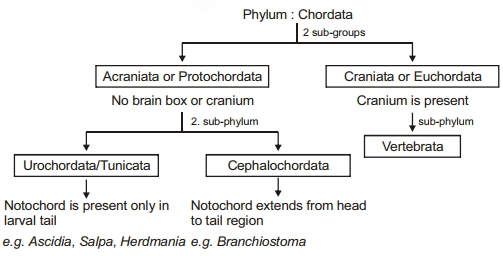
(D) Based on the classification of Phylum Chordata:
$1$. Phylum Chordata is divided into two groups: Protochordata (Acraniata) and Craniata (Vertebrata).
$2$. Protochordata is further divided into two sub-phyla: Urochordata (Tunicata) and Cephalochordata.
$3$. Ascidia belongs to the sub-phylum Urochordata,which is a part of the Protochordata group within the Phylum Chordata.
$4$. Therefore,the correct hierarchical classification is: Chordata $\rightarrow$ Protochordata $\rightarrow$ Urochordata.
$1$. Phylum Chordata is divided into two groups: Protochordata (Acraniata) and Craniata (Vertebrata).
$2$. Protochordata is further divided into two sub-phyla: Urochordata (Tunicata) and Cephalochordata.
$3$. Ascidia belongs to the sub-phylum Urochordata,which is a part of the Protochordata group within the Phylum Chordata.
$4$. Therefore,the correct hierarchical classification is: Chordata $\rightarrow$ Protochordata $\rightarrow$ Urochordata.
0 likes
View Solution158
MediumMCQ
The body of a urochordate is enclosed in a
A
Mantle
B
Test or tunic
C
Shell
D
Shield
Solution
(B) In urochordates,the adult body is enclosed within a leathery covering known as a $Test$ or $Tunic$.
This covering is composed of a cellulose-like organic substance called $Tunicin$.
Due to the presence of this $Tunic$,the subphylum $Urochordata$ is also commonly referred to as $Tunicata$.
This covering is composed of a cellulose-like organic substance called $Tunicin$.
Due to the presence of this $Tunic$,the subphylum $Urochordata$ is also commonly referred to as $Tunicata$.
0 likes
View Solution159
MediumMCQ
All of the following are characteristics of urochordates,except:
A
Neural gland as an excretory organ
B
Open type of circulatory system
C
Cranium is absent
D
Development is direct
Solution
(D) Urochordates (Tunicates) exhibit the following characteristics: they possess a neural gland as an excretory organ,have an open type of circulatory system,and lack a cranium (acraniates). However,their development is indirect,not direct. They undergo a larval stage that is free-swimming and exhibits retrogressive metamorphosis,where the larva possesses a notochord that disappears in the adult form.
0 likes
View Solution160
EasyMCQ
Respiration in cephalochordates occurs through
A
General body surface
B
Gills
C
Tracheole
D
Lungs
Solution
(A) In cephalochordates,specialized respiratory organs are absent. The blood lacks respiratory pigments,and gaseous exchange occurs through the general body surface.
0 likes
View Solution161
MediumMCQ
Excretion by protonephridia with solenocytes is a characteristic of
A
Branchiostoma
B
Amphioxus
C
Lancelet
D
All of these
Solution
(D) In the sub-phylum $Cephalochordata$,excretion occurs via protonephridia with solenocytes.
$Branchiostoma$ is also known as $Amphioxus$ or $Lancelet$.
Because its body is pointed at both ends like a lance,it is commonly called a $Lancelet$.
$Branchiostoma$ belongs to the sub-phylum $Cephalochordata$.
$Branchiostoma$ is also known as $Amphioxus$ or $Lancelet$.
Because its body is pointed at both ends like a lance,it is commonly called a $Lancelet$.
$Branchiostoma$ belongs to the sub-phylum $Cephalochordata$.
0 likes
View Solution162
MediumMCQ
Statement-$1$ : Cephalochordata bears notochord all along the body throughout life.
Statement-$2$ : Urochordate bears vertebral column only in tail region throughout the life.
Then which is correct?
Statement-$2$ : Urochordate bears vertebral column only in tail region throughout the life.
Then which is correct?
A
Both statement-$1$ and statement-$2$ are correct
B
Statement-$1$ is correct,statement-$2$ is wrong
C
Statement-$1$ is wrong,statement-$2$ is correct
D
Both statement-$1$ and statement-$2$ are wrong
Solution
(B) Statement-$1$ is correct because in Cephalochordata,the notochord extends from head to tail region and is persistent throughout their life.
Statement-$2$ is incorrect because Urochordates (Tunicates) possess a notochord only in the larval tail region,which disappears in the adult stage.
Furthermore,Urochordates do not possess a vertebral column; they are protochordates,and the notochord is not replaced by a bony or cartilaginous vertebral column.
Statement-$2$ is incorrect because Urochordates (Tunicates) possess a notochord only in the larval tail region,which disappears in the adult stage.
Furthermore,Urochordates do not possess a vertebral column; they are protochordates,and the notochord is not replaced by a bony or cartilaginous vertebral column.
0 likes
View Solution163
MediumMCQ
Which of the following are referred to as non-vertebrate chordates?
A
Ciona,Ascidia,Amphioxus
B
Lamprey,Myxine,Shark
C
Scoliodon,Torpedo,Trygon
D
Pristis,Branchiostoma,Scyllium
Solution
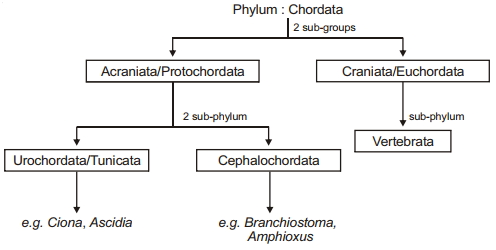
(A) The phylum Chordata is divided into two main groups: Protochordata (or Acraniata) and Craniata (or Vertebrata).
Protochordates are non-vertebrate chordates because they lack a true vertebral column. They include two sub-phyla: Urochordata (e.g.,Ciona,Ascidia) and Cephalochordata (e.g.,Branchiostoma,also known as Amphioxus).
Therefore,the group containing Ciona,Ascidia,and Amphioxus represents non-vertebrate chordates.
Protochordates are non-vertebrate chordates because they lack a true vertebral column. They include two sub-phyla: Urochordata (e.g.,Ciona,Ascidia) and Cephalochordata (e.g.,Branchiostoma,also known as Amphioxus).
Therefore,the group containing Ciona,Ascidia,and Amphioxus represents non-vertebrate chordates.
0 likes
View Solution164
MediumMCQ
$A$: All chordates have kidneys as excretory organs.
$R$: Kidneys help in the removal of metabolic wastes along with regulating the osmolarity of body fluids.
$R$: Kidneys help in the removal of metabolic wastes along with regulating the osmolarity of body fluids.
A
Assertion and Reason both are correct and Reason is the correct explanation of Assertion.
B
Assertion and Reason both are correct but Reason is not the correct explanation of Assertion.
C
Assertion is correct,but Reason is incorrect.
D
Assertion is incorrect,but Reason is correct.
Solution
(D) The Assertion is incorrect because not all chordates possess kidneys as excretory organs.
$1$. In $Urochordata$,excretion occurs through neural glands.
$2$. In $Cephalochordata$,excretion occurs through protonephridia.
Kidneys are specialized excretory organs primarily found in $Vertebrates$ to perform both excretion and osmoregulation.
Therefore,the Assertion is incorrect,while the Reason is a scientifically correct statement regarding the function of kidneys.
$1$. In $Urochordata$,excretion occurs through neural glands.
$2$. In $Cephalochordata$,excretion occurs through protonephridia.
Kidneys are specialized excretory organs primarily found in $Vertebrates$ to perform both excretion and osmoregulation.
Therefore,the Assertion is incorrect,while the Reason is a scientifically correct statement regarding the function of kidneys.
0 likes
View Solution165
Easy
Differentiate between Invertebrates and Vertebrates.
Solution
(N/A)
| Invertebrates | Vertebrates |
| $(1)$ Notochord,if present,does not transform into a vertebral column. | $(1)$ Notochord is transformed into a vertebral column. |
| $(2)$ Brain is not enclosed in a cranium. | $(2)$ Brain is enclosed in a cranium. |
| $(3)$ Appendages,if present,are often more than two pairs. | $(3)$ Appendages are typically present in two pairs (in tetrapods). |
| $(4)$ Examples: Protozoa to Protochordata. | $(4)$ Examples: Amphibia to Mammalia. |
0 likes
View Solution166
Difficult
Give a scientific reason: Annelids are considered evolutionary precursors of molluscs.
Solution
(N/A) Annelids are considered evolutionary precursors of molluscs due to several key pieces of evidence:
$1$. The presence of a $trochophore$ larva in both groups indicates a common ancestry.
$2$. The $trochophore$ larva of molluscs is structurally very similar to that of annelids.
$3$. While molluscs have lost the metameric segmentation characteristic of annelids,the larval development stages provide a strong link between the two phyla,suggesting that molluscs evolved from an annelid-like ancestor.
$1$. The presence of a $trochophore$ larva in both groups indicates a common ancestry.
$2$. The $trochophore$ larva of molluscs is structurally very similar to that of annelids.
$3$. While molluscs have lost the metameric segmentation characteristic of annelids,the larval development stages provide a strong link between the two phyla,suggesting that molluscs evolved from an annelid-like ancestor.
0 likes
View Solution167
Easy
Definition / Explanation: Notochord
Solution
(N/A) $\rightarrow$ The notochord is a mesodermally derived,rod-like structure formed on the dorsal side during embryonic development in some animals. It provides skeletal support to the body and is a characteristic feature of the phylum Chordata.
0 likes
View Solution168
EasyMCQ
What is the location and function of the notochord?
A
Ventral side; supports the digestive tract
B
Dorsal side; supports the body and provides surface for muscle attachment
C
Lateral side; aids in locomotion
D
Dorsal side; involved in nerve impulse conduction
Solution
(B) $\rightarrow$ Location: The notochord is a solid,rod-like structure present on the dorsal side of the body. It is derived from the mesoderm during embryonic development.
$\rightarrow$ Function: Its primary function is to provide structural support to the body and serve as a surface for the attachment of muscles,which facilitates movement.
$\rightarrow$ Function: Its primary function is to provide structural support to the body and serve as a surface for the attachment of muscles,which facilitates movement.
0 likes
View Solution169
EasyMCQ
What is the location and function of the nerve cord in chordates?
A
Ventral,solid; controls digestion
B
Dorsal,hollow; coordinates body functions
C
Lateral,solid; supports the body
D
Dorsal,solid; aids in respiration
Solution
(B) $\rightarrow$ Location: It is a hollow,tube-like structure present on the dorsal side of the body.
$\rightarrow$ Function: The anterior end develops into the brain,while the posterior end forms the spinal cord. It coordinates all the physiological functions of the body.
$\rightarrow$ Function: The anterior end develops into the brain,while the posterior end forms the spinal cord. It coordinates all the physiological functions of the body.
0 likes
View Solution170
EasyMCQ
What is the location and function of pharyngeal gill slits?
A
Location: Dorsal side of the body; Function: Digestion
B
Location: Lateral sides of the pharynx; Function: Respiration
C
Location: Ventral side of the heart; Function: Circulation
D
Location: Posterior end of the tail; Function: Locomotion
Solution
(B) $\rightarrow$ Location: These are paired openings formed on the lateral sides of the pharynx that communicate to the exterior.
$\rightarrow$ Function: They help in respiration. These are retained throughout life in lower chordates and aquatic vertebrates,and only during the embryonic stage in all other chordates.
$\rightarrow$ Function: They help in respiration. These are retained throughout life in lower chordates and aquatic vertebrates,and only during the embryonic stage in all other chordates.
0 likes
View Solution171
MediumMCQ
Given below are two statements: one is labelled as Assertion $(A)$ and the other is labelled as Reason $(R)$.
Assertion $(A)$: All vertebrates are chordates but all chordates are not vertebrates.
Reason $(R)$: Notochord is replaced by vertebral column in the adult vertebrates.
In the light of the above statements,choose the most appropriate answer from the options given below:
Assertion $(A)$: All vertebrates are chordates but all chordates are not vertebrates.
Reason $(R)$: Notochord is replaced by vertebral column in the adult vertebrates.
In the light of the above statements,choose the most appropriate answer from the options given below:
A
Both $(A)$ and $(R)$ are correct and $(R)$ is the correct explanation of $(A)$
B
$(A)$ is correct but $(R)$ is not correct
C
$(A)$ is not correct but $(R)$ is correct
D
Both $(A)$ and $(R)$ are correct but $(R)$ is not the correct explanation of $(A)$
Solution
(A) The phylum Chordata is characterized by the presence of a notochord,a dorsal hollow nerve cord,and paired pharyngeal gill slits.
Vertebrates are a subphylum of Chordata where the notochord is present during the embryonic period and is replaced by a cartilaginous or bony vertebral column in the adult stage.
Since all vertebrates possess a notochord at some stage of their life,they are chordates. However,not all chordates (like Urochordates and Cephalochordates) possess a vertebral column; therefore,they are not vertebrates.
Thus,Assertion $(A)$ is correct,and Reason $(R)$ correctly explains why all vertebrates are chordates but not all chordates are vertebrates.
Vertebrates are a subphylum of Chordata where the notochord is present during the embryonic period and is replaced by a cartilaginous or bony vertebral column in the adult stage.
Since all vertebrates possess a notochord at some stage of their life,they are chordates. However,not all chordates (like Urochordates and Cephalochordates) possess a vertebral column; therefore,they are not vertebrates.
Thus,Assertion $(A)$ is correct,and Reason $(R)$ correctly explains why all vertebrates are chordates but not all chordates are vertebrates.
0 likes
View Solution172
MediumMCQ
To which phylum do the classes Pisces,Amphibia,Aves,Reptilia,and Mammalia belong?
A
Chordata
B
Gnathostomata
C
Tetrapoda
D
Vertebrata
Solution
(A) The classes Pisces,Amphibia,Reptilia,Aves,and Mammalia are all grouped under the subphylum $Vertebrata$. The subphylum $Vertebrata$ belongs to the phylum $Chordata$. Therefore,these classes are part of the phylum $Chordata$.
0 likes
View Solution173
MediumMCQ
Select the correct option for the $notochord$:
A
It is a rod-like structure derived from the mesoderm.
B
It is absent in Porifera to Echinodermata.
C
In vertebrates,the $notochord$ is replaced by the vertebral column.
D
All of the above.
Solution
(D) The $notochord$ is a mesodermally derived rod-like structure formed on the dorsal side during embryonic development in some animals (Chordates).
It is absent in non-chordates,which include phyla from Porifera to Echinodermata.
In vertebrates,the $notochord$ is replaced by a cartilaginous or bony vertebral column in the adult stage.
Therefore,all the given statements are correct.
It is absent in non-chordates,which include phyla from Porifera to Echinodermata.
In vertebrates,the $notochord$ is replaced by a cartilaginous or bony vertebral column in the adult stage.
Therefore,all the given statements are correct.
0 likes
View Solution174
MediumMCQ
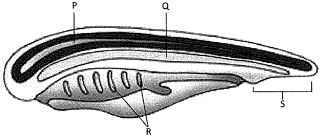
Label the parts $P$,$Q$,$R$,and $S$ in the given diagram of a chordate:
A
$P$: Notochord,$Q$: Nerve cord,$R$: Gill slits,$S$: Post-anal tail
B
$P$: Nerve cord,$Q$: Notochord,$R$: Gill slits,$S$: Post-anal tail
C
$P$: Nerve cord,$Q$: Notochord,$R$: Fins,$S$: Post-anal tail
D
$P$: Notochord,$Q$: Nerve cord,$R$: Fins,$S$: Post-anal tail
Solution
(B) The diagram represents the fundamental characteristics of the phylum Chordata.
$P$ represents the dorsal hollow nerve cord.
$Q$ represents the notochord,which is a rod-like structure located below the nerve cord.
$R$ represents the pharyngeal gill slits.
$S$ represents the post-anal tail.
Therefore,the correct sequence is $P$: Nerve cord,$Q$: Notochord,$R$: Gill slits,$S$: Post-anal tail.
$P$ represents the dorsal hollow nerve cord.
$Q$ represents the notochord,which is a rod-like structure located below the nerve cord.
$R$ represents the pharyngeal gill slits.
$S$ represents the post-anal tail.
Therefore,the correct sequence is $P$: Nerve cord,$Q$: Notochord,$R$: Gill slits,$S$: Post-anal tail.
0 likes
View Solution175
EasyMCQ
Select the incorrect statement for chordates.
A
Central nervous system is dorsal,hollow,and single.
B
Heart is ventral.
C
Pharyngeal gill slits are absent.
D
Post-anal tail is present.
Solution
(C) The fundamental characteristics of chordates include the presence of a notochord,a dorsal hollow nerve cord,and paired pharyngeal gill slits at some stage of their life cycle.
Option $A$ is correct as chordates possess a dorsal,hollow,and single central nervous system.
Option $B$ is correct as the heart in chordates is located on the ventral side.
Option $D$ is correct as a post-anal tail is a characteristic feature of chordates.
Option $C$ is incorrect because pharyngeal gill slits are a defining feature of chordates,not absent.
Option $A$ is correct as chordates possess a dorsal,hollow,and single central nervous system.
Option $B$ is correct as the heart in chordates is located on the ventral side.
Option $D$ is correct as a post-anal tail is a characteristic feature of chordates.
Option $C$ is incorrect because pharyngeal gill slits are a defining feature of chordates,not absent.
0 likes
View Solution176
MediumMCQ
Which of the following characteristics is $NOT$ applicable to both Urochordata and Cephalochordata?
A
Exclusively marine
B
Notochord present only in larval tail
C
Known as protochordates
D
None of these
Solution
(B) Urochordata (Tunicata) and Cephalochordata are collectively referred to as protochordates. Both groups are exclusively marine. However,the notochord in Urochordata is present only in the larval tail,whereas in Cephalochordata,it extends from head to tail region and persists throughout their life. Therefore,the characteristic 'notochord present only in larval tail' is not applicable to Cephalochordata.
0 likes
View Solution177
MediumMCQ
Identify the animals belonging to Urochordata (Tunicata) and Cephalochordata,respectively.
Urochordata $\quad$ Cephalochordata
Urochordata $\quad$ Cephalochordata
A
$A$. Brachiostoma,Doliolum $\quad$ Ascidia,Salpa
B
$B$. Ascidia,Salpa $\quad$ Brachiostoma,Doliolum
C
$C$. Brachiostoma $\quad$ Ascidia,Salpa,Doliolum
D
$D$. Ascidia,Salpa,Doliolum $\quad$ Brachiostoma
Solution
(D) $1$. Urochordata (also known as Tunicata) includes animals like $Ascidia$,$Salpa$,and $Doliolum$,where the notochord is present only in the larval tail.
$2$. Cephalochordata includes animals like $Branchiostoma$ (also known as $Amphioxus$ or lancelet),where the notochord extends from head to tail region and is persistent throughout their life.
$3$. Therefore,the correct classification is: Urochordata ($Ascidia$,$Salpa$,$Doliolum$) and Cephalochordata $(Branchiostoma)$.
$2$. Cephalochordata includes animals like $Branchiostoma$ (also known as $Amphioxus$ or lancelet),where the notochord extends from head to tail region and is persistent throughout their life.
$3$. Therefore,the correct classification is: Urochordata ($Ascidia$,$Salpa$,$Doliolum$) and Cephalochordata $(Branchiostoma)$.
0 likes
View Solution178
MediumMCQ
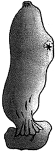
Select the correct option for the animal given below.
A
Urochordata - Salpa
B
Cephalochordata - Salpa
C
Urochordata - Ascidia
D
Cephalochordata - Ascidia
Solution
(C) The image provided shows an organism belonging to the subphylum Urochordata (also known as Tunicata).
Specifically,the organism depicted is Ascidia.
In Urochordates,the notochord is present only in the larval tail.
Therefore,the correct classification is Urochordata - Ascidia.
Specifically,the organism depicted is Ascidia.
In Urochordates,the notochord is present only in the larval tail.
Therefore,the correct classification is Urochordata - Ascidia.
0 likes
View Solution179
MediumMCQ
Select the incorrect option for vertebrates:
A
All chordates are vertebrates,but all vertebrates are not chordates.
B
They possess a ventral muscular heart with two,three,or four chambers.
C
They have kidneys for excretion and osmoregulation.
D
Locomotory organs can be fins or limbs.
Solution
(A) The correct answer is $A$.
In the phylum $Chordata$,all vertebrates are chordates because they possess a notochord during the embryonic stage,which is replaced by a vertebral column in adults.
However,not all chordates are vertebrates (e.g.,Urochordates and Cephalochordates lack a vertebral column).
Therefore,the statement 'All chordates are vertebrates,but all vertebrates are not chordates' is scientifically incorrect.
Vertebrates are characterized by a ventral muscular heart,kidneys for excretion/osmoregulation,and paired appendages (fins or limbs).
In the phylum $Chordata$,all vertebrates are chordates because they possess a notochord during the embryonic stage,which is replaced by a vertebral column in adults.
However,not all chordates are vertebrates (e.g.,Urochordates and Cephalochordates lack a vertebral column).
Therefore,the statement 'All chordates are vertebrates,but all vertebrates are not chordates' is scientifically incorrect.
Vertebrates are characterized by a ventral muscular heart,kidneys for excretion/osmoregulation,and paired appendages (fins or limbs).
0 likes
View Solution180
MediumMCQ
Select the correct statements with reference to chordates.
$A$. Presence of a mid-dorsal,solid and double nerve cord.
$B$. Presence of closed circulatory system.
$C$. Presence of paired pharyngeal gill slits.
$D$. Presence of dorsal heart.
$E$. Triploblastic pseudocoelomate animals.
Choose the correct answer from the options given below:
$A$. Presence of a mid-dorsal,solid and double nerve cord.
$B$. Presence of closed circulatory system.
$C$. Presence of paired pharyngeal gill slits.
$D$. Presence of dorsal heart.
$E$. Triploblastic pseudocoelomate animals.
Choose the correct answer from the options given below:
A
$C, D$ and $E$ only
B
$A, C$ and $D$ only
C
$B$ and $C$ only
D
$B, D$ and $E$ only
Solution
(C) The fundamental characteristics of chordates include:
$1$. Presence of a notochord.
$2$. Presence of a dorsal,hollow,and single nerve cord.
$3$. Presence of paired pharyngeal gill slits.
$4$. Presence of a post-anal tail.
$5$. Presence of a ventral heart.
$6$. Presence of a closed circulatory system.
Evaluating the given statements:
$A$. Incorrect: Chordates have a dorsal,hollow,and single nerve cord,not solid and double.
$B$. Correct: Chordates possess a closed circulatory system.
$C$. Correct: Chordates possess paired pharyngeal gill slits at some stage of their life cycle.
$D$. Incorrect: Chordates have a ventral heart,not a dorsal heart.
$E$. Incorrect: Chordates are triploblastic and coelomate,not pseudocoelomate.
Therefore,only statements $B$ and $C$ are correct.
$1$. Presence of a notochord.
$2$. Presence of a dorsal,hollow,and single nerve cord.
$3$. Presence of paired pharyngeal gill slits.
$4$. Presence of a post-anal tail.
$5$. Presence of a ventral heart.
$6$. Presence of a closed circulatory system.
Evaluating the given statements:
$A$. Incorrect: Chordates have a dorsal,hollow,and single nerve cord,not solid and double.
$B$. Correct: Chordates possess a closed circulatory system.
$C$. Correct: Chordates possess paired pharyngeal gill slits at some stage of their life cycle.
$D$. Incorrect: Chordates have a ventral heart,not a dorsal heart.
$E$. Incorrect: Chordates are triploblastic and coelomate,not pseudocoelomate.
Therefore,only statements $B$ and $C$ are correct.
1 likes
View Solution181
MediumMCQ
The following are the statements about non-chordates:
$A$. Pharynx is perforated by gill slits.
$B$. Notochord is absent.
$C$. Central nervous system is dorsal.
$D$. Heart is dorsal if present.
$E$. Post anal tail is absent.
Choose the most appropriate answer from the options given below:
$A$. Pharynx is perforated by gill slits.
$B$. Notochord is absent.
$C$. Central nervous system is dorsal.
$D$. Heart is dorsal if present.
$E$. Post anal tail is absent.
Choose the most appropriate answer from the options given below:
A
$A, B, D$ only
B
$B, D, E$ only
C
$B, C, D$ only
D
$A, C$ only
Solution
(B) The characteristics of non-chordates are as follows:
$1$. Notochord is absent (Statement $B$).
$2$. Central nervous system is ventral,solid,and double (Statement $C$ is incorrect for non-chordates as it is dorsal in chordates).
$3$. Heart is dorsal if present (Statement $D$).
$4$. Post-anal tail is absent (Statement $E$).
$5$. Pharynx is not perforated by gill slits (Statement $A$ is a characteristic of chordates).
Therefore,statements $B, D,$ and $E$ are the correct features of non-chordates.
Thus,the correct option is $B$ ($B, D, E$ only).
$1$. Notochord is absent (Statement $B$).
$2$. Central nervous system is ventral,solid,and double (Statement $C$ is incorrect for non-chordates as it is dorsal in chordates).
$3$. Heart is dorsal if present (Statement $D$).
$4$. Post-anal tail is absent (Statement $E$).
$5$. Pharynx is not perforated by gill slits (Statement $A$ is a characteristic of chordates).
Therefore,statements $B, D,$ and $E$ are the correct features of non-chordates.
Thus,the correct option is $B$ ($B, D, E$ only).
0 likes
View Solution182
MediumMCQ
Given below are two statements: one is labelled as Assertion $(A)$ and the other is labelled as Reason $(R)$.
Assertion $(A):$ All vertebrates are chordates but all chordates are not vertebrates.
Reason $(R):$ The members of subphylum Vertebrata possess a notochord during the embryonic period; the notochord is replaced by a cartilaginous or bony vertebral column in adults.
In the light of the above statements,choose the correct answer from the options given below:
Assertion $(A):$ All vertebrates are chordates but all chordates are not vertebrates.
Reason $(R):$ The members of subphylum Vertebrata possess a notochord during the embryonic period; the notochord is replaced by a cartilaginous or bony vertebral column in adults.
In the light of the above statements,choose the correct answer from the options given below:
A
Both $A$ and $R$ are true and $R$ is the correct explanation of $A$
B
Both $A$ and $R$ are true but $R$ is not the correct explanation of $A$
C
$A$ is true but $R$ is false
D
$A$ is false but $R$ is true
Solution
(A) Assertion $(A)$ is true because all vertebrates belong to the subphylum Vertebrata,which is a part of the phylum Chordata. However,not all chordates are vertebrates because the phylum Chordata also includes subphyla Urochordata and Cephalochordata,which lack a vertebral column.
Reason $(R)$ is also true and correctly explains the Assertion. Vertebrates are defined by the presence of a vertebral column in adults,which replaces the embryonic notochord. This structural transition is the fundamental reason why all vertebrates are classified as chordates (due to the embryonic notochord) but are distinguished from other chordates (which retain the notochord throughout life).
Reason $(R)$ is also true and correctly explains the Assertion. Vertebrates are defined by the presence of a vertebral column in adults,which replaces the embryonic notochord. This structural transition is the fundamental reason why all vertebrates are classified as chordates (due to the embryonic notochord) but are distinguished from other chordates (which retain the notochord throughout life).
0 likes
View Solution183
MediumMCQ
Assertion $(A)$: $Ascidia$ and $Salpa$ are placed under sub-phylum $Urochordata$.
Reason $(R)$: In $Ascidia$ and $Salpa$,notochord is present only in larval tail.
In the light of the above statements,choose the most appropriate answer from the options given below:
Reason $(R)$: In $Ascidia$ and $Salpa$,notochord is present only in larval tail.
In the light of the above statements,choose the most appropriate answer from the options given below:
A
Both $(A)$ and $(R)$ are correct but $(R)$ is not the correct explanation of $(A)$
B
$(A)$ is correct but $(R)$ is not correct
C
$(A)$ is not correct but $(R)$ is correct
D
Both $(A)$ and $(R)$ are correct and $(R)$ is the correct explanation of $(A)$
Solution
(D) The sub-phylum $Urochordata$ (also known as $Tunicata$) includes organisms where the notochord is present only in the larval tail.
$Ascidia$,$Salpa$,and $Doliolum$ are classic examples of $Urochordata$.
Since the defining characteristic of the sub-phylum $Urochordata$ is the presence of the notochord exclusively in the larval tail,the reason $(R)$ correctly explains why $Ascidia$ and $Salpa$ are classified under this sub-phylum.
Therefore,both $(A)$ and $(R)$ are correct,and $(R)$ is the correct explanation of $(A)$.
$Ascidia$,$Salpa$,and $Doliolum$ are classic examples of $Urochordata$.
Since the defining characteristic of the sub-phylum $Urochordata$ is the presence of the notochord exclusively in the larval tail,the reason $(R)$ correctly explains why $Ascidia$ and $Salpa$ are classified under this sub-phylum.
Therefore,both $(A)$ and $(R)$ are correct,and $(R)$ is the correct explanation of $(A)$.
0 likes
View Solution184
EasyMCQ
Urochordata: All the members of this subphylum are:
A
Exclusively marine
B
Exclusively fresh water
C
Exclusively terrestrial
D
Exclusively fossorial
Solution
(A) The subphylum $Urochordata$ (also known as $Tunicata$) consists of organisms that are exclusively marine. They are often referred to as tunicates because their body is enclosed in a test or tunic composed of cellulose-like substance called tunicin. Examples include $Ascidia$,$Salpa$,and $Doliolum$.
0 likes
View Solution185
EasyMCQ
Assertion: Notochord is a mesodermally derived rod-like structure formed on the dorsal side during embryonic development of chordates.
Reason: Notochord is replaced by the vertebral column in the adult vertebrate.
Reason: Notochord is replaced by the vertebral column in the adult vertebrate.
A
Both Assertion & Reason are True & the Reason is a correct explanation of the Assertion.
B
Both Assertion & Reason are True but Reason is not a correct explanation of the Assertion.
C
Assertion is True but the Reason is False.
D
Both Assertion & Reason are False.
Solution
(A) The Assertion is true because the notochord is indeed a mesodermally derived,rod-like structure that develops on the dorsal side during the embryonic stage of all chordates.
The Reason is also true because,in vertebrates,the notochord is replaced by a cartilaginous or bony vertebral column in the adult stage.
Since the presence of the notochord (which is later replaced by the vertebral column) is a defining characteristic that distinguishes vertebrates from other chordates,the Reason correctly explains the nature and fate of the notochord in vertebrates.
The Reason is also true because,in vertebrates,the notochord is replaced by a cartilaginous or bony vertebral column in the adult stage.
Since the presence of the notochord (which is later replaced by the vertebral column) is a defining characteristic that distinguishes vertebrates from other chordates,the Reason correctly explains the nature and fate of the notochord in vertebrates.
0 likes
View Solution186
EasyMCQ
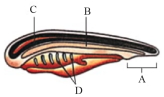
$A$ schematic representation of a chordate's embryo is shown in the figure. The structures marked $A, B, C$ and $D$ are respectively:
A
Notochord,Nerve cord,Intestine and Gill slits
B
Post anal tail,Gill slits,Nerve cord and Notochord
C
Post anal tail,Nerve cord,Notochord and Gill slits
D
Post anal tail,Notochord,Nerve cord and Gill slits
Solution
(D) The figure represents the fundamental characteristics of the phylum Chordata.
$A$ points to the post-anal tail,which is a posterior extension of the body beyond the anal opening.
$B$ points to the notochord,a flexible rod-like structure.
$C$ points to the dorsal hollow nerve cord.
$D$ points to the pharyngeal gill slits.
Therefore,the correct sequence is $A$: Post anal tail,$B$: Notochord,$C$: Nerve cord,$D$: Gill slits.
Comparing this with the given options,option $C$ is incorrect in its sequence,and option $D$ matches the labels correctly.
$A$ points to the post-anal tail,which is a posterior extension of the body beyond the anal opening.
$B$ points to the notochord,a flexible rod-like structure.
$C$ points to the dorsal hollow nerve cord.
$D$ points to the pharyngeal gill slits.
Therefore,the correct sequence is $A$: Post anal tail,$B$: Notochord,$C$: Nerve cord,$D$: Gill slits.
Comparing this with the given options,option $C$ is incorrect in its sequence,and option $D$ matches the labels correctly.
0 likes
View Solution187
EasyMCQ
Non-chordates have:
A
Notochord
B
Dorsal tubular nerve cord
C
Pharyngeal gill clefts
D
None of the above
Solution
(D) Chordates are characterized by the presence of a notochord,a dorsal hollow nerve cord,and paired pharyngeal gill slits at some stage of their life cycle.
Non-chordates are animals that lack these three fundamental chordate characteristics.
Therefore,none of the options $A$,$B$,or $C$ are present in non-chordates.
Non-chordates are animals that lack these three fundamental chordate characteristics.
Therefore,none of the options $A$,$B$,or $C$ are present in non-chordates.
0 likes
View Solution188
MediumMCQ
Which one of the following features are true for chordates?
$(a)$ Heart is ventral.
$(b)$ Pharyngeal gill slits present.
$(c)$ Central nervous system is ventral,solid and single.
$(d)$ Post-anal tail is present.
$(e)$ Notochord is present.
Choose the most appropriate answer from the options given below:
$(a)$ Heart is ventral.
$(b)$ Pharyngeal gill slits present.
$(c)$ Central nervous system is ventral,solid and single.
$(d)$ Post-anal tail is present.
$(e)$ Notochord is present.
Choose the most appropriate answer from the options given below:
A
$(a), (d)$ and $(c)$ only
B
$(b)$ and $(c)$ only
C
$(a), (b), (d)$ and $(e)$ only
D
$(e)$ only
Solution
(C) The fundamental characteristics of phylum Chordata include:
$1$. Presence of a notochord $(e)$.
$2$. $A$ dorsal,hollow,and single central nervous system $(c$ is incorrect because the $CNS$ in chordates is dorsal,not ventral).
$3$. Paired pharyngeal gill slits $(b)$.
$4$. $A$ ventral heart $(a)$.
$5$. $A$ post-anal tail $(d)$.
Therefore,the features $(a), (b), (d),$ and $(e)$ are correct for chordates. Option $(c)$ is incorrect because the central nervous system in chordates is dorsal,whereas it is ventral in non-chordates.
$1$. Presence of a notochord $(e)$.
$2$. $A$ dorsal,hollow,and single central nervous system $(c$ is incorrect because the $CNS$ in chordates is dorsal,not ventral).
$3$. Paired pharyngeal gill slits $(b)$.
$4$. $A$ ventral heart $(a)$.
$5$. $A$ post-anal tail $(d)$.
Therefore,the features $(a), (b), (d),$ and $(e)$ are correct for chordates. Option $(c)$ is incorrect because the central nervous system in chordates is dorsal,whereas it is ventral in non-chordates.
0 likes
View Solution189
EasyMCQ
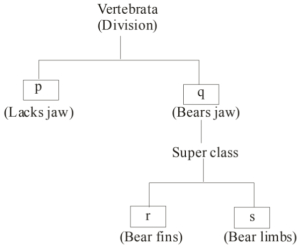
Observe the following simplified scheme of the division $Vertebrata$ and choose the correct option that matches with the letters given in the boxes.
$Vertebrata$ (Division)
- $p$ (Lacks jaw)
- $q$ (Bears jaw)
- Super class
- $r$ (Bear fins)
- $s$ (Bear limbs)
$Vertebrata$ (Division)
- $p$ (Lacks jaw)
- $q$ (Bears jaw)
- Super class
- $r$ (Bear fins)
- $s$ (Bear limbs)
A
$p$-Agnatha,$q$-Gnathostomata,$r$-Tetrapoda,$s$-Pisces.
B
$p$-Agnatha,$q$-Gnathostomata,$r$-Pisces,$s$-Tetrapoda.
C
$p$-Gnathostomata,$q$-Agnatha,$r$-Tetrapoda,$s$-Pisces.
D
$p$-Tetrapoda,$q$-Pisces,$r$-Gnathostomata,$s$-Agnatha.
Solution
(B) The division $Vertebrata$ is classified based on the presence or absence of jaws into two groups:
$1$. $Agnatha$: These are jawless vertebrates. Thus,$p$ corresponds to $Agnatha$.
$2$. $Gnathostomata$: These are jawed vertebrates. Thus,$q$ corresponds to $Gnathostomata$.
$Gnathostomata$ is further divided into two superclasses based on the presence of fins or limbs:
$1$. $Pisces$: These are aquatic vertebrates that bear fins for locomotion. Thus,$r$ corresponds to $Pisces$.
$2$. $Tetrapoda$: These are terrestrial vertebrates that bear limbs for locomotion. Thus,$s$ corresponds to $Tetrapoda$.
Therefore,the correct matching is $p$-Agnatha,$q$-Gnathostomata,$r$-Pisces,$s$-Tetrapoda.
$1$. $Agnatha$: These are jawless vertebrates. Thus,$p$ corresponds to $Agnatha$.
$2$. $Gnathostomata$: These are jawed vertebrates. Thus,$q$ corresponds to $Gnathostomata$.
$Gnathostomata$ is further divided into two superclasses based on the presence of fins or limbs:
$1$. $Pisces$: These are aquatic vertebrates that bear fins for locomotion. Thus,$r$ corresponds to $Pisces$.
$2$. $Tetrapoda$: These are terrestrial vertebrates that bear limbs for locomotion. Thus,$s$ corresponds to $Tetrapoda$.
Therefore,the correct matching is $p$-Agnatha,$q$-Gnathostomata,$r$-Pisces,$s$-Tetrapoda.
0 likes
View Solution190
EasyMCQ
In some chordates,the notochord is replaced by the vertebral column. Such animals are called vertebrates. Which one of the following statements is correct?
A
All chordates are vertebrates but all vertebrates are not chordates.
B
All vertebrates are chordates and all chordates are vertebrates.
C
All vertebrates are chordates but all chordates are not vertebrates.
D
Chordates are not vertebrates and vertebrates are not chordates.
Solution
(C) The correct statement is that all vertebrates are chordates,but all chordates are not vertebrates.
This is because the phylum $Chordata$ is a larger group that includes organisms with a notochord at some stage of their life cycle.
Vertebrates are a subphylum within $Chordata$ where the notochord is replaced by a vertebral column in the adult stage.
Therefore,while every vertebrate is a chordate,not every chordate (such as $Urochordata$ or $Cephalochordata$) possesses a vertebral column.
This is because the phylum $Chordata$ is a larger group that includes organisms with a notochord at some stage of their life cycle.
Vertebrates are a subphylum within $Chordata$ where the notochord is replaced by a vertebral column in the adult stage.
Therefore,while every vertebrate is a chordate,not every chordate (such as $Urochordata$ or $Cephalochordata$) possesses a vertebral column.
0 likes
View Solution191
EasyMCQ
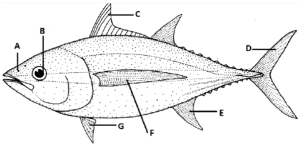
The diagram of a fish is given below. Identify the parts labelled $A, B, C, D, E, F, G$.
A
| $A$. Nostril | $B$. Eye | $C$. Anal fin | $D$. Caudal fin | $E$. Dorsal fin | $F$. Pectoral fin | $G$. Pelvic fin |
B
| $A$. Nostril | $B$. Eye | $C$. Dorsal fin | $D$. Anal fin | $E$. Caudal fin | $F$. Pectoral fin | $G$. Pelvic fin |
C
| $A$. Nostril | $B$. Eye | $C$. Dorsal fin | $D$. Caudal fin | $E$. Pectoral fin | $F$. Anal fin | $G$. Pelvic fin |
D
| $A$. Nostril | $B$. Eye | $C$. Dorsal fin | $D$. Caudal fin | $E$. Anal fin | $F$. Pelvic fin | $G$. Pectoral fin |
Solution
(B) By observing the provided diagram of the fish,we can identify the labeled parts as follows:
$A$ points to the Nostril.
$B$ points to the Eye.
$C$ points to the Dorsal fin (located on the back).
$D$ points to the Caudal fin (the tail fin).
$E$ points to the Anal fin (located on the ventral side near the tail).
$F$ points to the Pectoral fin (located on the side behind the operculum).
$G$ points to the Pelvic fin (located on the ventral side).
Comparing these identifications with the given options,option $C$ correctly labels all parts: $A$-Nostril,$B$-Eye,$C$-Dorsal fin,$D$-Caudal fin,$E$-Pectoral fin,$F$-Anal fin,$G$-Pelvic fin. Note: In the provided diagram,$E$ is the anal fin and $F$ is the pectoral fin. Therefore,the correct sequence is $A$-Nostril,$B$-Eye,$C$-Dorsal fin,$D$-Caudal fin,$E$-Anal fin,$F$-Pectoral fin,$G$-Pelvic fin,which matches option $B$.
$A$ points to the Nostril.
$B$ points to the Eye.
$C$ points to the Dorsal fin (located on the back).
$D$ points to the Caudal fin (the tail fin).
$E$ points to the Anal fin (located on the ventral side near the tail).
$F$ points to the Pectoral fin (located on the side behind the operculum).
$G$ points to the Pelvic fin (located on the ventral side).
Comparing these identifications with the given options,option $C$ correctly labels all parts: $A$-Nostril,$B$-Eye,$C$-Dorsal fin,$D$-Caudal fin,$E$-Pectoral fin,$F$-Anal fin,$G$-Pelvic fin. Note: In the provided diagram,$E$ is the anal fin and $F$ is the pectoral fin. Therefore,the correct sequence is $A$-Nostril,$B$-Eye,$C$-Dorsal fin,$D$-Caudal fin,$E$-Anal fin,$F$-Pectoral fin,$G$-Pelvic fin,which matches option $B$.
0 likes
View SolutionAnimal Kingdom — Phylum-Chordata · Frequently Asked Questions
1Are these Animal Kingdom questions useful for JEE and NEET?
Yes. All questions in this section are mapped to JEE Main and NEET exam patterns. Previous year questions from JEE Main, NEET, GUJCET and state-level exams are included with full solutions.
2Can I switch to Hindi or Gujarati for these questions?
Yes. Use the language tabs in the hero section or the sidebar to view the same questions and solutions in English, Hindi or Gujarati.
3How do I generate a question paper from this subtopic?
Use the Vedclass Exam Paper Generator — select the chapter and subtopic, set difficulty, and generate Sets A, B, C, D automatically. First 3 chapters of every subject are free.
Vedclass Products
For Students
Vedclass Test Series
Mock tests in real JEE/NEET style with performance analysis. 5-day free trial.
Start Free TrialFor Teachers
Exam Paper Generator
Generate Set A/B/C/D papers from this chapter in 2 minutes. 3 chapters free.
Try FreeFor Institutes
Online Exam Module
Live online exams with unlimited students, 360° analytics & white-label branding.
See DemoFor Teachers & Institutes
Generate a Animal Kingdom Exam Paper in 2 Minutes
Select subtopic & difficulty — Sets A, B, C, D auto-generated with No Repeat logic.
First 3 chapters of every subject are free — no payment required.