
A English
Phylum-Chordata Questions in English
Class 11 Biology · Animal Kingdom · Phylum-Chordata
191+
Questions
English
Language
100%
With Solutions
Showing 49 of 191 questions in English
101
EasyMCQ
In vertebrates,the notochord is replaced by which structure during the embryonic stage?
A
Larval stage
B
Adult stage
C
Embryonic stage
D
Notochord persists throughout life
Solution
(C) In vertebrates,the notochord is present during the embryonic period. It is replaced by a cartilaginous or bony vertebral column in the adult. Therefore,the transformation occurs during the embryonic development phase.
0 likes
View Solution102
EasyMCQ
What is present in the larval stage of Urochordata?
A
Coelom
B
Vertebral column
C
Notochord
D
Gill slits
Solution
(C) In the subphylum Urochordata (also known as Tunicata),the notochord is present only in the larval tail. As the larva undergoes metamorphosis into an adult,the notochord disappears. Therefore,the presence of a notochord in the larval tail is a characteristic feature of Urochordata.
0 likes
View Solution103
EasyMCQ
What do $a$ and $b$ represent in the given chart respectively?
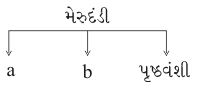
A
Cephalochordata,Hemichordata
B
Urochordata,Cephalochordata
C
Urochordata,Invertebrata
D
Urochordata,Hemichordata
Solution
(B) The phylum Chordata is classified into three subphyla: Urochordata (or Tunicata),Cephalochordata,and Vertebrata.
According to the provided chart,the subphyla are listed under Chordata. The third one is Vertebrata.
Therefore,$a$ and $b$ represent Urochordata and Cephalochordata respectively.
According to the provided chart,the subphyla are listed under Chordata. The third one is Vertebrata.
Therefore,$a$ and $b$ represent Urochordata and Cephalochordata respectively.
0 likes
View Solution104
MediumMCQ
To which group does $Salpa$ belong?
A
Cephalochordata
B
Vertebrata
C
Urochordata
D
Agnatha
Solution
(C) $Salpa$ is a genus of tunicate (tunicates are also known as Urochordates).
In the phylum Chordata,the subphylum Urochordata (or Tunicata) includes organisms where the notochord is present only in the larval tail.
$Salpa$ belongs to the class Thaliacea within the subphylum Urochordata.
Therefore,the correct option is $C$.
In the phylum Chordata,the subphylum Urochordata (or Tunicata) includes organisms where the notochord is present only in the larval tail.
$Salpa$ belongs to the class Thaliacea within the subphylum Urochordata.
Therefore,the correct option is $C$.
0 likes
View Solution105
MediumMCQ
$A:$ Amphioxus is not a vertebrate.
$R:$ Amphioxus is not a chordate.
$R:$ Amphioxus is not a chordate.
A
$A$ and $R$ are both true and $R$ is the correct explanation of $A$.
B
$A$ and $R$ are both true,but $R$ is not the correct explanation of $A$.
C
$A$ is true and $R$ is false.
D
$A$ is false and $R$ is true.
Solution
(C) $A:$ Amphioxus (Branchiostoma) belongs to the subphylum Cephalochordata. While it possesses a notochord throughout its life,it lacks a vertebral column,thus it is not a vertebrate. Therefore,statement $A$ is true.
$R:$ Amphioxus is a classic example of a protochordate (cephalochordate). It possesses a notochord,a dorsal hollow nerve cord,and pharyngeal gill slits,which are the defining characteristics of the phylum Chordata. Therefore,statement $R$ is false.
$R:$ Amphioxus is a classic example of a protochordate (cephalochordate). It possesses a notochord,a dorsal hollow nerve cord,and pharyngeal gill slits,which are the defining characteristics of the phylum Chordata. Therefore,statement $R$ is false.
0 likes
View Solution106
MediumMCQ
Which marine animals possess a notochord only during their larval stage?
A
Ascidia
B
Salpa
C
Both $A$ and $B$
D
Amphioxus
Solution
(C) The phylum Chordata is divided into three subphyla: Urochordata,Cephalochordata,and Vertebrata.
In subphylum Urochordata (also known as Tunicata),the notochord is present only in the larval tail and disappears in the adult stage.
Examples of Urochordata include $Ascidia$,$Salpa$,and $Doliolum$.
$Amphioxus$ (Cephalochordata) retains the notochord throughout its entire life,extending from head to tail.
Therefore,both $Ascidia$ and $Salpa$ are urochordates that possess a notochord only during the larval stage.
In subphylum Urochordata (also known as Tunicata),the notochord is present only in the larval tail and disappears in the adult stage.
Examples of Urochordata include $Ascidia$,$Salpa$,and $Doliolum$.
$Amphioxus$ (Cephalochordata) retains the notochord throughout its entire life,extending from head to tail.
Therefore,both $Ascidia$ and $Salpa$ are urochordates that possess a notochord only during the larval stage.
0 likes
View Solution107
MediumMCQ
Which of the following statements is $NOT$ true for invertebrates?
A
The digestive tract is located on the dorsal side of the nerve cord.
B
The nervous system is solid.
C
The nerve cord is double,ventral,and usually ganglionated.
D
They generally reproduce sexually.
Solution
(A) Invertebrates are characterized by the absence of a notochord. Their nervous system is solid,double,and ventral,often containing ganglia. In contrast,chordates have a dorsal,hollow,and single nerve cord. The digestive tract in invertebrates is typically located on the ventral side of the nerve cord,whereas in chordates,it is located on the ventral side of the notochord. Therefore,the statement that the digestive tract is located on the dorsal side of the nerve cord is incorrect for invertebrates.
0 likes
View Solution108
MediumMCQ
Which of the following statements is $NOT$ correct for Chordates?
A
They possess pharyngeal gill slits at some stage of their life.
B
They possess a post-anal tail.
C
Sexual reproduction is dominant in them.
D
Their nervous system is solid.
Solution
(D) The fundamental characteristics of Chordates include the presence of a notochord,a dorsal hollow nerve cord,and paired pharyngeal gill slits.
In Chordates,the central nervous system is dorsal,hollow,and single,not solid.
In contrast,non-chordates (invertebrates) typically possess a ventral,solid,and double nerve cord.
Therefore,the statement that their nervous system is solid is incorrect for Chordates.
In Chordates,the central nervous system is dorsal,hollow,and single,not solid.
In contrast,non-chordates (invertebrates) typically possess a ventral,solid,and double nerve cord.
Therefore,the statement that their nervous system is solid is incorrect for Chordates.
0 likes
View Solution109
MediumMCQ
Select the correct option for the following matches regarding Chordates:
| $(1)$ Notochord present only in larval stage. | $(a)$ Chordata |
| $(2)$ Notochord present throughout life. | $(b)$ Vertebrata |
| $(3)$ Notochord is replaced by vertebral column. | $(c)$ Cephalochordata |
| $(4)$ Notochord is mesodermal in origin. | $(d)$ Urochordata |
A
$(1-b), (2-c), (3-d), (4-a)$
B
$(1-c), (2-d), (3-a), (4-b)$
C
$(1-d), (2-c), (3-b), (4-a)$
D
$(1-d), (2-c), (3-a), (4-b)$
Solution
(C) The correct matching is as follows:
$(1)$ Urochordata (Tunicata): In these organisms, the notochord is present only in the larval tail.
$(2)$ Cephalochordata: In these organisms, the notochord extends from head to tail region and is persistent throughout their life.
$(3)$ Vertebrata: In vertebrates, the notochord is present during the embryonic period and is replaced by a cartilaginous or bony vertebral column in the adult.
$(4)$ Chordata: The phylum Chordata is characterized by the presence of a notochord, which is a rod-like structure of mesodermal origin.
Therefore, the correct sequence is $(1-d), (2-c), (3-b), (4-a)$.
$(1)$ Urochordata (Tunicata): In these organisms, the notochord is present only in the larval tail.
$(2)$ Cephalochordata: In these organisms, the notochord extends from head to tail region and is persistent throughout their life.
$(3)$ Vertebrata: In vertebrates, the notochord is present during the embryonic period and is replaced by a cartilaginous or bony vertebral column in the adult.
$(4)$ Chordata: The phylum Chordata is characterized by the presence of a notochord, which is a rod-like structure of mesodermal origin.
Therefore, the correct sequence is $(1-d), (2-c), (3-b), (4-a)$.
0 likes
View Solution110
MediumMCQ
Which one of the following statements is totally wrong about the occurrence of notochord,while the other three are correct?
A
It is present only in larval tail in ascidian.
B
It is replaced by a vertebral column in adult frog.
C
It is absent throughout life in humans from the very beginning.
D
It is present throughout life in Amphioxus.
Solution
(C) The correct answer is $C$.
$A$: In Ascidians (Urochordata),the notochord is present only in the larval tail. This statement is correct.
$B$: In adult frogs (Vertebrata),the notochord is replaced by a vertebral column. This statement is correct.
$C$: Humans are chordates. In all chordates,the notochord is present at least during the early embryonic stage. Therefore,saying it is absent from the very beginning in humans is incorrect.
$D$: In Amphioxus (Cephalochordata),the notochord extends from the head to the tail region and persists throughout their life. This statement is correct.
$A$: In Ascidians (Urochordata),the notochord is present only in the larval tail. This statement is correct.
$B$: In adult frogs (Vertebrata),the notochord is replaced by a vertebral column. This statement is correct.
$C$: Humans are chordates. In all chordates,the notochord is present at least during the early embryonic stage. Therefore,saying it is absent from the very beginning in humans is incorrect.
$D$: In Amphioxus (Cephalochordata),the notochord extends from the head to the tail region and persists throughout their life. This statement is correct.
0 likes
View Solution111
MediumMCQ
Select the correct option for Non-chordates:
$(I)$ Central nervous system is ventral,solid,and double
$(II)$ Gill slits are absent
$(III)$ Heart is ventral
$(IV)$ Post-anal tail is absent
$(I)$ Central nervous system is ventral,solid,and double
$(II)$ Gill slits are absent
$(III)$ Heart is ventral
$(IV)$ Post-anal tail is absent
A
Only $I$
B
Only $I$ and $II$
C
$I, II$ and $III$
D
$I, II$ and $IV$
Solution
(D) Non-chordates are characterized by the following features:
$1$. The central nervous system is ventral,solid,and double.
$2$. Pharyngeal gill slits are absent.
$3$. The heart,if present,is dorsal.
$4$. Post-anal tail is absent.
Comparing these with the given statements:
$(I)$ Correct: Non-chordates have a ventral,solid,and double nerve cord.
$(II)$ Correct: Gill slits are absent in non-chordates.
$(III)$ Incorrect: In non-chordates,the heart is dorsal (if present),whereas it is ventral in chordates.
$(IV)$ Correct: Post-anal tail is absent in non-chordates.
Therefore,statements $(I), (II),$ and $(IV)$ are correct.
$1$. The central nervous system is ventral,solid,and double.
$2$. Pharyngeal gill slits are absent.
$3$. The heart,if present,is dorsal.
$4$. Post-anal tail is absent.
Comparing these with the given statements:
$(I)$ Correct: Non-chordates have a ventral,solid,and double nerve cord.
$(II)$ Correct: Gill slits are absent in non-chordates.
$(III)$ Incorrect: In non-chordates,the heart is dorsal (if present),whereas it is ventral in chordates.
$(IV)$ Correct: Post-anal tail is absent in non-chordates.
Therefore,statements $(I), (II),$ and $(IV)$ are correct.
0 likes
View Solution112
MediumMCQ
The notochord is derived from which of the following germ layers?
A
Endoderm
B
Mesoderm
C
Ectoderm
D
Coelom
Solution
(B) The notochord is a flexible,rod-like structure that serves as a defining characteristic of the phylum $Chordata$.
During embryonic development,the three primary germ layers are formed: $Ectoderm$,$Mesoderm$,and $Endoderm$.
The notochord is formed from the $Mesoderm$ layer during the process of gastrulation.
Therefore,the correct option is $B$.
During embryonic development,the three primary germ layers are formed: $Ectoderm$,$Mesoderm$,and $Endoderm$.
The notochord is formed from the $Mesoderm$ layer during the process of gastrulation.
Therefore,the correct option is $B$.
0 likes
View Solution113
MediumMCQ
The body is divided into head and trunk in:
A
Toad
B
Cockroach
C
Ophiura
D
Ascidia
Solution
(D) In the $Phylum$ $Chordata$,specifically within the $Subphylum$ $Urochordata$ (also known as $Tunicata$),the body of the adult organism is typically not divided into distinct regions like head,thorax,and abdomen. However,in certain $Chordates$ like $Ascidia$ (a sea squirt),the body is often described as being organized into a head and a trunk region. $Cockroach$ belongs to $Phylum$ $Arthropoda$ and its body is divided into head,thorax,and abdomen. $Toad$ belongs to $Amphibia$ and its body is divided into head and trunk. Given the context of typical biological classification questions,$Ascidia$ is the correct answer as it represents a chordate where the body plan is simplified into these two primary regions.
0 likes
View Solution114
MediumMCQ
$Branchiostoma$ is an example of
A
$Cyclostomata$
B
$Chondrichthyes$
C
$Cephalochordata$
D
$Osteichthyes$
Solution
(C) $Branchiostoma$ (also known as $Amphioxus$ or lancelet) belongs to the subphylum $Cephalochordata$.
In $Cephalochordata$,the notochord extends from head to tail region and is persistent throughout their life.
$Cyclostomata$ are jawless vertebrates.
$Chondrichthyes$ are cartilaginous fishes.
$Osteichthyes$ are bony fishes.
In $Cephalochordata$,the notochord extends from head to tail region and is persistent throughout their life.
$Cyclostomata$ are jawless vertebrates.
$Chondrichthyes$ are cartilaginous fishes.
$Osteichthyes$ are bony fishes.
0 likes
View Solution115
MediumMCQ
In which of the following phyla are kidneys first present as excretory organs?
A
Hemichordata
B
Chordata
C
Echinodermata
D
Mollusca
Solution
(B) In the animal kingdom,the evolution of excretory systems shows a progression from simple structures to complex organs.
In $Chordata$,the presence of kidneys as specialized excretory organs is a defining characteristic.
While other phyla like $Mollusca$ and $Echinodermata$ have excretory structures (such as nephridia or water vascular systems),the true kidney as a complex organ for filtration and excretion is first observed in the phylum $Chordata$.
In $Chordata$,the presence of kidneys as specialized excretory organs is a defining characteristic.
While other phyla like $Mollusca$ and $Echinodermata$ have excretory structures (such as nephridia or water vascular systems),the true kidney as a complex organ for filtration and excretion is first observed in the phylum $Chordata$.
0 likes
View Solution116
MediumMCQ
What is the phylum of the frog?
A
Rana
B
Chordata
C
Primata
D
Vertebrata
Solution
(B) The frog belongs to the Kingdom $Animalia$,Phylum $Chordata$,Class $Amphibia$,Order $Anura$,Genus $Rana$,and Species $tigrina$.
$Chordata$ is the phylum because frogs possess a notochord at some stage of their life cycle,a dorsal hollow nerve cord,and pharyngeal gill slits.
$Chordata$ is the phylum because frogs possess a notochord at some stage of their life cycle,a dorsal hollow nerve cord,and pharyngeal gill slits.
0 likes
View Solution117
MediumMCQ
Which of the following is a characteristic feature of $Phylum-Chordata$?
A
Pharyngeal gill slits
B
Operculum
C
Post-anal tail
D
Chitinous exoskeleton
Solution
(C) The fundamental characteristics of $Phylum-Chordata$ include the presence of a notochord,a dorsal hollow nerve cord,and a post-anal tail at some stage of their life cycle.
Among the given options,the post-anal tail is a unique diagnostic feature of chordates.
While pharyngeal gill slits are also a characteristic,the post-anal tail is a defining feature that distinguishes chordates from non-chordates.
Among the given options,the post-anal tail is a unique diagnostic feature of chordates.
While pharyngeal gill slits are also a characteristic,the post-anal tail is a defining feature that distinguishes chordates from non-chordates.
0 likes
View Solution118
MediumMCQ
All vertebrates possess ......... .
A
Renal portal system
B
Dorsal,hollow,central nervous system
C
Four-chambered ventral heart
D
Pharyngeal gill slits
Solution
(B) All vertebrates belong to the phylum $Chordata$.
Key characteristics of chordates include the presence of a notochord,a dorsal hollow nerve cord,and pharyngeal gill slits at some stage of their life cycle.
While not all vertebrates have a renal portal system or a four-chambered heart (e.g.,fish have a two-chambered heart),the presence of a dorsal,hollow,central nervous system is a fundamental diagnostic feature of all vertebrates.
Key characteristics of chordates include the presence of a notochord,a dorsal hollow nerve cord,and pharyngeal gill slits at some stage of their life cycle.
While not all vertebrates have a renal portal system or a four-chambered heart (e.g.,fish have a two-chambered heart),the presence of a dorsal,hollow,central nervous system is a fundamental diagnostic feature of all vertebrates.
0 likes
View Solution119
MediumMCQ
All chordates possess $..........$.
A
Exoskeleton
B
Appendages
C
Skull
D
Notochord
Solution
(D) The phylum $Chordata$ is characterized by the presence of a notochord,a dorsal hollow nerve cord,and paired pharyngeal gill slits at some stage of their life cycle. The notochord is a mesodermally derived rod-like structure formed on the dorsal side during embryonic development in some animals. Therefore,the presence of a notochord is the defining feature of all chordates.
0 likes
View Solution120
MediumMCQ
$A$ common characteristic of all vertebrates is $..........$
A
Presence of a cranium
B
Division of body into head,neck,trunk,and tail
C
Two pairs of functional appendages
D
Body covered with an exoskeleton
Solution
(A) Vertebrates are a subphylum of Chordata characterized by the presence of a vertebral column.
All vertebrates possess a cranium (brain box) that protects the brain,which is why they are also known as Craniata.
Option $A$ is correct because the presence of a cranium is a defining feature of all vertebrates.
Options $B$,$C$,and $D$ are not universal characteristics; for example,cyclostomes lack jaws and paired appendages,and many vertebrates do not have a distinct neck or a body covered by an exoskeleton.
All vertebrates possess a cranium (brain box) that protects the brain,which is why they are also known as Craniata.
Option $A$ is correct because the presence of a cranium is a defining feature of all vertebrates.
Options $B$,$C$,and $D$ are not universal characteristics; for example,cyclostomes lack jaws and paired appendages,and many vertebrates do not have a distinct neck or a body covered by an exoskeleton.
0 likes
View Solution121
MediumMCQ
Apart from Annelida and Arthropoda,metamerism is also exhibited by ............ .
A
Cestoda
B
Chordata
C
Mollusca
D
Acanthocephala
Solution
(B) Metamerism (or true segmentation) is a characteristic feature where the body is externally and internally divided into segments with a serial repetition of at least some organs.
In the animal kingdom,true metamerism is primarily observed in three phyla: $Annelida$,$Arthropoda$,and $Chordata$.
While $Annelida$ and $Arthropoda$ show prominent external and internal segmentation,$Chordata$ (specifically in vertebrates) exhibit metamerism in their internal structures such as muscles,nerves,and vertebral column.
In the animal kingdom,true metamerism is primarily observed in three phyla: $Annelida$,$Arthropoda$,and $Chordata$.
While $Annelida$ and $Arthropoda$ show prominent external and internal segmentation,$Chordata$ (specifically in vertebrates) exhibit metamerism in their internal structures such as muscles,nerves,and vertebral column.
0 likes
View Solution122
MediumMCQ
Which of the following animals possesses a post-anal tail?
A
Earthworm
B
Lower invertebrates
C
Scorpion
D
Snake
Solution
(D) The presence of a post-anal tail is one of the fundamental diagnostic characteristics of the Phylum $Chordata$.
Among the given options, the $Earthworm$ (Annelida), $Scorpion$ (Arthropoda), and $Lower$ invertebrates do not possess a post-anal tail.
A $Snake$ is a member of the Class $Reptilia$, which belongs to the Phylum $Chordata$.
Therefore, the $Snake$ possesses a post-anal tail during its life cycle.
Among the given options, the $Earthworm$ (Annelida), $Scorpion$ (Arthropoda), and $Lower$ invertebrates do not possess a post-anal tail.
A $Snake$ is a member of the Class $Reptilia$, which belongs to the Phylum $Chordata$.
Therefore, the $Snake$ possesses a post-anal tail during its life cycle.
0 likes
View Solution123
EasyMCQ
In which of the following is the notochord present during the embryonic stage?
A
All chordates
B
Some chordates
C
Vertebrates
D
Non-chordates
Solution
(A) The phylum $Chordata$ is characterized by the presence of a notochord,a dorsal hollow nerve cord,and paired pharyngeal gill slits at some stage of their life cycle.
In all chordates,the notochord is present during the embryonic stage. It is a mesodermally derived rod-like structure formed on the dorsal side during embryonic development.
In all chordates,the notochord is present during the embryonic stage. It is a mesodermally derived rod-like structure formed on the dorsal side during embryonic development.
0 likes
View Solution124
DifficultMCQ
Which set of terms would most likely be used in a description of the nervous system of chordates?
A
Brain,dorsal nerve cord,highly developed receptors
B
Brain,fused ganglia,ventral nerve cord
C
No brain,fused ganglia,tympana
D
No brain,nerve net,modified neurons
Solution
(A) Chordates are a group of animals that include fish,amphibians,reptiles,birds,and mammals.
The defining characteristics of the chordate nervous system include a central nervous system consisting of a brain and a hollow,dorsal nerve cord.
Additionally,chordates possess highly developed sensory receptors to detect environmental stimuli.
In contrast,fused ganglia are characteristic of annelids and arthropods,tympana are found in insects like grasshoppers,and nerve nets are characteristic of cnidarians like Hydra.
The defining characteristics of the chordate nervous system include a central nervous system consisting of a brain and a hollow,dorsal nerve cord.
Additionally,chordates possess highly developed sensory receptors to detect environmental stimuli.
In contrast,fused ganglia are characteristic of annelids and arthropods,tympana are found in insects like grasshoppers,and nerve nets are characteristic of cnidarians like Hydra.
0 likes
View Solution125
MediumMCQ
Assertion : Acraniata is a group of organisms which do not have a distinct cranium.
Reason : It includes small marine forms without a head.
Reason : It includes small marine forms without a head.
A
If both Assertion and Reason are correct and the Reason is a correct explanation of the Assertion.
B
If both Assertion and Reason are correct but Reason is not a correct explanation of the Assertion.
C
If the Assertion is correct but Reason is incorrect.
D
If both the Assertion and Reason are incorrect.
Solution
(A) Acraniata (also known as Protochordata) is a group of chordates that lack a distinct cranium (brain box) and a vertebral column.
These organisms are exclusively marine and lack a well-defined head region,which is why they are often referred to as 'acraniates'.
Since the absence of a cranium is directly linked to the lack of a developed head region in these primitive chordates,the Reason correctly explains the Assertion.
These organisms are exclusively marine and lack a well-defined head region,which is why they are often referred to as 'acraniates'.
Since the absence of a cranium is directly linked to the lack of a developed head region in these primitive chordates,the Reason correctly explains the Assertion.
0 likes
View Solution126
Medium
"All vertebrates are chordates but all chordates are not vertebrates". Justify the statement.
Solution
(N/A) The characteristic features of the phylum $Chordata$ include the presence of a notochord and paired pharyngeal gill slits.
In the sub-phylum $Vertebrata$, the notochord present in the embryo is replaced by a cartilaginous or bony vertebral column in the adult.
Since all vertebrates possess a vertebral column (which is a modified notochord), they are classified as chordates.
However, some chordates, such as those in the sub-phyla $Urochordata$ and $Cephalochordata$, possess a notochord throughout their life or only in the larval stage but do not develop a vertebral column.
Therefore, it is correct to state that all vertebrates are chordates, but all chordates are not vertebrates.
In the sub-phylum $Vertebrata$, the notochord present in the embryo is replaced by a cartilaginous or bony vertebral column in the adult.
Since all vertebrates possess a vertebral column (which is a modified notochord), they are classified as chordates.
However, some chordates, such as those in the sub-phyla $Urochordata$ and $Cephalochordata$, possess a notochord throughout their life or only in the larval stage but do not develop a vertebral column.
Therefore, it is correct to state that all vertebrates are chordates, but all chordates are not vertebrates.
0 likes
View Solution127
EasyMCQ
What are the Chordates and non-chordates?
A
Animals with a notochord are chordates; those without are non-chordates.
B
Animals with a backbone are chordates; those without are non-chordates.
C
Animals with a nervous system are chordates; those without are non-chordates.
D
Animals with a coelom are chordates; those without are non-chordates.
Solution
(A) $\rightarrow$ The notochord is a mesodermally derived rod-like structure formed on the dorsal side during embryonic development in some animals.
$\rightarrow$ Animals that possess a notochord at any stage of their life cycle are classified as chordates.
$\rightarrow$ Animals that do not form this structure are classified as non-chordates,which include phyla from Porifera to Echinodermata.
$\rightarrow$ Animals that possess a notochord at any stage of their life cycle are classified as chordates.
$\rightarrow$ Animals that do not form this structure are classified as non-chordates,which include phyla from Porifera to Echinodermata.
0 likes
View Solution128
Easy
Write the general characters of phylum Chordata.
Solution
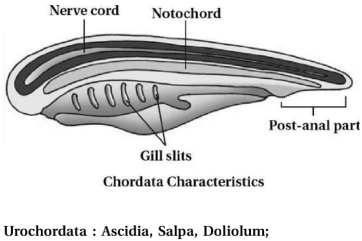
(N/A) $\rightarrow$ Animals belonging to phylum Chordata are fundamentally characterised by the presence of a notochord, a dorsal hollow nerve cord, and paired pharyngeal gill slits.
$\rightarrow$ These are bilaterally symmetrical, triploblastic, and coelomate animals with an organ-system level of organisation.
$\rightarrow$ They possess a post-anal tail and a closed circulatory system.
$\rightarrow$ Phylum Chordata is divided into three subphyla: Urochordata (or Tunicata), Cephalochordata, and Vertebrata.
$\rightarrow$ Protochordates:
$\rightarrow$ Subphyla Urochordata and Cephalochordata are often referred to as protochordates and are exclusively marine.
$\rightarrow$ In Urochordata, the notochord is present only in the larval tail, while in Cephalochordata, it extends from the head to the tail region and is persistent throughout their life.
$\rightarrow$ Examples of Urochordata: Ascidia, Salpa, Doliolum.
$\rightarrow$ These are bilaterally symmetrical, triploblastic, and coelomate animals with an organ-system level of organisation.
$\rightarrow$ They possess a post-anal tail and a closed circulatory system.
$\rightarrow$ Phylum Chordata is divided into three subphyla: Urochordata (or Tunicata), Cephalochordata, and Vertebrata.
$\rightarrow$ Protochordates:
$\rightarrow$ Subphyla Urochordata and Cephalochordata are often referred to as protochordates and are exclusively marine.
$\rightarrow$ In Urochordata, the notochord is present only in the larval tail, while in Cephalochordata, it extends from the head to the tail region and is persistent throughout their life.
$\rightarrow$ Examples of Urochordata: Ascidia, Salpa, Doliolum.
0 likes
View Solution129
Medium
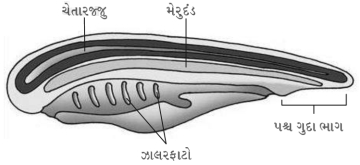
Draw a labeled diagram showing the fundamental characteristics of Phylum Chordata.
Solution
(N/A) The fundamental characteristics of Phylum Chordata include the following four features:
$1$. Notochord: $A$ flexible,rod-like structure providing support.
$2$. Dorsal hollow nerve cord: $A$ nerve cord located dorsally to the notochord.
$3$. Pharyngeal gill slits: Paired openings in the pharyngeal region.
$4$. Post-anal tail: $A$ muscular extension of the body beyond the anal opening.
The provided diagram illustrates these four key diagnostic features of chordates.
$1$. Notochord: $A$ flexible,rod-like structure providing support.
$2$. Dorsal hollow nerve cord: $A$ nerve cord located dorsally to the notochord.
$3$. Pharyngeal gill slits: Paired openings in the pharyngeal region.
$4$. Post-anal tail: $A$ muscular extension of the body beyond the anal opening.
The provided diagram illustrates these four key diagnostic features of chordates.
0 likes
View Solution130
Easy
Differentiate between Non-Chordata and Chordata.
Solution
(N/A)
| Non-Chordata | Chordata |
|---|---|
| $(1)$ Notochord is absent. | $(1)$ Notochord is present. |
| $(2)$ Digestive tract is dorsal to the nerve cord. | $(2)$ Digestive tract is ventral to the nerve cord. |
| $(3)$ Pharyngeal gill slits are absent. | $(3)$ Pharyngeal gill slits are present. |
| $(4)$ Blood circulatory system is open,closed,or absent. | $(4)$ Blood circulatory system is always closed. |
| $(5)$ Nervous system is solid,nerve cord is double,ventral,and ganglionated. | $(5)$ Nervous system is hollow,nerve cord is single,dorsal,and without ganglia. |
| $(6)$ Animals are cold-blooded (poikilothermic). | $(6)$ Animals can be cold-blooded or warm-blooded (homeothermic). |
| $(7)$ Post-anal tail is absent. | $(7)$ Post-anal tail is present. |
0 likes
View Solution131
Easy
Name the subphyla of the phylum Chordata.
Solution
(N/A) The phylum $Chordata$ is divided into three subphyla:
$1$. $Urochordata$ (Tunicata): The notochord is present only in the larval tail,e.g.,$Ascidia$.
$2$. $Cephalochordata$: The notochord extends from head to tail region and is persistent throughout their life,e.g.,$Amphioxus$.
$3$. $Vertebrata$: The notochord is replaced by a cartilaginous or bony vertebral column in the adult,e.g.,from $Cyclostomata$ to $Mammalia$.
$1$. $Urochordata$ (Tunicata): The notochord is present only in the larval tail,e.g.,$Ascidia$.
$2$. $Cephalochordata$: The notochord extends from head to tail region and is persistent throughout their life,e.g.,$Amphioxus$.
$3$. $Vertebrata$: The notochord is replaced by a cartilaginous or bony vertebral column in the adult,e.g.,from $Cyclostomata$ to $Mammalia$.
0 likes
View Solution132
Easy
Write the characteristics of animals that possess a notochord throughout their life.
Solution
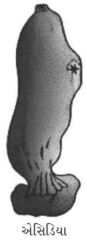
(N/A) Animals that possess a notochord throughout their life are classified under the subphylum Cephalochordata.
Characteristics of Cephalochordata:
- They are exclusively marine animals.
- They are primitive chordates.
- The notochord persists throughout their entire life cycle and extends from the head to the tail region.
- Example: $Branchiostoma$ (also known as Amphioxus or Lancelet).
Note: Urochordata (Tunicata) are also primitive chordates,but in them,the notochord is present only in the larval tail stage and disappears in the adult stage.
Characteristics of Cephalochordata:
- They are exclusively marine animals.
- They are primitive chordates.
- The notochord persists throughout their entire life cycle and extends from the head to the tail region.
- Example: $Branchiostoma$ (also known as Amphioxus or Lancelet).
Note: Urochordata (Tunicata) are also primitive chordates,but in them,the notochord is present only in the larval tail stage and disappears in the adult stage.
0 likes
View Solution133
MediumMCQ
What are the general characteristics of the subphylum Vertebrata?
A
Presence of notochord throughout life.
B
Presence of notochord during the embryonic period,replaced by a cartilaginous or bony vertebral column in adults.
C
Absence of a ventral muscular heart.
D
Absence of paired appendages.
Solution
(B) The subphylum $Vertebrata$ is characterized by the following features:
$1$. Members possess a notochord during the embryonic period.
$2$. The notochord is replaced by a cartilaginous or bony vertebral column in the adult stage.
$3$. All vertebrates are chordates,but all chordates are not vertebrates.
$4$. They possess a ventral muscular heart with two,three,or four chambers.
$5$. They have kidneys for excretion and osmoregulation.
$6$. They possess paired appendages which may be fins or limbs.
$1$. Members possess a notochord during the embryonic period.
$2$. The notochord is replaced by a cartilaginous or bony vertebral column in the adult stage.
$3$. All vertebrates are chordates,but all chordates are not vertebrates.
$4$. They possess a ventral muscular heart with two,three,or four chambers.
$5$. They have kidneys for excretion and osmoregulation.
$6$. They possess paired appendages which may be fins or limbs.
0 likes
View Solution134
Easy
All vertebrates are chordates but all chordates are not vertebrates. Explain.
Solution
(N/A) $\rightarrow$ The members of subphylum $Vertebrata$ possess a notochord during the embryonic period.
$\rightarrow$ The notochord is replaced by a cartilaginous or bony vertebral column in the adult.
$\rightarrow$ Since all vertebrates possess a vertebral column,they are classified as chordates. However,other chordates,such as those in subphyla $Urochordata$ and $Cephalochordata$,possess a notochord but lack a vertebral column. Thus,all vertebrates are chordates,but all chordates are not vertebrates.
$\rightarrow$ The notochord is replaced by a cartilaginous or bony vertebral column in the adult.
$\rightarrow$ Since all vertebrates possess a vertebral column,they are classified as chordates. However,other chordates,such as those in subphyla $Urochordata$ and $Cephalochordata$,possess a notochord but lack a vertebral column. Thus,all vertebrates are chordates,but all chordates are not vertebrates.
0 likes
View Solution135
EasyMCQ
What is the classification of the subphylum $Vertebrata$?
A
Division $Agnatha$ and $Gnathostomata$
B
Class $Pisces$ and $Tetrapoda$
C
Superclass $Pisces$ and $Tetrapoda$
D
Both $A$ and $C$
Solution
(D) The subphylum $Vertebrata$ is divided into two divisions based on the presence or absence of jaws:
$1$. $Agnatha$ (jawless vertebrates): Includes the class $Cyclostomata$.
$2$. $Gnathostomata$ (jawed vertebrates): This division is further divided into two superclasses:
- $Pisces$ (bearing fins): Includes classes $Chondrichthyes$ and $Osteichthyes$.
- $Tetrapoda$ (bearing limbs): Includes classes $Amphibia$,$Reptilia$,$Aves$,and $Mammalia$.
Therefore,the classification involves both the primary division into $Agnatha$ and $Gnathostomata$ and the subsequent division of $Gnathostomata$ into superclasses $Pisces$ and $Tetrapoda$.
$1$. $Agnatha$ (jawless vertebrates): Includes the class $Cyclostomata$.
$2$. $Gnathostomata$ (jawed vertebrates): This division is further divided into two superclasses:
- $Pisces$ (bearing fins): Includes classes $Chondrichthyes$ and $Osteichthyes$.
- $Tetrapoda$ (bearing limbs): Includes classes $Amphibia$,$Reptilia$,$Aves$,and $Mammalia$.
Therefore,the classification involves both the primary division into $Agnatha$ and $Gnathostomata$ and the subsequent division of $Gnathostomata$ into superclasses $Pisces$ and $Tetrapoda$.
0 likes
View Solution136
MediumMCQ
Name the following:
$A$ chordate animal having flame cells as excretory structures.
$A$ chordate animal having flame cells as excretory structures.
A
Amphioxus
B
Ascidia
C
Salpa
D
Doliolum
Solution
(A) $Amphioxus$ (also known as $Branchiostoma$ or lancelet) is a primitive chordate belonging to the subphylum $Cephalochordata$.
It possesses specialized excretory structures known as flame cells (or protonephridia) which are primarily involved in excretion and osmoregulation.
While flame cells are characteristic of flatworms $(Platyhelminthes)$,they are also found in the larvae of certain chordates like $Amphioxus$.
It possesses specialized excretory structures known as flame cells (or protonephridia) which are primarily involved in excretion and osmoregulation.
While flame cells are characteristic of flatworms $(Platyhelminthes)$,they are also found in the larvae of certain chordates like $Amphioxus$.
0 likes
View Solution137
Medium
Provide definitions/explanations for the following terms:
$(i)$ Cephalochordata
$(ii)$ Pseudocoelomates
$(i)$ Cephalochordata
$(ii)$ Pseudocoelomates
Solution
(N/A) $(i)$ Cephalochordata: These are chordates in which the notochord extends from head to tail region and is persistent throughout their life. Examples include $Branchiostoma$ (Amphioxus or Lancelet).
$(ii)$ Pseudocoelomates: These are animals in which the body cavity is not lined by mesoderm; instead,the mesoderm is present as scattered pouches in between the ectoderm and endoderm. Such a body cavity is called a pseudocoel,and the animals possessing them are called pseudocoelomates. Example: $Aschelminthes$ (Roundworms).
$(ii)$ Pseudocoelomates: These are animals in which the body cavity is not lined by mesoderm; instead,the mesoderm is present as scattered pouches in between the ectoderm and endoderm. Such a body cavity is called a pseudocoel,and the animals possessing them are called pseudocoelomates. Example: $Aschelminthes$ (Roundworms).
0 likes
View Solution138
Medium
Differentiate between: Direct development and indirect development.
Solution
(N/A)
| Direct development | Indirect development |
|---|---|
| $(1)$ In this type of development,there are no larval,nymphal,or other intermediate stages in the life cycle between the egg (or birth) and the adult. | $(1)$ In this type of development,the organism passes through one or more larval or nymphal stages before reaching the adult form. |
| $(2)$ Example: Mammals,birds,and reptiles. | $(2)$ Example: Echinoderms,many insects (arthropods),and amphibians. |
0 likes
View Solution139
Easy
There has been an increase in the number of chambers in the heart during the evolution of vertebrates. Name the classes of vertebrates that have two,three,and four-chambered hearts.
Solution
(N/A) Two-chambered heart: Present in fishes. It consists of one atrium and one ventricle,where oxygenated and deoxygenated blood mix.
$(b)$ Three-chambered heart: Present in amphibians. The atrium is divided into right and left halves,but the ventricle is undivided,leading to the mixing of blood.
$(c)$ Incomplete four-chambered heart: Present in most reptiles (except crocodiles). The ventricle is partially divided by an incomplete septum.
$(d)$ Four-chambered heart: Present in birds,mammals,and crocodiles. Both atria and ventricles are completely divided,preventing the mixing of oxygenated and deoxygenated blood.
$(b)$ Three-chambered heart: Present in amphibians. The atrium is divided into right and left halves,but the ventricle is undivided,leading to the mixing of blood.
$(c)$ Incomplete four-chambered heart: Present in most reptiles (except crocodiles). The ventricle is partially divided by an incomplete septum.
$(d)$ Four-chambered heart: Present in birds,mammals,and crocodiles. Both atria and ventricles are completely divided,preventing the mixing of oxygenated and deoxygenated blood.
0 likes
View Solution140
Medium
Differentiate between: Notochord and Nerve cord.
Solution
(N/A)
| Notochord | Nerve cord |
|---|---|
| $(1)$ It is a mesodermally derived rod-like structure formed on the dorsal side during embryonic development in some animals. | $(1)$ It is an ectodermally derived structure,present on the dorsal or ventral side in all animals. |
| $(2)$ It may exist throughout life,only during embryonic stages,or may be replaced by the vertebral column. | $(2)$ It remains present throughout the life of the animal. |
0 likes
View Solution141
Easy
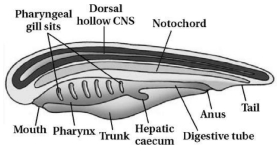
Give three major differences between chordates and non-chordates and draw a schematic sketch of a chordate showing those features.
Solution
(N/A)
The schematic sketch of a chordate showing these features is provided in the reference image.
| Chordates | Non-chordates |
|---|---|
| $(1)$ Notochord is present in at least one stage of the life cycle. | $(1)$ Notochord is absent. |
| $(2)$ Pharyngeal gill slits are present. | $(2)$ Pharyngeal gill slits are absent. |
| $(3)$ Post-anal tail is present. | $(3)$ Post-anal tail is absent. |
| $(4)$ Heart is ventrally located. | $(4)$ Heart is dorsally located (if present). |
| $(5)$ Central nervous system is dorsally located and is hollow. | $(5)$ Central nervous system is ventrally located and is solid. |
The schematic sketch of a chordate showing these features is provided in the reference image.
0 likes
View Solution142
Easy
Give three major differences between chordates and non-chordates and draw a schematic sketch of a chordate showing those features.
Solution
(N/A) The three major differences between chordates and non-chordates are as follows:
$1$. Notochord: Chordates possess a notochord at some stage of their life cycle,whereas non-chordates lack a notochord.
$2$. Central Nervous System: In chordates,the central nervous system is dorsal,hollow,and single. In non-chordates,it is ventral,solid,and double.
$3$. Pharyngeal Gill Slits: Chordates exhibit pharyngeal gill slits at some stage of development,which are absent in non-chordates.
Schematic sketch description: $A$ chordate body plan includes a dorsal hollow nerve cord,a notochord located below the nerve cord,a post-anal tail,and pharyngeal gill slits in the pharyngeal region.
$1$. Notochord: Chordates possess a notochord at some stage of their life cycle,whereas non-chordates lack a notochord.
$2$. Central Nervous System: In chordates,the central nervous system is dorsal,hollow,and single. In non-chordates,it is ventral,solid,and double.
$3$. Pharyngeal Gill Slits: Chordates exhibit pharyngeal gill slits at some stage of development,which are absent in non-chordates.
Schematic sketch description: $A$ chordate body plan includes a dorsal hollow nerve cord,a notochord located below the nerve cord,a post-anal tail,and pharyngeal gill slits in the pharyngeal region.
0 likes
View Solution143
MediumMCQ
Which of the following statements are true for the phylum $Chordata$?
$(a)$ In $Urochordata$,the notochord extends from head to tail and is present throughout their life.
$(b)$ In $Vertebrata$,the notochord is present during the embryonic period only.
$(c)$ The central nervous system is dorsal and hollow.
$(d)$ $Chordata$ is divided into $3$ subphyla: $Hemichordata$,$Tunicata$,and $Cephalochordata$.
$(a)$ In $Urochordata$,the notochord extends from head to tail and is present throughout their life.
$(b)$ In $Vertebrata$,the notochord is present during the embryonic period only.
$(c)$ The central nervous system is dorsal and hollow.
$(d)$ $Chordata$ is divided into $3$ subphyla: $Hemichordata$,$Tunicata$,and $Cephalochordata$.
A
$(b)$ and $(c)$
B
$(d)$ and $(c)$
C
$(c)$ and $(a)$
D
$(a)$ and $(b)$
Solution
(A) Statement $(a)$ is incorrect because in $Urochordata$ (Tunicata),the notochord is present only in the larval tail.
Statement $(b)$ is correct because in $Vertebrata$,the notochord is replaced by a cartilaginous or bony vertebral column in the adult.
Statement $(c)$ is correct as a dorsal,hollow central nervous system is a fundamental characteristic of chordates.
Statement $(d)$ is incorrect because $Chordata$ is divided into $3$ subphyla: $Urochordata$ (or $Tunicata$),$Cephalochordata$,and $Vertebrata$. $Hemichordata$ is a separate phylum.
Therefore,statements $(b)$ and $(c)$ are true.
Statement $(b)$ is correct because in $Vertebrata$,the notochord is replaced by a cartilaginous or bony vertebral column in the adult.
Statement $(c)$ is correct as a dorsal,hollow central nervous system is a fundamental characteristic of chordates.
Statement $(d)$ is incorrect because $Chordata$ is divided into $3$ subphyla: $Urochordata$ (or $Tunicata$),$Cephalochordata$,and $Vertebrata$. $Hemichordata$ is a separate phylum.
Therefore,statements $(b)$ and $(c)$ are true.
0 likes
View Solution144
MediumMCQ
Which of the following statements is/are correct for the phylum Chordata?
$(a)$ In Cephalochordata,the notochord extends from head to tail region and is persistent throughout their life.
$(b)$ In Vertebrata,the notochord is present only during the embryonic period.
$(c)$ The central nervous system is dorsal and hollow.
$(d)$ Chordata is divided into $3$ subphyla: Hemichordata,Urochordata,and Cephalochordata.
$(a)$ In Cephalochordata,the notochord extends from head to tail region and is persistent throughout their life.
$(b)$ In Vertebrata,the notochord is present only during the embryonic period.
$(c)$ The central nervous system is dorsal and hollow.
$(d)$ Chordata is divided into $3$ subphyla: Hemichordata,Urochordata,and Cephalochordata.
A
$(d)$ and $(c)$
B
$(c)$ and $(a)$
C
$(a)$ and $(b)$
D
$(b)$ and $(c)$
Solution
(D) The phylum Chordata is characterized by the presence of a notochord,a dorsal hollow nerve cord,and paired pharyngeal gill slits.
Statement $(a)$ is correct: In Cephalochordata,the notochord extends from head to tail region and is persistent throughout their life.
Statement $(b)$ is correct: In Vertebrata,the notochord is present during the embryonic period and is replaced by a cartilaginous or bony vertebral column in the adult.
Statement $(c)$ is correct: Chordates possess a dorsal,hollow,and single central nervous system.
Statement $(d)$ is incorrect: The phylum Chordata is divided into three subphyla: Urochordata (or Tunicata),Cephalochordata,and Vertebrata. Hemichordata is a separate phylum.
Therefore,statements $(a)$,$(b)$,and $(c)$ are correct. Given the options,$(b)$ and $(c)$ are correct.
Statement $(a)$ is correct: In Cephalochordata,the notochord extends from head to tail region and is persistent throughout their life.
Statement $(b)$ is correct: In Vertebrata,the notochord is present during the embryonic period and is replaced by a cartilaginous or bony vertebral column in the adult.
Statement $(c)$ is correct: Chordates possess a dorsal,hollow,and single central nervous system.
Statement $(d)$ is incorrect: The phylum Chordata is divided into three subphyla: Urochordata (or Tunicata),Cephalochordata,and Vertebrata. Hemichordata is a separate phylum.
Therefore,statements $(a)$,$(b)$,and $(c)$ are correct. Given the options,$(b)$ and $(c)$ are correct.
0 likes
View Solution145
MediumMCQ
All vertebrates are chordates but all chordates are not vertebrates,why?
A
All chordates possess notochord throughout their life.
B
Notochord is replaced by vertebral column in adult of some chordates.
C
Ventral hollow nerve cord remains throughout life in some chordates.
D
All chordates possess vertebral column.
Solution
(B) The correct answer is option $B$ because the members of subphylum $Vertebrata$ possess a notochord during the embryonic period.
Since all vertebrates possess a notochord at some stage of their life,they are classified as chordates.
However,in adult vertebrates,the notochord is replaced by a cartilaginous or bony vertebral column.
In protochordates (urochordates and cephalochordates),a vertebral column is never formed. In urochordates,the notochord is present only in the larval tail,while in cephalochordates,it extends from head to tail region and persists throughout their life.
Therefore,because not all chordates develop a vertebral column,all chordates are not vertebrates.
Since all vertebrates possess a notochord at some stage of their life,they are classified as chordates.
However,in adult vertebrates,the notochord is replaced by a cartilaginous or bony vertebral column.
In protochordates (urochordates and cephalochordates),a vertebral column is never formed. In urochordates,the notochord is present only in the larval tail,while in cephalochordates,it extends from head to tail region and persists throughout their life.
Therefore,because not all chordates develop a vertebral column,all chordates are not vertebrates.
0 likes
View Solution146
MediumMCQ
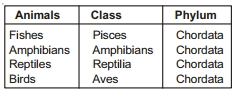
Fishes,amphibians,reptiles,and birds are kept in the same
A
Order
B
Class
C
Genus
D
Phylum
Solution
(D) The classification of the mentioned animals is as follows:
As shown in the table,while these animals belong to different classes (Pisces,Amphibia,Reptilia,and Aves),they all share the same phylum,which is $Chordata$. Therefore,they are kept in the same phylum.
| Animals | Class | Phylum |
|---|---|---|
| Fishes | Pisces | Chordata |
| Amphibians | Amphibia | Chordata |
| Reptiles | Reptilia | Chordata |
| Birds | Aves | Chordata |
As shown in the table,while these animals belong to different classes (Pisces,Amphibia,Reptilia,and Aves),they all share the same phylum,which is $Chordata$. Therefore,they are kept in the same phylum.
0 likes
View Solution147
MediumMCQ
All chordates have the following characteristics:
A
Bilaterally symmetrical,presence of coelom,triploblastic,closed or open circulatory system
B
Bilaterally symmetrical,presence of coelom,diploblastic or triploblastic
C
Open circulatory system,diploblastic or triploblastic,coelom and bilaterally symmetrical
D
Bilaterally symmetrical,coelom present,triploblastic with closed circulatory system
Solution
(D) All chordates share the following fundamental characteristics: they are bilaterally symmetrical,coelomates,triploblastic,and possess a closed circulatory system. They also exhibit an organ-system level of body organization.
0 likes
View Solution148
MediumMCQ
Which of the following groups of animals have a closed circulatory system?
A
Cockroach,locust,molluscs
B
Non-cephalopod molluscs,cockroach
C
Cephalopod molluscs and earthworm
D
Hemichordates and non-cephalopod molluscs
Solution
(C) In a closed circulatory system,blood circulates through a series of blood vessels of varying diameters,$i.e.$,arteries,veins,and capillaries,without coming into direct contact with body cells.
Closed circulatory systems are characteristic of Annelids,cephalopod molluscs,and chordates.
Earthworms belong to the phylum $Annelida$,which possesses a closed circulatory system.
Cephalopod molluscs (such as squids and octopuses) are unique among molluscs for having a closed circulatory system.
Closed circulatory systems are characteristic of Annelids,cephalopod molluscs,and chordates.
Earthworms belong to the phylum $Annelida$,which possesses a closed circulatory system.
Cephalopod molluscs (such as squids and octopuses) are unique among molluscs for having a closed circulatory system.
0 likes
View Solution149
MediumMCQ
Which of the following cannot be considered a characteristic of non-chordates?
A
Absence of notochord
B
Heart is ventral
C
Gill slits are absent
D
Chitinous exoskeleton present
Solution
(B) . Absence of notochord: This is a characteristic feature of non-chordates.
$B$. Heart is ventral: This is incorrect because in non-chordates, the heart (if present) is dorsal in position, whereas it is ventral in chordates.
$C$. Gill slits are absent: This is a characteristic feature of non-chordates.
$D$. Chitinous exoskeleton present: This is found in many non-chordates like arthropods.
Therefore, the statement "Heart is ventral" is not a characteristic of non-chordates.
$B$. Heart is ventral: This is incorrect because in non-chordates, the heart (if present) is dorsal in position, whereas it is ventral in chordates.
$C$. Gill slits are absent: This is a characteristic feature of non-chordates.
$D$. Chitinous exoskeleton present: This is found in many non-chordates like arthropods.
Therefore, the statement "Heart is ventral" is not a characteristic of non-chordates.
0 likes
View SolutionAnimal Kingdom — Phylum-Chordata · Frequently Asked Questions
1Are these Animal Kingdom questions useful for JEE and NEET?
Yes. All questions in this section are mapped to JEE Main and NEET exam patterns. Previous year questions from JEE Main, NEET, GUJCET and state-level exams are included with full solutions.
2Can I switch to Hindi or Gujarati for these questions?
Yes. Use the language tabs in the hero section or the sidebar to view the same questions and solutions in English, Hindi or Gujarati.
3How do I generate a question paper from this subtopic?
Use the Vedclass Exam Paper Generator — select the chapter and subtopic, set difficulty, and generate Sets A, B, C, D automatically. First 3 chapters of every subject are free.
Vedclass Products
For Students
Vedclass Test Series
Mock tests in real JEE/NEET style with performance analysis. 5-day free trial.
Start Free TrialFor Teachers
Exam Paper Generator
Generate Set A/B/C/D papers from this chapter in 2 minutes. 3 chapters free.
Try FreeFor Institutes
Online Exam Module
Live online exams with unlimited students, 360° analytics & white-label branding.
See DemoFor Teachers & Institutes
Generate a Animal Kingdom Exam Paper in 2 Minutes
Select subtopic & difficulty — Sets A, B, C, D auto-generated with No Repeat logic.
First 3 chapters of every subject are free — no payment required.