
A English
Secondary growth Questions in English
Class 11 Biology · Anatomy of Flowering Plants · Secondary growth
396+
Questions
English
Language
100%
With Solutions
Showing 49 of 396 questions in English
201
MediumMCQ
How many types of cells are present in the vascular cambium?
A
Two types,ray initials and fusiform initials
B
Only fusiform initials
C
Only ray initials
D
Three types,fusiform,ray,and pith ray initials
Solution
(A) The vascular cambium in dicot stems is composed of two types of meristematic cells:
$1$. Fusiform initials: These are elongated cells that give rise to the axial system (xylem and phloem tracheids,vessels,fibers,and parenchyma).
$2$. Ray initials: These are smaller,isodiametric cells that give rise to the radial system (vascular rays).
$1$. Fusiform initials: These are elongated cells that give rise to the axial system (xylem and phloem tracheids,vessels,fibers,and parenchyma).
$2$. Ray initials: These are smaller,isodiametric cells that give rise to the radial system (vascular rays).
0 likes
View Solution202
MediumMCQ
Coastal trees do not show annual rings because:
A
There is little climatic variation.
B
They are associated with monocotyledonous plants.
C
There is sufficient moisture.
D
The soil is sandy.
Solution
(A) Annual rings are formed due to the differential activity of the vascular cambium,which is influenced by seasonal climatic variations. In temperate regions,the cambium is more active in spring (forming early wood) and less active in autumn/winter (forming late wood),resulting in distinct annual rings. Coastal or tropical regions experience a relatively uniform climate throughout the year,meaning the cambium remains active consistently. Consequently,no distinct annual rings are formed in these trees.
0 likes
View Solution203
MediumMCQ
The vascular cambium normally gives rise to
A
primary phloem
B
secondary xylem
C
periderm
D
phelloderm
Solution
(B) The vascular cambium is a lateral meristem that undergoes periclinal divisions.
These divisions occur on both the inner and outer sides of the cambium ring.
The cells produced towards the inner side differentiate into secondary xylem,while the cells produced towards the outer side differentiate into secondary phloem.
Therefore,the vascular cambium gives rise to secondary xylem and secondary phloem.
These divisions occur on both the inner and outer sides of the cambium ring.
The cells produced towards the inner side differentiate into secondary xylem,while the cells produced towards the outer side differentiate into secondary phloem.
Therefore,the vascular cambium gives rise to secondary xylem and secondary phloem.
0 likes
View Solution204
MediumMCQ
Identify the wrong statement in the context of heartwood.
A
It is highly durable.
B
It conducts water and minerals efficiently.
C
It comprises dead elements with highly lignified walls.
D
Organic compounds are deposited in it.
Solution
(B) : Heartwood is the non-functional part of secondary xylem. It consists of dead elements with highly lignified walls and is filled with organic compounds like tannins,resins,oils,and gums,which make it highly durable and resistant to microbial attack. Because its vessels are blocked by these deposits,it does not conduct water and minerals.
0 likes
View Solution205
MediumMCQ
The balloon-shaped structures called $tyloses$:
A
originate in the lumen of vessels.
B
characterise the sapwood.
C
are extensions of $xylem$ $parenchyma$ cells into vessels.
D
are linked to the ascent of sap through $xylem$ vessels.
Solution
(C) : $Tyloses$ are balloon-like extensions of $parenchyma$ cells that protrude into the lumen of a neighbouring $xylem$ vessel or $tracheid$ through a pit in the cell wall.
$Tyloses$ form most commonly in older woody tissue,possibly in response to injury; they may eventually block the vessels and thus help prevent the spread of fungi and other pathogens within the plant.
$Tyloses$ may become filled with tannins,gums,pigments,etc.,giving $heartwood$ its dark colour,and their walls can remain thin or become lignified.
$Tyloses$ form most commonly in older woody tissue,possibly in response to injury; they may eventually block the vessels and thus help prevent the spread of fungi and other pathogens within the plant.
$Tyloses$ may become filled with tannins,gums,pigments,etc.,giving $heartwood$ its dark colour,and their walls can remain thin or become lignified.
0 likes
View Solution206
MediumMCQ
Read the different components from $(i)$ to $(iv)$ in the list given below and tell the correct order of the components with reference to their arrangement from outer side to inner side in a woody dicot stem.
$(i)$ Secondary cortex $(ii)$ Wood $(iii)$ Secondary phloem $(iv)$ Phellem
The correct order is:
$(i)$ Secondary cortex $(ii)$ Wood $(iii)$ Secondary phloem $(iv)$ Phellem
The correct order is:
A
$(iv), (i), (iii), (ii)$
B
$(iv), (iii), (i), (ii)$
C
$(iii), (iv), (ii), (i)$
D
$(i), (ii), (iv), (iii)$
Solution
(A) In a woody dicot stem,the arrangement of tissues from the periphery (outer side) to the center (inner side) is as follows:
$1$. Phellem (cork): This is the outermost layer of the periderm.
$2$. Secondary cortex (phelloderm): This lies just inside the phellem and phellogen.
$3$. Secondary phloem: This is located outside the vascular cambium.
$4$. Wood (Secondary xylem): This is located inside the vascular cambium.
Therefore,the correct sequence from outer to inner side is: $(iv)$ Phellem $\rightarrow$ $(i)$ Secondary cortex $\rightarrow$ $(iii)$ Secondary phloem $\rightarrow$ $(ii)$ Wood (Secondary xylem).
Thus,the correct option is $(A)$.
$1$. Phellem (cork): This is the outermost layer of the periderm.
$2$. Secondary cortex (phelloderm): This lies just inside the phellem and phellogen.
$3$. Secondary phloem: This is located outside the vascular cambium.
$4$. Wood (Secondary xylem): This is located inside the vascular cambium.
Therefore,the correct sequence from outer to inner side is: $(iv)$ Phellem $\rightarrow$ $(i)$ Secondary cortex $\rightarrow$ $(iii)$ Secondary phloem $\rightarrow$ $(ii)$ Wood (Secondary xylem).
Thus,the correct option is $(A)$.
0 likes
View Solution207
MediumMCQ
Lenticels are involved in
A
food transport
B
photosynthesis
C
transpiration
D
gaseous exchange
Solution
(D) : Lenticels are lens-shaped openings formed in the bark due to secondary growth.
They permit gaseous exchange in woody trees.
They also contribute to transpiration,but in minute amounts because the suberised complementary cells present beneath the pore prevent excessive water loss.
They permit gaseous exchange in woody trees.
They also contribute to transpiration,but in minute amounts because the suberised complementary cells present beneath the pore prevent excessive water loss.
0 likes
View Solution208
EasyMCQ
Age of a tree can be estimated by
A
number of annual rings
B
diameter of its heartwood
C
its height and girth
D
biomass
Solution
(A) : Two bands of secondary xylem,$i.e.$,autumn wood and spring wood,are produced in one year.
These two bands together form an annual ring.
The age of a tree can be determined by counting these annual rings.
This method of determining the age of a tree is known as $Dendrochronology$.
These two bands together form an annual ring.
The age of a tree can be determined by counting these annual rings.
This method of determining the age of a tree is known as $Dendrochronology$.
0 likes
View Solution209
MediumMCQ
Interfascicular cambium develops from the cells of
A
endodermis
B
pericycle
C
medullary rays
D
xylem parenchyma
Solution
(C) : In dicot stems,the cells of cambium present between primary xylem and primary phloem is the intrafascicular cambium.
The cells of medullary rays,adjoining these intrafascicular cambium,become meristematic and form the interfascicular cambium.
Thus,a continuous ring of cambium is formed.
The cells of medullary rays,adjoining these intrafascicular cambium,become meristematic and form the interfascicular cambium.
Thus,a continuous ring of cambium is formed.
0 likes
View Solution210
EasyMCQ
The common bottle cork is a product of
A
dermatogen
B
phellogen
C
xylem
D
vascular cambium
Solution
(B) : Cork cambium or phellogen is a type of cambium arising within the outer layer of the stems of woody plants,usually as a complete ring surrounding the inner tissues.
The cells of the cork cambium divide to produce an outer corky tissue ($cork$ or $phellem$) and an inner secondary cortex $(phelloderm)$.
The common bottle cork produced from $Quercus$ $suber$ is a product of phellogen.
The cells of the cork cambium divide to produce an outer corky tissue ($cork$ or $phellem$) and an inner secondary cortex $(phelloderm)$.
The common bottle cork produced from $Quercus$ $suber$ is a product of phellogen.
0 likes
View Solution211
EasyMCQ
The cork cambium, cork and secondary cortex are collectively called:
A
phelloderm
B
phellogen
C
periderm
D
phellem
Solution
(C) The cork cambium $(phellogen)$, cork $(phellem)$, and secondary cortex $(phelloderm)$ are collectively known as the $periderm$.
$1$. $Phellogen$ (cork cambium) is a meristematic layer that develops in the cortex.
$2$. $Phellem$ (cork) is produced on the outer side of the $phellogen$.
$3$. $Phelloderm$ (secondary cortex) is produced on the inner side of the $phellogen$.
These three layers together form the $periderm$, which serves a protective function as the epidermis ruptures during secondary growth.
$1$. $Phellogen$ (cork cambium) is a meristematic layer that develops in the cortex.
$2$. $Phellem$ (cork) is produced on the outer side of the $phellogen$.
$3$. $Phelloderm$ (secondary cortex) is produced on the inner side of the $phellogen$.
These three layers together form the $periderm$, which serves a protective function as the epidermis ruptures during secondary growth.
0 likes
View Solution212
MediumMCQ
Heartwood differs from sapwood in
A
presence of rays and fibres
B
absence of vessels and parenchyma
C
having dead and non-conducting elements
D
being susceptible to pests and pathogens
Solution
(C) : In old trees,the greater part of secondary xylem is dark brown due to the deposition of organic compounds like tannins,resins,oils,gums,aromatic substances,and essential oils in the central or innermost layers of the stem.
These substances make it hard,durable,and resistant to the attacks of microorganisms and insects.
This region comprises dead elements with highly lignified walls and is called heartwood.
The heartwood does not conduct water,but it gives mechanical support to the stem.
The peripheral region of the secondary xylem is lighter in color and is known as the sapwood.
It is involved in the conduction of water and minerals from root to leaf.
These substances make it hard,durable,and resistant to the attacks of microorganisms and insects.
This region comprises dead elements with highly lignified walls and is called heartwood.
The heartwood does not conduct water,but it gives mechanical support to the stem.
The peripheral region of the secondary xylem is lighter in color and is known as the sapwood.
It is involved in the conduction of water and minerals from root to leaf.
0 likes
View Solution213
MediumMCQ
For a critical study of secondary growth in plants,which one of the following pairs is suitable?
A
Teak and pine
B
Deodar and fern
C
Wheat and maiden hair fern
D
Sugarcane and sunflower
Solution
(A) Secondary growth is observed in dicots and gymnosperms. It is not observed in pteridophytes and is rarely observed in monocots.
Secondary growth results in an increase in the girth or diameter of the stem due to the formation of secondary tissues by the activity of lateral meristems (vascular cambium and cork cambium).
Teak is a dicotyledonous angiosperm,and pine is a gymnosperm; both exhibit significant secondary growth.
Therefore,for the study of secondary growth,teak and pine are the best-suited pair.
Secondary growth results in an increase in the girth or diameter of the stem due to the formation of secondary tissues by the activity of lateral meristems (vascular cambium and cork cambium).
Teak is a dicotyledonous angiosperm,and pine is a gymnosperm; both exhibit significant secondary growth.
Therefore,for the study of secondary growth,teak and pine are the best-suited pair.
0 likes
View Solution214
MediumMCQ
During the formation of interfascicular cambium,which cells lose the capacity to divide but mature to perform specific function?
A
Parenchyma
B
Sclerenchyma
C
Collenchyma
D
Phloem
Solution
(A) The interfascicular cambium is formed by the dedifferentiation of permanent parenchyma cells located between the vascular bundles.
These cells regain the capacity to divide to form the cambium ring.
However,in the context of plant development,cells that lose the capacity to divide and mature to perform specific functions are generally classified as parenchyma,collenchyma,or sclerenchyma.
Specifically,during the formation of the vascular cambium,the medullary ray cells (which are parenchyma cells) undergo dedifferentiation to become meristematic.
If the question refers to cells that differentiate into permanent tissue,parenchyma cells are the ones that mature to perform functions like storage or photosynthesis.
These cells regain the capacity to divide to form the cambium ring.
However,in the context of plant development,cells that lose the capacity to divide and mature to perform specific functions are generally classified as parenchyma,collenchyma,or sclerenchyma.
Specifically,during the formation of the vascular cambium,the medullary ray cells (which are parenchyma cells) undergo dedifferentiation to become meristematic.
If the question refers to cells that differentiate into permanent tissue,parenchyma cells are the ones that mature to perform functions like storage or photosynthesis.
0 likes
View Solution215
MediumMCQ
What is correct for heartwood?
A
Carries water
B
Provides mechanical strength
C
Have live components
D
None of them
Solution
(B) Heartwood,also known as duramen,is the central,non-functional part of the secondary xylem in older trees.
It consists of dead elements with highly lignified walls,which makes it hard and durable.
It does not conduct water or minerals because its vessels are blocked by tyloses.
Its primary function is to provide mechanical support to the stem.
Therefore,the statement 'Provides mechanical strength' is correct.
It consists of dead elements with highly lignified walls,which makes it hard and durable.
It does not conduct water or minerals because its vessels are blocked by tyloses.
Its primary function is to provide mechanical support to the stem.
Therefore,the statement 'Provides mechanical strength' is correct.
0 likes
View Solution216
DifficultMCQ
Choose the incorrect sentence:
A
Phellogen,phellem,and phelloderm are collectively known as periderm.
B
Secondary growth occurs in the stems and roots of gymnosperms; however,secondary growth does not occur in monocotyledons.
C
Phellogen is made of narrow,thin-walled,and nearly rectangular cells.
D
Annual rings seen in a cut stem indicate the capacity for water absorption.
Solution
(D) The correct answer is $D$.
$1$. Phellogen (cork cambium),phellem (cork),and phelloderm (secondary cortex) are collectively known as periderm. This statement is correct.
$2$. Secondary growth is a characteristic feature of dicotyledons and gymnosperms. It is generally absent in monocotyledons. This statement is correct.
$3$. Phellogen is composed of narrow,thin-walled,and nearly rectangular cells. This statement is correct.
$4$. Annual rings (growth rings) seen in a cut stem indicate the age of the tree and the seasonal variations in growth,not the capacity for water absorption. Therefore,this statement is incorrect.
$1$. Phellogen (cork cambium),phellem (cork),and phelloderm (secondary cortex) are collectively known as periderm. This statement is correct.
$2$. Secondary growth is a characteristic feature of dicotyledons and gymnosperms. It is generally absent in monocotyledons. This statement is correct.
$3$. Phellogen is composed of narrow,thin-walled,and nearly rectangular cells. This statement is correct.
$4$. Annual rings (growth rings) seen in a cut stem indicate the age of the tree and the seasonal variations in growth,not the capacity for water absorption. Therefore,this statement is incorrect.
0 likes
View Solution217
MediumMCQ
In monocotyledons,secondary phloem and xylem are not formed. Why?
A
Their vascular bundles do not possess cambium.
B
Vascular bundles have cambium.
C
Xylem and phloem are absent in them.
D
Cortex is absent in monocots.
Solution
(A) In plants,secondary growth (formation of secondary xylem and secondary phloem) is facilitated by the activity of the vascular cambium.
In monocotyledons,the vascular bundles are closed,meaning they lack the cambium layer between the xylem and phloem.
Because the cambium is absent,these plants cannot produce secondary tissues.
Therefore,the correct reason is that their vascular bundles do not possess cambium.
In monocotyledons,the vascular bundles are closed,meaning they lack the cambium layer between the xylem and phloem.
Because the cambium is absent,these plants cannot produce secondary tissues.
Therefore,the correct reason is that their vascular bundles do not possess cambium.
0 likes
View Solution218
MediumMCQ
Initiation of lateral roots and vascular cambium during the secondary growth takes place in these cells.
A
Pericycle
B
Epidermis
C
Cortex
D
Endodermis
Solution
(A) In dicot roots,the cells of the $Pericycle$ are parenchymatous and retain the ability to divide.
During the formation of lateral roots,the cells of the $Pericycle$ undergo division to form the root primordia.
Additionally,during secondary growth,the $Pericycle$ cells located opposite to the protoxylem divide to contribute to the formation of the vascular cambium ring.
During the formation of lateral roots,the cells of the $Pericycle$ undergo division to form the root primordia.
Additionally,during secondary growth,the $Pericycle$ cells located opposite to the protoxylem divide to contribute to the formation of the vascular cambium ring.
0 likes
View Solution219
MediumMCQ
In cambium,the amount of secondary xylem produced is more than secondary phloem because..........
A
The cambium is generally more active in the inner side.
B
The cambium is generally more active in the outer side.
C
The cambium is generally less active in the inner side.
D
Activity of cambium is similar in both outer and inner side.
Solution
(A) During secondary growth in dicot stems,the vascular cambium becomes active and starts dividing.
It cuts off cells towards the inner side and the outer side.
The cells cut off towards the inner side mature into secondary xylem,while the cells cut off towards the outer side mature into secondary phloem.
The cambium is generally much more active on the inner side than on the outer side.
As a result,the amount of secondary xylem produced is significantly greater than that of secondary phloem,leading to the formation of wood.
It cuts off cells towards the inner side and the outer side.
The cells cut off towards the inner side mature into secondary xylem,while the cells cut off towards the outer side mature into secondary phloem.
The cambium is generally much more active on the inner side than on the outer side.
As a result,the amount of secondary xylem produced is significantly greater than that of secondary phloem,leading to the formation of wood.
0 likes
View Solution220
MediumMCQ
Vascular cambium is responsible for cutting off..
A
Pith and cortex
B
Pericycle and endodermis
C
Pith and vascular bundle
D
Xylem and Phloem
Solution
(D) The vascular cambium is a lateral meristematic tissue responsible for secondary growth in plants.
During secondary growth,the cells of the vascular cambium divide periclinally.
The cells cut off towards the inner side differentiate into secondary xylem (wood),while the cells cut off towards the outer side differentiate into secondary phloem.
Therefore,the vascular cambium is responsible for the formation of secondary xylem and secondary phloem.
During secondary growth,the cells of the vascular cambium divide periclinally.
The cells cut off towards the inner side differentiate into secondary xylem (wood),while the cells cut off towards the outer side differentiate into secondary phloem.
Therefore,the vascular cambium is responsible for the formation of secondary xylem and secondary phloem.
0 likes
View Solution221
MediumMCQ
.......... permit the exchange of gases between the outer atmosphere and the internal tissue of the stem.
A
Root hair
B
Lenticel
C
Endodermis
D
Secondary cortex
Solution
(B) Lenticels are small,lens-shaped openings found on the bark of woody stems.
They consist of loosely arranged parenchyma cells called complementary cells.
These structures allow for the exchange of gases between the internal tissues of the stem and the outer atmosphere,which is essential for respiration.
They consist of loosely arranged parenchyma cells called complementary cells.
These structures allow for the exchange of gases between the internal tissues of the stem and the outer atmosphere,which is essential for respiration.
0 likes
View Solution222
MediumMCQ
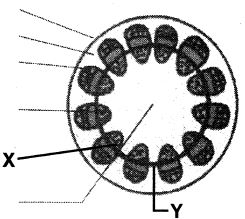
Identify $X$ and $Y$ in the given figure.
A
Primary phloem - Interfascicular cambium
B
Pith - Vascular cambium
C
Interfascicular cambium - primary xylem
D
Primary xylem - Interfascicular cambium
Solution
(D) The figure represents the process of secondary growth in a dicot stem.
In the diagram,$X$ points towards the central region of the stem,which is the pith.
$Y$ points towards the region between the vascular bundles,which is the interfascicular cambium.
During secondary growth,the cells of the medullary rays,which are present between the vascular bundles,become meristematic and form the interfascicular cambium.
Therefore,$X$ is the pith and $Y$ is the interfascicular cambium.
In the diagram,$X$ points towards the central region of the stem,which is the pith.
$Y$ points towards the region between the vascular bundles,which is the interfascicular cambium.
During secondary growth,the cells of the medullary rays,which are present between the vascular bundles,become meristematic and form the interfascicular cambium.
Therefore,$X$ is the pith and $Y$ is the interfascicular cambium.
0 likes
View Solution223
DifficultMCQ
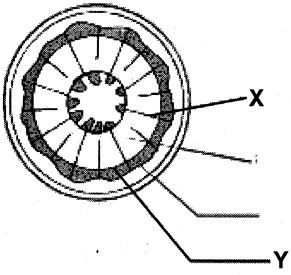
Identify $X$ and $Y$ in the given diagram of secondary growth in a dicot stem.
A
$X$ - Medullary ray,$Y$ - Cambium ring
B
$X$ - Secondary xylem,$Y$ - Cambium ring
C
$X$ - Secondary phloem,$Y$ - Secondary xylem
D
$X$ - Cambium ring,$Y$ - Secondary xylem
Solution
(B) In the process of secondary growth in a dicot stem,the vascular cambium becomes active and begins to cut off new cells both towards the inner and outer sides.
$1$. The cells cut off towards the center (inner side) mature into secondary xylem.
$2$. The cells cut off towards the periphery (outer side) mature into secondary phloem.
$3$. In the provided diagram,$X$ points to the secondary xylem,which forms the bulk of the wood in the center.
$4$. $Y$ points to the cambium ring (vascular cambium),which is the meristematic layer responsible for producing secondary vascular tissues.
$1$. The cells cut off towards the center (inner side) mature into secondary xylem.
$2$. The cells cut off towards the periphery (outer side) mature into secondary phloem.
$3$. In the provided diagram,$X$ points to the secondary xylem,which forms the bulk of the wood in the center.
$4$. $Y$ points to the cambium ring (vascular cambium),which is the meristematic layer responsible for producing secondary vascular tissues.
0 likes
View Solution224
EasyMCQ
The cork cambium,cork,and secondary cortex are collectively called:
A
phelloderm
B
lenticel
C
periderm
D
bark
Solution
(C) The cork cambium (phellogen),cork (phellem),and secondary cortex (phelloderm) are collectively known as the periderm.
These tissues are formed as a result of secondary growth in the dicot stem and root.
The phellogen cuts off cells on both sides; the outer cells differentiate into cork (phellem),while the inner cells differentiate into secondary cortex (phelloderm).
These tissues are formed as a result of secondary growth in the dicot stem and root.
The phellogen cuts off cells on both sides; the outer cells differentiate into cork (phellem),while the inner cells differentiate into secondary cortex (phelloderm).
0 likes
View Solution225
MediumMCQ
Lenticels are involved in:
A
Gaseous exchange
B
Food transport
C
Photosynthesis
D
Transpiration
Solution
(A) Lenticels are lens-shaped openings found in the bark of woody stems and roots.
They consist of loosely arranged parenchyma cells called complementary cells.
Their primary function is to facilitate the exchange of gases between the internal tissues of the plant and the external atmosphere.
While a small amount of water vapor may be lost through them (a process sometimes called lenticular transpiration),their main physiological role is gaseous exchange.
They consist of loosely arranged parenchyma cells called complementary cells.
Their primary function is to facilitate the exchange of gases between the internal tissues of the plant and the external atmosphere.
While a small amount of water vapor may be lost through them (a process sometimes called lenticular transpiration),their main physiological role is gaseous exchange.
0 likes
View Solution226
EasyMCQ
Age of a tree can be estimated by :
A
biomass
B
number of annual rings
C
diameter of its heartwood
D
its height and girth
Solution
(B) The age of a woody tree can be determined by counting the number of annual rings present in the secondary xylem of the trunk.
In temperate regions,the cambium is active during the spring and less active during the autumn,leading to the formation of distinct light-colored spring wood and dark-colored autumn wood.
Together,these two layers form one annual ring,which represents one year of growth.
Therefore,counting these rings provides an accurate estimate of the tree's age,a field of study known as dendrochronology.
In temperate regions,the cambium is active during the spring and less active during the autumn,leading to the formation of distinct light-colored spring wood and dark-colored autumn wood.
Together,these two layers form one annual ring,which represents one year of growth.
Therefore,counting these rings provides an accurate estimate of the tree's age,a field of study known as dendrochronology.
0 likes
View Solution227
MediumMCQ
Interfascicular cambium develops from the cells of:
A
Xylem parenchyma
B
Endodermis
C
Pericycle
D
Medullary rays
Solution
(D) During secondary growth in dicot stems,the cells of the medullary rays that are located between the vascular bundles become meristematic.
These cells form the interfascicular cambium.
This cambium joins with the intrafascicular cambium (present within the vascular bundles) to form a complete,continuous ring of vascular cambium.
These cells form the interfascicular cambium.
This cambium joins with the intrafascicular cambium (present within the vascular bundles) to form a complete,continuous ring of vascular cambium.
0 likes
View Solution228
MediumMCQ
The cork cambium (phellogen) is formed from:
A
Phellogen
B
Vascular cambium
C
Phloem
D
Xylem
Solution
(A) The cork cambium,also known as $phellogen$,is a secondary meristematic tissue.
It is formed by the dedifferentiation of the cortical cells (parenchyma cells) located just below the epidermis during secondary growth in dicot stems and roots.
Therefore,the correct origin of the cork cambium is the cortical cells (part of the ground tissue system).
Among the given options,$Phellogen$ is the tissue itself,but the question asks for the origin. However,in the context of standard multiple-choice questions where the options are limited,$Phellogen$ is often cited as the layer involved in the periderm formation. Given the options provided,$A$ is the most appropriate choice as it refers to the tissue layer responsible for cork production.
It is formed by the dedifferentiation of the cortical cells (parenchyma cells) located just below the epidermis during secondary growth in dicot stems and roots.
Therefore,the correct origin of the cork cambium is the cortical cells (part of the ground tissue system).
Among the given options,$Phellogen$ is the tissue itself,but the question asks for the origin. However,in the context of standard multiple-choice questions where the options are limited,$Phellogen$ is often cited as the layer involved in the periderm formation. Given the options provided,$A$ is the most appropriate choice as it refers to the tissue layer responsible for cork production.
0 likes
View Solution229
MediumMCQ
Which of the following is true regarding diffuse-porous and ring-porous wood?
A
Ring-porous wood conducts more water for a short duration.
B
Diffuse-porous wood conducts more water.
C
Ring-porous wood conducts more water during the time of need.
D
Diffuse-porous wood is less specialized but conducts water faster.
Solution
(C) In $Ring-porous$ wood, the vessels are significantly larger in the early wood compared to the late wood, which allows for a rapid and high volume of water conduction during the early spring when the plant's demand is high.
In $Diffuse-porous$ wood, the vessels are of uniform size throughout the growth ring, providing a steady but generally lower rate of water conduction compared to the peak capacity of $Ring-porous$ wood.
Therefore, $Ring-porous$ wood is considered more specialized for conducting large amounts of water during the period of high demand.
In $Diffuse-porous$ wood, the vessels are of uniform size throughout the growth ring, providing a steady but generally lower rate of water conduction compared to the peak capacity of $Ring-porous$ wood.
Therefore, $Ring-porous$ wood is considered more specialized for conducting large amounts of water during the period of high demand.
0 likes
View Solution230
MediumMCQ
The vascular cambium produces . . . . . . .
A
Primary xylem and primary phloem
B
Secondary xylem and secondary phloem
C
Primary xylem and secondary phloem
D
Secondary xylem and primary phloem
Solution
(B) The vascular cambium is a lateral meristem that is responsible for secondary growth in dicotyledonous plants.
During secondary growth,the cells of the vascular cambium divide periclinally.
The cells produced towards the inner side differentiate into secondary xylem,while the cells produced towards the outer side differentiate into secondary phloem.
Therefore,the vascular cambium produces secondary xylem and secondary phloem.
During secondary growth,the cells of the vascular cambium divide periclinally.
The cells produced towards the inner side differentiate into secondary xylem,while the cells produced towards the outer side differentiate into secondary phloem.
Therefore,the vascular cambium produces secondary xylem and secondary phloem.
0 likes
View Solution231
MediumMCQ
The intrafascicular cambium and interfascicular cambium are .......
A
parts of secondary phloem and xylem.
B
parts of the pericycle.
C
lateral meristems.
D
apical meristems.
Solution
(C) The intrafascicular cambium and interfascicular cambium are responsible for secondary growth in plants.
Together,they form a complete ring known as the 'cambium ring'.
Since these tissues increase the thickness or girth of plant organs,they are classified as 'lateral meristems'.
Together,they form a complete ring known as the 'cambium ring'.
Since these tissues increase the thickness or girth of plant organs,they are classified as 'lateral meristems'.
0 likes
View Solution232
MediumMCQ
Which type of wood is more susceptible to decay?
A
Sapwood
B
Softwood
C
Fibrous wood
D
Heartwood
Solution
(A) . Sapwood (also known as alburnum) is the peripheral,living part of the secondary xylem.
It contains living cells and conducts water and minerals.
Because it is less dense and contains stored food materials like starch and sugars,it is more susceptible to attack by microorganisms,fungi,and insects,making it decay faster than heartwood.
Heartwood is the central,dead part of the secondary xylem,which is impregnated with tannins,resins,and oils,making it highly resistant to decay.
It contains living cells and conducts water and minerals.
Because it is less dense and contains stored food materials like starch and sugars,it is more susceptible to attack by microorganisms,fungi,and insects,making it decay faster than heartwood.
Heartwood is the central,dead part of the secondary xylem,which is impregnated with tannins,resins,and oils,making it highly resistant to decay.
0 likes
View Solution233
EasyMCQ
Periderm is produced from ..........
A
Vascular cambium
B
Fascicular cambium
C
Phellogen
D
Intrafascicular cambium
Solution
(C) The periderm is a collective term for the secondary protective tissues formed in the stem and root of woody plants.
It consists of three layers: the phellogen (cork cambium),the phellem (cork),and the phelloderm (secondary cortex).
The phellogen is a meristematic tissue that gives rise to the periderm by producing phellem towards the outside and phelloderm towards the inside.
Therefore,the periderm originates from the phellogen.
It consists of three layers: the phellogen (cork cambium),the phellem (cork),and the phelloderm (secondary cortex).
The phellogen is a meristematic tissue that gives rise to the periderm by producing phellem towards the outside and phelloderm towards the inside.
Therefore,the periderm originates from the phellogen.
0 likes
View Solution234
MediumMCQ
The narrow layer of thin-walled cells found in dicots (between the phloem and xylem) is known as ..........
A
Phellogen
B
Vascular cambium
C
Endodermis
D
Pericycle
Solution
(B) In dicot stems, the meristematic layer that exists between the primary xylem and primary phloem is called the $Vascular \text{ } cambium$.
This layer is responsible for secondary growth by producing secondary xylem towards the inside and secondary phloem towards the outside.
Therefore, the correct option is $B$.
This layer is responsible for secondary growth by producing secondary xylem towards the inside and secondary phloem towards the outside.
Therefore, the correct option is $B$.
0 likes
View Solution235
MediumMCQ
Anomalous secondary growth is observed in ..........
A
Dracaena
B
Ginger
C
Wheat
D
Sunflower
Solution
(A) Anomalous secondary growth refers to any deviation from the normal pattern of secondary growth observed in dicot stems.
In most monocots,secondary growth is absent. However,some monocots like $Dracaena$,$Yucca$,and $Aloe$ exhibit anomalous secondary growth.
This occurs due to the formation of a secondary cambium in the cortex,which produces vascular bundles and parenchyma,leading to an increase in the girth of the stem.
Therefore,$Dracaena$ is the correct example among the given options.
In most monocots,secondary growth is absent. However,some monocots like $Dracaena$,$Yucca$,and $Aloe$ exhibit anomalous secondary growth.
This occurs due to the formation of a secondary cambium in the cortex,which produces vascular bundles and parenchyma,leading to an increase in the girth of the stem.
Therefore,$Dracaena$ is the correct example among the given options.
0 likes
View Solution236
MediumMCQ
As secondary growth proceeds in a tree,the thickness of which of the following increases?
A
Heartwood
B
Sapwood
C
Both
D
Both remain the same
Solution
(A) As secondary growth proceeds in a tree,the vascular cambium produces secondary xylem towards the inner side.
Over time,the older secondary xylem near the center of the stem becomes non-functional and is filled with tannins,resins,and oils,forming the heartwood.
The peripheral,functional part of the secondary xylem is called sapwood.
As the tree ages,the amount of heartwood increases because more secondary xylem is converted into heartwood,while the sapwood layer remains relatively constant in thickness to maintain water conduction.
Over time,the older secondary xylem near the center of the stem becomes non-functional and is filled with tannins,resins,and oils,forming the heartwood.
The peripheral,functional part of the secondary xylem is called sapwood.
As the tree ages,the amount of heartwood increases because more secondary xylem is converted into heartwood,while the sapwood layer remains relatively constant in thickness to maintain water conduction.
0 likes
View Solution237
MediumMCQ
Which of the following meristems is responsible for the formation of the extra-stelar secondary growth in a dicot stem?
A
Interfascicular cambium
B
Intrafascicular cambium
C
Intercalary meristem
D
Phellogen
Solution
(D) In a dicot stem,secondary growth occurs in two regions: the stelar region and the extra-stelar region.
$1$. The stelar secondary growth is caused by the vascular cambium (formed by intrafascicular and interfascicular cambium).
$2$. The extra-stelar secondary growth (also known as cork formation or periderm formation) is responsible for replacing the epidermis and cortex as the stem increases in girth.
$3$. This process is initiated by the $Phellogen$ (cork cambium),which is a meristematic tissue that develops in the cortex region.
$4$. Therefore,$Phellogen$ is responsible for the extra-stelar secondary growth.
$1$. The stelar secondary growth is caused by the vascular cambium (formed by intrafascicular and interfascicular cambium).
$2$. The extra-stelar secondary growth (also known as cork formation or periderm formation) is responsible for replacing the epidermis and cortex as the stem increases in girth.
$3$. This process is initiated by the $Phellogen$ (cork cambium),which is a meristematic tissue that develops in the cortex region.
$4$. Therefore,$Phellogen$ is responsible for the extra-stelar secondary growth.
0 likes
View Solution238
MediumMCQ
Which of the following pairs is correct in the study of secondary growth?
A
Teak and Pinus
B
Cedrus and Fern
C
Wheat and Fern
D
Sugarcane and Sunflower
Solution
(A) Secondary growth is the increase in thickness or girth of the plant body and is caused by the activity of the vascular cambium and cork cambium.
It is a characteristic feature of dicotyledonous plants and gymnosperms.
$A$. Teak ($Tectona$ $grandis$) is a dicot and $Pinus$ is a gymnosperm; both exhibit secondary growth.
$B$. $Cedrus$ is a gymnosperm,but Ferns (Pteridophytes) do not show secondary growth.
$C$. Wheat is a monocot and Fern is a pteridophyte; neither shows secondary growth.
$D$. Sugarcane is a monocot and does not show secondary growth,while Sunflower is a dicot and does.
Therefore,the correct pair is Teak and $Pinus$.
It is a characteristic feature of dicotyledonous plants and gymnosperms.
$A$. Teak ($Tectona$ $grandis$) is a dicot and $Pinus$ is a gymnosperm; both exhibit secondary growth.
$B$. $Cedrus$ is a gymnosperm,but Ferns (Pteridophytes) do not show secondary growth.
$C$. Wheat is a monocot and Fern is a pteridophyte; neither shows secondary growth.
$D$. Sugarcane is a monocot and does not show secondary growth,while Sunflower is a dicot and does.
Therefore,the correct pair is Teak and $Pinus$.
0 likes
View Solution239
MediumMCQ
How does heartwood differ from sapwood?
A
Presence of rays and fibers
B
Absence of vessels and parenchyma
C
Presence of dead and non-conductive elements
D
Susceptibility to pests and pathogens
Solution
(C) Heartwood $(duramen)$ is the inner,older part of the secondary xylem that has become dark in color due to the deposition of organic compounds like tannins,resins,oils,gums,aromatic substances,and essential oils.
These substances make it hard,durable,and resistant to the attacks of microorganisms and insects.
Due to the deposition of these materials,the elements of heartwood become dead and non-conductive,meaning they no longer participate in the conduction of water and minerals.
In contrast,sapwood $(alburnum)$ is the peripheral,lighter-colored region of the secondary xylem that is involved in the conduction of water and minerals.
These substances make it hard,durable,and resistant to the attacks of microorganisms and insects.
Due to the deposition of these materials,the elements of heartwood become dead and non-conductive,meaning they no longer participate in the conduction of water and minerals.
In contrast,sapwood $(alburnum)$ is the peripheral,lighter-colored region of the secondary xylem that is involved in the conduction of water and minerals.
0 likes
View Solution240
EasyMCQ
The age of a tree can be estimated by:
A
The circumference of the heartwood
B
Its height and circumference
C
Biomass
D
The number of annual rings
Solution
(D) The age of a tree is determined by counting the number of annual rings present in the trunk.
Each annual ring represents one year of growth,consisting of a layer of spring wood and a layer of autumn wood.
This method of determining the age of a tree is known as dendrochronology.
Each annual ring represents one year of growth,consisting of a layer of spring wood and a layer of autumn wood.
This method of determining the age of a tree is known as dendrochronology.
0 likes
View Solution241
MediumMCQ
The interfascicular cambium develops from the cells of -
A
Pericycle
B
Medullary rays
C
Xylem parenchyma
D
Endodermis
Solution
(B) In dicot stems,the vascular cambium is initially present as strips between the primary xylem and primary phloem,known as intrafascicular cambium.
During secondary growth,the cells of the medullary rays,which are located between the vascular bundles,become meristematic to form the interfascicular cambium.
Together,the intrafascicular and interfascicular cambium form a complete ring of vascular cambium.
During secondary growth,the cells of the medullary rays,which are located between the vascular bundles,become meristematic to form the interfascicular cambium.
Together,the intrafascicular and interfascicular cambium form a complete ring of vascular cambium.
0 likes
View Solution242
MediumMCQ
Read the components $a$ to $d$ given in the note and identify the correct sequence of components from the outside to the inside of a mature stem:
$(a)$ Secondary cortex
$(b)$ Wood (Secondary xylem)
$(c)$ Secondary phloem
$(d)$ Phellem (Cork)
$(a)$ Secondary cortex
$(b)$ Wood (Secondary xylem)
$(c)$ Secondary phloem
$(d)$ Phellem (Cork)
A
$(d), (a), (c), (b)$
B
$(c), (d), (b), (a)$
C
$(a), (b), (d), (c)$
D
$(d), (c), (a), (b)$
Solution
(A) In a mature dicot stem undergoing secondary growth, the arrangement of tissues from the periphery (outside) to the center (inside) is as follows:
$1$. Phellem (Cork) - The outermost protective layer formed by the cork cambium.
$2$. Secondary cortex (Phelloderm) - Formed by the cork cambium towards the inside.
$3$. Secondary phloem - Formed by the vascular cambium towards the outside.
$4$. Wood (Secondary xylem) - Formed by the vascular cambium towards the inside.
Therefore, the correct sequence from outside to inside is: Phellem $(d) \rightarrow$ Secondary cortex $(a) \rightarrow$ Secondary phloem $(c) \rightarrow$ Wood $(b)$.
Thus, the correct order is $(d), (a), (c), (b)$.
$1$. Phellem (Cork) - The outermost protective layer formed by the cork cambium.
$2$. Secondary cortex (Phelloderm) - Formed by the cork cambium towards the inside.
$3$. Secondary phloem - Formed by the vascular cambium towards the outside.
$4$. Wood (Secondary xylem) - Formed by the vascular cambium towards the inside.
Therefore, the correct sequence from outside to inside is: Phellem $(d) \rightarrow$ Secondary cortex $(a) \rightarrow$ Secondary phloem $(c) \rightarrow$ Wood $(b)$.
Thus, the correct order is $(d), (a), (c), (b)$.
0 likes
View Solution243
MediumMCQ
What are the balloon-like structures known as tyloses?
A
Extensions of xylem parenchyma cells into the vessel lumen.
B
Structures associated with the ascent of sap through vessels.
C
Structures that originate from the lumen of the tracheids.
D
Structures typically found in sapwood.
Solution
(A) Tyloses are balloon-like outgrowths of xylem parenchyma cells that protrude into the lumen of xylem vessels or tracheids through the pits.
They typically develop in older,non-functional xylem (heartwood) to block the vessels,thereby preventing the spread of pathogens and reducing water loss.
Therefore,they are extensions of xylem parenchyma cells into the vessel lumen.
They typically develop in older,non-functional xylem (heartwood) to block the vessels,thereby preventing the spread of pathogens and reducing water loss.
Therefore,they are extensions of xylem parenchyma cells into the vessel lumen.
0 likes
View Solution244
MediumMCQ
The vascular cambium typically produces .........
A
Phelloderm
B
Primary phloem
C
Secondary xylem
D
Periderm
Solution
(C) The vascular cambium is a lateral meristem responsible for secondary growth in plants.
It divides to produce secondary xylem towards the inner side and secondary phloem towards the outer side.
Secondary xylem is produced in much larger quantities compared to secondary phloem.
Therefore,the vascular cambium typically produces secondary xylem.
It divides to produce secondary xylem towards the inner side and secondary phloem towards the outer side.
Secondary xylem is produced in much larger quantities compared to secondary phloem.
Therefore,the vascular cambium typically produces secondary xylem.
0 likes
View Solution245
MediumMCQ
Which of the following consists of dead cells?
A
Xylem parenchyma
B
Collenchyma
C
Cork (Phellem)
D
Phloem
Solution
(C) The $Cork$ (also known as $Phellem$) is a component of the periderm formed during secondary growth in plants.
It is composed of dead cells that are compactly arranged without intercellular spaces.
The cell walls of these cells are thickened with $suberin$,a waxy substance that makes them impermeable to water and gases.
In contrast,$Xylem$ $parenchyma$,$Collenchyma$,and $Phloem$ (specifically sieve tubes and companion cells) contain living cells at maturity.
It is composed of dead cells that are compactly arranged without intercellular spaces.
The cell walls of these cells are thickened with $suberin$,a waxy substance that makes them impermeable to water and gases.
In contrast,$Xylem$ $parenchyma$,$Collenchyma$,and $Phloem$ (specifically sieve tubes and companion cells) contain living cells at maturity.
0 likes
View Solution246
MediumMCQ
Identify the incorrect statement regarding heartwood.
A
It contains organic compounds deposited in it.
B
It is highly durable.
C
It conducts water and minerals efficiently.
D
It consists of dead elements with highly lignified walls.
Solution
(C) is the correct answer. Heartwood is the central,non-functional part of the secondary xylem.
$1$. It is formed due to the deposition of organic compounds like tannins,resins,oils,gums,aromatic substances,and essential oils in the central layers of the stem.
$2$. These substances make it hard,durable,and resistant to the attacks of microorganisms and insects.
$3$. Because the vessels and tracheids are blocked by these deposits,heartwood does not conduct water or minerals.
$4$. It consists of dead elements with highly lignified walls.
Therefore,the statement that it conducts water and minerals efficiently is incorrect.
$1$. It is formed due to the deposition of organic compounds like tannins,resins,oils,gums,aromatic substances,and essential oils in the central layers of the stem.
$2$. These substances make it hard,durable,and resistant to the attacks of microorganisms and insects.
$3$. Because the vessels and tracheids are blocked by these deposits,heartwood does not conduct water or minerals.
$4$. It consists of dead elements with highly lignified walls.
Therefore,the statement that it conducts water and minerals efficiently is incorrect.
0 likes
View Solution247
MediumMCQ
Diffuse-porous wood is a characteristic of plants found in which region?
A
Tropical region
B
Alpine region
C
Cold winter regions
D
Temperate climate
Solution
(A) Diffuse-porous wood is a type of wood where the vessels are distributed uniformly throughout the growth ring. This type of wood is typically found in plants growing in tropical regions where there is no significant seasonal variation in growth conditions. In contrast,ring-porous wood is characteristic of temperate regions where distinct seasonal changes occur.
0 likes
View Solution248
MediumMCQ
Secondary xylem and phloem in dicot stem are produced by
A
Axillary meristems
B
Apical meristems
C
Phellogen
D
Vascular cambium
Solution
(D) In dicot stems,secondary growth occurs due to the activity of the vascular cambium.
During secondary growth,the cells of the vascular cambium divide periclinally to produce secondary xylem towards the inner side and secondary phloem towards the outer side.
$A$ - Axillary meristems are responsible for the formation of branches or flowers.
$B$ - Apical meristems are responsible for primary growth (increase in length).
$C$ - Phellogen (cork cambium) is responsible for the formation of periderm (cork and secondary cortex).
$D$ - Vascular cambium is the correct answer as it is responsible for secondary vascular tissues.
During secondary growth,the cells of the vascular cambium divide periclinally to produce secondary xylem towards the inner side and secondary phloem towards the outer side.
$A$ - Axillary meristems are responsible for the formation of branches or flowers.
$B$ - Apical meristems are responsible for primary growth (increase in length).
$C$ - Phellogen (cork cambium) is responsible for the formation of periderm (cork and secondary cortex).
$D$ - Vascular cambium is the correct answer as it is responsible for secondary vascular tissues.
0 likes
View Solution249
MediumMCQ
Plants having little or no secondary growth are
A
Cycads
B
Grasses
C
Conifers
D
Deciduous angiosperms
Solution
(B) Secondary growth is the increase in thickness or girth of the plant body and is caused by the activity of lateral meristems (vascular cambium and cork cambium).
Monocots,such as grasses,typically lack secondary growth because they do not possess a functional vascular cambium.
In contrast,gymnosperms (like Cycads and Conifers) and dicotyledonous angiosperms (like deciduous trees) exhibit significant secondary growth to support their perennial habit.
Therefore,grasses are the plants among the options that exhibit little or no secondary growth.
Monocots,such as grasses,typically lack secondary growth because they do not possess a functional vascular cambium.
In contrast,gymnosperms (like Cycads and Conifers) and dicotyledonous angiosperms (like deciduous trees) exhibit significant secondary growth to support their perennial habit.
Therefore,grasses are the plants among the options that exhibit little or no secondary growth.
0 likes
View SolutionAnatomy of Flowering Plants — Secondary growth · Frequently Asked Questions
1Are these Anatomy of Flowering Plants questions useful for JEE and NEET?
Yes. All questions in this section are mapped to JEE Main and NEET exam patterns. Previous year questions from JEE Main, NEET, GUJCET and state-level exams are included with full solutions.
2Can I switch to Hindi or Gujarati for these questions?
Yes. Use the language tabs in the hero section or the sidebar to view the same questions and solutions in English, Hindi or Gujarati.
3How do I generate a question paper from this subtopic?
Use the Vedclass Exam Paper Generator — select the chapter and subtopic, set difficulty, and generate Sets A, B, C, D automatically. First 3 chapters of every subject are free.
Vedclass Products
For Students
Vedclass Test Series
Mock tests in real JEE/NEET style with performance analysis. 5-day free trial.
Start Free TrialFor Teachers
Exam Paper Generator
Generate Set A/B/C/D papers from this chapter in 2 minutes. 3 chapters free.
Try FreeFor Institutes
Online Exam Module
Live online exams with unlimited students, 360° analytics & white-label branding.
See DemoFor Teachers & Institutes
Generate a Anatomy of Flowering Plants Exam Paper in 2 Minutes
Select subtopic & difficulty — Sets A, B, C, D auto-generated with No Repeat logic.
First 3 chapters of every subject are free — no payment required.