
A English
Mix Examples - Magnetic Effects of Electric Current Questions in English
Class 10 Science · Magnetic Effects of Electric Current · Mix Examples - Magnetic Effects of Electric Current
332+
Questions
English
Language
100%
With Solutions
Showing 50 of 332 questions in English
101
Medium
$A$ compass needle is placed near a current-carrying wire. State your observation for the following cases and give the reason for the same in each case:
$(a)$ Magnitude of electric current in the wire is increased.
$(b)$ The compass needle is displaced away from the wire.
$(a)$ Magnitude of electric current in the wire is increased.
$(b)$ The compass needle is displaced away from the wire.
Solution
(N/A) The deflection of the compass needle increases. Reason: The strength of the magnetic field produced by a current-carrying wire is directly proportional to the magnitude of the electric current flowing through it.
$(b)$ The deflection of the compass needle decreases. Reason: The strength of the magnetic field produced by a current-carrying wire is inversely proportional to the distance from the wire.
$(b)$ The deflection of the compass needle decreases. Reason: The strength of the magnetic field produced by a current-carrying wire is inversely proportional to the distance from the wire.
0 likes
View Solution102
Medium
Explain the Right-Hand Thumb Rule and the Maxwell's Corkscrew Rule to determine the direction of the magnetic field due to a current-carrying conductor.
Solution
(N/A) Right-Hand Thumb Rule: Imagine holding a current-carrying conductor in your right hand such that your thumb points in the direction of the electric current. Then,the direction in which your fingers curl around the conductor indicates the direction of the magnetic field lines.
Maxwell's Corkscrew Rule (Right-Hand Screw Rule): Imagine a right-handed screw being rotated such that it advances in the direction of the electric current. The direction in which the screw is rotated (the direction of the handle) gives the direction of the magnetic field lines.
Maxwell's Corkscrew Rule (Right-Hand Screw Rule): Imagine a right-handed screw being rotated such that it advances in the direction of the electric current. The direction in which the screw is rotated (the direction of the handle) gives the direction of the magnetic field lines.
0 likes
View Solution103
Medium
What are magnetic field lines? How is the direction of magnetic field at a point determined? Mention two important properties of magnetic field lines.
Solution
(N/A) magnetic field line is:
$1.$ $A$ pictorial representation of the magnetic field around a magnet.
$2.$ $A$ path,straight or curved,the tangent to which at any point gives the direction of the magnetic field at that point.
$3.$ $A$ path that would be followed by a hypothetical north pole in the magnetic field of another magnet if it were allowed to move freely.
The direction of the magnetic field at a point is determined by drawing a tangent to the magnetic field line at that point.
Two important properties of magnetic field lines are:
$1.$ They emerge from the North Pole and merge at the South Pole outside the magnet,and travel from South to North inside the magnet.
$2.$ They are continuous closed curves and never intersect each other.
$1.$ $A$ pictorial representation of the magnetic field around a magnet.
$2.$ $A$ path,straight or curved,the tangent to which at any point gives the direction of the magnetic field at that point.
$3.$ $A$ path that would be followed by a hypothetical north pole in the magnetic field of another magnet if it were allowed to move freely.
The direction of the magnetic field at a point is determined by drawing a tangent to the magnetic field line at that point.
Two important properties of magnetic field lines are:
$1.$ They emerge from the North Pole and merge at the South Pole outside the magnet,and travel from South to North inside the magnet.
$2.$ They are continuous closed curves and never intersect each other.
0 likes
View Solution104
Medium
What is the nature of the magnetic field produced by a straight current-carrying conductor? Explain with the help of an experiment.
Solution
(N/A) The magnetic field produced around a straight current-carrying conductor is in the form of concentric circles with the center lying on the straight conductor.
Experiment:
$1$. Take a copper wire $AB$ and pass it through a hole in a cardboard.
$2$. Connect the ends of the wire to a battery and a key in a series circuit.
$3$. Sprinkle some iron filings uniformly on the cardboard.
$4$. Switch on the key to allow current to flow and tap the cardboard gently.
$5$. You will observe that the iron filings arrange themselves in the form of concentric circles around the wire.
$6$. If you reverse the direction of the current by changing the battery polarity,the iron filings will still form concentric circles,but the direction of the magnetic field lines will be reversed.
Conclusion: The magnetic field lines around a straight current-carrying conductor are concentric circles centered on the conductor. The direction of the magnetic field depends on the direction of the electric current.
Experiment:
$1$. Take a copper wire $AB$ and pass it through a hole in a cardboard.
$2$. Connect the ends of the wire to a battery and a key in a series circuit.
$3$. Sprinkle some iron filings uniformly on the cardboard.
$4$. Switch on the key to allow current to flow and tap the cardboard gently.
$5$. You will observe that the iron filings arrange themselves in the form of concentric circles around the wire.
$6$. If you reverse the direction of the current by changing the battery polarity,the iron filings will still form concentric circles,but the direction of the magnetic field lines will be reversed.
Conclusion: The magnetic field lines around a straight current-carrying conductor are concentric circles centered on the conductor. The direction of the magnetic field depends on the direction of the electric current.
0 likes
View Solution105
Medium
What is the nature of the magnetic field produced by a current-carrying circular coil? Explain with the help of an experiment.
Solution
(N/A) $1$. Take a rectangular cardboard with two holes and pass a circular copper coil through it such that half of the coil is above the cardboard and half is below.
$2$. Connect the free ends of the coil to a battery,a resistor,and a plug key in a series circuit.
$3$. Sprinkle iron filings uniformly on the cardboard surface.
$4$. Close the key to allow current to flow through the coil.
$5$. Gently tap the cardboard. You will observe that the iron filings arrange themselves in the form of concentric circles around the points where the wire passes through the cardboard.
$6$. Near the wire,the magnetic field lines are circular. As we move towards the center of the coil,the circles become larger and larger.
$7$. At the center of the coil,the magnetic field lines appear as straight lines. This indicates that the magnetic field is uniform and perpendicular to the plane of the coil at the center.
$2$. Connect the free ends of the coil to a battery,a resistor,and a plug key in a series circuit.
$3$. Sprinkle iron filings uniformly on the cardboard surface.
$4$. Close the key to allow current to flow through the coil.
$5$. Gently tap the cardboard. You will observe that the iron filings arrange themselves in the form of concentric circles around the points where the wire passes through the cardboard.
$6$. Near the wire,the magnetic field lines are circular. As we move towards the center of the coil,the circles become larger and larger.
$7$. At the center of the coil,the magnetic field lines appear as straight lines. This indicates that the magnetic field is uniform and perpendicular to the plane of the coil at the center.
0 likes
View Solution106
Medium
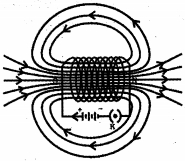
What is a solenoid? Explain with the help of a figure how a solenoid behaves like a bar magnet.
Solution
(N/A) solenoid is a cylindrical coil of many tightly wound turns of insulated wires,where the length of the coil is generally much greater than its diameter.
When an electric current is passed through the solenoid,a magnetic field is produced around and inside it.
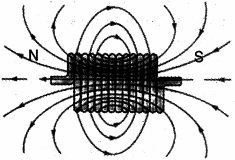
The magnetic field lines produced by the solenoid are similar to those of a bar magnet. Since the current in each circular turn of the solenoid flows in the same direction,the magnetic effects of individual turns add up.
As a result,one end of the solenoid acts as the North pole $(N)$ and the other end acts as the South pole $(S)$,similar to a bar magnet.
The figure below illustrates the magnetic field lines of a current-carrying solenoid:
When an electric current is passed through the solenoid,a magnetic field is produced around and inside it.
The magnetic field lines produced by the solenoid are similar to those of a bar magnet. Since the current in each circular turn of the solenoid flows in the same direction,the magnetic effects of individual turns add up.
As a result,one end of the solenoid acts as the North pole $(N)$ and the other end acts as the South pole $(S)$,similar to a bar magnet.
The figure below illustrates the magnetic field lines of a current-carrying solenoid:
0 likes
View Solution107
Medium
What are the factors on which the magnetic field due to a current carrying solenoid depends?
Solution
(N/A) The strength of the magnetic field produced by a current-carrying solenoid depends on the following factors:
$(a)$ The number of turns in the coil: The magnetic field is directly proportional to the number of turns $(N)$.
$(b)$ The strength of the current: The magnetic field is directly proportional to the current $(I)$ flowing through the solenoid.
$(c)$ The nature of the core material: The magnetic field is significantly increased when a soft iron core is placed inside the solenoid,as it acts as an electromagnet.
$(a)$ The number of turns in the coil: The magnetic field is directly proportional to the number of turns $(N)$.
$(b)$ The strength of the current: The magnetic field is directly proportional to the current $(I)$ flowing through the solenoid.
$(c)$ The nature of the core material: The magnetic field is significantly increased when a soft iron core is placed inside the solenoid,as it acts as an electromagnet.
0 likes
View Solution108
Difficult
Why does a magnetic needle deflect when brought close to a current carrying conductor? Explain the rule to find the direction of force on a current carrying conductor.
Solution
(N/A) When a magnetic needle is brought near a current-carrying conductor,it deflects because the magnetic field produced by the current-carrying conductor exerts a magnetic force on the needle.
The direction of the force experienced by a current-carrying conductor placed in a magnetic field is determined by Fleming's Left-Hand Rule. According to this rule,stretch the thumb,forefinger,and middle finger of your left hand such that they are mutually perpendicular to each other. If the forefinger points in the direction of the magnetic field and the middle finger points in the direction of the current,then the thumb will point in the direction of the force (or motion) experienced by the conductor.
The direction of the force experienced by a current-carrying conductor placed in a magnetic field is determined by Fleming's Left-Hand Rule. According to this rule,stretch the thumb,forefinger,and middle finger of your left hand such that they are mutually perpendicular to each other. If the forefinger points in the direction of the magnetic field and the middle finger points in the direction of the current,then the thumb will point in the direction of the force (or motion) experienced by the conductor.
0 likes
View Solution109
Medium
State Faraday's laws of electromagnetic induction.
Solution
(N/A) Faraday proposed two fundamental laws regarding electromagnetic induction:
$(i)$ Whenever the magnetic flux linked with a closed circuit changes,an induced electromotive force $(emf)$ is produced in the circuit.
$(ii)$ The magnitude of the induced $emf$ in a circuit is directly proportional to the rate of change of magnetic flux linked with the circuit. Mathematically,this is expressed as $\varepsilon = -\frac{d\Phi_B}{dt}$,where $\varepsilon$ is the induced $emf$ and $\frac{d\Phi_B}{dt}$ is the rate of change of magnetic flux.
$(i)$ Whenever the magnetic flux linked with a closed circuit changes,an induced electromotive force $(emf)$ is produced in the circuit.
$(ii)$ The magnitude of the induced $emf$ in a circuit is directly proportional to the rate of change of magnetic flux linked with the circuit. Mathematically,this is expressed as $\varepsilon = -\frac{d\Phi_B}{dt}$,where $\varepsilon$ is the induced $emf$ and $\frac{d\Phi_B}{dt}$ is the rate of change of magnetic flux.
0 likes
View Solution110
Medium
Differentiate between $AC$ and $DC$ along with the graph.
Solution
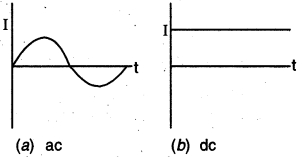
(N/A) The electric current which changes its direction (or polarity) after a certain fixed interval of time is called $AC$ or alternating current. In $AC$,the polarity ($+$ or $-$) is not fixed. The current $v/s$ time graph for $AC$ is shown in figure $(a)$.
The electric current which always flows in the same direction is called direct current or $DC$. In $DC$,the polarity ($+$ or $-$) is fixed. The current obtained from a battery or a cell is $DC$. The current $v/s$ time graph for $DC$ is shown in figure $(b)$.
The electric current which always flows in the same direction is called direct current or $DC$. In $DC$,the polarity ($+$ or $-$) is fixed. The current obtained from a battery or a cell is $DC$. The current $v/s$ time graph for $DC$ is shown in figure $(b)$.
0 likes
View Solution111
Medium
What is a fuse? How does it function?
Solution
(N/A) An electric fuse is a safety device used to limit the current in an electric circuit.
Its primary purpose is to protect the circuit and the connected appliances from damage due to excessive current flow.
The fuse consists of a short piece of wire made from a material with a low melting point.
When an electric current passes through the fuse,it generates heat.
If the current exceeds the safe limit,the heat produced is sufficient to melt the fuse wire,which breaks the circuit and stops the flow of electricity.
Its primary purpose is to protect the circuit and the connected appliances from damage due to excessive current flow.
The fuse consists of a short piece of wire made from a material with a low melting point.
When an electric current passes through the fuse,it generates heat.
If the current exceeds the safe limit,the heat produced is sufficient to melt the fuse wire,which breaks the circuit and stops the flow of electricity.
0 likes
View Solution112
Easy
Draw a rough sketch of the pattern of the magnetic field lines due to:
$(i)$ current flowing through a circular coil,and
$(ii)$ a current-carrying solenoid.
$(i)$ current flowing through a circular coil,and
$(ii)$ a current-carrying solenoid.
Solution
(N/A) The magnetic field lines for a circular coil and a solenoid are described as follows:
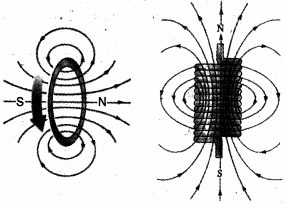
$(i)$ For a circular coil: The magnetic field lines near the coil are nearly circular. As we move towards the center of the coil,the arcs of these circles become larger and appear as straight lines at the center. The direction of the magnetic field can be determined using the right-hand thumb rule.
$(ii)$ For a solenoid: The magnetic field lines inside the solenoid are parallel to each other,indicating a uniform magnetic field. Outside the solenoid,the field lines resemble those of a bar magnet,emerging from the North pole and entering the South pole.
$(i)$ For a circular coil: The magnetic field lines near the coil are nearly circular. As we move towards the center of the coil,the arcs of these circles become larger and appear as straight lines at the center. The direction of the magnetic field can be determined using the right-hand thumb rule.
$(ii)$ For a solenoid: The magnetic field lines inside the solenoid are parallel to each other,indicating a uniform magnetic field. Outside the solenoid,the field lines resemble those of a bar magnet,emerging from the North pole and entering the South pole.
0 likes
View Solution113
Medium
Describe an experiment to illustrate the action of an electric fuse.
Solution
(N/A) $1$. Take a thin strip of aluminium foil about $3$ to $5\, cm$ in length.
$2$. Fix its two ends on the tips of two iron nails placed vertically on a wooden board or table.
$3$. Connect the ends of the two nails to the terminals of a battery using connecting wires to form a circuit.
$4$. Include a bulb in the circuit to indicate the flow of current.
$5$. As the current flows,the aluminium foil acts as a fuse. If the current exceeds a certain limit,the foil gets heated up due to the heating effect of electric current and eventually melts (burns out),thereby breaking the circuit and switching off the bulb.
$2$. Fix its two ends on the tips of two iron nails placed vertically on a wooden board or table.
$3$. Connect the ends of the two nails to the terminals of a battery using connecting wires to form a circuit.
$4$. Include a bulb in the circuit to indicate the flow of current.
$5$. As the current flows,the aluminium foil acts as a fuse. If the current exceeds a certain limit,the foil gets heated up due to the heating effect of electric current and eventually melts (burns out),thereby breaking the circuit and switching off the bulb.
0 likes
View Solution114
EasyMCQ
On what factors does the force experienced by a current-carrying conductor placed in a uniform magnetic field depend?
A
Strength of the magnetic field
B
Strength of the electric current
C
Length of the conductor
D
All of the above
Solution
(D) The force $F$ experienced by a current-carrying conductor of length $l$ carrying current $I$ placed in a uniform magnetic field $B$ is given by the formula $F = BIl \sin(\theta)$.
Based on this formula, the force depends on the following factors:
$(i)$ The strength of the magnetic field $(B)$.
$(ii)$ The strength of the electric current $(I)$.
$(iii)$ The length of the conductor $(l)$.
$(iv)$ The angle $(\theta)$ between the direction of the current and the direction of the magnetic field.
Based on this formula, the force depends on the following factors:
$(i)$ The strength of the magnetic field $(B)$.
$(ii)$ The strength of the electric current $(I)$.
$(iii)$ The length of the conductor $(l)$.
$(iv)$ The angle $(\theta)$ between the direction of the current and the direction of the magnetic field.
0 likes
View Solution115
Easy
State the rule to determine the direction of magnetic field produced around a current-carrying conductor.
Solution
(N/A) The rule used is the $Right-Hand$ $Thumb$ $Rule$.
Imagine a current-carrying conductor held in your right hand such that the thumb points in the direction of the current. Then,the curl of your fingers encircling the conductor will give the direction of the magnetic field lines around the conductor.
Imagine a current-carrying conductor held in your right hand such that the thumb points in the direction of the current. Then,the curl of your fingers encircling the conductor will give the direction of the magnetic field lines around the conductor.
0 likes
View Solution116
Easy
What is meant by the term "magnetic field lines"? List two properties of magnetic field lines.
Solution
(N/A) magnetic field line is a path that would be followed by a hypothetical north pole if it were allowed to move freely in the magnetic field of another magnet.
Two properties of magnetic field lines are:
$(i)$ Two magnetic field lines never intersect each other.
$(ii)$ Outside the magnet, they travel from the north pole to the south pole, and inside the magnet, they travel from the south pole to the north pole.
Two properties of magnetic field lines are:
$(i)$ Two magnetic field lines never intersect each other.
$(ii)$ Outside the magnet, they travel from the north pole to the south pole, and inside the magnet, they travel from the south pole to the north pole.
0 likes
View Solution117
Medium
With the help of a neat diagram,describe how you can generate induced current in a circuit.
Solution
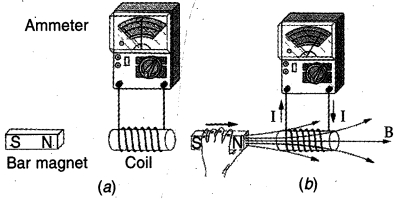
(N/A) The figure shows a bar magnet and a helical coil of wire connected to a galvanometer.
When there is no relative motion between the bar magnet and the coil,as shown in part $(a)$,the galvanometer shows zero deflection,indicating no current is flowing.
However,when the magnet moves toward the coil,as in part $(b)$,an induced current is generated in the coil.
As the magnet approaches,the magnetic field lines passing through the coil increase,and this change in magnetic flux induces the current.
When the magnet moves away from the coil,a current is also induced,but its direction is reversed because the magnetic flux through the coil decreases.
Thus,it is the change in the magnetic field (or magnetic flux) linked with the coil that generates the induced current.
When there is no relative motion between the bar magnet and the coil,as shown in part $(a)$,the galvanometer shows zero deflection,indicating no current is flowing.
However,when the magnet moves toward the coil,as in part $(b)$,an induced current is generated in the coil.
As the magnet approaches,the magnetic field lines passing through the coil increase,and this change in magnetic flux induces the current.
When the magnet moves away from the coil,a current is also induced,but its direction is reversed because the magnetic flux through the coil decreases.
Thus,it is the change in the magnetic field (or magnetic flux) linked with the coil that generates the induced current.
0 likes
View Solution118
Medium
Why is series arrangement not used for domestic circuits?
Solution
(N/A) In domestic circuits,series arrangement is not used because of the following reasons:
$(i)$ The total potential difference available (usually $220 \ V$) is divided between various appliances in the circuit according to their resistances since the current flowing through all the appliances is the same. Thus,each appliance will not get the required potential difference for it to operate properly.
$(ii)$ If one of the appliances is out of order,$e.g.$,if a bulb gets fused,all the appliances in the circuit will stop working as the circuit gets broken.
$(iii)$ All the appliances will work simultaneously whether we want them to work or not,thereby involving a lot of power wastage.
$(iv)$ If we switch off any one of the appliances,the circuit is broken and all the appliances will stop working.
$(i)$ The total potential difference available (usually $220 \ V$) is divided between various appliances in the circuit according to their resistances since the current flowing through all the appliances is the same. Thus,each appliance will not get the required potential difference for it to operate properly.
$(ii)$ If one of the appliances is out of order,$e.g.$,if a bulb gets fused,all the appliances in the circuit will stop working as the circuit gets broken.
$(iii)$ All the appliances will work simultaneously whether we want them to work or not,thereby involving a lot of power wastage.
$(iv)$ If we switch off any one of the appliances,the circuit is broken and all the appliances will stop working.
0 likes
View Solution119
Medium
Explain what is short-circuiting and overloading in an electric supply.
Solution
(N/A) Short-circuiting occurs when the live wire and the neutral wire come into direct contact with each other. This happens due to $(i)$ damage to the insulation of the power lines,or $(ii)$ a fault in an electric appliance. Due to short-circuiting,the resistance of the circuit decreases to a very small value,causing the current to become extremely large. This high current results in the heating of the live wires,which produces sparking at the point of contact. This sparking can sometimes cause a fire in a building.
An electric circuit is said to be overloaded if the total current drawn by all the electric appliances connected to it exceeds the permitted limit of the circuit. Overloading results in excessive heating of the wires,which can damage the insulation and lead to electrical fires.
An electric circuit is said to be overloaded if the total current drawn by all the electric appliances connected to it exceeds the permitted limit of the circuit. Overloading results in excessive heating of the wires,which can damage the insulation and lead to electrical fires.
0 likes
View Solution120
Medium
State the characteristics of magnetic force.
Solution
(N/A) The following are the characteristics of magnetic force:
$(i)$ Magnetic force acts only on moving charges and not on stationary charges.
$(ii)$ No magnetic force acts on a charge if it is moving parallel or anti-parallel to the direction of the magnetic field.
$(iii)$ The direction of magnetic force is perpendicular to both $(a)$ the velocity vector of the charge and $(b)$ the magnetic field vector.
$(iv)$ The magnitude of magnetic force $(F)$ depends on the charge $(q)$,velocity $(v)$,and the strength $(B)$ of the magnetic field; i.e.,$F = qvB \sin \theta$,where $\theta$ is the angle between velocity and magnetic field.
$(v)$ The magnetic force $(F)$ acting on a current-carrying conductor of length $(L)$ placed in a magnetic field $(B)$ is given by $F = BIL \sin \theta$,where $I$ is the current flowing through the conductor.
$(i)$ Magnetic force acts only on moving charges and not on stationary charges.
$(ii)$ No magnetic force acts on a charge if it is moving parallel or anti-parallel to the direction of the magnetic field.
$(iii)$ The direction of magnetic force is perpendicular to both $(a)$ the velocity vector of the charge and $(b)$ the magnetic field vector.
$(iv)$ The magnitude of magnetic force $(F)$ depends on the charge $(q)$,velocity $(v)$,and the strength $(B)$ of the magnetic field; i.e.,$F = qvB \sin \theta$,where $\theta$ is the angle between velocity and magnetic field.
$(v)$ The magnetic force $(F)$ acting on a current-carrying conductor of length $(L)$ placed in a magnetic field $(B)$ is given by $F = BIL \sin \theta$,where $I$ is the current flowing through the conductor.
0 likes
View Solution121
Medium
The flow of a current in a circular loop of a wire creates a magnetic field at its centre. How can the existence of this field be detected? State the rule which helps to predict the direction of this magnetic field.
Solution
(N/A) The existence of a magnetic field can be detected using a magnetic compass or by sprinkling iron filings on a cardboard sheet placed perpendicular to the plane of the loop. When current flows through the loop, the iron filings arrange themselves in concentric circles around the wire segments, and near the centre of the loop, the magnetic field lines appear as straight lines.
The direction of the magnetic field produced by a current-carrying circular loop is determined by the $Right-Hand$ $Thumb$ $Rule$. This rule states: "If you grasp the current-carrying conductor in your right hand such that your thumb points in the direction of the current, then the direction in which your fingers curl around the conductor gives the direction of the magnetic field lines."
The direction of the magnetic field produced by a current-carrying circular loop is determined by the $Right-Hand$ $Thumb$ $Rule$. This rule states: "If you grasp the current-carrying conductor in your right hand such that your thumb points in the direction of the current, then the direction in which your fingers curl around the conductor gives the direction of the magnetic field lines."
0 likes
View Solution122
Medium
How does the strength of the magnetic field at the centre of a circular coil of wire depend on: $(i)$ the radius of the coil $(ii)$ the number of turns of wire in the coil $(iii)$ the strength of the current flowing in the coil?
Solution
(N/A) The magnetic field $B$ at the centre of a circular coil is given by the formula $B = \frac{\mu_0 NI}{2R}$,where $N$ is the number of turns,$I$ is the current,and $R$ is the radius.
$(i)$ The magnetic field is inversely proportional to the radius of the coil $(B \propto \frac{1}{R})$.
$(ii)$ The magnetic field is directly proportional to the number of turns in the coil $(B \propto N)$.
$(iii)$ The magnetic field is directly proportional to the current flowing through the coil $(B \propto I)$.
$(i)$ The magnetic field is inversely proportional to the radius of the coil $(B \propto \frac{1}{R})$.
$(ii)$ The magnetic field is directly proportional to the number of turns in the coil $(B \propto N)$.
$(iii)$ The magnetic field is directly proportional to the current flowing through the coil $(B \propto I)$.
0 likes
View Solution123
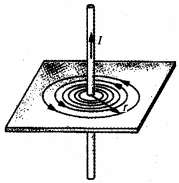
Medium
Draw the pattern of magnetic field lines associated with a current-carrying straight conductor. State how the magnetic field produced changes:
$(i)$ with an increase in current in the conductor,and
$(ii)$ with an increase in the distance from the conductor.
$(i)$ with an increase in current in the conductor,and
$(ii)$ with an increase in the distance from the conductor.
Solution
(N/A) The pattern of magnetic field lines around a current-carrying straight conductor consists of concentric circles centered on the conductor.
$(i)$ The strength of the magnetic field is directly proportional to the current flowing through the conductor. Therefore,the magnetic field increases with an increase in the current.
$(ii)$ The strength of the magnetic field is inversely proportional to the distance from the conductor. Therefore,the magnetic field decreases as the distance from the conductor increases.
$(i)$ The strength of the magnetic field is directly proportional to the current flowing through the conductor. Therefore,the magnetic field increases with an increase in the current.
$(ii)$ The strength of the magnetic field is inversely proportional to the distance from the conductor. Therefore,the magnetic field decreases as the distance from the conductor increases.
0 likes
View Solution124
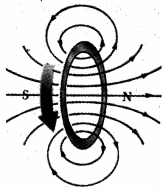
Medium
Draw the pattern of magnetic field lines through and around a current-carrying circular loop of wire. How would the strength of the magnetic field produced at the centre of the circular loop be affected if: $(i)$ the strength of the current passing through this loop is doubled? $(ii)$ the radius of the loop is reduced to half of the original radius?
Solution
(N/A) The pattern of magnetic field lines for a current-carrying circular loop is similar to that of a bar magnet,where the field lines are circular near the wire and become nearly parallel straight lines at the centre of the loop.
$(i)$ The magnetic field strength at the centre is given by $B = \frac{\mu_0 I}{2R}$. Since $B \propto I$,if the current $I$ is doubled,the magnetic field strength $B$ will also be doubled.
$(ii)$ Since $B \propto \frac{1}{R}$,if the radius $R$ is reduced to half $(R' = R/2)$,the new magnetic field strength $B'$ becomes $B' = \frac{\mu_0 I}{2(R/2)} = 2 \times \frac{\mu_0 I}{2R} = 2B$. Thus,the magnetic field strength will be doubled.
$(i)$ The magnetic field strength at the centre is given by $B = \frac{\mu_0 I}{2R}$. Since $B \propto I$,if the current $I$ is doubled,the magnetic field strength $B$ will also be doubled.
$(ii)$ Since $B \propto \frac{1}{R}$,if the radius $R$ is reduced to half $(R' = R/2)$,the new magnetic field strength $B'$ becomes $B' = \frac{\mu_0 I}{2(R/2)} = 2 \times \frac{\mu_0 I}{2R} = 2B$. Thus,the magnetic field strength will be doubled.
0 likes
View Solution125
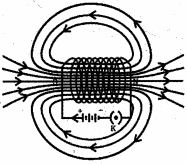
Easy
Draw the pattern of magnetic field lines due to a current-carrying solenoid. Clearly mark the north and south poles in the diagram.
Solution
(N/A) The magnetic field lines produced by a current-carrying solenoid are similar to those of a bar magnet. Inside the solenoid,the field lines are parallel to the axis,indicating a uniform magnetic field. Outside,they form closed loops. The end from which the field lines emerge is the North pole $(N)$,and the end where they enter is the South pole $(S)$.
0 likes
View Solution126
EasyMCQ
Why do iron filings arrange themselves in a certain pattern around a magnet?
A
Due to gravitational force.
B
Due to the magnetic field force exerted by the magnet.
C
Due to the electrostatic force.
D
Due to the friction between the filings and the surface.
Solution
(B) magnet creates a magnetic field in the region surrounding it.
When iron filings are placed in this region,they experience a magnetic force.
This force causes the iron filings to align themselves along the magnetic field lines,resulting in a specific pattern.
When iron filings are placed in this region,they experience a magnetic force.
This force causes the iron filings to align themselves along the magnetic field lines,resulting in a specific pattern.
0 likes
View Solution127
EasyMCQ
How is the relative strength of a magnetic field shown around a magnet?
A
By the length of the magnet
B
By the degree of closeness of the magnetic field lines
C
By the color of the magnetic field lines
D
By the temperature of the magnet
Solution
(B) The relative strength of a magnetic field is represented by the degree of closeness of the magnetic field lines.
Where the field lines are crowded,the magnetic field is stronger,meaning the force acting on the pole of another magnet placed in that region is greater.
Conversely,where the field lines are widely spaced,the magnetic field is weaker.
Where the field lines are crowded,the magnetic field is stronger,meaning the force acting on the pole of another magnet placed in that region is greater.
Conversely,where the field lines are widely spaced,the magnetic field is weaker.
0 likes
View Solution128
Easy
$A$ current through a horizontal power line flows in east to west direction. What is the direction of magnetic field at a point directly below it and a point directly above it?
Solution
(N/A) The current flows in the east to west direction.
According to the Right-Hand Thumb Rule,if you point your thumb in the direction of the current (west),your fingers curl in the direction of the magnetic field.
For a point directly below the wire,the magnetic field lines point from north to south.
For a point directly above the wire,the magnetic field lines point from south to north.
According to the Right-Hand Thumb Rule,if you point your thumb in the direction of the current (west),your fingers curl in the direction of the magnetic field.
For a point directly below the wire,the magnetic field lines point from north to south.
For a point directly above the wire,the magnetic field lines point from south to north.
0 likes
View Solution129
EasyMCQ
Two long parallel wires are hanging freely. If they are connected to a battery $(i)$ in series and $(ii)$ in parallel,what would be the effect on their positions?
A
They will attract in both cases.
B
They will repel in both cases.
C
They will repel in series and attract in parallel.
D
They will attract in series and repel in parallel.
Solution
(C) $(i)$ In series: When connected in series,the current flows through the wires in opposite directions relative to each other. According to the laws of electromagnetism,parallel wires carrying current in opposite directions exert a repulsive force on each other. Therefore,they will move apart.
$(ii)$ In parallel: When connected in parallel,the current flows through both wires in the same direction. Parallel wires carrying current in the same direction exert an attractive force on each other. Therefore,they will move towards each other.
$(ii)$ In parallel: When connected in parallel,the current flows through both wires in the same direction. Parallel wires carrying current in the same direction exert an attractive force on each other. Therefore,they will move towards each other.
0 likes
View Solution130
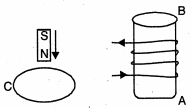
Medium
$A$ current $I$ passes through a circular loop $C$ and a solenoid $AB$ as shown below:
$(i)$ What is the polarity of: $(a)$ the face of the loop you are looking at? $(b)$ the end $B$ of the solenoid?
$(ii)$ What is the direction of the magnetic field at the centre of the loop?
$(i)$ What is the polarity of: $(a)$ the face of the loop you are looking at? $(b)$ the end $B$ of the solenoid?
$(ii)$ What is the direction of the magnetic field at the centre of the loop?
Solution
(N/A) $(i)$
$(a)$ According to the right-hand thumb rule or by observing the direction of current flow,the face of the loop will behave as a North pole.
$(b)$ By applying the right-hand rule for a solenoid,the end $B$ will also behave as a North pole.
$(ii)$ The magnetic field at the centre of the loop is perpendicular to the plane of the loop,directed along the axis of the loop.
$(a)$ According to the right-hand thumb rule or by observing the direction of current flow,the face of the loop will behave as a North pole.
$(b)$ By applying the right-hand rule for a solenoid,the end $B$ will also behave as a North pole.
$(ii)$ The magnetic field at the centre of the loop is perpendicular to the plane of the loop,directed along the axis of the loop.
0 likes
View Solution131
Easy
Explain why a fuse should be joined with the live wire and not with the neutral wire in a domestic circuit.
Solution
(N/A) In a domestic circuit,the live wire carries current at a high potential,while the neutral wire is at zero potential (connected to the earth at the substation). If a fuse is connected to the neutral wire and a short circuit occurs,the fuse will blow,but the appliance will remain connected to the high-potential live wire. This poses a severe risk of electric shock to anyone touching the appliance. By connecting the fuse to the live wire,the entire circuit is disconnected from the power source as soon as the fuse blows,ensuring safety.
0 likes
View Solution132
Medium
What is a solenoid? Draw the pattern of magnetic field lines of a solenoid through which a steady current flows.
Solution
(N/A) solenoid is a coil of many turns of insulated copper wire wound closely in the form of a cylinder.
The magnetic field lines around a solenoid are as shown in the diagram below,where the field lines inside the solenoid are parallel to each other,indicating a uniform magnetic field.
The magnetic field lines around a solenoid are as shown in the diagram below,where the field lines inside the solenoid are parallel to each other,indicating a uniform magnetic field.
0 likes
View Solution133
Easy
Differentiate between overloading and short-circuiting.
Solution
(N/A) Overloading occurs when the current drawn from a circuit exceeds the rated capacity of the wires,often caused by connecting too many electrical appliances to a single socket or circuit simultaneously.
Short-circuiting occurs when the live wire comes into direct contact with the neutral wire,usually due to damaged insulation or a fault in an appliance,leading to a sudden,extremely high flow of current.
Short-circuiting occurs when the live wire comes into direct contact with the neutral wire,usually due to damaged insulation or a fault in an appliance,leading to a sudden,extremely high flow of current.
0 likes
View Solution134
Easy
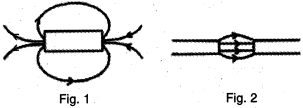
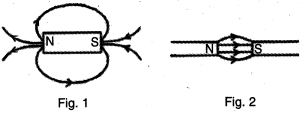
Identify the poles of the magnet in the given figures $(1)$ and $(2).$
Solution
(N/A) In Figure $(1)$,the magnetic field lines emerge from the left side and enter the right side. By convention,magnetic field lines emerge from the North pole $(N)$ and enter the South pole $(S)$. Therefore,the left side is the North pole and the right side is the South pole.
In Figure $(2)$,the magnetic field lines are directed from the left magnet to the right magnet. Thus,the left magnet's pole facing the right is the North pole $(N)$,and the right magnet's pole facing the left is the South pole $(S)$.
In Figure $(2)$,the magnetic field lines are directed from the left magnet to the right magnet. Thus,the left magnet's pole facing the right is the North pole $(N)$,and the right magnet's pole facing the left is the South pole $(S)$.
0 likes
View Solution135
Medium
What are permanent magnets and electromagnets? Give two uses of each.
Solution
(N/A) permanent magnet is a material that retains its magnetic properties for a long time without the need for an external power source. Its magnetic field is constant.
An electromagnet is a temporary magnet formed by passing an electric current through a coil (solenoid) wound around a soft iron core. Its magnetism exists only as long as the current flows.
Uses of Permanent Magnets:
$1$. Electric generators
$2$. Loudspeakers
Uses of Electromagnets:
$1$. Electric cranes for lifting heavy iron objects
$2$. Electric bells
An electromagnet is a temporary magnet formed by passing an electric current through a coil (solenoid) wound around a soft iron core. Its magnetism exists only as long as the current flows.
Uses of Permanent Magnets:
$1$. Electric generators
$2$. Loudspeakers
Uses of Electromagnets:
$1$. Electric cranes for lifting heavy iron objects
$2$. Electric bells
0 likes
View Solution136
Easy
Explain briefly different methods of producing induced electromotive force $(emf)$.
Solution
(N/A) $(i)$ By changing the magnetic flux linked with a coil,an $emf$ can be induced. This can be achieved by varying the current in a neighboring coil (mutual induction).
$(ii)$ By moving a magnet towards or away from a stationary coil,the magnetic field lines passing through the coil change,thereby inducing an $emf$ (electromagnetic induction).
$(iii)$ By rotating a coil within a uniform magnetic field,the angle between the area vector and the magnetic field changes,resulting in a change in magnetic flux and the induction of an $emf$.
$(ii)$ By moving a magnet towards or away from a stationary coil,the magnetic field lines passing through the coil change,thereby inducing an $emf$ (electromagnetic induction).
$(iii)$ By rotating a coil within a uniform magnetic field,the angle between the area vector and the magnetic field changes,resulting in a change in magnetic flux and the induction of an $emf$.
0 likes
View Solution137
Medium
What is the role of a fuse used in series with an electrical appliance? Why should a fuse with a defined rating not be replaced by one with a larger rating?
Solution
(N/A) fuse is a safety device used in series with an electrical appliance to protect it from damage caused by short-circuiting or overloading.
It is designed to handle a specific maximum current rating.
When the current flowing through the circuit exceeds this rated value,the fuse wire melts due to the heat generated,thereby breaking the circuit and preventing damage to the appliance.
If a fuse with a larger rating is used,it will not melt when the current exceeds the safe limit of the appliance.
Consequently,the appliance may get damaged or catch fire because the fuse fails to perform its protective function.
It is designed to handle a specific maximum current rating.
When the current flowing through the circuit exceeds this rated value,the fuse wire melts due to the heat generated,thereby breaking the circuit and preventing damage to the appliance.
If a fuse with a larger rating is used,it will not melt when the current exceeds the safe limit of the appliance.
Consequently,the appliance may get damaged or catch fire because the fuse fails to perform its protective function.
0 likes
View Solution138
Easy
$A$ magnetic compass shows a deflection when placed near a current-carrying wire. How will the deflection of the compass be affected if the current in the wire is increased? Support your answer with a reason.
Solution
(N/A) The deflection of the magnetic compass increases.
This happens because the strength of the magnetic field produced by a current-carrying straight conductor is directly proportional to the magnitude of the current flowing through it $(B \propto I)$.
Therefore,increasing the current increases the magnetic field strength,which exerts a greater force on the magnetic needle,resulting in a larger deflection.
This happens because the strength of the magnetic field produced by a current-carrying straight conductor is directly proportional to the magnitude of the current flowing through it $(B \propto I)$.
Therefore,increasing the current increases the magnetic field strength,which exerts a greater force on the magnetic needle,resulting in a larger deflection.
0 likes
View Solution139
EasyMCQ
No two magnetic field lines can intersect each other. Explain.
A
They are parallel to each other.
B
They represent the direction of the magnetic field.
C
At the point of intersection,there would be two directions of the magnetic field.
D
They are closed loops.
Solution
(C) Magnetic field lines represent the direction of the magnetic field at any point.
If two magnetic field lines were to intersect,there would be two tangents at the point of intersection.
This would imply that the magnetic field has two different directions at the same point,which is physically impossible.
Therefore,no two magnetic field lines can ever intersect each other.
If two magnetic field lines were to intersect,there would be two tangents at the point of intersection.
This would imply that the magnetic field has two different directions at the same point,which is physically impossible.
Therefore,no two magnetic field lines can ever intersect each other.
0 likes
View Solution140
Medium
What is meant by the term magnetic field lines? List any two properties of magnetic field lines.
Solution
(N/A) Magnetic field lines are the imaginary paths or lines drawn in a magnetic field along which a free north pole would move if placed in that field.
Properties of magnetic field lines:
$(i)$ Magnetic field lines originate from the North Pole and merge at the South Pole outside the magnet.
$(ii)$ No two magnetic field lines intersect each other because if they did,there would be two directions of the magnetic field at the point of intersection,which is impossible.
Properties of magnetic field lines:
$(i)$ Magnetic field lines originate from the North Pole and merge at the South Pole outside the magnet.
$(ii)$ No two magnetic field lines intersect each other because if they did,there would be two directions of the magnetic field at the point of intersection,which is impossible.
0 likes
View Solution141
Medium
Why does a current-carrying conductor experience a force when it is placed in a magnetic field? State Fleming's left-hand rule.
Solution
(N/A) current-carrying conductor experiences a force when placed in a magnetic field due to the interaction between the magnetic field produced by the current flowing through the conductor and the external magnetic field in which it is placed.
Statement of Fleming's left-hand rule:
Stretch the thumb,forefinger,and middle finger of your left hand such that they are mutually perpendicular to each other. If the forefinger points in the direction of the magnetic field and the middle finger points in the direction of the current,then the thumb will point in the direction of the force acting on the conductor. An example of a device based on this principle is the electric motor.
Statement of Fleming's left-hand rule:
Stretch the thumb,forefinger,and middle finger of your left hand such that they are mutually perpendicular to each other. If the forefinger points in the direction of the magnetic field and the middle finger points in the direction of the current,then the thumb will point in the direction of the force acting on the conductor. An example of a device based on this principle is the electric motor.
0 likes
View Solution142
Medium
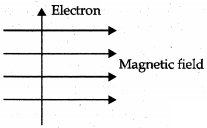
An electron enters a uniform magnetic field at right angles to it as shown in the figure below. In which direction will this electron move? State the rule applied by you in finding the direction of motion of the electron.
Solution
(N/A) The electron will move perpendicular to the plane of the paper and downwards.
Explanation:
$1$. The direction of the magnetic field is towards the right.
$2$. The electron is moving upwards. Since the current is defined as the flow of positive charges,the direction of conventional current is opposite to the direction of the electron's motion,i.e.,downwards.
$3$. Applying Fleming's Left-Hand Rule: Stretch the thumb,forefinger,and middle finger of the left hand such that they are mutually perpendicular. If the forefinger points in the direction of the magnetic field (right) and the middle finger points in the direction of the current (downwards),then the thumb points in the direction of the force acting on the electron.
$4$. According to this rule,the force on the electron acts perpendicular to the plane of the paper and downwards.
Explanation:
$1$. The direction of the magnetic field is towards the right.
$2$. The electron is moving upwards. Since the current is defined as the flow of positive charges,the direction of conventional current is opposite to the direction of the electron's motion,i.e.,downwards.
$3$. Applying Fleming's Left-Hand Rule: Stretch the thumb,forefinger,and middle finger of the left hand such that they are mutually perpendicular. If the forefinger points in the direction of the magnetic field (right) and the middle finger points in the direction of the current (downwards),then the thumb points in the direction of the force acting on the electron.
$4$. According to this rule,the force on the electron acts perpendicular to the plane of the paper and downwards.
0 likes
View Solution143
Medium
$A$ student,while studying the force experienced by a current-carrying conductor in a magnetic field,records the following observations:
$(i)$ The force experienced by the conductor increases as the current is increased.
$(ii)$ The force experienced by the conductor decreases as the strength of the magnetic field is increased.
Which of the two observations is correct and why?
$(i)$ The force experienced by the conductor increases as the current is increased.
$(ii)$ The force experienced by the conductor decreases as the strength of the magnetic field is increased.
Which of the two observations is correct and why?
Solution
(A) Observation $(i)$ is correct.
The force $(F)$ experienced by a current-carrying conductor placed in a magnetic field is given by the formula $F = BIl \sin \theta$,where $B$ is the magnetic field strength,$I$ is the current,and $l$ is the length of the conductor.
According to this relationship,the force is directly proportional to the current $(I)$ flowing through the conductor. Therefore,as the current increases,the force experienced by the conductor also increases.
Observation $(ii)$ is incorrect because the force is also directly proportional to the magnetic field strength $(B)$. Thus,increasing the magnetic field strength would increase the force,not decrease it.
The force $(F)$ experienced by a current-carrying conductor placed in a magnetic field is given by the formula $F = BIl \sin \theta$,where $B$ is the magnetic field strength,$I$ is the current,and $l$ is the length of the conductor.
According to this relationship,the force is directly proportional to the current $(I)$ flowing through the conductor. Therefore,as the current increases,the force experienced by the conductor also increases.
Observation $(ii)$ is incorrect because the force is also directly proportional to the magnetic field strength $(B)$. Thus,increasing the magnetic field strength would increase the force,not decrease it.
0 likes
View Solution144
Medium
$A$ student performs an experiment to study the magnetic effect of current around a current-carrying straight conductor with the help of a magnetic compass.
He reports that:
$(i)$ the degree of deflection of the magnetic compass increases when the compass is moved away from the conductor.
$(ii)$ the degree of deflection of the magnetic compass increases when the current through the conductor is increased.
Which of the above observations of the student appears to be wrong and why?
He reports that:
$(i)$ the degree of deflection of the magnetic compass increases when the compass is moved away from the conductor.
$(ii)$ the degree of deflection of the magnetic compass increases when the current through the conductor is increased.
Which of the above observations of the student appears to be wrong and why?
Solution
(A) The first observation $(i)$ is wrong.
According to the Biot-Savart law or the properties of the magnetic field produced by a straight current-carrying conductor,the magnetic field strength $B$ is inversely proportional to the distance $r$ from the conductor $(B \propto 1/r)$.
Therefore,as the distance from the conductor increases,the strength of the magnetic field decreases.
Consequently,the degree of deflection of the magnetic compass needle should decrease,not increase,as it is moved away from the conductor.
According to the Biot-Savart law or the properties of the magnetic field produced by a straight current-carrying conductor,the magnetic field strength $B$ is inversely proportional to the distance $r$ from the conductor $(B \propto 1/r)$.
Therefore,as the distance from the conductor increases,the strength of the magnetic field decreases.
Consequently,the degree of deflection of the magnetic compass needle should decrease,not increase,as it is moved away from the conductor.
0 likes
View Solution145
Medium
$(a)$ What is the direction of magnetic field lines inside a bar magnet and outside of it?
$(b)$ What does the degree of closeness of the field lines represent?
$(b)$ What does the degree of closeness of the field lines represent?
Solution
(N/A) The direction of magnetic field lines outside a bar magnet is from the north pole to the south pole,while inside the magnet,it is from the south pole to the north pole.
$(b)$ The degree of closeness of magnetic field lines represents the strength of the magnetic field. The magnetic field is stronger in regions where the field lines are more crowded.
$(b)$ The degree of closeness of magnetic field lines represents the strength of the magnetic field. The magnetic field is stronger in regions where the field lines are more crowded.
0 likes
View Solution146
Medium
$(a)$ What is electromagnetic induction?
$(b)$ In what way can the magnitude of the induced current be increased?
$(b)$ In what way can the magnitude of the induced current be increased?
Solution
(N/A) Electromagnetic induction is the phenomenon of producing an induced current in a coil when the magnetic field associated with it changes with time.
$(b)$ The magnitude of the induced current can be increased by:
$1$. Increasing the strength of the magnetic field.
$2$. Increasing the speed of movement of the conductor relative to the magnetic field.
$3$. Increasing the number of turns in the coil.
$(b)$ The magnitude of the induced current can be increased by:
$1$. Increasing the strength of the magnetic field.
$2$. Increasing the speed of movement of the conductor relative to the magnetic field.
$3$. Increasing the number of turns in the coil.
0 likes
View Solution147
Easy
$A$ magnetic compass shows a deflection when placed near a current-carrying wire. How will the deflection of the compass be affected if the current in the wire is increased? Support your answer with a reason.
Solution
(N/A) The deflection of the magnetic compass will increase.
This is because the strength of the magnetic field produced by a current-carrying straight conductor is directly proportional to the magnitude of the current flowing through it $(B \propto I)$.
Therefore,increasing the current increases the magnetic field strength,which exerts a greater force on the magnetic needle,resulting in a larger deflection.
This is because the strength of the magnetic field produced by a current-carrying straight conductor is directly proportional to the magnitude of the current flowing through it $(B \propto I)$.
Therefore,increasing the current increases the magnetic field strength,which exerts a greater force on the magnetic needle,resulting in a larger deflection.
0 likes
View Solution148
Easy
How does the strength of the magnetic field at the centre of a circular coil of a wire depend on:
$(a)$ radius of the coil
$(b)$ number of turns in the coil.
$(a)$ radius of the coil
$(b)$ number of turns in the coil.
Solution
(N/A) The strength of the magnetic field $(B)$ at the centre of a circular coil is inversely proportional to the radius $(r)$ of the coil. Mathematically, $B \propto 1/r$. Therefore, as the radius of the coil increases, the magnetic field strength at the centre decreases.
$(b)$ The strength of the magnetic field $(B)$ at the centre of a circular coil is directly proportional to the number of turns $(n)$ in the coil. Mathematically, $B \propto n$. Therefore, as the number of turns in the coil increases, the magnetic field strength at the centre increases.
$(b)$ The strength of the magnetic field $(B)$ at the centre of a circular coil is directly proportional to the number of turns $(n)$ in the coil. Mathematically, $B \propto n$. Therefore, as the number of turns in the coil increases, the magnetic field strength at the centre increases.
0 likes
View Solution149
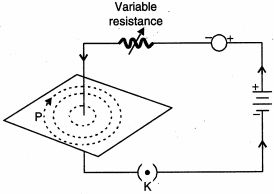
Medium
Draw magnetic field lines produced around a current-carrying straight conductor passing through a cardboard. How will the strength of the magnetic field change when the point where the magnetic field is to be determined is moved away from the straight wire carrying a constant current? Justify your answer.
Solution
(N/A) The magnetic field lines around a straight current-carrying conductor are concentric circles with the wire as the center. The direction of these lines can be determined using the Right-Hand Thumb Rule.
When the point where the magnetic field is to be determined is moved away from the straight wire,the strength of the magnetic field decreases.
Justification: The magnitude of the magnetic field $(B)$ produced by a straight current-carrying wire at a distance $(r)$ is inversely proportional to the distance from the wire,expressed as $B \propto 1/r$. Therefore,as the distance $(r)$ increases,the magnetic field strength $(B)$ decreases. This can be experimentally verified by observing the deflection of a compass needle,which decreases as it is moved further away from the wire.
When the point where the magnetic field is to be determined is moved away from the straight wire,the strength of the magnetic field decreases.
Justification: The magnitude of the magnetic field $(B)$ produced by a straight current-carrying wire at a distance $(r)$ is inversely proportional to the distance from the wire,expressed as $B \propto 1/r$. Therefore,as the distance $(r)$ increases,the magnetic field strength $(B)$ decreases. This can be experimentally verified by observing the deflection of a compass needle,which decreases as it is moved further away from the wire.
0 likes
View Solution150
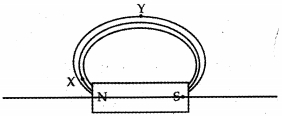
Medium
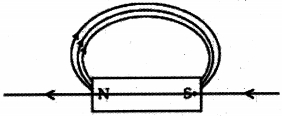
Magnetic field lines are shown in the given diagram. $A$ student makes a statement that the magnetic field at $X$ is stronger than at $Y$. Justify this statement. Also,redraw the diagram and mark the direction of magnetic field lines.
Solution
(N/A) The relative strength of the magnetic field is indicated by the degree of closeness of the magnetic field lines.
Field lines are closer together at point $X$ compared to point $Y$.
Therefore,the magnetic field is stronger at $X$ where the field lines are more crowded.
The direction of magnetic field lines outside a bar magnet is from the North pole $(N)$ to the South pole $(S)$.
Field lines are closer together at point $X$ compared to point $Y$.
Therefore,the magnetic field is stronger at $X$ where the field lines are more crowded.
The direction of magnetic field lines outside a bar magnet is from the North pole $(N)$ to the South pole $(S)$.
0 likes
View SolutionMagnetic Effects of Electric Current — Mix Examples - Magnetic Effects of Electric Current · Frequently Asked Questions
1Are these Magnetic Effects of Electric Current questions useful for JEE and NEET?
Yes. All questions in this section are mapped to JEE Main and NEET exam patterns. Previous year questions from JEE Main, NEET, GUJCET and state-level exams are included with full solutions.
2Can I switch to Hindi or Gujarati for these questions?
Yes. Use the language tabs in the hero section or the sidebar to view the same questions and solutions in English, Hindi or Gujarati.
3How do I generate a question paper from this subtopic?
Use the Vedclass Exam Paper Generator — select the chapter and subtopic, set difficulty, and generate Sets A, B, C, D automatically. First 3 chapters of every subject are free.
Vedclass Products
For Students
Vedclass Test Series
Mock tests in real JEE/NEET style with performance analysis. 5-day free trial.
Start Free TrialFor Teachers
Exam Paper Generator
Generate Set A/B/C/D papers from this chapter in 2 minutes. 3 chapters free.
Try FreeFor Institutes
Online Exam Module
Live online exams with unlimited students, 360° analytics & white-label branding.
See DemoFor Teachers & Institutes
Generate a Magnetic Effects of Electric Current Exam Paper in 2 Minutes
Select subtopic & difficulty — Sets A, B, C, D auto-generated with No Repeat logic.
First 3 chapters of every subject are free — no payment required.