
A English
Mix Examples - Magnetic Effects of Electric Current Questions in English
Class 10 Science · Magnetic Effects of Electric Current · Mix Examples - Magnetic Effects of Electric Current
332+
Questions
English
Language
100%
With Solutions
Showing 50 of 332 questions in English
151
Medium
Name and state the rule to determine the direction of a force experienced by a current-carrying straight conductor placed in a magnetic field which is perpendicular to it. Name a device that uses a current-carrying conductor and a magnetic field.
Solution
(N/A) The rule used to determine the direction of the force is $Fleming's \text{ left-hand rule}$.
Statement: Stretch the thumb,forefinger,and middle finger of your left hand such that they are mutually perpendicular to each other. If the forefinger points in the direction of the magnetic field and the middle finger points in the direction of the current,then the thumb will point in the direction of the force acting on the conductor.
$A$ device that uses a current-carrying conductor and a magnetic field is an $electric \text{ motor}$.
Statement: Stretch the thumb,forefinger,and middle finger of your left hand such that they are mutually perpendicular to each other. If the forefinger points in the direction of the magnetic field and the middle finger points in the direction of the current,then the thumb will point in the direction of the force acting on the conductor.
$A$ device that uses a current-carrying conductor and a magnetic field is an $electric \text{ motor}$.
0 likes
View Solution152
Medium
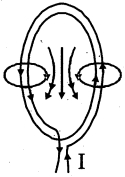
For the circular coil carrying current shown alongside,draw magnetic field lines. Decide which of its face behaves as North Pole and which face as South Pole. Give reason to justify your answer.
Solution
(N/A) The face of the circular coil where the current flows in an anti-clockwise direction behaves as the North Pole,as the magnetic field lines emerge from it.
Conversely,the face where the current flows in a clockwise direction behaves as the South Pole,as the magnetic field lines enter into it.
Based on the provided image,the front face shows current flow such that it acts as the North Pole (field lines emerging),and the rear face acts as the South Pole (field lines entering).
Conversely,the face where the current flows in a clockwise direction behaves as the South Pole,as the magnetic field lines enter into it.
Based on the provided image,the front face shows current flow such that it acts as the North Pole (field lines emerging),and the rear face acts as the South Pole (field lines entering).
0 likes
View Solution153
Medium
$A$ uniform magnetic field is directed vertically upwards. In which direction should an $\alpha$-particle (which is a positively charged particle) be projected in this field so that it is deflected southwards? Name and state the rule used to find the direction in this case.
Solution
(EAST) The $\alpha$-particle is a positively charged particle. According to Fleming's Left-Hand Rule,the force $(F)$ on a moving charge is perpendicular to both the magnetic field $(B)$ and the velocity $(v)$ of the charge.
Given: Magnetic field $(B)$ is vertically upwards. Force $(F)$ is towards the south.
Using Fleming's Left-Hand Rule: If the forefinger points upwards (magnetic field) and the thumb points south (force),the middle finger will point towards the east.
Therefore,the $\alpha$-particle should be projected towards the east.
Fleming's Left-Hand Rule states: Stretch the thumb,forefinger,and middle finger of your left hand such that they are mutually perpendicular. If the forefinger points in the direction of the magnetic field and the middle finger points in the direction of the current (or motion of positive charge),then the thumb points in the direction of the force acting on the particle.
Given: Magnetic field $(B)$ is vertically upwards. Force $(F)$ is towards the south.
Using Fleming's Left-Hand Rule: If the forefinger points upwards (magnetic field) and the thumb points south (force),the middle finger will point towards the east.
Therefore,the $\alpha$-particle should be projected towards the east.
Fleming's Left-Hand Rule states: Stretch the thumb,forefinger,and middle finger of your left hand such that they are mutually perpendicular. If the forefinger points in the direction of the magnetic field and the middle finger points in the direction of the current (or motion of positive charge),then the thumb points in the direction of the force acting on the particle.
0 likes
View Solution154
Medium
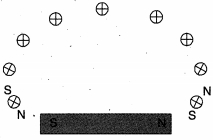
Define magnetic field. Describe an activity to draw magnetic field lines around a bar magnet from one pole to another pole.
Solution
(N/A) Magnetic field is the region around a magnet where the magnetic force can be experienced.
Activity:
$1$. Fix a sheet of white paper on a drawing board using adhesive material.
$2$. Place a bar magnet in the center of the paper and mark its boundary.
$3$. Place a small compass near the north pole of the magnet. The south pole of the compass needle will point towards the north pole of the magnet,and the north pole of the needle will point away from it.
$4$. Mark the positions of the two ends of the compass needle.
$5$. Move the compass to a new position such that its south pole occupies the position previously occupied by its north pole.
$6$. Repeat this process step by step until you reach the south pole of the magnet.
$7$. Join the points marked on the paper to obtain a smooth curve,which represents a magnetic field line.
Activity:
$1$. Fix a sheet of white paper on a drawing board using adhesive material.
$2$. Place a bar magnet in the center of the paper and mark its boundary.
$3$. Place a small compass near the north pole of the magnet. The south pole of the compass needle will point towards the north pole of the magnet,and the north pole of the needle will point away from it.
$4$. Mark the positions of the two ends of the compass needle.
$5$. Move the compass to a new position such that its south pole occupies the position previously occupied by its north pole.
$6$. Repeat this process step by step until you reach the south pole of the magnet.
$7$. Join the points marked on the paper to obtain a smooth curve,which represents a magnetic field line.
0 likes
View Solution155
EasyMCQ
Find the minimum rating of fuse that can be safely used on a line on which two $1.1 \, kW$ electric geysers are to run simultaneously. The supply voltage is $220 \, V$. (in $A$)
A
$5$
B
$10$
C
$15$
D
$20$
Solution
(C) The total power $P$ consumed by two geysers is $P = 2 \times 1.1 \, kW = 2.2 \, kW = 2200 \, W$.
Given supply voltage $V = 220 \, V$.
The current $I$ flowing through the circuit is calculated using the formula $I = P / V$.
$I = 2200 \, W / 220 \, V = 10 \, A$.
To safely operate the appliances,the fuse rating must be slightly higher than the current drawn by the circuit to prevent nuisance tripping while protecting against overcurrent.
Therefore,the minimum rating of the fuse should be greater than $10 \, A$.
Given supply voltage $V = 220 \, V$.
The current $I$ flowing through the circuit is calculated using the formula $I = P / V$.
$I = 2200 \, W / 220 \, V = 10 \, A$.
To safely operate the appliances,the fuse rating must be slightly higher than the current drawn by the circuit to prevent nuisance tripping while protecting against overcurrent.
Therefore,the minimum rating of the fuse should be greater than $10 \, A$.
0 likes
View Solution156
Medium
Can a freely suspended current-carrying solenoid stay in any direction? Justify your answer. What will happen when the direction of current in the solenoid is reversed? Explain.
Solution
(N/A) current-carrying solenoid behaves like a bar magnet because it produces a magnetic field similar to that of a magnet.
Therefore,when suspended freely,it will align itself in the $North-South$ direction,just like a freely suspended magnet.
When the direction of the current in the solenoid is reversed,the polarity of the magnetic poles at the ends of the solenoid is also reversed.
As a result,the solenoid will rotate by $180^{\circ}$ to realign itself with the Earth's magnetic field.
Therefore,when suspended freely,it will align itself in the $North-South$ direction,just like a freely suspended magnet.
When the direction of the current in the solenoid is reversed,the polarity of the magnetic poles at the ends of the solenoid is also reversed.
As a result,the solenoid will rotate by $180^{\circ}$ to realign itself with the Earth's magnetic field.
0 likes
View Solution157
Medium
What is meant by electromagnetic induction? State the rule which helps in determining the direction of induced current.
Solution
(N/A) Electromagnetic induction: It is the phenomenon of generating an induced electromotive force $(EMF)$ or potential difference in a conductor due to a change in the magnetic field linked with a coil.
Fleming's Right-Hand Rule: Stretch the thumb,forefinger,and middle finger of your right hand such that they are mutually perpendicular to each other. If the forefinger points in the direction of the magnetic field and the thumb points in the direction of the motion of the conductor,then the middle finger indicates the direction of the induced current in the conductor.
Fleming's Right-Hand Rule: Stretch the thumb,forefinger,and middle finger of your right hand such that they are mutually perpendicular to each other. If the forefinger points in the direction of the magnetic field and the thumb points in the direction of the motion of the conductor,then the middle finger indicates the direction of the induced current in the conductor.
0 likes
View Solution158
Medium
The horizontal component of the Earth's magnetic field at a place is uniform and its direction is from south to north. $A$ high current flows through a horizontal power line at this place from west to east. Consider two points $A$ and $B$ at equal distances from the wire,respectively above and below it. Giving reasons,explain where the magnetic field is stronger: at $A$ or at $B$.
Solution
(B) According to the Right-Hand Thumb Rule,the direction of the magnetic field produced by the current at point $A$ (above the wire) is from north to south.
The direction of the magnetic field produced by the current at point $B$ (below the wire) is from south to north.
The Earth's horizontal magnetic field is directed from south to north.
At point $A$,the Earth's magnetic field and the magnetic field due to the current are in opposite directions,so the net magnetic field is the difference between the two.
At point $B$,the Earth's magnetic field and the magnetic field due to the current are in the same direction,so the net magnetic field is the sum of the two.
Therefore,the total magnetic field is stronger at point $B$.
The direction of the magnetic field produced by the current at point $B$ (below the wire) is from south to north.
The Earth's horizontal magnetic field is directed from south to north.
At point $A$,the Earth's magnetic field and the magnetic field due to the current are in opposite directions,so the net magnetic field is the difference between the two.
At point $B$,the Earth's magnetic field and the magnetic field due to the current are in the same direction,so the net magnetic field is the sum of the two.
Therefore,the total magnetic field is stronger at point $B$.
0 likes
View Solution159
Medium
$A$ coil of insulated wire is connected to a galvanometer. Explain what happens if a bar magnet with its north pole towards one face of the coil is:
$(i)$ moved quickly towards the coil,
$(ii)$ kept stationary inside the coil,and
$(iii)$ moved quickly away from the coil?
$(i)$ moved quickly towards the coil,
$(ii)$ kept stationary inside the coil,and
$(iii)$ moved quickly away from the coil?
Solution
(N/A) $(i)$ The increasing magnetic field induces an electric current in the coil,as a result of which the galvanometer shows a momentary deflection (e.g.,towards the right).
$(ii)$ Since there is no change in the magnetic field,no induced current is produced,and the galvanometer shows zero deflection.
$(iii)$ The magnetic field decreases,which induces an electric current in the coil,and the galvanometer shows a momentary deflection in the opposite direction (e.g.,towards the left).
$(ii)$ Since there is no change in the magnetic field,no induced current is produced,and the galvanometer shows zero deflection.
$(iii)$ The magnetic field decreases,which induces an electric current in the coil,and the galvanometer shows a momentary deflection in the opposite direction (e.g.,towards the left).
0 likes
View Solution160
Medium
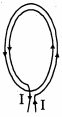
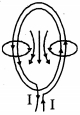
For the circular coil carrying current shown alongside,draw magnetic field lines. Decide which of its face behaves as north pole and which face as south pole. Give reason to justify your answer.
Solution
(N/A) The face of the circular coil in which the current flows in an anticlockwise direction behaves as the north pole,and the face in which the current flows in a clockwise direction behaves as the south pole.
Based on the provided image,the front face has current flowing in an anticlockwise direction,so it acts as the north pole.
The rear face has current flowing in a clockwise direction,so it acts as the south pole.
This is because magnetic field lines emerge from the north pole and enter the south pole.
Based on the provided image,the front face has current flowing in an anticlockwise direction,so it acts as the north pole.
The rear face has current flowing in a clockwise direction,so it acts as the south pole.
This is because magnetic field lines emerge from the north pole and enter the south pole.
0 likes
View Solution161
Medium
How will the magnetic field produced in a current-carrying circular coil change if we increase the:
$(i)$ value of current flowing through it?
$(ii)$ distance of point $P$ from the coil?
$(iii)$ number of turns of the coil?
$(i)$ value of current flowing through it?
$(ii)$ distance of point $P$ from the coil?
$(iii)$ number of turns of the coil?
Solution
(N/A) $(i)$ The magnetic field is directly proportional to the current flowing through the coil $(B \propto I)$. Therefore,increasing the current will increase the magnetic field.
$(ii)$ The magnetic field is inversely proportional to the distance from the coil. As the distance of point $P$ from the coil increases,the magnetic field at that point will decrease.
$(iii)$ The magnetic field is directly proportional to the number of turns in the coil $(B \propto N)$. Therefore,increasing the number of turns will increase the magnetic field.
$(ii)$ The magnetic field is inversely proportional to the distance from the coil. As the distance of point $P$ from the coil increases,the magnetic field at that point will decrease.
$(iii)$ The magnetic field is directly proportional to the number of turns in the coil $(B \propto N)$. Therefore,increasing the number of turns will increase the magnetic field.
0 likes
View Solution162
Medium
What happens to the deflection of the compass needle placed at a point near a current-carrying straight conductor:
$(a)$ If the current is increased?
$(b)$ If the direction of current in the conductor is changed (reversed)?
$(c)$ If the compass is moved away from the conductor?
$(a)$ If the current is increased?
$(b)$ If the direction of current in the conductor is changed (reversed)?
$(c)$ If the compass is moved away from the conductor?
Solution
(N/A) The deflection of the compass needle increases because the strength of the magnetic field produced by the conductor is directly proportional to the magnitude of the current flowing through it.
$(b)$ The direction of deflection in the compass needle changes (reverses) because the direction of the magnetic field lines around the conductor is reversed when the direction of the current is reversed.
$(c)$ The deflection of the compass needle decreases because the strength of the magnetic field decreases as the distance from the current-carrying conductor increases.
$(b)$ The direction of deflection in the compass needle changes (reverses) because the direction of the magnetic field lines around the conductor is reversed when the direction of the current is reversed.
$(c)$ The deflection of the compass needle decreases because the strength of the magnetic field decreases as the distance from the current-carrying conductor increases.
0 likes
View Solution163
Medium
List three sources of magnetic fields.
Solution
(N/A) $(i)$ Magnetic field produced by a permanent bar magnet.
$(ii)$ Magnetic field produced by a straight current-carrying conductor.
$(iii)$ Magnetic field produced by a current-carrying circular loop.
$(ii)$ Magnetic field produced by a straight current-carrying conductor.
$(iii)$ Magnetic field produced by a current-carrying circular loop.
0 likes
View Solution164
Easy
Name any three factors on which the magnitude of the magnetic field due to a solenoid depends.
Solution
(N/A) The magnitude of the magnetic field produced by a solenoid depends on the following three factors:
$(i)$ The strength of the current flowing through the solenoid: The magnetic field strength is directly proportional to the current.
$(ii)$ The number of turns (loops) in the solenoid: The magnetic field strength increases as the number of turns per unit length increases.
$(iii)$ The nature of the core material: Placing a soft iron rod inside the solenoid significantly increases the magnetic field strength due to magnetization.
$(i)$ The strength of the current flowing through the solenoid: The magnetic field strength is directly proportional to the current.
$(ii)$ The number of turns (loops) in the solenoid: The magnetic field strength increases as the number of turns per unit length increases.
$(iii)$ The nature of the core material: Placing a soft iron rod inside the solenoid significantly increases the magnetic field strength due to magnetization.
0 likes
View Solution165
Medium
State the condition for electromagnetic induction to take place. $A$ cylindrical bar magnet is kept along the axis of a circular coil as shown in the figure. Will there be a current induced in the coil if the magnet is rotated about its axis? Discuss.
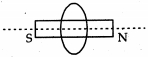
Solution
(N/A) The condition for electromagnetic induction to occur is that there must be a change in the magnetic flux linked with the coil.
This change in magnetic flux can be achieved by:
$(a)$ Relative motion between the coil and the magnet.
$(b)$ Changing the current in a nearby coil.
In the given scenario,when the cylindrical bar magnet is rotated about its own axis,the magnetic field lines associated with the magnet remain symmetric with respect to the axis of rotation. Consequently,the magnetic flux passing through the circular coil does not change over time. Since there is no change in the magnetic flux linked with the coil,no current will be induced in the coil.
This change in magnetic flux can be achieved by:
$(a)$ Relative motion between the coil and the magnet.
$(b)$ Changing the current in a nearby coil.
In the given scenario,when the cylindrical bar magnet is rotated about its own axis,the magnetic field lines associated with the magnet remain symmetric with respect to the axis of rotation. Consequently,the magnetic flux passing through the circular coil does not change over time. Since there is no change in the magnetic flux linked with the coil,no current will be induced in the coil.
0 likes
View Solution166
Medium
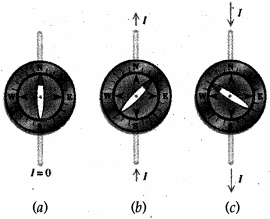
Draw a diagram to show how a magnetic needle deflects when it is placed above or below a straight conductor carrying current,depending on the direction of the current in the conductor.
Solution
(N/A) The diagram is as shown in the figure.
Consider a wire connected to a battery such that current flows through it. Place a magnetic compass directly over a horizontal wire. The needle points north when there is no current $(I = 0)$,as shown in Fig. $(a)$.
When a current is passed towards the north,the needle deflects towards the east,as shown in Fig. $(b)$.
When the current is passed towards the south,the needle deflects towards the west,as shown in Fig. $(c)$.
When the compass is placed directly below the wire,the direction of the needle's deflection is reversed.
Since a magnetic needle can be deflected only due to the presence of a magnetic field,it can be concluded that a magnetic field is produced around the current-carrying wire.
Consider a wire connected to a battery such that current flows through it. Place a magnetic compass directly over a horizontal wire. The needle points north when there is no current $(I = 0)$,as shown in Fig. $(a)$.
When a current is passed towards the north,the needle deflects towards the east,as shown in Fig. $(b)$.
When the current is passed towards the south,the needle deflects towards the west,as shown in Fig. $(c)$.
When the compass is placed directly below the wire,the direction of the needle's deflection is reversed.
Since a magnetic needle can be deflected only due to the presence of a magnetic field,it can be concluded that a magnetic field is produced around the current-carrying wire.
0 likes
View Solution167
Medium
$(a)$ Describe an activity to draw a magnetic field line outside a bar magnet from one pole to another.
$(b)$ List any two properties of magnetic field lines.
$(b)$ List any two properties of magnetic field lines.
Solution
(N/A) Place the bar magnet $NS$ on a sheet of paper and mark its boundary. Mark a point $A$ near the north pole of the magnet. Place a compass needle such that its south pole lies exactly over point $A$. Mark point $B$ on the paper at the position of the north pole of the compass needle. Move the compass needle so that its south pole now lies over $B$ and mark point $C$ at the north pole position. Repeat this process until you reach the south pole of the bar magnet. Join all these points with a smooth curve to represent a magnetic field line.
$(b)$ $(i)$ Magnetic field lines never intersect each other.
$(ii)$ Outside the magnet,magnetic field lines emerge from the north pole and merge into the south pole.
$(b)$ $(i)$ Magnetic field lines never intersect each other.
$(ii)$ Outside the magnet,magnetic field lines emerge from the north pole and merge into the south pole.
0 likes
View Solution168
Medium
$(a)$ Electric fuse is an important component of all domestic circuits. Why?
$(b)$ An electric oven of rating $2 \, kW, 220 \, V$ is operated in a domestic circuit with a current rating of $5 \, A$. What result would you expect? Explain.
$(b)$ An electric oven of rating $2 \, kW, 220 \, V$ is operated in a domestic circuit with a current rating of $5 \, A$. What result would you expect? Explain.
Solution
(B) An electric fuse is a safety device used in electrical circuits to prevent damage from excessive current flow. It protects appliances and wiring from fire hazards caused by short-circuiting or overloading.
$(b)$ The current drawn by the electric oven is calculated using the formula $I = P / V$.
Given: $P = 2000 \, W$ and $V = 220 \, V$.
$I = 2000 / 220 = 9.09 \, A$.
Since the current drawn $(9.09 \, A)$ is significantly higher than the circuit's rated capacity of $5 \, A$,the fuse will melt and break the circuit,preventing potential damage or fire.
$(b)$ The current drawn by the electric oven is calculated using the formula $I = P / V$.
Given: $P = 2000 \, W$ and $V = 220 \, V$.
$I = 2000 / 220 = 9.09 \, A$.
Since the current drawn $(9.09 \, A)$ is significantly higher than the circuit's rated capacity of $5 \, A$,the fuse will melt and break the circuit,preventing potential damage or fire.
0 likes
View Solution169
MediumMCQ
Name two safety measures commonly used in electric circuits and appliances. What precautions should be taken to avoid the overloading of domestic electric circuits?
A
Fuse and Earthing
B
Switch and Wire
C
Insulation and Socket
D
Voltage and Current
Solution
(A) Two safety measures commonly used in electric circuits and appliances are:
$(i)$ Electric Fuse: It acts as a safety device that breaks the circuit when the current exceeds a safe limit,preventing damage to appliances.
$(ii)$ Earthing: It provides a low-resistance path for leakage current to the ground,preventing electric shocks.
Precautions to avoid overloading of domestic electric circuits:
$1$. Do not connect too many high-power appliances to a single socket or extension board.
$2$. Ensure that the total load connected to the circuit does not exceed the rated capacity of the fuse or the wiring.
$(i)$ Electric Fuse: It acts as a safety device that breaks the circuit when the current exceeds a safe limit,preventing damage to appliances.
$(ii)$ Earthing: It provides a low-resistance path for leakage current to the ground,preventing electric shocks.
Precautions to avoid overloading of domestic electric circuits:
$1$. Do not connect too many high-power appliances to a single socket or extension board.
$2$. Ensure that the total load connected to the circuit does not exceed the rated capacity of the fuse or the wiring.
0 likes
View Solution170
EasyMCQ
What does the direction of the thumb indicate in the Right-Hand Thumb Rule? In what way is this rule different from Fleming's Left-Hand Rule?
A
Thumb indicates current direction; Fleming's rule indicates force direction.
B
Thumb indicates magnetic field; Fleming's rule indicates current.
C
Thumb indicates force; Fleming's rule indicates magnetic field.
D
Both rules indicate the same physical quantity.
Solution
(A) In the Right-Hand Thumb Rule,the thumb points in the direction of the conventional current flowing through a straight conductor,while the curled fingers represent the direction of the magnetic field lines around it.
In contrast,Fleming's Left-Hand Rule is used to determine the direction of the magnetic force (or motion) experienced by a current-carrying conductor when placed in an external magnetic field.
Therefore,the Right-Hand Thumb Rule relates current to the magnetic field,whereas Fleming's Left-Hand Rule relates current,magnetic field,and force.
In contrast,Fleming's Left-Hand Rule is used to determine the direction of the magnetic force (or motion) experienced by a current-carrying conductor when placed in an external magnetic field.
Therefore,the Right-Hand Thumb Rule relates current to the magnetic field,whereas Fleming's Left-Hand Rule relates current,magnetic field,and force.
0 likes
View Solution171
Easy
Why does a current-carrying conductor kept in a magnetic field experience a force? On what factors does the direction of this force depend? Name and state the rule used for the determination of the direction of this force.
Solution
(N/A) current-carrying conductor produces its own magnetic field around it. When this field interacts with an external magnetic field,it experiences a mechanical force.
The direction of this force depends on two factors:
$1$. The direction of the electric current flowing through the conductor.
$2$. The direction of the external magnetic field.
The rule used to determine the direction of this force is $Fleming's \text{ } Left-Hand \text{ } Rule$.
Statement of $Fleming's \text{ } Left-Hand \text{ } Rule$: Stretch the thumb,forefinger,and middle finger of your left hand such that they are mutually perpendicular to each other. If the forefinger points in the direction of the magnetic field,the middle finger points in the direction of the current,then the thumb will point in the direction of the force (or motion) acting on the conductor.
The direction of this force depends on two factors:
$1$. The direction of the electric current flowing through the conductor.
$2$. The direction of the external magnetic field.
The rule used to determine the direction of this force is $Fleming's \text{ } Left-Hand \text{ } Rule$.
Statement of $Fleming's \text{ } Left-Hand \text{ } Rule$: Stretch the thumb,forefinger,and middle finger of your left hand such that they are mutually perpendicular to each other. If the forefinger points in the direction of the magnetic field,the middle finger points in the direction of the current,then the thumb will point in the direction of the force (or motion) acting on the conductor.
0 likes
View Solution172
Medium
Under what condition does a current-carrying conductor kept in a magnetic field experience maximum force? On what other factors does the magnitude of this force depend? Name and state the rule used for the determination of the direction of this force.
Solution
(N/A) current-carrying conductor experiences maximum force when it is placed perpendicular to the direction of the magnetic field.
The magnitude of this force depends on the following factors:
$(i)$ The strength of the magnetic field $(B)$.
$(ii)$ The magnitude of the current flowing through the conductor $(I)$.
$(iii)$ The length of the conductor $(L)$ placed within the magnetic field.
The rule used to determine the direction of this force is Fleming's Left-Hand Rule.
Statement of Fleming's Left-Hand Rule: Stretch the thumb,forefinger,and middle finger of your left hand such that they are mutually perpendicular to each other. If the forefinger points in the direction of the magnetic field and the middle finger points in the direction of the current,then the thumb will point in the direction of the force acting on the conductor.
The magnitude of this force depends on the following factors:
$(i)$ The strength of the magnetic field $(B)$.
$(ii)$ The magnitude of the current flowing through the conductor $(I)$.
$(iii)$ The length of the conductor $(L)$ placed within the magnetic field.
The rule used to determine the direction of this force is Fleming's Left-Hand Rule.
Statement of Fleming's Left-Hand Rule: Stretch the thumb,forefinger,and middle finger of your left hand such that they are mutually perpendicular to each other. If the forefinger points in the direction of the magnetic field and the middle finger points in the direction of the current,then the thumb will point in the direction of the force acting on the conductor.
0 likes
View Solution173
Easy
$A$ coil made of insulated copper wire is connected to a galvanometer. What will happen to the deflection of the galvanometer if this coil is moved towards a stationary bar magnet and then moved away from it? Give reason for your answer and name the phenomenon involved.
Solution
(N/A) When the coil is moved towards a stationary magnet,the magnetic flux linked with the coil changes,which induces an electric current in the coil. This causes the galvanometer to show a deflection in one direction.
When the coil is moved away from the magnet,the magnetic flux linked with the coil changes in the opposite sense,inducing a current in the opposite direction. This causes the galvanometer to show a deflection in the opposite direction.
The phenomenon involved is known as electromagnetic induction.
When the coil is moved away from the magnet,the magnetic flux linked with the coil changes in the opposite sense,inducing a current in the opposite direction. This causes the galvanometer to show a deflection in the opposite direction.
The phenomenon involved is known as electromagnetic induction.
0 likes
View Solution174
Easy
What is meant by overloading of an electrical circuit? Explain two possible causes due to which overloading may occur in a household circuit. Explain one precaution that should be taken to avoid the overloading of a domestic electric circuit.
Solution
(N/A) Overloading occurs when the current in an electrical circuit increases abruptly beyond the rated capacity of the wires or the circuit.
Two possible causes for overloading in a household circuit are:
$(i)$ Accidental hike in the supply voltage: $A$ sudden increase in the voltage provided by the power supply can lead to excessive current flow.
$(ii)$ Connecting too many appliances to a single socket: Using a power strip or multiple adapters to connect several high-power devices to one socket draws more current than the circuit is designed to handle.
One precaution to avoid overloading is:
Do not connect too many high-power electrical appliances to a single socket or a single circuit simultaneously.
Two possible causes for overloading in a household circuit are:
$(i)$ Accidental hike in the supply voltage: $A$ sudden increase in the voltage provided by the power supply can lead to excessive current flow.
$(ii)$ Connecting too many appliances to a single socket: Using a power strip or multiple adapters to connect several high-power devices to one socket draws more current than the circuit is designed to handle.
One precaution to avoid overloading is:
Do not connect too many high-power electrical appliances to a single socket or a single circuit simultaneously.
0 likes
View Solution175
Medium
Write one difference between direct current $(DC)$ and alternating current $(AC)$. Which one of the two is mostly produced at power stations in our country? Name one device which provides alternating current. State one important advantage of using alternating current.
Solution
(N/A) $DC$ does not change its direction with time,whereas $AC$ reverses its direction periodically.
Most power stations in India produce $AC$.
An $AC$ generator is a device that produces alternating current.
One important advantage of using $AC$ is that electric power can be transmitted over long distances without much loss of energy.
Most power stations in India produce $AC$.
An $AC$ generator is a device that produces alternating current.
One important advantage of using $AC$ is that electric power can be transmitted over long distances without much loss of energy.
0 likes
View Solution176
Medium
Define magnetic field. $A$ compass needle gets deflected when brought near a bar magnet. Why? List three properties of magnetic field lines.
Solution
(N/A) Magnetic field is the region around a magnet where its magnetic force can be experienced.
$A$ compass needle gets deflected because the magnetic field of the bar magnet exerts a force on the poles of the compass needle.
Properties of magnetic field lines:
$(i)$ The magnetic field lines emerge from the north pole and merge at the south pole outside the magnet.
$(ii)$ They are closed continuous curves.
$(iii)$ No two magnetic field lines intersect each other.
$A$ compass needle gets deflected because the magnetic field of the bar magnet exerts a force on the poles of the compass needle.
Properties of magnetic field lines:
$(i)$ The magnetic field lines emerge from the north pole and merge at the south pole outside the magnet.
$(ii)$ They are closed continuous curves.
$(iii)$ No two magnetic field lines intersect each other.
0 likes
View Solution177
Medium
State one main difference between $AC$ and $DC$. Why is $AC$ preferred over $DC$ for long-range transmission of electric power? Name one source each of $DC$ and $AC$.
Solution
(N/A) The main difference is that $DC$ (Direct Current) flows in only one direction,whereas $AC$ (Alternating Current) reverses its direction periodically.
$AC$ is preferred for long-range transmission because it can be stepped up to high voltages using a transformer,which significantly reduces energy loss due to heat ($I^2R$ loss) in the transmission lines.
Source of $AC$: $AC$ generator (or alternator).
Source of $DC$: $DC$ generator,battery,or cell.
$AC$ is preferred for long-range transmission because it can be stepped up to high voltages using a transformer,which significantly reduces energy loss due to heat ($I^2R$ loss) in the transmission lines.
Source of $AC$: $AC$ generator (or alternator).
Source of $DC$: $DC$ generator,battery,or cell.
0 likes
View Solution178
Easy
$(a)$ Mention the colour code used for live,neutral,and earth wire.
$(b)$ You want to connect a $2 \ kW$ electric oven in the electric circuit. In which power line would you connect it and why? What may happen if you connect it wrongly in the other power line?
$(b)$ You want to connect a $2 \ kW$ electric oven in the electric circuit. In which power line would you connect it and why? What may happen if you connect it wrongly in the other power line?
Solution
(N/A) The standard colour code for wires is: Live wire is $Red$,Neutral wire is $Black$,and Earth wire is $Green$.
$(b)$ $A$ $2 \ kW$ electric oven should be connected to the $15 \ A$ power line (high-power circuit). This is because the oven draws a large amount of current $(I = P/V = 2000 \ W / 220 \ V \approx 9.09 \ A)$. If it is connected to the $5 \ A$ lighting circuit,the excessive current will cause the fuse to blow or the circuit breaker to trip,potentially damaging the wiring or causing a fire hazard.
$(b)$ $A$ $2 \ kW$ electric oven should be connected to the $15 \ A$ power line (high-power circuit). This is because the oven draws a large amount of current $(I = P/V = 2000 \ W / 220 \ V \approx 9.09 \ A)$. If it is connected to the $5 \ A$ lighting circuit,the excessive current will cause the fuse to blow or the circuit breaker to trip,potentially damaging the wiring or causing a fire hazard.
0 likes
View Solution179
Medium
$(a)$ Describe an activity to show the pattern of magnetic field lines of a bar magnet,with the help of a cardboard piece and iron filings.
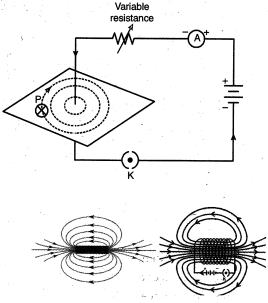
$(b)$ Compare the magnetic field of a bar magnet with that of a current-carrying solenoid with the help of a figure.
$(b)$ Compare the magnetic field of a bar magnet with that of a current-carrying solenoid with the help of a figure.
Solution
(N/A) Activity: Place a bar magnet on a sheet of white paper fixed on a drawing board. Sprinkle some iron filings uniformly around the bar magnet using a salt sprinkler. Gently tap the board. You will observe that the iron filings arrange themselves in a pattern representing the magnetic field lines of the bar magnet. The filings align along the field lines because each filing experiences a force in the magnetic field.
$(b)$ Comparison: The magnetic field lines produced by a current-carrying solenoid are very similar to those of a bar magnet. In both cases,the field lines emerge from the North pole and enter the South pole outside the magnet/solenoid. Inside,the field lines go from the South pole to the North pole. $A$ current-carrying solenoid behaves like a bar magnet with one end acting as the North pole and the other as the South pole.
$(b)$ Comparison: The magnetic field lines produced by a current-carrying solenoid are very similar to those of a bar magnet. In both cases,the field lines emerge from the North pole and enter the South pole outside the magnet/solenoid. Inside,the field lines go from the South pole to the North pole. $A$ current-carrying solenoid behaves like a bar magnet with one end acting as the North pole and the other as the South pole.
0 likes
View Solution180
Medium
$(a)$ Explain the difference between direct current and alternating current. Write one important advantage of using alternating current.
$(b)$ An air conditioner of $2 \,kW$ is used in an electric circuit having a fuse of $10 \,A$ rating. If the potential difference of the supply is $220 \,V$,will the fuse be able to withstand the current when the air conditioner is switched on? Justify your answer.
$(b)$ An air conditioner of $2 \,kW$ is used in an electric circuit having a fuse of $10 \,A$ rating. If the potential difference of the supply is $220 \,V$,will the fuse be able to withstand the current when the air conditioner is switched on? Justify your answer.
Solution
(B) The current whose direction reverses periodically is called alternating current $(AC)$,whereas direct current $(DC)$ flows in a constant direction.
The primary advantage of $AC$ is that it can be transmitted over long distances with minimal power loss compared to $DC$.
$(b)$ Given: Power $(P)$ = $2 \,kW = 2000 \,W$,Voltage $(V)$ = $220 \,V$.
Using the formula $P = VI$,the current $(I)$ is calculated as:
$I = \frac{P}{V} = \frac{2000}{220} \approx 9.09 \,A$.
Since the calculated current $(9.09 \,A)$ is less than the fuse rating of $10 \,A$,the fuse will withstand the current and will not blow off when the air conditioner is switched on.
The primary advantage of $AC$ is that it can be transmitted over long distances with minimal power loss compared to $DC$.
$(b)$ Given: Power $(P)$ = $2 \,kW = 2000 \,W$,Voltage $(V)$ = $220 \,V$.
Using the formula $P = VI$,the current $(I)$ is calculated as:
$I = \frac{P}{V} = \frac{2000}{220} \approx 9.09 \,A$.
Since the calculated current $(9.09 \,A)$ is less than the fuse rating of $10 \,A$,the fuse will withstand the current and will not blow off when the air conditioner is switched on.
0 likes
View Solution181
Difficult
$(a)$ Describe an activity to determine the direction of magnetic field produced by a current-carrying straight conductor. Also,show that the direction of the magnetic field is reversed on reversing the direction of current.
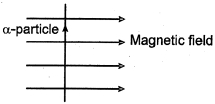
$(b)$ An $\alpha$-particle (which is a positively charged particle) enters a uniform magnetic field at right angles to it as shown below. Stating the relevant principle,explain in which direction will this $\alpha$-particle move?
$(b)$ An $\alpha$-particle (which is a positively charged particle) enters a uniform magnetic field at right angles to it as shown below. Stating the relevant principle,explain in which direction will this $\alpha$-particle move?
Solution
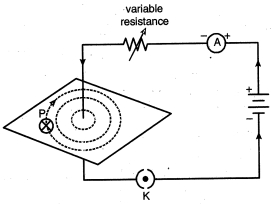
(N/A) Take a battery $(12\, V)$,a variable resistance (or a rheostat),an ammeter $(0-5\, A)$,a plug key,and a long straight thick copper wire. Insert the thick wire through the center,normal to the plane of a rectangular cardboard. Take care that the cardboard is fixed and does not slide.
Connect the copper wire vertically in series with the battery,a plug key,and a rheostat. Sprinkle some iron filings uniformly on the cardboard. Keep the rheostat at a fixed position and note the current through the ammeter. Close the key so that a current flows through the wire. Gently tap the cardboard a few times. You would find that the iron filings align themselves in a pattern of concentric circles around the copper wire. This represents the magnetic field around the current-carrying conductor.
If the direction of current through the straight conductor is reversed (by reversing the battery terminals),the direction of the magnetic field lines also gets reversed.
$(b)$ Here,the motion of the $\alpha$-particle ($+$ve charge) in the given direction represents the direction of conventional current. By using Fleming's left-hand rule,we find that the force acting on the $\alpha$-particle is directed perpendicular to the plane of the paper,pointing inward. Hence,the $\alpha$-particle will be deflected into the plane of the paper.
Connect the copper wire vertically in series with the battery,a plug key,and a rheostat. Sprinkle some iron filings uniformly on the cardboard. Keep the rheostat at a fixed position and note the current through the ammeter. Close the key so that a current flows through the wire. Gently tap the cardboard a few times. You would find that the iron filings align themselves in a pattern of concentric circles around the copper wire. This represents the magnetic field around the current-carrying conductor.
If the direction of current through the straight conductor is reversed (by reversing the battery terminals),the direction of the magnetic field lines also gets reversed.
$(b)$ Here,the motion of the $\alpha$-particle ($+$ve charge) in the given direction represents the direction of conventional current. By using Fleming's left-hand rule,we find that the force acting on the $\alpha$-particle is directed perpendicular to the plane of the paper,pointing inward. Hence,the $\alpha$-particle will be deflected into the plane of the paper.
0 likes
View Solution182
Medium
What is a solenoid? Sketch magnetic field lines produced around a current-carrying solenoid. Mark the region where the field is uniform. Compare its field with that of a bar magnet.
Solution
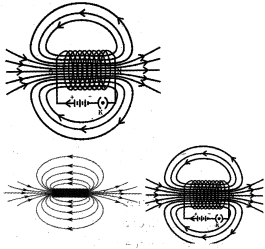
(N/A) solenoid is a coil of many circular turns of insulated copper wire wrapped closely in the shape of a cylinder.
The magnetic field lines around a current-carrying solenoid are similar to those of a bar magnet. The field lines emerge from one end and enter the other,forming closed loops.
The magnetic field is uniform inside the solenoid,which is represented by parallel field lines along the axis of the solenoid.
Comparison with a bar magnet:
$1$. The magnetic field pattern of a current-carrying solenoid is identical to that of a bar magnet.
$2$. One end of the solenoid behaves like the North pole $(N)$,and the other end behaves like the South pole $(S)$.
$3$. Like a bar magnet,the field lines outside the solenoid go from the North pole to the South pole,and inside,they go from the South pole to the North pole.
The magnetic field lines around a current-carrying solenoid are similar to those of a bar magnet. The field lines emerge from one end and enter the other,forming closed loops.
The magnetic field is uniform inside the solenoid,which is represented by parallel field lines along the axis of the solenoid.
Comparison with a bar magnet:
$1$. The magnetic field pattern of a current-carrying solenoid is identical to that of a bar magnet.
$2$. One end of the solenoid behaves like the North pole $(N)$,and the other end behaves like the South pole $(S)$.
$3$. Like a bar magnet,the field lines outside the solenoid go from the North pole to the South pole,and inside,they go from the South pole to the North pole.
0 likes
View Solution183
Medium
$(a)$ State the function of a fuse in an electric circuit. How is it connected in the domestic circuit?
$(b)$ An electric fuse of rating $3 \, A$ is connected in a circuit in which an electric iron of power $1.5 \, kW$ is connected,which operates at $220 \, V$. What would happen? Explain.
$(b)$ An electric fuse of rating $3 \, A$ is connected in a circuit in which an electric iron of power $1.5 \, kW$ is connected,which operates at $220 \, V$. What would happen? Explain.
Solution
(D) The function of a fuse is to protect electric circuits and appliances by stopping the flow of excessively high electric current. It is connected in series with the live wire in a domestic circuit.
$(b)$ Given: Power $(P) = 1.5 \, kW = 1500 \, W$,Voltage $(V) = 220 \, V$.
The current $(I)$ drawn by the electric iron is calculated as:
$I = \frac{P}{V} = \frac{1500 \, W}{220 \, V} \approx 6.82 \, A$.
Since the current required by the electric iron $(6.82 \, A)$ is significantly higher than the fuse rating $(3 \, A)$,the fuse wire will get heated and melt due to the excessive current,breaking the circuit. Consequently,the electric iron will stop working.
$(b)$ Given: Power $(P) = 1.5 \, kW = 1500 \, W$,Voltage $(V) = 220 \, V$.
The current $(I)$ drawn by the electric iron is calculated as:
$I = \frac{P}{V} = \frac{1500 \, W}{220 \, V} \approx 6.82 \, A$.
Since the current required by the electric iron $(6.82 \, A)$ is significantly higher than the fuse rating $(3 \, A)$,the fuse wire will get heated and melt due to the excessive current,breaking the circuit. Consequently,the electric iron will stop working.
0 likes
View Solution184
Medium
Explain the meanings of the words "electromagnetic" and "induction" in the term electromagnetic induction. List three factors on which the value of induced current produced in a circuit depends. Name and state the rule used to determine the direction of induced current. State one practical application of this phenomenon in everyday life.
Solution
(N/A) Electromagnetic refers to the production of electric current in a coil under the influence of a magnetic field. Induction refers to the process of generating an electrical flow in a conductor without direct physical contact with a magnetized body.
Factors affecting the magnitude of induced current:
$(i)$ Number of turns in the coil.
$(ii)$ Strength of the magnetic field.
$(iii)$ Relative speed of the magnet with respect to the coil.
Rule: Fleming's Right-Hand Rule.
Statement: Stretch the thumb, forefinger, and middle finger of your right hand such that they are mutually perpendicular to each other. If the forefinger points in the direction of the magnetic field and the thumb indicates the direction of motion of the conductor, then the middle finger will point in the direction of the induced current.
Practical application: Electric Generator.
Factors affecting the magnitude of induced current:
$(i)$ Number of turns in the coil.
$(ii)$ Strength of the magnetic field.
$(iii)$ Relative speed of the magnet with respect to the coil.
Rule: Fleming's Right-Hand Rule.
Statement: Stretch the thumb, forefinger, and middle finger of your right hand such that they are mutually perpendicular to each other. If the forefinger points in the direction of the magnetic field and the thumb indicates the direction of motion of the conductor, then the middle finger will point in the direction of the induced current.
Practical application: Electric Generator.
0 likes
View Solution185
Medium
$(a)$ Draw magnetic field lines of a bar magnet. "Two magnetic field lines never intersect each other". Why?
$(b)$ An electric oven of $1.5 \, kW$ is operated in a domestic circuit $(220 \, V)$ that has a current rating of $5 \, A$. What result do you expect in this case? Explain.
$(b)$ An electric oven of $1.5 \, kW$ is operated in a domestic circuit $(220 \, V)$ that has a current rating of $5 \, A$. What result do you expect in this case? Explain.
Solution
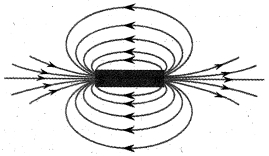
(N/A) Magnetic field lines around a bar magnet originate from the North pole and enter the South pole outside the magnet, forming closed loops.
If two magnetic field lines were to intersect at a point, it would imply that there are two directions of the magnetic field at that single point, which is physically impossible.
$(b)$ Given: Power $(P) = 1.5 \, kW = 1500 \, W$, Voltage $(V) = 220 \, V$, Current rating $= 5 \, A$.
Using the formula $P = V \times I$, the current $(I)$ drawn by the oven is:
$I = \frac{P}{V} = \frac{1500 \, W}{220 \, V} \approx 6.82 \, A$.
Since the current drawn $(6.82 \, A)$ is significantly higher than the current rating of the circuit $(5 \, A)$, the circuit will experience an overload. This will likely cause the fuse to blow or the circuit breaker to trip, cutting off the power supply to prevent damage to the wiring.
If two magnetic field lines were to intersect at a point, it would imply that there are two directions of the magnetic field at that single point, which is physically impossible.
$(b)$ Given: Power $(P) = 1.5 \, kW = 1500 \, W$, Voltage $(V) = 220 \, V$, Current rating $= 5 \, A$.
Using the formula $P = V \times I$, the current $(I)$ drawn by the oven is:
$I = \frac{P}{V} = \frac{1500 \, W}{220 \, V} \approx 6.82 \, A$.
Since the current drawn $(6.82 \, A)$ is significantly higher than the current rating of the circuit $(5 \, A)$, the circuit will experience an overload. This will likely cause the fuse to blow or the circuit breaker to trip, cutting off the power supply to prevent damage to the wiring.
0 likes
View Solution186
Medium
$(a)$ Explain any three properties of magnetic field lines.
$(b)$ Give two uses of magnetic compass.
$(b)$ Give two uses of magnetic compass.
Solution
(N/A) Properties of magnetic field lines:
$(i)$ Magnetic field lines emerge from the north pole and merge at the south pole outside the magnet.
$(ii)$ They form continuous closed loops.
$(iii)$ The strength of the magnetic field is indicated by the degree of closeness of the field lines; they are stronger where the field lines are crowded.
$(iv)$ No two magnetic field lines can ever intersect each other,as that would imply two directions of the magnetic field at a single point,which is impossible.
$(b)$ Uses of a magnetic compass:
$(i)$ It is used to determine the cardinal directions (North,South,East,West).
$(ii)$ It is used to detect the presence of a magnetic field around a current-carrying conductor or a magnetic material.
$(i)$ Magnetic field lines emerge from the north pole and merge at the south pole outside the magnet.
$(ii)$ They form continuous closed loops.
$(iii)$ The strength of the magnetic field is indicated by the degree of closeness of the field lines; they are stronger where the field lines are crowded.
$(iv)$ No two magnetic field lines can ever intersect each other,as that would imply two directions of the magnetic field at a single point,which is impossible.
$(b)$ Uses of a magnetic compass:
$(i)$ It is used to determine the cardinal directions (North,South,East,West).
$(ii)$ It is used to detect the presence of a magnetic field around a current-carrying conductor or a magnetic material.
0 likes
View Solution187
Medium
$(a)$ An electric current is passed in a horizontal copper wire from east to west. Explain your observations when a compass needle is placed $(i)$ below this wire,$(ii)$ above the wire. Draw inference from your observations.
$(b)$ List the factors on which the strength of the magnetic field due to a straight conductor carrying current depend. How should these be changed to decrease magnetic field at a point?
$(b)$ List the factors on which the strength of the magnetic field due to a straight conductor carrying current depend. How should these be changed to decrease magnetic field at a point?
Solution
(A) According to Oersted's experiment and the Right-Hand Thumb Rule,when current flows from east to west,the magnetic field lines form concentric circles around the wire. $(i)$ When the compass is placed below the wire,the north pole of the needle will deflect towards the south. $(ii)$ When the compass is placed above the wire,the north pole of the needle will deflect towards the north. Inference: The direction of the magnetic field depends on the direction of the current and the position of the point relative to the wire.
$(b)$ The strength of the magnetic field $(B)$ due to a straight current-carrying conductor depends on: $(i)$ The magnitude of the electric current $(I)$: $B$ is directly proportional to $I$. $(ii)$ The perpendicular distance $(r)$ from the conductor: $B$ is inversely proportional to $r$. To decrease the magnetic field at a point,one should: $(i)$ Decrease the magnitude of the current flowing through the conductor. $(ii)$ Increase the perpendicular distance of the point from the conductor.
$(b)$ The strength of the magnetic field $(B)$ due to a straight current-carrying conductor depends on: $(i)$ The magnitude of the electric current $(I)$: $B$ is directly proportional to $I$. $(ii)$ The perpendicular distance $(r)$ from the conductor: $B$ is inversely proportional to $r$. To decrease the magnetic field at a point,one should: $(i)$ Decrease the magnitude of the current flowing through the conductor. $(ii)$ Increase the perpendicular distance of the point from the conductor.
0 likes
View Solution188
Medium
$(a)$ Name two electrical appliances of daily use in which an electric motor is used.
$(b)$ Name and state the principle on which an electric motor works.
$(b)$ Name and state the principle on which an electric motor works.
Solution
(N/A) Electric motors are commonly used in appliances such as electric fans,washing machines,and mixers.
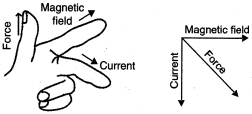
$(b)$ An electric motor works on the principle that a current-carrying conductor placed in a magnetic field experiences a mechanical force.
Fleming's Left-Hand Rule: If we stretch the thumb,forefinger,and middle finger of our left hand such that they are mutually perpendicular to each other,then the forefinger points in the direction of the magnetic field,the middle finger points in the direction of the current,and the thumb gives the direction of the force acting on the conductor.
$(b)$ An electric motor works on the principle that a current-carrying conductor placed in a magnetic field experiences a mechanical force.
Fleming's Left-Hand Rule: If we stretch the thumb,forefinger,and middle finger of our left hand such that they are mutually perpendicular to each other,then the forefinger points in the direction of the magnetic field,the middle finger points in the direction of the current,and the thumb gives the direction of the force acting on the conductor.
0 likes
View Solution189
Medium
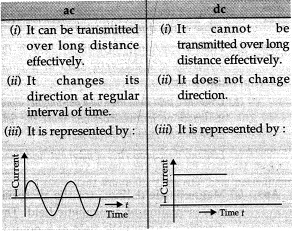
$(a)$ Write three differences between $AC$ and $DC$.
$(b)$ State the frequency of $AC$ supply in India and mention the potential difference between the neutral and live wire in a domestic circuit.
How many times does $AC$ change its direction in one second?
$(b)$ State the frequency of $AC$ supply in India and mention the potential difference between the neutral and live wire in a domestic circuit.
How many times does $AC$ change its direction in one second?
Solution
(N/A) Differences between $AC$ and $DC$:
| Feature | $AC$ | $DC$ |
| :--- | :--- | :--- |
| $(i)$ Transmission | Can be transmitted over long distances effectively. | Cannot be transmitted over long distances effectively. |
| $(ii)$ Direction | Changes its direction at regular intervals of time. | Does not change its direction. |
| $(iii)$ Representation | Represented by a sinusoidal wave. | Represented by a straight line parallel to the time axis. |
$(b)$
- The frequency of $AC$ supply in India is $50 \, Hz$.
- The potential difference between the neutral and live wire in a domestic circuit is $220 \, V$ to $240 \, V$ (standard is $220 \, V$).
- Since the frequency is $50 \, Hz$,the current completes $50$ cycles per second. In each cycle,the current changes direction twice. Therefore,the $AC$ changes its direction $50 \times 2 = 100$ times in one second.
| Feature | $AC$ | $DC$ |
| :--- | :--- | :--- |
| $(i)$ Transmission | Can be transmitted over long distances effectively. | Cannot be transmitted over long distances effectively. |
| $(ii)$ Direction | Changes its direction at regular intervals of time. | Does not change its direction. |
| $(iii)$ Representation | Represented by a sinusoidal wave. | Represented by a straight line parallel to the time axis. |
$(b)$
- The frequency of $AC$ supply in India is $50 \, Hz$.
- The potential difference between the neutral and live wire in a domestic circuit is $220 \, V$ to $240 \, V$ (standard is $220 \, V$).
- Since the frequency is $50 \, Hz$,the current completes $50$ cycles per second. In each cycle,the current changes direction twice. Therefore,the $AC$ changes its direction $50 \times 2 = 100$ times in one second.
0 likes
View Solution190
Difficult
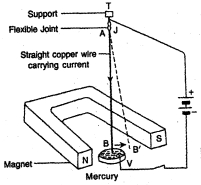
Describe an experiment to demonstrate the force acting on a current-carrying conductor placed in a magnetic field.
Solution
(N/A) thick,copper wire $AB$ is suspended vertically from a support $T$ by means of a flexible joint $J.$ The lower end $B$ of this wire is free to move between the poles of a $U$-shaped magnet $M.$ The lower end $B$ of the wire just touches the surface of mercury kept in a shallow vessel $V$ so that it can move when a force acts on it. The positive terminal of a battery is connected to end $A$ of the wire. The circuit is completed by dipping another wire from the negative terminal of the battery into the mercury in the vessel. We know that mercury is a liquid which is a good conductor of electricity,so the circuit is completed.
On pressing the switch,a current flows in the wire $AB$ in the vertically downward direction. The wire $AB$ is pushed in the forward direction (towards south) and its lower end $B$ reaches the position $B',$ so that the wire comes to the new position $AB',$ as shown by the dotted line in the figure. When the lower end $B$ of the hanging wire comes forward to $B',$ its contact with the mercury surface is broken,due to which the circuit breaks and the current stops flowing in the wire $AB.$
Since no current flows in the wire,no force acts on the wire in this position and it falls back to its original position. As soon as the wire falls back,its lower end again touches the mercury surface,current starts flowing in the wire,and it is pushed again. This reaction is repeated as long as the current is passed in wire $AB.$ It may be noted that the current-carrying wire is pushed forward because a force is exerted on it by the magnetic field of the $U$-shaped magnet. From this experiment,we conclude that when a current-carrying conductor is placed in a magnetic field,a mechanical force is exerted on the conductor which makes it move.
On pressing the switch,a current flows in the wire $AB$ in the vertically downward direction. The wire $AB$ is pushed in the forward direction (towards south) and its lower end $B$ reaches the position $B',$ so that the wire comes to the new position $AB',$ as shown by the dotted line in the figure. When the lower end $B$ of the hanging wire comes forward to $B',$ its contact with the mercury surface is broken,due to which the circuit breaks and the current stops flowing in the wire $AB.$
Since no current flows in the wire,no force acts on the wire in this position and it falls back to its original position. As soon as the wire falls back,its lower end again touches the mercury surface,current starts flowing in the wire,and it is pushed again. This reaction is repeated as long as the current is passed in wire $AB.$ It may be noted that the current-carrying wire is pushed forward because a force is exerted on it by the magnetic field of the $U$-shaped magnet. From this experiment,we conclude that when a current-carrying conductor is placed in a magnetic field,a mechanical force is exerted on the conductor which makes it move.
0 likes
View Solution191
Medium
Explain what is short circuiting and overloading in an electric supply.
Solution
(N/A) Short circuiting is the connection between two points in a circuit across which the resistance is very low. As a result,most of the current bypasses part of the circuit and flows between these two points. Short circuiting occurs when the live wire comes in direct contact with the neutral wire,such that a zero-resistance path is provided to the current. The current then does not pass through the appliance,but a heavy current passes through the wires of the circuit.
Overloading: Every circuit is designed to carry a pre-determined amount of power. When the power demand in the circuit exceeds the pre-determined capacity,the circuit is said to be overloaded.
Overloading: Every circuit is designed to carry a pre-determined amount of power. When the power demand in the circuit exceeds the pre-determined capacity,the circuit is said to be overloaded.
0 likes
View Solution192
Medium
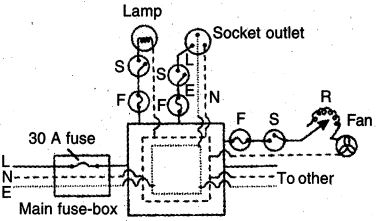
Explain with the help of a figure the ring system of wiring in domestic wiring.
Solution
(N/A) The ring system is as shown in the figure.
It consists of a ring-circuit. Wires starting from the main fuse-box run around all the main rooms of the house and then return to the fuse-box again.
The fuse-box contains a fuse with a rating of about $30\, A$.
$A$ separate connection is taken from the live wire of the ring for each appliance.
The terminal of the appliance is connected to the live wire through a separate fuse and a switch.
If the fuse of one appliance blows,it does not affect the other appliances.
For each appliance,the wires used for connection should have the proper current-carrying capacity.
It consists of a ring-circuit. Wires starting from the main fuse-box run around all the main rooms of the house and then return to the fuse-box again.
The fuse-box contains a fuse with a rating of about $30\, A$.
$A$ separate connection is taken from the live wire of the ring for each appliance.
The terminal of the appliance is connected to the live wire through a separate fuse and a switch.
If the fuse of one appliance blows,it does not affect the other appliances.
For each appliance,the wires used for connection should have the proper current-carrying capacity.
0 likes
View Solution193
Medium
What are the safety measures to be taken while dealing with household electricity?
Solution
(N/A) Electricity is an essential and convenient source of energy in our daily lives,but it can be hazardous if not handled correctly. The following safety measures should be observed:
$(i)$ Use high-quality wires with appropriate amperage and proper insulation.
$(ii)$ Cover all exposed wires and joints with insulating tape.
$(iii)$ Ensure all connections at plugs,switches,and sockets are tight.
$(iv)$ Replace any defective plugs,switches,or sockets immediately.
$(v)$ Never touch any part of an electrical circuit without wearing rubber shoes or rubber gloves.
$(vi)$ Use a fuse or $MCB$ (Miniature Circuit Breaker) of the correct rating and material.
$(vii)$ All electrical appliances must be properly earthed.
$(viii)$ Always connect switches and fuses to the live wire.
$(ix)$ Turn off the main switch in the event of a short circuit or fire.
$(x)$ Never use water to extinguish a fire caused by electricity.
$(i)$ Use high-quality wires with appropriate amperage and proper insulation.
$(ii)$ Cover all exposed wires and joints with insulating tape.
$(iii)$ Ensure all connections at plugs,switches,and sockets are tight.
$(iv)$ Replace any defective plugs,switches,or sockets immediately.
$(v)$ Never touch any part of an electrical circuit without wearing rubber shoes or rubber gloves.
$(vi)$ Use a fuse or $MCB$ (Miniature Circuit Breaker) of the correct rating and material.
$(vii)$ All electrical appliances must be properly earthed.
$(viii)$ Always connect switches and fuses to the live wire.
$(ix)$ Turn off the main switch in the event of a short circuit or fire.
$(x)$ Never use water to extinguish a fire caused by electricity.
0 likes
View Solution194
Medium
$(a)$ What are magnetic field lines? How is the direction of a magnetic field at a point determined?
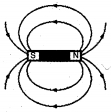
$(b)$ Draw two field lines around a bar magnet along its length on its two sides and mark the field directions on them by arrow marks.
$(c)$ List any three properties of magnetic field lines.
$(b)$ Draw two field lines around a bar magnet along its length on its two sides and mark the field directions on them by arrow marks.
$(c)$ List any three properties of magnetic field lines.
Solution
(N/A) Magnetic field lines are the pictorial representation of a magnetic field. The direction of a magnetic field at a point is determined by placing a magnetic compass (or magnetic needle) at that point. The direction in which the north pole of the compass needle points gives the direction of the magnetic field at that point.
$(b)$ The field lines around a bar magnet are shown in the figure.
$(c)$ Properties of magnetic field lines are:
$(i)$ They emerge from the north pole and merge at the south pole outside the magnet.
$(ii)$ They are continuous closed curves.
$(iii)$ No two field lines can intersect each other.
$(b)$ The field lines around a bar magnet are shown in the figure.
$(c)$ Properties of magnetic field lines are:
$(i)$ They emerge from the north pole and merge at the south pole outside the magnet.
$(ii)$ They are continuous closed curves.
$(iii)$ No two field lines can intersect each other.
0 likes
View Solution195
Medium
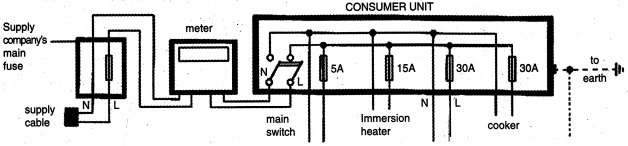
$(a)$ Draw a schematic labelled diagram of a domestic wiring circuit which includes $(i)$ a main fuse,$(ii)$ a power meter,$(iii)$ one light point,and $(iv)$ a power plug.
$(b)$ Why is it necessary to connect an earth wire to electric appliances having metallic covers?
$(b)$ Why is it necessary to connect an earth wire to electric appliances having metallic covers?
Solution
(N/A) The schematic diagram of a domestic wiring circuit is provided in the image.
$(b)$ It is necessary to connect an earth wire to electrical appliances having metallic covers to protect us from the harmful effects of electric shock. In the event of any leakage of current or any other electrical defect,the earth wire provides a low-resistance path to the ground,thereby carrying the excess current to the earth and preventing the user from receiving a shock.
$(b)$ It is necessary to connect an earth wire to electrical appliances having metallic covers to protect us from the harmful effects of electric shock. In the event of any leakage of current or any other electrical defect,the earth wire provides a low-resistance path to the ground,thereby carrying the excess current to the earth and preventing the user from receiving a shock.
0 likes
View Solution196
Medium
Why is pure iron not used for making permanent magnets? Name one material used for making permanent magnets. Describe how permanent magnets are made electrically. State two examples of electrical instruments made by using permanent magnets.
Solution
(N/A) Pure iron is not used for making permanent magnets because it gets easily demagnetized.
$Alnico$,an alloy of iron,nickel,cobalt,and aluminum,is used for making permanent magnets.
Permanent magnets are made electrically by placing a ferromagnetic material (like $Alnico$) inside a solenoid and passing a strong direct current through the coil for a sufficient duration. The magnetic field produced by the solenoid aligns the magnetic domains within the material,resulting in a permanent magnet.
Two examples of electrical instruments that use permanent magnets are $electric$ $motors$ and $electric$ $bells$.
$Alnico$,an alloy of iron,nickel,cobalt,and aluminum,is used for making permanent magnets.
Permanent magnets are made electrically by placing a ferromagnetic material (like $Alnico$) inside a solenoid and passing a strong direct current through the coil for a sufficient duration. The magnetic field produced by the solenoid aligns the magnetic domains within the material,resulting in a permanent magnet.
Two examples of electrical instruments that use permanent magnets are $electric$ $motors$ and $electric$ $bells$.
0 likes
View Solution197
Medium
$(a)$ What is an electromagnet? What does it consist of?
$(b)$ Name one material in each case which is used to make a: $(i)$ permanent magnet $(ii)$ temporary magnet.
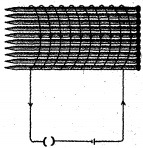
$(c)$ Describe an activity to show how you can make an electromagnet in your school laboratory.
$(b)$ Name one material in each case which is used to make a: $(i)$ permanent magnet $(ii)$ temporary magnet.
$(c)$ Describe an activity to show how you can make an electromagnet in your school laboratory.
Solution
(N/A) An electromagnet is a device that produces a magnetic field around its conductor coil when an electric current is passed through it. It consists of a core of soft iron or its alloy and a solenoid conductor coil wound around the core.
$(b)$ $(i)$ Alnico alloy is used for making permanent magnets.
$(ii)$ Soft iron is used for making temporary magnets.
$(c)$ Take about $10$ iron nails of equal length and wrap an insulated copper wire around them in the form of a solenoid coil. Now,connect this arrangement to a battery and a key switch as shown in the diagram. When the current is passed through the coil,the nails inside the coil act as a core and become magnetized. Such an arrangement is called an electromagnet.
$(b)$ $(i)$ Alnico alloy is used for making permanent magnets.
$(ii)$ Soft iron is used for making temporary magnets.
$(c)$ Take about $10$ iron nails of equal length and wrap an insulated copper wire around them in the form of a solenoid coil. Now,connect this arrangement to a battery and a key switch as shown in the diagram. When the current is passed through the coil,the nails inside the coil act as a core and become magnetized. Such an arrangement is called an electromagnet.
0 likes
View Solution198
Medium
$(a)$ What is meant by a 'magnetic field'?
$(b)$ How is the direction of magnetic field at a point determined?
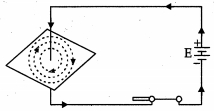
$(c)$ Describe an activity to demonstrate the direction of the magnetic field generated around a current-carrying conductor.
$(d)$ What is the direction of the magnetic field at the centre of a current-carrying circular loop?
$(b)$ How is the direction of magnetic field at a point determined?
$(c)$ Describe an activity to demonstrate the direction of the magnetic field generated around a current-carrying conductor.
$(d)$ What is the direction of the magnetic field at the centre of a current-carrying circular loop?
Solution
(N/A) magnetic field is the region surrounding a magnet or a current-carrying conductor in which its magnetic influence can be experienced by other magnetic materials.
$(b)$ The direction of the magnetic field at a point is determined using a magnetic compass. The north pole of the compass needle points in the direction of the magnetic field. It can also be determined using the Right-Hand Thumb Rule.
$(c)$ Activity: Take a piece of cardboard and pass a straight copper wire through its centre,perpendicular to the plane of the cardboard. Connect the ends of the wire to a battery and a switch. Sprinkle some iron filings uniformly on the cardboard. When the current is passed through the wire,tap the cardboard gently. You will observe that the iron filings align themselves in a pattern of concentric circles around the wire. These circles represent the magnetic field lines. The direction of these lines can be determined by placing a magnetic compass at different points on the circles. If the direction of the current is reversed,the direction of the magnetic field lines also reverses.
$(d)$ At the centre of a current-carrying circular loop,the magnetic field lines are straight and perpendicular to the plane of the loop.
$(b)$ The direction of the magnetic field at a point is determined using a magnetic compass. The north pole of the compass needle points in the direction of the magnetic field. It can also be determined using the Right-Hand Thumb Rule.
$(c)$ Activity: Take a piece of cardboard and pass a straight copper wire through its centre,perpendicular to the plane of the cardboard. Connect the ends of the wire to a battery and a switch. Sprinkle some iron filings uniformly on the cardboard. When the current is passed through the wire,tap the cardboard gently. You will observe that the iron filings align themselves in a pattern of concentric circles around the wire. These circles represent the magnetic field lines. The direction of these lines can be determined by placing a magnetic compass at different points on the circles. If the direction of the current is reversed,the direction of the magnetic field lines also reverses.
$(d)$ At the centre of a current-carrying circular loop,the magnetic field lines are straight and perpendicular to the plane of the loop.
0 likes
View Solution199
Medium
$(a)$ What is the function of an earth wire in electrical instruments? Why is it necessary to earth the metallic electric appliances?
$(b)$ Explain what is short-circuiting and overloading in an electric supply.
$(c)$ What is the usual capacity of the fuse wire in the line to feed:
$(i)$ lights and fans?
$(ii)$ appliances of $2 \,kW$ or more power?
$(b)$ Explain what is short-circuiting and overloading in an electric supply.
$(c)$ What is the usual capacity of the fuse wire in the line to feed:
$(i)$ lights and fans?
$(ii)$ appliances of $2 \,kW$ or more power?
Solution
(N/A) The earth wire provides a low-resistance path for the current to flow to the ground in case of any leakage,preventing electric shock to the user. It is necessary to earth metallic appliances to protect the user from accidental electric shocks if the live wire touches the metallic casing.
$(b)$ Short-circuiting: This occurs when the live wire comes into direct contact with the neutral wire,causing a sudden,massive increase in current due to zero resistance in the path.
Overloading: This occurs when too many electrical appliances are connected to a single socket or circuit,drawing current beyond the capacity of the wires,which can lead to overheating.
$(c)$ $(i)$ For lights and fans,the fuse capacity is $5 \,A$.
$(ii)$ For appliances of $2 \,kW$ or more,the fuse capacity is $15 \,A$.
$(b)$ Short-circuiting: This occurs when the live wire comes into direct contact with the neutral wire,causing a sudden,massive increase in current due to zero resistance in the path.
Overloading: This occurs when too many electrical appliances are connected to a single socket or circuit,drawing current beyond the capacity of the wires,which can lead to overheating.
$(c)$ $(i)$ For lights and fans,the fuse capacity is $5 \,A$.
$(ii)$ For appliances of $2 \,kW$ or more,the fuse capacity is $15 \,A$.
0 likes
View Solution200
Difficult
Describe in short an activity to:
$(i)$ demonstrate the pattern of magnetic field lines around a straight current-carrying conductor, and
$(ii)$ find the direction of the magnetic field produced for a given direction of current in the conductor. Name and state the rule to find the direction of the magnetic field associated with a current-carrying conductor. Apply this rule to determine the direction of the magnetic field inside and outside a current-carrying circular loop lying horizontally on a table. Assume that the current through the loop is anticlockwise.
$(i)$ demonstrate the pattern of magnetic field lines around a straight current-carrying conductor, and
$(ii)$ find the direction of the magnetic field produced for a given direction of current in the conductor. Name and state the rule to find the direction of the magnetic field associated with a current-carrying conductor. Apply this rule to determine the direction of the magnetic field inside and outside a current-carrying circular loop lying horizontally on a table. Assume that the current through the loop is anticlockwise.
Solution
(N/A) $(i)$ Take a battery $(12 \, V)$, a variable resistance (or a rheostat), an ammeter $(0-5 \, A)$, a plug key, and a long straight thick copper wire. Insert the thick wire through the centre, normal to the plane of a rectangular cardboard. Take care that the cardboard is fixed and does not slide up or down. Connect the copper wire vertically between the points $X$ and $Y$ in series with the battery, a plug, and a key. Sprinkle some iron filings uniformly on the cardboard. Keep the variable of the rheostat at a fixed position and note the current through the ammeter. Close the key so that a current flows through the wire. Ensure that the copper wire placed between the points $X$ and $Y$ remains vertically straight. Gently tap the cardboard a few times. Observe the pattern of the iron filings. You would find that the iron filings align themselves showing a pattern of concentric circles around the copper wire.
$(ii)$ When a magnetic compass is placed on these lines, it experiences a force in the direction of the magnetic field. Thus, the direction of deflection of the needle of the compass gives the direction of the magnetic field. Now, when the current is reversed, the direction of deflection of the needle also reverses. This shows that the direction of the magnetic field has also reversed. The rule is the Right-Hand Thumb Rule. It states that: "Imagine that you are holding a current-carrying straight conductor in your right hand such that your thumb points towards the direction of current. Then your fingers will wrap around the conductor in the direction of the field lines of the magnetic field."
For a circular loop lying horizontally on a table with anticlockwise current: By applying the Right-Hand Thumb Rule, the magnetic field lines inside the loop will be directed vertically upwards, and outside the loop, they will be directed vertically downwards.
$(ii)$ When a magnetic compass is placed on these lines, it experiences a force in the direction of the magnetic field. Thus, the direction of deflection of the needle of the compass gives the direction of the magnetic field. Now, when the current is reversed, the direction of deflection of the needle also reverses. This shows that the direction of the magnetic field has also reversed. The rule is the Right-Hand Thumb Rule. It states that: "Imagine that you are holding a current-carrying straight conductor in your right hand such that your thumb points towards the direction of current. Then your fingers will wrap around the conductor in the direction of the field lines of the magnetic field."
For a circular loop lying horizontally on a table with anticlockwise current: By applying the Right-Hand Thumb Rule, the magnetic field lines inside the loop will be directed vertically upwards, and outside the loop, they will be directed vertically downwards.
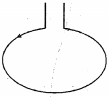
0 likes
View SolutionMagnetic Effects of Electric Current — Mix Examples - Magnetic Effects of Electric Current · Frequently Asked Questions
1Are these Magnetic Effects of Electric Current questions useful for JEE and NEET?
Yes. All questions in this section are mapped to JEE Main and NEET exam patterns. Previous year questions from JEE Main, NEET, GUJCET and state-level exams are included with full solutions.
2Can I switch to Hindi or Gujarati for these questions?
Yes. Use the language tabs in the hero section or the sidebar to view the same questions and solutions in English, Hindi or Gujarati.
3How do I generate a question paper from this subtopic?
Use the Vedclass Exam Paper Generator — select the chapter and subtopic, set difficulty, and generate Sets A, B, C, D automatically. First 3 chapters of every subject are free.
Vedclass Products
For Students
Vedclass Test Series
Mock tests in real JEE/NEET style with performance analysis. 5-day free trial.
Start Free TrialFor Teachers
Exam Paper Generator
Generate Set A/B/C/D papers from this chapter in 2 minutes. 3 chapters free.
Try FreeFor Institutes
Online Exam Module
Live online exams with unlimited students, 360° analytics & white-label branding.
See DemoFor Teachers & Institutes
Generate a Magnetic Effects of Electric Current Exam Paper in 2 Minutes
Select subtopic & difficulty — Sets A, B, C, D auto-generated with No Repeat logic.
First 3 chapters of every subject are free — no payment required.